 Ethical competencies in nursing in primary health care: perspectives from advanced practice
Abstract
Objective To analyze which ethical attitudes present in the practice of nurses in Primary Health Care (PHC) could be considered Advanced Nursing Practices (ANP).
Methods Qualitative study with secondary data analysis from the database of the research project “Nursing Practices in the Context of Primary Health Care (PHC): a national study using mixed methods.” The five Brazilian regions were included, with 26 states and the Federal District, in 108 municipalities. A total of 831 PHC nurses from all Brazilian states were interviewed. Data were processed using MAXQDA® software, version 2024, from July to December 2024. The methodological design adopted in the quantitative analysis was descriptive, to understand ethical attitudes in the practice of nurses in Primary Health Care that are close to the competencies of Advanced Nursing Practice.
Results It was evident that in practice, despite theoretical recognition of the ethical competencies of ANP, there is little frequency in its application throughout the national territory.
Conclusion The data from this research confirm that the ethical domain, although widely recognized in the literature as central to Advanced Nursing Practice (ANP), still faces significant obstacles in its effective implementation in the daily practice of PHC nurses.
Descriptors:
Advanced practice nursing; Primary health care; Ethics; Nurses
Resumo
Objetivo Analisar quais atitudes éticas presentes na prática do Enfermeiro na Atenção Primária à Saúde (APS) que poderiam ser consideradas Práticas Avançadas em Enfermagem (PAE).
Métodos Estudo qualitativo, com análise de dados secundários do banco de dados da pesquisa “Práticas de Enfermagem no contexto da Atenção Primária à Saúde (APS): estudo nacional de métodos mistos”. As cinco regiões brasileiras foram contempladas, com 26 Estados e no Distrito Federal, em 108 municípios. Foram entrevistados 831 enfermeiros da APS de todos os Estados do Brasil. O tratamento dos dados foi realizado por meio do software MAXQDA®, versão, 2024, durante os meses de julho a dezembro de 2024. O delineamento metodológico adotado na análise quantitativa foi o descritivo, para compreender atitudes éticas na prática do Enfermeiro na Atenção Primária à Saúde que se aproximem das competências da Prática Avançada de Enfermagem.
Resultados Evidenciado que na prática, apesar do reconhecimento teórico nas competências éticas da PAE, há pouca frequência na sua aplicação em todo o território nacional.
Conclusão Os dados desta pesquisa confirmam que o domínio ético, embora amplamente reconhecido na literatura como central à Prática Avançada de Enfermagem (PAE), ainda encontra obstáculos significativos em sua efetivação na prática cotidiana dos Enfermeiros da APS.
Descritores:
Prática avançada de enfermagem; Atenção primária à saúde; Ética; Enfermeiras e enfermeiros
Resumen
Objetivo Analizar qué actitudes éticas presentes en la práctica del enfermero en la Atención Primaria de Salud (APS) podrían considerarse prácticas avanzadas de enfermería (PAE).
Métodos Estudio cualitativo, con análisis de datos secundarios provenientes de la base de datos de la investigación «Prácticas de enfermería en el contexto de la Atención Primaria de Salud (APS): estudio nacional de métodos mixtos». Se contemplaron las cinco regiones brasileñas, con 26 estados y el Distrito Federal, en 108 municipios. Se entrevistó a 831 enfermeros de APS de todos los estados de Brasil. El tratamiento de los datos se realizó mediante el software MAXQDA®, versión 2024, durante los meses de julio a diciembre de 2024. El diseño metodológico adoptado en el análisis cuantitativo fue de tipo descriptivo, con el objetivo de comprender las actitudes éticas en la práctica del enfermero en la Atención Primaria de Salud que se aproximan a las competencias de la Práctica Avanzada de Enfermería.
Resultados Se evidenció que, en la práctica, a pesar del reconocimiento teórico de las competencias éticas de la PAE, su aplicación es poco frecuente en todo el territorio nacional.
Conclusión Los datos de esta investigación confirman que el ámbito ético, aunque ampliamente reconocido en la literatura como fundamental para la Práctica Avanzada de Enfermería (PAE), sigue encontrando obstáculos significativos para su aplicación en la práctica diaria de los enfermeros de APS.
Descriptores:
Enfermería de práctica avanzada; Atención Primaria de Salud; Ética; Enfermeras y enfermeros
Résumé
Objectif Analyser les attitudes éthiques présentes dans la pratique des infirmiers en soins de santé primaires (SSP) qui pourraient être considérées comme des Pratiques infirmières avancées (PIA).
Méthodes Étude qualitative, avec analyse des données secondaires issues de la base de données de la recherche « Pratiques infirmières dans le contexte des soins de santé primaires (SSP) : étude nationale utilisant des méthodes mixtes ». Les cinq régions brésiliennes ont été prises en compte, avec 26 États et le District fédéral, dans 108 municipalités. 831 infirmiers des SSP de tous les États du Brésil ont été interrogés. Le traitement des données a été réalisé à l’aide du logiciel MAXQDA®, version 2024, entre juillet et décembre 2024. La méthodologie adoptée pour l’analyse quantitative était descriptive, afin de comprendre les attitudes éthiques dans la pratique des infirmiers en soins de santé primaires qui se rapprochent des compétences de la pratique infirmière avancée.
Résultats Il est apparu que, dans la pratique, malgré la reconnaissance théorique des compétences éthiques de la PIA, leur application est peu fréquente sur l’ensemble du territoire national.
Conclusion Les données de cette recherche confirment que le domaine éthique, bien que largement reconnu dans la littérature comme central à la pratique infirmière avancée (PIA), rencontre encore des obstacles importants dans sa mise en œuvre dans la pratique quotidienne des infirmiers de la SSP.
Descripteurs:
Pratiques infirmières avancées; Soins de santé primaires; Éthique; Infirmières
Introduction
The Declaration of Helsinki is a set of ethical principles that guides biomedical research involving human subjects. The declaration was adopted in 1964 at the World Medical Assembly (WMA) and has been revised seven times since then. The current version was updated in October 2024, also in Helsinki, Finland, reflecting the contemporary challenges of science and bioethics.(1,2)
Bioethics emerged as a response to the need for ethical reflection in the face of scientific and technological advances that occurred from the mid-20th century onwards. The term was first proposed by Fritz Jahr in 1927, when he advocated a “bioethical imperative” that included respect for all forms of life.(3) However, it was with Van Rensselaer Potter, in 1970, that the concept gained notoriety when it was presented as a bridge between science and humanism, aiming at the survival of the human species and the planet.(4) The consolidation of bioethics as a disciplinary field occurred with the publication of the Belmont Report in 1979 in the United States, which established the fundamental principles of research ethics: autonomy, beneficence, non-maleficence, and justice.(5)
In Brazil, bioethics began to consolidate in the 1990s with the creation of institutions focused on research ethics and the formulation of public health policies. An important milestone was the creation of the National Research Ethics Commission (CONEP), linked to the National Health Council, which regulates and supervises the ethical aspects of research involving human beings, in line with international guidelines. The publication of Resolution No. 196/1996 of the National Health Council, later replaced by Resolution No. 466/2012.(6)
Brazilian bioethics is strongly influenced by social and collective values, reflecting the country’s historical inequalities and promoting a critical and inclusive view, especially through the so-called Bioethics of Intervention. This strand stands out for defending social justice, equity, and addressing vulnerabilities as central elements in contemporary bioethical analysis.(7)
The Code of Ethics for Nursing Professionals (CEPE) emerged as a normative instrument to guide the ethical conduct of Nurses, Technicians, and Assistants, linked to the creation of the COFEN/CORENs System by Law No. 5,905/1973.(8) Its first formal text was approved by COFEN Resolution No. 160/93,(9) and has undergone updates that have accompanied social and technological transformations in health care. The current version, established by COFEN Resolution No. 564/2017, reinforces principles such as human dignity, autonomy, confidentiality, social justice, and responsibility for human well-being.(10)
Primary Health Care (PHC), as the preferred gateway to the Health Care Network (RAS), carries out promotion, prevention, diagnosis, treatment, and rehabilitation actions, organizing care and strengthening ties with the population. Ethics is a central theme, as direct and continuous contact with users requires sensitivity, active listening, respect for autonomy, and a commitment to justice.(11)
Advanced Nursing Practice (ANP) refers to a set of expanded clinical competencies performed by highly qualified nurses with specialized training and autonomy for decision-making in complex care contexts.(12)
Ethical conduct is an essential component of ANP, given that these professionals assume expanded responsibilities in care management, prescribing therapies, and conducting diagnostic processes. Thus, principles such as autonomy, beneficence, non-maleficence, justice, and professional responsibility become even more relevant, requiring nurses to have not only technical and scientific knowledge but also ethical discernment when faced with situations involving vulnerabilities, limits of practice, confidentiality, and equity in access to health services.(10,13)
Ethics in ANP guides critical, reflective action committed to human rights and the dignity of the people served, contributing to the quality, safety, and humanization of health care.(10)
Given this context, it is necessary to understand how ethical principles guide the actions of nurses in PHC, especially in the face of changes in professional practice and the expansion of clinical competencies provided for in ANP, contributing to qualified, decisive, humanized, and socially committed care. Thus, this article aims to analyze which ethical attitudes are present in the practice of nurses in PHC that could be considered ANP.
Methods
Qualitative study with secondary data analysis from the database of the research “Nursing practices in the context of Primary Health Care (PHC): national study of mixed methods”, developed in partnership with COFEN and UNB, from 2019 to 2022.(14) This secondary data analysis is part of the activities of the Advanced Practices Commission of the Federal Nursing Council, and a working group was created for this purpose.(15) As this is a secondary data analysis, the study followed the guidelines established in the Consolidated Criteria for Reporting Qualitative Research (COREQ) - Brazilian Portuguese version, with regard to domain 3, analysis and results.(16)
The five Brazilian regions were covered, with 26 states and the Federal District, in 108 municipalities of various types (rural, remote, adjacent, capital, small, and large-sized).(14)
The study involved 831 primary health care (PHC) nurses, identified in the National Register of Health Establishments (CNES) and linked to health centers, family health units, and traditional Basic Health Units (BHU). Professionals with formal employment contracts who worked in care or management activities were included, while preceptors, consultants, workers without employment contracts, and those on vacation or leave during the data collection period were excluded. The information was obtained through semi-structured interviews, conducted in person before the pandemic and, subsequently, virtually, by a network of researchers composed of professors, scholarship recipients, and students. All interviews were recorded, transcribed in full, and organized into a database that supported both the original study and the present analysis.(14)
The primary study sample considered the National Register of Health Establishments (CNES) for primary care nurses in health centers, family health units, and traditional basic units. The CNES database was linked to the municipality database provided by the IBGE so that the classification of Brazilian municipalities could be included.(17)
For the collection of secondary data, an instrument containing 73 competencies was constructed based on tested and validated instruments.(18-21)
The statements were coded based on the ICN reference with the definitions of essential characteristics that must be present for a nurse to be recognized as an APN.(18)
Data processing was performed using MAXQDA® software, version 2024, from July to December 2024, following these steps:
-
Basic structure of categories/coding tree (main categories) adapted from the instruments listed above.
-
Axial coding process and definition of separate subcategories/subcodes for each region.
-
Integration of cases (with different subcodes) into a joint categorical system.
The categories were defined a priori and coded following Flick’s thematic coding framework(22), generating nine themes, each with its own domains, as follows: (1) Nurse Care Management with a view to Advanced Practice; (2) Ethics in the Work of Nurses in PHC; (3) Interprofessional Collaboration in PHC; (4) Nurses’ Role in PHC in Health Promotion and Prevention; (5) Nurses’ Use of Evidence-Based Practice in PHC; (6) The use of Research by Nurses in PHC; (7) Nursing Leadership in PHC; (8) Nursing Education Activities in PHC; (9) Performance of advanced nursing practices.
This article presents the results of category (2) Ethics in the Work of Nurses in PHC, which involves four competencies:
-
Creating a therapeutic environment that allows patients to freely discuss health issues.
-
Providing conditions to enable families to make their own health decisions.
-
Adopting ethical principles in decision-making.
-
Recognition of moral and ethical dilemmas and appropriate action, if necessary.
The qualitative data were quantified in relation to the daily work of nurses, who report that they perform the activity, perform it partially, or do not perform it.(23)
The methodological design adopted in the quantitative analysis was descriptive, with the aim of understanding ethical attitudes in the practice of nurses in Primary Health Care that are close to the competencies of Advanced Nursing Practice. Descriptive studies aim to characterize populations or phenomena through observation and analysis of facts, without direct intervention.(24)
The primary study was approved by the Research Ethics Committee of the University of Brasília (UnB), under opinion no. 3,619,308 and Certificate of Presentation for Ethical Review: 20814619.2.0000.0030.
Results
The research data show that most PHC nurses are trained by private institutions (56.6%), especially in the Southeast (73.2%) and North (62.9%). Although the nature of the institution does not determine the quality of training, public institutions tend to be more integrated with the SUS, favoring more critical and ethical training. Specialization in the area of PHC, present in 64.2% of professionals, is a positive finding, with emphasis on the Northeast (70.5%), Southeast (64.8%), and Midwest (60.9%). However, 33.8% still do not have this specific training, which may limit the expected clinical resolution in the ANP. Stricto Sensu training is low (11.1%), with better rates in the Northeast (15.9%) and South (13.8%), and marked weaknesses in the North (3.2%) and Midwest (4.3%). This highlights the need for policies that expand access to academic postgraduate education, especially in less favored regions. The Family Health Strategy (FHS) is predominant among professionals (73%), which favors bonds, continuous care, and the ethical and effective practice of ANP. Table 1 presents data characterizing the sample analyzed.
The analysis of secondary data from interviews with PHC nurses revealed professional practices related to the ethical competencies of ANP. This article presents the findings of the category “Ethics in the Work of Nurses in PHC,” structured according to sub-competencies defined by thematic coding and the conceptual references adopted. The ethical attitudes observed were analyzed by region, allowing for the identification of patterns, challenges, and advances. Table 2 presents the domains of ethical competence according to regional distribution.
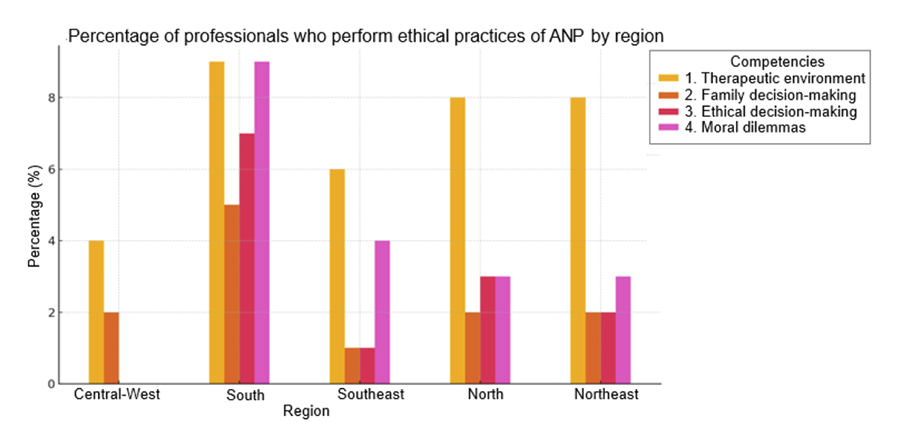
The analysis of the data reveals a low frequency in the performance of ethical competencies attributed to ANP by the professionals interviewed in the five regions of Brazil. With regard to the creation of a therapeutic environment that allows patients to freely discuss health issues, only 7.2% of professionals stated that they performed this practice, with emphasis on the South (9%), North, and Northeast (8%). As for providing conditions for families to participate in health decisions, the occurrence was even lower, totaling 2% of affirmative responses, with a predominance in the Northeast (2%) and occasional occurrence in the other regions. The adoption of ethical principles in decision-making was mentioned by 2.7% of participants, while the recognition of moral dilemmas and corresponding action was identified by 4.2%. These data indicate that, although ethical principles are present in nursing education and normative guidelines, their effective incorporation into daily PHC practice is still incipient, reflecting the need to strengthen ethical competencies as part of the consolidation of ANP. Figure 1 below shows the percentages of professionals who stated that they perform each of the four ethical sub-skills analyzed, distributed by region, demonstrating regional disparities and identifying where these practices are more or less present.
The graphical analysis reveals a low incorporation of ethical competencies associated with ANP in the performance of PHC nurses, with slight variations between regions of the country. Among the four sub-competencies analyzed, it is observed that the South region has the highest percentages in three of the four indicators, although still low, varying between 5% and 9%. In the other regions, the percentages remain equally low, with a worrying emphasis on the Southeast, whose sample was the largest (n=247), but obtained the lowest ethical performance rates, especially in the competency related to providing conditions for family decision-making (1%). Competencies related to ethical decision-making and the recognition of moral dilemmas show percentages close to or below 4% in all regions, signaling a significant gap in the integration between ethical-clinical reasoning and professional decision-making in the daily routine of PHC. The data indicate a distance between ethical and training references and their application in practice. The low occurrence of actions such as creating therapeutic environments and encouraging family autonomy highlights the need for specific training, reflective practice, and the valorization of ethical competencies, especially in complex contexts such as PHC. These findings reinforce the importance of more equitable and ethical training strategies, aligned with the strengthening of PHC throughout the national territory.
Discussion
The results presented show little application of ethical attitudes essential for the consolidation of ANP in the daily lives of nurses working in PHC, even in the face of consolidated normative and training guidelines in the field of professional ethics.
Although the Code of Ethics for Nursing Professionals reinforces principles such as autonomy, justice, and responsibility for care,(10) the low percentages of professionals who claim to create open therapeutic environments, promote family participation in decisions, and recognize ethical dilemmas demonstrate a gap between normative discourse and concrete practice. This finding reinforces Garrafa’s assertion that ethics in health must be understood as a situated practice, deeply influenced by the social context, institutional conditions, and unequal professional training.(25)
The data show an extremely low percentage of nurses who claim to offer conditions for families to participate in health decision-making, with variations between 1% and 5% in the regions analyzed. This finding is particularly concerning, considering that family-centered care is a fundamental guideline in PHC and contemporary ethical practices. According to Starfield, quality care in PHC requires the active involvement of families in decision-making processes, respecting their values and sociocultural contexts.(26)
The explicit adoption of ethical principles in clinical decision-making was reported by only 2.7% of the nurses interviewed, revealing a significant gap between ethical knowledge and its application in practice. According to Beauchamp and Childress, ethical decision-making in health care should consider the principles of autonomy, beneficence, non-maleficence, and justice as guiding references, especially in complex contexts such as PHC.
Only 4.2% of participants recognized ethical dilemmas and adopted appropriate behaviors, revealing the invisibility of these conflicts in daily PHC practice. As Garrafa points out, ethics must be interventionist, requiring positions to be taken on injustices and omissions that affect care.(25)Silence does not eliminate dilemmas, but it can reinforce automated and dehumanized practices. This is why ethics must be recognized as a professional competence, linked to conscious and responsible action in the face of the challenges of care.
The core competencies of an Advanced Practice Nurse (APN) include creating therapeutic environments, supporting decision-making by patients and families, integrating ethical principles into clinical decisions, and acting in the face of moral dilemmas.
It cannot be denied that ethical issues are not being addressed in lato sensu courses, even given their low applicability, but from the perspective of the future implementation of ANP in Brazil, there is a need to increase discussions on ethical issues in view of the responsibilities that they will assume as APN in PHC, as well as the future design for this training in Brazil.
These competencies are described in a structured and detailed manner in the glossary prepared by the Federal Nursing Council, which organizes the domains and skills essential to the performance of the APN in Primary Health Care.(12)
These same elements were considered indispensable or very relevant by up to 93.3% of the participants in the study conducted by Zug et al., especially among nurses with higher education.(28)
As Oliveira et al. point out, ANP represents not only a technical expansion of the nurse’s role, but also a qualitative transformation, guided by principles such as resolutiveness, autonomy, and ethical responsibility in care.
This study has limitations that should be considered. As it is a secondary analysis, there were restrictions on control over the original instruments and collection conditions, which may have limited the exploration of some competencies. In addition, the uneven distribution of the sample between states and municipalities may have influenced regional comparisons, especially in locations with fewer participants. Nevertheless, the findings provide relevant insights for critical reflection and reinforce the need to strengthen the ethical dimension in the training and daily practice of nursing in primary health care.
Conclusion
The data from this study confirm that the ethical domain, although widely recognized in the literature as central to ANP, still faces significant obstacles in its implementation in the daily practice of PHC nurses. The absence of these elements in the daily routine of PHC points to the challenge of aligning training, regulations, and professional practice with the requirements of advanced, safe, and subject-centered care. The study reveals that, despite the theoretical recognition of the importance of ethics, its practical manifestation remains limited, which reinforces the need for training policies that not only expand access to postgraduate courses but also integrate the ethical dimension into curricula in a cross-cutting and applied manner. The professional regulation of ANP is a decisive step towards the practice of ethics in ANP in PHC.
Acknowledgments
To the Federal Nursing Council (COFEN) for its institutional support of the qualitative secondary analysis of the database of the research study “Nursing practices in the context of Primary Health Care (PHC): a national study of mixed methods.” To the University of Brasília (UnB) for releasing the qualitative database, of which UnB and COFEN hold the intellectual property rights.
References
-
1 World Medical Association (WMA). Declaration of Helsinki: Recommendations guiding doctors in clinical research. Helsinki (FI): 18th World Medical Assembly; 1964 [cited 2025 Apr 22]. Available from: https://www.wma.net/wp-content/uploads/2016/11/DoH-Jun1964.pdf
» https://www.wma.net/wp-content/uploads/2016/11/DoH-Jun1964.pdf -
2 World Medical Association (WMA). Declaration of Helsinki: Recommendations guiding doctors in clinical research. Helsinki (FI): 75th World Medical Assembly; 2024. [cited 2025 Apr 22]. Available from: https://www.wma.net/policies-post/wma-declaration-of-helsinki
» https://www.wma.net/policies-post/wma-declaration-of-helsinki - 3 Jahr F. Bio-Ethics: Reviewing the ethical relations of humans towards animals and plants. Eur J Bioeth. 2015;1(2):227-31.
- 4 Bingham NE. Potter, Van Rensselaer. Bioética: uma ponte para o futuro. Englewood Cliffs: NJ Prentice-Hall; 1971. 196 p.
- 5 United States. National Commission for the Protection of Human Subjects of Biomedical and Behavioral Research. The Belmont Report: Ethical Principles and Guidelines for the Protection of Human Subjects of Research. Washington (DC): U.S. Government Printing Office; 1979 [cited 2025 Apr 21]. Available from:
- 6 Brasil. Ministério da Saúde. Conselho Nacional de Saúde. Resolução nº 466, de 12 de dezembro de 2012. Diretrizes e normas regulamentadoras de pesquisas envolvendo seres humanos. Brasília (DF): Ministério da Saúde; 2012. [citado 2025 Abr 21]. Disponível em:
- 7 Feitosa PF, Nascimento WF. A bioética de intervenção no contexto do pensamento latino-americano contemporâneo. Rev Bioét. 2015;23(2):277-84.
- 8 Brasil. Presidência da República. Lei nº 5.905, de 12 de julho de 1973: Dispõe sobre a criação dos Conselhos Federal e Regionais de Enfermagem e dá outras providências. Brasília (DF): Presidência da República; 1973 [citado 2025 Abr 21]. Disponível em:
- 9 Conselho Federal de Enfermagem (COFEN). Resolução COFEN nº 160/93: Aprova o Código de Ética dos Profissionais de Enfermagem. Brasília (DF): COFEN; 1993.
- 10 Conselho Federal de Enfermagem (COFEN). Resolução COFEN nº 564/2017: aprova o novo Código de Ética dos Profissionais de Enfermagem. Brasília (DF): COFEN; 2017 [citado 2025 Abr 21]. Disponível em:
- 11 Brasil. Ministério da Saúde. Política Nacional de Atenção. Brasília (DF): Ministério da Saúde; 2012 [citado 2025 Abr 21]. Disponível em:
- 12 Conselho Federal de Enfermagem (COFEN). Glossário: Competências Centrais da Enfermeira de Prática Avançada (EPA). Brasília (DF): COFEN; 2023 [citado 2025 Abr 21]. Disponível em:
- 13 American Nurses Association (ANA). Code of Ethics for Nurses with Interpretive Statements. 2nd ed. Silver Spring: ANA; 2015. 64 p.
- 14 Sousa MF. Práticas de enfermagem no contexto da Atenção Primária à Saúde (APS): estudo nacional de métodos mistos (Relatório final). Núcleo de Estudos em Saúde Pública, Centro de Estudos Avançados Multidisciplinares (CEAM), Universidade de Brasília (UnB), Conselho Federal de Enfermagem (COFEN). Brasília (DF): Editora ECoS; 2022.
- 15 Conselho Federal de Enfermagem (COFEN). Portaria Cofen nº 1075 de 10 de junho de 2024. Institui Grupo de Trabalho - GT para análise de dados da etapa qualitativa da pesquisa "Práticas de Enfermagem no contexto da Atenção Primária à Saúde (APS): estudo nacional de métodos mistos". Brasília (DF): COFEN; 2024.
- 16 Souza VR, Marziale MH, Silva GT, Nascimento PL. Translation and validation into Brazilian Portuguese and assessment of the COREQ checklist. Acta Paul Enferm. 2021;34:eAPE02631.
- 17 Instituto Brasileiro de Geografia e Estatística (IBGE). Brasil. Classificação e caracterização dos espaços rurais e urbanos do Brasil: uma primeira aproximação. Rio de Janeiro: IBGE; 2017 [citado 2025 Abr 21]. Disponível em:
- 18 International Council of Nurses (ICN). Guidelines on advanced practice nursing. Geneva: ICN; 2020. 44 p.
- 19 Minosso KC, Santos MB, Toso BR. Validation of the Brazilian version of the modified scale for delineating advanced practice nursing roles. Rev Bras Enferm. 2024;77(2):e20230211.
- 20 Dias FC, Baitelo TC, Toso BR, Sastre-Fullana P, Oliveira-Kumakura AR, Gasparino RC. Adaptation and validation of the Advanced Practice Nursing Competency Assessment Instrument. Rev Bras Enferm. 2022;75(5):e20210582.
- 21 Cassiani SH, Aguirre-Boza F, Hoyos MC, Barreto MF, Peña LM, Mackay MC, et al. Competencies for training advanced practice nurses in primary health care. Acta Paul Enferm. 2018;31(6):572-84.
- 22 Flick U. An introduction to qualitative research. 6th ed. Thousand Oaks, CA: SAGE Publications; 2018. 696 p.
- 23 Sorra JS, Nieva VF. Hospital survey on patient safety culture. Rockville, MD: Agency for Healthcare Research and Quality; 2004. 74 p.
- 24 Gil AC. Métodos e técnicas de pesquisa social. 6ª ed. São Paulo (SP): Atlas; 2008. 224 p.
- 25 Garrafa V, Porto D. Intervention bioethics: a proposal for peripheral countries in a context of power and injustice. Bioethics. 2003;17(5-6):399-416.
- 26 Starfield B. Primary Care: Balancing health needs, services, and technology. New York: Oxford Academic; 1998.
- 27 Beauchamp TL, Childress JF. Principles of biomedical ethics. 7th ed. New York: Oxford University Press; 2013. 480 p.
- 28 Zug KE, Cassiani SH, Pulcini J, Garcia AB, Aguirre-Boza F, Park J. Advanced practice nursing in Latin America and the Caribbean: regulation, education and practice. Rev Lat Am Enfermagem. 2016;24:e2807.
- 29 Oliveira JL, Toso BR, Matsuda LM. Advanced practices for care management: reflections on the Brazilian Nursing. Rev Bras Enferm. 2018;71(4):2060-5.
-
Data availability:
The authors did not make the data from this article available in repositories prior to submission.
Edited by
-
Guest associate editor:
Marcia Barbieri (https://orcid.org/0000-0002-4662-1983) Escola Paulista de Enfermagem, Universidade Federal de São Paulo, São Paulo, SP, Brazil
The authors did not make the data from this article available in repositories prior to submission.