 FIRST AID LEARNING NEEDS OF TEACHERS AND STAFF WORKING IN EARLY CHILDHOOD EDUCATION SETTINGS
ABSTRACT
Objective: to outline the first aid learning needs of teachers and staff working in early childhood education settings.
Method: this is a qualitative, descriptive study conducted at an early childhood education institution in the city of Niterói, Rio de Janeiro, Brazil. A total of 13 early childhood education professionals participated in the study. Data collection was conducted through semi-structured interviews. The software Interface de R pour les Analyses Multidimensionnelles de Textes et de Questionnaires was used for data processing, employing Descending Hierarchical Classification (DHC).
Results: among the four classes identified in this study, the key first aid experiences and needs to be addressed include falls, with a focus on fractures and head trauma, burns, wounds and cuts, seizures, choking, dental trauma, and cardiopulmonary arrest.
Conclusion: understanding these learning needs allows for the implementation of actions that are tailored to the actual demands of early childhood education professionals, ultimately enabling the school team to provide effective first aid in everyday school situations.
DESCRIPTORS:
First aid; Education in health; School teachers; Emergencies; Pediatric nursing
RESUMO
Objetivo: descrever as necessidades de aprendizagem de primeiros socorros de professores e funcionários da educação infantil.
Método: estudo qualitativo, descritivo, realizado em instituição de educação infantil localizada em Niterói, Rio de Janeiro, Brasil. Participaram 13 profissionais de educação infantil. Coleta de dados com entrevistas semiestruturadas. Foi utilizado o software Interface de R pour les Analyses Multidimensionnelles de Textes et de Questionnaires, como ferramenta para o processamento dos dados, por meio da Classificação Hierárquica Descendente”.
Resultados: entre as quatro classes encontradas, destacam-se as experiências de cuidado e necessidades de aprendizagem de primeiros socorros relacionadas a quedas com foco em fraturas e traumas na cabeça, queimaduras, ferimentos e cortes, convulsões, engasgos, traumas dentais, e paradas cardiorrespiratórias.
Conclusão: compreender as necessidades de aprendizagem permite a implementação de ações fundamentadas nas reais demandas do contexto dos profissionais de educação infantil e, assim, colaborar com a equipe escolar na prestação de primeiros socorros no cotidiano escolar.
DESCRITORES:
Primeiros socorros; Educação em saúde; Professores escolares; Emergências; Enfermagem pediátrica
RESUMEN
Objetivo: describir las necesidades de aprendizaje en primeros auxilios de profesores y personal de educación infantil.
Método: estudio cualitativo y descriptivo realizado en una institución de educación infantil situada en Niterói, Río de Janeiro (Brasil). Participaron trece profesionales de educación infantil. Los datos se recogieron mediante entrevistas semiestructuradas. Se utilizó el software Interface de R pour les Analyses Multidimensionnelles de Textes et de Questionnaires como herramienta para el procesamiento datos, mediante Clasificación Jerárquica Descendente.
Resultados: entre las cuatro clases encontradas, destacamos las experiencias asistenciales y las necesidades de aprendizaje en primeros auxilios relacionadas con las caídas, con especial atención a las fracturas y traumatismos craneoencefálicos, quemaduras, heridas y cortes, convulsiones, atragantamientos, traumatismos dentales y paradas cardiopulmonares.
Conclusión: comprender las necesidades de aprendizaje permite implementar acciones basadas en las demandas reales del contexto de los profesionales de educación infantil y así colaborar con el personal escolar en la prestación de primeros auxilios en la vida cotidiana escolar.
DESCRIPTORES:
Primeros auxilios; Educación para la salud; Maestros de escuela; Emergencias; Enfermería pediátrica
INTRODUCTION
Children are more prone to accidents due to their unique anatomical and developmental characteristics. One of the anatomical features that make children more likely to access dangerous areas, such as inserting their fingers into electrical outlets, is their small size. Additionally, the disproportionate size of their heads compared to the rest of their bodies shifts their center of gravity, increasing the risk of falls. On the other hand, their development is driven by curiosity, imagination, and a strong desire to explore their surroundings, which increases the risk of accidents1.
Accidents, also referred to as “unintentional injuries”, are unpredictable events2, and although it is impossible to know when they will occur, preventive measures must be adopted to minimize such incidents3. In 2022, Brazil recorded a total of 1,919 deaths among children aged one to nine years, resulting from external causes such as accidents and violence. The age group between 1 and 4 years had the highest rate in the Southeast region, while the age group between 5 and 9 years had the highest rate in the Northeast region. Boys are more commonly affected, possibly due to their higher engagement in more aggressive play and increased exposure to risk. Cultural factors may also contribute, as boys are typically less supervised than girls2.
The World Health Organization (WHO) and the United Nations Children's Fund (UNICEF) have prioritized this issue, working to implement policies and strategies aimed at minimizing these incidents due to their significant social and economic impacts4.
These accidents can happen in different environments, such as at home, on the streets, and at school-settings where children spend a large portion of their time. When accidents happen at school, teachers and staff are typically responsible for providing first aid. Therefore, it is essential that they have the necessary knowledge and skills to manage these situations effectively5.
Early childhood education, the initial stage of basic education, includes daycare centers and preschools. Its primary aim is to promote the physical, psychological, intellectual, and social development of children up to the age of five. In this process, the family and community collaborate with the school. Play is a key component of the curriculum framework, providing children with opportunities to explore cultural practices, gain knowledge, and foster their creativity and imagination6.
Despite frequently encountering emergencies, many teachers and staff are not adequately trained to provide the essential care needed on a daily basis. A systematic review conducted in Saudi Arabia revealed that while most teachers and staff lack sufficient knowledge, they still provide support to students and express a strong desire to learn more about first aid care7.
Another study examining teachers’ knowledge of dental trauma, a common accident in schools, revealed a significant lack of understanding on the subject, highlighting considerable gaps in their ability to handle such emergencies effectively. Many schools in Brazil lack healthcare professionals, often requiring the activation of emergency services. However, the response time of these services can be slow, highlighting the importance of administering immediate first aid until help arrives8.
First aid is defined as the immediate and appropriate assistance given to a person experiencing a health issue or injury, and it can be administered by non-professionals. The goal is to prevent further harm, disabilities, or even death, which requires the first responder to quickly assess the situation and take the necessary actions9-10.
In Brazil, teacher training programs do not include first aid training in their curricula, with the exception of physical education degree courses. Therefore, early childhood education teachers who wish to receive this type of training must seek it through extracurricular courses11.
However, Brazil’s Law No. 13.722/2018, known as the “Lucas Law”, mandates first aid training for teachers and staff in basic education, a requirement that came into effect in 201812. In this context, a study conducted in Belgium advocates for the inclusion of mandatory first aid courses in teacher training programs, stressing the importance of continuous knowledge updates and retention5.
When the school team is trained in first aid, the chances of recovery and prognosis for children improve significantly, resulting in better outcomes once specialized services are involved. Studies indicate that teachers are eager to learn about first aid and view this knowledge as crucial for effectively responding to emergency situations. However, it is crucial to identify the specific needs of this group and understand what they consider most important for their ongoing training5:13.
The concept of “learning needs” is firmly rooted in Paulo Freire’s theoretical framework, which highlights the importance of recognizing and integrating the learner’s existing knowledge in the educational process, ultimately fostering collective understanding. The horizontal relationship between educator and learner, grounded in respect and humility, fosters individual empowerment and encourages the development of critical thinking. Freire challenges the banking model of education, where knowledge is passively deposited into students, and emphasizes the importance of drawing on learners’ prior knowledge to foster genuine transformation14.
While legislation exists and teachers express interest in learning first aid for school settings, it is crucial to understand the specific learning needs of early childhood education professionals on this subject. Therefore, the guiding question of this study is: What are the first aid training needs of teachers and staff working in early childhood education settings?
Hence, the study aims to describe the first aid learning needs of teachers and staff working in early childhood education environments.
METHOD
This is a qualitative, descriptive, and exploratory study that followed the guidelines established by the COnsolidated criteria for REporting Qualitative research (COREQ)15. It was conducted at an early childhood education institution located in the city of Niterói, state of Rio de Janeiro, Brazil, serving 57 children aged between 2 and 5 years, 11 months, and 29 days, in a full-time education model, from 8:00 AM to 3:30 PM.
The institution offers a wide range of educational activities, including capoeira, music, physical education, library services, and arts. It also offers educational, research, and outreach programs in various fields, including pedagogy, nursing, nutrition, and more.
At the outset of the research in 2021, the school had a total of 33 professionals on staff, including educators, student mediators, capoeira, arts, and music teachers, administrative assistants, a nurse, a doorman, a janitor, a nutritionist, a librarian, an educational agent, a social worker, and a psychologist.
The study included both permanent and temporary staff members working in early childhood education at the institution under investigation. Professionals on leave or vacation during the data collection period were excluded from the study.
Out of a total of 33 professionals, 16 were invited to participate, as they met the inclusion criteria and were available during the data collection period, which occurred between August and September 2021.
Each participant was sent an invitation letter via email from the first author, a nurse at the institution. The letter outlined the study's topic and objectives and included an Informed Consent Form (Portuguese Acronym: TCLE) for review. The participants were given a 15-day period to respond, and 13 confirmed their participation by replying to the email. The interviews were scheduled according to the availability of each participant.
The interviews were conducted online, individually, and only once, with each participant, using the Google Meet® platform, in compliance with the social distancing measures required by the Covid-19 pandemic. All interviews were recorded with the participants’ prior consent and conducted by the first author, following a semi-structured script. The closed-ended questions aimed to characterize the participants (age, gender, marital status, ethnicity, level of schooling, profession, years of experience at the school, previous experience with first aid courses, and further details about those courses). The open-ended questions were directly aligned with the study’s objective and included topics such as incidents observed at the school, knowledge of first aid, actions taken during emergencies, and areas or content they wished to explore further.
The script was reviewed in advance by the research team, consisting of the first author and two doctors specializing in child health. Adjustments were made to ensure that the script effectively aligned with the study’s objectives.
The interviews were conducted individually with each participant. Initially, the researcher provided an overview of the study’s objectives and made herself available to clarify any questions regarding the interview or the research. Each interview lasted a mean of 42 minutes and was fully transcribed for later analysis using the IRAMUTEQ software, version 0.7, alpha2 2020, and the R software, version 4.1.1. This open-source software allows for the quantitative analysis of qualitative data, ensuring a more rigorous and detailed analysis16.
Data analysis followed three stages. The first stage involved preparing the textual corpus. The second stage involved processing the corpus using the IRAMUTEQ software, applying Descending Hierarchical Classification (DHC) to categorize text segments (TSs) according to their lexical content16. During the analysis, active forms (adjectives, adverbs, nouns, verbs, and unrecognized forms) and text segments with statistical significance (p-value≥3.84 and p-value<0.05 in the chi-square test) were considered to ensure data processing rigor16. DHC processing required a threshold above 75%, which was exceeded, reaching 86.7% in this study17. The third stage involved analyzing and interpreting the data through the lens of Paulo Freire’s theoretical framework14.
Thus, data collection was concluded based on the combination of two key factors: the theoretical saturation of the data and the analysis of the textual corpus using the IRAMUTEQ software reached 86.7% in this study, surpassing the recommended threshold of 75%18-20. Additionally, the number of participants provided comprehensive coverage, with key information being repeated, making further data collection unnecessary and leading to theoretical saturation18-20.
The study was approved by the Research Ethics Committee in accordance with Resolutions No. 466/2012 and No. 510/2016 of the National Health Council. Data collection began only after obtaining the participants’ consent via the Informed Consent Form (TCLE). Participants were assigned the letter “P” (for participant) to maintain confidentiality and anonymity, followed by an Arabic numeral to indicate the order in which they participated.
RESULTS
A total of 13 professionals from the early childhood education team participated in the study, including 11 women (84.6%) and 2 men (15.4%). The mean age was 33, ranging from 24 to 58 years, indicating a group predominantly made up of young adults. Regarding ethnicity, nine participants identified as white (69.2%) and four as brown (30.8%). The largest group of participants was composed of teachers, with seven participants (53.8%), followed by student mediators, who represented four participants (30.8%). The remaining participants included one librarian (7.7%) and one nutritionist (7.7%).
Regarding marital status, nine participants were single (69.2%) and four were married (30.8%). In terms of education, participants demonstrated a high level of schooling: three (23.1%) had incomplete higher education, four (30.8%) had completed higher education and held a specialization degree, and one (7.7%) held both a doctorate and a post-doctorate degree. The participants had a mean of four years of experience at the institution, with a range spanning from five months to seven years.
Five participants (38.5%) indicated that they had completed a first aid course. Among them, three participants (23.1%) reported having taken the course at a driving school, noting that it was basic and primarily focused on traffic accident-related topics. Only one participant (7.7%) mentioned having completed a comprehensive first aid course as part of their training to become a combat sports teacher. Another participant (7.7%) had completed a drowning prevention course through a fire department program at the age of 14, describing it as a one-time experience.
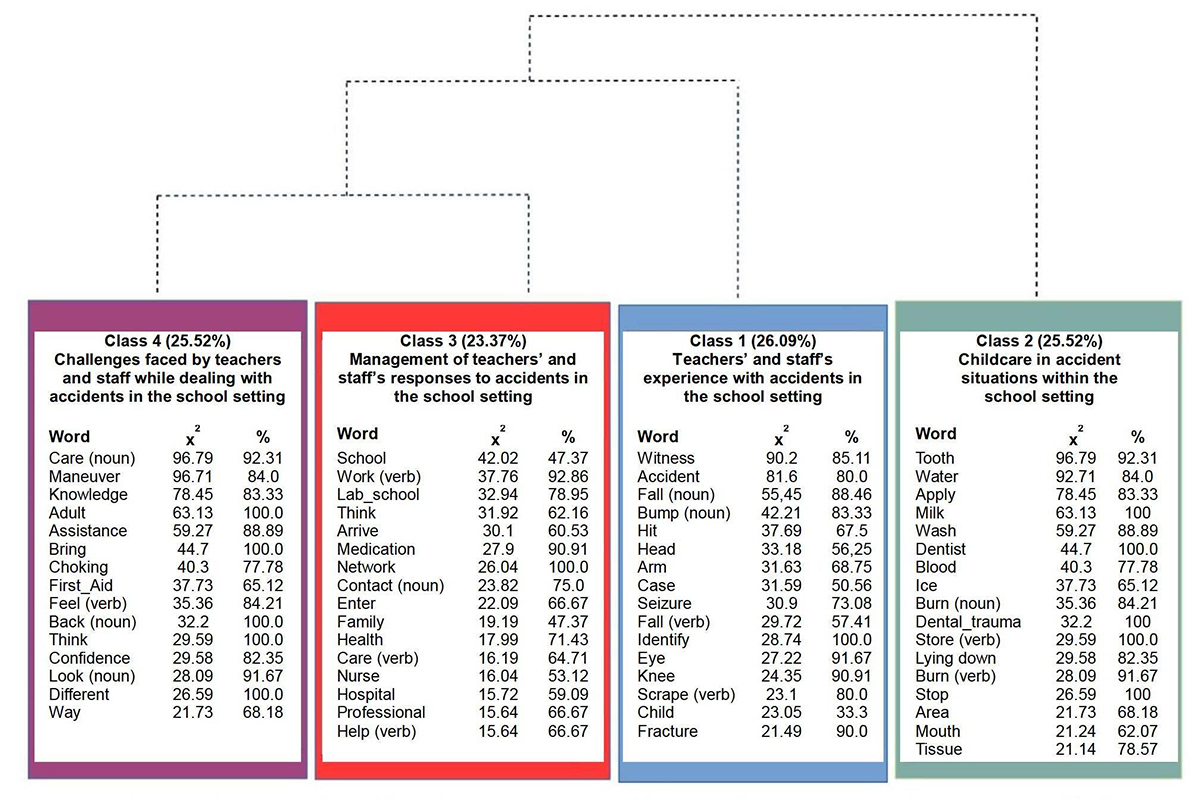
Data processing in the IRAMUTEQ software took 1 minute and 19 seconds, resulting in 13 texts, 826 text segments (TSs), 2,835 forms, 2,9383 occurrences, 1,724 lemmas, 1,511 active forms, 203 supplementary forms (hapax), and a mean of 35.6 forms per segment, grouped into four classes. The dendrogram (Figure 1) was split into two sections of the textual corpus, represented by classes 2 (green) and 1 (red). A further subdivision led to the creation of classes 3 (blue) and 4 (purple), achieving a processing yield of 86.7% and resulting in 713 text segments (TSs).

Dendrogram of the Descending Hierarchical Classification (DHC) of text segments related to the first aid learning needs of teachers and staff in early childhood education settings. Niterói, RJ, Brazil, 2024.
Classes 1, 3, and 4 were semantically interconnected, while class 2 exhibited a clear semantic distinction. In the dendrogram (Figure 1), the most significant words were presented in descending order, and their context was analyzed by extracting the corresponding text segments. The data were then analyzed through the lens of the study’s theoretical framework to understand the meanings participants attributed to their life experiences and actions.
A thorough analysis of the text segments within each class revealed the specific first aid learning needs of teachers and staff. Thus, the classes were named according to their semantic content as follows: Teachers’ and staff’s experience with accidents in the school setting; Childcare in accident situations within the school setting; Management of teachers’ and staff’s responses to accidents in the school setting; Challenges faced by teachers and staff while dealing with accidents in the school setting.
Class 1: Teachers’ and staff’s experience with accidents in the school setting
The team’s reports highlighted everyday experiences in early childhood education, featuring common accidents typical of this age group, such as falls, bites, seizures, minor cuts, and abrasions. In this class, the most frequent words were “witness”, “accident”, “fall” (noun), “bump” (noun), “severe”, “hit”, “head”, “seizure”, “child”, “identify”, “eye”, “knee”, and “scrape” (verb).
[..] falls are pretty common as well as bites, but I have also witnessed too many falls. I've witnessed many situations where children were running on the grass and fell (P1). […] scraping themselves when they fall is also quite common (P2).
The professionals focused on distinguishing between minor and severe accidents by observing the signs and symptoms in the children, identifying cases that necessitated hospitalization. These situations were recognized as frequent occurrences both within the school environment and in this age group.
[…] I remember witnessing an accident at school when a child jumped off the playhouse in the playground and fractured their arm, requiring surgery afterward. The other was when a child had a seizure. Aside from those two incidents, I haven't witnessed any severe accidents, just minor cuts and small injuries here and there, but nothing major. Minor injuries are quite common in early childhood education settings; they occur frequently (P3).
[…] the child quickly developed a large bump on their head (head trauma), which looked quite bad. I was really startled at first, as it swelled rapidly and became massive (P4).
Class 2: Childcare in accident situations within the school setting
This class emphasizes the type of care that professionals identify as essential when responding to accidents. The most frequently mentioned words included “tooth”, “water”, “apply”, “milk”, “wash”, “dentist”, “blood”, “ice”, “burn” (noun), “dental trauma”, “store” (verb), “lying down”, and “burn” (verb).
[…] in cases of dental trauma, professionals provide care that involves performing hygiene, applying ice, and preserving teeth. […] in a dental trauma situation, the tooth should be stored in milk, and ice should be applied to the child’s mouth until professional assistance is available (P2).
[…] in the case of dental trauma, ice should be applied to the child’s mouth to help reduce bleeding. The tooth should be gently wrapped in a clean tissue to dry it and then placed in a bag for preservation (P4).
In cases of burns, professionals adopt different approaches. Some would choose to cool the affected area with cold water, while others would prefer to refer the child to the school nurse for proper care. This divergence reflects the varying levels of knowledge among professionals and is influenced by updates in research and practices related to burn treatment, as noted by one of the participants.
[…] in the case of a burn, I believe the child should be taken directly to the nurse. I think it’s complicated because studies keep changing. Sometimes they say we must apply water, other times they say we shouldn’t (P5). […] my first instinct is always to clean the area, even to try to ease the pain a bit, because cold water can provide relief. However, depending on the situation, I don’t know what to do next (P3).
During a seizure, the school team ensures the child’s head is properly supported and protected, while also removing any nearby objects that could pose a danger. However, opinions diverge on whether something should be placed in the child’s mouth during the episode.
[…] the head must be supported - you shouldn't put your hand in the person’s mouth because they could bite it. I know the head must be supported to prevent injuries, but I'm not sure if anything else should be done (P2). […] during a seizure, I would place something in the person’s mouth to prevent them from biting their tongue and remove any nearby objects (P3).
Teachers and staff also express concern for their own safety when handling bodily fluids, recognizing the importance of taking necessary precautions in these situations.
[…] I also believe that an important precaution we should take is to thoroughly sanitize our own hands (P6). […] whenever I noticed that the area was bleeding from a scrape, I would wash my hands and clean the area thoroughly with plenty of water and soap (P4).
[…] you can’t tell just by looking who is HIV positive and who isn’t. When helping a child, you must wear gloves. You should be cautious when a child is coughing on you. When children need help using the bathroom due to diarrhea or vomiting, you should assist them and change their clothes if needed. Additionally, it’s important to clean them up when they have a runny nose, as they may not always be able to clean themselves properly (P7).
Class 3: Management of teachers’ and staff’s responses to accidents in the school setting
When it comes to managing accidents in the school environment, several aspects must be considered, from contacting the family and administering medication to transporting the child to the hospital in a personal vehicle. The most prominent words identified were “school”, “work” (verb), “lab school”, “think”, “arrive”, “medication”, “network”, “contact” (noun), “enter”, “family”, “health”, “care” (verb), “nurse”, “hospital”, “professional”, and “help (verb)”.
[…] what we did was call an ambulance since the parents were far away. In these situations, we are not permitted to transport the child in our personal vehicle. However, out of desperation, we tried both (P3). […] at the school, we were not allowed to administer medication. We would contact the family to inform them, but there were also instances where the family couldn't arrive in time and gave us permission to administer the medication. With the family’s consent, we would do it (P8).
[…] the teacher, at the end of her shift, helped a child and took them to the hospital. Guess what the family did? They rushed to the police station, accusing the teacher of breaking their son’s leg, and the teacher was subsequently faced with charges of bodily harm (P9).
The team notes that the level of assistance required for a child can vary based on the context, such as whether the school has health insurance or employs a healthcare professional. In this way, diverse backgrounds emphasize the crucial importance of first aid knowledge.
[…] since the school had insurance, when the boy fell and injured his arm, the school staff made contact [with the hospital] and took him. The kid’s parents were at work and far away, so the staff made the arrangements using the school’s insurance (P8).
[…] in the municipal network, when a child fell, we would provide assistance, and there was a health clinic right across from the school that supplied the necessary materials (P9).
Class 4: Challenges faced by teachers and staff while dealing with accidents in the school setting
In class 4, professionals viewed accidents with a certain level of concern, given the need to take certain actions. The most frequently mentioned words were “care” (noun), “maneuver”, “knowledge”, “choke”, “adult”, “assistance”, “bring”, “choking”, “feel” (verb), “back” (noun), “think”, “confidence”, and “look” (noun).
Choking was identified as an accident that demands prompt care. It requires maneuvers that may be unfamiliar to the team, along with considerations of the child’s unique characteristics, such as body size and the precise amount of pressure needed during the procedure. This creates uncertainty among the professionals. The team stresses that the management of such accidents requires specialized care, which must be executed with precision due to the immediate risk of death.
[…] I know there is a maneuver to help a choking child, I know this procedure exists, but I don’t know how to perform it. So, I won’t even attempt it because I might hurt the child or make the situation worse if I perform it incorrectly (P4). […] the choking situation is the most stressful for me. I know there’s a technique of applying pressure to the abdomen from behind, but I wouldn't know how to perform it (P10).
[…] I don’t feel confident performing the maneuver, especially on a child; I don’t know if I would apply the right amount of pressure (P2).
The team understands the need to provide the child with care that involves listening, offering comfort, and emotional support.
[…] I try to make them understand and provide comfort, if necessary, by holding the child and calming them down. First, it’s important to remain calm and confident in the situation, as this will help everything fall into place. I believe that the term “first aid” implies an initial response, a first assessment, and a first form of support. So, I think that's what I have to offer-humanized care as part of the initial assistance (P5).
[…] It's a young child from a human perspective. I don’t know, we simply have this instinct to help, to pick them up and hold them in our arms (P7).
Knowing first aid techniques is considered an essential part of the professionals’ role and is crucial for promoting and preventing children's health.
[…] we must take precautions and learn everything we can so that, in such moments, we can provide the necessary support. In moments like this, having knowledge is very important (P5).
[…] very often, [children] put their lives at risk precisely because they are unaware of the dangers. They depend on us and our knowledge to stay safe and well (P2).
The team expressed a wide range of emotions when providing first aid to a child, including insecurity, uncertainty, and a strong sense of legal and ethical responsibility.
[…] the other teacher became very nervous about the situation because no one wants something like this to happen (P5). […] in stressful situations, I usually stay calm, and once it's over, I find myself crying (P7).
[…] we can't help but blame ourselves, even when we know we’re not at fault… those whose work involves caring for others should have this kind of knowledge (P4).
DISCUSSION
The first aid learning needs of teachers and staff in early childhood education are shaped by their past experiences and the situations that may arise within the school environment21.
This is due to the perception that certain accidents, such as falls, are common within this population group, representing a huge portion of incidents, especially among children aged 0 to 5 years22. It also reflects the understanding that having the appropriate knowledge is essential for preserving children’s lives.
The findings revealed a range of aspects, from identifying and managing emergency situations to delivering care that is not only effective but also empathetic and safe, prioritizing the well-being and protection of children in school settings23.
It is important to highlight that many of these professionals-most of whom are women-lack specific training in first aid. This highlights a troubling gap in their preparation to manage such situations, a concern that is also backed by scientific literature1.
The research findings highlighted specific types of accidents frequently encountered by these professionals, including falls, fractures, head trauma, burns, wounds and cuts, seizures, choking, dental trauma, and cardiopulmonary arrest. These findings underscore the critical need for comprehensive first aid training to effectively manage the range of situations21:23 that may arise in the educational setting.
Choking on a foreign object can result in cardiopulmonary arrest, demanding a rapid and effective response. However, many professionals report feeling unprepared to handle such situations. In this context, accurately recognizing the signs and symptoms of airway obstruction and determining the appropriate care are vital to ensuring children’s safety24.
Another study, however, found that teachers demonstrated solid knowledge of the signs and symptoms of foreign body airway obstruction (FBAO), a crucial skill for promptly recognizing and responding to such emergencies24.
The severity of FBAO should not be underestimated, as it is one of the leading causes of mortality and morbidity. Additionally, it can result in cardiopulmonary arrest if not treated promptly. Therefore, quickly identifying and responding to this type of emergency is essential24.
The treatment approach for FBAO differs based on the child’s age. For infants under 1 year old, it is recommended to administer chest compressions and back blows between the shoulder blades. If the child is unresponsive and has no pulse, this indicates cardiopulmonary arrest25.
This variation in approaches underscores the importance of possessing specialized knowledge to effectively manage emergency situations involving children of different age groups, emphasizing the need for targeted learning21:23-25.
For older children, the approach to managing foreign body airway obstruction involves performing abdominal compressions, commonly known as the Heimlich maneuver. This technique involves recognizing the signs and symptoms in the child, starting by prompting them to cough. As the situation escalates, abdominal compressions should be performed, and the right amount of pressure must be applied to dislodge the object blocking the airway24.
The team expresses concern about the above-mentioned issue, recognizing the critical need for accurate knowledge to effectively manage the situation. Failing to provide this care could result in harm to the child24-25. Therefore, the importance of first aid training is emphasized21;23 to ensure an effective response in these emergencies.
This concern is supported by previous studies that have shown teachers understand the need to administer first aid. However, they emphasized that without prior first aid knowledge, they are unable to provide adequate assistance21,24.
A prompt response is crucial in such emergencies, as the optimal time frame for removing foreign objects is four minutes or less to avoid severe consequences, including a vegetative state or even death26. However, it is important to note that the time for help to arrive often exceeds this limit, creating a significant delay between the call for assistance and its arrival at the scene23.
Another concern for the team is cardiopulmonary arrest, a high-risk condition that frequently occurs outside the hospital, resulting in elevated morbidity and mortality rates. Cardiopulmonary resuscitation (CPR) plays a crucial role in patient survival; however, the number of people who receive CPR in out-of-hospital settings remains relatively low. Compressions must be administered with the correct depth and minimal interruptions to maximize the child’s chances of survival27.
When analyzing the various first aid topics, it becomes evident that there is a significant gap in these professionals’ knowledge-while some demonstrate proficiency in certain practices, others exhibit considerable deficiencies in specific areas.
In the context of dental trauma, for example, essential care includes cleaning the dental fragment and storing it in an appropriate medium, such as milk or water, to preserve the viability of the cells. Additionally, it is essential to wash the child’s mouth and ensure they are referred for a dental evaluation. It is worth highlighting that storing teeth in bags does not create the proper conditions for a successful reimplantation28.
These findings underscore the importance of comprehensive first aid training that addresses a wide variety of situations relevant to the context analyzed. However, a lack of confidence in performing these procedures is often rooted in insufficient knowledge. Therefore, it is essential to foster collective knowledge building by identifying the team’s knowledge gaps and addressing their concerns22.
This understanding could only be achieved by actively listening to the participants, giving them the opportunity to share the experiences and needs that shape their daily lives. According to Paulo Freire, transformative education is built when both the learner and the educator actively participate in this process14.
The challenge of administering first aid with limited resources stands out as a critical issue, particularly in Brazilian school settings where material availability is often scarce.
In this context, it is crucial to emphasize strategies that optimize the use of limited resources, such as basic practices like performing hand hygiene with soap and water when handling bodily fluids or using bags as improvised biosafety measures29.
Raising awareness about these practices is crucial, as it ensures that first responders are protected while providing necessary care29. However, it is concerning to note that some professionals still neglect these precautions, choosing not to use personal protective equipment. This exposes them directly to bodily fluids, putting their own safety at risk30.
The stress experienced by the team in managing these situations within the school setting is heightened by the need to communicate with the children’s families and caregivers. In some cases, these individuals may not fully comprehend the situation and may unfairly blame the professionals, even though accidents can happen in any environment31.
The tendency of parents to hold teachers and staff accountable highlights the need for a broader educational process that also engages parents in understanding the risks and challenges present in the school environment31. This educational approach is essential for cultivating a culture of safety and collaboration among everyone involved, united by the common goal of protecting and caring for the children.
The study has certain limitations that should be considered when interpreting the results, as conditions and resources can vary significantly between schools. This restricts the ability to apply the findings to a wide range of educational contexts.
Additionally, the study was conducted during the Covid-19 pandemic. As a result, some professionals may have been absent from the team or temporarily reassigned, which limited the understanding of their specific learning needs.
However, despite these limitations, the study offers valuable insights for nursing practice. It emphasizes the urgent need for first aid training for early childhood education professionals. This training should cover a wide range of emergency situations that could occur in the school environment.
This highlights the need for targeted training programs23 that focus on practical skills and realistic scenarios, ensuring professionals are well-prepared to effectively manage emergency situations.
CONCLUSION
A wide range of first aid learning needs was identified. The key topics identified in the study included falls, with an emphasis on fractures and head trauma; burns; wounds and cuts; seizures; choking; dental trauma; and cardiopulmonary arrest. Additionally, guidance on biosafety and the use of minimal resources during care was highlighted.
Understanding these needs allows for the creation of more targeted educational strategies, improving the team’s ability to respond effectively and ensuring greater safety when managing incidents in the school setting.
Therefore, this study could serve as a basis for planning initiatives aimed at enhancing the initial first aid response for children in schools, particularly by teachers and staff in early childhood education. After all, by understanding the specific needs of the context under study, it becomes possible to develop educational strategies that are tailored to the participants’ unique needs. This, in turn, can play a crucial role in fostering a safer and more secure environment for children in early childhood education.
ACKNOWLEDGMENT
I would like to thank the research participants who generously gave their time, such a valuable resource, to conduct this study.
REFERENCES
-
1.Ilha AG, Cogo SB, Ramos TK, Andolhe R, Badke MR, Colussi G. Ações educacionais sobre primeiros socorros para professores de educação infantil: um estudo quase experimental. Rev Esc Enferm USP [Internet]. 2021 [cited 2023 Mar 18];55:e20210025Available from: https://doi.org/10.1590/1980-220X-REEUSP-2021-0025
» https://doi.org/10.1590/1980-220X-REEUSP-2021-0025 -
2. Brasil. Ministério da Saúde. Sistema de informações sobre mortalidade [Internet]. 2024 [cited 2024 Jun 18].Available from: https://tabnet.datasus.gov.br/cgi/tabcgi.exe?sim/cnv/ext10uf.def
» https://tabnet.datasus.gov.br/cgi/tabcgi.exe?sim/cnv/ext10uf.def -
3. Mujkić A, Zebec JS. The accident prevention. Glob Pediatr [Internet]. 2024 [cited 2024 Mar 18];9:100191.Available from: https://doi.org/10.1016/j.gpeds.2024.100191
» https://doi.org/10.1016/j.gpeds.2024.100191 -
4. Sleet DA. The global challenge of child injury prevention. Int J Environ Res Public Health [Internet]. 2018 [cited 2023 Mar 18];15(9):1921.Available from: https://doi.org/10.3390/ijerph150919214
» https://doi.org/10.3390/ijerph150919214 -
5. Vermonden M, Dehaerne L, Toelen J, De Coninck D. Teacher preparedness for medical emergencies in belgian classrooms: Studying objective and subjective first-aid knowledge. Children (Basel) [Internet]. 2023 [cited 2024 Apr 10];10(4):669.Available from: https://doi.org/10.3390/children10040669
» https://doi.org/10.3390/children10040669 -
6. FMCSV - Fundação Maria Cecilia Souto Vidigal. LEPES - USP Laboratório de Estudos e Pesquisas em Economia Social. Avaliação da qualidade da educação infantil [Internet]. 2022 [cited 2022 Oct 18].Available from: https://biblioteca.fmcsv.org.br/biblioteca/estudo-nacional-qualidade-educacao-infantil/
» https://biblioteca.fmcsv.org.br/biblioteca/estudo-nacional-qualidade-educacao-infantil/ -
7. Alsulami M. First-aid knowledge and attitudes of schoolteachers in Saudi Arabia: A systematic review. Risk Manag Healthc Policy [Internet]. 2023 [cited 2023 Nov 10];16:769-77.Available from: https://doi.org/10.2147/RMHP.S395534
» https://doi.org/10.2147/RMHP.S395534 -
8. Trabelsi K, Shephard RJ, Zlitni S, Boukhris O, Ammar A, Khacharem A, et al. Dental Trauma first-aid knowledge and attitudes of physical education teachers: A systematic review and meta-analysis of the literature with meta-regressions. Educ Sci [Internet]. 2019 [cited 2023 Nov 10];9(4):251.Available from: https://doi.org/10.3390/educsci9040251
» https://doi.org/10.3390/educsci9040251 -
9. Zideman DA, Singletary EM, Borra V, Cassan P, Cimpoesu CD, De Buck E, et al. European Resuscitation Council guidelines 2021: First aid introduction and scope. Resusc [Internet]. 2021 [cited 2023 Nov 10];161:270-90.Available from: https://doi.org/10.1016/j.resuscitation.2021.02.013
» https://doi.org/10.1016/j.resuscitation.2021.02.013 -
10. Hosapatna M, Bhat N, Belle J, Priyadarshini S, Ankolekar VH. Knowledge and training of primary school teachers in first Aid - A questionnaire based study. Kurume Med J [Internet]. 2021 [cited 2023 Nov 10];66:101-6.Available from: https://doi.org/10.2739/kurumemedj.MS662001
» https://doi.org/10.2739/kurumemedj.MS662001 -
11. Brasil. Ministério da Educação. Resolução n. 2, de 1º de julho de 2015. Define as Diretrizes Curriculares Nacionais para a formação inicial em nível superior (cursos de licenciatura, cursos de formação pedagógica para graduados e cursos de segunda licenciatura) e para a formação continuada [Internet]. 2015 [cited 2024 Apr 20].Available from: https://portal.mec.gov.br/docman/agosto-2017- pdf/70431-res-cne-cp-002-03072015-pdf/file
» https://portal.mec.gov.br/docman/agosto-2017- pdf/70431-res-cne-cp-002-03072015-pdf/file -
12. Brasil. Lei nº 13.722, de 4 de outubro de 2018. Torna obrigatória a capacitação em noções básicas de primeiros socorros de professores e funcionários de estabelecimentos de ensino públicos e privados de educação básica e de estabelecimentos de recreação infantil [Internet]. 2018 [cited 2022 Jun 02].Available from: https://pesquisa.in.gov.br/imprensa/jsp/visualiza/index.jsp?data=05/10/2018&jornal=515&pagina=2&totalArquivos=171
» https://pesquisa.in.gov.br/imprensa/jsp/visualiza/index.jsp?data=05/10/2018&jornal=515&pagina=2&totalArquivos=171 -
13. Dantas RAN, Dantas DV, Silva IRN, Araújo NM, Laurentino AMA, Nunes HMA, et al. Approach to first aid in school: Children, teenagers and teachers learning to save lives. Enferm Brasil[Internet]. 2018 [cited 2022 Jun 02];17(3):259-65.Available from: https://doi.org/10.33233/eb.v17i3.1186
» https://doi.org/10.33233/eb.v17i3.1186 - 14. Freire P. Pedagogia do oprimido. 65th ed. Rio de Janeiro: Paz e Terra; 2018.
-
15. Souza VR, Marziale MH, Silva GT, Nascimento PL. Tradução e validação para a língua portuguesa e avaliação do guia COREQ. Acta Paul Enferm [Internet]. 2021 [cited 2022 Jun 02];34:eAPE02631.Available from: https://doi.org/10.37689/actaape/2021AO02631
» https://doi.org/10.37689/actaape/2021AO02631 -
16. Soares SSS, Souza NVDO, Carvalho EC, Queiroz ABA, Costa CCP, Souto JSS. COVID19 pandemic and nursing week: Analysis from software Iramuteq. Rev Bras Enferm [Internet]. 2022 [cited 2023 Oct 10];75 Supp1:e20200690.Available from: https://doi.org/10.1590/0034-7167-2020-069 0
» https://doi.org/10.1590/0034-7167-2020-069 -
17. Do Rosario Lima VM, Amaral-Rosa MP, Ramos MG. Software-supported Discursive Textual Analysis: IRaMuTeQ and subcorpus analysis. New Trends Qual Res [Internet]. 2021 [cited 2022 Jun 02];7:1-9.Available from: https://doi.org/10.36367/ntqr.7.2021.1-9
» https://doi.org/10.36367/ntqr.7.2021.1-9 -
18. Góes FGB, Santos AST, Campos BL, Silva ACSS, Silva LF, França LCM. Utilização do software IRAMUTEQ em pesquisa de abordagem qualitativa: relato de experiência. Rev Enferm UFSM [Internet]. 2021 [cited 2022 Jun 02];11:e63.Available from: https://doi.org/10.5902/217976926442
» https://doi.org/10.5902/217976926442 -
19. Acauan LV, Abrantes CV, Stipp MAC, Trotte LAC, Paes GO, Queiroz ABA. Utilização do software iramuteq® para análise de dados qualitativos na enfermagem: um ensaio reflexivo. Rev Min Enferm [Internet]. 2020 [cited 2022 Oct 05];24.Available from: https://doi.org/10.5935/1415-2762.20200063
» https://doi.org/10.5935/1415-2762.20200063 - 20. Minayo MCS. O desafio do conhecimento: pesquisa qualitativa em saúde. 14th ed. São Paulo: Hucitec; Rio de Janeiro: Abrasco; 2014.
-
21. Alruwaili A, Al Sulaiteen H, Alanazy A, Almousa Z, Alshaqaqiq M, Alhofufi A, et al. Awareness of school teachers about students common emergencies during school time in the eastern region, Saudi Arabia: A cross-sectional study. J Fam Med Prim Care [Internet]. 2024 [cited 2024 Oct 10];13(8):3059-66.Available from: https://doi.org/10.4103/jfmpc.jfmpc_1954_23
» https://doi.org/10.4103/jfmpc.jfmpc_1954_23 -
22. Gonçalves AC, Araújo MPB, Paiva KV, Menezes CSA, Silva AEMC, Santana GO, et al. Acidentes na infância: casuística de um serviço terciário em uma cidade de médio porte do Brasil. Rev Col Bras Cir [Internet]. 2019 [cited 2022 Jun 02];46(2):e2104.Available from: https://doi.org/10.1590/0100-6991e-20192104
» https://doi.org/10.1590/0100-6991e-20192104 -
23. Tamur S, Alasmari RM, Alnemari MA, Altowairgi MA, Altowairqi AH, Alshamrani NM, et al. Knowledge and attitudes around first aid and basic life support of kindergarten and elementary school teachers and parents in Taif City, Saudi Arabia. Children (Basel) [Internet]. 2023 [cited 2024 Oct 10];10:1266.Available from: https://doi.org/10.10.3390/children10071266
» https://doi.org/10.10.3390/children10071266 -
24. Alenezi MM, Bohulaigah ZH, Aldajani NF, Alotaibi LG, Alshammari MF. Assessment of knowledge, attitude, and practice of first aid management of choking among primary school teachers in riyadh, Saudi Arabia: A cross-sectional study. Cureus [Internet]. 2024 [cited 2022 Jun 02];16(1):e51519.Available from: https://doi.org/10.7759/cureus.51519
» https://doi.org/10.7759/cureus.51519 -
25. Lorenzoni G, Lanera C, Azzolina D, Baldas S, Messi G, Gregori D. Assessing school-based intervention strategies to foster the prevention of choking injuries in children: The results of the CHOP (CHOking Prevention) trial. Health Soc Care Community [Internet]. 2021 [cited 2022 Jun 02];29:1858-67. Available from:Available from:https://doi.org/10.1111/hsc.13298
» https://doi.org/10.1111/hsc.13298 -
26. Igarashi Y, Norii T, Sung-Ho K, Nagata S, Yoshino Y, Hamaguchi T, et al. Airway obstruction time and outcomes in patients with foreign body airway obstruction: Multicenter observational choking investigation. Acute Med Surg [Internet]. 2022 [cited 2022 Jun 02];9(1):e741.Available from: https://doi.org/10.1002/ams2.741
» https://doi.org/10.1002/ams2.741 -
27. American Heart Association CPR e First Aid. CPR e ECC Guidelines [Internet]. 2020 [acesso 2022 Jun 02].Available from: https://cpr.heart.org/en/resuscitation-science/cpr-and-ecc-guidelines
» https://cpr.heart.org/en/resuscitation-science/cpr-and-ecc-guidelines -
28. de Medeiros CSP, Zanin L, Sperandio M, de Souza Fonseca Silva A, Flório FM. Validation of an educational comic book to guide conducts in situations of dental trauma. Dent Traumatol [Internet]. 2024 [cited 2022 Jun 02];40(2):161-70.Available from: https://doi.org/10.1111/edt.12901
» https://doi.org/10.1111/edt.12901 -
29. Toney-Butler TJ, Gasner A, Carver N. Hand Hygiene. In: StatPearls [Internet]. Treasure Island, FL(US): StatPearls Publishing; 2023 [cited 2024 Feb 17].Available from: https://www.ncbi.nlm.nih.gov/books/NBK470254/
» https://www.ncbi.nlm.nih.gov/books/NBK470254/ -
30. Souza MF, Divino AB, Souza DAS, Cunha SGS, Almeida CS. Conhecimento dos educadores dos centros municipais de educação infantil sobre primeiros socorros. Nursing (São Paulo) [Internet]. 2020 [cited 2024 Feb 17];23(268):4624-35.Available from: https://doi.org/10.36489/nursing.2020v23i268p4624-4635
» https://doi.org/10.36489/nursing.2020v23i268p4624-4635 -
31. Galindo Neto NM, Carvalho GCN, Castro RCMB, Caetano JA, Santos ECB, Silva TM, et al. Teachers’ experiences about first aid at school. Rev Bras Enferm [Internet]. 2018 [cited 2024 Feb 17];71 Suppl 4:1678-84.Available from: https://doi.org/10.1590/0034-7167-2017-0715
» https://doi.org/10.1590/0034-7167-2017-0715
NOTES
-
ORIGIN OF THE ARTICLE
Extracted from the dissertation - Elaboração e Validação de vídeos educativos sobre primeiros socorros: produção baseada na demanda de saber de professores e funcionários da educação infantil, presented to the Graduate Program in Health Care Sciences, Universidade Federal Fluminense, 2022.
-
FUNDING INFORMATION
There was no funding for this study.
-
APPROVAL OF ETHICS COMMITTEE IN RESEARCH
Approved by the Ethics Committee in Research the Faculty of Medicine of the Universidade Federal Fluminense under Opinion No. 4.856.704 and Certificate of Presentation for Ethical Consideration No. 47530021.7.0000.5243.
-
TRANSLATED BY
Agência Latintrad - Leonardo Parachú.
-
DATA AVAILABILITY
The data set that supports the results of this study is not publicly available.
Edited by
The data set that supports the results of this study is not publicly available.