
 Effectiveness of Exercises without Restriction of Shoulder Range of Movement in the Postoperative Basis of Breast Cancer: Systematic Literature Review
ABSTRACT
Introduction: Breast cancer is the most common type of cancer in women worldwide. Since surgical approach is a treatment choice for breast cancer, in the postoperative, physiotherapeutic techniques can be used for rehabilitation, such as kinesiotherapy.
Objective: To review the effectiveness of upper limb exercises in the postoperative period for breast cancer in improving range of motion and function of the upper limbs, gaining muscle strength and the appearance of seroma.
Method: Review of randomized clinical trials that evaluated the effects of an exercise program on range of motion, muscle strength, upper limb function and seroma in the arm and breast ipsilateral to breast cancer surgery in female participants.
Results: 284 studies were found in the databases, after eligibility, five studies were included in this review. Three articles evaluated range of motion, two evaluated the incidence of seroma, two articles evaluated the function of the upper limbs and one article the strength of the upper limbs.
Conclusion: Performing an immediate intervention in the postoperative of breast cancer gives patients a better range of movement to carry out their activities of daily living, while minimizing delays for adjuvant therapies. Starting the exercise program immediately on the postoperative period, either on the 1st or 15th day, or starting after removing stitches and drains, as previously protocolled, will have the same probability of seroma formation.
Key words:
Breast Neoplasms/surgery; Physical Exercise; Range of Motion Articular; Muscle Strength; Seroma/surgery
RESUMO
Introdução: O câncer de mama é o tipo de câncer mais incidente nas mulheres no mundo. Uma vez que a abordagem cirúrgica é uma escolha de tratamento para o câncer de mama, no pós-operatório, técnicas fisioterapêuticas podem ser empregadas para reabilitação, como a cinesioterapia.
Objetivo: Revisar a efetividade de exercícios de membros superiores no pós-operatório de câncer de mama em relação à melhora de amplitude de movimento e função de membros superiores, ganho de força muscular e aparecimento de seroma.
Método: Revisão de ensaios clínicos randomizados que avaliou os efeitos de um programa de exercícios sobre a amplitude de movimento, força muscular, função de membros superiores e seroma no braço e mama homolateral à cirurgia de câncer de mama em participantes do sexo feminino.
Resultados: Foram encontrados 284 estudos nas bases de dados, dos quais cinco foram incluídos nesta revisão. Três artigos avaliaram a amplitude de movimento, dois, a incidência de seroma, outros dois, a função de membros superiores e um artigo, a força de membros superiores.
Conclusão: Realizar uma intervenção imediata no pós-operatório de câncer de mama confere aos pacientes uma melhor amplitude de movimento para realização de suas atividades de vida diária e minimiza atrasos para as terapias adjuvantes. Iniciar o programa de exercícios no pós-operatório imediato, tanto no 1° ou 15° dia, quanto iniciar após a retirada de pontos e drenos, conforme previamente protocolado, terá a mesma probabilidade para formação de seroma.
Palavras-chave:
Neoplasias da Mama/cirurgia; Exercício Físico; Amplitude de Movimento Articular; Força Muscular; Seroma/cirurgia
RESUMEN
Introducción: El cáncer de mama es el tipo de cáncer más común en las mujeres a nivel mundial. Dado que el enfoque quirúrgico es una opción de tratamiento para el cáncer de mama, en el posoperatorio se pueden utilizar técnicas fisioterapéuticas para la rehabilitación, como la kinesioterapia.
Objetivo: Revisar la efectividad de los ejercicios de miembros superiores en el posoperatorio de cáncer de mama para mejorar la amplitud de movimiento y función de los miembros superiores, ganar fuerza muscular y la aparición de seroma.
Método: Revisión de ensayos clínicos aleatorios que evaluaron los efectos de un programa de ejercicios sobre la amplitud de movimiento, la fuerza muscular, la función de las extremidades superiores y el seroma en el brazo y la mama ipsilateral a la cirugía de cáncer de mama en participantes femeninas.
Resultados: Se encontraron 284 estudios en las bases de datos, después de la elegibilidad, se incluyeron cinco estudios en esta revisión. Tres artículos evaluaron la amplitud de movimiento, dos evaluaron la incidencia de seroma, dos artículos evaluaron la función de los miembros superiores y un artículo la fuerza de los miembros superiores.
Conclusión: Realizar una intervención inmediata en el posoperatorio del cáncer de mama brinda a las pacientes una mejor amplitud de movimiento para realizar sus actividades cotidianas, minimizando retrasos para terapias adyuvantes. Iniciar el programa de ejercicio inmediatamente después de la operación, ya sea el día 1 o 15, o iniciarlo después de retirar puntos y drenajes, como se protocoló previamente, tendrá la misma probabilidad de formación de seroma.
Palabras clave:
Neoplasias de la Mama/cirugía; Ejercicio Físico; Amplitud del Movimiento Articular; Fuerza Muscular; Seroma/cirugía
INTRODUCTION
Breast cancer is the most common type of cancer in women worldwide and ranks second in the list of most mortal cancers in the world1. In Brazil, 74 thousand new breast cancer cases are estimated to be reported annually from 2023 to 20252. Despite the high numbers of incidence and mortality by breast cancer, the treatment possibilities are expanding in face of the technological and scientific advances, which reflects on the increase of successful treatments and survivals3.
Surgical approach is a treatment choice for breast cancer that is related to the increase in survival. Surgeries are classified as conserving and non-conserving and may trigger functional changes that impact in the quality of life of patients. Some of these impacts include pain, lymphedema, paresthesia, loss of muscle strength, scar retractions and decrease in range of motion (ROM) on the shoulder ipsilateral to surgery4.
Physiotherapy plays a key role in treating dysfunctions resulting from breast cancer, with the aim of minimizing or repairing the effects of surgeries. The physiotherapist’s main objective is to rehabilitate the oncological patient, treat the musculoskeletal dysfunctions so they can resume their daily activities, thus improving their quality of life5.
Early rehabilitation minimizes delays in adjuvant therapies, such as radiotherapy, in which the patient must adopt a specific flexing posture with shoulder abduction. Physiotherapeutic techniques may be employed in the rehabilitation of breast cancer patients, including kinesiotherapy, a movement therapy aimed at rehabilitating the patients’ functionality6.
The present study aims to increase the knowledge on the clinical practice and offer more confidence to physiotherapists when prescribing postoperative mastectomy exercise. Thus, the aim of this study is to review the effectiveness of upper limb exercises (UL), with no restriction of ROM of shoulder at 90°, compared to exercises with restriction or that were not initiated early in the breast cancer postoperative period. Moreover, it aims at assessing improvement of the UL function, muscle strength gain, if there are greater postoperative repercussions when the 90° movement is not limited, and the emergence of seroma.
METHOD
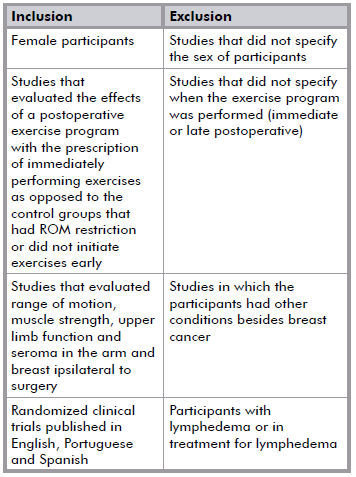
The protocol for this systematic review was pre-recorded in the International Prospective Register of Systematic Reviews (PROSPERO)7, number CRD42021270451. The eligibility criteria were developed using the PICO approach (Participants, Intervention, Comparison and Outcomes) (Chart 1).

The database research was performed in March 2022 using the Medical Subject Headings (MeSH) combinations, including pluralization and spelling variations of USA/United Kingdom English and suffixes/prefixes: Breast Cancer, Postoperative Period, Range of Motion, Articular, Exercise, Seroma, Muscle Strength, Motor activity, randomized controlled trial. The following databases were the research sources: Cumulative Index to Nursing and Allied Health Literature (CINAHL), Cochrane Library, Physiotherapy Evidence Database, (PEDro) and PubMed (Chart 2).

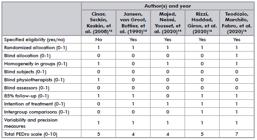
The quality assessment of the studies included in this review was performed through the PEDro Scale8 (Chart 3), which is an exclusive database tool for studies that analyze the effectiveness of physiotherapy interventions. It is based on the Delphi list, developed by Verhagen et al.9, though it includes additional items (items 8 and 10 of the PEDro scale). The objective of the PEDro scale is to help PEDro database users regarding the methodological quality of randomized controlled studies, in addition to assessing if the study contains minimal statistical information to allow the interpretation of results10.
RESULTS
The database search resulted in the identification of 284 studies with analysis of 48 full text articles, the exclusion of 43, and final inclusion of five (Figure 1 11). Among the studies, two articles were published between 1990 and 2008 and three in 2020. In the evaluated articles, it was verified that more than one outcome studied in the present research was found in the same article.

The selection of studies was performed independently by two reviewers (CA, MP) and third reviewer (KP) solved all the divergences. After article selection, the data was extracted and described in Table 1. The quality assessment of studies included in this review was performed using the PEDro scale (Chart 3).
DISCUSSION
Women that have been submitted to surgical treatment for breast cancer may perform upper limbs (UL) exercises with the aim of improving range of motion (ROM), muscle strength, UL function without the occurrence of seroma. In the present study, three articles assessed ROM12,14,15, two the incidence of seroma15,16, two UL function12,14 and, finally, one article, UL strength14.
Seroma is a serous liquid originating from an exudative process (typical of the inflammatory phase of the healing process) that accumulates in the dead spaces after closing the surgical wound. It’s associated to several risk factors, like obesity, age, body mass index (BMI), type and duration of surgery, neoadjuvant treatments, size of tumor, amount of intraoperative blood loss and duration of drainage17,18. In addition to shoulder immobility, described as a seroma preventing factor, some studies from 1997 to 2007 indicate that the immediate start of exercise in the first postoperative day results in a greater incidence of seroma formation, with significant differences when compared to the late start17,18,19,20.
However, in the present study, most of the literature reviewed shows that women with breast cancer that started an exercise program for shoulder mobility in the first postoperative day showed significant improvements to shoulder-arm mobility (UL function), strength and ROM improvement, in comparison to those who did not perform. Upon assessing the complications of the surgical wound, including seroma, Teodózio et al.16 did not observe statistically significant difference among the groups for any of the outcomes assessed by the study (p > 0.05). The study compared 461 women divided in an intervention group with free exercises since the first postoperative day and a group restricted to 90°16. Rizzi et al.15, on the other hand, decided to compare the two groups only 15 days after the postoperative period, before that, the two groups remained with ROM limited to 90°, with a sample of 60 women, and also did not show significant difference among the groups15. Jansen et al.13, with a sample of 144 women, observed that patients in the control group had 14% less wound drainage volume (600 ± 436 ml vs. 701 ± 398 ml) than patients in the intervention group, but this difference was not statistically significant13.
The articles that assessed seroma did not observe significant difference among the groups regarding seroma incidence. Jansen et al.16 assessed the presence of seroma through inspection and palpation and if there was a need for puncture, and the study by Rizzi et al.15 through the volume of drains.
Studies have shown that exercise can be started at the first postoperative day, without the need for restriction of shoulder movement at 90°, considering that, in most studies, the incidence of seroma showed no significant difference among the restricted or free ROM groups. Thus, the other factors that influence the emergence of seroma can be more related to its incidence in breast cancer postoperative periods than in free range shoulder mobility exercises. It is worth mentioning that all studies verified the presence of seroma or dehiscence during the study, and if any of those were present, the patients were guided to continue the exercises, but limited to 90º ROM, according to Bergmann et al.21.
For the evaluation of ROM, studies were performed using goniometry12,14,15. In Cinar et al.12, differences throughout time in the flexion, abduction and adduction movements were significantly better in the intervention group compared to the control group (p < 0.01, p < 0.001, p < 0.005, respectively). The mean amplitudes of flexion and abduction returned to preoperative values closer to the previous ones more quickly in the intervention group compared to the control group12. In Majed et al.14, there were significant differences in the second and fourth weeks after surgery. Flexion in two weeks for the intervention group was greater than the control group (p = 0.04). Just as in Rizzi et al.15, who also found no difference among the groups regarding the changes in shoulder ROM15. Of the articles that assessed ROM as an outcome, all of them noticed greater ROM gain in the intervention group with two studies that did not show significant differences among the groups12,14,15. Thus, performing an immediate intervention in postoperative breast cancer gives patients a better range of movement to carry out their activities of daily living, while minimizing delays for adjuvant therapies.
To Cinar et al.12, recovery of upper extremity functional questionnaire scores was also significantly better in the intervention group compared to the control group (p < 0.05). In the intervention group, the functional questionnaire score in the sixth follow-up month was lower than the basal, indicating that patients presented better upper limb function compared to the pre-operative period. The Disabilities of the Arm, Shoulder and Hand (DASH) questionnaire was also used in the study by Rizzi et al.15, and the variance analysis of the study did not show difference in the upper limb function among the groups during follow-up11. Regarding upper limb function, an article described a significant difference among the groups in which the intervention presented improvement regarding this outcome, against a study that did not observe a significant difference among the compared groups. The discrepancy among the instruments used in the two articles should be considered.
The potential biases for the study that may be considered are heterogeneity of the tested exercise programs; the diversity of instruments used for assessing each outcome; adequate blinding of participants allocation, at least from the therapists that performed the assessments; and lack of information on the bias risk assessment in some studies. The difference in surgical approach between participants in each study may also be a limiting factor for more reliable results.
In line with the results of this study, Cochrane’s review in 2010, which included 24 studies involving 2,132 women with breast cancer, examined the effect of early vs. late implementation of postoperative exercise. Such study concluded that early exercise was more effective than late exercise in clinical and statistical significance on ROM. The authors recommended more research that closely monitor the frequency and intensity of exercise programs22. In Yang et al.23, a recent 2018 systematic review of six studies, including two randomized clinical trials, concluded that training programs for patients submitted to breast cancer surgery may reduce pain and improve functional recovery, especially in increasing shoulder ROM22.
CONCLUSION
Women that have been submitted to surgical treatment for breast cancer may perform upper limbs (UL) exercises to improve range of motion (ROM), muscle strength, UL function without the formation of seroma. Performing an immediate intervention in postoperative breast cancer gives patients a better range of movement to carry out their activities of daily living, while minimizing delays for adjuvant therapies. Starting the exercise program immediately on the postoperative period, either on the 1st or 15th day, or starting after removing stitches and drains, as previously protocoled, will have the same probability of seroma formation. New studies should be performed to measure what other factors are related to seroma occurrence.
References
-
1 Bray F, Laversanne M, Sung H, et al. Global cancer statistics 2022: GLOBOCAN estimates of incidence and mortality worldwide for 36 cancers in 185 countries. CA Cancer J Clin. 2024;74(3):229-63. doi: https://doi.org/10.3322/caac.21834
» https://doi.org/10.3322/caac.21834 -
2 Instituto Nacional de Câncer. Estimativa 2023: incidência de câncer no Brasil [Internet]. Rio de Janeiro: INCA; 2022. [acesso 2024 maio 15]. Disponível em: Disponível em: https://www.inca.gov.br/sites/ufu.sti.inca.local/files//media/document//estimativa-2023.pdf
» https://www.inca.gov.br/sites/ufu.sti.inca.local/files//media/document//estimativa-2023.pdf -
3 Stallbaum JH, Baldissera C, Santos LF, et al. Influência do tratamento cirúrgico do câncer de mama sobre a funcionalidade do membro superior. Rev inspirar [Internet]. 2022[acesso 2024 ago 25];4(19):1-16. Disponível em: Disponível em: https://www.inspirar.com.br/wp-content/uploads/2020/02/702-1.pdf
» https://www.inspirar.com.br/wp-content/uploads/2020/02/702-1.pdf - 4 Pinheiro TS, Barros HVO, Borges KWC. Atuação da fisioterapia no tratamento de sequelas incapacitantes em pacientes com cancer de mama. Liberum Accessum. 2020;4(1):1-8.
-
5 Silveira LG. Cinesioterapia no pós-operatório de mastectomia: uma revisão integrativa [monografia na Internet]. Santa Catarina: Universidade do Sul de Santa Catarina; 2020. Disponível em: https://repositorio.animaeducacao.com.br/bitstream/ANIMA/16169/1/Cinesioterapia%20no%20P%C3%B3s%20Operat%C3%B3rio%20de%20Mastectomia%20-%20Luana%20G.%20Silveira.pdf
» https://repositorio.animaeducacao.com.br/bitstream/ANIMA/16169/1/Cinesioterapia%20no%20P%C3%B3s%20Operat%C3%B3rio%20de%20Mastectomia%20-%20Luana%20G.%20Silveira.pdf -
6 Petito EL, Esteves MT, Elias S, et al. The influence of the initiation of an exercise programme on seroma formation and dehiscence following breast cancer surgery. J Clin Nurs. 2014;23(21-22):3087-94. doi: https://doi.org/10.1111/jocn.12544
» https://doi.org/10.1111/jocn.12544 -
7 University of York. Centre for Reviews and Dissemination. New York: University of York; 2019. PROSPERO - International prospective register of systematic reviews. 2023. [acesso 2023 ago 31]. Disponível em: Disponível em: https://www.crd.york.ac.uk/PROSPERO/
» https://www.crd.york.ac.uk/PROSPERO/ -
8 PEDro: Escala PEDro [Internet]. Database Physiotherapy Evidence. Sydney: Universidade de Sydney; IMH; 1999. [acesso 2024 jan 23]. Disponível em: Disponível em: https://pedro.org.au/portuguese/resources/pedro-scale/
» https://pedro.org.au/portuguese/resources/pedro-scale/ - 9 Verhagen AP, Vet HC, Bie RA, et al. The Delphi list: a criteria list for quality assessment of randomized clinical trials for conducting systematic reviews developed by Delphi consensus. J Clin Epidemiol. 1998;51(12):1235-41
-
10 Shiwa SR, Costa LOP, Moser ADL, et al. PEDro: a base de dados de evidências em fisioterapia. Fisioter Mov [Internet]. 2011;24(3):523-33. Disponível em: https://doi.org/10.1590/S0103-51502011000300017
» https://doi.org/10.1590/S0103-51502011000300017 -
11 Moher D, Liberati A, Tetzlaff J, et al. Principais itens para relatar revisões sistemáticas e meta-análises: a recomendação PRISMA. Epidemiol Serv Saúde. 2015;24(2):335-42. doi: https://doi.org/10.5123/S1679-49742015000200017
» https://doi.org/10.5123/S1679-49742015000200017 - 12 Cinar N, Seckin Ü, Keskin D, et al. The Effectiveness of early rehabilitation in patients with modified radical mastectomy. Cancer Nursing. 2008;31(2):160-5.
-
13 Jansen RFM, van Geel AN, Groot HGW, et al. Immediate versus delayed shoulder exercises after axillary lymph node dissection. Am J Surg. 1990;160(5):481-4. doi: https://doi.org/10.1016/s0002-9610(05)81008-6
» https://doi.org/10.1016/s0002-9610(05)81008-6 - 14 Majed M, Neimi CA, Youssef SM, et al. The impact of therapeutic exercises on the quality of life and shoulder range of motion in women after a mastectomy, an RCT. J Cancer Educ. 2022;37(3):843-51.
-
15 Rizzi SKLA, Haddad CAS, Giron PS, et al. Exercise protocol with limited shoulder range of motion for 15 or 30 days after conservative surgery for breast cancer with oncoplastic technique: a randomized clinical trial. Am J Clin Oncol. 2021;44(6):283-90. doi: https://doi.org/10.1097/coc.0000000000000811
» https://doi.org/10.1097/coc.0000000000000811 -
16 Teodózio CGC, Marchito LO, Fabro EAN, et al. Shoulder amplitude movement does not influence postoperative wound complications after breast cancer surgery: a randomized clinical trial. Breast Cancer Res Treat. 2020;184(1):97-105. doi: https://doi.org/10.1007/s10549-020-05826-9
» https://doi.org/10.1007/s10549-020-05826-9 -
17 Iida S, Furukawa K, Yanagihara K, et al. An analysis of factors that influence the duration of suction drainage in breast cancer surgery J Nippon Med Sch. 2008;75(6):332-6. doi: https://doi.org/10.1272/jnms.75.332
» https://doi.org/10.1272/jnms.75.332 -
18 Gautam AP, Maiya AG, Vidyasagar MS. Effect of home-based exercise program on lymphedema and quality of life in female postmastectomy patients: Pre-post intervention study. J Rehabil Res Dev. 2011;48(10):1261. doi: https://doi.org/10.1682/jrrd.2010.05.0089
» https://doi.org/10.1682/jrrd.2010.05.0089 -
19 Schultz I, Barholm M, Gröndal S. Delayed shoulder exercises in reducing seroma frequency after modified radical mastectomy: a prospective randomized study. Ann Surg Oncol. 1997;4(4):293-7. doi: https://doi.org/10.1007/bf02303577
» https://doi.org/10.1007/bf02303577 - 20 Shamley DR, Barker K, Simonite V, et al. Delayed versus immediate exercises following surgery for breast cancer: a systematic review. Breast Cancer Res Treat. 2005;90(3):263-71.
-
21 Bergmann A, Ribeiro MJP, Pedrosa E, et al. Fisioterapia em mastologia oncológica: rotinas do Hospital do Câncer III/INCA. Rev Bras Cancerol. 2006;52(1):97-109. doi: https://doi.org/10.32635/2176-9745.RBC.2006v52n1.1906
» https://doi.org/10.32635/2176-9745.RBC.2006v52n1.1906 -
22 McNeely ML, Campbell K, Ospina M, et al. Exercise interventions for upper-limb dysfunction due to breast cancer treatment. Cochrane Database Syst Rev. 2010;16:(6):CD005211. doi: https://doi.org/10.1002/14651858.cd005211.pub2
» https://doi.org/10.1002/14651858.cd005211.pub2 -
23 Yang A, Sokolof J, Gulati A. The effect of preoperative exercise on upper extremity recovery following breast cancer surgery. Int J Rehabil Res. 2018;41(3):189-96. doi: https://doi.org/10.1097/mrr.0000000000000288
» https://doi.org/10.1097/mrr.0000000000000288


 Note: PEDro scale score: external validity (item 1); bias risk assessment (items 2-9); statistical description (items 10 and 11).
 Source: PRISMA