
 Hermeneutic Literature Review: A Methodological Possibility in Organizational Studies
Abstract
In the context of increasingly complex organizational dynamics, there is a growing need to deepen and refine research methods. Hermeneutics provides an iterative, dynamic, interpretive, and critical framework for conducting literature reviews. This paper offers an overview of how this method is applied in organizational studies. It starts by introducing the main concepts related to the method, followed by an application protocol and a summary of key studies that have used it. The analysis highlighted that the hermeneutic method provides a unique approach to understanding literature, as it is dynamic, comprehensive, and critical, with a specific focus on interpreting meanings and their temporal evolution. However, the method is still underused in the organizational field. The study demonstrated the feasibility of applying this methodology and encourages further exploration within organizational studies. As a research agenda, it is recommended to expand the search to encompass the broader field of administration and incorporate additional academic databases.
hermeneutic literature review; methodology; hermeneutics; hermeneutic circle; epistemology
Resumo
Em um contexto de dinâmicas organizacionais cada vez mais complexas, nota-se a necessidade de aprofundamento dos métodos de investigação. No campo dos estudos de revisão de literatura, a hermenêutica é um processo iterativo, dinâmico, interpretativo e crítico. Este trabalho visa apresentar um panorama sobre essa possibilidade de revisão nos estudos organizacionais. Inicia-se apresentando os principais conceitos relacionados ao método, segue com um protocolo de aplicação e um apanhado dos principais estudos que utilizaram o método. Foi possível perceber que o método hermenêutico oferece um procedimento singular para compreensão da literatura, pois se propõe a ser dinâmico, compreensivo e crítico, tendo como foco a interpretação dos significados e sua evolução temporal. No entanto, o método ainda é pouco utilizado no campo organizacional. O estudo revelou a viabilidade da metodologia e incentiva sua exploração nos estudos organizacionais. Como agenda de pesquisa, propõe-se ampliar a busca realizada para o campo da administração como um todo, incluindo a ampliação de bases de dados acadêmicos.
revisão de literatura hermenêutica; metodologia; hermenêutica; círculo hermenêutico; epistemologia
Introduction
Organizational practice demonstrates that, since management is carried out by people, the administration of various types and forms of organizations is shaped by different epistemological foundations. However, when examining the dominant model of literature reviews on this topic, it becomes evident that a traditional epistemological foundation prevails, one associated with a more rigid approach to the search process, which is less interpretive and less critical of the studies under analysis. These reviews are typically structured around a single search protocol, with the detailed analysis concluding once a fixed and unchangeable protocol has been established.
However, if the researcher adopts a more interpretive and critical stance — not only in the search process but also in the selection and interpretation stages — the data can be expanded in alignment with the researcher’s ontological perspective. This approach can influence the scope of the search, allowing for a more detailed analysis of the content, fully aligned with the researcher’s epistemological orientation and the research itself. Such an approach can generate unique contributions to the organizational field. In practical terms, different perspectives and proposals related to the topic may emerge, framing the literature review within the specific context in which it is situated.
This study highlights the importance, characteristics, and potential of the hermeneutic literature review (HLR) within the organizational field. This type of review offers significant benefits for the analysis of literature, incorporating theoretical and philosophical dimensions derived from hermeneutic studies, thus contributing to the development of a more consistent, interpretive, and critical theoretical framework (Gadamer, 2013; Van Manen, 1990). Although some studies in the organizational field have already applied hermeneutic reviews, there is still considerable room for further discussion, particularly regarding the potential this approach offers for exploring analytical theories related to organizational phenomena.
Most literature review studies still rely on the traditional systematic review, whether in quantitative or qualitative research. This research aims to demonstrate that HLR can provide more relevant contributions by fostering open, interpretive, and critical perspectives — especially for research aligned with specific epistemological stances.
The purpose of the hermeneutic method is to generate an understanding of the world based on the ontological perspectives that shape both researchers and their research objectives. This understanding is developed with an awareness of existing knowledge, which can be achieved through a systematic investigation of previously documented insights. Therefore, the main objective here is to provide an overview of HLR as a potential method for organizational studies. Additionally, this study serves as a possible alternative to the Cartesian and positivist methodologies that currently dominate literature reviews, offering a route for encouraging epistemological reflection on how scientific knowledge is reviewed and mobilized as a tool for debate (Vizeu, Torres, & Kolachnek, 2022). We established the following specific objectives: to present a protocol for employing HLR and to utilize this approach to identify and analyze key studies that have used this type of review in the field of organizational studies. This includes examining how these studies were conducted and which authors were referenced – always starting from the premise that HLR differs from traditional approaches by offering a path that is both interpretive and critical.
To deepen this understanding, we present the foundational principles of HLR. Next, we map the use of the method through searches conducted in three major scientific databases: Scopus, Web of Science, and Google Scholar, which are significant for research in the field of administration. It is important to emphasize that when this method is used in organizational studies, it should be tested and critically evaluated. Furthermore, it is essential to emphasize that the search was carried out from a hermeneutic review perspective, integrating its interpretive and iterative nature into the search process.
Hermeneutic philosophy: origins, concepts, and main authors
The term hermeneutics originates from the Greek god Hermes, whose primary role was the interpretation of the symbolic. Hermeneutics, therefore, focuses on uncovering the hidden meanings of the subject under examination (Espósito, 2001), meanings that remain inaccessible through conventional scientific methods, as practiced in the natural sciences. Instead, they arise from an openness to the phenomenon being investigated – derived from what reveals itself during the inquiry process.
When addressing science, knowledge, epistemology, and method, the discussion involves a rupture with positivism (Santos, 2004). Hermeneutics, as a field within the philosophy of science, has gained prominence more recently, starting from ontological questions related to the metaphysical origin of being — grounded in the very nature of being itself. Two seminal authors stand out in hermeneutic studies: Martin Heidegger and Hans-Georg Gadamer. It is also important to recognize the contributions of Schleiermacher, who developed the concept of the hermeneutic circle, a methodological approach later refined by Heidegger and Gadamer, which will be presented further on.
For Schleiermacher (2005), hermeneutics is the art of understanding and continually interpreting, in a process with no predetermined endpoint — or perhaps with no endpoint whatsoever. For this reason, it is represented by a circle, symbolizing the constant process of interpretation and reinterpretation. This approach aims to gradually bring the researcher or reader closer to understanding the object of analysis, without ever fully closing off the process. Thus, hermeneutics is an evolving process, continually open to refinement. As one progresses, their understanding of the subject expands, revealing new possibilities and avenues for exploration.
Heidegger introduced the concept of facticity, which played a central role in what the philosophical community terms the ontological turn. This shift involved proposing an interpretation that transcends mere meaning, incorporating a broader perspective that considers the set of practices that uphold and shape meanings, which are discursively constructed themselves. Heidegger’s major contribution was to transform the understanding of meaning — recognizing it not as something static, but as something practical and emerging through lived experience (Heidegger, 2014). For the author, interpretation is a development of understanding. The understanding in what Heidegger calls interpretation appropriates the element that was understood. When interpreting, the understood element does not become something else, but becomes itself. The interpretation is existentially grounded in understanding, i.e., the understanding does not come from the interpretation. The interpretation does not mean to learn about the understood element, but in elaborating possibilities projected in the act of understanding (Heidegger, 2014, p. 421).
Hermeneutics is frequently linked to phenomenology, which seeks to uncover meaning and significance. While hermeneutics serves this purpose, it also extends beyond, aiming to interpret meaning rather than merely capturing it. Heidegger’s great contribution to science is the movement known as the “ontological turn,” generating an interpretation beyond just understanding, seeking the founding bases of the beings involved. Heidegger conceived the founding basis of hermeneutics but stated that it was the field of Gadamer, who was his student (Heidegger, 2014).
Merleau-Ponty (1990) serves as an example of the relationship between hermeneutics and phenomenology. According to the author, although a phenomenological approach aims to observe what is perceived, one cannot forgo reflection. This is because when analyzing the description of the lived experience being studied, an interpretation is made. Hermeneutics is therefore an approach that can be highly recommended for works that adopt phenomenological, interpretive, and critical positions.
In his work, Truth and Method, Hans-Georg Gadamer (1989, p. 296) discusses hermeneutics and observes a significant historical perspective on truth as part of an ontology proposed by Heidegger. According to the author: “For the hermeneutic productivity of temporal distance could be understood only when Heidegger gave understanding an ontological orientation by interpreting it as an ‘existential’ and when he interpreted Dasein’s [Heideggerian term meaning ‘existence,’ ‘ human being’] mode of being in terms of time.” Gadamer (1989) advocates for an alternative understanding that encompasses not only the ability to assimilate and employ methods but also the researcher’s sensitivity.
Gadamer emphasizes the significance of the subjective dimension of interpretation. He presents the concept of “game” as distinct from the subjective. He describes the game itself as a fact that is not influenced by the players' perceptions, as once they engage in the game, they act within its context: “The players are not the subjects of play; instead play merely reaches presentation (Darstellung) through the players” (Gadamer, 1989, p. 103). The game has a distinct independence that shifts based on the players. In this way, subjectivity exists and is only diminished by the player who allows themselves to be swept away.
Play clearly represents an order in which the to-and-fro motion of play follows of itself. It is part of play that the movement is not only without goal or purpose but also without effort (Gadamer, 1989, p. 105).
Gadamer (2013) proposes that the researcher’s thought process is analogous to that of the player since they do not superimpose their subjectivity over other research subjects. However, they are also not reduced to a neutral being who only observes without subjective interpretation. As elements for Gadamer in the development of his philosophical hermeneutics applicable to the human sciences, historical consciousness, language, and the hermeneutic circle are concepts that need to be seen in an interrelated way.
The author redefined hermeneutics instead of creating a new method, an issue clarified in Truth and Method, in which he states that the logic of the human sciences was closely related to the natural sciences and the inductive method and its origins in Francis Bacon (1979). By opposing this logic, Gadamer, in the mid-20th century, adopted a critical approach, which sought to understand and explain human action throughout history, aiming to find uniformity, regularity, and legality:
However much experiential universals are involved, the aim is not to confirm or extend these universalized experiences in order to attain knowledge of a law – e.g., how men, peoples, and states evolve – but to understand how this man, this people, or this state is what it has become or, more generally, how it happened that it is so (Gadamer, 1989, p. 4).
Dilthey (1991), criticizing positivist and empiricist logic, attempted to differentiate the approaches of natural sciences from human sciences. The author argues that, in the field of human sciences, we cannot speak of general laws because the understanding of meanings is subjective.
In the same way, Gadamer seeks to understand the ontological bases of being and its historical framework. His interpretive and critical approach aims to abandon the hegemonic conceptions of the method as a constructor of truths, defending the validation of the epistemology of science as a value for knowledge together with the being that founds it, preventing truth from being a methodological appropriation (Gadamer, 2013). Ricoeur also argues that hermeneutics is an instrument of analysis, understanding, and interpretation (Ricoeur, 1989).
Ricoeur (1989) raises complex issues between hermeneutics and critical theory, especially the dialogue between Hans-Georg Gadamer and Jürgen Habermas, as the authors represent two poles of thought. According to Ricoeur (1989), Gadamer, in his work Truth and Method, argues that understanding and interpretation are inevitably influenced by history and tradition, which determine our horizons of understanding. Understanding is seen as a dialogical process that involves the fusion of horizons. Jürgen Habermas, on the other hand, advocates a more critical approach, emphasizing the need for reflection and critical analysis to emancipate individuals from prejudices and ideologies that can distort communication and understanding. Habermas developed the theory of communicative action, which focuses on how consensus and understanding can be achieved through interaction free from domination.
In entering this debate, Ricoeur does not align completely with either field but offers a synthesis that recognizes both the validity of tradition, as argued by Gadamer, and the need for critique and distance, as Habermas advocated. Ricoeur’s (1989) approach to the debate between Gadamer and Habermas offers a rich interplay between understanding and critique, emphasizing the importance of reflecting on our own interpretive processes. The author acknowledges the significance of social and historical conditions in shaping understanding, yet asserts that interpretation can embody an act of freedom and renewal. Consequently, he enriches the hermeneutical debate by advocating for a balance between recognizing the influence of tradition and maintaining constant critical vigilance, which fosters a more comprehensive and liberated form of understanding.
The Hermeneutic Literature Review
The understanding of the hermeneutic literature review (HLR) cannot be attributed to a singular origin, as it emerges from the fundamental principles of hermeneutics applied to literature reviews. Hermeneutics, as an interpretive approach, reveals itself as the essence of the relationship between human beings and texts. This relationship transcends disciplinary boundaries and extends across the social and human sciences. Thus, the application of hermeneutic principles to literature reviews emerges as part of a gradual process, rooted in the search for the meaning of being in the world, as scholars pursue more authentic and reflective approaches to interpreting literature in their respective fields of investigation. Through this journey, researchers seek a deeper and more meaningful understanding, in which the essence of being reveals itself through the analysis and interpretation of texts. Therefore, the origin of HLR lies in the very essence of existence itself — in the incessant search for the truth of being (Heidegger, 2014; Gadamer, 2013; Van Manen, 1990).
For example, a search for the term “hermeneutic literature review” in Google Scholar returns no direct results. Instead, researchers have adopted different approaches in their studies, using the terms “hermeneutics” and “review” separately. These findings show that researchers often carry out what they call “reviews” in a broad sense, frequently applying an epistemological lens associated with hermeneutic-based data collection methods.
The hermeneutic method proposes a continuous and cyclical review process, comprising the stages of bibliographic research, classifying and mapping, critical assessment, and argument development. This process is continuous and iterative, allowing these actions to be repeated and refined, contributing to the progressive improvement of results. Thus, HLR is characterized by constant interaction between the researcher and the literature under investigation (Gadamer, 2013).
The interpretation of a part of the whole, along with the process that involves the relationship between this interpretation and each of the other parts, generates a new interpretation. This new interpretation raises new questions, and a detailed analysis of these inquiries leads to the advancement of each part and the relationships among them (the parts) and the whole, creating a continuous circle. Therefore, there is an interaction between understanding and interpretation (Allen & Jensen, 1990).
As the researcher seeks meaning in what they read and study, they offer their own interpretation of the research object. Unlike the conventional literature review found in most published scientific works, the HLR assumes that the researcher holds a particular interest in the selected literature. This interest gives the review a specific, subjective orientation – the researcher’s own interpretive lens. Thus, the literature review is an integral part of the entire research process, shaping the research’s scope, guiding questions, and overall design. The review is more than just a part of the work (Gadamer, 2013).
The research process is not fragmented into linear stages. It is dynamic, with different moments overlapping and interweaving. There is no strict sequence of reading, systematization, and writing; instead, these activities – and others – occur simultaneously and in parallel. Literature review ceases to be a routine procedural step and becomes embedded within the broader research process (Gadamer, 2013).
It is important to note that, since its initial conceptualization, the HLR has not been considered a formal method (Boell & Cecez-Kecmanovic, 2010). In this study, the HLR is understood as an interpretive and critical approach. Its contribution to the social sciences is linked to the work of Habermas, particularly his critique of Gadamer’s hermeneutics, which opposes hermeneutics to methodical, procedural knowledge. For Habermas (2009), hermeneutics is not about method, but rather about debate and interpretation. In this sense, Habermas proposes hermeneutics as a critical-dialectical approach.
In addition to Habermas’ influence, the HLR also draws on broader interpretive traditions. Husserl (2008), in his phenomenology, emphasizes the importance of suspending prior interpretations and returning directly to the phenomenon itself, enabling a more authentic understanding of beings in their full complexity. Merleau-Ponty (1996), in turn, highlights the centrality of lived experience in the interpretation of meaning. Gadamer (2013), in his philosophical hermeneutics, highlights the importance of interpretive horizons in understanding texts and constructing knowledge. For Gadamer, understanding arises through the fusion of horizons between the interpreter and the text. Thus, a deep and reflective analysis can take into consideration both the content of the texts and the cultural, historical, and existential contexts that shape them.
The structure of the HLR is best understood through the hermeneutic circle, initially developed by Schleiermacher and later expanded by Heidegger and Gadamer. As already noted, the process of HLR is continuous; therefore, the hermeneutic circle represents a philosophically inexhaustible path, constantly rotating and evolving. The following image presents an initial visualization, adapted from Boell and Cecez-Kecmanovic (2010):
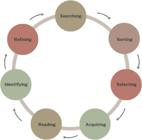
The circle consists of seven distinct stages, each featuring specific techniques. The initial stage is searching, which Heidegger emphasizes as the starting point of the hermeneutic circle. At this stage, a review of the existing literature is conducted using the selected databases. This is not the time to read this material, as poorly chosen sources can result in wasted time. Boell and Cecez-Kecmanovic (2010) suggest that it is best to begin with review articles to gain a comprehensive overview of the research area. According to the authors:
Moreover, they [review articles] introduce the specific vocabulary used to discuss those concepts. Reviews usually draw on a wide range of material introducing important research publications and their relationship to each other. Reviews are therefore ideal for immersing into a field. Reading review articles at the beginning of research is helpful, even if only some sections of a review are relevant for a particular research project (Boell & Cecez-Kecmanovic, 2010, p. 135).
Sorting the search results is the second stage. This is the time when the criteria set during the literature review will be established, which may include time period, relevance, citations, and more. For instance, using citations as a criterion tends to highlight older studies that benefit from a greater number of citations. If the goal is to find the most recent research on a particular topic, this criterion may not be the most effective, and it is better to use a time or year criterion instead (Boell & Cecez-Kecmanovic, 2010).
The third stage indicates the sources of the terms, which may come from one or two parts of the studies, including the title, abstract, keywords, or text, but not all of them. In this stage, it is customary to examine the titles and abstracts of the selected documents to determine their relevance for the research (Boell & Cecez-Kecmanovic, 2010).
In the fourth stage of the circle, the material selected for reading is acquired. Securing these materials is not always easy, but all selected ones should be retrieved. They can be obtained in electronic format, but some older documents may only be found in libraries. Foreign languages can pose a barrier in this stage (Boell & Cecez-Kecmanovic, 2010).
The identified publications are read in the fifth stage of the circle. This is when the main concepts are extracted, and the vocabulary is identified. The researcher also makes notes and selects additional references since it is through reading that an overview of the literature and the field is obtained (Boell & Cecez-Kecmanovic, 2010).
In the sixth stage, additional literature and search terms are identified and reference tracking is performed – which can be useful for finding more relevant literature or seminal studies. This method is referred to as “snowballing” because reading allows us to identify which literature is relevant to these authors, thereby expanding the theoretical framework (Boell & Cecez-Kecmanovic, 2010).
The seventh stage comprises the research refinement. In this stage, the researcher selects publications in certain basic journals for the area, choosing central authors for the study, and searching for other publications that cite other important works (Boell & Cecez-Kecmanovic, 2010).
Boell and Cecez-Kecmanovic (2010, p. 139) recommend using building blocks or successive fractions as research strategies. The building blocks start with a straightforward search and are combined to create a more complex search, which is highly effective for identifying and expanding search terms. Successive fractions involve reducing the items searched in a funneling approach. Once the previously mentioned items have been addressed and improvements and literature have been continuously identified, the goal is to reach a saturation point, where only minor contributions with limited centrality start to appear. When the key ideas have been pinpointed and the results have been reviewed, this may indicate that the saturation point has been achieved (Boell & Cecez-Kecmanovic, 2010).
These processes are constantly occurring interconnectedly. Following this path makes it possible to systematize complex research, which can help the researcher. The hermeneutic approach is also used to understand public controversies in which questions persist. In these cases, hermeneutics offers new possibilities for analyzing controversial public issues by respecting the plurivocity and intertextuality of narratives (Lejano & Leong, 2012). In the same vein, using the meaning-centered hermeneutic approach is also relevant for educational administration, as it considers the production of meanings above technical production, bringing an interpretive dimension of practices as relevant (Mackler & Mulryan, 2010). The hermeneutic approach is also used in the organizational approach as a tool to analyze the communication processes of different actors, who may have divergent worldviews to seek to create or maintain patterns of social relations and culture within the organization (Phillips & Brown, 2017).
Methodology
The methodological choice adopted in this review is based on the hermeneutic approach, which emphasizes the critical and iterative interpretation of existing literature. Hermeneutics, as a method, stands out for its ability to extract deep and dynamic meanings from texts, making it particularly suitable for organizational studies, which are embedded in complex and constantly evolving realities. This methodology enables a holistic understanding that considers not only the explicit content of scientific documents, but also their interrelations and the underlying contexts that shape their development over time. The following section aims to map the use of the hermeneutic review in scientific databases.
Using Hermeneutic Literature Review
We identified the most relevant and frequently cited articles to map the use and production of studies associated with the hermeneutic review. The chosen databases included Scopus, Web of Science, and Google Scholar. The first two were selected intentionally for their extensive coverage and recognized relevance to the field of administration. Google Scholar was included due to its broader reach, which encompasses Brazilian and Latin American journals often not indexed in major international databases.
The search covered all available articles published online in the three databases, with no restriction on publication year. The process followed the sequence of terms described below for each database:
In Scopus, the terms “hermeneutic,” “literature,” and “review” were searched within the “article title, abstract, keywords” field, and the results were sorted by the highest number of citations. This search yielded six articles. One additional article was included, which was identified in the theoretical framework of one of the selected papers and considered relevant because it was empirical, thereby aligning with the search criteria. This resulted in a total of seven articles from Scopus.
In Web of Science, the terms “hermeneutic,” “literature,” and “review” were searched using the “topic” field, which includes title, abstract, and keywords. The results were sorted by the “times cited” classification. Ten articles were found, but five were excluded because they had already been identified in the Scopus search.
In Google Scholar, the terms “hermeneutic,” “literature,” and “review” were used, with results sorted by relevance. This initial search yielded seven articles, but two were excluded due to duplication with articles identified in previous searches. The search was then expanded, first using only the terms “literature” and “hermeneutic,” which added two additional articles, and then using only the terms “hermeneutic” and “review,” which resulted in one more article. In total, eight articles were retrieved from Google Scholar.
The final sample comprised twenty articles, organized and displayed in the table below:
The analysis of the ten most relevant studies from each database uncovered seven articles that overlap, even though none were present across all three platforms. The fact that no articles are repeated in the three databases and the results observed when searching on Google Scholar indicate that the HLR is not yet widely adopted or frequently cited by researchers, although it is gradually gaining significance in certain fields.
Additionally, it is worth noting that, among the seven overlapping studies, four are from the health field – one of the areas where this methodology has gained the most prominence. As for the remaining three studies, one belongs to the field of information systems, another to sociology, and the last one to methodology itself. These selected studies will serve as the core references for further research in a future study. The following section will present the HLR’s contributions to the administration field.
Contributions of the Method to the Field of Administration
The hermeneutic literature review (HLR) method offers significant contributions to studies in various fields. In administration, its relevance increases as it highlights the importance of historical awareness. This awareness arises through dialogical practice and a comprehension of the historicity of the phenomena being analyzed, which is especially pertinent considering the field of administration has experienced significant transformations over the years. Hermeneutics encourages an interpretive and critical literature analysis, enabling researchers to question underlying assumptions, implicit values, and dominant perspectives. This promotes deeper reflection on organizational theories and practices, as well as their social implications.
At the same time, technological advances, which have introduced increasing organizational complexity, demand more sophisticated forms of analysis that consider how knowledge is generated, shared, and applied within specific contexts. This requires exploring the boundaries of prevailing knowledge paradigms, especially in organizational studies, enabling a better understanding of organizational complexity – as previously highlighted in the literature (Demo, 1995; Tsoukas, 2005).
As a multidisciplinary and interdisciplinary field, administration benefits significantly from the HLR, particularly because it is an iterative and complex method capable of capturing the peculiarities of the diverse research objects found within organizational studies. Researchers can understand organizational theories, concepts, and practices within their cultural, historical, and social contexts. This allows for a deeper and more meaningful understanding of organizational dynamics and how they are influenced by various factors.
On the other hand, the organizational field consists of individuals who engage in management practices based on specific epistemological foundations. In more rigid systematic reviews following a single search protocol, the in-depth analysis concludes once the protocol is completed. However, when employing the hermeneutic circle, the epistemology of the field is continually shaped and influenced by the researcher’s ontology, enabling an in-depth analysis that aligns with the researcher’s beliefs and worldview. This approach generates unique contributions to the field of organization studies. From a practical standpoint, this openness to interpretation encourages the development of various proposals to tackle the same issue, enabling professionals to choose the methods that best fit the specific requirements of their contexts. Furthermore, the approach explicitly acknowledges the subjectivity inherent in the interpretive process, examining how researchers’ experiences, values, and beliefs influence their understandings. These considerations promote a more reflective and self-aware attitude toward both methodological decisions and research outcomes in organizational studies.
The reorientation of hermeneutic meaning allows for the unfolding of the literature under analysis, guided by clearly defined criteria, with the goal of conducting thorough searches that deepen the understanding of the phenomenon based on the researcher’s epistemological foundation. In this context, "exhausting" the literature does not imply reviewing all available texts, but rather achieving a profound understanding grounded in the researcher’s epistemological perspective.
Furthermore, as a knowledge domain, administration has its specialized language. By using the HLR, researchers can pinpoint key terms and theoretical contributions that shape the discipline. Hence, hermeneutics, by allowing different meanings to arise for the same phenomenon, not only enhances the literature review aligned with a particular epistemological foundation but also significantly contributes to the growth of organizational thought by embracing various meanings and interpretations. This empowers researchers to recognize multiple interpretations and viewpoints on a given topic, promoting the development of a more comprehensive and inclusive understanding within organizational studies.
Conclusions
This study offers a synthesis of the application of the hermeneutic literature review (HLR) method across different fields, to contribute to future research employing this methodology in the area of administration, particularly within organizational studies,
It illustrates the HLR as a distinct method for understanding other studies by incorporating a critical and historical perspective at every stage of the scientific research process, offering an interpretive comprehension of meanings. The study encourages future research using this approach and aspires to facilitate its wider adoption.
The method has proven highly relevant for generating an understanding of the world through the ontological perspectives that shape both researchers and their research objectives, fostering awareness of existing knowledge and historical consciousness.
The HLR is an essential contribution to organizational studies by enabling reflexive and critical analyses of organizational history and practices. Through the interpretation of texts and apprehending underlying values, this method reveals the essence of organizational phenomena and their relationships with historical and social contexts. By recognizing the subjectivity inherent in the interpretive process and exploring researchers’ experiences and beliefs, hermeneutics facilitates a more authentic and meaningful assimilation of organizational dynamics.
The application of the method to identify key publications employing this same approach indicated that the method is not yet widely adopted in the literature. In addition, the articles retrieved from the three major scientific databases – Scopus, Web of Science, and Google Scholar – displayed a lack of uniformity, with none of the selected articles appearing in all three databases. All identified and selected articles were found in at most two databases. This finding highlights that the process of consolidating the HLR as a recognized research method is still ongoing. Nonetheless, the method’s applicability to the organizational field was confirmed.
A key limitation of this research is the reliance on only three databases. For future studies, it is recommended that the search scope be expanded to include EBSCO, Redalyc, Science Direct, and SciELO. EBSCO covers economic and administrative sciences; Redalyc includes studies in the social sciences, encompassing organizational studies; Science Direct is of international relevance; and SciELO features research conducted in Latin America and Brazil.
As part of the future research agenda, monitoring the adoption of the hermeneutic approach within organizational studies is also recommended. Greater use of the approach will help clarify how to further develop a hermeneutic methodology aligned with organizational studies’ specific needs and characteristics.
References
-
Allen, M. N., Jensen, L. (1990). Hermeneutical inquiry: Meaning and scope. Western Journal of Nursing Research, 12(2), 241–253. https://doi.org/10.1177/019394599001200209
» https://doi.org/10.1177/019394599001200209 - Bacon, F. (1979). Novum organum: ou verdadeiras indicações acerca da interpretação da natureza São Paulo, SP: Abril Cultural.
- Boell, S. K., Cecez-Kecmanovic, D. (2014). A hermeneutic approach for conducting literature reviews and literature searches. Communications of the Association for Information Systems, 34, 257–286.
- Boell, S. K., & Cecez-Kecmanovic, D. (2010). Literature reviews and the hermeneutic circle. Australian Academic & Research Libraries, 41(2), 129-144.
- Crowther, S., Smythe, E., & Spence, D. (2014). The joy at birth: An interpretive hermeneutic literature review. Midwifery, 30(4), e157-e165.
- Demo, P. (1985). Demarcação científica. In P. Demo (Ed.), Metodologia científica em ciências sociais São Paulo, SP: Atlas.
- De Witt, L., & Ploeg, J. (2006). Critical appraisal of rigour in interpretive phenomenological nursing research. Journal of Advanced Nursing, 55(2), 215-–29.
- Dilthey, W. (1991). Introduction to the Human Sciences (Vol. 1). New Jersey: Princeton University Press.
- Espósito, V. H. C. (2001). Hermenêutica. In I. Fazenda (Org.), Dicionário em construção: interdisciplinaridade (pp. 238-241). São Paulo, SP: Cortez.
- Finfgeld-Connett, D., Johnson, E. D. (2013). Literature search strategies for conducting knowledge-building and theory-generating qualitative systematic reviews. Journal of Advanced Nursing, 69(1), 194–204.
- Fischer, E., Bristor, J., & Gainer, B. (1996). Creating or escaping community? An exploratory study of internet consumers' behaviors. Advances in Consumer Research.
- Gadamer, H.-G. (1989). Truth and Method (2nd ed.) (Trans J. Weinsheimer and D. G. Marshall). New York: Continuum.
- Gadamer, H.-G. (2013). Verdade e método (13 ed.). Petrópolis, RJ: Vozes; Bragança Paulista, SP: EDUSF.
- Geeling, S., Brown, I., & Weimann, P. (2016). Information systems and culture-a systematic hermeneutic literature review
- Greenhalgh, T., Wherton, J., Papoutsi, C., Lynch, J., Hughes, G., A'Court, C., … Shaw, S. (2017). Beyond adoption: A new framework for theorizing and evaluating nonadoption, abandonment, and challenges to the scale-up, spread, and sustainability of health and care technologies. Journal of Medical Internet Research, 19(11), e367.
- Greenhalgh, T., A’Court, C., Shaw, S. (2017). Understanding heart failure; explaining telehealth–a hermeneutic systematic review. BMC Cardiovascular Disorders, 17(1), 1-16.
- Habermas, J. (2009). A Lógica das Ciências Sociais Petrópolis: Vozes.
- Hartelius, E. J., & Browning, L. D. (2008). The application of rhetorical theory in managerial research: a literature review. Management Communication Quarterly, 22(3), 452-472.
- Heidegger, M. (2014). Ser e tempo Campinas, SP: Editora da Unicamp; Petrópolis, RJ: Vozes.
- Husserl, E. (2008). A ideia da fenomenologia. Lisboa: Edições 70, 2008.
- Koch, T., & Harrington, A. (1998). Reconceptualizing rigour: The case for reflexivity. Journal of Advanced Nursing, 28(4), pp. 882-890.
- Kusnanto, H., Agustian, D., Hilmanto, D. (2018). Biopsychosocial model of illnesses in primary care: A hermeneutic literature review. Journal of family medicine and primary care, 7(3), pp. 497.
- Lejano, R. P., Leong, C. (2012). A Hermeneutic Approach to Explaining and Understanding Public Controversies. Journal of Public Administration Research and Theory, 22(4), 793–814.
- LeVasseur, J. J. (2003). The problem of bracketing in phenomenology. Qualitative Health Research, 13(3), 408-420.
- Lopez, K. A., & Willis, D. G. (2004). Descriptive versus interpretive phenomenology: Their contributions to nursing knowledge. Qualitative Health Research, 14(5), 726-735.
- Mackler, S., & Mulryan, S. (2010). Reconceptualizing Educational Administration as a Hermeneutics of Trust. In E. A. Samier, M. Schmidt (Ed.), Trust and Betrayal in Educational Administration and Leadership. (pp. 14-30). London: Routledge.
- Matua, G. A., & Van der Wal, D. M. (2015). Differentiating between descriptive and interpretive phenomenological research approaches. Nurse Researcher, 22(6), 22-27.
- Merleau-Ponty, M. (1996). Fenomenologia da percepção (C. A. R. Moura, Trad.). São Paulo: Martins Fontes.
- Merleau-Ponty, M. (1990). O primado da percepção e suas consequências filosóficas.Campinas: Papirus.
- Phillips, N., Brown, J. L. (2017). Analyzing Communication in and Around Organizations: A Critical Hermeneutic Approach. Academy of Management Journal, 60(1), 29–55.
- Santos, B. S. (2004). Introdução. In B. S. Santos (Ed.). Conhecimento prudente para uma vida decente (pp. 17-27). São Paulo, SP: Cortez.
- Schleiermacher, F. D. E. (2005). Hermenêutica e crítica. (A. Ruedell, Trad.). Ijuí, RS: Unijuí.
- Shephard, K., Rieckmann, M., Barth, M. (2019). Seeking sustainability competence and capability in the ESD and HESD literature: An international philosophical hermeneutic analysis. Environmental Education Research, 25(4), 532–547.
- Ricoeur, P. (1989). Do texto à acção: ensaios de hermenêutica II. Porto: Rés-Editora.
- Smythe, E., & Spence, D. (2012). Re-viewing literature in hermeneutic research. International Journal of Qualitative Methods, 11(1), pp. 12-25.
- Stefani, J., Cruz, N. O. (2019). Compreensão e linguagem em Heidegger: existência, abertura ontológica e hermenêutica. Bakhtiniana, Revista de Estudos do Discurso, 14(2), pp. 112-127.
- Tsoukas, H. (2005). Introduction. In H. Tsoukas (Ed.), Complex Knowledge: Studies in Organizational Epistemology (pp. 1-9). Oxford: Oxford University Press.
- Van der Wath, A., & Van Wyk, N. (2020). A hermeneutic literature review to conceptualize altruism as a value in nursing. Scandinavian Journal of Caring Sciences, 34(3), 575-584.
- Van Manen, M. (1990). Researching Lived Experience: Human Science for an Action Sensitive Pedagogy. New York: State University of New York Press.
-
Vizeu, F., Torres, K. R., Kolachnek, L. M. P. (2022). Revisão sistemática de literatura? Depende! Limites de procederes quantitativos de análise de literatura na área de Administração. Revista Eletrônica de Ciência Administrativa, 21(2), 213–241. https://doi.org/10.21529/RECADM.2022008
» https://doi.org/10.21529/RECADM.2022008 - Wang, Y. (2015). Business intelligence and analytics education: Hermeneutic literature review and future directions in is education [paper presentation]. Proceedings of Twenty-First Americas Conference on Information Systems (AMCIS), Puerto Rico.
-
Inclusive language:
The authors use inclusive language that acknowledges diversity, conveys respect to all people, is sensitive to differences, and promotes equal opportunities.
-
Plagiarism check:
O&S submit all documents approved for publication to the plagiarism check, using specific tools.
-
Data availability:
O&S encourages data sharing. However, in compliance with ethical principles, it does not demand the disclosure of any means of identifying research participants, preserving fully their privacy. The practice of open data seeks to ensure the transparency of the research results, without requiring the identity of research participants.
-
Funding:
The authors received no financial support for the research, authorship, and/or publication of this article.
-
Associate Editor:
Josiane Silva de Oliveira
O&S encourages data sharing. However, in compliance with ethical principles, it does not demand the disclosure of any means of identifying research participants, preserving fully their privacy. The practice of open data seeks to ensure the transparency of the research results, without requiring the identity of research participants.

 Source: Adapted from