 SOCIO-ENVIRONMENTAL KNOW-HOW AND THE COPRODUCTION OF LOCALIZED KNOWLEDGE
Abstract
The co-production of knowledge, through socio-environmental know-how, can build closer and more horizontal university-territory relationships. Thus, the objective of this article is to reflect on territorial praxis, considering the importance of socio-environmental know-how as a path to valorizing and activating territorialities. Our place for research-action-reflection is the Madre Maria Domênica Integration Center (CIMMAD), located in the Padre Ulrico neighborhood, in Francisco Beltrão (Paraná, Brazil). As a methodological approach, we developed participatory-action research (PAR), considering the decolonial perspective, as a way of redefining our academic activities. In order to research-act-reflect on the territory, we chose, together with the subjects involved in the research, to carry out workshops and social cartography. The results make us reflect that this movement contributes to readings of territory as a place of life, in which socio-environmental relations are important sources for the co-production of localized knowledge, based on the construction of popular science or ‘other’ sciences, committed to social transformation.
Keywords:
Territory; PAR; Territorial Praxis
Resumo
A coprodução de conhecimentos, por meio dos saberes-fazeres socioambientais, podem construir relações universidade-território de mais proximidade e horizontalidade. Assim, o objetivo desse artigo é refletir sobre a práxis territorial, considerando a importância dos saberes-fazeres socioambientais, como caminho de valorização e ativação das territorialidades. Nosso lugar de pesquisa-ação-reflexão é o Centro de Integração Madre Maria Domênica (CIMMAD), localizado no bairro Padre Ulrico, em Francisco Beltrão (Paraná, Brasil). Como caminho metodológico, desenvolvemos a investigação-ação-participativa (IAP), considerando a perspectiva decolonial, como forma de ressignificar nossos fazeres acadêmicos. Para pesquisar-atuar-refletir sobre o território, escolhemos em conjunto com os sujeitos envolvidos na pesquisa a realização de oficinas e cartografia social. Os resultados nos fazem refletir que esse movimento contribui para leituras de território como lugar de vida, em que relações socioambientais, são fontes importantes para a coprodução de conhecimentos localizados, a partir da construção da ciência popular ou de ciências ‘outras’, comprometidas com a transformação social.
Palavras-chave:
Território; IAP; Práxis Territorial
Resumen
La coproducción de conocimiento, a través del saber socioambiental, puede contribuir a relaciones universidad-territorio con mayor proximidad y horizontalidad. Así, el objetivo de este texto es reflexionar sobre la praxis territorial, considerando la importancia del saber socioambiental, como camino para valorar y activar las territorialidades. Nuestro lugar de investigación-acción-reflexión es el Centro de Integración Madre María Domânica (CIMMAD), ubicado en el barrio Padre Ulrico, en Francisco Beltrão (Paraná, Brasil). Como camino metodológico, desarrollamos la investigación-acción participativa (IAP), considerando la perspectiva decolonial, como una forma de darle un nuevo significado a nuestras actividades académicas. Para ello, investigar-actuar-reflexionar sobre el territorio, optamos junto a los sujetos por realizar talleres y cartografía social, entendiendo que este movimiento contribuye a lecturas del territorio como lugar de vida, en el que las relaciones socioambientales pueden ser fuentes importantes para la coproducción de conocimiento localizado, que contribuya a la construcción de una ciencia popular u 'otra' ciencias, comprometida con la transformación social.
Palabras-clave:
Lluvias; Territorio; IAP; Praxis Territorial
INTRODUCTION
Experiences in/of place are dynamic and complex movements that require ethics and social commitment, affection and discipline, in order to think of different ways of contributing to the co-production of knowledge. This movement focuses on social demands, based on the subjects, their ways of life, territories and socio-environmental know-how. Thus, the proposal is to think-act-research-reflect, based on the dimension of everyday territorialities, through the methodology of participatory action-research (PAR), and as an epistemic path we opted for the decolonial perspective, seeking to reflect our actions together with the popular classes. The objective of the research is to reflect on territorial praxis, considering the importance of socio-environmental know-how as a path to valorization and activation of territorialities. Our research site is the Madre Maria Domênica Integration Center (CIMMAD), located in the Padre Ulrico neighborhood, in Francisco Beltrão (Paraná, Brazil), which houses the Amarbem Community Garden.
This movement of researching-acting-reflecting with the territory, understanding it as a place of life, can contribute to redefining the university-territory relationship, considering praxis. The socio-environmental relations present in each territory are important sources for the co-production of localized knowledge, which contributes to the construction of popular science - defended by Fals Borda (2012 [2003]), in which the knowledge produced has the purpose of social transformation, based on utility and not on the incessant search for truth.
In this context, we understand the decolonial perspective as the epistemic response to the violence of coloniality, as a movement that seeks to resignify academic activities through ‘other’ sciences (or popular science), considering the knowledge and understanding of subjects located in the silenced and denied part of modern rationality (MIGNOLO, 2006). According to the author, the ways of producing modern science occurred through the denial of the knowledge of colonized subjects, thus the ongoing decolonization is linked to processes of socialization of knowledge permeated by epistemic decolonization, in favor of other sciences.
In a movement that expands the possibilities of understanding science from other perspectives, opening spaces for movements that incorporate 'different principles and practices of knowing and fighting for a society whose ultimate goal is a decent life for all’ (MIGNOLO, 2006) and all. This invites other understandings of the university-territory relationship, valuing the subjects, places, knowledge and actions that dynamize the interactions between society and nature.
Participatory action research (PAR) is in line with this movement to redefine university-territory relations, guiding the research process in favor of social transformation. In this sense, Fals Borda (1978) highlights some fundamental principles of this methodology, namely: i - social insertion, with political commitment; ii - systematic devolution, with the involvement of subjects in the research process, and the adoption of an appropriate and easy-to-understand language for everyone; iii - subject-subject relations, configuring horizontal relations (in dialogue and participation); iv - mediation posture between researchers and institutions and popular groups; v - rhythm of reflection-action, permeated by praxis; and; vi - escape from pure theories and decontextualized paradigms.
Thus, considering the principles guided by the PAR, we co-produced our research through social inclusion, development of workshops and social mapping, construction of a field diary and readings of authors who contributed to the topic addressed. Furthermore, it is worth mentioning that the research subjects participate in the Amarbem community garden, located in CIMMAD. CIMMAD is a religious, social assistance, non-profit institution that works in basic and formative social care and protection, serving children (4 to 12 years old), in the after-school regime, with special attention to children in socioeconomic vulnerability. It is coordinated by the Congregation of the Little Sisters of the Holy Family (PISF) and is maintained by the Diocesan Caritas of Palmas.
The Amarbem/CIMMAD community garden is the result of a university extension project by UNIOESTE (Universidade Estadual do Oeste do Paraná) - Francisco Beltrão campus - aimed at the recovery and maintenance of medicinal plants in the Padre Ulrico neighborhood, with the participation of the guardians of medicinal plants (elderly women who preserve and reproduce the knowledge, uses and cultivation of plants). The project has been developing activities in the neighborhood since 2013 together with the community garden group, and has been in the CIMMAD space since 2017. It is worth noting that the neighborhood originated in the urban periphery of the municipality, bringing together individuals in situations of socioeconomic and environmental vulnerability.
Thus, from 2021 onwards, we started to participate in the activities of the community garden group and the CIMMAD institution, through PAR, developing different activities. We also had the collaboration of the NAPI group - Food and Territory (New Research and Innovation Arrangements). This involvement with the subjects and institutions enabled spaces for dialogues of different knowledge and practices, which contributed to the development of our research. This article is one of the results of the doctoral research, linked to the Pós-graduação em Desenvolvimento Regional, da Universidade Tecnológica Federal do Paraná (PPGDR/UTFPR).
In this context, we understand the university as a space for academic training, dialogue and knowledge production, but without being restricted to it, since it is inserted in a territory of power relations, conflicts, disputes, appropriations and confrontations. And the territory is socially produced, complex and trans-scalar, containing alliances and affections, as well as organizational, economic, cultural and political practices.
The place can be understood from a social and historical construction that brings together thoughts, practices, cosmologies, materialities, symbols and meanings. Thus, in its relationship with the territory, it contains a dynamic social construction woven by the subjects, through economic, environmental, political and cultural relations; in everyday life, place and territory are not separate (SAQUET, 2019), and can be understood through territorial praxis, as we will reflect.
To this end, the article is divided into four parts. In this introduction, we seek to contextualize the problem and locus of the research, present the objective, justification and theoretical-methodological perspective. In the second part, we reflect on the praxis in the territory, based on the work of the Amarbem/CIMMAD community garden group, and in the third part, we seek to discuss the experience in the place. Finally, the final considerations provide a summary of our main reflections.
TERRITORIAL PRAXIS: LOCALIZED EXPERIENCES
Territorial praxis in the context of PAR focuses on university-territory relations with greater proximity and horizontality, which requires social inclusion and ongoing dialogue with the subjects with whom we work. In this sense, we seek to reflect on the importance of praxis in the territory, considering the ways of life and the know-how of the subjects, in a movement that considers the places of life.
Working at the interface between university and territory requires understanding modes of resistance as a praxis of confrontation, confrontation and dispute, involving subjects in the act of resisting and fighting, strengthening relationships of trust, solidarity and cooperation (NATES-CRUZ, 2009; SAQUET, 2019), in the same way that there are other elements that configure everyday resistance. These elements can be mobilized in the university-territory relationship in favor of urban and rural communities.
In this sense, territorial praxis can contribute to understanding society-nature relations, as a path to improving PAR, in the dimension of social insertion and the rhythm of reflection-action, being a supportive, participatory and creative movement (SAQUET, 2019), which involves subjects, knowledge, actions and daily experiences, in the process of co-producing knowledge.
In this way, we can understand praxis as a path of interpreting possibilities 'in a necessity-praxis dialectic, through which people act daily to reproduce themselves, in the best possible way, biologically and socially' (SAQUET, 2019). Praxis can be experienced, as learning, in the experiences of subjects with their own reality and in their relationships with nature, thus guiding different knowledge, understandings and ways of life.
This understanding allows the incorporation of subjects in the construction of discourses, strengthening the processes of detachment from modern/Western logic. This movement, however, requires the appreciation of subjects and the recognition of their socio-environmental know-how, as well as respect and trust in the autonomy of grassroots social groups (FALS BORDA, 2015 [1998]).
According to Floriani (2009), socio-environmental knowledge and practices need to be linked to the place, so that this knowledge is localized and can be reinvented by the diversity of living thought embodied in practices, critical knowledge and technologies invented by human ingenuity, in a tense, contradictory, creative and critical dialogue about the processes of interaction between societies and nature. With this understanding, starting in 2021, working together with the Amarbem/CIMMAD community garden group, through the PAR, we developed different social inclusion actions, seeking to contribute to the resolution of problems themselves, valuing subjects, places and daily practices.
Among the activities developed in participation with the group, we can highlight the holding of workshops with social cartography, understanding that this movement involves new perceptions about living well, in which social movements, the defense of common goods and territory, together with the fight for food sovereignty, can contribute to social transformation, even on a local scale, happening in silent and everyday processes.
Thus, the place contains the dimension of the development of life on multiple levels, considering the internal historical processes and the external interferences in the dynamics of the relationships established between the subjects and between the subjects and the place. The latter is the basis for the reproduction of life, in which the relationships that the subjects build with the inhabited spaces materialize in the ways of daily life. 'It is the space that can be felt, thought, appropriated and lived through the body' (CARLOS, 1996), as a way of experimenting with social, cultural and environmental dynamics.
Territorial knowledge linked to everyday resistance, such as that identified and experienced in CIMMAD, underpins political and place awareness in the face of the 'cultural and ecological transition we face in the interrelated crisis of climate, food, energy, poverty and meanings' (ESCOBAR, 2016). Due to the intimate relationship between medicinal plants-soil-water-bodies-knowledge, there is a synergy with the Earth, in which subjects feel-think the place, seeking to affirm coexistence in society-nature-community relations (FALS BORDA 2015 [1998]).
In this way, the place becomes the dimension felt, appropriated and lived in everyday life, through the body, allowing subjects to inhabit the space, whether through the modes of use or through the multiple social, economic, religious, cultural and political relations, expanding the dimension of the lived. And, based on our research, the neighborhood materializes the most subtle relations of the place, being the basis for neighborly relations, meetings, games, walks and shopping; it is 'the recognized path of a practice lived/recognized in small, routine and apparently meaningless acts that create deep bonds of identity’ (CARLOS, 1996), which produce the territory as a place of life.
With this understanding, the territory helps us understand the epistemological dimension of knowledge, while structuring the ontological actions of social relations and relations with nature. In this way, the subjects cease to be the “Other”, to constitute, in the research process, an “Us”. This movement allows for different readings of the social and the territory, in an intimate relationship with nature and its developments. Thus, to understand the territory as a place of life, considering relations present in the context of the Amarbem/CIMMAD community garden, based on praxis, we propose and carry out workshops with the group.
The workshop on July 14, 2023 took place at the Jorge Baleeiro de Lacerda Ecomuseum, located on the premises of the Irmão Cirilo Environmental Park (Padre Ulrico neighborhood). Lasting 3 hours, we developed: isystematic feedback regarding the activities developed with the group between November 2021 and July 2023, through a conversation circle with presentation of photographic records; iia dialogue circle about the neighborhood (what is it like to live in the Padre Ulrico neighborhood?), with recording of the testimonies, and; iiidrawing of the social cartography of the neighborhood and the community garden.
The workshop on July 21, 2023 took place at CIMMAD, where the group completed the social mapping, as well as integration with other subjects who interact indirectly with the community garden. Such as the teachers and cleaning and pedagogical teams at CIMMAD, which resulted in important dialogues about the existence of the garden and the benefits provided to the people who live in the institution on a daily basis.
Regarding social cartography (Figure 1), we can highlight that this meant a movement of listening and resonating with the meanings, feelings and perceptions of the subjects about the territory with an emphasis on CIMMAD and the community garden. Among the aspects that drew the most attention were: ithe construction of the cartography in two stages, in which the group first started from their homes and streets, describing and commenting on life in the neighborhood, then how they integrated into the community garden group, and; iithe drawing of the garden, on a separate piece of paper, emphasizing the importance of the garden and collective work for the revival of territorialities.

This movement of thinking about the territory can be forms of resistance, which are configured in ways of life, of inhabiting and living. According to Albán Achinte and Rosero (2016), resistance becomes questioning about power, nature and the construction of subjectivities, generating ‘other’ ethics of life, breaking with the nature x culture dichotomy. Thus, when we insert ourselves in the territory of the neighborhood, considering the territorial node of CIMMAD, in the web of networks and socio-environmental relations, the cartographies represent the readings of the subjects from their perspective of everyday life.
As can be seen in the social cartography, the readings of the territory carried out by the subjects contain, as expected, symbols, meanings, subjectivities and identities that are characterized at the immaterial level, involving personal struggles, conflicts, problems and memories that interrelate the history of the place with the lives of the people. As well as material elements, such as the main streets, distribution of housing, churches, schools, CIMMAD and the vegetable garden, the environmental park, the river, the industrial area. All elements that characterize the territorial dynamics of the Padre Ulrico neighborhood.
Another movement experienced during the development of the workshops was the group's choice to map the Amarbem/CIMMAD community garden (figure 2) on a separate piece of paper. This helps us understand the community relations and resistance that this place represents for the group. In the sense that the garden represents both the production of organic food and the preservation and maintenance of medicinal plants, referring to the care of knowledge, uses and forms of cultivation. Thus, we can understand that the relationships built in the community garden are forms of resistance that are organized at the local level, focused on organic production and the maintenance of socio-environmental know-how.

In social cartography, we can observe from left to right, the centrality of the garden in the neighborhood, the structure of the garden (in the center) and the medicinal plants - represented by mandalas - also as an essential aspect, which gives meaning to the existence of the community garden and the group of guardians of medicinal plants. These aspects reveal the territorialities of people, which can, according to Saquet (2019), configure networks - of circulation and information - as well as interactions that can be harmonious and/or conflicting, or even permeated by space-time coexistence. In this sense, the experiences we have had together with the subjects of the community garden show that we are also territorialized subjects, through the communication we establish with these people, in meetings, workshops and mapping. Or even in the practice of social inclusion, in which we share experiences weekly, through weeding, planting medicinal plants and vegetables, taking care of flowerbeds and collective areas, in which we are active, in manual labor.
In this analysis, the material elements are not separated from the immaterial, considering the social and political context of the neighborhood's formation, in which popular struggles were fundamental to improving the living conditions of this population. Thus, in the mapped area, the daily territorialities of the subjects in the territory are described, starting from CIMMAD, as a territorial node of encounter between subjects. The cartography carried out with the subjects highlights aspects of belonging and identities that shape the communities, as ways of life and uses of the territories, denoting the more subtle dimensions of resistance.
Resistance occurs through devices of knowledge, action, thinking, feeling and action from historical experiences (ALBÁN ACHINTE and ROSERO, 2016), seeking to value the relationships built in the territories, through participatory and respectful exchanges between subjects and with nature. In our experience, this movement is characterized by confronting poverty and food insecurity, even though it occurs on a local scale, and has as its outcome access to healthy food and the maintenance of socio-environmental know-how, which strengthens the struggle for environmental conservation, promoting practices of care for water, land, plants and people.
Thus, we understand that the university-territory relationship can be worked on through practices such as the ones we are doing, describing and reflecting on, as a means of bringing subjects closer to solutions to everyday problems, working towards social transformation. This process focuses on creative intelligence and mediation to produce socially useful knowledge that is in favor of popular causes, valuing the potential of subjects, their desires, needs and decisions (FREIRE, 2018 [1968]; FALS BORDA 2015 [1998]).
The co-production of knowledge can occur from socio-environmental interrelations, involving different perspectives, modes and perceptions of reality, understanding nature as an element within the body, without separation. The experiences lived at CIMMAD demonstrate ways of interpreting and reproducing life that escape modern logic, occurring on the ontological and epistemological frontiers focused on solidarity, cooperation and care for others and for nature.
CARTOGRAPHY THE COMMUNITY GARDEN
In this movement of praxis, social cartography has become a fundamental tool for analysis and reflection on the territory, as a place of life, resistance and co-production of knowledge. Thus, we understand that reflecting on our research, actions, and co-production of know-how in relationships are important as possible ways of inhabiting epistemological frontiers. This can contribute to strengthening everyday resistance, the territory as a place of life, valuing and respecting the people who shape these experiences and territories.
Borders are thus configured as 'living zones' (CURY, 2019), woven into different movements, containing conflicts and multi-scalar relationships, or even the “place of otherness”, of encounters, disagreements and 'discovery of the other' (MARTINS, 1997). In which, border thinking can be constructed by different subjects and relationships, contributing to popular sciences, located in the territories.
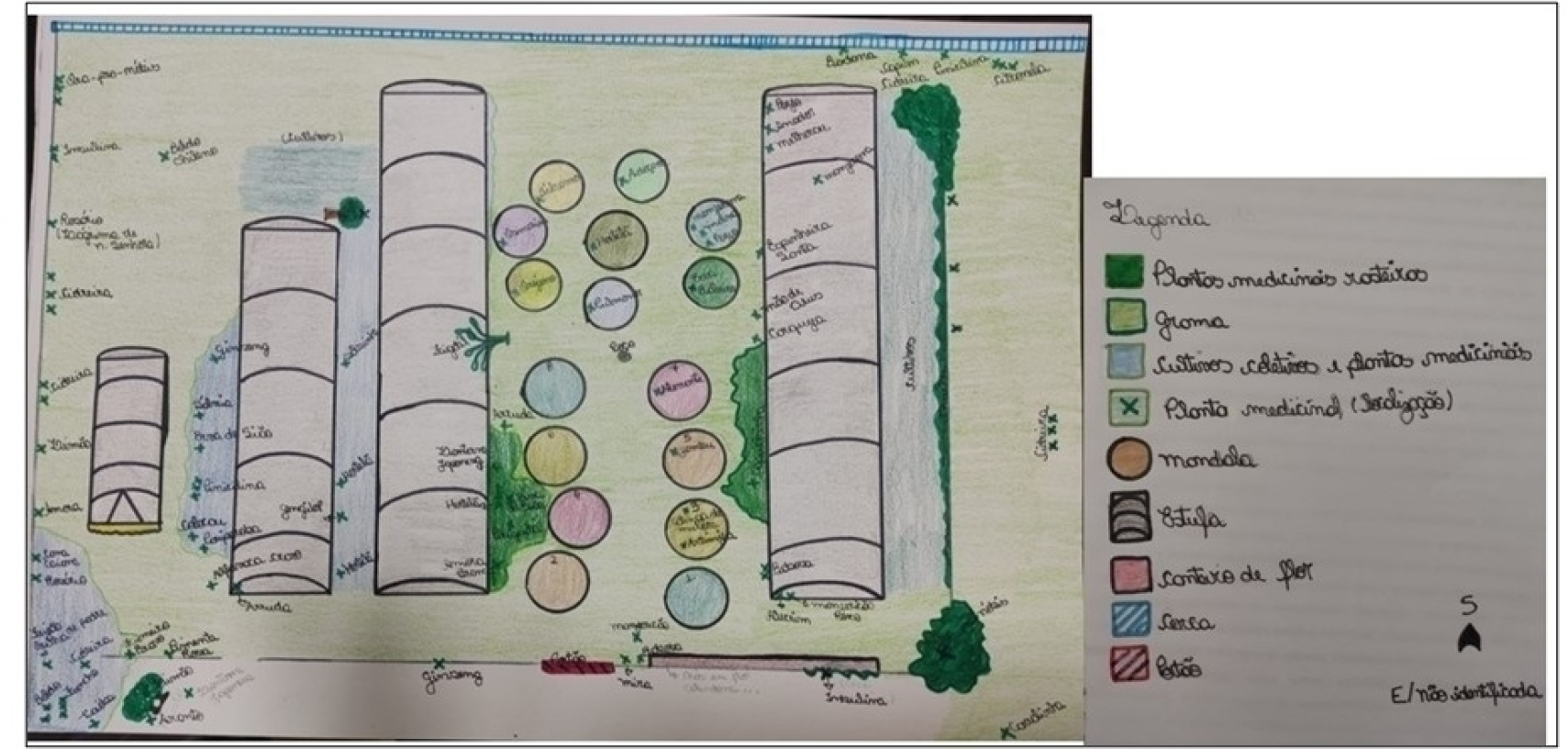
Furthermore, we understand that the territory of life is established in a historical practice, in intercultural communication and in a dialogue with science and other knowledge, in a process of objectification of life (LEFF, 2021). Projects focused on the place can contribute to social transformation on the scale of everyday territorialities, in know-how. Valuing people, their ways of life and subjectivities, as well as their individual and collective resistance. In this direction, seeking to understand these relationships that the subjects configure with the community garden, we developed another social cartography in June 2024, with the objective of meeting the group's request to map the garden together, considering the living collection of medicinal plants. Carrying out this exercise became special for us, in the sense of materializing relationships of trust, respect and dialogue with the subjects.
In March 2024, at the group meeting, the guardians highlighted the importance of better identifying the arrangement of the plants, as well as updating the collection list, considering the idea that the garden functions as a house of medicinal plants, serving the community and institutions that seek medicinal plant seedlings in the region. Thus, we arranged a meeting with the guardians on June 4th, at the garden to take photographs of all the plants and mark their arrangement on paper.
Another important aspect was the movement from the inside out, in which the group requested that the cartography be created, with the aim of improving communication, especially in the division of tasks. Thus, with the use of cartography, everyone has access to the layout of the plants, mandalas and flowerbeds, being able to indicate the place where they worked during the period they were in the garden, as well as this material helping in the planning of planting new plants or replanting those that need maintenance (figure 3).

In this first meeting, in addition to photographing the plants, we drew the first draft of the cartography, considering the choices of symbols, to form the legend. On 06/18/24, we met again to finalize the cartography, using the images from the previous meeting. With this exercise, we sought to co-produce a social cartography aimed at identifying and planning activities in the community garden. In addition, we carried out the systematic return movement, in order to discuss the care and preservation of socio-environmental relations present in this territory.
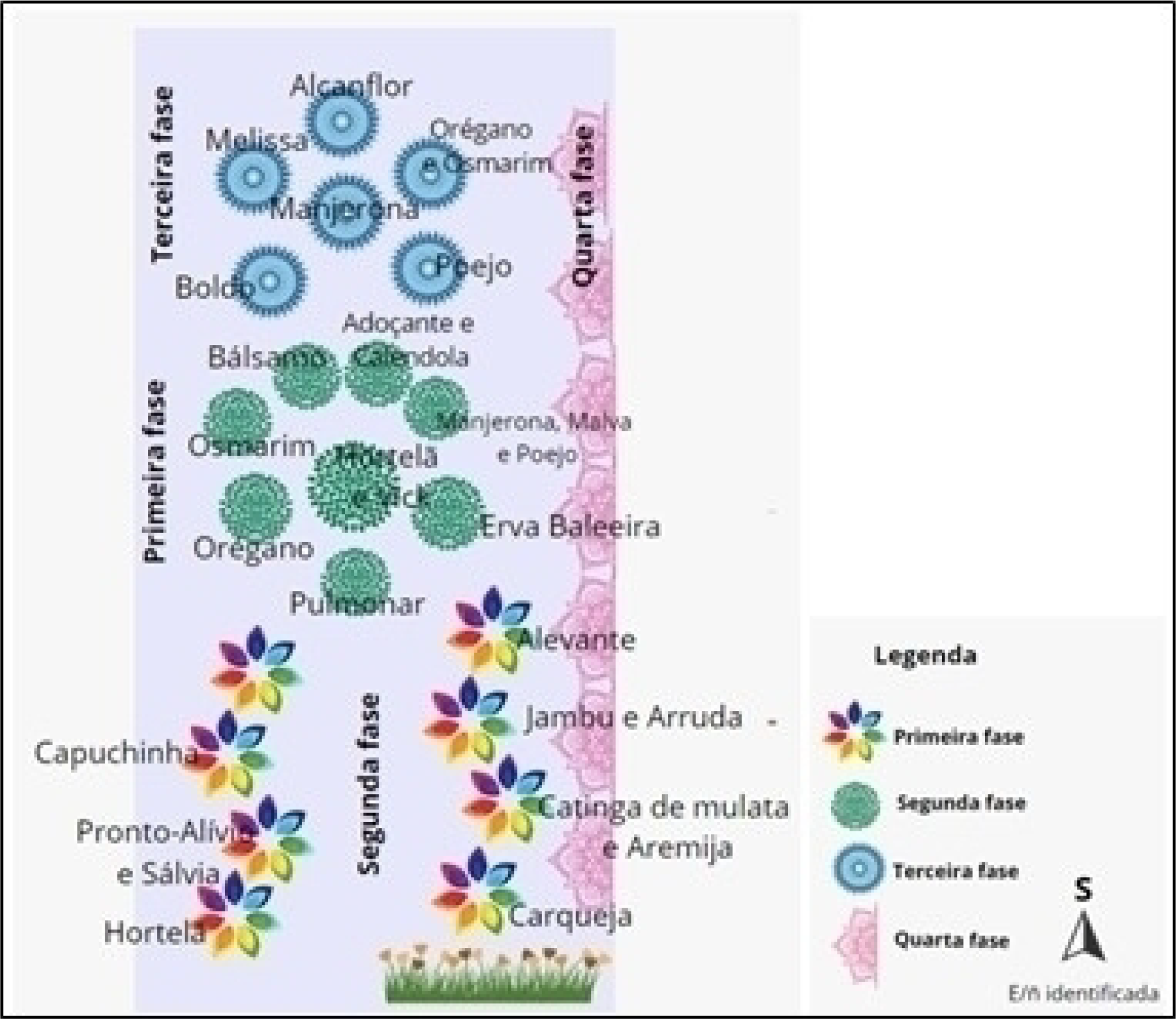
With the cartography ready, the group considered it important to produce a detailed cartographic representation of the mandala area. To this end, we carried out a joint exercise of social cartography analysis, using a drawing platform to produce a thematic representation - colored and named - of the area in question (figure 4). In this way, the group used this representation in a didactic way to propose and plant new medicinal plants, as well as organize the cleaning of the space.

With this movement, we can understand different sensitivities and readings of reality and the construction of thought from other perspectives and with greater decision-making autonomy on the part of the group. In this way, situating ourselves as political subjects is presented as a necessity in the process of changing the modes of production of socio-environmental knowledge and know-how, which can enhance different ways of thinking and knowing, in order to strengthen the foundations of a historical consciousness focused on the production of territories as a place of life.
And, it was and remains, from these epistemic bases, that we sought to reflect co-productions of socio-environmental knowledge, based on our experiences at CIMMAD, in the Padre Ulrico neighborhood. In this context, we can understand the diversity present in the place, both in terms of materialities and immaterialities (affections, knowledge, subjectivities, sensibilities) that shape everyday territorialities and socio-environmental knowledge. This understanding focuses on the sustainability of life, which in this experience, is associated with environmental issues, situated in a complex web that involves society-nature interrelations.
The co-production of socio-environmental knowledge, in this way, can contribute to enhancing the construction of meanings and other ways of interacting with nature, in order to mobilize 'action with non-commercial values and for non-material or utilitarian purposes’ (LEFF, 2011); in which the dialogue of knowledge is configured as 'knowledge marked by the diversity of knowledge and the differentiation of the senses of being' (LEFF, 2011), focused on the existence of subjects, their knowledge, ways of life and sensibilities of living.
This movement requires feeling, working and educating in favor of socio-environmental relations, based on the sustainability of life, without exclusion and violence, valuing subjects and nature in continuous and dynamic interrelations, in this way, working for peace, in its different dimensions and levels, in favor of a sentient-thinking praxis focused on people, communities, cultures, knowledge, identities and histories (SANDOVAL-FORERO, 2021).
Along this path, another important aspect related to the movement to consolidate the garden in question, in favor of socio-environmental know-how, is the implementation of clean-up efforts, expansion of flowerbeds, planting of vegetables and construction and cultivation of medicinal plants. This movement is also one of the results of our participatory action-research. In this sense, in figure 5 we highlight the community garden in 2021 and in figure 6, the structural modifications that occurred throughout our participation.


The figure shows some images that reflect the experience of 2021, while the institution was undergoing structural renovations and after the relaxation of Covid-19 prevention measures. At that time, we carried out some cleaning and extension activities on the construction sites, in view of receiving the material - PVC pipes, shade cloth and hoses - from the city hall, considering the resumption of in-person activities by the group; monthly work parties were held, with a control on the number of participants, considering the municipal health measures.
It is worth noting that the cleaning of the medicinal plant area and the extension of the vegetable beds were happening simultaneously, so that the group divided up the tasks, respecting the know-how and health conditions of each person. Thus, in 2022, 6 collective efforts were carried out and in 2023 there were 10, approximately one per month, respecting the recess and vacation period provided for in the CIMMAD calendar.
In 2024, with the change in coordination of the extension project and the community garden committee, the community gardening sessions began to take place weekly (totaling 4 per month). The change made it possible to maintain the flowerbeds and increase the number of mandalas, as well as recover medicinal plants (Figure 6).
The joint efforts made it possible to improve the garden's infrastructure, so that the beds were redistributed, increasing the size of the cultivation area, both individually and collectively. In this way, 50% of all production is destined to feed the children enrolled in the Institution, and the remainder goes to the member of the group responsible for the garden, who has autonomy over the destination of the production, whether it be for family consumption, sale of the surplus or donation. In the experience with the subjects, it became clear that commercialization is not central, since the group members do not sell their production, which is donated to the institution that stores it in a cold chamber. Another aspect is the care with the production of vegetables in collective areas - between flowerbeds and borders -, since the production is divided according to the demand and taste of each member of the group, being cultivated and maintained by everyone. Finally, the mandalas are also the responsibility of the group, with the guardians of the medicinal plants being responsible for the decision on the removal, replanting, distribution and introduction of new plants.
All decisions that were made to reorganize the Amarbem/CIMMAD community garden from 2021 onwards were made in a collective, participatory and dialogic manner, sometimes with the presence of more people, sometimes less, but always respecting the autonomy and know-how of the group. This means a political, ethical and epistemic positioning that aligns itself with a relationship with social conflicts, seeking to actively participate in a decolonial perspective, as a movement that aims to contribute to social transformation. In this way, everyday resistance is characterized by practices that oppose the dominant discourse, or according to Freire (2018 [1968]), resistance brings together political and cultural struggles that go against hegemonic ideals.
This is why we tried to build subject-subject relationships, so that communication became essential to create spaces for dialogue and exchange of knowledge and actions that could not be previously planned. What we mean is that, while we were investigating, acting, reading, working, listening and dialoguing in a respectful way, we co-produced participatory movements, which allowed decision-making by the group involved, meeting the demands of this group and counting on the active participation of the subjects.
The knowledge co-produced in the community garden moves through a network of connections and circulations, being absorbed and adapted, depending on the singularities of the place, contributing to breaking the notion of isolation. This understanding allows us to understand that, by co-producing knowledge through PAR, committed to local social transformation, the configuration of networks becomes a relevant aspect for the movement to overcome the coloniality of knowledge, being, power and nature.
By configuring networks, the subjects - in this case in which we are involved - bring together actions in favor of maintaining the territorial node - CIMMAD - while at the same time creating some conditions for living well, focused on the sustainability of life. According to Figure 7, we can observe the web of relationships and connections that shape the actions from CIMMAD, involving several institutions such as: Caritas Diocesana de Palmas, PISF, UNIOESTE (Medicinal Plants Project and NAPI - Food and Territory), UTFPR (PPGDR), ASSESOAR and the city hall.

Summary of institutions and relations coexisting in the place. Source: Own elaboration (2023).
This movement has enabled the formation of webs of knowledge, practices, subjects, stories and geographies that resist through daily habits and dialogues of knowledge, which configure the ways of life that materialize in the Amarbem/CIMMAD community garden. The subjects with whom we work were and are the center of our research, in which the primary objective has always been to understand the coproduction of cross-border socio-environmental know-how.
The reality in which we live in the Padre Ulrico-Francisco Beltrão neighborhood has enabled us to come closer to the production of 'other territories, with times, rhythms and singularities that are opposed to the dominant logic. In this context, the place-community has emerged as a central focus in socio-environmental relations, demonstrating the importance of extension projects linked to social movements.
From this perspective, among the lessons learned that we can highlight is the medicinal plants project, which resulted in two positive aspects for the neighborhood, namely: i: the construction of the Amarbem community garden, which became a space for dialogue of socio-environmental knowledge and actions focused on human and environmental care, and: iithe promotion of a positive agenda for the neighborhood, redefining the place based on new symbols and values. This redefining of the place is linked to the presence of new experiences in the neighborhood, more positive socially and culturally, breaking away from the negative news of violence and poverty.
Furthermore, the work of the Napi-Food and Territory team, with the development of workshops with the public enrolled in CIMMAD, enabled new debates on environmental education based on the territory lived. It also contributed to the construction of mandalas of medicinal plants, assisting in the initial process, strengthening attitudes and feelings of participation, solidarity and autonomy with the group.
Regarding the PISF project, we can highlight: ithe redefinition of the place (institution) with the presence of the sisters, in order to attract new partnerships and infrastructure investments; iithe offer of after-school vacancies, serving a significant number of families; iiithe interdisciplinary work aimed at the search for sustainability of life; ivthe feeling of security co-produced between the sisters (religious) and the guardians, in the sense of permanence and strengthening of the community garden, as a place to be preserved and valuable, and; vthe production of a place that strengthens new symbols and values for the neighborhood, distancing itself from the news of violence.
These aspects appeared in the research-action-reflection process at many moments, mainly in the speeches of the subjects involved in the research, as well as in spaces outside the neighborhood. The presence of the community garden since 2013 and the opening of CIMMAD in 2022, has strengthened silent popular struggles for self-recognition of the place (Padre Ulrico neighborhood) as a territory produced by subjects in resistance - be it social, political, cultural and/or environmental - linked to the search for the sustainability of life in all its forms.
Socio-environmental knowledge and practices, place, and local knowledge can thus be understood as paths that allow the construction of diverse modes of production and life that are not necessarily capitalist (ALBÁN ACHINTE & ROSERO, 2016). Likewise, the importance of place as a locus for the perpetuation of culture, identities of resistance (CARLOS, 1996), self-organization, and popular participation can result in co-productions of knowledge aimed at social transformation, in favor of life and the strengthening of ‘other’ sciences or localized popular sciences, in favor of the people and the care of the planet. Or, according to Floriani (2009), we need to learn to live with diversity, valuing culturally localized knowledge and sustainable ways of life present in communities. Thus, the urgency lies in relearning how to live together, giving way to ‘other’ ways of producing and living, without necessarily destroying nature.
CONCLUSION
The construction of localized knowledge involves the co-production of socio-environmental know-how, based on other understandings of nature, culture and knowledge, focused on border realities, invisible ways of life, subalternized practices and knowledge, slower rhythms that coexist with the modern logic of socioeconomic development, dynamizing territories. Thus, our objective was to reflect on territorial praxis, considering socio-environmental know-how as a path to activating territorialities, valuing the subjects and places of life.
In this sense, the cartographies co-produced throughout the participatory action-research sought to reveal other ways of living in a network, through processes of cooperation and solidarity, revealing other ways of life, focused on more respectful relationships between society and nature in all dimensions. This perspective considers the reproduction of life associated with ‘other’ ways of being and being with others, thus the sustainability of life is based on the existence of relationships of affection (direct or indirect), dependencies and solidarity, which includes interdependencies that materialize in the place. These are ways of perceiving life experiences, including resistance, recognizing subjective relationships of affection, belonging and solidarity. Thus, the production of knowledge permeates different dimensions of the lived, as we are reflecting-acting-practicing in CIMMAD, considering it as a territorial ‘node’, permeated by different society-nature relationships.
The production of knowledge in the context of CIMMAD, as we seek to reflect in this action research, permeates the understanding of the interconnection of subject-nature relationships, towards the production of living well. Community relationships, territorial belonging and perceptions of nature, present in this context, bring together socio-environmental experiences promoted by different subjects and institutions, which come together in common objectives, to contribute to the sustainability of life.
Thus, we believe that the co-production of knowledge based on the socio-environmental know-how of the guardians and other subjects included in CIMMAD can contribute to strengthening movements in favor of popular sciences, aimed at solving local problems. The territory and everyday territorialities are inscribed in this context as fundamental aspects for understanding the sensitivities of living. The knowledge and practices present in these territories located on the ontological and epistemological frontiers are the materialization of the resistance promoted and experienced by the subjects, in a movement of solidarity, cooperation and respect for life.
This understanding helps us to reflect on relationships that involve notions of living well, care, nature, know-how, territories, subjectivities and temporalities coexisting in the place. The experience of participatory action-research that we experienced at CIMMAD, especially with the Amarbem/CIMMAD community garden group, makes us reflect and understand the potential of feeling-thinking-making knowledge through co-production, configuring 'other ways of understanding society-nature relationships, based on territorial praxis.
This movement showed ways of living, thinking and territorializing, located on the borders of modern/colonial logic. Ways of living that approach other logics of living well (theme for another text), being located in a dimension of coexistence, which include forms of resistance from within, subtle and silent, practiced in everyday life, reproducing ways of life, with territorial belonging.
ACKNOWLEDGMENTS
This work was financed by the Coordenação de Aperfeiçoamento de Pessoal de Nível Superior (CAPES).
REFERENCES
- ALBÁN ACHINTE, Adolfo e ROSERO, José. Colonialidad de la naturaleza: ¿imposición tecnológica y usurpación epistémica? Interculturalidad, desarrollo y re-existencia. Revista Nómadas, N. 45, 2016, p. 27-41.
- CARLOS, Ana Fani A. O Lugar no/do mundo. São Paulo, HUCITEC, 1996.
- CURY, Mauro J. F. As categorias de território, fronteiras, territorialidades e redes intrínsecas na interdisciplinaridade. In: CURY, Mauro J. F (org). Interdisciplinaridade em territorialidades transfronteiriças. Curitiba: CRV, 2019, p. 23-34.
- ESCOBAR, Arturo. Sentipensar con la Tierra: Las Luchas Territoriales y la Dimensión Ontológica de las Epistemologías del Sur. Revista de Antropología Iberoamericana, V 11, N 1, 2016, p. 11 - 32.
- FALS BORDA, Orlando. Por la praxis: el problema de cómo investigar la realidad para transformarla. Simposio Mundial de Cartagena, vol. 1, Bogotá, Punta de Lanza - Universidad de Los Andes, 1978, p. 209-249.
- FALS BORDA, Orlando. Experiencias teórico-prácticas. In: Una sociología sentipensante para América Latina. Cidade do México: Siglo veintiuno, Clacso, 2015 [1998], p. 303-366.
- FLORIANI, Dimas. Por uma epistemologia da diversidade. ResearchGate, janeiro, 2009.
- FREIRE, Paulo. Pedagogia do compromisso. América Latina e educação popular. In: FREIRE, Ana Maria Araujo (org). 1 edição. Paz & Terra, RJ/SP, 2018 [1968].
- LEFF, Enrique. Ecologia Política: da desconstrução do capital à territorialização da vida. São Paulo: Editora da Unicamp, 2021.
- MARTINS, Jose de Sousa. Fronteira, A degradação do Outro nos confins do humano. São Paulo. Editora Hucitec, 1997.
- MIGNOLO, Walter. Os esplendores e as misérias da “ciência”: colonialidade, geopolítica do conhecimento e pluri-versidade epistémica. In: SOUSA SANTOS, Boaventura (org). Conhecimento prudente para uma vida decente: um discurso sobre as ciências revisitado. São Paulo: Cortez, 2006, p. 639 - 665.
- SANDOVAL-FORERO, Eduardo A. Sentipensar intercultural y metodologias para la sustentabilidade de desarrollos otros. Ediciones de la Universidad Autonoma Indigena de México. 2021.
- SAQUET, Marcos. Saber popular, práxis territoriais e contra-hegemonia. Rio de Janeiro: Editora Consequência, 2019.
-
Editors in Charge
Alexandra Maria OliveiraAlexandre Queiroz Pereira