 QUILOMBOLA RESISTANCE OF CUMBE (ARACATI/CE) AGAINST THE CAPITALIST APPROPRIATION OF NATURE
Abstract
The article results from questions deriving from our doctoral thesis project and the analysis of data obtained in our master's thesis. We aim to understand: how the community logic of appropriation of natural assets made by Quilombo do Cumbe, followed by its resistance to capitalist appropriation, contributes to hindering or stopping local environmental degradation. As for the methodology, we used participatory research, committing ourselves to exposing the collected data to the researched subjects and maintaining dialogue between scientific knowledge and the empirical knowledge of quilombolas do Cumbe. Regarding methodological procedures, they were based on bibliographic and documentary research, followed by fieldwork, allowing the construction of a field notebook, the application of semi-structured interviews, and the conduction of social cartography workshops. By carrying out the research, it was possible to verify that, because the quilombolas do Cumbe do not see their natural assets in a capitalist way, they resist the advances of large companies in their territory, using varied strategies that result in a slowdown in local environmental degradation. That said, the quilombo's actions, resisting the advances of capital in their territory, have benefited the local environment, contributing to the conservation of their natural assets.
Keywords:
Capitalist Appropriation; Cumbe; Human/nature Relationship; Resistance.
Resumo
O artigo resulta de indagações oriundas do nosso projeto de tese e da análise de dados obtidos na nossa dissertação de mestrado. Objetivamos compreender: como a lógica comunitária de apropriação dos bens naturais feita pelo Quilombo do Cumbe, seguido da sua resistência à apropriação capitalista, contribui para dificultar ou barrar a degradação ambiental local. Quanto à metodologia, utilizamos pesquisa participante, comprometendo-nos a expor os dados coletados aos sujeitos pesquisados e a manter o diálogo entre o saber científico e o saber empírico dos quilombolas do Cumbe. Com relação aos procedimentos metodológicos, basearam-se em pesquisas bibliográficas e documentais, seguidas de trabalhos de campo, permitindo a construção de um caderno de campo, a aplicação de entrevistas semiestruturadas, e a realização de oficinas de cartografia social. Com a realização da pesquisa foi possível constatar que, devido aos quilombolas do Cumbe não enxergarem seus bens naturais de uma forma capitalista, eles resistem aos avanços das grandes empresas no seu território, utilizando estratégias variadas que resultam em uma desaceleração da degradação ambiental local. Dito isto, a atuação do quilombo, resistindo aos avanços do capital em seu território, tem beneficiado o ambiente local, assim, contribuindo para a conservação dos seus bens naturais.
Palavras-chave:
Apropriação Capitalista; Cumbe; Relação Ser Humano/Natureza; Resistência.
Resumen
Este artículo surge de las preguntas que surgieron de nuestro proyecto de tesis y del análisis de los datos obtenidos en nuestra disertación de maestría. Buscamos comprender cómo la lógica comunitaria de apropiación de los recursos naturales por parte del Quilombo do Cumbe, seguida de su resistencia a la apropiación capitalista, contribuye a obstaculizar o detener la degradación ambiental local. En cuanto a la metodología, utilizamos una investigación participativa, comprometiéndonos a compartir los datos recopilados con los sujetos de investigación y a mantener un diálogo entre el conocimiento científico y el conocimiento empírico de los quilombos de Cumbe. Los procedimientos metodológicos se basaron en la investigación bibliográfica y documental, seguida de trabajo de campo, lo que permitió la creación de un cuaderno de campo, la aplicación de entrevistas semiestructuradas y la realización de talleres de cartografía social. La investigación reveló que, dado que los quilombolas de Cumbe no ven sus recursos naturales desde una perspectiva capitalista, se resisten a los avances de las grandes corporaciones en su territorio, empleando diversas estrategias que resultan en una desaceleración de la degradación ambiental local. Dicho esto, las acciones del quilombo en resistencia a los avances del capital en su territorio han beneficiado el medio ambiente local, contribuyendo así a la conservación de sus recursos naturales.
Palabras-clave:
Apropiación Capitalista; Cumbe; Relación Humano/naturaleza; Resistencia.
INTRODUCTION
According to Porto-Gonçalves (2014), the “human being vs. nature” dichotomy, which is hegemonically (but not totally) installed in our society, leads us to perceive other living beings, as well as the natural resources existing on our planet, as something inferior, whose only purpose is to serve the purposes of human beings.
This vision of nature enables the capitalist appropriation of natural assets and their use for generation of profit, transforming them into resources and commodities. These ways of relating to nature aim at meeting capitalist accumulation, and they cause various environmental impacts. Due to the environmental injustice (Acselrad; Mello; and Bezerra, 2009) that is integrated to the capitalist reality, people with lower income and discriminated social groups, such as the traditional communities, are the most affected. They are chosen by the capital to carry most of the burden caused by capital accumulation.
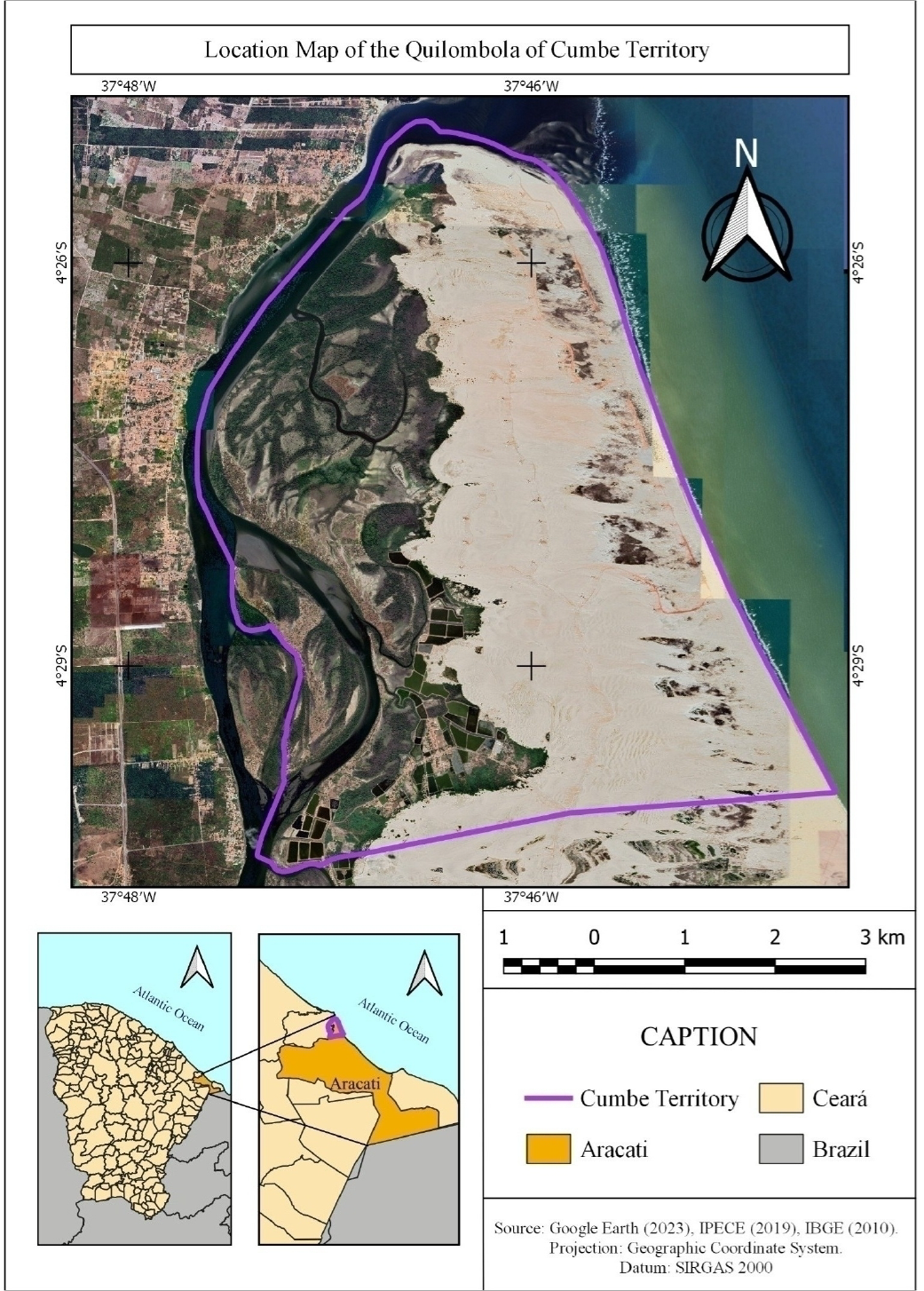
The Quilombola of Cumbe Community, which is our spatial cut, was selected, by both the State and the companies that operate there, as a “sacrifice zone”1 for the sake of an alleged greater good, based on the ideology of development (Dilger; Lang; Pereira, 2016). The territory of the community is located on the eastern coast of the State of Ceará, in the municipality of Aracati, as shown on map 1, more specifically, on the right bank of Jaguaribe River2, close to its mouth. Due to its dependence on natural resources, which are preserved for purposes of social reproduction, the community seeks to appropriate them as common assets in opposition to capitalist appropriation, and resist the latter. On several occasions, through this resistance and a different way of relating to nature, the community ends up contributing to the conservation of the natural assets of its territory.

The importance of our research is mainly due to four reasons: the need to instigate scientific discussions regarding the way that traditional communities appropriate the natural assets found in their territories, so that critical reflections arise on how this traditional knowledge could reduce the environmental degradation generated by the capitalist appropriation of nature; the importance of understanding the seriousness of the capitalist appropriation of nature, as it usually leads to the degradation of appropriated natural resources, which is further aggravated when it occurs after the seizure of traditional territories, since it denies the means of subsistence of these communities; the need to convey to society the importance of the resistance of traditional communities in the face of the capitalist appropriation of their territories, in their struggle for a balanced environment; and the possibility of contributing to the resistance of the community of Cumbe in the face of the advances of capital in its territory.
The general purpose of our work is to understand how the communitarian logic of appropriation of natural resources by the Quilombola do Cumbe Community, followed by its resistance to capitalist appropriation, contributes to hinder or stop local environmental degradation. Accordingly, the specific objectives of our work include: 1) analyzing the forms of appropriation of natural assets by the Quilombola do Cumbe Community and setting them apart from capitalist appropriation; 2) identifying the forms of resistance to the capitalist appropriation of nature within the Quilombola territory; 3) discussing the contribution given by the resistance against capitalist appropriation of nature to the maintenance of natural assets in the territory analyzed.
As for the methodological procedures, we used bibliographic and documentary research, as well as fieldwork, which allowed the application of semi-structured interviews, the creation of a field notebook and its constant updating, and the holding of social cartography workshops that resulted in some of the maps presented in this article.
During our research, we noticed that the community treats its natural resources as common goods, which leads to greater care in the maintenance of these assets, followed by resistance to appropriation by companies that arrive in the territory. We realized that the ways of resisting are diverse, forming a set of strategies that contribute to slowing down the destruction of the territory's natural assets, or even to preserving them.
Regarding the methodology of our research, the dialogue between scientific knowledge and the empirical knowledge of the quilombolas do Cumbe allowed us to get closer to the reality observed, and, thus, contribute to strengthening the local struggle. In this way, we can affirm that we developed a participatory research that, according to Gabarrón and Landa (2006), has social relevance, leading to a closer relationship between the researched subjects and the researchers, and putting knowledge at the service of popular interests, with the responsibility of exposing the results to the group studied, for their analysis and discussion.
The preparation of our work included the following methodological procedures: bibliographic research on the main concepts, categories and topics used, such as the capitalist appropriation of nature, the “human beings vs. nature” dichotomy, resistance, common goods, territory, environmental injustice etc.; and documentary research on CAGECE - Companhia de Água e Esgoto do Ceará [Water and Sewage Company of Ceará]3, which operates directly in the territory analyzed.
The participation in social cartography workshops that were held in the community studied, such as the “Social Cartography of Waters,” in which we brought together the community to locate the water bodies of the territory, as well as to map their access to the activities carried out in each of them by the members of the quilombo; “Paths of Community Tourism,” in which we collected data and mapped, together with the community, the routes used in the territory during the practice of community tourism; and the “Social Cartography of Shellfish Catchers.” All these initiatives were organized by our research group in partnership with Terramar Institute for Research and Advisory on Artisanal Fishing and the Quilombola do Cumbe Association; in addition, we participated in the Mangrove Festival, organized by the Cumbe Association, in order to promote the community's struggle and show the beauty of the quilombo's natural assets. The purpose of participating in these events was to collect information, get closer to the researched subjects and contribute to their struggle in defense of the territory.
The field research involved the application of different procedures, as described below: the production of maps based on the social cartography technique, combined with geoprocessing, which enabled creating the location of data analyzed in a more reliable way and closer to the reality of the community; the creation of a field notebook for writing down information about the daily life of the community; and the application of semi-structured interviews carried out in the form of conversation, giving the subjects greater freedom to detail their interviews, and allowing us to collect more data for organizing the research.
THE “HUMAN BEING VS. NATURE” DICHOTOMY AND CAPITALIST APPROPRIATION
Throughout the history of humanity, the distance between human beings and nature has become something natural, and human beings see themselves as superior to what they consider natural. However, this hegemonic vision that we have today is a Eurocentric vision that was imposed on the various peoples of the globe through the colonization and domination perpetrated by Europe. According to Leff (2016), a whole range of ontologies4 was replaced by the imaginary of a single world, a capitalist world.
Therefore, human beings have not always seen nature as something separate and subordinate to them. According to Carvalho (2003), primitive people did not even conceptualize nature, since they felt they were part of it. Thus, it was not necessary to group different natural elements, including other living beings, in a ‘conceptual box’ and name it “Nature.”
According to Bornheim (1985), in the Ancient World, pre-Socratic philosophers already felt the need to conceptualize nature, but in a way that included the human being. The distinction between animate and inanimate nature did not exist. Everything would be constituted of a soul, the nature, and human beings, who also possessed it and were part of it.
Porto-Gonçalves (2014) clarifies that the post-Socratic philosophers started to privilege the human being and the ideas in their reflections, while nature begun to be ignored. The thoughts of previous philosophers were disqualified. As a result, the part of humanity that was influenced by the Greek thought gradually distanced itself from nature, until it no longer felt it was part of it.
Continuing with the historical leaps, still based on Porto-Gonçalves (2014), the Middle Ages were one of the main milestones of human distancing from nature. Due to the Judeo-Christian influence, human beings start to see themselves as the image and likeness of God, feeling superior to other living beings and believing that both natural resources and other animate beings exist to serve humanity.
The Modern Age is another milestone in the separation of human beings and nature, according to Aráoz (2016, p. 456) and Carvalho (2003, p. 41): this would be the time when capitalism was consolidated and asserted itself as the main mode of production, establishing new relations of coexistence between people, and also between them and nature.
Scientific knowledge became a way of subordinating nature, with the rise of a mechanistic notion of nature as a scientific truth. The only purpose of nature would be to function as a “machine,” whose only objective was to provide raw materials for industries, that is, resources for production of goods, and all of this when nature itself was not often seen as a commodity.
This way of relating to nature was not restricted only to its "cradle" (Europe), according to Castro (2021, p.40):
With the great navigations, and the colonization of peoples and the impositions of "modern" Europe on its colonies, this (European) way of seeing nature was spread throughout the world to other societies that, when colonized, had no choice but to accept this vision of nature, to pretend it was accepted, or to die with their ontologies.
Based on the reading of Porto-Gonçalves (2014), this vision of a subaltern nature is convenient to the capitalist system, thus allowing the transformation of natural assets (land, water, forests, biodiversity) into resources and commodities, leading to the capitalist appropriation of nature. This way of appropriating nature relegates natural assets to simple instruments of capital, used to meet the needs of capital in the generation of profit, thus disregarding their usefulness for the maintenance of the environment in which they are found, often leading to pollution and consequently, the emergence of various environmental impacts.
However, according to Acselrad, Mello and Bezerra (2009), the destructive legacies of the capitalist appropriation of nature are not equally divided. Based on the Brazilian Network of Environmental Justice (2001, n.p.), most environmental damages are distributed to low-income populations and discriminated social groups, creating situations of environmental injustice. The traditional communities are among the discriminated social groups.
According to FASE, ETTRN, IPPUR (2011), environmental injustice occurs in different ways, from disposal of pollution to discriminated and vulnerable groups; denial of access of these groups to their natural assets; prioritizing the exploitation of natural resources in their territories, generally causing degradation of their environments; and even when companies, or the State itself, arrive in the territories to co-opt and deceive part of the residents, separating them and causing members of the same group to fight among them.
Therefore, traditional communities are deeply affected by the capitalist appropriation of nature. Nevertheless, according to Ostrom (1990) these communities usually see their natural resources as common goods, that is, they have a view that differs from the capitalist view with regard to the natural assets in their territories. Appropriating a natural asset as a common good implies appropriation that prioritizes its maintenance, resulting in a more adequate management of the natural limitations of that asset.
It is important to understand that, when using a common good, one should have a collective vision, rather than an individualistic one. Its use by one person cannot harm the enjoyment of another, and the maintenance of the good in question should always be prioritized. A common good does not mean the absence of property, but that all users of that good are its owners and have equal responsibility and rights over it. According to Feeny et al. (2001), the common use of an asset is linked to rules that are created by those who use the asset, in order to preserve it.
According to Alier (2017) and Castro (2021), we realize that, because they need the natural assets of their territories to be in good condition to maintain their survival and customs, and because they treat their natural assets as a common good and resist the capitalist appropriation of their territory and its natural assets, the traditional communities are an enclave of resistance to capitalist appropriation, hindering or barring environmental degradation in their territory.
THE QUILOMBO DO CUMBE AND RESISTANCE IN FAVOR OF THE COMMONS
The Quilombola do Cumbe Community is no exception, and it sees the natural assets of its territory - the mangrove, the water bodies, and the dune field - as common goods that must be preserved through sustainable use. Map 2, which was prepared together with the quilombolas using the technique of social cartography, reveals the community’s different uses of the water, a common good, in their territory. These uses result not only in the demonstration of territoriality5 of the quilombo, expressing the limits of its territory of life (Leff, 2016), but also result in the defense of these assets through resistance to a possible capitalist appropriation that may also occur.
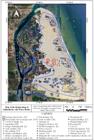
Map of the Relationship of Quilombolas with Water Bodies. Source: prepared by the Authors, 2024.

On Map 2, we can list 110 water bodies. Of these, 91 still exist, but 19 no longer exist due to the impacts caused by companies and/or natural causes. Adding the activities that are still performed today to those that took place in water bodies that no longer exist, we would have a total of 423 activities spread across these 110 water bodies in the territory. Of the total of 423 activities, there are 27 different categories of activities. It is important to highlight that, on the map, the large water body represented by the contour and encompassing most of the dune field, is the Jandaíra aquifer. Although it cannot be seen directly on the satellite image, it gives rise to the local interdune lagoons, and supplies the wells used by the community members. In this way, due to its great importance, the community decided to represent it on the map. Looking at this map, we can see the significance of the “water” common good for the Quilombo, and the richness of uses that the community makes of this good.
However, it is important to emphasize that the community only has this wealth of uses of its common goods due to its constant resistance, since companies arrived in the quilombo's territory appropriating water and other natural goods as a resource and commodity. According to the data collected in our research and to readings of Meireles (2011), Nascimento (2014) and Pinto et al. (2014), the action of companies, such as CAGECE, shrimp farms and wind farms, and the capitalistic appropriation of the natural resources of Cumbe, ended up generating several impacts, such as the pollution of Jaguaribe River, cut-down of mangroves, salinization of wells, fencing of river branches, privatization of streams and lagoons, compaction of dunes, and others.
However, these degrading actions generated a reaction, resulting in numerous forms of resistance on the part of the quilombo so as to prevent the advance of capital in their territory. According to Scott (2011) and Pereira (2017), there are several forms of resistance, and these do not necessarily have to be violent.
The community has used several strategies to resist the advances of different agents of capital, from direct confrontation, such as the closure of roads, occupation of lands for construction of alleged shrimp farming tanks, and organization of demonstrations, and even legal confrontation to regain access to the dune field, creation and maintenance of community tourism in the territory, and a partnership with the university for conduction of joint research that would support the importance of the quilombola resistance and identify the environmental impacts caused by the companies. Some of the main forms of resistance linked to the respective impacts are shown in Table 1, which contains neither all the forms of resistance of the community, nor all the impacts generated by the capitalist appropriation of nature in the territory, as these are innumerable and generated by several factors, besides multiplying rapidly.
Table of the Different Forms of Resistance and Respective Strategies Used by Quilombo do Cumbe(6). Source: prepared by the authors, 2024.
As shown in the table above, we can notice that community tourism is a form of resistance common to all the impacts generated. It is through community tourism that the quilombolas communicate both their struggle and environmental injustice, exposing the impacts generated by the capitalist appropriation of nature in their territory. The speech of a quilombola woman explains the importance of community tourism for their resistance:
We try to take actions, avoiding conflicts, like: community tourism is an action that is not conflicting, at least it is not meant to be, because we are families doing community tourism, and we are saying that we need this territory to live, we go to the river, we use the space of the river, the beach and the lagoon. "Look, wind farm, we don't want you to close here [referring to the fencing and privatization of the dune field that gives access to the beach], because we have community tourism here, we need this beach, we fish, we have leisure." So, this is a way of resisting without conflict. (UÇÁ, 2020)(7)
slowing down others, such as the prevention of mangrove cut-downs by shrimp farmers, due to the constant surveillance of the quilombo, and the occupation of shrimp farming tanks, which demonstrated that the community was willing to fight for this ecosystem. As another quilombola woman explains:
[...] today we practically hold vigils, so the vigils are constant, in the sense of observing the mangroves, the degraded areas [...] I remember our resistance inside a shrimp farm and that we wanted the replanting of the mangrove in this area, because [the cut-down of mangrove] was a big loss, many families took their income from there, and we occupied the place for 5 months. (INTÃ, 2020)
The resistance also contributed to the reduction of river pollution and mortality of species on which the community depends. The speech below recalls the struggle against pollution of the river, which was causing the death of crabs:
Our income came from the crabs, the family's biggest income was the income from crab catching and then, like, after one week you don't catch anything, another one goes by and you still don't catch anything, then you get desperate because that's where my income comes from, that's where my food comes from. We panicked, and then I remember that we mobilized and went to fight, this mortality of crabs was really disastrous [...] it took two years [...] they [the shrimp farmers] used too much chemistry, [...] too much chemistry, so that's where our resistance came from [...] it went from 2000 to 2001. (INTÃ, 2020)
It is worth mentioning that quilombola men and women consider themselves as guardians of the natural water asset in their territory and, consequently, of Jaguaribe River, and it is their duty to defend this natural element as well as the life that depends on it. For the quilombolas, water is a common good essential to their survival and, at the same time, a sacred good:
Because, well, we see water as a sacred good, a good for everyone, and that water is life, and they [entrepreneurs] see water as a business, water is the commodity, and then we are the ones who lose, because as I see water as life and we have all this care, we are the guardians of water [...] and they [entrepreneurs] are the destroyers [...] they see it as a business, as a commodity, and they destroy all that purity of the waters, because they are not worried about tomorrow, no, they want today and more money, and if they have their water, they do not think about the future generations (INTÃ, 2020).
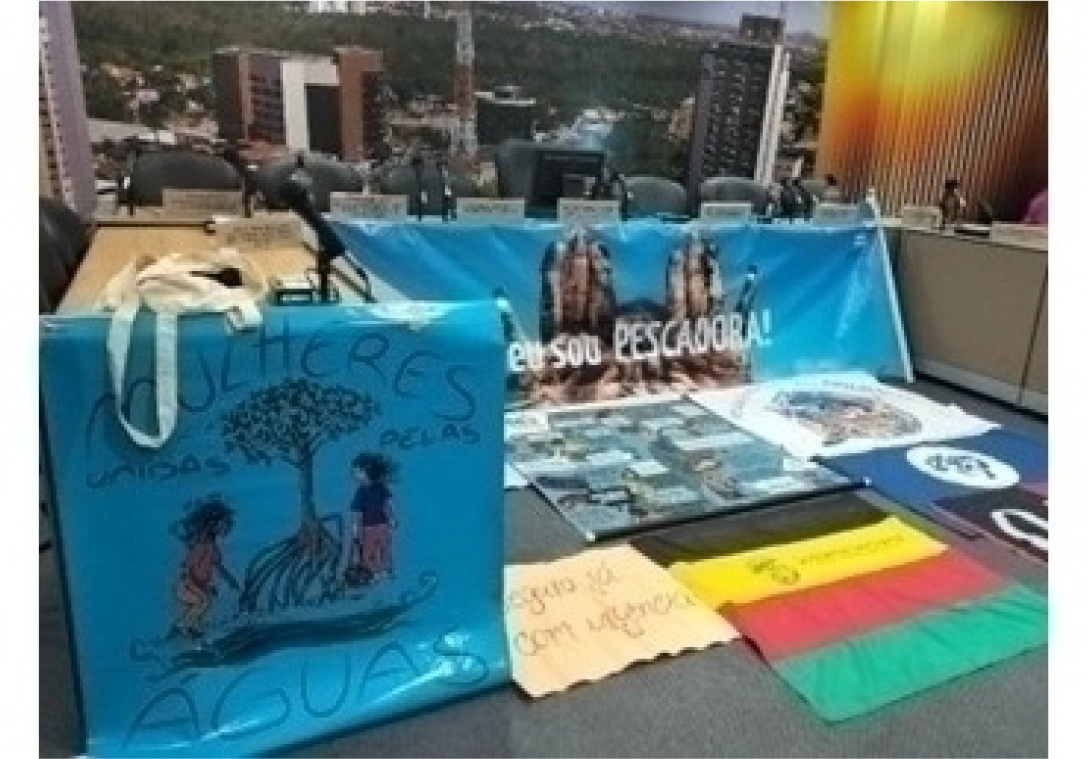
However, it is worth mentioning that the defense of Jaguaribe River health8 is not only a responsibility of the Cumbe community: other communities also participate in this struggle, which is constant. In 2023, the shellfish catchers9 from Cumbe and two nearby communities, Jardins and Canavieira, which also use Jaguaribe River, requested a public hearing (which took place after much struggle), in which one of the agendas was for the State to monitor the river and discover possible sources of pollution, so as to repair them. In 2024, a public hearing was also held, organized by the shellfish catchers, to demand that the 2023 hearing be forwarded, and to bring new requests to defend their rights and their way of life.
Looking at the photo, we can see the importance of the “water” natural good for shellfish catchers. In addition to being an essential asset for the survival and continuity of their craft, it is also an element of union in favor of the protection of this asset, as we can see on the poster on the left, which bears the phrase: “Women united for the Waters,” and shows female shellfish catchers conducting their activities in the mangrove, a biome of great esteem for them.
Community resistance also led to a delay in the implementation of the project of the wind company, which was privatizing large areas of the dune field, consequently filling interdune lagoons with earth, and destroying archaeological fields for road construction and implementation of wind turbines, among several other impacts. One form of resistance was the closure of the road of access to the dune field with the purpose of paralyzing the construction of the wind farm.
[...] they promised a lot of things and the wind farm was almost finished and nothing had improved. Then, we decided that on Monday of the week they would resume works, we would start [closing the access road] for an indefinite period, and then people agreed and saw that it was the only thing we could do. [...] And we stayed there for 19 days closing [the road]. (ARATU, 2020)
Unfortunately, the dune field was privatized, but, due to the community's struggle, the quilombolas were granted partial access and managed to save some artifacts from the archaeological sites that would have been destroyed by the wind power company if there had been no resistance; after all, the Cumbe dune field, based on Nascimento and Lima (2017), is a historical source of the community and has artifacts dating from five to ten thousand years ago.
Another result of the resistance is the fact that the community has made it difficult to transform water into a commodity in its territory. Unfortunately, as much as the quilombolas do not see the water in their territory as a commodity, a state-owned company named “CAGECE,” appropriated the water of the territory, causing environmental impacts with the removal of the water table. One of the problems observed by the quilombolas was the fact that interdune lagoons that were once perennial had become intermittent.
Although their resistance has not been able to overcome the interests of the State, the quilombolas have shown that appropriating the natural resources of Cumbe is not easy, due to their resistance. According to the community members, as soon as CAGECE was set up, in the 1970s, water was distributed for free. Later on, the company began to charge a fixed fee and, finally, installed meters to mark and charge for the amount of water used, which generated great resistance on the part of residents.
Man, I think it was in 1992, 1990, something like that, when they first put the [water] meters, then the high bills started to come, then there was a revolution [...] the group didn't accept it, they took the meters and ripped them all out; when the CAGECE people were working there they stopped the car, then they were digging to be able to tear out the general, because the general controlled, but then the police came and didn't let them. Then we took the meters, since no one accepted that, and we were left paying the normal rate. [...] Then the police came and took the employees, they were like hostages, the car remained, but the employees, the gang, they let them go, [...] it was a big revolution, a terrible revolution, then they didn't put the meters. (GUAIAMUM, 2019)
However, after much pressure, the community had no choice but to allow the company to place the meters and start charging for water use. Currently, the water from the quilombola territory is appropriated by the State and sold to the quilombolas.
As observed in the various cases reported, the quilombola do Cumbe community, because they live in a territory that is rich in preserved natural resources, due to the struggle made by the Quilombo, suffered several attacks from capital. For this reason, they learnt different ways to resist these attacks, both for preserving the natural resources of their territory and for maintaining their way of life.
CONCLUSION
In conducting our research, we could notice that the community of Cumbe usually sees its natural assets as common goods, in a relationship with its environment that is much more focused on its maintenance, in opposition to a capitalist appropriation, as they see the water bodies of the territory (river, river branches, streams and lagoons), the mangrove, and the dune fields, as an integral part of their identity as a quilombola do Cumbe.
This relationship between the quilombo and natural assets reminds us of a symbiosis when, in some statements, the quilombolas seem to refer to Jaguaribe River as a living being, which gets sick, runs, and needs protection of the quilombo to stay alive. As a result, the various attempts by the companies that arrive in the territory to appropriate the natural resources in a capitalist way, generating degradation, are faced with a lot of resistance from the quilombo in favor of the natural resources.
From the closure of roads, legal struggles and conduction of research with the university, through to community tourism, the community has been able to block, contain or even hinder some advances of capital in its territory. This leads us to think that, if it were not for the quilombola struggle, the mangroves, the river, the gamboas and the biodiversity of the territory would be much more degraded today. Therefore, Quilombo do Cumbe contributes to the conservation of the natural assets of its territory, which are considered by quilombolas as common goods.
ACKNOWLEDGMENTS
We thank CAPES for having granted the essential master's scholarship so that we could carry out our research, thus enabling preparation of this article.
DATA AVAILABILITY
Not applicable
NOTES
-
1
Based on Knox and Ferreira (2022) and Viegas (2011), the origin of the term dates back to1980, and refers to places elected by the capital to receive the environmental burdens of development, which are often places with cheaper lands and where residents have little access to decision-making processes. Areas that are sacrificed for the sake of an alleged "greater good."
-
2
The largest river in the State of Ceará. It crosses the western side of the quilombola do Cumbeterritory.
-
3
Public-private company founded in 1971. It is responsible for water supply and sewage treatment in most municipalities of the State of Ceará.
-
4
We refer to "ontologies" in the same way that Escobar (2015) considers them, that is, as "ways of seeing the world."
-
5
For more information on territoriality read: SAQUET, Marcos Aurélio; SPOSITO, Eliseu Savério. Territórios e Territorialidades: teorias, processos e conflitos. São Paulo: Expressão Popular, 2009, and SOUZA, Marcelo Lopes de. Ambientes e Territórios: uma introdução à Ecologia Política. Rio de Janeiro: Bertrand Brasil, 2019.
-
6
To prepare the table, we used only data obtained in our interviews.
-
7
For reasons of privacy and security of the interviewees, we changed their names for the names of the animals that live in their territory, highlighting them in italics.
-
8
Some shellfish catchers speak of the river as a loved one who is sick. That's why we say that they “fight” for its health.
-
9
We have called it like that because the female shellfish catchers are fighting for their right to also be considered fisherwomen.
REFERENCES
- ACSELRAD, Henri; MELLO, Cecilia Campello Amaral; BEZERRA, Gustavo das Neves. O que é justiça ambiental. Rio de Janeiro: Garamond, 2009. 156p.
- ALIER, Joan Martinez. O ecologismo dos pobres: conflitos ambientais e linguagens de valoração. Translated by M. Waldman. São Paulo: Contexto, 2017. 384p.
- ARÁOZ, Horacio Machado. O debate sobre o “extrativismo” em tempo de ressaca. In: DILGER, Gerhard; LANG, Miriam; Pereira, Jorge Filho. Descolonizar o Imaginário: debates sobre pósextrativismo e alternativas ao desenvolvimento. São Paulo: Fundação Rosa Luxemburgo, 2016. p. 444-468.
- BORNHEIM, Gerd Alberto. Os filósofos pré-socráticos. São Paulo, Cultrix, 1985. 128p.
- CARVALHO, Marcos de. O que é natureza. 2. ed. São Paulo: Brasiliense, 2003. 86p.
- CASTRO, Ariel Rocha Nobrega De. A Apropriação Capitalista da Natureza e os Conflitos pela Água no Território do Cumbe (Aracati/CE): Lutar e Resistir por um Bem Comum. 2021. 309 f. Dissertation (Academic or Professional Master’s Program in 2021) - Universidade Estadual do Ceará, Fortaleza, 2021. Available at: Accessed on: August 1, 2022
- DILGER, Gerhard; LANG, Miriam; PEREIRA, Jorge Filho. Descolonizar o Imaginário: debates sobre pós-extrativismo e alternativas ao desenvolvimento. São Paulo: Fundação Rosa Luxemburgo, 2016. 468p.
- ESCOBAR, Arturo. Territorios de diferencia: la ontología política de los “derechos al territorio”. Desenvolvimento e Meio Ambiente, v. 35, p. 89-100, Dec. 2015.
- FASE; ETTERN; IPPUR. Projeto “Avaliação de Equidade Ambiental”. Rio de Janeiro: Fase, 2011. 174p.
- FEENY, David; BERKES, Fikret; MCKAY, Bonnie J.; ACHESON, James M. A tragédia dos comuns: vinte e dois anos depois. In: DIEGUES, Antonio Carlos; MOREIRA, André de Castro C. (orgs.) Espaços e recursos naturais de uso comum. São Paulo: NUPAUB - USP, 2001. p. 17 - 42.
- GABARRÓN, Luís R., LANDA, Libertad Hernandez. O que é a pesquisa participante? In: BRANDÃO, Carlos Rodrigues; STRECK, Danilo Romeu. Pesquisa participante: a partilha do saber. São Paulo: Ideias & Letras, 2006. p. 93 - 121.
-
KNOX, Winifred; FERREIRA, José Gomes. Desastre ambiental e zonas de sacrifício: o derramamento de petróleo no nordeste do Brasil e políticas públicas de estado. Revista da ANPEGE. v.12, n.37, p. 89-105, 2022. Available at: https://repositorio.ufrn.br/bitstream/123456789/51926/1/DesastreAmbientalZonas_Knox_Ferreira_2023.pdf Accesed on: July 1, 2024.
» https://repositorio.ufrn.br/bitstream/123456789/51926/1/DesastreAmbientalZonas_Knox_Ferreira_2023.pdf - LEFF, Enrique. A aposta pela vida. A imaginação sociológica e imaginários sociais nos territórios ambientais do Sul. São Paulo: Vozes, 2016. 512p.
- MEIRELES, Antonio Jeovah de Andrade. Danos socioambientais originados pelas usinas eólicas nos campos de dunas do Nordeste brasileiro e critérios para definição de alternativas locacionais. CONFINS, v.11, n.11, p. 1 - 27, 2011.
- NASCIMENTO, João Luís Joventino do; LIMA, Ivan Costa. Nas trilhas da memória e da história: Cumbe um museu a céu aberto. In: Encontro Regional Nordeste de História Oral, 11, 2017.
- Fortaleza. Electronic Proceedings. Fortaleza: Universidade Federal do Ceará, 2017. Available at: Accessed on: July 9, 2024.
- OSTROM, Elinor. Reflections on the commons; an institutional approach to the study of selforganization and self-governance in CPR situations. In: Governing the commons: the evolution of institutions for collective action. Cambridge: Cambridge University Press, 1990. p. 1 - 55.
- PEREIRA, Resistência descolonial: estratégias e táticas territoriais. Terra Livre, v.2, n.43 p. 17-55, jan. 2017.
- PINTO, Marcia Freire; NASCIMENTO, João Luiz Joventino do; BRINGEL, Paulo Cunha Ferreira; MEIRELES, Antônio Jeovah de Andrade. Quando os conflitos socioambientais caracterizam um território? Gaia Scientia, v. 8, n. 1, p. 271-288, 2014. Available at: Accessed on: May 4, 2020.
-
PORTO-GONÇALVES, Carlos Walter. A ecologia política na américa latina: reapropriação social da natureza e reinvenção dos territórios. INTERthesis, Florianópolis, v.9, n.1, p.16-50, 2012. Available at: https://periodicos.ufsc.br/index.php/interthesis/article/view/1807-1384.2012v9n1p16/23002 Accessed on: July 9, 2024.
» https://periodicos.ufsc.br/index.php/interthesis/article/view/1807-1384.2012v9n1p16/23002 - PORTO-GONÇALVES, Carlos Walter. Os (des)caminhos do meio ambiente. 15. ed. São Paulo: Contexto, 2014. 152p.
-
REDE BRASILEIRA DE JUSTIÇA AMBIENTAL. Manifesto de Lançamento. Niterói, 2001. Available at: https://antigo.mma.gov.br/agenda-ambiental-urbana/%C3%A1reas-verdes-urbanas/item/8077-manifesto-de-lan%C3%A7amento-da-rede-brasileira-de-justi%C3%A7aambiental.html Accessed on: September 16, 2020. Not paginated.
» https://antigo.mma.gov.br/agenda-ambiental-urbana/%C3%A1reas-verdes-urbanas/item/8077-manifesto-de-lan%C3%A7amento-da-rede-brasileira-de-justi%C3%A7aambiental.html - SAQUET, Marcos Aurélio; SPOSITO, Eliseu Savério. Territórios e Territorialidades: teorias, processos e conflitos. São Paulo: Expressão Popular, 2009. 400p.
- SCOTT, James C. Exploração normal, resistência normal. Revista Brasileira de Ciência Política, n.5, p.217 - 243, jul. 2011.
- SOUZA, Marcelo Lopes de. Ambientes e Territórios: uma introdução à Ecologia Política. Rio de Janeiro: Bertrand Brasil, 2019. 357p.
-
VIÉGAS, Nuñes Rodrigo. Desigualdade Ambiental e “Zonas de Sacrifício”. 2011. Available at: https://www.faneesp.edu.br/site/documentos/desigualdade_ambiental_zonas_sacrificio.pdf
» https://www.faneesp.edu.br/site/documentos/desigualdade_ambiental_zonas_sacrificio.pdf
-
Editors in Charge
Alexandra Maria OliveiraAlexandre Queiroz PereiraEduardo Von Dentz