
 Matopiba and exclusionary food systems: development and contradiction in Campos Lindos (TO)
Abstract
The idea that food systems are sustained by production volume excludes the influences that sustainability, culture, and, most importantly, food quality have on their maintenance and reproduction. Supported by the agribusiness project, the municipality of Campos Lindos, an emblematic case of the dynamics of the Matopiba agricultural frontier, exposes these contradictions by presenting high production levels relative to its region, yet with precarious social and food security situations. Therefore, this study sought to interview nine rural producers in the area to assess their perceptions on this topic, exploring the food context in which they operate and how the dynamics of agribusiness influence and incentive the expansion of the frontier and deepen inequality and food insecurity.
Keywords:
agricultural frontier; inequality; food insecurity; agricultural production; Campos Lindos.
Resumo
A ideia de que os sistemas alimentares são sustentados pelo volume de produção exclui as influências que a sustentabilidade, cultura e, principalmente, a qualidade dos alimentos possuem na manutenção e reprodução desses sistemas. Apoiado pelo projeto do agronegócio, o município de Campos Lindos, um caso emblemático sobre as dinâmicas da fronteira agrícola do Matopiba, expõe contradições ao apresentar níveis de produção elevados em relação à região, porém com situações precárias em âmbitos sociais e insegurança alimentar. A presente pesquisa, como parte do Mestrado, entrevistou nove produtores rurais, pequenos agricultores estudando suas percepções a respeito desta temática, explorando o contexto alimentar em que estão estabelecidos e como as dinâmicas do agronegócio influenciam e incentivam a expansão da fronteira e aprofundam a desigualdade e insegurança alimentar.
Palavras-chave:
fronteira agrícola; desigualdade; insegurança alimentar; produção agropecuária; Campos Lindos.
Resumen
La idea de que los sistemas alimentarios se sustentan en el volumen de producción excluye la influencia que la sostenibilidad, la cultura y, sobre todo, la calidad de los alimentos tienen en el mantenimiento y la reproducción de estos sistemas. Con el apoyo del proyecto de agronegocios, el municipio de Campos Lindos, un caso emblemático de la dinámica de la frontera agrícola de Matopiba, expone contradicciones al presentar altos niveles de producción en relación con la región, pero con situaciones sociales precarias e inseguridad alimentaria. Este trabajo, como parte del programa de maestría, entrevistó a pequeños agricultores y estudió sus percepciones sobre este tema, explorando el contexto alimentario en el que operan y cómo la dinámica del agronegocio influye y fomenta la expansión de la frontera y profundiza la desigualdad y la inseguridad alimentaria.
Palabras clave:
frontera agrícola; desigualdad; inseguridad alimentaria; producción agrícola; Campos Lindos
Introdução
Although the concept of food systems is not consensual in the literature on the subject, it is commonly understood as a set of activities related to food and food production. According to the HLPE (2017), the modernization of logistics that permeates food production, distribution, and consumption worldwide is increasingly intensifying, leading to the idea of "shortening" these cycles.
Although agribusiness's rhetoric is justified by "solving hunger problems," the reality is different. Currently, agribusiness's record production comes from the production of commodities for the international market, such as soybeans, corn, and cotton-not necessarily food.
According to Bombardi (2016), agriculture, as a term used in agribusiness, does not belong to a Food Sovereignty project; as a business, it clearly states that production is intended for the market, not for people. Therefore, it is possible to analyze the contradiction involved in the capital process: production is significant while there is still hunger and food insecurity, revealing the market's interest not in feeding, but rather in expanding its monopolies, large estates, and capital (Sousa, Silva, 2020).
According to Sousa and Silva (2020), by understanding that records "feed" only the global market, food production, as well as its value, ceases to be established by production processes and becomes defined by Players (players in the commodity and stock exchange market) (Sousa, Silva, 2020, p. 9). Therefore, the actors who mechanize the capitalist system end up being responsible for global food production, in whatever way suits them. The article addresses the duality between production records in the Matopiba agricultural frontier region and the decline in food security and the guarantee of the right to food, using the municipality of Campos Lindos, Tocantins, as a case study, given that the territory has historically been marked by social and landownership conflicts based on agribusiness exploitation.
The Brazilian Territory and the exclusionary food systems
In the Brazilian context, issues related to territory and environmental exploitation are inherited from the colonial period, through mining and large monoculture sugarcane and coffee farms, which shaped the Brazilian land structure. Dean (1996) analyzes this system applied to the Atlantic Forest biome, which during the colonial period had part of its land donated to influential families of the time for exploitation, so intense that, at times, the grantees requested new portions of land so that their soil could "rest." Aguiar and Porto (2019) analyze that the expansion of agricultural frontiers towards the Cerrado from the Military Dictatorship (1964-1985) onwards was motivated by the colonization factor, which encouraged capitalist logic in the Central-West region to the detriment of occupied Indigenous lands. Although the portion of the Cerrado that currently constitutes the agricultural frontier was formalized in 2015, extraction and exploitation of the Matopiba territory began decades before its formalization. Matopiba is an acronym formed by the initials of the four states that constitute it: Maranhão, Tocantins, Piauí, and Bahia. Bibliographies that discuss this "last agricultural frontier" are divided into two main groups, coordinated by two narratives: the first, based on the notion of development, and the second, of degradation and inequality.
Major national companies and large international conglomerates are based on the idea that productive expansion, especially of soybeans, is beneficial to local populations and the economy as a whole. This view is justified by the low social and productive indices of the regions prior to the establishment of agribusiness (Favareto, 2019). In contrast, environmentalists and authors who address the consequences of agricultural expansion view the productive and extractive model applied in Matopiba as a "sacrifice zone," a term coined to describe the Cerrado, which, due to its low visibility compared to biomes such as the Amazon and the Atlantic Forest, can be "sacrificed" to ensure profitability linked to agribusiness. In short, the exploitation of nature and society would be justified by productive gains.
The delimitation of Matopiba's agricultural frontier in the Brazilian Cerrado can be related to the "entrepreneurial State," a concept proposed by Mazzucato (2015). This is because the so-called "development" of this territory was largely facilitated by state actions, such as the creation of infrastructure for the flow of production, in addition to the creation of tax incentives for the exploitation of the area. The so-called entrepreneurial State, then, would be the government's facilitation of private interests and investments (Favareto, 2019).
The expansion of the agricultural frontier is consistently justified by the idea that increased production will solve problems of hunger and food insecurity. This observation, however, restricts the issue to a productivist logic, ignoring the inequalities identified in the global scenario, such as income concentration, access to land, housing, and food. Sauer (2024) emphasizes that climate and food issues cannot be dissociated from the mode of production, which is reinforced in the countryside, the environments most affected by these crises.
Therefore, understanding the context of Matopiba's record production requires observing the social and economic consequences for the population, expanding horizons limited to production and profit statistics to encompass the structural inequalities exacerbated by this system.
In addition to state action, several political figures contributed to the expansion of Matopiba's agricultural frontier, as did their ideas and promises of economic and social development for the region. The production records also corroborate the narrative of the frontier as an opportunity for growth and solutions to food problems, as demonstrated in the study "Agribusiness Projections, Brazil 2022/23 to 2032/33," prepared by the Secretariat of Agricultural Policy of the Ministry of Agriculture and Livestock (MAPA) and Embrapa, which revealed a 92% increase in grain production in Matopiba over the last 10 years, in addition to a projection of 37.1% by 2033.
Campos Lindos, the municipality covered by the study, is located in the northern/northeastern portion of the state of Tocantins and was founded in 1992, officially recognized by State Law No. 498, of December 21, 1992. It has a territorial area of 3,255.7 km2 and a population of 9,917, according to the municipal government (2024). This municipality is emblematic of the implementation of the "Campos Lindos Agricultural Project - Santa Catarina Subdivision," which in 1996, following the publication of Official Gazette No. 597/97, expropriated approximately 105,000 hectares of land, where approximately 600 people resided. The project aimed to promote the development of agribusiness in the municipality, primarily through agriculture and grain farming (soybean being a prominent crop).
The Santa Catarina Subdivision was divided into lots, which benefited politicians and influential families in the region. Only 26 squatter families were paid a paltry sum ($9.21 per hectare) for their land, where they had resided for decades.
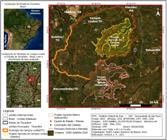
The arrival of soybean "pioneers" in Campos Lindos, strongly encouraged by the promises of success rooted in the Campos Lindos Agricultural Project, sparked significant land ownership changes in the municipality. Land in the region, particularly in the Serra do Centro region, became highly sought-after, even though previously, under state ownership, it was considered "worthless" (Sá et al, 2017).
Although it has achieved exceptional "development" figures, soybean planting is relatively recent in Campos Lindos. According to the IBGE (2014), in 1997, the year the Agricultural Project was created, the area planted with soybeans occupied, compared to the current figures, only 450 hectares in the municipality. However, 15 years later, the area designated for soybean cultivation has increased to 6,700 hectares, while productivity has increased from 945 to 213,570 tons in the same period. This expansion is supported by "agribusiness development," based on the use of machinery, technology, agricultural inputs, mechanization, and significant investment in land and capital (Sá et al., 2017).
The effects of the Agricultural Project and investments by national and international companies can be seen in the production figures for various products in Campos Lindos. Besides being the largest soybean producer in Tocantins, the region also boasts a significant presence of corn, with over 21,000 hectares planted (Conab, 2022). There are also high levels of permanent crops, valued at R$101,000.00 per 5 hectares of land designated for harvest (IBGE, 2023). For temporary crops, this value reached R$745,048.00 per 150,000 hectares of planted and harvested land (IBGE, 2024). In this case, it is important to highlight short-term agricultural crops, such as commodity crops.
Based on the analyses by Sousa and Silva (2020), it is possible to identify a decline in interest and focus on food when food production is primarily geared towards the international market. Since the areas that could produce food are large soybean farms, commodity producers, this also results in rising prices for staple foods such as rice and beans, as well as other essential foods. Zafalon (2016) considers soybeans the "green gold of the country" due to their record production and increasingly high estimates. However, forecasts for rice and bean production decline year after year.
According to Maluf and Menezes (2000), food security is based on three pillars: nutritional quality of food (including the avoidance of pesticides); habits and cultures related to food; and, finally, the sustainability of the agrifood system (continuity in food production). The authors corroborate the contradictory notion that the record production levels achieved each year in the Matopiba agricultural frontier, given the three points listed, are insufficient to solve food-related problems, both nationally and internationally.
Regarding the third pillar, food sustainability, soybean crops and other commodities also compromise sustainability, starting with smallholder farmers. In the case of Campos Lindos, Tocantins, 58.33% of respondents are smallholders and family farmers. What they report in common regarding water is that they live near streams, which often run through their property, but they understand that the water is unfit for consumption, drinking, livestock, or irrigation. Common statements include "I used to let my children bathe in the river, but now I can't anymore. They come out scratching themselves because the water is full of poison that comes from the Serra do Centro" and "It used to be fit for consumption when I was young, a child, but not anymore." The Serra do Centro region is the plateau region, with more arable soils, where most of the large-scale production is located.
Beyond the narratives that support and maintain agribusiness in the region, socioeconomic indicators reveal the profound contradiction of Campo Lindense: paradoxically, while it boasts the best soybean production and productivity rates in all of Tocantins, it also records social indicators below the state average, as can be seen in Table 1.
Regarding food security in Campos Lindos, few data and indicators support its analysis. The EBIA (Brazilian Food Insecurity Scale), the main metric instrument for food security in the country, does not present data for the municipality because it does not include Campos Lindos households in its sample. The lack of data and studies, even preliminary ones, on the food sector in the municipality demonstrates the lag in public agencies' awareness of problems related to hunger.
The normative and technical nature of public policies are directly subordinate to what is understood as the "public policy cycle," the rational process of state action (Costa, 2016). Policy design is conceived through the formation of agendas, which then proceeds to implementation, monitoring, and evaluation. Both the lack of official statistical data and the relegation of the hunger problem by Campos Lindos's government hinder the possibility of government action through public policies, as they generate little demand or agenda to address the problem, creating an impression of "ignorance" of food insecurity in the municipality.
Campos Lindos only joined SISAN (National Food and Nutrition Security System) in September 2024, which aims to formulate and implement food security policies. This recent membership reinforces the municipality's structural lag in adopting measures to address the problems related to food insecurity faced in the region.
Campos Lindos also lacks a market, even though a significant portion of the municipality lives in rural areas and cultivates some type of crops. Interviewees reported that they grow rice, beans, corn, various fruits and vegetables on their farms, in addition to raising poultry, cattle, and pigs. This, at the very least, supports the need for a market in the city, both to generate income for producers through the sale of their surplus produce and to serve as a driving force for the development of food security, as food is largely grown agroecologically, ensuring food quality and sustainability. One of the small producers interviewed recalls the project to create a market for the municipality, where a location was designated shortly before 2020, before the COVID-19 pandemic. A large, covered, and ventilated warehouse was built; however, it remains unused, with the city government yet to inaugurate it.
Some small farmers sell their surplus produce to local markets; however, there are no tax incentives for these businesses to purchase products from the municipality, making it more advantageous to purchase products from other locations, such as Balsas, Maranhão, or Araguaína, Tocantins. The municipality also failed to integrate institutional purchasing into its structure, nor did it join programs such as the Food Acquisition Program (PAA) and the National School Feeding Program (PNAE) as a way to sell to small producers in the region.
Regarding food purchases, all interviewees cited the exorbitant price increases for staple foods (rice, beans, pasta, and fruit) in common, especially since 2020, in the post-pandemic period. Furthermore, they also reported that the lack of tax incentives in the municipality led entrepreneurs to purchase food from nearby regions, such as Balsas, Maranhão, and Araguaína, Tocantins. However, beyond access to food through supermarket purchases, food production for selfconsumption also underwent abrupt changes, although these began earlier, with the establishment of soybean and livestock farming in the region. From the first to the last speaker interviewed, they cited the difficulties associated with the intensive use of pesticides in the municipality by large companies. They reported the appearance of pests, such as the "whitefly," which destroys small seedlings planted before they can develop. The whitefly is also a common occurrence among all producers, who link its appearance to the pesticides used in the region. Producers describe feelings of disbelief and discouragement due to the pests, their advanced age, and the lack of returns from the land that has always guaranteed them a plentiful and healthy diet.
Final Considerations
The genesis of the Matopiba agricultural frontier is highly marked by state action, with a clear role in promoting a classic agro-export model while maintaining its land, environmental, and social issues. Since the 1960s, with the introduction of policies such as the Green Revolution, the National Integration Program (PIN) and the Proceder program, the Cerrado, once of little interest, has worked to transform the Cerrado into a productive territory suited to Brazilian agribusiness. The formalization of Matopiba in 2015, through Presidential Decree 8,447, merely consolidated a decades-long process of "development." At this point, the beginning of the "Miracle of the Cerrado" evolved into the "Sacrifice Zone," with the destruction of the Cerrado justified by the gains obtained from the region's exploitation.
The case of Campos Lindos (Tocantins), an emblematic municipality of the study, preserves within its territory the clarity of the tensions that permeate the Matopiba. Despite being among the municipalities with the highest commodity production, and the largest in the state of Tocantins, it also reveals low social indicators. The data analyzed and the reports obtained during the field research highlight the contradictions in "development," extreme structural inequality, and food insecurity, even though these realities are not reflected in the country's official data and statistics.
The analyzed contradictions show that developmentalist discourse ignores much of the structural inequalities that permeate the Brazilian countryside, which tend to be naturalized due to the logic of capital, wealth, and accumulation. Indepth research into the social processes directly impacted by agribusiness (and its national and international influences) continues to have a latent impact on the conditions of life for the local communities of Matopiba. The very occupation of the Matopiba territories occurred based on logic of exploitation and deterritorialization (expulsion), which ignored the ways of life, knowledge, and basic civil rights of the local communities.
Data Availability:
Research data are available in the body of the article
References
- AGUIAR, D.; PORTO, S. I. A expansão da fronteira agrícola e logística nos cerrados e savanas: agroestratégias e resistências no Brasil e Moçambique. In: Sauer, S. (org.). Desenvolvimento e transformações agrárias: BRICS, competição e cooperação no Sul Global 1. ed. São Paulo: Outras Expressões, 2019. p. 105-128.
- BOMBARDI, L. M. Atlas do Uso de Agrotóxicos no Brasil associa intoxicações ao agronegócio: Um Atlas de nossa agricultura envenenada. 2016.
- CONAB. Levantamento de safras Brasília, DF, jul. 2022.
- COSTA, Valeriano. Políticas públicas no Brasil: uma agenda de pesquisas. Ideias, Campinas, SP, v. 6, n. 2, p. 135-166, 2016.
- DEAN, W. A ferro e fogo: a história e a devastação da Mata Atlântica brasileira Companhia das Letras, São Paulo, 1996.
- FAVARETO, A. Entre chapadas e baixões do Matopiba: dinâmicas territoriais e impactos socioeconômicos na fronteira da expansão agropecuária no cerrado / Favareto Arilson (Org.), Nakagawa, Louise, Pó, Marcos, Seifer, Paulo, Kleeb, Suzana. Editora Ilustre - São Paulo, 2019.
- HLPE. Nutrition and food systems: a report by The High Level Panel of Experts on Food Secutirty and Nutrition Rome: [s.n.], 2017.
- IBGE, Instituto Brasileiro de Geografia e Estatística. Produção Agrícola Municipal 2013 Rio de Janeiro: IBGE, 2014.
- IBGE, Instituto Brasileiro de Geografia e Estatística. Produção Agrícola Municipal 2023 Rio de Janeiro: IBGE, 2024.
- MALUF, R. S.; MENEZES, F.; MARQUES, S. B. Caderno segurança alimentar. Paris: Fhp, p. 1-52, 2000.
- MAZZUCATO, M. O Estado empreendedor - desmascarando o mito do setor público versus o setor privado, São Paulo: Companhia das Letras, 2015.
- SÁ, H. A.; MORAIS, L.; CAMPOS, C. S. S. Que desenvolvimento é esse? Análise da expansão do agronegócio da soja na área do MATOPIBA a partir de uma perspectiva furtadiana. Anais do XXI Congresso Brasileiro de Economia Curitiba, 2015.
- SAUER, S. Questão eco-agrária: extrativismo agrário, mudanças climáticas e desmatamento no Brasil. Revista nera, v. 27, n. 2, p. e10185, 2024.
- SOUSA, R. A. D.; DA SILVA, I. B. Os commodities agrícolas e a (in) segurança alimentar. OKARA: Geografia em Debate, v. 14, n. 1, 2020.
-
TELES, L.W. de N. Território em conflito: uma análise a partir da expansão da agricultura capitalista em Campos Lindos, Tocantins. Faculdade de Filosofia, Letras e Ciências Humanas, Catálogo Usp, São Paulo, 2023. Disponível em: https://www.teses.usp.br/teses/disponiveis/8/8136/tde-28042023-185247/pt-br.php
» https://www.teses.usp.br/teses/disponiveis/8/8136/tde-28042023-185247/pt-br.php -
ZAFALON, Mauro. Vaivém das Commodities. Folha de S. Paulo em 8 de julho de 2016, disponível em: https://www1.folha.uol.com.br/colunas/vaivem/?mobile
» https://www1.folha.uol.com.br/colunas/vaivem/?mobile
-
Edition:
Altemar Amaral Rocha

 Source: