
 Relationship between Change Management Practices and the Success of Organizational Projects
Abstract
Some authors have highlighted increasing research interest in the use of projects as a way to institute change in organizations. The literature on management and performance has demonstrated that effective change management and leadership significantly influence the successful implementation rates of organizational projects. This study aimed to assess the contribution of organizational change management practices to project success. This study presents a quasi-experimental design to test a model using structural equations. The results of the experimental study suggest that the adoption of change management practices was greater in the experimental group than in the control group. However, there were no significant differences between the groups in terms of the variables studied. The proposed model disclosed acceptable goodness-of-fit indices using structural equations. Semi-structured interviews with professionals from the corporate project office, as well as executive officers, deepened the understanding about the adoption of CMP (Change Management Practices) to develop projects in Brazilian federal public organizations.
Keywords:
change management practices; project management; project success
Resumo
Alguns autores destacaram o interesse da pesquisa na utilização de projetos como forma de instituir mudanças nas organizações. A literatura organizacional e de gestão demonstrou que a gestão eficaz da mudança e a liderança influenciam significativamente as taxas de implementação de sucesso dos projetos organizacionais. Este estudo teve como objetivo avaliar a contribuição das práticas de gestão de mudanças organizacionais para o sucesso de projetos. Este estudo apresenta um desenho quase experimental para testar um modelo usando equações estruturais. Os resultados do estudo experimental sugerem que a adoção de práticas de gestão de mudanças foi maior no grupo experimental do que no grupo de controle. Contudo, não houve diferenças significativas entre os grupos em relação às variáveis estudadas. O modelo proposto revelou índices de ajuste aceitáveis usando equações estruturais. Entrevistas semiestruturadas com profissionais do escritório de projetos corporativos e diretores executivos aprofundaram o entendimento sobre a adoção de CMP - Change Management Practices - para desenvolvimento de projetos nas organizações públicas federais brasileiras.
Palavras-chave:
práticas de gerenciamento de mudanças; gerenciamento de projetos; sucesso de projetos
Some authors have highlighted an increasing research interest in the use of projects as a way to institute change in organizations (Crawford & Hassner-Nahmias, 2010). The management and organizational literature have demonstrated that effective change management and leadership influence significantly the successful implementation rates of organizational projects (Gilley et al., 2008; Standish Group, 2013). There is a necessity to viewing projects as organizational change initiatives, and literature suggests that project managers (PMs) should be explicitly trained in applying organizational change methodologies and processes that integrate the aforementioned social/psychological perspectives in the implementation of projects, and/or include the competence in their project teams (Hornstein, 2015). Whence there was a growing interest on behavioral competencies of the project manager (Aitken & Crawford, 2008) and leadership (Müller & Turner, 2007) as variables that are beyond the use of tools, techniques, and practices of project management (Hornstein, 2015; Standish Group, 2013).
Project success has been a significant concern in the project management - PM -literature (Cooke-Davies, 2002; Fortune & White, 2006). Recent findings tended to reflect the technical bias that characterized the approach adopted by most investigators and conceptions applied to project management (Hornstein, 2015). Project success has much to do with whether or not employees adopt the changes that are advocated; much can also be understood through leadership, organizational resistance, culture matching, ethics, user/customer satisfaction, and group engagement in the change process (Burnes & Cooke, 2012; King & Peterson, 2007; MacKay & Chia, 2013; Turner & Zolin, 2012).
Most recently, the PMI - Project Management Institute - seems to be starting to acknowledge formally the import of organizational change management to project success, but management of organizational change has continued to have a relatively small representation in the project management literature (Hornstein, 2015). Also, although project and program management standards address communications and stakeholder management, this does not address the knowledge and skills required to manage organizational and behavioral change as identified in descriptions of various valid change management models used (Crawford et al., 2014; Hassner-Nahmias & Crawford, 2008; Hornstein, 2015).
Although the PMI prescribes adding change management to the project management process, the literature does not yet provide many directions on how this can be done (Crawford et al., 2014; Hornstein, 2015). So, this article moves towards showing how it can be done, by proposing practices that compose change management. These practices include some organizational and group activities, as well as behavioral leadership competences. In addition, we propose to test whether applying organizational change methodologies and processes that integrate the aforementioned social/psychological perspectives in implementation of projects which could influence their success.
Change management has been defined as “the process of continually renewing an organization's direction, structure, and capabilities to serve the ever-changing needs of external and internal customers” (Moran & Brightman, 2001, p. 111). However, theories and approaches to change management currently available to academics and practitioners are often contradictory, mostly lacking empirical evidence and supported by unchallenged hypotheses concerning the nature of contemporary organizational change management (By, 2005). In this paper, we propose viewing change management as social practices which facilitate organizational change, instituted by projects. Change management practices (CMPs) include a variety of organizational interventions that, when executed properly and consistently, facilitate the enactment of organizational change processes (Raineri, 2011). In summary, organizational change management consists of a set of practices aimed at building a sense of urgency around the intended change, establishing a state of crisis, problem, or opportunity that justifies changing, aligning a vision of the future, establishing a coalition around leadership and purpose, empowering, fostering initiative in people to make change happen, and sustaining, planning, and promoting results throughout the process (Kotter, 2012). Nevertheless, significant gaps exist in our understanding of how these practices work and their effectiveness (Doyle et al., 2000; Lewis et al., 2006).
However, changes in management practices can affect project results. Although highly complementary, the relationship between change management and project management in organizations remains unclear (Crawford et al., 2014). Projects are ways to improve changes in organizational environments (Block & Frame, 1998). Scholars argue that organizational change management practices may increase the chances of project success (Basamh et al., 2013; Heckmann et al., 2016) as they contribute to better project execution, development (Aga et al., 2016), learning (Zwikael & Smyrk, 2015), and team commitment (Tyssen et al., 2014). It also affects senior management’s support (Ahmed & Mohamad, 2016; Badewi & Shehab, 2016; Kloppenborg et al., 2014) and transformational leadership (Aga et al., 2016; Tabassi et al., 2016). These practices contribute to the implementation of sustained final gains, promoting the effectiveness of deliverables and business performance (Parry et al., 2014), and the benefits entailed by the project to the end public (Badewi, 2016).
This research was developed at a federal public organization and aimed to determine whether adopting organizational change management practices (CMP) positively alters project success (PS) among those involved in the changes. The relationship between CMP and PS was investigated in three ways: 1) testing of a proposed model in which CMP contributes to the achievement of PS; 2) through a quasi-experimental design study in which a planned intervention (training) on the concerned organization aimed to promote the adoption of practices in an experimental group; and 3) interviewing project managers who have been trained to use change management practices to manage their projects. After training, the experimental group was further compared with a control group that was naive to the intervention. Interviews with the organization’s executive officers and project enhanced the quantitative information collected and assisted in understanding the potential contributions that CMP may bring to the success of the organizational projects. Both the experimental and control groups consisted of managers and team members of the projects implemented in the organization. The study’s baseline assumption is that introducing interventions for proper change management in the context of organizational projects will contribute toward successful project results (Basamh et al., 2013; Heckmann et al., 2016).
1. About Change Management
Management literature frequently proposes the use of a set of managerial practices to facilitate the management of organizational change processes. Raineri (2011) describes GMO as a “set of organizational intervention practices that, when properly executed in coherence with internal and external organizational events, facilitate the adoption of organizational change processes” (p. 226). According to the author, the GMO is segmented into diagnostic and organizational alignment practices, leadership, communication, training, and reward and incentives. Parry et al. (2014) considered these practices as critical change factors that chiefly include communication, stakeholder management, and training added to the quality of leadership’s decision-making in initiatives aimed at the change (Brown et al., 2016). Despite the abundance of literature with advice on change management for practitioners, there is a lack of research on how these practices work and how their effectiveness subsists (Doyle et al., 2000; Buchanan et al., 2005).
Organizational project management is a mechanism for deploying changes in the organizational context (Heckmann et al., 2016). Change management practices are imperative to achieve project success, as PGM helps adopt the changes envisaged in projects designed within the organizational context (Basamh et al., 2013; Heckmann et al., 2016).
2. On Project Success
A project can be defined as a temporary effort undertaken to create a singular service, product, or result. Project management comprises a set of management practices targeted at planning, executing, monitoring, and accomplishing the deliverables of a project. It follows the given quality parameters by applying knowledge, skills, tools, and techniques throughout the management cycle (Guide, 2017). The successful completion of a project results in the organization moving into a future state and achieving a specific goal (Guide, 2017). The concept of project success has been changing over the years, evolving from traditional indicators such as planned and fulfilled costs, time, scope, and quality, to a vision focused on achieving the final benefits intended by those involved and others impacted by the project (Albert et al., 2017; Davis, 2014).
The concept of project success from a strategic organizational viewpoint (Albert et al., 2017; Davis, 2016), based on the perception of different stakeholders (Davis, 2014, 2016; Todorović et al., 2015), and success measures applied to different contexts (Basamh et al., 2013; Costantino et al., 2015; Müller & Jugdev, 2012; Pinto & Slevin, 1987, 1988a, 1988b, 2006; Turner & Müller, 2005), the perception of a project success may take into consideration the performance in its execution, quality of deliveries, value added (result) to the business or organization, and the final benefits produced.
Recent studies have shown that analyses of project success comprise a multidimensional approach, involving several stakeholders under different approaches (Todorović et al., 2015). A stakeholder is an individual, group, or organization that may affect, be affected, or feel affected by the decision, activity, or result of a project. Other stakeholders, in addition to the project manager, are usually project sponsors, project teams, managers, and teams of the areas affected by the project, suppliers, customers, and end users of deliverables and the project (Guide, 2017).
3. About the Relationship Between CMP and PS
Change and project management complement each other and converge toward the larger goal of achieving organizational results. There is evidence of the effect of project managers’ transformational leadership on project success (Aga et al., 2016; Tabassi et al., 2016; Tyssen et al., 2014). There is also evidence that support from senior management in communication, alignment of expectations, and relationships with stakeholders increases the chances of project success (Ahmed & Mohamad, 2016; Kloppenborg et al., 2014). Governance practices, such as clearly defining the roles and assignments of change managers, as well as benefits of management practices, also have positive impacts on project success (Badewi, 2016; Badewi & Shehab, 2016). In fact, change management has positive effects on project success (Basamh et al., 2013; Heckmann et al., 2016; Hornstein, 2015; Parry et al., 2014), considering the need to focus on human behavior to cope with the change movements ensuing from projects.
Project management is primarily an integrative work that demands the incorporation of change management principles and activities throughout the project life cycle. Many professionals, regardless of their backgrounds and training, find the task of integrating change and project management arduous. However, it is a core effort; and to some extent, project success depends on change management (Jarocki, 2014). CMP has become pivotal for the training of managers and teams. Crawford et al. (2014) state that learning change management practices should enhance the project managers’ performance in running their projects and achieving the desired outcomes (Basamh et al., 2013; Heckmann et al., 2016; Hornstein, 2015; Parry et al., 2014). According to Hornstein (2015), a small number of organizations have engaged in integrating change and projects. The author emphasizes the need for project managers to be trained in CMP to integrate social and psychological perspectives into the management of both the team and other parties involved in the project. For the author, the success of a project depends on the affected subjects adopting changes, organizational leadership actions, resistance to change, attention attached to cultural adaptation, customer satisfaction, and other aspects that are not manageable just with the heroic efforts of project managers who have been technically trained to manage projects in their areas of expertise.
Based on the argument that CMP may increase the chances of PS and that it is necessary to promote a process of learning and deploying such practices among project teams, the following hypotheses were proposed:
H1: There is a positive correlation between CMP (organizational change management practices) and PS (project success).
H2: Those involved in projects whose teams underwent CMP training (experimental group) experience stronger PS perception compared to the control group.
H3: the perception of CMP adoption is stronger for those involved with projects in the experimental group subjected to intervention for managers’ learning about organizational change management.
4. Method
This is a quantitative and qualitative research that was developed in three stages: an experimental design; testing a correlational model using structural equations and interviews with project managers. A quasi-experimental research design considered two groups: an experimental group and a control group, randomly assigned. Participants in an organization's projects (managers and members) were divided into two groups (experimental and control) to test the hypothesis that change management practices-trained and performed by project managers-can influence project success indicators. The minimum level of manipulation of the presence or absence of the independent variable was considered with no pre-testing (Goodwin, 2010). This quasi-experimental study promoted a training intervention in the concerned organization and assessed the effects of this intervention on the differentiation between groups. An analysis of variance (ANOVA) was applied to incorporate CMP into project development and variations in the perception of the relationship between CMP and PS.
Hypothesis testing using structural equations in a correlational design was also performed considering the entire contingent of project participants. This SEM-based quantitative test assessed the significant relationships between the dependent and independent variables. And finally, interviews with project managers were carried out to assess their perceptions about the use of change management practices in the context of project management. Semi-structured interview scripts with questions directed to executive officers (department heads/project managers) and consultants from the Corporate Project Office (Espro) executing the projects. The questions addressed the adoption of change management practices in the surveyed projects.
4.1. Definitions and Instruments
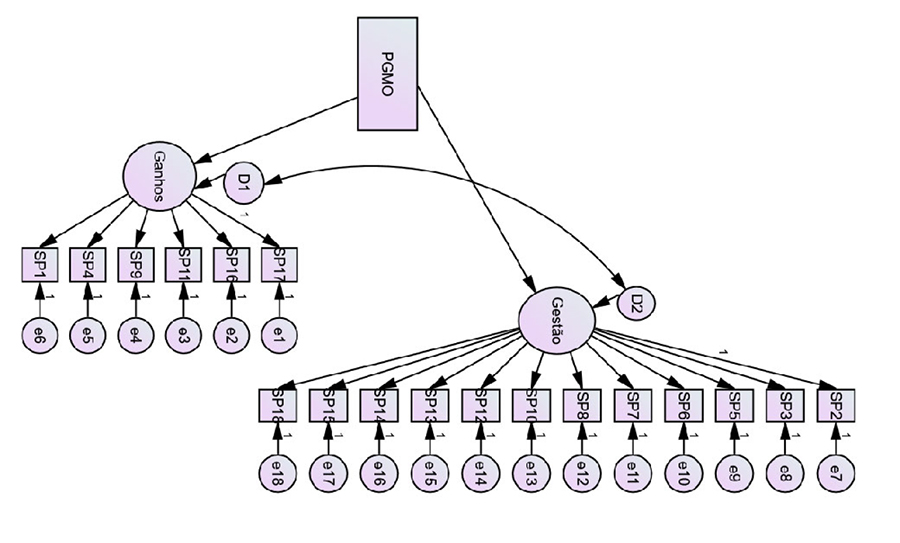
The design presented in Figure 1 presents the proposed model of relationship between PGMO and SP. The PGMO variable consists of a single-factor set of practices, while the SP variable is structured in the management and gains factors, based on the perception of organizational actors involved in projects under execution.
Organizational Change Management Practices (CMP) are organizational interventions that, when executed appropriately and in coherence with internal and external organizational events, facilitate the enactment of organizational change processes (Raineri, 2011; Machado & Neiva, 2017). They typically consist of the following dimensions: diagnosis and alignment, leadership, communication, training, reward, and incentives. In this study, they are considered as a single-factor set of change practices or actions. Organizational change management practices were measured using a scale, with items that described the practices. The organizational change management practices adoption scale contains 20 items of Likert-type, ranging from 1 (strongly disagree) to 10 (strongly agree) with good evidence of validity (Raineri, 2011). The initial scale proposal considers five factors: diagnosis and alignment, leadership, communication, training, and reward and incentives. The results of the validity studies, however, pointed out a single-factor structure, with an explained total variance of 68.78% and Cronbach’s alpha of .98, according to analyses performed on the current sample. Confirmatory factor analysis of the instrument indicated a RMSEA of .109, SRMR of .039, TLI of .90, and CFI of .91.
Project Success (PS) is a multidimensional concept that involves both successful project management and final gain generation from the perspective of parties interested in or impacted by the project. Successful project management refers to the achievement of the traditional results of scheduled time, scope, and cost, leading to the fulfillment of the expected deliverables. This was measured using project management indicators. Success in generating gains refers to the attainment of the organizational strategy and the generation of long-lasting gains and benefits arising from project execution for the organization for those involved. Project success perception scale (E-PSP), contains 18 items of Likert-type, ranging from 1 (strongly disagree) to 7 (strongly agree), with evidence of validity showing acceptable goodness-of-fit, with Cronbach’s alpha of .96, for the management factor and Cronbach’s alpha of .95, for the gains factor. The total variance explained by the two factors was 74.84% with the extraction of two factors: management and gains. Confirmatory factor analysis suggested an RMSEA of .103, SRMR of .050, TLI of .93, and CFI of .92.
Ongoing projects are projects underway that are performing activities, adhering to schedule, producing deliverables, and generating organizational benefits. In this study, ongoing projects were divided into two groups: projects from the experimental group, called Projects with Intervention (PCI), whose team members (experimental group subjects) received training on CMP, and projects from the control group, called Projects Without Intervention (PSI), whose teams did not receive direct training on CMP and made up the control group.
Organizational actors are civil servants (project participants) in the institution surveyed. As for the link with projects, they are classified as stakeholders directly involved with the project and stakeholders indirectly involved but impacted by the ongoing projects. The intervention performed in this study was classified as subjects in the experimental and control groups.
The CMP variable consists of a single-factor practice set and the PS variable involves the benefits and gains factors that portray project success indicators from the perspective of project participants. Figure 1 shows the model tested by this study.

Semi-structured interview scripts with questions directed to executive officers (department heads/project managers) and consultants from the Corporate Project Office (Espro) executing the projects. The questions addressed the adoption of change management practices in the surveyed projects.
4.2. Research Environment
The study was developed at a federal public institution in charge of the formulation, execution, monitoring, and control of policies on monetary, foreign exchange, credit, and foreign financial relations. It is also in charge of the organization, discipline, and supervision of the Brazilian National Financial System (SFN), Consortium System, Brazilian Payment System (SPB), and circulating medium services.
The organization implements major changes through projects and programs, managed based on a specific methodology called MGPro (project, program, and portfolio management methodology) in use at the organization for over ten years. This work is supervised by the Corporate Project Office (Espro), which provides methodological support and tools for project and program portfolio management. The organization was selected for this study because of the degree of maturity in project and program management measured by the organization every two years; and because of the adoption of a project management methodology that is known and in use by a community of practice consisting of about 600 members internal to the organization; and the constant transformation process it has been going through in recent years.
The organization has an annual portfolio of approximately 40 strategic projects with an average 2-year execution period. A convenience sample of 24 ongoing projects was selected from the portfolio, observing the following criteria aimed at equivalence among projects: (i) belong to one of the three corporate strategic portfolio baskets (business, organizational strengthening, or governance); (ii) present change scope (projects on diagnosis and events were excluded); (iii) execution time schedule ranging from 18 to 24 months; (iv) average planned costs around R$ 500 thousand reais; (v) have medium or high-complexity scope according to the classification assigned by the team and registered on the portfolio; (vi) predominantly have as participants subjects internal to the organization; and (vii) have a summary follow-up rite that considers the requirement of issuing follow-up reports on a monthly basis, among other rites necessary for the project monthly follow-up.
4.3. Intervention on the Research Environment
The 24 projects in the sample were randomly divided into two groups with 12 projects each: an experimental group and a control group. The projects varied in scope. The intervention plan was deployed for the experimental group and consisted of a training action with a workload of 60 hours comprising: (a) evaluation of the scope of change of the projects randomly selected to make up the sample, supported by the project office (eight hours); (b) planning of the workshop content named, “Change management practices applied to ongoing projects” (16 hours); (c) workshop implementation (20 hours); (d) analysis and selection of practices for application and feedback to participants (20 hours). Espro’s project teams, managers, and consultants were the subjects of the intervention in the experimental group participating in the training and, at the end, selecting a set of six change management actions to be implemented in the projects they worked within three months of the training. The training content is shown in Figure 2.

4.4. Data Collection Procedures
Initially, an intervention was conducted for the managers and participants of the 12 projects selected for the experimental group. Three months after the training intervention, a single 44-item instrument was submitted with 20 items from the E-CMP scale, 18 items from the E-PSP scale, and 6 items related to demographic data. The instrument was made available only electronically on the SurveyMonkey survey application, and an access link was emailed to the participants to respond on an individual, voluntary, and anonymous basis. Data analyses were performed using SPSS and AMOS software.
Six months after the intervention, semi-structured interviews were conducted with executive officers (project managers) from the areas responsible for the sample projects as well as with Espro consultants responsible for providing methodological support to the ongoing projects. This qualitative survey aimed to obtain the perceptions of these subjects about the relevance of adopting CMPs in developing projects. To this end, the executive officers were asked about the results and changes implemented by the projects and practices that could be implemented to promote the intended changes. Espro consultants (Executive Officers) were asked about recent changes regarding how projects were conducted, with an emphasis on the methodological incorporation of change management practices.
The responses were recorded and subjected to content analysis (Hsieh & Shannon, 2005). After preliminary reading, records were classified and grouped into common themes which were identified a posteriori (Hsieh & Shannon, 2005). The common themes were leadership and change management roles, standardization of change management practices, organizational culture change, and changes in project management methodology. To preserve their identities, interview participants were identified using codes (E = Executive Officers; C = Espro Consultants).
4.5. Research Participants
The subjects of this study were civil servants of a federal public organization working in departments responsible for the sample projects. Regarding the quantitative research, after excluding missing cases and outliers, the sample was composed of 485 participants (from 24 projects selected) who completed both the E-CMP and E-PSP scales. These 485 subjects were divided into two groups (experimental and control). The results of the scales applied to the two groups of participants were analyzed in two ways: all responses were analyzed using Structural Equation Modeling; the responses of participants divided into two groups (experimental and control) were compared by Multivariate Analysis of Variance (a comparison between the groups that underwent or not the intervention).
Of the total valid answers, 82% were male respondents and 18% were female respondents, aged up to 30 years (1.3%), 31 to 40 years (23.7%), 41 to 50 years (36.3%), 51 to 60 years (31.2%), 71 to 70 years (7.1%), and over 70 years (4%). Regarding academic background, high school (6%), undergraduate (21.8%), specialized (44.7%), masters (23.5%), and doctoral (9.4%). The time they had been working in the organization varied: up to 10 years (32.5%), 10 to 20 years (31.7%), 20 to 30 years (31.4%), and above 30 years (4.4%). Some held a management position (43%), while others did not (57%).
As for the qualitative research, the participants included 22 civil servant members of the project teams in the experimental group (project managers, project team members, change managers, functional managers of the areas impacted by the changes implemented by the projects), who were trained in CMP and selected CMP actions to be applied to their projects; two Espro consultants who were trained in CMP and completed the semi-structured interview; six executive officers (department heads of the concerned organization who participated in the semi-structured interview). The main question in the interview was: What has changed in the conduct of projects monitored by you? What changes have been implemented in the project management methodology referenced in change management practices?”.
5. Results
The results found in this study are segmented into three topics: results about the relationship between CMP and PSP (H1); results of the intervention action, assessing if there are differences between the experimental and control groups regarding the relationship between CMP and PSP (H2 and H3); results of the interviews showing the perceptions of managers and members of project offices about the adoption of change management practices in the project context.
5.1. Quantitative Results About the Relationship Between CMP and PSP
The analysis by means of structural equation modeling (SEM) tests H1 (there is a positive correlation between the perception of organizational change management practices and of project success). For model adjustments, the following indices were reviewed: comparative fit index (CFI), root mean square error of approximation (RMSEA), normed fit index (NFI), and goodness-of-fit index (GFI), as discussed in specialized literature (McDonald & Ho, 2002). The following index values were adopted as criteria for satisfactory model fit to the data: CFI greater than .90; RMSEA close to or less than .08; GFI greater than .90; TLI greater than .90.
Two structural equation models were tested: the initial and adjusted models, using AMOS software and the maximum likelihood estimation method. The fit indices of the initial hypothetical model (Figure 3) were satisfactory, although the estimated parameters were found to be significant.

The resulting main fit indexes presented in Table 1 for the initial model reached values that met the criteria but were indicator values that may be improved.
As the indicator values presented acceptable but reduced values, adjustments were made to the model. To this end, post hoc analyses were performed to observe significant covariances among the latent variables of the model. Correlation in the adjusted model was then performed and all indexes showed improvements, confirming the regression model between variables. These results support the forecast that the higher the adoption of CMP, the higher the perception of project success, be it regarding the management performed or the gains ensuing from execution. The higher the perception of change management practices, the more project managers and participants perceived positive project results in terms of gains and management.
5.2. Results of the Intervention on the Experimental Group: The CMP Effect on the PS (comparison between the groups that underwent or not the intervention)
The positive relationship between CMP and PSP factors was corroborated (H1); however, the hypothesis (H2) that there is a significant difference between the experimental and control groups for this relationship between variables was not confirmed. The hypothesis that the perception of CMP adoption is higher for the group of projects under intervention (H3) was not confirmed. Despite the answers having a higher average, this value was not statistically significant.
In order to test H2 and H3, ANOVA was performed to compare the factors CMP, Management, and Gains between the experimental and control groups and the result was non-significant between the groups, as shown in Table 2. All measurements of variables (CMP, Management, and Gains) in the experimental group were greater than in the control group, but no statistical difference between groups was found.
According to Table 2, there are no differences in perception between the experimental group and the control group regarding the existence of change in management practices, nor regarding the project results in terms of management and gains delivered. Therefore, hypotheses H2 and H3 were not supported by this study. The intended actions were more strongly perceived by the subjects in the projects whose teams received CMP training. Although the descriptive results imply a greater presence of change management practices in the experimental group, the overall group comparative results did not support these hypotheses.
5.3. Perception of Project Office Executive Officers and Consultants About the Relationship Between CMP and PSP According to Semi-structured Interviews
The perceptions of executive officers raised through semi-structured interviews confirm the quantitative data presented, especially regarding the potential effect of change management on the achievement of results in projects. When asked if the projects were achieving the intended results, the executive officers considered that most results had been fully achieved, with partial fulfillment observed in projects that did not fully reach the corporate impact. They emphasized that aspects related to time and cost affect project performance, pointing out that the success achieved is mainly due to the team’s involvement and engagement with project execution. They also highlight aspects such as delivery and benefits as ways to demonstrate the projects’ final results. Technical results are easier to achieve than those related to the behavioral changes demanded by new processes. They understood that the broader and more strategic the intended result, the lower the perception of the fulfilled results. Regarding changes implemented by projects, respondents stressed that operational changes tend to be more concrete and effective than changes with more strategic designs. On the other hand, they also emphasize that changes led by projects should be aligned with a predefined vision of the future. Diagnosis was one of the aspects highlighted in the executive officers’ answers when mentioning that changes foreseen in diagnostic studies were fully achieved, such as integration between areas and processes, alignment of processes with international practices, and effective institutional communication. The executive officers interviewed understood that implementing cultural change is more challenging, taking as an example the change focused on integrating areas.
5.4. What is Yet to be Done for the Changes to Happen
Concerning what is yet to be done to effectively implement changes as expected, several aspects of change management were pointed out, mainly related to leadership, standardization of practices, and management of cultural issues. With regard to leadership, the executive officers interviewed highlighted aspects related to the development of competencies of change among managers and leaders, their attitudes toward change (believing and sponsoring), and the roles they should play in the process. The executive officers interviewed also pointed out the shortage of practices specifically aimed at change management and that, even when these are adopted, they should rest on institutional support, so they are actually followed by several organizational players. This information supports the results presented regarding the level of adoption of CMPs in the organization concerned which was considered below average. Cultural issues and the sustainability of changes implemented were also addressed by the executive officers (Table 3), who pointed to the need for greater integration between areas as a crucial factor for cultural change.
The methodological changes that stood out in the respondents’answers included guidance toward clearly recording the intended changes in the project plan, aiming at better communication with the involved parties. Benefit management, which necessarily involves changes aimed at final gains and the satisfaction of involved participants, becomes the focus of projects, thus weakening the focus on deadlines and deliveries.
6. Discussion
The main contributions of this study include three aspects: 1) reinforcing the position of authors renowned in the literature, according to whom change management practices consist of a set of actions aimed at promoting organizational results, aligning change and project management, and its impacts on project success (Raineri, 2011; Hornstein, 2015); 2) more importantly, the research contributes to the development of an advanced research outline that seeks to teach managers how to introduce moving management practices; the article also draws a definition of the management of the change in literature and begins its investigation indicating which practices are part of the process. Rather than saying that change management must be incorporated into project management, this research is advancing in terms of what must be developed in compass with technical requirements of PMI.
Definitions of change management in terms of practices-and specifications of which practices are part of change management process-are in consistent advance in this field of research. Moreover, this paper adds an operational and behavioral list of how managers can act in terms of management practices and, finally, it brings an empirical support for assumptions that change management contributes to project success. Methodologically, this research also contributes with quasi-experimental outlines for field advancement. Quasi-experimental designs are often overlooked in the field of organizational studies due to the fact that they are quite laborious.
Three hypotheses were tested to answer the research question (Does the adoption of change management practices positively alter the perception of project success (PS) among those involved in changes?). The findings related to Hypothesis 1 (there is a positive association between CMP and PSP) converge to the understanding that the success or failure of a project ensues, to some extent, from a set of actions aimed at achieving sustainable change in human behavior within organizations, focusing on processes and people (Raineri, 2011; Turner & Müller, 2005). The experimental group has shown higher levels of change management practices; although not statistically significant, this result reinforces the importance of change management for project management (Hornstein, 2015). The intervention workload and the time elapsed between intervention and collection of results may not have been sufficient for development of required skills in managers. This aspect may explain the non-significance of the difference between means.
As an advance, we propose change management as social practices to facilitate organizational change instituted by projects. Change management practices (CMPs) include a variety of organizational interventions that, when executed properly and consistently, facilitate the enactment of organizational change processes (Raineri, 2011). Considering our definition, organizational change management consists of a set of practices aimed at building a sense of urgency around the intended change, establishing a state of crisis, problem, or opportunity that justifies changing, aligning a vision of the future, establishing a coalition around leadership and purpose, empowering and fostering people to make change happen, and sustaining, planning, and promoting results throughout the process (Kotter, 2012).
All these practices are constituted as directives and actions to create a social purpose and a line of conduct for the actions of the managers and members of the project. In addition to the technical requirements of PMI, there are actions that the manager must carry out in the conduct of the project that are often neglected due to erroneous conceptions by project owners (Doyle et al., 2000; Hornstein, 2015; The Standish Group, 2013).
The need and relevance of integrating change management practices into project management are clear; however, project managers and teams may be skeptical about adopting new management practices to achieve the intended results. Skeptical attitudes encompass negative beliefs and behaviors in relation to change processes, notably disbelief and noncollaboration (Neiva & Paz, 2012). Hence, it is necessary to nurture a positive attitude towards CMPs among project teams. Some psychological processes are known to be responsible for attitude change; persuasion is one of the main strategies with persuasive communication as a core factor in this process (Baumeister & Finkel, 2010).
The way individuals process the persuasive message, as well as its source, context, and addressee, is crucial to influence the attitudes and behaviors of group members toward the changes to be implemented (Neiva & Paz, 2012). The ability of attitude to predict behavior is affected by several aspects, such as social influence, the individual’s experiences, and the type of behavior to be predicted. These aspects may also limit the assessment of changes in the attitudes of individuals and groups. These changes are often implicit and unclear in explicit measurements.
To persuade project teams to incorporate CMP into existing project management practices, a CMP training plan was structured and delivered to a group of project members from the sample. In addition to promoting the possible use of these practices, they were expected to generate positive effects on the perceived project success, which was not confirmed by testing Hypotheses 2 and 3. This may be because the 3-month period between training, incorporation of practices, and PSP measurement was not long enough to produce effects on such a multifaceted construct as project success.
In this study, the training exposed subjects in the experimental group to cognitive stimuli on the incorporation of new practices and encouraged them to implement these in their work routines. When asked to show which change management actions could be incorporated into the management of the projects on which they worked, managers and teams presented a set of six actions related to leadership, training, and behavioral incentives expected as results of change projects. Further application of the E-CMP scale showed that the mean perception of CMP was higher in the group of projects with interventions than in the control group. This indicates a positive effect of CMP training on this set of selected actions.
The training actions implemented may not have been sufficient to produce changes in managers’ behaviors that are meaningful enough to affect the perceptions of project team members. Long-term behavioral changes are more complex and depend on a series of actions with target populations, such as project managers (Goodwin, 2010; Gorran-Farkas, 2013).
Importantly, the selected practices concerned the psychosocial aspects associated with change management. When pointing out leadership and capacity-building practices, the teams developing projects do not feel prepared for change management and still lack efforts to convince and mobilize people aiming at better outcomes of organizational projects.
The quantitative effects tested in this study were confirmed through qualitative research conducted with executive officers and project consultants of the organization. Their responses highlight what is recommended by recent literature, including that diagnosis is the preliminary and determining practice of the change management process (Packard, 2013) and that cultural change is a major challenge in the process of changing people’s behavior in an organizational environment (Kotter, 2012). Sustaining change and incorporating it into organizational culture (Gorran-Farkas, 2013; Kotter, 2012; Micelotta et al., 2017) were issues present in the respondents’ answers.
Regarding leadership, profiling the change agent for each project and developing CMP-related competencies were also underlined in interviews with executive officers. The change agent is responsible for managing change activities within the organization. They may be executive officers, employees of the organization, or external consultants. Being an agent of a specific change demands several attributes, such as knowing and understanding the purpose of the change, integrating individuals around this purpose and facing resistance, and trying to negotiate and maintain clear and objective communication with the organizational players involved. For example, project managers are change agents because they actively define the goals of a project and use their skills and competencies to inspire a sense of shared purpose within the project team (Costeira et al., 2019).
It is believed that when implementing changes, leaders review their roles (Binci et al., 2016). In addition to senior management, managers at various levels of the organization should incorporate the role of change leaders (Barratt-Pugh et al., 2013) for both major transformations and incremental improvements (Binci et al., 2016), relying on a network of collaborators, namely change agents (Wee & Taylor, 2018). Transformational leadership is crucial for employee support for planned or emergent changes (Al-Ali et al., 2017). In order to lead change, managers shall provide operational support, foster relationships, promote learning, boost organizational balance (Nelson-Brantley & Ford, 2017), and develop trusting relationships with their teams (Smollan, 2014). Through leadership, the change process may be inspired and conducted with the participation of the organization’s formal and informal leaders.
The need to standardize practices and control actions on change was also highlighted in interviews with Espro’s executive officers and consultants. If the incidence of change in an organization or project is frequent, the tendency to skip stages and hasten the execution of changes may become a habit. This habit may affect control over these changes and their impact on the project’s scope, organization’s structure, or intended benefits. Poorly performed impact assessments, approval-only collections, incomplete records, and out-of-date documentation are some of the effects of this loosening of change control processes. The need to clearly define what will change in processes and the resulting benefits in the project plan is an indication that project management methodology is settling for better change and benefits management, as identified in the respondents’ answers.
Although the result is reflected in the whole, changes start in actions focused on people’s behavior. From the beginning to the final result of change management, communication is a tool that brings all employees of the organization together with the same goal. The way managers and agents underpin change management starts by preparing arguments that strengthen their vision of the future, as well as the preparation of the required stages to reach the expected level. Recent changes in the project plan content of the researched organization revealed greater attention to more efficient communication of the expected changes, as inferred from the answers of the interview participants.
7. Final Remarks
This paper moves towards showing directions on how project managers can explicitly be trained in applying organizational change methodologies and processes that integrate the aforementioned social/psychological perspectives in the implementation of projects. The study does this by proposing practices that composes change management that include some organizational and group activities, as well as behavioral leadership competences. Furthermore, we obtained evidence that the adoption, in project management, of practices guided by a social/psychological perspective influences the success of projects. To achieve the objective of this study, we sought to investigate the existing relationship between CMP and PSP. This was done through the theoretical framework and then through quantitative and qualitative research that pointed out the positive relationships between these variables in a federal public organization. Studying and understanding change management practices and measuring the level of acceptance of these practices in the organizational environment seems to be a good starting point. However, it is not sufficient to offer practical and academic contributions to this theme. According to Pollack and Pollack (2015), little research has investigated the practical aspects of the use of CMPs or critically challenged their effectiveness. Quasi-experimental research proved to be a suitable method when comparing two groups of ongoing projects, following certain scientific criteria when investigating the actual effects of adopting the practices. Therefore, in addition to surveys of theoretical concepts and empirical methodological arrangements, the survey also captured the perceptions of the main players involved in project management and organizational change management regarding the effects of applying organizational change management practices to run projects. This revealed the possibility of integration and complementation between the aforementioned practices.
A longitudinal study is recommended as a proposal for further research. It shall allow assessing the evolution of CMP adoption in the environment surveyed, as well as the long-term effects that such adoption may promote. In the case of the intervention action on CMP, improvements to the training program and intervention plan should be implemented to ensure its actual effects contribute to the success of the projects.
References
-
Aga, D. A., Noorderhaven, N., & Vallejo, B. (2016). Transformational leadership and project success: The mediating role of team-building. International Journal of Project Management, 34(5), 806-818. https://doi.org/10.1016/j.ijproman.2016.02.012
» https://doi.org/10.1016/j.ijproman.2016.02.012 -
Ahmed, R., & Mohamad, N. A. (2016). Exploring the relationship between multi-dimensional top management support and project success: An international study. Engineering Management Journal, 28(1), 54-67. https://doi.org/10.1080/10429247.2015.1136525
» https://doi.org/10.1080/10429247.2015.1136525 - Aitken, A., & Crawford, L. H. (2008). Senior management perceptions of effective project manager behavior: An exploration of a core set of behaviors for superior project managers. InProceedings of PMI Research Conference Project Management Institute.
-
Al-Ali, A. A., Singh, S. K., Al-Nahyan, M., & Sohal, A. S. (2017). Change management through leadership: The mediating role of organizational culture. International Journal of Organizational Analysis, 25(4), 723-739. https://doi.org/10.1108/IJOA-01-2017-1117
» https://doi.org/10.1108/IJOA-01-2017-1117 -
Albert, M., Balve, P., & Spang, K. (2017). Evaluation of project success: A structured literature review. International Journal of Managing Projects in Business, 10(4), 796-821. https://doi.org/10.1108/IJMPB-01-2017-0004
» https://doi.org/10.1108/IJMPB-01-2017-0004 -
Badewi, A. (2016). The impact of project management (PM) and benefits management (BM) practices on project success: Towards developing a project benefits governance framework. International Journal of Project Management , 34(4), 761-778. https://doi.org/10.1016/j.ijproman.2015.05.005
» https://doi.org/10.1016/j.ijproman.2015.05.005 -
Badewi, A., & Shehab, E. (2016). The impact of organizational project benefits management governance on ERP project success: Neo-institutional theory perspective. International Journal of Project Management, 34(3), 412-428. https://doi.org/10.1016/j.ijproman.2015.12.002
» https://doi.org/10.1016/j.ijproman.2015.12.002 -
Barratt-Pugh, L., Bahn, S., & Gakere, E. (2013). Managers as change agents: Implications for human resource managers engaging with culture change. Journal of Organizational Change Management, 26(4), 748-764. https://doi.org/10.1108/JOCM-Feb-2011-0014
» https://doi.org/10.1108/JOCM-Feb-2011-0014 -
Basamh, S. S., Huq, M. N., & Dahlan, A. R. A. (2013). Project implementation success and change management practices in Malaysian government-linked companies (GLCs). Journal of Social and Development Sciences, 4(7), 357-363. https://irep.iium.edu.my/31632/1/JSDSVol4No7_Jul2013_ProjectSuccess_CM_GLC.pdf
» https://irep.iium.edu.my/31632/1/JSDSVol4No7_Jul2013_ProjectSuccess_CM_GLC.pdf - Baumeister, R. F., & Finkel, E. J. (2010). Advanced social psychology: The state of the science Oxford University Press.
-
Binci, D., Cerruti, C., & Braganza, A. (2016). Do vertical and shared leadership need each other in change management? Leadership & Organization Development Journal, 37(5), 558-578. https://doi.org/10.1108/LODJ-08-2014-0166
» https://doi.org/10.1108/LODJ-08-2014-0166 - Block, T. and Frame, J.D. (1998). The Project Office: A Key to Managing Projects Effectively Crisp Publications.
-
Brown, D. R., Rose, D., & Gordon, R. (2016). De-commoditizing change management: A call for the re-positioning of change management on IT projects. Journal of Organizational Change Management, 29(5), 793-803. https://doi.org/10.1108/JOCM-07-2015-0116
» https://doi.org/10.1108/JOCM-07-2015-0116 - Buchanan, D., Fitzgerald, L., Ketley, D., Gollop, R., Jones, J. L., Lamont, S. S., Neath, A., & Whitby, E. (2005). No going back: A review of the literature on sustaining organizational change.International Journal of Management Reviews, 7(3), 189-205.
-
Burnes, B., & Cooke, B. (2012). The past, present and future of organization development: Taking the long view.Human Relations, 65(11), 1395-1429.https://doi.org/10.1177/0018726712450058
» https://doi.org/10.1177/0018726712450058 - By, R. T. (2005). Organisational change management: A critical review.Journal of Change Management, 5(4), 369-380.
-
Crawford, L., & Hassner-Nahmias, A. H. (2010). Competencies for managing change.International Journal of Project Management,28(4), 405-412.https://doi.org/10.1016/j.ijproman.2010.01.015
» https://doi.org/10.1016/j.ijproman.2010.01.015 -
Crawford L., Aitken A., Hassner-Nahmias A. (2014, November 11). Project Management and Organizational Change Project Management Institute, Inc. https://www.pmi.org/-/media/pmi/documents/public/pdf/research/research-summaries/crawford_org-change.pdf?v=1c16c831-2613-43e6-acaa-d0a30fef0beb
» https://www.pmi.org/-/media/pmi/documents/public/pdf/research/research-summaries/crawford_org-change.pdf?v=1c16c831-2613-43e6-acaa-d0a30fef0beb -
Cooke-Davies, T. (2002) The “Real” Success Factors on Projects. International Journal of Project Management, 20, 185-190. https://doi.org/10.1016/S0263-7863(01)00067-9
» https://doi.org/10.1016/S0263-7863(01)00067-9 -
Costantino, F., Di Gravio, G., & Nonino, F. (2015). Project selection in project portfolio management: An artificial neural network model based on critical success factors. International Journal of Project Management, 33(8), 1744-1754. https://doi.org/10.1016/j.ijproman.2015.07.003
» https://doi.org/10.1016/j.ijproman.2015.07.003 -
Costeira, I. B. S., Gomes, V. V. B., & Correia, M. S. (2019). The projection of an organizational structure using the project management tool a case study on the executive event. Brazilian Journal of Development, 5(9), 14168-14190. https://doi.org/10.34117/bjdv5n9-036/
» https://doi.org/10.34117/bjdv5n9-036/ -
Davis, K. (2014). Different stakeholder groups and their perceptions of project success. International Journal of Project Management, 32(2), 189-201. https://doi.org/10.1016/j.ijproman.2013.02.006
» https://doi.org/10.1016/j.ijproman.2013.02.006 -
Davis, K. (2016). A method to measure success dimensions relating to individual stakeholder groups. International Journal of Project Management, 34(3), 480-493. https://doi.org/10.1016/j.ijproman.2015.12.009
» https://doi.org/10.1016/j.ijproman.2015.12.009 - Doyle, M., Claydon, T., & Buchanan, D. (2000). Mixed results, lousy process: The management experience of organizational change. British Journal of Management,11, S59-S80.
-
Gilley, A., Dixon, P., & Gilley, J. W. (2008). Characteristics of Leadership Effectiveness: Implementing Change and Driving Innovation in Organizations. Human Resource Development Quarterly, 19, 153-169.https://doi.org/10.1002/hrdq.1232
» https://doi.org/10.1002/hrdq.1232 - Goodwin, C. J. (2010). Research in psychology methods and design (6th ed.). Wiley.
-
Gorran-Farkas, M. (2013). Building and sustaining a culture of assessment: Best practices for change leadership. Reference Services Review, 41(1), 13-31. https://doi.org/10.1108/00907321311300857
» https://doi.org/10.1108/00907321311300857 - Guide, P. B. (2017).A Guide to the Project Management Body of Knowledge (6th ed.). Project Management Institute, Inc.
- Hassner-Nahmias, A., & Crawford, L. H. (2008). Project manager or change manager: Who should be managing organizational change. InProceedings of the PMI Research Conference, Warsaw Poland Project Management Institute.
-
Heckmann, N., Steger, T., & Dowling, M. (2016). Organizational capacity for change, change experience, and change project performance. Journal of Business Research, 69(2), 777-784. https://doi.org/10.1016/j.jbusres.2015.07.012
» https://doi.org/10.1016/j.jbusres.2015.07.012 -
Hornstein, H. A. (2015). The integration of project management and organizational change management is now a necessity. International Journal of Project Management, 33(2), 291-298. https://doi.org/10.1016/j.ijproman.2014.08.005
» https://doi.org/10.1016/j.ijproman.2014.08.005 -
Hsieh, H. F., & Shannon, S. E. (2005). Three approaches to qualitative content analysis. Qualitative Health Research, 15(9), 1277-1288. https://doi.org/10.1177/1049732305276687
» https://doi.org/10.1177/1049732305276687 - Jarocki, T. L. (2014). One solution for project success: Project and change management in the PMBOK® guide Project Management Institute.
-
King, S., & Peterson, L. (2007). How effective leaders achieve success in critical change initiatives, Part 2: Why change leadership must transcend project management for complex initiatives to be successful. Healthcare quarterly (Toronto, Ont.), 10(2), 72-74. https://pubmed.ncbi.nlm.nih.gov/17491570/
» https://pubmed.ncbi.nlm.nih.gov/17491570/ -
Kloppenborg, T. J., Tesch, D., & Manolis, C. (2014). Project success and executive sponsor behaviors: Empirical life cycle stage investigations. Project Management Journal, 45(1), 9-20. https://doi.org/10.1002%2Fpmj.21396
» https://doi.org/10.1002%2Fpmj.21396 - Kotter, J. P. (2012). Leading change Harvard Business Press.
-
Lewis, L. K., Schmisseur, A. M., Stephens, K. K., & Weir, K. E. (2006). Advice on Communicating During Organizational Change: The Content of Popular Press Books. The Journal of Business Communication, 43(2), 113-137. https://doi.org/10.1177/0021943605285355
» https://doi.org/10.1177/0021943605285355 - Machado, L. C. P., & Neiva, E. R. (2017). Práticas de gestão da mudança: impacto nas atitudes e nos resultados percebidos.Revista Psicologia Organizações e Trabalho,17(1), 22-29.
- MacKay, R. B., & Chia, R. (2013). Choice, chance, and unintended consequences in strategic change: A process understanding of the rise and fall of NorthCo Automotive.Academy of Management Journal,56(1), 208-230.
-
Manifesto, C.H.A.O.S. (2013) Think Big, Act Small The Standish Group International Inc. https://versionone.com/assets/img/files/ChaosManifesto2013.pdf
» https://versionone.com/assets/img/files/ChaosManifesto2013.pdf -
Micelotta, E., Lounsbury, M., & Greenwood, R. (2017). Pathways of institutional change: An integrative review and research agenda. Journal of Management, 43(6), 1885-1910. https://doi.org/10.1177%2F0149206317699522
» https://doi.org/10.1177%2F0149206317699522 -
McDonald, R. P., & Ho, M.-H. R. (2002). Principles and practice in reporting structural equation analyses.Psychological Methods, 7(1), 64-82.https://doi.org/10.1037/1082-989X.7.1.64
» https://doi.org/10.1037/1082-989X.7.1.64 - Moran, J. W., and Brightman, B. K. (2001). Leading organizational change.Career Development International, 6(2), 111-118.
-
Müller, R., & Jugdev, K. (2012). Critical success factors in projects: Pinto, Slevin, and Prescott - the elucidation of project success. International Journal of Managing Projects in Business, 5(4), 757-775. https://doi.org/10.1108/17538371211269040
» https://doi.org/10.1108/17538371211269040 -
Neiva, E. R., & Paz, M. D. G. T. (2012). Percepção de mudança individual e organizacional: o papel das atitudes, dos valores, do poder e da capacidade organizacional. Revista de Administração (São Paulo), 47(1), 22-37. https://doi.org/10.5700/rausp1023
» https://doi.org/10.5700/rausp1023 -
Nelson-Brantley, H. V., & Ford, D. J. (2017). Leading change: A concept analysis. Journal of Advanced Nursing, 73(4), 834-846. https://doi.org/10.1111/jan.13223
» https://doi.org/10.1111/jan.13223 -
Packard, T. (2013). Organizational change: A conceptual framework to advance the evidence base. Journal of Human Behavior in the Social Environment, 23(1), 75-90. https://doi.org/10.1080/10911359.2013.739534
» https://doi.org/10.1080/10911359.2013.739534 -
Parry, W., Kirsch, C., Carey, P., & Shaw, D. (2014). Empirical development of a model of performance drivers in organizational change projects. Journal of Change Management, 14(1), 99-125. https://doi.org/10.1080/14697017.2012.745894
» https://doi.org/10.1080/14697017.2012.745894 -
Pinto, J. K., & Slevin, D. P. (1987). Critical factors in successful project implementation. IEEE Transaction on Engineering Management, 34(1), 22-28. https://doi.org/10.1109/TEM.1987.6498856
» https://doi.org/10.1109/TEM.1987.6498856 -
Pinto, J. K., & Slevin, D. P. (1988a). Project success: Definitions and measurement techniques. Project Management Journal, 19(1), 67-72. https://www.pmi.org/learning/library/project-success-definitions-measurement-techniques-5460
» https://www.pmi.org/learning/library/project-success-definitions-measurement-techniques-5460 -
Pinto, J. K., & Slevin, D. P. (1988b). Critical success factors across the project life cycle. Project Management Journal, 19(3), 67-75. https://www.pmi.org/learning/library/critical-success-factors-project-life-cycle-2131
» https://www.pmi.org/learning/library/critical-success-factors-project-life-cycle-2131 - Pinto, J. K., & Slevin, D. P. (2006). Organizational governance and project success: Lessons from Boston’s Big Dig. In Concept Symposium 2006: Principles of governance for major investment projects Norwegian University of Science and Technology.
-
Pollack, J., & Pollack, R. (2015). Using Kotter’s eight stage process to manage an organisational change program: Presentation and practice. Systemic Practice and Action Research, 28(1), 51-66. https://doi.org/10.1007/s11213-014-9317-0
» https://doi.org/10.1007/s11213-014-9317-0 -
Raineri, A. B. (2011). Change management practices: Impact on perceived change results. Journal of Business Research, 64(3), 266-272. https://doi.org/10.1016/j.jbusres.2009.11.011
» https://doi.org/10.1016/j.jbusres.2009.11.011 -
Smollan, R. K. (2014). The emotional dimensions of metaphors of change. Journal of Managerial Psychology, 29(7), 794-807. https://doi.org/10.1108/JMP-04-2012-0107
» https://doi.org/10.1108/JMP-04-2012-0107 -
Tabassi, A. A., Roufechaei, K. M., Ramli, M., Bakar, A. H. A., Ismail, R., & Pakir, A. H. K. (2016). Leadership competences of sustainable construction project managers. Journal of Cleaner Production, 124, 339-349. https://doi.org/10.1016/j.jclepro.2016.02.076
» https://doi.org/10.1016/j.jclepro.2016.02.076 - Standish Group. (2013). CHAOS Manifesto 2013 The Standish Group International, Inc.
-
Todorović, M. L., Petrović, D. Č., Mihić, M. M., Obradović, V. L., & Bushuyev, S. D. (2015). Project success analysis framework: A knowledge-based approach in project management. International Journal of Project Management, 33(4), 772-783. https://doi.org/10.1016/j.ijproman.2014.10.009
» https://doi.org/10.1016/j.ijproman.2014.10.009 -
Turner, J. R., & Müller, R. (2005). The project manager's leadership style as a success factor on projects: A literature review. Project Management Journal, 36(2), 49-61. https://www.pmi.org/learning/library/leadership-style-success-factor-projects-5536
» https://www.pmi.org/learning/library/leadership-style-success-factor-projects-5536 - Turner, R., & Zolin, R. (2012). Forecasting success on large projects: Developing reliable scales to predict multiple perspectives by multiple stakeholders over multiple time frames.Project Management Journal,43(5), 87-99.
-
Tyssen, A. K., Wald, A., & Heidenreich, S. (2014). Leadership in the context of temporary organizations: A study on the effects of transactional and transformational leadership on followers’ commitment in projects. Journal of Leadership & Organizational Studies, 21(4), 376-393. https://doi.org/10.1177%2F1548051813502086
» https://doi.org/10.1177%2F1548051813502086 -
Wee, E. X., & Taylor, M. S. (2018). Attention to change: A multilevel theory on the process of emergent continuous organizational change. Journal of Applied Psychology, 103(1), 1-13. https://doi.org/10.1037/apl0000261
» https://doi.org/10.1037/apl0000261 -
Zwikael, O., & Smyrk, J. (2015). Project governance: Balancing control and trust in dealing with risk. International Journal of Project Management, 33(4), 852-862. https://doi.org/10.1016/j.ijproman.2014.10.012
» https://doi.org/10.1016/j.ijproman.2014.10.012
Edited by
-
Associate editor:
João Ferreira https://orcid.org/0000-0002-5928-2474
-
Editor-in-Chief
Talles Vianna Brugni https://orcid.org/0000-0002-9025-9440

 Source: developed by the authors
 Source: Developed by the authors
 Source: Developed by the authors throughout Amos Software