 Social Voices of the Deaf Community in Memes
ABSTRACT
Given the relevance of memes in Internet culture, this study aims to analyze how visual memes reflect discursive positions and construct meanings based on the social voices of the deaf community. This is a qualitative study that involved participant observation of a community account on Instagram called “surdalidades” [“deafties”]. From this account, a sample of three memes was selected and then analyzed with the support of discourse analysis. Results indicate the presence of confrontational positions, which reflect tension with listeners and with the Portuguese language, as well as the need to assert their own linguistic and cultural identity. Thus, memes are configured as forms of political expression, since the style, thematic content, and compositional structure of this genre reveal how different voices from the deaf community express themselves and position themselves through this form of visual communication.
KEY-WORDS:
Social voices; Positions; Memes; Deaf community
RESUMO
Tendo em vista a relevância dos memes na cultura da Internet, este estudo tem como objetivo analisar como memes visuais refletem posicionamentos discursivos e constroem significados a partir das vozes sociais da comunidade surda. Trata-se de uma pesquisa qualitativa que envolveu a observação participante de uma conta da comunidade no Instagram denominada “surdalidades”. A partir dessa conta, foi selecionada uma amostra de três memes, posteriormente analisados com o suporte da análise do discurso. Os resultados indicam a presença de posicionamentos de confronto, os quais refletem o tensionamento com ouvintes e com a língua portuguesa, além da necessidade de afirmar uma identidade linguística e cultural própria. Assim, os memes configuram-se como formas de expressão política, uma vez que o estilo, o conteúdo temático e a estrutura composicional desse gênero revelam como diferentes vozes da comunidade surda se manifestam e se posicionam através dessa forma de comunicação visual.
PALAVRAS-CHAVE:
Vozes sociais; Posicionamentos; Memes; Comunidade surda
Introduction
Although memes are often associated with the Internet, they have existed long before the 21st century. Variations of the motivational poster “Keep Calm,” which evolved from a British crown propaganda poster during World War II, can be considered memes, as Viktor Chagas (2020) demonstrates. Similarly, items replicated and parodied from movies, TV shows, or songs also fit into this category, as they are humorously reproduced and communicate social ideas and values.
Memes today are an integral part of Internet culture, standing out for their accessibility and ease of creation, allowing anyone to express their ideas and beliefs. In the case of the Deaf community, these digital creations act as a means of asserting identities, values, and voices, giving them unique cultural value (Dourado, 2022). Thus, these artifacts serve as forms of communication that express positions, ideas, and interests of individuals or groups within a dialogic interaction of social voices.
It is important to clarify that the Deaf community encompasses diverse identities, including both deaf and non-deaf members, each with their unique characteristics (Moura & Ohkawa, 2024). These members share experiences, interests, and symbolic exchanges through a visual linguistic-cultural artifact, which contributes to their own organization, specific modes of behavior and expression, strengthening the recognition of the group as a legitimate community.
In this context, the purpose of this article is to analyze how visual memes reflect discursive positions and construct meanings through the social voices of the Deaf community, materialized within and by the community itself, regardless of hearing levels. The proposal is justified by the understanding that the Deaf community represents Deaf voices, including intentions, stances, and perspectives of historical subjects, which influence dialogic interactions and the construction of meanings from the utterances produced within this specific cultural context.
1 Memes According to Bakhtin
Although Mikhail Bakhtin (1895-1975) did not live in the digital age, his conception of language aligns with the diversity of enunciative practices present in various fields, including contemporary discursive practices such as the circulation of memes. Memes can be seen as arenas for the confrontation of voices and ideas, where different perspectives intersect and create tensions, supporting Bakhtin’s view of language as a heterogeneous and dialogical phenomenon.
We start from the premise that every discursive action, by weaving dialogical relationships with its time through a process of social interaction, constitutes a domain where subjects influence and are influenced by others. In this context, memes become part of contemporary dialogical relations, serving not only as a medium of online communication but also as an ideological practice, as argued by Wiggins (2019).
Shifman (2014) defines memes as a set of items that share common characteristics of content, form, and stance, which are widely imitated and/or transformed by Internet users. Guerra and Botta (2018) expand on this view by characterizing memes as a native genre of Web 2.0,1 created with the purpose of expressing a stance on specific events.
Considering the contributions of these authors, Internet memes are participatory digital culture artifacts that integrate users’ memory and daily lives, reflecting the technological possibilities and characteristics of the online network. In this context, Xavier (2018) questions whether memes can be considered discursive genres and, to address this issue, draws on Bakhtin’s conception, which defines genres by the presence of three elements: compositional structure, style, and content.
When analyzing memes, the author identifies that, although they are common in new technologies, they share certain attributes with other traditional genres, such as cartoons. According to Xavier, “the latter [genre] has undergone changes to adapt to the virtual environment and the communicative needs of internet users, giving rise to a new genre (2018, p. 74).”2
In this way, memes demonstrate a great ability to adapt to emerging contexts and behavioral patterns. This flexibility is essential for their perpetuation, as it allows them to quickly respond to new circumstances and events, ensuring their dissemination in the social sphere. As Faraco (2020, p. 127) states, “the relatively stable forms of expression within any given activity must be open to continuous remodeling; they must be able to respond to the new and to change.”3
Regarding the constitutive elements of memes, starting with their thematic content, Xavier (2018) associates their discourse with humor and irony, not necessarily to provoke laughter, but to establish a dialogical relationship with other discourses present in society. This intertextual characteristic connects humor to the creation of memes, as it enables them to reconfigure existing information, assigning new meanings to it. Thus, we understand that memes are not isolated units but products of constant dialogue with other texts and contexts. As Wiggins (2019, p. 34) points out, “An Internet meme cannot exist without referring to something other than the subject matter it contains.”
Concerning the structure of memes, it is important to highlight the variety of formats used for their creation, such as videos, GIFs, photos, texts, and drawings. In this study, we focus our analysis on memes based on images. According to Guerra and Botta (2018), visual or image-based memes usually consist of an image accompanied by a short and impactful expression or phrase, superimposed on the image (at the top or bottom). This results in a combination of verbal and non-verbal language. However, as Xavier (2018) argues, not all texts composed of verbal and non-verbal language can be considered memes, but only those that feature a compositional structure intertwined with the content and style that define them. This argument is based on Bakhtin (2016), contributing to the understanding that certain compositional units are inseparable from specific thematic units, and especially, from style.
Memes circulate widely across various social media platforms, fostering multiple interactions. Beyond creating and sharing these contents, individuals also interpret them in diverse ways, playing roles as producers, consumers, and disseminators. This dynamic demonstrates how memes not only reflect the values and humor shared by different social groups but also function as tools of expression and discursive positioning.
In this regard, Faraco (2020) highlights:
it is along this path that we can understand the argumentation of those authors who assert that the stylistic elaboration of enunciation is an activity of selection, of individual choice, but of a sociological nature, since style is constructed based on a social orientation of an evaluative character: the selections and choices are, primarily, axiological stances toward linguistic reality, including the vast universe of social voices (Faraco, 2020, p. 136). 4
Based on this perspective, the creation of memes involves stylistic choices that go beyond individuality, being shaped by a sociological context. The selection of words, the use of metaphors, metonymies, bricolage, pastiche, synecdoche, and the remixing of images, among other resources (Wiggins, 2019), are deliberate decisions that reflect axiological stances. These resources aim to generate specific reactions, influence perceptions, and engage readers, revealing the underlying intentionality in the construction of memes. Consequently, such choices foster new forms of interaction and mobilization in the digital environment, strengthening the bonds between creators and their followers.
Given the above, the next section will present the theoretical review on the concept of voice and positioning.
2 Voice and Positioning
From the Bakhtinian perspective, social voices represent the different positions that emerge in discourse. These voices are characterized by specific evaluative markers, reflecting the experiences and contexts of their enunciators. Applied to the analysis of memes within the Deaf community, this theoretical approach highlights how discursive practices construct meanings and shape ideological positions.
According to Molon and Viana (2012), every utterance carries the positioning of its enunciator, which they define as voice. In the authors’ words:
Therefore, it becomes clear that every utterance is marked by its speaker’s position. This mark can be named voice. Voices are, then, the different positions found in utterances, positions and marks that carry value in utterances and in life. (Molon and Viana, 2012, p. 156).5
While Molon and Viana (2012)6 emphasize the evaluative nature of voices within the utterance, Sipriano and Gonçalves (2017) expand this discussion by analyzing how these markers manifest through discursive resources, such as quoted speech and evaluative accents. These elements reveal ideological struggles and evaluative perspectives, which also emerge in the digital context of memes.
In this context, the voice is not neutral. As Sipriano and Gonçalves (2017) argue, it reflects an ideological stance shaped by the dialogic confrontation with other voices and directed toward future interlocutors. This perspective aligns with Bakhtin (2016), who asserts that we are not Adamic beings-in other words, our word is never the first nor the last on a subject. We are constantly immersed in a historical and social flow of utterances, responding to prior discourses and influencing those to come. In this sense, voice emerges as a dialogic and dynamic phenomenon, reflecting the interplay between subjects, discourses, and the sociocultural contexts in which they are embedded.
According to Bubnova (2011), Bakhtin does not establish a rigid separation between orality and writing, understanding both as manifestations of a continuous interactive dynamic. This perspective is particularly relevant in the context of memes, which, although predominantly visual, integrate written and visual elements that dialogue with specific cultural contexts. From this standpoint, Bakhtin views language as an ethical act, intrinsically tied to values and responsibilities, emphasizing its heterogeneous nature and its ability to act upon the world and others.
Thus, the words of others carry tones and values that are assimilated, reworked, and reaccentuated. In the process of creating and sharing memes, the subject-whether creator or disseminator-internalizes and redefines preexisting discourses, generating new utterances that reflect an evaluative stance.
In the digital context, memes stand out due to their dynamics of appropriation and reinterpretation. Constantly adapted, parodied, and commented upon, these multimodal utterances generate a multiplicity of meanings. For the Deaf community, they express conflicts of values, identity perspectives, and ideological stances.
According to Bakhtin (1981),7 utterances carry a discursive “authority,” the result of social forces that shape them and make them recognizable as belonging to certain groups. This authority is expressed in a characteristic “tone” that reflects the group’s collective memory by incorporating experiences, values, and forms of expression.
A practical example illustrating this discursive authority and its impact on identity discourse is the phrase “eu sou surdo, porra!” [I am deaf, damn it!]-signaled in Brazilian Sign Language (Libras) and popularized as a meme. The emphatic lexical choice of “porra” [damn it!] incorporates a tone of critical dissatisfaction and protest, responding to misguided social practices, such as the belief that speaking louder facilitates communication with Deaf individuals. This expression not only resonates with shared values but also strengthens the identity ties of the Deaf community, consolidating the utterance as an act of cultural resistance. When appropriated and replicated in the digital sphere, the meme transcends the individual context, becoming a collective marker of confrontation and identity affirmation.
In this context, the stylistic elements of memes, as for Bakhtin (1981),8 reveal ideological struggles and positions marked by the multiple voices that participate in the construction of meaning. Features such as visual language, direct speech, and the strategic use of verbs and adjectives lend memes a specific directionality. These aspects guide interpretations within the Deaf community, fostering perspectives that are validated, questioned, or reinterpreted by its members.
According to Bakhtin (1981),9 utterances are dynamic, subject to continuous transformations and contestations. In the digital context, this characteristic enables members of the Deaf community to renegotiate and reshape meanings based on their experiences and cultural practices. Through memes, this renegotiation manifests in the form of parodies, reinterpretations, or critiques of common-sense discourses, shaping a collective identity that resists within the interactive dynamics of the virtual environment.
Following the theoretical review that underpins the analysis of some memes as expressions of the positioned voices of the Deaf community, we will now proceed to the research’s methodological procedures.
3 Methodological Procedures
This section addresses the methodological aspects of the research and describes the procedures used to analyze how memes reflect discursive positions and construct meanings based on the voices of the Deaf community.
To achieve the proposed objective, we adopted a qualitative approach, focusing on participant observation of an Instagram account called “surdalidades” [deafties]. The research corpus, composed of materials generated on this account and previously used in a prior study (Dourado, 2022), was expanded to include new memes, allowing for the capture of additional nuances in the discussion surrounding the content produced there. From this expanded corpus, we selected a sample of three memes that best represented deafness as a symbolic field of dispute over the meaning of language and cultural identity in a broader context.
The construction of these meanings is not limited to a closed group but extends to relations with the non-deaf (hearing) other, in a constant process of negotiation and confrontation. Thus, the analysis of the selected memes aims to demonstrate how these visual and textual utterances reflect the conflicts, beliefs, and values of the Deaf community, both in their thematic content and in their linguistic style and visual composition.
For the analysis of the genre, we use the structure proposed by Bakhtin (2016) as a starting point, complementing it with the model developed by Wiggins (2019), which is specifically dedicated to the analysis of image memes. Based on Shifman’s (2014) typology, Wiggins highlights the integration of content and stance in memes, arguing that the transmission of ideas and ideologies in these formats occurs through a deliberate semiotic and intertextual construction, even in the absence of human speech.
Wiggins (2019) suggests starting the analysis with form, and then advancing in interpretation based on a fusion of content and stance dimensions, seeking to understand the ideological implications of a meme, as well as how its meaning is constructed.
This approach enriches our role as discourse analysts, as we examine the stylistic aspects, compositional plan, and content, interpreting them as clues to the ideological actions at play. “Thus, it is not only the utterance, as linguistic materiality, that is the focus of Discourse Analysis, but also the conditions of its production” (Voese, 2002, p. 191).10
By examining the materiality of memes and understanding the social and cultural context in which they are created, we can gain insights into how communities generate their own content and shape their stances in response to the events they experience. We now move to the next section: the analysis of the results.
4 Analysis of Results: Tense Positions
Seeking to understand how the memes from the “surdalidades” profile reflect discursive positions and construct meanings through the social voices of the deaf community, this research analyzes the stylistic aspects, composition, and content of the memes, interpreting them as indicators of the underlying ideological actions.
Regarding form, the memes presented below fit the definition of image-macro proposed by Wiggins (2019),11 consisting of an image overlaid with text to construct a specific meaning.

In this meme, the background image shows a combat scene, with a person in military uniform jumping toward another holding a weapon, creating a visual and dramatic tension. The overlaid texts label the characters: the jumping soldier is “deaf,” (in Portuguese, “surdo”) and the other, with the weapon, is “hearing people creating a sign” (“ouvintes: criando um sinal”). The choice of this image for the meme transforms the combat scenario into a metaphor for the relationship between deaf and hearing people.
In this context, on the content level, the meme uses the metaphor of a war scene to represent a cultural and linguistic conflict. The image reflects the clash between the “deaf world” and the “hearing world” (terms used by Paddy Ladd, 2013), suggesting a dispute over who has the right and competence to create signs in Brazilian Sign Language (Libras). This representation suggests that when hearing people create signs, they often do so inappropriately or without due respect and understanding of deaf experiences. Humor emerges in the irony and implicit criticism, where the “deaf” (represented by the soldier advancing) appears as an active defender against the “invasion” of hearing people into a territory they consider their own.
Regarding style (in the Bakhtinian sense) or semiotics (as proposed by Wiggins, 2019), the meme expresses the deaf community’s resistance to the dominance of hearing people in the creation and dissemination of signs in Libras. In Perlin’s (2003, our emphasis) article, “O ouvinte: o outro do outro surdo” [The hearing person: the other of the deaf other] is characterized as someone who, lacking visual experiences, cannot elaborate a sign language in its originality or construct an authentic visual culture. Thus, the meme suggests that the creation of signs in Libras is an exclusive right of deaf people. The “weapon” in the hearing person’s hand, representing the act of “creating a sign,” becomes a tool of power and colonization, a metaphor for the “theft” of the linguistic authority of the deaf community.
The image uses the analogy of a war to reflect the clash between cultures and, intertextually, suggests that the deaf community has the ability to defend its interests and resist the external intervention of hearing people. Through humor, the meme mocks the presumption of hearing people creating signs, subverting the idea that this action is neutral or well-intentioned. In practice, the meme represents the hearing person as an intruder who threatens the authenticity of deaf culture. This representation fits within a discourse of resistance, where the deaf community actively positions itself against any threat to the construction of its own cultural and linguistic identity.
In a way, this creates a contradiction in the content of the genre, given that hearing people are also part of the deaf universe. However, the deaf community, in its search for recognition and validation of the deaf experience, seeks to establish its own space of identity and culture, which may lead to the exclusion of other actors. This need to delineate an identity territory is justified by the construction of cultural representation, which, according to Klein and Lunardi (2006), has been mistakenly presented as an “ideal” to be achieved, as if there were a singular deaf culture instead of a multiplicity of them.
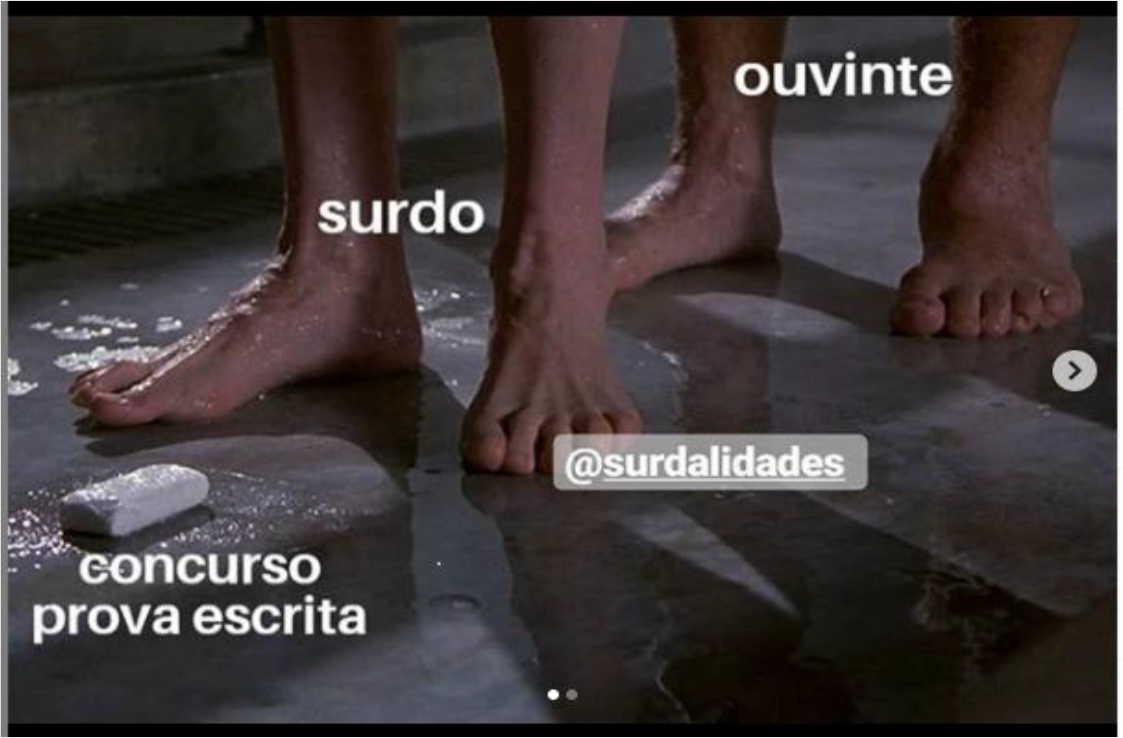
The following example highlights a tense relationship with the Portuguese language in competitive exams.

The meme presents a remixed image of a public restroom, where two people are barefoot, and a bar of soap is lying on the floor. This visual composition suggests a sense of exposure and discomfort for the “deaf” person represented in the image. In this context, the image of the wet and slippery soap symbolizes the fragility and vulnerability of the deaf subject in overcoming challenges in adverse situations. By associating this idea with deaf people’s participation in written exams in competitions, the meme suggests they are at a disadvantage, forced to compete in a system whose rules were not designed to accommodate them. The fallen soap metaphor highlights the exclusionary and unequal nature of this selection process, which favors those for whom Portuguese is their first language.
Thus, the content conveys a critique of the structure of public competitions that require written exams, highlighting the tension with the Portuguese language faced by deaf individuals whose first language is Libras and who encounter barriers in written communication. The wet soap on the floor metaphorically represents a trap that harms deaf candidates, reinforcing the hegemony of Portuguese as the norm in the context of “written exam competition.” This linguistic imposition limits the access of deaf individuals to the job market and perpetuates social exclusion.
Furthermore, the visual context of the meme reveals the interdiscursivity present, allowing different voices and discourses to overlap and resonate. In this meme, multiple voices coexist: the discourse of the deaf community, which demands fair access in public competitions (see technical note);14 the discourse of institutions, which impose Portuguese as the norm; and the cultural discourse associated with the joke about “dropping the soap,” evoking references to a macho and homophobic culture, reinforcing the idea of vulnerability and inferiority associated with the deaf character. These discourses, with their different perspectives, create a dialogic network marked by the subject’s response to others, manifesting a value-based stance in relation to external discourses.
The following meme shows a different discursive orientation, although it also presents another tense positioning:

The meme illustrates the frustration and disbelief of the deaf community upon realizing that, even in spaces meant to promote Libras, such as lectures and events targeted at the deaf audience, the hegemony of Portuguese persists. The stance of the “hearing speaker” who apologizes for speaking in Portuguese, justifying it as their first language (L1), reveals resistance or discomfort in adopting Libras as the language of instruction and communication. This behavior contradicts the guidelines of Brazilian language policies and disregards the historical efforts of the deaf community to implement Libras as a means of communication in educational and institutional environments for the deaf.
Law 10.436/2002 recognizes Libras as a legal means of communication and expression, promoting its use in all social spheres. However, the scenario depicted in the meme exposes a discrepancy between legal recognition and its practical application: many hearing speakers, even in contexts that require the valorization of Libras, continue to prioritize Portuguese. This practice reinforces the marginalization of sign language and neglects the need for communication spaces aligned with deaf culture.
Choosing to communicate in Portuguese in front of a deaf audience perpetuates an ethnocentric view, where the majority language is privileged, relegating Libras to a secondary role. This behavior highlights the power relations between linguistic groups, as discussed by Júnior et al. (2018), who examine how dominant languages impose themselves on minority languages, even in contexts where the use of these languages is essential for social valorization and identity building.
This scenario reflects the challenges faced by the deaf community in ensuring that Libras is not only legally recognized but also practiced and respected in formal spaces. Teske (2016) emphasizes that sign language is crucial for social and identity relations, strengthening the cohesion of the deaf community. The speaker’s stance directly interferes with the experience of belonging and the collective life of deaf culture.
Thus, the meme critically manifests the ongoing struggle of the deaf community for spaces where Libras is valued and respected. Although language policies represent progress, more concrete actions are needed to ensure that Libras is treated with the same legitimacy as Portuguese in environments targeted at the deaf community.
Final Considerations
Considering our goal of analyzing how visual memes reflect discursive positions and construct meanings through the social voices of the deaf community, our results indicate the presence of confrontational positions, especially highlighted by the polarized juxtaposition between “deaf” and “hearing speaker.” In these memes, we identify linguistic markers that reveal the voices of the deaf community as social expression, while simultaneously reenacting ideological positions reflecting the tension with hearing individuals and the Portuguese language, as well as the need to assert a linguistic and cultural identity.
While the memes express a sense of community, promoting a feeling of belonging and shared understanding of experiences and humor, it is important to note that they can also generate a sense of exclusion by reenacting and reinforcing the markers of difference, drawing a dividing line between those who belong to deaf culture and those who do not, i.e., the other hearing person.
Going beyond a simple image with text, the meme represents a stylistic act that carries a political and ideological charge. This stance, along with the context of the utterance, influences the interpretation and evaluation by the reader. This characteristic aligns with Bakhtin’s concept that every utterance is interconnected with others, shaped by the social, historical, and cultural context resulting from discursive practices within a community. Thus, memes act as a platform for expression and dissemination of political attitudes, being recognized and legitimized by the group in the constant clash of social voices and ideological positions.
Therefore, with this study, we confirm that memes are not only forms of entertainment but also means of political expression. By analyzing the stylistic aspects, content, and compositional structure of the genre, we reveal the ideological conflicts present within the deaf community and understand how different social voices position themselves and manifest through this form of visual communication.
However, it is important to highlight that this work has some limitations. For instance, the study may not have considered all the nuances and variations present in the memes produced and shared by the community, as the analysis of their stylistic aspects and content can be subjective and vary depending on one’s interpretation. Therefore, further investigation is needed to deepen our understanding of the role of memes in this cultural context.
For future research, it would be interesting to investigate the reception of memes among different members of the deaf community, as they appropriate this form of visual communication to compose their voices.
-
1
The term Web 2.0 refers to the technological advancement and the emergence of new digital platforms, such as social media, which have become an integral part of users’ daily lives.
-
2
In Portuguese: “este último [gênero] sofreu alterações para estar adequado ao ambiente virtual e às necessidades comunicativas dos internautas, gerando um novo gênero.”
-
3
In Portuguese: “as formas relativamente estáveis do dizer no interior de uma atividade qualquer têm de ser abertas à contínua remodelagem; têm de ser capazes de responder ao novo e à mudança.”
-
4
In Portuguese: “é por esse caminho que poderemos entender a argumentação daqueles autores segundo a qual a elaboração estilística da enunciação é uma atividade de seleção, de escolha individual, mas de natureza sociológica, já que o estilo se constrói a partir de uma orientação social de caráter apreciativo: as seleções e escolhas são, primordialmente, tomadas de posição axiológicas frente à realidade linguística, incluindo o vasto universo de vozes sociais.”
-
5
MOLON, Newton Duarte; VIANNA, Rodolfo. The Bakhtin Circle and Applied Linguistics. Bakhtiniana: Revista de Estudos do Discurso, São Paulo, 7 (2): 142-164, Jul./Dec. 2012. DOI: https://doi.org/10.1590/S2176-45732012000200010. Access on 29 Oct. 2024.
-
6
For reference, see footnote 5.
-
7
BAKHTIN, M. M. The Dialogic Imagination: Four Essays. Translated by Caryl Emerson and Michael Holquist. Austin: University of Texas Press, 1981.
-
8
See footnote 7.
-
9
See footnote 7.
-
10
In the original, in Portuguese: “Assim, não é só o enunciado, enquanto materialidade linguística, o foco de interesse da Análise do Discurso, mas também as condições de sua produção.”
-
11
For reference, see footnote 1.
-
12
In the original, in Portuguese: “deaf”; “hearing people creating signs.”
-
13
In the original, in Portuguese: “written exam competition”; “deaf”; “hearing person.”
-
14
Technical note considering the guidelines for public tenders, available in: https://feneis.org.br/wp-content/uploads/2024/03/NOTA-FENEIS-CONCURSOS-PUBLICOS-E-PROFESSORES-DE-LIBRAS.pdf. Access on May 5, 2024.
-
15
In the original, in Portuguese: “hearing speaker: Libras field”; “sorry deaf people, I will speak Portuguese because my L1 is Portuguese.”
-
Translated by Rafahel Parintins - rafahel.parintins@ufrn.br
-
Reviews
Due to the commitment assumed by Bakhtiniana. Revista de Estudos do Discurso [Bakhtiniana. Journal of Discourse Studies] to Open Science, this journal only publishes reviews that have been authorized by all involved.
Research Data and Other Materials Availability
The contents underlying the research text are included in the manuscript.
References
- BAKHTIN, Mikhail. Teoria do romance I: a estilística. Tradução, prefácio, notas e glossário de Paulo Bezerra. Organização da edição russa de Serguei Botcharov e Vadim Kójinov. São Paulo: Editora 34, 2015.
- BAKHTIN, Mikhail. Os gêneros do discurso. Organização, tradução, posfácio e notas de Paulo Bezerra. Notas da edição russa de Serguei Botcharov. São Paulo: Editora 34, 2016.
-
BUBNOVA, Tatiana. Voz, sentido e diálogo em Bakhtin. Tradução de Roberto Leiser Baronas e Fernanda Tonelli. Bakhtiniana: Revista de Estudos do Discurso, São Paulo, 6 (1): Ago./Dez. 2011, pp. 268-280. Disponível em: https://revistas.pucsp.br/index.php/bakhtiniana/article/view/7286 Acesso em 29 out. 2024.
» https://revistas.pucsp.br/index.php/bakhtiniana/article/view/7286 - CHAGAS, Viktor. Da memética aos estudos sobre memes: uma revisão da literatura concernente ao campo nas últimas cinco décadas (1976-2019). In: Viktor Chagas (org.). A cultura dos memes: aspetos sociológicos e dimensões políticas de um fenômeno do mundo digital. Salvador: EDUFBA, 2020. pp. 23-78.
- DOURADO, Maria Kérsia da Silva. Vozes surdas: um estudo de memes sobre a e pela comunidade surda. 2022. 114f. Dissertação (Mestrado em Estudos da Linguagem e Linguística Aplicada) - Centro de Ciências Humanas, Letras e Artes, Universidade Federal do Rio Grande do Norte, Natal, 2022.
- FARACO, Carlos Alberto. Linguagem & diálogo [recurso eletrônico]: as ideias linguísticas do Círculo de Bakhtin. São Paulo: Parábola, 2020.
- GIL, Antonio Carlos. Como elaborar projetos de pesquisa 6. ed. São Paulo: Atlas, 2017.
-
GUERRA, Christiane; BOTTA, Mariana Giacomini. O meme como gênero discursivo nativo do meio digital: principais características e análise preliminar. Domínios de Lingu@gem Uberlândia, v. 12, n. 3, pp. 1859-1877, jul.- set. 2018. DOI: https://doi.org/10.14393/DL35-v12n3a2018-17 Acesso em: 23 fev. 2024.
» https://doi.org/10.14393/DL35-v12n3a2018-17 -
JÚNIOR, Josmar Gonçalves; DÓREA, Yasmin Galvani Tonete; KOGUT, Marcos Kluber; SOUZA, Luiz Cláudio da Silva. Políticas linguísticas e a língua de sinais brasileira. Revista Sinalizar, Goiânia, v. 3, n. 1, pp. 57-67, 2018. DOI: https://doi.org/10.5216/rs.v3i1.51571 Acesso em: 15 nov. 2024.
» https://doi.org/10.5216/rs.v3i1.51571 -
KLEIN, Madalena; LUNARDI, Márcia Lise. Surdez: um território de fronteiras. ETD - Educação Temática Digital, Campinas, v. 7, n. 2, pp. 14-23, 2006. Disponível em: https://periodicos.sbu.unicamp.br/ojs/index.php/etd/article/view/787 Acesso em: 23 fev. 2024.
» https://periodicos.sbu.unicamp.br/ojs/index.php/etd/article/view/787 - LADD, Paddy. Em busca da surdidade 1: colonização dos surdos. Tradução de Sintagma e Mariana Martini. Editora: Surd’Universo. 2013.
- MOURA, Cecília; OHKAWA, Alexandre Dantas. Atitudes relacionadas à Surdez e ao Surdo/Deficiente Auditivo (DA). In: MOURA, Cecília; BEGROW, Desirée De Vit. (Orgs.). Libras e surdos: políticas, linguagem e inclusão. São Paulo: Contexto, 2024. pp. 41-52.
-
MOLON, Newton Duarte; VIANNA, Rodolfo. O círculo de Bakhtin e a Linguística Aplicada. Bakhtiniana: Revista de Estudos do Discurso, São Paulo, 7 (2): 142-165, Jul./Dez. 2012. DOI: https://doi.org/10.1590/S2176-45732012000200010 Acesso em 29 out. 2024.
» https://doi.org/10.1590/S2176-45732012000200010 - SHIFMAN, Limor. Memes in Digital Culture. Cambridge, Massachusetts: MIT Press, 2014.
-
SIPRIANO, Benedita Franca; GONÇALVES, João Batista Costa. O conceito de vozes sociais na teoria bakhtiniana - The Concept of Social Voices in the Bakhtiniana Theory. Revista Diálogos Relendo Bakhtin, Cuiabá (MT), v. 5, n. 1, pp. 60-80, jan.-jun., 2017. Disponível em: https://periodicoscientificos.ufmt.br/ojs/index.php/revdia/article/view/5084 Acesso em 5 mai. 2024.
» https://periodicoscientificos.ufmt.br/ojs/index.php/revdia/article/view/5084 -
PERLIN, Gladis. O ouvinte: o outro do outro surdo. In: PORSINAL. Florianópolis, 2003. Disponível em: https://www.porsinal.pt/index.php?ps=artigos&idt=artc&cat=20&idart=150 Acesso em: 23 fev. 2024.
» https://www.porsinal.pt/index.php?ps=artigos&idt=artc&cat=20&idart=150 - TESKE, Ottmar. A relação dialógica como pressuposto na aceitação das diferenças: o processo de formação das comunidades surdas. In: SKLIAR, Carlos. (Org,). Surdez: um olhar sobre as diferenças. 8. ed. Porto Alegre: Mediação, 2016.
-
VOESE, Ingo. Desafios para uma análise do discurso (e para o ensino?). Linguagem em (Dis)curso, Tubarão, v.3, n.1, pp. 187-2010, jul/dez. 2002. Disponível em: https://edisciplinas.usp.br/pluginfile.php/7491830/mod_folder/content/0/An%C3%A1lise%20de%20v%C3%ADdeos-materiais-sites-recursos-documentos/An%C3%A1lise%20de%20documentos%20oficiais/Proposta%20de%20ana%CC%81lise%20de%20texto%20e%20discurso.pdf Acesso em 5 mai. 2024.
» https://edisciplinas.usp.br/pluginfile.php/7491830/mod_folder/content/0/An%C3%A1lise%20de%20v%C3%ADdeos-materiais-sites-recursos-documentos/An%C3%A1lise%20de%20documentos%20oficiais/Proposta%20de%20ana%CC%81lise%20de%20texto%20e%20discurso.pdf -
WIGGINS, Bradley E. The Discursive Power of Memes in Digital Culture: Ideology, Semiotics, and Intertextuality. Routledge: New York, 2019. DOI: https://doi.org/10.4324/9780429492303 Acesso em 5 de maio, 2024.
» https://doi.org/10.4324/9780429492303 - XAVIER, Camila Jéssica Medeiros da Costa. Enunciação aforizante e panaforização: o caso dos memes políticos. 2018. 106 f. Dissertação (Mestrado em Estudos da Linguagem e Linguística Aplicada) - Centro de Ciências Humanas, Letras e Artes, Universidade Federal do Rio Grande do Norte, Natal, 2019.
-
Editors in ChargeAdriana Pucci Penteado de Faria e SilvaBeth BraitBruna LopesMaria Helena Cruz PistoriPaulo Rogério StellaRegina Godinho de Alcântara
Review I
About the reviewerSCIMAGO INSTITUTIONS RANKINGSReview I
There is a need for language revision, for defining the term “deaf community;” replacing “apud” with the original source; and using more appropriate synonyms for some terms. Please refer to the attached file. APPROVED WITH SUGGESTIONS [Revised]
- peer review recommendation: accept
Review III
About the reviewerSCIMAGO INSTITUTIONS RANKINGSReview III
The submitted work demonstrates relevance to the proposed theme, clearly states its objective, and ensures coherence in its textual development, analyzing the discursive positions present in visual memes produced by the deaf community. It is also consistent with the proposed theory, which is primarily Bakhtinian, showing an up-to-date understanding of the relevant bibliography. Furthermore, it highlights the originality of the reflection and its contribution to the field of knowledge, as well as demonstrates clarity, accuracy, and the adequacy of language for a scientific work. Therefore, this review is favorable to the publication of this work. APPROVED
- peer review recommendation: accept
Review IV
About the reviewerSCIMAGO INSTITUTIONS RANKINGSReview IV
The article Vozes sociais em memes da comunidade surda / Social voices in deaf community memes addresses a relevant topic concerning the tensions experienced by deaf and hearing individuals from Brazilian and possibly American communities, considering the selection of one of the four memes analyzed. Justifying the choice of a meme produced in another deaf community seems pertinent. Although the languages - Brazilian Sign Language (Libras) and Portuguese - are central to the conflicts between the two groups in the Brazilian context, the memes use written Portuguese instead of Libras. This point of tension, related to verbal content, was not discussed. Throughout the text, there are indications for reflection and suggestions to address some gaps identified in the text. Some are highlighted below: The memes analyzed do not belong to a single deaf community, making the title inconsistent. The methodology does not justify the selection of a sample related to different sociocultural contexts (Brazilian and foreign) nor does it identify whether the memes were produced by deaf or hearing individuals. How the voice of hearing individuals appears in all memes is unclear in the analysis section. With adjustments, the article will gain in content and clarity, making it suitable for publication. MANDATORY CORRECTIONS [Revised]
- peer review recommendation: accept
Review V
About the reviewerSCIMAGO INSTITUTIONS RANKINGSReview V
Initially, it is pertinent to note that there is alignment between the title and the content of the article. As the title is intriguing, it is inviting and will undoubtedly attract the interest of many readers. The objective of the work is clearly stated and consistent with the discussion throughout the text. The references used align with the proposed theory, and, moreover, the authors cited and the references to research demonstrate that the author(s) sought up-to-date knowledge on the proposed topic. The submitted article is original, contributing to reflections and discussions not only in the field of Discourse Analysis but also in Cultural/Deaf Studies. That said, it is worth emphasizing that the submitted work meets the standards of a scientific article, as it demonstrates clarity, accuracy, and appropriate language. The article requires only minor adjustments regarding the use of commas and the elimination of double spaces in some passages. APPROVED
- peer review recommendation: accept
Review VI
About the reviewerSCIMAGO INSTITUTIONS RANKINGSReview VI
The recommendations from the previous review were addressed in the new version. However, I identified a few adjustments that could improve the text’s clarity. Once these are made, my recommendation is for publication. APPROVED
- peer review recommendation: accept

 Source:
  Source:
  Source: