 Conceptual definitions of the outcome “Knowledge: Wound Management” in Portuguese and Spanish
Abstract
Objective To develop and evaluate the content validity of conceptual definitions for the nursing outcome “Knowledge: Wound Management (3209)” in Brazilian Portuguese and to culturally adapt the conceptual definitions of the nursing outcome “Knowledge: Wound Management (3209)” into Colombian Spanish.
Methods Two-phase methodological study. Initially, two nurses with experience in wound care and a linguist developed the conceptual definitions based on consultation of texts, scientific literature, guides, and dictionaries related to the attributes of the indicators. The definitions were then content-validated by nurses with experience in using the Nursing Outcomes Classification (NOC). To be considered valid, the definitions needed an agreement rate of 0.8 on the criteria of simplicity, clarity, completeness, and relevance. After validation, the definitions were culturally adapted through initial translation, translation synthesis, back-translation, and consensus committee.
Results 47 conceptual definitions were developed and validated, with an agreement rate greater than or equal to 0.8 for the four criteria evaluated. Subsequently, the definitions were adapted to Colombian Spanish, in accordance with the cultural nuances and terminology used in the version of the outcome for this population.
Conclusion The 47 conceptual definitions of the “Knowledge: Wound Management (3209)” are considered valid according to the criteria defined in this study. The culturally adapted version of the conceptual definitions in Colombian Spanish is classified as equivalent to the original. Both versions of the definitions aim to reduce nurses’ subjectivity when assessing knowledge of wound care.
Keywords:
Wounds and injuries; Health knowledge, attitudes, practice; Standardized nursing terminology; Nursing care; Translations
Resumo
Objetivo Desenvolver e avaliar a validade de conteúdo de definições conceituais para o resultado de enfermagem “Conhecimentos: Controle de Feridas (3209)” em Português do Brasil e adaptar culturalmente as definições conceituais do resultado de enfermagem “Conhecimentos: Controle de Feridas (3209)” para o espanhol da Colômbia.
Métodos Estudo metodológico de duas fases. Inicialmente, duas enfermeiras com experiência no cuidado de feridas e um linguista desenvolveram as definições conceituais com base na consulta de textos, literatura científica, guias e dicionários relacionados aos atributos dos indicadores. Imediatamente, as definições foram validadas em conteúdo por enfermeiras com experiência na utilização da Nursing Outcomes Classification (NOC). Para serem consideradas válidas, as definições precisavam de uma taxa de concordância de 0,8 nos critérios de simplicidade, clareza, exaustividade e pertinência. Após a validação, foi realizada a adaptação cultural das definições por meio de tradução inicial, síntese das traduções, retrotradução e comitê de consenso.
Resultados foram desenvolvidas e validadas 47 definições conceituais, obtendo-se taxa de concordância maior ou igual a 0,8 nos quatro critérios avaliados. Posteriormente, as definições foram adaptadas para o espanhol da Colômbia, de acordo com as nuances culturais e a terminologia utilizada na versão do resultado para esta população.
Conclusão As 47 definições conceituais do resultado “Conhecimentos: Controle de Feridas (3209)” são consideradas válidas segundo os critérios definidos neste estudo. A versão adaptada culturalmente das definições conceituais em espanhol da Colômbia é classificada como equivalente à original. Ambas as versões das definições pretendem reduzir a subjetividade das enfermeiras na avaliação do conhecimento sobre o cuidado de feridas.
Descritores:
Ferimentos e lesões; Conhecimentos, atitudes e prática em saúde; Terminologia padronizada em enfermagem; Cuidados de enfermagem; Traduções
Resumen
Objetivo Elaborar y evaluar la validez de contenido de definiciones conceptuales para el resultado de enfermería “Conocimientos: manejo de heridas (3209)” en portugués de Brasil y adaptar culturalmente las definiciones conceptuales del resultado de enfermería “Conocimientos: manejo de heridas (3209)” al español de Colombia.
Métodos Estudio metodológico de dos fases. Primeramente, dos enfermeras con experiencia en el manejo de heridas y un lingüista elaboraron las definiciones conceptuales basados en la consulta de textos, literatura científica, guías y diccionarios relacionados con los atributos de los indicadores. Luego, fue validado el contenido de las definiciones por enfermeras con experiencia en la utilización de la Nursing Outcomes Classification (NOC). Para que sean consideradas válidas, las definiciones precisaban un índice de concordancia de 0,8 en los criterios de simplicidad, claridad, exhaustividad y pertinencia. Después de la validación, se realizó la adaptación cultural de las definiciones mediante una traducción inicial, la síntesis de las traducciones, la retrotraducción y el comité de consenso.
Resultados Se elaboraron y validaron 47 definiciones conceptuales, con un índice de concordancia mayor o igual a 0,8 en los cuatro criterios evaluados. Posteriormente, se adaptaron las definiciones al español de Colombia, de acuerdo con los matices culturales y la terminología utilizada en la versión del resultado para esta población.
Conclusión Las 47 definiciones conceptuales del resultado “Conocimientos: manejo de heridas (3209)” se consideraron válidas según los criterios establecidos en este estudio. La versión de las definiciones conceptuales adaptada culturalmente al español de Colombia se clasificó como equivalente a la original. Ambas versiones de las definiciones pretenden reducir la subjetividad de las enfermeras en la evaluación del conocimiento sobre el manejo de heridas.
Descriptores:
Heridas y lesiones; Conocimientos, actitudes y práctica en salud; Terminología normalizada de enfermería; Atención de enfermería; Traducciones
Introduction
The success of wound healing is influenced by multiple internal and external factors, with emphasis on the knowledge of the individuals, families, or nurses responsible for wound care.(1,2) A greater understanding of the specific needs of each wound has a positive impact on people’s behavior, improving decision-making, the safety of the care provided, and its effectiveness.(1) Proper wound care optimizes resources, improves quality of life, and minimizes complications, thus reducing economic costs for health systems across the world.(2,3)
To evaluate the construct related to knowledge about wound care, the Nursing Outcomes Classification (NOC) contains the outcome called “Knowledge: Wound Management (3209)”. This outcome was presented in the sixth edition of the classification in 2018 and is conceptually defined as “Extent of understanding conveyed about caring for a surgical incision, puncture, ulcer, or open wound following tissue injury”. The outcome is made up of 32 indicators measured on a Likert scale ranging from 1 (No knowledge) to 5 (Extensive knowledge).(4)Recently, a scoping review was carried out with the aim of identifying indicators related to surgical wound care, in which 15 new proposed indicators were identified to complement the construct assessed by the outcome. In addition, the original English version underwent a process of cultural adaptation into Brazilian Portuguese and Colombian Spanish, in which the terminology used in the label, the definition, the indicators, and the scale for measuring the outcome were reviewed.(5)
In order to improve the use of the outcome in practice, teaching, and research, and to continue refining the construct assessed by the outcome, it is important to develop conceptual definitions.(6,7)Conceptual definitions are an additional component to the classification that allows the nurse to have a greater understanding of the concepts assessed by the outcome indicators.(6) A greater understanding of the indicators is important because these are the means by which it is possible to characterize and assess the health status of the person, the family, or the community.(4) On the other hand, given that future studies are expected to validate the nursing outcome for use in the Brazilian and Colombian populations, a unified process of cultural adaptation of the conceptual definitions becomes essential. This process is essential to ensure that the concepts evaluated are relevant, understandable, and applicable in both linguistic and cultural contexts. It also makes it possible to create a solid basis for the development of questions aimed at evaluating the indicators, ensuring accuracy and suitability to local realities.(7)
Validating the outcomes in Brazilian Portuguese and Colombian Spanish is especially important due to the linguistic and cultural differences between the two countries. These differences directly influence how the concepts described in the indicators are understood and applied in practice. Careful translation and adaptation reduce the inevitable loss of meaning that occurs when transferring information between languages, ensuring semantic and contextual equivalence. Hence, nursing professionals in both countries can use the instrument effectively, promoting a reliable assessment of knowledge about wound care.(6,8)
It should be noted that conceptual definitions translated and adapted for different languages, cultures, and contexts contribute to consensus on the concepts assessed in the indicators and strengthen the classification’s conceptual refinement. This refinement improves the applicability of the outcome in clinical practice, education, and research, providing benefits at both regional and international levels. Validation in multiple contexts also facilitates comparisons between populations, promoting scientific advances and strengthening the use of the NOC in different health systems.(6,7)
Considering the aforementioned, this study had two objectives: to develop and evaluate the content validity of the conceptual definitions for the nursing outcome “Knowledge: Wound Management (3209)” in Brazilian Portuguese and to culturally adapt the conceptual definitions of the same outcome into Colombian Spanish.
Methods
This was a two-phase methodological study. In the first phase, the conceptual definitions for the indicators of the outcome “Knowledge: Wound Management (3209)” in Brazilian Portuguese were developed and content was validated.(9) In the next phase, the Beaton model was adjusted to culturally adapt the conceptual definitions to Colombian Spanish.(5,10) o describe the outcome indicators, the versions adapted by Perez-Jaimes et al. (2024)(5) for both Brazilian Portuguese and Colombian Spanish were considered.
Phase 1. Development and content validation of conceptual definitions
In this study, a conceptual definition was considered to be the description of the set of fundamental characteristics that are common (and potentially unique) to each outcome indicator.(7) The conceptual definitions were developed in Brazilian Portuguese, as this was the native language and the language most understood by the panel of experts who participated in the content validation process. It is important to note that the development of the conceptual definitions involved the 32 indicators of the original outcome and the 15 new indicators identified in a previous study.(5)
The phase began with the identification and organization of the attributes that each outcome indicator represents.(9) To do this, the characteristics of the indicators described in a recently published scoping review focused on surgical wound care were considered.(5) Subsequently, a preliminary definition for each indicator was drawn up based on the researchers’ experience in wound care and consultation of academic texts, scientific literature, guidelines, consensus, and medical dictionaries related to the attributes and title of each indicator.(9) It should be noted that the development of the conceptual definitions was reviewed and monitored by a linguist.
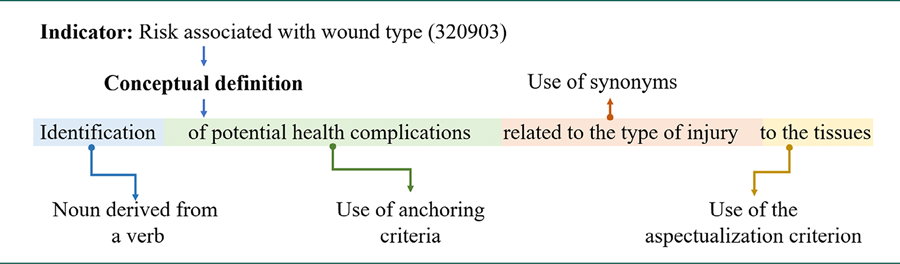
A grammatical structure was developed for each definition, taking into account four aspects: starting definitions with a noun derived from a verb, using synonyms, using the anchoring criterion, and using the aspectualization criterion. The discursive and linguistic criteria of anchoring and aspectualization are defined as follows: anchoring consists of giving a precise name to the concept being defined, using a central discursive word or theme-title (indicator concept), responsible for producing “the meaningful whole”. Aspectualization refers to the inclusion of information about temporal or spatial conditions. Furthermore, depending on the type of indicator, additional details can be included relating to the specific properties, functions, or situations being described.(11)
In order to assess the content validity of the conceptual definitions, a panel of experts made up of nurses with experience in using the NOC, whether in practice, teaching, or research, was recruited.(7) The nurses were recruited from the Study Group on Nursing Diagnoses, Interventions, and Outcomes (DIREnf) at the Nursing School of the University of São Paulo, located in the city of São Paulo - SP/Brazil. To be considered a member of the panel, the nurse was required to have at least five years of experience using the NOC.(12)
A sample size of 12 nurses was estimated for this phase, taking into account possible losses during the content validation process. Panel members were contacted by e-mail, and those who agreed to participate completed an online questionnaire developed in the SurveyMonkey software.(13)
The psychometric criteria of simplicity, clarity, completeness, and relevance were assessed to ensure that the conceptual definitions were clear, concise, comprehensive, and expressed only the description of a single outcome indicator.(14) Each criterion was assessed using a three-point Likert scale, where (-1) was disagree, (0) neither agree nor disagree, and (+1) agree. For the definitions to be considered valid, the agreement rate among the panel of experts had to be at least 0.8 for each criterion assessed. Conceptual definitions that scored less than 0.8 in any of the criteria evaluated were revised and re-evaluated according to the qualitative analysis of the expert panel’s comments.(7)
Phase 2. Cultural adaptation of conceptual definitions
Initially, an initial translation was carried out independently by two bilingual and bicultural sworn translators, whose native language is Colombian Spanish. The first translator (T1) was familiar with the concepts described in the outcome, specifically knowledge about wound care. The second translator (T2), was familiar with the cultural and linguistic nuances commonly used in Colombian Spanish, but had no prior knowledge of the concepts in the outcome, nor was he informed about them. Following on from the original definitions and the versions of translator T1 and translator T2, a document summarizing the translations was created called the “common translation” (T-12).(5,10,15)
To ensure that the synthesis of the translations reflected the same content as the original version of the conceptual definitions, a back translation of the common translation (T-12) into Brazilian Portuguese was carried out. This process required the participation of two new bilingual and bicultural translators (BT1 and BT2), who were completely blind to the original version of the definitions. Translators BT1 and BT2 share the same characteristics described for translators T1 and T2, with the difference that their native language is Brazilian Portuguese.(10,15)
As a final step, a consensus committee was formed to consolidate the definitive version of the conceptual definitions in Colombian Spanish. The committee was made up of two nurses with experience in wound care, a linguist, and a bilingual and bicultural translator (T3), who had not previously participated in the translation process.(5) To reach a definitive consensus, the committee considered each translation carried out in the previous stages of the study (T1, T2, T-12, BT1, BT2) and the original version of the definitions. In addition, the translation and adaptation processes previously carried out for this population were taken into account to maintain consistency with the terminology used in the Colombian Spanish version of the outcome.(5) In order to obtain a translation equivalent to the original version, the consensus committee considered the questions presented in Appendix 1.(10)
Any discrepancies between committee members were resolved by consensus. When there was no agreement on a translated or adapted component of the conceptual definitions, the processes relating to the conflicting component were repeated.(10,15)
The study was approved by the Research Ethics Committee of the School of Nursing at the University of São Paulo (Certificate of Submission for Ethical Appraisal: 71969823.8.0000.5392; Opinion: 6.544.337; 30/11/2023). All the nurses who participated in the study voluntarily read and signed the Informed Consent Form. Confidentiality of information and anonymity of those involved were ensured.
Results
Development and content validation of conceptual definitions
A total of 47 conceptual definitions were developed for the indicators of the outcome “Knowledge: Wound Management (3209)” in Brazilian Portuguese. Figure 1 shows an example of the grammatical structure used in the conceptual definitions.
Grammatical structure of the conceptual definitions of the outcome “Knowledge: Wound Management (3209)”
Twenty members of the DIREnf group agreed to participate in the content validation of the conceptual definitions, 13 of whom answered the questionnaires and met the study’s inclusion criteria. It should be noted that not all 13 members participated in all the validation rounds. The number of participants varied from six to ten depending on the round, as detailed in Table 1.
Among the members of the panel of experts, there was a predominance of women, PhDs, and an average age of over 46 years in all validation rounds. As for experience in using the NOC, the average was over 11 years in all rounds. The members’ primary areas of activity were research, teaching and clinical practice, respectively (Table 1). In addition, several study focus areas were identified, including: Cardiology, Adult ICU, Health Education, Trauma, Nursing Process, Standardized Nursing Language Systems, Medical-Surgical Nursing, Advanced Nursing Practice, Emergencies, and Stomatherapy. The panel evaluated the 47 conceptual definitions in three rounds. In the first round, 22 definitions were approved; in the second, 23; and the last two, in the third. The definitions that required three rounds of evaluation to reach the desired agreement of 0.8 in the four criteria were those related to the indicators: (320814) Importance of hand hygiene, and (320932) Importance of using sunscreen once healing occurs (Table 2).
During the validation, the panel made specific suggestions about the conceptual definitions. These recommendations were considered to improve the definitions and then sent back for approval. The conceptual definitions validated in Brazilian Portuguese are shown in Table 1.
Cultural adaptation of conceptual definitions
The results of the cultural adaptation of the conceptual definitions of the indicators for the outcome “Knowledge: Wound Management (3209)” for Colombia are shown in Chart 1. The translations T1, T2, T-12, BT1, and BT2 of the conceptual definitions of the outcome “Knowledge: Wound Management (3209)” in Colombian Spanish are presented in Appendix 2.
Conceptual definitions of the outcome “Knowledge: Wound Management (3209)”. Brazilian Portuguese and Colombian Spanish versions
Discussion
Development and content validation of conceptual definitions
As a discipline, nursing lacks its own process for effectively developing conceptual definitions for its standardized terminologies. Generally, concepts and research practices from other disciplines are adopted, in which definitions are drawn up based on a review of the literature, the experience of researchers, and consultation of academic texts, dictionaries, guides, and consensus related to the concepts to be defined.7,16
To improve and standardize the processes for developing conceptual definitions in the nursing field, this study presents four new aspects applicable to the grammatical structure of definitions. The first is including a noun derived from a verb at the beginning of each definition. This inclusion seeks to give the definition intentionality, i.e., to specify what the nurse expects the person being assessed to do based on the outcome indicator. For example, in indicator (320903) Risks associated with wound type, defined as “Identificação de complicações de saúde potenciais relacionadas ao tipo de lesão nos tecidos”, the assessed person is expected to identify, based on their knowledge, health complications related to the wound, such as infection, dehiscence or other, under the guidance of the nurse. Adding the noun derived from a verb is especially relevant for outcomes that assess knowledge or behavior, which focus on determining whether individuals are prepared to manage a particular health condition.(4)
As a second innovative aspect, synonyms were added to the terms described in the indicator’s title to better describe the concepts being assessed. The synonyms broaden the understanding of the concept, offering terminology that is more suited to the conditions and competencies of nurses.(23)
The third and fourth criteria are anchoring and aspectualization, respectively. The linguist recommended these to enable nurses to identify the concepts that make up the definition, based on cohesion and linguistic coherence. The anchoring criterion allows the objects of discourse to be inscribed in a cultural pre-construction, activating two types of knowledge in memory: the nurse’s knowledge of wound care (discursive object) and knowledge of language (available lexical discourse). In turn, the aspectualization criterion allows for the construction of extradiscursive elements that bring the series of descriptive propositions closer to the structure of a definition.(11)
The inclusion of nouns derived from verbs and the use of synonyms are practices that, in one way or another, nurses already apply unconsciously when drawing up definitions, as evidenced in the scientific literature.(16,19,20) However, a detailed description of these aspects is relevant, since they consolidate professional research practices and methodological models in each area.(24) In addition, interdisciplinary work with linguistics professionals is recommended, who, thanks to their knowledge and experience in the study of language, can contribute significantly to the exploration and improvement of standardized terminologies in nursing.(5,9)
Regarding the validation of the conceptual definitions, these were evaluated with the participation of 13 members of the DIREnf group, experts in the use of the NOC, according to Quatrini’s criteria.(12) In the evaluation rounds, the sample varied between six and ten participants, six being the minimum acceptable number of experts used for content validation processes.(13,21) This variability has been previously documented in the validation of the conceptual and operational definitions of the outcome Symptom control (1608), and may be related to how arduous and extensive the process of evaluating the elements of a nursing outcome can be.(21)
It took three rounds during validation to reach the desired agreement rate of 0.8 for the 47 conceptual definitions. The definitions of indicators (320914) Importance of hand hygiene, and (320932) Importance of using sunscreen once healing occurs were the ones that required the most adjustments and rounds of evaluation. Indicator 320914 presented difficulties in relation to the focus or purpose of hand hygiene, which led to the modification of the phrase “para a cicatrização” into “para o cuidado da lesão”, based on the panel’s comments. In relation to indicator 320932, debates arose about the phrase “ao fim da fase de proliferação”, which led to discussions about the best way to refer to when the product should be applied. Based on the panel’s comments, it was concluded that the best option was to replace the phrase with “após a cicatrização”.
Cultural adaptation of conceptual definitions
The cultural adaptation of the definitions followed the same rigorous phases used previously in the cultural adaptation of the outcome carried out by Perez-Jaimes et al (2024). These phases included initial translation, synthesis, back-translation and consensus, where the participation of a linguist stands out.(5) In all these phases, agreement was reached on all the elements, without needing to repeat the translation of any conceptual definitions. However, there was difficulty in culturally adapting the definition of indicator (320917) Use of ointments, defined in Brazilian Portuguese as “Identificação dos cuidados para uso de pomadas na lesão”. The main difficulty was with the term “pomadas”, which in Spanish may represent a different pharmaceutical form from ointments, the term used in the Colombian Spanish version of the outcome. In order to maintain homogeneity with the cultural adaptation of the outcome into Colombian Spanish, we opted to use the term “ungüentos”. However, the discussion remains open for future cultural adaptation studies on the need to compare versions of the same outcome in different languages.
Finally, the process of adapting the conceptual definitions focused on finding terminology suitable for the Colombian cultural environment, to communicate the same concept that the indicator represents. An example of this is the case of the indicators related to self-care activities, in which the expression “cuidado de sí mismo” was implemented to refer to “ações pessoais”, as described in the Brazilian Portuguese definition.
This study has some limitations. During the content validation process of the conceptual definitions, using several rounds with the same group of nurses could have generated an acceptance bias.(25) Regarding the cultural adaptation process of the definitions, a comprehension test of the Colombian Spanish version was not carried out with nurses from this cultural environment.
Conclusion
The conceptual definitions developed and evaluated in content for the “Knowledge: Wound Management (3209)” in Brazilian Portuguese met the psychometric validity criteria defined in this study. These conceptual definitions aim to reduce nurses’ subjectivity when using the outcome in research, teaching, or practice by describing the concepts that each indicator assesses. In addition, a version of the conceptual definitions of the outcome “Knowledge: Wound Management (3209)” in Colombian Spanish was generated, equivalent to the original in Brazilian Portuguese. This version of the conceptual definitions is important for Colombian nurses as it takes into account the unique linguistic and cultural aspects of this population. Both versions of the conceptual definitions will contribute to the consolidation of the concepts assessed by the indicators in the different countries and will facilitate the continuity of research processes focused on refining the construct assessed in the outcome: knowledge about wound care, in particular, processes of content validation of the outcome in both countries, for different types of wounds and individuals providing care.
Acknowledgments
This work was carried out with the support of the Coordination for the Improvement of Higher Education Personnel - Brazil (CAPES) - Funding Code 001, master’s scholarship for the author Giovanny Andres Perez-Jaimes.
Appendix 1
Issues considered by the consensus committee to ensure equivalence in the cultural adaptation of conceptual definitions
-
Semantic equivalence: Do the words used in the conceptual definitions mean the same thing? Are their multiple meanings equivalent for a given element? Are there grammatical difficulties in translating the conceptual definitions?
-
Linguistic equivalence: Do the translated components of the conceptual definitions contain colloquialisms or idioms equivalent to those of the target country?
-
Experiential equivalence: Do the translated components of the conceptual definitions effectively capture the daily life experiences of people in the target country?
-
Conceptual equivalence: Do the words used in the conceptual definitions maintain a similar conceptual meaning to the original version?
Appendix 2
References
- 1 Do HT, Finlayson K, Edwards H. Surgical wound assessment in Vietnam: a think-aloud technique and interview analysis. J Wound Care. 2020;29 (Sup4):S4-13.
- 2 Chhabra S, Chhabra N, Kaur A, Gupta N. Wound healing concepts in clinical practice of OMFS. J Maxillofac Oral Surg. 2017 ;16(4):403-23.
- 3 Al-Gharibi KA, Sharstha S, Al-Faras MA. Cost-effectiveness of wound care a concept analysis. Sultan Qaboos Univ Med J. 2018;18(4):e433-9.
- 4 Moorhead S, Swanson E, Johnson M. Nursing outcomes classification (NOC)-E-Book: Measurement of health outcomes. 7th ed. St. Louis (Missouri): Elservier; 2024.
- 5 Perez-Jaimes GA, Arévalo Viveros LF, Rueda-Díaz LJ. Nursing outcome "Knowledge: Wound management" for surgical incision wound care: Update, translate, and culturally adapt. Int J Nurs Knowl. 2024:1-13.
- 6 Echevarría Pérez P, Romero Sánchez JM, Giró Formatger D, Giménez Fernández M. Investigación en metodología y lenguajes enfermeros. 2nd ed. Barcelona: Elsevier; 2020.
- 7 da Costa Ferreira N, Moorhead S, de Cassia Gengo E Silva Butcher R. The nurse-patient outcome content validation method. Int J Nurs Knowl. 2021;32(2):88-95.
- 8 Gapper S. La teoría y el arte de la traducción. Letras; 1991: 23-24; 27-58.
- 9 Podsakoff PM, MacKenzie SB, Podsakoff NP. Recommendations for creating better concept definitions in the organizational, behavioral, and social sciences. Organ Res Methods. 2016;19(2):159-203.
- 10 Beaton DE, Bombardier C, Guillemin F, Ferraz MB. Guidelines for the process of cross-cultural adaptation of self-report measures. Spine. 2000;25(24):3186-91.
- 11 Sánchez Martínez A. La superestructura de la descripción. Estudios de Lingüística Aplicada. 2005;42:1-16.
- 12 Quatrini Carvalho Passos Guimarães HC, Pena SB, Lopes JL, Lopes CT, Bottura Leite de Barros AL. Lopes J d. L, Lopes CT, Bottura Leite de Barros AL. Experts for validation studies in nursing: new proposal and selection criteria. Int J Nurs Knowl. 2016;27(3):130-5.
- 13 Yusoff MS. ABC of content validation and content validity index calculation. Educ Med J. 2019;11(2):49-54.
- 14 Pasquali L. Princípios de elaboração de escalas psicológicas. Arch Clin Psychiatry. 1998;25(5):206-13.
- 15 Sousa VD, Rojjanasrirat W. Translation, adaptation and validation of instruments or scales for use in cross-cultural health care research: a clear and user-friendly guideline. J Eval Clin Pract. 2011;17(2):268-74.
- 16 Cavalcante AM, Lopes CT, Swanson E, Moorhead SA, Bachion MM, De Barros AL. Validation of definitions of the indicators for Nursing Outcomes Classification outcomes: self-management cardiac disease. Acta Paul Enferm. 2020;33: e-APE2018026.
- 17 Chantal Magalhães da Silva N, de Souza Oliveira-Kumakura AR, Moorhead S, Pace AE, Campos de Carvalho E. Clinical validation of the indicators and definitions of the nursing outcome “Tissue integrity: skin and mucous membranes” in people with diabetes mellitus. Int J Nurs Knowl. 2017;28(4):165–70.
- 18 Emidio SC, Dias FS, Moorhead S, Deberg J, Oliveira-Kumakura AR, Carmona EV. Conceptual and operational definition of nursing outcomes regarding the breastfeeding establishment. Rev Lat Am Enfermagem. 2020;28:e3259.
- 19 Graeff MS, Almeida MA. Construction and validity of definitions for outcome indicators of the INICIARE-26 instrument. Acta Paul Enferm. 2023;36:1-13.
- 20 Luzia MF, Argenta C, Almeida MA, Lucena AF. Conceptual definitions of indicators for the nursing outcome "Knowledge: fall Prevention". Rev Bras Enferm. 2018;71(2):431-9.
- 21 Quirino Afonso B, da Costa Ferreira N, Gengo E Silva Butcher RC. Conceptual and operational definitions for the indicators of the nursing outcome classification: symptom control in patients with heart failure in palliative care. Enferm Clin (Engl Ed). 2020;30(6):386-97.
- 22 Rodríguez-Acelas AL, Reich R, de Abreu Almeida M, Oliveira Crossetti MD, de Fátima Lucena A. Nursing outcome "Severity of infection": conceptual definitions for indicators related to respiratory problems. Invest Educ Enferm. 2016;34(1):38-45.
- 23 Luisa M, Rodríguez R. La sinonimia como recurso de acceso léxico en la enseñanza de lenguas. Revista Nebrija de Lingüística Aplicada a La Enseñanza de Lenguas. 2013;13:1-13.
- 24 McMeekin N, Wu O, Germeni E, Briggs A. How methodological frameworks are being developed: evidence from a scoping review. BMC Med Res Methodol. 2020;20(1):173.
- 25 Shang Z. Use of Delphi in health sciences research: A narrative review. Medicine (Baltimore). 2023;102(7):E32829.
Edited by
-
Associate Editor:
Camila Takao Lopes (https://orcid.org/0000-0002-6243-6497) Escola Paulista de Enfermagem, Universidade Federal de São Paulo, São Paulo, SP, Brazil