
 Dimensions of Identity and Pathways for Engagement in the Preservation of Local Cultural Heritage among Young Chinese People: A Grounded Theory Study
Abstract:
Under the context of cultural globalization, this study explores how youth reconstruct the value of local culture amidst negotiating its subjective identity and cultural belonging. It contends that young people’s engagement in cultural heritage conservation is not merely an external response, but a constructive practice of cultural agency, rooted in the awakening of value identification and an existential sense of belonging. Through semi-structured interviews with 30 young Chinese people and utilizing the three-tiered coding process of Grounded Theory, a localized theory model is derived. The study indicates that youth engagement follows a dynamic and nonlinear path of “perception-identity-action”, with cultural confidence serving as the pivotal hub driving a virtuous cycle. This work posits that cultural heritage can serve as the foundational basis for contemporary ethical practices and identity construction. Further, it stresses the imperative of a collaborative governance involving diverse stakeholders and institutional guarantees to propel the youth as an organic force in the cultural rejuvenation process.
Keywords:
Agency; Youth; Heritage; Culture; Identity; Philosophy; Practice; Action; Ethics
Resumo:
No contexto da globalização cultural, este estudo explora como os jovens reconstroem o valor da cultura local, enquanto negociam a sua identidade subjetiva e pertencimento cultural. Ele defende que o envolvimento dos jovens na conservação do patrimônio cultural não é meramente uma resposta externa, mas uma prática construtiva de agência cultural, enraizada no despertar da identificação de valores e de um senso existencial de pertencimento. Por meio de entrevistas semiestruturadas com 30 jovens chineses, utilizando-se o processo de codificação em três níveis da Teoria Fundamentada, derivou-se um modelo teórico localizado. O estudo indica que o envolvimento dos jovens segue um caminho dinâmico e não linear de “percepção-identidade-ação”, com a confiança cultural servindo como o eixo central que impulsiona um ciclo virtuoso. Este trabalho postula que o patrimônio cultural pode servir como base fundamental para práticas éticas contemporâneas e construção de identidade. Além disso, enfatiza a necessidade de uma governança colaborativa envolvendo diversas partes interessadas e garantias institucionais para impulsionar os jovens, como uma força orgânica, no processo de rejuvenescimento cultural.
Palavras-chave:
Agência; Juventude; Patrimônio; Cultura; Identidade; Filosofia; Prática; Ação; Ética
INTRODUCTION
Amidst the dynamic landscape of globalization and the rapid evolution of information technology, cultural heritage finds itself embroiled in a complex web of challenges. Embodying the continuity of civilization, the preservation of collective memory and the enhancement of identity, cultural heritage assumes a multifaceted role that is deeply intertwined with the fundamental issues of identity reconstruction and social identification (Ma; Dao, 2025). In China’s context, local cultural heritage is deeply rooted in imperial traditions, emphasizing the transmission of literary works and the revitalization of artifacts. Influenced by Western ideologies, a division has emerged between tangible and intangible heritages, with ownership transitioning from monarchies to the public sphere. Despite these shifts, the essence of cultural heritage continues to be rooted in a reflective examination of history, embracing a convergence of Eastern and Western wisdom to pursue enduring cultural traits (Zhu, 2020).
The notion of “indigenous cultural heritage” in this study does not strictly refer to administrative territorial divisions, but rather denotes cultural heritage spaces that young individuals directly perceive and emotionally connect with in their life, learning and social experiential contexts. This concept underscores “localized experiences” over “geographical locations”, aiming to explore how young people, within their cultural milieu, reinterpret and engage in the contemporary valorization of cultural heritage. However, the relentless forces of urbanization, consumerism and media saturation threaten to diminish the vibrancy of culturally distinctive forms, eroding their historical essence and potentially giving rise to a crisis of “cultural disjunction” (Knapik; Król, 2023; Quan, 2024).
Viewed through the lens of intergenerational continuity, the youth demographic emerges as pivotal agents in the preservation of cultural vitality (Menkshi; Braholli; Çobani, 2021). No longer passive recipients of traditional culture, today’s youth is actively engaged in the constructive practice and redefinition of cultural heritage. Its attitudes and actions wield significant influence over the unfolding fate and evolution of local cultural heritage within the context of contemporary times.
It is crucial to note that youth involvement in cultural heritage preservation transcends mere compliance with external policy directives, evolving into a profound pathway for shaping cultural identity, ethical conduct and an existential sense of belonging. Its efforts in safeguarding cultural legacies do not merely reflect cultural agency, but also serve as an internalized practice rooted in emotional connections and value systems, underscoring the “emotional and pragmatic dimensions” inherent in the construction of cultural agency. Yet, existing research predominantly fixates on facets, such as policy frameworks, media technologies, or knowledge dissemination, overlooking a systematic exploration of the subjective motivations, internal logic and operational mechanisms driving youth engagement in the preservation of cultural heritage. Particularly, there is a distinct oversight in understanding the generative mechanisms and operational dynamics behind youth “cultural agency” in the process of cultural inheritance.
Within this study, “youth” specifically delineates individuals aged between 18 and 40, encompassing young adults, such as university students, young civil servants and early career professionals. This cohort not only exhibits a high level of cultural receptivity, but also grapples with challenges of identity reconstruction within the context of value diversification and globalization, thereby representing a pivotal sample for observing the process of “cultural subjectivation” within contemporary cultural heritage preservation practices (Rannala et al., 2024).
Therefore, this research concentrates on the elements of indigenous cultural heritage preservation that resonate with Chinese youth and its pathways of involvement, positing the research hypothesis that youth engagement, in cultural heritage protection, is not merely a reactive response, but a constructive cultural subject practice, rooted in the awakening of value identification and existential belonging. It also investigates the following questions: is youth participation, in cultural heritage preservation behavior, a consequence of formed identity or a way of identity generation? And, in the backdrop of cultural globalization, how do young people reconstruct the values of indigenous culture amidst subject identification and cultural belonging? In practical terms, through the utilization of Grounded Theory to develop a model, this research endeavors to provide actionable insights for universities, cultural institutions and policymakers in formulating youth cultural policies. By doing so, it endeavors to catalyze deep-rooted youth involvement in the transformative preservation and innovative development of local cultural heritage, thereby propelling progress in the realm of cultural inheritance practices.
While the focus of study lies on the Chinese young people’s engagement mechanisms in safeguarding local cultural heritage, its theoretical framework holds potential for cross-cultural interpretations, offering insights into youth cultural actions within a globalized context. The structure of this paper is as follows: it initially delineates core concepts and establishes a theoretical foundation. Subsequently, it reviews recent studies on youth cultural identity and cultural heritage preservation to identify research gaps. It, then, elucidates the research design and methodology, proceeding to present a model based on grounded theory and expounding the mechanism behind youth cultural actions. Lastly, it summarizes theoretical contributions and practical insights.
1 CONCEPTUAL DEFINITION AND THEORETICAL FOUNDATION
Current research interprets cultural subjectivity as the individuals’ or groups’ capacity to engage in self-awareness, self-construction and meaning expression within cultural systems, emphasizing its manifestation as agency, where subjects are not merely influenced by culture, but actively participate in its reproduction and innovation processes (Bhatti; Pardaev, 2025). From the perspective of practical philosophy, such agency is not a predetermined setting, but rather emerges within the context of specific social actions.
An existential sense of belonging reflects the psychological state where individuals deeply connect emotionally with specific social, cultural, or spatial constructs (Allen et al., 2021). Identity philosophy posits that an individual’s “identity” is a relational existence, established through interactions with others and processes of recognition (Joshi et al., 2023). Identity affirmation is not static, but an ongoing and dynamic process of construction and negotiation. A sense of belonging influences the individual’s self-identity structure, thereby shaping their cultural behavioral patterns and willingness to engage in collective endeavors.
Traditional policy-oriented perspectives often view young people as mere recipients of cultural resources rather than active constructors (Husu; Kumpulainen, 2020). However, practical philosophy contends that human beings are entities in action, deriving meaning and identity from engagement in real societal practices. Ethical action theory posits that ethical conduct is not merely a result of norm adherence, but a complex decision-making process influenced by motives, environmental reinforcement and cognitive biases within specific contexts.
Cultural confidence, as a reflection of psychological state and identity affirmation, signifies an individual’s acknowledgment and pride in their cultural values. The establishment of cultural confidence enables individuals to exhibit ethical behaviors driven by intrinsic values and emotions in cultural heritage preservation, rather than solely adhering to external norms. While cultural actions are influenced by institutional norms, they also reflect individuals’ responses to value orientations and boundaries of responsibility in social interactions (Cicero, 2021). In the traditional Chinese philosophical tradition, Confucianism, through the concept of “integration of knowing and acting”, reveals the generation of practical rationality: moral motivations must be translated through the daily practice of “rites” to achieve virtue. Actions not only manifest value identification, but also contribute to identity formation.
2 LITERATURE REVIEW
Existing research indicates that contemporary young people exhibit enthusiasm towards cultural heritage, yet their engagement motivations are generally lacking, particularly showcasing new complexities in highly digitized contexts (Gao; Han, 2024). Cultural content often becomes “recreated for entertainment” within youth communities, expanding its reach, but potentially diminishing the guiding value function of cultural cores. This, in turn, may reduce the development of youth identity and lead to a disconnect between cultural perception and the construction of cultural confidence (Zhu, 2025).
Nevertheless, other studies suggest that voluntary practices, physical engagement and “immersive community experiences” can effectively evoke emotional resonance among young people, thereby propelling the active construction of cultural identity (Yue; Li, 2023; Tang; Liang, 2025). It is evident that the youth’s process of cognitive and identity transformation towards cultural heritage exhibits high situational and dynamic characteristics, necessitating an in-depth analysis of its mechanisms.
Quan Xi (2024, p. 52-59) suggested that youth’s role, in cultural heritage preservation, can be understood as a progressive one - from “potential stakeholders” to “active communicators” to “new guardians”. However, in the context of intensified online media, despite increased interactivity enhancing surface engagement levels, youth behavior can easily fall into a shallow logic of “entertainment and fragmentation”, leading to a structural contradiction of “cognitive overload and resulting in behavioral inertia” (Han; Liu, 2025). Furthermore, the current engagement mechanisms struggle to effectively translate cognition into sustained actions, resulting in a situation where youth may accumulate value identity, but lack stable support in their action pathways (Xu, 2025; Zhang et al., 2024). Hence, it is imperative to establish intermediary mechanisms that bridge cognition and action, enhancing the practical efficacy of youth cultural engagement. Building upon this foundation, this study seeks to uncover the modern transformation logic of cultural inheritance, addressing the gaps in systematic engagement mechanism research, and providing a framework to support policy formulation and theoretical analysis.
Existing research on youth and cultural identity predominantly focuses on policy guidance and educational interventions, often portraying youth as passive recipients of culture while neglecting its agency and cultural subjectivity (Soleimani et al., 2022; Yalvaç Arıcı, 2025). Even when studies mention subjectivity, they tend to dwell on surface experiences, lacking in-depth philosophical and theoretical exploration and construction of “cultural subjectivity” and “an existential sense of belonging”. Moreover, mainstream psychological and social research often simplifies belonging to emotional states, overlooking the underlying identity structures and ethical expectations (Allen et al., 2021). In contrast, Joshi et al. (2023) argued that individual identity should be placed within the philosophical inquiry framework of “who am I”, encompassing the dimensions of ontology, epistemology and ethics.
With the enhancement of cultural confidence, youth participation in cultural heritage preservation transitions from external impetus to internal awareness, showcasing a practice driven by ethical responsibility and cultural identity. This shift aligns with the path of self-cultivation, advocated in The Great Learning and The Doctrine of the Mean: starting from sincerity and rectifying the mind to self-cultivation, and eventually extending to care for society. The youth’s confidence in its culture is a demonstration of sincerity of intention and rectification of the heart-mind, allowing it to prioritize self-cultivation in safeguarding and passing on cultural heritage. This transformation of identification into action demonstrates a deeper sense of cultural responsibility and initiative.
Overall, there exists a disconnect between philosophical propositions and empirical pathways in research on youth cultural engagement. This study seeks to introduce a perspective from practical philosophy, integrating the method of grounded theory. By empirically modeling youth cultural behavior, it reexamines the young people’s motivation in cultural heritage preservation from the standpoint of cultural subjectivity. Addressing the philosophical debate on whether youth participation in cultural heritage preservation is a result of identification or a way to generate identification, it introduces, for the first time, the shaping role of cultural confidence in ethical behavior. This contribution fills a theoretical gap in existing literature and expands the explanatory dimension of cultural participation research.
3 RESEARCH METHODOLOGY
This study conducts semi-structured interviews with young individuals, including students, civil servants and professionals from various industries, to explore the dimensions of identity and engagement processes in the preservation of cultural heritage among young people. Through these interviews, the study aims to construct a theoretical model that addresses philosophical controversies.
Utilizing a qualitative research approach, this study employs grounded theory, a qualitative research method introduced by American scholars Barney G. Glaser and Anselm L. Strauss (Wang; Li; Jin, 2022, p. 47).
To construct a theoretical model focusing on the dimensions of identity and pathways to engagement in preserving local cultural heritage among young Chinese people, semi-structured interviews were designed and implemented. Drawing from literature, the interview guide covers core topics, such as young individuals’ sources of cultural heritage awareness, attitudes towards preservation, motivations for engagement, experiences of identity, modes of practice, and their understandings and recommendations regarding the government’s, social organizations and businesses roles (Mkwananzi; Cin; Marovah, 2023).
The research involved interviews conducted over a six-month period (from April to September 2024), divided into two phases: pilot interviews with 10 individuals to test and revise the outline, and formal interviews with 20 individuals to ensure gender, occupation and educational diversity. Interviews were conducted via Tencent Meeting and phone calls, with researchers explaining the research purpose before asking questions based on the outline. Flexibility was maintained in scheduling interviews with respondents to minimize interference and fatigue, with each interview lasting approximately 20-30 minutes (Guo; Peng, 2025).
All interview recordings were transcribed into texts and systematically coded and managed using NVivo 12. Through the use of nodes, memos and coding frequency functions, researchers identified conceptual relationships, tracked thematic evolution and controlled for subjective biases to enhance the transparency and reproducibility of the study.
The study encompasses 30 young individuals aged 18 to 40, including students, civil servants and professionals from various sectors, such as education, administration and technical services. The educational backgrounds range from below high school to postgraduate levels, with over 60% holding bachelor’s degrees or higher. All participants had experiences with cultural heritage involvement and possessed fundamental cultural heritage knowledge, as depicted in Table 1. The sample structure aimed to reflect diversity in age, education and occupation types to enhance the realism and explanatory power of the study when constructing the theoretical model.
Sample selection was based on the real structure of youth participation in cultural heritage preservation and research feasibility (Dahal et al., 2024). Young people’s three categories - students, civil servants, and young professionals from enterprises and institutions - were chosen to represent dimensions of cultural cognition, public affairs and social practice, providing a comprehensive reflection of the youth’s characteristics in terms of cognition and action. However, there were biases in the sample, with a higher proportion of university students and young professionals from enterprises and institutions, and fewer individuals from rural areas and cultural professions, constraining motivational heterogeneity of motivations for cultural participation. This bias stemmed from limitations in the accessible population, indicating that the current main force in cultural heritage preservation consists mostly of highly educated youth.
After the interviews, the author meticulously cross-checked all interview records and randomly coded extracted statements, removing duplicates. A total of 420 original statements were collected, with 280 (2/3) randomly selected for coding processing and analysis, while the remaining 140 (1/3) interview records were used to test theoretical saturation.
The final sample of 30 individuals was determined based on the principle of “theoretical saturation” in grounded theory. During the coding process, no new concepts or categories were identified after the 27th interviewee, with subsequent data mainly repeating and supplementing existing categories, thus indicating theoretical saturation (Rahimi, 2024). The 30 samples displayed diversity in terms of gender, occupation and educational background, ensuring both theoretical depth and aligning with the qualitative research logic of pursuing theoretical saturation rather than numerical representativeness.
4 FROM MODEL TO PROPOSITION: ANALYSIS OF THE MECHANISM OF CULTURAL ACTION GENERATION
Utilizing the three-tier coding process of Grounded Theory, the interview transcripts were meticulously analyzed line by line. Through iterative comparisons and content organization, relevant information was gradually synthesized and merged to transform raw data into conceptualized and categorized core vocabulary (Wang; Zhou; Fan, 2024). This process involves continuously adjusting coding content to refine higher-fitting concepts, aiding in the generation of core categories. A total of 22 categories and 48 concepts were extracted, with some examples provided in Table 2, and the complete content available in the appendix.
During the axial coding process, relationships among concepts are identified, categorizing related concepts into different categories to further explore the underlying connections between concepts and categories. This process involves rational expressions of the relationships among different parts of the original data. Main categories are concretized with attributes and dimensions, reorganizing fragmented data within categories to derive key elements of the theoretical model, such as “cultural continuity”, “motivations driving engagement” and “cultural confidence”, among others. Seven core categories were summarized, with some examples shown in Table 3, and the full content available in the appendix.
Selective coding refers to the systematic analysis and establishment of a core category among the identified various categories, which serves as the theoretical axis to integrate other categories, thereby encompassing the main research findings (Li, 2022). This study takes “Dimensions of Identity and Pathways to Engagement in the Preservation of Local Cultural Heritage Among Chinese Youth” as the core category, proposing that youth’s actions in protecting cultural heritage are not merely responses to external policies, but rather constructive cultural subject practices, rooted in the awakening of value identification and an existential sense of belonging.
The “plotline” indicates that young people often perceive the educative value and social significance of cultural heritage through chance encounters, which subsequently ignite deeper reflections on cultural continuity. Driven by intrinsic motivations, such as interest, emotional resonance and value identification, a willingness to engage gradually emerges. As the practices deepen, young people encounter various cognitive obstacles in their development, which can be categorized into three types: inadequacy of protective driving forces and public misconceptions, loss of authenticity and convergence of innovation in the inheritance process, and experiential fractures and insufficient accessibility in the dissemination dimension. Addressing these structural issues is crucial through strengthened protection measures and multi-actor governance, ultimately enhancing cultural confidence.
Cultural confidence serves as a crucial link, enhancing protection efficacy not only through education and technological means, but also by activating values through intergenerational communication and innovative expressions.
The bolstering of cultural confidence resulted in the young people’s forming cultural belongings in cognition, demonstrating ethical practices in action. This enhancement not only reflects cultural identity, but also ignites ethical responsibilities, prompting youth to actively engage in cultural heritage preservation and drive deepened practices. This process aligns with the emphasis on self-cultivation in Confucianism, where sincerity of intention and rectification of the heart-mind serve as the foundation, achieving harmony in society through self-improvement. The young’s confidence in culture embodies a sense of “ sincerity of intention and rectification of the heart-mind”, enabling it to achieve internal identity and external action unity in safeguarding and inheriting, fostering a virtuous cycle of cultural awareness and societal responsibility.
Through the three-stage coding process of the Grounded Theory, the conceptual framework of this study has stabilized, with no new analytical categories emerging, indicating theoretical saturation. To enhance research reliability and ensure interpretative consistency, peer review was conducted. Researchers submitted preliminary coding results to two scholars with qualitative research experience for validation, primarily involving concept definition and delimitation of categories (Thomson et al., 2024). Based on their feedback, researchers revised some coding, and reviewers ultimately acknowledged the clear logic of core categories, the reasonable structure of the model and its effectiveness in reflecting the mechanisms of youth cultural heritage protection. The validation results have enhanced the reliability and academic credibility of the study.
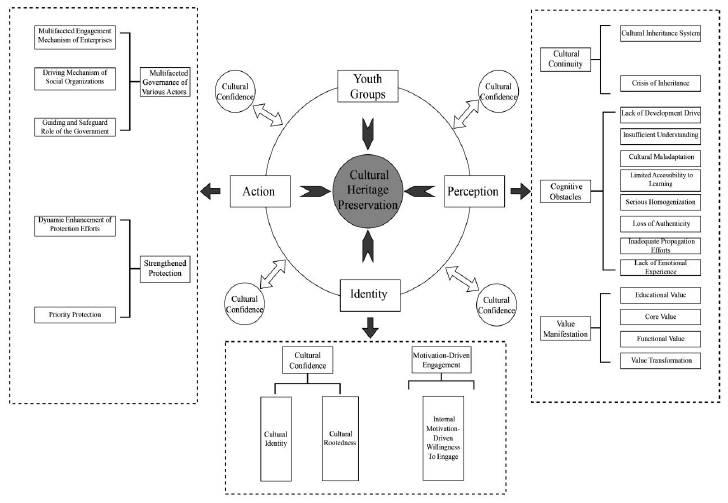
By conducting Grounded Theory coding on the interview data, related to the preservation of local cultural heritage among the young Chinese people, a virtuous cycle narrative of “perception, identity, and action” was formulated, leading to the development of a theoretical model for the preservation of local cultural heritage among the young Chinese people. This model not only illustrates the path taken by youth from chance encounters with cultural heritage to actively engaging in protective actions. But it also reveals how young individuals gradually construct their cultural subjectivity in this process, awakening a profound perception of value identification and an existential sense of belonging, thereby transforming cultural protection actions into ethical practices driven by intrinsic motivations.
This path can be philosophically traced back to Habermas’s theory of communicative action and phenomenological understanding of subject generation. Habermas posits that action is not merely a technical response to external systems, but is rooted in intersubjective meaning negotiation and value consensus (Chriss, 2022). Consequently, individuals involved in cultural engagement are not merely instrumental responders, but active agents reconstructing identity and norms in communicative practices. The young’s practical path in cultural heritage protection is a process where specific perceptual experiences foster identity construction, culminating in ethical actions motivated by principles.
Viewed through the lens of The Great Learning and The Doctrine of the Mean, cultural confidence corresponds to the ethical self-awareness of “sincerity, integrity, self-cultivation”, and the ideal of “achieving harmony”. This entails the genuine recognition of cultural values (sincerity) and the clarity of mind (integrity), which, through daily practice of self-cultivation, manifest as tangible social virtues. Consequently, cultural confidence is not a static attitude, but a process of self-cultivation where identification leads to responsibility and responsibility incites action, fostering a demonstrative effect that can be disseminated in youth interactions within society.
Theoretical Model of Dimensions of Identity and Pathways to Engagement in the Preservation of Local Cultural Heritage among Young Chinese People
The continuity of culture transcends mere inheritance of traditional forms. It symbolizes the youth’s understanding of and spiritual connection to their nation’s historical values in practice. For the youth, cultural heritage is not solely a historical testament, but a cognitive anchor defining their sense of identity. Through actively embracing the essence of cultural spirit, the youth transitions from memory inheritance to existential positioning, embodying ethical characteristics of cultural subjectivity (Mazurkevych et al., 2024).
In the context of Wang Yangming’s Neo-Confucianism, the principles of “mind as moral principle” and “integration of knowing and acting” reveal the fusion of moral motivation and practice: understanding of the good must be realized through self-confirmation in actions. The ethical intentionality in youth cultural actions lies in the unity of internal self-demands and external public spirit. Moreover, the Confucian emphasis on “self-community relations (qunji guanxi)” highlights the interdependence of the self, others and the community: individuals settle themselves through self-cultivation, empathize with others, and sustain the community’s goodness through protection and transmission. Therefore, the youth’s specific actions in heritage preservation (guarding authenticity (shouzhen), preserving rites (huli), communal learning, mutual assistance) constitute a practical path towards its moral identity, making “action is identity” a sustainable mechanism for ethical cultivation.
Within this progression, cultural confidence serves as the cornerstone for shaping the youth’s subjective identity. This identity goes beyond mere emotional attitudes, manifesting as an internalized structure of values logic. Leveraging the mechanism of “model demonstration to group diffusion”, it triggers resonance within the youth cohort (Yin; Ji; Ni, 2023).
The motivation behind youth’s actions in preserving cultural heritage often stems from interest and experiential drives, serving as an external reflection of their intrinsic cultural identity. Through practical engagement, the youth achieves a “reappropriation” of cultural significance, transforming abstract identities into concrete manifestations through practice, showcasing its ethical agency. Simultaneously, cultural value identification is continually fortified through actions, evident in contemporary expressions across education, society, economics and various multifaceted functions, forming a pivotal pathway for the generation of cultural subjectivity.
The youth groups’ ability to transform cultural identity into tangible actions is constricted by various structural factors. Developmental cognitive barriers represent a crucial hindrance, primarily manifested as information asymmetry, suboptimal cultural adaptability and ambiguity of authenticity, leading to obstacles in translating youth’s willingness to participate into actionable initiatives. Therefore, it is imperative to establish mechanisms that bridge the gap between identity and practice, rendering identity transformation into action practically feasible.
In terms of practical support, collaborative governance among diverse entities has provided a foundational pathway for the actualization of cultural identity. Government bodies, businesses and social organizations collaborate with the youth to construct action platforms, assuming roles in policy safeguarding, technological conversion, resource mobilization and collectively shaping the structural landscape of cultural engagement, facilitating the transition from identity to actionable realization.
Building upon this foundation, institutional support stands as a core element for ensuring sustainable youth practices. The advancement of cultural preservation necessitates multidimensional support in policies, technologies, resources, and should offer clear mechanisms and tangible support for youth engagement, thereby constructing an institutional basis for transforming identity into action.
5 RESEARCH SUMMARY AND THEORETICAL REFLECTIONS
Drawing on Grounded Theory, this study conducted semi-structured interviews with 30 young Chinese people, utilizing a three-stage coding process of “open-axial-selective” to construct a local cultural heritage preservation theoretical model of “perception, identity, and action”. The research elucidated the motivational structures and pathway mechanisms of youth cultural engagement, validating the philosophical assertion stated in the introduction: that the youth’s protective behavior towards cultural heritage is a constructive cultural subject practice rooted in the awakening of value identification and an existential sense of belonging.
The research clearly delineated seven primary categories - cultural continuity, value embodiment, cognitive obstacles, cultural confidence, motivation-driven engagement, reinforced protection, and multifaceted governance of various actors, revealing their structural roles in the process of cultural identity transforming into action willingness. The model demonstrated that young people are not merely passive responders to external policies, but actively construct cultural identity through personal involvement, visual exposure and knowledge acquisition stages. This process integrates historical retrospection, emotional resonance and value judgment to stimulate ethical actions, confirming the assertion that “identity is generated through action”.
Furthermore, the study identified that cultural identity plays an intermediary role in the engagement pathway, connecting perception with action and facilitating the transformation of individual emotions into group consensus. It established a virtuous “perception, identity, and action” cyclic path, highlighting its bridging function in the construction of youth cultural subjectivity. It further addressed philosophical queries: what makes youth cultural preservation a form of ethical practice? The results suggest that youth develop its identity and sense of responsibility through dialogues with cultural significance and social belonging, wherein ethics naturally emerge within these cultural practices. Youth subjectivity is not a preconceived rational self, but an active existence formed through interactions with culture, history and others, exhibiting relational, procedural and ethical characteristics.
In the backdrop of globalization, youth populations from different countries and regions encounter similar challenges in cultural identity formation. For instance, teenagers in European countries exhibit participation methods in cultural identity construction similar to Chinese youth, particularly in the practice of cultural confidence and ethical behavior, displaying certain commonalities (Schachner et al., 2024). Future research could compare the ways in which youth from different cultural backgrounds engage in cultural heritage preservation, exploring the interactive mechanisms between cultural confidence and ethical behavior to promote cross-cultural knowledge sharing and cooperation.
In conclusion, this study not only empirically constructed a theoretical model, but also provided theoretical inspiration and a cognitive basis for the mechanisms of youth engagement in cultural heritage preservation in the global era. Moreover, at a philosophical level, it offers structural support for the notion that “cultural participation leads to the cultural subject formation”.
By introducing the theoretical perspective of “cultural subject formation”, this research posits that cultural confidence profoundly influences the youth’s behavior in cultural heritage preservation, establishing a dynamic participation model from perception and identification to action. Compared to existing studies, the innovation of this research lies in emphasizing that cultural heritage preservation is not just a response to external policies, but also a practice of youths’ inherent cultural identity and ethical responsibility. Through this model, the study not only deepens the theory of cultural heritage preservation, but also establishes a novel subjectivation-paradigm framework for subsequent cross-cultural youth research. Methodologically, the research advances from static description to a dynamic process paradigm in cultural identity research through category construction and process modeling.
Of greater significance, the study addressed the philosophical controversy at the philosophical level: “Is youth involvement in cultural heritage preservation a result of identity or a way of generating identity?” Empirical evidence demonstrates that young people are not passive respondents. Instead, they actively generate identity and ethical actions through cultural perception and engagement. Their protective behavior is rooted in intrinsic value identification and an existential sense of belonging, embodying cultural subjectivity in the realm of practical philosophy. This discovery extends the ethical implications of cultural engagement and provides new pathways for understanding cultural selfhood and subjectivity.
The outcomes of the study suggest that, to foster young individuals’ profound engagement in safeguarding cultural heritage, strategic initiatives should be tailored across several key areas: 1. Enhancing the Visibility of Cultural Heritage Communication: to amplify awareness, crafting immersive experiential initiatives and integrating them into academic curricula, alongside leveraging short video platforms for dissemination, will elevate youths’ frequency of interaction with cultural heritage and deepen their emotional resonance, thereby reducing cognitive barriers. 2. Augmenting Support for the Cultivation of Youth Cultural Identity: by nurturing cultural belonging and identity through national narratives, the preservation of regional memories and the contemporary reinterpretation of lifestyles, a heightened sense of cultural affiliation and identity, among young individuals, can be cultivated, ultimately elevating their proactive engagement. 3. Establishing Collaborative and Diversified Engagement Mechanisms: governments are urged to provide institutional backing and financial support, while corporations can catalyze engagement enthusiasm through innovative cultural and creative designs. Social organizations, in turn, could assume the pivotal role of connecting resources and facilitating events, collectively furnishing multifaceted support for youth-led initiatives towards meaningful engagement.
This study, grounded in qualitative data, posits the constructivist subjectivity of youth cultural engagement with substantial theoretical explanatory power. Nonetheless, the limited sample size and the influence of regional and cultural disparities constrain its universal applicability. To address this, future endeavors could incorporate mixed methods, uniting survey instruments with experimental validation to delineate the causal relationships underlying the generation pathways of cultural identity and behavioral mechanisms. Furthermore, comparative studies can be conducted between Chinese youth and youth from other East Asian countries to further explore the manifestations and differences of “value identity” and “ontological belonging” in specific social contexts, deepening the theoretical construction regarding the characteristics of youth cultural participation and ethical practices.
REFERENCES
- ALLEN, K. A.; KERN, M. L.; ROZEK, C. S.; MCINERNEY, D. M.; SLAVICH, G. M. Belonging: A review of conceptual issues, an integrative framework, and directions for future research Australian Journal of Psychology, v. 73, n. 1, p. 87-102, 2021.
- BHATTI, M. A.; PARDAEV, J. Exploring the influence of culture and heritage on personal and collective identity: A qualitative inquiry. Cultura: International Journal of Philosophy of Culture and Axiology , v. 22, n. 4, p. 897-927, 2025.
- CHRISS, J. J. Jürgen Habermas and theory of communicative action. In: MEYEN, M. (ed.). Goffman-Handbuch: Leben - Werk - Wirkung Stuttgart: JB Metzler, 2022.
- CICERO, F. R. Behavioral ethics: Ethical practice is more than memorizing compliance codes. Behavior Analysis in Practice, v. 14, n. 4, p. 1169-1178, 2021.
- DAHAL, N.; NEUPANE, B. P.; PANT, B. P.; DHAKAL, R. K.; GIRI, D. R.; GHIMIRE, P. R.; BHANDARI, L. P. Participant selection procedures in qualitative research: Experiences and some points for consideration. Frontiers in Research Metrics and Analytics, n. 9, 1512747, 2024.
- GAO, Z.; HAN, W. Role and value orientation of the “new intangible youth”. Heritage Transmission Studies, n. 4, p. 25-30, 2024.
- GUO, F.; PENG, X. Over-storage and difficult deletion: A mechanism model of youth digital hoarding behavior - a qualitative study based on grounded theory. Library Theory and Practice, n. 3, p. 114-126, 2025.
- HAN, B.; LIU, J. Youth identity of traditional culture based on digital museum exposure. Journalism and Communication Review, v. 78, n. 1, p. 46-65, 2025.
- HUSU, H. M.; KUMPULAINEN, K. Workers’ and volunteers’ ideas about the benefits of young people’s cultural participation: A critical capital-based approach. International Journal of Cultural Policy, v. 27, n. 6, p. 815-829, 2020.
- JOSHI, A.; ROY, S.; MANIK, R. K.; SAHOO, S. K. Scientific philosophy: Exploring existential, metaphysical, and ethical research philosophy behind the question “Who am I?” Journal of Pharmaceutical Negative Results, v. 14, n. 3, p. 1648-1651, 2023.
- KNAPIK, W.; KRÓL, K. Inclusion of vanishing cultural heritage in a sustainable rural development strategy-prospects, opportunities, recommendations. Sustainability, v. 15, n. 4, p. 36-56, 2023.
- LI, J. Grounded theory-based model of the influence of digital communication on handicraft intangible cultural heritage. Heritage Science, v. 10, n. 1, p. 126, 2022.
- MA, W.; DAO, Y. The theoretical logic, value orientation, and practical innovation of cultural heritage protection: Study on Xi Jinping’s cultural thoughts. Journal of Northwest University for Nationalities (Philosophy and Social Science Edition), n. 2, p. 126-136, 2025.
- MAZURKEVYCH, O.; SKORYK, A.; ANTIPINA, I.; GONCHAROVA, O.; KONDRATENKO, I. The specifics of preserving cultural identity in the context of globalization processes. Mankind Quarterly, v. 64 , n. 4, p. 721-734, 2024.
- MENKSHI, E.; BRAHOLLI, E.; ÇOBANI, S. Assessing youth engagement in the preservation and promotion of cultural heritage: A case study in Korça City, Albania. Quaestiones Geographicae, v. 40, n. 1, p. 109-125, 2021.
- MKWANANZI, F.; CIN, F. M.; MAROVAH, T. Transformative youth development through heritage projects: Connecting political, creative, and cultural capabilities. International Journal of Heritage Studies, v. 29, n. 6, p. 581-597, 2023.
- QUAN, X. Harmony in diversity: The digital action logic and value co-creation system of ‘new intangible youth’ from the perspective of empowerment theory. Journal of Yunnan University for Nationalities (Philosophy and Social Sciences Edition), v. 41, n. 2, p. 52-59, 2024.
- RAHIMI, S. Saturation in qualitative research: An evolutionary concept analysis International Journal of Nursing Studies Advances, n. 6, p. 100174, 2024.
- RANNALA, I. E.; GORMAN, J.; TIERNEY, H.; GUÐMUNDSSON, Á.; HICKEY, J.; CORNEY, T. Ethical practice in professional youth work: Perspectives from four countries. Ethics and Social Welfare, v. 18, n. 2, p. 195-210, 2024.
- SCHACHNER, M. K.; HÖLSCHER, S.; MOSCARDINO, U.; CECCON, C.; JUANG, L.; PASTORE, M. Adolescent cultural identity development in context: The dynamic interplay of the identity project with classroom cultural diversity climate in Italy and Germany. Journal of Youth and Adolescence, v. 53, n. 11, p. 2480-2498, 2024.
- SOLEIMANI, T.; SAMET, A.; GHAYOUMI, A.; KAVOUSI, E.; RASHIDPOUR, A. Identification and analysis of the cultural policy framework to create the transformation of the cultural identity of the youth of Ilam province. Strategic Studies of Culture, v. 2, n. 3, p. 109-134, 2022.
- TANG, H.; LIANG, J. Practice of ‘body-subject’ generation: Behavioral mechanism of youth volunteer service in cultural heritage protection. China Youth Study, n. 4, p. 14-23, 2025.
- THOMSON, T. J.; IRVINE, L.; THOMAS, G. Learning the art of scholarly peer review: Insights from the communication discipline. Media International Australia, n. 192, p. 1-14, 2024.
- WANG, C.; LI, B. B.; JIN, Y. Y. Inducing factors of the ‘unreal practice’ phenomenon in the cultivation mechanism of excellent engineers: A grounded theory analysis from participants’ perspective. China Higher Education Research, n. 9, p. 46-52, 2022.
- WANG, F.; ZHOU, J.; FAN, C. Exploring the factors influencing public intention for spectator sports consumption based on grounded theory. Scientific Reports, v. 14, n. 1, p. 8221, 2024.
- XU, Y. Online representation and future direction of contemporary youth’s identity with traditional Chinese culture: A case study of Weibo, TikTok, and Bilibili. China Youth Study, n. 4, p. 87-94, 2025.
- YALVAÇ ARICI, H. The future of religious education: The role and contributions of youth theology. Religions, v. 16, n. 4, p. 454, 2025.
- YIN, J.; JI, Y.; NI, Y. How does cultural confidence awaken community citizenship behaviors? The moderating effect of cultural involvement. Journal of Hospitality and Tourism Management, v. 55, p. 425-434, 2023.
- YUE, N.; LI, J. Cultural heritage protection paths of ferry sites along the Yellow River in Shanxi from the perspective of cultural routes: An exploratory study based on grounded theory. Arid Land Resources and Environment, v. 37, n. 7, p. 102-110, 2023.
- ZHANG, Y.; IKIZ KAYA, D.; VAN WESEMAEL, P.; COLENBRANDER, B. J. Youth participation in cultural heritage management: A conceptual framework. International Journal of Heritage Studies, v. 30, n. 1, p. 56-80, 2024.
- ZHU, Y. Indigenous concepts and practices of cultural heritage in China: An empire-centered examination. National Arts, n. 3, p. 97-105, 2020.
- ZHU, Z. The negative impact of online pan-entertainment on youth values in the intelligent media era and the solution path. China Broadcast and Television Journal, 2025.
-
Data availability statement:
The dataset for this article is available in the SciELO Dataverse of the Trans/Form/Ação Journal, at the link: https://doi.org/10.1590/0101-3173.2025.v48.n5.e025202
The dataset for this article is available in the SciELO Dataverse of the Trans/Form/Ação Journal, at the link: https://doi.org/10.1590/0101-3173.2025.v48.n5.e025202

 Source: Illustrated by the author.