
 SAFETY CULTURE IN THE NEONATAL ICU OF A TEACHING HOSPITAL FROM A MULTIPROFESSIONAL PERSPECTIVE
ABSTRACT
Objective: evaluating the safety culture in a neonatal intensive care unit of a teaching hospital.
Method: this was a cross-sectional, observational study carried out in the neonatal intensive care unit of a teaching hospital in Brazil's Northeast region, using the Hospital Survey on Patient Safety Culture version 1.0. Data was collected in June and July 2023.
Results: a total of 72 professionals from the multi-professional team were included. Of the twelve dimensions assessed, nine showed points of weakness in the safety culture, and these were the most critical: “non-punitive response to error”, “frequency of reporting events” and “general perception of patient safety”. Teamwork also stood out as an area of weakness, with 48% positive responses. In relation to the safety culture assessment, the study obtained a final percentage of 41% positive responses among the 12 dimensions. When analyzed by professional category, the lowest percentage of positive responses was from residents with 34%.
Conclusion: the neonatal intensive care unit is a highly complex environment, requiring adherence to protocols and management strategies to ensure safe care for patients, families and professionals. The findings of this study point to the need for ongoing education on the subject, institutional support to strengthen the dimensions considered weak and to prioritize the provision of qualified health care that includes a culture of safety
DESCRIPTORS:
Patient safety; Risk management; Patient assistance team; Neonatal Intensive Care Units; Near miss
RESUMO
Objetivo: avaliar a cultura de segurança em uma unidade de terapia intensiva neonatal de um hospital de ensino.
Método: estudo transversal, observacional, realizado na unidade de terapia intensiva neonatal, de hospital de ensino na região Nordeste do Brasil, com a utilização do questionário Hospital Survey on Patient Safety Culture versão 1.0. A coleta de dados foi realizada em junho e julho de 2023.
Resultados: foram incluídos 72 profissionais da equipe multiprofissional. Dentre as doze dimensões avaliadas, nove demonstraram pontos de fragilidade da cultura de segurança, sendo as mais críticas: “resposta não punitiva ao erro”, “frequência de relato de eventos” e “percepção geral de segurança do paciente”. O trabalho em equipe também se destacou como área de fragilidade, com 48% de positividade nas respostas. Quanto à avaliação da cultura de segurança, o estudo obteve um percentual final de 41% em respostas positivas entre as 12 dimensões. Quando analisado por categoria profissional, o menor percentual de respostas positivas foi o dos residentes com 34%.
Conclusão: A unidade de terapia intensiva neonatal é um ambiente de alta complexidade, requerendo adesão a protocolos e estratégias gerenciais para garantir cuidado seguro aos pacientes, familiares e profissionais. Os achados deste estudo alertam para a necessidade de educação permanente sobre a temática, de suporte institucional para o fortalecimento das dimensões consideradas frágeis e de priorizar o provimento de assistência qualificada em saúde, que contemple a cultura de segurança.
DESCRITORES:
Segurança do paciente; Gestão de risco; Equipe de assistência ao paciente; Unidades de Terapia Intensiva neonatal; Near miss
RESUMEN
Objetivo: evaluar la cultura de seguridad en una unidad de cuidados intensivos neonatales de un hospital universitario.
Método: estudio observacional transversal, realizado en la unidad de cuidados intensivos neonatales de un hospital universitario de la región Nordeste de Brasil, utilizando el cuestionario Hospital Survey on Patient Safety Culture versión 1.0. La recolección de datos se realizó en junio y julio de 2023.
Resultados: se incluyeron 72 profesionales del equipo multidisciplinario. Entre las doce dimensiones evaluadas, nueve demostraron puntos débiles en la cultura de seguridad, siendo los más críticos: “respuesta no punitiva al error”, “frecuencia de notificación de eventos” y “percepción general de seguridad del paciente”. El trabajo en equipo también se destacó como un área de debilidad, con 48% de respuestas positivas. En cuanto a la valoración de la cultura de seguridad, el estudio obtuvo un porcentaje final del 41% en respuestas positivas entre las 12 dimensiones. Al analizar por categoría profesional, el menor porcentaje de respuestas positivas fue el de los residentes con un 34%.
Conclusión: la unidad de cuidados intensivos neonatales es un entorno altamente complejo, que requiere el cumplimiento de protocolos y estrategias de manejo para garantizar una atención segura a los pacientes, familiares y profesionales. Los hallazgos de este estudio resaltan la necesidad de educación continua sobre el tema, como así también de apoyo institucional para el fortalecer de dimensiones consideradas frágiles y priorizar la prestación de atención de salud calificada, que abarque una cultura de seguridad.
DESCRIPTORES:
Seguridad del paciente; Gestión de riesgo; Equipo de asistencia al paciente; Unidades de Cuidados Intensivos Neonatales; Near miss
INTRODUCTION
Care in a neonatal intensive care unit (NICU) requires qualified management in order to ensure protection from harm, given the immaturity and instability of newborns, who require multi-professional care, with pharmacological measures and invasive procedures1. To this end, it is essential that all NICU professionals (doctors, nurses, nutritionists, physiotherapists, psychologists, social workers and occupational therapists) share a culture of safety, working as a team to promote a therapeutic environment2 and reduce the occurrence of care-related harm3-5.
The most frequent errors are related to medication, healthcare-associated infections, skin lesions, intravascular catheters and mechanical ventilation4. These events are directly related to deaths and other negative outcomes for newborns, and neonatal infection is among the leading causes of preventable death among newborns in Brazil6. While skin lesions in premature newborns have been associated with alterations in thalamic and microstructural development and have an independent impact on childhood cognitive outcomes7.
Teamwork has an even broader meaning in the care of premature infants, given the need to provide care, preferably in pairs and groups, in order to reduce handling of the newborn and minimize care failures8. Failures in teamwork have been one of the main factors contributing to the occurrence of errors and adverse events9.
Studies on evaluating safety culture and its impact on healthcare management are important for developing safe care and monitoring its development in healthcare institutions10-11. They provide a clear view of the aspects of safety that need to be adapted and paid more attention to, prioritizing the exploration of the origin of unsafe acts, without being merely punitive2,10.
Although the first studies on safety culture date back to the 2000s12, there is a pressing need for services to invest in systematic evaluations and implement effective actions11. In Brazil, safety culture gained prominence in 2013 with the National Patient Safety Program (Programa Nacional de Segurança do Paciente, PNSP)13, and since then studies have been conducted on the subject, using the Hospital Survey on Patient Safety Culture (HSOPSC) questionnaire14-17. Assessing safety culture makes it possible to monitor the effects of internal interventions and public policies14. Few studies have focused on neonatal units, environments that can pose greater risks to patient safety, due to the particularities of neonates, intense care, technological devices and the specific knowledge and skills of professionals18.
In view of the above, the aim of this study was to assess the safety culture in a NICU at a teaching hospital.
METHOD
A cross-sectional, descriptive, observational study, supported by the STROBE®19 checklist in the preparation of the research report, carried out in a type II NICU of a government-run (federal) university hospital in Brazil's Northeast region, between June and July 2023. The NICU has ten beds, with a high occupancy rate and frequent overcrowding. The unit's main demand comes from the hospital's own high-risk maternity ward, which, in addition to the capital, is a reference for high-risk pregnant women from 27 other municipalities in the interior.
The study population consisted of professionals from the multi-professional team working in the NICU, made up of 22 care doctors and one physician in management, 18 physiotherapists, 32 nursing technicians, 14 care nurses, two nurses in management, as well as just one representative from the following professional categories: speech therapist, psychologist, nutritionist and social worker. Most of the workers who work as nursing technicians are trained as nurses. The NICU also receives pediatric residents.
Inclusion criteria were: working in the NICU for six months or more, attending the service on any of the three shifts or working daily between the months of data collection. Professionals who are unique in any professional category were not included, as a way of preventing the participant from being identified, professionals on vacation or sick leave during the period of the study, and first-year pediatric residents, due to their short time working in the sector. Questionnaires with a response rate of less than 50% were excluded.
All eligible participants were invited to take part. To characterize the study population, the variables used were age, gender, professional category, education level, length of time working at the hospital and in the sector, as well as working hours per week, as available in the instrument used. And for the safety culture assessment, the variables were made up of the 12 dimensions analyzed through the HSOPSC questionnaire: teamwork within units/areas, expectations and actions to promote patient safety by the supervisor/manager, organizational learning and continuous improvement, hospital management support for patient safety, general perception of patient safety, feedback and communication regarding errors, openness of communication, frequency of reported events, teamwork between hospital units/areas, adequacy of personnel, internal transfers and duty shifts, and non-punitive response to error.
We chose to use the HSOPSC questionnaire, version 1.0, produced by the Agency for Healthcare Research and Quality (AHRQ), as it comprehensively assesses safety culture and is available in a translated and validated version for Brazil20. Among the various validated instruments for measuring safety culture, version 1.0 (HSOPSC version 1.0), developed by the AHRQ in 2004, is the instrument that has allowed international comparisons for some time17. Version 2.0 of the HSOPSC-AHRQ questionnaire for Brazilian Portuguese showed low factor loadings for ten items17 in its validation and has not been used in other studies to robustly assess safety culture. For this reason, we opted for version 1.0, which obtained permission from AHRQ.
The collection instrument analyzes 12 dimensions of patient safety culture, based on 42 items, in the form of a scale graded in five levels, from 1 (strongly disagree or never) to 5 (strongly agree or always)21. Positive answers refer to the options: “I agree” and “I totally agree” or “almost always” and “always” for positively worded sentences, or “I disagree” and “I totally disagree” or “never” and “rarely” for negatively worded questions. It also asked the subjects to rate the general view of patient safety in their work unit (excellent, very good, acceptable, poor and very poor) and the number of adverse event notifications made by the professional in the last 12 months21.
Participants were approached and data collected in their workplaces, after signing an informed consent form. The completed questionnaires were deposited in a ballot box placed in the unit itself, ensuring the forms' anonymity.
To analyze the data, we followed the methodology proposed in the HSOPSC questionnaire user guide prepared by the AHRQ - Hospital Survey on Patient Safety Culture: User's Guide and the survey data was prepared for analysis using the Hospital Survey 1.0 Data Entry and Analysis Tool. Initially, the percentages of positive responses to the 42 items in the instrument were calculated. Next, the percentage of positive responses for each dimension. Finally, the percentage of positive responses among the 12 dimensions evaluated was also obtained21.
The classification of the dimensions in terms of patient safety culture followed the definitions in the HSOPSC user guide21: strong areas of patient safety culture for those with 75% positive responses and weak areas of patient safety culture for those with 50% or less positive responses.
Ethical issues followed Resolution 466/2012 of the National Health Council of the Ministry of Health. Data collection only began after approval from the Research Ethics Committee.
RESULTS
A total of 78 questionnaires were distributed among the participants who met the inclusion criteria. A response rate of 92% was obtained, and six of these questionnaires were excluded for analysis due to the high percentage of unanswered questions. The study included 72 NICU health professionals, the majority of whom were female, with a mean age of 40.6 years (±7.4). The professional category with the highest percentage was nursing technician (31%), followed by doctors (26%). There was a predominance of professionals with postgraduate degrees (specialization, master's or doctorate), most of whom had worked at the hospital for between six and 15 years, between six and 10 years in the NICU, and a weekly workload of between 20 and 39 hours (Table 1).
Characterization of the professional respondents at the study hospital, in Brazil's Northeast region, Maceió-AL, 2023. (n=72)
Table 2 shows the distribution of the percentages of positive responses to the safety culture dimensions in the overall study and by professional category. It can be seen that no dimension achieved a percentage greater than or equal to 75% of positive responses. And nine had a percentage of positive responses below 50%, thus being considered points of weakness in the safety culture. The most critical dimensions were: “non-punitive response to error”, “frequency of reporting events” and “general perception of patient safety”, which respectively showed only 20%, 23% and 30% positive responses, and “teamwork” also stood out as an area of weakness (48%). The percentage of positive responses to the 12 dimensions in the evaluation of the NICU's safety culture was 41%.
Among the categories, the dimension that showed the highest percentages among the categories of professionals was “expectations and actions to promote patient safety by the managing supervisor” (values between 52% for physiotherapists and 74% for nursing technicians), followed by “organizational learning and continuous improvement” (values between 59% for nurses and 74% for nursing technicians). The lowest percentage of positive responses among the professionals corresponded to the dimension “non-punitive response to error” (values between 14% for resident doctors and 27% for physiotherapists).
Positive responses percentages distribution to the 12 dimensions of the study's safety culture by professional category, in a university hospital in Brazil's Northeast region, Maceió-AL, 2023. (n=72)
In the professionals' perception of the variables in the scope of results (tables 3 and 4), it was found that the nursing technician category had the highest percentages of ratings for the “patient safety’s general view” (excellent or very good 43%). And for the variable “percentage of event notifications” there was a high number of nursing technicians and residents who did not notify (61% and 82% respectively) in the last 12 months, with higher percentages than all the categories combined. Nurses, however, were the professionals who reported the most events, followed by physiotherapists.
Classification of the patients safety’s general view, overall and by professional category, in a university hospital in Brazil's Northeast region, Maceió-AL, 2023. (n=69)
Number of notifications made by professionals in the last 12 months, overall and by professional category, in a university hospital in Brazil's Northeast region, Maceió-AL, 2023. (n=72)
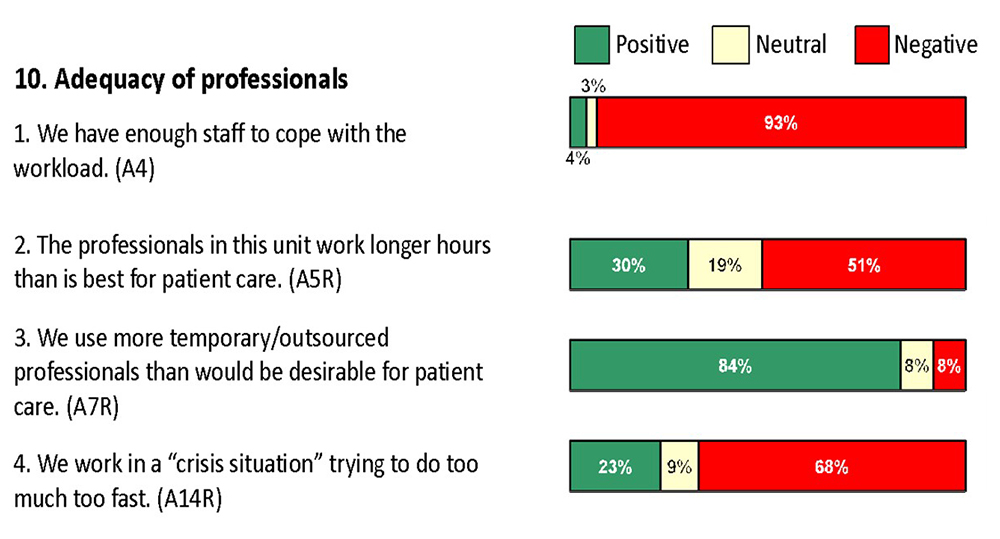
Each of the dimensions is made up of three or four questionnaire items. Dimension 10 “adequacy of professionals” contains the item with the lowest rate of positive responses out of the 42 items in the questionnaire. Item A2 states “we have enough staff to cope with the workload” and only 4% of professionals agreed with this statement (Figure 1).

Responses to the items of the “adequacy of professionals” dimension, university hospital in Brazil's Northeast region, Maceió-AL, 2023. (n=72)
DISCUSSION
The evaluation carried out in the study's NICU showed a weak safety culture, with the exception of the dimensions: “expectations and actions to promote patient safety by the supervisor/manager”; “organizational learning and continuous improvement” and “openness to communication”, which obtained percentages between 50% and 75%, constituting an intermediate classification between the areas considered weak and strong in a safety culture.
In Brazil, other studies in neonatal NICUs have obtained similar results. In a study carried out in three NICUs of large public hospitals in Belo Horizonte, of the 12 dimensions evaluated, 11 were characterized as weaknesses or opportunities for improvement, and none as strong areas of safety culture10. The study carried out in four NICUs of public hospitals located in Florianópolis did not identify any dimension as a strong area and seven dimensions were classified as weak18. Finally, in a neonatal ICU in a public hospital in Fortaleza, they identified four weakened dimensions and two strong dimensions16. In all the studies, the “non-punitive response to error” dimension was the most fragile, similar to our study10,16,18.
It can be seen that this “non-punitive response to error” dimension is not just a weakness in neonatal units, but a reality in health services in general. In a meta-analysis of 59 studies, including 4 continents (America, Europe, Asia and Africa) and a total of 755,415 professionals surveyed, it was observed that the culture of guilt is present in the majority of hospitals that measured safety culture using the HSOPSC11. This article also discussed the importance of the “culture of safety” theme in the undergraduate and specialization courses for health professionals in general, with the aim of training professionals who are more committed to patient safety, teamwork and the importance of reporting events.
In this study, it is an additional concern that the lowest rate of positivity in the “non-punitive response to error” dimension was identified among resident doctors. This raises concerns because they are doctors in training and are in a teaching hospital. The non-punitive approach, but one of identification and proactive action for prevention, should be encouraged in the training of resident doctors, across the board, at all stages of their training, especially in sectors such as the NICU, which is still incipient at the hospital. Resident doctors in this sector perform under supervision clinical and invasive procedures that can lead to adverse events, and this should be emphasized in order to make them aware of prevention and, at the same time, to report the occurrence of harm22.
The culture of blame inhibits professionals from reporting errors, causing these events to be underreported. The “frequency of events” reported in the study hospital was the second dimension with the lowest percentage of positive responses. However, it's not just the culture of punishment that reduces reporting. Several aspects play a part: few improvements have been instituted based on reported incidents, a lack of awareness of the occurrence of adverse events, ignorance of the reporting process, forgetfulness, the insufficient number of health professionals and work overload, and a lack of appreciation of adverse health events22.
Studies based on an analysis of medical records have identified a high percentage of adverse events in newborns admitted to the neonatal ICU, but these injuries are not reported in hospital systems. In Brazil, it has been shown that between 70% and 84% of newborns admitted to the NICU suffered care-related injuries3-5. This data needs to be discussed in hospital management, because errors are happening and the lack of knowledge of these events, together with the damage caused, makes it difficult to implement policies and plans to deal with them.
Among the professional categories participating in the study, nurses were the most likely to report incidents. Consistent with these findings is a study in which doctors gave the following reasons for not reporting: time constraints, uncertainty about what to report, expectation of punishment or blame, and the perception that reporting incidents is not linked to improvements23.
The pillars of the safety culture and routine in neonatal units are teamwork and communication. It is already well documented that multi-professional teams with an interdisciplinary work process are better prepared to protect patients from risks and achieve better clinical results24. A study identified a correlation between NICU teamwork and the absence of healthcare-associated infections24. Weakness in these domains is among the main factors contributing to errors and adverse events8, which makes the low percentage of positive responses worrying, especially in the dimension of teamwork in the unit. However, the dimension of openness to communication was the most highly rated.
In an assessment of the safety culture in 44 NICUs participating in the California Perinatal Quality Care Collaborative, teamwork within the units was the scale with the highest scores, with three-quarters of respondents reporting good teamwork. Around half of the interviewees reported good “openness of communication” and “feedback and error communication”25. In Brazil, studies that evaluated the safety culture in the NICU, teamwork did not stand out as an area of weakness10,16,18. This demands more attention for the study unit, in order to understand the local gaps that may be causing this assessment.
One of the causes of the reduction in satisfactory teamwork is burnout among health professionals working in the NICU26. In this study, one element that demonstrates the existence of work overload within the unit was the team's low recognition of having “enough staff to do the job”.
Nurses' reports highlight how fatigue and exhaustion affect the quality of patient care15. Management needs to be sensitive to the benefits of the right number of professionals on the team in terms of safety culture. There has already been evidence of a reduction in various negative outcomes, such as mortality, medication errors, ulcers, the use of restraints, infections and pneumonia, associated with the greater number of professionals in the hospital team27.
Work overload can also jeopardize the shift handover, when vital information about the patient's clinical condition and treatment is passed on to the team that will be responsible for the patient. Communication failures at these times can interfere with continuity of care and patient safety28. In the neonatal environment, communication between professionals and transfer processes to other sectors or other health institutions are even more complex as they require the integration of maternal and neonatal information and the involvement of several professionals, increasing the risk of errors29.
Health services in general need to implement strategies capable of minimizing miscommunication at shift handovers and transfers, such as the use of standardized and computerized forms and reports in line with the patients' complexity level28, as well as providing conditions that facilitate the transfer of information, free from distractions or interruptions29.
The perception of patient safety was one of the weakest dimensions of this study, with repercussions on the classification of the general view of patient safety, which in this study obtained 27% of responses between excellent and very good, a lower percentage than that found in other neonatal units in Brazil: 44%11, 41%20 and 44%16.
The findings of the study suggest that the culture of safety still needs to be strengthened within neonatal units and more studies need to be carried out on this subject in neonatology. Despite more than two decades of encouraging a culture of safety in the scientific literature, it can be seen that developing countries are still far behind in the number of studies and research into monitoring a culture of safety when compared to developed countries, especially when it comes to evaluating neonatal units. In Brazil, despite progress17, there are still gaps in its implementation, despite current government regulations13.
The culture of blame is still very strong in health services in general, even 25 years after the publication of the US Institute of Medicine's report “To err is human”. Strengthening the importance of reporting events is perhaps the first step towards management understanding the gaps in each service and drawing up action plans to be implemented. Mistakes happen and, consequently, so does damage to patients. The big issue is that they are going unnoticed, and we may only see the tip of the iceberg.
Limitations
The limitation is that only one work sector was studied, which may not correspond to the reality of the safety culture in other sectors of the neonatal unit. However, it is an interesting way of locating the safety culture of the unit (NICU), comparing it with the reference standard of hospitals with experience in patient safety culture, using a validated instrument in use in international literature. Another limitation was not including professionals from other categories (speech therapist, psychologist, nutritionist and social worker) in order to avoid embarrassment and, as a result, the reliability of the answers, as there was only one representative from each category.
CONCLUSION
The NICU is a critical environment that deals with highly vulnerable patients and is expected to be a safe environment for patients, their families and healthcare professionals. In this study, we observed that none of the dimensions assessed was characterized as a strong area of safety culture, and nine of the twelve dimensions were classified as areas of weakness. In addition, only 27% of those interviewed rated patient safety in the unit as 'very good' or 'excellent'.
These findings point to the need for institutional support for the health team in designing, implementing and monitoring strategies to strengthen the dimensions considered weak, as well as training in the unit. This enhances engagement and adherence to voluntary notifications in the collective search for solutions to prevent the risks identified and establishes a robust safety culture aimed at strengthening multi-professional teamwork and management.
Finally, technological advances and the complexity of care in the hospital context reaffirm the priority of providing qualified health care that includes a culture of safety, based on systematic evaluation processes to understand the impact of the strategies implemented and identify new weak points that will be the focus of future investment. This study opens up possibilities to identify demands for future research, by using a validated instrument with international recognition to compare data between countries, thus encouraging this culture in our country and promoting greater visibility of our research on the subject.
REFERENCES
-
1. Molloy EJ, El-Dib M, Juul SE, Benders M, Gonzalez F, Bearer C, et al. Neuroprotective therapies in the NICU in term infants: Present and future. Pediatr Res [Internet]. 2023 [cited 2024 May 01];93:1819-27. Available from: https://doi.org/10.1038/s41390-022-02295-2
» https://doi.org/10.1038/s41390-022-02295-2 -
2. Babaie M, Nourian M, Atashzadeh-Shoorideh F, Manoochehri H, Nasiri M. Patient safety culture in neonatal intensive care units: A qualitative content analysis. Front Public Health [Internet]. 2023 [cited 2024 May 01];11:1065522. Available from: https://doi.org/10.3389/fpubh.2023.1065522
» https://doi.org/10.3389/fpubh.2023.1065522 -
3. Cossul UM, Neiva LECP, Silveira AO. Notificação de eventos adversos em uma unidade de terapia intensiva neonatal. Rev Enferm UFPE [Internet]. 2021 [cited 2024 Mar 08];15(1):246969. Available from: https://doi.org/10.5205/1981-8963.2021.246969
» https://doi.org/10.5205/1981-8963.2021.246969 -
4. Lanzillotti LS, Seta MHD, Andrade CLT, Mendes Junior WV. Adverse events and other incidents in neonatal intensive care units. Ciênc Saúde Coletiva [Interrnet]. 2015 [cited 2024 May 01];20(3):937-46. Available from: https://doi.org/10.1590/1413-81232015203.16912013
» https://doi.org/10.1590/1413-81232015203.16912013 -
5. Ventura CMU, Alves JGB, Meneses JA. Eventos adversos em Unidade de Terapia Intensiva Neonatal. Rev Bras Enferm [Internet]. 2012 [cited 2023 Dec 13];65:49-55. Available from: https://doi.org/10.1590/S0034-71672012000100007
» https://doi.org/10.1590/S0034-71672012000100007 -
6. Prezotto KH, Bortolato-Major C, Moreira RC, Oliveira RR, Melo EC, Silva FRT, et al. Early and late neonatal mortality: Preventable causes and trends in Brazilian regions. Acta Paul Enferm [Internet]. 2023 [cited 2024 May 01];36:eAPE02322. Available from: https://doi.org/10.37689/acta-ape/2023AO023222
» https://doi.org/10.37689/acta-ape/2023AO023222 -
7. Duerden EG, Grunau RE, Chau V, Groenendaal F, Guo T, Chakravarty MM, et al. Association of early skin breaks and neonatal thalamic maturation: A modifiable risk? Neurology [Internet]. 2020 [cited 2024 May 8];95(24):e3420-7. Available from: https://doi.org/10.1212/WNL.0000000000010953
» https://doi.org/10.1212/WNL.0000000000010953 -
8. Carneiro LP, Alves KSB, Viana VA, Noronha RS, Freitas VCC, Alves CNC, et al. A importância da atenção humanizada pelo método canguru para os cuidados com o recém-nascido nas unidades neonatais. Rev Contri Cienc Soc [Internet]. 2024 [cited 2024 Sep 08];17(7):e8621. Available from: https://doi.org/10.55905/revconv.17n.7-316
» https://doi.org/10.55905/revconv.17n.7-316 -
9. Zajac S, Woods A, Tannenbaum S, Salas E, Holladay CL. Overcoming challenges to teamwork in healthcare: A team effectiveness framework and evidence-based guidance. Front Commun [Internet]. 2021 [cited 2024 Sep 08];6:606445. Available from: https://doi.org/10.3389/fcomm.2021.606445
» https://doi.org/10.3389/fcomm.2021.606445 -
10. Notaro KAM, Corrêa AR, Tomazoni A, Rocha PK, Manzo BF. Safety culture of multidisciplinary teams from neonatal intensive care units of public hospitals. Rev Lat Am Enfermagem [Internet]. 2019 [cited 2024 Feb 20];27:e3167. Available from: https://doi.org/10.1590/1518-8345.2849.3167
» https://doi.org/10.1590/1518-8345.2849.3167 -
11. Okuyama JHH, Galvao TF, Silva MT. Healthcare Professional's Perception of Patient Safety Measured by the Hospital Survey on Patient Safety Culture: A Systematic Review and Meta-Analysis. Sci World J [Internet]. 2018 [cited 2024 Mar 03];2018:9156301. Available from: https://doi.org/10.1155/2018/9156301
» https://doi.org/10.1155/2018/9156301 -
12. Institute of Medicine, Committee on Quality of Health Care in America, Kohn LT, Corrigan JM, Donaldson MS, editors. To Err Is Human: Building a Safer Health System [Internet]. 2000 [cited 2024 Mar 03]. Available from: https://nap.nationalacademies.org/catalog/9728/to-err-is-human-building-a-safer-health-system
» https://nap.nationalacademies.org/catalog/9728/to-err-is-human-building-a-safer-health-system -
13. Brasil, Ministério da Saúde. Portaria nº 529 de 1º de abril de 2013: institui o Programa Nacional de Segurança do Paciente (PNSP) [Internet]. 2013 [cited 2024 Mar 04]. Available from: https://bvsms.saude.gov.br/bvs/saudelegis/gm/2013/prt0529_01_04_2013.html
» https://bvsms.saude.gov.br/bvs/saudelegis/gm/2013/prt0529_01_04_2013.html -
14. Andrade LEL, Lopes JK, Souza Filho M, Vieira Júnior RF, Farias LPC, Santos CCM, et al. Cultura de segurança do paciente em três hospitais brasileiros com diferentes tipos de gestão. Ciênc Saúde Coletiva [Internet]. 2018 [cited 2024 Feb 10];23(1):161-72. Available from: https://doi.org/10.1590/1413-81232018231.24392015
» https://doi.org/10.1590/1413-81232018231.24392015 -
15. Costa DB, Ramos D, Gabriel SC, Bernardes A. Patient safety culture: Evaluation by nursing professionals. Texto Contexto Enferm [Internet]. 2018 [cited 2024 Feb 10];27(3):e2670016. Available from: https://doi.org/10.1590/0104-070720180002670016
» https://doi.org/10.1590/0104-070720180002670016 -
16. Ventura MWS, Façanha APM, Néri EDR, Diógenes MS, Lopes EM. Safety culture in the Neonatal Intensive Care Unit: Contributions from the multiprofessional team. Rev Bras Saúde Materno Infantil [Internet]. 2022 [cited 2024 Mar 11];22(2):311-22. Available from: https://doi.org/10.1590/1806-9304202200020007
» https://doi.org/10.1590/1806-9304202200020007 -
17. Reis CT, Laguardia J, Andreoli PBA, Nogueira Junior C, Martins M. Cross-cultural adaptation and validation of the Hospital Survey on Patient Safety Culture 2.0 - Brazilian version". BMC Health Serv Res [Internet]. 2023 [cited 2024 Feb 20];23(1):32. Available from: https://doi.org/10.1186/s12913-022-08890-7
» https://doi.org/10.1186/s12913-022-08890-7 -
18. Tomazoni A, Rocha PK, Souza S, Anders JC, Malfussi HF. Patient safety culture at Neonatal Intensive Care Units: Perspectives of the nursing and medical team. Rev Latino-Am Enfermagem [Internet]. 2014 [cited 2024 Mar 11];22(5):755-63. Available from: https://doi.org/10.1590/0104-1169.3624.2477
» https://doi.org/10.1590/0104-1169.3624.2477 -
19. Von Elm E, Altman DG, Egger M, Pocock SJ, Gotzsche PC, Vandenbroucke JP. The Strengthening the Reporting of Observational Studies in Epidemiology (STROBE) Statement: Guidelines for reporting observational studies. British Med J [Internet]. 2007 [cited 2022 Jan 22];335:806-8. Available from: https://doi.org/10.1136/bmj.39335.541782.AD
» https://doi.org/10.1136/bmj.39335.541782.AD -
20. Reis CT, Laguardia J, Martins M. Translation and cross-cultural adaptation of the Brazilian version of the Hospital Survey on Patient Safety Culture: Initial stage. Cad Saúde Pública [Internet]. 2012 [cited 2024 Mar 03];28:2199-210. Available from: https://doi.org/10.1590/S0102-311X2012001100019
» https://doi.org/10.1590/S0102-311X2012001100019 -
21. Sorra J, Gray L, Streagle S, Famolaro T, Yount N, Behm J. AHRQ Hospital Survey on Patient Safety Culture: User’s Guide [Internet]. 2018 [cited 2024 Mar 03]. Available from: https://www.ahrq.gov/sites/default/files/wysiwyg/professionals/quality-patient-safety/patientsafetyculture/hospital/userguide/hospitalusersguide.pdf
» https://www.ahrq.gov/sites/default/files/wysiwyg/professionals/quality-patient-safety/patientsafetyculture/hospital/userguide/hospitalusersguide.pdf -
22. World Health Organization - WHO. Patient safety incident reporting and learning systems: technical report and guidance [Internet]. 2020. [cited 2024 Jan 24]. Available from: https://iris.who.int/bitstream/handle/10665/334323/9789240010338-eng.pdf
» https://iris.who.int/bitstream/handle/10665/334323/9789240010338-eng.pdf -
23. Furini ACA, Nunes AA, Dallora MELV. Notifications of adverse events: Characterization of the events that occurred in a hospital complex. Rev Gaúcha Enferm [Internet]. 2019 [cited 2024 Jan 24]. Available from: https://doi.org/10.1590/1983-1447.2019.20180317
» https://doi.org/10.1590/1983-1447.2019.20180317 -
24. Profit J, Sharek PJ, Cui X, Nisbet CC, Thomas EJ, Tawfik DS, et al. The Correlation between Neonatal Intensive Care Unit safety culture and quality of care. J Patient Saf [Internet]. 2020 [cited 2024 Mar 14];16(4):e310-6. Available from: https://doi.org/10.1097/PTS.0000000000000546
» https://doi.org/10.1097/PTS.0000000000000546 -
25. Profit J, Lee HC, Sharek PJ, Kan P, Nisbet CC, Thomas EJ, et al. Comparing NICU teamwork and safety climate across two commonly used survey instruments. BMJ Qual Saf [Internet]. 2016 [cited 2024 Mar 14];25:954-61. Available from: https://doi.org/10.1136/bmjqs-2014-003924
» https://doi.org/10.1136/bmjqs-2014-003924 -
26. Russo NC. Burnout syndrome in the nursing team in a neonatal intensive care unit: An integrative review. Rev Soc Bras Enferm Ped [Internet]. 2020 [cited 2024 Sep 08];20(1):40-6. Available from: https://doi.org/10.31508/1676-3793202000006
» https://doi.org/10.31508/1676-3793202000006 -
27. Driscoll A, Grant M, Carroll D, Dalton S, Deaton C, Jones I, et al. The effect of nurse-to-patient ratios on nurse-sensitive patient outcomes in acute specialist units: A systematic review and meta-analysis. Eur J Cardiovasc Nurs [Internet]. 2018 [cited 2024 Mar 11];17(1):6-22. Available from: https://doi.org/10.1177/1474515117721561
» https://doi.org/10.1177/1474515117721561 -
28. El-Guindy HA, El-Shahate MM, Mohamed NAAA. Effectiveness of educational program on nurses’ knowledge and performance regarding shift change handoff and its effect on continuity of patient care. Int Egypt J Nurs Sci Res [Internet]. 2022 [cited 2024 Jan 19];3(1):192-205. Available from: https://doi.org/10.21608/ejnsr.2022.247072
» https://doi.org/10.21608/ejnsr.2022.247072 -
29. Minagorrea PJA, Garaub AD, Fernández MJS, Reina CC, Pernas PD, Borges AAH, et al. Safe handoff practices and improvement of communication in different paediatric settings. An Pediatr [Internet]. 2023 [cited 2024 Mar 14];99(3):185-94. Available from: https://doi.org/10.1016/j.anpede.2023.08.008
» https://doi.org/10.1016/j.anpede.2023.08.008
NOTES
-
ORIGIN OF THE ARTICLE
Extract from the thesis - Safety of the newborn on mechanical ventilation: systemic analysis of risks, to be presented to the Postgraduate Program in Child and Adolescent Health, at the Universidade Federal de Pernambuco, in 2025.
-
FUNDING INFORMATION
Scientific Initiation Grant from the National Council for Scientific and Technological Development (CNPq), process 230419517, notice 2023-2024-UFPE.
-
APPROVAL OF ETHICS COMMITTEE IN RESEARCH
Approved by the Research Ethics Committee of Empresa Brasileira de Serviços Hospitalares - Hospital Universitário Professor Alberto Antunes, opinion n. 6.105.381/2023, Certificate of Presentation for Ethical Appraisal: 69544723.4.0000.0155.
-
TRANSLATED BY
LatinTrad - Leonardo Parachú.

 Source: HSOPSC Hospital Survey 1.0 Data Entry and Analysis Tool AHRQ 2021 database.