
 LITERATURE SEARCH STRATEGIES: A GUIDELINE FOR IDENTIFYING THE BEST EVIDENCE IN HEALTHCARE
ABSTRACT
Objective: to present a guideline for the development of search strategies aimed at identifying the best evidence in the health field.
Method: theoretical reflection based on a critical review of the literature and the authors' experience, identifying consensus on existing methodologies and best practices in the development of search strategies.
Results: The guideline includes eight essential stages, from preliminary reading and definition of the problem to documentation of the search. It provides instructions for identifying keywords, using terms in thesauruses, combining Boolean operators and adapting to different databases. It is also includes pilot tests for adjustments and promotes transparency, optimizing the identification of the best health evidence as well as improving the quality of literature reviews.
Conclusion:s The proposal presents a practical framework for developing search strategies, providing a clear guide for optimizing research and synthesis of health evidence, with the emphasis on practical applicability.
KEYWORDS:
Research; Evidence-Based Practice; Review Literature as Topic; Information Science; Information Storage and Retrieval; Health; Nursing
RESUMO
Objetivo: apresentar um roteiro de orientação para a elaboração de estratégias de busca visando identificar as melhores evidências na área da saúde.
Método: reflexão teórica baseada em uma revisão crítica da literatura e na experiência dos autores, destacando consensos sobre metodologias existentes e melhores práticas no desenvolvimento de estratégia de busca.
Resultados: O roteiro abrange oito etapas essenciais, desde a leitura preliminar e definição do problema até a documentação da busca. Ele orienta a identificação de palavras-chave, o uso de termos em tesauros, a combinação de operadores booleanos e a adaptação para diferentes bases de dados. Inclui testes piloto para ajustes e promove a transparência, otimizando a identificação das melhores evidências em saúde e aprimorando a qualidade das revisões de literatura.
Conclusões: A proposta apresenta uma estrutura prática para o desenvolvimento de estratégias de busca, fornecendo um roteiro claro para otimizar futuras sínteses de evidências em saúde, com ênfase na aplicabilidade prática.
DESCRITORES:
Pesquisa; Prática clínica baseada em evidências; Literatura de revisão como assunto; Ciência da informação; Armazenamento e recuperação da informação; Saúde; Enfermagem
RESUMEN
Objetivo: presentar una guía de orientación para la elaboración de estrategias de búsqueda con el fin de identificar las mejores evidencias en el área de la salud.
Método: reflexión teórica basada en una revisión crítica de la literatura y en la experiencia de los autores, destacando consensos sobre metodologías existentes y mejores prácticas en el desarrollo de estrategias de búsqueda.
Resultados: La guía abarca ocho etapas esenciales, desde la lectura preliminar y la definición del problema hasta la documentación de la búsqueda. Orienta la identificación de palabras clave, el uso de términos en tesauros, la combinación de operadores booleanos y la adaptación a diferentes bases de datos. También incluye pruebas piloto para ajustes y fomenta la transparencia, optimizando la identificación de las mejores evidencias en salud y mejorando la calidad de las revisiones de literatura.
Conclusiones: La propuesta presenta una estructura práctica para el desarrollo de estrategias de búsqueda, proporcionando una guía clara para optimizar futuras síntesis de evidencias en salud, con énfasis en su aplicabilidad práctica.
DESCRITORES:
Investigación; Práctica clínica basada en la evidencia; Literatura de revisión como asunto; Ciencia de la Información; Almacenamiento y recuperación de la Información; Salud; Enfermería
INTRODUCTION
The concept of evidence, which includes a diversity of data, reports and observations to support conclusions on a specific topic, emphasizes the intrinsic connection between this evidence and its context. This requires careful assessment of its applicability in different situations1. Global evidence provides an essential starting point for evaluating interventions, but context-specific results may not be widely generalizable. On the other hand, local evidence from specific settings are crucial for analyzing problems, approaches and implementation strategies adapted to particular realities2.
In the healthcare field, especially in nursing science, research into knowledge synthesis, such as systematic reviews and meta-analyses, is fundamental for consolidating the best available evidence to support evidence-based practice3. However, the quality and consistency of search strategies in these reviews continue to be a challenge, which can directly impact the effectiveness of interventions in several areas of nursing, such as the use of clinical decision support systems and the integration of technologies into care practices, highlighting the need for methodological rigor in search processes4.
The number of studies dedicated to knowledge synthesis in the healthcare field has increased significantly, particularly systematic reviews3. However, concerns have arisen regarding the quality of these studies5. In a survey aimed at evaluating searches conducted in systematic reviews in Medline/PubMed, it was found that 78.1% of the strategies had flaws, which directly impacted information retrieval and, consequently, the conclusions6. This finding is particularly relevant for nursing, as the quality of evidence directly influences clinical practice and care decisions3.
The process of searching the literature is central to the success of evidence synthesis, and therefore the quality of the search significantly impacts the final product.7. In this sense, improving search strategies is a critical necessity, especially considering the diversity of sources and the complexity of information systems in the healthcare field.8,9.
In recent years, guidelines such as the Peer Review Guide and Checklist for Electronic Search Strategies (PRESS) have been developed to ensure quality of searches performed 7,10. Although PRESS is widely used in systematic reviews, there is a gap in the adaptation of these guidelines to nursing practice, which has its own specificities, such as the emphasis on the humanization of care and the particularities of patients3. This reflection aims to contribute to the improvement of search strategies, with special attention to their applicability in the nursing context, offering support to improve evidence-based clinical practice. This reflection seeks to present a guiding framework for the development of search strategies aimed at identifying the best evidence in the field of health.
METHOD
This article adopts a theoretical reflection format, based on a critical review of the existing literature 4,11-13 and the authors' experience in the field of synthesizing health knowledge. We did not use an empirical approach with primary data collection. Instead, reflection was grounded in established consensus13, relevant guidelines 10-12,14 and the analysis of search strategies described in the literature 4,14,15. The selection of materials was guided by the relevance of the topics discussed and their applicability to evidence-based practice in nursing.
RESULTS
Search strategy: definition and challenges
The search strategy can be defined as a technique or set of rules designed to facilitate the connection between a formulated question and the information stored in a database, enabling more efficient information retrieval 11,12. In this way, the search is conducted using a ‘strategy’, which consists of a set of words and/or terms that, when combined, generate results of citations relevant to the topic being searched8.
Systematized research involves applying the same search strategy or sequence of strategies as closely as possible to ensure the same approach across several databases. This consistency in approach will minimize the possibility of missing important steps within the strategy and ensure that the same search is performed in each database16. In this context, a carefully developed strategy enables a precise and focused approach to a specific topic within a given subject.
Particularly noteworthy is that the construction of the search strategy should be supported by a librarian with expertise in search strategy development and the search process itself 8,16-18. However, the researcher must have an active role in this process, using his or her experience to guide strategy formulation.
Evaluating the quality of reporting in systematic reviews reveals challenges related to language restrictions, which require the inclusion of researchers proficient in several languages in order to improve the selection of studies. Additionally, obtaining translations of documents for analysis can significantly increase the cost and logistical complexity of the project3,4.
It is important to realize that limitations on the resources available for searching may require pragmatic decisions about what types of information are required. Search methods differ in their effectiveness depending on the type of information desired. For example, a search in scientific databases is usually more efficient for finding peer-reviewed articles, while a search in grey literature, such as technical reports and dissertations, can take longer and require more resources due to their lower level of standardization and more difficult access19,20.
Thus, developing the search strategy requires a greater level of specificity in the research question, involving an increase in the number of thematic groups, which contributes to the complexity of the strategy's development. The researcher must formulate a sufficiently clear question, but at the same time provide enough information to create a consistent strategy. The probability of retrieving information decreases as the number of descriptors between the Boolean operator AND increases21.
In addition, it is essential to recognize that there are frequent errors in the strategy, including typing mistakes, inappropriate use of Boolean operators, and omission of relevant synonyms3. Therefore, careful attention to the formulation of the research question and the selection of descriptors, synonyms, and keywords is essential to avoid such errors and improve the search strategy effectiveness.
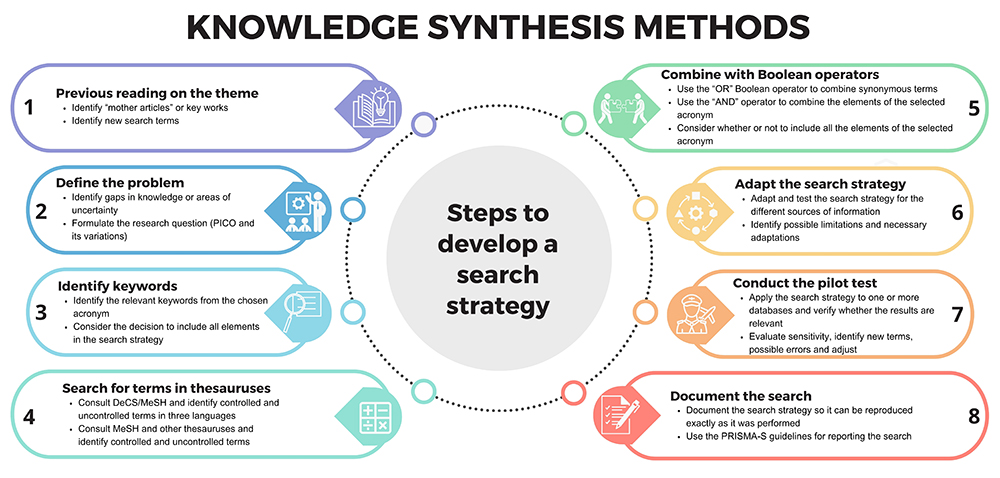
Based on these considerations, we offer a structured proposal grounded in consensus between existing methodologies and best practices for the development of a search strategy, using an eight-step process.
Stages for developing the search strategy
Step 1: Previous reading on the theme
In order to begin the search strategy design, researchers must first have sufficiently read about the subject, carefully checking the keywords and terms used in these studies to define the research question.
Thus, the preliminary review of the literature related to the subject in question aims to identify ‘mother articles’, i.e. fundamental and relevant studies that will provide a basis for the development of the new study. In-depth reading of these key articles provides valuable information on previous approaches, identification of new search terms, and the logical formulation of the strategy, providing a solid basis for construction of new knowledge 3,4.
Step 2: Defining the problem
The precise definition of the research problem is a fundamental step in the process of preparing systematized review methods, guided by the objectives of the review and by the research question to be answered4. For the literature review method, this definition must be clear and objective, involving key terms related to the topic under study 21. The formulation of the research question is essential; it guides the investigation and relevant key terms9,21.
Preliminary analysis of the literature contributes to identifying gaps in knowledge and areas of uncertainty9. The research question must be appropriately formulated for the proposed review method, broad enough to cover all relevant studies, with adequate specificity to guide the search strategy9. A common approach to organizing these questions is the PICO model (P: Patient, Problem or Population; I: Intervention; C: Comparison; O: Outcome), which provides a logical structure to outline the essential elements of the research question and facilitate the construction of an effective search strategy. 14,21,22.
Adapting the PICO model to the specific details of each study is crucial to guaranteeing the relevance and comprehensiveness of the search strategy. Variations such as PECO (Population, Exposure, Comparator, Outcome), PIO (Population, Intervention, Outcome), PCC (Population, Concept, Context), SPICE (Setting, Perspective, Intervention, Comparison, Evaluation), SPIDER (Sample, Phenomenon of Interest, Design, Evaluation, Research type), among others, can be used to better adapt to the particular nature of certain research questions14,22. These conceptual models not only provide an organized structure, promoting clarity and consistency regarding the development of the research question, but also contribute to the overall quality of the study. Thus, a well-designed definition of the research problem is essential for an efficient search strategy and identification of relevant studies23.
Step 3: Identifying terms and keywords
The search strategy begins by identifying relevant terms and keywords, based on the objective of the study and the elements of the chosen acronym8. Recommendations suggest that when using the PICO model, the strategy should begin with the Population (P) and Intervention (I) components4,12. It is important to note that the terms related to Comparison and/or Results are generally not incorporated initially, as they can be neglected in titles and abstracts, and are not often included as controlled terms24.
The decision on whether to include the terms for Outcomes (O) should be carefully analyzed by researchers during the development of the search strategy, considering that a very restrictive approach can limit the retrieval of relevant studies12. A broader search strategy with a subsequent selection of relevant studies may be a better alternative. Therefore, testing each component of the search strategy is an important approach to support decision-making regarding the terms used in the search.
Ensuring a proper balance between comprehensiveness (sensitivity of the search) and relevance (precision of the search) is essential to achieve an effective search. A sensitive search should capture all articles related to the topic, while specificity is necessary to avoid irrelevant results. This balancing between sensitivity and precision is essential in order to find as many relevant studies as possible without overwhelming the researcher with unnecessary information3,8,18.
Once the main terms have been identified, the next step is to cluster them, whenever possible, into categories of similarity. This organization enables easier visualization and development of the search strategy8.
Step 4: Search for term in thesauruses in the databases
The next step in the process of constructing the search strategy involves consulting the thesauruses (controlled vocabulary that helps to standardize and expand the search for related terms and synonyms, ensuring a more comprehensive and accurate representation of relevant literature) of the main databases, such as Descriptors in Health Sciences of the Virtual Health Library (DeCS), indicated for searches in Latin American and Caribbean databases, Medical Subject Headings (MeSH) for Medline/Pubmed, Subject Headings of the Cumulative Index to Nursing and Allied Health Literature (CINAHL of EBSCO), Emtree in Embase, among others. The aim is to identify controlled terms and relevant synonyms. A balanced combination of controlled and alternative terms along with keywords is essential, as each type of term plays a specific role in the search4,22. The idea is to develop a unique strategy, adapted to the particularities of each database selected, considering the specific features and functionalities of each platform. This includes the use of thesauruses such as MeSH in PubMed or Emtree in Embase, the appropriate application of Boolean operators, as well as truncation and filters to optimize the search according to the resources available in each database.
The health terms that constitute the descriptors are part of a controlled vocabulary, which is essential for delimiting the topics in each database. When a term does not have an official descriptor in a database, it is advisable to use free terms, along with their synonyms3,4. The inclusion of keywords is particularly valuable in emerging areas or when terms are not present in database thesauruses. When identifying subject definers, variations in the indexing terms of each database are essential, such as MeSH in Medline/PubMed and Emtree in Embase. In addition, the incorporation of keywords is absolutely essential, as not all concepts will have an indexer12. Figure 1 shows examples of the controlled terms and their synonyms in DeCS/MeSH and MeSH.

The search strategy is finalized by using the same search terms and keywords in all databases, ensuring that the search is comprehensive. Although it is essential to maintain consistency, small variations may be necessary due to the peculiarities of each database, and it is important that the researcher justifies these variations16. A practical example is the search strategy outlined in the national databases, where the researcher must include terms in at least three languages spoken in Latin America: Portuguese, English and Spanish25. The search for combined words and terms must be comprehensive, including all synonyms, plurals, and alternative spellings to avoid losing evidence. Competent researchers have the ability to improve the effectiveness of the search by expanding the strategy with spelling variations and synonyms. The intention is to ensure that no study relevant to the research question is missed during identification.
The beginning of the search for terms in DeCS/MeSH proves to be a valuable practice for new researchers in knowledge synthesis methods, as it enables the identification of terms in English that will guide the subsequent consultation using MeSH in Medline/PubMed. A notepad, the reviewer's best tool, plays a vital role in the review process, as it facilitates copying and pasting information without including marks from the internet. This resource is essential for maintaining the integrity and clarity of the data collected, ensuring that the evidence is compiled accurately and free from external interference.
Step 5: Combine terms and keywords with Boolean operators
The development of an efficient search strategy requires understanding and proper use of Boolean connectors, also known as Boolean operators. The next step in this process is to identify which Boolean operators will be used and correctly apply them to the terms identified in the previous readings and searches in the thesauruses of the chosen databases.
Boolean operators, which originate from Boolean algebra, are fundamental tools for combining terms in any database to limit or expand search results8. The “AND” connector is appropriate when it is necessary to associate different concepts, such as the components of the PICOT question, and its use restricts the search to studies that contain both terms combined. The Boolean connector “OR” is generally used to expand the search by including the search terms in the list of results, as they are synonyms3,16.
The use of “AND” searches for an associated term, while “OR” searches for one term or another and is generally used between synonymous or approximate terms (Figure 2). On the other hand, the Boolean exclusion operator “NOT” is used to remove the association of one term with another, or the exclusion of a term. However, “NOT” should not be used in knowledge synthesis methods, as it can result in the exclusion of relevant studies8.

When combining groups of similar terms connected by the “OR” operator, it is essential to include each group in brackets to ensure that all the terms contained within them are crossed with all the terms in the other group when they are combined by “AND” 8.
Each searching system has its own unique method of combining terms, for example by typing in the Booleans “AND” or “OR” or by offering the facility of clicking on a “combine” option and specifying the correct connector16. The Boolean operators need to be in capital letters (OR, AND), as some databases do not accept Booleans in lowercase letters, at the risk of confusing search results 8,18. The proper use of quotation marks is necessary to ensure that the search is conducted exactly as the terms were typed, generally used for compound words8. Chart 1 illustrates a search strategy.
Example of literature search according to DeCS controlled terms and synonyms for the LILACS database search. Source: the authors
Thus, accessing the help section of databases and relying on the guidance of librarians can be fundamental in determining the appropriate search strategy16.
Step 6: Adapting the search strategy for other databases
Once the terms have been combined with the Boolean operators and according to the acronym selected, it is necessary to adapt the search strategy to all the information sources selected in the study. The implementation of a robust search strategy for different sources is a relevant stage in the review process, requiring a careful and adaptive approach. Consistency in search terms is essential to preserve the integrity of the research, while flexibility is fundamental to meet the peculiarities of each platform3,9.
When accessing databases such as Medline/PubMed, where MeSH terms play a significant role in indexing, maintaining this structure is essential. Taking the controlled descriptor “Nursing” as an example, the search strategy should be as follows: “Nursing”[Mesh] OR “Nursing” OR “Nursings”. By repeating the controlled descriptor “Nursing”[Mesh], without indicating the MeSH, the search will prioritize the indexed terms and will also extend to all fields (“Nursing”[MeSH Terms] OR “Nursing”[All Fields] OR “Nursings”[All Fields]), if some kind of limiter is not used. Thus, including MeSH terms in the search of this database provides standardized categorization that facilitates the retrieval of relevant studies. Adaptation in this context involves not only incorporating these controlled terms, but also understanding how the database interprets and relates the concepts26,27.
It is imperative to recognize that each database operates with different nuances. Some platforms may have limited search functionality, which requires additional adaptations to the strategy, such as reducing the number of terms or performing multiple searches with different combinations of words8,12. It will probably be necessary to repeatedly test the strategies, improving them as the results obtained from each database are analyzed.
In this context, the researcher's experience plays a key role. An in-depth understanding of the particularities of each database, combined with interactive testing, enables continuous refinement of the strategy. Collaborating with librarians and exploring the specific help resources of each platform are recommended practices to optimize the adaptation of the search strategy, guaranteeing a comprehensive and accurate search amidst the diversity of information sources3,8,12.
When dealing with grey literature sources (documents not published in conventional sources, such as theses, dissertations and documents from government agencies and organizations), the approach may require more specific adjustments. In these instances, where the formalities of MeSH terms may not be universally applicable, the search strategy may need to simplify or restrict the terms. The unconventional nature of these sources demands a more flexible and creative approach to the selection and combination of terms and keywords19,20.
Step 7: Conducting the pilot test
Before formalizing and registering the review protocol, it is important to conduct a pilot for the search strategy. This stage is essential to assess the effectiveness and sensitivity of the strategy before implementing it definitively, providing a valuable opportunity to identify possible gaps and adjust the parameters as necessary9,28.
During the pilot, the search strategy is implemented on one or more databases relevant to the research topic. The objective is to assess the sensitivity and effectiveness of the strategy, identify possible problems, adjust parameters and, if necessary, include or exclude specific terms. In addition, this stage tests the combination of Boolean operators, verifies the applicability of subject descriptors and observes how the results align with the objectives of the review13.
By conducting a pilot search, researchers are able to test the sensitivity of the strategy in retrieving relevant studies and, at the same time, assess its accuracy in excluding irrelevant studies. This contributes significantly to refining the strategy, ensuring that it is sensitive enough to capture all relevant studies and, at the same time, sufficiently specific to avoid unnecessary results13,14.
Identifying new terms or information during the pilot search is an essential advantage of this process. Sometimes new descriptors or synonyms can emerge, providing a more comprehensive and accurate understanding of the theme. In addition, it ensures familiarity with the specific characteristics of each database, contributing to specific adaptations that increase the effectiveness of the strategy14,21.
The pilot test not only improves the accuracy of the search, but also saves time in the subsequent stage, when the strategy is definitively implemented. This is a primary principle in the review methodology, widely recognized by leading researchers and research organizations12,28,29.
In addition to the pilot test, a peer review of the literature search strategy is essential to improve quality, comprehensiveness, and the correct application of the “AND” or “OR” connectors, and to reduce errors, including misspelled words 3. Therefore, peer review is a fundamental process for improving the quality and comprehensiveness of the search, avoiding syntax errors and ensuring the correct implementation of the connectors13.
Validating the strategy with a research partner is an additional and valuable step. This collaboration not only ensures the reproducibility of the search, but also guarantees that the strategy comprehensively captures the focus of the search strategy. The exchange of ideas and perspectives contributes to further refinements and strengthens the robustness of the strategy. So, after developing an effective strategy, with satisfactory results in the databases, the next step is to document the process.
Step 8: Documenting the stages of the development of the search strategy
Throughout the review process, each phase of the search needs to be meticulously documented in order to report and update requirements. The search report must be presented in such a way that each study can be reproduced or at least properly evaluated. Such tools as the Preferred Reporting Items for Systematic Reviews and Meta Analyses (PRISMA) checklist30 and the PRISMA-S Statement for Reporting Literature Searches in Systematic Reviews13 are useful for this.
To ensure reproducibility, it is essential to provide the search report exactly as it was recorded in the information sources and databases13. It is recommended to copy and paste the search strategy into a Word document after it has been inserted into each database. In addition, searches should be described in narrative form, detailing limiting factors applied and reasons behind decisions18.
Researchers can make a printout or capture images of the search history from all information sources for later replication. Maintaining uniformity in the search approach ensures the consistent use of keywords, descriptors and alternative terms identified in all databases16.
Developing a search strategy that balances sensitivity and specificity is challenging and demands practice14. Systematic searching should be incorporated as a practice, avoiding disorganized approaches to searching for evidence16.
The importance of registration is associated with several fundamental aspects, as highlighted in Chart 2.
At the end of this section, a figure summarizes these steps, to facilitate visualization and understanding by the reader (Figure 3).

FINAL CONSIDERATIONS
Recognizing that developing a search strategy is a complex, repetitive and continuous process is essential, especially in the area of nursing, where evidence-based practice plays a central role in the quality of care. This process requires patience, dedication and constant improvement. Regular practice combined with in-depth reading is indispensable for developing skills in identifying and selecting relevant terms. Adopting a collaborative approach that integrates the expertise of the researcher with the knowledge of the specialist in scientific information is fundamental to overcoming challenges inherent in this process.
The proposal presented in this study consists of eight steps, and offers a structured guideline that standardizes best practices in the development of search strategies, helping to address challenges in an organized and effective way. Unlike fragmented guides or scattered guidelines, the strategy provides a clear path from problem definition to detailed search documentation, promoting efficient integration of key steps. A relevant feature of this proposal is the emphasis on adapting the strategy to different databases, considering the specificities of each to optimize the findings, which is particularly important for nursing, which includes a wide range of topics and approaches.
By providing a practical and applicable framework, the guideline not only improves the quality and effectiveness of evidence synthesis, but also methodologically advances the field of nursing by enabling researchers to conduct more precise and comprehensive searches. This systematic approach, centered on collaboration and continuous practice, represents a differentiator that can transform literature search practices, promoting high-quality knowledge syntheses capable of responding effectively to health and nursing research needs and questions.
REFERENCES
-
1. Yu X, Wu S, Sun Y, Wang P, Wang L, Su R, et al. Exploring the diverse definitions of 'evidence': A scoping review. BMJ Evid Based Med [Internet]. 2024 [cited 2024 Oct 10];29(1):37-43. Available from: https://doi.org/10.1136/bmjebm-2023-112355
» https://doi.org/10.1136/bmjebm-2023-112355 -
2. Brasil. Ministério da Saúde, Tecnologia, Inovação e Insumos Estratégicos em Saúde. Departamento de Ciència e Tecnologia. Diretriz metodológica: síntese de evidências para políticas [Internet]. 2020 [cited 2024 Oct 10]. Available from: https://www.gov.br/conitec/pt-br/midias/artigos_publicacoes/diretrizes/diretrizes_metodologicas_ptc.pdf
» https://www.gov.br/conitec/pt-br/midias/artigos_publicacoes/diretrizes/diretrizes_metodologicas_ptc.pdf -
3. Briscoe S. Errors to avoid when searching for studies for systematic reviews: A guide for nurse researchers. Int J Older People Nurs [Internet]. 2023 [cited 2024 Oct 10];18(3):e12533. Available from: https://doi.org/10.1111/opn.12533
» https://doi.org/10.1111/opn.12533 -
4. Abi Khalil C, Saab A, Rahme J, Seroussi B. Developing a comprehensive search strategy for the systematic review of clinical decision support systems for nursing practice. Stud Health Technol Inform [Internet]. 2023 [cited 2024 Oct 10];302:591-5. Available from: https://doi.org/10.3233/SHTI230211
» https://doi.org/10.3233/SHTI230211 -
5. Park HY, Suh CH, Woo S, Kim PH, Kim KW. Quality reporting of systematic review and meta-analysis according to PRISMA 2020 guidelines: Results from recently published papers in the Korean Journal of Radiology. Korean J Radiol [Internet]. 2022 [cited 2024 Oct 10];23(3):355-69. Available from: https://doi.org/10.3348/kjr.2021.0808
» https://doi.org/10.3348/kjr.2021.0808 -
6. Schoones JW. Redundancy of terms is not an error but plays a positive role in composing search strategies. J Med Libr Assoc [Internet]. 2020 [cited 2024 Oct 10];108(1):118-9. Available from: https://doi.org/10.5195/jmla.2020.780
» https://doi.org/10.5195/jmla.2020.780 -
7. Neilson CJ. Adoption of peer review of literature search strategies in knowledge synthesis from 2009 to 2018: An overview. Health Info Libr J [Internet]. 2021 [cited 2024 Oct 10];38(3):160-71. Available from: https://doi.org/10.1111/hir.12367
» https://doi.org/10.1111/hir.12367 - 8. Canto GL. Revisões sistemáticas da literatura: guia prático. Curitiba, PR(BR): Brazil Publishing; 2020.
-
9. Clark MJ, Beller E, Glasziou P, Sanders S. The decisions and processes involved in a systematic search strategy: A hierarchical framework. J Med Libr Assoc [Internet]. 2021 [cited 2024 Oct 10];109(2):201-11. Available from: https://doi.org/10.5195/jmla.2021.1086
» https://doi.org/10.5195/jmla.2021.1086 -
10. McGowan J, Sampson M, Salzwedel DM, Cogo E, Foerster V, Lefebvre C, et al. PRESS peer review of electronic search strategies: 2015 guideline statement. J Clin Epidemiol [Internet]. 2016 [cited 2024 Oct 10];75:40-6. Available from: https://doi.org/10.1016/j.jclinepi.2016.01.021
» https://doi.org/10.1016/j.jclinepi.2016.01.021 -
11. Portal da Rede BVS. Elaboração de estratégias de busca [Internet]. 2016 [cited 2024 Oct 10]. Available from: https://red.bvsalud.org/capacitacao/pt/elaboracao-de-estrategias-de-busca/
» https://red.bvsalud.org/capacitacao/pt/elaboracao-de-estrategias-de-busca/ - 12. Higgins JPT, Thomas J, Chandler J, Cumpston M, Li T, Page MJ, et al. Cochrane Handbook for Systematic Reviews of Interventions. 2nd ed. Chichester, EN(UK): John Wiley & Sons; 2019.
-
13. Rethlefsen ML, Kirtley S, Waffenschmidt S, Ayala AP, Moher D, Page MJ, et al. PRISMA-S: An extension to the PRISMA statement for reporting literature searches in systematic reviews. J Med Libr Assoc [Internet]. 2021 [cited 2024 Oct 10];109(2):174-200. Available from: https://doi.org/10.5195/jmla.2021.962
» https://doi.org/10.5195/jmla.2021.962 -
14. Stillwell SB, Scott JG. Sensitive versus specific search strategy to answer clinical questions. J Nurs Educ [Internet]. 2020 [cited 2024 Oct 10];59(1):22-5. Available from: https://doi.org/10.3928/01484834
» https://doi.org/10.3928/01484834 -
15. Herrström K, Larsson S, Einberg EL, Nilsson M, Blomqvist K, Garmy P. Assessment of search strategies in literature-review-based candidate theses within a nursing program. Adv Med Educ Pract [Internet]. 2020 [cited 2024 Oct 10];11:71-7. Available from: https://doi.org/10.2147/AMEP.S227547
» https://doi.org/10.2147/AMEP.S227547 - 16. Melnyk BM, Fineout-Overholt E. Evidence-based practice in nursing & healthcare: A guide to best practice. 5th ed. Philadelphia, PA(US): Lippincott Williams & Wilkins; 2023.
-
17. Aromataris E, Munn Z. JBI manual for evidence synthesis [Internet]. 2020 [cited 2024 Oct 10]. Available from: https://synthesismanual.jbi.global
» https://synthesismanual.jbi.global - 18. Toronto CE, Remington R. A step-by-step guide to conducting an integrative review. Switzerland: Springer Nature; 2020.
-
19. Pedersen ML, Tingleff EB. Enhancing research inclusion: The importance of grey literature searches. Scand J Caring Sci [Internet]. 2024 [cited 2024 Oct 10];38(1):249-50. Available from: https://doi.org/10.1111/scs.13188
» https://doi.org/10.1111/scs.13188 -
20. Pedersen ML, Tingleff EB. Enhancing research inclusion: The importance of grey literature searches. Scand J Caring Sci [Internet]. 2024 [cited 2024 Oct 10];38(1):249-50. Available from: https://doi.org/10.1111/scs.13188
» https://doi.org/10.1111/scs.13188 -
21. Araújo WCO. Recuperação da informação em saúde: construção, modelos e estratégias. ConCI: Conv Ciênc Inform [Internet]. 2020 [cited 2024 Oct 10];3(2):100-34. Available from: https://periodicos.ufs.br/conci/article/view/13447/10713
» https://periodicos.ufs.br/conci/article/view/13447/10713 -
22. Trivisonno LF, Escobar Liquitay C, Vergara-Merino L, Pérez-Bracchiglione J, Franco JVA. Key concepts for searching evidence: An introduction for healthcare professionals. Medwave [Internet]. 2022 [cited 2024 Oct 10];22(1):002512. Available from: https://doi.org/10.5867/medwave.2022.01.002512
» https://doi.org/10.5867/medwave.2022.01.002512 -
23. Masterson D, Martinez-Silveira MS. Aplication do Peer Review of Electronic Search Strategies para avaliação da qualidade das estratégias de busca das revisões sistemáticas. Em Quest [Internet]. 2022 [cited 2024 Oct 10];28(3):117865. Available from: https://doi.org/10.19132/1808-5245283.117865
» https://doi.org/10.19132/1808-5245283.117865 -
24. Brasil. Ministério da Saúde. Secretaria de Ciência, Tecnologia, Inovação e Insumos Estratégicos em Saúde. Departamento de Gestão e Incorporação de Tecnologias em Saúde. Diretrizes metodológicas: elaboração de revisão sistemática e meta-análise de ensaios clínicos randomizados [Internet]. 2021 [cited 2024 Oct 10]. Available from: https://bvsms.saude.gov.br/bvs/publicacoes/diretrizes_elaboracao_revisao_sistematica_meta-analise.pdf
» https://bvsms.saude.gov.br/bvs/publicacoes/diretrizes_elaboracao_revisao_sistematica_meta-analise.pdf -
25. Escobar-Liquitay CM, Vergara-Merino L, Verdejo C, Kirmayr M, Schuller-Martínez B, Madrid E, et al. Methodological and users' surveys on the use of the LILACS database in Cochrane reviews identified desirable improvements to the database. Health Info Libr J [Internet]. 2024 [cited 2024 Oct 10];41(1):76-83. Available from: https://doi.org/10.1111/hir.12505
» https://doi.org/10.1111/hir.12505 -
26. Massonnaud CR, Kerdelhué G, Grosjean J, Lelong R, Griffon N, Darmoni SJ, et al. Identification of the best semantic expansion to query PubMed through automatic performance assessment of four search strategies on all medical subject heading descriptors: comparative study. JMIR Med Inform [Internet]. 2020 [cited 2024 Oct 10];8(6):e12799. Available from: https://doi.org/10.2196/12799
» https://doi.org/10.2196/12799 -
27. Kim W, Yeganova L, Comeau DC, Wilbur WJ, Lu Z. Towards a unified search: Improving PubMed retrieval with full text. J Biomed Inform [Internet]. 2022 [cited 2024 Oct 10];134:104211. Available from: https://doi.org/10.1016/j.jbi.2022.104211
» https://doi.org/10.1016/j.jbi.2022.104211 -
28. Heath A, Levay P, Tuvey D. Literature searching methods or guidance and their application to public health topics: A narrative review. Health Info Libr J [Internet]. 2022 [cited 2024 Oct 10];39(1):6-21. Available from: https://doi.org/10.1111/hir.12414
» https://doi.org/10.1111/hir.12414 -
29. Jones EP, Brennan EA, Davis A. Evaluation of literature searching and article selection skills of an evidence-based practice team. J Med Libr Assoc [Internet]. 2020 [cited 2024 Oct 10];108(3):487-93. Available from: https://doi.org/10.5195/jmla.2020.865
» https://doi.org/10.5195/jmla.2020.865 -
30. Page MJ, McKenzie JE, Bossuyt PM, Boutron I, Hoffmann TC, Mulrow CD, et al. The PRISMA 2020 statement: An updated guideline for reporting systematic reviews. BMJ [Internet]. 2021 [cited 2024 Oct 10];372(71):1-9. Available from: https://doi.org/10.1136/bmj.n71
» https://doi.org/10.1136/bmj.n71

 Source: the authors
 Source: Adapted from
 Source: The authors.