 Role of the oxidative metabolism in induced resistance or susceptibility mechanism during the interaction of avocado with Phytophthora cinnamomi Rands.
ABSTRACT
The disease caused by the oomycete Phytophthora cinnamomi Rands affects most avocado (Persea americana) varieties, requiring additional tools for the selection of resistant materials. In the present study, induction of defense responses related to the oxidative metabolism in avocado was evaluated as a support for establishing its role in the defense responses during infection by this oomycete. Infection trials were carried out with the avocado clones ‘Duke 7’ (tolerant) and ‘Hass’ (susceptible), which had their stem base inoculated with the pathogen and whole leaves sampled at 0, 3, 24, 48 and 120 hours after infection (hai), for subsequent evaluation of the activities of the enzymes superoxide dismutase (SOD) and ascorbate peroxidase (APX), as well as for assessment of free radical scavenging capacity, total polyphenol content and caspase 3-like activity. The area under the disease progress curve was 1.3 and 14.8 (cm.day-1) for ‘Duke 7’ and ‘Hass’, respectively, and the former showed high resistance to the oomycete, which correlated with higher APX activity, higher free radical scavenger activity, and expression of caspase 3-like activity. Resistance or susceptibility in avocado during interaction with Phytophthora cinnamomi is suggested to be mediated by the participation of induced and innate antioxidants and by the induction of apoptosis responses in the resistant genotype ‘Duke 7’, whereas there is lack of such responses in ‘Hass’, the susceptible genotype.
Keywords
Persea americana
; Phytophthora root rot; oxidative stress; antioxidant; plant defense; apoptosis
RESUMO
A doença causada pelo oomiceto Phytophthora cinnamomi Rands afeta a maioria das variedades de abacate (Persea americana), exigindo ferramentas adicionais para a seleção de materiais resistentes. No presente estudo, a indução de respostas de defesa relacionadas ao metabolismo oxidativo em abacate foi avaliada como suporte para estabelecer seu papel nas respostas de defesa durante a infecção por este oomiceto. Ensaios de infecção foram realizados com os clones de abacate ‘Duke 7’ (tolerante) e ‘Hass’ (suscetível), que tiveram sua base do caule inoculada com o patógeno e folhas inteiras amostradas em 0, 3, 24, 48 e 120 horas após a infecção (hai), para posterior avaliação das atividades das enzimas superóxido dismutase (SOD) e ascorbato peroxidase (APX), bem como para avaliação da capacidade de sequestro de radicais livres, conteúdo total de polifenóis e atividade de caspase 3. A área abaixo da curva de progresso da doença foi de 1,3 e 14,8 (cm.dia-1) para ‘Duke 7’ e ‘Hass’, respectivamente, e o primeiro apresentou alta resistência ao oomiceto, o que se correlacionou com maior atividade de APX, maior atividade de eliminação de radicais livres e expressão de atividade de caspase 3. Sugere-se que a resistência ou suscetibilidade em abacate durante a interação com Phytophthora cinnamomi seja mediada pela participação de antioxidantes induzidos e inatos e pela indução de respostas de apoptose no genótipo resistente ‘Duke 7’, enquanto que tais respostas estão ausentes em ‘Hass’, o genótipo suscetível.
Palavras-chave
Persea americana
; podridão radicular por Phytophthora ; estresse oxidativo; antioxidante; defesa vegetal; apoptose
The oomycete Phytophthora cinnamomi Rands affects avocado crops in diverse producing countries (14). The disease is characterized by root rot, affecting crops at almost all development stages (4) (16). One of the most effective alternatives in controlling diseases in avocado remains the use of disease-resistant rootstocks (15). An approach that would support the selection and identification of tolerant patterns for implementing breeding programs is the understanding of the molecular basis of resistance. Among the most recognized defense mechanisms in plants are those associated with oxidative metabolism. During stress situations, plants can increase the production of Reactive Oxygen Species (ROS), which affects the chemical structure of biomolecules, subsequently causing cell damage (12). The plant antioxidant system responsible for inactivating the superoxide anion and hydrogen is highly important (6) and includes the enzyme superoxide dismutase (SOD), responsible for transforming the superoxide anion into hydrogen peroxide, which in turn is used by the enzyme ascorbate peroxidase (APX) to catabolize the reduction of ascorbate (ASC) to dehydroascorbate (DHA) or ascorbate monodehyde radical (MDA) (17). On the other hand, hypersensitive response (HR) is a plant defense mechanism that has been closely linked to oxidative stress. Classically, HR has been defined as a type of suicide of the cells surrounding the site of biotrophic pathogens, preventing their arrival and colonization (11). The molecules responsible for executing apoptosis during programmed cell death (PCD) are proteins called caspases (21), which are important to understand not only the mechanisms associated with the oxidative metabolism during defense responses, but also the complexity of their regulation and effect on various aspects of plant physiology. Therefore, in the present study, some aspects of the oxidative metabolism in the avocado-Phytophthora cinnamomi pathosystem were analyzed in infected avocado genotypes ‘Duke 7’ and ‘Hass’.
MATERIALS AND METHODS
Plant material and induction tests
The virulent strain of P. cinnamomi used in the present study was kindly supplied by Corporation for Biological Research (CIB). The five-month-old ‘Duke 7’ and ‘Hass’ avocado clones were purchased from the company “Profrutales” and were kept under greenhouse conditions during the trial. Plants were inoculated according to the methodology reported by Jaramillo (10). Samples corresponded to the whole leaves of three plants and were collected after 0, 3, 24, 48, 120 hours.
Virulence tests on the two genotypes
The area under the disease progress curve (AUDPC) (5) for the two genotypes infected with P. cinnamomi was obtained from the kinetics of the lesion diameter in the stems as a function of the days after infection (dai).
Superoxide dismutase activity assay (SOD, EC 1.15.1.1)
Leaf tissue samples (200 mg) were homogenized with 100mM sodium phosphate buffer (pH 7) and centrifuged at 15,000 rpm for 30 min at 4◦C, and supernatants were used to determine the enzyme activities. The activity was measured in a spectrophotometer, at 560 nm, as inhibition of nitro-blue tetrazolium (NBT) photochemical reduction (18). The action mixture consisted of 33 μM NBT, 10 mM L-methionine, 0.66 mM EDTA × Na2, and 0.0033 mM riboflavin in 0.05 M Na-phosphate buffer (pH 7.8). Riboflavin was measured at 300 μmol m-2s-1 irradiance at room temperature. The reaction mixture without enzymes developed maximum color due to maximum NBT reduction, and the non-irradiated reaction mixture did not develop color (control). One unit of SOD was defined as the amount of enzyme that inhibits 50% NBT photoreduction.
Ascorbate peroxidase activity assay (APX , EC 1.11.1.11)
Leaf tissue samples (100 mg) were homogenized in 2 mL cold 50 mM potassium phosphate buffer (pH 7.0), 1 mM EDTA and 1 mM ascorbic acid, followed by centrifugation at 15,000 g, for 20 min, at 4 °C. The supernatant was used as enzyme extract (13). The reaction mixture (3 mL) consisted of 50 mM potassium phosphate buffer (pH 7.0) containing 1 mM EDTA, 0.5 mM ascorbate, 0.1 mM H2O2 and 200 µL enzyme extract. The decrease in absorbance was measured at 290 nm for 1.5 min in a spectrophotometer (Evolution™ 260 Bio Uv-Visible, Thermo Scientific™). The enzyme activity was measured at 290 nm and calculated based on a coefficient of 2.8 mM-1 cm-1. One unit of enzyme activity was defined as 1 nmol ascorbate oxidized min-1.
Total phenolic compounds
Quantification of total polyphenols was carried out by following the methodology described by Barrientos (3), with some modifications. The raw extract was prepared with 20 mg fresh tissue and 300 µL acetone/water solution (60/40, v/v), followed by 2h shaking. After evaporation for 2h, the extract was centrifuged at 11,000 rpm for 15 min. Subsequently, 80 µL supernatant was collected and completed with 920 µL methanol. A 96-well plate received 150 µL distilled water, 20 µL methanol extract of each sample, and 20 µL sodium carbonate solution (20%); this mixture was allowed to react for 6 min for subsequent addition of 10 µL Folin-Ciocalteu reagent and shaking for 30s, followed by incubation for 1h in the dark at 22°C. Absorbance was measured at 760 nm. The concentration of phenols was estimated from the calibration curve for gallic acid (GAE).
DPPH free radical scavenging assay
The extract (100µL) obtained in section 2.5 was used. For each well, 100 µL methanol extract and 100 µl DPPH radical solution at 20 ppm in methanol were added according to a modification in the methodology proposed by Dias et al. (7). Absorbance was measured at 517 nm in a spectrophotometer Multiskan GO™ (Thermo Scientific™). The inhibition percentage was calculated with the following formula: %Inhibition=[(C – T)/C] x 100, where, C=absorbance of the blank (DPPH+methanol), T=absorbance of the tested sample (DPPH+methanol+sample).
Caspase 3-like activity
Enzyme extracts were obtained from the maceration of 150 mg leaves with 2 mL 100mM buffer Tris-HCl (pH 7.2; 5mM MgCl2; 2mM EDTA; 10% v/v glycerol). Subsequently, the samples were centrifuged at 13,000 rpm for 30 min at 4°C (19). Supernatants were put in contact with the substrate N-Acetyl-Asp-Glu-Val-Asp-p-nitroanilide (Ac-DEVD-pNa, caspase 3), 6 mM, at 37°C, for 60 min. For the enzyme kinetics, readings were obtained at every 5 min for 30 min, every 10 min for 30 min, and every 15 min for 30 min. Caspase 3-like activity was calculated by measuring the absorbance at 405 nm at every 5 min for 30 min, every 10 min for 30 min and every 15 min for 30 min (90 min total time).
Statistical Analysis
All assays were performed according to a completely randomized design. The whole experiment was repeated three times and data from all variables (biochemical tests) were obtained with a minimum of three replicates. Anova and multiple comparison tests (Tukey’s test) were adopted when significant (P<0.05) differences between means were detected. In addition, linear regression analyzes were also employed when data were significantly adjusted to the said model. All statistical analyses were performed with R software.
RESULTS AND DISCUSSION
Disease progression
The AUDPC (cm.day-1) was 1.3 and 14.8 for ‘Duke 7’ and ‘Hass’, respectively (Figure 1). In all cases, under the conditions and methodologies used in the present study, the disease progress was significantly lower for ‘Duke 7’ since, after 20 days, all ‘Hass’ plants died while ‘Duke 7’ ones remained alive despite showing a certain disease progress level. The obtained AUDPC data are consistent with various findings on the tolerance of ‘Duke 7’ genotype to P. cinnamomi (5). Only few reports have been made on the molecular basis of resistance of this genotype. Nonetheless, ‘Thomas’ rootstocks, at 17°C, and ‘Duke7’, at 28°C, have been considered tolerant for showing similar percentages of tyloses during wilt symptoms.
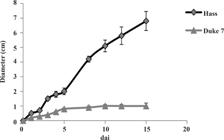
Disease progress kinetics for ‘Hass’ and ‘Duke 7’ avocado genotypes inoculated with P. cinnamomi Rands. Values represent the mean ±SD, calculated from at least three replicates. dai: days after infection.
Superoxide dismutase activity
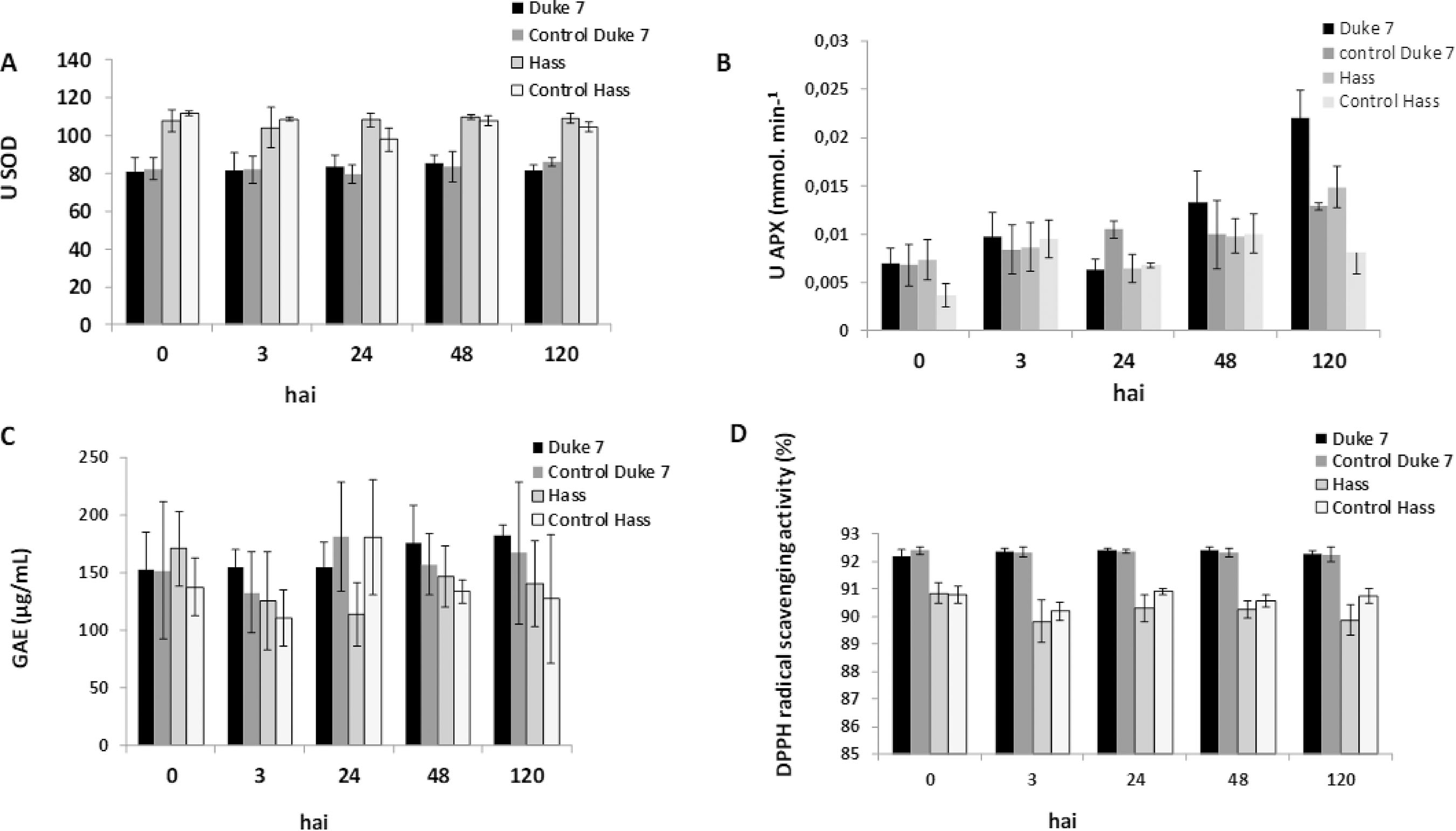
For both genotypes, SOD activity did not show statistical differences (p-value 0.7956), compared to untreated controls. Similarly, there was no effect of time and, therefore, no effect of induction on SOD activity for either genotype (Figure 2A). However, according to ANOVA, there were statistically significant differences between genotypes (p-value 2x10-16); SOD activity was greater in ‘Hass’, which suggests higher hydrogen peroxide production. Diverse and even contradictory results can be found in the literature; for example, SOD production was reported to be higher in induced resistant melon variety than in the susceptible one or in any of the controls (9). In contrast, Azarabadi et al. (2) evaluated SOD in susceptible and tolerant pear rootstocks and reported more activity in the susceptible variety. Nonetheless, SOD is shown to be responsible for converting O2- into H2O2 (22) which, at high concentrations, can participate in the oxidative outburst processes (1) and, on the other hand, can serve as a substrate for peroxidases of other antioxidant systems, act in cell wall biosynthesis or play a role as a second messenger during amplification and cross-linking of signals for gene activation. Therefore, to establish the role of SOD in the defense process of avocados, analysis of other subsequent biochemical events is required.

Activities of superoxide dismutase (SOD) (A) and ascorbate peroxidase (APX) (B) from leaves of ‘Hass’ and ‘Duke 7’ avocado genotypes inoculated with P. cinnamomi Rands. Values represent the mean ±SD, calculated from at least three replicates. Total polyphenol (C) content and free radical scavenging capacity (D), from the leaves of ‘Hass’ and ‘Duke 7’ avocado genotypes inoculated with P. cinnamomi Rands. hai: hours after infection. Values represent the mean ±SD, calculated from at least three replicates. Means with the same letter are not significantly different (ANOVA followed by Tukey’s test at p<0.05)>
Ascorbate peroxidase activity
Regression analysis showed significance for both genotypes induced with P. cinnamomi and no significance for untreated controls (Table 1), which evidences an effect of time on APX activity. The higher slopes for induced ‘Duke 7’ demonstrated greater activity during the interaction with the pathogen, which increased by 32% and 72% at 48 and 120 hours, compared to its non-induced control (Figure 2B). For ‘Hass’ material, an increase in activity was also observed, compared to control; however, it occurred later (120 h) and was significantly lower than that for ‘Duke 7’. The regression results suggested free radical production during induction and major and more rapid stabilization capacity of those radicals by ‘Duke 7’ (Table 1). This resistant genotype had greater capacity to disrupt H2O2 and pass the electrons to ascorbate, subsequently supplying substrate for the development of the Haliwell-Asada cycle and consequently stabilizing free radicals as defense responses (17). In this sense, SOD and APX activities represent key steps in the cell redox balance and in the stabilization of harmful free radicals. Different papers have shown the relationship between increased APX production and resistance, as reported by Azarabadi (2). In contrast, another study with avocados susceptible to P. cinnamomi indicated high H2O2 production in response to the pathogen (8). Thus, additional research is needed to understand the functionality of APX in avocados and the role of peroxide.
Regression analysis results for ‘Duke 7’ control (non-induced), ‘Duke 7’ (induced), ‘Hass’ control (non-induced), and ‘Hass’ (in duced), considering the variable initial speed of APX activity as a function of time after induction with P. cinnamomi.
Phenolic compounds and DPPH free radical scavenging
In the present study, scavenging of free radicals was not explored in a enzymatic way but was based on secondary metabolites of polyphenolic nature. Analysis of variance showed no statistically significant differences between the two genotypes or their untreated controls overtime (Tukey’s test) for the accumulation of total polyphenols or free radical scavenging capacity. However, free radical scavenging capacity was statistically greater for ‘Duke 7’ (Figure 2C and 2D). Biosynthesis of polyphenols as a defense response is related to their capacity, given by their distinctive molecular structure, to act as molecules that delocalize the radical species by resonance (20). Results suggested no effect of the infection with P. cinnamomi on the accumulation of total polyphenols or free radical scavenging capacity. This means that there is no induction due to P. cinnamomi on the antioxidant activity through stabilization of free radicals by metabolites of polyphenolic nature, which could be a defense response; instead, the defense against oxidative stress operates through the enzymatic pathway (Tukey’s test). However, free radical scavenging capacity was statistically greater in ‘Duke 7’, suggesting the presence of an underlying antioxidant mechanism in both genotypes, especially in the resistant one, due to the presence of innate but not induced polyphenol.

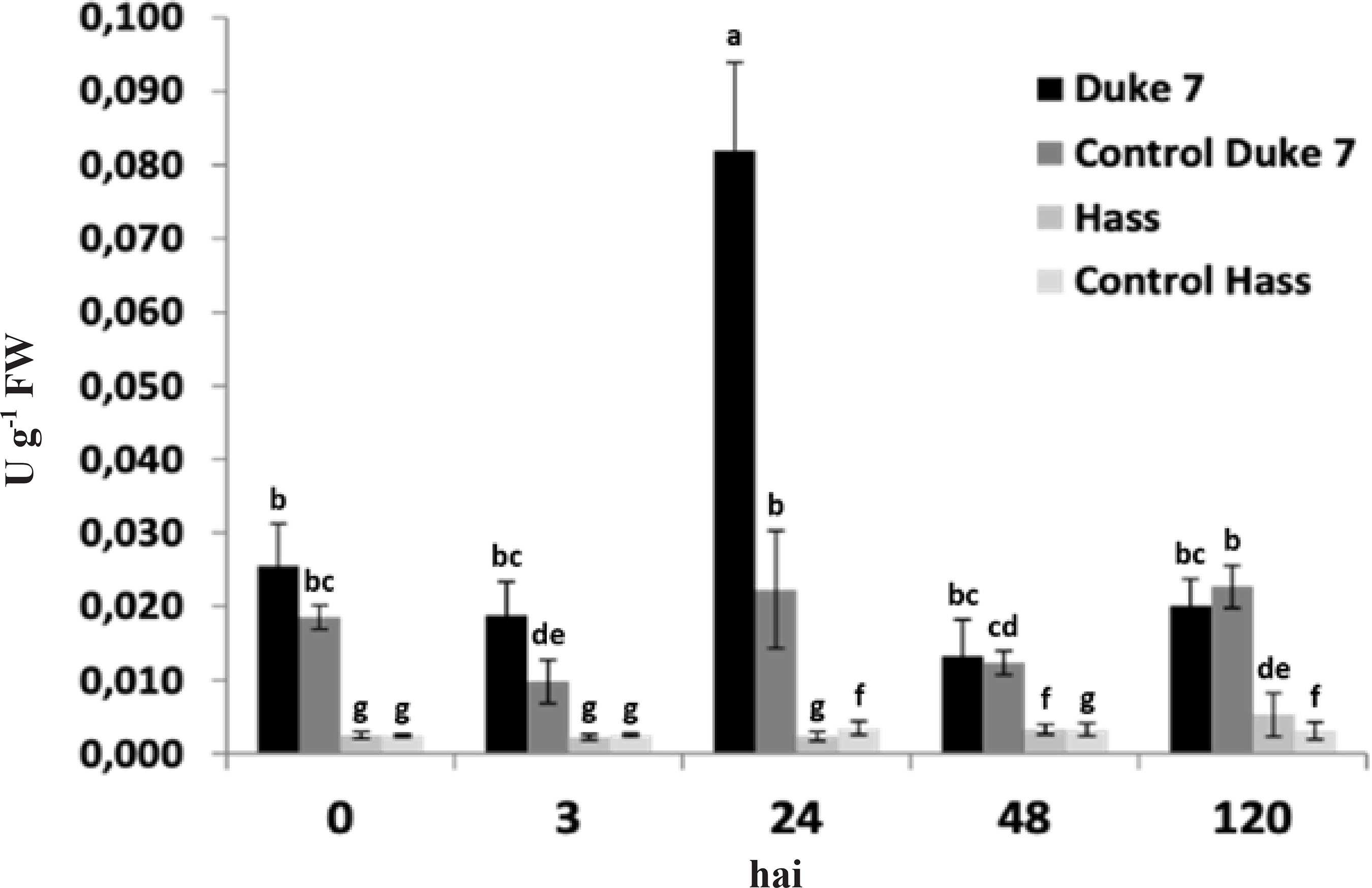
Activity of caspase 3-like from the leaves of ‘Hass’ and ‘Duke 7’ avocado genotypes, inoculated with P. cinnamomi Rands. Values represent the mean ±SD, calculated from at least three replicates. Means with the same letter are not significantly different (ANOVA followed by Tukey’s test at p<0.05).
Determination of caspase 3-like activity
A statistically significant increase in caspase 3-like activity was observed for ‘Duke 7’, which peaked in production, whereas no such activity was found for ‘Hass’ genotype (Figure 3). Several studies have established a correlation between oxidative metabolism responses and other defense responses (21). The current results suggest that the resistant genotype develops apoptosis processes that may be linked to PCD processes; this corroborates different studies using synthetic fluorogenic substrates and caspase inhibitor peptides, which proposed that plants develop apoptosis processes during biotic and abiotic stress (25). More specifically, as regards the relationship between ROS production and PCD processes, there also seems to be conflicting opinions in the literature worldwide since some authors have reported that, as a defense response, high ROS levels are present, which activate HR processes and therefore PCD. This approach considers that stress induces a disruption in redox balance, followed by ROS overproduction, which in turn triggers an oxidative burst and subsequent cell death (HR) (24). On the other hand, some researchers have conceptualized apoptosis-mediated PCD in resistant genotypes, assuming that ROS, at specific concentrations, can act as signaling molecules for initiating PCD processes (23). The present results, from sampling plant leaves inoculated with the pathogen, suggest defense response induction processes in the resistant genotype, which were mediated by oxidative metabolism regulation, directed towards the stabilization of free radicals and signal amplification for PCD start. However, further research is required to fully establish the role of oxidative metabolism, as well as the development of PCD in Persea americana.
During the compatible and incompatible interaction of P. cinnamomi with ‘Hass’ and ‘Duke 7’ avocado genotypes, respectively, the responses associated with oxidative metabolism largely explain the susceptibility or resistance of these genotypes. In the resistant genotype ‘Duke 7’, the antioxidant enzymatic system activation, which stabilizes ROS, correlated with slow disease progress. Enzymatic processes associated with apoptosis and thus possibly PCD were also observed. In contrast, in the susceptible genotype ‘Hass’, these responses were the opposite. Further studies are required to more solidly establish PCD development, its possible regulation, and signaling mediated by low ROS concentrations. Resistance induction was also evidenced in ‘Duke 7’ during the interaction with the oomycete, which did not occur in ‘Hass’. In addition to induced responses, ‘Duke 7’ is suggested to have an innate and non-induced antioxidant system mediated by polyphenolic compounds, which also contributes to ROS stabilization and is superior to that of ‘Hass’. Based on the obtained results, the evaluated antioxidant activities could be adopted as resistance markers in planting material selection programs for avocado, especially in the search for resistance patterns to P. cinnamomi.
-
Funding
The authors thank “Sistema General de Regalías” (SGR) of the Department of Antioquia in Colombia for financing this research project.
References
-
1 Apel, K., Hirt, H. Reactive oxygen species: metabolism, oxidative stress, and signal transduction. Annu Rev. Plant Biol 55, 373-399. 2004. https://doi.org/10.1146/annurev.arplant.55.031903.141701
» https://doi.org/10.1146/annurev.arplant.55.031903.141701 -
2 Azarabadi, S., Abdollahi, H., Torabi, M., Salehi, Z., Nasiri, J. ROS generation, oxidative burst and dynamic expression profiles of ROS-scavenging enzymes of superoxide dismutase (SOD), catalase (CAT) and ascorbate peroxidase (APX) in response to Erwinia amylovora in pear (Pyrus communis L). European Journal of Plant Pathology 147, 279-294. 2017. https://doi.org/10.1007/s10658-016-1000-0
» https://doi.org/10.1007/s10658-016-1000-0 -
3 Barrientos Ramírez L, Lourdes Arvizu M, Salcedo Pérez E, Villanueva Rodríguez S, Vargas Radillo JJ, Barradas Reyes BA, et al. Contenido de polifenoles y capacidad antioxidante de Physalis chenopodifolia lam. silvestre y bajo cultivo. Rev Mex Cienc For. 10 (51): 182-200.2019 Doi: https://doi.org/10.29298/rmcf.v10i51.323
» https://doi.org/10.29298/rmcf.v10i51.323 - 4 Berg, V. D. N.; Swart, V.; Backer, R.; Fick, A.; Viena, R.; Engelbrecht, J. and Prabhu, S. 2021. Advances in understanding defense mechanisms in Persea americana Against Phytophthora cinnamon.
- 5 Campbell, C.L, Madden, L.V. “Introduction to Plant Disease Epidemiology”. John Wiley & Sons, New York, NY, USA.1990
-
6 Černý, M., Habánová, H., Berka, M., Luklová, M. y Brzobohatý, B. Peróxido de hidrógeno: su papel en la biología vegetal y la diafonía con las redes de señalización. En t. J. Mol. Ciencia. 19: E2812. 2018 doi: 10.3390/ijms19092812
» https://doi.org/10.3390/ijms19092812 - 7 Dias, M. C., Ponte, N. M., & Santos, C. (2019). Lead induces oxidative stress in Pisum sativum plants and changes the levels of phytohormones with antioxidant role. Plant Physiology and Biochemistry, 137, 121–1120
-
8 García-Pineda, E., Benezer-Benezer, M., Gutiérrez-Segundo, A. Rangel-Sánchez, G., Arreola-Cortés, A., Castro-Mercado, E. Regulation of defence responses in avocado roots infected with Phytophthora cinnamomi (Rands). Plant & Soil 331, 45-56, 2010. https://doi.org/10.1007/s11104-009-0225-5
» https://doi.org/10.1007/s11104-009-0225-5 -
9 Ge, Y., Bi, Y., Guest, D.I. Defence responses in leaves of resistant and susceptible melon (Cucumis melo L.) cultivars infected with Colletotrichum lagenarium. Physiological and molecular plant pathology 81, 13-21, 2013. https://doi.org/10.1016/j.pmpp.2012.09.002
» https://doi.org/10.1016/j.pmpp.2012.09.002 - 10 Jaramillo, J., Mejía, A., Villamiza, P., Orozco, M., Arenas, A. Informe final del Proyecto: Colección, caracterización y multiplicación clonal de selecciones criollas de aguacate con énfasis en la identificación de patrones con tolerancia a Phytophthora spp.CIAT, CORPOICA, PROFRUTALES., Palmira, Valle del Cauca, p. 153. 2009.
-
11 Kabbage, M., Kessens, R., Bartholomay, L.C., B. Williams, B. The life and death of a plant cell, Annu. Rev. Plant Biol. 375– 404. 2017. https://doi.org/10.1146/annurev-arplant-043015-111655
» https://doi.org/10.1146/annurev-arplant-043015-111655 -
12 Mittler, R. Los ROS son buenos. Tendencias de ciencia vegetal. 22, 11-19. 2017. doi: 10.1016/j.tplants.2016.08.002
» https://doi.org/10.1016/j.tplants.2016.08.002 -
13 Nakano, Y., Asada, K. Hydrogen peroxide is scavenged by ascorbate-specific peroxidase in spinach chloroplasts. Plant and cell physiology 22, 867-880.1981. https://doi.org/10.1093/oxfordjournals.pcp.a076232.
» https://doi.org/10.1093/oxfordjournals.pcp.a076232 - 14 Norton, R., Argüello, R. Una perspectiva de la competitividad agrícola en Colombia. Agencia de los Estados Unidos para el Desarrollo Internacional, USAID. 2008.
- 15 Pérez Álvarez, Sandra; Ávila Quezada, Graciela y Coto Arbelo, Orlando. El aguacatero (Persea americana Mill). [en línea]. Cultivos Tropicales.Vol. 36, no. 2, pp. 111-123. ISSN 1819-4087.2015.
- 16 Pérez-Jiménez, R.M. Significant avocado diseases caused by fungi and oomycetes. Eur J Plant Sci Biotech, 1-24. 2008.
-
17 Potters, G., De Gara, L., Asard, H., Horemans, N. Ascorbate and glutathione: guardians of the cell cycle, partners in crime? Plant Physiology and Biochemistry 40, 537-548. 2002. https://doi.org/10.1016/S0981-9428(02)01414-6.
» https://doi.org/10.1016/S0981-9428(02)01414-6 - 18 Rajan, S., & Pushpa, A. In vitro evaluation of enzymic antioxidants in the seed and leaf samples of Syzygium cumini and Momordica charantia. International Journal of Scientific and Research Publications, 5, 476–480.2015.
-
19 Satish, L., Rathinapriya, P., Sagina Rency, A., Antony Ceasar, S., Prathibha, M., Pandian, S., Rameshkumar, R., Ramesh, M. Effect of salinity stress on finger millet (Eleusine coracana (L.) Gaertn): Histochemical and morphological analysis of coleoptile and coleorhizae. Flora - Morphology, Distribution, Functional Ecology of Plants 222, 111-120. 2016. https://doi.org/10.1016/j.flora.2016.04.006.
» https://doi.org/10.1016/j.flora.2016.04.006 -
20 Sharma A., Shahzad B., Rehman A., Bhardwaj R., Landi M., Zheng B. Respuesta de la vía de los fenilpropanoides y el papel de los polifenoles en plantas bajo estrés abiótico. Moléculas.24 :2452.2019. doi: 10.3390/moléculas24132452.
» https://doi.org/10.3390/moléculas24132452 -
21 Van den Berg, N., Mahomed, W., Olivier, N. A., Swart, V., and Crampton, B. G.Transcriptome analysis of an incompatible Persea americana- Phytophthora cinnamomi interaction reveals the involvement of SA-and JA-pathways in a successful defense response. PLoS One 13:e0205705. (2018b). https: doi: 10.1371/journal.pone.0205705.
» https://doi.org/10.1371/journal.pone.0205705 -
22 Xu, J., Tran, T., Marcia, C.S.P., Braun, D.M., Goggin, F.L. Superoxide-responsive gene expression in Arabidopsis thaliana and Zea mays. Plant physiology and biochemistry 117, 51-60. 2017. https://doi.org/10.1016/j.plaphy.2017.05.018
» https://doi.org/10.1016/j.plaphy.2017.05.018 -
23 Zhang, H.K., Zhang, X., Mao, B.Z., Qun, L., Zu Hua, H. Alpha-picolinic acid, a fungal toxin and mammal apoptosis-inducing agent, elicits hypersensitive-like response and enhances disease resistance in rice. Cell research 14, 27. 2004 https://doi.org/10.1038/sj.cr.7290199.
» https://doi.org/10.1038/sj.cr.7290199 -
24 Zhang, L., Pei, Y., Wang, H., Jin, Z., Liu, Z., Qiao, Z., Fang, H., Zhang, Y. Hydrogen sulfide alleviates cadmium-induced cell death through restraining ROS accumulation in roots of Brassica rapa L. ssp. pekinensis. Oxidative medicine and cellular longevity 2015. https://doi.org/10.1155/2015/804603.
» https://doi.org/10.1155/2015/804603 -
25 Zhang, L., Xu, Q., Xing, D., Gao, C., Xiong, H. Real-time detection of caspase-3-like protease activation in vivo using fluorescence resonance energy transfer during plant programmed cell death induced by ultraviolet C overexposure. Plant physiology 150, 1773-1783. 2009. https://doi.org/10.1104/pp.108.125625.
» https://doi.org/10.1104/pp.108.125625
Edited by
-
SCIENTIFIC EDITOR:
Edson Luiz Furtado https://org/0000-0002-6924-835X
-
ASSOCIATE EDITOR:
Sergio Florentino Pascholati https://0000-0002-9690-9694