 Social innovation in rural areas to promote Sustainable Development: A Systematic Review
Resumo
Foi realizada uma revisão sistemática para o período 2010–2020, a partir de uma busca exaustiva com o modelo de declaração PRISMA e as bases de dados SCOPUS, JSTOR e EBSCO, para identificar referências na literatura científica em nível global. Para tanto, foram respondidas questões como: quais modelos de inovação social têm sido aplicados em áreas rurais para promover o desenvolvimento sustentável, como forma de adaptação às novas práticas agrícolas? Qual o papel desempenhado pelas entidades governamentais e pela comunidade rural no planejamento e execução de iniciativas com inovação social que promovam alternativas sustentáveis? Foram encontrados resultados alusivos ao uso de Tecnologias de Informação e Comunicação, empreendedorismo, agricultura familiar e costumes transformadores. Da mesma forma, foram definidos os papéis de promotor e facilitador a partir da perspectiva da governança, em conexão com os papéis de participação e liderança comunitária para modificar a realidade socioeconômica do território.
Keywords:
social innovation; sustainable development; rural environment; systematic review
Abstract
A systematic review was implemented for the period 2010–2020, based on an exhaustive search with the PRISMA declaration model and the SCOPUS, JSTOR, EBSCO databases, to identify references in the scientific literature at a global level. To this end, questions were answered such as: what models of social innovation have been applied in rural areas to promote sustainable development, as a way of adapting to new agricultural practices? What is the role played by government entities and the rural community in the planning and execution of initiatives with social innovation that promote sustainable alternatives? Results were found alluding to the use of Information and Communication Technologies, entrepreneurship, family farming, transformative customs. Likewise, the roles of promoter and facilitator were defined from the perspective of governance, in connection with the roles of community participation and leadership to modify the socioeconomic reality of the territory.
Keywords:
social innovation; sustainable development; rural environment; systematic review
Introduction
Rural communities face various inequities in socioeconomic, educational, and healthcare access, in addition to challenges in achieving a dignified quality of life that must be differentially dimensioned in comparison to urban lifestyles (Lawrence-Bourne et al., 2020). Based on a study with academics and policymakers, (Macgregor-Fors and Vázquez, 2020) identified that, for 52% of the 164 respondents from 48 countries, the meaning of rurality is related to: lack of services, low population, underdevelopment, sparsely populated areas, and ties to nature. Therefore, it is evident that rural community conditions globally are precarious in a context of climate change, socio-environmental conflicts, extractivism of natural resources, ecosystem changes that demand new ways of relating to the environment for its protection, and an economic system that commodifies nature (Domínguez et al., 2019; Gudynas, 2014; Roa-García, 2017; Svampa, 2019).
In this context, Social Innovation (SI) presents itself as a factor for the social inclusion of systematically excluded communities; however, it will only have a significant impact by transforming into governmental policies or programs (Bernal, 2017). While the existence of SI is not new, for policymakers and public administrators, it is an emerging field (Tucker, 2014), characterized by the lack of state presence in its implementation at the national, regional, and local levels; therefore, the actors who historically have promoted the action of SI in rural contexts are civil society organizations and community leaders (Rey de Marulanda and Tancredi, 2010).
SI is defined as “the search for new ways of doing traditional tasks and actions in management, education, and administration; with an appropriate relationship between costs, results, and economic and political sustainability” (Bernal, 2017, p. 23). Thus, SI comprises new ways of creating and implementing social change, fundamentally from a practical approach (Baptista et al., 2019), which manifests an interest in SI initiatives from the narratives of individuals, based on proposals and alternative futures for building changes (Wittmayer et al., 2019). Consequently, SI maintains an immediate link with Sustainable Development (SD), which involves facing the environmental crisis and avoiding the deterioration of ecosystems with a balance between economic, social, and ecological goals (Gudynas, 2011); likewise, it leads to the modification of human behaviors in response to social and environmental challenges that demand participation (Muñoz, 2016).
From SI, SD should be embraced as an alternative to revalue the conception of rural areas, in order to detach it from the exclusionary economic paradigm and transfer it to a governmental and political context (Pérez, 2018), as rural residents have lost confidence in authorities, reducing community cooperation with local governments (Henderson et al., 2020). In this way, thinking about rural SD should move away from economic impositions to consolidate aspects related to guaranteeing rights and access to participation scenarios (Pereira-García, 2020; Sánchez, 2019); for which the participation of leaders, managers, and entrepreneurs with the capacity to make decisions and take risks is required, specifically from rural development with a defined local focus as:
The process of organizing the future of a territory and the result of the concerted effort and planning undertaken by the set of local actors in order to enhance the human and material resources of a given territory and maintain a dialogue with the economic, social, cultural, and political decision centers, integrating with and depending on them (Martínez de Anguita, 2006, p. 42).
According to what was mentioned, the purpose of the study is to identify models of SI applied in rural areas to promote sustainable development as a way of adapting to new agricultural practices. Likewise, to interpret the role played by government entities and the rural community in the planning and implementation of SI initiatives that promote sustainable alternatives, based on a systematic review for the retrospective analysis of scientific literature published in the period 2010-2020. Consequently, the accuracy in the selection of documents provided the correlation of the collected information, which favored the achievement of the research objectives.
The article contains four sections. The first section presents the literature review methodology, which includes the approach to search criteria, data collection, and analysis process. The second section refers to the bibliometric results obtained and content analysis. Based on the results, the third section opens a discussion on the global influence of SI to enhance sustainable development in rural areas. Finally, the study’s conclusions are presented.
Methodology
The systematic review was used following the PRISMA (Preferred Reporting Items for Systematic Reviews and Meta-Analysis) statement, which is a guide for academics in the development of scientific literature reviews (PRISMA, 2015). For the present study, SI is related within the framework of SD for the adaptation of new agricultural practices and sustainable alternatives. It should be noted that a systematic review seeks to identify all available evidence on a specific topic in order to collect, analyze, and synthesize the information obtained (Torgerson, 2003).
Studies that determine a methodological planning and action line were taken as a reference (Romero-Rodríguez et al., 2020; Seddighi et al., 2021; Velásquez, 2015). Thus, research objectives, inclusion-exclusion criteria, the databases and descriptors were defined, and preliminary searches were initiated to then extract and select the information.
Search criteria
The SCOPUS, JSTOR, and EBSCO databases were selected. The first database is characterized by its prevalence in scientific searches (Zhu and Liu, 2020), with more than 14,000 indexed journals (Mohamed, Ghazali and Samsudin, 2020). The second specializes in social and human sciences. The third is multidisciplinary and integrates more than 15 databases, of which three were chosen for their specificity in the study topic: Academic Search Ultimate, Academic Source Plus, and Green File.
After selecting the databases, the descriptors to be used were defined, based on the ERIC and UNESCO thesauri and their concordance with the research objectives. The three keywords used were: social innovation AND rural environment AND sustainable development. From there, synonyms were deployed that made it possible to expand the search (Table 1). At the same time, inclusion and exclusion criteria were defined, as shown in Table 2.
For the selection of documents, an initial classification matrix was developed according to the review objectives that guided the analysis (Eichler and Schwarz, 2019). Once the title and abstract were read, the first compilation of publications adapted to the study topic was included. Next, a specific guide was prepared in Excel to catalog the search by each investigator, in order to compare criteria, exclude irrelevant studies, and include pertinent documents.
Data Collection and Analysis
Figure 1 presents the PRISMA flowchart, which is divided into four stages: identification, corresponding to the total number of collected articles after transcribing the search equation with inclusion and exclusion criteria. Screening reviewed the abstract and title of each publication, and then selected the appropriate documents, while excluding those that were not available online, mostly published in 2020. Suitability was determined by reviewing the full text, verifying its relevance to the stated objectives, the clarity of the research problem, and its consistency with the results; publications that focused on IS as rural tourism, the IS model presented deployed from a sustainable context and/or disconnected from the needs of the rural community were segregated.

Results
Bibliometrics
In line with the SCOPUS Analyze Search Results tool, it was possible to visualize the thematic trends of the study in the period 2010-2020 based on the 243 articles obtained by entering the search equation in that database. Thus, Figure 2 shows an increase in the number of publications related to IS in the context of DS and rurality in the last three years; specifically, between 2017 and 2018, the number of articles increased from 21 to 36. Also, a significant transition is observed in the last decade since 8 documents were published in 2010, and as of October 2020, 45 papers were available, showing an abrupt change in the number of publications that represents approximately 562%. From the above, it is deduced that the interest of the scientific community in IS from a sustainable perspective in the rural context has increased in line with the environmental transformations that demand ecological conservation and adequate community relationships with the environment.

Figure 3 presents the 25 countries linked to the 72 selected studies. Italy appears with greater prevalence (10 articles), followed by China, Spain, and the United Kingdom with seven publications each. The most influential continent is Europe, in line with the influence of the European Union (EU) on global environmental issues; followed by Asia, especially with China’s contributions regarding rural agriculture investment analysis and economic readjustments built from that scenario.

On the other hand, the co-authorship of Wiebke Wellbrock (Universität Hohenheim, Germany) with Dirk Roep (Wageningen University & Research, Netherlands) was identified in two articles referring to rural regional learning and collaboration as a starting point for innovation. Likewise, Mariana Melnykovych (European Forest Institute, Spain) and Maria Nijnik (The James Hutton Institute, United Kingdom) collaborated on two articles about IS in communities that depend on mountainous areas. These links denote the relationship of researchers at a global level, consistent with similar rural contexts, policies that meet the needs of communities, and IS strategies that facilitate environmental protection.
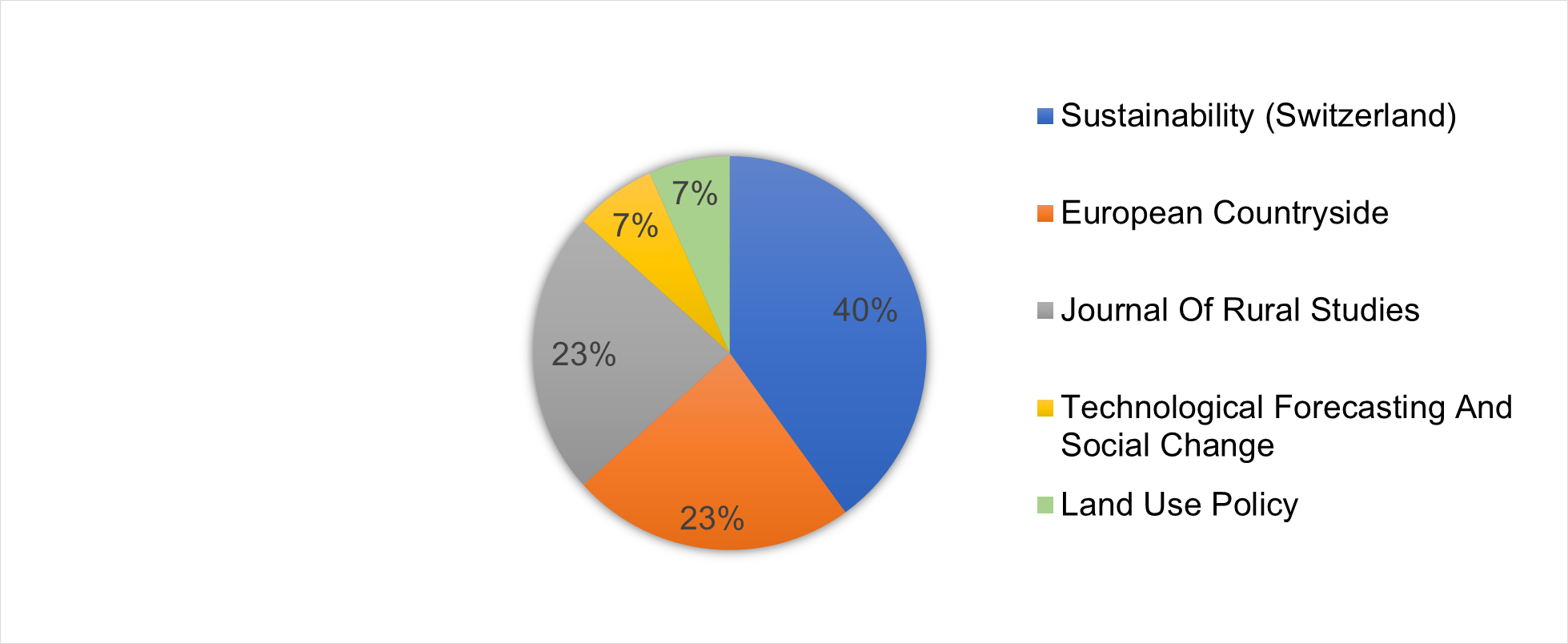
According to the 72 selected documents, Figure 4 presents five prominent journals: Sustainability (Switzerland), European Countryside (Czech Republic), Journal of Rural Studies (United Kingdom), Technological Forecasting and Social Change (United States), and Land Use Policy (Netherlands). Once again, European countries stand out in the frequency and importance of publications on the subject of study, connected to the relevance that it has had for the scientific community’s interest in disseminating the results of their research in the aforementioned journals, classified in Q1 and Q2 according to the SCImago classification.

Content analysis
Social innovation models with focus on agroecological strategies
The agroecological approach delves into local-level solutions. These models are targeted to address technical and ecological aspects in the economic and sociocultural dimensions, while strengthening knowledge and innovation (Pagliarino et al., 2020). As a result, the rural environment is a transformative space to explore SI that links social issues with environmental ones from their root, rather than making insignificant adjustments (Pereira et al., 2018). In this regard, the commitment that the main parties involved must assume in the decision-making process is highlighted in order to propose innovative models within the framework of SD, especially with the connection of significant actors (Biggs, Westley and Carpenter, 2010; Van Zwanenberg et al., 2018).
The design and implementation of Information and Communication Technologies (ICT) represent a compendium of recurring SI models for the transformation and improvement of the human-environment relationship in rural areas. According to (Stillman et al., 2020), the use of ICT in rural spaces is not only subject to infrastructure and technological dissemination, but it must also be rooted in sociocultural factors specific to each of the territories. In this sense, SI can be understood from two perspectives: the development of innovative practices to give solutions to environmental problems (Sept, 2020) and the supply of innovative products or services that enable market participation (Olaniyi and Reidolf, 2015).
Agroecological technology refers to a variety of methods and techniques related to the improvement of agricultural production, quality, and efficiency in order to promote the rural economy and SD (Chen et al., 2019). For example, the adoption of Automatic Milking Systems in Norway is rising significantly because farmers trust the technology, plus they can collaborate with their peers, and it brings job satisfaction by generating significant income (Hansen and Stræte, 2020). On the other hand, (Srbinovska et al., 2015) proposes a Wireless Sensors Network that gives information about influential environmental parameters in the development of agricultural crops; thus, enabling the monitoring of temperature, humidity, and lighting. This is applied data analysis for decision-making, and the application of control mechanisms.
An influential factor in ICT models for SI is the digitization process in rural areas, especially for the exchange of information that must be adapted at the community level in order to obtain the greatest common benefit (Onitsuka, 2019). Therefore, Comprehensive Projects employ software development to find solutions to urgent rural problems and implement digital ecosystems, whereas Individual Projects focus on a specific environmental issue (trade, tourism, local economy, administration), providing solutions through the use of ICT (Sept, 2020). Consequently, technological innovation is acknowledged as a strategy to reduce the ecological footprint, mainly through its integration into SD in emerging economies (Ahmad et al., 2020).
The digital structure is an effective setting for new Business Models with products and services that cater to social needs. These models are premised on the concept that rural areas are suitable for the creation of entrepreneurial projects (Ievoli et al., 2019). From this perspective, rural entrepreneurships make it possible to realize the potential of the rural community to develop innovative initiatives in the production of goods or services. Simultaneously, these initiatives are aimed at enhancing the local and regional markets through the necessary investment and training, all while considering sustainability as a guiding principle.
Malta Orange, grown in the state of Uttarakhand (India), represents a relevant commercial plantation in the region; however, its farmers faced difficulties in selling the fruit. Consequently, (Choudhary, Kunwar and Rasul, 2015) proposed using the Value Chain approach as a tool to identify the functional division of labor and implement marketing. This can be achieved by establishing a community cooperative, which is jointly managed by the local residents and the state government. This resulted in the creation of value through the promotion of a brand. In a similar way, from the territory (Romera, Forero Suárez and Ruiz Hernández, 2017) projected the design of products using local resources and knowledge in the construction market to enhance rural development in Colombia.
In this context, the rural-urban link is crucial for the correct functioning of rural entrepreneurships, with the aim of reducing spatial disparities and creating economic opportunities in rural areas (Mayer, Habersetzer and Meili, 2016; Pato, 2020). An example of this is the proposal of (Katonáné Kovács and Zoltán, 2017), consolidated in the architectural area for the construction of business centers in abandoned rural buildings. A project that opens the way to the transformation of physical spaces and strengthens human capital in the context of SI. It is highlighted that entrepreneurs who actively establish bonds between rural and urban areas are key actors in promoting a sustainable rural economy and connection to national and even global markets; aspects that reduce the center-periphery disparity (Mayer, Habersetzer and Meili, 2016).
The use of ICT and the development of rural entrepreneurship are contemporary alternatives of SI that favor sustainability. Nevertheless, the reliance on limited or scarce technology and infrastructure should not impede SI implementation, as it requires integrative elements related to participation and learning to consolidate the commitment of involved parties to promote meaningful changes (Lee, Díaz-Puente and Vidueira, 2020). In that order of ideas, the Family Farming model fits the demands of SD, considering the multifunctionality it represents in the implementation of alternative paths to utilize their own resources and expand relations with conventional markets, relying on family labor (Galdeano-Gómez et al., 2017; Schneider and Niederle, 2010).
The Solution-Centered Sustainability Assessment focuses on providing sustainable solutions for resolving complex environmental problems, through risk assessment and the projection of proposals from involved parties (Zijp et al., 2016). From this participatory perspective, Social Cooperatives in rural zones offer opportunities for job creation and the development of the local economy in order to improve the quality of life for residents. Furthermore, they impact the conditions of the regional labor market and strengthen the identity of the communities (Tésits and Alpek, 2017). Also, the Agent-Based Model allows for the adoption of schemes for payment for environmental services, incentivizing the cooperative work of farmers in decision-making based on their context and local social interactions (Bell et al., 2016).
From rurality, several complexities are faced, such as abandonment and reduced investment to promote its development. In this regard, Collaborative Initiatives between large-scale agribusiness systems and small to medium-scale farming contribute to overcoming structural barriers that hinder rural development. (Futemma, De Castro and Brondizio, 2020) highlight the progressive transformation of the state program for oil palm in the Brazilian Amazon, which led to diversified production and alignment with the needs of small farmers, along with the consolidation of social relationships that benefit the regional economy.
Similarly, the Tanzanian government has promoted public-private partnerships to improve the value chain of rural markets. (Mgeni, Müller and Sieber, 2018) point out the need for farmers living in isolated rural areas to associate and ensure food security. Innovations with limited resources are driven by narratives of empowerment, social inclusion, and environmental sustainability to create economic and social value with the participation of involved parties that integrate vulnerable rural areas (Pansera and Owen, 2015). In this way, the Consolidation of Rural Lands promotes large-scale agriculture by optimizing the infrastructure that increases income and facilitates the transfer of land exploitation rights, leading to operational scale reductions (Zhang et al., 2020).
On the other hand, the Rural Area Learning Framework contributes to addressing agreements related to learning and innovation. In this sense, this framework allows mapping the actors involved in the development of policies and support programs; it permits the analysis of the learning and innovation domains, and also evaluates and compares the existing agreements between the public entity, knowledge facilitators, and beneficiaries (Wellbrock and Roep, 2015). In sum, the SI models found in the scientific literature emphasize the active participation of involved parties and provide agroecological strategies that enhance the local and regional economy of rural areas. Therefore, it is important to continue building innovative initiatives that enable the implementation of precise actions in line with deconstructing imaginaries of an impoverished and distant rurality.
The role of government entities and the rural community
According to McCarthy et al. (2014), SI is a developing conceptual framework, but the challenge of understanding changes and social transformations is embedded in a historical discussion. In this regard, the socioecological perspective offers glimpses of the complexity of ecological relationships that integrate human well-being, economic aspects, governance, and territorial policies (García-Llorente et al., 2019). From there, the opportunity arises to build and integrate social networks within the framework of agricultural innovation, as agriculture is conditioned by both natural and social parameters (Aase, Chapagain and Tiwari, 2013; Pagliarino et al., 2020).
The analysis of social networks in SI helps to understand the structures that influence agroecological systems and the relationships built among the different actors involved (Kratzer and Ammering, 2019). In this way, these analyses are consolidated as a useful tool for disseminating knowledge, innovation in various economic sectors, and analyzing agricultural systems (Filippini et al., 2020). Consequently, the scope of eco-innovative projects will depend on traditional mechanisms of the market and the personal networks of the individuals involved (Galliano, Gonçalves and Triboulet, 2019). In this regard, Minas, Mander and McLachlan (2020) found that membership in agricultural associations has facilitated farmers in obtaining support, accessing government resources, and organizing collaborative alliances that can promote SI.
Academics of the reviewed scientific literature emphasize that the action of national, regional, and local governments is essential to make visible significant changes in SI models applied in rural zones to promote SD within the territories. Therefore, even though various innovation models with methodologies, approaches, and theoretical-conceptual findings have been developed in the last decade, which are significant for the scientific community, all researchers agree with the economic, political and social decisions that are influenced by the governance, and that are determinant for building agroecological strategies that transform the rural environment. Within this framework, two vital roles of governmental entities stand out:
-
Promoters: at the global level, SD has been promoted for the conservation and sustainability of rural ecosystems. As a result, the EU proposes the concept of Smart Specialization as an innovation policy focused on regional growth that contributes to building local capacities and investment (Olaniyi and Reidolf, 2015). On the other hand, the Consorcio para el Desarrollo Sostenible de la Ecorregión Andina (CONDESAN) proposed a plan of strategies to improve decision-making regarding the management of resources at the local and regional level linked to the Andean tropics, in order to sustain biodiversity, Andean watersheds and rural livelihoods (Saravia, 2011).
In accordance with the above, it is important to point out that, despite actions taken by governance, access to institutional support for technological investment and infrastructure must be facilitated, since it is difficult for farmers to implement SI models in their territories without financial support (Esparcia, 2014). The above happened in India, where the government made use of technologies for the protection of natural resources in the Himalayan Mountain range (one of the most fragile and complex ecosystems in the world) by ICT learning with indigenous practices and knowledge over a period of 8 years. However, participants could not implement these technologies on their farms due to lack of resources (Maikhuri et al., 2011).
Meanwhile, public policies are directly related to SI within the framework of SD in rural ecosystems, especially for the creation and adoption of alternative forms of agriculture, social economy, and cognitive practices. In that way, public policies make it possible to get SI and transform existing initiatives (Gordon, Becerra and Fressoli, 2017). Indeed, promoting rural development entails a multitude of challenges related to the design of strategies, the implementation of control actions, and the participation of a significant number of actors with different interests. Therefore, governance must assume the challenge of coordinating local initiatives and avoiding the imposition of projects that limit development (Vázquez-Barquero and Rodríguez-Cohard, 2016).
In China, the main objective of agricultural policy is to consolidate agriculture as the basis of the national economy through innovative initiatives and increased commercialization in specific markets (Jianxing and Xiang, 2010). In this scenario, rural economic growth is linked to the adoption of new technologies that facilitate the process, together with labor mobility in all regions and allocation of resources to research and development (Wu, Zhuo and Wu, 2017). Chen and Zhang (2019) highlights that Chinese local governments tend to be interpreters, implementers, and coordinators of state policies, adapting them to local conditions in order to rebuild the agricultural sector and rurality. Thus, the practices of the Asian country can be a referent in the role of governance to promote rural SD.
According to Oliveira et al. (2019), the design of SI policies will reach an optimal level by understanding the complexity of learning and the adaptation of communities in innovation processes. Therefore, interested parties must be committed to the territories when incentivizing public-private partnerships, along with the necessary social and human capital (Jeziorny, 2016; Navarro et al., 2018). In this regard, Živojinović, Ludvig and Hogl (2019) identified four institutional gaps when implementing SI models in Serbia: lack of regulatory frameworks or strategies on SI and entrepreneurship, reduced supply of relevant information about SI, insufficient cooperation between state organizations leading to sectoral fragmentation of government, and manipulative use of power by public administration.
-
Facilitators: as part of governance, it is necessary to get to know rural communities and make them visible, acknowledge their rights to access natural resources, facilitate their participation in decision-making and provide possibilities to implement innovations in their territories (Melnykovych et al., 2018). Also, Mahbob et al. (2015) highlights that the acceptance of rural inhabitants to the SI programs proposed by the government is consistent with the improvement of life quality and with the values, norms, experiences and needs of the communities. Consequently, the unwillingness of farmers to engage or invest in rural entrepreneurial activities is a consequence of their negative experiences with unfulfilled and unmet policy measures (Macken-Walsh, 2011).
In view of the above, it is important to engage in dialogue with rural communities to learn about their expectations and opinions on the implementation of the SI in their territories. One alternative consists of rural regional learning, which interconnects support policies, development initiatives, and facilitators of learning and innovation (Cisilino and Monteleone, 2020; Wellbrock, Roep and Wiskerke, 2012). In this way, education seeks to meet the needs of the local community, delving into a transformative phase that involves participation and expands leadership capacity (Rawat, Bouchon and Nair, 2015). In this context, universities can aid in co-creating SI models that contribute to entrepreneurship, research in agroecological processes, and dissemination of tools that facilitate decision-making (Rinaldi and Cavicchi, 2016).
Regarding rural communities, scholars are emphatic in encouraging participation and strengthening leadership capacity in the planning, implementation, and following up of SI models applied to the territories. To achieve this, it is important to value traditional ecological knowledge by considering the experiences and learning processes of the inhabitants in the development of their agricultural activities and giving them a place in the research of adaptable techniques for the generation of good practices (Pagliarino et al., 2020). This alternative expands to collectively influencing the dissemination of innovative and sustainable solutions (Grewer and Keck, 2019). In this way, two fundamental roles of communities are deepened:
-
Participatory role: social networks of agricultural innovation in rural areas are essential to foster participation of farmers in SI systems, since community involvement will determine the quality of innovation programs or projects to enhance the local economy (Macken-Walsh, 2011; Prasetyanti and Susilatun, 2020). In addition, Pagliarino et al. (2020) emphasizes the importance of involving the rural community in research processes to identify SI models and the creation of networks, since the practices, ideas and scope of the strategies implemented that contribute to local development are shared with other farmers and involved parties. It is significant to note that SI in the rural context must re-appropriate marginalized, ignored, or lost traditions in agriculture. This helps establish a direct and permanent connection with the cultural heritage that is part of the identity of communities (Cannarella and Piccioni, 2011).
The triple helix model within the context of the SI represents a partnership between the government, universities, and industries aimed at promoting innovative projects. In this way, Nordberg, Mariussen and Virkkala (2020) analyzes the fourth helix formed by civil society, identified as the rural community that displays a sense of local identity and finds in shared experiences the possibility of creating SI networks. In this regard, the new rurality constitutes the re-appropriation of ancestral farming knowledge based on productive techniques (Orria and Luise, 2017), by linking civil society actors and the local public sector in collaborative development (Jungsberg et al., 2020); especially in rural areas affected by progressive depopulation which jeopardizes sustainability and exacerbates the marginalization of rural communities (Lombardi et al., 2020).
-
Leadership role: although the relationship between members of local communities is essential to promote collaborative initiatives in SI for rural development (Minas, Mander and McLachlan, 2020), transformational leadership will be definitive to make visible representative changes in agricultural practices and to analyze the interwoven dynamics in the leader-follower relationship within the territories (McCarthy et al., 2014).
This framework specifies three components: (i) the capacity to adapt to change, which positively influences peers in decision-making (Aase, Chapagain and Tiwari, 2013); (ii) resilience as a dynamic of learning and rebalancing to support agricultural conditions and livelihoods from the family, community and regional spheres (Knickel et al., 2018); and (iii) self-efficacy, which is related to the behavioral intention to accept change (Mahbob et al., 2015). All three components imply the conformation of new livelihoods with innovative agricultural practices. For example, rural women who diversify the local economy through sustainable entrepreneurships (Ní Fhlatharta and Farrell, 2017; Pallarès-Blanch, Vera Martín and Tulla, 2018).
Discussion
The SI is considered a starting point to enhance SD in rural areas that are mostly identified as marginalized zones with weaknesses in agricultural processes that nullify the economic and social development of the regions. In this regard, academics underline positive aspects of the SI models implemented in rural environments. Thus, Govigli et al. (2020) emphasizes that the SI provides models to address social or community problems, complementing the actions of the State and/or private actors. In this way, it is possible to state that SI can reconstruct the local economy and quality of life (Nijnik et al., 2019). However, the changes achieved will depend on participatory processes involving stakeholders and government policies that affect the adoption and incidence of innovations (Neumeier, 2017; Oliveira et al., 2019).
Consequently, the proposal of Cannarella and Piccioni (2011), identified as Traditiovations (tradition-innovation), implements innovative practices and techniques derived from traditional knowledge supported by science and research, despite the apparent obsolescence of traditional thinking. Therefore, the rural community could feel identified when suggesting ideas based on their ancestral knowledge and strengthen their capacity to participate. Yin, Chen and Li (2019) proposes the Rural Innovation System, whose function is to create an ecosystem in which participants build new technical, administrative, and institutional knowledge, with the purpose of disseminating and applying new technologies and business models that promote the flow of resources and relationships with the urban environment. This proposal is an interesting driver for governance because it allows for management and implementation of plans that dimension the SI as a promoter of the revitalization of the rural environment.
From the content analysis and the findings of the scientific literature, it was found that in a significant body of publications three influential factors predominated in the SI models which, in turn, represent the roles exercised from governance and rural communities at the global level: social networks (Esparcia, 2014; Filippini et al., 2020; Kratzer and Ammering, 2019; Lombardi et al., 2020), neo-endogenous development (Jungsberg et al., 2020; Nijnik et al., 2019; Onitsuka, 2019) and the LEADER initiative (Bosworth et al., 2016; Knickel et al., 2018; Macken-Walsh, 2011; Wellbrock, Roep and Wiskerke, 2012).
SI in the agricultural sector is interrelated with new models of thinking, development of technological, socioeconomic, and sustainable tools (Oliveira et al., 2019). Therefore, in order to achieve a significant reach, networks are established, and alliances are created to increase the trust and participation of the inhabitants (Navarro et al., 2018). Otherwise, the SI will be limited to the technological and economic emphasis, losing sight of the SD and quality of life within the territories (Novikova, De Fátima Ferreiro and Stryjakiewicz, 2020). Consequently, the extension of networks will open up continuous communication and permanent participation in the exchange of knowledge (Filippini et al., 2020).
Neo-endogenous development “requires a delicate balance between local initiative and local resources on the one hand, and the right contributions of capital, experience and sources of innovation on the other” (Jungsberg et al., 2020, p. 279). In this regard, the consistency between the role of governmental entities and rural communities is related, since endogenous rural development emphasizes that the objective of local governments is to enable resources and the participation of all interested parties (Lipták, 2019). In this way, the SI bases its actions on approaches aimed at providing cohesion and development to rural communities (Bosworth et al., 2016); in addition to the promotion of scientific and traditional knowledge related to innovation models (Nijnik et al., 2019).
On the other hand, the EU program known as LEADER (Liaison Entre Actions de Développement de l’Économie Rurale, for its French acronym) was referenced in most of the European countries’ studies. This constitutes a method of local development implemented for the last 20 years to engage local actors in the design and execution of strategies, decision-making and resource allocation for the development of their rural areas (European Network for Rural Development, 2020). Even though it is not an SI model of its own, scholars highlight weaknesses and strengths, focusing on the creation of public-private alliances, consolidation of social capital with Local Action Groups (Bosworth et al., 2016; Navarro et al., 2018), the introduction of new ideas and methods from the exchange of experiences and knowledge (Knickel et al., 2018), aspects that can be references for the construction of alternative SI models in rural contexts.
Conclusions
Findings from the literature review provided answers to the research objectives, leading to an enriching content analysis for the identification of SI models applied in rural areas to promote SD as a way of adapting to new agricultural practices, as well as the interpretation of the role played by governmental entities and the rural community in the planning and implementation of SI initiatives that promote sustainable alternatives. As a result, from the studies collected from the period 2010-2020, it was possible to delve deeper into the state of SI in the last decade in terms of its application in the rural context and its prevalence in SD for the transformation of the territories.
It is worth mentioning that the bibliometric results made it possible to visualize the evolution of the subject matter of analysis and that they were congruent with the incidence of European and Asian countries in the promotion and interpretation of the SI as an emerging field of study in relation to SD from rurality. In turn, the findings are preponderant when delving into similar studies, in terms of trends in publication sources and prominent authors in collaborative work. It is proposed to employ these resources in future investigations related to the presented research objectives, especially regarding governance to ensure structural transformations of SI in rural contexts to achieve SD.
A significant variety of SI models was found within the framework of rural SD. It emphasizes the influence of ICT implementation in innovative initiatives. However, other models with an agricultural-ecological approach were opened up, involving enterprises related to the rural-urban relationship, family agriculture, changes in the behavior toward constructing new sustainable practices, and the incidence of community decisions in the transformation of spaces with limited resources. It is also suggested to explore the innovative field of living labs, which emphasizes ideas and human needs from a participative perspective involving a diversity of actors (García-Llorente et al., 2019).
Concurrently, it was possible to identify the main roles of government leaders and rural communities when applying SI initiatives. Most of the academics were emphatic about the scope that each of the actors involved in SI processes should have, regardless of the objectives or results of the studies. In this way, it was possible to demonstrate that there are concrete actions for the scientific community that must be restructured by the governance, and that there are others that must be strengthened in the interaction with rural communities for the transformation of their context. As a consequence, it is recommended to deepen the scope of social agriculture as a means of strengthening institutional support (Choudhary, Kunwar and Rasul, 2015), and it is a starting point to consolidate public policies from innovative governance, with the conservation of agroecosystems and changes in quality of life in rural communities (Galliano, Gonçalves and Triboulet, 2019; García-Llorente et al., 2019; Melnykovych et al., 2018).
Bibliografia
- AASE, T. H.; CHAPAGAIN, P. S.; TIWARI, P. C. Innovation as an expression of adaptive capacity to change in himalayan farming. Mt. Res. Dev., v. 33, n. 1, p. 4–10, 2013.
- AHMAD, M. et al. The dynamic impact of natural resources, technological innovations and economic growth on ecological footprint: An advanced panel data estimation. Resour. Policy, v. 69, 2020.
- BAPTISTA, N. et al. Exploring the meaning of social innovation: A categorisation scheme based on the level of policy intervention, profit orientation and geographical scale. Innovation, v. 21, n. 3, p. 379–397, 2019.
- BELL, A. et al. Scaling up pro-environmental agricultural practice using agglomeration payments: Proof of concept from an agent-based model. Ecol. Econ., v. 126, p. 32–41, 2016.
- BERNAL, M. E. La innovación social como factor de inclusión social en latinoamérica. In: PAZ, A.; MONTOYA, M. P.; ASENCIO, R. H. (Eds.). Escalando innovaciones rurales Lima: IEP Ediciones, 2017. p. 17–36.
- BIGGS, R.; WESTLEY, F.; CARPENTER, S. Navigating the back loop: Fostering social innovation and transformation in ecosystem management. Ecol. Soc., v. 15, 2010.
- BOSWORTH, G. et al. Identifying social innovations in european local rural development initiatives. Innovation, v. 29, n. 4, p. 440–459, 2016.
- CANNARELLA, C.; PICCIONI, V. Traditiovations: Creating innovation from the past and antique techniques for rural areas. Technovation, v. 31, n. 12, p. 689–699, 2011.
- CHEN, C. et al. Globalization, state intervention, local action and rural locality reconstitution - a case study from rural china. Habitat Int., v. 93, 2019.
- CHEN, H.; ZHANG, X. Study on the path of agricultural ecological construction improving agricultural production efficiency. Ekoloji, v. 28, n. 107, p. 1737–1744, 2019.
- CHOUDHARY, D.; KUNWAR, M. S.; RASUL, G. From farmers to entrepreneurs-strengthening malta orange value chains through institutional development in uttarakhand, india. Mt. Res. Dev., v. 35, n. 1, p. 4–15, 2015.
- CISILINO, F.; MONTELEONE, A. Designing rural policies for sustainable innovations through a participatory approach. Sustain. (Switz.), v. 12, n. 21, p. 1–17, 2020.
- DOMÍNGUEZ, R. et al. Recursos naturales, medio ambiente y sostenibilidad: 70 años de pensamiento de la CEPAL [s.l.] CEPAL, 2019.
- EICHLER, G. M.; SCHWARZ, E. J. What sustainable development goals do social innovations address? A systematic review and content analysis of social innovation literature. Sustain. (Switz.), v. 11, n. 2, 2019.
- ESPARCIA, J. Innovation and networks in rural areas. An analysis from european innovative projects. Rural Stud., v. 34, p. 1–14, 2014.
- FILIPPINI, R. et al. Social networks as drivers for technology adoption: A study from a rural mountain area in italy. Sustain. (Switz.), v. 12, n. 22, p. 1–18, 2020.
- FUTEMMA, C.; DE CASTRO, F.; BRONDIZIO, E. S. Farmers and social innovations in rural development: Collaborative arrangements in eastern brazilian amazon. Land Use Policy, v. 99, 2020.
- GALDEANO-GÓMEZ, E. et al. Family farm’s features influencing socio-economic sustainability: An analysis of the agri-food sector in southeast spain. New Medit., v. 16, n. 1, p. 50–61, 2017.
- GALLIANO, D.; GONÇALVES, A.; TRIBOULET, P. The peripheral systems of eco-innovation: Evidence from eco-innovative agro-food projects in a french rural area. J. Rural Stud., v. 72, p. 273–285, 2019.
- GARCÍA-LLORENTE, M. et al. Agroecological strategies for reactivating the agrarian sector: The case of agrolab in madrid. Sustain. (Switz.), v. 11, n. 4, 2019.
- GORDON, A.; BECERRA, L. D.; FRESSOLI, M. Potentialities and constraints in the relation between social innovation and public policies: Some lessons from south america. Ecol. Soc., v. 22, n. 4, 2017.
- GOVIGLI, V. M. et al. Testing a framework to co-construct social innovation actions: Insights from seven marginalized rural areas. Sustain. (Switz.), v. 12, n. 4, p. 1–26, 2020.
- GREWER, J.; KECK, M. How one rural community in transition overcame its island status: The case of heckenbeck, germany. Sustain. (Switz.), v. 11, n. 3, 2019.
- GUDYNAS, E. Ambiente, sustentabilidad y desarrollo: Una revisión de los encuentros y desencuentros. In: REYES, J.; CASTRO, E. (Eds.). Contornos educativos de la sustentabilidad Guadalajara, México: Universidad de Guadalajara, 2011.
- ___. Conflictos y extractivismos: Conceptos, contenidos y dinámicas. Decursos, Rev. en Cienc. Soc., p. 79–115, 2014.
- HANSEN, B. G.; STRÆTE, E. P. Dairy farmers’ job satisfaction and the influence of automatic milking systems. NJAS - Wageningen. J. Life Sci., v. 92, 2020.
- HENDERSON, F. et al. Challenges of community engagement in a rural area: The impact of flood protection and policy. J. Rural Stud., v. 73, p. 225–233, 2020.
- IEVOLI, C. et al. Information and communication infrastructures and new business models in rural areas: The case of molise region in italy. Eur. Countrys., v. 11, n. 4, p. 475–496, 2019.
- JEZIORNY, D. L. Territory, innovation and rural development: The case of “vale dos vinhedos” in the brazilian region of rio grande do sul. Rev. Int. Sociol., v. 74, n. 3, 2016.
- JIANXING, Y.; XIANG, G. The relationship between government on one side and the market and society on the other in china’s agricultural and rural development: An analytical framework. Soc. Sci. China, v. 31, n. 3, p. 27–49, 2010.
- JUNGSBERG, L. et al. Key actors in community-driven social innovation in rural areas in the nordic countries. J. Rural Stud., v. 79, p. 276–285, 2020.
- KATONÁNÉ KOVÁCS, J.; ZOLTÁN, E. S. Rural enterprise hub supporting rural entrepreneurship and innovation-case studies from hungary. Eur. Countrys., v. 9, n. 3, p. 473–485, 2017.
- KNICKEL, K. et al. Between aspirations and reality: Making farming, food systems and rural areas more resilient, sustainable and equitable. J. Rural Stud., v. 59, p. 197–210, 2018.
- KRATZER, A.; AMMERING, U. Rural innovations in biosphere reserves – a social network approach. J. Rural Stud., v. 71, p. 144–155, 2019.
- LAWRENCE-BOURNE, J. et al. What is rural adversity, how does it affect wellbeing and what are the implications for action? Int. J. Environ. Res. Public. Health, v. 17, n. 19, p. 1–13, 2020.
- LEE, S. Y.; DÍAZ-PUENTE, J. M.; VIDUEIRA, P. Enhancing rural innovation and sustainability through impact assessment: A review of methods and tools. Sustain. (Switz.), v. 12, n. 16, 2020.
- LIPTÁK, K. The importance of social innovations in rural areas. Deturope, v. 11, n. 3, p. 160–174, 2019.
- LOMBARDI, M. et al. Network impact of social innovation initiatives in marginalised rural communities. Soc. Netw., v. 63, p. 11–20, 2020.
- MACGREGOR-FORS, I.; VÁZQUEZ, L.-B. Revisiting “rural.” Sci. Total Environ., v. 741, p. 132789, 2020.
- MACKEN-WALSH, Á. Partnership and subsidiarity? A case-study of farmers’ participation in contemporary EU governance and rural development initiatives. Rural Soc., v. 21, n. 1, p. 43–53, 2011.
- MAHBOB, M. H. et al. The acceptance of government transformation program (GTP) among urban and rural communities. J. Asian Pac. Commun., v. 25, n. 2, p. 253–266, 2015.
- MAIKHURI, R. K. et al. Managing natural resources through simple and appropriate technological interventions for sustainable mountain development. Curr. Sci., v. 100, n. 7, p. 992–997, 2011.
- MARTÍNEZ DE ANGUITA, P. Desarrollo rural sostenible Madrid: McGraw-Hill, 2006.
- MAYER, H.; HABERSETZER, A.; MEILI, R. Rural-urban linkages and sustainable regional development: The role of entrepreneurs in linking peripheries and centers. Sustain. (Switz.), v. 8, n. 8, 2016.
- MCCARTHY, D. D. P. et al. The oak ridges moraine as a social innovation: Strategic vision as a social-ecological interaction. Ecol. Soc., v. 19, n. 1, 2014.
- MELNYKOVYCH, M. et al. Social-ecological innovation in remote mountain areas: Adaptive responses of forest-dependent communities to the challenges of a changing world. Sci. Total Environ., v. 613–614, p. 894–906, 2018.
- MGENI, C. P.; MÜLLER, K.; SIEBER, S. Sunflower value chain enhancements for the rural economy in tanzania: A village computable general equilibrium-CGE approach. Sustain. (Switz.), v. 11, n. 1, 2018.
- MINAS, A. M.; MANDER, S.; MCLACHLAN, C. How can we engage farmers in bioenergy development? Building a social innovation strategy for rice straw bioenergy in the philippines and vietnam. Energy Res. Soc. Sci., v. 70, 2020.
- MOHAMED, R.; GHAZALI, M.; SAMSUDIN, M. A systematic review on mathematical language learning using PRISMA in scopus database. Eurasia J. Math. Sci. Technol. Educ., v. 16, p. em1868, 2020.
- MUÑOZ, J. F. Las transferencias del desarrollo sostenible a las dimensiones ontológicas, axiológicas, epistemológicas y praxeológicas de las organizaciones empresariales. In: SERNA, C. (Ed.). Tecnologías, inclusión y desarrollo: Reflexiones hacia la ruralidad de bogotá México DF: Ediciones de la U, 2016. p. 169–183.
- NAVARRO, F. et al. Interpretations of innovation in rural development. The cases of leader projects in lecce (italy) and granada (spain) in 2007-2013 period. Eur. Countrys., v. 10, n. 1, p. 107–126, 2018.
- NEUMEIER, S. Social innovation in rural development: Identifying the key factors of success. Geogr. J., v. 183, n. 1, p. 34–46, 2017.
- NIJNIK, M. et al. Can social innovation make a difference to forest-dependent communities? For. Policy Econ., v. 100, p. 207–213, 2019.
- NORDBERG, K.; MARIUSSEN, Å.; VIRKKALA, S. Community-driven social innovation and quadruple helix coordination in rural development. Case study on LEADER group aktion österbotten. J. Rural Stud., v. 79, p. 157–168, 2020.
- NOVIKOVA, M.; DE FÁTIMA FERREIRO, M.; STRYJAKIEWICZ, T. Local development initiatives as promoters of social innovation: Evidence from two european rural regions. Quaest. Geogr., v. 39, n. 2, p. 43–53, 2020.
- NÍ FHLATHARTA, A. M.; FARRELL, M. Unravelling the strands of “patriarchy” in rural innovation: A study of female innovators and their contribution to rural connemara. J. Rural Stud., v. 54, p. 15–27, 2017.
- OLANIYI, E. O.; REIDOLF, M. Organisational innovation strategies in the context of smart specialization. J. Secur. Sustain. Issues, v. 5, n. 2, p. 213–227, 2015.
- OLIVEIRA, M. F. et al. Innovations in sustainable agriculture: Case study of lis valley irrigation district, portugal. Sustain. (Switz.), v. 11, n. 2, 2019.
- ONITSUKA, K. How social media can foster social innovation in disadvantaged rural communities. Sustain. (Switz.), v. 11, n. 9, 2019.
- ORRIA, B.; LUISE, V. Innovation in rural development: “Neo-rural” farmers branding local quality of food and territory. Ital. J. Plan. Pract., v. 7, n. 1, p. 125–153, 2017.
- PAGLIARINO, E. et al. Participatory research for sustainable agriculture: The case of the italian agroecological rice network. Eur. J. Futur. Res., v. 8, n. 1, 2020.
- PALLARÈS-BLANCH, M.; VERA MARTÍN, A.; TULLA, A. F. Entrepreneurship and innovation of women: Towards greater sustainability in rural mountain areas. Cuad. Geogr., v. 57, p. 56–57, 2018.
- PANSERA, M.; OWEN, R. Framing resource-constrained innovation at the “bottom of the pyramid”: Insights from an ethnographic case study in rural bangladesh. Technol. Forecast. Soc. Change, v. 92, p. 300–311, 2015.
- PATO, L. Entrepreneurship and innovation towards rural development evidence from a peripheral area in portugal. European Countryside, v. 12, n. 2, p. 209–220, 2020.
- PEREIRA, L. M. et al. Designing transformative spaces for sustainability in social-ecological systems. Ecol. Soc., v. 23, n. 4, 2018.
- PEREIRA-GARCÍA, A. Miradas sobre tecnologías, inclusión y desarrollo. In: PEREIRA-GARCÍA, A.; ÁLVAREZ, N. H. (Eds.). Tecnologías, inclusión y desarrollo: Reflexiones hacia la ruralidad de bogotá Bogotá: Corporación Universitaria Minuto de Dios, 2020. p. 13–34.
- PRASETYANTI, R.; SUSILATUN, H. R. Innovating rural: A comparative analysis of community-driven rural innovation in north sumatera and yogyakarta, indonesia. Int. J. Innov. Creat. Change, v. 11, n. 2, p. 306–324, 2020.
- PÉREZ, E. Hacia una nueva visión de lo rural. In: GIARRACA, N. (Ed.). ¿Una nueva ruralidad en américa latina? Buenos Aires: CLACSO, 2018.
- RAWAT, K.; BOUCHON, F.; NAIR, V. Innovative practices in education to empower rural communities: A case study of a “non-formal education” school in thailand. Worldw. Hosp. Tour. Themes, v. 7, n. 5, p. 516–529, 2015.
- EUROPEAN NETWORK FOR RURAL DEVELOPMENT. LEADER Disponível em: https://enrd.ec.europa.eu/leader-clld_en Acesso em: 4 set. 2023. [s.l.] European Network for Rural Development, 2020.
- PRISMA. PRISMA Disponível em: http://www.prisma-statement.org/ Acesso em: 8 aug. 2023. [s.l.] PRISMA, 2015.
- REY DE MARULANDA, N.; TANCREDI, F. B. De la innovación social a la política pública. Historias de éxito en américa latina y el caribe [s.l.] CEPAL, 2010.
- RINALDI, C.; CAVICCHI, A. Universities’ emerging roles to co-create sustainable innovation paths: Some evidences from the marche region. Aestimum, v. 69, p. 211–224, 2016.
- ROA-GARCÍA, M. C. Environmental democratization and water justice in extractive frontiers of colombia. Geoforum, v. 85, p. 58–71, 2017.
- ROMERA, C. J.; FORERO SUÁREZ, F. E.; RUIZ HERNÁNDEZ, J. A. Technology and design for rural development: A methodological proposal and a pilot experience in two colombian municipalities. Ager, v. 2017, n. 23, p. 27–57, 2017.
- ROMERO-RODRÍGUEZ, J.-M. et al. Social appropriation of knowledge as a key factor for local development and open innovation: A systematic review. J. Open Innov. Technol. Mark. Complex, v. 6, n. 2, 2020.
- SARAVIA, M. CONDESAN: Two decades of innovation for the sustainable development of the andean ecoregion. Mt. Res. Dev., v. 31, n. 4, p. 363–366, 2011.
- SCHNEIDER, S.; NIEDERLE, P. A. Resistance strategies and diversification of rural livelihoods: The construction of autonomy among brazilian family farmers. J. Peasant Stud., v. 37, n. 2, p. 379–405, 2010.
- SEDDIGHI, H. et al. Child abuse in natural disasters and conflicts: A systematic review. Trauma Violence Abuse, v. 22, n. 1, p. 176–185, 2021.
- SEPT, A. Thinking together digitalization and social innovation in rural areas: An exploration of rural digitalization projects in germany. Eur. Countrys., v. 12, n. 2, p. 193–208, 2020.
- SRBINOVSKA, M. et al. Environmental parameters monitoring in precision agriculture using wireless sensor networks. J. Clean. Prod., v. 88, p. 297–307, 2015.
- STILLMAN, L. et al. Sociotechnical transformative effects of an ICT project in rural bangladesh. Am. Behav. Sci., v. 64, n. 13, p. 1871–1888, 2020.
- SVAMPA, M. Neo-extractivism in latin america: Socio-environmental conflicts, the territorial turn, and new political narratives Cambridge: Cambridge University Press, 2019.
- SÁNCHEZ, A. Sociología rural emergente en américa latina. In: APARICIO, S. ET AL. (Ed.). Desarrollo rural y cuestión agraria Buenos Aires: CLACSO, 2019. p. 17–38.
- TORGERSON, C. Systematic reviews Bodmin: Continuum, 2003.
- TUCKER, S. Social innovation for public service excellence [s.l.] UNDP Global Centre for Public Service Excellence, 2014.
- TÉSITS, R.; ALPEK, L. Social innovations for the disadvantaged rural regions: Hungarian experiences of the new type social cooperatives. East. Europ. Countryside, v. 23, p. 27–49, 2017.
- VAN ZWANENBERG, P. et al. Seeking unconventional alliances and bridging innovations in spaces for transformative change: The seed sector and agricultural sustainability in argentina. Ecol. Soc., v. 23, n. 3, 2018.
- VELÁSQUEZ, J. Una guía corta para escribir revisiones sistemáticas de literatura parte 4. Dyna, v. 82, p. 9–12, 2015.
- VÁZQUEZ-BARQUERO, A.; RODRÍGUEZ-COHARD, J. C. Endogenous development and institutions: Challenges for local development initiatives. Environ. Plan. C Gov. Policy, v. 34, n. 6, p. 1135–1153, 2016.
- WELLBROCK, W.; ROEP, D.; WISKERKE, J. S. C. An integrated perspective on rural regional learning. Eur. Countrys., v. 4, n. 1, p. 1–16, 2012.
- WELLBROCK, W.; ROEP, D. The learning rural area framework: A heuristic tool to investigate institutional arrangements which support collaboration in rural areas. Sociologia Ruralis, v. 55, n. 1, p. 106–124, 2015.
- WITTMAYER, J. M. et al. Narratives of change: How social innovation initiatives construct societal transformation. Futures, v. 112, p. 102433, 2019.
- WU, J.; ZHUO, S.; WU, Z. National innovation system, social entrepreneurship, and rural economic growth in china. Technol. Forecast. Soc. Change, v. 121, p. 238–250, 2017.
- YIN, X.; CHEN, J.; LI, J. Rural innovation system: Revitalize the countryside for a sustainable development. J. Rural Stud., 2019.
- ZHANG, D. et al. The effect on poverty alleviation and income increase of rural land consolidation in different models: A china study. Land Use Policy, v. 99, 2020.
- ZHU, J.; LIU, W. A tale of two databases: The use of web of science and scopus in academic papers. Scientometrics, v. 123, n. 1, p. 321–335, 2020.
- ZIJP, M. C. et al. Definition and use of solution-focused sustainability assessment: A novel approach to generate, explore and decide on sustainable solutions for wicked problems. Environ. Int., v. 91, p. 319–331, 2016.
- ŽIVOJINOVIĆ, I.; LUDVIG, A.; HOGL, K. Social innovation to sustain rural communities: Overcoming institutional challenges in serbia. Sustain. (Switz.), v. 11, n. 24, 2019.
-
Editoria:
Eduardo Dimitrov
The research data are available in the body of the document.