 The hijacking of politics: Impacts of parliamentary amendments for democracy, federalism, and public health in Brazil
ABSTRACT
This study examines the implications of the growing centrality of parliamentary amendments (PAs) in Brazil’s public budget, with emphasis on their repercussions on the political system, the federal arrangement, and health policies. Drawing on a literature review and documentary analysis, the research traces the trajectory of PAs, from their original function of strengthening the legislative branch to their consolidation as instruments of political bargaining and power redistribution. It argues that the expansion of PAs has triggered an institutional shift from the executive to the legislative branch, deepening distortions in budgetary governance, in the balance of powers, and in intergovernmental dynamics. Judicialization of conflicts, the fragmentation of planning, and the weakening of the executive’s coordinating capacity emerge as consequences of this process. In the health sector, the mandatory execution of PAs and their distributive logic, detached from technical criteria, have compromised equitable funding and the sustainability of the Brazilian Unified Health System (SUS). The article concludes that the current model of budget allocation, based on mandatory and opaque implementation procedures, undermines the state’s capacity to formulate public policies, already weakened by fiscal austerity measures, exacerbates regional inequalities, fosters clientelism, and threatens the democratic foundations underlying budgetary policy.
KEYWORDS
Parliamentary amendments; Legislative; Fiscal budget; Federalism; Public policy; Health care rationing.
RESUMO
Este artigo analisa as implicações da crescente centralidade das Emendas Parlamentares (EP) no orçamento público brasileiro, com ênfase em suas repercussões sobre o sistema político, o pacto federativo e as políticas de saúde. Por meio de levantamento bibliográfico e análise documental, o texto apresenta a trajetória das EP, desde sua função original de fortalecimento do Legislativo até sua consolidação como instrumento de barganha e redistribuição de poder. Argumenta-se que a ascensão das EP provocou um deslocamento institucional do Executivo para o Legislativo, aprofundando distorções na governança orçamentária, na relação entre os Poderes e nas dinâmicas intergovernamentais. A judicialização dos conflitos, a fragmentação do planejamento e o enfraquecimento do papel coordenador do Executivo emergem como consequências desse processo. No campo da saúde, a obrigatoriedade de execução das EP e sua lógica distributiva, desconectada de critérios técnicos, têm comprometido o financiamento equitativo e a sustentabilidade do Sistema Único de Saúde. O artigo conclui que o modelo atual de alocação orçamentária, baseado em emendas impositivas e de execução opaca, enfraquece a capacidade estatal de indução de políticas públicas, já debilitada pelas medidas de ajuste fiscal, aprofunda desigualdades regionais, fomenta o clientelismo e ameaça os princípios democráticos da política orçamentária.
PALAVRAS-CHAVE
Emendas parlamentares; Orçamento fiscal; Federalismo; Política pública; Alocação de recursos para a atenção à; saúde.
Introduction
Parliamentary amendments (PAs) are proposals submitted by members of Congress to allocate public budget funds to areas of their choice - such as health care and infrastructure - usually in their electoral constituencies. They are equivalent to Community Project Funding in the United States. They have gained prominence in political debate and academic research due to the growing volume of discretionary financial resources allocated to them. This development has reshaped intergovernmental relations, intensified tensions among the executive, legislative, and judiciary branches, and produced significant effects on public policies, particularly in the health sector. Originally, PAs were conceived as a mechanism to deepen democracy by enabling the legislature to counterbalance the executive’s dominance in budgetary decision-making1. Over time, they became a central bargaining instrument in coalition formation within a presidential system characterized by broad party fragmentation and proportional representation in the legislature. However, as the role and scope of PAs have expanded, especially regarding the legislature’s authority over budgetary implementation, Brazil has come to diverge in important ways from other parliamentary, semi-presidential, and presidential systems2.
This article analyzes how the growing centrality of PAs in the Brazilian public budget has affected political-institutional dynamics across branches of government, across levels of government, and within strategic policy arenas such as health policy. The study draws on publicly available documents issued by the executive, legislative, and judiciary branches, accessed through official government platforms, as well as academic literature and journalistic reporting. Documents were selected based on their relevance for reconstructing the historical trajectory of PAs, identifying points of conflict between branches of government, and examining the repercussions for intergovernmental relations and health policy.
Beyond this introduction, the text is organized into three analytical sections. The first traces the trajectory of PAs in the country, presenting typologies and normative frameworks of PAs. The second examines their political and institutional effects, with attention to implications for legislative functioning, electoral dynamics, the balance of powers, federalism, and the governance and financing of the Brazilian Unified Health System (SUS). The final section presents the conclusions, summarizing the main findings and reflecting on the role of PAs in the fragmentation and weakening of Brazil’s political and policy-making capacities.
Trajectory of Parliamentary Amendments in Brazil
Parliamentary amendments (PAs) have been included in Brazilian legislation since the 1946 Federal Constitution (CF/1946). However, their use remained limited during the military dictatorship (1964-1985)3, when the centralization of political authority in the executive restricted legislative influence over the budget. With the process of redemocratization, PAs were reintroduced into the scope of the Joint Budget Committee, but only in the form of caucus amendments, which were restricted to canceling expenditures due to errors or omissions in the budget bill submitted by the executive or due to inconsistencies with federal strategic planning4.
Following the end of the military regime, the 1988 Federal Constitution sought to expand democratic participation in budgetary decision-making. One of the mechanisms advancing this objective was the strengthening of PAs through the introduction of two additional modalities - individual and committee amendments - though their execution was not yet mandatory5. This occurred in a context of loosening the centralized budgeting logic of previous decades and reflected a political expectation that legislative representation could act as a counterweight to executive dominance in budgetary matters. Since then, the Congress has issued a series of normative resolutions (1991, 1995, 2001, 2003, and 2006) regulating the submission of amendments, the functioning of the Joint Budget Committee, and the processing of the federal budget6.
Currently, PAs are classified into four categories: individual amendments (RP-6), submitted by each federal deputy or senator; caucus amendments (RP-7), prepared by state or regional parliamentary caucuses; committee amendments (RP-8), proposed by the standing committees of each chamber of Congress; and rapporteur amendments (RP-9), authored by the member of Congress designated as rapporteur of the Annual Budget Law (LOA). Individual PAs may take two forms: a) programmatic transfers, which specify a particular budget action; or b) special transfers (popularly known as ‘pix amendments’, in reference to ‘pix’, Brazil’s official instant payment platform), which designate funds directly to states or municipalities without requiring project proposals, planning documents, or justification for the allocation. The absence of transparency in the allocation criteria for rapporteur amendments (RP-9), combined with the increasing use of individual special transfers (RP-6) since 2015, culminated in the crisis surrounding the so-called ‘Secret Budget’ (orçamento secreto) at the end of President Jair Bolsonaro’s administration (2019-2022).
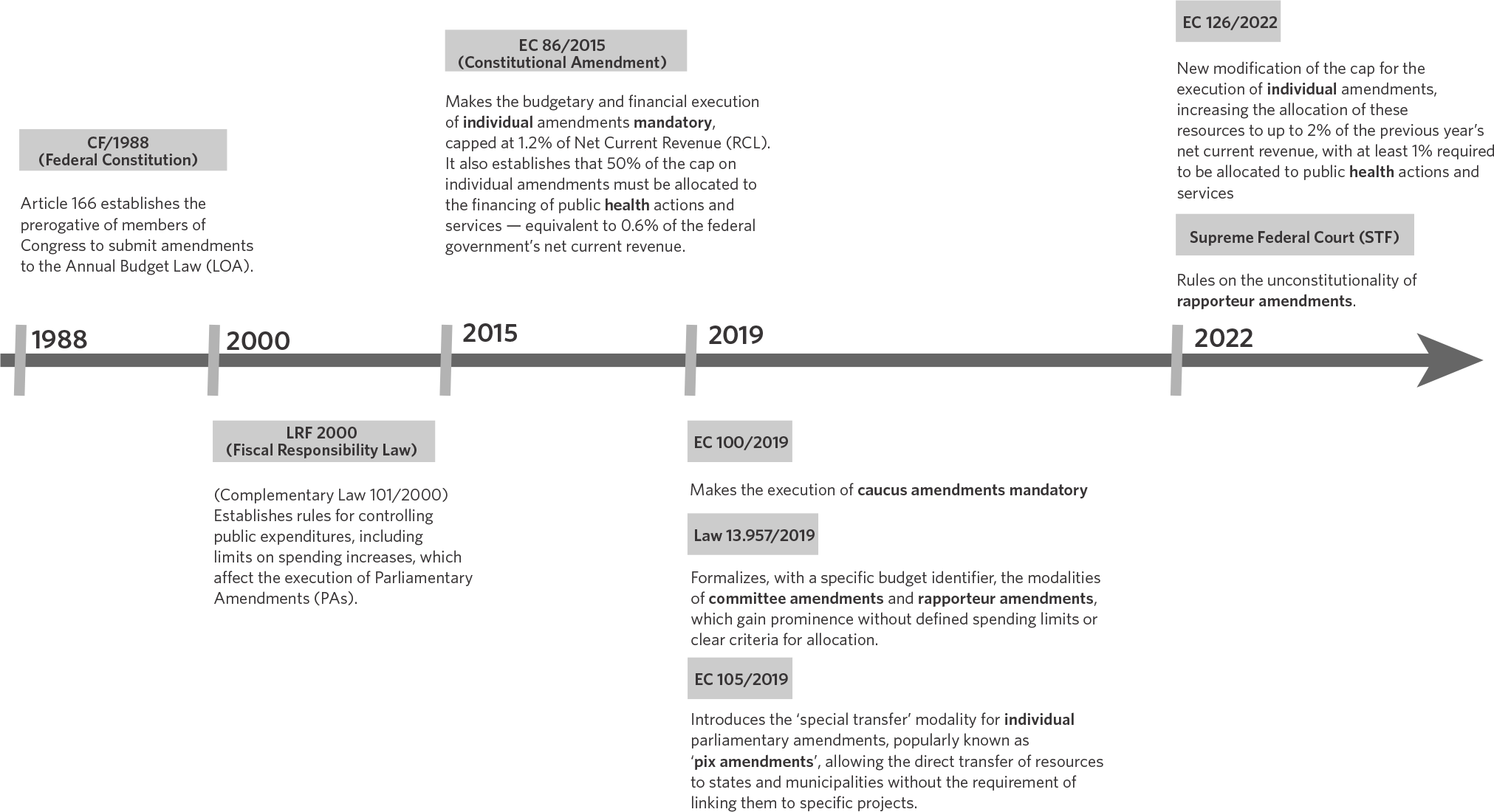
In the historical trajectory of legislative participation in the public budget, Constitutional Amendment No. 86/20157 marked a significant turning point by establishing the mandatory execution of individual parliamentary amendments, creating what became known as the ‘mandatory budget’ (orçamento impositivo). It is important to recall that the impeachment of President Dilma Rousseff was accompanied by an expansion of the legislature’s power relative to the executive. Until then, all budget appropriations had merely an authorizing status, that is, their execution depended on approval by the executive branch8. Amendment 86/20157 also set a ceiling for individual amendments equivalent to 1.2% of the federal government’s net current revenue from the previous year, with half of this amount mandatorily allocated to Public Health Actions and Services (Ações e Serviços Públicos de Saúde, ASPS).
Four years later, Constitutional Amendment No. 100/20199 extended mandatory execution to caucus amendments, and Constitutional Amendment No. 105/201910 created ‘special transfers’, enabling the distribution of financial resources from individual amendments to states and municipalities without predefined programmatic destination (the aforementioned pix amendments). In the same year, Law No. 13,957/201911 amended the 2020 Budget Guidelines Law (LDO), formalizing committee amendments and rapporteur amendments (emendas de relator), and reinforcing the central role of the rapporteur in adjusting the federal budget submitted by the executive. The law recognized the general budget rapporteur as the author of amendments, granting authority not only for technical adjustments but also for changes in existing programs and the creation of new ones (beyond purely technical modifications).
These measures intensified existing problems of opacity and clientelism within the portion of the budget influenced by legislative discretion, culminating in the scandal of the ‘secret budget’ mentioned before. As a result, the legislative branch assumed an increasingly decisive role in federal budget allocation, heightening debates about the weakening of traditional mechanisms used to structure national political coalitions12.
Given the exponential growth in budgetary resources allocated through parliamentary amendments, especially in the health sector, several lawsuits were filed before the Supreme Federal Court (STF) in 2021, challenging the lack of transparency regarding the amounts, authorship, and application of rapporteur amendments. Among these were Arguments of Noncompliance with Fundamental Precepts (ADPFs 850, 851, and others). In December 2022, the STF Plenary issued a final ruling declaring rapporteur amendments unconstitutional, restricting them to the correction of technical or legal omissions and the reinstatement of canceled appropriations13.
In response to STF’s decision, Congress enacted Constitutional Amendment No. 126/202214, which redistributed the financial resources previously associated with rapporteur amendments across individual amendments and discretionary programs implemented by the executive. The amendment also increased the ceiling for individual amendments to up to 2% of the federal government’s net current revenue, with half of this amount designated for social assistance programs (ASPS).
Figure 1 summarizes the main developments in the trajectory of parliamentary amendments since the 1988 Constitution.

The hijacking of politics: Parliamentary amendments and the political-institutional system
The trajectory of parliamentary amendments (PAs) highlights the shifting balance of power between the legislative and executive branches, both in terms of the increasing volume of budgetary financial resources under legislative control and the growing mandatory character of their execution. Beyond the expansion of available resources across the various types of PAs, this process has been marked by the allocation of funds outside the parameters of transparency, traceability, and alignment with public policy planning. This dynamic ultimately prompted the involvement of the Supreme Federal Court (STF), which demanded that all branches of government adhere to the constitutional principles governing public administration in the allocation and execution of budget resources.
In addition to the legal dimension, it is essential to recognize the political impacts of these changes, which manifest across different levels and arenas of intergovernmental relations. We characterize this phenomenon as the hijacking of politics, insofar as it contributes to the erosion of substantive political debate, undermining the negotiation of ideas and the pursuit of programmatic convergence that are at the core of a democratic public sphere.
The replacement of the debate of ideas with the control of financial resources in parliament
In December 2022, the Supreme Federal Court (STF), in a plenary ruling, declared the so-called rapporteur amendments unconstitutional. Minister Rosa Weber, acting as the case rapporteur, based her vote on the understanding that this mechanism violated fundamental constitutional principles, notably transparency, impartiality, morality, and publicity, because its anonymous nature prevented the identification of the proposer and obscured the beneficiaries of the allocated financial resources13. From that point on, a process began (and continues) in which the STF has demanded transparency and traceability in the distribution of public funds by the legislative branch, while congressional leaders have sought ways to retain control over budget allocation, initially by concentrating resources in rapporteur amendments and, subsequently, in committee amendments.
The concentration of financial resources in rapporteur amendments (BRL 16.5 billion in 2022) has contributed to the emptying of political debate, since the distribution of these funds has become tied to political alignment and proximity to the rapporteur. The STF’s intervention - which restricted the rapporteur’s discretionary authority over the so-called secret budget - resulted in the reallocation of financial resources to committee amendments as a strategy to circumvent judicial oversight. At present, these committee amendments constitute the primary locus of dispute over budgetary resources in Congress and are widely understood as successors to the secret budget. However, centralizing resources in committees has also contributed to the erosion of debate, since the plenary is the main arena for substantive deliberation, and committee proceedings frequently lack publicly available minutes demonstrating actual debate.
In the absence of such documentation, STF Minister Flávio Dino15(32) ordered the blocking of committee amendment resources, stating that “there has never been such institutional disruption involving so much public money in so few years”, and imposed new requirements for public recordkeeping. He also requested the involvement of the Federal Police to investigate financial resource flows. Congress then drafted a work plan to improve transparency, ensuring traceability and accountability regarding amendment authorship. This plan was approved by Minister Flávio Dino and validated by the STF in March 202516. A public hearing was convened, indicating that the broader debate on mandatory amendments remains contingent on additional technical information before a final judgment.
This process demonstrates the absence of the executive branch in mediating conflicts over budget distribution, an arena in which it historically held a leading role, while the STF assumed responsibility for ensuring compliance with constitutional norms. The legislative branch, in turn, sought to preserve its authority over financial resource allocation. The final arrangement, which required a proposal jointly submitted by the executive and legislative branches for judicial approval, does not suggest a resumption of political debate; rather, it reflects a negotiated effort to comply with STF’s ruling while minimizing political and institutional costs to parliament.
As a consequence of the constitutional rule requiring that 50% of individual amendments be allocated to the health sector7, health policy became a central site of political dispute. This led, in March 202317, to the division of the Social Security and Family Committee of the Chamber of Deputies (created in 1989) into two bodies: the Health Committee and the Committee on Social Security, Social Assistance, Childhood, Adolescence, and Family. To decentralize control over committee amendments, the new arrangement requires that party leaders submit committee amendment proposals and that these proposals be voted on by committee members17. The number of caucus amendments that legislators from each state may propose was also reduced from ten to eight. Since the committee chair must approve these amendments, the position now wields considerable political power, particularly given the volume of financial resources earmarked for the health sector.
Feeding the cycle of conservatism in municipal elections
According to the National Confederation of Municipalities18, the 2024 municipal election marked the highest reelection rate since the adoption of the reelection rule in 1997, reaching 81%. Most of the elected mayors belonged to the same party as the governor, demonstrating the strength of the state executive in shaping municipal disputes; moreover, more than half of the municipalities (55%) had only one or two candidates, with a record number of single-candidate races.
One factor that helps explain this scenario was the distribution of financial resources from party funds, electoral funds, and parliamentary amendments. A Datafolha study19, based on data from the Superior Electoral Court (TSE) and Siga Brasil, found that in municipalities receiving more than BRL 2,543.70 per voter (three times the national median), the reelection rate reached 98%. Those receiving between two and three times the median had a reelection rate of 91%, above the national average of 85%. This also helps explain the rise in single-candidate races, since opposition groups perceived virtually no viable path to victory.
Less developed municipalities received proportionally more pix-type amendments than larger or more developed municipalities, as measured by the Municipal Human Development Index (MHDI). While municipalities with low MHDI received 47% of PA resources, those with high or very high MHDI received 32%20. A closer examination shows that among the 20 municipalities with the lowest MHDI, 15 had not received resources from PAs for more than a year21-most likely because they are governed by political opponents or have small electoral weight.
For mayors, pix amendments represent advantages in terms of agility and fewer bureaucratic barriers, in comparison to amendments with a defined purpose, which require a project, performance reports, and the demonstration that there are no technical impediments. However, the absence of such requirements hinders control over the use of these resources, a concern raised by the Federal Public Prosecutor’s Office (MPF) and the Supreme Federal Court (STF). The prosecutor’s office has initiated several proceedings to monitor and track the allocation of at least BRL 450 million in pix-type amendments directed by deputies and senators to municipalities22.
These amendments also directly affect the electoral process, because, alongside party and electoral funds, municipalities receive financial resources from pix amendments in a personalized and non-transparent manner. This dynamic violates republican principles, favors those already in office, and may support not only corruption but also the perpetuation of local political dominance, reproducing on a broader scale a pattern similar to amoral familism in politics.
Likewise, this mechanism can reinforce political conservatism, since mayors benefiting from state-run parliamentary programs tend to publicly promote the parliamentarians who favored them, contributing to their likely reelection to the federal chamber in 2026. This closes a cycle of conservatism that limits political renewal because, as is often said, ‘gratitude never expires’. It cannot be disregarded that the federal government’s austerity measures may intensify mayors’ dependence on state-run parliamentary programs, as federal resources are scarce, constraining their capacity to formulate and implement strategic policies and programs across public policy areas and to sustain the municipal delivery of services.
Budgetary dynamics and relations between the branches of government
The thesis that the Brazilian executive branch continues to set the rules of the game in the decision-making process, as is traditionally associated with the modus operandi of ‘coalition presidentialism’23, requires more careful review and analysis. It is also necessary to avoid the stereotype that views the actions of the legislative branch exclusively through distributive motivations anchored in local interests, reinforcing the idea that parliamentary participation in the budgetary process is merely a vehicle for ‘fiscal irresponsibility’. This interpretation is, at the very least, misleading. Since the 1988 Constitution, the legislative branch has had limited capacity to propose laws of a budgetary and fiscal nature in comparison to the executive branch24. Deputies cannot autonomously decide how to reallocate revenues because constitutional provisions themselves prevent them from doing so. Although parliamentarians frequently use their prerogative to present budgetary amendments, as highlighted in this article, constitutionally their legislative activity is primarily oriented toward social policy, often complementing initiatives submitted by the executive in this area25. If we consider ordinary laws, particularly those relating to social policy, parliamentary initiative since 1988 has been significant, as noted by Figueiredo and Limongi26-28. However, factors such as the mandatory allocation of PA resources and the urgent approval of the ‘war budget’ to confront the COVID-19 pandemic altered this dynamic, placing the legislative branch in a more prominent position in economic legislation29.
The executive branch, in turn, has gradually lost its capacity to conduct public policies due to revenue stagnation and expenditure constraints, exacerbated by successive economic crises and fiscal adjustments. Since the 1990s, mechanisms such as the federal government Revenue Detachment and the Fiscal Responsibility Law30 have had direct effects on social spending and, particularly, on personnel expenditure in social policy areas administered by federative entities. In the 2000s, maintaining the macroeconomic tripod, including the effort to generate primary surpluses even while expanding public investment, continued the pattern of macroeconomic policy aligned with fiscal austerity. The crisis beginning in 2014 intensified this trajectory, culminating in more radical adjustment measures and the institution of fiscal frameworks initiated by the executive branch. Constitutional Amendment 95/2016 (the spending cap) severely affected programmed expenditures in ministries and substantially reduced investment spending. As a result, ministries lost much of their appeal as instruments for accommodating coalitions and influencing parliamentary behavior, and the executive became increasingly limited to supervising fiscal adjustment.
The disorganization of programmed expenditure management within ministries increased the legislature’s ability to reorganize its internal rules to compete for the limited financial resources available from net current revenues through the authorization of budget amendments. Since 1995, following the Real Plan, fiscal stabilization measures led to changes in the rules governing budget amendment proposals, creating strong incentives for amendments to be concentrated in the rapporteurs and presented collectively-often by state delegations-rather than through individual initiatives28. Unsurprisingly, individualistic strategies saw reduced space between 1995 and 2014. This period corresponds to coalition governments that sought, each in their own way, to reconcile fiscal balance with the maintenance or expansion of public investment and social spending. There was political and fiscal space for selected policies to gain prominence through certain ministries, and parliamentary majorities had an interest in supporting the execution of these policies. In this context, a form of ‘collective distributivism’ linked to executive policy projects still predominated in the legislature, despite fiscal constraints related to monetary stabilization.
When the executive branch must implement fiscal adjustments, it uses its capacity to anticipate reactions within its legislative base to accommodate parliamentary interests by strengthening amendments as bargaining instruments to stabilize majorities. This is a paradoxical process. To secure congressional approval for measures aimed at meeting strict fiscal targets, including the reduction of social spending, the executive branch turns to parliamentary amendments that increase spending, though in discretionary ways less connected to ministerial programs. Because spending contingency decrees set spending limits at an aggregate level per ministry, parliamentarians often lack clarity regarding ministerial plans for executing amendments. This uncertainty increases incentives for insulating individual amendments from ministry programming, and these amendments begin operating independently of more comprehensive public policies. In a context of budgetary uncertainty for policies with electoral relevance, and lacking the capacity to use ministry budgets to accommodate its legislative base, the executive is compelled to yield to the centrifugal pressures of parliamentarians, expanding the legislative branch’s prerogatives in the budget process.
Thus, individualistic parliamentary distributivism is not the result of the emptying of the executive branch’s institutional powers or agenda-setting capacity, but of the weakening of its bureaucratic capacity to manage distributive tensions. The transformation of public expenditures into mandatory spending, combined with the expansion of fiscalism, reduces the executive branch’s room for negotiation and strengthens the individual bargaining power of parliamentarians. Fiscalism, therefore, contributes to the emptying of public funds and to the misalignment of political actors around common agendas. In short, since fiscal control became the principal orientation of the Brazilian executive branch, the executive and legislative branches have come to move increasingly in opposite directions, precisely because state bureaucracy has ceased to operate as an instrument of contention and political coordination.
The imbalance in relations between the executive and the legislative branches
The coalition presidential system, a term coined by Abranches23, functioned effectively as long as the president possessed sufficient political strength to negotiate the construction of a governing base, strength derived from legitimacy and popularity among the electorate and major political actors, as in President Fernando Henrique Cardoso’s first term, and in President Lula’s first and second terms. This arrangement was also sustained by a set of governing resources, such as appointments in state-owned companies and ministries, combined with the legislative prerogatives of the executive and the authority exercised by the College of Leaders.
However, with the weakening of President Dilma Rousseff’s government and her resistance to negotiating with the then Speaker of the Chamber of Deputies, Eduardo Cunha, the coalition presidential system gave way to a more confrontational presidential dynamic31, with the legislative branch actively seeking to destabilize the executive. Under President Temer’s government, which was itself the result of congressional action to remove the sitting president, and later under President Bolsonaro, both administrations sought to avoid confrontation with Congress. This avoidance came at the cost of diminishing the executive’s authority over the budget, and correspondingly, empowering Congress through the progressive control of public expenditures, which reached BRL 52 billion in discretionary resources in 2024.
In short, the shift in the balance of power between the executive and the legislative branches resulted from a set of changes that undermined the political arrangement of coalition presidentialism, including the growing volume of financial resources directed to electoral and party funds. These include:
a: 1) The reduction of the executive’s legislative power with the establishment of a 60-day deadline for provisional measures to be approved; otherwise, they lose validity; 2) the weakening of party leaders’ control over their caucuses due to the concentration of amendment resources in the hands of the Speaker of the Chamber via the secret budget, marked by discretionary authority and a lack of transparency; 3) the approval of the mandatory budget in 2015, making individual parliamentary amendments compulsory, removing from the executive an important bargaining instrument, i.e., the capacity to freeze amendment allocations; 4) electoral reforms that prompted the reorganization of party alignments in Congress, through the approval of the barrier clause and the party federation mechanism, reducing leadership control over their parliamentary bases32.
It is estimated that state-managed parliamentary programs will account for 20% of all federal discretionary spending in 2025, implying that the combined expenditure of states and municipalities will surpass that of the federal government. This decentralization of financial resources further reduces the executive branch’s capacity to implement public policies, as amendments are not guided by the logic of the Multi-Year Plan (PPA), leading to the dispersion of funds across parochial and politically targeted expenditures33. The consequences of this redistribution, with greater spending capacity accumulating in states and municipalities, are visible in the reconfiguration of the political power structure, weakening the federal executive’s capacity for political coordination while increasing the autonomy of subnational entities and their influence on national politics. Economically, this process introduces fiscal tensions: austerity policies and high interest rates constrain federal spending and raise treasury financing costs, but do not impose equivalent restrictions on subnational expenditures34.
The growing friction between an empowered legislature and an executive weakened by spending constraints and reduced control over discretionary financial resources has shifted the locus of conflict to the judiciary. The STF has increasingly acted to arbitrate disputes, potentially establishing a new equilibrium, distinct from that of coalition presidentialism, capable of restoring some level of governance. However, should such a rebalancing occur, it will reaffirm the fragility of the executive branch, and perhaps of the presidential system itself, since the judiciary’s prominence evidences the erosion of bureaucratic capacity to mediate and accommodate political interests.
Changes in federalism and intergovernmental relations
The redefinition of the federal governance arrangement promoted by the 1988 Constitution altered intergovernmental relations and introduced a new institutional framework for social policies in Brazil. In the post-constitutional period, and until the mid-1990s, municipal revenues expanded primarily due to constitutional transfers, which became the main source of financial resources for most municipalities, rather than an increase in their tax-collection capacity. The growth in municipal revenues during this period enabled the strengthening of municipal political autonomy vis-à-vis the states and the federal government, resulting in highly competitive intergovernmental dynamics and the exacerbation of regional inequalities.
From 1995 onward, the federal government regained centrality within intergovernmental relations. It is important to emphasize that the political and fiscal predominance of the federal government over the other federative entities has historically characterized Brazil’s federal system35. Pressured by strong budgetary constraints and committed to fiscal adjustment, the federal government implemented a series of structural measures that strengthened the federal government and reshaped intergovernmental relations by imposing stricter constraints on states and municipalities in the name of deficit control. While the federal government recovered its share of national revenue collection, states and municipalities saw their financial capacity weakened by economic crisis and by legal measures to restrict public spending, such as the Fiscal Responsibility Law30 and the Kandir Law36.
In the 2000s, a model of federative coordination was reinforced, marked by the continued institutional strengthening of the federal government and the expansion of its control over the design of public policies. At the same time, voluntary intergovernmental transfers, especially to municipalities, increased significantly. Unlike constitutional transfers, whose allocation is predetermined and thus limits the discretion of mayors, voluntary transfers constitute a valuable source of political capital in federal bargaining. This applies not only to executive authorities at different levels of government but also to members of the national legislative branch, whose political careers are closely tied to their ability to direct these financial resources to their electoral bases, predominantly located in municipalities.
However, the Brazilian federal governance arrangement has undergone significant changes in the past decade. The introduction of the ‘new fiscal regime’ in 201637, which constitutionalized austerity, combined with the economic recession and the political crisis that intensified from 2014 onwards, imposed severe fiscal losses on federative entities and adversely affected public policies. This situation worsened during the COVID-19 pandemic, when intergovernmental tensions escalated due to the federal government’s omission in coordinating the response and the confrontational stance adopted by the President toward subnational governments - a pattern that Ouverney and Fleury29 define as ‘confrontational federalism’. This dynamic opened space for assertive and sometimes innovative actions by subnational governments and contributed to the reconfiguration of relationships among the executive, legislative, and judiciary branches.
In this broader context of fiscal, economic, and political crises, PAs have gradually gained prominence, including at the municipal level. Faced with the underfunding of public policies in a low-growth environment, and within a federal coalition strategy based on exchanges of favors and legislative support, mayors increasingly sought financial resources from PAs, using electoral support as a form of political currency.
Public health policy: Financing and equity in the Unified Health System (SUS)
The progressive strengthening of the legislative branch in defining the federal budget, particularly through Parliamentary Amendments (PAs), has had structural consequences for public policies. The health sector is the most affected, not only because it has been the mandatory destination of 50% of individual amendments since Constitutional Amendment No. 86/20157, but also because it is the area where the erosion of the executive’s coordinating role and the fragmentation of state actions driven by clientelistic logic are most evident. The mandatory execution of amendment-allocated resources has definitively placed this issue at the center of current debates on health financing.
In 2024, 66% of the total value of PAs was directed to health, totaling BRL 44.67 billion, an increase of 380% compared to 2015, the year when amendments became mandatory38. However, this growth does not represent an effective increase in the structural financing of the Unified Health System (SUS). Resources allocated through amendments have replaced regular public investments, revealing a system survival strategy under the fiscal framework, which limits the central government’s ability to plan and implement universal, integrated, and equitable policies.
Two recent studies show that amendment resources already represent approximately 10% of the federal health budget5, surpassing the Ministry of Health’s discretionary budget in areas such as primary care and hospital care39. Using different methodologies, both studies analyzed budgetary and financial execution data from the Integrated Financial Administration System (SIAFI), obtained through the Budget Panel of the Integrated Planning and Budget System (SIOP). They also identified a shift in spending patterns: amendment resources have increasingly been allocated to current expenditures rather than investments. Thus, rather than supplementing the health budget, these amendments have become essential for maintaining basic services. This dynamic deepens SUS’s chronic underfunding and transfers the distributive logic of public policy to the political-electoral arena of parliament.
Another concern relates to the detachment of financial resource allocation from technical criteria, such as social and health indicators. Distribution based on amendments is largely determined by political linkages and local interests, rather than population health needs40,41. Redirecting health budgets according to political criteria may contribute to increased inequities in access to and the quality of public health services. Although the most socioeconomically vulnerable municipalities have received proportionally more PA resources in recent years, the overall distribution remains unequal, which may maintain or even exacerbate disparities among them42.
A further issue involves the substitution of funding sources: when municipalities receive federal financial resources through amendments, many reduce their own primary care spending43 and reallocate resources to other sectors. This creates an apparent expansion of service coverage without corresponding local investment. Since amendment resources are volatile and non-recurring, there are no guarantees of continuity, directly affecting municipal planning and service quality. In other words, the absence of regular (mandatory) transfers undermines both continuity and sustainability of health services.
It is also possible that such reallocations address health needs not captured by the Ministry of Health’s technical criteria, since municipalities are responsible for meeting local demands and managing system-wide resource constraints. Therefore, it is necessary to analyze not only the use of financial resources received directly by Municipal Health Departments, but also the reallocation of municipal resources within local health budgets, and to assess their alignment with national policies and Integrated Regional Planning within the corresponding Health Macroregion.
The growing centrality of PA amendments in health financing thus not only distorts technical criteria and compromises equity but also generates dependence and instability among federated entities, replacing state policy with short-term electoral strategies. Constrained by the fiscal framework, the executive branch increasingly accepts this arrangement as a form of ‘parallel financing’ for SUS. However, rather than solving structural challenges, it introduces new ones: disarticulation, inequality, opacity, and the political capture of public financial resources.
Conclusions
Parliamentary Amendments (PAs), originally conceived as a mechanism to deepen democratic processes by strengthening the legislative branch’s participation in budgetary decision-making, have come to play a central role in the reconfiguration of the Brazilian political system. Since 2015, we have observed a progressive loss of executive branch authority over discretionary spending, which weakens its constitutional and political capacity to direct the federal budget and to coordinate public policies across the federated entities. Simultaneously, the volume of available discretionary financial resources has not kept pace with growing demands for investment and public expenditure, given the constraints imposed by successive fiscal adjustment measures.
This expansion of the legislative branch into areas traditionally under the executive’s authority has altered the logic of budget management, compromising principles of transparency, equity, and adherence to planning. The resulting tensions have prompted increased intervention by the judiciary to uphold constitutional norms, highlighting the institutional fragility of democratic accountability mechanisms. Moreover, political decision-making has become progressively subordinated to electoral and clientelist incentives, displacing programmatic debate and shifting political bargaining toward the direct competition for financial resources.
In the health sector, PA-funded public expenditure has increasingly replaced regular investment in the Unified Health System (SUS), producing fragmented and unstable financing arrangements that run counter to the principles of universality, comprehensiveness, and equity. The allocation of financial resources based on individual interests rather than technical or epidemiological criteria reinforces regional inequalities and compromises both continuity and quality in service provision.
Historically, the management of distributive conflicts in Brazil has relied on a delicate institutional balance in which the executive branch played a leading role not due to a constitutional anomaly, but because it was responsible for reconciling divergent interests around public resource allocation and policy coordination in a country marked by profound socioeconomic and territorial disparities. If bureaucratic appointments have traditionally been among the president’s key instruments for building legislative support, the expansion of discretionary spending under PA control has raised the political cost of coalition maintenance. Not coincidentally, the congressional majority has shown declining interest in occupying positions within the executive, as ministerial budgets have been eroded while PA resources have expanded.
The analysis developed in this article demonstrates that the political use of PAs compromises not only budgetary governance but also the federal balance and the effectiveness of public policies. This dynamic signals a transformation in Brazil’s political regime - whether toward a reconfigured coalition presidentialism, a hybrid semi-presidential arrangement, intensified parliamentary tutelage, or even a transition toward formal parliamentarism. What we emphasize is that both democratic governability - the legitimate exercise of authority - and governance - the government’s ability to implement its program - are significantly threatened under current conditions.
-
Finnancial support:
Non-existent
Data availability:
The research data are contained within the manuscript itself
References
- 1 Melo M. Emendas parlamentares. In: Anastasia F, Avritzer L, organizadores. Reforma Política no Brasil. Belo Horizonte: Editora UFMG; 2006. p. 197-2021.
-
2 Tollini H, Mendes M. É assim em todo lugar? Emendas parlamentares no Brasil e em 11 países da OCDE [Internet]. São Paulo: Insper; 2024 [acesso em 2025 jun 30]. Disponível em: https://repositorio.insper.edu.br/entities/publication/bfd34354-650a-41fe-8481-f317d9d474bf/full
» https://repositorio.insper.edu.br/entities/publication/bfd34354-650a-41fe-8481-f317d9d474bf/full - 3 Maia W. História do Orçamento Público no Brasil. São Paulo: AGESP - Associação dos Gestores Públicos do Estado de São Paulo; 2010.
-
4 Cambraia T. Emendas ao Projeto de Lei Orçamentária Anual: algumas distorções. [Internet]. Brasília, DF: Consultoria Legislativa da Câmara dos Deputados; 2011 [acesso em 2025 jun 30]. Disponível em: https://www2.camara.leg.br/atividade-legislativa/estudos-e-notas-tecnicas/estudos-por-assunto/economia/arquivos/emendas-parlamentares2
» https://www2.camara.leg.br/atividade-legislativa/estudos-e-notas-tecnicas/estudos-por-assunto/economia/arquivos/emendas-parlamentares2 -
5 Piola SF, Vieira FS. Financiamento das ações e serviços públicos de saúde no Brasil: um retrato das desigualdades regionais do período 2010-2022 [Internet]. Brasília, DF: Instituto de Pesquisa Econômica Aplicada (Ipea); 2024 [acesso em 2024 set 17]. Disponível em: https://repositorio.ipea.gov.br/bitstream/11058/14118/1/TD_3010_Web.pdf
» https://repositorio.ipea.gov.br/bitstream/11058/14118/1/TD_3010_Web.pdf -
6 Baptista TWDF, Machado CV, Lima LDD, et al. As emendas parlamentares no orçamento federal da saúde. Cad Saúde Pública. 2012;28(12):2267-79. DOI: https://doi.org/10.1590/S0102-311X2012001400006
» https://doi.org/10.1590/S0102-311X2012001400006 - 7 Presidência da República (BR). Emenda Constitucional no 86, de 17 de março de 2015. Altera os arts. 165, 166 e 198 da Constituição Federal, para tornar obrigatória a execução da programação orçamentária que especifica. Diário Oficial da União, Brasília, DF. 2015 mar 18; Edição 52; Seção I:1.
- 8 Piola SF, Vieira FS. As emendas parlamentares e a alocação de recursos federais no Sistema Único de Saúde. Brasília, DF: Instituto de Pesquisa Econômica Aplicada (Ipea); 2019.
- 9 Presidência da República (BR). Emenda Constitucional no 100, de 26 de junho de 2019. Altera os arts. 165 e 166 da Constituição Federal para tornar obrigatória a execução da programação orçamentária proveniente de emendas de bancada de parlamentares de Estado ou do Distrito Federal. Diário Oficial da União, Brasília, DF. 2019 jun 27; Edição 122; Seção I;1.
- 10 Presidência da República (BR). Emenda Constitucional no 105, de 12 de dezembro de 2019. Acrescenta o art. 166-A à Constituição Federal, para autorizar a transferência de recursos federais a Estados, ao Distrito Federal e a Municípios mediante emendas ao projeto de lei orçamentária anual. Diário Oficial da União, Brasília, DF. 2019 dez 13; Edição 241; Seção I:2.
- 11 Presidência da República (BR). Lei no 13.957, de 18 de dezembro de 2019. Altera a Lei nº 13.898, de 11 de novembro de 2019, que dispõe sobre as diretrizes para a elaboração e a execução da Lei Orçamentária de 2020 e dá outras providências. Diário Oficial da União, Brasília, DF. 2019 dez 18; Edição 244-A; Seção I:1.
-
12 Santos NCB, Gasparini CE. Orçamento Impositivo e Relação entre Poderes no Brasil. Rev Bras Ciênc Política. 2020;(31):339-96. DOI: https://doi.org/10.1590/0103-335220203109
» https://doi.org/10.1590/0103-335220203109 -
13 Supremo Tribunal Federal (BR). Arguição de Descumprimento de Preceito Fundamental 850. Relator: Min. Rosa Weber. Julgamento em 19 dez 2022 [Internet]. Brasília, DF: STF; 2022 [acesso em 2025 jun 30]. Disponível em: https://www.stf.jus.br/portal/jurisprudencia/listarJurisprudencia.asp?s1=ADPF%20850&base=baseAcordaos
» https://www.stf.jus.br/portal/jurisprudencia/listarJurisprudencia.asp?s1=ADPF%20850&base=baseAcordaos - 14 Congresso Nacional (BR). Emenda Constitucional no 126, de 26 dezembro de 2022. Altera a Constituição Federal, para dispor sobre as emendas individuais ao projeto de lei orçamentária, e o Ato das Disposições Constitucionais Transitórias para excluir despesas dos limites previstos no art. 107; define regras para a transição da Presidência da República aplicáveis à Lei Orçamentária de 2023; e dá outras providências. Diário Oficial da União, Brasília, DF. 2022 dez 22; Edição 240; Seção I:18.
- 15 Supremo Tribunal Federal (BR). ADPF 854/DF. Relator: Ministro Flávio Dino; decisão de 2 dez 2024. Brasília, DF: STF; 2024.
-
16 CNN Brasil. Por unanimidade, STF valida plano de trabalho para pagamento de emendas. CNN Brasil [Internet]. 2025 mar 3 [acesso em 2025 jun 30]; Política. Disponível em: https://www.cnnbrasil.com.br/politica/por-unanimidade-stf-valida-plano-de-trabalho-para-pagamento-de-emendas/
» https://www.cnnbrasil.com.br/politica/por-unanimidade-stf-valida-plano-de-trabalho-para-pagamento-de-emendas/ - 17 Câmara dos Deputados (BR). Resolução no 1, de 8 de fevereiro de 2023. Altera os arts. 17, 26, 32 e 34 do Regimento Interno da Câmara dos Deputados. Diário da Câmara dos Deputados, Brasília, DF. 2023 feve 15; Suplemento.
-
18 Confederação Nacional de Municípios. O perfil dos candidatos a prefeito nas eleições municipais de 2024 [Internet]. Brasília, DF: CNM; 2024 [acesso em 2025 jun 30]. Disponível em: https://www.cnm.org.br/biblioteca/exibe/15459
» https://www.cnm.org.br/biblioteca/exibe/15459 -
19 Santos N, Ferreira F, Pretto N. 98% dos prefeitos mais turbinados com emendas se reelegem. Folha de S Paulo [Internet]. 2024 out 8 [acesso em 2025 jun 30]; Datafolha. Disponível em: https://www1.folha.uol.com.br/poder/2024/10/98-dos-prefeitos-mais-turbinados-com-emendas-se-reelegem.shtml
» https://www1.folha.uol.com.br/poder/2024/10/98-dos-prefeitos-mais-turbinados-com-emendas-se-reelegem.shtml -
20 Barbon J, Santos N. Quase metade das emendas para as cidades mais pobres é gasta sem transparência. Folha de S Paulo [Internet]. 2025 fev 9 [acesso em 2025 jun 30]; Datafolha. Disponível em: https://www1.folha.uol.com.br/poder/2025/02/quase-metade-das-emendas-as-cidades-mais-pobres-e-gasta-sem-transparencia.shtml
» https://www1.folha.uol.com.br/poder/2025/02/quase-metade-das-emendas-as-cidades-mais-pobres-e-gasta-sem-transparencia.shtml -
21 Marzullo L. No fim da fila das emendas, municípios com os piores IDH do país são preteridos por parlamentares no envio de verbas. O Globo [Internet]. 2025 jun 1 [acesso em 2025 jun 30]; Política. Disponível em: https://oglobo.globo.com/politica/noticia/2025/06/01/no-fim-da-fila-das-emendas-municipios-com-os-piores-idh-do-pais-sao-preteridos-por-parlamentares-no-envio-de-verbas.ghtml
» https://oglobo.globo.com/politica/noticia/2025/06/01/no-fim-da-fila-das-emendas-municipios-com-os-piores-idh-do-pais-sao-preteridos-por-parlamentares-no-envio-de-verbas.ghtml -
22 Cury T. Repasses de R$ 450 milhões em emendas pix entram na mira do MPF. CNN Brasil [Internet]. 2025 fev 5 [acesso em 2025 maio 25]; Política. Disponível em: https://www.cnnbrasil.com.br/blogs/teo-cury/politica/repasses-de-r-450-milhoes-em-emendas-pix-entram-na-mira-do-mpf/
» https://www.cnnbrasil.com.br/blogs/teo-cury/politica/repasses-de-r-450-milhoes-em-emendas-pix-entram-na-mira-do-mpf/ - 23 Abranches S. Presidencialismo de coalizão: raízes e evolução do modelo político brasileiro. São Paulo: Companhia das Letras; 2019.
-
24 Lemos LBDS. O Congresso Brasileiro e a distribuição de benefícios sociais no período 1988-1994: uma análise distributivista. Dados. 2001;44(3):561-630. DOI: https://doi.org/10.1590/S0011-52582001000300004
» https://doi.org/10.1590/S0011-52582001000300004 -
25 Amorim Neto O, Santos F. O segredo ineficiente revisto: o que propõem e o que aprovam os deputados brasileiros. Dados. 2003;46(4):66198. DOI: https://doi.org/10.1590/S0011-52582003000400002
» https://doi.org/10.1590/S0011-52582003000400002 -
26 Limongi F, Figueiredo A. Processo orçamentário e comportamento Legislativo: emendas individuais, apoio ao Executivo e programas de governo. Dados. 2005;48(4):737-76. DOI: https://doi.org/10.1590/S0011-52582005000400002
» https://doi.org/10.1590/S0011-52582005000400002 - 27 Figueiredo AMC, Limongi Neto FP. Executivo e legislativo na nova ordem constitucional. Rio de Janeiro: Editora FGV; 1999.
- 28 Figueiredo AC, Limongi F. O Legislativo e Âncora Fiscal. In: Rezende F, Cunha A, organizadores. O Orçamento e a Transição de Poder. Rio de Janeiro: Fundação Getúlio Vargas Editora; 2003. p. 55-91.
- 29 Ouverney ALM, Fleury S, organizadores. Novo Federalismo no Brasil: Tensões e Inovações em Tempos de Pandemia de COVID-19. Brasília, DF: Ed. do Autor; 2023.
- 30 Presidência da República (BR). Lei Complementar nº 101, de 4 de maio de 2000. Estabelece normas de finanças públicas voltadas para a responsabilidade na gestão fiscal e dá outras providências. Diário Oficial da União, Brasília DF. 2000 maio 5; Seção I:1.
- 31 Fleury S, Ouverney AM. Federalismo de confrontação: tensões, inovações e limites da estratégia de enfrentamento à pandemia de COVID-19 no Brasil. In: 11º Congresso Latino-Americano de Ciência Política (ALACIP); 2022 jul 21-23; Santiago, Chile. Santigo, Chile: Associação Latino-Americana de Ciência Política e pela Associação Chilena de Ciência Política; 2022.
-
32 Fleury S, Neves LA. Lula e Saúde: entre governança e governabilidade. Outras Palavras [Internet]. 2023 jun 19 [acesso em 2025 jun 30]; Outra Saúde. Disponível em: https://outraspalavras.net/outrasaude/lula-e-a-saude-entre-governanca-e-governabilidade/
» https://outraspalavras.net/outrasaude/lula-e-a-saude-entre-governanca-e-governabilidade/ -
33 Lima B. Brasil (in)eficiente: Emendas parlamentares batem recorde e chegam a R$ 50 bi. Para especialistas, há distorção. O Globo [Internet]. 2025 fev 25 [acesso em 2025 jun 30]; Economia. Disponível em: https://oglobo.globo.com/economia/noticia/2025/02/25/brasil-ineficiente-emendas-parlamentares-batem-recorde-e-chegam-a-r-50-bi-para-especialistas-ha-distorcao.ghtml
» https://oglobo.globo.com/economia/noticia/2025/02/25/brasil-ineficiente-emendas-parlamentares-batem-recorde-e-chegam-a-r-50-bi-para-especialistas-ha-distorcao.ghtml -
34 Tomazelli I. Estados e municípios já gastam mais que União e mudam cenário fiscal e político do país. Folha de S Paulo [Internet]. 2025 abr 7 [acesso em 2025 jun 30]; Finanças Regionais. Disponível em: https://www1.folha.uol.com.br/mercado/2025/04/estados-e-municipios-ja-gastam-mais-que-uniao-e-mudam-cenario-fiscal-e-politico-do-pais.shtml
» https://www1.folha.uol.com.br/mercado/2025/04/estados-e-municipios-ja-gastam-mais-que-uniao-e-mudam-cenario-fiscal-e-politico-do-pais.shtml - 35 Arretche M. Democracia, federalismo e centralização no Brasil. Rio de Janeiro: Fiocruz Editora; 2012.
- 36 Presidência da República (BR). Lei Complementar no 87, de 13 de setembro de 1996. Dispõe sobre o imposto dos Estados e do Distrito Federal sobre operações relativas à circulação de mercadorias e sobre prestações de serviços de transporte interestadual e intermunicipal e de comunicação, e dá outras providências. Diário Oficial da União, Brasília, DF. 1996 set 16; Seção I:18261.
- 37 Presidência da República (BR). Emenda Constitucional no 95, de 15 de dezembro de 2016. Altera o Ato das Disposições Constitucionais Transitórias, para instituir o Novo Regime Fiscal, e dá outras providências. Diário Oficial da União, Brasília, DF. 2016 dez 15; Edição 241; Seção I:2.
-
38 Agência Câmara. Emendas em 2024 foram destinadas principalmente para saúde e prefeituras. [Internet]. Senado Notícias. 2024 mar 25 [acesso em 2025 jun 30]. Disponível em: https://www12.senado.leg.br/noticias/materias/2024/03/25/emendas-em-2024-foram-destinadas-principalmente-para-saude-e-prefeituras
» https://www12.senado.leg.br/noticias/materias/2024/03/25/emendas-em-2024-foram-destinadas-principalmente-para-saude-e-prefeituras - 39 Nobre V, Rodrigues M, Semente M. Emendas Parlamentares em saúde: para onde caminham? Rio de Janeiro: Instituto de Estudos para Políticas de Saúde (IEPS); 2024.
-
40 Medina SA, Ferreira MAM, Pinto TRGS, Santos IAD. Alocação das emendas parlamentares individuais: correção de assimetria em saúde ou ganho político? REAd Rev Eletrônica Adm Porto Alegre. 2023;29(1):98-125. DOI: https://doi.org/10.1590/1413-2311.374.124848
» https://doi.org/10.1590/1413-2311.374.124848 -
41 Baião AL, Couto CG, Oliveira VED. Quem ganha o quê, quando e como? Emendas orçamentárias em Saúde no Brasil. Rev Sociol Polit. 2019;27(71):e004. DOI: https://doi.org/10.1590/1678-987319277104
» https://doi.org/10.1590/1678-987319277104 -
42 Vieira FS, Lima LDD. Distorções das emendas parlamentares à alocação equitativa de recursos federais ao PAB. Rev Saúde Pública. 2022;56:123. DOI: https://doi.org/10.11606/s1518-8787.2022056004465
» https://doi.org/10.11606/s1518-8787.2022056004465 -
43 Ulinski KGB, Carvalho BG, Vieira FS, et al. Efeitos das emendas parlamentares no financiamento municipal da atenção primária à saúde do Sistema Único de Saúde. Cad Saúde Pública. 2024;40(3):e00007323. DOI: https://doi.org/10.1590/0102-311XPT007323
» https://doi.org/10.1590/0102-311XPT007323
-
Editor in charge:
Eli Iola Gurgel Andrade

 Source: Elaborated by the authors.