
 Behavioral changes and the need for support in knowledge transfer: An evaluation of training in Primary Health Care
ABSTRACT
The training of Primary Health Care professionals in the management of Chronic Non-Communicable Diseases is essential within the context of the Brazilian Unified Health System. Despite its relevance, there is still a lack of robust evaluations on the impacts of such training. This study evaluated the effects of the QualiDCNT Program on the aforementioned training. A cross-sectional and analytical study was conducted using a structured questionnaire that included sociodemographic and work-related data, along with three validated scales: Reaction to Instructional Procedures, Psychosocial and Material Support for Training Transfer, and Self-Assessment of Impact. Data were collected at the end of the program and 30 days later, and analyzed using descriptive and inferential statistics. The sample consisted of 64 participants in the first stage and 71 in the second, recruited by convenience. Satisfaction scores showed higher averages for Reaction to Instructional Procedures, Self-Assessment of Impact presented moderate averages, and the scores for Psychosocial and Material Support for Training Transfer were the lowest. The results indicate that the Program contributed positively to participant satisfaction and perceived impact, but also highlighted challenges related to the understanding that organizational support is inseparable from the success of training initiatives for the Unified Health System.
KEYWORDS
Educational assessment; Primary Health Care; Non-communicable diseases; Continuing education
RESUMO
A formação de profissionais da Atenção Primária à Saúde para o manejo de Doenças Crônicas Não Transmissíveis é fundamental no contexto do Sistema Único de Saúde. Apesar de sua relevância, ainda há carência de avaliações robustas sobre os impactos de tal formação. Este estudo avaliou os efeitos do Programa QualiDCNT na capacitação supracitada. Foi realizado um estudo transversal e analítico, utilizando um questionário estruturado sociodemográfico, laboral e três escalas: Reação aos Procedimentos Instrucionais, Suporte Psicossocial e Material à Transferência de Treinamento e Autoavaliação de Impacto. Os dados foram coletados ao final do Programa e 30 dias após, e analisados por estatística descritiva e inferencial. A amostra foi composta por 64 participantes na primeira etapa e 71 na segunda, recrutados por conveniência. Os escores de satisfação registraram maiores médias para Reação aos Procedimentos Instrucionais, a Autoavaliação de Impacto apresentou médias moderadas e os escores do Suporte Psicossocial e Material à Transferência de Treinamento foram os mais baixos. Os resultados destacam que o Programa contribuiu positivamente para a satisfação e a percepção de impacto dos participantes, mas apontou desafios relacionados ao entendimento de que o suporte organizacional seja indissociável do sucesso das ações formativas para o Sistema Único de Saúde.
PALAVRAS-CHAVES
Avaliação educacional; Atenção Primária à Saúde; Doenças não transmissíveis; Educação permanente
Introduction
Non-communicable chronic diseases (NCDs) pose a major global public health challenge and are associated with high morbidity and mortality rates1, as well as substantial economic costs due to preventable deaths2. In Brazil, NCDs account for approximately 76% of all deaths, significantly affecting the economically active population3,4. This scenario underscores the importance of strategies that promote continuous and integrated care for individuals with NCDs, particularly within Primary Health Care (PHC), which plays a central role in organizing health services5.
Due to its capacity to provide comprehensive, community-based care, PHC is a strategic setting for addressing NCDs and their risk factors. However, the complexity of NCD management requires professionals to critically reflect on their practices to effectively respond to users’ health needs and adopt safe, evidence-based care approaches5.
In this sense, the Strategic Action Plan for Addressing NCDs 2021-2030 reaffirms the importance of public policies for the ongoing training of professionals in primary health care, focusing on improving the quality of care and reorganizing work processes4. In Goiás, the State Plan for Continuing Education in Health prioritizes the qualification of PHC professionals in the comprehensive care of people with NCDs, and it was in this context that, in 2023, the Training Program for the Care of People with NCDs in Primary Health Care (Programa de Formação para o Cuidado de Pessoas com DCNT na APS – QualiDCNT) was implemented in the state, seeking to offer a course for training, evaluation, dissemination, and translation of knowledge6.
Despite the existence of training policies and programs such as QualiDCNT, the implementation of Continuing Health Education (CHE) actions in Brazil faces challenges, particularly barriers related to evaluation. In Goiás, weaknesses in the support and assessment of these initiatives were identified in 83% of the municipalities studied7, revealing shortcomings in monitoring and evaluation processes, which were incipient, unsystematic, or nonexistent8.
The evaluation of training processes enables a critical analysis of the approaches adopted, their alignment with workers’ training needs, and their potential to transform practices within the health work environment9,10. Such evaluation provides systematic information on gaps in training and performance, assesses applicability and usefulness for participants, identifies planning flaws, and examines how acquired knowledge is applied in practice, highlighting factors that facilitate or hinder this process11,12.
The evaluation process thus informs improvements in content, teaching strategies, and pedagogical objectives, ensuring that training effectively enhances professional performance13. This cycle goes beyond course completion, encompassing the integration of new knowledge, the adoption of behaviors consistent with the training, and improvements in the quality of user care. In this context, training and in-service education processes within the SUS should be systematically and continuously evaluated, given their strategic importance for strengthening CHE.
Accordingly, evaluating initiatives such as QualiDCNT is essential to assess their effectiveness and ensure alignment with professionals’ needs and workplace realities. This leads to the following questions: what are the effects of the QualiDCNT Program on the training of PHC professionals, and which factors influenced this process?
In this context, this study aims to evaluate the effects of the QualiDCNT Program on the training of PHC professionals in the care of people with NCDs, examining participant satisfaction, support for knowledge transfer, self-perceived breadth of training impact, and the correlation among satisfaction, support for transfer, and breadth of impact on professional practice.
Materials and methods
Study design
This was a cross-sectional and analytical study, reported according to the Strengthening the Reporting of Observational Studies in Epidemiology (STROBE) checklist14.
Context
The study was conducted in Goiás, in the Central-West Region of Brazil, to evaluate the effects of the QualiDCNT Program on PHC in the state. Developed by the Federal University of Goiás (UFG), the program offered 521 places for PHC professionals and managers, of which 358 were filled. It was delivered between April and December 2023 in a blended-learning format. Health professionals completed a total workload of 180 hours (36 in-person and 144 via e-learning), while managers completed 115 hours (36 in-person and 79 via e-learning)6.
The Program, designed according to the principles of CHE, was structured into 14 modules organized into four learning units: I – Primary Health Care as the coordinator of care for people with NCDs in the territories; II – Organization of the work process for NCDs in PHC; III – Comprehensive care for people with NCDs; and IV – Health Promotion and Continuing Education.
E-learning strategies included discussion forums, guided study, research-based learning, territorial diagnoses, video lectures, and the development of intervention projects. In addition, three in-person seminars were held: an opening seminar with presentations and thematic workshops; a midterm seminar to assess program progress; and a closing seminar for the presentation of participants’ projects. For managers, the learning unit focused on care-related topics, such as person-centered care for diabetes mellitus, hypertension, and related conditions, was not included in the theoretical component of the program. The course was facilitated by five tutors, including nurses and nutritionists.
Course participants were recruited from 84 municipalities selected according to specific criteria, considering population vulnerability, the structure of services to promote access, and the availability of data in health information systems. The criteria included: municipalities with obesity prevalence above the state rate (28.6% in Goiás), according to the Food and Nutrition Surveillance System (SISVAN); municipalities with an Expanded Family Health Center (NASF); those with a Health Academy Center; and those with health professionals working with traditional peoples and communities, including quilombola and Indigenous populations15.
Target population
The target population of the study consisted of health professionals and/or PHC managers who participated in and completed the training program. Initial recruitment for participation in the Program was carried out with the primary health care coordinators of the participating municipalities, who indicated the professionals and managers, ensuring their availability for the stages of the training program.
Data collection
Data collection was conducted from February to April 2024 in two stages: (i) immediately after course completion, when graduates completed the Instructional Procedures Reaction Scale (ERPI-EAD)16; and (ii) 30 days later, when they completed the Psychosocial and Material Support for Training Transfer Scales (EST)17 and the Self-Assessment of Impact (EAI)18. Data were collected through an online form sent to all participants who completed the program.
Data collection instruments
The instruments consisted of a sociodemographic and occupational questionnaire with 12 items and 3 scales: ERPI-EAD, EST, and EAI.
The ERPI-EAD scale, developed by Martins and Zerbini19 and adapted and validated in 201815, consists of nine items that assess reactions to the instructional procedures of online courses, measuring participants’ satisfaction with their quality. Responses are rated on a five-point Likert scale (1 = very poor to 5 = excellent). Mean scores closer to 5 indicate that participants rated the instructional procedures as excellent; thus, the higher the mean score, the greater the satisfaction with the evaluated procedures.
The validated EST scale comprises 22 items organized into two dimensions: material support for transfer (SMT), with 5 items; and psychosocial support, subdivided into situational support factors (FSA), with 9 items, and consequences associated with the use of new work skills (CANB), with 7 items. It is a five-point Likert-type scale ranging from 1 (never) to 5 (always)17. Mean scores closer to 5 indicate that participants consistently perceive managerial, organizational, and peer support, as well as adequate and available resources. Therefore, higher mean scores reflect a more positive perception of these aspects.
Finally, the EAI18 is a validated 12-item scale that assesses perceived improvements in job performance, motivation to perform activities, and favorable attitudes toward changes in work practices. It uses a five-point Likert scale (1 = strongly disagree to 5 = strongly agree). Mean scores closer to 5 indicate strong agreement that the training contributed to improved professional performance, increased motivation, and a positive attitude toward applying acquired skills in the workplace. Scores near 5 are considered highly favorable.
Data analysis
Data were analyzed using the R programming language through the RStudio interface. Initially, a descriptive analysis of participants’ sociodemographic and occupational characteristics was conducted. Categorical variables were presented as absolute (n) and relative (%) frequencies. Quantitative variables, including scale scores, were summarized using mean, standard deviation (SD), median, 25th percentile (P25), and 75th percentile (P75), according to data distribution. Normality was assessed using the Anderson-Darling test.
In the bivariate analysis, the parametric Student’s t-test or the nonparametric Mann-Whitney U test was used to compare scale scores with categorical variables, according to data distribution. The dependent variables were the mean scale scores, and the independent variables included age, sex, managerial role, type of employment, time in the position, length of experience in PHC, enrollment in a postgraduate program, and prior training in NCDs.
Spearman’s correlation coefficient (ρ) was used to assess the association among ERPI-EAD, EAI, and EST scores. Correlation strength was classified as very weak (0 to ±0.19), weak (±0.20 to ±0.39), moderate (±0.40 to ±0.69), strong (±0.70 to ±0.89), or very strong (±0.90 to ±1.00)20. A p-value <0.05 was considered statistically significant in all analyses.
Additionally, variables with p-values <0.20 in the bivariate analysis were included in a multiple linear regression model to adjust for potential confounding variables.
Ethical aspects
The ethical principles of Resolution No. 466/2012 were followed, and the research project was reviewed and approved by the Research Ethics Committee, with the Ethical Review Presentation Certificate Protocol (CAAE) 45401221.0.0000.5078.
Results
Of the 358 participants enrolled in the QualiDCNT Program, 113 completed the course and were eligible for the study. In the first stage, 64 participants completed the online form, corresponding to a response rate of 57%. After 30 days, 71 participants responded, representing a response rate of 63%. A total of 44 professionals completed both stages. Figure 1 presents the flowchart of participant inclusion in the study.

The samples from Stages I (n = 64) and II (n = 71) showed similar sociodemographic and professional profiles. The mean age was 39.7 years in both stages, with comparable medians (39 and 40 years), as well as similar time in the current position (6.2 vs. 6.6 years) and in Primary Health Care (8.7 vs. 9.1 years). Most participants were female (82.8% and 84.5%) and self-identified as mixed-race or White. Regarding territorial distribution, the Central-South region predominated in Stage I (26.6%), whereas São Patrício I and the South region were more represented in Stage II (12.7% each).
In both stages, most participants did not hold managerial positions (71.9% and 74.7%) and had statutory employment contracts (57.8% and 56.3%). Nurses predominated (59.4% in Stage I and 42.3% in Stage II), followed by physicians and dentists. Most participants held postgraduate degrees (76.6% and 69%), frequently with specialization in PHC (52.8% and 60.6%).
In Stage II, the ‘other’ category (32.39%) included health professionals working as managers, coordinators, superintendents, or advisors who did not specify their original profession. Finally, a marked increase in training related to NCDs was observed between stages, rising from 18.8% in Stage I to 84.5% in Stage II, reflecting recognition of the QualiDCNT Program as relevant training by participants (table 1).
The descriptive analysis showed that the ERPI-EAD presented the highest scores among the three scales, with close mean and median values, indicating that participants rated the instructional procedures between good and excellent.
The EST yielded the lowest scores, reflecting lower perceived levels of psychosocial and material support for training transfer.
Finally, the EAI scores indicated an intermediate perception of training impact regarding improvements in professional performance, motivation, and application in the workplace (table 2).
Table 3 presents the bivariate analysis of ERPI-EAD, EST, and EAI scores according to sociodemographic and professional variables. Higher ERPI-EAD scores were observed among female professionals (p = 0.012) and those in managerial positions (p = 0.035). In addition, ERPI-EAD scores were negatively correlated with length of service and positively correlated with age. No significant associations were found between these variables and EST scores.
Bivariate analysis between scale scores and sociodemographic and professional variables of study participants. Goiás, Brazil, 2024 (n=71)
Regarding the EAI, professionals in managerial positions showed higher scores (p = 0.049).
Multiple linear regression models were performed for the ERPI-EAD and EAI outcomes. For ERPI-EAD, significant associations were found with age and length of service: each additional year of age was associated with a 0.02-point increase in the mean score (p = 0.018), whereas each additional year in the current position was associated with a 0.04-point decrease (p = 0.004).
For the EAI, professionals holding managerial positions showed a mean increase of 0.315 points compared with those not in managerial roles (p = 0.034).
Spearman’s correlation matrix analysis revealed significant associations among the study scales. Correlations were calculated using data from the 31 participants who completed both stages and all three instruments. The results demonstrated moderate to strong positive correlations between the EAI and the EST and its subscales (table 4).
Spearman correlation matrix according to the scores of the EAI, FSA, Canb, SMT, EST, and Erpi scales of the study. Goiás, Brazil, 2024 (n=31)
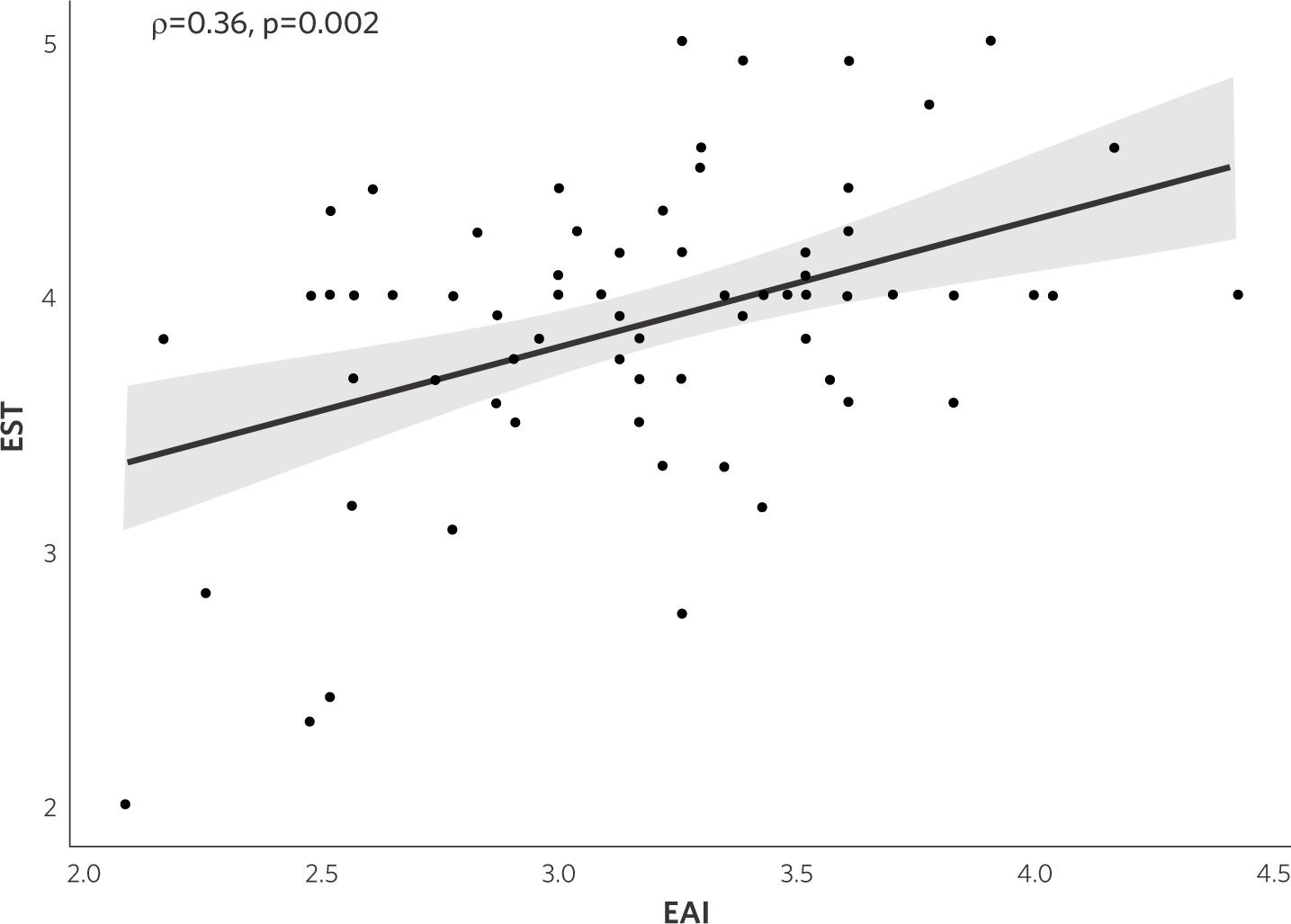
The analysis of correlations between the EAI and EST scales, considering all 71 respondents in Stage II, showed a positive trend, confirmed by the upward slope of the regression line. The Spearman correlation coefficient was 0.36 (p = 0.002), indicating a positive but weak association between the analyzed variables (figure 2).

Discussion
The study findings indicate a positive perception of the instructional procedures adopted in the course. However, they also reveal gaps in psychosocial and material support for the effective transfer of learning to professional practice, as well as a moderate perception of improvements in job performance, motivation to perform activities, and favorable attitudes toward changes in work practices.
Furthermore, ERPI-EAD scores were not significantly correlated with the other scales, suggesting relative independence between instructional procedures and the other evaluated factors. In contrast, perceived impact was associated with psychosocial support and with the consequences related to the use of newly acquired skills.
The findings of this study underscore the complexity of transferring skills developed during training to daily practice in PHC. A systematic review with meta-analysis demonstrated that continuing education activities, such as meetings and workshops, are effective in promoting changes in professional practice within PHC, although they have a more limited impact on patient outcomes21.
Accordingly, the results suggest that combining strategies, such as hybrid courses and face-to-face workshops that complement distance learning, may enhance the impact of training on professionals’ learning outcomes and potentially improve patient results21. This approach was incorporated into the evaluated program through its in-person seminars.
Similar to the program investigated in this study, the literature highlights the potential of continuing education initiatives delivered through distance learning, combining self-instructional approaches with tutoring support and complemented by face-to-face activities, as seen in Massive Open Online Courses (MOOCs). In addition to demonstrated effectiveness in knowledge acquisition across diverse topics among health professionals, studies emphasize their role in knowledge retention, although establishing causal relationships with patient health indicators remains challenging22–25.
By assessing participants’ perceptions of the QualiDCNT Program’s impact, this study advances the examination of self-reported behavioral changes as a pathway to improving outcomes related to the identification, monitoring, and treatment of users with NCDs, reinforcing the transformative potential of continuing education initiatives.
In contrast to some findings reported in the literature26, this study identified a positive association between age and reaction, as measured by the ERPI-EAD score. However, it remains unclear whether this relationship is mediated by other factors, such as the clarity and focus of the instructional approach. The literature also suggests a positive relationship between older age and greater motivation to engage in continuing education activities, indicating the potential impact of ongoing professional development27.
In contrast to the previous finding, the negative association between reaction and length of service suggests challenges faced by professionals with longer tenure, possibly related to institutional barriers within the workplace—such as the absence of a routine for continuing education activities. Prior participation in educational initiatives and well-structured instructional design are associated with greater satisfaction with current training activities28,29.
These results are consistent with the literature on continuing health education, which emphasizes the importance of aligning instructional content with local needs and contexts30, particularly through approaches that incorporate Information and Communication Technologies (ICTs) in the PHC setting31.
The positive association between holding a managerial position and higher mean EAI scores suggests that managers perceive greater course impact, possibly due to increased autonomy and decision-making power to implement changes in services. Moreover, the moderate correlations between EAI factors and the EST scale reinforce the interdependence between psychosocial support and structural resources as key determinants of successful learning transfer. These elements are closely linked to the instructional design of continuing education initiatives, as the way learning experiences are structured, including planning, teaching strategies, and interactions among peers and instructors, directly influences satisfaction, learning, and the transfer of outcomes into professional practice21,29,32–34.
Consistent with other studies35,36, the present findings underscore the need to strengthen institutional support to maximize the benefits of qualification courses in PHC, particularly for professionals directly involved in the care of people with NCDs. Strategies such as post-course follow-up, closer integration between managers and teams, and the provision of adequate material resources may facilitate the implementation of acquired competencies37.
Furthermore, the results highlight the importance of engaging leaders in the training process, given their strategic role in disseminating practices and fostering collaborative work38,39. In this regard, by including managers as participants, QualiDCNT adopted a favorable approach to expanding the course’s impact on professional practice.
This study makes relevant contributions by evaluating a training program designed to qualify PHC professionals for the care of people with NCDs, a priority within the Brazilian Unified Health System (SUS) and in the assessment of training processes. By identifying factors related to satisfaction and organizational support that enable positive changes in health practices, the findings provide valuable input for improving future initiatives. These results may guide managers and policymakers in designing and evaluating effective strategies for continuing professional development in PHC, enhancing the management of NCDs and informing needs assessment, planning, and course implementation. Moreover, by proposing strategies to strengthen psychosocial and material support, the study highlights institutional gaps and contributes to integrating in-service training into teams’ daily routines, thereby increasing the impact of such programs on care quality, complication reduction, and cost containment related to NCDs within the SUS.
Although this study presents relevant findings, some limitations should be acknowledged, including the small sample size and the inability to establish causal relationships due to the study design. However, unlike other investigations40,41, the response rate in this study was satisfactory (63.7%).
Another limitation concerns the potential influence of social desirability bias, given the reliance on self-reported measures. Future research should examine specific interventions to evaluate training program outcomes directly within health institutions, particularly regarding organizational change. Additionally, longitudinal studies are needed to assess the long-term impact of the course on PHC and to evaluate how organizational interventions influence the transfer of acquired skills to clinical practice.
Conclusions
The QualiDCNT Program contributed positively to participant satisfaction and perceived training impact; however, challenges related to organizational support remain evident and represent opportunities to enhance the practical application of acquired competencies. These findings underscore the need to consider the organizational context as an integral component of successful training initiatives, as the transfer of learning to daily practice does not occur automatically. Instead, it depends on factors such as institutional support, adequate infrastructure, and alignment between training content and workplace realities.
A grounded and critical perspective on continuing education is essential, considering that its transformative potential can only be fully realized through close alignment among training initiatives, institutional strategies, and local contexts. This requires coordinated efforts by managers, professionals, and policymakers to overcome organizational barriers and create conditions that enable effective changes in care practices.
Data availability:
The research data is available on demand, a condition justified in the manuscript
-
Financial support:
Non-existent
References
-
1 Emadi M, Delavari S, Bayati M. Global socioeconomic inequality in the burden of communicable and non-communicable diseases and injuries: an analysis on global burden of disease study 2019. BMC Public Health. 2021;21(1):1771. DOI: https://doi.org/10.1186/s12889-021-11793-7
» https://doi.org/10.1186/s12889-021-11793-7 -
2 Verguet S, Bolongaita S, Chang AY, et al. The economic value of reducing mortality due to noncommunicable diseases and injuries. Nat Med. 2024;30(11):3335-44. DOI: https://doi.org/10.1038/s41591-024-03248-4
» https://doi.org/10.1038/s41591-024-03248-4 -
3 World Health Organization. World health statistics 2020: monitoring health for the SDGs, sustainable development goals [Internet]. Geneva: WHO; 2020 [acesso em 2026 jan 15]. Disponível em: https://www.who.int/publications/i/item/9789241565707
» https://www.who.int/publications/i/item/9789241565707 -
4 Ministério da Saúde (BR). Plano de Ações Estratégicas para o Enfrentamento das Doenças Crônicas e Agravos não Transmissíveis no Brasil 2021-2030 [Internet]. Brasília, DF: Ministério da Saúde; 2021 [acesso em 2026 jan 15]. Disponível em: http://bvsms.saude.gov.br/bvs/publicacoes/plano_enfrentamento_doencas_cronicas_agravos_2021_2030.pdf
» http://bvsms.saude.gov.br/bvs/publicacoes/plano_enfrentamento_doencas_cronicas_agravos_2021_2030.pdf -
5 Alves KCG, Guimarães RA, Souza MR, et al. Evaluation of the primary care for chronic diseases in the high coverage context of the Family Health Strategy. BMC Health Serv Res. 2019;19(1):913. DOI: https://doi.org/10.1186/s12913-019-4737-2
» https://doi.org/10.1186/s12913-019-4737-2 -
6 Gomes BLA, Mota RFN, Braga RS, et al. Association between Primary Care Assessment Tool (PCAT) and Assessment of Chronic Illness Care (ACIC): a Brazilian cross-sectional study. Front Med. 2024;11. DOI: https://doi.org/10.3389/fmed.2024.1374801
» https://doi.org/10.3389/fmed.2024.1374801 -
7 Barcellos RMS, Melo LM, Carneiro LA, et al. Educação permanente em saúde: práticas desenvolvidas nos municípios do estado de Goiás. Trab Educ Saúde. 2020;18:e0026092. DOI: https://doi.org/10.1590/1981-7746-sol00260
» https://doi.org/10.1590/1981-7746-sol00260 -
8 Silva CBG, Scherer MDA. A implementação da Política Nacional de Educação Permanente em Saúde na visão de atores que a constroem. Interface (Botucatu). 2020;24:e190840. DOI: https://doi.org/10.1590/Interface.190840
» https://doi.org/10.1590/Interface.190840 -
9 Feliciano KVO, Kovacs MH, Costa IER, et al. Avaliação continuada da educação permanente na atenção à criança na estratégia saúde da família. Rev Bras Saúde Matern Infant. 2008;8:45-53. DOI: https://doi.org/10.1590/S1519-38292008000100006
» https://doi.org/10.1590/S1519-38292008000100006 -
10 Ramos JN, Rodrigues CCFM, Costa TD, et al. Educação Permanente em Saúde: uma estratégia para melhorar a identificação segura do paciente. Mundo Saúde (Impr). 2022;1-8. DOI: https://doi.org/10.15343/0104-7809.202246153160
» https://doi.org/10.15343/0104-7809.202246153160 - 11 Meneses P, Zerbini T, Abbad G. Manual de treinamento organizacional. Porto Alegre: Artmed Editora; 2009.
-
12 Araujo MCSQ, Abbad GS, Freitas TR. Evaluation of learning, reaction and impact of corporate training at work. Psicol Teor Pesqui. 2019;35:e35511. DOI: https://doi.org/10.1590/0102.3772e35511
» https://doi.org/10.1590/0102.3772e35511 -
13 Santos RA. Avaliação dos resultados de um programa de formação em qualidade em saúde e segurança do paciente em hospitais do estado de Minas Gerais [tese na Internet]. Rio de Janeiro: Escola Nacional de Saúde Pública, Fundação Oswaldo Cruz; 2018 [acesso em 2025 set 18]. 277 p. Disponível em: https://pesquisa.bvsalud.org/portal/resource/pt/ens-36705
» https://pesquisa.bvsalud.org/portal/resource/pt/ens-36705 -
14 Elm E, Altman DG, Egger M, et al. The Strengthening the Reporting of Observational Studies in Epidemiology (STROBE) Statement: Guidelines for reporting observational studies. Int J Surg [Internet]. 2014;12(12):1495-9. DOI: https://doi.org/10.1016/j.ijsu.2014.07.013
» https://doi.org/10.1016/j.ijsu.2014.07.013 -
15 Projeto QualiDCNT [Internet]. Goiânia (GO): Universidade Federal de Goiás. [acesso em 2025 set 18]. Disponível em: https://projetoqualidcnt.fen.ufg.br/
» https://projetoqualidcnt.fen.ufg.br/ -
16 Martins LB, Zerbini T, Medina FJ. Escala de reação ao curso em educação a distância: adaptação e estrutura fatorial. Psicol Teor Prática. 2018;20(1):211-22. DOI: https://doi.org/10.5935/1980-6906/psicologia.v20n1p223-234
» https://doi.org/10.5935/1980-6906/psicologia.v20n1p223-234 -
17 Abbad GS, Sallorenzo LH. Desenvolvimento e validação de escalas de suporte à transferência de treinamento. Rev Adm [Internet]. 2001 [acesso em 2026 jan 15];36(2):36-45. Disponível em: http://rausp.usp.br/wp-content/uploads/files/v36n2p33a45.pdf
» http://rausp.usp.br/wp-content/uploads/files/v36n2p33a45.pdf - 18 Abbad GS, Mourão L, Meneses PPM, et al. Medidas de avaliação em treinamento, desenvolvimento e educação: ferramentas para gestão de pessoas. Porto Alegre: Artmed Editora; 2012.
-
19 Martins LB, Zerbini T. Evidências de validade de instrumentos de reações no ensino superior à distância. Estud Pesqui Psicol [Internet]. 2015 [acesso em 2025 set 18];15(1):116-34. Disponível em: https://pepsic.bvsalud.org/scielo.php?script=sci_arttext&pid=S1808-42812015000100008
» https://pepsic.bvsalud.org/scielo.php?script=sci_arttext&pid=S1808-42812015000100008 -
20 Ali Abd Al-Hameed K. Spearman’s correlation coefficient in statistical analysis. Int J Nonlinear Anal Appl. 2022;13(1):3249-55. DOI: https://doi.org/10.22075/ijnaa.2022.6079
» https://doi.org/10.22075/ijnaa.2022.6079 -
21 Forsetlund L, O’Brien MA, Forsén L, et al. Continuing education meetings and workshops: effects on professional practice and healthcare outcomes. Cochrane Database Syst Rev. 2021;(9). DOI: https://doi.org/10.1002/14651858.CD003030.pub3
» https://doi.org/10.1002/14651858.CD003030.pub3 -
22 Longhini J, Rossettini G, Palese A. Massive open online courses for nurses’ and healthcare professionals’ continuous education: a scoping review. Int Nurs Rev. 2021;68(1):108-21. DOI: https://doi.org/10.1111/inr.12649
» https://doi.org/10.1111/inr.12649 -
23 Eglseer D. Development and evaluation of a Massive Open Online Course (MOOC) for healthcare professionals on malnutrition in older adults. Nurse Educ Today. 2023;123:105741. DOI: https://doi.org/10.1016/j.nedt.2023.105741
» https://doi.org/10.1016/j.nedt.2023.105741 -
24 Nieder J, Nayna Schwerdtle P, Sauerborn R, et al. Massive open online courses for health worker education in low-and middle-income countries: a scoping review. Front Public Health. 2022;10:891987. DOI: https://doi.org/10.3389/fpubh.2022.891987
» https://doi.org/10.3389/fpubh.2022.891987 -
25 Dagenais C, Hot A, Bekelynck A, et al. MOOC-based blended learning for knowledge translation capacity-building: A qualitative evaluative study. PLoS One. 2024;19(2):e0297781. DOI: https://doi.org/10.1371/journal.pone.0297781
» https://doi.org/10.1371/journal.pone.0297781 -
26 Araujo MCSQ, Abbad GS, Freitas TR. Avaliação de aprendizagem, reação e impacto de treinamentos corporativos no trabalho. Psicol Teor Pesqui. 2019;35:e35511. DOI: https://doi.org/10.1590/0102.3772e35511
» https://doi.org/10.1590/0102.3772e35511 -
27 Sade PMC, Peres AM, Zago DPL, et al. Avaliação dos efeitos da educação permanente para enfermagem em uma organização hospitalar. Acta Paul Enferm. 2020;33:eAPE20190023. DOI: https://doi.org/10.37689/acta-ape/2020AO0023
» https://doi.org/10.37689/acta-ape/2020AO0023 -
28 Gonçalves GCC, Pascon DM, Messias M, et al. Preditores de crenças no processo de avaliação das ações educacionais à equipe de saúde. Rev Enferm UFSM. 2019;9:1-25. DOI: https://doi.org/10.5902/2179769229250
» https://doi.org/10.5902/2179769229250 -
29 Muñoz-Castro FJ, Valverde-Gambero E, Herrera-Usagre M. Predictors of health professionals’ satisfaction with continuing education: A cross-sectional study. Rev Latino-Am Enfermagem. 2020;28:e3315. DOI: https://doi.org/10.1590/1518-8345.3637.3315
» https://doi.org/10.1590/1518-8345.3637.3315 -
30 Du B. Research on the factors influencing the learner satisfaction of MOOCs. Educ Inf Technol. 2023;28(2):1935-55. DOI: https://doi.org/10.1007/s10639-022-11269-0
» https://doi.org/10.1007/s10639-022-11269-0 -
31 Bender JD, Facchini LA, Lapão LMV, et al. O uso de Tecnologias de Informação e Comunicação em Saúde na Atenção Primária à Saúde no Brasil, de 2014 a 2018. Ciênc saúde coletiva. 2024;29(1):e19882022. DOI: https://doi.org/10.1590/1413-81232024291.19882022
» https://doi.org/10.1590/1413-81232024291.19882022 -
32 Militello LK, Gance‐Cleveland B, Aldrich H, et al. A methodological quality synthesis of systematic reviews on computer‐mediated continuing education for healthcare providers. Worldviews Evid Based Nurs. 2014;11(3):177-86. DOI: https://doi.org/10.1111/wvn.12041
» https://doi.org/10.1111/wvn.12041 -
33 Rajabalee YB, Santally MI. Learner satisfaction, engagement and performances in an online module: Implications for institutional e-learning policy. Educ Inf Technol. 2021;26(3):2623-56. DOI: https://doi.org/10.1007/s10639-020-10375-1
» https://doi.org/10.1007/s10639-020-10375-1 -
34 Moreira GE, Oliveira MAM, Lopes AV, et al. Concepção de suporte organizacional e intenção de rotatividade com base na literatura. Soc Cult. 2018;21(1):219-31. DOI: https://doi.org/10.5216/sec.v21i1.54932
» https://doi.org/10.5216/sec.v21i1.54932 -
35 Karan A, Hussain S, Jensen LX, et al. Non-communicable diseases, digital education and considerations for the Indian context – a scoping review. BMC Public Health. 2024;24(1):1280. DOI: https://doi.org/10.1186/s12889-024-18765-7
» https://doi.org/10.1186/s12889-024-18765-7 -
36 Rakhra A, Hooley C, Fort M, et al. The WHO-TDR dissemination and implementation massive open online course (MOOC): Evaluation and lessons learned from eight low-and middle-income countries. Res Square. 2022. DOI: https://doi.org/10.21203/rs.3.rs-1455034/v1
» https://doi.org/10.21203/rs.3.rs-1455034/v1 -
37 Pant HV, Lohani MC, Pande J. Exploring the factors affecting learners’ retention in MOOCs: A systematic literature review. Int J Inf Commun Technol Educ. 2021;17(4):1-17. DOI: https://doi.org/10.1016/j.compedu.2016.03.016
» https://doi.org/10.1016/j.compedu.2016.03.016 -
38 Hudak NM, Heflin MT, McNeill D. Increasing Interprofessional Education Experiences and Collaboration: Outcomes of a Virtually-Based Continuing Education Program. J Interprof Educ Pract. 2024;100730. DOI: https://doi.org/10.1016/j.xjep.2024.100730
» https://doi.org/10.1016/j.xjep.2024.100730 -
39 King R, Taylor B, Talpur A, et al. Factors that optimise the impact of continuing professional development in nursing: A rapid evidence review. Nurse Educ Today. 2021;98:104652. DOI: https://doi.org/10.1016/j.nedt.2020.104652
» https://doi.org/10.1016/j.nedt.2020.104652 -
40 Wachelke J, Natividade J, Andrade A, et al. Caracterização e avaliação de um procedimento de coleta de dados online (CORP). Aval Psicol [Internet]. 2014 [acesso em 2026 jan 15];13(1):143-6. Disponível em: https://pepsic.bvsalud.org/scielo.php?script=sci_arttext&pid=S1677-04712014000100017
» https://pepsic.bvsalud.org/scielo.php?script=sci_arttext&pid=S1677-04712014000100017 -
41 Huang X, Gao Y, Chen H, et al. Hospital Culture and Healthcare Workers’ Provision of Patient-Centered Care: A Moderated Mediation Analysis. Front Public Health. 2022;10:919608. DOI: https://doi.org/10.3389/fpubh.2022.919608]
» https://doi.org/10.3389/fpubh.2022.919608
Edited by
-
Editor in charge:
Ingrid D’avilla Freire Pereira, Fundação Oswaldo Cruz (Fiocruz), Rio de Janeiro (RJ), Brasil. Lattes: http://lattes.cnpq.br/5474471781659941, Orcid: https://orcid.org/0000-0002-2042-2871, e-mail: ingriddavilla@gmail.com

 Source: Prepared by the authors.
 Source: Prepared by the authors.EST: Psychosocial Support and Training Transfer Scales. EAI: Self-Assessment Impact Scale.