 Relationships that promote and threaten family hope during pregnancy and care for high-risk newborns
ABSTRACT
Objective: To understand the relationships that promote and threaten family hope during pregnancy and in the care of high-risk newborns.
Method: Qualitative research, guided by the theoretical framework of Understanding the Complex Nature of Hope, carried out between December 2021 and March 2022, with 28 members of 14 families attended at a multidisciplinary outpatient clinic for at-risk newborns in Minas Gerais, Brazil. Data obtained from interviews in thematic oral history allowed the construction of narratives, genograms and ecomaps, which were subjected to deductive thematic analysis procedures.
Results: The study highlighted relationships that promote and threaten family hope. Conflicting relationships, insecurity, indifference to the situation and unavailability to build bonds threatened hope. Reciprocity, attachment, relationship with God, self-confidence and protection of the newborn were constituent elements of relationships that promote hope during pregnancy and neonatal care.
Conclusion: Family hope was constructed and given new meaning in intrapersonal and interpersonal relationships. Despite the uncertainties experienced by families, hope was strengthened in the relationship with oneself, with family members, professionals and with the transcendent, generating intimidation and a feeling of belonging. Knowing this context can help nurses promote family hope, through attentive and resolute listening, assertive guidance on gestational and neonatal risk, and support in neonatal care.
Descriptors:
Hope; Family; High-risk pregnancy; Newborn infant; Nursing research
RESUMO
Objetivo: Compreender as relações promotoras e ameaçadoras da esperança familiar na gestação e nos cuidados com o neonato de risco.
Método: Pesquisa qualitativa, orientada pelo referencial teórico de Entendimento da Natureza Complexa da Esperança, realizada entre dezembro de 2021 e março de 2022, com 28 integrantes de 14 famílias atendidas em um ambulatório multiprofissional de atenção ao neonato de risco em Minas Gerais, Brasil. Dados obtidos a partir de entrevista em história oral temática permitiram a construção de narrativas, genogramas e ecomapas, os quais foram submetidos aos procedimentos da análise temática dedutiva.
Resultados: O estudo evidenciou as relações promotoras e ameaçadoras da esperança familiar. Relações conflituosas, de insegurança, de indiferença à situação vivida e de indisponibilidade para construção de vínculos ameaçaram a esperança. Reciprocidade, vinculação, relação com Deus, autoconfiança e proteção com o neonato foram elementos constituintes de relações promotoras da esperança na gestação e nos cuidados neonatais.
Conclusão: A esperança familiar foi construída e ressignificada nas relações intrapessoais e interpessoais. Apesar das incertezas vivenciadas pelas famílias, a esperança foi fortalecida na relação consigo mesmo, com familiares, profissionais e com o transcendente, gerando intimidade e sentimento de pertencimento. Conhecer este contexto, pode auxiliar os enfermeiros na promoção da esperança familiar, através de uma escuta atenta e resolutiva, orientações assertivas sobre o risco gestacional e neonatal e apoio nos cuidados.
Descritores:
Esperança; Família; Gravidez de alto risco; Recém-nascido; Pesquisa em enfermagem
RESUMEN
Objetivo: Comprender las relaciones que promueven y amenazan la esperanza familiar durante el embarazo y en el cuidado del recién nacido de alto riesgo.
Método: Investigación cualitativa, guiada por el marco teórico de Comprender la naturaleza compleja de la esperanza, realizada entre diciembre de 2021 y marzo de 2022, con 28 miembros de 14 familias atendidos en un ambulatorio multidisciplinario para recién nacidos en riesgo en Minas Gerais, Brasil. Los datos obtenidos de entrevistas en historia oral temática permitieron la construcción de narrativas, genogramas y ecomapas, los cuales fueron sometidos a procedimientos de análisis temático deductivo.
Resultados: El estudio destacó las relaciones que promueven y amenazan la esperanza familiar. Las relaciones conflictivas, la inseguridad, la indiferencia ante la situación y la falta de disponibilidad para construir vínculos amenazaron la esperanza. La reciprocidad, el apego, la relación con Dios, la confianza en sí mismo y la protección del recién nacido fueron elementos constitutivos de las relaciones que promueven la esperanza durante el embarazo y el cuidado.
Conclusión: La esperanza familiar fue construida y resignificada en las relaciones intrapersonales e interpersonales. A pesar de las incertidumbres vividas por las familias, la esperanza se fortaleció en la relación con uno mismo, con los familiares, con los profesionales y con lo trascendente, generando intimidación y sentimiento de pertenencia. Conocer este contexto puede ayudar al enfermero a promover la esperanza familiar, a través de una escucha atenta y resuelta, una orientación asertiva sobre el riesgo gestacional y neonatal y un apoyo en el cuidado.
Descriptores:
Esperanza; Familia; Embarazo de alto riesgo; Recién nacido; Investigación en enfermería
INTRODUCTION
There are different approaches to hope1. In this study, it is understood as an experience of meaning and purpose for life, encompassing aspirations for improvement of the situation, with desires for change and positive thinking2. In daily health care, the construction of thoughts, behaviors, and relationships of hope can be influenced by health professionals, especially the nursing team, based on information provided, effective communication, and care practices1. These strategies may contribute to better coping and family adjustment in adverse situations3.
Regarding caring for a high-risk pregnancy and birth, family members experience several challenges, from discovering the gestational and/or neonatal risk to continuing to care for the newborns3. This experience may involve hospitalization of the mother and newborn, generating physical and psychological overload, both maternal and family4,5. However, these situations can be transformed into positive experiences when some feelings and thoughts enable hope and strategies for family strengthening6,7. An important resource for mobilizing and influencing family hope is the relationships that caregivers build with themselves and others, including health professionals. However, such relationships can either promote or threaten hope8. Thus, in situations of illness or gestational and neonatal risk, the relationships established by families can make the situation experienced positive or negative, triggering balances or imbalances in intrafamily relationships2,5.
Hope is part of the set of nursing diagnoses, that is, it is part of an action recognized as an object of care for this profession, as it contributes to the comprehensiveness and continuity of health care9. Therefore, nursing practices that consider and support hope can minimize the challenges imposed by the uncertainties experienced during pregnancy and neonatal care3.
The theme of family hope has been explored in nursing investigations in the context of palliative care4,5, care for children with chronic conditions or complex chronic conditions5,7. There are studies on inter and intrapersonal relationships, which favor or not family hope, in situations of illness, risks or crises, but there is a gap on how this happens in the context of pregnancy and care for at-risk newborns4,5,10.
In addition to this gap, priorities for research in neonatal nursing have indicated the need for studies that include different care contexts, cultures, and family compositions5-7. Thus, investigating family hope, as well as relationships that promote or threaten hope, in the context of pregnancy and high-risk newborns, broadens understanding in this field, supports clinical practice, and points to new studies. Given the above, the following questions were asked: how are the interactions and relationships that promote and threaten family hope in situations involving pregnancy and a high-risk newborn? How do interpersonal and intrapersonal relationships affect family hope during pregnancy and care of a high-risk newborn? Thus, the present study aimed to gain insight into the relationships that promote and threaten family hope during pregnancy and care of high-risk newborns.
METHOD
Qualitative interpretative study based on the theoretical framework of Understanding the Complex Nature of Hope2, according to which social interactions, intrapersonal and interpersonal relationships, and self-transcendence mark the experience of hope.
Families of at-risk newborns, whose mothers had their pregnancies assessed as high-risk 11, participated in the study. Family is understood here as a relational structure composed of individuals with emotional and/or biological bonds with each other, with mutual commitment, identity of life projects, and common purposes. The bonds between members of this group can be genetic or symbolic10.
The study setting was the homes of these families and the multidisciplinary outpatient clinic of the Advanced Early Intervention Program (PIPA), a reference for care for newborns at risk in the center-west of Minas Gerais, Brazil. The service monitors newborns and children at risk up to 2 years of age and carries out an average of 192 consultations each quarter.
The inclusion criteria for participants were: (a) families with children aged between 6 and 12 months during the collection, with enough time to share the experience through oral stories and with the establishment of a time limit between birth and interview, (b) who were being monitored by the reference center for care of newborns at risk, whose mothers had pregnancies classified as high risk11. The following were excluded: (a) families in which the mothers were under 18 years of age, (b) women classified as having high-risk pregnancies due to issues such as depression or mental disorders, (c) families of women who had depression or mental distress up to 45 days after giving birth. The justification for the last two exclusion criteria is that the interview could bring up memories, suffering or embarrassment for the women and/or their families.
After the analysis of 146 outpatient records, 60 families were considered pre-eligible. First, the families were approached via a telephone call, in which the objective of the research was explained to them. Of these, 24 families did not respond to the invitation and five refused to participate in the study. Therefore, 31 families showed interest in participating in the research. However, after the inclusion of the 14th family, interviews were discontinued due to theoretical data saturation12,13.
To establish the moment when data saturation has been reached, content analysis of the interviews was carried out simultaneously with data collection14,15. Twenty-eight family members from 14 families participated in the study, including: 13 mothers, 6 fathers, 4 aunts, 3 grandmothers, 1 godmother and 1 sister. Once data saturation was confirmed, the 17 families who expressed interest in participating and who were not part of the interviewed group were contacted again. In this new contact, they were informed that the interviews would not be scheduled, as had been explained in the first phone call, due to data saturation. Thematic oral history interviews were conducted for data collection. Oral history is a method of recording and studying social experience, both of groups and communities and of individuals. It is based on the concepts of experience and narrative, as through specific procedures it reveals a certain experience in a narrative way12,14.
The thematic oral history interview was supported by a guide with questions regarding the characterization of family composition, gestational and neonatal risk, and the internal relationship of the family context. The guide also included open-ended questions related to the family's experience of hope during pregnancy and in caring for the high-risk newborn and related to the family's interaction pattern, interpersonal relationships, and each family member's relationship with themselves, such as: What do you understand by hope? In your experience with pregnancy, labor, and birth, tell me how hope was present during the journey of caring for (child's name). Describe interpersonal relationships that strengthened or threatened hope present during pregnancy, in caring for (child's name), to the present day. Who or what has strengthened or threatened your hope from gestation to the present day?
Data were collected at PIPA and at families' homes between December 2021 and March 2022. The interviews were conducted by authors BCL and ROC, who had experience in qualitative studies. Although they had not previously worked in this setting, they both sought to get to know it better, as well as the families, under the guidance of researcher PPB, who had a previous connection with PIPA and the families. The average length of each oral history interview was approximately 45 minutes.
The interviews were recorded with prior authorization from the participants. The data collected were treated securely, to guarantee confidentiality, secrecy, and anonymity at all stages of the study. To ensure the anonymity of the participants, during the interview, only the interviewer and the participants were in the room, with no third parties present. Furthermore, the most appropriate moment, time, condition, and location were chosen, both at home and at PIPA, to conduct the interviews, considering the peculiarities of the caregivers and their family dynamics.
After transcription of interviews into oral history, narratives12 were constructed for each family, which were subjected to deductive thematic analysis16. Thus, the first stage of this analysis consisted of becoming familiar with the narratives constructed, through exhaustive readings, after their validation by more than one researcher. In the second stage, a code dictionary was created, covering the dimensions of the theoretical model. The code dictionary is a structure, defined by the researchers, to guide what will be treated in the data under analysis, that is, definitions that support or exemplify the theoretical contribution of the research17. To validate the code dictionary, a narrative was analyzed simultaneously by three researchers with expertise in the model. After this analysis, adjustments were needed in the dictionary, and a new coding process was carried out for another narrative, which allowed the identification of a conceptual alignment between the researchers and the representativeness of the codes according to the theoretical model adopted.
The narrative coding process was then carried out. Two researchers independently carried out the coding process of a first interview and presented the coding to a third researcher. Four rounds of coding were necessary to identify any incongruence in the process. Subsequently, the narratives were analyzed by the researchers and any discrepancies or doubts were resolved in a meeting with a third researcher. This favored the process of reliability in coding16. The process revealed two categories that will be shown in the results.
In addition to the narratives, the data collected allowed the structural elaboration of genograms and ecomaps of the families included in the study, favoring an understanding of the family composition and its relationship with the community18. The construction of these instruments was supported by a study that represented the hope of families of children with chronic conditions, through the ecomap and genogram19 and, from this perspective, it was possible to represent, schematically, relationships that promote and threaten the hope of the families included.
In compliance with the scientific criteria, we clarify that in this study credibility was made possible by rigorous analyses conducted simultaneously with the data collection process, In compliance with the scientific criteria, we clarify that in this study, credibility was made possible by rigorous analyses conducted simultaneously with the data collection process, supported by narratives and the construction of instruments of relationships of hope. Reliability was observed after a detailed description of the method, following the Consolidated Criteria for Reporting Qualitative Research (COREQ) checklist. Confirmability was contemplated and guaranteed, considering the presentation of the study's strengths and limitations20,21.
The study was conducted in accordance with the ethical aspects that guide the development of research involving human beings in Brazil. It was approved by the Human Research Ethics Committee of the proposing institution Fundação Universidade Federal de São João Del Rei - C. C. Oeste Dona Lindu, number CAAE 51866821.4.0000.5545 registered on Plataforma Brasil, and approved under Protocol no 5,119,278. All participants were informed about the purpose of the research and signed the Free and Informed Consent Form (FICF) before data collection began.
RESULTS
The study consisted of 28 participants from 14 families with at-risk newborns. Data analysis made it possible to present the characterization and composition of families, and gestational and neonatal risk, as shown in Chart 1.
Of the 28 study participants, 46.4% (n = 13) were biological mothers, 21.4% (n = 6) parents, 14.3% (n = 4) aunts, 10.7% (n = 3) grandparents, 3.6% (n = 1) godmothers, and 3.6% (n = 1) sisters. The age range of the participants varied between 25 and 56 years.
The analysis of the ecomaps and genograms showed that family structures were not only represented by the nuclear family (father, mother and children), but also by the extended family, consisting of grandparents, uncles, siblings and other kinship relations. Data analysis revealed two patterns of interaction linked to family hope: relationships that promote and threaten hope.
Relationships that promote hope
Family members identified spirituality and religiosity, through the relationship with God, as a factor that promotes hope in the context of the experience lived. This relationship was present from the mother's high-risk pregnancy until the days when the study was carried out and was sustained through feelings of strength and peacefulness. Furthermore, the sense of belongingness, which in this study may refer to a need to maintain a stable relationship with God, was also present in the participants' statements.
God was my refuge in all situations of despair [...] He was present with me the whole time, and that made me feel more relaxed, calm, and always gave me hope. (Aunt 5)
We often pray together (referring to the family). This brings us closer to God [...] that's what gave us strength when he was hospitalized. (Mother 8)
God is always good. My relationship with Him is lasting and deep. I have Him with me every day, in the days of glory and the days of struggle. (Father 1)
Self-confidence behaviors and adoption of attitudes, such as positive thinking, were also used as mechanisms to strengthen the intrapersonal relationship of hope. Many family members reported having been their own point of support and action, especially during the pregnancy and birth of high-risk newborns:
It's positive thinking [...] it's really trying to control my thoughts, you know? That helps me a lot. (Mother 4)
There are times when it's just you, right? I was optimistic. I trusted myself and I was strong. That helped me have hope. (Father 1)
The relationship with health professionals, including nurses, doctors and psychologists, also had a positive influence on family hope, gestational care for high-risk newborns and care for family members themselves. This happened thanks to the feeling of empathy in the professionals' attitudes, such as sharing information, listening attentively and welcoming. These factors were considered to be a strength to the family experience:
Health professionals help a lot and even indirectly, a word of support is already hope, right? Sometimes just listening to our distress is enough, it gives us hope. (Mother 3)
The person who gave me hope was the nurse at the hospital. He left the hospitalization ward and the guidance he gave me, the information that everything was fine, what had to be done [...] that alone gave me hope. (Father 1)
For some participants, the health services they attended could be considered sources of hope during the trajectory of gestational and neonatal risk. This relationship with the service seemed to be strengthened through actions such as access to assistance and adequate structures for care:
I have a powerful bond with PIPA that gives me hope. At each appointment, health professionals make us feel more at ease, which renews our hope. (Mother 14)
The Neonatal ICU was a source of hope. The environment that favors their care [twins], right? Getting there and knowing that they were well taken care of. This gave us peace of mind every day. (Father 13)
The strengthening of hope was triggered in the relationship with the newborns themselves, by the feeling of protection from family members and their need to meet the demands for the care of newborns. During the coexistence, the role of family members in caring for the children further increased the bond, and this strengthened hope:
He is our little point of light, of hope, you know? We are very careful. Perhaps too careful. (Paternal sister 4)
When we love, we look after. The care I give to them [twins], being with them every day gives me hope. (Father 13)
As demonstrated in the analysis, in intrafamily relationships, hope was strengthened through the feeling of trust with others, in attitudes such as attentive listening, and the demonstration of help from family members, from high-risk pregnancies to the daily care for newborns:
When we found out that the baby was going to be born with the infection, the first person I looked at, who was there by my side, was my mother […] Just looking at her gave me hope, made me see a light at the end of the tunnel. The look in her eyes gave me confidence, you know? (Mother 9)
The person who gave me hope and continues to give me hope today is my wife. It's that supportive relationship, of listening to each other, just being there and listening brings peace and hope. (Father 5)
Relationships that threaten hope
In the context of intrapersonal relationships, insecurity with oneself was considered a threatening element, in the sense that there was no self-confidence and it was not possible to establish attitudes and strategies in the face of challenges. This was present both in the discovery of the high-risk pregnancy and in the daily care of the high-risk newborn, in carrying out ordinary tasks and in personal fulfillment:
I myself discouraged my hope sometimes when I was sad. I couldn't do anything, I couldn't deal with being the father of an at-risk child. (Father 1)
It's bad because we fight a battle with ourselves […] and become hopeless. We can't hope for anything. (Godmother 2)
The analysis showed that in some cases, intrapersonal relationships of insecurity gained strength due to the lack of information and connection with health professionals when faced with the discovery of gestational risk and the possibility of having a high-risk newborn, which became a threat to hope.
In fact, we feel very insecure when we face a high-risk pregnancy, you know? This changes the whole context, right, of the pregnancy […] and then we feel even more insecure because our companions do not transmit security. We are at a dead end. (Mother 2)
I think the main reason for my inner confusion, for feeling insecure, was the fact that I didn't receive much information about what was going to happen from then on, when my blood pressure started to rise. (Mother 14)
The relationship with health professionals, including nurses, doctors, and psychologists, could also negatively impact family hope. Some participants experienced situations in which health professionals, through attitudes such as indifference, lack of interaction, and decisions not shared with the family, triggered situations of hopelessness:
The doctor told me to do the curettage without carrying out an examination to see if they [twins] were alive… I had a curettage and despite that, 15 days later I saw that my children were still alive. It was very threatening to hope. (Mother 9)
When we found out about the pregnancy risk, due to rubella, the doctor didn't give us any guidance. He didn't even tell me what it was about, he sent me to the high-risk care [...] and then I got lost, after the baby was born too. They just told me that she needed to be kept under observation and go to the outpatient clinic. (Father 12)
While the relationship with the family could be a factor that promotes hope, the analysis revealed that intrafamily relationships also generated hopelessness, through discouragement attitudes in the context of gestational and neonatal risk:
It was definitely my family who threatened my hopes. When I found out I had syphilis while I was still pregnant, they told me that the baby would have birth defects, and that I had better start preparing myself. It was horrible. (Mother 2)
When I found out that curettage might be necessary because they [the twin children] might not be alive, my husband told me not to have hope. Because otherwise, I would suffer more [...] so, yes, I see this as a threat to hope (Mother 9)
Intrafamily conflicts and crises or losses, such as the death of a family member, were described as threats to hope:
My difficult relationship with her father made me lose faith in everything. I had no hope. Everything was wrong, I couldn't have dreams, I couldn't think positively. (Mother 5)
We [the newborn's father and I] fought a lot, you know, even after the birth, and even today. So I thought that was a factor of despair for me. It threatened my hope because I had no support at all. (Mother 13)
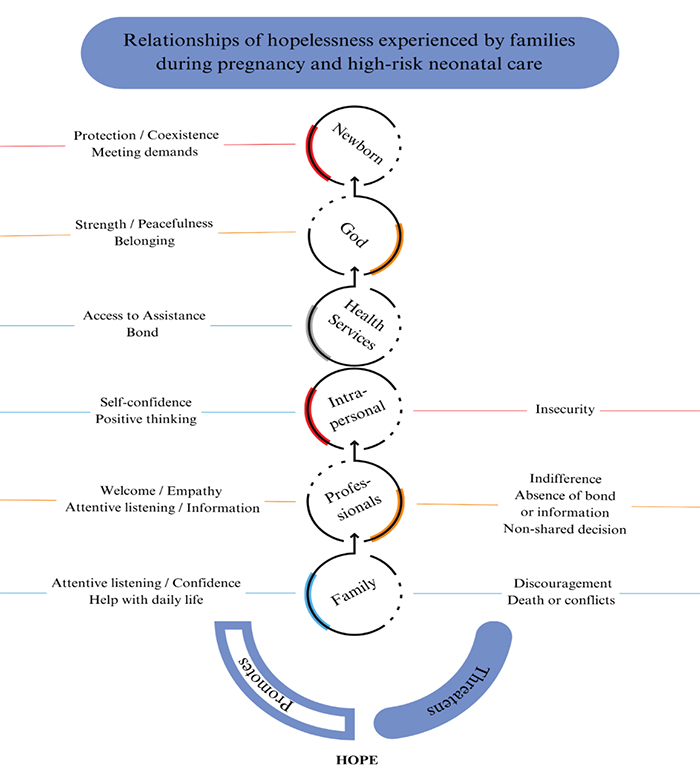
The results show that social relationships, interdependence, mutuality, emotional bonds, and intimacy were present in the lived experiences. These relationships were manifested in different ways, intertwined with attitudes/behaviors and feelings that could either collaborate or threaten hope. Figure 1 shows a summary of the main results found.

Presentation of relationships and attributes that promote or threaten family hope. Divinópolis, Minas Gerais, Brazil, 2023
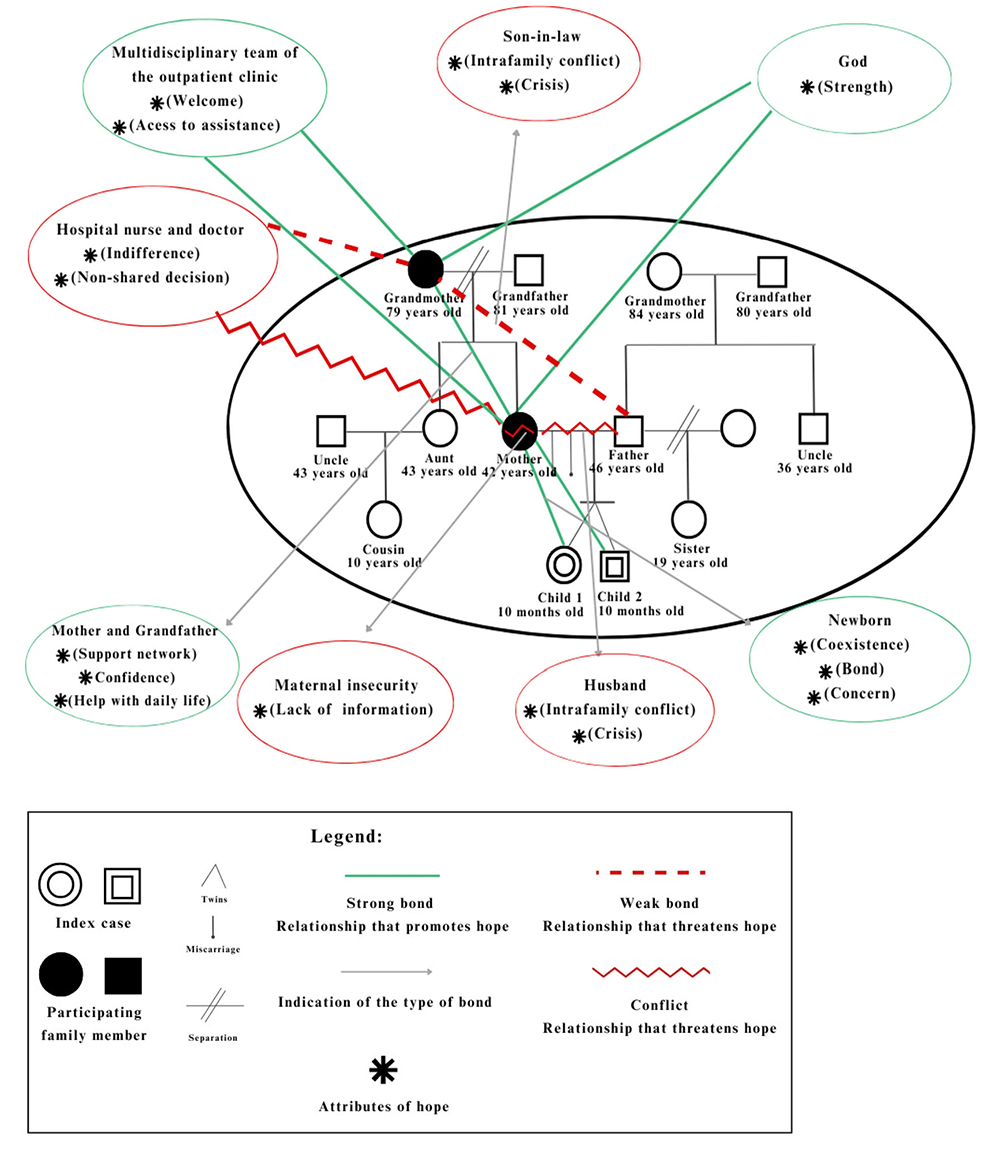
The genogram and ecomap of family F9, shown in Figure 2, exemplify relationships considered to be hope-promoting and hope-threatening.
Presentation of the genogram and ecomap of hope in the F9 family that illustrates the relationships and attributes that promote and threaten hope. Divinópolis, Minas Gerais, Brazil, 2023
DISCUSSION
Data analysis confirmed the premise of this study, demonstrating that family experiences of hopelessness during pregnancy and care for at-risk newborns are influenced by interpersonal and intrapersonal relationships, and can be a source of strengthening or threatening hope. It is clear that hope is also built and strengthened through these relationships, and this is one of the assumptions of the adopted theoretical framework, that advocates interactions and relationships as binding components of hope2.
There are indications that hope was built through relationships with oneself and with others, which directly influenced the care of at-risk newborns. This is based on the theoretical framework adopted, which shows that hope is built in the presence of social interactions, reciprocities, interdependence, bonding, intimacy, and also in self-transcendence2.
The decision to organize the data based on narratives, genograms, and ecomaps provided an expanded and in-depth understanding of reality. It also contributed to interpreting the patterns of interaction and relationships of hope existing in the family system. It can be inferred from the results and international literature that the preparation and interpretation of genograms and eco-maps of hope can support nurses in promoting family hope, especially in contexts of gestational and neonatal risk2,19.
This study demonstrated that each child's neonatal risk was contextualized based on the risk presented by the mother during pregnancy. This is consistent with international studies that have shown the same perspective, highlighting the importance of studying family structure and context, including the obstetric profile of women and the condition of their newborns during birth, as the sooner these risks are detected, the better the prognosis and neonatal condition will be, and it will be possible to plan care that promotes hope22,23.
The intrapersonal relationships attributed to hope by the family members who participated in this study involve ambivalent feelings, overcome through the relationship with God, constituting strategies that promote hope and suggesting that it is strengthened by the practices of spirituality and religiosity2,24. This characteristic appeared in the results of an Asian study, showing that the experience of caring for a family member at risk awakens meanings and senses of life directed toward hope. The latter can be based on the relationship with God, such as attending church and praying, minimizing negative emotions, and strengthening positive feelings such as strength, peace, and belonging25.
The feeling of self-confidence and positive attitudes and thoughts strengthened the personal relationships of individuals. Studies show, and are corroborated by the framework of understanding the complex nature of hope2, that this posture can be associated with an attempt to be strong, due to the entire process experienced, and can prove to strengthen hope5,26,27.
It became evident that experiencing adverse situations during pregnancy and in caring for at-risk newborns impacts the feeling of hope, providing learning and reflections on the meaning of life and attitudes oriented towards the future. Despite this, due to contextual uncertainties, insecurity was a feeling of hopelessness that also involves the intrapersonal relationship, being sustained by relationships of threat to oneself, influencing the coping with experiences and daily activities10.
Family insecurity was also supported by attitudes such as lack of information and connection with health professionals at the time of discovery of the high-risk pregnancy and the possibility of risk involving newborns. In this context, it is important to consider that the family experiences an unexpected and difficult change and may react in different ways, impacting the process of accepting the real baby and getting involved in the care routine28.
This demands the development of coping strategies by the family, and in this study, despite the uncertain hope and the binding dimension2 in the discovery of risk, focused on negative feelings, the need to establish relationships and interactions to support family members is highlighted, such as attentive listening, bonding and the provision of adequate guidance, from prenatal care to assistance to the newborn and their family after birth2,22.
In interpersonal relationships that promote hope, it was evident that the bond between the health professional and the family member, through attitudes such as providing information and attentive listening, was considered a positive resource. It is necessary for the professional to be attentive to the demands of those family members and to the response to the situation of gestational and neonatal risk, as a way of promoting bonding, acceptance and empathy10,29.
The fact that professionals dialogue and maintain assertive relationships with caregivers becomes a strategy that will contribute to both the promotion and maintenance of hope and may support interactions of reciprocity2 and intimacy2), as advocated by the theoretical framework adopted in this investigation.
One of the resources for promoting hope also identified in this study is provided by access to care and the fact that the health professional, especially the nurse, is close to the pregnant woman at risk or the newborns and their families, in the different health services. A study with parents of at-risk children revealed that nursing professionals, when present during care, available and attentive, talking, listening, encouraging, and dedicating themselves to the care of the child and family, strengthen hope29. Based on data analysis, it can be inferred that nursing practices can promote hope and positively influence families in facing and adjusting to challenges in the context of risk. Thus, the care strategies that promote family hope and more assertive interactions with families include guidance on gestational and neonatal risk and available resources, adequate social support for the family including active listening, recourse to spirituality, gaining experience and mastery of newborn care and valuing positive aspects experienced in the present.
On the other hand, the type of care offered by health professionals may threaten hope, when the family and/or parents are disregarded or ignored in the decision-making processes. The lack of assertive communication and provision of adequate information was also identified as an attitude that discourages hope concerning the situations experienced. Therefore, health professionals must welcome this group and understand their subjectivities 29.
A strategy that can help change the negative relational pattern between family members and professionals is the appropriate approach to delivering bad news. Dealing with this world full of peculiarities and the amount of complex information given to family members leads us to some reflections, among them is the need to acquire knowledge about technologies and devices necessary for qualified communication at the time of diagnosis28. Therefore, knowing how to communicate with family members assertively and attentively is a way of strengthening and promoting family hope, which can change the situation, making it positive.
The interpersonal relationship of the participants with at-risk newborns, in daily coexistence and in meeting their demands, was perceived as a source that stimulates existence and awakens the belief in better times, and this refers to reciprocity, interdependence and intimacy, highlighted in the theoretical framework as constituents of hope2. European studies obtained similar results when they stated that hope is driven and maintained by the strong relationship between newborn and caregiver, and this enables the creation of bonds and a feeling of protection10,19. This is in line with the theoretical framework adopted in the present study, as it contributes to care and the development of realistic objectives, impacting the present and strengthening belief in the future2,10.
In this research, intrafamily relationships are highlighted as resources not only for emotional and psychological support but also for the experience of positive hope experienced by families2. They were the basis for behaviors of help in daily care, attentive listening, positive thinking, and feelings of trust, being fundamental in the coping process in the context of gestational and neonatal risk2,29.
On the other hand, discouraging attitudes on the part of some family members can threaten hope. This corroborates the results of a study that demonstrated that the discovery of gestational risk was what motivated some family members to disbelieve in the possibility of a favorable outcome, or even in the survival of the newborn after birth, making family relationships fragile22.
Intrafamily conflicts and situations of crisis or loss, such as the death of a family member, were also described as situations that threaten hope in the context of the family relational pattern. Studies show that the process of experiencing risk itself can generate crisis or stress situations, both at family and individual levels27.
A limitation of this study is that the results shown here report the experiences of people exposed to a specific network of professional care and attention, which influenced the family hope of the participants. Therefore, studies in other care contexts can complement the findings of this investigation. Not all variations in family compositions were included, such as those formed by same-sex couples. This points to the need for additional studies to broaden the understanding of the subject. Considering that health professionals, including nurses, were frequently mentioned by participants, the following question was proposed to be answered in the future: How have clinical approaches and nursing interventions influenced family hope relationships, during pregnancy and in the care of high-risk newborns?
However, the results of this study contribute to guiding health professionals, especially nurses, in developing care strategies for the families of newborns and children considered at risk, to promote family hope.
CONCLUSION
There are indications that family hope is constructed and given new meaning in intrapersonal and interpersonal relationships. Despite the uncertainties in the experience lived by these families since pregnancy and the discovery of neonatal risk, hope can be based on the relationship with oneself and with God (intrapersonal), and with family members and professionals (interpersonal), generating intimacy and a sense of belonging, which promotes hope.
From the perspective of the theoretical framework of this investigation, social interactions can reestablish the meaning of the situation experienced by the individual, contributing to comfort, and, when intrapersonal hope is threatened, a movement that allows it to be accessed externally may be necessary2. In this study, it was evident that participants sought to strengthen personal hope in relationships with professionals, and family members and in spirituality.
Furthermore, when hope is threatened by intrapersonal insecurity, decisions not shared by professionals and intrafamily discouragement, there is an imbalance and weakening of relationships, which can have repercussions on maternal and child care.
Evidence indicates that nurses will promote hope by exercising active listening, providing family safety in newborn care and providing appropriate guidance on risk. Hope can be strengthened by encouraging the practice of spirituality and valuing the positive aspects of the family system. Hope can be strengthened by encouraging the practice of spirituality and valuing the positive aspects of the family system. Relationships that generate hopelessness can be identified through instruments, such as the genogram and ecomap of hope, as they point out situations that require intervention. In this context, appropriating this theme generates new perspectives of care for nurses, strengthening the promotion of family hope.
Acknowledgments:
This study was carried out with support from CAPES 001 and the project of Fundação de Amparo à Pesquisa do Estado de Minas Gerais - FAPEMIG- FAPEMIG (APQ-03978-22).
REFERENCES
-
1. Vale CCR, Santos NC, Angelo M. Conhecendo o uso do genograma entre enfermeiras de unidades pediátricas de um Hospital Universitário. Rev Soc Bras Enferm Pediatras. 2019;19(1):23-31. https://doi.org/10.31508/1676-3793201900004
» https://doi.org/10.31508/1676-3793201900004 -
2. Dufault K, Martocchio BC. Hope: its spheres and dimensions. Nurs Clin North Am. 1985;20(2):379-91. https://doi.org/10.1016/S0029-6465(22)00328-0
» https://doi.org/10.1016/S0029-6465(22)00328-0 -
3. Zerbetto SR, Marcheti PM, Querioz AM, Rezio LA, Sousa AR, Oliveira E, et al. Senses of hope of nursing professionals in the context of the COVID-19 Pandemic. REME Rev Min Enferm. 2021;25:e1419. https://doi.org/10.5935/1415.2762.20210068
» https://doi.org/10.5935/1415.2762.20210068 -
4. Bally JM, Burles M, Spurr S, Holtslander L, Hodgson-Viden H, Sinha R, Zimmer M. Keeping hope possible toolkit: the development and evaluation of a psychosocial intervention for parents of infants, children and adolescents with life limiting and life threatening illnesses. Children. 2021;8(3):218. https://doi.org/10.3390/children8030218
» https://doi.org/10.3390/children8030218 -
5. Carvalho M, Lourenço M, Charpe Z, Nunes E. Intervenciones promotoras de esperanza en padres de niños con necesidades especiales de salud: una revisión scoping. Enferm Glob. 2019;18(53):646-89. https://doi.org/10.6018/eglobal.18.1.342621
» https://doi.org/10.6018/eglobal.18.1.342621 -
6. Martins MC, Boeckman LMM, Melo MC, Moura AS, Morais RCM, Mazoni SR, et al. Nursing mothers’ perceptions when experiencing prematurity in the neonatal intensive care unit. Cogitare Enferm. 2022;27: e80125. https://doi.org/10.5380/ce.v27i0.80125
» https://doi.org/10.5380/ce.v27i0.80125 -
7. Leite ACAB, García-Vivar C, DeMontigny F, Nascimento LC. Waves of family hope: narratives of families in the context of pediatric chronic illness. Rev. Latino-Am. Enfermagem. 2021;29:e3504. https://doi.org/10.1590/1518-8345.5515.3504
» https://doi.org/10.1590/1518-8345.5515.3504 -
8. Oliveira LG, Monteiro GN, Azevedo VL, Barbosa AS, Girão CM, Borges S, et al. The experience of the critical patient’s relative in contact isolation. Rev Bras Promoç Saúde. 2020;33:10667. https://doi.org/10.5020/18061230.2020.10667
» https://doi.org/10.5020/18061230.2020.10667 - 9. Herdman TH, Kamitsuru S. Diagnósticos de Enfermagem da NANDA: definições e classificação 2021-2023. 10. ed. Porto Alegre: Artmed; 2021.
-
10. Maravilha TLFD, Marcelino MFL, Charepe ZB. Factors influencing hope in parents of children with chronic illness. Acta Paul Enferm. 2021;34:eAPE001545. https://doi.org/10.37689/acta-ape/2021AR01545
» https://doi.org/10.37689/acta-ape/2021AR01545 -
11. Ministério da Saúde (BR). Portaria nº 1.020, de 29 de maio de 2013. Institui as diretrizes para a organização da Atenção à Saúde na Gestação de Alto Risco e define os critérios para a implantação e habilitação dos serviços de referência à Atenção à Saúde na Gestação de Alto Risco [Internet]. Diário Oficial da União. 2013 [cited 2023 Sep 4];103 Seção 1:72-5. Available from: https://pesquisa.in.gov.br/imprensa/jsp/visualiza/index.jsp?jornal=1&pagina=72&data=31/05/2013
» https://pesquisa.in.gov.br/imprensa/jsp/visualiza/index.jsp?jornal=1&pagina=72&data=31/05/2013 - 12. Meihy JC, Holanda F. História oral: como fazer, como pensar. São Paulo: Contexto; 2014.
-
13. Rêgo AS, Radovanovic CAT, Haddad MCFL, Santos JLG, Carreira L, Salci MA, et al. Utilização da Grounded Theory na extração, codificação e análise de dados em metassínteses de literatura. Texto Contexto Enferm. 2023;32:e20210445. https://doi.org/10.1590/1980-265X-TCE-2021-0445pt
» https://doi.org/10.1590/1980-265X-TCE-2021-0445pt -
14. Guest G, Namey E, Chen M. A simple method to assess and report thematic saturation in qualitative research. PloS One. 2020;15(5):e0232076. https://doi.org/10.1371/journal.pone.0232076
» https://doi.org/10.1371/journal.pone.0232076 -
15. Campos CJG, Saidel MGB. Amostragem em investigações qualitativas: conceitos e aplicações ao campo da saúde. Rev Pesq Qual. 2022;10(25):404-24. https://doi.org/10.33361/RPQ.2022.v.10.n.25.545
» https://doi.org/10.33361/RPQ.2022.v.10.n.25.545 -
16. Braun V, Clarke V. One size fits all? what counts as quality practice in (reflexive) thematic analysis? Qual Res Psychol. 2021;18(3):328-52. https://doi.org/10.1080/14780887.2020.1769238
» https://doi.org/10.1080/14780887.2020.1769238 - 17. Saldaña J. The coding manual for qualitative researchers. London: Sage; 2013.
-
18. Santos RC, Carneiro PSA, Bastos MM, Tiné RF, Silva TCL. Fatores que interferem na história da doença de pessoas com diagnóstico de hipertensão arterial: uma abordagem a partir do genograma e ecomapa. Rev APS. 2021;24(1):76-91. https://doi.org/10.34019/1809-8363.2021.v24.32569
» https://doi.org/10.34019/1809-8363.2021.v24.32569 -
19. Charepe ZB, Figueiredo MHJS, Vieira MMS, Afonso Neto LMV. (Re)descoberta de esperança na família da criança com doença crônica através do genograma e ecomapa. Texto Contexto Enferm. 2011;20:349-58. https://doi.org/10.1590/S0104-07072011000200018
» https://doi.org/10.1590/S0104-07072011000200018 -
20. Boas RF, Campos FF, Amaro B. Análise dos critérios formais de qualidade editorial: a política de classificação de periódicos científicos a partir do Qualis periódicos. Inf Inf. 2021;26(1):28-52. https://doi.org/10.5433/1981-8920.2021v26n1p28
» https://doi.org/10.5433/1981-8920.2021v26n1p28 -
21. Tong A, Sainsbury P, Craig J. Consolidated criteria for reporting qualitative research (COREQ): a 32-item checklist for interviews and focus groups. Int J Qual Health Care. 2007;19(6):349-57. https://doi.org/10.1093/intqhc/mzm042
» https://doi.org/10.1093/intqhc/mzm042 -
22. Szabat M. Parental experience of hope in pediatric palliative care: Critical reflections on an exemplar of parents of a child with trisomy. Nurs Inq. 2020;27(2):1-10. http://doi.org/10.1111/nin.12341
» http://doi.org/10.1111/nin.12341 -
23. Polita NB, Montigny F, Neris RR, Alvarenga WA, Silva-Rodrigues FM, Leite ACAB, et al. The experiences of bereaved parents after the loss of a child to cancer: a qualitative metasynthesis. J Pediatr Oncol Nurs. 2020;37(6):444-57. http://doi.org/10.1177/1043454220944059
» http://doi.org/10.1177/1043454220944059 -
24. Scorsolini-Comin F, Rossato L, Cunha VF, Correia-Zanini MRG, Pillon SC. A religiosidade/espiritualidade como recurso no enfrentamento da COVID-19. Rev Enferm Cent-Oeste Min. 2020;10(1):3723. https://doi.org/10.19175/recom.v10i0.3723
» https://doi.org/10.19175/recom.v10i0.3723 -
25. Kowalczyk O, Roszkowski K, Montane X, Pawliszak W, Tylkowski B, Bajek A. Religion and faith perception in a pandemic of COVID-19. J Relig Health. 2020;59(6):2671-7. https://doi.org/10.19175/recom.v10i0.3723
» https://doi.org/10.19175/recom.v10i0.3723 -
26. Faria LJF, Lima PMR, Silva NLP. Resiliência familiar diante do diagnóstico da doença de Parkinson na velhice. Pesqui Prát Psicossociais. 2019 [cited 2023 Sep 4];14(1):1-18. Available from: http://pepsic.bvsalud.org/pdf/ppp/v14n1/14.pdf
» http://pepsic.bvsalud.org/pdf/ppp/v14n1/14.pdf -
27. Squizato L, Silva AD, Martinelle E, Machineski GG, Toso BRGO, Viera SC. Maternal self-efficacy for premature newborn care and breastfeeding maintenance. Cogitare Enferm. 2023;28:e87287. https://doi.org/10.1590/ce.v28i0.91122
» https://doi.org/10.1590/ce.v28i0.91122 -
28. Rodrigues BC, Uema RTB, Rissi GP, Felipin LCS, Higarashi, IH. Family centered care and practice in the neonatal intensive care unit. Rev Rene. 2019;20(1):e39767. https://doi.org/10.15253/2175-6783.20192039767
» https://doi.org/10.15253/2175-6783.20192039767 -
29. Cabeça LP, Melo LL. From despair to hope: copying of relatives of hospitalized children before bad news report. Rev Bras Enferm. 2020:73(Suppl. 5):e20200340. https://doi.org/10.1590/0034-7167-2020-0340
» https://doi.org/10.1590/0034-7167-2020-0340

 Source: Research data, 2023.
 Source: Research data, 2023.