 Use of the Food and Nutrition Surveillance System in epidemiological studies on the nutrition profile of the Brazilian population: a scoping review, Brazil, 2008-2025
Abstract
Objectives: To identify and characterize the scientific literature on the use of the Food and Nutrition Surveillance System (SISVAN) in the description and analysis of the nutrition profile of the Brazilian population who use the Brazilian Unified Health System.
Methods: This is a scoping review. Document selection occurred independently in stages previously defined in a research protocol. The review included primary studies, reviews, and grey literature that underwent peer review and produced evidence from quantitative information on nutrition status held on SISVAN Web, for all populations and locations. Data extraction was standardized, and publications were analyzed according to a glossary developed to standardize methodological aspects.
Results: A total of 1,294 records were identified, and 161 were analyzed after applying the eligibility criteria. There was a significant increase in publications, especially from 2021 onwards, with emphasis on ecological time-series designs, which have adopted robust methods to analyze SISVAN data. Twenty-nine studies were identified that worked with individualized data, with cross-sectional or retrospective cohort analysis. The most studied life stage was childhood, particularly up to 5 years of age. In 40 studies, the data source was stratified, and most used data from the Bolsa Família Program. Pernambuco, Minas Gerais and Bahia were the states most studied. Some studies investigated the effect of the COVID-19 pandemic on SISVAN indicators or used georeferencing/spatial analysis methods.
Conclusion: This review presented the state of the art of scientific production using nutrition information from SISVAN and characterized methodological aspects, thus informing future research.
Keywords:
Food and Nutritional Surveillance; Health Information Systems; Nutritional Status; Nutritional Epidemiology; Scoping Review
Resumo
Objetivos: Identificar e caracterizar a literatura científica sobre o uso do Sistema de Vigilância Alimentar e Nutricional (Sisvan) na descrição e na análise do perfil nutricional da população brasileira usuária do Sistema Único de Saúde.
Métodos: Trata-se de revisão de escopo. A seleção dos documentos ocorreu de forma independente em etapas previamente definidas em protocolo de pesquisa. Incluíram-se estudos primários, revisões e literatura cinzenta que passaram por avaliação por pares e produziram evidências a partir de informações quantitativas sobre estado nutricional do Sisvan Web, de todas as populações e localizações. A extração dos dados ocorreu de forma padronizada, e as publicações foram analisadas segundo glossário desenvolvido para padronizar aspectos metodológicos.
Resultados: Identificaram-se 1.294 registros e analisaram-se 161 após a aplicação dos critérios de elegibilidade. Houve incremento expressivo de publicações, especialmente a partir de 2021, destacando-se delineamentos ecológicos de séries temporais, que têm adotado métodos robustos para analisar dados do Sisvan. Identificaram-se 29 pesquisas que trabalharam dados individualizados, com recorte transversal ou coorte histórica. A fase da vida mais estudada foi a infância, particularmente até os 5 anos. Em 40 pesquisas, a origem do dado foi estratificada, e a maioria utilizou os provenientes do Programa Bolsa Família. Pernambuco, Minas Gerais e Bahia foram os estados mais estudados. Algumas pesquisas investigaram o efeito da pandemia de covid-19 em indicadores do Sisvan ou utilizaram métodos de georreferenciamento/análise espacial.
Conclusão: Esta revisão apresentou o estado da arte da produção científica com uso de informações nutricionais do Sisvan e caracterizou aspectos metodológicos, informando pesquisas futuras.
Palavras-chave:
Vigilância Alimentar e Nutricional; Sistemas de Informação em Saúde; Estado Nutricional; Epidemiologia Nutricional; Revisão de Escopo
Resumen
Objetivos: Identificar y caracterizar la literatura científica sobre el uso del Sistema de Vigilancia de Alimentos y Nutrición (SISVAN) en la descripción y el análisis del perfil nutricional de la población brasileña que utiliza el Sistema Único de Salud.
Métodos: Se trata de una revisión de alcance. La selección de documentos se realizó de forma independiente en etapas previamente definidas en un protocolo de investigación. Se incluyeron estudios primarios, revisiones y literatura gris que fueron sometidos a revisión por pares y que aportaron evidencia a partir de información cuantitativa sobre el estado nutricional del SISVAN Web, para todas las poblaciones y localidades. La extracción de datos se estandarizó y las publicaciones se analizaron según un glosario desarrollado para estandarizar los aspectos metodológicos.
Resultados: Se identificaron 1294 registros y se analizaron 161 tras aplicar los criterios de elegibilidad. Se observó un incremento significativo en las publicaciones, especialmente a partir de 2021, destacando los diseños de series temporales ecológicas, que han adoptado métodos robustos para analizar los datos del SISVAN. Se identificaron 29 estudios que trabajaron con datos individualizados, con análisis de cohortes transversales o históricas. La etapa de vida más estudiada fue la infancia, particularmente hasta los 5 años de edad. En 40 estudios, la fuente de datos fue estratificada, y la mayoría utilizó datos del Programa Bolsa Família. Pernambuco, Minas Gerais y Bahía fueron los estados más estudiados. Algunos estudios investigaron el efecto de la pandemia de COVID-19 en los indicadores del SISVAN o utilizaron métodos de georreferenciación/análisis espacial. Conclusión: Esta revisión presentó el estado del arte de la producción científica utilizando información nutricional del SISVAN y caracterizó aspectos metodológicos, lo que permite orientar futuras investigaciones.
Palabras clave:
Vigilancia Alimentaria y Nutricional; Sistemas de Información en Salud; Estado Nutricional; Epidemiología Nutricional; Revisión de Alcance
Introduction
The Brazilian National Food and Nutrition Policy recognizes food and nutrition surveillance as a means of qualifying care in the Brazilian Unified Health System (Sistema Único de Saúde, SUS)1. To this end, the Food and Nutrition Surveillance System (Sistema de Vigilância Alimentar e Nutricional, SISVAN) acts to enable diagnosis of the food and nutrition status of the population and identifies geographic areas and groups at risk, supporting SUS care provision and public health decisions2.
Food and nutrition surveillance practices occur mainly in Primary Health Care (PHC). Based on anthropometric and food consumption assessments, and screening for Food and Nutrition Security, those practices are operationalized by the SISVAN Web health information system, created in 2007 to centralize information management3-5. This platform receives data from the national PHC central information hub (e-SUS PHC strategy)6, from the Bolsa Família Program (conditional cash transfer) Management System, as well as data input directly to the platform by SUS managers. The data can be accessed in publicly available reports, which contain frequencies of nutrition classifications in geographic areas or health establishments on an intramunicipal scale5, or accessed via a restricted module for Health Department managers and technicians, who access individualized data7.
Food and nutrition surveillance has been the subject of interest in scientific research in the field of public health nutrition. Researchers have used SISVAN data to support investigations into the food and nutrition profile of the population that uses the SUS, the performance of this system and the quality of the data collected8-14.
Despite the importance of SISVAN for generating evidence in the field of surveillance and the analytical potential of the continuously collected data, there are no studies that systematize the literature produced. It is therefore relevant to systematically map scientific production based on SISVAN, in order to understand the extent and type of evidence being produced and to identify gaps, strengths and key aspects in the knowledge about this information system.
The objectives of this review were to identify and characterize the scientific literature on use of SISVAN Web in the description and analysis of the nutrition profile of the Brazilian population. It seeks to understand how SISVAN Web information has been used in scientific production, identifying the most studied populations in terms of age group, location, sex, race/color and education level; the most frequently evaluated nutrition status indicators; and the most commonly used research designs and data analyses.
Methods
Design
This is a scoping review guided by the Joanna Briggs Institute manual and the checklist of the Preferred Reporting Items for Systematic Reviews and Meta-Analyses Extension for Scoping Reviews15-17, as well as by the population-concept-context elements:
Population: individuals served by SUS Primary Health Care with consolidated data on the SISVAN Web system, covering all phases/events of their life course, including gender, race/color and education level.
Concept: epidemiological studies on the diet and nutrition profile of the population with data consolidated on the SISVAN Web system.
Context: SUS Primary Health Care, covering Brazil as a whole, in all its states and municipalities.
Given that they extensively map the literature on underexplored topics, scoping reviews were the method that aligned with the purpose of this study15,18.
Prior to conducting the study, a research protocol detailing the methods employed was registered and is available at: https://doi.org/10.17605/OSF.IO/2UCSA.
Search strategy
Evidence gathering was systematized in three steps: (i) initial search for scientific articles about SISVAN Web held on the PubMed and Latin American and Caribbean Health Sciences Literature (LILACS) databases to identify words present in titles, abstracts and indexing terms and to build the search strategy; (ii) search in all databases (PubMed, LILACS, Scopus, Web of Science, Cumulative Index to Nursing and Allied Health Literature - CINAHL, Biblioteca Digital Brasileira de Teses e Dissertações (BDBTD) and Google Acadêmico[Google Scholar]); and (iii) retrospective search for citations in the reference lists of literature reviews and grey literature19.
The following search strategy was adopted, combining terms with AND and OR Boolean operators: ("sisvan" OR "food and nutrition* surveillance system" OR "nutrition* surveillance system" OR "food surveillance system") AND ("brazil" OR "brazilian"). The search strategy was used in all the databases except Google Acadêmico (Supplementary Table 1). The search was conducted on July 31, 2024, and updated on May 21, 2025. There were no restrictions on publication date or language.
Evidence selection
Two independent researchers conducted the evidence selection in sequential steps defined in the protocol (steps 7 to 12), with support from the free Rayyan platform20. Primary studies (without design restriction) and literature reviews, published as scientific articles, undergraduate or residency final papers, master's dissertations or doctoral theses, that had undergone a peer review criterion and produced evidence from quantitative information based on SISVAN Web were included. Articles derived from undergraduate or residency final papers, dissertations and theses were used instead of the original source so as to avoid duplication.
We excluded technical documents and reports, opinion articles, editorials, letters, advocacy materials and policy briefs, as well as research that was not based on SISVAN Web data or that used SISVAN-Indígena data; research on SISVAN data quality or performance (e.g., coverage); intervention studies; and qualitative investigations (e.g., perception of health servise professionals or managers about SISVAN).
Data extraction and analysis
Two researchers extracted data from ten primary studies to test the extraction spreadsheet. Only the principal researcher extracted the following information from the selected documents, using Google Sheets software (Alphabet Inc., California, United States): author(s), study name, year of publication, type of literature, journal, objectives, location, level of data disaggregation, data typology, design, population, SISVAN indicators, data source, and methods, in an interactive process with the team.
Regarding population classification, the same research could be included in several categories, depending on the stratification employed. For example, the same study may have evaluated multiple age groups or data source systems (Bolsa Família Program Management System, e-SUS PHC strategy, and SISVAN Web). Only population or data source stratifications applied to the description/analysis of nutrition status were considered; those used only for sample descriptions were not taken into account.
The publications were analyzed and categorized according to a glossary developed to standardize methodological elements (Supplementary Table 2)21-24.
Results
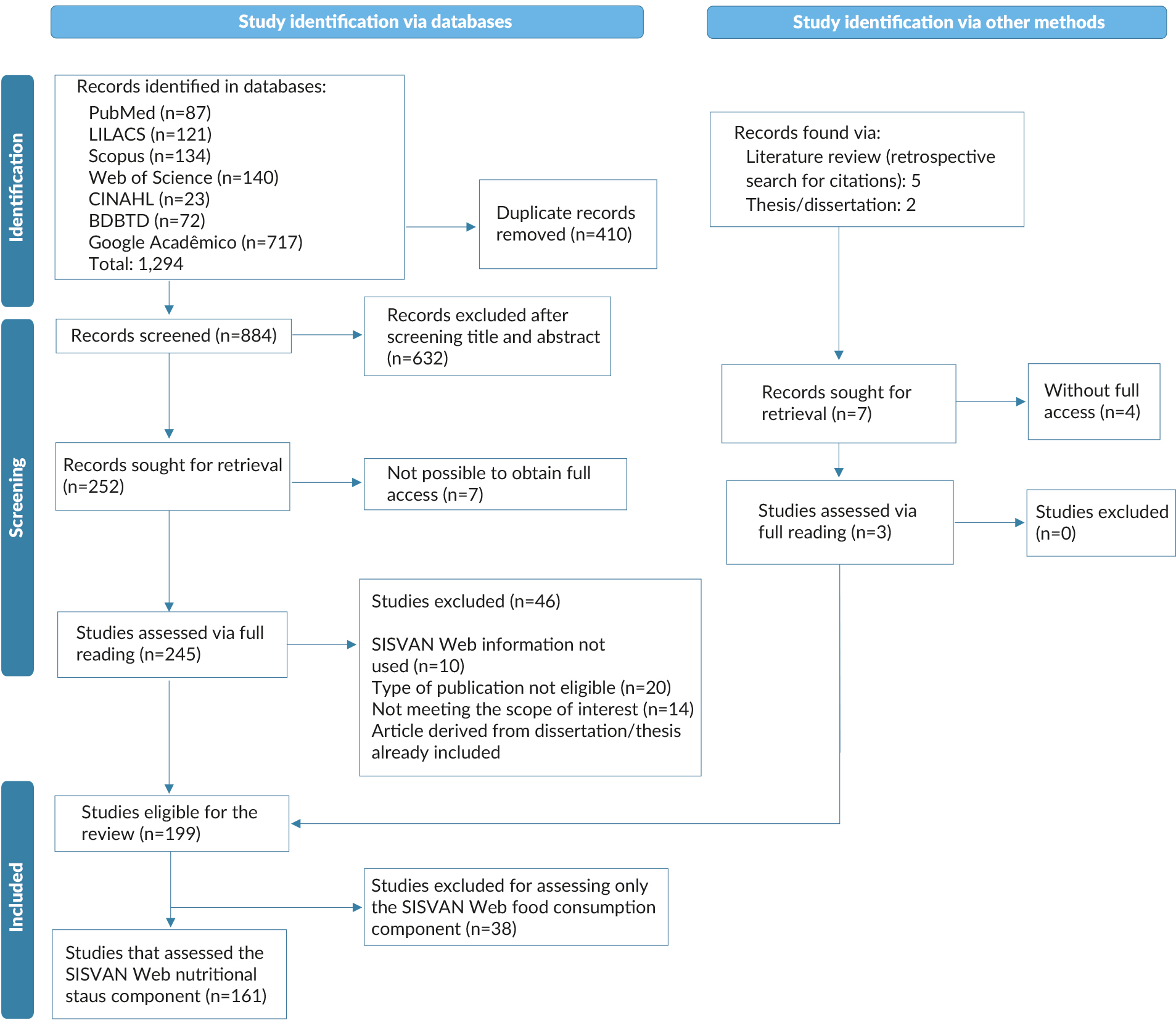
Figure 1 contains the flowchart25 with the sequential steps adopted to select the scientific literature that comprised this scoping review. In total, one systematic review was found, returning one eligible primary study, and two scientific articles were identified via dissertation/thesis.
The results presented here are based on the analysis of 161 publications that investigated the nutrition status component of SISVAN Web, either alone (n=123) or in addition to its food consumption component (n=38). Studies that assessed only the food consumption component were excluded (n=38).
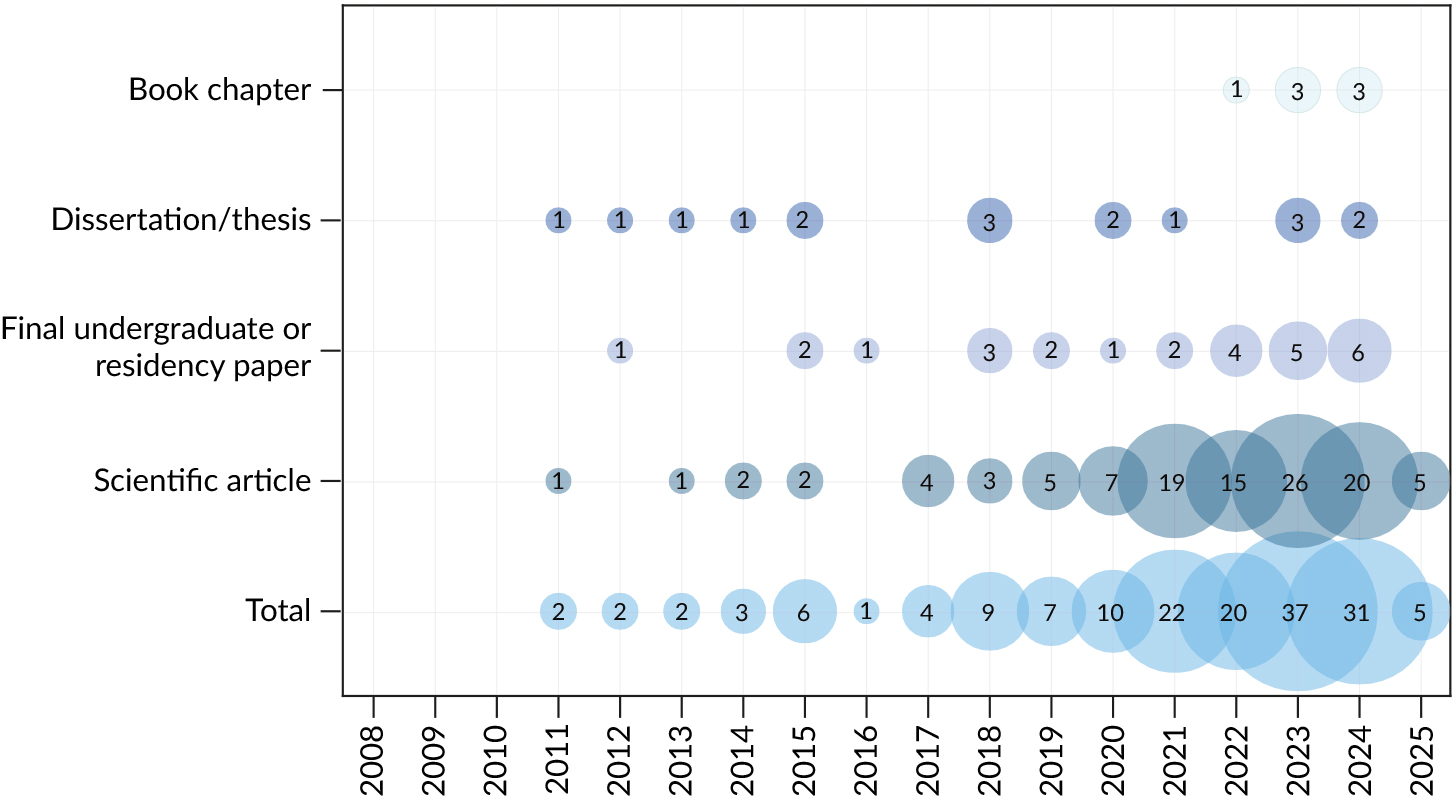
Although the SISVAN Web platform was launched in 20074, the first two publications date from 2011, increasing modestly until 2020. From 2021 onwards, a significant increase in publications was observed, especially in 2023. Scientific articles predominated, followed by course or residency final papers, while book chapters, dissertations and theses were less frequent (Figure 2).
Regarding the structure of the epidemiological data, 82.0% used aggregated secondary data from the consolidated SISVAN Web annual reports, with the exception of two studies that used monthly reports26,27. Of the total, 59.0% of the studies were classified as longitudinal, and 39.8% as cross-sectional; 64.0% were exploratory, and 36.0% analytical (Table 1).
Selection process for studies eligible for inclusion in the scoping review, used in the two bibliographic searches
Among the studies with aggregated data (n=132), 95.5% used information from geographic databases, and 4.5% used reports from health establishments. The majority compared frequencies or trends between groups (locations or institutions) (65.9%) and employed an aggregated-observational-longitudinal design (65.2%). An increase in publications with an ecological design was observed, with 23 studies in 2023. Of the total (n=88), 46 were descriptive in nature. The remainder (n=42) were analytical; of these, 40 estimated trends in SISVAN indicators over time.
Among the 29 designs with individualized data, there were 16 cross-sectional28-43, nine historical cohort44-52 and four repeated cross-sectional studies53-56. Three used information from the School Health Program32,40,43; three from health establishments38,39,44; and one used microdata input to SISVAN Web by the nutritionist responsible for the municipal element of the National School Meals Program28.
Sixty-nine 69 studies used demographic information, mostly sex (n=61), followed by race/color (n=15), belonging to traditional peoples/communities (n=4), and schooling (n=3). Among the three studies with this latter aspect, one examined administrative data on children under 6 months according to daycare attendance29; another classified elderly people who attended or did not attend school37; and the last one selected only "primary education" from SISVAN Web for school data57. The four studies with traditional peoples/communities were published between 2021 and 2024, and three worked exclusively with information on these populations30,54,58,59 (Table 2).
Of the studies with race/color stratification, ten used all the SISVAN categories29,37,40,50,54,60-64. Two compared Black and non-Black populations65 or Black/mixed-race and White populations66; and three focused only on the non-village indigenous population, since monitoring of village populations is done through SISVAN-Indígena67-69. Seven studies reported missing race/color records in some of the data37,50,61-63,70,71.
Childhood stood out as the most studied life stage, particularly up to 5 years of age, followed by school-aged children, preschoolers and infants. A smaller number of analyses focused on more stratified age groups within childhood. The four studies with data from 0-7 years of age involved beneficiaries of the Bolsa Família Program. A smaller proportion studied adults, adolescents, the elderly and pregnant women.
Most studies that stratified the type of follow-up used the Bolsa Família Program Management System. Of these, 25 studied only beneficiaries, and eight compared the nutrition status of this group with that of all users. Studies that used data from SISVAN Web itself or the e-SUS PHC strategy did not compare nutrition indicators between systems nor justify the choice57,68,72-74, except for one thesis56 and one dissertation75 that analyzed data prior to the implementation of the latter system.
It was possible to identify the Federative Unit studied in 124 of the documents. Twelve studies covered all the Brazilian states. Among the others, there were one to 10 studies per state, except Bahia, Minas Gerais and Pernambuco, which stood out with 11 to 19 publications. A further 37 studies did not specify the Federative Unit, as they examined national data, macro-regions or groupings such as municipalities on the Brazilian border76 and Intermediate Regions of Urban Articulation77.
Most publications targeting children and adolescents assessed body mass index-for-age, followed by height-for-age. In the case of studies with adults, the elderly or pregnant women, the only index available via SISVAN Web was body mass index (Table 3).
Nine studies with individualized data explored other nutrition indicators, which is only possible with this type of unit of analysis. In general, the authors employed diverse designs (retrospective cohort, cross-sectional, and repeated cross-sectional) to analyze mean and percentile distributions of weight and height measurements; child growth trajectories (weight, height, and body mass index in unadjusted values and z-scores); catch-up growth (growth recovery according to z-scores); and gestational weight gain. Some studies related these indicators to sociodemographic variables, such as sex and maternal race/color, food consumption markers used in primary health care, and contextual aspects of municipalities30,42,45-47,51-53,56.
Regarding the statistical techniques used to estimate trends among studies with an aggregate-observational-longitudinal design, nine studies employed simple linear regression models66,74,77-83. One of them had a predictive character and estimated frequency of obesity in adults for 2025 and 2030, investigating the influence of the COVID-19 pandemic83.
Most publications employed the Prais-Winsten generalized linear regression technique (n=24), with the first two dating from 202184,85. From that period onwards, use of this method increased9,10,27,67,76,86-101. The use of this approach was identified in one article with a repeated individualized-observational-cross-sectional design54. Furthermore, six studies used the Joinpoint Trend Analysis program, created by the National Cancer Institute102, to quantify trends63,103-107.
The interrupted time-series approach was found to be applied in an article that investigated the effect of the COVID-19 pandemic on malnutrition indicators in infants registered with the Bolsa Família Program, using the Prais-Winsten technique and an autoregressive, integrated and moving average model for seasonal time-series, using monthly SISVAN Web reports27.
Twelve publications were identified that aimed to study the impact of the COVID-19 health crisis108 on nutrition outcomes, with children being the most studied population. Of these, eight employed longitudinal ecological designs, six were descriptive70,109-113 and two were analytical27,83. The others had a descriptive cross-sectional character, one being a survey33 and three being cross-sectional ecological studies64,114,115.
The SISVAN coverage variable was reported in 29 of the 161 documents and was calculated in different ways. Among the studies that estimated temporal trends (n=41), 17 calculated SISVAN coverage. Of these, four used it to adjust regression models, based on the understanding that variations in coverage can explain part of the trend estimates of outcomes due to the relationship with case reports or health service access/quality54,87,89,93.
Some publications employed exploratory spatial data analyses on individualized53 or aggregated SISVAN information - thematic maps (n=12), global Moran's index and local Moran's index - using various geographic information and analysis systems at one77,91,116-120 or more points in time89,98,105,121. Three studies applied georeferencing/geocoding techniques to spatialize nutrition deviations at municipal scales, either through geographic coordinates of individual addresses33,41, or through aggregated SISVAN data, locating health establishments according to neighborhoods within municipalities70.
Discussion
This was the first scoping review on the use of the SISVAN Web system in investigating the nutrition profile of the population cared for by the Brazilian Unified Health System (SUS). Early childhood was the most studied phase, especially regarding body mass index-for-age. Most studies stratified the analyses by sex, while race/color and education level were less explored and presented limitations. Bolsa Família Program beneficiaries were the most studied group regarding the origin of the data. Research was concentrated in the states of Pernambuco, Minas Gerais and Bahia. Ecological designs predominated, with an increase in robust time-series studies. Some researchers used individualized SISVAN data, which expanded its analytical potential.
A limitation of this review was the absence of critical appraisal of the studies, potentially leading to selection bias, although this stage is not expected in scoping reviews. However, the volume of publications reviewed allowed us to meet the comprehensive exploratory purpose expected in this type of synthesis15,16,18. Analyzing the extensive volume of evidence presented a methodological challenge. Ideally, data extraction should be conducted by two or more researchers15; however, the collaborative processes adopted helped to minimize potential biases in data extraction and categorization.
The increasing applicability of SISVAN in scientific production may have been driven by national computerization in 2007, which brought operational improvements, favoring its consolidation and expansion of its coverage. By 2014, the system was recording information on all the Brazilian municipalities, although the largest volume of data was still concentrated on childhood122. Academic interest in this system also grew, evidenced by the increase in publications, especially after 2021. The increase in food insecurity, aggravated by the political and economic crises, has had repercussions on the living conditions of the population. It is known that this scenario affects and is reflected in the health status of individuals, putting them at risk of various forms of malnutrition93,123.
The increase in ecological research is consistent with the operational ease and low cost associated with secondary information, while use of anonymized individualized data requires its authorized provision by the Ministry of Health or access to the restricted module of the platform7, thus limiting its use by researchers. However, both types of data offer potential: individualized data are considered ideal for making inferences about associated or causal factors of health problems, while ecological data allow for understanding of phenomena at a more comprehensive level of determination, by capturing structural conditioning factors. When combined in hierarchical models, as observed in the reviewed works, they can provide relevant understanding of the phenomena of interest, this being a significant application of individualized SISVAN Web information21,22,24.
This system can signal social inequalities through its sociodemographic variables70,124, which are still underrepresented in aggregate studies, with the exception of sex. On the SISVAN data collection form, only sex and race/color are mandatory fields; belonging to traditional peoples and communities has been an available field since 20135,30. Studies have shown shortcomings in the race/color field37,50,61-63,70,71, as well as lower SISVAN coverage for the Black population65 or possible classification or recording errors of this variable54.
However, since 2017, the national primary health care central information hub has been the preferred method for submitting food and nutrition surveillance data, instead of direct data entry to the SISVAN Web platform, which will be discontinued as the implementation of the e-SUS strategy progresses12,125,126. This interface is opportune for improving the quality of information held on SISVAN and strengthening use of sociodemographic information in gaining understanding of the social determinants of health124.
Regarding nutrition indicators, one study reported a preference for weight-for-age for children under 5 years old, as it eliminates the need to measure height, minimizing errors in estimates and encompassing a larger number of children with data held on SISVAN103. In the case of pregnant women, the Ministry of Health has adopted gestational weight gain as a diagnostic criterion, although SISVAN Web still uses body mass index per gestational week to consolidate data from this population3. The non-mandatory nature of filling in the pre-gestational weight field on SISVAN may result in a significant part of this data being missing53.
Bolsa Família Program data were the most used, consistent with the historical link between nutrition surveillance actions and government assistance programs, such as the Bolsa Família Program since 2004, and the linking of this system with SISVAN Web since it was launched4,127,128. In 2020, compliance with and recording of the Bolsa Família Program health conditionalities, including nutrition assessment, stopped being mandatory. Between 2021 and 2022, this program was replaced by the Auxílio Brasil Program, but was reinstated in June 2023. Understanding the impact of these changes on the SISVAN indicators is necessary129-131.
Studies using e-SUS strategy data are incipient, possibly due to the recent interface between the systems, begun in 20176,7,125. This measure increased the number of food consumption records input via this system between 2015 and 2019. There is no evidence on nutrition indicators, and more in-depth evaluation of the effects of this strategy on SISVAN performance as a whole is necessary12.
Expansion of ecological time-series designs has been made possible by the volume of information regularly stored on SISVAN Web since its inception. There has been a growing use of robust statistical techniques to estimate temporal trends, such as the Prais-Winsten methodology, which is indicated for this purpose because it considers serial autocorrelation present in population measurements. This characteristic is contrary to assumptions required in traditional regression models, which limits their use in temporal analyses by potentially inducing incorrect interpretations of phenomena132-134. Centralizing the "year" variable to deal with autocorrelation is not recommended, as was identified in one of the documents80,132.
The use of the Prais-Winsten approach has grown in national studies involving various indicators of health, mortality and service performance135. The first application of this technique to SISVAN data dates from 2020, in an evaluation of the system's coverage for children in the Northern region of Brazil, between 2008 and 20178 (search in LILACS and PubMed databases in August 2025 with the terms "prais-winsten" AND "sisvan"). This method was also applied to data from the Chronic Disease Risk and Protective Factors Surveillance Telephone Survey, another food and nutrition surveillance strategy136-138.
In addition to their use in epidemiological surveillance, temporal studies can reveal the effects of events or public policies. For this purpose, routinely collected data, such as SISVAN data, are appropriate as they enable long time-series to be built. Interrupted time-series analysis, considered the most robust quasi-experimental model for this purpose, although still incipient in the area of nutrition surveillance, can assess longitudinal effects of events/interventions on food and nutrition indicators133,134,139.
Research using spatial analysis and geocoding resources highlights important methodological tools for epidemiology. Freely accessible geographic information systems can facilitate their use with SISVAN data, contributing to spatial visualization of food and nutrition problems and knowledge of priority territories for interventions and surveillance measures.
This scoping review made it possible to identify elements to be explored in future research: (i) trend estimates with SISVAN Web data based on standardized and robust methods, for the various phases/events of the life course and geographic locations; (ii) longitudinal analyses that consider the effect of population events/interventions on nutrition indicators will increase the applicability of nutrition surveillance information; (iii) spatial analyses and geocoding on an intramunicipal scale enable local problems to be monitored as well as targeted effective efforts; (iv) better understanding of the effect of interoperability between SISVAN Web and the national PHC central information hub and the impact of changes in monitoring Bolsa Família Program conditionalities on system indicators; (v) systematizing missing demographic information in the macrodata, with the aim of informing sectors responsible for managing the platform; and (vi) incorporating hierarchical models into the microdata to investigate individual and contextual determinants of nutrition problems.
This review presented the state of the art in scientific production and reconnoitered the field of studies on nutrition surveillance via SISVAN, methodologically characterizing a broad body of evidence and identifying the use of information from this system. It is expected that the findings will contribute to informing future research and supporting the improvement of SISVAN.
References
-
1. Brasil. Ministério da Saúde. Secretaria de Atenção à Saúde. Departamento de Atenção Básica. Política nacional de alimentação e nutrição [Internet]. Brasília: Ministério da Saúde; 2013 [cited 2026 Feb 20]. Available from: https://bvsms.saude.gov.br/bvs/publicacoes/politica_nacional_alimentacao_nutricao.pdf
» https://bvsms.saude.gov.br/bvs/publicacoes/politica_nacional_alimentacao_nutricao.pdf - 2. Brasil. Ministério da Saúde. Portaria no 1.156, de 31 de agosto de 1990. Institui o Sistema de Vigilância Alimentar e Nutricional – Sisvan. Diário Oficial da União. Brasília; 31 Ago 1990.
-
3. Brasil. Ministério da Saúde. Guia para a organização da Vigilância Alimentar e Nutricional na Atenção Primária à Saúde [Internet]. Brasília: Ministério da Saúde; 2022 [cited 2026 Feb 19]. Available from: https://bvsms.saude.gov.br/bvs/publicacoes/guia_organizacao_vigilancia_alimentar_nutricional.pdf
» https://bvsms.saude.gov.br/bvs/publicacoes/guia_organizacao_vigilancia_alimentar_nutricional.pdf - 4. Coutinho JG, Cardoso AJC, Toral N, Silva ACF, Ubarana JA, Aquino KKNC, et al. A organização da Vigilância Alimentar e Nutricional no Sistema Único de Saúde: histórico e desafios atuais. Rev Bras Epidemiol. 2009;12(4):688-99.
-
5. Brasil. Ministério da Saúde. Secretaria de Atenção à Saúde. Departamento de Atenção Básica. Sistema de Vigilância Alimentar e Nutricional – Sisvan [Internet]. Brasília: Ministério da Saúde; 2026 [cited 2026 Feb 19]. Available from: https://sisaps.saude.gov.br/sisvan/
» https://sisaps.saude.gov.br/sisvan/ - 6. Brasil. Ministério da Saúde. Portaria GM/MS no 7.639, de 18 de julho de 2025. Altera a Portaria de Consolidação GM/MS no 1, de 28 de setembro de 2017. Diário Oficial da União. Brasília; 2025 Jul 22.
-
7. Brasil. Ministério da Saúde. Secretaria de Atenção à Saúde. Departamento de Atenção Básica. Manual operacional para uso do Sistema de Vigilância Alimentar e Nutricional (Sisvan) – versão 3.0 [Internet]. Brasília: Ministério da Saúde; 2017 [cited 2026 Feb 19]. Available from: https://sisaps.saude.gov.br/sisvan/public/file/ManualDoSisvan.pdf
» https://sisaps.saude.gov.br/sisvan/public/file/ManualDoSisvan.pdf - 8. Mourão E, Gallo CO, Nascimento FAD, Jaime PC. Temporal trend of Food and Nutrition Surveillance System coverage among children under 5 in the Northern Region of Brazil, 2008-2017. Epidemiol Serv Saude. 2020;29(2):e2019377.
- 9. Oliveira KPD, Carioca AAF, Vieira LJEDS, Muniz LSDS, Barbosa MEJDP. Estado nutricional e tendência temporal da cobertura de adolescentes brasileiros acompanhados no Sistema de Vigilância Alimentar e Nutricional, 2008 a 2019. Rev Bras Saúde Matern Infant. 2023;23:e20220296.
- 10. Silva RPC, Vergara CMAC, Sampaio HAC, Vasconcelos Filho JE, Strozberg F, Ferreira Neto JFR, et al. Sistema de Vigilância Alimentar e Nutricional: tendência temporal da cobertura e estado nutricional de adultos registrados, 2008-2019. Epidemiol Serv Saúde. 2022;31:e2021605.
- 11. Silva NDJ, Silva JFDM, Carrilho TRB, Pinto EDJ, Andrade RDCSD, Silva SA, et al. Qualidade dos dados antropométricos infantis do Sisvan, Brasil, 2008-2017. Rev Saúde Pública. 2023;57:62.
- 12. Ricci JMS, Romito ALZ, Silva SAD, Carioca AAF, Lourenço BH. Marcadores do consumo alimentar do Sisvan: tendência temporal da cobertura e integração com o e-SUS APS, 2015-2019. Ciênc Saúde Colet. 2023;28(3):921-34.
- 13. Nascimento FAD, Silva SAD, Jaime PC. Cobertura da avaliação do estado nutricional no Sistema de Vigilância Alimentar e Nutricional brasileiro: 2008 a 2013. Cad Saúde Pública. 2017;33(12):e00161516.
- 14. Barbosa BB, Baltar VT, Horta RL, Lobato JCP, Vieira LJEDS, Gallo CDO, et al. Food and Nutrition Surveillance System (SISVAN) coverage, nutritional status of older adults and its relationship with social inequalities in Brazil, 2008-2019: an ecological time-series study. Epidemiol Serv Saúde. 2023;32(1):e2022595.
-
15. Peters MDJ, Godfrey C, McInerney P, Munn Z, Tricco AC, Khalil H. Scoping reviews (2020 version). In: Aromataris E, Munn Z, editors. JBI manual for evidence synthesis [Internet]. Adelaide: JBI; 2020 [cited 2026 Feb 19]. Available from: https://synthesismanual.jbi.global
» https://synthesismanual.jbi.global - 16. Tricco AC, Lillie E, Zarin W, O’Brien KK, Colquhoun H, Levac D, et al. PRISMA Extension for Scoping Reviews (PRISMA-ScR): Checklist and Explanation. Ann Intern Med. 2018;169(7):467-73.
- 17. Pollock D, Peters MDJ, Khalil H, McInerney P, Alexander L, Tricco AC, et al. Recommendations for the extraction, analysis, and presentation of results in scoping reviews. JBI Evid Synth. 2023;21(3):520-32.
- 18. Khalil H, Peters MDj, Tricco AC, Pollock D, Alexander L, McInerney P, et al. Conducting high quality scoping reviews-challenges and solutions. J Clin Epidemiol. 2021;130:156-60.
- 19. Hirt J, Nordhausen T, Fuerst T, Ewald H, Appenzeller-Herzog C. Guidance on terminology, application, and reporting of citation searching: the TARCiS statement. BMJ. 2024;385:e078384.
- 20. Ouzzani M, Hammady H, Fedorowicz Z, Elmagarmid A. Rayyan—a web and mobile app for systematic reviews. Syst Rev. 2016;5(1):210.
- 21. Almeida Filho N, Barreto ML. Epidemiologia & saúde: fundamentos, métodos, aplicações. Rio de Janeiro: Editora Guanabara Koogan; 2011.
- 22. Szklo M, Nieto FJ. Epidemiology: beyond the basics. 3. ed. Burlington: Jones & Bartlett Learning; 2014.
- 23. Pérez-Guerrero EE, Guillén-Medina MR, Márquez-Sandoval F, Vera-Cruz JM, Gallegos-Arreola MP, Rico-Méndez MA, et al. Methodological and statistical considerations for cross-sectional, case–control, and cohort studies. J Clin Med. 2024;13(14):4005.
- 24. Rothman KJ, Greenland S, Lash TL. Modern epidemiology. 3. ed. Porto Alegre: Artmed; 2011.
-
25. PRISMA Statement. PRISMA 2020 flow diagram [Internet]. 2024 [cited 2026 Feb 19]. Available from: https://www.prisma-statement.org/prisma-2020-flow-diagram
» https://www.prisma-statement.org/prisma-2020-flow-diagram - 26. Silva LRSD, Monteiro ADKBF, Silva NKDA, Xavier MEF. Avaliação do estado nutricional de mulheres idosas residentes da região Nordeste do Brasil através de dados do Sisvan-Web. Rev Ibero-Am Humanid Cienc Educ. 2021;7(12):1394-403.
- 27. Rodrigues ESM, Costa EM, Sousa FSD, Araújo FBP, Lopes MBS, Thomaz EBAF. Efeito da pandemia da covid-19 sobre a má nutrição em crianças em vulnerabilidade social, no Brasil. Ciênc Saúde Colet. 2024;29(10):e04692023.
- 28. Bergamaschi D, Adami F. Perfil antropométrico de crianças e adolescentes. Rev Ciênc Saúde. 2015;17(1):53-60.
- 29. Gonçalves VSS, Silva SA, Andrade RCS, Spaniol AM, Nilson EAF, Moura IF. Marcadores de consumo alimentar e baixo peso em crianças menores de 6 meses acompanhadas no Sistema de Vigilância Alimentar e Nutricional, Brasil, 2015. Epidemiol Serv Saúde. 2019;28(2):e2018358.
- 30. Aguiar IWO, Carioca AAF, Barbosa BB, Adriano LS, Barros AQS, Kendall C, et al. Indicadores antropométricos em povos e comunidades tradicionais do Brasil: análise de registros individuais do Sistema de Vigilância Alimentar e Nutricional, 2019. Epidemiol Serv Saúde. 2023;32(4):e2023543.
- 31. Alves RL, Toral N, Gonçalves VSS. Individual and socioeconomic contextual factors associated with obesity in Brazilian adolescents: VigiNUTRI Brasil. Int J Environ Res Public Health. 2022;20(1):430.
- 32. Da Luz LAP, Nascimento BVDSS, Ribeiro RADA, Carreira CM, Pereira NDS, De Souza JD. Acompanhamento da situação alimentar e nutricional de crianças atendidas na Atenção Primária à Saúde. Braz J Health Rev. 2023;6(4):14539-51.
- 33. Gomes TG, Bicalho JMF, Coelho KR. Geographical distribution of nutritional status of adolescents in a Brazilian city in the early years of the pandemic. Rev Nutr. 2023;36:e230030.
- 34. Veronez PT, Teixeira EMB, Santos ENF. Associação do consumo de embutidos e perfil nutricional e escolaridade dos usuários do sus de acordo com os marcadores de consumo alimentar do sisvan da cidade de Araguari-MG. Braz J Dev. 2021;7(4):34734-45.
- 35. Tatsch CG, Brunetto S. Perfil Alimentar e nutricional das crianças beneficiadas pelo Programa Bolsa Família da Estratégia Saúde da Família Macedo do município de Venâncio Aires-RS. Rev Bras Obes Nutr Emagrec. 2020;14(90):1249-58.
- 36. Silva CVA, Marques TDP, Souza LBD, Guimarães MM. Does the Brazilian cash transfer program (Bolsa Família): Protect nutritional deviations among infants and breastfeeding practices in a capital of the Central Region of Brazil? Rev Chil Nutr. 2023;50(5):521-8.
-
37. Andrade RCS. Avaliação do estado nutricional e consumo alimentar dos idosos brasileiros: uma análise a partir de registros administrativos [dissertação]. Brasília: Fundação Oswaldo Cruz; 2020 [cited 2026 May 6]. 85 p. Available from: https://bdtd.ibict.br/vufind/Record/CRUZ_445350fc28d766f822fdbc5c2c5d0b71
» https://bdtd.ibict.br/vufind/Record/CRUZ_445350fc28d766f822fdbc5c2c5d0b71 -
38. Cordeiro CMC, Cordeiro FGS, Santos IR, Tinôco LS. Marcadores de consumo alimentar e estado nutricional de beneficiárias do Programa Bolsa Família acompanhadas pelo Sistema de Vigilância Alimentar e Nutricional (Sisvan) na cidade de Natal-RN [trabalho de conclusão de curso]. Natal: Centro Universitário do Rio Grande do Norte; 2024 [cited 2026 May 6]. 16 p. Available from: https://repositorio.unirn.edu.br/jspui/handle/123456789/8/simple-search?query=&sort_by=scoreℴ=desc&rpp=10&filter_field_1=publisher&filter_type_1=equals&filter_value_1=Centro+Universit%C3%A1rio+do+Rio+Grande+do+Norte&filter_field_2=available&filter_type_2=equals&filter_value_2=2024&filter_field_3=referees&filter_type_3=equals&filter_value_3=Aires%2C+Kelly+Souza+do+Nascimento&etal=0&filtername=subject&filterquery=SISVAN&filtertype=equals
» https://repositorio.unirn.edu.br/jspui/handle/123456789/8/simple-search?query=&sort_by=scoreℴ=desc&rpp=10&filter_field_1=publisher&filter_type_1=equals&filter_value_1=Centro+Universit%C3%A1rio+do+Rio+Grande+do+Norte&filter_field_2=available&filter_type_2=equals&filter_value_2=2024&filter_field_3=referees&filter_type_3=equals&filter_value_3=Aires%2C+Kelly+Souza+do+Nascimento&etal=0&filtername=subject&filterquery=SISVAN&filtertype=equals -
39. Figueiredo PEA. Avaliação antropométrica de crianças de zero a 10 anos: dados do SISVAN do Centro de Saúde da Vila Planalto, Brasília, DF [trabalho de conclusão de curso]. Brasília: Universidade de Brasília; 2016 [cited 2026 May 6]. 31 p. Available from: https://bdm.unb.br/handle/10483/13926
» https://bdm.unb.br/handle/10483/13926 -
40. Wagner DGP. Prevalência de excesso de peso em crianças e adolescentes cadastrados no Sisvan-Web Pertencentes à região de abrangência de uma Unidade Básica de Saúde de Porto Alegre [trabalho de conclusão de curso]. Porto Alegre: Universidade Federal do Rio Grande do Sul; 2012 [cited 2026 May 6]. 40 p. Available from: https://www.lume.ufrgs.br/handle/10183/66677
» https://www.lume.ufrgs.br/handle/10183/66677 -
41. Monestel A. Avaliação das condições nutricionais de crianças com base nos dados do Sisvan Web e do benefício do Programa Bolsa Família no município de Itajaí/SC [dissertação]. Itajaí: Universidade do Vale do Itajaí; 2011 [cited 2026 May 6]. 77 p. Available from: https://biblioteca.univali.br/acervo/200653
» https://biblioteca.univali.br/acervo/200653 -
42. Barros LM. Consumo alimentar e estado nutricional de crianças entre cinco e nove anos acompanhadas na Atenção Primária à Saúde: análise multinível com microdados de 2019 [dissertação]. São Paulo: Universidade de São Paulo; 2024 [cited 2026 May 6]. 92 p. Available from: https://teses.usp.br/teses/disponiveis/6/6138/tde-27012025-163343/en.html
» https://teses.usp.br/teses/disponiveis/6/6138/tde-27012025-163343/en.html - 43. Silva AFC, Santos JLA, Cavalcanti RAS, Aguiar NA. Markers of food consumption and nutritional status of schoolchildren in Northeast Brazil. Nutr Clín Diet Hosp. 2019;39(3):86-91.
- 44. Giesta JM, Schiffner MD, Boklis M, Schuch I, Bosa VL, Silva CH. Linkage between 2 information systems: combined live births and food and nutrition surveillance as a public health tool for investigation of the determinants of obesity among children and adolescents in Southern Brazil. Food Nutr Bull. 2022;43(1):56-67.
- 45. Santiago-Vieira C, Velasquez-Melendez G, Ribeiro-Silva RC, Pinto EJ, Barreto ML, Li L. Recent changes in growth trajectories: a population-based cohort study of over 5 million Brazilian children born between 2001 and 2014. Lancet Reg Health Am. 2024;32:100721.
- 46. Rocha A, Ribeiro-Silva R, Silva J, Pinto E, Silva N, Paixao E, et al. Postnatal growth in small vulnerable newborns: a longitudinal study of 2 million Brazilians using routine register-based linked data. Am J Clin Nutr. 2024;119(2):445-55.
- 47. Silva HBM, Ribeiro-Silva RDC, Silva JFDM, Ster IC, Rebouças P, Goes E, et al. Ethnoracial disparities in childhood growth trajectories in Brazil: a longitudinal nationwide study of four million children. BMC Pediatr. 2024;24(1):103.
-
48. Maia JDO. O Programa Bolsa Família e o estado nutricional de crianças participantes: uma análise no município de Cabedelo-PB [dissertação]. João Pessoa: Universidade Federal da Paraíba; 2012 [cited 2026 May 6]. 90 p. Available from: https://repositorio.ufpb.br/jspui/handle/tede/4275
» https://repositorio.ufpb.br/jspui/handle/tede/4275 -
49. Santos MCS. Impacto do Programa Bolsa Família: avaliação do estado nutricional de crianças e revisão sistemática da condicionalidade educação, Ouro Preto, MG, 2015 [dissertação]. Ouro Preto: Universidade Federal de Ouro Preto; 2015 [cited 2026 May 6]. 85 p. Available from: https://www.repositorio.ufop.br/items/31d02355-6f81-41c4-b804-ac69c75ed4b2
» https://www.repositorio.ufop.br/items/31d02355-6f81-41c4-b804-ac69c75ed4b2 - 50. Barros AQS, Aguiar IWO, Adriano LS, Carioca AAF, Marchioni DML, Sampaio HADC. Food consumption markers and sociodemographic factors associated with obesity among adult women registered in the Food and Nutrition Monitoring System (SISVAN) in Brazil: a cohort study, 2015–2019. Front Public Health. 2024;12:1467339.
-
51. Salviano AF. Práticas alimentares nos dois primeiros anos entre crianças acompanhadas na Atenção Primária à Saúde no Brasil: tendências temporais e associações longitudinais com o estado nutricional na infância [tese]. São Paulo: Universidade de São Paulo; 2024 [cited 2026 May 6]. 157 p. Available from: https://teses.usp.br/teses/disponiveis/6/6138/tde-13022025-115930/publico/SalvianoAF_DR.pdf
» https://teses.usp.br/teses/disponiveis/6/6138/tde-13022025-115930/publico/SalvianoAF_DR.pdf - 52. Alves RL, Toral N, Paravidino V, Gonçalves VSS. Comparison of scenarios in the trajectory of body mass index among adolescents monitored in primary health care: the VigiNUTRI Brazil study. Sci Rep. 2025;15:3355.
- 53. Carrilho TRB, Rasmussen KM, Hutcheon JA, Alves RFS, Farias DR, Freitas‐Costa NC, et al. Prevalence and temporal trends in prepregnancy nutritional status and gestational weight gain of adult women followed in the Brazilian Food and Nutrition Surveillance System from 2008 to 2018. Matern Child Nutr. 2022;18(1):e13240.
- 54. Ribeiro-Silva RDC, Silva NDJ, Felisbino-Mendes MS, Falcão IR, Andrade RDCS, Silva SA, et al. Time trends and social inequalities in child malnutrition: nationwide estimates from Brazil’s food and nutrition surveillance system, 2009–2017. Public Health Nutr. 2021;25(12):3366-76.
-
55. Rodrigues LSV. Análise do estado nutricional de mulheres inscritas no programa Bolsa família no período de 2018 a 2019 nas 5 macrorregiões do Brasil [dissertação]. Brasília: Fundação Oswaldo Cruz; 2021 [cited 2026 May 6]. 109 p. Available from: https://bdtd.ibict.br/vufind/Record/CRUZ_b6d2062452fcb3dac04e2a75ec67f4a7
» https://bdtd.ibict.br/vufind/Record/CRUZ_b6d2062452fcb3dac04e2a75ec67f4a7 -
56. Silva ACF. Programa Saúde na Escola: análise da gestão local, ações de alimentação e nutrição e estado nutricional dos escolares brasileiros [tese]. São Paulo: Universidade de São Paulo; 2014 [cited 2026 May 6]. 162 p. Available from: https://teses.usp.br/teses/disponiveis/6/6138/tde-21102014-115727/pt-br.html
» https://teses.usp.br/teses/disponiveis/6/6138/tde-21102014-115727/pt-br.html - 57. Soares A, Silva IS, Oliveira JG, Lucas RJL, Oliveira AGRC. Current Brazilian consumption scenario and eating habits and nutritional status of school children: an epidemiological study. Bol Conjunt. 2024;19(55):300-19.
-
58. Beltrão KYDCM. Incidência de insegurança alimentar em crianças menores de 5 anos residentes no Quilombo da Pitombeira no Município de Várzea-PB [trabalho de conclusão de curso]. Piúma: Instituto Federal do Espírito Santo; 2024 [cited 2026 May 6]. 15 p. Available from: https://repositorio.ifes.edu.br/items/4f59cd52-dda1-467b-87f8-305980004f71
» https://repositorio.ifes.edu.br/items/4f59cd52-dda1-467b-87f8-305980004f71 -
59. Barbosa MAS. Estado nutricional de povos e comunidades tradicionais no Brasil: uma análise dos dados do Sisvan [trabalho de conclusão de curso]. Uberlândia: Universidade Federal de Uberlândia; 2024 [cited 2026 May 6]. 17 p. Available from: https://repositorio.ufu.br/handle/123456789/44195
» https://repositorio.ufu.br/handle/123456789/44195 - 60. Santos CFE, Campos HLM. Perfil nutricional de idosos do município de Vitória nos anos de 2009 a 2012 por meio do Sistema de Vigilância Alimentar e Nutricional (Sisvan). Rev Bras Pesq Saúde. 2018;20(4):63-70.
- 61. Oliveira LF, Oliveira CA, Santana JM, Campos RO. Associação entre estado nutricional, indicadores socioeconômicos e quesito raça/cor em gestantes do Recôncavo da Bahia, Brasil. Rev Inst Adolfo Lutz. 2023;82:1-18.
- 62. Borba LP. Perfil nutricional de pré-escolares através do Sisvan Web de um município do recôncavo da Bahia [trabalho de conclusão de curso]. Governador Mangabeira: Faculdade Maria Milza; 2020. 39 p.
- 63. Fernandes TDS, Silva BS, Silva HB. Perfil epidemiológico e incidência temporal do estado nutricional de adultos do estado do Espírito Santo, de 2008 a 2023. Aracê. 2025;7(2):5373-91.
- 64. Castro SED. Perfil nutricional de crianças menores de 5 anos beneficiárias do programa bolsa família antes e durante a pandemia da covid-19 residentes da região nordeste do Brasil. Braz J Health Rev. 2021;4(4):16058-74.
-
65. Vaz DLM. Estado nutricional e cobertura do registro da população negra no sistema de vigilância alimentar e nutricional no estado de Minas Gerais e no Brasil em 2021 [trabalho de conclusão de curso]. Ouro Preto: Universidade Federal de Ouro Preto; 2023 [cited 2026 May 6]. 64 p. Available from: https://monografias.ufop.br/handle/35400000/6283
» https://monografias.ufop.br/handle/35400000/6283 - 66. Silveira VNC, Nascimento JBM, Cantanhede NAC, Frota MTBA, Chagas DC, Carvalho CA, et al. Desigualdade racial e regional na tendência temporal do déficit de estatura e excesso de peso de crianças brasileiras menores de cinco anos. Rev Bras Epidemiol. 2023;26:e230004.
- 67. Barbosa BB, Brito GCD, Mendes LL, Adriano LS, Carvalho AM, Carioca AAF. Temporal trend in markers of nutritional status and food consumption of non-village indigenous people in Brazil. Int J Equity Health. 2024;23(1):216.
-
68. Dias LF. Health transition among amerindian populations in the Brazilian Amazon. In: Vieira MLC, Lopes AEMP, editors. Povos Indígenas Citadinos e Políticas Públicas: abordagem das políticas indigenistas no contexto urbano [Internet]. 1. ed. Guarujá: Editora Científica Digital; 2023 [cited 2026 Feb 25]. p. 95-112. Available from: https://downloads.editoracientifica.com.br/books/978-65-5360-348-6.pdf
» https://downloads.editoracientifica.com.br/books/978-65-5360-348-6.pdf - 69. Costa RSL, Maia JS, Silva YC, Linard DFN, Ribeiro MSA. Avaliação do estado nutricional de crianças entre 0 a 05 anos no estado do Acre através do Sisvan Web no ano de 2015. DêCiênc Foco. 2017;1(2):27-42.
-
70. Cardozo ABS. Análise socioespacial da vulnerabilidade a insegurança alimentar e nutricional no município do Rio de Janeiro - 2011 a 2021 [dissertação]. Rio de Janeiro: Fundação Oswaldo Cruz; 2023 [cited 2026 May 6]. 88 p. Available from: https://bdtd.ibict.br/vufind/Record/CRUZ_f31cdbdc764aa4044426ae2650dae89a
» https://bdtd.ibict.br/vufind/Record/CRUZ_f31cdbdc764aa4044426ae2650dae89a - 71. Régis IS, Lima MRS, Braga RAM, Pascoal KO, Damasceno KNM. Perfil pôndero-estatural de crianças no estado do Ceará. Rev Interdiscip. 2021;13(1):1817.
- 72. Costa LSG, Amaral KDA, Siqueira TL, Araújo BLPCD, Pitanga IFDS, Barros LMDM, et al. Obesidade infantil na região sudeste: uma análise de dados da atenção primária registrados no Sisvan. Braz J Implantol Health Sci. 2024;6(1):569-79.
- 73. Dantas CDM, Cavalcanti RAS. Consumo de alimentos ultraprocessados e estado nutricional de escolares no estado de Pernambuco. Rev Bras Obes Nutr Emagrec. 2022;15(95):669-77.
- 74. Moreira JC, Lacerda LFF, Della Torre ACDC, Brito TRPD, Teixeira LG, Lima DB. Estado nutricional de gestantes adolescentes assistidas pela Atenção Básica: um estudo de série temporal com dados do estado de Minas Gerais. Medicina (Ribeirão Preto). 2023;56(4):e-208421.
-
75. Botega AO. O Sistema de Vigilância Alimentar e Nutricional como ferramenta de gestão na Atenção Básica [dissertação]. Santa Maria: Universidade Federal de Santa Maria; 2018 [cited 2026 May 6]. 79 p. Available from: https://bdtd.ibict.br/vufind/Record/UFSM_fdb51d3f85aac9a303720bb55f3f0d29
» https://bdtd.ibict.br/vufind/Record/UFSM_fdb51d3f85aac9a303720bb55f3f0d29 - 76. Santos CMRC, Zembrzuski LJP, Fonseca KRV, Engelmann CA, Younes S, Nihei OK. Estado nutricional de crianças em municípios de fronteira: análise temporal. FIEP Bull. 2022;92(1):198-208.
-
77. Garcia LRS. Déficit estatural infantil em beneficiários do Programa Bolsa Família: análise dos determinantes sociais e da evolução da desigualdade no Brasil [tese]. Natal: Universidade Federal do Rio Grande do Norte; 2018 [cited 2026 May 6]. 103 p. Available from: https://bdtd.ibict.br/vufind/Record/UFRN_eab7a333c0fbba0c88441543552cc0a9
» https://bdtd.ibict.br/vufind/Record/UFRN_eab7a333c0fbba0c88441543552cc0a9 - 78. Barancelli MDC, Gazolla M, Schneider S. Characterization of the prevalence of excess weight in Brazil. BMC Public Health. 2022;22(1):1131.
- 79. Moreira NF, Soares CA, Junqueira TS, Martins RCB. Tendências do estado nutricional de crianças no período de 2008 a 2015: dados do Sistema de Vigilância Alimentar e Nutricional (Sisvan). Cad Saúde Colet. 2020;28(3):447-54.
- 80. Pires CC, Carvalho MF, Lima FF, Monteiro LS, Sperandio N, Pereira S, et al. Evolução do excesso de peso em gestantes usuárias da Atenção Primária à Saúde do município de Macaé-RJ entre 2010-2018. Demetra (Rio J). 2020;15:48033.
-
81. Lima AMC. O desempenho do setor saúde no acompanhamento das condicionalidades do Programa Bolsa Família: a intersetorialidade em ação [dissertação]. Rio de Janeiro: Escola Nacional de Saúde Pública Sergio Arouca; 2013 [cited 2026 May 6]. 76 p. Available from: https://bdtd.ibict.br/vufind/Record/CRUZ_4fa083391c504b9bc2bf1b86dbe848b3
» https://bdtd.ibict.br/vufind/Record/CRUZ_4fa083391c504b9bc2bf1b86dbe848b3 -
82. Machado VMG. Avaliação temporal da cobertura do Sisvan e do estado nutricional em crianças, nos anos de 2008 a 2019, na microrregião de saúde Congonhas, MG. [trabalho de conclusão de curso]. Ouro Preto: Universidade Federal de Ouro Preto; 2021 [cited 2026 May 6]. 79 p. Available from: https://monografias.ufop.br/handle/35400000/3307
» https://monografias.ufop.br/handle/35400000/3307 - 83. Souza LC, Rocha DMUP, Costa GHS, Castro LCV, Miranda Hermsdorff HH. Mapping and projections of obesity in the Brazilian adult population assisted in Primary Health Care: impact of the COVID-19 pandemic. Health Sci J. 2024;14(1):e1499.
- 84. Aprelini CMO, Reis EC, Enríquez-Martinez OG, Jesus TR, Molina MCB. Tendência da prevalência do sobrepeso e obesidade no Espírito Santo: estudo ecológico, 2009-2018. Epidemiol Serv Saúde. 2021;30(3):e2020961.
- 85. Silva Júnior AED, Macena MDL, Vasconcelos LGL, Almeida NB, Praxedes DRS, Pureza IRDOM, et al. Tendência do estado nutricional de gestantes adolescentes beneficiárias do programa de transferência condicionada de renda brasileiro Bolsa Família no período 2008-2018. Ciênc Saúde Colet. 2021;26(7):2613-24.
- 86. Barbosa BB, Baltar VT, Horta RL, Lobato JCP, Vieira LJES, Gallo CO, et al. Cobertura do Sistema de Vigilância Alimentar e Nutricional (Sisvan), estado nutricional de idosos e sua relação com desigualdades sociais no Brasil, 2008-2019: estudo ecológico de série temporal. Epidemiol Serv Saúde. 2023;32(1):e2022595.
- 87. Azevedo LN, Gallo CO, Jaime PC, Baraldi LG. Temporal trend in the nutritional status of children in a Brazilian metropolis in light of food and nutrition policies. Arch Latinoam Nutr. 2023;73(2):65-72.
- 88. Castro RA, Rebelo KS, Santana ABC. Avaliação do estado nutricional em adultos cadastrados no Sisvan em Coari, Amazonas, região Norte e Brasil, 2018-2022: um estudo ecológico. J Nurs Health Sci. 2023;12(5):15-21.
- 89. Corrêa EM, Gallo CO, Antunes JLF, Jaime PC. The tendency of stunting among children under five in the Northern Region of Brazil, according to the Food and Nutrition Surveillance System, 2008-2017. J Pediatr (Rio J). 2023;99(2):120-6.
- 90. Lima PT, Pereira PPS, Freitas JLG, Lemke GMMN, Oliveira LML, Figueiredo ACMG. Nutritional status of children under five years of age in Rondônia, Brazil Northern region and in Brazil: 2008 to 2019. Rev Nutr. 2022;35:e210211.
- 91. Sousa AKDSD, Lima CEBD, Mascarenhas MDM, Rodrigues MTP. Tendência e correlação de obesidade e aleitamento materno continuado em crianças de seis a 23 meses. Rev Bras Saúde Matern Infant. 2023;23:e20210223.
- 92. Costa GDS, Pereira CC, Perfeito DGDA. Estado nutricional de crianças menores de 5 anos residentes no município de Ipameri, Goiás. Braz J Health Rev. 2024;7(3):e69517.
-
93. Gallo CDO, Jaime PC. O segundo Objetivo de Desenvolvimento Sustentável: vigilância da insegurança alimentar e da má nutrição no Brasil. In: Malta DC, Silva AG, Ferrinho P, Barros FPC, editors. Comunidade dos países de língua portuguesa e determinantes sociais da saúde [Internet]. 1. ed. Brasília: Conass; 2024 [cited 2026 Feb 25]. p. 190-219. Available from: https://www.conass.org.br/biblioteca/comunidade-dos-paises-de-lingua-portuguesa-e-determinantes-sociais-da-saude/
» https://www.conass.org.br/biblioteca/comunidade-dos-paises-de-lingua-portuguesa-e-determinantes-sociais-da-saude/ - 94. Recofka SM, Vieira DG, Bortolanza EDVC, Melhem ARF, Saldan PC. Tendência do estado nutricional de gestantes na atenção básica no período de 2010 a 2021. Rev Saúde Pública Paraná. 2024;7(2):1-16.
- 95. Albach C, Santos EFD, Negrão NTGX, Melhem ARDF, Saldan PC. Consumo alimentar e estado nutricional de crianças menores de seis meses acompanhadas na Atenção Primária à Saúde: uma análise temporal de 2016 a 2021. DEMETRA. 2024;19:e75109.
- 96. Silva MBP, Lira IDS, Melo KVE, Goes JE, Macena ML, Silva Júnior AE. Tendência do estado nutricional de gestantes adolescentes atendidas na Atenção Primária do estado de Alagoas no período 2009-2022. GEP News. 2024;8(3), 66-72.
- 97. Castro CP, Pfaffenbach G, Santana ABC. Avaliação do estado nutricional de adolescentes cadastrados no Sisvan em Manaus, Amazonas, Região Norte e Brasil, 2016–2020. In: Silva R, Oliveira M, editors. Nutrição Brasil. São Paulo: Atlântica Editora; 2023. p. 45-60.
- 98. Canazas VMA, Filocreão ASM, Medeiros FAD, Faustino CG. Tendência temporal da obesidade em adultos usuários da atenção primaria à saúde do Sistema Único de Saúde no período 2008-2023. Obs Econ Latinoam. 2024;22(7):e5783.
-
99. Barbosa LB, Vasconcelos NBR, Lima JRS, Santos LF. Perfil do excesso de peso em crianças do estado de Alagoas, Brasil, no período de 2009-2019. In: One GMC, editor. Nutrição: os desafios do novo cenário [Internet]. João Pessoa: Instituto Medeiros de Educação Avançada; 2022 [cited 2026 Feb 25]. p. 78-95. Available from: https://cinasama.com.br/wp-content/uploads/2022/03/Livro-nutri%C3%A7%C3%A3o-2022.pdf
» https://cinasama.com.br/wp-content/uploads/2022/03/Livro-nutri%C3%A7%C3%A3o-2022.pdf - 100. Oliveira BMR, Dallazen C, Schabarum JC, Melhem ARF, Saldan PC. Análise de tendência temporal do estado nutricional de crianças de seis a 23 meses no período de 2013 a 2022. Rev Atenç Saúde. 2025;23:e20259480.
- 101. Beserra JB, Rodrigues LSC, Sousa RA, Cardoso OO, Santos MM. Prevalence of overweight and obesity in the state of Piauí, Brazil: a time trend analysis (2012–2021). Rev Chil Nutr. 2023;50(1):66-74.
-
102. National Institutes of Health. National Cancer Institute. Joinpoint Trend Analysis Software [Internet]. Bethesda: National Cancer Institute; 2026 [cited 2026 Feb 24]. Available from: https://surveillance.cancer.gov/joinpoint/
» https://surveillance.cancer.gov/joinpoint/ - 103. Vasconcelos LGL, Almeida NB, Santos MODA, Silveira JACD. Tendência temporal (2008-2018) da prevalência de excesso de peso em lactentes e pré-escolares brasileiros de baixa renda. Ciênc Saúde Colet. 2022;27(1):363-75.
- 104. Lima YM, Silva SC, Ramalho AA. Tendência temporal da prevalência de excesso de peso em crianças de cinco a dez anos de idade acompanhadas pelo Sisvan no estado do Acre. DêCiência em Foco. 2018;2(2):48-58.
- 105. Ramalho AA, Silva TM, Lima YMM, Silva TF, Oliveira MA, Silva SCEV, et al. The Double burden of malnutrition in the Brazilian Legal Amazon: spatial distributions and temporal trends (2013–2023). Nutrients. 2025;17(6):1054.
- 106. Rodrigues LDSC, Beserra JB, Sousa CB, Cardoso ODO, Santos MM. Excesso de peso em adolescentes piauienses acompanhados pelo Sistema de Vigilância Alimentar e Nutricional. Sustinere. 2022;10(2):591-607.
-
107. Souza GP. Tendência temporal do estado nutricional de gestantes de um estado do Nordeste brasileiro, 2012–2022 [trabalho de conclusão de residência]. Currais Novos: Universidade Federal do Rio Grande do Norte; 2023 [cited 2026 May 6]. 19 p. Available from: https://repositorio.ufrn.br/items/8593c115-b6a9-402e-a5e8-b9dce9db8a0f
» https://repositorio.ufrn.br/items/8593c115-b6a9-402e-a5e8-b9dce9db8a0f - 108. Brasil. Decreto Legislativo no 6, de 2020. Reconhece a ocorrência do estado de calamidade pública em decorrência da pandemia de covid-19. Diário Oficial da União. 2020 Mar 20; Seção 1:1.
- 109. Alves FO, Fonseca ELA, Ferreira CE, Faria LAD, Silva GGD, Bicalho JMF. Estado nutricional de crianças de 0 a 5 anos de idade do município de Igaratinga-MG em 2019 a 2021. Res, Soc Dev. 2023;12(2):e1012239743.
-
110. Rodrigues MTO. Obesidade infantil relacionada ao consumo de ultraprocessados durante a pandemia da covid-19 no Brasil, região Nordeste, Pernambuco e Vitória de Santo Antão: um olhar através do Sisvan [trabalho de conclusão de curso]. Vitória de Santo Antão: Universidade Federal de Pernambuco; 2023 [cited 2026 May 6]. 40 p. Available from: https://repositorio.ufpe.br/jspui/handle/123456789/50521
» https://repositorio.ufpe.br/jspui/handle/123456789/50521 -
111. Cavalcanti CAT. O consumo alimentar e o perfil nutricional de crianças entre 6 e 24 meses de idade no estado de Pernambuco durante o período da pandemia do Covid-19 [trabalho de conclusão de curso]. Recife: Universidade Federal de Pernambuco; 2024 [cited 2026 May 6]. 50 p. Available from: https://repositorio.ufpe.br/handle/123456789/55646
» https://repositorio.ufpe.br/handle/123456789/55646 -
112. Santana MED. Estado nutricional de crianças de 0 a 5 anos acompanhadas pelo Sistema de Vigilância Alimentar e Nutricional (Sisvan) em período pandêmico da covid-19 no município de Vitória de Santo Antão - Pernambuco [trabalho de conclusão de curso]. Vitória de Santo Antão: Universidade Federal de Pernambuco; 2023 [cited 2026 May 6]. 48 p. Available from: https://repositorio.ufpe.br/handle/123456789/53017
» https://repositorio.ufpe.br/handle/123456789/53017 - 113. Ribeiro LA, Coêlho MDG, Rosa SF, Oliveira MMLD, Lourenço JVG. Children’s nutritional status - the impacts of the pandemic and their perspectives for prevention. Res, Soc Dev. 2022;11(4):e15211427129.
-
114. Nascimento JDF, Carvalho WRC, Bogéa EG. Estudo comparativo do estado nutricional de crianças maranhenses menores de 5 anos em período pandêmico e não pandêmico In: Bogéa EG, editor. Pesquisa multidisciplinar em saúde [Internet]. 1. ed. São Luís: Editora Pascal LTDA; 2023 [cited 2026 Feb 25]. v. 1. p 16-23. Available from: https://editorapascal.com.br/wp-content/uploads/2024/01/166-PESQUISA-MULTIDISCIPLINAR-EM-SAUDE.pdf
» https://editorapascal.com.br/wp-content/uploads/2024/01/166-PESQUISA-MULTIDISCIPLINAR-EM-SAUDE.pdf - 115. Castro LGGD, Silva NDCD, Vital AJDL, Ferreira RS, Linhares IW. Caracterização do perfil nutricional do registro de indivíduos com excesso de peso da cidade de Betim- MG no contexto da pandemia de SARS-COV-2. Rev Ibero-Am Humanid Cienc Educ. 2021;7(11):1767-77.
- 116. Canazas VMA, Faustino CG, Medeiros FA. Análise espacial da obesidade na população adulta usuária da Atenção Primaria à Saúde do Sistema Único de Saúde: Brasil, 2021. Rev Bras Obes Nutr Emagrec. 2022;16(102):569-76.
-
117. Cruz JVO. Consumo de alimentos ultraprocessados, excesso de peso e marcadores de desenvolvimento social em adolescentes de Pernambuco [trabalho de conclusão de curso]. Vitória de Santo Antão: Universidade Federal de Pernambuco; 2022 [cited 2026 May 6]. 37 p. Available from: https://repositorio.ufpe.br/bitstream/123456789/48863/1/Cruz%2C%20Jo%C3%A3o%20Victor%20Oliveira%20da.pdf
» https://repositorio.ufpe.br/bitstream/123456789/48863/1/Cruz%2C%20Jo%C3%A3o%20Victor%20Oliveira%20da.pdf - 118. Pereira TAM, Freire AKG, Gonçalves VSS. Exclusive breastfeeding and underweight in children under six months old monitored in primary health care in Brazil, 2017. Rev Paul Pediatr. 2021;39:e2019293.
-
119. Almeida Junior HL. Variação temporal da ocorrência de excesso de peso em adolescentes no Estado de Pernambuco, do Nordeste e do Brasil [trabalho de conclusão de curso]. Vitória de Santo Antão: Universidade Federal de Pernambuco; 2024 [cited 2026 May 6]. 51 p. Available from: https://repositorio.ufpe.br/handle/123456789/55994
» https://repositorio.ufpe.br/handle/123456789/55994 -
120. Jokura A. Fatores socioeconômicos e ambientais associados ao excesso de peso de adolescentes em municípios do estado de São Paulo [dissertação]. Franca: Universidade de Franca; 2015 [cited 2026 May 6]. 48 p. Available from: https://bdtd.ibict.br/vufind/Record/UNICSUL-1_a8381c954a2c7d67667b959579809b5f
» https://bdtd.ibict.br/vufind/Record/UNICSUL-1_a8381c954a2c7d67667b959579809b5f -
121. Taschetto HZP. Implementação de um protocolo de Vigilância Alimentar e Nutricional para crianças beneficiárias do Programa Bolsa Família [dissertação]. Santa Maria: Universidade Franciscana; 2023 [cited 2026 May 6]. 120 p. Available from: https://www.oasisbr.ibict.br/vufind/Record/UFN-1_79f3b152bdc89317468c49043405cc01
» https://www.oasisbr.ibict.br/vufind/Record/UFN-1_79f3b152bdc89317468c49043405cc01 - 122. Bortolini GA, Pereira TN, Nilson EAF, Pires ACL, Moratori MF, Ramos MKP, et al. Evolução das ações de nutrição na atenção primária à saúde nos 20 anos da Política Nacional de Alimentação e Nutrição do Brasil. Cad Saúde Pública. 2021;37:e00152620.
- 123. Ribeiro-Silva RDC, Pereira M, Campello T, Aragão E, Guimarães JMDM, Ferreira AJ, et al. Implicações da pandemia covid-19 para a segurança alimentar e nutricional no Brasil. Ciênc Saúde Colet. 2020;25(9):3421-30.
- 124. Campos DS, Fonseca PC. A vigilância alimentar e nutricional em 20 anos da Política Nacional de Alimentação e Nutrição. Cad Saúde Pública. 2021;37:e00045821.
-
125. Brasil. Ministério da Saúde. Nota Técnica no 51‑SEI/2017‑CGAA/DAB/SAS/MS: integração do Sistema de Vigilância Alimentar e Nutricional (Sisvan) à Estratégia e‑SUS Atenção Primária (e‑SUS APS) [Internet]. Brasília: Ministério da Saúde; 2017 [cited 2026 Feb 25]. Available from: https://sisaps.saude.gov.br/esus/upload/docs/nt_51_sei_2017.pdf
» https://sisaps.saude.gov.br/esus/upload/docs/nt_51_sei_2017.pdf - 126. Cielo AC, Raiol T, Silva END, Barreto JOM. Implantação da Estratégia e-SUS Atenção Básica: uma análise fundamentada em dados oficiais. Rev Saúde Pública. 2022;56:5.
-
127. Silva DO, Barros DC. O Sistema de Vigilância Alimentar e Nutricional. In: Barros DC, Silva DO, Gugelmin SA, editors. Vigilância alimentar e nutricional para a saúde Indígena [Internet]. Rio de Janeiro: Editora Fiocruz; 2007 [cited 2026 Feb 25]. p. 155-177. Available from: https://static.scielo.org/scielobooks/fyyqb/pdf/barros-9788575415870.pdf
» https://static.scielo.org/scielobooks/fyyqb/pdf/barros-9788575415870.pdf - 128. Brasil. Lei no 10.836, de 9 de janeiro de 2004. Cria o Programa Bolsa Família e dá outras providências. Diário Oficial da União. 2004 Jan 12; Seção 1:1.
- 129. Brasil. Lei no 14.284, de 29 de dezembro de 2021. Institui o Programa Auxílio Brasil e o Programa Alimenta Brasil, e dá outras providências. Diário Oficial da União. 2021 Dec 30; Seção 1:1.
- 130. Brasil. Lei no 14.601, de 19 de junho de 2023. Institui o Programa Bolsa Família e o Programa de Aquisição de Alimentos, e dá outras providências. Diário Oficial da União. 2023 Jun 20; Seção 1:1.
-
131. Brasil. Ministério da Cidadania. Informe no 708 [Internet]. Brasília: Ministério da Cidadania; 2020 Apr 2020 [cited 2026 Feb 25]. Available from: https://www.mds.gov.br/webarquivos/sala_de_imprensa/boletins/boletim_bolsa_familia/2020/abril/boletim_BFInforma708.html
» https://www.mds.gov.br/webarquivos/sala_de_imprensa/boletins/boletim_bolsa_familia/2020/abril/boletim_BFInforma708.html - 132. Antunes JLF, Cardoso MRA. Uso da análise de séries temporais em estudos epidemiológicos. Epidemiol Serv Saúde. 2015;24(3):565-76.
- 133. Lopez Bernal J, Cummins S, Gasparrini A. Interrupted time series regression for the evaluation of public health interventions: a tutorial. Int J Epidemiol. 2017;46(1):348-55.
- 134. Aquino R, Gouveia N, Teixeira MG, Costa MC, Barreto ML. Estudos ecológicos (desenho de dados agregados). In: Almeida Filho N, Baretto ML, editors. Epidemiologia & saúde: fundamentos, métodos, aplicações. Rio de Janeiro: Guanabara Koogan; 2011. p. 200-210.
- 135. Andrade FRD, Antunes JLF. Time and memory in time series analysis. Epidemiol Serv Saúde. 2023;32(1):e2022867.
- 136. Azevedo ABCD, Cunha VCR, Souza NABD, Rimes-Dias KA, Castro LMC, Canella DS. Evolução temporal de indicadores de consumo alimentar e estado nutricional relacionados às doenças crônicas entre adultos na cidade do Rio de Janeiro e nas demais capitais brasileiras, 2006-2019. Cad Saúde Colet. 2023;31(4):e31040316.
- 137. Silva LESD, Claro RM. Tendências temporais do consumo de frutas e hortaliças entre adultos nas capitais brasileiras e Distrito Federal, 2008-2016. Cad Saúde Pública. 2019;35(5):e00023618.
- 138. Rodrigues PRM, Moreira NF, Andrade ACDS, Muraro AP, Ferreira MG. Trends of overweight and obesity prevalence among Brazilian adults: analysis of 2006-2019 VIGITEL by capitals and Federal District. DEMETRA. 2021;16:e61356.
- 139. Penfold RB, Zhang F. Use of interrupted time series analysis in evaluating health care quality improvements. Acad Pediatr. 2013;13(6 Suppl):S38-44.
-
140. Silva LM. Vigilância Alimentar e Nutricional de crianças atendidas na Atenção Básica à Saúde do município de Limoeiro-PE [trabalho de conclusão de curso]. Vitória de Santo Antão: Universidade Federal de Pernambuco; 2018 [cited 2026 May 6]. 40 p. Available from: https://repositorio.ufpe.br/bitstream/123456789/29022/1/Silva%2C%20Leila%20Mariana%20da.pdf
» https://repositorio.ufpe.br/bitstream/123456789/29022/1/Silva%2C%20Leila%20Mariana%20da.pdf