
 REVISTA DIREITO GV IN NUMBERS: 2024 BALANCE SHEET AND OUTLOOK FOR 2025
Abstract
This editorial provides an overview of the year 2024 at Revista Direito GV, offering general data on the flow of manuscripts submitted to the journal over the course of the year. It also presents the editorial outlook for 2025. Since 2017, we have presented, through quantitative data, the various aspects of editorial work, such as the number of submissions received, the geographical distribution of authors and the number of reviews issued. More recently, we have sought to incorporate gender related data into our analysis. The overall aim is to provide information to the journal community, keep a record of its main milestones and offer broad transparency of our editorial processes, always with a view to improving editorial work as a whole and raising the quality of the articles published.
Keywords
Law; scientific publishing; article submission; peer review; gender
Resumo
Este editorial apresenta um balanço das atividades da Revista Direito GV em 2024, com dados gerais sobre o fluxo de manuscritos submetidos durante o ano. Expõe também as perspectivas para 2025. Como fazemos desde 2017, divulgamos, por meio de dados quantitativos, as várias dimensões do trabalho editorial, como o número de submissões recebidas, a distribuição geográfica dos autores e a quantidade de pareceres emitidos. Mais recentemente, passamos a incorporar a dimensão de gênero nos dados. O objetivo é informar a comunidade da revista, manter um histórico de seus principais marcos e oferecer ampla transparência sobre nossos processos editoriais - sempre com o propósito de aperfeiçoar continuamente o trabalho editorial e elevar a qualidade dos artigos publicados.
Palavras-chave
Direito; editoração científica; submissão de artigos; avaliação por pares; gênero
Resumen
Este editorial ofrece una retrospectiva del año 2024 de Revista Direito GV, con datos generales relativos al flujo de manuscritos enviados al periódico durante el año. También presenta las perspectivas editoriales para 2025. Desde 2017, presentamos, a través de datos cuantitativos, las diversas dimensiones del trabajo editorial, como el número de envíos recibidos, la distribución geográfica de los autores y el número de opiniones emitidas. Más recientemente, buscamos incorporar la dimensión de género en los datos. El objetivo general es proporcionar información a la comunidad del periódico, mantener un historial de sus principales hitos y ofrecer una amplia transparencia de nuestros procesos editoriales, siempre con la vista de mejorar el trabajo editorial en su conjunto y aumentar la calidad de los artículos publicados.
Palabras clave
Derecho; publicación científica; envío de artículos; revisión por pares; género
Introduction
Revista Direito GV begins 2025 with the publication of an editorial review, presenting the main milestones of the previous year. It also outlines projections for the current year and the future. In keeping with our commitment to transparency, we share data on the number of submissions received, the geographic and gender distribution of authors, the evaluation process, average processing times for articles, and other metrics that reflect our editorial trajectory.
More than just a quantitative overview, this editorial records the transformations and projects that have shaped the journal, consolidating a history that is accessible to the academic community. This year, we highlight, in particular, the implementation, in December 2024, of the new preprint publication format, which enables the immediate dissemination of approved articles before the completion of the editing and layout stages. The initiative reaffirms our ongoing commitment to improving editorial practices and speeding up the release of submitted research.
1. Submissions
Graph 1 shows the total number of submissions received annually by the journal between 2017 and 2024. These figures reflect the volume of editorial work in each year, covering all types of submissions, including original manuscripts, resubmissions, and revised versions.

As can be observed, after three consecutive years with a workload exceeding 500 submissions per year (2019, 2020, and 2021), the journal began to record a decrease in the number of submissions starting in 2022. In our last two editorials (Barbieri; Noya; Buzolin, 2023; Mouallem et al., 2024), we had already drawn attention to the downward trend in scientific production in the wake of the pandemic, observed not only in the journals of the SciELO Brazil collection, but also internationally.
In the case of Revista Direito GV, this reduction is also directly associated with the adoption of the new Editorial Policy-in effect since the beginning of 2023-which established stricter criteria for article submissions, such as narrowing the editorial scope and requiring minimum qualifications for authors (a master’s degree, in the case of single-author articles, and, in co-authored articles, at least one of the authors must have a doctoral degree). As mentioned in the previous two editorials, the decrease in the number of submissions was not only expected but also desired. The new policy was designed with the aim of “attempting to circumvent the immense number of articles submitted without publication potential, concentrating energy and resources on the assessment of cutting-edge research and more experienced researchers” (Barbieri; Noya; Buzolin, 2023). Data from the last two years indicate that these objectives are being effectively achieved.
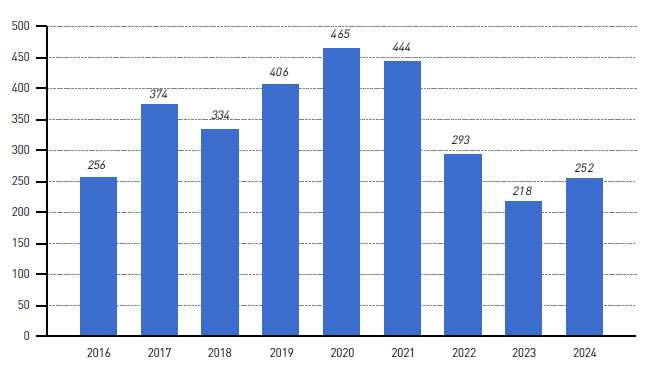
Graph 2 shows the number of new articles submitted to Revista Direito GV since 2016. Unlike Graph 1, Graph 2 excludes revisions and resubmissions, taking into account only new submissions.

Not all new submissions advance to the preliminary evaluation phase (desk review). A large number of manuscripts, after initial analysis of the minimum formal requirements, are referred back to the authors for adjustments, but never return. Graph 3 shows the number of submissions that actually advance in the evaluation process.

Graph 4 shows the relationship between the total number of submissions (Graph 1) and the number of articles sent to reviewers.
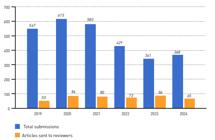
As can be noted, a significant portion of submissions do not pass the initial review stage, either due to non-compliance with formal requirements or because the content is not appropriate for the scope of the Editorial Policy. In such cases, the process is terminated at the peer review stage (rejection during desk review). We emphasize that authors should be aware of the high initial rejection rate: careful preparation of the manuscript and attentive reading of the journal’s editorial policy are essential for a successful submission.
As for the location of authors who submitted articles to the journal in 2024, the data indicate that São Paulo remained the state with the highest number of submissions (31% of the total), followed by Minas Gerais (11.6%), Rio Grande do Sul (7.6%), Paraná (7.1%), and the Federal District (4.8%)-the five states with the highest proportion. The Southeast region accounted for 47.8% of submissions, followed by the South (19.2%), Northeast (13.3%), Midwest (11.2%), and North (8.5%).
Authors from 22 different countries submitted manuscripts that were evaluated in 2024. Brazil, naturally, leads in the number of submissions, followed by Portugal (6 submissions), Chile and Ukraine (5 submissions each), India (3 submissions), Angola, Argentina, Italy, Kazakhstan, Spain, the United Kingdom, and Vietnam (2 submissions each), and Canada, Colombia, Costa Rica, El Salvador, Indonesia, Iraq, Luxembourg, Russia, the United States, and Uzbekistan (1 submission each).
2. Average time
Table 1 shows the average time, in days, for evaluating all manuscripts, from submission to final decision. It reveals that this average has been falling since we began measuring this data. However, in 2023 and 2024, there was an increase in this average time. This was expected, as we indicated previously (Mouallem et al., 2024), due to the necessary adaptation to changes in the new Editorial Policy, which made the editorial process more thorough and complex.
The average time between submission and approval of articles fell sharply between 2022 and 2024. In 2021, this average was 361.6 days, rising to 443.2 days in 2022 and peaking at 516.5 days in 2023. In 2024, however, there was a significant reduction, with the average falling to 317.5 days. Another positive result was the decrease in the average time between submission and publication of manuscripts, which recorded its shortest interval in three years. There was a drop of approximately four months in manuscript processing time: while in 2023 the average was around 23 months, in 2024 this time was reduced to 19 months, as shown in Table 2 below.
The reduction of this timeframe is an important milestone for the journal, which seeks to comply with SciELO’s best practice guidelines (SciELO, 2024), which recommend an average of 12 months between submission and publication of articles. With the consolidation of new editorial practices and the improvement of internal processes implemented since 2022, we expect to further reduce the processing time for articles in the coming years.
3. Peer evaluation
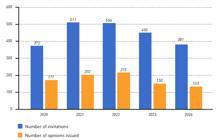
The peer review process also saw improvement. In 2024, 381 invitations were extended to provide 133 opinions in the double-blind peer review stage, representing the lowest indicator since 2021.
For the first time in four years, there was a reduction in the average number of invitations required to obtain an opinion. In 2021 and 2022, an average of 2.5 invitations was required for each opinion issued. In 2023, that number jumped to 3. In 2024, the average fell to 2.3 invitations per opinion.
As illustrated in Graph 5, this remains one of the bottlenecks in the editorial process. In fact, academic journals around the world face the so-called “peer review crisis” (Nassi-Calò, 2023), which includes the difficulty of finding, in a timely manner, reviewers capable of evaluating the articles submitted. Although still high, the lower number of invitations required per review can be interpreted as a positive sign of improvement in the editorial process at Revista Direito GV.
4. Distribution by gender
Gender inequality in submissions to the journal-that is, when analyzing the authors of submitted manuscripts-remains a reality, as discussed in previous editorials.
In 2024, the difference in the proportion of manuscripts submitted with only-male authors and only-female authors became more pronounced again. While in 2023, the percentage of articles submitted by only-male authors was 35%, in 2024, this number increased to 38%. However, the percentage of articles submitted by exclusively female authors decreased from 29% in 2023 to 26% in 2024. Graph 6 illustrates this scenario.

To attract more submissions of manuscripts written by women, Revista Direito GV launched a call for papers for a special issue on Law, Gender, and Equality, scheduled for publication in 2026.
Also as a result of the journal’s gender equality policy, two positive indicators were observed in 2024: (i) increased gender equality among published authors, and (ii) a decrease in the difference between the proportion of male and female reviewers.
In 2024, 49% of the articles published in Revista Direito GV were written by women, while 51% were written by men. That year also saw the smallest historical difference in the proportion of reviewers by gender, as shown in Table 3 below.
5. Preprints and acceleration of scientific communication
In 2024, Revista Direito GV, committed to making the editorial process more dynamic and accelerating the scientific communication of its manuscripts, began publishing articles in preprint format.
In the preprint mode, approved articles are immediately made available in the SciELO Preprints collection, prior to final publication, with the aim of accelerating access to research. Articles published in this mode can already be cited and receive the same DOI (digital identifier) as the final version, published after completion of the editing process.
Aware of the need to expand and accelerate the communication of its publications and reduce the average time between submission and availability of articles, Revista Direito GV has sought to improve its processes. Publication in preprints is part of these efforts. It is hoped that these changes will contribute to an efficient editorial process that adheres to best practices.
6. Outlook for 2025
In 2025, the journal is projected to face a scenario of substantial transformation in the regulation of scientific publications in Brazil, in which adherence to good editorial practices and the principles of Open Science tends to consolidate itself as a central criterion of excellence. In this context, Revista Direito GV has been actively preparing for this scenario, strengthening its interactions with the SciELO team and other national legal journals in the search for ways to strengthen its editorial practices.
In line with the recent change in the scope of its editorial policy, throughout 2025, the journal will publish a series of interviews with leading figures in the field of Law and Development, produced by faculty and students from the São Paulo Law School of the Getulio Vargas Foundation (FGV DIREITO SP). The initiative aims to foster interdisciplinary academic dialogue and provide reference material for research in the field, expanding the formats for the production and circulation of legal knowledge.
This year, the journal will also intensify its internationalization efforts by building international academic networks and modernizing its dissemination strategies. Institutional participation in international conferences and the creation of profiles on social networks are part of this initiative. In addition, with the publication of the thematic dossier on Law, Gender, and Inequality, the journal seeks to address a persistent challenge: the gender disparity among published authors, reaffirming its commitment to a more inclusive and pluralistic legal science.
Conclusion
We are deeply grateful for the valuable contributions of everyone involved in the maintenance and continuous improvement of Revista Direito GV: authors, reviewers, and readers. We recognize that the success of this publication is only possible thanks to the commitment and dedication of each and every contributor.
The 2024 balance sheet reveals that Revista Direito GV has been able to successfully implement the changes planned since 2022, aimed at improving the evaluation, editing, and dissemination processes of its publications. Committed to best practices and the principles of Open Science, the journal has managed to renew itself without compromising the standard of excellence it has built over decades. Fortunately, our readership remains loyal and engaged. For all these reasons, we share an optimistic outlook for 2025.
References
-
BARBIERI, Catarina Helena Cortada; NOYA, Henrique Cruz; BUZOLIN, Lívia Gonçalves. Revista Direito GV em números: balanço de 2022 e perspectivas para 2023. Revista Direito GV, São Paulo, v. 19, e2300, 2023. DOI: https://doi.org/10.1590/2317-6172202300
» https://doi.org/https://doi.org/10.1590/2317-6172202300 -
MOUALLEM, Pedro Salomon Bezerra et al Revista Direito GV em números: balanço de 2023 e perspectivas para 2024. Revista Direito GV, São Paulo, v. 20, e2400, 2024. DOI: https://doi.org/10.1590/2317-6172202400
» https://doi.org/https://doi.org/10.1590/2317-6172202400 -
NASSI-CALÒ, Lilian. Como reformular a publicação científica para enfrentar a crise da avaliação por pares. SciELO em Perspectiva, 13 dez. 2023. Disponível em: https://blog.scielo.org/blog/2023/12/13/como-reformular-a-publicacao-cientifica-para-enfrentar-a-crise-da-avaliacao-por-pares/ Acesso em: 25 fev. 2025.
» https://blog.scielo.org/blog/2023/12/13/como-reformular-a-publicacao-cientifica-para-enfrentar-a-crise-da-avaliacao-por-pares/ -
SCIENTIFIC ELECTRONIC LIBRARY ONLINE (SCIELO). Critérios, política e procedimentos para a admissão e a permanência de periódicos na Coleção SciELO Brasil São Paulo: SciELO, set. 2024. Disponível em: https://www.scielo.br/media/files/20240900-Criterios-SciELO-Brasil.pdf Acesso em: 4 fev. 2025.
» https://www.scielo.br/media/files/20240900-Criterios-SciELO-Brasil.pdf
-
How to cite this editorial:
MOUALLEM, Pedro Salomon Bezerra; BUZOLIN, Lívia Gonçalves; NOYA, Henrique Cruz. Revista Direito GV in Numbers: 2024 Balance Sheet and Outlook for 2025. Revista Direito GV, São Paulo, v. 21, e2501, 2025. https://doi.org/10.1590/2317-6172202501

 Source: Prepared by the authors, based on files from Revista Direito GV and ScholarOne Manuscripts/Revista Direito GV.
 Source: Prepared by the authors, based on files from Revista Direito GV and ScholarOne Manuscripts/Revista Direito GV.
 Source: Prepared by the authors, based on files from Revista Direito GV and ScholarOne Manuscripts/Revista Direito GV.
 Source: Prepared by the authors, based on files from Revista Direito GV and ScholarOne Manuscripts/Revista Direito GV.
 Source: Prepared by the authors, based on files from Revista Direito GV and ScholarOne Manuscripts/Revista Direito GV.
 Source: Prepared by the authors, based on files from Revista Direito GV and ScholarOne Manuscripts/Revista Direito GV.