 READING AND INFORMATIONAL PRACTICES IN COMMUNITY LIBRARIES IN REREADING NETWORK - PE
ABSTRACT:
This analyzes the existing reading and informational practices in four community libraries of rereading - Pernambuco, Brazil, based on two pillars: the actions it performs and the behaviors/ experiences/feelings of the subjects involved with these libraries. It uses as a theoretical basis a reflection that seeks to discuss the concept of reading in a broad way, as well as its relationship with the concepts of mediation and appropriation of information and sketches considerations about the concept of information and its implications with informational practices. It also elaborates conceptual explanation about community libraries, seeking to understand the singularities of this typology of libraries, as well as presents the Releitura-PE. From the methodological point of view, it carries out a bibliographic study, together with an empirical investigation of the collection of information about community libraries and the collection of testimonies of the individuals that are part of these libraries, such as managers, reading mediators and interactors, through semi-structured interviews, which were analyzed and categorized using the Content Analysis, technique. It concludes that the reader's and informational practices of the subjects are multiple and are revealed individually, in the ways of reading and informing themselves, as well as collectively, in the following practices: management, organization and political incidence; training and qualification of the team; communication and dissemination of actions; mediation of reading and cultural actions; Articulation with local entities and interaction with the library. The library, in turn, was considered a living space, a place of coexistence, reading, learning and leisure, as well as an instrument of politicization and development of citizenship and autonomy of the individuals.
KEYWORDS:
Community library; Reading; Information.Releitura - PE.
RESUMO:
Analisa as práticas leitoras e informacionais existentes em quatro bibliotecas comunitárias da Releitura-PE, a partir de dois pilares: das ações que ela realiza e das condutas/vivências/sentimentos dos sujeitos envolvidos com essas bibliotecas. Utiliza como embasamento teórico uma reflexão que busca discutir o conceito de leitura de maneira ampla, bem como sua relação com os conceitos de mediação e apropriação da informação e esboça considerações sobre o conceito de informação e suas implicações com as práticas informacionais. Realiza ainda explanação conceitual sobre bibliotecas comunitárias, buscando compreender as singularidades dessa tipologia de bibliotecas, bem como apresenta a Releitura. Do ponto de vista metodológico, realiza um estudo de caráter bibliográfico aliado a uma investigação empírica de coleta de informações acerca das bibliotecas comunitárias e coleta de depoimentos dos sujeitos que fazem parte dessas bibliotecas, tais como gestores, mediadores de leitura e interagentes, por meio de entrevistas semiestruturadas, as quais foram analisadas e categorizadas por meio da técnica de Análise de Conteúdo. Conclui que as práticas leitoras e informacionais dos sujeitos são múltiplas e se revelam tanto individualmente, nas maneiras de ler e de se informar, como coletivamente, nas seguintes práticas: gestão, organização e incidência política; formação e capacitação da equipe; comunicação e divulgação das ações; mediação de leitura e ações culturais; articulação com entidades locais e interação com a biblioteca. A biblioteca, por sua vez, foi considerada um espaço vivo, local de convivência, leitura, aprendizado e lazer, além de um instrumento de politização e desenvolvimento da cidadania e da autonomia dos sujeitos.
PALAVRAS-CHAVE:
Biblioteca comunitária; Leitura; Informação; Releitura -PE.
RESUMEN:
Se analiza las prácticas lectoras e informativas existentes en cuatro bibliotecas comunitarias de la Releitura-PE, a partir de dos pilares: de las acciones que ella realiza y de las conductas/ vivencias/sentimientos de los sujetos involucrados en esas bibliotecas. Utiliza como base teórica una reflexión que busca discutir el concepto de lectura de manera amplia, así como su relación con los conceptos de mediación y apropiación de la información y esboza consideraciones sobre el concepto de información y sus implicaciones con las prácticas informacionales. Se realiza una explicación conceptual sobre bibliotecas comunitarias, buscando comprender las singularidades de esa tipología de bibliotecas, así como presenta la Releitura. Desde el punto de vista metodológico, realiza un estudio de carácter bibliográfico aliado a una investigación empírica de recolección de informaciones acerca de las bibliotecas comunitarias y recolección de testimonios de los sujetos que forman parte de esas bibliotecas, tales como gestores, mediadores de lectura e interagentes, por medio de entrevistas semiestructuradas, las cuales fueron analizadas y categorizadas por medio de la técnica de Análisis de Contenido. Concluye que las prácticas lectoras e informacionales de los sujetos son múltiples y se revelan tanto individualmente, en las maneras de leer y de informarse, como colectivamente, en las siguientes prácticas: gestión, organización e incidencia política; formación y capacitación del equipo; comunicación y difusión de las acciones; mediación de lectura y acciones culturales; articulación con entidades locales e interacción con la biblioteca. La biblioteca, por su parte, fue considerada un espacio vivo, local de convivencia, lectura, aprendizaje y ocio, además de un instrumento de politización y desarrollo de la ciudadanía y de la autonomía de los sujetos.
PALABRAS CLAVE:
Biblioteca comunitaria; Lectura; Información; Releitura -PE.
1 THREADING THE NEEDLE: initial thoughts
Community libraries are spaces that have achieved social prominence by the way in which they manage and promote their actions in favor of access to reading, information and culture of the less favored classes. They usually appear in marginalized neighborhoods, by initiative of the population itself, in a solidarity and voluntary way, in the search to meet the demands of reading these places, besides being an alternative space to the inoperativeness of school libraries and the distance from public libraries in relation to neighborhoods more peripheral.
In the Metropolitan Region of Recife (RMR), in Pernambuco, the group of community libraries, Releitura-PE, has been developing relevant work to train readers in peripheral communities. Created in 2007, this articulation now has seven libraries, and has the mission of invigorating and qualifying its member libraries, in order to democratize access to the book and the written culture, with reading as a human right.
Therefore, to contribute to the expansion of the visibility of these experiences, as well as to understand and characterize the informational and reading practices of community libraries, in order to discover what is produced and lived in these spaces from the interaction with information and with the reading, we carried out this study in Releitura. This choice is also justified because it is a collective that stands out in terms of its time of action and political-social articulation, which struggles and resists daily in search of more reading and informed communities.
2 READING PRACTICES
We propose, for this theoretical reflection, a discussion based on the assumption that informational appropriation is acquired through a process of mediation, the basis of which is reading. By virtue of this, subjects construct a set of informational and reading practices through a dialogical and interactional process, in the actions of search, use and sharing of information, from a sociocontextual perspective, as well as appropriating sources, attributing meanings, feelings and experiences to their actions.
We agree with Almeida Júnior (2007), when he affirms that reading is a fundamental piece for the existence of information, because it is from the reading that occurs the informational appropriation, that is, it is in the act of reading that the information is concretized. Without the use of reading, it is impossible to give meaning to the actions developed by Librarianship and Information Science (CI), since both have the reading as a basis of support (ALMEIDA JÚNIOR, 2007).
In the present study, we adopted the conception of reading in a broad sense and, therefore, in its interaction with other languages, and not only with the written text, as it frequently occurs. Thus, reading, in addition to a mechanical decoding of letters, is understood as a sensorial, emotional and physiological movement that involves different instances of knowing, feeling and being (MARTINS, 1997). Like Paulo Freire (2011), who advocates reading the world, instead of just reading the word, we believe that the formation of readers requires an inclusive dynamic that encompasses all kinds of reading, not only the written text, and that understands the reality and the context that permeates these languages. Therefore, reading is not only about lawyers; the reading of the images, the symbols, the colors, the music, the dramaturgy, the film, the conversations are also elements that are part of the reading formation.
Thus, several experiences involve the act of reading, ranging from a more pragmatic and utilitarian to a more social and imaginative. According to the French anthropologist Michele Petit (2008), reading can contribute in several aspects, such as access to knowledge, instruction, language appropriation, self-construction, a singular identity, as well as the extension of the horizon of references and the development of new forms of sociability and autonomy in the face of dominant discourses.
Literary reading, in turn, is an exquisite way of entering into the universe of fable and enchantment, and consequently of acquiring more instrumental skills. Cândido (2012, p.23) conceptualizes literature as "all creations of poetic, fictional or dramatic touch at all levels of a society, in all kinds of culture, from what we call folklore, legend, to the most complex forms and difficult of the written production of great civilizations. " Such manifestation is present from the illiterate to the scholar, from the cause to the HQ, and, thus, corresponds to the use of the word for the creation of worlds or a sense of world (COSSON, 2014), whose presence is imperative to any people.
We believe, therefore, that reading is a right and that its power of transformation can help people to better understand themselves as subjects citizens and actors in their own history. As Riter (2009, p.35) tells us, being a reader makes a difference, because it allows us to build new feelings and experiences, "it is the possibility of building a better, more critical, more sensitive human being; someone able to put himself in the other's shoes; someone more imaginative and dreamy; someone a little more freed from the many prejudices that society is imposing on us every day ".
However, it being about an informational space for the formation of readers, it is worth mentioning the figure of another important element in the process of mediation of reading, which is the mediator. He is responsible for collaborating in the construction of a more mature reader in the interactional movement that relates the work of readership, having "the task of directing the reader to new discoveries and adventures" (ALMEIDA JÚNIOR; BORTOLIN, 2008, p.3). This is not to say that mediators are only the subjects who work in the library, but all those who exchange, indicate, comment and suggest readings among themselves.
We also recall that every act of mediation presupposes interference. Such interference, which can be carried out by the information professional or not, meets the idea of the supposed neutrality of this professional, since there is no impartial mediation, but, on the contrary, all interference is salutary, provided it is not confused with manipulation, it may exist unconsciously (ALMEIDA JÚNIOR, 2007).
The mediation of reading is therefore a way of presenting and stimulating the reading of a work. The mediator has, in turn, the function of enabling experiences of appreciation of the work, of aesthetic enjoyment, that bring the relations between the work and the reader, widening their universe of reading. He is also the actor who will facilitate and drive access to texts when they are still foreign to the reader. It is not the mediator's role to impose his impressions on the work, but to stimulate and arouse the reader's interest in it (RITER, 2009; NEITZEL; BRIDON; WEISS, 2016).
Thus, the place of reading in libraries is organized in a singular and structuring way, as a form of formation through the guarantee of the right to reading, especially to literary reading. In a broad perspective, the reading is presented here as a motto for the aesthetic enjoyment of an artistic work, as well as for citizen and human education, as well as the confrontation of conditions of social exclusion.
It focuses on the importance of reading and producing meaning through literary reading, which is always surrounded by a network of mediations and a repertoire constructed by the reader. The ways and motives to read are plural and do not always converge. Here, then, are the infinite possibilities of interpretation provided by the work.
Therefore, the singular ways of reading, the constructs derived from reading and the instances involving the mediation of reading converge in the practices of reading and information, which are the activities, sensations, the ways of reading of the subjects for purposes of aesthetic or utilitarian use, as long as they make sense to them. These practices promote, through the use of information, the formation of readers and, consequently, the opening of new paths for the life of these subjects.
3 INFORMATIONAL PRACTICES
Information is embedded in all social practices as something that needs the subject to assign meaning, and whose context is vital to its meaning. We can say that all human beings use and interact with information, each with its own peculiarities. All people need information to carry out their social practices, be they personal, recreational, professional or academic. Therefore, the information is inserted in all daily actions, since, daily, information is sought to carry out several activities (CUNHA; AMARAL; DANTAS, 2015).
We seek to delineate, initially, the concept of information as a phenomenon that presents itself on three faces - material, subjective and social - whose construction is done by the subjects through cognitive and interactional actions with other subjects with autonomy to perceive what is informative for him or for the group. Then, to base the concept of information practices, we made a brief introduction to user studies, and presented information practices as an emerging trend in this field.
In terms of terminology, the word information comes from Latin, from the verb informare, translated into Greek as informatio and inform, which means to give shape to something, to construct an idea, to shape matter. In the Middle Ages, the term was used in the ontological and epistemological sense of giving shape to something, and in the pedagogical sense of instructing (CAPURRO; HJØRLAND, 2007).
In the transition from the Middle Ages to the Modern Age, the use of the term information, in the sense of giving form to matter, becomes employed in the sense of communicating something to someone, and is therefore considered intangible. However, this abstraction of the concept of information ceased to exist until the emergence of Information Theory in the mid-twentieth century (CAPURRO, HJØRLAND, 2007), a theory that directly influenced the first formulations about the concept of information in Information Science.
The Mathematical Theory of Communication, or, as it became known, Information Theory presents itself as a physical conception of information, when it is conceived as an element that can be measured and calculated. Created by the American engineers Claude Shannon and Warren Weaver in 1949, this theory proposed to analyze the effectiveness of the transference of information only from a syntactic point of view, not considering the semantic and pragmatic factors associated with it. In this way, the type of information studied was objective information, which could be processed in systems for the retrieval of information (CAPURRO, 2003; WERSIG, 1996; ARAÚJO, 2011; ALMEIDA, 2015).
From this perspective, information can also be understood as a given or as a thing. Buckland (1991) argues that all records and objects are potentially informative, and that information as a thing deserves to be studied in the IS because it is the only form of information that is directly addressed by information systems. He also argues that people are informed not only by means of conventional communiqués, but also from a wide variety of objects and events.
However, for the processing of this information to occur, it is necessary to mobilize structures that denote meaning to it. The interpretation of information and the attribution of value to a document are elements that characterize the cognitive aspect of information, which seeks to see how the user attributes meaning to information and how it is transformed during the informational process (CAPURRO, 2003) how that information altered its state of knowledge (BARRETO, 2002).
However, instead of this interpretation being considered only in an individual subjective plane, for some authors it is determined in the social and cultural context (CAPURRO, HJØRLAND, 2007). The social facet of information, therefore, goes beyond the subject's cognition or individuality, considering the social and material conditionings of human existence (CAPURRO, 2003).
Thus, what defines the informational process are the very definitions of what each social cognoscent subject considers as information, what he selects and places as a criterion to access or discard, in a socio-historical process (CAPURRO, 2003). Producing, accessing or sharing information "presupposes, in his act, the direct recognition by the individual that he is the main protagonist of this complex process involving both human and non-human entities" (SILVA, NUNES, 2014).
Information is thus revealed as the result of the individual's interpretation of his reality. The construction of knowledge takes place on an individual, group and social level in a dialectical way, between the objectivity of reality and the subjective meaning attributed to it by the subjects (BERGER, LUCKMANN, 2014).
Thus, we agree with Almeida Júnior (2007), when he states that information does not exist a priori, but only materializes at the moment of mediation. What is in advance is the document or the support, but the appropriation of the information occurs when the subject, through reading in a broad sense (decoding and deciphering the message until inferential comprehension), constructs the information. The information here is therefore considered as a "source" of conflict generation that, instead of diminishing the certainties, raises new questions, and thus provides the construction of new knowledge (ALMEIDA JÚNIOR, 2009).
Through information mediation, it is understood the process that goes from the communication through support until the transformation of the knowledge of the subject. What does not refer only to the subject strictly in his individual structure, but having as a dependent and co-constructor also the collective (historical, social, interaction with other subjects) (ALMEIDA JÚNIOR, 2009; 2007).
Informational appropriation, in turn, refers not only to an action of consumption or reception of information, but refers to the idea of change, change and production of knowledge (ALMEIDA JÚNIOR, 2007). In informational environments, the author continues:
the mediation is present, not explicitly, in the selection, in the choice of materials that will be part of the collection of the library, in all the technical processing work, in the collections development activities, and also in the reference and information service. Present in all these actions, mediation is part of the information area itself. Specifically, in relation to the area of Information Science, its object would be more mediation than information (ALMEIDA JÚNIOR; BORTOLIN, 2008, p. 6-7).
It is, therefore, from this context, that it considers that the concretization of information occurs through a mediational process through reading and this, in turn, results in the process of appropriation information, the construction of which takes place individually and collectively, that we come to understand the concept of informational practice.
According to Savolainen (2007), informational behavior and informational practices are, in general, ways in which people deal with information. However, they are not synonymous terms, but loaded with different meanings, originated by different theoretical conceptions and discourses.
Savolainen's (2007) arguments argue that the concept of informational practices is more socially and contextually oriented than the concept of informational behavior. The idea of informational practice shifts the emphasis of the individual's abilities and motivations to the search for and use of information constructed dialogically in the midst of social interactions. For the author, the concept is linked to the contextual factors of search and information sharing, putting the social and cultural elements in the central plane of analysis.
In this way, Savolainen expands the search for information, widening the focus beyond the search. This perspective encompasses the use and sharing of information, and transcends to environments outside the workplace, outside organizations, the concern with the search and use of information in everyday life contextually (SAVOLAINEN, 2008).
Informational practices can therefore be understood as "a set of socially and culturally established ways to identify, seek, use and share information available from various sources, such as television, newspapers and the Internet" (SAVOLAINEN, 2008). This concept also includes the actions of information mediation and information appropriation, which presuppose a movement of sharing through the reading that promotes interaction and negotiation among subjects, so that they appropriate information and produce knowledge.
The approach to information practices is important, therefore, considering the subject as a social actor who, in addition to being an active being in the search and sharing of his actions, realizes them in the midst of a collectivity and assigns meaning to them.
In carrying out these actions, subjects demonstrate information competencies in the search, use, appropriation, production and sharing of this information, including, in this, the capacity to make relationships, discern, infer and use information appropriately, in addition to understand as information not only that linked to scientific knowledge, but also to the knowledge of the people, to common sense and to the empirical world (ALMEIDA JÚNIOR, 2016).
In this sense, in addition to the use of information, the conception of negotiation and sharing of information makes the mediation process a joint action of dialogue, interaction and discussion that promotes and stimulates the informational practices of the subjects. The interaction presupposes effective participation of the subjects and transformative action, opportunized by the dialogue.
Thus, as a way of reflecting on these concepts, we understand that informational and reading practices are concepts that are broadly treated. They imply search, production, appropriation and sharing of information, which are acquired through the use of reading through a process mediated by diverse contextual, human, cultural and technological interferences. The knowledge, skills, feelings, values and experiences acquired and transformed during these processes also include informational and reading practices.
Considering the proposed theoretical discussion, we consider that the appropriation of information is a process that involves collective instances that, in a mediated way, provoke individual decisions / sensations about the ways of reading and informing oneself. Both the explanation of reader practices and the exposition concerning informational practices, the concept of context is highlighted, since the individual actions of the subjects are strictly entangled with their historical, social and group actions.
4 COMMUNITY LIBRARIES
In beginning a conceptual discussion of the term "community libraries", Almeida Júnior (1993) considered that the community library would be a modality of the alternative library concept. The latter is defined by it as being all proposals that would change or alter the work of the traditional library, such as the concepts of "Library-Cultural Action", Flusser's "Library-Cultural Center", "Center for Popular Documentation", Reference and Information Service, as well as popular and community libraries.
Later, in a way complementary to the conception presented by Almeida Junior (1993), Machado (2008) pointed out five elements peculiar to community libraries that distinguish them from other types of library. They are:
-
the form of constitution: they are libraries created effectively by and not for the community as a result of a cultural action.
-
the group's common perspective on combating informational exclusion as a form of struggle for equality and social justice.
-
the process of local articulation and the strong bond with the community.
-
spatial reference: they are, in general, located in peripheral regions.
-
the fact that they are not governmental institutions, or directly linked to the Municipalities, States or Federation (MACHADO, 2008, p. 60-61, highlighted by the author).
We emphasize that, in fact, the community libraries are not without the alternative character to the public library, as emphasized by Almeida Junior. However, we also agree with Machado, when she points out the other elements, since they represent, concretely, the form of constitution of community libraries, especially those that are part of our research locus, Releitura.
The community libraries present themselves as a new type of library that, although they are also public information spaces, are maintained by people of the society in general (FERNANDEZ, MACHADO, 2016). They are spaces that seek to be a place of access to information, reading and culture of people who, often, do not have other spaces of education, culture and leisure.
The Re-reading, Community Networked Libraries of the Metropolitan Region of Recife, is an articulation that arose in 2007, initially with four community libraries. Subsequently, four more libraries met with the group to strengthen themselves as a collective, with information exchange, mutual help and improvement in formation (RELEITURA, 2013).
By 2013, Releitura was composed of ten member libraries. Today, it has seven libraries. The purpose of the collective is to strengthen and qualify the community libraries of the Metropolitan Region of Recife, aiming at the formation of reader communities in the perspective of building a more just, plural and democratic society project (RELEITURA, 2014).
The libraries that are part of the Releitura work in the municipalities of Jaboatão dos Guararapes, Olinda and Recife, serving about 15 thousand people, among children and young people and their families. The collective seeks to strengthen and democratize access to the book and written culture in these communities through various actions in each library, as well as to foster the political-pedagogical framework of community libraries and fight for the construction of public policies for reading and the library (RELEITURA, 2013, 2014).
From the beginning, in 2007, Releitura counts on the partnership of the Luiz Freire Culture Center, and the C&A Institute (IC&A), in 2008, through the Pleasure in Reading Program. It participates and works with the Pernambucano Forum in Defense of Libraries, Book, Reading and Literature (FDBLLL/PE) for the creation of the State and Municipal Book and Reading Plans. In 2012, it became a partner of the Center for Studies in Education and Language (CEEL) of UFPE, which in 2014 promoted a series of actions, among them the National Literacy Program (PNAIC) subproject (RELEITURA, 2014).
The initiative of the Releitura group in RMR, as a network of community libraries, is a pioneer in Brazil, influencing the formation of other networks of libraries in the country. Currently, it also integrates the National Network of Community Libraries (RNBC), a collective formed by several state and regional networks of such libraries (RELEITURA, 2013).
5 METHODOLOGICAL DESIGN
Our methodological process, besides exploratory bibliographic research, included an empirical study of the collation of information about community libraries and the collection of testimonies with subjects that are part of these libraries through semi-structured interviews, which were analyzed and categorized through the Content Analysis technique (BARDIN, 2008)
The four libraries that formed the empirical body of the research were, in alphabetical order: Community Library Friends of Reading (BAL), created in 2004 by a resident of the neighborhood, along with some partner institutions; CEPOMA Library (BCEPOMA), created in 2006 within a popular education center founded by the community; The Nascimento Multicultural Library (BMN), created in 2000 by young people from the community, together with partner institutions, and the Coque Popular Library (BPC), created in 2006 by a community resident, along with partner institutions. To date, all these libraries are maintained by members of the community, idealizers and partners.
The interviews were conducted with managers, mediators and interactors of the four community libraries. The collection of the testimonies occurred from September 30 to December 7, 2016, including the pre-test. In all, there were 31 interviews, totaling almost 40 hours (the shortest interview time being 29 minutes and the longest interview time 6 hours) and 305 pages of transcription, in addition to the hours spent before and after the interviews in each library or location of the interview.
For the analysis of formal interviews, we use the technique of content analysis, defined and structured by Laurence Bardin (2008), which defines this form of data analysis as a set of communication analysis techniques (oral discourses or written texts) which uses systematic procedures and objectives to describe the content of messages. Content analysis was chosen because it considers the meanings (the content) rather than the form (the occurrence analysis).
We chose to perform a categorical analysis, which constitutes a classification operation, followed by gender regrouping according to previously defined criteria. It operates by splitting the text into units (categories), according to the proposed thematic analysis (BARDIN, 2008). In this study, the themes in question were delineated according to the two basic matters of the research: the information practices and the reading practices of the subjects involved with the community libraries. However, it is emphasized that the categories used here do not only seek to include the common elements of each group, but rather to present their conflicts, their singularities, their different positions on a fact, and the multiplicity of visions, practices and affinities.
6 DISCOVERING AUTHORS AND THEIR PRACTICES
So reading broadens our field of vision, our range of vision and broadening your field of vision, you have a better perspective of the future, because when the person is only there in his "box", he thinks life is that, he does not transcend that (Sérgio, manager).
Regarding the profile of the interviewees, we have people of different backgrounds and occupations, who have extensive involvement with libraries. All of them reside in the RMR, with the majority located in Recife (19) and Olinda (11). The educational training and the occupation of the 18 subjects managers and mediators of the libraries is heterogeneous, contemplating, for the most part, areas related to Education. School levels range from high school (1), undergraduate (10), teaching (1), specialization (2), to master's degree (4). About five of them have 10 to 30 year involvement with libraries, and 11 have a library link of up to 10 years.
Regarding library interactions, the age range ranged from 11 to 34 years, with levels of education from the 2nd year of elementary school to the technical level. Most of them are students, including a street artist and a maid. They live with two to seven people at home. Seven of them pointed out the frequency of relatives, such as mothers, brothers and nephews, to the library.
Due to ethical reasons, the libraries will be treated by their acronyms and the names of the interviewees have been changed to maintain their integrity, preserving only the gender. For this substitution, names of literary characters were chosen. We emphasize that the presented results show some of the elements analyzed in the original research, therefore the inclusion of Charts in order to synthesize and better illustrate the content of each category.
6.1 READING AS THE THREAD: Reading and informational practices of subjects
Reading is another story, reading is all good, you know how it is, right, it's the maximum, listening to the story is good, but reading with your own eyes is magic (Ana Clara, educator)
Because we understand that reading is the entity that unites and brings together all these people, feelings and wishes around this library network, even though for some the relationship with reading already existed before the library and in others, this relationship only came to emerge from it, we chose to categorize reading as the first instance of analysis as the thread that propelled and established the bond between these people and encouraged them to read more, to inform themselves and to be in the library.
It was noted that subjects have a broad relation with reading, even though they have mostly cited the book as the main support. Some interviewees observed the broad concept of world reading, both realized by them, as well as the past and worked with interactors. Even considering the written word as the main basis, reading represents, for the deponents, a variety of values and pleasures, a source of knowledge and wisdom, as well as a gateway to the world of fiction and creation. In this sense, the interviewee Leonardo says:
I'm kind of dramatic about it, you know? Because reading is like drinking water. If you stop drinking water, you will become thirsty, will die, dehydrate. So if you fail to read, I think you become a less creative person, more apathetic to the world, more apathetic to yourself. I have the need to be destabilized all the time. For me, I seek in reading this destabilization and this growth, both pragmatic, in terms of vocabulary, in terms of logical reasoning, and [it also] has a subjective dimension of sensitivity, of your relationship with the world, of your affection with things, of that thing to fall in love with. I think reading is a great source of strength.
In order to deal with the search, use and share information by the deponents, we perceive the reading of written texts as a driving and influential factor of this process, since it was the most cited way to obtain information. The position of Almeida Júnior (2009) was therefore confirmed, stating that there is only the appropriation of information through reading, although reading is considered in its broad sense, and not only the reading of written texts.
It is observed, in the informational practices of the interviewees, the use of information competence and reading competence, which allows, through acquired skills, the appropriation of information. And this reflects both in the way the informational spaces are conducted, in which the interfering figure of the mediator acts, and in the interaction generated by the readers, which merge and amalgamate in the exchanges and the sharing of information. In a synthetic way, we set up a Chart that summarizes the main elements that represent the reader's and informational practices of the research subjects.
6.2 THE LIBRARY AS ARTISAN: tailoring the informational and reading practices
Considering that it was the reading and informational practices of these subjects that encouraged them to forge reading spaces, we highlight in this section the practices resulting from the creation of each library and the connection of the libraries (Releitura) and their partnerships, according to Image 1.

6.2.1 Management, organization and advocacy practices
One of the concerns that libraries have always shown and have always strived to seek new alternatives for improvement was with regard to how to manage their spaces, such as individual libraries or as Releitura. At first, each library tried to do the services in the best possible way, but they did not have a structured management practice. As they acquired knowledge about the existence of other community libraries and articulated themselves, they began to exchange information about how each one acted, thus becoming organized in a Network and maintaining many procedures in common, according to Chart 2.
6.2.2 Team education and capacitation practices
The quest for and the desire for empowerment arise amid a context of empirical action in which libraries were created, since most of the creators of these spaces are people not related to the field of Librarianship, but who had links with the field of Education and they saw in the book the possibility of changing the life of the community. Therefore, although they did not have the theoretical knowledge initially, they were gradually seeking it, as a way of improving their practical performance, according to Chart 3.
6.2.3 Communication practices and disclosure of actions
In all the activities and actions carried out, the library staff always do their best to register and disseminate them, from the planning stage to the moment of execution. Therefore, another information and reading practice observed was the production and sharing of information, carried out through the dissemination devices of activities, whether on posters, social networks or orally.
The communication represents, in addition to a practice that keeps the registered actions, a form of accountability to the society of the actions that take place in these spaces. They are informational actions that are inseparable from the social, historical, cultural and political context in which these practices are inserted, forming itself as a mediating movement of reception, appropriation and reappropriation of information. The synthesis of this category is presented in Chart 4.
6.2.4 Reading mediation and culture action practices
Another reading and information practice understood by us as the moment when libraries make use of mediation and appropriation of information and reading are the activities and services offered by them that will be seen both from the team's point of view and from the interaction agents.
Reading Mediation is the most developed activity in all libraries, because it involves a variety of actions that aim at interaction and the contact between the work and the reader. It is also considered by Releitura an action capable of promoting the taste for reading and literate culture in the places where the community libraries are inserted. It includes various activities such as reading wheels, recitals, chat with author, visits to cultural spaces, storytelling, among other actions.
Other activities carried out in the libraries that promote the encounter with culture take place through a multiplicity of supports or expressions, whether through the written or oral word, such as legends, tales, speeches, music, or through image, theater, dance, percussion, cinema, as well as capoeira, maracatu, bumba-meu-boi.
Thus, we have that the work developed in these libraries is based on a line of thought whose primary function is the development of reading and creative skills, based on an integrative proposal and a receptive environment adapted to the use of any type of public. All the care, planning, study and offering of actions undertaken by managers and mediators are done with the purpose of inclusion, of approaching the reader with the work, in order to provide diverse experiences and overcoming challenges. The intention is to offer a pleasant reading, leisure or refuge environment, since the library is often the only cultural equipment in the community. Chart 5 summarizes some considerations about these practices.
6.2.5 Joint practices with local entities
For this category, we have chosen to consider, as local entities, the educational institutions or community-based organizations with which libraries relate. However, libraries interact with various types of government, nongovernmental, and neighborhood institutions. The intention was to highlight the mutual activities carried out between the libraries and these training institutions, because they are actions of exchange, highlighted by the interviewees as fundamental for both actions.
The interaction of libraries with schools is a practice that occurs as a way to strengthen relationships with children and students in the community, to give or to expand access to reading, because in many of these schools libraries do not function way they should. This joint action of libraries with schools has been calcified by another partnership, carried out between Releitura and CEEL, which, through formations and actions, have been providing a routine of reading activities for this group.
We note, that the search for information, stimulated by work with reading, developed by the school indicates the formation of the development of reading competence of these students as actors who locate, research, appropriate and disseminate information already at this early stage of the school period. Through reading literacy mediation activities and weekly reading practices, these students acquired a taste for reading and for informing themselves.
For the teacher at the participating school, Lúcia, the action was very worthwhile, especially for having awakened in the children the taste for reading. Although she noticed that the interest was not everyone's, most of the children felt touched by the reading that, in one way or another, ended up infecting everyone. Another fact observed by the educator in this group of children, who is between 11 and 13 years old, was the exchange of books, the comments about them and the recommendation of the readings made. Thus, the educator points out:
This desire for this joyous reading, then, was very interesting, the movement in the library [of people] coming to borrow books to read, the movement that we generated there in [BMN], they leaving here and passing by to get a book to read on the weekend. So, among all the other things, of course having written the book, which I drew, that having done the whole rereading was very important, especially for them to perceive it that way, but it was very good to wake up.
It can be seen that the partnerships with these training institutions are mutually beneficial among them, and they have a good reception for the children and young people served. Interest in using the library grows, as well as interest in reading. We emphasize the work carried out by mediators of reading as fundamental for the development of the project, as well as the role of the library in the implementation and articulation of these partnerships. Chart 6, in summary, shows some points about these practices.
6.2.6 Library interaction practices by interacting agents
It has been noted that the ways in which subjects appropriate libraries are attuned to the way space was created and installed and the way the regulars came to it. Thus, each interactor knew the library in a way very appropriate to the way of creating these spaces.
The library staff's approach to interactors, because many members belong to the community, is a factor that drives most of these interactors to libraries. The proximity relationship and the hospitality provided by the library environment make it a living and transforming space. Interactors express admiration and gratitude to the library staff for the care, hospitality and attention given to them, not found in other information spaces, which is another factor that guarantees their permanence in these places.
This differential configuration of performance developed by community libraries comes from their conception of the educational and literary process, which is not consistent with a traditional methodology of teaching and training, but rather with an understanding that the formative process is constituted by a structure of actions that demand not only the arsenal of technical knowledge, but also of affective conceptions that lead to multiple experiences. Regarding the forms of interaction with the library, the actions of reading and borrowing books were pointed out as those of more interest and use by the interactors (Graph 1).
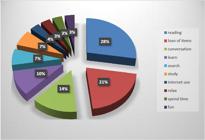
We understand, therefore, that there is a strong community relationship between the population and community libraries, so that one realizes how indispensable they are to the community and how much people need a space that provides information, books, recreation and support, and that is close to them. The synthesis of this section is shown in Chart 7.
6.2 ALIGNING NETWORKS AND PRODUCING NEW WEAVERS
For this last section, we conceived the results, changes and sensations that reverberated in the interviewees after their involvement with the libraries. What such reading and informational practices mean to them; as each subject realizes the importance of the library to him and to the other. The informational and reading practices here are the singular experiences, the unfoldings, the effects, the actions in which the subjects appropriate the reading and the information. In other words, what the use of reading, information, and the library generates in these individuals, and what they produce and feel from that.
The community library is considered by the interviewees an indispensable place within the community, which gives access to a peripheral group often excluded from society. It presents itself as an essential element that makes the difference in the history of the place, to the point that the community does not want it to end or weaken, because it already feels part of the library and embraces the cause. The mediator Miguel says:
[state and municipal public libraries] are libraries that are central and that even the population in the peripheries does not have access to. As a strategy for training readers, community libraries are the bridge, they are at the tip of this process of reading awareness because they are where the people are (Miguel).
Libraries are also seen as spaces of socialization and coexistence. A place of study, learning, leisure and culture, that is, "has this fundamental social function, both in the issue of reading and also in this issue of facilitating the coexistence between people, contributes in some way also to the decrease of violence indirectly, "Miguel points out.
Mediators also perceive the literary progress of the interactors, the larger movement in the library, and receive testimonials from parents and teachers about behavior change, such as the habit of listening and affection. For example, Augusto and Estela, respectively, evoke that:
[...] The boys came in large scale to make the card. Sometimes we are here and they invade the library. We realize that after this project, the movement grew, had a very good result. Who read continues reading and who did not read is beginning to read. I discovered some poets in the middle of the school, some children that they suddenly did not even know.
Schools come to us to comment that the students themselves ask for teachers and charge teachers to read the stories to them and say that "it is done in the library."
The role of the community library as an instrument of politicization and the development of citizenship and autonomy is also clear. A place that, through the availability of books, literary mediation and cultural action, is acting in a process of citizen education and its forms of intervention:
I think that the community library is this place of access to literate culture, access to a place of political strengthening, the exercise of the speech itself, the practice of speaking, of living together. Nowadays, I approach libraries in this sense, beyond this place of democratization of access, democratization of information, but of producing information, it is a place of empowerment, strenghtening (Leonardo).
But this relation of being with the library until today is to believe that this here is a space of transformation, to a space even of political, human empowerment, of the people being in a space like this, to have access to the book, because the book in Brazil is expensive (Sérgio).
Working in a community library is challenging, requiring the constant exercise of empathy and persistence, and it brings diverse possibilities to your collaborators. Knowledge of other life histories and other realities was a key factor in sensitizing these people to the understanding and acceptance of the other.
Finally, people who work in the library often have their identity confused with the history of that space because they are involved from the beginning and believe in this ideal. onceição mentions the following: "The change in my life comes from all this trajectory of the construction of the Releitura, there wasn't a before and an after because I also mix with this story."
It is clear, then, the love for libraries and the desire for change on the part of these subjects. The community library represents a place of daily living among people and the contact of these people with reading, information and culture, which seeks to overcome the challenge of sustainability, so that they can continue to build more reader-friendly and critical communities. The reader and informational practices existing in these libraries are the result of the mediation and appropriation of reading and information carried out by them, and reveal how significant these spaces are for the subjects' lives.
7 SEWING BUTTONS: some considerations
This research sought to find out what reading and information practices were developed in the libraries of the Releitura -PE collective, both through the actions carried out by each library and through the behaviors, experiences and feelings of the subjects who are part of them. Specifically, we seek to characterize each of the four libraries; to verify what were the practices of reading and of information existing in these spaces, as well as to understand what these practices meant for the subjects.
In this sense, the individual reading practices were quite plural, in that we had subjects who feel happy reading and others who feel difficulty or anxiety when reading. While some cannot live without reading, being thus the reading associated with a "virus" that infects and that remains, others aim at its instrumental and scholastic character. In this way, reading makes possible the expansion of the universe of language and the cultural universe, in the same way that it helps in the academic and professional exercise.
The interviewees presented the different forms of contact with reading in different phases of life, as well as the references of this process, such as the family, the school or the bookstore, the public library and the community library. Subjects also cited their ways of reading, their literary preferences and tastes, as well as the meanings that the reading conveys to them, and what is produced or felt from this interaction with reading. Therefore, reading represents a source of creativity, criticality, fun, alterity and humanization, as well as a way of building oneself. We find in these readers sensitive and critical people, highly politicized and engaged and, above all, dreamers, who have an ideal and who seek to realize this individual or collective ideal.
Regarding information practices, although they have been dealt with directly in only one section of the text, considering the broad concept of information we have brought, the information practices existing in these libraries go beyond the search and reading of news, in other actions, especially in the activities of mediation and communication and dissemination of activities, among others. However, we also point out that the concept of information discussed in IC differs greatly from the concept of information understood by the general public and, in this research, it was not possible to deepen this question. Therefore, a larger exploration would be necessary to identify what information is for these subjects and what sources they are informed about, and to compare these results with the theoretical discussions structured in the IC.
We note that informational practices are essential actions performed by the subjects interviewed when they resort to informing themselves about a varied content of information, to remain active in their functions and updated on the things that occur around them. In addition to the process of searching and using information through a process of mediation and informational appropriation, interviewees also record and share information that is produced through their individual and collective actions in libraries through the means of communication and dissemination of activities, especially through written and oral practices. Moreover, they do not conceive the act of informing themselves as something naive or passive, but seek to act actively in the selection of sources of information that are consistent with their political and historical perspectives, trying to remain critical in the middle of the media manipulative process and, at the same time, demonstrating a creative attitude towards this scenario.
We therefore conceive, in a non-linear way, that these reading and information practices were and are what motivated these subjects to interact with these community libraries in the creation of spaces and in the development of everyday actions, including the creation of Releitura and the agency of partnerships.
On this, the reading and information practices of these libraries are also linked to the political participation of the Releitura regarding the political incidence practices carried out by this collective in the Pernambuco scenario. This can be observed when the Releitura works in the planning of forms of sustainability of the libraries, as well as in the participation in the debates on public policies for the intervention in the proposals of public budgets destined to the book, the reading and the libraries and, consequently, in the formulation of policies that guarantee the development of its activities.
In addition, the activities carried out in these libraries portray their creative character in the development of actions that are characteristic of the communities, aiming at strengthening the bonds with the public and articulating inventive forms of intervention in such places. Reading mediation practices and cultural actions therefore represent a way of keeping alive the collection and the identitary and cultural traits of these populations, so that they themselves build their singularities through written and artistic practices. We therefore conceive, in a non-linear way, that these reading and information practices were and are what motivated these subjects to interact with these community libraries in the creation of spaces and in the development of everyday actions, including the creation of Rereading and the agency of partnerships.
On this, the reading and information practices of these libraries are also linked to the political participation of the Releitura regarding the political incidence practices carried out by this collective in the Pernambuco scenario. This can be observed when the Releitura works in the planning of forms of sustainability of the libraries, as well as in the participation in the debates on public policies for the intervention in the proposals of public budgets destined to the book, the reading and the libraries and, consequently, in the formulation of policies that guarantee the development of its activities.
In addition, the activities carried out in these libraries portray their creative character in the development of actions that are characteristic of the communities, aiming at strengthening the bonds with the public and articulating inventive forms of intervention in such places. Reading mediation practices and cultural actions therefore represent a way of keeping alive the collection and the identitary and cultural traits of these populations, so that they themselves build their singularities through written and artistic practices.
In this way, the advances achieved by the Releitura of libraries are great and never imagined by its members. However, due to the mishaps presented by the political and social scenario in the country, we believe that the expansion of partnerships and the development of new forms of sustainability should be raised, with increasing intensity and articulation, as well as communication strategies should be more incisive and consistent, so that the collective can stay and conquer new spaces, new communities and new readers.
Finally, we leave our recognition and admiration to these people who work in community libraries because they are untiring in their role as mediators of reading, since they have given up, as they still do, many personal desires for the benefit of others and the reading cause. Not everything that was said by them could be analyzed, but it is clear the daily effort that they all have, at all times, to look for alternatives and to search for ways so that reading is alive in communities. They are, therefore, seamstresses who have the book as a needle and reading as a line, in order to build more reader networks and continue in this movement of existence and resistance, but of never giving up.
References
-
ALMEIDA JÚNIOR, O. F. Competência em Informação: algumas considerações críticas. 2016. Disponível em: <Disponível em: http://www.ofaj.com.br/colunas_conteudo.php?cod=966 >. Acesso em: 15 jan. 2017.
» http://www.ofaj.com.br/colunas_conteudo.php?cod=966 -
___ Bibliotecas públicas e alternativas: bibliografia comentada. Revista Brasileira de Biblioteconomia e Documentação, São Paulo, v. 26, n.1/2, p.115-127, jan./jun.1993. Disponível em: <http://www.brapci.inf.br/_repositorio/2011/10/pdf_a725a4bdc0_0019248.pdf>. Acesso em: 06 jun. 2015
» http://www.brapci.inf.br/_repositorio/2011/10/pdf_a725a4bdc0_0019248.pdf - ___ Leitura, mediação e apropriação da informação. In: SANTOS, J.P. (Org.). A leitura como prática pedagógica na formação do profissional da informação. Rio de Janeiro: Biblioteca Nacional, 2007. p. 33-45.
- ___ Mediação da Informação e Múltiplas Linguagens. Tendências da Pesquisa Brasileira em Ciência da Informação, v. 2, p. 89-103, 2009.
- ___; BORTOLIN, S. Mediação da informação e da leitura. In: SILVA, T. E. (Org.). Interdisciplinaridade e transversalidade em Ciência da Informação. Nectar, Recife, v. 1, p. 67-86, 2008.
- ALMEIDA, M. A. A informação, seus personagens e histórias. InCID: R. Ci. Inf. e Doc., Ribeirão Preto, v. 6, n. 1, p. 116-119, mar./ago. 2015. Resenha de: GLEICK, James. A informação: uma história, uma teoria, uma enxurrada. São Paulo: Companhia das Letras, 2013.
- ARAÚJO, C. A. A. Teoria matemática da comunicação e a questão da interdisciplinaridade. Revista Cesumar Ciências Humanas e Sociais Aplicadas, v.16, n. 2, p. 545-570, set./dez. 2011.
- BARDIN, L. Análise de conteúdo. Lisboa: Edições 70, 2008.
- BARRETO, A. A. A condição da informação. São Paulo em Perspectiva, v. 16, n. 3, p. 67- 74, 2002.
- BERGER, P.; LUCKMANN, T. A construção social da realidade: tratado de sociologia do conhecimento. 36. ed. Petrópolis, RJ: Vozes, 2014.
- BUCKLAND, M. Information as thing. Journal of the American Society of Information Science, v. 42, n. 5, p. 351-360, 1991.
- CÂNDIDO, A. Direito à Literatura. In: LIMA, A. de et al. O Direito à Literatura. Recife: Ed. Universitária da UFPE, 2012. p. 17-40.
- CAPURRO, R. Epistemologia e ciência da informação. In: ENCONTRO NACIONAL DE PESQUISA EM CIÊNCIA DA INFORMAÇÃO, 5, 2003, Belo Horizonte. Anais... Belo Horizonte, MG: Associação Nacional de Pesquisa e Pós-Graduação em Ciência da Informação e Biblioteconomia, 2003. 1 CD-ROM.
- CAPURRO, R.; HJØRLAND, B. O conceito de informação. Perspectivas em Ciência da Informação, Belo Horizonte, v. 12, n. 1, p. 148-207, jan./abr. 2007.
- COSSON, R. Círculos e leitura e letramento literário. São Paulo: Contexto, 2014
- CUNHA, M. B.; AMARAL, S. A.; DANTAS, E. B. Manual de estudo de usuários da informação. São Paulo: Atlas, 2015.
- FERNANDEZ, M. A. A.; MACHADO, E. Bibliotecas públicas: um equipamento cultural para o desenvolvimento local: guia político-pedagógico para ampliação do número de bibliotecas públicas no Brasil. Recife: Centro de Desenvolvimento e Cidadania, 2016.
- FREIRE, P. A importância do ato de ler: em três artigos que se completam. 51. ed. São Paulo: Cortez, 2011.
- GUARALDO, T. S. B. Práticas de informação e leitura: a mediação leitor e jornal na leitura diária. 2012. 240f. Tese (Doutorado em Ciência da Informação) - Universidade Estadual Paulista Júlio de Mesquita Filho, São Paulo, 2012.
- MACHADO, E. C. Bibliotecas comunitárias como prática social no Brasil. 2008. 184f. Tese (Doutorado em Ciência da Informação) - Programa de Pós-Graduação em Ciência da Informação, Universidade de São Paulo, 2008.
- MARTINS, M. H. O que é leitura. São Paulo: Brasiliense, 1997.
- NEITZEL, A. A; BRIDON, J.; WEISS, C. S. Mediações em leitura: encontros na sala de aula. Rev. bras. Estud. pedagog., Brasília, v. 97, n. 246, p. 305-322, mai./ago. 2016.
- PETIT, M. Os jovens e a leitura: uma nova perspectiva. São Paulo: Editora 34, 2008.
-
RELEITURA BIBLIOTECAS EM REDE: fortalecendo conexões leitoras. Projeto submetido ao Prêmio Viva Leitura. Recife, 2014. Disponível em: <Disponível em: www.premiovivaleitura.org.br/projetos_uploads/22112014101625.doc >. Acesso em: 05 abr. 2016.
» www.premiovivaleitura.org.br/projetos_uploads/22112014101625.doc - RELEITURA. Bibliotecas comunitárias em rede: para tecer os futuros nas teias da literatura e da criatividade. [2013]. 1 folder. Apoio Instituto C&A, Centro de Estudos em Educação e Linguagem e Centro de Cultura Luiz Freire.
- RITER, C. A formação do leitor literário em casa e na escola. São Paulo: Biruta, 2009.
- SAVOLAINEN, R. Information behavior and information practice: reviewing the “umbrella concepts” of information-seeking studies. Library Quarterly, v. 77, n. 2, p. 109-132, 2007.
- SAVOLAINEN, R. Everyday information practices: a social phenomenological perspective. Lanham, MD: Scarecrow Press, 2008.
- SILVA, A.; NUNES, J. Práticas informacionais como paradigma: por uma teoria social da informação. In: ENCONTRO NACIONAL DE PESQUISA EM CIÊNCIA DA INFORMAÇÃO, 15, 2013, Belo Horizonte. Anais... Belo Horizonte, MG: ECI, UFMG. 1 CD-ROM.
-
WERSIG, Gernot; NEVELING, Ulrich. Os fenômenos de interesse para a ciência da informação. Texto publicado originalmente em inglês no Periódico Information Scientist, v.9, n.4, p.127-140, dec., 1975. Disponível em: <Disponível em: http://www.alvarestech.com/lillian/GestaoDaInformacao/Rogerio/WersigNeveling.pdf >. Acesso em: 23 jan. 2016.
» http://www.alvarestech.com/lillian/GestaoDaInformacao/Rogerio/WersigNeveling.pdf


 Source: the author (2017)
 Source: Research data
