 THE SILENCING OF MULTICULTURALISM IN THE AGENDA OF THE FEDERAL UNIVERSITIES OF SOUTHEAST AND NORTHEAST BRAZIL: TRENDS IN THE EDUCATION OF LIBRARIANS AND INFORMATION SCIENCE SCIENTISTS
ABSTRACT:
This article investigates the graduation system of librarians and information science scientists, at federal universities of the southeast and northeast regions of Brazil. More precisely, our research aims to discuss the extent to which the courses on Library Science and Information Science encompass Multiculturalism in the field of university teaching, research and extension. We take account of the theoretical framework of Multiculturalism and Intercultural Education, leading an investigation of qualitative and quantitative nature. The evidence indicates that the discussions on Multiculturalism still occurs in an incipient way in four of the six universities of the southeast. More than that, the debate is absent at two universities in this region. On the other hand, in the Northeast region it is incipient in four of the eight universities surveyed, being absent in the others. Our work may contribute to stimulate reflections on the role of the university in the informational demands of multicultural societies.
KEYWORDS:
Graduation system; Librarian; Information science scientist; Multiculturalism; Federal universities
RESUMO:
Este artigo investiga a formação do bibliotecário e do cientista da informação nas universidades federais das regiões Sudeste e Nordeste do Brasil. Mais precisamente, nossa pesquisa visa discutir até que ponto os cursos de Biblioteconomia e Ciência da Informação contemplam o Multiculturalismo no âmbito do ensino, da pesquisa e da extensão universitária. Levamos em consideração o referencial teórico do Multiculturalismo e da Educação Intercultural, realizando uma investigação de natureza qualitativa e quantitativa. As evidências apontam que as discussões sobre Multiculturalismo ainda ocorrem de forma incipiente em quatro das seis universidades do Sudeste. Mais que isso, estão ausentes em duas universidades dessa região. Por outro lado, na região Nordeste se dão de forma incipiente em quatro das oito universidades pesquisadas, estando ausente nas demais. Nosso trabalho poderá contribuir no sentido de estimular a reflexão sobre o papel da universidade face às demandas informacionais das sociedades multiculturais.
PALAVRAS-CHAVE:
Formação; Bibliotecário; Cientista da informação; Multiculturalismo; Universidades federais
RESUMEN:
El presente artículo investiga la formación del bibliotecario y del cientista de la Información en las universidades públicas de las regiones Sureste y Nordeste de Brasil. Específicamente, nuestra investigación, apunta a discutir hasta que punto los cursos de Biblioteconomia y Ciencia de la Información contemplan el Multiculturalismo en el ámbito de la enseñanza, investigación y extensión universitaria. Consideramos como referencial teórico estudios sobre el Multiculturalismo y la Educación Intercultural, realizando una investigación de carácter cualitativo y cuantitativo. Las muestras señalan que las discusiones sobre Multiculturalismo aún ocurren de forma incipiente en cuatro de las seis universidades del Sureste. Y están ausentes en dos universidades de esa región. Por otro lado, en la región Nordeste las discusiones acontecen tímidamente en cuatro de las ocho universidades investigadas, ausentándose la discusión en las demás. Así, nuestro trabajo podrá contribuir estimulando la reflexión sobre el papel de la universidad de cara a las demandas informacionales de las sociedades multiculturales.
PALABRAS CLAVE:
Formación; Bibliotecario; Cientista de la Información; Multiculturalismo; Universidades públicas
1 INTRODUCTION
Multicultural studies have proved to be a fertile theoretical field for research in the areas of Library Science and Information Science. Although the research points to the urgency of offering training that sensitizes the information professional to the informational demands of multicultural society, the "silencing" of higher education institutions about the subject and its variants is notorious (ALENCAR, 2014). So, the question that guides this research is: to what extent do the federal universities of the northeast and southeast regions offer courses in basic and continuing education and university extension actions that inform about discussing multiculturalism and its implications for the librarian and information science scientist?
As a result of our interest in the deepening of the research developed during the accomplishment of the stages of the subproject of Scientific Initiation1, our research has a qualitative and quantitative feature (RICHARDSON, 1999; DUARTE, 2009) and exploratory nature (GIL, 1999). It is inserted in the theoretical framework of multicultural studies (HALL, 2003; SANTOS, 2003, FLEURI, 2000) and joins the researches of the literature review regarding the discussions of Multiculturalism in the areas of Librarianship and Information Science.
This study has as object of study the incidence of multicultural studies offered in the training courses of information professionals, and its general objective is to investigate the extent to which Multiculturalism is part of the guidelines of the courses of Librarianship and Information Science, of the federal universities of the Northeast and Southeast Brazil, in the scope of education, research and extension.
To carry out our research, we pursue the following specific objectives:
-
to analyze the initial (undergraduate) and continuing (postgraduate) courses in order to know if studies about Multiculturalism, Cultural Diversity, Intercultural Education and its variants consider multicultural studies;
-
to study programs and projects of university extension in order to verify if the university is (pre)occupied with intercultural extension actions;
-
to discuss whether the federal universities of the Northeast and Southeast present a framework for the education of the professional librarian and information science scientist in favor of the study of Multiculturalism.
This work is justified insofar as it brings contributions to Librarianship and information science professionals, regarding the discussions about a training based on the needs of information coming from cultural diversity, in a proactive and welcoming way, according to the guidelines of the International Federation of Library Associations and Institutions - IFLA (2012); as well as a "photograph" of the framework of multicultural studies in the training courses for librarians and information science scientists, in order to reflect the extent to which such professionals have been discussing their capacity to act in favor of communities considered, for example, as minorities2, bringing to the scene of the discussion the role of the university in this context - hence the relevance of this research.
2 THEORETICAL-METHODOLOGICAL FRAMEWORK
In subsection 2.1, we highlight the relevance of Multiculturalism for an increasingly globalized world, and the importance of cultural studies. In subsection 2.2, we discuss the methodology adopted for our research, as well as the technical procedure and concepts approached by theorists.
2.1 Multiculturalism and Intercultural Education
In this section, we address the main concepts that underpin multicultural studies, as well as the main considerations about Intercultural Education which can promote a training that contributes to a proactive and welcoming performance.
Multiculturalism has been relevant in several countries in recent decades and nowadays, especially, in Brazil. Many debates are held in the academic universe. In the world considered increasingly globalized, cultural diversity, as well as conflicts between cultures, is clearly present. The purpose of bringing to light the studies on multiculturalism is based on the recognition of differences, whether related to ethnicity, culture, gender, society or economy. Discussions on minority rights, especially about access to information and education, are urgent in the scenario set up.
Jamaican Stuart Hall (1932-2014), sociologist and writer, was one of the most outstanding authors and a great incentivator in the academic and intellectual circles of studies entitled "Cultural Studies". He was one of the founders of the Center for Contemporary Cultural Studies (CCCS), at the University of Birmingham, England, directing this same center between 1968 and 19793. Stuart Hall is considered one of the leading scholars of multiculturalism. He contributed to the recognition of the concept and to the consolidation of studies on the subject, publishing several works that deal in a wide way with the crucial issues of multiculturalism.
Multiculturalism is a term now universally used, which does not contribute to stabilize or clarify its meaning. It is used in various areas of knowledge, and is often found within political discourses. This is why, like other related terms - "race," ethnicity, identity, diaspora - "multiculturalism" is so discursively entangled that it can only be used "under shave"4 (HALL, 2003, p 51).
For Hall, it is important to distinguish between the Multicultural and the Multiculturalism.
Multicultural is a qualifying term. It describes the social characteristics and problems of governance presented by any society in which different cultural communities coexist and try to build a life in common, while retaining something of their "original" identity. In contrast, the term Multiculturalism is substantive. It refers to the strategies adopted to govern or manage problems of diversity and multiplicity generated by multicultural societies. It usually means the specific philosophy or doctrine that underpins multicultural strategies (HALL, 2003, p.52).
In the concept of multiculturalism worked by Hall (2003), it is perceived that the notions of "Cultural Studies" are often present. The author proposes, in the study of multiculturalism, the relevance of the idea of culture, considering specific and historical conditions of each time. The approaches of "Cultural Studies" by Hall reflect on the theoretical and political function, founding different fields, thus also basing the concept of multiculturalism.
According to Santos and Nunes (2003), multiculturalism, multicultural justice, multicultural society and collective rights are some of the expressions used to define the tensions between the recognition of difference and the achievement of equality, which are at the center of struggles, movements and groups that seek an ideal of citizenship and advocacy for the discussions of multiculturalism.
International Federation of Library Associations and Institutions (IFLA) is the leading international body representing the interests of libraries, information services and their users. It is an independent, non-governmental and non-profit organization. It is the global voice of the library and library professionals. Through its manifests and guidelines, IFLA aims to promote high standards of library and information service delivery, encourages widespread understanding of the value of good library and information services, and represents the interests of members throughout the world. In the manifesto " Por La Biblioteca Multicultural” (here translated as For the Multicultural Library), IFLA, in partnership with UNESCO, announces that:
"Cultural Diversity" or "Multiculturalism" refers to the harmonious coexistence and interaction of different cultures, where "culture must be considered as the set of distinctive spiritual, material, intellectual and emotional characteristics of society or a social and cultural group, which encompasses, besides art and literature, lifestyles, forms of coexistence, value systems, traditions and beliefs5. " Cultural diversity or multiculturalism is the basis of our collective strength in our local communities and in our global society. (IFLA, 2008, p. 1)
According to Fleuri (2000), the debate in Brazil on multicultural and intercultural relations in education is very recent. The discussion is stimulated by studies originated in Europe and North America. It is a complex debate in which different theoretical and political conceptions take part. The author emphasizes that intercultural education goes beyond the multicultural perspective:
It recognizes the intrinsic value of each culture and defends reciprocal respect between different identity groups. In addition, intercultural education proposes to build the reciprocal relationship between them. A relationship that occurs, not abstractly, but between real people. Among persons who decide to construct contexts and processes of approximation, reciprocal knowledge and interaction. Relationships that produce changes in each individual, favoring self-awareness and reinforcing one's identity. (FLEURI, 2000, p.79)
Taking into account all the challenges that Librarians and Information Science Scientists encounters in their professional performance, whether in an educational environment or not, it is expected that these professionals will be sensitized to meet the demands of a culturally diverse society, and for this reason it is desirable that the subject of multiculturalism and intercultural education have been present in a significant way since its basic formation, until its continuing formation with a view to a proactive and welcoming performance.
Considering the difficulties for the precise definition of the term, it can be said that multiculturalism has become a way of highlighting cultural differences in a global context. It can be associated with projects and contents of emancipation and against cultural hegemony, supported by the struggle for recognition of differences. Here we adopt the term Multiculturalism in its original conception according to Boaventura Santos (2003), for whom Multiculturalism designates "the coexistence of cultural forms or groups characterized by different cultures within “modern" societies (SANTOS, 2003, p.26).
2.2 Methodological Procedures
In this section, we present the methodological procedures adopted in our research, as well as we make its framework according to its nature. It is a research that can be considered qualitative and quantitative, according to Duarte (2009):
Qualitative and quantitative methods can be combined in different ways in the same research. Although there is a preponderance of the quantitative over the qualitative, and qualitative research is facilitating the quantitative one, the quantitative research can also be qualitative facilitating, or both are equally important. (DUARTE, 2009, p.15)
To classify our research based on the objectives, we resorted to the concepts of exploratory research, described by Gil (2002).
These researches aim to provide greater familiarity with the problem, in order to make it more explicit or to become hypotheses. One can say that these researches have as main objective the improvement of ideas or the discovery of intuitions (GIL, 2002, p.41).
To classify our research based on the technical procedures used, we are based on the concepts of documentary research, also described by Gil (2002).
The development of documentary research follows the same steps of bibliographic research. It is only necessary to consider that, while in the bibliographical research, the sources are constituted mainly by printed material located in the libraries, in the documentary research, the sources are much more diversified and dispersed. There are "first-hand" documents, which have received no analytical treatment. In this category are documents kept in archives of public bodies and private institutions, such as scientific associations, churches, unions, political parties, etc. Included here are numerous other documents such as personal letters, diaries, photographs, recordings, memoranda, regulations, crafts, bulletins, etc. (GIL, 2002, p. 46)
Considering the concepts previously mentioned by Gil (2002), we chose, according to our objective, the exploratory research using documentary research as a technical procedure. Firstly, qualitative data obtained through access to the institutions’ websites and queries, by e-mail, and then confronting them with the quantitative data collected, mostly through access to the institutions' websites in order to make them more robust.
Initially we considered only the course of Librarianship in the curricular matrix of the federal universities of Rio de Janeiro state. When extending the research to the Southeastern region, we noticed that at the Federal University of São Carlos (UFSCAR), the undergraduate course was called Librarianship and Information Science, under graduating professionals in Librarianship.
When selecting which federal institutions offer the undergraduate degree in Librarianship, we come across data on the Regional Library Council of the 6th Region’s site6 (CRB - 6, in Brazil), provided by Instituto Nacional de Estudos Educacionais e Pesquisa Anísio Teixeira (INEP), here translated as National Institute of Educational Studies and Research Anísio Teixeira, which shows that the highest concentration of these federal institutions is in the Southeast and Northeast regions. We also consulted the site of Secretaria para Regulação e Supervisão da Educação Superior7 (SERES), here, Secretariat for Regulation and Supervision of Higher Education, in order to verify which institutions of the two regions offer the training courses researched. Therefore, given this information, we chose the two regions as the scenario for our research.
Our clipping for the Southeast and Northeast regions includes federal institutions of undergraduate programs that offer Librarianship (licentiate), as well as the course of Information Science or Librarianship in Research (Postgraduate), according to Charts 1 and 2 presented respectively by region:
Following, in Chart 2, we present Northeast federal universities and its offered courses.
Most of the information was collected through the access to the websites of the aforementioned federal institutions, seeking first the information about the undergraduate degree in Library Science, investigating as a priority documents such as: The Pedagogical Project of the Course (PPC), curricular matrix and mandates of the compulsory and optional subjects offered in each course. At this stage of data collection, it was also investigated whether the curriculum matrix was reformulated from the original curriculum.
We used the following descriptors in our research: "Multiculturalism, Cultural Diversity, Multiculturalism and Multicultural Society". During the initial period of the collection process, between 2013 and 2015, we came across some sites of institutions that were under maintenance or reformulation, a fact that sometimes made access to information difficult. In some cases, after several unsuccessful attempts, we had to request access to the information by phone and email.
In the postgraduate courses (masters and doctorate), the curricular matrixes and the menus of compulsory and optional subjects offered were investigated. For these cases, the Pedagogical Project of the Course was not often found. We emphasize that there was an initial interest in the investigation of the Scientific Initiation Projects, but in most of the researched institutions, these data were not available on the sites and were not available for external disclosure. Faced with the fact, these data were not quantified in our research.
Finally, the extension actions (programs, projects, courses and events) were investigated within the areas of Library Science, Information Science, Culture and Education that contemplated the subject investigated. As some data had been collected in the period between 2013 and 2015, there was a need for a new investigation following the same criteria in 2016 for updating the data.
After analyzing all the investigated documents, tables and graphs were generated, considering the percentage of the Multiculturalism found in teaching, research and extension in each institution, as discussed in the following section.
3 ANALYSIS OF RESULTS
In this section, we present the data collected and the results of our research, after analyzing the documents provided by each investigated institution. We illustrate, through tables 1 and 2, the percentages found for the subject in teaching, research and extension courses, respectively in the universities of the Southeast and Northeast region. Through graphs, we individually illustrate the distribution of the incidental percentages for the subject in teaching, research and extension for each investigated institution that presented significant data. Finally, we compare our results to those of other researches, carried out with the focus on the training and performance of the information professional.
The following table presents the data obtained for teaching, research and university courses, regarding multiculturalism in the Federal Institutions of Higher Education (IFES) of the Southeast Region.
According to Table 1, the subject is not yet part of the academic-cultural scenario of Universidade Federal do Rio de Janeiro (here translated as Federal University of Rio de Janeiro) - UFRJ, and neither of Universidade Federal de São Carlos (Federal University of São Carlos) - UFSCAR. In Universidade Federal Fluminense (Federal Fluminense University) - UFF (2.66%), Universidade Federal do Espírito Santo (Federal University of Espírito Santo) - UFES (1.61%) and Universidade Federal de Minas Gerais (Federal University of Minas Gerais) - UFMG (0.98%), although the volume of extension courses’ actions is expressive in the field of culture, there are no programs or projects in the area of Librarianship, only in undergraduate courses, with few disciplines involved with the investigated proposal. On the other hand, in Universidade Federal do Estado do Rio de Janeiro (Federal University of Rio de Janeiro) - UNIRIO, as the data points out, the subject is found in both education (1.53%), research (4.76%) and extension courses (14, 28%). In the others, no data is available for the research and extension.
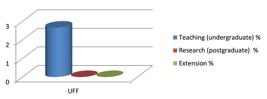
The following graphs illustrate the way in which the investigated institutions distribute multiculturalism in teaching, research and extension. Graph 1, for example, presents data related to UFF:
Fluminense Federal University (UFF)
-
8Undergraduate program - 75 disciplines offered: 39 compulsories, 36 electives;
-
1) Cultural action in information units (compulsory subject);
-
2) Cultural Anthropology I (optional discipline);
-
9Postgraduate (masters and doctoral) - 25 subjects offered: 4 compulsories, 21 optional;
-
10Extension - 27 programs and projects related to the area of culture.
In Graph 1, we verified the incidence in teaching (2.66%) referring to the total number of courses offered in the undergraduate program, which contemplate the researched topic. For search and extension, no percentage was found. According to the Pedagogical Project of the Bachelor's Degree in Library Science at UFF, 75 subjects are offered, being 39 compulsory and 36 elective. Analyzed the menus of each discipline, it was concluded that only 2 subjects covered the subject investigated, which are: Cultural Action in Information Units (compulsory subject) and Cultural Anthropology I (optional discipline), corresponding to 2.66% of the total disciplines offered in the whole course. In the masters and PhD degree programs in Information Science, 25 subjects are offered, of which 4 are compulsory and 21 are electives, and their subjects are analyzed, and none of them is contemplated. Analyzing the programs, projects and extension courses associated with the area of culture, 27 actions were found, none of them contemplating the subject investigated.
Graph 2 presents the data for UNIRIO:

Federal University of Rio de Janeiro State (UNIRIO)
-
11Undergraduate program (bachelor degree and licentiate) - 131 subjects offered: 51 compulsories, 80 elective.
-
1) Cultural Anthropology (elective course), bachelor degree.
-
2) Librarianship, Education and Diversity (optional discipline), licentiate undergraduate degree.
-
12Postgraduation (professional masters) - 21 subjects offered: 2 compulsories, 19 optional
-
1) Librarianship, Multi / Interculturalism and social inclusion (optional discipline)
-
13Extension - Among 7 projects associated with the area of librarianship, 1 project contemplates the researched topic:
-
1) Program "Ethno-cognition for an ethno (re)cognition: the importance of differentiated and intercultural education with social quality”.
In Graph 2, we identified the incidence of percentages in education (1.53%), research (4.76%) and extension courses (14.28%), referring to the disciplines offered and extension actions that contemplate the subject investigated. According to the Educational Projects of the Undergraduate Degree in Library Science (undergraduate and graduate) of UNIRIO, 131 subjects are offered, being 51 compulsories and 80 elective, and the articles of each discipline are analyzed. It was concluded that only 2 subjects cover the research topic: Cultural Anthropology, undergraduate (optional) and Librarianship, Education and Diversity, undergraduate (optional), corresponding to 1.53% of the total number of subjects offered in the course. In the postgraduate professional masters’ degree program in Librarianship, 21 subjects are offered, being 2 compulsory and 19 elective, and their menus are analyzed. Only 1 contemplates the subject investigated, the subject Librarianship, Multi / Interculturalism and social inclusion), corresponding to 4.76% of the total number of subjects offered in the course. In order to analyze the programs, projects and extension courses associated to Library Science, 7 projects were found, only one contemplating the subject: "Ethnoconference for an ethno (re)cognition: the importance of differentiated and intercultural education with social quality", corresponding to 14.28% of the extension actions.
Following, we discuss the data for (UFES).

Federal University of Espirito Santo (UFES)
In Graph 3, we identified the incidence in the teaching (1.61%) of the total number of subjects offered in the undergraduate course, which contemplate the researched topic. In the research (postgraduation) we did not find any percentage, because it is not offered, in the institution, for the area. In extension courses there was also no percentage. According to the Pedagogical Project of the undergraduate degree in Library Science at UFES, 62 subjects are offered, being 35 compulsory and 27 elective, the papers of each discipline are analyzed, it was concluded that only one subject contemplates the subject investigated, Brazilian Culture (compulsory subject), corresponding to 1.61% of the total number of subjects offered in the course. A masters and doctoral degree is not offered in the area. Analyzing the programs, projects and extension courses associated to the area, 4 actions were found, none of which contemplated the topic investigated.
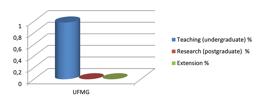
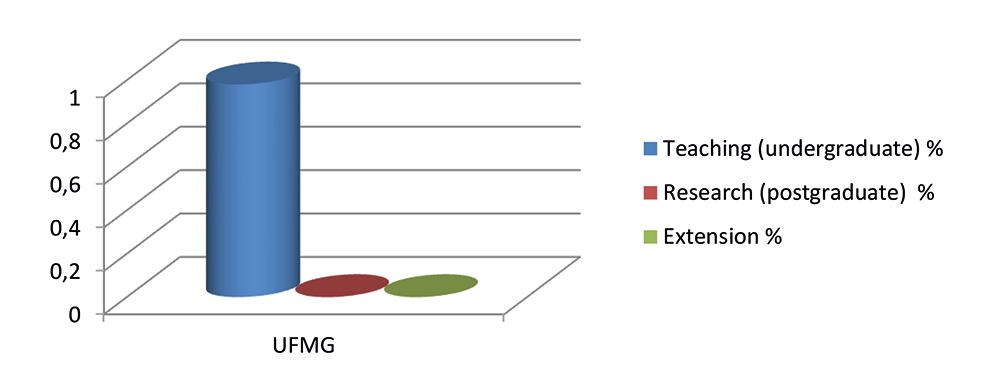
In graph 4, we present the data for (UFMG):
Federal University of Minas Gerais (UFMG)
-
17Undergraduate program - 102 courses offered: 30 compulsory subjects, 72 optional subjects.
-
1) Culture and Information (mandatory discipline).
-
18Postgraduate (masters and doctorate) - 16 subjects offered: 8 compulsory subjects, 8 optional subjects.
-
19Extension: 13 extension actions: 10 projects, 3 programs.
In Graph 4, we find the incidence in the teaching (0.98%) of the total offered courses in the undergraduate program. For research and extension courses, we did not find any percentage. According to the Pedagogical Project of the undergraduate degree in Library Science at UFMG, 102 subjects are offered, of which 30 are compulsory and 72 are elective, the papers of each subject are analyzed, only one subject is studied, the Culture and Information (compulsory discipline), corresponding to 0.98% of the total number of courses offered in the course. In the postgraduate studies in masters and doctorate in Information Science, 16 subjects are offered, being 8 compulsory and 8 optional. Analyzed their menus it was concluded that none contemplates the subject investigated. Analyzing the programs, projects and extension courses associated with the area, 13 actions were found, none of them contemplating the subject under investigation.
The following table presents the data obtained for teaching, research and extension, regarding multiculturalism in the Federal Institutions of Higher Education (IFES) of the Northeast Region.
According to Table 2, the subject is not yet part of the academic-cultural scenario of Universidade Federal de Alagoas (UFAL, here translated as Federal University of Alagoas), Universidade Federal da Bahia (UFBA, Federal University of Bahia), and Universidade Federal de Pernambuco (UFPE, Federal University of Pernambuco). At Universidade Federal do Ceará (UFC, Federal University of Ceará), the subject appears discretely only in extension actions (2%), at Universidade Federal do Cariri (UFCA, Federal University of Cariri), the subject is found in undergraduate (1.56%) and in research (3.70%) , at Universidade Federal do Maranhão (UFMA, Federal University of Maranhão) and at Universidade Federal do Rio Grande do Norte (UFRN, Federal University of Rio Grande do Norte), the subject is found only at undergraduate programs (2.04%) and (1.61%), respectively. At Universidade Federal da Paraíba (UFPB, Federal University of Paraíba), the subject is found only in the Survey (5.77%).
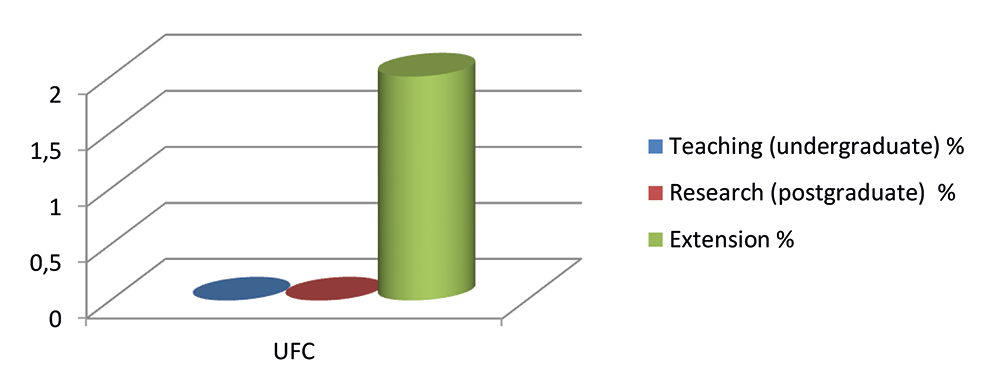
Graph 5 presents data from UFC:

Multiculturalism in Teaching, Research and Extension at the Federal University of Ceará (UFC).
Federal University of Ceará (UFC)
-
20Undergraduate - 89 subjects offered: 43 compulsory subjects, 46 optional subjects.
-
21Postgraduate (master degree) - 26 subjects offered: 3 compulsory subjects, 23 optional subjects.
-
22Extension course: 50 extension actions: 1 project - Vulnerable Social Groups - issues of gender, ethnicity, sexual orientation, cultural diversity, religious beliefs, among others.
In Graph 5, we did not find any incidence related to teaching and research. in the extension course, it was identified a percentage of 2%, referring to the total of extensionist actions for the area. According to the Pedagogical Project of the Undergraduate Program in Library Science of the UFC, 89 subjects are offered, of which 43 are compulsory and 46 are elective, the papers of each discipline are analyzed, it was concluded that no subject contemplates the subject investigated, that is, 0% of the undergraduate courses in Librarianship. In the masters degree, 26 subjects are offered, with 3 compulsory subjects and 23 optional subjects. Analyzed the menus of the offered courses in the professional masters’ degree, it is concluded that no discipline contemplates the subject investigated. Analyzing the programs, projects and extension courses associated with the area, 50 actions were found, only one extension project contemplates the topic investigated: "Vulnerable social groups - issues of gender, ethnicity, sexual orientation, cultural diversity, religious creeds, among others”, corresponding to 2% of all extension actions found.
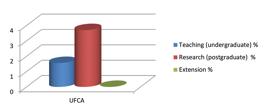
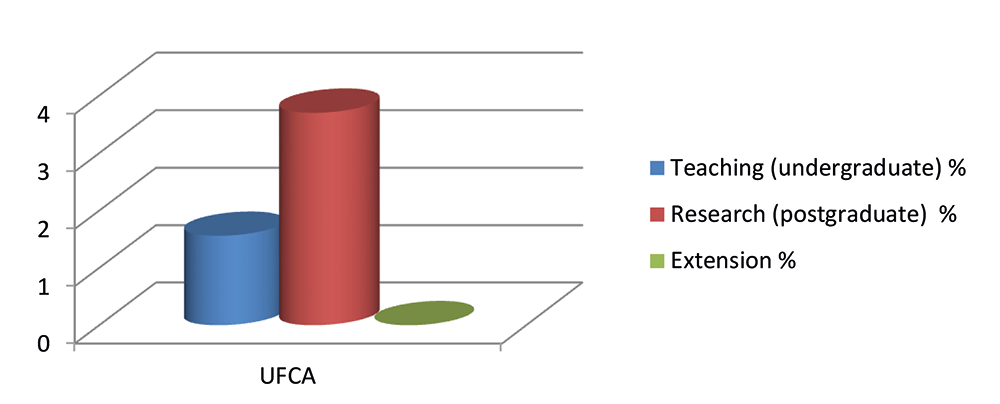
Graph 6 provides data for UFCA.
Federal University of Cariri (UFCA)
-
23Undergraduate program - 64 subjects offered: 42 compulsory subjects, 22 optional subjects.
-
1) Ethnic-racial relations and Africanities (optional discipline).
-
24Postgraduation (professional masters) - 27 subjects offered: 4 compulsory subjects, 23 optional subjects.
-
1) Information, Popular and Regional Culture (optional discipline).
-
25Extension course: 21 extension actions.
In Graph 6, we find the incidence in the teaching (1.56%) of the total offered courses in the undergraduate program. We also found the incidence in research (3.70%) of the total number of courses offered in the professional masters’ degree, and in the extension courses we did not find any percentage. According to the Pedagogical Project of the undergraduate degree in Library Science at UFCA, 64 subjects are offered, of which 42 are compulsory and 22 are elective, the papers of each discipline are analyzed, it was concluded that only 1 subject contemplates the subject investigated, the discipline Ethnic Relations (optional subject), corresponding to 1.56% of the total number of subjects offered in the course. In the postgraduate professional masters’ degree in Library Science, 27 subjects are offered, 4 of which are compulsory and 23 are elective, and their menus are analyzed. Only 1 is considered in the research subject, Information, Popular and Regional Culture (optional discipline) corresponding to 3.70% of the total number of courses offered. Analyzing the programs, projects and extension courses associated to the area, 21 actions were found, none of which contemplated the topic under investigation.
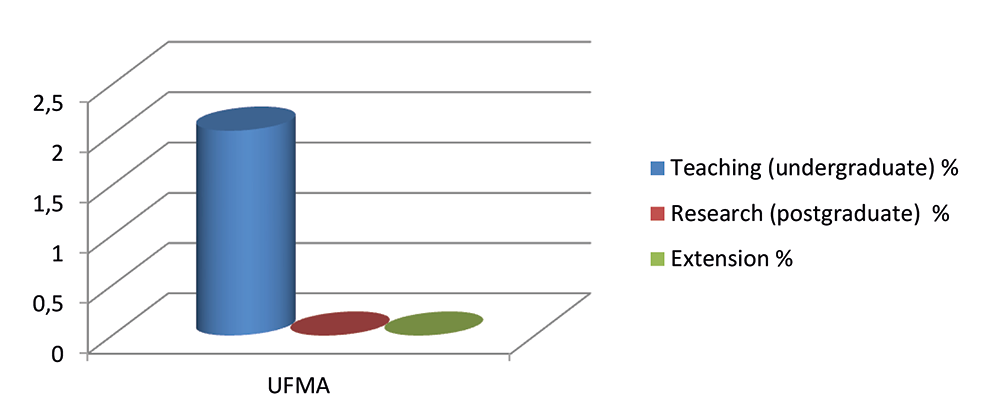
In Graph 7 data for UFMA is available:

Multiculturalism in Teaching, Research and Extension at the Federal University of Maranhão (UFMA)
Federal University of Maranhão (UFMA)
In Graph 7, we find the incidence in the teaching (2.04%) of the total of the offered courses in the undergraduate program. For research (postgraduation), which is not offered in the area by the institution, and extension we did not find any percentage. According to the Pedagogical Project of UFMA’s Librarianship Course, which has undergone 3 changes in its curricular matrix in 1996, 1998 and 2007, 49 subjects are offered, 43 of which are compulsory and 6 are elective. It is understood that only 1 subject covers the subject under investigation, the subjects Study of Users and Pluriculturalism (compulsory subject), corresponding to 2.04% of the total number of subjects offered in the course. A masters and doctoral degree is not offered in the area. Analyzing the programs, projects and extension courses associated to the area, 38 actions were found, none of which contemplated the topic under investigation.
Graph 8 presents the data for UFPB:

Multiculturalism in teaching, research and extension at the Federal University of Paraíba (UFPB)
Federal University of Paraíba (UFPB)
-
29Undergraduate program - 58 subjects offered: 28 compulsory subjects, 30 optional subjects.
-
30Postgraduate (masters and doctorate) - 52 subjects offered: 9 compulsory subjects, 43 optional subjects.
-
1) Information and Culture (optional course common to both);
-
2) Information and Social Inclusion (optional course common to both);
-
3) Information and Patrimony (optional course common to both).
-
31Extension course: 8 programs.
In Graph 8, we did not find any percentage referring to teaching and extension. In the survey we found the incidence of (5.77%) of the total number of subjects offered by the postgraduate course in masters and doctorates. According to the Pedagogical Project of the Undergraduate Program in Librarianship of UFPB, which began in 1992, it was expanded in 2004 and was restructured in 2008, 58 subjects are offered, of which 28 are compulsory and 30 are optional, it was concluded that no subject contemplates the subject investigated, that is, 0% of the subjects of the degree course in Librarianship. At the postgraduate level in masters and doctorate degrees, 52 subjects are offered, of which 9 are compulsory subjects and 43 are optional. The subjects offered in the masters and doctorate had their menus analyzed and 3 optional subjects common to both courses were found: Information and Culture, Information and Social Inclusion, and Information and Patrimony, corresponding to 5.77% of the total number of courses offered. Analyzing the programs, projects and extension courses associated to the area, we found 8 actions, none of which contemplated the subject.
Graph 9, presents the data for UFRN:

Multiculturalism in Teaching, Research and Extension at the Federal University of Rio Grande do Norte (UFRN)
Federal University of Rio Grande do Norte (UFRN)
In Graph 9, we found the incidence in the teaching (1.61%) referring to the total of the offered courses in the undergraduate program. No percentage was found in research (postgraduate) and extension. According to the Education Program of undergraduate program in librarianship from UFRN, 62 courses are offered, 48 are compulsory and 14 are optional. Analyzed the menus of each discipline, it was concluded that only one subject covers the content investigated, the Brazilian Culture discipline (compulsory subject), corresponding to 1.61% of the total number of subjects offered in the course. In the postgraduate in professional masters, 10 subjects are offered, being 2 compulsory subjects and 8 optional subjects. Analyzed the menus of the offered courses in the professional masters’ degree, it is concluded that no discipline contemplates the subject investigated. Analyzing the programs, projects and extension courses associated with the area, 5 actions were found, none of them contemplating the subject.
Analyzing the data of our investigation, considering the two areas surveyed, Southeast and Northeast, among the fourteen (14) federal universities surveyed offering the course of Library and Information Science, six (6) are located in the Southeast and eight (8) are located in the Northeast Region. In the Southeast Region, three (3) universities deal specifically with Multiculturalism in education (undergraduate), and only one (1) university deals with the subject in education (undergraduate), search (undergraduate) and extension; four (4) out of the six (6) universities in the region previously mentioned deal with the subject in their curricula and agendas, corresponding to (66.66%) of the universities surveyed. In the Northeast Region, two (2) universities study the subject only in education (undergraduate), one (1) university only in extension, one (1) only in research (postgraduate) and only one (1) in education (undergraduate) and in research (undergraduate), so, five (5) out of eight (8) universities, in the aforementioned region, address the subject in their curricula and agendas, which corresponds to (62.8%) of the researched universities.
This way, comparing the Southeast and Northeast regions, we find that in the Southeast region, more than half of the universities surveyed address the subject in their curricula and agenda, while in the Northeast the incidence is somewhat lower. We conclude, therefore, that only nine (9) of the fourteen (14) universities surveyed address the subject in their curriculum and agenda, corresponding to 64.28% federal universities in the two regions mentioned before.
Although the analyzed data points to the aforementioned direction, we recognize that the provision of disciplines foreseen in the curricular matrix can vary from one semester to another, and, in this case, the subjects with the multiculturalism subject are considered as they are exposed in the curricular matrix of each course in the institutions investigated.
Considering the low incidence of subjects with Multiculturalism and Cultural Diversity in the initial and continued formation of the librarian and information science scientist, as well as in the extensionist actions in the institutions investigated, in the Southeast and Northeast, we can compare them with the results found in the research conducted in 201135 in Miriam Mattos masters’ thesis, in which she describes:
The research revealed that, in terms of academic education, there was a large majority of professionals surveyed who did not have undergraduate and postgraduate approaches to contents such as multiculturalism, cultural diversity, respect for differences, accessibility, gender or similarities (MATTOS, 2011, p.110).
The trend pointed out by Miriam Mattos about the results of her research, restricted to librarians working in school libraries in the city of Florianópolis (SC), undergraduate program from the Federal University of Santa Catarina (UFSC), and from the State University of Santa Catarina (UDESC) is confirmed by the scenario found in our research in the IFES of the Southeast and Northeast regions.
Considering that librarians also work in educational environments, the conception of "Intercultural Education" is necessary where there is the relationship of individuals from different cultures, Fleuri (2000) states that:
[...] intercultural education proposes to build the reciprocal relationship between them. A relationship that occurs, not abstractly, but between people. Among persons who decide to construct contexts and processes of approximation, reciprocal knowledge and interaction. Relationships that produce changes in each individual, favoring self-awareness and reinforcing one's identity (FLEURI, 2000, p.79).
Our results are very similar to the ones in Mattos' (2011) research, pointing to a common direction, we mean, ‘multiculturalism’ and cultural diversity are very little recurrent in the initial and continued education of the librarian. Considering this gap in the curriculum, Mattos asks some questions:
[...] to what extent is the active librarian ... qualified to deal with the new educational context, where topics such as multiculturalism, accessibility and diversity imply recognition of cultural diversity and respect for the right to difference? Do these professionals know and contribute to the application of the 21 laws that regulate these issues? What do these professionals perceive about multiculturalism? Does the initial and continuing training of librarians contribute to their full suitability for the implementation of multicultural education? (MATTOS, 2011, p.20).
The research that originated the publication of Professor Patrícia Vargas’ paper, presented at the XV ENANCIB in 2014, also presents data that are confirmed in this research, regarding the knowledge by the students of Professional Masters in Librarianship’s course, related to the discussions associated with Cultural Diversity:
According to the data, half (50%) admitted having no knowledge about cultural diversity in librarian’s universe, and 25% admitted having average knowledge on the subject. The minority indicated knowing very well (8%), considerably (8%) and little (8%) about it (ALENCAR, 2014, p.9).
In the scenario confirmed by the aforementioned researches, Multiculturalism in a Plural Society is discussed, since, according to Boaventura Santos (2003):
The emancipatory versions of multiculturalism are based on the recognition of the difference and the right to the difference and the coexistence or construction of a life in common as well as differences of various kinds. (SANTOS, 2003, p.33)
In the same direction, Hall (2003) mentions the need to "strategies and policies used to govern or manage diversity and multiplicity of problems in multicultural societies" (Hall, 2003, p.52).
Our research recognizes this demand for a Multicultural Society and nods to the relevance of discussing multiculturalism in initial training courses, in the area of Library and Information Science. Following, we make our final considerations.
4 FINAL CONSIDERATIONS
This research provides evidence that both in initial training and in continuing education of the librarians and information science scientists, there is a gap in the federal universities’ courses in the Southeast and Northeast of Brazil, regarding the approaches related to Multiculturalism as teaching, research and extension courses.
Apparently, the scene found may extend to other federal universities in other regions of Brazil that offer undergraduate and postgraduate programs in Librarianship and Information Science, since there is a "silencing" of the subject in literature review, as our research points out.
Although this research does not exhaust the discussion proposed here, his contribution is to make room for new research on multiculturalism, in order to discuss the silent position of universities as they relate to the initial and continuing education courses in Library and Information Science.
References
-
ALENCAR, P. V. Mediação da Informação no fazer do bibliotecário no âmbito do Interculturalismo. In: ENANCIB 2014 XV Encontro Nacional de Pesquisa em Ciência da Informação/ Além das nuvens: Expandindo as Fronteiras da Ciência da Informação, 2014, Belo Horizonte. Anais eletrônicos. 2014. Disponível em: <http://enancib2014.eci.ufmg.br/documentos/anais/anais-gt6>. Acesso em: 05 ago 2015.
» http://enancib2014.eci.ufmg.br/documentos/anais/anais-gt6 -
CONSELHO REGIONAL DE BIBLIOTECONOMIA. Carreira CRB - 6. Disponível em: <http://www.crb6.org.br/carreira.php>. Acesso em: 20 jul. 2014.
» http://www.crb6.org.br/carreira.php -
DUARTE, Teresa et al. A possibilidade da investigação a 3: reflexões sobre triangulação (metodológica). CIES e-working, Portugal, v. 60, 2009. Disponível em: <http://cies.iscte-iul.pt/destaques/documents/CIES-WP60_Duarte_001.pdf>. Acesso em: 20 nov. 2016.
» http://cies.iscte-iul.pt/destaques/documents/CIES-WP60_Duarte_001.pdf - FLEURI, Reinaldo Matias. Multiculturalismo e interculturalismo nos processos educacionais. In.: CANDAU, Vera Maria et al. Ensinar e aprender: sujeitos, saberes e pesquisa. Rio de Janeiro: DP&A, 2000, p. 67-81.
- GIL, Antonio Carlos. Como elaborar projetos de pesquisa. 4 ed. São Paulo: Atlas, 2002.
- HALL, Stuart. Da Diáspora: Identidades e mediações culturais. Trad.: Adelaide la Guardiã Resende et al. Belo Horizonte: Editora UFMG. 2003.
-
INTERNATIONAL FEDERATION OF LIBRARY ASSOCIATIONS AND INSTITUTIONS. Manifesto por la biblioteca multicultural, 2008. Disponível em: <http://www.ifla.org/files/assets/library-services-to-multicultural-populations/publications/multicultural_library_manifesto-es.pdf>. Acesso em: 10 ago.2016.
» http://www.ifla.org/files/assets/library-services-to-multicultural-populations/publications/multicultural_library_manifesto-es.pdf - MATTOS, Miriam; MURGUIA, Eduardo. Multiculturalismo em Ciência da Informação: percepções e ações dos profissionais da informação em bibliotecas escolares de Florianópolis. In: ENCONTRO NACIONAL DE PESQUISA EM CIÊNCIA DA INFORMAÇÃO - ENANCIB, 10. 2009. Anais...João Pessoa: UFPB, 2009
-
MATTOS, Miriam. Multiculturalismo em Ciência da Informação: percepções e ações dos profissionais da informação em bibliotecas escolares. 2011. Dissertação de Mestrado apresentada ao Programa de Pós-Graduação em Ciência da Informação, Faculdade de Filosofia e Ciências, Universidade Estadual Paulista, Marília, São Paulo: 2011. Disponível em: <http://www.marilia.unesp.br/Home/Pos-graduacao/CienciadaInformacao/Dissertacoes/mattos_mccm_me_mar.pdf>. Acesso em: 19 set. 2013.
» http://www.marilia.unesp.br/Home/Pos-graduacao/CienciadaInformacao/Dissertacoes/mattos_mccm_me_mar.pdf - MINAYO, M.C.S. O desafio do conhecimento científico: pesquisa qualitativa em saúde. 2. ed. São Paulo: Hucitec - Abrasco, 1994.
- RICHARDSON, R. J. Pesquisa Social: métodos e técnicas. 3 ed. São Paulo: Atlas, 1999.
- SANTOS, Boaventura de Sousa; NUNES, João Arriscado. Introdução: para ampliar o cânone do reconhecimento, da diferença e da igualdade. In: SANTOS, Boaventura de Sousa (org.). Reconhecer para libertar: os caminhos do cosmopolitismo multicultural. Rio de Janeiro: Civilização Brasileira, 2003.
-
UNESCO. Declaração universal sobre a diversidade cultural. 2002. Disponível em: <http://unesdoc.unesco.org/images/0012/001271/127160por.pdf>. Acesso em: 19 ago. 2015
» http://unesdoc.unesco.org/images/0012/001271/127160por.pdf -
UNIVERSIDADE FEDERAL DA BAHIA. Graduação. Disponível em: <https://blog.ufba.br/ici/ensino/biblioteconomia/>. Acesso em: 25 jun. 2016.
» https://blog.ufba.br/ici/ensino/biblioteconomia/ -
UNIVERSIDADE FEDERAL DA BAHIA. Pós-graduação. Disponível em: <https://ppgci.ufba.br/disciplinas>. Acesso em: 25 jun. 2016.
» https://ppgci.ufba.br/disciplinas -
UNIVERSIDADE FEDERAL DA BAHIA. Extensão. Disponível em: <https://proext.ufba.br/>. Acesso em: 25 jun. 2016.
» https://proext.ufba.br/ -
UNIVERSIDADE FEDERAL DA PARAÍBA. Graduação. Disponível em: <https://sigaa.ufpb.br/sigaa/public/departamento/componentes.jsf?id=1331>. Acesso em: 05 jul. 2016.
» https://sigaa.ufpb.br/sigaa/public/departamento/componentes.jsf?id=1331 -
UNIVERSIDADE FEDERAL DA PARAÍBA. Pós-graduação. Disponível em: <http://www.ccsa.ufpb.br/ppgci>. Acesso em: 05 jul. 2016.
» http://www.ccsa.ufpb.br/ppgci -
UNIVERSIDADE FEDERAL DA PARAÍBA. Extensão. Disponível em: <http://www.prac.ufpb.br/>. Acesso em: 05 jul. 2016
» http://www.prac.ufpb.br/ -
UNIVERSIDADE FEDERAL DE ALAGOAS. Graduação. Disponível em: <http://www.ufal.edu.br/estudante/graduacao/projetos-pedagogicos/campus-maceio/ppc-biblioteconomia.pdf/view>. Acesso em: 21 jun. 2016.
» http://www.ufal.edu.br/estudante/graduacao/projetos-pedagogicos/campus-maceio/ppc-biblioteconomia.pdf/view -
UNIVERSIDADE FEDERAL DE ALAGOAS. Pós-graduação. Disponível em: <http://www.ufal.edu.br/estudante/pos-graduacao-e-pesquisa/mestrado>. Acesso em: 21 jun. 2016.
» http://www.ufal.edu.br/estudante/pos-graduacao-e-pesquisa/mestrado -
UNIVERSIDADE FEDERAL DE ALAGOAS. Extensão. Disponível em: <http://www.ufal.edu.br/estudante/extensao/documentos>. Acesso em: 22 jun. 2016.
» http://www.ufal.edu.br/estudante/extensao/documentos -
UNIVERSIDADE FEDERAL DE MINAS GERAIS. Graduação. Disponível em: <http://colgradbiblio.eci.ufmg.br/formularios/ementas-de-disciplinas>. Acesso em: 17 jun. 2016
» http://colgradbiblio.eci.ufmg.br/formularios/ementas-de-disciplinas -
UNIVERSIDADE FEDERAL DE MINAS GERAIS. Pós-Graduação. Disponível em: <http://ppgci.eci.ufmg.br/cursos/mestrado>. Acesso em: 17 jun. 2016.
» http://ppgci.eci.ufmg.br/cursos/mestrado -
UNIVERSIDADE FEDERAL DE MINAS GERAIS. Extensão. Disponível em: <https://www2.ufmg.br/proex/>. Acesso em: 17 jun. 2016.
» https://www2.ufmg.br/proex/ -
UNIVERSIDADE FEDERAL DE PERNAMBUCO. Graduação. Disponível em: <https://www.ufpe.br/proacad/images/cursos_ufpe/biblioteconomia_perfil_0406.pdf>. Acesso em: 08 jul. 2016.
» https://www.ufpe.br/proacad/images/cursos_ufpe/biblioteconomia_perfil_0406.pdf -
UNIVERSIDADE FEDERAL DE PERNAMBUCO. Pós-Graduação. Disponível em: <https://www.ufpe.br/ppgci/index.php?option=com_content&view=article&id=303&Itemid=233>. Acesso em: 08 jul. 2016.
» https://www.ufpe.br/ppgci/index.php?option=com_content&view=article&id=303&Itemid=233 -
UNIVERSIDADE FEDERAL DE PERNAMBUCO. Extensão. Disponível em: <https://www.ufpe.br/proexc/index.php?option=com_content&view=article&id=2084%3Aprojetos-de-extensao-ufpe-registrados-em-2015&catid=1%3Aa-proext&Itemid=108>. Acesso em: 08 jul. 2016.
» https://www.ufpe.br/proexc/index.php?option=com_content&view=article&id=2084%3Aprojetos-de-extensao-ufpe-registrados-em-2015&catid=1%3Aa-proext&Itemid=108 -
UNIVERSIDADE FEDERAL DE SÃO CARLOS. Graduação. Disponível em: <http://www.prograd.ufscar.br/cursos/cursos-oferecidos-1/biblioteconomia-e-ciencia-da-informacao/biblioteconomia-e-ciencia-da-informacao>. Acesso em: 10 jun. 2016.
» http://www.prograd.ufscar.br/cursos/cursos-oferecidos-1/biblioteconomia-e-ciencia-da-informacao/biblioteconomia-e-ciencia-da-informacao -
UNIVERSIDADE FEDERAL DE SÃO CARLOS. Pós-graduação. Disponível em: <http://www.ppgci.ufscar.br/>. Acesso em: 10 jun. 2016
» http://www.ppgci.ufscar.br/ -
UNIVERSIDADE FEDERAL DE SÃO CARLOS. Extensão, Disponível em: <http://www.proex.ufscar.br/>. Acesso em: 10 jun. 2016
» http://www.proex.ufscar.br/ -
UNIVERSIDADE FEDERAL DO CARIRI. Graduação. Disponível em: <https://si3.ufc.br/sigaa/public/curso/curriculo.jsf?lc=pt_BR&id=657490>. Acesso em: 12 dez. 2016.
» https://si3.ufc.br/sigaa/public/curso/curriculo.jsf?lc=pt_BR&id=657490 -
UNIVERSIDADE FEDERAL DO CARIRI. Pós-graduação. Disponível em: <http://ppgb.ufca.edu.br/disciplinas-mpb/>. Acesso em: 12 dez. 2016.
» http://ppgb.ufca.edu.br/disciplinas-mpb/ -
UNIVERSIDADE FEDERAL DO CARIRI. Extensão. Disponível em: <https://www.ufca.edu.br/portal/extensao/acoes-de-extensao-proex>. Acesso em: 12 dez. 2016.
» https://www.ufca.edu.br/portal/extensao/acoes-de-extensao-proex -
UNIVERSIDADE FEDERAL DO CEARÁ. Graduação. Disponível em: <http://www.ufc.br/ensino/cursos-de-graduacao/187-biblioteconomia-fortaleza>. Acesso em: 30 jun. 2016.
» http://www.ufc.br/ensino/cursos-de-graduacao/187-biblioteconomia-fortaleza -
UNIVERSIDADE FEDERAL DO CEARÁ. Pós-graduação. Disponível em: <https://sucupira.capes.gov.br/sucupira/public/consultas/coleta/disciplina/listaDisciplina.jsf>. Acesso em: 30 jun. 2016.
» https://sucupira.capes.gov.br/sucupira/public/consultas/coleta/disciplina/listaDisciplina.jsf -
UNIVERSIDADE FEDERAL DO CEARÁ. Extensão. Disponível em: <http://www.ufc.br/extensao/programas-de-extensao>. Acesso em: 30 jun. 2016.
» http://www.ufc.br/extensao/programas-de-extensao -
UNIVERSIDADE FEDERAL DO ESPIRITO SANTO. Graduação. Disponível em: <http://www.ufes.br/gradua%C3%A7%C3%A3o>. Acesso em: 15 jun. 2015.
» http://www.ufes.br/gradua%C3%A7%C3%A3o -
UNIVERSIDADE FEDERAL DO ESPIRITO SANTO. Pós-graduação. Disponível em: <http://www.ufes.br/p%C3%B3s-gradua%C3%A7%C3%A3o>. Acesso em: 15 jun. 2015.
» http://www.ufes.br/p%C3%B3s-gradua%C3%A7%C3%A3o -
UNIVERSIDADE FEDERAL DO ESPIRITO SANTO. Extensão. Disponível em: <http://proex.ufes.br/>. Acesso em: 15 jun. 2015.
» http://proex.ufes.br/ -
UNIVERSIDADE FEDERAL DO ESTADO DO RIO DE JANEIRO. Graduação. Disponível em: <http://www.unirio.br/unirio/cchs/eb/graducao>. Acesso em: 07 jun. 2016
» http://www.unirio.br/unirio/cchs/eb/graducao -
UNIVERSIDADE FEDERAL DO ESTADO DO RIO DE JANEIRO. Pós-graduação. Disponível em: <http://www.unirio.br/unirio/cchs/eb/graducao>. Acesso em: 07 jun. 2016
» http://www.unirio.br/unirio/cchs/eb/graducao -
UNIVERSIDADE FEDERAL DO ESTADO DO RIO DE JANEIRO. Extensão. Disponível em: <http://www2.unirio.br/unirio/proexc/dep.-de-extensao/acoes-de-extensao-cadastradas/acoes-de-extensao-e-cultura-cadastradas-2016/view>. Acesso em: 15 jan. 2014
» http://www2.unirio.br/unirio/proexc/dep.-de-extensao/acoes-de-extensao-cadastradas/acoes-de-extensao-e-cultura-cadastradas-2016/view -
UNIVERSIDADE FEDERAL DO MARANHÃO. Graduação. Disponível em: <https://sigaa.ufma.br/sigaa/public/curso/ppp.jsf?lc=pt_BR&id=85812>. Acesso em: 02 jul. 2016.
» https://sigaa.ufma.br/sigaa/public/curso/ppp.jsf?lc=pt_BR&id=85812 -
UNIVERSIDADE FEDERAL DO MARANHÃO. Pós-graduação. Disponível em: <https://sigaa.ufma.br/sigaa/public/programa/lista.jsf>. Acesso em: 02 jul. 2016.
» https://sigaa.ufma.br/sigaa/public/programa/lista.jsf -
UNIVERSIDADE FEDERAL DO MARANHÃO. Extensão. Disponível em: <https://sigaa.ufma.br/sigaa/public/extensao/consulta_extensao.jsf?aba=p-extensao>. Acesso em: 02 jul. 2016.
» https://sigaa.ufma.br/sigaa/public/extensao/consulta_extensao.jsf?aba=p-extensao -
UNIVERSIDADE FEDERAL DO RIO DE JANEIRO. Graduação. Disponível em: <https://www.siga.ufrj.br/sira/temas/zire/frameConsultas.jsp?mainPage=/repositorio-curriculo/E4BF91B2-92A4-F713-00FD-C0153E641DC7.html>. Acesso em: 10 jun. 2016.
» https://www.siga.ufrj.br/sira/temas/zire/frameConsultas.jsp?mainPage=/repositorio-curriculo/E4BF91B2-92A4-F713-00FD-C0153E641DC7.html -
UNIVERSIDADE FEDERAL DO RIO DE JANEIRO. Pós-graduação. Disponível em: <http://www.pr2.ufrj.br/pr2/listarStrictoMestreDoutor>. Acesso em: 10 jun. 2016.
» http://www.pr2.ufrj.br/pr2/listarStrictoMestreDoutor -
UNIVERSIDADE FEDERAL DO RIO DE JANEIRO. Extensão. Disponível em: <http://www.pr5.ufrj.br/>. Acesso em: 10 jun. 2016.
» http://www.pr5.ufrj.br/ -
UNIVERSIDADE FEDERAL DO RIO GRANDE DO NORTE. Graduação. Disponível em: <https://sigaa.ufrn.br/sigaa/public/curso/curriculo.jsf>. Acesso em: 11 jul. 2016.
» https://sigaa.ufrn.br/sigaa/public/curso/curriculo.jsf -
UNIVERSIDADE FEDERAL DO RIO GRANDE DO NORTE. Pós-graduação. Disponível em: <https://sigaa.ufrn.br/sigaa/public/curso/lista.jsf?nivel=S&aba=p-stricto>. Acesso em: 06 fev. 2018.
» https://sigaa.ufrn.br/sigaa/public/curso/lista.jsf?nivel=S&aba=p-stricto -
UNIVERSIDADE FEDERAL DO RIO GRANDE DO NORTE. Extensão. Disponível em: <https://sistemas.ufrn.br/portal/PT/extensao/>. Acesso em: 11 jul. 2016.
» https://sistemas.ufrn.br/portal/PT/extensao/ -
UNIVERSIDADE FEDERAL FLUMINENSE. Graduação. Disponível em: <https://inscricao.id.uff.br/consultaMatrizCurricular.uff>. Acesso em: 02 jun. 2016.
» https://inscricao.id.uff.br/consultaMatrizCurricular.uff -
UNIVERSIDADE FEDERAL FLUMINENSE. Pós-Graduação. Disponível em: <http://www.ci.uff.br/ppgci/>. Acesso em: 02 jun. 2016.
» http://www.ci.uff.br/ppgci/ -
UNIVERSIDADE FEDERAL FLUMINENSE. Extensão. Disponível em: <http://www.extensao.uff.br/>. Acesso em: 02 jun. 2016.
» http://www.extensao.uff.br/
-
1
Subproject entitled “Librarian training and activities: working strategies towards intercultural education”, linked to the research project "Dimensions of the intercultural perspective in libraries: trends in information, education and work", coordinated by Professor Patrícia Vargas Alencar, from Professional Master's Program in Library Science, in the Federal University of Rio de Janeiro state (UNIRIO).
-
2
The word minorities is understood here as a certain human or social group that is in numerical inferiority or in a situation of socio-economic, political or cultural subordination in relation to another group, which is majority or dominant in a given society.
-
3
Information from HALL, Stuart. Da Diáspora: Identidades e mediações culturais. Trad.: Adelaide la Guardiã Resende et al. Belo Horizonte: Editora UFMG. 2003.
-
4
HALL, Stuart. “A questão multicultural”. Op. Cit. p. 51. Essa expressão se refere às dificuldades de utilizar termos e conceitos extremamente complexos e amplamente discutidos, que impossibilitam abordagens mais precisas das realidades que tentam compreender.
-
5
UNESCO’s Universal Declaration on cultural diversity in 2001.
-
6
CRB’s site - 6, http://www.crb6.org.br/carreira.php, accessed in 2014/07/20
-
7
SERES’site - http://portal.mec.gov.br/secretaria-de-regulacao-e-supervisao-da-educacao-superior-seres/apresentacao, accessed in Dec. 10, 2016.
-
8
Data from https://inscricao.id.uff.br/consultaMatrizCurricular.uff, accessed in 2016/06/02.
-
9
Data from http://www.ci.uff.br/ppgci/, accessed in 2016/06/02
-
10
Data from http://www.extensao.uff.br/, accessed in 2016/06/02.
-
11
Data from http://www.unirio.br/unirio/cchs/eb/graducao, accessed in 2016/06/07
-
12
Data from http://www.unirio.br/ppgb, accessed in 2016/06/07
-
13
Data from http://www2.unirio.br/unirio/proexc/dep.-de-extensao/acoes-de-extensao-cadastradas/acoes-de-extensao-e-cultura-cadastradas-2016/view, accessed in 2014/01/15
-
14
Data from http://www.ufes.br/gradua%C3%A7%C3%A3o, accessed in 2016/06/15.
-
15
Data from http://www.ufes.br/p%C3%B3s-gradua%C3%A7%C3%A3o, accessed in 2016/06/15.
-
16
Data from http://proex.ufes.br/, accessed in 2016/06/15.
-
17
Data from http://colgradbiblio.eci.ufmg.br/formularios/ementas-de-disciplinas, accessed in 2016/06/17.
-
18
Data from http://ppgci.eci.ufmg.br/cursos/mestrado, accessed in 2016/06/17.
-
19
Data from https://www2.ufmg.br/proex/, accessed in 2016/06/17.
-
20
Data from http://www.ufc.br/ensino/cursos-de-graduacao/187-biblioteconomia-fortaleza, accessed in 2016/06/30
-
21
Data from https://sucupira.capes.gov.br/sucupira/public/consultas/coleta/disciplina/listaDisciplina.jsf, accessed in 2016/06/30.
-
22
Data from http://www.ufc.br/extensao/programas-de-extensao, accessed in 2016/06/30.
-
23
Data from https://si3.ufc.br/sigaa/public/curso/curriculo.jsf?lc=pt_BR&id=657490, accessed in 2016/12/12.
-
24
Data from http://ppgb.ufca.edu.br/disciplinas-mpb, accessed 2016/12/12.
-
25
Data from https://www.ufca.edu.br/portal/extensao/acoes-de-extensao-proex, accessed in 2016/12/12.
-
26
Data from https://sigaa.ufma.br/sigaa/public/curso/ppp.jsf?lc=pt_BR&id=85812, accessed in 2016/06/02.
-
27
Data from https://sigaa.ufma.br/sigaa/public/programa/lista.jsf, accessed in 2016/06/02.
-
28
Data from https://sigaa.ufma.br/sigaa/public/extensao/consulta_extensao.jsf?aba=p-extensao, accessed in 2016/06/02.
-
29
Data from https://sigaa.ufpb.br/sigaa/public/departamento/componentes.jsf?id=1331, accessed in 2016/06/05.
-
30
Data from https://sigaa.ufpb.br/sigaa/public/departamento/componentes.jsf?id=1331, accessed in 2016/06/05.
-
31
Data from http://www.prac.ufpb.br/, accessed in 2016/06/05.
-
32
Undergraduate course in Librarinaship started in the beggining of the first semester of 1997, and its curricular matrix was restructured twicw, in 2008 and 2011. Disposable in: <https://sigaa.ufrn.br/sigaa/public/curso/curriculo.jsf>, Acesso em: 11 jul. 2016.
-
33
Data from the site. Disposable in: <https://sigaa.ufrn.br/sigaa/public/curso/lista.jsf?nivel=S&aba=p-stricto>. Acessed in Jul, 11 2016.
-
34
Data from the site. Disposable in: <https://sistemas.ufrn.br/portal/PT/extensao/>Acessed in Jul, 11 2016.
-
35
MATTOS, Miriam. Multiculturalismo em Ciência da Informação: Percepções e Ações dos Profissionais da Informação em Bibliotecas Escolares. Dissertação de Mestrado apresentada ao Programa de Pós-Graduação em Ciência da Informação, Faculdade de Filosofia e Ciências, Universidade Estadual Paulista, Marília, São Paulo: 2011.
-
JITA:
AC. Relationship of LIS with other fields.


 Thumbnail
 Source: Data obtained by analyzing the documents provided by UFF.
 Source: Data obtained by analyzing the documents provided by the institution
 Source: Data obtained by analyzing the documents provided by the institution
 Source: Data obtained by analyzing the documents provided by the institution
 Source: Data obtained by analyzing the documents provided by the institution
 Source: Data obtained by analyzing the documents provided by the institution
 Source: Data obtained by analyzing the documents provided by the institution
 Source: Data obtained by analyzing the documents provided by the institution
 Source: Data obtained by analyzing the documents provided by the institution