 Audit opinion determinants in Brazilian State-owned companies
ABSTRACT
This study aimed to identify audit opinion modification determinants in Brazilian State-owned companies. Audit opinion modification may indicate risk factors, but studies are still incipient in State-owned companies, which have particular characteristics, especially with regard to controlling shareholder’s dependence and governance and management structure. The findings are useful to regulatory and/or control bodies, as well as to public managers and auditors, as they indicate red flags about State-owned companies, in addition to providing means for discussion on State participation in the economy and government investment efficiency, highlighting risk factors associated with State-owned companies. The results may be used by auditors as a way to anticipate and mitigate audit risk, decreasing or increasing the scope and depth of planned testing. They can also help management anticipate future opinion modifications and prevent weaknesses. A Logit model was applied to test hypotheses regarding characteristics of audit firms and audited companies, considering 2,268 observations related to 233 federal and state-level State-owned companies, from 2001 to 2022. The tests revealed that audit opinion modification in Brazilian State-owned companies is: positively associated with audit delay, opinion modification in the previous fiscal year, the fact that a State-owned company is fiscally dependent, and company size; and negatively associated with: audits performed by the big four, audit tenure, profitability level, federal control of State-owned companies, and audit complexity. These results contribute to grasping audit dynamics in the State environment, highlighting variables specific to State-owned companies, such as dependence, in addition to providing means for regulatory and control bodies in assessing what is expected from entity management and auditors.
Keywords:
audit; audit report; audit opinion; modified opinion; State-owned companies
RESUMO
Este estudo teve por objetivo identificar os determinantes da modificação de opinião de auditoria em estatais brasileiras. A modificação de opinião de auditoria pode indicar fatores de risco, mas os estudos são incipientes em estatais, as quais apresentam características particulares, especialmente quanto à dependência do controlador e à estrutura de governança e de gestão. Os achados são úteis aos órgãos reguladores e/ou de controle, bem como aos gestores públicos e auditores, por indicarem red flags associadas às estatais, além de oferecer subsídios às discussões sobre a participação do Estado na economia e a eficiência dos investimentos governamentais, ressaltando fatores de risco associados às estatais. Os resultados podem ser utilizados pelos auditores como forma de antecipar e mitigar o risco de auditoria, reduzindo ou aumentando a extensão e profundidade dos testes previstos. Também podem auxiliar a administração a antever futuras modificações de opinião e a prevenir fragilidades. Foi aplicado modelo Logit para testar hipóteses relativas às características das firmas de auditoria e das empresas auditadas, contemplando 2.268 observações relativas a 233 estatais federais e estaduais, de 2001 a 2022. Os testes revelaram que a modificação de opinião de auditoria em estatais brasileiras é: positivamente associada ao audit delay, à modificação de opinião no exercício anterior, ao fato da estatal ser dependente fiscalmente e ao porte da empresa; e negativamente associada com: as auditorias realizadas por big four, o audit tenure, o nível de rentabilidade, o controle federal das estatais e a complexidade da auditoria. Esses resultados contribuem para a compreensão da dinâmica de auditoria no ambiente estatal, em destaque para variáveis específicas de estatais, como a dependência, além de servirem como subsídios para órgãos regulatórios e de controle na avaliação sobre o que se espera da administração das entidades e dos auditores.
Palavras-chave:
auditoria; relatório de auditoria; opinião de auditoria; opinião modificada; empresas estatais
1. INTRODUCTION
Audit opinion is a subject that has aroused interest in academia, especially due to the possibility of indicating risk factors associated with the audited company. In this line, research has been carried out on audit opinion determinants since the 1980s (Krishnan & Krishnan, 1996), although the results of meta-analysis carried out by Habib (2013) have shown that the subject is far from conclusive, as also pointed out by Alareeni (2018).
In Brazil, studies addressing auditing in State-owned companies are scarce. Silva (2022) addressed competitiveness in hiring independent auditing firms in State-owned companies. Silva and Rodrigues (2022), in a study that aimed to identify factors capable of influencing disclosure level in transactions with related parties in federal State-owned companies, found that there was no association between this disclosure and audit opinion. These studies, due to their focus on state-owned companies, can be considered an exception among research centered on the Brazilian public sector. Regarding audit opinions, there is an even greater scarcity, as most of the research has been conducted on private companies (e.g. Araujo & Dantas, 2022; Cunha et al., 2009; Marques et al., 2018).
State-owned companies have specific characteristics that distinguish them from other companies, such as: (i) some State-owned companies are privately held, having the government as the sole controlling entity; (ii) some State-owned companies operate at a deficit and receive government contributions for carrying out social or strategic activities; (iii) State-owned companies may operate under a monopoly or quasi-monopoly regime; (iv) the compensation of employees and executives of dependent State-owned companies is limited to the ‘constitutional ceiling;’ (v) subject to the bidding regime for contracts, including independent auditing, which must be carried out at the lowest price, as determined by the Tribunal de Contas da União (TCU, 2014).
As a result of these peculiarities, audit opinion determinants in State-owned companies may differ from those in other entities, considering that this context may influence management behavior and affect auditor’s independence, objectivity, and skepticism, with repercussions on audit opinion.
According to Habib (2013), much of the studies related to opinion modification was carried out in the United States of America (USA). Thus, the results cannot be automatically extended to the Brazilian State environment, given the specific characteristics of the country's institutional arrangements and the public sector, especially the legal system and the way in which public administration is organized, which may be influenced by cultural, environmental, and economic factors. Such aspects may influence financial statement quality, as well as auditor’s independence, objectivity, and skepticism.
Considering this context of lack of studies on audit performance in State-owned companies - entities that have specificities that can lead to auditor/client relationships that are different from those of private entities - in addition to the need for a better understanding of audit performance in this particular institutional environment and the economic relevance of these entities in the Brazilian economy, this research sought to bridge this gap in the literature by identifying opinion modification determinants in Brazilian State-owned companies. The hypotheses and empirical tests are driven from the perspective of the influence of characteristics of audited companies and audit firms on opinion modification, based on a sample of 233 federal and state-level State-owned companies, from 2001 to 2022.
Among this study’s contributions, we highlight bridging the research gap with regard to the study of audit opinion in State-owned companies. By pointing out the characteristics of State-owned companies and audit firms that influence auditor’s modified opinions, this study provides means for improving standards, such as those related to audit rotation and the hiring of audit firms, which directly affect auditor’s independence and skepticism, with consequences for audit quality. Additionally, it contributes to public managers and auditors, since it points out red flags associated with State-owned companies.
2. LITERATURE REVIEW AND RESEARCH HYPOTHESES
Jensen and Meckling (1976) define agency relationship as an agreement in which one party (principal) delegates to another (agent) a mandate, with authority to make decisions on behalf of the principal, resulting in asymmetry of information between them. As this theory shows, the principal will not always act in the same direction as the agent's interests, thus agency conflicts may occur, resulting in issues such as adverse selection and moral hazard, which can be mitigated through incentive and monitoring mechanisms.
In the context of agency theory, independent auditing is a monitoring instrument that aims to reduce information asymmetry and agency costs by ensuring that financial statements are free from material distortions (Dantas et al., 2016; Jensen & Meckling, 1976).
This gives rise to the line of research on opinion modification determinants in audit reports, which has focused on two categories (Gissel et al., 2010; Habib 2013), which can impact the principal-agent relationship and opinion formation: a) audit firm characteristics that can affect auditor’s independence, objectivity, and skepticism; and b) audited company characteristics that attempt to capture agent behavior, which can affect financial report quality and audit risk.
2.1 Firm or Audit Service Characteristics
Audit firm size has been highlighted in the literature as a relevant variable to explain opinion modification, since it would have an impact, for instance, on audit quality (DeAngelo, 1981; Mowchan, 2023; Teoh & Wong, 1993), on risk, including litigation (Becker et al., 1998; Francis & Krishnan, 1999), and on auditor independence (DeAngelo, 1981; Mowchan, 2023). Much of the research indicates that the largest audit firms, the big N, due to their greater volume of resources, would have more ‘to lose,’ thus having less incentive to behave opportunistically, in addition to their greater capability to identify distortions (Becker et al., 1998; DeAngelo, 1981; Francis & Krishnan, 1999; Francis & Yu, 2009; Habib, 2013; Teoh & Wong, 1993).
Regarding risk exposure, studies indicate that large audit firms, due to their larger structure, would have a greater capacity to assess and respond to risks, taking a rather conservative stance in relation to questionable practices, which may increase the likelihood of opinion modification, in order to mitigate audit risk (Becker et al., 1998; Francis & Krishnan, 1999). Audit firm size would also affect auditor independence, considering that smaller firms would be less independent to modify opinion (He et al., 2024) and more vulnerable to audit opinion buying (DeAngelo, 1981). In this context, smaller firms tend to suffer greater losses in audit quality (Mowchan, 2023).
Although results in the literature are not uniform, most studies were carried out in private companies and indicate that large auditing firms carry out higher quality audits, have greater risk aversion, including litigation, respond better to risks and are more independent compared to smaller firms.
Given the scarcity of studies on the subject in State-owned companies, it is considered that the proposed rationale would have the same meaning, i.e. that audits carried out by the big four in State-owned companies would have higher quality, resulting in a greater probability of opinions modification, in terms of the following hypothesis:
H1: In audits carried out in Brazilian State-owned companies, there is a positive association between the audit firm being a big four and the issuance of a modified opinion.
Another variable that may affect auditor independence, and consequently audit opinion, is the length of agreement between the company and the independent audit firm, the audit tenure. The assumption is that a longer agreement period decreases auditor independence, due to, for instance, interest in maintaining client income and strengthening personal ties, thus affecting and audit opinion quality (Deis & Giroux, 1992; Knechel & Vanstraelen, 2007; Kyriakou & Dimitras, 2018; Susanto, 2018), although some studies point out the opposite (Carcello & Nagy, 2004a; Carey & Simnett, 2006; Chung et al., 2019; Dahlia et al., 2023; DeFond & Zhang, 2014; Myers et al., 2003).
In the case of audits carried out in Brazilian State-owned companies, despite the opposing view of part of the literature and the peculiarities of such companies, it is understood that a longer agreement period would also tend to decrease audit independence and quality and, consequently, the likelihood of opinion modification, and this provides support for the following hypothesis:
H2: In audits carried out in Brazilian State-owned companies, there is a negative association between auditor's agreement length (audit tenure) and the issuance of a modified opinion.
The literature has pointed out that the time to deliver the report, the so-called audit delay, is another relevant factor in explaining opinion modification (Blankley et al., 2015). Audit delay may result from negotiations about audit findings, as well as pressure on the audit firm (Abernathy et al., 2016; Habib, 2013).
Research has associated long audit delay with failures in internal controls, distortions, and even resubmission of financial statements (Marques et al., 2023). Thus, a long audit delay may reflect poor-quality accounting information (Susanto, 2018), increasing the likelihood of opinion modification (Blankley et al., 2015).
In the case of Brazilian State-owned companies, some peculiarities may increase audit delay, such as the complexity of public policies, budgetary legislation, specific regulations to which the company is subject, as well as political and social pressure on auditors. In this context, the expectation is that these environmental factors of Brazilian State-owned companies would be aligned with the behavior identified in the literature, supporting the following hypothesis:
H3: In audits carried out in Brazilian State-owned companies, there is a positive association between audit delay and the issuance of a modified opinion.
The literature has pointed out that modified audit opinion in previous periods may be seen as an indication that the distortions found may not have been corrected, increasing audit risk and auditor’s skepticism and conservatism, resulting in a greater propensity to modify opinion in the current period (Habib, 2013; Kurnia & Cellica, 2016; Ramadhan & Sumardjo, 2021).
In the case of State-owned companies, this context of persistent issues from one period to the next tends to be greater, given that some adjustments depend on political context and even legislative changes. Also, some State-owned companies tend to operate with successive deficits, depending on contributions from the controlling public entity to maintain their activities, and this may lead to opinion modification, given the greater risk, including of going concern, resulting in the following hypothesis:
H4: In audits carried out in Brazilian State-owned companies, there is a positive association between opinion modification in the previous year and the issuance of a modified opinion in the current year.
2.2 Characteristics of Audited Companies
Regarding the characteristics of audited companies, one of the most studied variables is size, with the literature converging in the sense that the probability of issuing a modified audit opinion is greater for smaller companies than for larger companies (Alareeni, 2018; Habib, 2013; Habib et al., 2021, Lawrence et al., 2016).
Company capability to influence audit firms arises from factors such as higher fees paid (DeAngelo, 1981) and threats of changing the audit firm and litigation (Ireland, 2003; Lennox, 2000). These factors may be related to the size of an audited company, due to greater bargaining power and capability to pressure audit firms, thus resulting in a lower propensity for the auditor to issue a modified opinion (Carcello & Nagy, 2004b; DeAngelo, 1981; Ireland, 2003; Lennox, 2000). Besides, large companies are less susceptible to going concern risk because they have more resources to mitigate it (Mutchler et al., 1997).
In the case of State-owned companies, no prior studies were found that specifically address the relationship between audit opinion and size of an audited company. However, even in the absence of empirical data and the peculiarities of State-owned companies, it is considered that the relationship between size of an audited company and audit opinion, within the scope of State-owned companies, follows the same pattern identified in private companies, i.e. large State-owned companies would have a greater capability to influence and pressure auditors, affecting audit independence and quality, and this would imply a reduced probability of issuing a modified opinion. This provides support for the following hypothesis, to be tested empirically:
H5: In audits carried out in Brazilian State-owned companies, there is a negative association between the size of an audited company and the issuance of a modified opinion.
Still regarding the characteristics of companies that can influence auditor opinion, company performance stands out in the literature. Empirical studies have shown that poor performance is associated with a greater probability of auditors issuing a modified opinion (Araujo & Dantas, 2022; Ballesta & García-Meca, 2005; Habib, 2013).
In the context of State-owned companies, even given the fact that the government has a social interest in maintaining companies with poor performance, it is believed that negative indicators increase the skepticism level among auditors, influencing the issuance of a modified opinion, and this results in the following hypothesis:
H6: In audits carried out in Brazilian State-owned companies, there is a negative association between company profitability and the issuance of a modified opinion.
State-owned company dependence on the controlling entity is another factor that may affect audit opinion. In Brazil, dependence is described from a fiscal perspective, a concept contained in Supplementary Law n. 101 (Lei de Responsabilidade Fiscal, 2000), in which a company is considered dependent when it receives resources from the controlling entity for operational costs.
Although not specifically addressing auditing, Silva and Rodrigues (2022) found, when assessing the disclosure of federal State-owned companies, that fiscal dependence, under the Fiscal Responsibility Act (Lei de Responsabilidade Fiscal, 2000), has a negative relationship with disclosure, i.e. the results suggest that federal State-owned companies depending on resources of the controlling entity tend to disclose less information when compared to independent State-owned companies. Also in a different context, Constanti (2019) identified that dependence on resources in relation to the controlling entity exerts a significant influence on the performance of federal State-owned companies.
Specifically regarding auditing, but in another jurisdictional environment, Santos (2020) empirically confirmed, within the scope of Portuguese public education institutions, a positive relationship between entity financial dependence and modified audit opinion.
In this context, the premise is that, in general, dependent State-owned companies will have greater difficulty in generating positive operating resources, which may lead to successive losses, the need for financial contributions from the controlling shareholder, or even risk for operational continuity, and this may lead to an increased probability of a modified opinion being issued by independent auditors. This perspective results in the following hypothesis:
H7: In audits carried out in Brazilian State-owned companies, there is a positive association between fiscal dependence and the issuance of a modified opinion.
At the State level, research has demonstrated the influence of the State structure (government control and management) on financial statements, as companies seem to adjust their financial reports in response to control (Bushman & Piotroski, 2006).
In Brazil, in general, federal State-owned companies have a larger volume of assets, as it is shown by data from the Secretaria de Coordenação e Governança das Empresas Estatais (SEST, 2022) and the Secretaria do Tesouro Nacional (STN, 2021), and many of them, especially independent State-owned companies, such as Petrobras and Banco do Brasil, are subject to market regulations, which, in theory, might result in a more robust governance structure, impacting accounting statement quality and audit opinion.
Studies along this line demonstrate that governance structure plays a relevant role in the monitoring process and this can influence financial statement quality, which impacts audit opinion (Ballesta & García-Meca, 2005; Cunha et al., 2015; Klein, 2002; Yang & Krishnan, 2005), and the relevant attributes of a good governance structure consist in quantity, independence, experience, and authority of members of the governance structure, such as the Board of Directors and Audit Committee (Ballesta & García-Meca, 2005; Cunha et al., 2015; Yang & Krishnan, 2005).
Thus, State action, through control and management mechanisms, can have an impact on governance structure and financial statement quality. Based on this distinction between federal and subnational entities, the following hypothesis is formulated:
H8: In audits carried out in Brazilian State-owned companies, there is a negative association between this being under federal control and the issuance of a modified opinion.
Audit complexity, which is related to factors such as procedure quantity, structure, clarity, and precision, involving greater auditor cognitive effort (Asare & McDaniel, 1996; Eny & Mappanyukki, 2020), is another factor that may be relevant to explain audit opinion. The premise is that certain groups of accounts in the statements may be more complex than others (Hassan & Naser, 2013; Khan et al., 2015), as well as the fact that they have subsidiaries (Hassan & Naser, 2013).
Research suggests that complexity can impair auditor judgment, reducing audit quality (Asare & McDaniel, 1996). In this context, considering that institutional arrangements in the public sector bring to the audit an additional element of complexity, notably due to the legislation to which State-owned companies are subject, it is expected that complexity might decrease the likelihood of issuing a modified opinion on financial statements, in the following terms:
H9: In audits carried out in Brazilian State-owned companies, there is a negative association between audit complexity and the issuance of a modified opinion.
3. METHODOLOGICAL PROCEDURES
3.1 Defining the Model and Variables
To test the research hypotheses related to audit opinion modification determinants on financial statements of Brazilian State-owned companies, a Logit model (3.1) has been developed, based on the literature (Carcello & Nagy, 2004a; Francis & Yu, 2009; Gissel et al., 2010; Habib, 2013; Ireland, 2003; Kyriakou & Dimitras, 2018; Myers et al., 2003; E. R. Silva & Rodrigues, 2022, among others) and on characteristics of the institutional arrangement applicable to Brazilian State-owned enterprises:
Table 1 describes the study variables.
The independent model variables are representative of the research hypotheses H1 to H9, with the incorporation of two control variables, to capture the effects: of the adoption of auditing standards convergent with International Standards on Auditing (ISA), according to Castro et al. (2017); and of the institution of the new audit report (NAR), from 2016 onwards, in line with Francis (2011) and Habib (2013).
3.2 Population, Sample, and Data Source and Treatment
The population of interest for this research includes Brazilian State-owned companies controlled by the federal government and state governments, including the Brazilian Federal District. In addition to directly controlled State-owned companies, companies in which entities exercise indirect control were also considered, i.e. companies in which direct subsidiaries hold the majority of the voting capital. It was decided not to consider companies controlled by municipal entities, due to the limited availability of information. The definition of the research period (from 2001 to 2022) was intended to consider the broadest possible period, given the availability of information.
Based on data from the Brazilian Secretariat of Coordination and Governance of State-Owned Enterprises (Secretaria de Coordenação e Governança das Empresas Estatais [SEST]) and the Brazilian National Treasury Secretariat (Secretaria do Tesouro Nacional [STN]), 456 State-owned companies were identified. Among these, financial statements and audit reports were identified for 233 of the companies (53% of the population), through consultation on companies’ websites and/or via the Lei n. 12.527 (Lei de Acesso à Informação, 2011).
After collecting financial and non-financial data, some adjustments were made, such as not considering data of privatized companies in the fiscal year in which the privatization occurred, since in that fiscal year the company ceases to be controlled by the respective public entity, impacting, for instance, data availability in government databases. Tests were also performed to ensure data reliability, such as: checking whether there were undated audit reports; confirming very long audit delay periods; and analyzing atypical fluctuations in accounting variables (assets, net income, etc.).
Finally, the presence of relevant outliers in the economic-financial data was detected, which could bias the estimation results. Therefore, winsorization of these data was promoted to 1%, a level sufficient to correct the most extreme situations.
4. RESULTS CALCULATION AND ANALYSIS
This section aims to determine and analyze the results of empirical tests performed, aiming to corroborate or reject the research hypotheses formulated in Section 2.3. Thus, the following steps are considered: a) analysis of descriptive statistics; b) model validity tests; and c) analysis of model estimates.
4.1 Descriptive Statistics
The first stage of empirical tests consists of determining the variables and analyzing the descriptive statistics. The dependent variables, continuous and binary, were segregated by type of opinion, i.e. unmodified opinion (Mod = 0) and modified opinion (Mod = 1), as shown in Table 2.
Regarding continuous variables, it can be seen that, in the 618 cases in which there was opinion modification, on average, the time to issue the audit report (AudDel) is longer and the audits are more complex (Cpx.int). On the other hand, the agreement period of audit firms is shorter (AudTen), audited State-owned companies are smaller (Size) and they have lower profitability (Rent). Regarding binary variables, the results suggest that opinion modifications occurred, to a greater extent: after a previous change - more than 80% of the cases (Mod(-1)); in non-dependent State-owned companies (LRF); in federal State-owned companies (Fed); and in less complex audits, considering the financial sector (Cpx.fin) and the fact that the company has subsidiaries (Cpx.cont) as a proxy. Analyzing the descriptive statistics from the perspective of the research hypotheses, albeit in a preliminary manner and without intending to anticipate the analysis of the regression model, relationships predicted in the research hypotheses are observed, except for the variables Big4 and LRF and complexity measured by the amount of intangible assets (Cpx.int).
4.2 Regression Model Analysis
Prior to estimating the regression model, the VIF test was performed, which concluded that there was no evidence of multicollinearity risk among independent variables. To test the research hypotheses, 6 variations of the model 3.1 were estimated, combining: the consideration or not of the lagged dependent variable itself (Mod(-1)) among regressors; and the alternating use of 3 audit complexity proxies (Cpx.fin, Cpx.cont, or Cpx.int). The estimates, summarized in Table 3, were performed with data winsorized at 1% in distribution tails, in order to mitigate the effects of outliers.
Initially, it is worth noticing that estimates considering the lagged dependent variable itself (Mod(-1)) among regressors substantially increase the model’s explanatory power and cause a reduction in the statistical significance of some of the other independent variables, suggesting that opinion modification in the previous period is one of the main causes for the modified report in the current period. These effects on the other variables are more evident in the analyses of each hypothesis.
Regarding the variable Big4, the results refute hypothesis H1, since the variable had statistical significance, but with a negative sign in all estimates, revealing that the big four are less likely to issue reports with opinion modification than the others. This conclusion contradicts the prevailing perspective in the literature that the largest audit firms may be more likely to modify opinions due to greater independence, audit risk, litigation risk, and audit quality (Becker et al., 1998; Francis & Krishnan, 1999; Francis & Yu, 2009; Habib, 2013; Teoh & Wong, 1993), but corroborates findings in the Brazilian market with listed companies (Marques et al., 2018). In the case of Brazilian State-owned companies, some peculiarities may justify this result, such as concentration of the big four's operations among larger companies and the financial sector, which generally have better governance and internal control structure, and this might reduce the risk of distortions and imply a lower probability of opinion modification.
Next, the negative sign of the variable AudTen is in line with what was predicted in hypothesis H2, but with statistical relevance in only two estimates. Thus, the findings only partially corroborate the expectations of the hypothesis that the length of agreement may reduce independence and audit quality, which might result in a lower probability of opinion modification (Deis & Giroux, 1992; Kyriakou & Dimitras, 2018). These results, which do not fully adhere to the prediction, may be explained by the fact that another part of the literature indicates that longer agreements may result in greater knowledge acquired, higher quality, and consequently a greater probability of opinion modification (Carcello & Nagy, 2004a; Carey & Simnett, 2006; DeFond & Zhang, 2014; Myers et al., 2003). So, this duality may justify the fact that the empirical evidence of this study is not robust enough to confirm the hypothesis.
As for the deadline for completing audit reports (AudDel), a positive relationship was recorded with the dependent variable in all estimates, corroborating hypothesis H3 that, in the context of Brazilian State-owned companies, the longer the deadline for submitting the audit report, the greater the probability of reports with a modified opinion. The results confirm evidence in the literature (Habib, 2013), which indicates that a longer audit delay may reflect the performance of additional audit procedures and long periods of negotiation between the auditor and the auditee concerning the distortions found. In the context of the public sector, the delay may reflect peculiarities of the State environment, such as the operationalization of specific policies and subjection to specific regulations, such as budgetary and bidding regulations.
The variable Mod(-1), as highlighted initially, showed a strong positive association with the dependent variable in the 3 estimates performed. Odds ratio indicates that opinion modification in the previous period increases the probability of this occurring in the current period by up to 37 times, and the presence of the lagged dependent variable among regressors increases the model’s explanatory power (Pseudo R²) from around 13% to up to 46%. These results corroborate hypothesis H4 and reinforce the findings of the prevailing literature on the subject (Habib, 2013), suggesting that a previous modified opinion increases auditor’s skepticism, who may consider the existence of greater audit risk, which might increase the probability of issuing a new opinion modification within Brazilian State-owned companies.
When it comes to size of the audited entity (Size), the tests demonstrated a positive association with the dependent variable in only 2 out of the 6 estimates, and even then at the 10% level. These results refute the research hypothesis H5, which predicted a negative relationship between client size and audit opinion modification. Thus, the findings, although still incipient and not very robust, provide evidence that the larger the audited State-owned company, the greater the probability of opinion modification, differing from the findings in the dominant literature on the subject, including meta-analyses, which point at the opposite direction. For such studies, company size may have a negative association with the likelihood of opinion modification, mainly due to greater pressure on audit firms (Alareeni, 2018; Carcello & Nagy, 2004b; DeAngelo, 1981; Habib, 2013; Habib et al., 2021; Ireland, 2003; Lawrence et al., 2016; Lennox, 2000).
The variable profitability (Rent) was negatively related to the dependent variable in all estimates performed, as initially predicted. These results corroborate hypothesis H6, by revealing that, in audits performed in Brazilian State-owned companies, the higher the profitability level, the lower the probability of issuing a modified opinion on financial statements, in line with the findings in the literature, in the sense that company performance, when negative, may increase the level of auditor skepticism (Araujo & Dantas, 2022; Ballesta & García-Meca, 2005; Habib, 2013; Carcello & Nagy, 2004b; DeAngelo, 1981; Ireland, 2003; Lennox, 2000).
The next association to be tested corresponds to the impact of fiscal dependence of State-owned enterprises (LRF) on auditor propensity to issue a modified opinion (Mod) on financial statements. Empirical tests showed a positive association between variables in the three estimates that do not use lagged dependent variable between regressors, suggesting that in audits carried out in dependent Brazilian State-owned companies there is a greater probability of resulting in an audit report with a modified opinion, corroborating the findings of Santos (2020) and hypothesis H7.
The premise that State-owned companies under federal control may generally have better governance structure and, therefore, might be less likely to receive a modified audit opinion was the eighth hypothesis tested. The results of empirical tests confirmed the expectation of a negative relationship between the variables Fed and Mod, as predicted in research hypothesis H8, and in line with previous findings (Ballesta & García-Meca, 2005; Cunha et al., 2015; Kent et al., 2010), which found that better governance by the client company reduces auditor propensity to issue a modified opinion on financial statements.
Finally, regarding audit complexity, tests performed without incorporating opinion modification in the previous period reveal that proxies related to the fact that a State-owned company operates in the financial sector (Cpx.fin) and the relative share of intangible assets (Cpx.int) were negatively related to the dependent variable. These findings show that more complex audits tend to reduce the probability of a modified audit opinion on financial statements, in line with what is predicted in research hypothesis H9. On the other hand, the variable Cpx.cont was not significant in any of the estimates. So, it is considered that the results are not robust enough to fully accept the research hypothesis, and this is partially corroborated for the variables Cpx.fin and Cpx.int and refuted for the variable Cpx.cont. Therefore, these results partially corroborate the research hypothesis and previous studies stating that certain groups of accounts are more complex than others (Hassan & Naser, 2013; Khan et al., 2015), and this may impair auditor judgment, which could reduce audit quality (Asare & McDaniel, 1996).
4.3 Analysis of the Model's Predictive Capability
In order to verify the model’s predictive capability, Table 3 also summarizes the likelihood ratio (LR) and Hosmer-Lemeshow tests, which indicated a good model fit. Sensitivity, specificity, and overall model efficiency (Correctly classified) were also analyzed. Regarding estimates 1 to 3, without considering audit opinion in the previous period, low sensitivity is observed, indicating a loss in the total model accuracy rate, despite the high accuracy rate of a non-event (specificity). Thus, estimates 4 to 6, considering audit opinion in the previous period among regressors, have better predictive capability, with overall model efficiency, or total accuracy rate, close to 90%, in the same direction as the analysis in relation to Pseudo R². Figure 1 demonstrates the relationship between specificity and sensitivity of estimates 3 and 5 - those with the best fit in each block - considering global efficiency as a parameter.
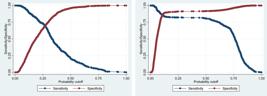
The model’s predictive capability may also be assessed using the ROC (Receiver Operating Characteristic) curve. Figure 2 demonstrates the relationship between specificity and sensitivity in the best-fit estimates for each block - with and without considering audit opinion in the previous period.

As observed in Figure 2, estimation 3, without considering audit opinion in the previous period, has an acceptable predictive capability (area under the curve of 0.7420), while estimation 5 has an excellent discriminatory power (area under the curve of 0.9063), mainly due to the inclusion of the variable Mod(-1). It is worth noticing that estimates of the first block are also relevant to the study, since, even with a lower accuracy rate, they have an acceptable fit, according to the parameters exposed.
5. CONCLUSIONS
This research aimed to identify opinion modification determinants in Brazilian State-owned companies, especially whether the audit service characteristics, the audit firm, and the audited companies help to explain the auditor’s decision to modify their opinion on financial statements. To carry out empirical tests, 233 federal and state-level State-owned companies were considered, from 2001 to 2022, resulting in 2,268 observations.
Empirical findings confirmed most of the research hypotheses, revealing that a modified audit opinion is: positively associated with time to deliver the audit report (AudDel), the issuance of reports with modified opinion in the previous fiscal year (Mod(-1)) and the fact that the State-owned company is fiscally dependent (LRF); and it is negatively related to the length of agreement between the auditor and the client (AudTen), the profitability level of audited companies (Rent), the control of a State-owned company by the Union (Fed) and the complexity of the audit service performed (Cpx.fin and Cpx.int). These results are supported by the literature and suggest that many hypotheses, tested in private companies, regarding the characteristics of audited companies and audit firms, are also applicable to Brazilian State-owned companies. On the other hand, some results did not confirm the hypotheses expectations, such as that predicting a greater probability of a modified opinion issued by the main audit firms (Big4) and a lower propensity for this type of opinion the smaller the size of the audited State-owned company (Size).
Discrepancies found in relation to prior research studies suggest the influence of the Brazilian institutional environment and, in particular, in relation to peculiarities of the State-owned segment. In this way, as verified, specific characteristics of State-owned companies, such as fiscal dependence and federal control, are factors that significantly influence audit opinion. Federal control, for instance, may be related to a higher level of management regulation, and this may result in a more robust governance structure, when compared to other entities. In turn, receiving resources for operational maintenance of some State-owned companies, which characterizes dependence, was another factor impacting the opinion of an independent auditor, suggesting that this fact may increase auditor perception of company risk.
In the set of results, it is worth highlighting the predominance of opinion modification in the previous period to explain a new modified opinion in the current period. The inclusion of this condition in the model substantially increases its explanatory power and its predictive capability, resulting in better model fit and discriminatory power. This may be explained both by persistence of issues previously identified and by greater skepticism of the auditor who identified material misstatements in the previous period.
Among the contributions of the study, it is worth highlighting the scarcity of similar research studies in the country focused on State-owned companies, as they exhibit specific characteristics regarding governance and control mechanisms. These particularities can influence the governance structure and financial performance of the companies, impacting, for example, the going concern assumption and the audit opinion. This situation makes it difficult to generalize the results obtained in the private sector to the state-owned companies segment.
The empirical findings are useful for the work of regulatory and/or state control bodies, as well as for public managers, by highlighting the characteristics of state-owned companies or audit firms that explain the auditors' propensity to issue a modified opinion. These findings provide elements that may improve regulatory or management forecasts, better reflecting the associated risks. Moreover, they contribute to discussions on topics such as audit rotation and the method of hiring audit firms - issues that can impact audit quality, as well as auditor independence and skepticism. Additionally, this study may contribute to company managers, public auditors, and even the audit firms themselves, in order to mitigate audit risk, given that opinion modification determinants may also point out red flags associated with State-owned companies.
This study provides insights for further research, such as the possibility of assessing the transparency perspective in State-owned companies or the content of audit reports in these companies, such as the issues adopted to justify opinion modification. Finally, some relationships not explored in this study deserve in-depth examination, such as the influence of hiring auditors exclusively for the lowest price, variables related to audit firm’s specialization level, and variables related to governance structure.
REFERENCES
-
Abernathy, J. L., Barnes, M., Stefaniak, C., & Weisbarth, A. (2016). An international perspective on audit report lag: A synthesis of the literature and opportunities for future research. International Journal of Auditing, 21(1), 100-127. https://doi.org/10.1111/ijau.12083
» https://doi.org/10.1111/ijau.12083 -
Alareeni, B. (2018). The associations between audit firm attributes and audit quality-specific indicators: A meta-analysis. Managerial Auditing Journal, 34(1), 6-43. https://doi.org/10.1108/MAJ-05-2017-1559
» https://doi.org/10.1108/MAJ-05-2017-1559 -
Araujo, M. D., & Dantas, J. A. (2022). Posicionamento dos auditores sobre continuidade operacional em bancos em dificuldades financeiras. Revista Contabilidade & Finanças, 33(90), e1436. https://doi.org/10.1590/1808-057x20221436.pt
» https://doi.org/10.1590/1808-057x20221436.pt - Asare, S. K., & McDaniel, L. S. (1996). The effects of familiarity with the preparer and task complexity on the effectiveness of the audit review process. The Accounting Review, 71(2), 139-159.
-
Ballesta, J. P., & García-Meca, E. (2005). Audit qualifications and corporate governance in Spanish listed firms. Managerial Auditing Journal, 20(7), 725-738. https://doi.org/10.1108/02686900510611258
» https://doi.org/10.1108/02686900510611258 -
Becker, C. L., Defond, M. L., Jiambalvo, J., & Subramanyam, K. (1998). The effect of audit quality on earnings management. Contemporary accounting research, 15(1), 1-24. https://doi.org/10.1111/j.1911-3846.1998.tb00547
» https://doi.org/10.1111/j.1911-3846.1998.tb00547 -
Blankley, A. I., Hurtt, D. N., & MacGregor, J. E. (2015). Are lengthy audit report lags a warning signal? Current Issues in Auditing, 9(2), 19-28. https://doi.org/10.2308/ciia-51215
» https://doi.org/10.2308/ciia-51215 -
Bushman, R. M., & Piotroski, J. D. (2006). Financial reporting incentives for conservative accounting: The influence of legal and political institutions. Journal of Accounting and Economics, 42(1-2), 107-148. https://doi.org/10.1016/j.jacceco.2005.10.005
» https://doi.org/10.1016/j.jacceco.2005.10.005 - Carcello, J. V., & Nagy, A. L. (2004a). Audit firm tenure and fraudulent financial reporting. Auditing: a Journal of Practice & Theory, 23(2), 55-69.
-
Carcello, J. V., & Nagy, A. L. (2004b). Client size, auditor specialization and fraudulent financial reporting. Managerial Auditing Journal, 19(5), 651-668. https://10.1108/02686900410537775
» https://10.1108/02686900410537775 - Carey, P., & Simnett, R. (2006). Audit partner tenure and audit quality. The Accounting Review, 81(3), 653-676.
-
Castro, R. L., Vasconcelos, J. P., & Dantas, J. A. (2017). Impactos das normas internacionais de auditoria nos relatórios dos auditores sobre as demonstrações financeiras dos bancos brasileiros. Revista Ambiente Contábil, 9(1), 1-20. https://doi.org/10.21680/2176-9036.2017v9n1ID7827
» https://doi.org/10.21680/2176-9036.2017v9n1ID7827 - Chung, H., Sonu, C. H., Zang, Y., & Choi, J. H. (2019). Opinion shopping to avoid a going concern audit opinion and subsequent audit quality. Auditing: a Journal of Practice & Theory, 38(2), 101-123.
- Constanti, V. G. (2019). Análise do desempenho financeiro das empresas estatais federais: Um contraponto entre as classificações legais e a dependência de recursos do controlador. Tribunal de Contas da União.
-
Cunha, P. R., Beuren, I. M., & Pereira, E. (2009). Análise dos pareceres de auditoria das demonstrações contábeis de empresas de Santa Catarina registradas na Comissão de Valores Mobiliários. Revista de Informação Contábil, 3(4), 44-65. https://doi.org/10.34629/ric.v3i4.66-80
» https://doi.org/10.34629/ric.v3i4.66-80 - Cunha, P. R., Lunelli, L. D., Santos, V. D., Faveri, D. B., & Rodrigues, M. M., Júnior. (2015). Relação entre as características do comitê de auditoria e o atraso da emissão do relatório da auditoria independente (audit delay). Contabilidade, Gestão e Governança, 18(3), 47-65.
-
Dahlia, R., Thomas, S., & Stephanie, W. (2023). Till death do us part: An examination of the impact of unbroken auditor-client relationships on audit efficiency and audit quality. Auditing: a Journal of Practice & Theory, 43(1), 167-190. https://doi.org/10.2308/AJPT-2021-022
» https://doi.org/10.2308/AJPT-2021-022 -
Dantas, J. A., Carvalho, P. R., Couto, B. A., & Silva, T. N. (2016). Determinantes da remuneração dos auditores independentes no mercado de capitais brasileiro. Revista Universo Contábil, 12(4), 68-85. http://10.4270/ruc.2016428
» http://10.4270/ruc.2016428 -
DeAngelo, L. E. (1981). Auditor size and audit quality. Journal of Accounting and Economics, 3(2), 183-199. https://doi.org/10.1016/0165-4101(81)90002-1
» https://doi.org/10.1016/0165-4101(81)90002-1 -
DeFond, M., & Zhang, J. (2014). A review of archival auditing research. Journal of Accounting and Economics, 58(2-3), 275-326. http://dx.doi.org/10.1016/j.jacceco.2014.09.002
» http://dx.doi.org/10.1016/j.jacceco.2014.09.002 - Deis, D. R., & Giroux, G. A. (1992). Determinants of audit quality in the públic sector. The Accounting Review, 67(3), 462-479.
-
Eny, N., & Mappanyukki, R. (2020). Moderating role of audit fees on the effect of task complexity and independence towards audit judgment. Journal of Economics, Business, and Accountancy Ventura, 23(2), 194-204. https://10.14414/jebav.v23i2.2326
» https://10.14414/jebav.v23i2.2326 -
Francis, J. R. (2011). A framework for understanding and researching audit quality. Auditing: a Journal of Practice & Theory, 30(2), 125-152. https://10.2308/ajpt-50006
» https://10.2308/ajpt-50006 -
Francis, J. R., & Krishnan, J. (1999). Accounting accraals and auditor reporting conservatism. Contemporary Accounting Research, 16(1), 135-165. https://10.1111/j.1911-3846.1999.tb00577.x
» https://10.1111/j.1911-3846.1999.tb00577.x -
Francis, J. R., & Yu, M. D. (2009). Big 4 office size and audit quality. The Accounting Review, 84(5), 1521-1552. https://10.2308/accr.2009.84.5.1521
» https://10.2308/accr.2009.84.5.1521 - Gissel, J. L., Robertson, J. C., & Stefaniak, C. M. (2010). Formation and consequences of going concern opinions: A review of the literature. Joumal of Accouting Literature, 29, 59-141.
-
Habib, A. (2013). A meta-analysis of the determinants of modified audit opinion decisions. Managerial Auditing Journal, 28(3), 184-216. https://10.1108/02686901311304349
» https://10.1108/02686901311304349 -
Habib, A., Bhuiyan, M. B., & Wu, J. (2021). Corporate governance determinants of financial restatements: A meta-analysis. The International Journal of Accounting, 56(1), 1-71. http://10.1142/S1094406021500025
» http://10.1142/S1094406021500025 -
Hassan, Y. M., & Naser, K. (2013). Economy, determinants of audit fees: Evidence from an emerging economy. International Business Research, 6(8). 56-74. http://dx.doi.org/10.5539/ibr.v6n8p13
» http://dx.doi.org/10.5539/ibr.v6n8p13 -
He, K., Pan, X., Tian, Y., & Wu, Y. (2024). Political turnover and audit opinion: Evidence from China. Auditing: a Journal of Practice & Theory, 20(20) 1-27. https://doi.org/10.2308/AJPT-2022-025
» https://doi.org/10.2308/AJPT-2022-025 -
Ireland, J. C. (2003). An empirical investigation of determinants of audit reports in the UK. Journal of Business Finance & Accounting, 30(7-8), 975-1016. https://10.1111/1468-5957.05417
» https://10.1111/1468-5957.05417 -
Jensen, M. C., & Meckling, W. H. (1976). Theory of the firm: Managerial behavior, agency costs and ownership structure. Journal of Financial Economics, 3(4), 305-360. https://doi.org/10.1016/0304-405X(76)90026-X
» https://doi.org/10.1016/0304-405X(76)90026-X - Kent, P., Routledge, J., & Stewart, J. (2010). Innate and discretionary accruals quality and corporate governance. Accounting and Finance, 50(1), 171-195. https://10.1111/j.1467-629X.2009.00321.x
-
Khan, A., Siddiqui, J., & Muttakin, M. B. (2015). Audit fees, auditor choice and stakeholder influence: Evidence from a family-firm dominated economy. The British Accounting Review, 47(3), 304-320. http://dx.doi.org/10.1016/j.bar.2015.03.002
» http://dx.doi.org/10.1016/j.bar.2015.03.002 -
Klein, A. (2002). Audit committee, board of director characteristics, and earnings management. Journal of Accounting and Economics, 33(3), 375-400. https://doi.org/10.1016/S0165-4101(02)00059-9
» https://doi.org/10.1016/S0165-4101(02)00059-9 -
Knechel, W. R., & Vanstraelen, A. (2007). The relationship between auditor tenure and audit quality implied by going concern opinions. Auditing: a Journal of Practice & Theory, 26(1), 113-131. https://doi.org/10.2308/aud.2007.26.1.113
» https://doi.org/10.2308/aud.2007.26.1.113 -
Krishnan, J., & Krishnan, J. (1996). The role of economic trade-offs in the audit opinion decision: An empirical analysis. Journal of Accounting, Auditing & Finance, 11(4), 565-586. https://doi.org/10.1177/0148558X9601100403
» https://doi.org/10.1177/0148558X9601100403 - Kurnia, R., & Cellica, L. (2016). The impact of bankruptcy prediction, company's financial condition, previous year audit opinion, firm size and audit tenure towards auditor's going concern opinion. Accounting and Finance Review, 1, 51-58.
-
Kyriakou, M. I., & Dimitras, A. I. (2018). Impact of auditor tenure on audit quality: European evidence. Investment Management and Financial Innovations, 15, 374-386. http://dx.doi.org/10.21511/imfi.15(1).2018.31
» http://dx.doi.org/10.21511/imfi.15(1).2018.31 - Lawrence, A., Minutti-Meza, M., & Zhang, P. (2016). The importance of client size in the estimation of the big 4 effect: A comment on DeFond, Erkens, and Zhang (2016). Management Science, 63(11), 3650-3653.
-
Lei n. 12.527, de 18 de novembro de 2011. (2011). Regula o acesso a informações previsto no inciso XXXIII do art. 5º, no inciso II do § 3º do art. 37 e no § 2º do art. 216 da Constituição Federal; altera a Lei n. 8.112, de 11 de dezembro de 1990; revoga a Lei n. 11.111, de 5 de maio de 2005, e dispositivos da Lei n. 8.159, de 8 de janeiro de 1991; e dá outras providências. https://www.planalto.gov.br/ccivil_03/_ato2011-2014/2011/lei/l12527.htm
» https://www.planalto.gov.br/ccivil_03/_ato2011-2014/2011/lei/l12527.htm -
Lei Complementar n. 101, de 4 de maio de 2000. (2000). Estabelece normas de finanças públicas voltadas para a responsabilidade na gestão fiscal e dá outras providências. https://www.planalto.gov.br/ccivil_03/leis/lcp/lcp101.htm
» https://www.planalto.gov.br/ccivil_03/leis/lcp/lcp101.htm -
Lennox, C. (2000). Do companies successfully engage in opinion-shopping? Evidence from the UK. Journal of Accounting and Economics, 29(3), 321-337. https://doi.org/10.1016/S0165-4101(00)00025-2
» https://doi.org/10.1016/S0165-4101(00)00025-2 -
Marques, V. A., Louzada, L. C., Amaral, H. F., & Souza, A. A. (2018). O poder da reputação: Evidências do efeito big four sobre a opinião do auditor. Revista Contemporânea de Contabilidade, 15(35), 3-31. http://dx.doi.org/10.5007/2175-8069.2018v15n35p3
» http://dx.doi.org/10.5007/2175-8069.2018v15n35p3 -
Marques, V. A., Vaz, U. O., Miranda, D. V., & Checon, R. P. (2023). Quando os controles importam: Evidências da associação não linear entre as deficiências de controles internos e a qualidade de auditoria. Revista Contabilidade & Finanças, 34(92), e1692. https://doi.org/10.1590/1808-057x20231692.en
» https://doi.org/10.1590/1808-057x20231692.en -
Mowchan, M. J. (2023). Do accounting firms change strategy through office managing partner appointments? Evidence from the U.S. Accounting, Organizations and Society, 108, 101442. https://doi.org/10.1016/j.aos.2023.101442
» https://doi.org/10.1016/j.aos.2023.101442 -
Mutchler, J. F., Hopwood, W., & McKeown, J. M. (1997). The influence of contrary information and mitigating factors on audit opinion decisions on bankrupt companies. Journal of Accounting Research, 35(2), 295-310. https://doi.org/10.2307/2491367
» https://doi.org/10.2307/2491367 - Myers, J. N., Myers, L. A., & Omer, T. C. (2003). Exploring the term of the auditor-client relationship and the quality of earnings: A case for mandatory auditor rotation? The Accounting Review, 78(3), 779-799.
-
Ramadhan, A. P., & Sumardjo, M. (2021). Previous years audit opinions, profitability, audit tenure and quality control system on going concern audit opinion. European Journal of Business and Management Research, 6(2), 140-145. https://doi.org/10.24018/ejbmr.2021.6.2.817
» https://doi.org/10.24018/ejbmr.2021.6.2.817 - Santos, S. F. (2020). Os determinantes da opinião modificada em auditoria no setor público: O caso do ensino superior universitário público em Portugal (Dissertação de Mestrado). Instituto Universitário de Lisboa.
- Secretaria de Coordenação e Governança das Empresas Estatais. (2022). Boletim das Empresas Estatais Federais, 22.
- Secretaria do Tesouro Nacional. (2021). Raio-x das empresas dos Estados brasileiros: Um panorama das estatais estaduais brasileiras. STN.
- Silva, E. R., & Rodrigues, J. M. (2022). Evidenciação de partes relacionadas em empresas estatais: Análise dos fatores determinantes do nível de evidenciação previsto no CPC 05 (Apresentação de Trabalho). 16º Congresso ANPCONT, Foz do Iguaçu, PR, Brasil.
- Silva, J. D. (2022). O efeito da maldição do vencedor nas contratações públicas da auditoria independente (Dissertação de Mestrado). Universidade Federal do Rio Grande do Norte.
- Susanto, Y. K. (2018). Auditor switching: Management turnover, qualified opinion, audit delay, financial distress. International Journal of Business, Economics and Law, 15(5), 125-132.
- Teoh, S. H., & Wong, T. J. (1993). Perceived auditor quality and the earnings response coefficient. The Accounting Review, 68(2), 346-366.
- Tribunal de Contas da União. (2014). Acórdão 1.046/2014 (Plenário). TCU.
-
Yang, J. S., & Krishnan, J. (2005). Audit committees and quarterly earnings management. International Journal of Auditing, 9(3), 201-219. https://doi.org/10.1111/j.1099-1123.2005.00278.x
» https://doi.org/10.1111/j.1099-1123.2005.00278.x
-
4
This is a bilingual text. This article was originally written in Portuguese and published under the DOI https://doi.org/10.1590/1808-057x20242055.pt
-
This article stems from an MA dissertation submitted by the author Vinícius Alves dos Santos Pereira in 2023.

 Fonte: Prepared by the authors.
 Fonte: Prepared by the authors.