
 Parents' and teachers' perceptions of school inclusion of children presented with hearing loss
ABSTRACT
Purpose: to analyze and relate the perception of parents of students with hearing loss (HL) and their teachers regarding the impact of HL on school relationships.
Methods: 26 parents/guardians and 16 teachers of schoolchildren linked to a Hearing Health Program participated. A structured questionnaire with objective questions was applied. Data were analyzed with descriptive and inferential statistics.
Results: most parents (53.8%) considered that school favors the social life of their children, although 34.6% report difficulties in school relationships. Among teachers, 100% indicated that school favors social relationships and friendship, but 75% reported difficulties in the teaching process. There was agreement between the groups regarding the presence of school inclusion and the existence of barriers, especially related to communication and teaching resources, although without statistically significant differences.
Conclusion: parents and teachers recognize the importance of school in promoting the social interaction of schoolchildren presented with HL and share similar perceptions about the impacts of disability on school interactions. Teachers indicate challenges in the teaching process and in the use of assistive technologies, pointing to the need for continuing education and inclusive strategies that favor the permanence, accessibility and participation of these students.
Keywords:
Hearing Loss; Mainstreaming, Education; School Teachers; Parents; Child
RESUMO
Objetivo: analisar e relacionar a percepção de pais de escolares com deficiência auditiva (DA) e de seus professores quanto ao impacto da DA nas relações escolares.
Métodos: participaram 26 pais/responsáveis e 16 professores de escolares vinculadas a um Programa de Saúde Auditiva. Foi aplicado um questionário estruturado com questões objetivas. Os dados foram analisados por meio de estatística descritiva e inferencial (Teste de Fisher).
Resultados: a maioria dos pais (53,8%) considera que a escola favorece o convívio social de seus filhos, embora 34,6% relatem dificuldades no relacionamento escolar. Entre os professores, 100% indicaram que a escola favorece as relações sociais e de amizade, mas 75% relataram dificuldades no processo de ensino. Observou-se concordância entre os grupos quanto à presença de inclusão escolar e à existência de barreiras, sobretudo ligadas à comunicação e aos recursos didáticos, embora sem diferenças estatisticamente significativas.
Conclusão: pais e professores reconhecem a importância da escola na promoção do convívio social de escolares com DA e compartilham percepções semelhantes sobre os impactos da deficiência nas interações escolares. Os professores indicam desafios no processo de ensino e no uso de tecnologias assistivas, apontando para a necessidade de formação continuada e estratégias inclusivas que favoreçam a permanência, a acessibilidade e a participação desses alunos.
Descritores:
Perda Auditiva; Inclusão Escolar; Professores Escolares; Pais; Criança
INTRODUCTION
Since the mid-2000s, with the National Policy on Hearing Health Care1, the early identification of hearing loss (HL) has been carried out in the first months of life, followed by referral for appropriate intervention as soon as possible. The intervention encompasses the adaptation of hearing aids (HA) and speech therapy. Both have made it possible for children to make the most of their hearing ability by facilitating access to Oral Language. As a result, many of these children are integrated into mainstream education, which raises discussions about the challenges involved in school inclusion.
In recent years, there have been significant advances in inclusive practices. However, the political and social principles that underlie inclusion are not yet fully incorporated into the everyday school environment, generating concerns among educators and insecurities among parents.
In addition, at school, it is also possible to verify the consequences of HL on the child's relationship with other colleagues and/or even with the teacher. These consequences lead to many problems of adaptation in this environment, such as the ability to be independent and the difficulty of interpersonal communication, associated with the difficulties of understanding speech, the difficulty of understanding the rules of the school environment and the difficulty in the learning process of this child, due to AD. For these reasons, the communication barrier can be considered the main reason for a failure in the school inclusion of this population2-4.
There are many barriers that children with HL face. The term “barriers” refers to any obstacle or behavior that causes limitation and even impediment of the person's participation in society. They can be related to communication, accessibility, people's attitudes, among others5. In HL, the “language barrier” at various times hinders communication and active child participation in the family and school environment2,6.
Given the above, this research aims to analyze and relate the perception of parents of children with hearing impairment and their teachers in relation to the impact of this disability on school relationships.
METHODS
The research was approved by the Research Ethics Committee of the Federal University of Santa Maria, RS, Brazil (CAAE nº 23081.027862/2021-65; opinion nº 055748). All participants were formally invited, informed about the objectives, risks and benefits of the research, as well as the confidentiality of the data. After acceptance, the Informed Consent Form (ICF) was signed by parents and teachers, and the Confidentiality Term by the responsible researcher, according to the guidelines of Resolution No. 466/2012 of the National Health Council.
This study presents an observational, descriptive, quantitative and cross-sectional design. The objective was to analyze the perception of family members (parents or legal guardians) and teachers of children with hearing loss (HL) on aspects related to school inclusion. For purposes of simplification, the term “parent” will be used throughout the text to refer to all legal caregivers. Participants who lived daily with the child and had an active role in their educational process were included, regardless of the biological parental bond.
The sample consisted of two groups: legal caregivers (parents) and teachers of hearing impaired children. The identification of the participants was carried out through an active search in a database of a Program of Hearing Health linked to the Unified Health System (SUS), which grants hearing aids (HA). From the identification of children with HL served by the program, the respective public schools in the city where the study was developed were selected for convenience, seeking to contemplate the largest possible number of peers (parents-teachers) involved with the same school.
The following inclusion criteria were established for the group of parents: legal caregivers of children with symmetrical bilateral sensorineural hearing loss (varying degrees), aged between 4 and 14 years, enrolled in regular public schools, users of HA, with oral or bilingual communicative modality. Caregivers of children with multiple disabilities (registered in medical records), without visible cognitive conditions to understand the instrument, or who did not complete the questionnaire completely, were excluded.
For teachers, the inclusion criteria were: working in a state or municipal public school in that city and teaching at least one child with HL previously identified in the Hearing Health Program. Teachers who did not complete the questionnaire were excluded.
The instruments were applied in person, with technical support from the researchers. Each group answered a different questionnaire, prepared by the authors, still without formal validation. The instruments were composed of objective questions, with five-point Likert scales, representing the frequency of occurrence of the items investigated: "always" (100%), "almost always" (80%), "sometimes" (50%), "rarely" (20%) and "never" (0%).
The parent questionnaire was divided into two sections. The first included identification data and information on the student's hearing history (degree of HL, type of device, form of communication, and history of intervention). The second section was structured in two thematic blocks: Block A with seven questions about family relations, and Block B with 16 questions about school and social relations. The questionnaire for teachers was also divided into two parts. The first included identification data, training time and professional experience, as well as six questions about communication, accessibility and barriers. The second part included 15 questions on teaching methodologies, assistive technologies, curricular adaptations and challenges for inclusion.
The answers were organized in spreadsheets and subjected to statistical analysis. Descriptive statistics (mean, standard deviation and absolute and relative frequencies) were used to characterize the sample. Fisher's test was used to compare proportions, considering statistical significance for p ≤ 0.05. The analyses were conducted using IBM SPSS software, version 25.
It should be noted that variables such as degree of HL, time of use of the devices and aspects of the therapeutic process were not included in the analyzes statistics, since the focus of the study was to measure, in general, the perception of the participants regarding the process of school inclusion.
RESULTS
The final sample consisted of 26 fathers (10 men and 16 women; mean age of 37.8 ± 6.4 years) and 16 teachers (15 women and 1 man; mean age of 46.6 ± 9.7 years) of children with hearing loss (HL), aged between four and 14 years, enrolled in state and municipal public schools in a city in the countryside.
As for the age profile of the students, one was 4 years old; nine were between 5 and 7 years old; eight between 8 and 10 years old; and eight between 11 and 14 years old. Regarding the degree of symmetrical sensorineural HL, 11 presented severe, 14 moderate and one mild degree. All students were oral or bilingual (6 bilingual and 20 with the main oral language) and users of HA; 10 of them also used a remote microphone. All were attended, at some point, by speech therapy in the hearing qualification sector of the local Hearing Health Program.
The results, analyzed descriptively on the perception of parents regarding the impact of hearing loss in the school environment, are presented in Table 1.
Among the data, issues related to social interaction, inclusion and communication stood out. Most parents reported that their children were generally included in class activities; however, they pointed out frequent difficulties in communicating with peers and problems in understanding the proposed activities.
Table 2 shows the descriptive analysis of teachers' perception data regarding the impact of hearing loss in the school environment:
Similarly to parents, teachers also highlighted aspects related to social interaction, inclusion and communication. Despite using specific methodologies, they reported frequent difficulties in teaching children with hearing impairment. It should be noted that the specific methodologies include the use of Remote Microphone (RM), support of visual resources (captions, concept maps, support tables), adaptation of materials, multimodal teaching, organization of classroom positioning, adapted class rhythm and collaboration of colleagues.
Next, for didactic purposes, Figure 1 was elaborated. In this, the perception of parents and teachers about the difficulty of relationship and communication with students with hearing impairment and their respective colleagues (listeners) was presented, considering the descriptive data of the previous tables.

Perception of parents and teachers about the difficulties of students with Hearing Loss with their peers
Next, the perception of parents and teachers about the inclusion of students with hearing impairment in the activities proposed for the class was verified, data presented in Figure 2. As in Figure 1, there is an excerpt from Tables 1 and 2, in which the visual comparison of this theme is presented.
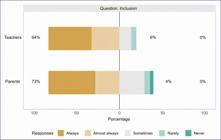
Perception of parents and teachers about the inclusion of students with hearing loss in the activities proposed for the class
Considering the issues related to barriers to permanence, inclusion and accessibility of children with HL in school, it was decided to compare the perception of parents and teachers. In order to make inferences about the impact of hearing loss in the school environment. Questions that addressed the same theme were chosen in the two questionnaires to perform such comparison, using the Fisher´s Test, considering significance of p ≤ 0.05. The results are shown in Table 3.
It is important to highlight that the situations listed as barriers (Table 3) were predetermined by the researchers based on the literature of the area and clinical experiences, not being open answers. Although some barriers, such as school transportation or the practice of inclusive physical education (EFI), are not exclusive to hearing impairment, they were included for their potential specific impact on this group, especially in contexts where communication is a critical factor for participation.
Finally, Table 4 shows the data regarding the communicative barriers that hinder school accessibility, also analyzed using the Fisher´s Test.
DISCUSSION
In the present study, most parents perceive school as a space that expands their children's social life, and believe that their children often have difficulties communicating efficiently with their peers.
The teachers participating in this research agree that the school is a good space for social interaction and the development of relationships. Most of them often experience difficulties in teaching children with HL. In addition, educators report difficulties in having a Libras interpreter and making use of RM.
Regarding relationship difficulty, teachers differed on how often this occurs, while parents note that this difficulty happens “sometimes”. Regarding inclusion in the activities proposed for the class, the perception between parents and teachers is similar, as they agree that children with HL are included. There was no difference in relation to the perception of parents and teachers about the barriers to permanence, inclusion and accessibility of the child with HL at school, nor regarding the communicative barriers that hinder accessibility in the school environment.
In Table 1, 53.8% of parents state that school always expands the social life of their children, which was also observed in a national study, in which the authors analyzed narratives of mothers of children with HL2. In this work, it was pointed out that the school plays a representative role in the lives of children with this sensory deficit, being a space of fundamental importance for the development of autonomy, communication and child socialization.
Regarding the communication difficulties of children with HL and their peers in school, it is known that the absence of interaction with mediators and peers impairs development, especially in the teaching-learning process7. This communication barrier in the development of family and school activities is something pointed out by both parents and teachers in another study8. In addition, communication difficulties, especially between children with disabilities and their peers and teachers, have negative effects on the cognitive development and learning of students with HL. The effects are often ignored in inclusive practice9, which leads us to reflect on how inclusion still needs to advance, because in an educational environment, communication, the main means of social interaction, should not be a barrier experienced by the two groups (students/teachers) who live together and form the educational environment.
In Table 2, it is possible to observe that all teachers in this study believe that the school always provides a good space for social interaction and for the production of social relations. This was also observed in another study, in which teachers were interviewed about the process of school inclusion of students with hearing impairment10. They associated the school with a space that allows students to interact, socialize, in addition to being a right that needs to be enforced. It is known that the school must promote a welcoming environment that collaborates with the integration of these students in order to absorb cultural, affective, cognitive and social values, meeting what the teachers of this study had as perception11.
Another fact that deserves to be highlighted is that, in this study, teachers point out that they often have difficulty teaching children with hearing impairment. To minimize this situation, some authors argue that pedagogical actions need to be based on concrete daily relationships. They should be able to promote the basic principles, guided by collective learning that seeks to facilitate the relationships of hearing impaired children with their peers7.
Literature data10 point out that teachers present and report difficulties in developing and adapting materials, as well as doubts about the best strategy used for learning. However, this aspect differs from what was observed in the surveyed sample, as most teachers reported using specific methodologies for the teaching of their students with HL. A possible justification for this data is that teachers may have been embarrassed to assume the difficulties in this teaching-learning process of children with the sensory deficit studied. In addition, it should be noted that often the specific methodologies are not suitable for this audience due to the technical unpreparedness of the teacher who does not carry out continuing school training. In addition, many factors contribute to the unpreparedness of teachers in the inclusion process, which generates barriers in the daily life of children with disabilities. Among them, the following stand out: the teacher's doing, the demands school, the lack of incentive policies and how much the technical training process is aligned only with public policies, not being an effective practice.
In addition, 50.8% of teachers report never having a Libras interpreter at school and 68.8% state that they never use RM. It should be noted that there are different studies that prove the effectiveness and benefits of RM to favor the inclusion and accessibility of students12. Although currently there are still research data indicating that teachers do not have appropriate knowledge about hearing aids, Cochlear Implant and RM13. In addition, often because they do not know these technologies, they choose not to use them. This decision results in a barrier to student follow-up in classroom activities10. In agreement with the data of this study and with those already mentioned, there is a national study highlighting that, of the 30 teachers who participated in the research, only nine use the RM in the classroom14. Different authors15 report teachers' lack of knowledge about these aspects, as in the present study. The articulation between health service and school favors the use of RM, however only when this relationship is intermediated by parents, according to a current publication16. This could be a way to improve the low adherence to the use of RMs pointed out here in this study.
Figure 1 explains the findings about the relationship of children with HL with their peers. The teachers participating in this research differed on how often this difficulty occurs. Most parents, on the other hand, note that this obstacle happens “sometimes”. Recent studies13,15 point out that, as observed, communication difficulties are present in the school environment and should be minimized to promote interaction and favor teaching-learning.
Finally, Figure 2 addresses an issue related to the inclusion of students with HL in the activities proposed for the class, with agreement between the perception of parents and teachers. This is a fact that differs from other studies in which teachers mainly perceive the difficulties of this process and, in many environments, believe that inclusion is not occurring17. In a current Brazilian study18, one of the teachers points out as challenges facing inclusion to better structure the environment to receive students. It should be noted that to ensure inclusion and quality education, it is necessary to reduce barriers and promote equal access. Thus, the school must fulfill its role of conducting inclusion in a respectful manner, guaranteeing the right of permanence and accessibility of students with hearing impairments and producing quality education for all students19.
Table 3 shows that there was no statistically significant difference between the perception of parents and teachers when analyzing the environments that could be considered a barrier to the permanence, inclusion and accessibility of children with HL. In addition, both point out that there are no obstacles that impact school inclusion. Regarding parents, another study2 highlights the lack of knowledge on the part of parents of the barriers found in different environments frequented by their children. Some authors13 point out that schools have different architectural obstacles and their structural limitations hinder the process of including children with hearing impairment in these spaces. Examples of this type of barrier can be school transportation, the library, and even the classroom. In addition, a study20 highlighted some factors that can increase and provide the difficulty of inclusion in Physical Education classes, such as Teaching Strategies, Collaborative Work and Training. These aspects extend to other areas of teaching within the school.
In Table 4, there was no statistically significant difference in any of the responses of parents and teachers regarding the communicative barriers that hinder accessibility in the school environment. It should be noted that the two groups surveyed cited as barriers some inappropriate behaviors of colleagues and teachers and difficulties with reading and writing the Portuguese language. The communication barriers were scored at different times in this study and it should be noted that the inappropriate behaviors of colleagues and teachers make it difficult for children with hearing impairment to communicate. The professional should be the student's support network and the mediator of relationships6 as already mentioned at another time. Other studies also list the difficulty with reading and writing the Portuguese language as a recurring barrier in the classroom7,8,12. Authors hypothesize that the difficulties generated by the different constructions produced by children with hearing impairment are due to the interference of Sign Language, the difficulty of understanding the semantic content, the conditions of deafness, the inappropriate use of technologies and also inadequate pedagogical techniques7,8,12.
Based on some results of this study, it is possible to reflect on the parents' understanding of school inclusion in the face of the answers to several questions asked, for example, it can be mentioned that the child has difficulties communicating with colleagues and communicating efficiently. At different times in this study, it is observed that there is a lack of knowledge on the part of parents about some barriers when compared to the teachers' report. This allows us to reflect on the role of this professional, who, in addition to being the mediator of relationships at school, needs to be the interlocutor for parents. In this panorama, the teacher of the child with AD has a very important role, especially for those who are still unable to communicate to their parents about the confrontations experienced in daily school life.
In this study, the initial hypothesis was that parents and teachers had a different view of the impact of hearing loss and the barriers that their children/students face to school inclusion. However, the result indicates that both have a similar perception. It is pointed out that, perhaps, the final data may have been interfered with due to the use of a subjective questionnaire that depended on the perception of each subject in the sample. It should be noted that this is a representative sample, considering the criteria used for inclusion in this study.
The variables degree of HL, time of use of HA and issues related to the therapeutic process were not the focus of study in this publication, as it focused on measuring the perception of parents and teachers in a generic way about the inclusion process.
This study demonstrated its relevance by highlighting important aspects of the school inclusion process from the perspective of parents and teachers of children with HL.
CONCLUSION
In this study, parents and teachers make it clear that school is a space that expands the social life of children presented with hearing loss, despite the communicative barriers that exist in it. Therefore, parents and teachers have a similar perception of the impact of disability on school and social relationships, although they consider that children with hearing impairment are included in the activities proposed to the class.
The results of this study show that, although children are perceived as included in school activities, communicative barriers that impact socialization and the learning process persist, especially with regard to the use of assistive technologies and communicative mediation between students and their peers. Both parents and teachers demonstrated similar perceptions regarding the barriers faced, although parents, in some cases, do not recognize certain obstacles observed in school daily life.
These findings point to the need to strengthen the articulation between school, families and specialized support services, promoting continuous training for teachers and guidance strategies for those responsible. In this way, it will be possible to build a more effective and meaningful inclusion that considers the particularities of hearing impairment and ensures real conditions of permanence, learning and full participation of students in the school environment.
REFERENCES
- 1 Brasil. Ministério da Saúde. Institui a Política Nacional de Atenção à Saúde Auditiva. Brasília, 2004.
-
2 Machado LB, Davi ML. The role of mothers in the education and inclusion of deaf students. Rev. Dialogues and Perspectives in Special Education. 2021;8(1):55-70. https://doi.org/10.36311/2358-8845.2021.v8n1.p55-70
» https://doi.org/10.36311/2358-8845.2021.v8n1.p55-70 -
3 Nelson LH, Anderson K, Whicker J, Barrett T, Muñoz K, White K. Classroom listening experiences of students who are deaf or hard of hearing using Listening Inventory for Education-Revised. Lang speech Hear Serv School. 2020;51(3):720-33. https://doi.org/10.1044/2020_LSHSS-19-00087
» https://doi.org/10.1044/2020_LSHSS-19-00087 -
4 Qiao XF, Ren Q, Li X, Li TL, Mariano RS. Analysis of subjective perception and influencing factors of different inclusive education models among prelingually deaf children with a cochlear implant. J Int Med Res. 2020;48(6):030006052092985. https://doi.org/10.1177/0300060520929855 PMID: 32567996.
» https://doi.org/10.1177/0300060520929855 - 5 Brasil. Ministério da Saúde. Política Nacional de Atenção Integral à Saúde da Criança: orientações para implementação (eletronic book). Brasília, 2018.
-
6 Pinto CG, Nunes MC. Children's literature in the process of inclusion of students with hearing impairment. Rev. Nova Amazônica. 2019;7(3):211-21. http://dx.doi.org/10.18542/nra.v7i3.7944
» http://dx.doi.org/10.18542/nra.v7i3.7944 -
7 Hashizume CM, Morais CS. School exclusion: Epistemological and practical reflections on the learning of the student with hearing impairment in regular school. Graduate Notebooks. 2021;20(1):111-27. https://doi.org/10.5585/cpg.v20n1.18665
» https://doi.org/10.5585/cpg.v20n1.18665 -
8 Schemberg S, Guarinello AC, Massi G. The point of view of parents and teachers regarding the linguistic interactions of deaf children. Rev. bras educ espec. 2012;18(1):17-32. https://doi.org/10.1590/s1413-65382012000100003
» https://doi.org/10.1590/s1413-65382012000100003 - 9 Lacerda CB. The insertion of the deaf child in a class of hearing children: Focusing on the organization of pedagogical work. In: ANPED Annual Meeting; September 24, 2000; Caxambú, Brasil. Caxambú: ANPED; 2000. p. 1-17.
-
10 Silva JB, Fidêncio VL. Conhecimento de professores sobre a inclusão de alunos com deficiência auditiva no ensino regular. Journal Health NPEPS. 2021;2(6):122-36. http://dx.doi.org/10.30681/252610105469
» http://dx.doi.org/10.30681/252610105469 - 11 Cunha LA. Ensino superior e universidade no Brasil. 500 anos de educação no Brasil. 2a ed. Belo Horizonte: Autêntica; 2000.
-
12 Carvalho DS, Pedruzzi CM. Use of the frequency-modulated system by students with hearing loss. Distúrb. Comun. 2019;31(1):12-21 https://doi.org/10.23925/2176-2724.2019v31i1p12-21
» https://doi.org/10.23925/2176-2724.2019v31i1p12-21 -
13 Resende AS, Santos CF, Silva KD, Coutinho DJ. A educação inclusiva da criança surda: quebra de barreiras atitudinais para uma educação de qualidade na rede regular de ensino. Rev. Braz J Develop. 2019;5(12):32920-33. https://doi.org/10.34117/bjdv5n12-349
» https://doi.org/10.34117/bjdv5n12-349 -
14 Miranda ES, Brazorotto JS. Facilitators and barriers for the use of the FM System in school-age children with hearing loss. Rev. CEFAC. 2018;20(5):583-94. https://doi.org/10.1590/1982-021620182055118
» https://doi.org/10.1590/1982-021620182055118 -
15 Fidêncio VLD, Costa CA, Sousa IS, Romão JMFE. Investigation of teachers' knowledge in regular schools in a region of the Federal District about the frequency modulation (FM) system. Audiol., Commun. Res. 2020;25:e2278. https://doi.org/10.1590/2317-6431-2019-2278
» https://doi.org/10.1590/2317-6431-2019-2278 -
16 Esturaro GT, Youssef BC, Ficker LB, Deperon TM, Mendes BCA, Novaes BCAC. Adherence to remote microphone system use at school in children and adolescents with hearing loss. CoDAS. 2022;34(3):e20200326. https://doi.org/10.1590/2317-1782/20212020326 PMID: 35043858; PMCID: PMC9769424.
» https://doi.org/10.1590/2317-1782/20212020326 -
17 Simoes MRS. Process of inclusion of deaf students: New perspectives and possibilities. REASE. 2021;7(2):1038-57. https://doi.org/10.51891/rease.v7i2.3757
» https://doi.org/10.51891/rease.v7i2.3757 -
18 Souza QR, Reis ED, Rocha TE, Mota OM, Eler RR, França SD. Inclusão na Universidade Federal de Rondônia/Brasil: análise acerca da percepção de gestores x aluno. Rev. Braz. J. Develop. 2020;6(5):25506-20. https://doi.org/10.34117/bjdv6n5-124
» https://doi.org/10.34117/bjdv6n5-124 -
19 Oliveira MR, Barros MP. Processo de inclusão do estudante surdo no ensino fundamental na rede municipal de Salgueiro. Id on Line Rev. Psic. 2021;15(58):122-38. https://doi.org/10.14295/idonline.v15i58.3312
» https://doi.org/10.14295/idonline.v15i58.3312 -
20 Santos FF, Matos MAS, Santos JOL. Fatores potencializadores e/ou dificultadores do processo de inclusão de alunos com deficiência nas aulas de Educação Física. Educação. 2020;45(1):e105/1-25. https://doi.org/10.5902/1984644442654
» https://doi.org/10.5902/1984644442654
-
A study conducted at the Federal University of Santa Maria - UFSM, Santa Maria, RS, Brazil.
-
Financial support
Nothing to declare
-
Data sharing statement
The data collected will be treated anonymously and confidentially; that is, at no time will the participants’ names be disclosed. The participant’s privacy will be ensured, as their name will be replaced by letters or numbers. The data collected will be used exclusively for analysis in this research, and the results may be published in scientific events and/or journals in the field or related areas. These data will be stored at the Speech-Language Pathology Service (SAF), located in Building 26E, Avenida Roraima no. 1000, UFSM campus, Camobi district, Santa Maria-RS, Room 108. After this period, the data will be discarded through incineration of the physical protocols, and the data entered in Excel spreadsheets will be “deleted.” The project will comply with the ethical procedures established by Resolution 466/2012 of the National Health Council.
The data collected will be treated anonymously and confidentially; that is, at no time will the participants’ names be disclosed. The participant’s privacy will be ensured, as their name will be replaced by letters or numbers. The data collected will be used exclusively for analysis in this research, and the results may be published in scientific events and/or journals in the field or related areas. These data will be stored at the Speech-Language Pathology Service (SAF), located in Building 26E, Avenida Roraima no. 1000, UFSM campus, Camobi district, Santa Maria-RS, Room 108. After this period, the data will be discarded through incineration of the physical protocols, and the data entered in Excel spreadsheets will be “deleted.” The project will comply with the ethical procedures established by Resolution 466/2012 of the National Health Council.

 Source: Elaborated by the authors
 Source: Elaborated by the authors