Development and content validation of the Communication Screening Instrument - IRC-36
ABSTRACT
Purpose: to develop and validate the content of the communication screening instrument for children aged 0 to 36 months.
Methods: an instrument comprising nine categories organized into five domains, according to developmental milestones per age group. The research was conducted in two stages. The first included item construction and theoretical content validation by seven judges with expertise in child language. The second included the empirical validation by the target population, in which three speech-language-hearing pathologists applied the instrument to 30 parents in a school in Recife, PE, Brazil. First-stage data analysis focused primarily on verifying agreement between the judges. In the second stage, the examiners suggested adjusting some items, and the children's performances were stratified.
Results: a high level of interjudge agreement was observed in the first stage (CVI > 0.90). In the second stage, the performances stratified into quartiles confirmed the instrument’s feasibility for discriminating normally developing children from those at risk of a communication disorder or needing attention.
Conclusion: the process ensured the instrument's content validity, with further validation steps being recommended.
Keywords:
Language Development; Child Language; Communication; Validation Study; Speech, Language and Hearing Sciences
RESUMO
Objetivo: elaborar e validar o conteúdo do instrumento de rastreio da comunicação de crianças de 0 a 36 meses.
Métodos: o instrumento possui nove categorias organizadas em cinco domínios estruturados com base nos marcos do desenvolvimento por faixa etária. A pesquisa foi realizada em duas etapas. A primeira englobou a construção dos itens e a validação teórica do conteúdo por sete juízes com expertise na área de linguagem infantil. A segunda englobou a validação empírica pela população-alvo, consistindo na aplicação do instrumento por três fonoaudiólogas a 30 pais em uma escola de Recife-PE. A análise dos dados da primeira etapa voltou-se prioritariamente à verificação da concordância entre os juízes. Na segunda etapa, as aplicadoras apresentaram sugestões para ajustes em alguns itens e os desempenhos das crianças foram estratificados.
Resultados: na primeira etapa, foi observado um alto índice de concordância entre os juízes (IVC > 0,90). Na segunda etapa, a estratificação dos desempenhos em quartis confirmou a viabilidade do instrumento para discriminação de crianças com possível risco ou em atenção para alterações da comunicação, bem como crianças com desenvolvimento normal.
Conclusão: o processo assegurou a validade de conteúdo do instrumento, com a recomendação de que novas etapas de validação sejam realizadas.
Descritores:
Desenvolvimento da Linguagem; Linguagem Infantil; Comunicação; Estudo de Validação, Fonoaudiologia
INTRODUCTION
The first years of life are the most important for a child's development, as they are marked, mainly, by greater neuroplasticity, enabling the development of brain structures and connections necessary to acquire various skills and abilities1. Language acquisition is one of the most important early childhood milestones, with important results for the child's entire subsequent development2.
The lifelong importance of language makes it essential for family members and health and education professionals to know the development milestones to monitor them, especially in early childhood3,4.
Several studies in the United States advocate using validated screening instruments at regular intervals to monitor development in childcare. Thus, the literature argues that parental reports are a valid resource for this monitoring and that professionals who monitor child development should be familiar with such screening tools5.
The enormous social inequality in Brazil increases the importance of monitoring children's language development. However, until very recently, there was a lack of validated instruments for this purpose. A Brazilian study6 highlights that in 2018 there were three internationally used multidimensional instruments published in Brazil - the Bayley Scale, the Denver-II Test, and the Ages and Stages Questionnaire (ASQ-3) -, none of which were developed considering the Brazilian context. Moreover, acquiring some of these instruments and training specifically for applying them are rather expensive, hindering application, especially in Brazilian public health and education services.
Previous Brazilian studies indicate that primary healthcare professionals have difficulty screening or do not screen communication development7,8.
Another study with pediatricians also reveals that although 93.4% of interviewees observed communication development milestones, only 50.5% reported referring children for speech-language-hearing (SLH) assessment when they lacked oral language between 1 and 2 years old9.
Despite its importance, few instruments are available in Brazil to screen and monitor changes in communication development, especially considering free access, rapid application, and low cost.
The communication screening protocols most cited in the Brazilian literature include the MacArthur Communicative Development Inventory, translated and adapted to Brazilian Portuguese10. It assesses the communicative behavior of children aged 8 to 30 months based on their parents’/guardians’ responses to a questionnaire, indicating the words present in the child's receptive and expressive vocabulary.
A search of the national literature revealed other instruments created for the same purpose. One example is the Checklist for Identifying Children at Risk for Oral Language Disorders (CICRICAL)11, developed to identify children aged 0 to 5 years at risk for language disorders early. It has initial questions on biological and environmental risk factors and investigates communicative behavior through three to five yes/no questions directed at seven age groups. It also recommends that children lacking one or more communicative behaviors be referred for SLH assessment. There are data on the instrument’s content validation but not on its application to a population - which prevents testing the approximate number of indications for SLH evaluation in a population. Furthermore, the instrument addresses language alone, not including cognition or social skills data.
More recent research has developed and validated the Dimensional Inventory of Child Development Assessment (IDADI), for use in children aged 0 to 72 months, also through parental reports, covering the cognitive, motor skills (gross and fine), communication and language (receptive and expressive), socio-emotional, and adaptive behavior domains6. Despite being an easy-to-use instrument and having been developed in Brazil, the IDADI is sold at a relatively high cost, making it difficult to apply on a large scale, especially considering the context of public health and education in Brazil.
Other validated instruments and protocols are available in the country for use by qualified professionals, most of them for exclusive use by psychologists or SLH pathologists and to diagnose rather than monitor development - all of them requiring time and finances to apply.
Hence, measurement instruments are very important for research, clinical practice, and health assessment. However, the literature has been warning researchers about the need to evaluate the psychometric properties of instruments in depth to ensure the quality of the results. Instruments must provide accurate, valid, and interpretable data for assessing the population’s health12. Brazilian SLH pathologists only scarcely or partially apply psychometric principles13.
The above highlights the importance of monitoring language development and identifying changes in early childhood communication development as soon as possible. However, these have been a challenge for Brazilian health and education professionals. As in other countries, one of the greatest difficulties is the lack of screening instruments for this purpose and the time required to apply them, considering the professionals’ daily routine14.
Thus, this study aimed to develop an instrument to screen the communication development of children aged 0 to 36 months and present evidence of its content validity.
The idea was to develop a simple, quick-to-apply, low-cost instrument that can be used by primary healthcare or education professionals who monitor children in this age group, following the criteria recommended by the Brazilian Ministry of Health for screening programs15.
METHODS
This quantitative-qualitative, observational, analytical, cross-sectional study was approved by the Human Research Ethics Committee of the Universidade Federal de Pernambuco, PE, Brazil, under evaluation report number 3.043.400 and CAAE: 94718218.1.0000.5208.
The study was divided into two stages. The first one encompassed theoretical analysis, with item construction and theoretical content validation by a committee of seven judges, all SLH pathologists from different regions of Brazil, with proven expertise in child language.
The judges were selected based on a list of language experts provided by the Federal SLH Council and the researchers' knowledge of the judges' scientific production and clinical practice concerning the research topic. The professionals received an email with the invitation letter, an informed consent form, a professional characterization questionnaire, a checklist to evaluate the items, and the Communication Screening Instrument (IRC-36, in Portuguese).
The second stage focused on empirical content validation, having it applied by the target population. Hence, three SLH pathologists applied the instrument to 30 parents/guardians, contacted at a private school in Recife, PE, Brazil.
The study adopted the instrument development model suggested by Pasquali16, with theoretical, empirical, and analytical stages. The model’s first two stages (theoretical and empirical) were carried out in this study, like previous Brazilian ones approaching the validation of SLH instruments17.
Altogether, the theoretical and empirical stages worked as follows: 1) search in the literature on the topic; 2) construction and organization of the instrument items; 3) evaluation by the committee of judges; 4) application of the first instrument version to parents/guardians and evaluation by the target population.
Stage 1 - theoretical
The literature search was conducted in 2019 and sought to answer the following question, “What are the language assessment instruments applied to children up to 36 months old available to health professionals?”. The studies were selected based on this question on the Virtual Health Library database, the largest network of online information sources regarding scientific health research in Brazil. The search also used DeCS and MESH descriptors - keywords for retrieving topics from the scientific literature. The following cross-referencing was performed in English and Portuguese: child language (DeCS and MESH) AND diagnosis (DeCS and MESH); child language (DeCS and MESH) AND screening (DeCS and MESH). Two researchers searched the literature, following the inclusion and exclusion criteria. In case of conflict, a third researcher analyzed the study in question.
The inclusion criteria were original articles addressing language assessment instruments for children up to 36 months old, published in any language between 2013 and 2019. Most selected articles intended to screen for specific disorders and not monitor language or communication development; therefore, they were excluded.
The instrument’s development considered that communication development milestones in the first 3 years of life can change every few months. Hence, it was organized into nine categories, each corresponding to an age group, initially with 3-month then 6-month intervals, as follows: category 1 - 0 to 3 months, category 2 - 4 to 6 months, category 3 - 7 to 9 months, category 4 - 10 to 12 months, category 5 - 13 to 15 months, category 6 - 16 to 18 months, category 7 - 19 to 24 months, category 8 - 25 to 30 months, category 9 - 31 to 36 months.
The items were assessed with some essential criteria: objectivity (OB), simplicity (SI), clarity (CL), relevance (RE), precision (PR), amplitude (AM), modality (MO), typicality (TY), and credibility (CR). Grammatical criteria were also considered: sentence length (SL), sentence structure (SS), and vocabulary (VO).
The items and categories were judged with a Likert scale ranging from 1 to 5, as follows: (1) totally inadequate, (2) inadequate, (3) neither adequate nor inadequate, (4) adequate, and (5) totally adequate.
The SPSS statistical analysis software, version 25.0, was used to analyze the judges' evaluation data, enabling descriptive analyses and the calculation of the content validity index (CVI).
The following formula was used to calculate the CVI for each category and the general aspects of the instrument: CVI = number of responses 4 or 5 / total number of responses. A rate of no less than 0.78 is recommended when there are six or more judges; in the case of new instruments, such as in this study, the concordance index should be at least 0.8018.
Stage 2 - empirical
As previously stated, in the empirical stage three SLH pathologists applied the instrument to 30 parents/guardians, collecting quantitative data (the scores obtained in the instrument) and qualitative data (the pathologists’ perceptions and notes from applying the instrument).
Parents/guardians were selected by convenience. Their children had to be within the established age range, have no complaints or diagnosis of developmental changes, and be enrolled in the school participating in the study. The children’s parents/guardians were informed that, during the collection, they would only have to answer 10 questions that investigated communication development milestones and sign an informed consent form. The instrument was then applied, considering the category corresponding to each child's age. In the application, the respondents had to choose from three options on a Likert scale the one that best described the child's behavior - e.g., Category 1 (0 to 3 months) - Question 1 - “Does the child make eye contact, even if for a short time?”; Answers (0) no, (1) sometimes, (2) yes. Some questions ask for additional qualitative information - e.g., Category 1 (0 to 3 months) - Question 1 - If you answered yes or sometimes, please specify for how long19.
At the end of the interview, the parents/guardians were instructed on how to encourage communication development. If the child was identified as at risk, they were referred for SLH assessment, at no cost to the family.
A statistical analysis of distribution into quartiles was performed based on the instrument application data, identifying the central tendency and dispersion. Children whose results were in the 1st quartile performed poorly (at risk), in the 2nd and 3rd quartiles performed moderately (under attention), and in the 4th quartile (the highest one) performed well (not at risk). This analysis does not intend to establish the instrument’s definitive cutoff points; rather, it initially explores its sensitivity to distinguish the population’s performances.
One limitation of the study is that it was not possible to allocate many children in each age group - some categories had only one or two children. However, as all categories have 10 questions and the same scoring system, each child’s final score and performance could be interpreted based on the stratification into quartiles, considering the group's performance.
The notes and perceptions recorded by the SLH pathologists who applied the test enabled adjustments to some items.
RESULTS
Stage 1 - Instrument item development
As mentioned previously, the literature search was a preliminary step in item development, from which it was established that the main communication development skills and abilities were social skills, hearing, cognition, receptive language, and expressive language.
Based on this review and the identification of abilities and skills, 90 items were developed as questions, distributed across nine age categories (10 per category), thus defining the first instrument version. Table 1 shows the abilities and skills approached in the instrument per age category.
Evaluation of items by the expert committee
The judges' assessment allowed the calculation of the content validity index (CVI) to assess the general aspects and each of the nine categories that make up the instrument. The analysis revealed that most judges' responses in analyzing the general aspects and categories were 4 or 5, generating a CVI > 0.80 in both cases.
Therefore, there was a high level of agreement among the judges regarding both the instrument’s general aspects and its categories.
In addition to the analysis that calculated the CVI, four of the seven judges made qualitative comments regarding some items. These comments, shown in Chart 1, led to a thematic classification that revealed the judges’ great concern with the vocabulary of several items in all categories and the clarity of the items and sentence structure (syntax). They also made some compliments.
Most comments referred to the need for changes in the instrument’s vocabulary to offer a more accessible language to the subjects who would be asked the questions. These qualitative observations drew a closer look at the item “vocabulary”, seeking to detail its quantitative analysis better.
Hence, Table 2 presents the means and standard deviations of all judges’ responses concerning the vocabulary of the items in each category.
Despite the qualitative comments about the vocabulary, the means of the judges' responses concerning the item were quite satisfactory in all categories. However, as the comments made specific suggestions for modifying some items, all these were adjusted, including examples to help respondents understand them. These modifications resulted in the second instrument version. No one suggested adding or removing items.
Furthermore, the vocabulary was investigated in further depth by including a specific question to the examiners in the second stage of the research.
Stage 2 - Application of the instrument
Three SLH pathologists administered the instrument to the parents/guardians of 30 children aged 0 to 36 months to verify its applicability and effectiveness in identifying children at risk for communication development disorders. It is important to emphasize that the initial intention was for the instrument to be administered by preschool teachers after training with the researchers. However, there was no time available for training due to the school routine, which made it impossible for the teachers to administer it.
The SLH pathologists' perceptions after applying the instrument generally show that it was easily and quickly used (taking 15 minutes on average).
Chart 2 presents a summary of the SLH pathologists' comments.
Comments from speech-language-hearing pathologists who applied the Communication Screening Instrument - IRC-36
The SLH pathologists had no difficulty in applying the instrument, although two of them noticed that some parents/guardians had difficulty understanding some of the questions. They pointed out that the examples included after the judges' assessment greatly facilitated the respondents’ comprehension. On the other hand, they sometimes had to give examples other than those available in the instrument version. The three SLH pathologists stated they would recommend the instrument to health and education professionals to screen and monitor communication development. Some suggestions were made to improve the items.
The individual scores in the parents/guardians’ responses to the instrument were initially added. Each instrument category has 10 items, with three response options each, scoring 0, 1, or 2. Hence, the highest possible score was 20 - if the parent/guardian answered yes to all items.
Next, a statistical analysis of quartile distribution was performed to stratify the children's performances into below expectations, or at risk (when the scores were in the first quartile - Q1); moderate performance, or under attention (when the scores were in the second or third quadrant, close to the median - Q2); and higher performance (when the scores were in the last quartile - above Q3).
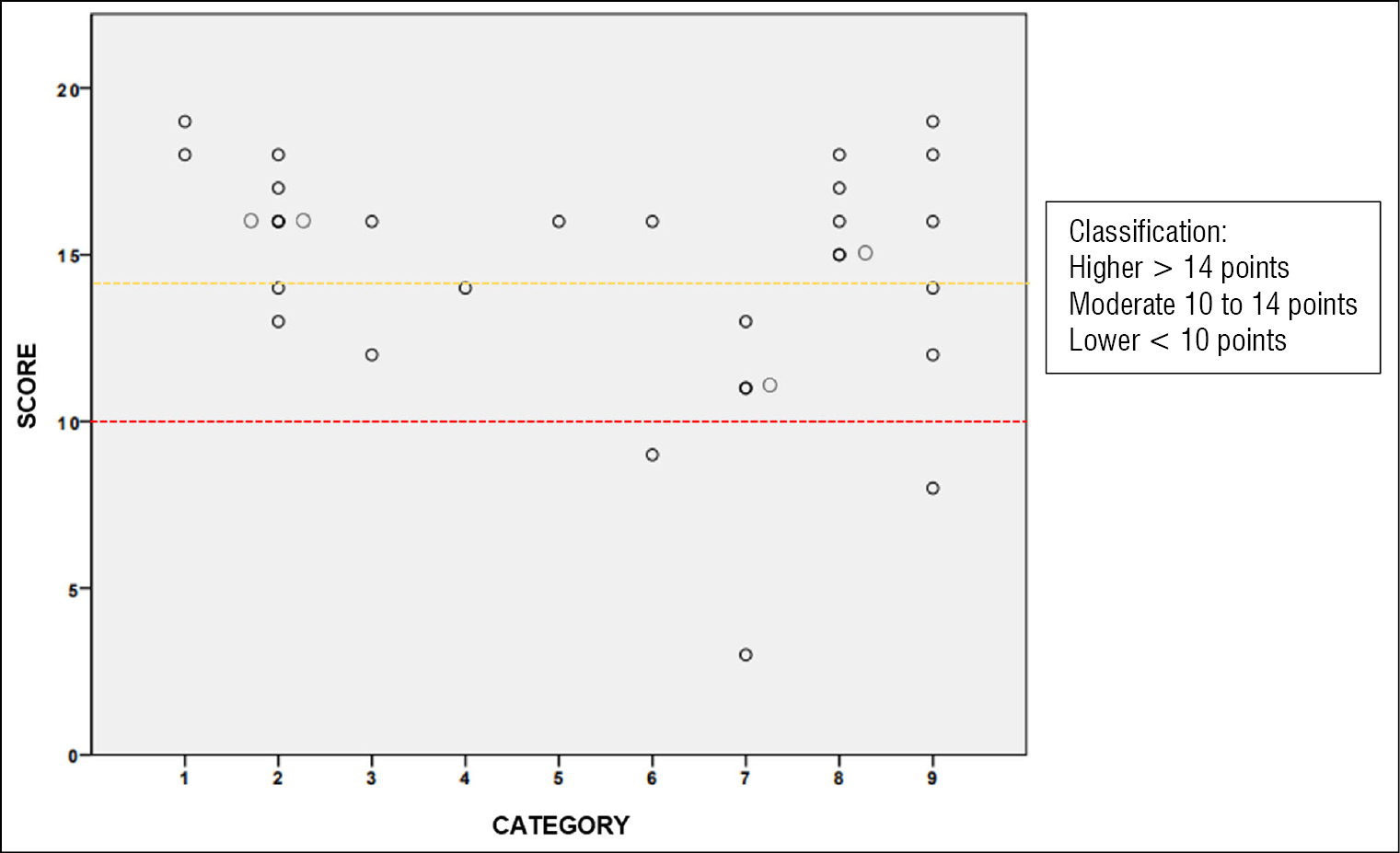
The distribution of the participants' performances and classification is shown in Figure 1.

Distribution of individual scores and classification by lower (at risk), moderate (under attention), and higher performance (out of risk)
The instrument enabled the stratification of the children's performances, based on the parents’/guardians’ results.
Three children scored below 10 points, indicating that they may be at risk for changes in communication development. The procedure in their case was to refer them for detailed SLH assessment and guide their parents and teachers.
The analysis also identified nine children who scored between 11 and 14 points, indicating that they should be monitored and remain under observation. The recommendation in their case was to reapply the instrument after 3 months, when the child was already in another age group (another category) to monitor their communication development and guide their parents and teachers.
The remaining eighteen 18 scored above 15 points, indicating that up until when the instrument was applied, they did not show signs of changes or delays, and their performances were considered out of risk.
The parents/guardians of the three children identified as at risk for changes in communication development were invited to take their children for a detailed SLH assessment. The Brazilian Ministry of Health’s Screening Manual15 requires another test with greater specificity when the screening is positive. Only one mother attended the scheduled date and time for her child’s assessment - a 20-month-old boy, the one with the lowest score (3 points) of all the analyses with the screening instrument.
Two protocols already consolidated in Brazilian SLH clinical practice were selected for the SLH assessment: the Behavioral Observation Protocol (PROC)20,21 and the Language Development Assessment Protocol (ADL 2)22. The PROC was applied in the first assessment session, and a follow-up appointment was scheduled to apply the ADL. However, the mother and the child did not attend it.
Therefore, all considerations regarding this child's communication development were based on the PROC parameters. This protocol assesses expressive communicative skills, oral language comprehension, and cognitive development.
According to the PROC analysis, the child’s results were below expectations in all skills, totaling a score of 68 points.
The researchers observed the child's communication, leading to analyze the following aspects: general characteristics of communicative abilities (he presented intentional communication with primary functions through non-symbolic means, absent in the participation of dialogic activity), general characteristics of linguistic organization (he produced isolated words), general characteristics of oral language comprehension (he does not respond systematically), general characteristics of imitation (he imitates only visible gestures with his body and does not respond to requests for sound imitation), and general characteristics of cognitive development (level of sensorimotor development in the initial stages).
Thus, it can be stated that the screening instrument developed in this study was sensitive to identifying the change in this child’s communication development, confirmed in an SLH assessment.
DISCUSSION
The instrument's items and categories were developed based on a literature search. Content validity was based on the assessment of judges with expertise in the area and on the application of the instrument, which generated quantitative and qualitative data. Altogether, the results showed that the instrument effectively stratified normally developing children, those under attention, and those at risk for changes in communication development, providing evidence of content validity and filling a gap in the literature.
The literature review for this research was carried out in 2019. As in this research, another study6 also pointed out this gap referring to a 2018 review. The authors highlighted the lack of instruments developed in the Brazilian context and the high commercial cost of some instruments translated and adapted for Brazil - which also require specific training for application, making them very difficult to apply, especially in Brazilian public health and education services.
Furthermore, previous Brazilian studies indicate that primary healthcare professionals have difficulty screening or do not screen communication development7-9. This has been a worldwide concern, since late diagnoses of communication disorders cause significant harm to the child's later development, including the process of learning to read and write2.
The World Health Organization (WHO) has been drawing attention for some years to the importance of early childhood for a person's entire later life. The document entitled “Early Child Development: A Powerful Equalizer” states that a child’s experiences during their first years establish a critical foundation for the entire course of life. This is because early childhood development, including the health, physical, social/emotional, and language/cognitive domains, strongly influences basic learning, school success, economic participation, social citizenship, and health. Thus, the WHO argues that early childhood development is strongly tied to other social determinants of health23. Such considerations further reinforce the importance of monitoring communication development, such as that presented in this study, especially in countries with great social inequalities, such as Brazil.
This study’s initial intention was for preschool teachers to administer the IRC-36 after being trained by the researchers to validate the instrument for the target population. However, some barriers prevented its application - the most important one was the limited time for training and administering the instrument to parents. Similarly, another study5 highlighted that the limited time in the professionals' routine is the main barrier to using development screening instruments.
Besides the lack of time, limited knowledge has also been identified as a barrier to monitoring child development. A study with nurses investigated their approach to language development during childcare consultations and found that, although they recognize the importance of monitoring language development, it is not prioritized during consultations, and the professionals do not feel prepared to do so. The study also analyzed 150 medical records and found that only 4% of them had any record of language development. Hence, the authors highlight the need to increase investment in the ongoing training of professionals working in childcare to prepare them and raise awareness about the importance of monitoring language development for the child's overall development7.
Resources such as the one developed in this study can be useful tools for professionals who monitor child development, as they are easy-to-use and low-cost instruments. Parental reporting has been considered an important strategy for the early identification of children at risk for developmental delays. The ease of applying instruments with parental reporting makes them particularly useful in primary healthcare. Some authors5 argue that they can be answered by parents while they wait for the appointment or can even be filled out and sent electronically. However, they warn of the risk of self-completion in cases of literacy problems - e.g., when respondents have a low education level.
Most users of public health and basic education services in Brazil come from low-income families, with different education levels. Hence, it is advisable that screening instruments, such as the one developed in this investigation, be applied by health and education professionals properly trained for this purpose.
Another important aspect to consider is that caregivers’ knowledge and beliefs affect the way they interact with the child, including how they interpret and respond to the child's behavior. Thus, it is believed that parents also need to be informed about developmental milestones to provide children with situations and experiences that help them develop2,4. In this sense, the application of the instrument by a properly prepared health and education professional can contribute to expanding parental knowledge on the subject, helping them to offer their children richer situations.
Three of the 30 children were identified as at risk in this study’s empirical phase - i.e., 10% of the sample. The national literature does not indicate Brazilian population data, perhaps due to screening difficulties. In a North American survey, researchers point out that approximately 12 to 16% of children in the United States have at least one developmental delay, and only half of them are identified early, in preschool. The authors emphasize that if identification occurs late, opportunities for early intervention will be lost5.
Based on this data, it is believed that few children in Brazil are identified early, and even fewer have access to early intervention programs.
Therefore, it is necessary to consider the great importance of using a screening instrument such as the IRC-36 for decision-making regarding therapeutic conduct. Only one of the three guardians of children identified as at risk in this study was willing to take her child for a more detailed SLH assessment. Although the child did not complete the evaluation process, the preliminary results were compatible with the suspected diagnostic of language delay. This draws attention to the importance of such instruments for regulating health services, avoiding unnecessary referrals and consequent overcrowding, and enabling the early identification of those who truly need monitoring. In this regard, some authors8 consider that primary care is the gateway to various health needs. It monitors children concerning their growth and development in routine consultations in their first years of life. Hence primary care professionals must expand their knowledge regarding developmental milestones to identify possible risk factors, carry out interventions, and refer children to specialized care.
Even though the objective of IRC-36 content validation was achieved, further steps in the validation process are needed to investigate other psychometric properties. One study12 highlights that the main criteria for evaluating an instrument are reliability (stability, internal consistency, and equivalence) and validity (content, criterion, and construct). According to the authors, content validity refers to the degree to which the content of an instrument adequately reflects the construct being measured; as there is no specific statistical test for assessing content validity, mixed research methods are generally used, including qualitative and quantitative data obtained from a committee of experts in the field. For quantitative data, the authors recommend calculating the CVI. This study followed these guidelines to obtain content validity, with acceptable CVI in all age categories and the overall evaluation of the instrument. Furthermore, the qualitative data enabled some adjustments to the items to make them clearer.
A limitation regarding this study’s empirical stage is that, although there were children distributed across all age categories, it was not possible to have more participants and an equal number of them in each category, preventing some statistical tests. This aspect needs to be further investigated in future studies. In this regard, some authors5 argue that a good screening tool needs to be validated on a large scale, with children with characteristics of the general population, which is an important step in further research.
Another important step in validating the IRC-36 concerns criterion validity, which compares the instrument with external criteria, such as a gold standard test12. Recent research24 aimed to find evidence of criterion validity and accuracy of the IRC-36. In this research24 community health workers were initially trained to apply the instrument to the population of the region. Then, the IRC-36 was reapplied in the second research phase along with the Denver II Developmental Screening Test to compare their results. It indicated a strong correlation between the IRC-36 and the Denver II, confirming the instrument’s concurrent criterion validity and indicating that it can be used to screen communication in children aged 0 to 36 months24.
This recognizes not only the IRC-36’s content validity identified in this research but also the criterion validity found in the cited study24. Furthermore, the main advantage of the IRC-36, which distinguishes it from other already validated instruments, is that it is a free access instrument (obtainable from the appendices of the master's dissertation that originated this research)19 with quick and simple application. According to the Brazilian Ministry of Health's Screening Manual15, screening tests should be quick to apply, taking about 10 to 15 minutes, and should detect the greatest number of cases at the lowest cost.
Similarly, a recent study investigated the correlation between the Developmental Monitoring Instrument (IVD) - available in the Personal Child Health Record given to all babies born in Brazil at the time of hospital discharge - and other standardized instruments used in the country: the Alberta Infant Motor School and the Denver II. To this end, babies were assessed using the instruments in the first, fourth, and eighth months of life. The results revealed significant positive correlations between the instruments, and the authors emphasize that Brazilian health professionals should use the IVD correctly, claiming that it has been underused25. Even though both are screening instruments, the advantage of the IRC-36 over the IVD is that the former delves deeper into skills and abilities related to communication development.
CONCLUSION
This study developed a screening instrument to identify the risk of changes in communication development in children aged 0 to 36 months, with evidence of content validity. Such evidence, studied to date, enabled modifications and a second instrument version. The results of the empirical stage suggest that the instrument is sensitive to identifying children with changes in communication development, as three participants were classified as at risk. However, the validation process must continue to address the other psychometric stages.
REFERENCES
- 1 Araújo A. Aprendizagem infantil: uma abordagem da neurociência, economia e psicologia. Academia Brasileira de Ciências: Rio de Janeiro, 2011.
-
2 Ford ALB, Elmquist M, Merbler AM, Kriese A, Will KK, McConnell SR. Toward an ecobehavioral model of early language development. Early Childhood Research Quarterly. 2020;50(1):246-58. https://doi.org/10.1016/j.ecresq.2018.11.004
» https://doi.org/10.1016/j.ecresq.2018.11.004 -
3 Visser-Bochane MI, Reijneveld SA, Krijnen WP, Van der Schans CP, Luinge MR. Identifying milestones in language development for young children ages 1 to 6 years. Acad Pediatric. 2020;20(3):421-9. https://doi.org/10.1016/j.acap.2019.07.003 PMID: 31306799.
» https://doi.org/10.1016/j.acap.2019.07.003 -
4 Zuble JM, Wiggins LD, Macias MM, Whitaker TM, Shaw JS, Squires JK et al. Evidence-informed milestones for developmental surveillance tools. Pediatrics. 2022;149(3):e2021052138. https://doi.org/10.1542/peds.2021-052138 PMID:35132439.
» https://doi.org/10.1542/peds.2021-052138 - 5 Mackrides PS, Ryherd SJ. Screening for developmental delay. Am Fam Physician. 2011;84(5):544-9. PMID: 21888305.
-
6 Silva MA, Mendonça Filho EJ, Bandeira DR. Development of the Dimensional Inventory of Child Development Assessment (IDADI). Psico-USF. 2019;24(1):11-26. https://doi.org/10.1590/1413-82712019240102
» https://doi.org/10.1590/1413-82712019240102 -
7 Lima LSV, Frazão IS, Queiroga BAM. Desenvolvimento da linguagem: abordagem de enfermeiros nas consultas de puericultura. Rev Enferm UERJ. 2016;24(6):e16051. https://doi.org/10.12957/reuerj.2016.16051
» https://doi.org/10.12957/reuerj.2016.16051 -
8 Pizolato RA, Fonseca LMM, Bastos RS, Fernandes AY, Lefévre F, Maximino LP. Child's language development surveillance: Knowledge and practices among primary health care professionals. Rev. CEFAC. 2016;18(5):1109-20. https://doi.org/10.1590/1982-0216201618520615
» https://doi.org/10.1590/1982-0216201618520615 -
9 Leite RCD. O olhar pediátrico no diagnóstico das alterações específicas do desenvolvimento da linguagem [Dissertation]. Belo Horizonte (MG): Universidade Federal de Minas Gerais, Programa de Pós-Graduação em Saúde da Criança e do Adolescente; 2008. Available at: https://repositorio.ufmg.br/handle/1843/ECJS-7JZNZE?locale=es
» https://repositorio.ufmg.br/handle/1843/ECJS-7JZNZE?locale=es - 10 Teixeira ER. A adaptação dos Inventários MacArthur de Desenvolvimento Comunicativo (CDI's) para o português brasileiro. Available at: Anais do II Congresso Nacional da ABRALIN. CD Multimídia, 2000.
-
11 Panes ACS, Corrêa CDC, Maximino LP. Checklist for identifying children with risk factors for oral language disorders: New proposal. Distúrb. Comum. 2018;30(2):278-87. https://doi.org/10.23925/2176-2724.2018v30i2p-278-287
» https://doi.org/10.23925/2176-2724.2018v30i2p-278-287 -
12 Souza AC, Alexandre NMC, Guirardello EB. Psychometric properties in instruments evaluation of reliability and validity. Epidemiol. Serv de Saúde. 2017;26(3):649-59. https://doi.org/10.5123/S1679-49742017000300022
» https://doi.org/10.5123/S1679-49742017000300022 -
13 Pernambuco L, Espelt A, Magalhães Junior H, Lima KC. Recommendations for elaboration, transcultural adaptation and validation process of tests in Speech, Hearing and Language Pathology. CoDAS. 2017;29(3):e20160217. https://doi.org/10.1590/2317-1782/20172016217 PMID: 28614460.
» https://doi.org/10.1590/2317-1782/20172016217 -
14 Wilkinson CL, Wilkinso MJ, Lucarelli J, Fogler JM, Becker RE, Huntington N. Quantitative evaluation of content and age concordance across developmental milestone checklists. J Dev Behav Pediatr. 2019;40(7):511-8. https://doi.org/10.1097/DBP.0000000000000695 PMID: 31169653.
» https://doi.org/10.1097/DBP.0000000000000695 - 15 Brasil. Ministério da Saúde. Secretaria de Atenção à Saúde. Departamento de Atenção Básica. Caderno de Atenção Primária no 29 - Rastreamento, 2010, 95p.
-
16 Pasquali L. Princípios de elaboração de escalas psicológicas. Rev Psiquiatr Clin. 1998;25(5):206-13. Available at: http://ppget.ifam.edu.br/wp-content/uploads/2017/12/Principios-de-elaboracao-de-escalas-psicologicas.pdf
» http://ppget.ifam.edu.br/wp-content/uploads/2017/12/Principios-de-elaboracao-de-escalas-psicologicas.pdf -
17 Ceron MI, Gubiani MB, Oliveira CR, Keske-Soares M. Phonological Assessment Instrument (INFONO): A pilot study. CoDAS. 2020;32(4):e20190105. https://doi.org/10.1590/2317-1782/20202019105 PMID: 32756856.
» https://doi.org/10.1590/2317-1782/20202019105 -
18 Alexandr NMC, Coluci MZO. Validade de conteúdo nos processos de construção e adaptação de instrumentos de medidas. Ciênc. saúde coletiva. 2011;16(7):306-8. https://doi.org/10.1590/S1413-81232011000800006
» https://doi.org/10.1590/S1413-81232011000800006 -
19 Queiroga CAM. Avaliação da comunicação nos três primeiros anos de vida: elaboração de um instrumento de rastreio [Dissertation]. Recife (PE): Universidade Federal de Pernambuco, Programa de Pós-graduação em Saúde da Comunicação Humana; 2019. Available at: https://repositorio.ufpe.br/handle/123456789/36062
» https://repositorio.ufpe.br/handle/123456789/36062 - 20 Zorzi JL, Hage SRV. PROC - Protocolo de Observação Comportamental: avaliação da linguagem. São José dos Campos: Pulso Editorial, 2004.
-
21 Rocha S, Hage V, Pereira C, Zorzi JL. Protocolo de Observação Comportamental - PROC: Valores de referência para uma prática quantitativa. Rev. CEFAC. 2012;14(4):677-90. https://doi.org/10.1590/S1516-18462012005000068
» https://doi.org/10.1590/S1516-18462012005000068 - 22 Menezes MLN. Avaliação do Desenvolvimento da Linguagem - ADL 2. Ribeirão Preto: Booktoy, 2019.
- 23 World Health Organization. Early Child Development: A Powerful Equalizer Final Report, 2007.
-
24 Almeida DPR, Cordeiro AAA, Almeida LNA, Queiroga CAM, Queiroga BAM. Evidence of concurrent and predictive criterion validity of the Child Communication Screening Instrument from 0 to 36 months (IRC-36). CoDAS. 2024;36(1):e20220218. https://doi.org/10.1590/2317-1782/20232022218pt PMID: 38126425.
» https://doi.org/10.1590/2317-1782/20232022218pt -
25 Montedori KT, Lima MCMP. Early childhood development monitoring during the first thousand days: Investigating the relationship between the developmental surveillance instrument and standardized scales. Early Hum Dev. 2024;190:105965. https://doi.org/10.1016/j.earlhumdev.2024.105965 PMID: 38354455.
» https://doi.org/10.1016/j.earlhumdev.2024.105965
-
A study conducted at the Universidade Federal de Pernambuco, Recife, Pernambuco, Brazil.
-
Financial support: This study was financed in part by the Coordenação de Aperfeiçoamento de Pessoal de Nível Superior - Brasil (CAPES) - Finance Code 001
-
Data sharing statement: The data used in this research have been filed at the Laboratory for Language and Learning Studies at the Federal University of Pernambuco (UFPE), where they will be stored for 10 years, and may be shared upon direct request to the authors.
Data sharing statement: The data used in this research have been filed at the Laboratory for Language and Learning Studies at the Federal University of Pernambuco (UFPE), where they will be stored for 10 years, and may be shared upon direct request to the authors.