
 Deaf people’s health care beyond hearing aid technologies
ABSTRACT
Purpose: to analyze the construction of health care networks based on the life histories of two adult women with hearing loss, considering biopsychosocial impacts and intersectionality in access to health care services.
Methods: interference and cartographic qualitative research in a non-metropolitan city in the state of São Paulo. In-depth interviews with two guide users with hearing loss and four semi-structured interviews with health care network professionals. The collected material was analyzed according to the theoretical assumptions of Institutional Analysis, based on what is called “analyzers.”
Results: analysis of the empirical material showed two analyzers: the first related to difficulties in accessing hearing aid technology, and the second related to linguistic and communicational barriers, considering in both cases intersectionality (socioeconomic status, gender, race) as a fundamental aspect in the health care process for individuals who use or do not use Brazilian Sign Language.
Conclusion: hearing loss, associated with difficulty in accessing hearing aid technology, can seriously impact individuals’ lives. However, in order to promote comprehensive health care, the public health care network needs to consider and expand its practices beyond those related to aural rehabilitation, ensuring accessibility to various health care services.
Keywords:
Deafness; Intersectional Framework; Comprehensive Health Care
RESUMO
Objetivo: analisar a construção de redes de cuidado a partir da história de vida de duas mulheres adultas com perda auditiva, considerando os impactos biopsicossociais e a interseccionalidade no acesso aos serviços de saúde.
Métodos: pesquisa qualitativa, do tipo interferência e cartográfica, realizada em uma cidade do interior de São Paulo. Foram realizadas entrevistas em profundidade com duas usuárias-guia com perda auditiva e quatro entrevistas semiestruturadas com profissionais da rede de saúde. O material coletado foi analisado segundo a Análise Institucional, a partir do que se denomina ‘analisadores’.
Resultados: a análise do material empírico fez emergir dois analisadores: o primeiro relacionado às dificuldades de acesso à tecnologia auditiva e o segundo, às barreiras linguísticas e comunicacionais, considerando em ambos a interseccionalidade (condição socioeconômica, gênero, raça) como aspecto fundamental no processo de cuidado à saúde de pessoas usuárias ou não de língua de sinais.
Conclusão: perdas auditivas, associadas à dificuldade de acesso à tecnologia, podem trazer graves impactos à vida dos indivíduos; porém, para promover cuidados de saúde integrais, a rede pública precisa considerar e ampliar suas práticas para além daquelas relacionadas à reabilitação auditiva, garantindo acessibilidade aos diversos serviços de saúde.
Descritores:
Surdez; Enquadramento Interseccional; Assistência Integral à Saúde
INTRODUCTION
Hearing is one of the most complex and important senses for humans, as it involves several mechanisms to capture, transmit and process sounds. The cochlea is an important peripheral organ, as it performs the function of receiving sound waves and sending them to the brain. However, several occurrences can cause damage to the cochlea and, consequently, deafness, such as genetic diseases, prolonged exposure to noise, acoustic trauma, infections, use of ototoxic medications, head trauma, otitis, among others1.
Hearing loss resulting from these damages significantly impacts oral communication and, from this perspective, can affect cognition, language, and social interaction. Seeking to reduce these impacts, resources such as hearing aids and cochlear implants can be used, with the aim of improving the quality of life of these people2. In adulthood, hearing loss can represent a significant obstacle to dealing with everyday events.
According to the 2022 National Household Sample Survey (PNAD), about 1.2% of the Brazilian population aged over 2 years is hard of hearing, even when using hearing aids3.
In 2019, the National Health Survey (PNS) indicated that 67.6% of the hard-of-hearing population had incomplete basic education or only incomplete elementary education. Employment rate among hard of hearing persons in 2019 was only 15.3%, with an average monthly wage of up to one minimum monthly wage4. This aspect showed some improvement in the 2023 PNAD, increasing to 24.4%; however, the barriers to inclusion in the labor market remain3.
As for access to health care, the National Policy on Hearing Health Care (PNASA) was implemented in 2004 aiming to improve the quality of life of this population by providing care at all levels of health care5.
Years later, in 2012, the Care Network for Persons with Disabilities (RCPD) was created, being organized into the components of Primary Health Care, Specialized Outpatient Care and Hospital Care, for Urgency and Emergency, with the objective of guaranteeing comprehensive health care6. Health care networks consist of a systematized set of actions and services that seek to ensure the continuity and comprehensiveness of health care to people in services, in a person-centered and effective manner, according to user needs6. The RCPD was created to replace the PNASA and other specific policies geared toward persons with disabilities, combining into a single policy the elements guiding the organization of the system, services and actions for persons with disabilities, including persons with hearing disabilities.
The dispensation of hearing aid technological resources was gradually expanded after the creation of the aforementioned policies7. According to the 2019 PNS data, 1.7 million people used some type of hearing aid resource, such as the Sound Amplification Hearing Aid (SAHA), the Cochlear Implant (CI) or the individual frequency modulated system (FM System)4.
It is worth mentioning that, in the hard of hearing people segment in statistical reports, as well as in related public health policies, there is a group, still quite invisible, that calls itself the Deaf or Deaf person (with a capital “S”), which are terminologies associated with the socio-anthropological knowledge of deafness. From this perspective, the use of sign language is the main characteristic of this group of people, who constitute a linguistic-cultural minority, thus forming the Deaf Community. This conception is opposed to the clinical-therapeutic knowledge of deafness, which considers it an impairment that needs to be corrected, thus justifying the use of the term “person with hearing impairment” in national policies and surveys7.
The first statistical data about this group began to appear only in 2019, showing that about 1.7 million persons with hearing disabilities, in the age group of 5 to 40 years, have some knowledge of the Brazilian Sign Language (LIBRAS), representing 22.4%. Among individuals with total deafness, this percentage increases significantly to 61.3%. On the other hand, among individuals who are hard of hearing at some level, only 9.2% have knowledge of LIBRAS4.
These PNS4 data are an important milestone, as they provide a more accurate view of the dissemination and use of LIBRAS in Brazil. They underscore the importance of public policies and educational initiatives oriented toward teaching and promoting this language. In addition, they reflect the need to support the inclusion of people with different levels of hearing loss and their language preferences, contributing toward greater understanding and respect for diversity within the Deaf Community.
Both the clinical-therapeutic knowledge and the socio-anthropological knowledge standardize individuals with hearing loss, framing them in closed and predefined characteristics, without considering that deafness is diverse8 and that there is a multiplicity of individuals, each being subjectively affected by deafness in different ways7. There are those who use CI and/or hearing aids or those who chose not to use any technological apparatus; those who oralize and signal and, also, the Deaf children of Deaf parents and the Deaf children of hearing parents, among many other singular cases.
It is worth noting that deafness can also have repercussions on important issues related to emotional and psychological aspects, requiring special attention from professionals. It is necessary to deepen and focus on discussions on interdisciplinary clinical management and comprehensive care for people with hearing loss, whether they are considered hard of hearing or deaf, and consider that they can also be affected by social determinants and intersectional aspects such as gender, race, ethnicity, social class, among others.
Acting towards comprehensive health care - among the many polysemic forms that this concept implies - requires that professionals understand the individual as a biopsychosocial being9, which presupposes an action considering that health-disease-care processes are influenced by biological, psychological and social factors, in a model geared toward the real needs of users10.
Considering intersectionality enables a richer and more complete analysis, which shows how different forms of oppression and privilege interrelate and affect the lives of these people in society11. Intersectionality is a means of understanding how social markers such as gender, disability, class, race, family status are mutually related, increasing the inequalities experienced by a person, intensifying vulnerabilities and increasing demands for access to rights12.
Considering the biopsychosocial impacts, intersectionality and access to the RCPD, this study aimed to analyze the production of health care networks, based on the life history of two adult women, one considered hard of hearing and the other Deaf, served in the Unified Health System of a non-metropolitan city in the state of São Paulo.
METHODS
The research was approved by the Research Ethics Committee (REC) of the State University of Campinas, SP, Brazil, (participating institution) (opinion 4.759.446, CAAE 46693021300005404) and by the REC of the Hospital of the Pontifical Catholic University of Campinas, Brazil, (co-participating institution) (opinion 4.798.144, CAAE 46693021330015481). All participants signed the Informed Consent Form (ICF).
This study is part of the research entitled “Analysis of an Aural Rehabilitation Center: users, managers and workers as guides” (FAPESP process 2020/09229-4 and 2023/09189-0).
Research type
This is an interference and cartographic qualitative research.
Interference research leads to deviations, with effects that extend beyond conventional boundaries, with people and events, enabling deeper research. This approach acts as a form of disruption, capable of affecting and impacting the field of research by problematizing and analyzing work and care processes. Thus, it is intertwined with the perspective of health care and “living work in action”13.
Cartography is a research method that delves into the analysis of subjective processes, operating at both the individual and collective levels. This approach is characterized by always being in motion, maintaining constant contact between the researcher and the object of study. This provides for a more complete understanding of the field of research, focusing on the observed processes rather than seeking a final result or a definitive conclusion14.
Field of research
The study was carried out in an Aural Rehabilitation Center of a reference Municipal University Hospital associated with the Municipal Health Department of Campinas, SP, in its relation with the health care network of the city.
Instruments for obtaining information
Four semi-structured interviews with health care workers and two in-depth interviews with guide users.
The interviews with health care workers aimed to understand the user referral flows in the health care network, from Primary to Specialized health care. Research participants:
-
a speech therapist, 43 years old, 24 years of training, who works at the Aural Rehabilitation Center of Campinas;
-
a speech therapist, 37 years old, 13 years of training, who works in the Multiprofessional Team (eMulti) of Campinas;
-
a psychologist, 32 years old, 8 years of training, also linked to eMulti;
-
a community health agent, 42 years old, 8 years of experience in the Family Health Strategy (FHS), at the Health Center.
The objective of the interview was to understand how is the access of users, their work processes, in addition to tracing the barriers and facilities in the service for people with hearing complaints.
While the two in-depth interviews with two guide users, named Vitória and Carla (fictitious names), were indicated by professionals from the Aural Rehabilitation Center team.
The term “guide user” refers to a tool that enables analyzing the adopted care process. It is characterized by collaboration between the user and the service team, in which both build an analysis based on the results obtained by the workers and the user’s own experiences. This process aims to understand, in a deeper and clearer way, the care, both individual and collective, in cases that are configured as highly complex in the service15.
In the specific case of the guide user Vitória, 40 years old, who is hard of hearing and uses hearing aids and CI as technological resources to communicate, the team of an Aural Rehabilitation Center perceived intense psychological and emotional suffering as a result of the COVID-19 pandemic, and the challenges experienced in this period resulted in her dismissal and permanence in the unemployed condition. Hearing loss, absence from work and social isolation imposed by the pandemic triggered a condition of depression, with symptoms of anxiety and intense psoriasis.
Guide user Carla is a 43-year-old Deaf woman who communicates through the Brazilian Sign Language (LIBRAS) and does not use hearing aid technologies. The Multiprofessional Team (eMulti) faced the complexity of the case of Carla, who faces a series of linguistic, familial and social difficulties. The traced challenges include aspects of domestic violence, the consequences of isolation for her child during the pandemic, unemployment and the desire to use hearing aid resources.
The interviews were conducted in two stages: in a first meeting with the guide users, they were invited to talk about their hearing loss, their search for care, and other events they considered relevant in their lives. Subsequently, the first stage of the interview was transcribed and transformed into a preliminary narrative text, which was read and reread by all members of the research group in order to trace any gaps. In the second meeting, the users were invited to validate the first version of the narrative produced with the data obtained in the first meeting, making corrections and/or additions to any information they desired.
It should be added that, in the case of the Deaf user, the interview was conducted by two researchers members of the team, qualified to communicate through LIBRAS, one of them being a professional in LIBRAS Translation and Interpretation and, therefore, fluent in this language. The latter performed the function of interpreter during the interview, thus ensuring the reliability of the information. The second meeting to validate the interview was also held by these two researchers, at which time one of them read the text and the other interpreted from the Portuguese language to LIBRAS, leaving the user free to make interruptions at any time, in order to correct or add information to the text.
Data analysis
The study was based on the assumptions of Institutional Analysis, in which both established and instituted processes are analyzed, while considering the possible changes and innovations for the institution and the non-instituted processes and their developments. The concept of “analyzers” - understood as acts that reveal situations highlighted in the process of analyzing the intervention in the institution and in which it is possible to identify institutionally hidden aspects - was particularly important for the analysis16.
This concept of analyzers is a central element in Institutional Analysis and refers to events or situations that break the usual routine of an institution, revealing hidden aspects, tensions and contradictions that usually go unnoticed. They expose what is invisible in institutional routine and open the way to questioning and transforming practices and structures that once seemed fixed and immutable17. The analyzers we highlighted in this article to analyze the production of health care networks, based on the life history of two adult women with hearing loss served in the SUS in the city of Campinas/SP, were: “Difficulties in accessing hearing aid technology and intersectionality: the case of Vitória” and “Language barriers and intersectional factors in the care of a Deaf user: the case of Carla.”
RESULTS
The analysis of the production of health care networks, considering the access to the RCPD, biopsychosocial impacts and intersectionality, was based on the life history of two adult women, Vitória and Carla, both with hearing loss, served in the Unified Health System (SUS) in Campinas/SP, Brazil.
Guide user Vitória
Vitória, a brown woman, had her 40 years of age affected by hearing difficulties and the desire to use devices that helped her to hear. At the age of 13, she learned that her hearing loss began when, at the age of 20 days, she needed antibiotics to treat pneumonia, which affected her hearing. She spent childhood in the countryside of Bahia with difficulty hearing, but managed to develop speech and communicate orally. However, her hearing worsened and today she has moderate hearing loss on the right side and severe hearing loss on the left side. She moved to Brasília and then to Campinas, where she married and had two children (narrative by guide user Vitória).
Guide user Carla
Carla, a 43-year-old brown woman, is Deaf and communicates exclusively through LIBRAS. She has bilateral profound hearing loss; she used hearing aid in childhood until the age of 12, but she did not perceive benefits. More recently, she said that she would like to use it again, but with the awareness that it would only be to have access to the warning sounds. She lives in Campinas, is a mother of four hearing children and her husband is also a Deaf person who uses sign language (narrative by guide user Carla).
Vitoria and Carla are two dependent SUS users, residing in peripheral neighborhoods of the city. Both have hearing loss, but their health needs go far beyond, challenging professionals who work in the Campinas SUS network services to find strategies that guarantee them comprehensive health care. Vitória and all related complexity pose challenges to the team of the Aural Rehabilitation Center located at the reference Municipal University Hospital that dispenses hearing aids and cochlear implant surgeries. In Carla’s case, the concern lies with the Family Health Team (ESF) and the Multiprofessional Team (eMulti) of the Basic Health Unit (UBS) that provides her care.
Although both women have hearing loss, deafness subjectively affects them in very different ways. Vitória had a progressive deterioration of hearing as she aged, without compromising the acquisition and development of oral language (Portuguese Language), communicating through speech, making her identify herself as a person with hearing disability. Carla, on the other hand, profound congenital Deaf, did not acquire oral language, as her condition allowed her full access only to (one) visual sign language - sign language, in the case of Brazil, LIBRAS. Therefore, she feels she belongs to the Deaf Community, which has its own cultural characteristics, marked mainly by the use of this language7.
By analyzing both stories, it is observed that, for Vitória, access to hearing aid technology has always been a desire and a hindrance in her life, which remains in the present day. Since childhood, she has always sought access to hearing aids that could help her hear, which only happened in adulthood; Carla, in turn, does not use any hearing aid technology and this is not considered a problem.
In the case of a woman with hearing disability, brown, mother of two, living in the peripheral area and in a situation of economic vulnerability, there is an overlap of several social factors, such as disability, race, class, gender and territory, which intensify the challenges faced by this woman. These factors produce additional barriers to access to essential services and to full guarantee of her rights.
Similarly, in the case of a Deaf woman, brown, single mother, divorced, peripheral area resident and victim of domestic violence, different social markers intersect, such as gender, disability, familial structure, territory and violence, significantly increasing her vulnerabilities and demands for social health care and access to basic rights.
DISCUSSION
Difficulties in accessing hearing aid technology and intersectionality: the case of Vitória
Vitória and Carla were born before the National Policy on Hearing Health Care (PNASA) published in 20045, when there was a relevant advance in expanding access to hearing tests and hearing aids for the population7. However, this growth was not homogeneous in a territory of continental proportions such as Brazil, where there is significant inequality in the distribution of resources geared toward people with disabilities, especially when comparing the Southeast region with the North and Northeast regions, showing care gaps due to the lack of adequate services and support18. Vitoria told how she spent a good part of her life trying to have access to hearing aids.
At the age of 13, in 1995, Vitória traveled to Brasília, since the state where she lived lacked resources. She underwent tests that proved her difficulty, she had medical follow-up, but she could not obtain the devices. In 2012, she moved to Campinas. She sought the UBS to expose her condition, being referred to the Polyclinic, where she had consultations with an otorhinolaryngologist; however, despite the evident difficulties, there were no developments in relation to her demand. Tired of waiting, in 2013 her husband bought a hearing aid for her right ear, as her left ear was severely compromised. When her two children were born, Vitória noticed that there had been a thorough examination of the children’s hearing. Shortly after, Vitória was referred from the Basic Health Unit (BHU) for hearing evaluation and, this time, for hearing aid fitting at the Aural Rehabilitation Center. Two years later, when she was about to be called to receive the device, the COVID-19 pandemic arose, making Vitória have to wait. In 2021, she had her second hearing aid fitted on the right ear, this time by SUS (narrative by guide user Vitória).
Vitória’s story denotes how hard it can be to wait for examinations and, above all, for hearing aids, especially if the individual was born before the first public policies on the issue, even to the extent of giving up and acquiring the technology by means of personal resources.
The demand and supply for hearing health care service users may be inconsistent, resulting in years of waiting, as reported by one of the interviewed professionals:
“It’s a huge demand [...] and that anguishes you [...], you see that the patient is waiting [...], they experience their anguish too, we, our anguish, you know?” (transcription of an excerpt from the interview with Irene, a speech therapist at the Aural Rehabilitation Center).
This does not occur only in the cities where Vitória lived, as shown by the study of Thomazi et al. (2022)19, in Rio Grande do Sul, which noted deficiencies in the provision of hearing evaluation, diagnosis and rehabilitation in Specialized Health Care services.
The situation began to change, at the national level, with the creation of the RCPD, which aimed to reduce regional disparities6 by prioritizing the implementation of rehabilitation services where the policy had barely reached, such as in Bahia, Vitória’s homeland.
In 2022, the Southeast region had 98 Specialized Rehabilitation Centers (CER), while the Northeast region had 86. These numbers indicate an advance in health care coverage in the Northeast, although there are still significant inequalities, impacting the quality and comprehensiveness of the health care provided to users, reflecting the persistence of health care gaps18.
The study of Castaneda et al. (2020)20 noted a significant growth in the number of CERs, showing that in 2019 the country had only 35 units, a number that increased to 265 in 2021. The study of Melo (2021)21 showed that, between 2012 and 2014, there was a 14.8% increase in evaluations for diagnosis of hearing disability in the SUS, followed by a 5.6% growth until 2019. It also showed an increased production of OPSM (Orthotics, Prostheses and Special Materials), with a 26.1% growth for hearing OPSM. These data show improved access of people with hearing loss to diagnosis and rehabilitation.
According to 2024 data from the National Secretariat for the Rights of Persons with Disabilities, Brazil has 150 CERs that provide the hearing modality: 63 in the Southeast, 48 in the Northeast, 20 in the North, 17 in the South and 11 in the Central-West. Moreover, there are 110 single hearing modality services, distributed as follows: 40 in the Southeast, 32 in the South, 28 in the Northeast, 5 in the North and 5 in the Central-West22.
These data show the regional disparity in the distribution of services, especially in the single hearing modality, with a higher concentration in the South and Southeast compared to the other regions.
Despite the expansion of access after 20045, with the publication of PNASA and with a new increase after 2012, with the creation of RCPD, Vitória faced, for reasons not fully known, several hindrances in the health care network, which were only removed after the birth of her children, especially after that of her oldest daughter, in 2017, when the BHU started to reconsider her case.
Family history of deafness is a crucial risk indicator for hearing loss in the examination of this condition in newborns, which is the main reason why Vitória’s children inspired different care from the FHS team in relation to hearing. A study by Faistauer et al. (2022)23 with 140 children with profound hearing loss showed that 85 of them had risk indicators. Among the 85 children, 27 (31.76%) had a family history of hearing loss.
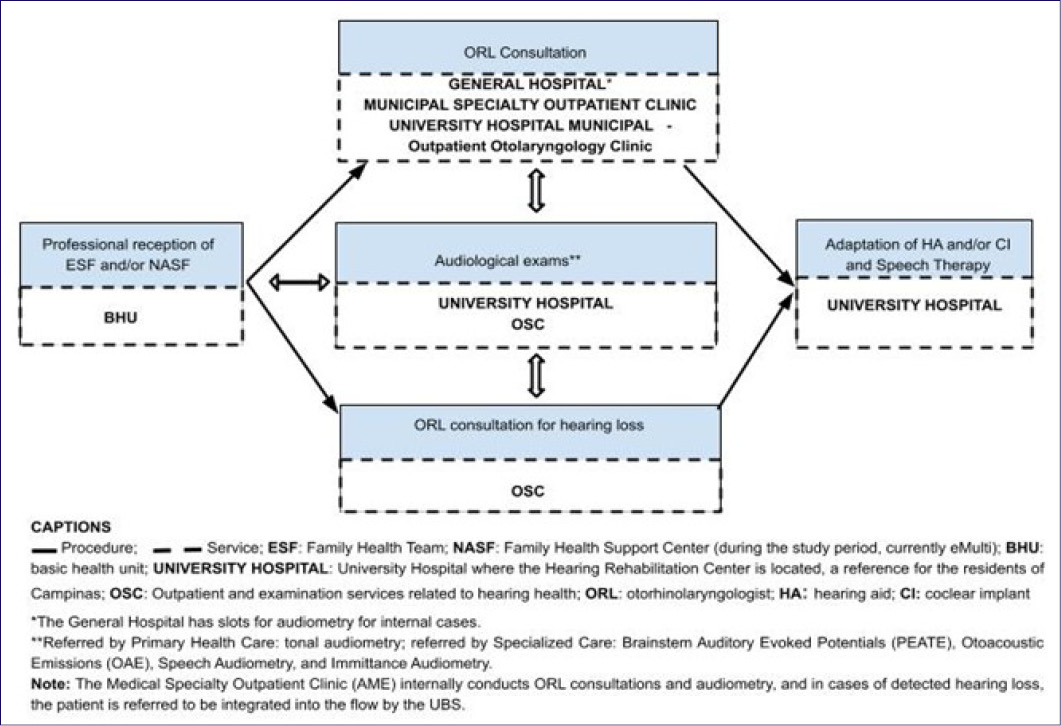
In Campinas, the adult hearing health care process begins at the BHU, with subsequent referral to Specialized Health Care for medical consultation and/or hearing testing procedures. The reference services for these procedures are: the General Hospital; the Municipal Specialty Outpatient Clinic; the reference Municipal University Hospital and the Civil Society Organization (CSO), an outpatient and examination service related to hearing health care, whose agreement was ended in April/2023, that is, during the research. When hearing loss is confirmed, the user should be referred to the Hearing Rehabilitation Center located at the reference Municipal University Hospital, as illustrated in Figure 1.

Flowchart for the adult user with suspected hearing loss, before the end of the agreement with the Civil Society Organization
Vitória went through one of the possible predicted processes, but there were access barriers, because, as shown in the flowchart in Figure 2 (routes 1 and 2), she had her search for hearing health care characterized by a mixture between the public and the private, which resulted in late access to hearing aid technology by SUS.

BHUs have a fundamental role in the classification of referrals to the specialty of Otorhinolaryngology, which refers patients to the Hearing Rehabilitation Center. According to one of the interviewed professionals, in some situations, referrals from BHUs arrive without the need for a prosthesis indication and even without clinical evaluation. She notes that: “There are referrals that don’t need a prosthesis and they send it without need and then it ends up occupying [the spot]” (transcript of an excerpt from the interview with Irene, a speech therapist at the Hearing Rehabilitation Center).
This results in longer waiting lines, occupying spots that could be allocated to cases with real demand, as reported by speech therapist Irene. Thus, the appointment or spot for the prosthesis ends up being wasted due to inadequate referrals.
Primary Health Care can detect hearing difficulties early due to the users’ close relation with the service, in addition to acting in prevention and promotion in hearing health care. However, a PHC professional said: “I think there is a little lack, there is a lack of more training, but as far as possible they [professionals] are prepared [to act on hearing health care demands]” (transcription of an excerpt from the interview with Júlia, a community health agent).
Resuming the case of Vitória, the birth of the two children reopened the possibilities of access to hearing aid technology, being again postponed by the COVID-19 pandemic, greatly impacting the health care network of Campinas and Brazil, which saw a significant reduction in the supply of services, including rehabilitation.
The study of Suda et al. (2023)24 showed that, during the COVID-19 pandemic, 91.7% of CERs in Brazil underwent organizational and structural changes, which resulted in a 97.6% reduction in rehabilitation services and an 83.5% decrease in the frequency of therapies. In 2020, there was a 26.3% reduction in the dispensation of hearing aids and a 42.4% reduction in therapy in the context of hearing rehabilitation. In addition, there was a 31.2% decrease in the number of speech therapists in the services, professionals that are essential for the evaluation, selection and fitting of hearing aids and specific therapy for users with hearing loss.
In this context, the wait - which already was not easy - became even worse for Vitória and many other Brazilians. Cieza et al. (2021)25 state that persons with disabilities were even more vulnerable in the face of barriers to access rehabilitation, which already existed before the pandemic, but intensified during this period.
The pandemic led to Vitória’s biopsychosocial vulnerability, as it “made her lose her job overnight and forced her to stay at home, isolated, with two young children, causing her emotional and financial problems” (narrative of guide user Vitória), triggering depression, anxiety and psoriasis, which compounded the hearing difficulties.
Psoriasis is an inflammatory skin disease that results from the combination of multifactorial factors, including genetic, immunological, environmental and psychological aspects. This condition has a significant relation with mental health, evidencing the influence of the psychological state on the development and worsening of the disease26.
The pandemic left me with marks for the rest of my life, because psoriasis has no cure and I ‘contracted’ it during the period I stayed at home. I got so sick and didn’t know what it was. I woke up in the morning, I wanted to cry, because I looked at myself in the mirror and it looked like I had been set on fire (...). And as there was no way to go see the doctor, because the pandemic stopped everything [that is, the consultations were suspended], it gradually worsened, worsened, worsened (transcription of an excerpt from the interview with guide user Vitória).
In the study conducted by Schlindwein-Zanini et al. (2021)27, it was found that, among adults with complaints of hearing loss in a university hospital in Santa Catarina, 58.63% also suffered from untreated psychological or mental illnesses, such as depression. These mental health problems were associated with social communication difficulties and consequent isolation.
Thus, the isolation stemming from the pandemic triggered, in many people, psychological changes such as anxiety, which manifests fear, frustrations and anxieties, resulting from the lack of social interaction and uncertainty about the future. These feelings are faced by many, but are aggravated for individuals with hearing loss due to the various barriers and difficulties already faced, increasing the propensity to psychological disorders27.
It is crucial to note that the emotional aspect also influences the therapeutic process and can affect the entire organism, which can lead to clinical worsening and several diseases. The individual is not just the impacts of hearing loss. The emotional factor cannot be neglected in clinical management and care7.
It is noted the importance of health care professionals being attentive to the other complaints of patients, in addition to hearing complaints, thus contributing toward comprehensive health care27. It is also essential that the network, in all instances, is prepared to provide full support throughout the process of adapting to CI28. Surgery to implant the CI in the left ear of Vitória was performed in February 2022. During this process, the Otorhinolaryngology and Speech-Language Pathology and Audiology professionals at the Aural Rehabilitation Center had an expanded view of the case, referring the user to the dermatologist at the reference Municipal University Hospital. This approach provides comprehensive user support, ensuring comprehensive rehabilitation and care that address all patient needs10.
Another aspect to be considered, in the case of Vitória, refers to her socioeconomic condition. Unemployment caused financial difficulties that compromised adherence to treatments.
Another problem was to attend speech therapy, because, as she was unemployed, she had much difficulty bearing the costs of transportation, even more so after her ‘free transport was cancelled’ (narrative by guide user Vitória).
According to PNAD 2022, the occupancy rate among people with disabilities is approximately 32.7% for men and 22.4% for women. These percentages are significantly lower than those recorded for people without disabilities, whose occupancy rates are 70.8% for men and 50.8% for women3. These data indicate that women with disabilities face greater difficulties in entering and remaining in the labor market, especially when compared to people without disabilities. Thus, female persons with disabilities face greater difficulty in finding and maintaining jobs compared to people without disabilities.
The route to the health care service is a crucial factor in the continuous care process, influenced by the means of transportation used, the possible need for a companion and the distance to the Aural Rehabilitation Center. In this context, persons with disabilities may face several barriers to accessing health care services, including urban obstacles, problems locating services, and organizational barriers, such as insufficient service supply. Transportation issues, such as cost and difficulty in transportation, also impair the autonomy of persons with disabilities during the health care process, in addition to other economic, territorial and infrastructure aspects that have a major impact on the users’ access to health care services29.
When she arrived in Campinas, Vitória worked in a store where the hearing loss directly impacted her performance27. This work required frequent interactions and good listening comprehension to deal with the public. Access to hearing aid only in the right ear, in 2013, contributed toward minimizing the difficulties in the work settings, although the hearing limitations were not totally overcome, since she did not have any hearing aid in the left ear. The situation experienced by Vitória exemplifies how access to hearing aid is fundamental for inclusion and performance in communicative activities, such as in the work setting, in addition to improving the quality of life for Deaf people who opt for oralization30.
Vitória’s case illustrates how the impacts of hearing loss and its implications on daily life can go far beyond not hearing, causing important mental disorders, as observed by an eMulti professional from the Campinas health care network:
Because, sometimes, [...] the person is losing [hearing] and they are not coping very well with this loss. [...] because you imagine, the person tries to communicate and fails, tries again and fails, tries again and fails. The tendency will be to gradually stop, because it is very painful (transcription of an excerpt from the interview with Adriana, eMulti psychologist from the Campinas health care network).
Regarding the pandemic, organizational and political barriers can lead to a long waiting time, showing difficulties faced by patients such as Vitória, which demonstrates that, despite advances, there are still inconsistencies between supply and demand, being urgent the guarantee of faster access, especially for people with more vulnerabilities31.
In 2021, Vitória had her second hearing aid fitted on the right ear, replacing the one she had previously purchased. Sometime later, the team proposed that she underwent CI surgery in the left ear, with profound hearing loss, while she would continue using the device in the right ear, due to the severe to profound hearing loss. The surgery was successful, but Victoria had no idea about what was to come. It was really difficult when they activated the implant, because, at that moment, I learned that the ‘world was noisy’ and that even the egg car [that vehicle that passes through the streets of some non-metropolitan cities announcing the sale of chicken eggs] had its own loud and uncomfortable sound. It was so difficult to familiarize with the implant that she even thought about giving up, but with the support of her family and all the speech therapy, she is adapting (narrative of guide user Vitória).
Vitória’s case illustrates a very common situation in the Brazilian context: the waiting time in the SUS queue to receive aural rehabilitation, Primary Health Care’s difficulty to understand the complexity of the case.
Despite all the difficulties she faced, Vitória developed a strength she did not know she had and compared the moment when she began to hear to having started living again.
She realizes how much she did not understand anything before the implant, having today the incredible possibility of hearing, something that only became reality thanks to the SUS, as she could never financially afford such surgery (narrative of the guide user Vitória).
Language barriers and intersectional factors in the care of a Deaf user: Carla’s case
Hearing losses, associated with the difficulty in access to technology, can have serious impacts on the lives of individuals, as observed in the history of Vitória. For health care professionals, care for people with hearing loss often focuses on access to hearing aids and/or CI. However, guide user Carla demonstrates that SUS needs to be much more prepared, expanding its practices beyond those related to aural rehabilitation.
Let us understand Carla’s history and the reasons why this case poses a challenge to the health care system.
Carla, a brown woman, 43 years old, is the mother of Caio, 5 years old, who worries her much because he does not speak. However, between the two there is no difficulty in communicating, as both understand each other perfectly through LIBRAS. Carla has bilateral profound hearing loss; she and the child’s father are Deaf and communicate exclusively using sign language. Caio, a hearing person, was exposed to LIBRAS in his first four years of life, through almost exclusive contact with his parents due to the isolation imposed by the COVID-19 pandemic. In addition to worrying about her son, Carla had problems at home with her husband, who drank much, used drugs and betrayed her constantly. He became aggressive after Carla said she wanted to separate. Until, in a fight, he tried to attack her with a knife. Frightened, Carla filed a Police Report (BO) at the police station, where a LIBRAS interpreter mediated the communication between her, the police officer and the psychologist. There, in addition to taking all necessary measures, including filing a request for protection, they referred her to the reference BHU, where she should provide a detailed report seeking care, explaining the case to the hearing professionals who received her (narrative of the guide user Carla).
Carla had tried a few times to access the BHU: “I have come here many times, no one helped me, it’s difficult alone” (transcription of an excerpt from the interview with guide user Carla). However, she faced communicational and linguistic barriers, since she did not have access to service in her own language, despite being provided for in Decree 5,626/200532, which regulates the LIBRAS Law, and in the Brazilian Inclusion Law - Law 13,146/201533 that Deaf people have the right to be served in an accessible manner.
After having suffered domestic violence, instructed by the police station, she attended the BHU again, receiving some attention from the reception, which informed her, using an informational leaflet, to return on the day of the Mental Health Care Group, led by the eMulti speech therapist and occupational therapist.
Carla gave an account of what she felt when she attended the group: “I saw that it was a group, I got scared, but as the speech therapist was there, she helped me, it was very difficult” (transcription of an excerpt from the interview with the guide user Carla). The user was frightened because, although she understood that she should return on a certain day and time, the reception did not provide her information, accessible in her language, about the type of service they were indicating to her. In addition, she was scared because, suddenly, she found herself within a group in which all people were hearing persons (professionals and users), not speakers of LIBRAS, feeling excluded in an inaccessible setting. Upon realizing that the group had a user with unique needs, the speech therapist - as she had some knowledge of LIBRAS - called her for an individual conversation, considered her demands and understood the complexity of the case by reading the documents (police station report, among others) and interacting in LIBRAS.
It is worth noting that, since 2005, after Decree 5.626/200532, undergraduate Speech-Language Pathology and Audiology programs have become the only bachelor’s degree programs in the field of health have the obligation to offer Libras education in the curriculum, which, despite not representing the learning of this language at a sufficient level of fluency, aims to prepare future professionals to establish basic and initial communication, in addition to understanding that the Deaf community consists of subjects with their own identity and cultural characteristics.
Despite the progress introduced by the LIBRAS Law, it is clear that a revision of the legislative text is urgent in order to expand the obligation to other health-related programs, since the lack of LIBRAS in the professionals’ skill set represents linguistic and communicational barriers that, in turn, lead to barriers to access to health care, violating the principles of universality, integrality and equity. On this matter, the eMulti speech therapist commented:
I think they [the professionals] do not have this preparation [to serve Deaf people]. And I’m not talking about preparation, the technical part, I think it’s more this awareness [understanding] of what happens. Not that there is no technical capacity for that, I know that any health care professional is capable, but I don’t see this awareness (transcription of an excerpt from the interview with Luísa, a speech therapist at the reference eMulti of the guide user’s BHU).
The study of Mazzu-Nascimento (2020)34 indicates that, of the 5,317 higher education undergraduate programs in health in Brazil, 43% offer the course of Libras, with 16.7% including it as mandatory and 83.3% as optional. In addition, among medical programs, only 5.3% offer Libras in Brazil, and in only 16% the subject is considered mandatory.
This situation justifies a profound lack of knowledge of most professionals regarding LIBRAS and Deaf people, contributing to make the difficulties of access to the health care system a reality in the lives of this group. Therefore, it is necessary to invest in training health care professionals on the Brazilian Sign Language to ensure more effective and inclusive health care.
The study of Santos and Portes (2019)35 sought to understand the perception of Deaf users about Primary Health Care in the city of Rio de Janeiro. The results showed that 83% of the participants answered that they are not served by professionals who use LIBRAS. In addition, due to language barriers in the services, 63% of these users give up continuing to seek care in the BHU. The professionals’ lack of preparation causes embarrassment and discouragement, impairing the treatment of the health of Deaf users, with potential aggravation of clinical problems35, as happened to Carla in the countless times she sought the BHU and gave up.
In addition to knowledge of LIBRAS, Condessa et al. (2020)36 note the importance of having communication facilitators in the BHUs of Brazil, such as specific professionals to accommodate people with hearing loss, visual communication through illustrations, texts and figures of health care services, and lists of actions and services available.
The lack of guarantees of linguistic rights and accessibility for Deaf people in health care services reflects organizational and political capacitism. Most services are not prepared to serve this population. It is wrongly assumed that all users with hearing loss are equal and can communicate orally, ignoring the diversity of needs and forms of communication, such as those that occur through LIBRAS, compromising equitable access to health care37,38.
Resuming the guide user’s story, she felt uncomfortable in exposing her personal problems in a group, but, in particular, she managed to report the situation of violence, her concern and even guilt with the fact that the hearing child does not speak in Portuguese language, showing distress and anxiety. Carla left the care service with some referrals: 1) to the Reference Center for Women Support (CEAMO), a service for women victims of violence, and 2) to speech therapy, with the same eMulti professional, for her son.
Upon arriving at CEAMO, Carla was again faced with group care, but this time there was a professional Sign Language and Portuguese Interpreter Translator (TILSP) from the Libras Interpreter Center (CIL), previously requested by the eMulti speech therapist, to mediate communication. CIL is a public facility linked to the Department of Social Care, People with Disabilities and Human Rights of Campinas, in which both Deaf people and professionals can request the presence of a TILSP, provided that it is for municipal services39. Even with the presence of the interpreter, the user did not feel comfortable, as she herself reported: “And then I saw that it was a group again. I said ‘Oh, I can’t’. I didn’t want to, because I cry, I remember my whole story. I didn’t feel well in a group” (transcription of an excerpt from the interview with guide user Carla).
After this episode, the speech therapist took the case to a team discussion and an appointment was scheduled with the eMulti psychologist. Knowing the need to overcome language and communication barriers, the professionals requested the presence of a TILSP to CIL, but, due to the incompatibility of time slot (the consultation with the psychologist was at 8 am and CIL starts to work at 9 am), it was not possible to have this professional or notify the user in advance.
Therefore, the psychologist tried to use another tool: communicating with the user through an avatar available in a free application that is used to translate written text into LIBRAS. Thus, he wrote it and showed the video to the user. However, these technological tools generally do not meet the needs of Deaf people, as the mere automatic conversion of written texts usually produces sentences in signaled Portuguese, and not in Libras, avatars do not have facial expressions, an important marker of sign language, they do not meet the polysemy of the language or regional variants. Despite all the technological advancement and wide use, including on official government websites, it is still a limited tool, which leads to pseudo-accessibility. In subsequent consultations with the psychologist, the appointment was schedule to a time slot that enabled the presence of the CIL interpreter, allowing Carla to continue with individual psychological therapy.
Few professionals in the primary health care network know CIL, which does not exist in many Brazilian cities. According to 2022 data surveyed by the National Secretariat for the Rights of Persons with Disabilities, there were 63 Libras centers in Brazil, distributed across the five regions of the country39. Those who know and use it approve the service, as noted in the account of the eMulti professional in the following interview excerpt:
And [CIL] is something that I had never seen in any other municipality, in this way, having a specific service of Libras interpreters, I think it is an interesting thing, despite the issues, of the specificity of psychological care (transcription of an excerpt from the interview with Adriana, psychologist of the reference eMulti of the guide user’s BHU).
In addition to CIL, the municipality of Campinas has the “Acessa Libras” service, a tool created to facilitate communication in services. It is a remote Libras interpreter center, available for free, 24 hours a day, including weekends and holidays. Through a QR code, the Deaf person or service professionals can request the interpreter through the cell phone, computer or tablet. The purpose of this service is to promote interaction between Deaf people and hearing people in all municipal public services in the city, ensuring more accessible communication.
Despite the resources provided by the municipality, the psychologist recognizes the importance of professionals having communication facilitators in their resource set and knowledge of Libras, even at a basic level, in their skill set:
I think that having a professional who can communicate in the [LIBRAS] language, [or at least have basic knowledge] of the language that the person speaks, this direct communication makes a lot of difference (transcription of an excerpt from the interview with Adriana, eMulti psychologist from the Campinas health care network).
Other aspects that should be discussed in Carla’s history refer to gender, race and socioeconomic issues. The guide user lived in an abusive marriage, marked by verbal aggression and threats, culminating in an episode of physical violence. After deciding to separate, her socioeconomic condition, which was already poor due to unemployment, deteriorated even more, as can be seen in the following excerpt:
She said she felt very depressed and sad because her husband wants to sell the house [in the face of the separation decision], but where will she go with her son, unemployed, living with the help of BPC [Continuous Cash Benefit]? She does not think about getting a new job because she feels a lot of pain in her arm due to the old job she had (narrative of guide user Carla).
Carla, despite being a Deaf person like her husband, was a victim of violence for being a woman, showing how gender inequality persists, even in a context in which both face challenges related to deafness. This case reveals the multiple layers of oppression that women with disabilities may face.
The study of Silva (2023)37 analyzes the situation of Deaf women facing domestic violence in Santa Catarina, noting that this situation is shaped by the exclusion and oppression of patriarchy, sexism and capacitism. These women face difficulties in securing their rights, accessing services and obtaining information, living in a society that further perpetuates violence against their bodies.
Women are still seen as subordinate to men and this relationship of submission is exacerbated in contexts of greater social vulnerability, such as disability. Marked by precarious social conditions, such as housing without adequate infrastructure, poor educational quality, scarce health care services and poor working conditions12, this gender inequality is intensified.
Borba (2021)40 notes that hard of hearing and Deaf women face significant barriers in the work setting due to communication difficulties and increased psychological and physical issues. According to the author, physical issues are related to constant attention in spaces where alerts are predominantly audible. The lack of visual warnings, such as signal lights, in addition to overloading these workers, increases the risk of occupational accidents due to lack of immediate access to safety information40. In addition, they face prejudices and barriers, both at work and in educational and leisure activities.
Beyond the gender issue, it is necessary to consider the race factor in Carla’s history. According to data from PNS 20194, 9.7% of the population that self-declares as black has a disability, while 8.5% identify themselves as brown with disability, as is the case of the guide user of this study. In comparison, the percentage of self-declared white people with disabilities is 8%.
All the complexity involved in the case of Carla, a Deaf person, associated with intersectional factors, should be taken into consideration by the professionals responsible for the user’s health care, as reflected on by one of the interviewed professionals:
And Carla’s case was a case that also touched us a lot, because she arrived due to a case of violence, you know, so it mobilized how much the communication barrier impaired her access to the service, you know (transcription of an excerpt from the interview with Luísa, a speech therapist at eMulti).
This reflection is fundamental to reach the conclusion that a user like Carla requires not only hard technologies (hearing aid, cochlear implant, etc.) or light-hard technologies (specific knowledge about aural rehabilitation). Above all, she needs light technologies that promote close contact between professionals and users, favoring listening, care and the strengthening of bonds, which are essential for person-centered and comprehensive health care7,9.
In the case of Deaf users who communicate through LIBRAS, these light technologies must be mediated by this language, otherwise there is no possible listening, care and bonding. For Primary Health Care to be effective, these tools need to be widely adopted and used in care, resulting in more efficient health care, as shown by the following excerpt:
When she changed BHU, I saw several people on the team being touched. Then, when I arrived at the health care unit, I scheduled a day to register her, which was one day I was there, because I thought “she will get to that little door for the health agents to register her, it may be difficult for her to communicate.” So I said “Look, you come on that day and I’m going to be there and I’ll help you with the registration.” In the end, I did not need to do anything, because the health care agents promptly came out of the door, they went there and she also writes, you know, they promptly wrote there, then the nursing technician said “I want to work in her initial care because I wish a lot to learn Libras, I know a little, so I want to provide her initial care” and I thought it was a very fantastic thing (transcription of excerpt from the interview with Luísa, speech therapist at eMulti).
It is observed in Carla’s history, based on her reports and the statements of the eMulti speech therapist, that there was a difference in the initial care service provided to the user Carla between the two Basic Health Units involved. From Carla’s perspective, in the first unit that was a reference for her at the beginning of the research, there were difficulties in communication, which compromised the quality of care. In the second unit, the professionals showed greater concern so she received proper care. On the occasion, the professionals were careful to seek means to communicate with the user, as shown in the following excerpt. It is important to note that, in Carla’s case, writing was a possibility of communication, which does not correspond to the situation of all people.
She sought the BHU in her territory and the BHU had a very careful approach. They obtained her WhatsApp number [to notify her]: “Hey, we’re going to visit you,” dengue inspection visit, for example. Notify her by WhatsApp text message, you know, because in the other BHU, she had missed several exams because they made calls and then she did not listen to the call (transcription of an excerpt from the interview with Luísa, a speech therapist at eMulti).
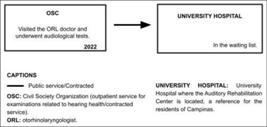
Guide user Carla spontaneously and autonomously sought service to access the hearing aid, which had always been her desire. She started monitoring at the OSC, which was still in operation at the time. In the institution, she underwent the necessary examinations and was later referred to the Aural Rehabilitation Center, where she currently waits in the queue to receive her Personal Sound Amplification Products (PSAPs). Her goal is not to develop speech, but to listen to essential sounds that provide her improved safety in daily life. The process experienced by the user in the service network is shown in Figure 3.
CONCLUSION
Hearing loss affects several aspects of life, such as psychological, socioeconomic, familial and labor aspects. Our guide users’ experiences illustrate the multiple barriers faced in health care services, including linguistic, communicational, and attitudinal barriers. To promote effective rehabilitation and comprehensive health care, it is essential to consider biopsychosocial impacts and intersectionality. These intersections reveal additional challenges, especially for women, who, in addition to communication difficulties, face intensifying issues related to social class, race, housing and economic conditions. The lives of these people cannot be reduced to hearing loss, as other equally important factors influence their life trajectories.
Each person with hearing disability or deafness has particularities that must be respected, including the type and degree of hearing loss and, especially, the choice of language for communication. The lack of technologies and the lack of professionals trained in LIBRAS limit comprehensive care. Thus, the public health care network needs to expand its practices, preparing itself to provide not only aural rehabilitation, but also inclusive and comprehensive care, that can meet the multiple needs of users.
REFERENCES
-
1 OMS: Organização Mundial de Saúde [webpage on the internet]. World Report on Hearing - Executive Summary. Genebra, Suiça: OMS, 2021. [accessed on 2024 nov 5]. Available at: https://www.who.int/publications/i/item/9789240021570
» https://www.who.int/publications/i/item/9789240021570 -
2 Amorim AFL, Siqueira EC de. Hearing loss and cochlear implant. Reamed. 2023;23(2):1-7. https://doi.org/10.25248/REAMed.e12070.2023
» https://doi.org/10.25248/REAMed.e12070.2023 -
3 IBGE: Instituto Brasileiro de Geografia e Estatística [webpage on the internet]. PNAD Contínua: Pessoas Com Deficiência (2022). Dpe/Grupo de Trabalho de Deficiência. 2023. [accessed on 2024 out 20]. Available at: https://agenciadenoticias.ibge.gov.br/media/com_mediaibge/arquivos/0a9afaed04d79830f73a16136dba23b9.pdf
» https://agenciadenoticias.ibge.gov.br/media/com_mediaibge/arquivos/0a9afaed04d79830f73a16136dba23b9.pdf -
4 IBGE: Instituto Brasileiro de Geografia e Estatística [webpage on the internet]. Pesquisa Nacional de Saúde, 2019: país tem 17,3 milhões de pessoas com algum tipo de deficiência | Agência de Notícias. [accessed on 2024 set 15]. Available at: https://agenciadenoticias.ibge.gov.br/agencia-sala-de-imprensa/2013-agencia-de-noticias/releases/31445-pns-2019-pais-tem-17-3-milhoes-de-pessoas-com-algum-tipo-de-deficiencia#:~:text=2,3%20milh%C3%B5es%20de%20pessoas%20tinham%20defici%C3%AAncia%20auditiva&text=Em%202019,%20havia%2031%20mil,3%)%20tinham%20defici%C3%AAncia%20auditiva
» https://agenciadenoticias.ibge.gov.br/agencia-sala-de-imprensa/2013-agencia-de-noticias/releases/31445-pns-2019-pais-tem-17-3-milhoes-de-pessoas-com-algum-tipo-de-deficiencia#:~:text=2,3%20milh%C3%B5es%20de%20pessoas%20tinham%20defici%C3%AAncia%20auditiva&text=Em%202019,%20havia%2031%20mil,3%)%20tinham%20defici%C3%AAncia%20auditiva -
5 Brasil. Ministério da Saúde [webpage on the internet]. Portaria nº 2.073, de 28 de setembro de 2004. Institui a Política Nacional de Atenção à Saúde Auditiva. Brasília: Ministério da Saúde; 2009 [accessed on 2025 ago 29]. Available at: https://bibliotecadigital.economia.gov.br/handle/123456789/927
» https://bibliotecadigital.economia.gov.br/handle/123456789/927 -
6 Brasil. Ministério da Saúde [webpage on the internet]. Portaria GM/MS nº 1.526, de 11 de outubro de 2023. Dispõe sobre a Política Nacional de Atenção Integral à Saúde da Pessoa com Deficiência (PNAISPD). Diário Oficial da União. 2023 out 11 [accessed on 2025 ago 29]. Available at: https://www.gov.br/saude/pt-br/composicao/saes/legislacao/portaria-gm-ms-no-1-526-de-11-de-outubro-de-2023/view
» https://www.gov.br/saude/pt-br/composicao/saes/legislacao/portaria-gm-ms-no-1-526-de-11-de-outubro-de-2023/view -
7 Vianna NG, Andrade M da GG, Lemos FCS, Rodriguez-Martín D. Deafness in the Brazilian care policy: A genealogical analysis. Ciênc Saúde Colet. 2022;27(4):1567-80. https://doi.org/10.1590/1413-81232022274.0914202
» https://doi.org/10.1590/1413-81232022274.0914202 -
8 Soleman C, Bousquat A. Health policies and definitions of deafness and hearing impairment in the SUS: A monologue? Cad Saúde Pública. 2021;37(8):1-14. https://doi.org/10.1590/0102-311X00206620 PMID: 34495093.
» https://doi.org/10.1590/0102-311X00206620 -
9 Carnut L. Cuidado, integralidade e atenção primária: articulação essencial para refletir sobre o setor saúde no Brasil. Saúde debate. 2017;41(115):1177-86. https://doi.org/10.1590/0103-1104201711515
» https://doi.org/10.1590/0103-1104201711515 -
10 Castaneda L. Healthcare and the biopsychosocial model: Understand to act. CoDAS. 2019;31(5):e20180312. https://doi.org/10.1590/2317-1782/20192018312 PMID: 31618319.
» https://doi.org/10.1590/2317-1782/20192018312 - 11 Collins PH, Bilge S. Interseccionalidade. Tradução de Rane Souza. 1 ed. São Paulo: Boitempo, 2021.
-
12 Santos SC dos, Kabengele D do C, Monteiro LM. Necropolitics and intersectional criticism to capacitism: A comparative study of the convention of the rights of persons with disabilities and the statute of persons with disabilities. Rev. Inst. Estud. Bras. 2022;(81):158-70. https://doi.org/10.11606/issn.2316-901X.v1i81p158-170
» https://doi.org/10.11606/issn.2316-901X.v1i81p158-170 -
13 Moebus RLN. Interference research since Heisenberg. DIVERSITATES International Journal [journal on the internet]. 2015 [accessed on 2024 set 15]; 7(1):54-61. Available at: https://repositorio.ufop.br/server/api/core/bitstreams/9f24d111-2fe2-4ab3-95cb-142d8e9e25f6/content
» https://repositorio.ufop.br/server/api/core/bitstreams/9f24d111-2fe2-4ab3-95cb-142d8e9e25f6/content -
14 Costa LB. Cartography: Another possibility to research. Revista Digital do LAV. 2014;7(2):66-77. https://doi.org/10.5902/1983734815111
» https://doi.org/10.5902/1983734815111 -
15 Chiabotto C da C, Robinson PG. Cartography of tensions in mental health care from the "userguide" analysis tool. Trabalho, Educação e Saúde. 2023;21:1-17. https://doi.org/10.1590/1981-7746-ojs2228
» https://doi.org/10.1590/1981-7746-ojs2228 -
16 L'Abbate S. Institutional analysis and intervention: A brief reference to the social and theoretical genesis of an articulation and its application in collective health. Mnemosine [journal on the internet]. 2012 [accessed on 2024 out 20]; 8(1):194-219. Available at: https://www.e-publicacoes.uerj.br/mnemosine/article/view/41580/pdf_232
» https://www.e-publicacoes.uerj.br/mnemosine/article/view/41580/pdf_232 - 17 Rossi A, Passos E. Análise institucional: revisão conceitual e nuances da pesquisa-intervenção no Brasil. Rev. Epos 2014;5(1):156-81.
- 18 Alves JCT. Os Serviços de reabilitação no Sistema Único de Saúde, os Centros Especializados em Reabilitação (CER): Quem são, quantos são, onde estão e como se organizam? [final paper]. Rio de Janeiro (RJ): Instituto Federal de Educação, Ciência e Tecnologia do Rio de Janeiro, Curso de Fisioterapia; 2022.
-
19 Thomazi AB de O, Gonçalves MS, Fedosse E. Hearing health care in the Regional Health Coordinating Bodies in Rio Grande do Sul: Access regulation, challenges, and perspectives. Audiol., Commun. Res. 2022;27:e2590. https://doi.org/10.1590/2317-6431-2021-2590
» https://doi.org/10.1590/2317-6431-2021-2590 -
20 Castaneda L, Dantas D de S, Oliveira ATR de, Castro SS de. Situational diagnosis of Specialized Centers in Rehabilitation and Orthopedic Manufacturings: CER Brasil Project. Acta Fisiátr. 2020;27(4):256-9. https://doi.org/10.11606/issn.2317-0190.v27i4a171383
» https://doi.org/10.11606/issn.2317-0190.v27i4a171383 - 21 Melo SCS de. Eixo atenção à saúde do plano viver sem limite: avaliação de resultados das ações destinadas à saúde auditiva (2012 a 2019) [dissertation]. Recife (PE): Universidade Federal de Pernambuco; 2021.
-
22 Medeiros A, Silva FM da. Documento técnico contendo base de dados organizada com informações a respeito das informações atualizadas sobre os Centros Especializados em Reabilitação (CERs) com modalidade auditiva [document on the internet]. Ministério da Saúde. Secretaria de Atenção Especializada à Saúde. Coordenação-Geral de Saúde da Pessoa com Deficiência, Brasília, 2024. [accessed on 2024 nov 9]. Available at: https://falabr.cgu.gov.br/web/manifestacao/detalhar/7831613
» https://falabr.cgu.gov.br/web/manifestacao/detalhar/7831613 -
23 Faistauer M, Silva AL, Félix TM, Souza LT de, Bohn R, Costa SS da et al. Etiology of early hearing loss in Brazilian children. Braz J Otorhinolaryngol. 2022;88(Suppl 1):533-41. https://doi.org/10.1016/j.bjorl.2021.02.012 PMID: 33839059.
» https://doi.org/10.1016/j.bjorl.2021.02.012 -
24 Suda BTR, Mota PH dos S, Bousquat A. Centros Especializados em Reabilitação (CER) no SUS e o impacto da pandemia de Covid-19. Rev Saude Pública. 2023;57(Supl 1):1-12. https://doi.org/10.11606/s15188787.2023057004807 PMID: 37255120.
» https://doi.org/10.11606/s15188787.2023057004807 -
25 Cieza A, Kamenov K, Al Ghaib OA, Aresu A, Chatterji S, Chavez F et al. Disability and COVID-19: Ensuring no one is left behind. Arch Public Health. 2021;79(1):1-6. https://doi.org/10.1186/s13690-021-00656-7
» https://doi.org/10.1186/s13690-021-00656-7 -
26 Perin EO, Tavares TM, Perin JO, Silva DB da, Fonseca LC da, Sedovski MC et al. Relação entre aspectos psicossomáticos e psoríase. Arq Ciênc Saúde UNIPAR. 2023;27(1):359-69. https://doi.org/10.1590/S0103-166X20070002000
» https://doi.org/10.1590/S0103-166X20070002000 -
27 Schlindwein-Zanini R, Ikino C, Mada M, Ferreira ZCG. Psychological impairments in patients with hearing loss. Arq Catarin Med [journal on the internet]. 2021 [accessed on 2024 nov 3]; 50(2):298-310. Available at: https://revista.acm.org.br/arquivos/article/view/1045
» https://revista.acm.org.br/arquivos/article/view/1045 -
28 Diniz ML, Jardim DSP, Pereira INB, Braga TC, Lemos SMA. Hearing and functioning: An analysis of the context of a hearing rehabilitation service based on the International Classification of Functioning. Rev. CEFAC. 2024;26(2):1-10. https://doi.org/10.1590/1982-0216/202426210423
» https://doi.org/10.1590/1982-0216/202426210423 -
29 Clemente KAP, Silva SV, Vieira GI, Bortoli MC de, Toma TS, Ramos VD et al. Barriers to the access of people with disabilities to health services: A scoping review. Rev Saude Pública. 2022;56:64. https://doi.org/10.11606/s1518-8787.2022056003893 PMID: 35792776.
» https://doi.org/10.11606/s1518-8787.2022056003893 -
30 Vieira ESS, Monteiro MC, César CPHAR, Rosa BC da SR. Impact of hearing aids on the quality of life of adults with hearing loss: A scoping review. Audiol., Commun. Res. 2023;28:e2804. https://doi.org/10.1590/2317-6431-2023-2804en
» https://doi.org/10.1590/2317-6431-2023-2804en -
31 Geraldo JPB, Andrade SMO de. People with disabilities and barriers to health services: A metasynthesis approach. Research, Society and Development. 2022;11(6):1-16. https://doi.org/10.33448/rsd-v11i6.29082
» https://doi.org/10.33448/rsd-v11i6.29082 -
32 Brasil. Ministério da Saúde [webpage on the internet]. Decreto nº 5.626, de 22 de dezembro de 2005. Regulamenta a Lei nº 10.436, de 24 de abril de 2002, que dispõe sobre a Língua Brasileira de Sinais - Libras, e o art. 18 da Lei nº 10.098, de 19 de dezembro de 2000. Brasília: Presidência da República Casa Civil; 2005 [accessed on 2025 ago 29]. Available at: https://www.planalto.gov.br/ccivil_03/_ato2004-2006/2005/decreto/d5626.htm
» https://www.planalto.gov.br/ccivil_03/_ato2004-2006/2005/decreto/d5626.htm -
33 Brasil. Ministério da Saúde [webpage on the internet]. Lei nº 13.146, de 6 de julho de 2015. Institui a Lei Brasileira de Inclusão da Pessoa com Deficiência (Estatuto da Pessoa com Deficiência). Brasília: Presidência da República, Secretaria-Geral; 2015 [accessed on 2025 ago 29]. Available at: https://www.planalto.gov.br/ccivil_03/_ato2015-2018/2015/lei/l13146.htm
» https://www.planalto.gov.br/ccivil_03/_ato2015-2018/2015/lei/l13146.htm -
34 Mazzu-Nascimento T, Melo DG, Evangelista DN, Silva TV, Afonso MG, Cabello J et al. Fragility in the training of health professionals regarding the Brazilian Sign Language: A reflection on the health care of the deaf. Audiol., Communic. Res. 2020;7;25(2361):1-9. https://doi.org/10.1590/2317-6431-2020-2361
» https://doi.org/10.1590/2317-6431-2020-2361 -
35 Santos AS, Portes AJF. Perceptions of deaf subjects about communication in Primary Health Care. Revista Latino-Americana de Enfermagem. 2019;27(3127):1-9. https://doi.org/10.1590/1518-8345.2612.3127
» https://doi.org/10.1590/1518-8345.2612.3127 -
36 Condessa AM, Giordani JM, Neves M, Hugo FN, Hilgert JB. Barriers to and facilitators of communication to care for people with sensory disabilities in primary health care: A multilevel study. Rev Bras Epidemiol. 2020;23:e200074:1-14. https://doi.org/10.1590/1980-549720200074
» https://doi.org/10.1590/1980-549720200074 - 37 Silva JS da. O atendimento de mulheres surdas em situação de violência doméstica [final paper]. Florianópolis (SC): Universidade Federal de Santa Catarina; 2023.
- 38 Silva PMVA, Vianna NG, Campos MI. A Libras na área da saúde. In: Moura C, Begrow DV, editors. Libras e surdos: políticas, linguagem e inclusão. São Paulo: Contexto. 2024. p.101-12.
-
39 Brasil. Ministério da Mulher, da Família e dos Direitos Humanos. Secretaria Nacional dos Direitos da Pessoa com Deficiência [webpage on the internet]. Produto 1: Documento técnico contendo base de dados organizada com informações a respeito das Centrais de Intérpretes de Libras e análise a partir desta [do Projeto BRA/18/008. Fortalecimento da garantia e promoção dos Direitos das Pessoas com Deficiência]. Consultora: Mariângela Ribeiro de Almeida. 2022 mai 3. Brasília, DF: Secretaria Nacional dos Direitos da Pessoa com Deficiência; 2022 [accessed on 2024 nov 13]. Available at: https://buscalai.cgu.gov.br/PedidosLai/DetalhePedido?id=5331873
» https://buscalai.cgu.gov.br/PedidosLai/DetalhePedido?id=5331873 - 40 Borba L. Cartografias existenciais de mulheres com deficiência auditiva e surdas trabalhadoras na cidade de Goiânia (GO) [dissertation]. Goiás (GO): Universidade Estadual de Goiás; 2021.
-
A study conducted at the Universidade Estadual de Campinas and at the Hospital of the Pontifical Catholic University of Campinas, associated with the Municipal Health Department of Campinas, Campinas, SP, Brazil.
-
Financial support
São Paulo Research Foundation (FAPESP process 2020/09229-4 and 2023/09189-0)
-
Data sharing statement
All data obtained in the research will be shared indefinitely.
All data obtained in the research will be shared indefinitely.

 Source: Prepared by the authors based on information obtained in interviews
 Source: Prepared by the authors based on information obtained in interviews
 Source: Prepared by the authors based on information obtained in interviews