
 Operative Versus Nonoperative Management of Penetrating Liver Injuries: A Systematic Review and Meta-analysis
ABSTRACT
Introduction: While the conservative management of blunt liver injuries is well established in the medical literature, with reported success rates ranging from 82% to 100% in hemodynamically stable patients, its application to penetrating injuries remains controversial due to perceived risks. This study aims to assess the potential outcomes of non-operative management (NOM) in selected patients with penetrating liver injuries compared to operative management (OM).
Methods: A systematic review and meta-analysis of observational studies comparing NOM and OM in patients with penetrating liver injuries was conducted using the Medline, Scopus, and Cochrane databases, in accordance with the Cochrane Handbook for Systematic Reviews of Interventions and the Preferred Reporting Items for Systematic Reviews and Meta-Analyses (PRISMA).
Results: Six observational studies comprising 4,407 patients were included. NOM was associated with lower mortality (RR 0.40; 95% CI 0.31-0.53; I2=0%; p<0.01) and complication rates (RR 0.83; 95% CI 0.75-0.91; I2=0%; p<0.01). No statistically significant difference was observed in liver complications (RR 0.25; 95% CI 0.01-12.47; I2=0%; p=0.10), blood transfusion (RR 0.73; 95% CI 0.0-1741.82; I2=84%; p=0.73), and hospital length of stay (RR -0.44; 95% CI -6.76-5.87; I2=0%; p=0.83).
Conclusion: Non-operative management of penetrating liver injuries, when compared to operative management, may be considered a possible alternative for selected patients.
Keywords:
Meta-Analysis; Conservative Treatment; Liver; Penetrating Wound
RESUMO
Introdução: Embora o tratamento conservador de lesões hepáticas contusas esteja bem estabelecido na literatura médica, com taxas de sucesso relatadas variando de 82% a 100% em pacientes hemodinamicamente estáveis, sua aplicação em lesões penetrantes permanece controversa devido às potenciais complicações. Este estudo tem como objetivo avaliar os desfechos do tratamento não operatório (TNO) em pacientes selecionados com lesões hepáticas penetrantes, em comparação ao tratamento operatório (TO).
Métodos: Uma revisão sistemática e meta-análise de estudos observacionais comparando TNO e TO em pacientes com lesões hepáticas penetrantes foi conduzida por meio dos bancos de dados Pubmed, Scopus e Cochrane de acordo com o Guia Cochrane para Revisões Sistemáticas e Meta-análises e Itens de Relato Preferenciais para Revisões Sistemáticas e Meta-Análises (PRISMA).
Resultados: Foram abordados seis estudos observacionais que incluíram 4.407 pacientes. O TNO foi associado a menor mortalidade (RR 0.40; 95% CI 0.31-0.53; I2=0%; p<0.01) e menores taxas de complicação (RR 0.83; 95% CI 0.75-0.91; I2=0%; p<0.01). Não foi observada diferença estatisticamente significativa nas taxas de complicações hepáticas (RR 0.25; 95% CI 0.01-12.47; I2=0%; p=0.10), nas taxas de transfusão sanguínea (RR 0.73; 95% CI 0.0-1741.82; I2=84%; p=0.73) e na duração da internação hospitalar (RR -0.44; 95% CI -6.76-5.87; I2=0%; p=0.83).
Conclusão: O TNO de lesões hepáticas penetrantes, quando comparado ao TO, pode ser considerado uma alternativa possível para pacientes selecionados.
Palavras-chave:
Meta-análise; Tratamento Conservador; Fígado; Ferimentos Perfurantes
INTRODUCTION
The liver is the most frequently injured organ in abdominal trauma due to its size and location. With the rising incidence of violence, hepatic injuries have become increasingly common in emergency department admissions worldwide, especially in developing countries like South Africa and Brazil, where they account for more than 5% of emergency admissions1.
Liver trauma can be classified into two main mechanisms: blunt and penetrating. Penetrating liver injuries are mainly caused by gunshot wounds (GSW) and stab wounds (SW), both representing significant treatment challenges due to their complexity and diverse clinical outcomes. In patients presenting with hemodynamic instability, peritonitis, or evisceration, some form of surgical treatment remains mandatory and may involve hemostatic sutures, hepatorrhaphy, digital hemostasis, intrahepatic balloon tamponade, hepatectomy, and, in severe cases, tamponade with a damage-control protocol2,3.
Although non-operative management (NOM) for blunt trauma to liver injuries is well established in the medical literature, its application in selected cases of penetrating trauma remains a controversial topic. While NOM can reduce unnecessary surgical procedures, which pose a risk to the patient, failure to address them may increase morbidity associated with undetected injuries3,4.
The indication of NOM for penetrating injuries has gained relevance due to the high percentage of non-therapeutic laparotomies performed in these cases and the high success rate of NOM for complex liver injuries from blunt trauma, especially with the use of endovascular procedures as adjuvants2,3. The advantages range from lower morbidity associated with non-therapeutic laparotomy, reduced need for blood transfusions, lower rates of abdominal complications, shorter hospital stays, lower costs associated with non-therapeutic laparotomy, and even lower mortality1,5,6.
In this context, the present comprehensive systematic review and meta-analysis, based on new evidence, aims to evaluate strategies for the management of penetrating liver injuries, including mortality and complication rates associated with NOM compared to Operative Management (OM).
METHODS
The protocol of this review was registered in the International Prospective Register of Systematic Reviews (PROSPERO) under the protocol CRD42024628705. The report and conduct of the systematic review and meta-analysis were performed as recommended by the Cochrane Handbook for Systematic Reviews of Interventions and the Preferred Reporting Items for Systematic Reviews and Meta-Analysis (PRISMA)7.
Eligibility criteria
The studies that met all the following eligibility criteria were included in this meta-analysis: (1) population with penetrating liver injuries; (2) at least one group of patients receiving conservative or non-operative treatment for the liver injury ; (3) at least one group of patients receiving surgical treatment for the liver injury; (4) observational studies or randomized controlled trials. In addition, studies were included only if they reported at least one outcome of interest.
Search strategy and data extraction
We systematically searched Pubmed, Scopus, and Cochrane databases according to The Cochrane Handbook for Systematic Reviews of Interventions7 until December 2024 with the following search strategy: “Liver” AND (“penetrating” OR “gunshot” OR “Wound” OR “Wounds” OR “Injury” OR “Injuries”) AND (“Conservative Treatment” OR “nonoperative” OR “non-operative”). Two authors (L.C. and S.B.) independently extracted data according to predefined search criteria, and disagreements were resolved through a panel discussion involving both authors.
Endpoints
The outcomes of interest were mortality, complication rate, liver complications, blood transfusion, and hospital length of stay.
Quality assessment
Two independent authors (S. B. and L. C.) assessed the risk of bias of the included randomized trials using the Risk of Bias in Non-randomized Studies - of Interventions (ROBINS-I tool)8 for observational studies. Additionally, analysis was performed using the GRADEpro tool9 and following the GRADE guide10 to explicitly assess the certainty of evidence of the studies used.
Statistical analysis
We conducted this systematic review and meta-analysis in accordance with the Cochrane Collaboration guidelines and the PRISMA statement. To compare effects for binary endpoints, we utilized risk ratios (RR) with 95% confidence intervals. Heterogeneity was assessed using I² statistics, with P values less than 0.10 and I² greater than 25% indicating significant heterogeneity. We employed the Mantel-Haenszel statistical method and the random-effects model in Review Manager for the outcome of interest.
RESULTS
Study selection and characteristics
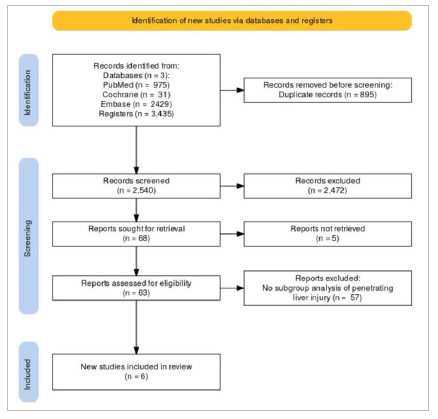
As detailed in Figure 1, the initial search yielded 3435 registers. After removing duplicate records, 2540 studies were screened. From these, 68 articles were chosen to be evaluated by full-text analysis, and 62 were excluded. As a result, six observational studies were included in the analysis, with no randomized controlled trials identified in the literature. Even though the previously established protocol included both randomized controlled trials and observational studies, the lack of published evidence led to the exclusion of randomized controlled trials. A total of 4407 patients were evaluated across 6 Observational Studies, of whom 2738 (62.1%) underwent surgery, and 1669 (37.9%) underwent conservative treatment; 200 (4.5%) suffered GSWs, and 4207 (94.5%) were treated for SWs. Other study characteristics are reported in Table 1.

Pooled analysis of all studies
Overall, NOM was associated with lower mortality (RR 0.40; 95% CI 0.31-0.53; I2=0%; p<0.01; Figure 2A) and complication rates (RR 0.83; 95% CI 0.75-0.91; I2=0%; p<0.01; Figure 2B).


Additionally, no statistically significant difference was observed in liver complications (RR 0.25; 95% CI 0.01-12.47; I2=0%; p=0.10 Figure 3A), blood transfusion (RR 0.73; 95% CI 0.0-1741.82; I2=84%; p=0.73; Figure 3B) and hospital length of stay (RR -0.44; 95% CI -6.76-5.87; I2=0%; p=0.83; Figure 3C). The said analyses were submitted to the GRADEpro tool, which identified a very low certainty of evidence for all outcomes, mainly due to patient selection bias (Figure 4).


Quality assessment
Individual study appraisal is reported in Figures 5X and 5Y.


DISCUSSION
This systematic review and meta-analysis included 4407 patients analyzed in six studies published between 1986 and 2024. Patients eligible for NOM were those who, during evaluation, remained hemodynamically stable with isolated penetrating injuries in the right upper quadrant and did not present signs of peritonitis or evisceration. For these patients, a complementary evaluation with a contrast-enhanced CT scan was performed, identifying liver lesions and their severity. Despite patient heterogeneity, the data suggest that, in selected patients, NOM may be associated with lower mortality and complication rates than OM.
Dalcin et al.11, in a Brazilian observational study, evaluated 54 patients with FAFs, of whom 37 underwent NOM. Patients who presented hemodynamic instability or major signs of severity were excluded from the analysis. Both NOM and OM groups included patients with varying injury severity, categorized as low, moderate, or high according to the American Association for the Surgery of Trauma (AAST) scale. Among the 37 patients treated with NOM, only two had treatment failure, requiring a laparotomy 24 hours after admission. One was due to an episode of hypotension, and the other was due to the increase in a perihepatic hematoma identified on a contrast-enhanced CT scan. Both had good postoperative recovery.
Gonullu et al.12 conducted a retrospective analysis of 50 cases of GSW or SW. Across the entire cohort, 86% of patients underwent laparotomy due to hemodynamic instability or signs of peritoneal irritation. Notably, 22% of laparotomies were deemed non-therapeutic. Revised Trauma Score (RTS) and Injury Severity Score (ISS) scores were significantly different between the non-therapeutic and surgically treated groups, and all patients with grade III, IV, and V injuries were managed surgically.
MacGoey et al.13 studied 31 patients with penetrating liver injuries at a British hospital, most caused by SW. Of these, 21 patients underwent laparotomy, mainly due to hemodynamic instability or the presence of hollow viscus injury. Among the patients treated with NOM, only two experienced failure and, due to evidence of arterial contrast extravasation on CT scan, subsequently required surgery.
Schellenberg et al.14 conducted a retrospective American study including 4,031 patients with penetrating liver injuries. Most patients treated with NOM had low-grade liver injuries and experienced fewer complications compared to those undergoing surgical treatment. In this group, only 4.9% failed NOM and underwent surgical intervention, with no difference in mortality rates compared to those operated on immediately.
Schnuriger et al.15 evaluated, in a retrospective study, 178 patients with penetrating liver injuries caused by both GSWs and SWs. Patients who died within the first 72 hours were excluded from the analysis. The remaining patients were hemodynamically stable, showed no signs of peritonitis, and underwent CT scan evaluation before being selected for NOM. Only one patient did not undergo NOM due to a small, unidentified colonic lesion.
Demetriades et al.16 analyzed, in a South African study, 63 cases of penetrating injuries to the right upper quadrant of the abdomen, of which 42 patients underwent OM due to peritoneal irritation and signs of hemodynamic instability. Of the other 21 patients who underwent NOM, no postoperative complications were identified, demonstrating the pioneering prospective study of the conservative treatment of this type of injury.
While it can be argued that stab wounds are more linear and low-energy compared to gunshot wounds-which represent high-energy traumas, have unpredictable trajectories, and can involve fragmentation, multiplying tissue damage-it is important to note that the articles included in this review generally classify both types as penetrating injuries. This is because peritoneal perforation has historically been the primary surgical indication in penetrating abdominal trauma, regardless of the trauma mechanism. Furthermore, in the context of isolated liver injury, the severity of the injury, which is frequently reflected in the patient’s hemodynamic status, appears to be more clinically relevant than the specific mechanism of trauma itself. Given this context, it is reasonable for this review to group both mechanisms under the same category of penetrating trauma. Subgroup analyses to assess the impact of the specific trauma mechanism may be more appropriate in future reviews, once the available literature allows for a clearer distinction between injury patterns and outcomes.
Based on this review, it is observed that no grade of the AAST classification formally contraindicates NOM. However, less favorable outcomes are consistently described in grades III to V. This occurs because more complex lesions frequently involve significant vascular compromise, which increases the likelihood of hemodynamic instability, one of the main criteria that direct the patient to OM. Therefore, NOM is less applicable in these cases, not because of any contraindications to the classification itself, but because of physiological criteria.
This finding represents a significant source of bias in the analysis. Considering the close relationship between surgical indication and the severity of liver injury, a significant difference is observed in the proportion of more complex traumas (grades IV and V) included in the groups undergoing NOM. This discrepancy limits the interpretation of the approach’s true effectiveness, since different injury patterns exhibit distinct clinical behaviors. In this context, the use of adjustment methods, such as propensity score matching in observational studies, would be fundamental to reduce this bias and increase methodological robustness. Such a strategy would allow for more reliable estimates of outcomes, constituting an important recommendation for future investigations on the subject.
Furthermore, it is important to consider that more severe injuries present a higher risk of non-hemorrhagic complications, such as bile leakage, collection formation, and sepsis. However, due to the limited clinical details in the included studies, it is not possible to determine precisely which of these factors prompted the OM indication in the reported cases. Thus, the ability to distinguish whether NOM failure resulted from bleeding or other mechanisms associated with the injury’s complexity remains limited.
Finally, to ensure the best outcome for each patient, the patient must remain monitored and under close observation for the first 48 hours after admission, as this is the most crucial period for NOM failure. If the patient’s condition worsens, it is essential to reassess the indication for surgical intervention and adapt the treatment strategy accordingly. As demonstrated by Schellenberg et al.14, in cases like this, a late surgical procedure following an initial attempt at NOM does not appear to affect patient morbidity or mortality negatively.
Limitations
This meta-analysis includes 4,407 patients from 5 countries (Brazil, South Africa, Turkey, the United States, and the United Kingdom), and the lack of participation from any Asian country represents an important limitation of this study.
Furthermore, there was little information about which organs were affected beyond the liver, and about other characteristics of the event or the patient that could influence the outcome of the case. This information would be important to assess other lesions that could make each case more complex or interfere with the indication for NOM or OM.
Possible selection bias may also interfere with this analysis: liver lesions with a high AAST score are more commonly associated with hemodynamic instability, peritonitis, and associated abdominal organ injuries, leading to higher mortality and complications, and are therefore less exposed to NOM. Thus, the review does not allow for a direct comparison between lesions of equivalent severity.
Ideally, propensity score matching based on the degree of liver injury should be performed to allow comparisons of outcomes between groups with similar injury severity, thus minimizing potential sample selection bias. A research design capable of comparing success and complication rates among patients with equivalent degrees of injury would yield more robust, reliable conclusions.
CONCLUSION
The results presented indicate that NOM for penetrating liver injuries may represent a possible alternative to mandatory surgical intervention in carefully selected patients, with potential association with lower mortality and complication rates. However, the available evidence is limited, and further studies are needed to better define its role in clinical practice.
-
Abbreviations
- GSW - Gunshot wounds
- SW - Stab wounds
- NOM - Non-operative Management
- OM - Operative Management
- PROSPERO - International Prospective Register of Systematic Reviews
- PRISMA - Preferred Reporting Items for Systematic Reviews and Meta-Analysis
- ROBINS -I - Risk of Bias In Non-randomized Studies of Interventions
- RR - Risk ratios
- CI - Confidence Interval
- AAST - American Association for the Surgery of Trauma
- RTS - Revised Trauma Score
- ISS - Injury Severity Score
- CT - Computed tomography
REFERENCES
-
1 Zago TM, Pereira BM, Nascimento B, Alves MSC, Calderan TRA, Fraga GP. Trauma hepático: uma experiência de 21 anos. Rev Colégio Bras Cir. 2013;40:318-322. doi: 10.1590/S0100-69912013000400011.
» https://doi.org/10.1590/S0100-69912013000400011 -
2 Shaftan GW. Indications for operation in abdominal trauma. Am J Surg. 1960;99:657-664. doi: 10.1016/0002-9610(60)90010-6.
» https://doi.org/10.1016/0002-9610(60)90010-6 -
3 Biffl WL, Leppaniemi A. Management guidelines for penetrating abdominal trauma. World J Surg. 2015;39(6):1373-1380. doi:10.1007/s00268-014-2793-7.
» https://doi.org/10.1007/s00268-014-2793-7 -
4 Ferrada R, Birolini D. New concepts in the management of patients with penetrating abdominal wounds. Surg Clin North Am. 1999;79(6):1331-1356. doi:10.1016/s0039-6109(05)70081-5.
» https://doi.org/10.1016/s0039-6109(05)70081-5 -
5 Pryor JP, Reilly PM, Dabrowski GP, Grossman MD, Schwab CW. Nonoperative management of abdominal gunshot wounds. Ann Emerg Med. 2004;43(3):344-353. doi:10.1016/s0196-0644(03)00815-1.
» https://doi.org/10.1016/s0196-0644(03)00815-1 -
6 Saadia R, Degiannis E. Non-operative treatment of abdominal gunshot injuries. Br J Surg. 2000;87(4):393-397. doi:10.1046/j.1365-2168.2000.01414.x.
» https://doi.org/10.1046/j.1365-2168.2000.01414.x -
7 Page MJ, McKenzie JE, Bossuyt PM, et al. The PRISMA 2020 statement: an updated guideline for reporting systematic reviews. BMJ. 2021;372:n71. doi:10.1136/bmj.n71.
» https://doi.org/10.1136/bmj.n71 -
8 Sterne JAC, Savovic J, Page MJ, et al. RoB 2: a revised tool for assessing risk of bias in randomised trials. BMJ. 2019;366:l4898. doi:10.1136/bmj.l4898.
» https://doi.org/10.1136/bmj.l4898 -
9 McMaster University / Evidence Prime. GRADEpro Guideline Development Tool (GDT). Accessed March 8, 2026. https://www.gradepro.org/
» https://www.gradepro.org -
10 Schünemann, H. / Brozek, J. / Guyatt, G. / Oxman, A. Handbook for grading the quality of evidence and the strength of recommendations using the GRADE approach. October 2013. Accessed March 8, 2026. https://gdt.gradepro.org/handbook/
» https://gdt.gradepro.org/handbook -
11 Dalcin RR, Petrillo Y, Alves L, Fonseca MK, Almeida AS, Corso CO. Selective nonoperative versus operative management of liver gunshot injuries: a retrospective cohort study. Ann R Coll Surg Engl. 2025;107(2):130-134. doi:10.1308/rcsann.2022.0061.
» https://doi.org/10.1308/rcsann.2022.0061 -
12 Gonullu D, Koksoy FN, Ilgun S, Demiray O, Yucel O, Yucel T. Treatment of penetrating hepatic injuries: a retrospective analysis of 50 patients. Eur Surg Res Eur Chir Forsch Rech Chir Eur. 2009;42(3):174-180. doi:10.1159/000200167.
» https://doi.org/10.1159/000200167 -
13 MacGoey P, Navarro A, Beckingham IJ, Cameron IC, Brooks AJ. Selective non-operative management of penetrating liver injuries at a UK tertiary referral centre. Ann R Coll Surg Engl. 2014;96(6):423-426. doi:10.1308/003588414X13946184901524.
» https://doi.org/10.1308/003588414X13946184901524 -
14 Schellenberg M, Benjamin E, Piccinini A, Inaba K, Demetriades D. Gunshot wounds to the liver: No longer a mandatory operation. J Trauma Acute Care Surg. 2019;87(2):350-355. doi:10.1097/TA.0000000000002356.
» https://doi.org/10.1097/TA.0000000000002356 -
15 Schnüriger B, Talving P, Barbarino R, Barmparas G, Inaba K, Demetriades D. Current practice and the role of the CT in the management of penetrating liver injuries at a Level I trauma center. J Emerg Trauma Shock. 2011;4(1):53-57. doi:10.4103/0974-2700.76838.
» https://doi.org/10.4103/0974-2700.76838 -
16 Demetriades D, Rabinowitz B, Sofianos C. Non-operative management of penetrating liver injuries: a prospective study. Br J Surg. 1986;73(9):736-737. doi:10.1002/bjs.1800730919.
» https://doi.org/10.1002/bjs.1800730919

 (A) Lower mortality was observed in non-operative management.
 (B) Fewer complications were observed in non-operative management.
 (A) No statistically significant difference was observed in liver complications.
 (B) No statistically significant difference was observed in blood transfusion.
 (C) No statistically significant difference was observed in hospital length of stay.

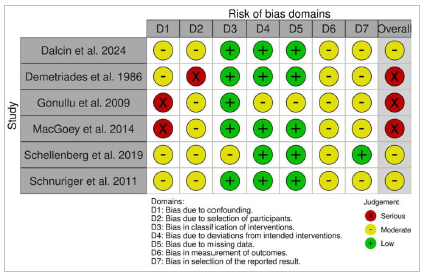 (X) Risk of Bias Traffic Light Plot.
 (Y) Risk of Bias Summary Plot.