Food insecurity, habits, and working conditions in subsistence workers during COVID-19 isolation, Medellin, Colombia, 2021
Abstract
Introduction: Mandatory isolation and quarantine measures implemented between 2020 and 2021 had important repercussions on labor dynamics.
Objectives: To identify the characteristics of COVID-19 isolation, as well as the habits and working conditions that characterize food insecurity in subsistence workers in Medellin, Colombia, in 2021.
Methods: Cross-sectional study using primary data sources. An interviewer-administered survey was conducted among 656 workers selected through snowball sampling.
Results: Overall, 56.4% were men and 74.7% were aged ≥45 years. Furthermore, 89.9% of women were the primary household income provider, and 74.8% did not have a partner. Alcohol and tobacco use were more frequent among men, and 43.0% of women consumed two meals a day. Furthermore, 95.6% of participants underwent mandatory quarantine; 73.2% remained isolated > 12 weeks; and 77.0% received support during isolation. The prevalence of moderate/severe food insecurity was 44.1%, increasing to 51.4% among women. Conditions characterizing food insecurity included being female, consuming one meal a day, not having a partner, being the primary household income provider, lacking work permit, not receiving government food assistance, making payment arrangements with landlords, and receiving food assistance from a university.
Conclusions: Although food insecurity decreased by 10 percentage points, the conditions characterizing it reveal the subsistence circumstances experienced by workers, particularly women, whose social and occupational disadvantage deepened.
Keywords
working conditions; food insecurity; COVID-19; eating habits; informal sector.
Resumen
Introducción: Las medidas de aislamiento y cuarentena obligatoria implementadas entre 2020 y 2021 tuvieron repercusiones importantes en las dinámicas laborales.
Objetivos: Identificar las características del aislamiento por COVID-19, así como los hábitos y condiciones laborales que perfilan la inseguridad alimentaria en trabajadores de subsistencia en Medellín, Colombia, en 2021.
Métodos: Estudio transversal con fuentes primarias de información. Se aplicó encuesta asistida a 656 trabajadores, seleccionados mediante muestreo por bola de nieve.
Resultados: El 56,4% eran hombres y el 74,7% tenían ≥ 45 años. El 89,9% de las mujeres eran la persona que más aportaba económicamente al hogar, y 74,8% no tenía pareja. El consumo de alcohol y tabaco fue mayor en los hombres, y el 43,0% de las mujeres consumían dos comidas al día. El 95,6% de los participantes se aisló en cuarentena obligatoria, el 73,2% permaneció aislado durante > 12 semanas y el 77,0% recibió apoyo durante el aislamiento. La prevalencia de inseguridad alimentaria moderada/severa fue del 44,1%, y del 51,4% en las mujeres. Perfilaron inseguridad alimentaria: ser mujer, consumir una comida diariamente, no tener pareja, ser la persona que más aportaba económicamente al hogar, no tener permiso para trabajar, no recibir beneficio alimentario estatal durante la pandemia, acuerdo de pago con el arrendador y recibir apoyo alimentario de una universidad.
Conclusiones: Aunque la inseguridad alimentaria disminuyó 10 puntos porcentuales, las condiciones que la perfilan evidencian las situaciones de subsistencia en las que vivían los trabajadores, particularmente las mujeres, cuya desventaja social y laboral se profundizó.
Palabras clave
condiciones de trabajo; inseguridad alimentaria; COVID-19; hábitos alimentarios; sector informal.
INTRODUCTION
Informal work in Colombia is a growing phenomenon. According to the Organisation for Economic Co-operation and Development (OECD), it accounted for 49.9% in 2019 and reached 53.1% of total employment in 2021 [1]. This employment modality is prevalent among populations with limited educational attainment, weak integration into the formal economy, and restricted access to the general social security system [2]. These individuals often engage in subsistence activities [3], as is the case of perishable and non-perishable goods on urban streets and sidewalks, who in Medellín, Colombia, are referred to as “venteros”. During the pandemic, this group experienced a marked deterioration in their living conditions, with increased socioeconomic, family, food, and nutritional vulnerability as a result of mandatory lockdown measures and the suspension or reduction of their sales, even after returning to the streets to resume their activities.
This situation may have influenced eating habits, lifestyle, and household food insecurity. However, these conditions have not been clearly explored or sufficiently documented. Although the profile of food and nutritional insecurity in this working group has been identified in the pre-pandemic period [4], with a prevalence of 53.9%, factors associated with moderate to severe food insecurity (MSFI) were observed, such as abstaining from alcohol consumption, mood-related appetite disturbances, consuming one or two meals a day without a defined eating schedule, lack of work permit, and female sex. These conditions were, in turn, associated with sedentary behavior, high intake of fatand carbohydrate-rich foods, and the presence of overweight, obesity, diabetes, and hypertension [5-7].
Despite the foregoing, there is still limited evidence describing the profile of food and nutritional insecurity experienced during the pandemic. This profile may be partly determined by their sociodemographic and working conditions, as well as by isolation circumstances and dietary habits adopted both during and after mandatory lockdown. In the context of the COVID-19 pandemic, the socioeconomic and food-related vulnerabilities of individuals relying on subsistence employment may have been exacerbated [8,9].
Mandatory isolation and quarantine measures implemented between 2020 and 2021 had significant repercussions on labor dynamics, initially causing the interruption of work activities [10] and subsequently affecting food sovereignty on a global scale [11,12]. This was notably reflected in dietary habits and levels of food insecurity, driven by reduced food availability in the market, increased food prices, and a noticeable reduction in household income [12-15].
In Latin America and the Caribbean, data from the Panamerican Health Organization (PAHO) indicate a sustained increase in levels of hunger and food insecurity since 2015, with a more pronounced rise beginning in 2019. By 2020, the prevalence of hunger reached 9.1%, representing an increase of two percentage points. Additionally, a 9.0 percentage point increase in moderate to severe insecurity was observed in the region [16].
For the reasons outlined above, this study identified the characteristics of COVID-19 related isolation, dietary habits, and working conditions that shape MSFI among subsistence workers in Medellín, Colombia in 2021. The aim was to provide evidence to support the planning and implementation of public health and occupational health interventions, including food and nutritional security measures for these populations in the context of emergencies, natural or human-made disasters, and pandemics.
METHODS
POPULATION AND SAMPLE
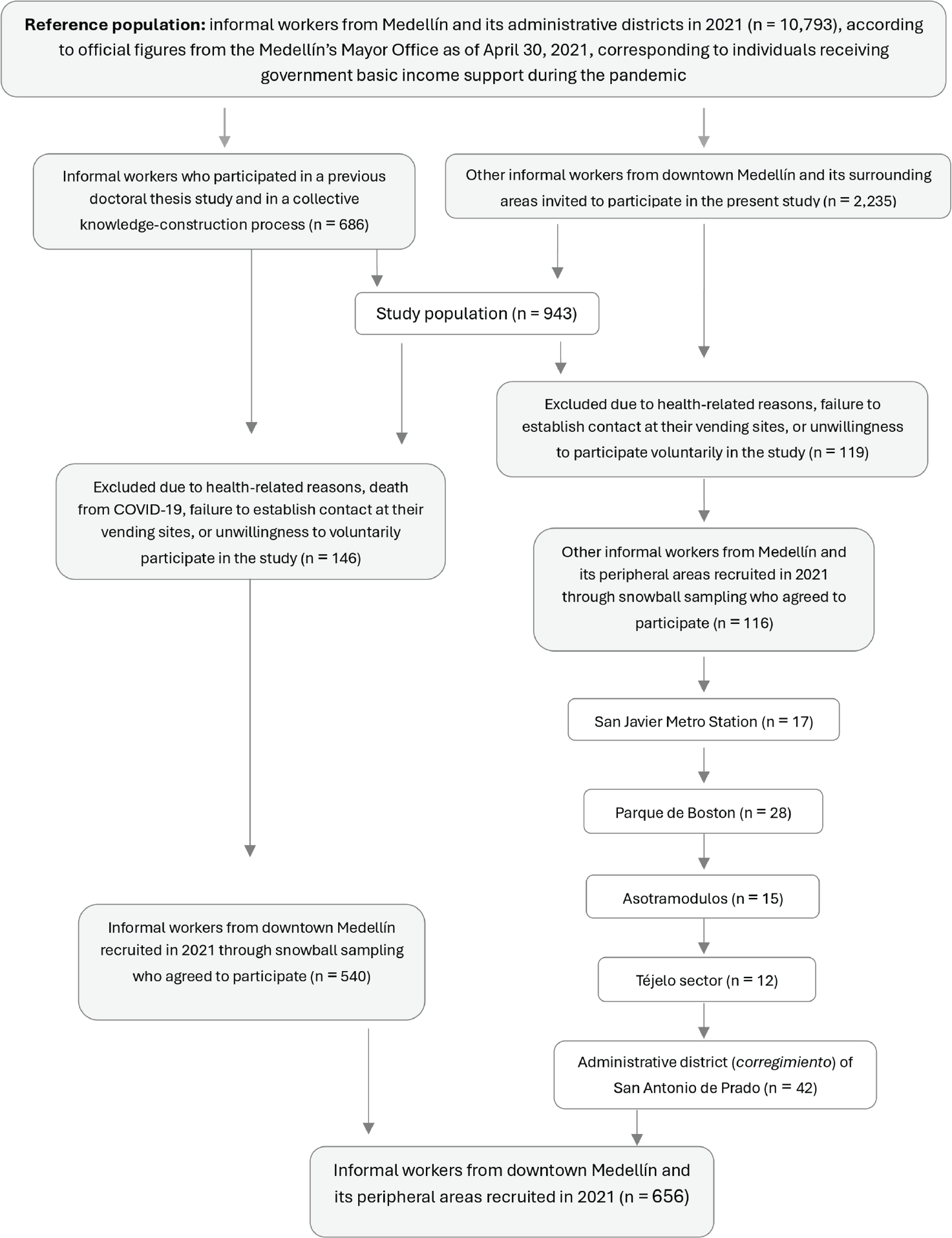
A total of 656 informal workers from the city of Medellín and the administrative district (corregimiento) of San Antonio de Prado were recruited using snowball sampling (Figure 1). Participants were invited by their leaders and the principal investigator at their vending sites, as well as during meetings and trade association assemblies. A structured, interviewer-administered survey was conducted following prior face and content validation with a group of leaders and workers.

INCLUSION CRITERIA
Individuals aged over 18 years, with at least 3 years of occupational experience, who were informed about the study and its procedures, agreed to participate, and provided written consent prior to data collection.
VARIABLES
Dependent variable: MSFI, used to screen households at risk of food insecurity, according to the Latin American and the Caribbean Food Security Scale [17], a 15-item instrument with dichotomous (yes/no) responses. The following cut-off points were considered: zero for food security; one to five for mild insecurity; six to ten for moderate insecurity; and eleven to fifteen for severe insecurity. For bivariate and multivariate analysis, categories were grouped as moderate/severe food insecurity (6 to 15 points) and food security/mild insecurity (zero to five points).
Explanatory variables included sex; age (recategorized into two and four groups); primary household income earner; marital status; and work permit. Variables related to lifestyle and dietary habits included physical activity level; alcohol and tobacco use; meal timing; food origin; eating companionship (alone or with others); relationship between emotional state and food consumption; time food remained at the workplace before consumption; number of meals a day; concurrent activities during food intake; and cooking methods. Mandatory isolation and support variables included compliance with isolation; duration of isolation in weeks; receipt of support; receipt of government food assistance; type of support received; provision of support during isolation, duration of support; receipt of government subsidies during the pandemic; and need for government support.
CONTROL OF ERRORS AND BIASES
Multivariate statistical analyses were adjusted for sex, age, and occupational tenure. Selection bias was controlled by including workers who agreed to participate and met the inclusion criteria. Information bias was controlled through the use of an instrument validated for face and content, awareness activities with workers and leaders, standardization of investigators and the interviewer, and refinement of both the instrument and data collection after a pilot test involving eight workers.
STATISTICAL ANALYSIS
Descriptive analyses were conducted using absolute frequencies and percentages for all variables. Bivariate and multivariate analyses were also performed to explore associations between independent variables and MSFI. Bivariate analysis was conducted using chi-squared tests and prevalence ratios (PRs) with 95% confidence intervals (95%CIs). Multivariate analysis was performed using binomial regression to identify conditions associated with MSFI in workers’ households. Variables with p-values < 0.25 were entered sequentially into the model in ascending order of p-value.
Interdependent multivariate analysis was performed using multiple correspondence analysis to characterize the profile of food insecurity, incorporating variables with explanatory capacity identified in dependent multivariate analyses, whose associations were verified using chi-squared test. The following variables were included: primary household income earner, age, marital status, number of meals a day, work permit, duration of support, government food assistance, payment arrangement with the landlord of the dwelling, and sex. MSFI was included as a supplementary variable. Statistical analyses were performed with a 95.0% confidence level and 5.0% significance level, using SPSS® version 26 (Universidad de Antioquia license) and Epidat version 3.1. Tables and text formatting were prepared using Microsoft Word.
ETHICAL CONSIDERATIONS
This article presents the results of the nutritional and food-related component of the main project: “Living, working, and health conditions among a group of informal workers (“venteros”) in Medellín during the pandemic and post-pandemic period, 2021-2022,” approved by the Institutional Research Ethics Committee of Universidad CES, under Minutes No.156 dated February 3, 2021. The study was classified as posing minimal risk in accordance with Resolution 8,430, and international guidelines for research involving vulnerable populations developed by the Council for International Organizations of Medical Sciences.
RESULTS
SOCIODEMOGRAPHIC CONDITIONS
Men accounted for the majority of participants (56.4%), and 74.7% were aged ≥ 45 years. A higher concentration of women was observed among individuals aged 45-59 years, whereas men predominated among those aged ≥ 60 years. More than 85.0% were the primary household income earner, with a higher prevalence among women. Furthermore, 56.4% did not have a partner, a condition more frequent among women (74.8%). In addition, 50.8% lacked work permit, reaching 54.1% among men (Table 1).
Descriptive statistics of sociodemographic conditions, dietary habits, lifestyles, isolation during quarantine, support received, and food insecurity among workers participating in the study (n = 656)
SOCIODEMOGRAPHIC AND LIFESTYLE CONDITIONS ASSOCIATED WITH FOOD INSECURITY
Statistically significant associations (p < 0.05) were identified between MSFI and biological sex, age, marital status, work permit, and tobacco use. The prevalence of MSFI was 34.0% higher among women (PR = 1.34; 95%CI = 1.13-1.60), 28.0% higher among individuals aged 18-49 years (PR = 1.28; 95%CI = 1.05-1.56), 16.0% higher among those without a partner (PR = 1.16; 95%CI = 1.01-1.33), 26.0% higher among those lacking work permit (PR = 1.26; 95%CI = 1.08-1.47), and 37.0% higher among smokers (PR = 1.37; 95%CI = 1.00;1.88) (Table 2).
Sociodemographic conditions, lifestyles, dietary habits, isolation, and support received during the pandemic associated with moderate/severe food insecurity in the households of workers participating in the study (n = 656), Medellín, 2021
LIFESTYLE AND DIETARY HABITS
More than 70.0% of the sample was physically active or very active, predominantly men, whereas 22.4% of women were sedentary. Alcohol and tobacco use were more frequent among men (27.6% and 22.2%, respectively). Moreover, 78.5% consumed food brought from home, a practice more common among women (88.1%), and 45 out of every 100 men consumed their meals alone. In addition, 34.0% reported that their mood state affected food intake, with women being more affected (45.4%). Most participants kept food at the vending site for ≤ 3 hours before consumption, and for half of the men this duration was < 1 hour (49.7%) (Table 1).
Although 87.5% consumed between two and three meals a day, 43.0% of women consumed two meals. Only 28.3% devoted exclusive time to eating, while many combined meals with serving customers (71.7%) and handling money (40.5%). With respect to cooking methods, 69.0% preferred fried foods, 38.8% baked foods, 37.8% grilled foods, and 34.9% steamed foods (Table 1).
ISOLATION DUE TO COVID-19 AND SUPPORT RECEIVED
Overall, 95.6% of participants reported complying with mandatory quarantine measures, and 73.2% remained in isolation for more than 12 weeks. Furthermore, 77.0% reported receiving support during this period, which was more frequent among women (80.0%). Types of support included food assistance (55.1%), financial support (37.3%), and payment arrangements with landlords (15.0%) (Table 1).
Support mostly lasted ≤ 3 months (90.0%), with a higher proportion among women (92.4%). Additionally, 82 out of every 100 workers received support during mandatory isolation from a private university, and 11 out of every 100 received government support (Table 1).
MODERATE/SEVERE FOOD INSECURITY
It was found that 44.1% of the sample presented MSFI in their households, and this condition was more prevalent among female workers (51.4%) (Table 1).
DIETARY HABITS ASSOCIATED WITH FOOD INSECURITY
Statistically significant associations (p < 0.05) were identified MSFI and emotional state, length of time food remained at the vending site before consumption, and the number of meals a day. The prevalence of MSFI was 67.0% higher among individuals who reported that their emotional state affected food intake (PR = 1.67; 95%CI = 1.35-2.07); 1,28 times higher among those who kept food at their vending site ≤ 3 hours before consumption (PR = 2.28; 95%CI = 1.34-3.86); 2,44 times higher among those who consumed one meal a day (PR = 3.44; 95%CI = 1.96-6.04); and 1,69 times higher among those who consumed two meals a day (PR = 2.69; 95%CI = 1.57-4.49) (Table 2).
The prevalence of MSFI was significantly lower (p < 0.05) among individuals who had a defined eating schedule (PR = 0.81; 95%CI = 0.67-0.99) and among those who consumed their meals at the workplace (PR = 0.68; 95%CI = 0.57-0.81). Despite the lack of statistical significance, a higher prevalence of MSFI was found among participants who consumed three meals a day and who combined food consumption with customer service activities (Table 2).
ISOLATION CONDITIONS AND SUPPORT VARIABLES ASSOCIATED WITH FOOD INSECURITY
A statistically significant association (p > 0.05) was identified between MSFI and making payment arrangements with landlords (PR = 2.29; 95%CI = 1.48-3.54). A lower prevalence of MSFI was observed among individuals who received financial support and government subsidies (Table 2).
FACTORS CONTRIBUTING TO THE EXPLANATION OF MODERATE/SEVERE FOOD INSECURITY
The following factors contributed significantly (p < 0.05) to a higher prevalence of MSFI: lack of work permit (adjusted PR = 1.33; 95%CI = 1.01-1.74), mood state affecting food intake (adjusted PR = 1.59; 95%CI = 1.20-2.12), consuming one meal a day (adjusted PR = 2.84; 95%CI = 1.30-8.02), and making payment arrangements with landlords during the pandemic (adjusted PR = 2.19; 95%CI = 1.48-3.37) (Table 3).
Conditions contributing to explain moderate/severe food insecurity among the working population during the pandemic (n = 656), Medellín 2021
In turn, the following factors contributed significantly (p < 0.05) to a lower prevalence of MSFI: consuming meals at the vending site (adjusted PR = 0.57; 95%CI = 0.39-0.80), devoting exclusive time to eating (adjusted PR = 0.27; 95%CI = 0.09-0.67), and receiving financial support during mandatory isolation (adjusted PR = 0.79; 95%CI = 0.56-0.99) (Table 3).
Despite the lack of statistical significance, the following conditions contributed to a higher prevalence of MSFI: being female, tobacco use, food remaining at the vending site ≥ 3 hours before consumption and receiving support during the pandemic for ≤ 1 month. After adjustment of the variables in the model, the following retained statistical significance (p < 0.05): lacking a work permit, consuming food at the workplace, mood affecting food intake, food remaining at the vending site for ≥ 3 hours before consumption, consuming one meal a day, and making payment arrangements with landlords during the pandemic. In turn, devoting exclusive time to eating and receiving financial support during mandatory isolation gained statistical significance (Table 3).
FACTORS THAT CHARACTERIZE MODERATE/SEVERE FOOD INSECURITY PROFILE IN THE WORKING POPULATION
The profile shown in Figure 2 reveals two subgroups, with a total explained variance of 2.82, Cronbach’s alpha of 0.366 for dimension 1 and 0.282 for dimension 2, and a mean of 0.326. The most relevant discrimination measures were: sex (0.619; dimension 1), primary household income earner (0.540; dimension 2), marital status (0.408; dimension 2), and age (0.292). The highest correlations were identified for not having a partner, being female, and being the primary household income earner.
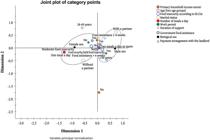
Profile of lifestyle factors and dietary and nutritional habits among informal workers from downtown Medellín during the pandemic, 2021. ELCSA = Latin American and Caribbean Food Security Scale.
The first and fourth quadrants of Figure 2 grouped characteristics that coincide with the position of the supplementary variable MSFI. These quadrants included: being female, consuming one meal a day, not having a partner, being the primary household income earner, lacking work permit, not receiving government food assistance during the pandemic, making payment arrangements with landlords, and receiving food assistance from a private university in the city (Figure 2).
The second and third quadrants included workers who had a partner, consumed ≥ two meals a day, had work permit, were male, received food assistance from 1 to 4 weeks during mandatory isolation, and were aged ≥ 50 years. These characteristics coincided with the position of the supplementary variable food security/mild food insecurity (Figure 2).
DISCUSSION
The impact of the pandemic on food insecurity has been both global and local. Although no significant effects were observed on food supply, negative effects were identified regarding demand, particularly food access, mainly due to decline in income among most vulnerable populations [18]. The prevalence of MSFI in the working population in 2021 was 44.0%, a figure 7.3 percentage points higher among women (51.4%). However, in this same working population, the pre-pandemic prevalence of MSFI was 54.0%, reaching 61.5% among women [4].
According to data from the Food and Agriculture Organization of the United Nations, in 2021, approximately 30.0% of the world population experienced moderate and severe levels of food insecurity, corresponding to 2.37 billion people [18]. In the present study, the prevalence identified in this working population was 14 percentage points higher than that reported globally, highlighting their socio-occupational and environmental vulnerability, although it was 10 percentage points lower than the prevalence identified during the pre-pandemic period [4].
Contrary to these results, Kansiime et al. [19], when evaluating the implications of the pandemic on income and food security in Kenia and Uganda (regions with a high proportion of informal workers), observed that, compared with a typical period, the number of food insecure households increased by 38% and 44% in Kenia and Uganda, respectively. Likewise, compared with a typical period, severe food insecurity levels have been exacerbated by 7 and 20 percentage points among respondents in Uganda and Kenia, respectively.
Although the present study was conducted in the city of Medellín, it is important to highlight that food insecurity during the pandemic was documented across different populations in Latin America and the Caribbean. Indeed, PAHO reported that, in 2020, 267 million people experienced some form of food insecurity [16], with an undernourishment prevalence below 10.0% in Colombia, despite an ongoing upward trend [16].
WORKERS’ SOCIODEMOGRAPHIC CONDITIONS
The largest proportion of workers was between 45 and 59 years, followed by those aged ≥ 60 years, indicating that within a few years this population will be predominantly composed of older adults. This situation, together with the low income levels reported in previous studies [4-6], is likely to contribute to poorer food security conditions, as noted by Estrada Restrepo et al. [20]. It is noteworthy that, although hombres predominated in this study, women were more frequently the primary household income earner, and most did not have a partner. These findings are consistent with data reported by the National Administrative Department of Statistics, which showed that women were the primary household income earner in 34.8% of households in 2016, increasing to 36.9% in 2018 [21]. Both internationally and in the present study, women exhibited a higher risk of severe food insecurity [22,23], contributing to previously described phenomena such as the feminization of poverty [4,10].
Workers’ biological sex, age, marital status, and lack of work permit were significant associated with the presence of MSFI. These sociodemographic characteristics have been consistently linked to food insecurity in different populations [24,25].
Empirical evidence indicates that female workers exhibit a higher prevalence of food insecurity compared with male workers in univariate analysis [26]. However, this association loses statistical significance in multivariate models [27], suggesting that the observed difference may be more closely related to contextual factors, such as lower income and being the primary household income earner, as evidenced in the present study. Nevertheless, among the female workers included in this study, these associations persisted and were strengthened in both dependent and interdependent multivariate analyses.
Lack of work permit was significantly associated with MSFI, a finding that is difficult to compare with previous evidence due to the limited literature examining this condition among subsistence workers operating on urban streets and sidewalks.
WORKERS’ LIFESTYLES AND DIETARY HABITS
Most workers reported not having either an exclusive time or space for food consumption and combined eating with customer service and handling of money; practices that have been documented in previous studies [4-6] and that, in the present study, were associated with a higher prevalence of food insecurity.
A preference for high-fat foods and increased frequency of food consumption was observed, findings similar to those reported in previous studies conducted in the same population [4-6]. These factors may contribute to explaining the higher prevalence of overweight and obesity [7] in this population compared with that observed in Medellín [28].
Mood state, reflected in levels of stress, anxiety, and depression, affected food consumption and was associated in the multivariate model with the prevalence of MSFI, as had already been observed before the pandemic [4], This suggests that mood-related food choices may represent an indicator of deteriorating mental health conditions among workers, as food insecurity was exacerbated by COVID-19 lockdowns and restrictions. Similar findings have also been reported in a study conducted in rural areas of Bangladesh [29]. However, the cross-sectional design of the present study precludes establishing a causal relationship between mental health and MSFI.
SUBSIDIES, FINANCIAL SUPPORT, AND DURATION OF SUPPORT
In order to mitigate the effects of the novel coronavirus pandemic, governments implemented several social assistance programs to enable the most vulnerable populations to cope with the new challenges imposed by the public health emergency.
In the present study, 77.0% of informal workers received support, primarily in the form of food assistance, often for periods shorter than 3 months. Furthermore, a lower prevalence of MSFI was observed among those who received financial support and among those who reported receiving subsidies from a private university and from the government. However, these differences were not statistically significant in either the bivariate or multivariate analysis. These findings are consistent with those of 2020 study on food insecurity in Canadian households [25], in which, although the prevalence of food insecurity was significantly higher among households receiving charitable food assistance, no statistically significant differences were observed in the severity of food insecurity between food-insecurity households receiving charitable food assistance and those not receiving such assistance.
Although dietary habits and lifestyles were explored in this working population during the pandemic period (2020-2021), food consumption frequencies according to food type were not reported. In previous studies [7,16-18], this information has enabled additional characterization of the vulnerability profile observed during the early stages of COVID-19 pandemic and should therefore be included in future analyses of the nutritional and dietary components of this working population.
In this same population during the pre-pandemic period [4], the conditions that explained MSFI were alcohol consumption and having an exclusive time for food consumption. In turn, the conditions that characterized this food insecurity profile were: not consuming alcohol, mood affecting food intake, consuming one or two meals a day, lacking a defined eating schedule, not having work permit, and being female [4]. These conditions were similar to those identified in the present study, in which receiving subsidies during mandatory isolation for more than 4 weeks and not having a partner also contributed to characterizing the profile of MSFI.
A limitation in the analysis of some variables related to mandatory isolation and support received during the pandemic is the scarcity of literature focused on this population group. However, this gap may gradually be addressed through studies such as the present one, which seeks to contribute to the understanding and characterization of food security among subsistence workers and their households during pandemic periods. Such evidence may help support the planning of actions aimed at this working population in public health emergencies and other exceptional circumstances requiring timely and appropriate responses, while considering other studies and investigations conducted in Medellín, Colombia.
CONCLUSIONS
This study provided evidence of the high prevalence of MSFI among informal workers in downtown Medellín during the pandemic. Nevertheless, a 10-percentage-point decrease was observed compared with the pre-pandemic period, although conditions among women worsened. Factors that characterized the profile of MSFI included being female, consuming one meal a day, not having a partner, being the primary household income earner, having work permit, not receiving food assistance from the government during the pandemic (including mandatory isolation, making payment arrangements with landlords during the pandemic, and receiving food assistance from a private university.
Funding
Data Statement:
The data supporting the findings of this study are available within the article
REFERENCES
-
1 Organización para la Cooperación y el Desarrollo Económico (OCDE). Employment - self-employment rate [Internet]. Paris: OECD; 2022 [accessed Oct 23 2022]. Available: http://data.oecd.org/emp/self-employment-rate.htm
» http://data.oecd.org/emp/self-employment-rate.htm - 2 Benach J, Muntaner C, eds. Empleo, trabajo y desigualdades en salud: una visión global. 1a ed. Barcelona: Icaria Editorial; 2010. 518 p.
-
3 Organización Internacional del Trabajo (OIT). Estadísticos del trabajo. Resolución sobre la clasificación internacional de la situación en el empleo (CISE) [Internet]. Ginebra: OIT; 1993 [acceso 24 Oct 2022]. Disponible: https://www.ilo.org/es/media/270971/download
» https://www.ilo.org/es/media/270971/download -
4 Garzón-Duque MO, Rodríguez-Ospina FL, Butinof M, Cardona-Arango M, Segura-Cardona AM, Miranda-Muñoz JM. Food insecurity profile according to habits and lifestyles in workers with subsistence jobs, Medellín-Colombia 2016. Rev Bras Med Trab. 2023;21(3):e20221005. https://doi.org/10.47626/1679-4435-2022-1032
» https://doi.org/10.47626/1679-4435-2022-1032 -
5 Garzón-Duque MO, Cardona-Arango MD, Rodríguez-Ospina FL, Segura-Cardona AM, Zuluaga-Giraldo AM, Echeverri-Loor JI. Condiciones ambientales, laborales, hábitos y estilos de vida relacionados con la hipertensión en trabajadores informales, Medellín. Hacia Promoc Salud. 2022;27(2):37-54. https://doi.org/10.17151/hpsal.2022.27.2.4
» https://doi.org/10.17151/hpsal.2022.27.2.4 -
6 Garzón-Duque MO, Rodríguez-Ospina FL, Cardona D, Segura-Cardona AM, Borbón MC, Zuluaga-Giraldo AM, et al. Sociodemographic, labor conditions, habits, lifestyles and diabetes mellitus in workers with subsistence jobs, Medellín-Colombia. Rev Bras Med Trab. 2020;18(3):280-92. https://doi.org/10.47626/1679-4435-2020-560
» https://doi.org/10.47626/1679-4435-2020-560 -
7 Garzón Duque MO, Cardona-Arango MD, Segura-Cardona AM, Rodríguez-Ospina FL, Molina CF, Restrepo Ochoa DA. Influencia de los hábitos alimentarios y condiciones de trabajo en la prevalencia de sobrepeso y obesidad de trabajadores informales de la ciudad de Medellín. Rev Argent Endocrinol Metab. 2019;56(2):40-9 [acceso 10 Dic 2019]. Disponible: http://www.scielo.org.ar/scielo.php?script=sci_abstract&pid=S1851-30342019000200040
» http://www.scielo.org.ar/scielo.php?script=sci_abstract&pid=S1851-30342019000200040 -
8 Wanjek C. Food at work. Workplace solutions for malnutrition, obesity and chronic diseases [Internet]. Geneva: International Labour Office; 2005 [access Apr 18 2024]. Available: https://www.ilo.org/publications/food-work-workplace-solutions-malnutrition-obesity-and-chronic-diseases
» https://www.ilo.org/publications/food-work-workplace-solutions-malnutrition-obesity-and-chronic-diseases -
9 Organización Panamericana de la Salud (OPS). Plan de acción sobre la salud de los trabajadores 2015-2025 [Internet]. Washington: OPS; 2017 [acceso 24 Oct 2022]. Disponible: https://iris.paho.org/handle/10665.2/33983
» https://iris.paho.org/handle/10665.2/33983 -
10 Souza LF. Trabalhadores informais de aplicativos e o impacto da doença pelo novo coronavírus: uma reflexão teórica. J Nurs Health. 2020;10(4). https://doi.org/10.15210/jonah.v10i4.18740
» https://doi.org/10.15210/jonah.v10i4.18740 -
11 L’Angiocola PD, Monti M. COVID-19: the critical balance between appropriate governmental restrictions and expected economic, psychological and social consequences in Italy. Are we going in the right direction? Acta Bio Med Atenei Parm. 2020;91(2):35-8. https://doi.org/10.23750/abm.v91i2.9575
» https://doi.org/10.23750/abm.v91i2.9575 -
12 Castro PA, Bustos JP, Rueda-Guevara P. Estrategias de fortalecimiento de la seguridad y soberanía alimentaria en medio del COVID-19 en Colombia. Biomédica. 2022;42(Supl 1):26-32. https://doi.org/10.7705/biomedica.6041
» https://doi.org/10.7705/biomedica.6041 -
13 Lopes MS, Freitas PP, Carvalho MCR, Silva UM, Lopes ACS. The COVID-19 pandemic in a Brazilian metropolis: repercussion on food prices. Cad Saude Publica. 2022;38(4):e166721. https://doi.org/10.1590/0102-311XEN166721
» https://doi.org/10.1590/0102-311XEN166721 -
14 Beach SR, Schulz R, Donovan H, Rosland AM. Family caregiving during the COVID-19 pandemic. Gerontologist. 2021;61(5):650-60. https://doi.org/10.1093/geront/gnab049
» https://doi.org/10.1093/geront/gnab049 -
15 Andrade CN, Aquino V, Duhart Y, Floretta E, Ocampo C, Paiva V. Accesibilidad en la alimentación en personas mayores. Rev Urug Enferm. 2022;17(2):e2022v17n2a1. https://doi.org/10.33517/rue2022v17n2a1
» https://doi.org/10.33517/rue2022v17n2a1 -
16 FAO, FIDA, OPS, WFP, UNICEF. América Latina y el Caribe - panorama regional de la seguridad alimentaria y nutricional 2021: estadísticas y tendencias [Internet]. Santiago: FAO, FIDA, OPS, WFP y UNICEF; 2021 [acceso 24 Oct 2022]. 62 p. Disponible: https://www.fao.org/documents/card/es/c/cb7497es
» https://www.fao.org/documents/card/es/c/cb7497es -
17 Organización de las Naciones Unidas para la Alimentación y la Agricultura (FAO). Escala latinoamericana y caribeña de seguridad alimentaria (ELCSA): manual de uso y aplicaciones [Internet]. Roma: FAO; 2012 [acceso 17 Nov 2022]. 78 p. Disponible: https://www.fao.org/publications/card/fr/c/98ea2c72-7b10-5e71-bae2-38f48f25c1a5/
» https://www.fao.org/publications/card/fr/c/98ea2c72-7b10-5e71-bae2-38f48f25c1a5/ -
18 FAO, FIDA, OMS, PMA, UNICEF. El estado de la seguridad alimentaria y la nutrición en el mundo 2021: transformación de los sistemas alimentarios en aras de la seguridad alimentaria, una nutrición mejorada y dietas asequibles y saludables para todos [Internet]. Roma: FAO; 2021 [acceso 10 Dic 2023]. 262 p. Disponible: https://doi.org/10.4060/cb4474es
» https://doi.org/10.4060/cb4474es -
19 Kansiime MK, Tambo JA, Mugambi I, Bundi M, Kara A, Owuor C. COVID-19 implications on household income and food security in Kenya and Uganda: findings from a rapid assessment. World Dev. 2021;137:105199. https://doi.org/10.1016/j.worlddev.2020.105199
» https://doi.org/10.1016/j.worlddev.2020.105199 -
20 Estrada Restrepo A, Giraldo Giraldo NA, Deossa Restrepo GC. Inseguridad alimentaria en hogares donde habitan adultos mayores. Medellín, Colombia. Rev Fac Nac Salud Publica. 2022;40(1):e342583. https://doi.org/10.17533/udea.rfnsp.e342583
» https://doi.org/10.17533/udea.rfnsp.e342583 -
21 Colombia, Departamento Administrativo Nacional de Estadística. Boletín técnico encuesta nacional de calidad de vida (ECV) 2018 [Internet]. 2018 [acceso 10 Dic 2023]. Disponible: https://www.dane.gov.co/files/investigaciones/condiciones_vida/calidad_vida/Boletin_Tecnico_ECV_2018.pdf
» https://www.dane.gov.co/files/investigaciones/condiciones_vida/calidad_vida/Boletin_Tecnico_ECV_2018.pdf -
22 Maia I, Monjardino T, Frias B, Canhão H, Cunha Branco J, Lucas R, et al. Food insecurity in Portugal among middleand older-aged adults at a time of economic crisis recovery: prevalence and determinants. Food Nutr Bull. 2019;40(4):504-13. https://doi.org/10.1177/0379572119858170
» https://doi.org/10.1177/0379572119858170 -
23 FAO, FIDA, OPS, WFP, UNICEF. América Latina y el Caribe - panorama regional de la seguridad alimentaria y nutricional 2018: desigualdad y sistemas alimentarios [Internet]. Santiago: UNICEF; 2018 [acceso 10 Dic 2023]. Disponible: https://www.unicef.org/lac/media/4261/file/PDF%20Panorama%20de%20la%20seguridad%20alimentaria%20y%20nutricional%202018.pdf
» https://www.unicef.org/lac/media/4261/file/PDF%20Panorama%20de%20la%20seguridad%20alimentaria%20y%20nutricional%202018.pdf -
24 Laska MN, Lenk K, Lust K, McGuire CM, Porta CM, Stebleton M. Sociodemographic and health disparities among students screening positive for food insecurity: findings from a large college health surveillance system. Prev Med Rep. 2020;21:101297. https://doi.org/10.1016/j.pmedr.2020.101297
» https://doi.org/10.1016/j.pmedr.2020.101297 -
25 Men F, Tarasuk V. Food insecurity amid the COVID-19 pandemic: food charity, government assistance, and employment. Can Public Policy. 2021;47(2):202-30. https://doi.org/10.3138/cpp.2021-001
» https://doi.org/10.3138/cpp.2021-001 -
26 Horwood C, Haskins L, Hinton R, Connolly C, Luthuli S, Rollins N. Addressing the interaction between food insecurity, depression risk and informal work: findings of a cross-sectional survey among informal women workers with young children in South Africa. BMC Womens Health. 2021;21:2. https://doi.org/10.1186/s12905-020-01147-7
» https://doi.org/10.1186/s12905-020-01147-7 -
27 Fierro Moreno E, Lozano Keymolen D. Seguridad alimentaria y posición laboral en el contexto de la pandemia por COVID-19 en México. RESPYN. 2022;21(3):1-11. https://doi.org/10.29105/respyn21.3-1
» https://doi.org/10.29105/respyn21.3-1 -
28 Colombia, Alcaldía de Medellín, Universidad de Antioquia. Perfil de seguridad alimentaria y nutricional de Medellín y sus corregimientos 2015: caracterización de hogares [Internet]. Medellín: Alcaldía de Medellín, Universidad de Antioquia; 2015 [acceso 10 Dic 2023]. 411 p. Disponible: https://www.medellin.gov.co/irj/go/km/docs/pccdesign/medellin/Temas/InclusionSocial/Programas/Shared%20Content/Documentos/2020/PERFIL%20ALIMENTARIO%20ESAN%202015.pdf
» https://www.medellin.gov.co/irj/go/km/docs/pccdesign/medellin/Temas/InclusionSocial/Programas/Shared%20Content/Documentos/2020/PERFIL%20ALIMENTARIO%20ESAN%202015.pdf -
29 Rahman T, Hasnain MDG, Islam A. Food insecurity and mental health of women during COVID-19: evidence from a developing country. PLoS One. 2021;16(7):e0255392. https://doi.org/10.1371/journal.pone.0255392
» https://doi.org/10.1371/journal.pone.0255392