
 The Use of Photos to Create a New History of Education: A Case Study of the Mompiano Kindergarten in Italy in the Early 20th Century
Abstract
Photography has been a heuristic tool of historical documentation since the historiographical revolution introduced it during the twentieth century by the French Annales school, reinforced by more recent historical-educational study models. This paper analyses a series of photos published in 1903 in Italy to document school life in the Mompiano kindergarten in Brescia (Italy), which followed the pedagogical and methodological principles introduced by the sisters Rosa and Carolina Agazzi under the guidance of Pietro Pasquali. The study shows how those photos became a fundamental tool for training educators and spreading an innovative reform experiment in pre-school education for children’s emancipation.
Keywords:
photos; pre-school education; Italy; 20th century
Resumo
A fotografia tornou-se um instrumento heurístico de documentação histórica desde a revolução historiográfica introduzida no século XX pela escola francesa dos Annales, reforçada por modelos de estudo histórico-educacionais mais recentes. O artigo seguinte analisa uma série de fotografias publicadas em 1903 em Itália para documentar a vida escolar no jardim de infância de Mompiano (Brescia), de acordo com a renovação pedagógica e metodológica introduzida pelas irmãs Rosa e Carolina Agazzi sob a orientação de Pietro Pasquali. O estudo mostra que essas fotografias tornaram-se um instrumento fundamental para a formação dos educadores e para a difusão de uma experiência inovadora de reforma da educação pré-escolar para a emancipação das crianças.
Palavras-chave:
fotografias; educação pré-escolar; Itália; século XX
Resumen
La fotografía se ha convertido en una herramienta heurística de documentación histórica desde la revolución historiográfica introducida durante el siglo XX por la escuela francesa de los Annales, reforzada por modelos de estudio histórico-educativos más recientes. El siguiente artículo analiza una serie de fotografías publicadas en 1903 en Italia para documentar la vida escolar en el jardín de infancia de Mompiano (Brescia), según la renovación pedagógica y metodológica introducida por las hermanas Rosa y Carolina Agazzi bajo la dirección de Pietro Pasquali. El estudio muestra que las fotografías se convirtieron en un instrumento fundamental para la formación de los educadores y la difusión de un innovador experimento de reforma de la educación preescolar por la emancipación de los niños.
Palabras clave:
fotos; educación preescolar; Italia; siglo XX
Introduction
The photographic work documenting a kindergarten renewed by three Italian educators - Pietro Pasquali and the sisters Rosa and Carolina Agazzi - can be understood as a heuristic tool of historical evidence in the fight against children’s poverty and cultural deprivation during the transition between the nineteenth and twentieth centuries. According to the recent methodological advancements to the History of Education, its study offers a deeper understanding of early childhood education and its development at the institutional and pedagogical levels (Sani, 2016; Lascarides & Hinitz, 2011; Luc, 1997).
Starting in 1896, Pietro Pasquali and the sisters Agazzi made direct educational interventions in the Mompiano kindergarten (located in a rural area near the city of Brescia in northern Italy). They also published handbooks, journal articles and developed training courses to prepare new educators to guide the working-class families to take care of children with educational intent. Their educational programme was illustrated systematically in a set of 55 photos collected in Pietro Pasquali’s book titled Il nuovo asilo: Guida per le maestre e le madri nell’educazione della prima infanzia sulle tracce dell’Asilo di Mompiano [The New Kindergarten: A Guide for Teachers and Mothers in Early Childhood Education on the Traces of Mompiano Kindergarten], published in 1903 by Canossi Publishing House in Brescia. It was not based on mental instruction, but on attitudes, therefore, more deeds than words. This is the cornerstone of the entire system: things for actions, and actions for habits and for life’ (Pasquali, 1903, p. 21, my translation).
Pietro Pasquali and the sisters Agazzi’s educational work was characterised by the unified development of the body, mind, and heart of each child and the pedagogical principle of inner personal ordering and its daily educational practice. These principles transformed the Mompiano kindergarten into a Casa dei Fanciulli [children’s home], as Giuditta Contesini defined it (Contesini, 1903, p. 79). This place was animated by the industrious life of the children following a precise rational discipline that gradually led them to develop a personal intellectual and moral order from respect for and maintenance of the material order in the school setting.
Rosa Agazzi, in collaboration with her sister Carolina, succeeded in a short time in showing in practice how the didactic plague of the educational habit of the ‘mixed method’ could be definitively defeated. It was a heterogeneous patchwork of empirical educational inspirations, often of dubious origin and effectiveness, which forced children into immobility and silence, instead of educating them to freedom of action and speech.
The recognition of an interdependent relationship among social modernisation, the educational role of the family and school activism was placed at the heart of the renewal plan in a speech given by Rosa Agazzi at the first National Pedagogical Congress in Turin in 1898, entitled Ordinamento pedagogico dei giardini d’infanzia secondo il sistema di Fröbel [Pedagogical Reorganisation of Kindergartens According to Fröbel’s System]. Starting from an idea of educational reorganisation based on a new vision of the child’s distinctive nature, Rosa Agazzi argued that it was important for kindergarten teachers to ‘cultivate their minds’ and give ‘educational form’ to the physical and spiritual aspirations of each child, inspired by a ‘maternal method’ as a natural method of infant education (Agazzi, 1973). This approach offered a pedagogical option to overcome the ‘wildness that sometimes borders on ferocity’ exhibited by most of the poor girls and boys entering kindergarten for the first time, due to ‘serious defects in family upbringing’ (Agazzi, 1973, p. 71 [my transl.]). Agazzi did not fail to highlight the limits of traditional maternal education and the distorted interpretation of the Fröbelian conception of the mother as the first child educator and of the professionalisation of kindergarten teachers, caused by the persistence of a ‘vicious circle’ of the ineffective promotion of the maternal educational role and child neglect (in terms of hygiene, health, psychology and affection, etc.).
The educational project of the Mompiano kindergarten was made possible thanks to the convergence of at least three factors, which made it much more than a proposal for a new educational method for kindergarten. These factors were as follows: 1) the implementation of an internal reform of Fröbelism to adapt it to the characteristics of Italian families, animated by their Catholic faith and in the majority of humble origins (Mazzetti, 1967, pp. 29-59, 107-114); 2) the creative educational genius and the inquiring spirit that animated Rosa Agazzi, assisted by her sister Carolina, in the original educational experiment implemented in a systematic manner in Mompiano after years of attempts (Agazzi, 1951, p. 69); and 3) the prospect of the educational awakening advocated by Pietro Pasquali to promote a process of human and social redemption for poor people, especially in light of the pedagogical inspiration underlying the Austrian law of 1872. This law relates to kindergartens in the Habsburg empire and the methodological innovations proposed by the French author Pauline Kergomard in L'éducation maternelle dans l'école [Maternal Education in Nursery School] in 1886 (Grazzini, 2006, pp. 148-149).
The Theorical/Methodological Framework of a Qualitative Investigation
The volume published by Pietro Pasquali in 1903 was an innovative example of a handbook with practical purposes, reflecting the new educational focus of late Positivism on the hygienic and social functions of kindergartens and schools to promote children’s healthy growth (Polenghi, 2021).
The choice to analyse the set of 55 photos, illustrated at the end of the book, reflects the recognition that photography has become part of historical documentation in the field of the History of Education. This historiographical revolution was promoted by the Nouvelle Histoire movement with the foundation, in 1929, of the journal Annales d’histoire économique et sociale by the French historians Marc Bloch and Lucien Febvre. The Nouvelle Histoire movement was characterised by the promotion of a ‘total history capable of recovering even the real experiences’ of people (Sani, 2008, p. 69), which had been marginalised until then. The movement involved other disciplines, including the social sciences and geography, as well as the valorisation of archival sources and documentary typologies that had long been neglected or completely ignored as they were considered ‘sources from below’, such as cartography, oral sources and figurative documents (including religious images and family photographs) (Le Goff, 1980, pp. 9-46).
The perspective inaugurated by the Nouvelle Histoire movement coincided with a turning point that, between the end of the nineteenth and the beginning of the twentieth century, saw the gradual abandonment of the study of childhood as an ideal type formulated by adults, in favour, instead, of the study of a ‘real child’ in his/her daily life (Polenghi, 2017, p. 31). Children were the protagonists of the coeval pedagogical revolution introduced by the international development of the New Education movement, influenced by innovative ideas from developmental psychology and psychoanalysis, which saw children increasingly placed at the centre of the public space and of a progressive process of recognition of their rights (Chiosso, 2012, p. 46; Pironi, 2010).
In recent times, the international scientific debate has recognised the importance of photography as a source for History of Education, particularly in studies concerning the evolution of schools and educational practices (Comas Rubí, 2010; Grosvenor & Lawn, 2001; Depaepe & Henkens, 2000). Within this framework, the photos taken in the Mompiano kindergarten represent an interesting case study for a qualitative investigation, starting from the assumption that ‘the classroom has indeed remained the “black box” of the pedagogical historiography’ (Depaepe & Simon, 1995, p. 10) and the interpretation of the cultural history of classrooms as ‘living cells of the school’ and the ‘beating heart of the educational system’ (Braster, Grosvenor, & del Mar del Pozo Andrés, 2011, p. 9).
In line with Sjaak Braster’s methodological proposal of a ‘triangulation of sources’ (Braster, 2011, p. 25) and with some key studies in the domains of the cultural history of the classroom, the material culture of schools and visual history (Dussel & Priem, 2017; Meda & Badanelli, 2013; Braster, Grosvenor & del Mar del Pozo Andrés, 2011; Escolano Benito, 2008; Grosvenor, 1999), a qualitative examination of photos and their written descriptions might usefully be informed by the following questions: What were the main educational goals of the pupil-led teaching/learning processes? What representation of kindergarten teachers’ professionalism did they promote? In what kind of educational context did the depicted experiences take place?
These questions can be addressed by examining specific indicators that can help us better understand the context in which the images were produced, in terms of space, time and creators of the photos (Braster, 2011, pp. 26-34). They consider, especially, the arrangement of classroom benches, the presence or absence of pedagogical objects in the classroom, pupil discipline and mood, as well as the position of the teacher. In addition, more detailed parameters are introduced, such as how the photos were taken, how many pupils are depicted in the photos and whether the kindergarten teachers are present, whether the pupils are undertaking an educational task or they are just posing for the photo, whether the photos depicted pupils and/or teachers, how the pupils and teachers are dressed and what kinds of didactic materials are depicted. In this sense, it is also possible to focus on the meaning of gestures, facial expressions, posture and the use of space (Depaepe & Henkens, 1998).
For a better investigation, as prompted by the international visual turn in the History of Education, the analysis of the photos should be guided by an awareness that ‘images can be quite treacherous sources’ (Burke, 2001, p. 9), but they are necessary as testimonies of the reconstruction of a History of Education. If, on the one hand, they show ‘objective’ or ‘actual’ realities, according to the perspective of Grosvenor (1999), who focussed on the empirical knowledge and visual ‘truth’ conveyed by images, on the other hand, they show us a ‘representation’ or an ‘interpretation’ of these realities, as affirmed by Burke (2001). In this second meaning, they are not a ‘mimetic reproduction of the past’ but rather a ‘social construction’ and a product that is historically defined. If their main potential, as historical sources, lies in their ‘visual formation’ (Liepe, 2003, pp. 415, 417-418), the ‘treachery’ of the images is connected to the more or less arbitrary linkage between context and expression (Bolvig, 2003, pp. xxiii-xxv). In this direction, photos are considered ‘active means’ by which society is constructed rather than ‘innocent tools’, and they are influenced by the power relationships that exist within society (Plutz, 1995, p. 10).
It is important to point out two main considerations: First, as argued by Grosvenor and Macnab (2015, p. 117), each photograph can be considered an ‘agent of transformation’ because it is a ‘tool of meaning-making and societal transformation’. Our hypothesis is that all the photos in Pasquali’s book had the same aim, which was to contribute to the promotion of an educational innovation process and the professionalisation of kindergarten teachers, thanks to the new school culture they conveyed and the reflections they provoked, with important consequences at the social level, which would follow the development of children’s emancipation.
Second, the analysis of the photos should consider the specific social and cultural contexts in which they were taken to correctly understand the educational processes depicted because the ‘work of history is always a work of interpretation’ (Peim, 2005, p. 7). Above all, the Mompiano kindergarten can be investigated as an ‘educational space’ and a ‘social space’, with a specific atmosphere and particular cultural artefacts (such as the benches and the didactic material) and social artefacts (such as school rules, regulations, classroom organisation, etc.) (Dams, Depaepe, & Simon, 1999, pp. 15-17). For our hypothesis, the photos published by Pietro Pasquali’s volume can be considered ‘social objects’, understandable only within their context and in terms of the relationships in which they were produced. In this sense, the material and social qualities of the images are inseparable, and the visual evidence can be considered a source of investigation. For their specific material and affective qualities, all the photos are objects to think with and to problematise as ‘signs or traces’, because the images they convey become active each time they are represented. As emphasised by Karin Priem (2017, pp. 687-694), they are a sort of an ‘artefact’, not only to transmit meanings, create emotional responses and relationships, but also to produce pedagogical reflections about the complex and original world of the educational practices in the Mompiano kindergarten.
Photos as Sources for a Pedagogical Analysis
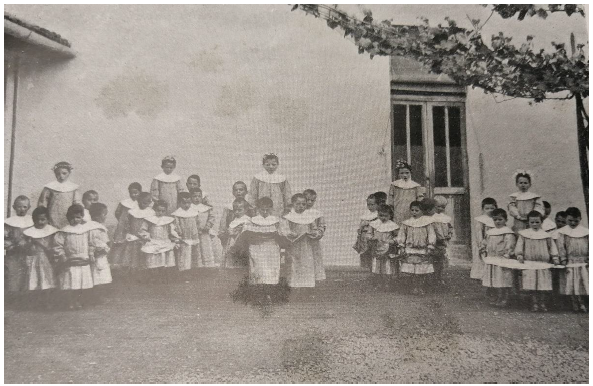
To start the qualitative analysis of the set of 55 photos published in Pasquali’s (1903) volume and taken in 1902 by a professional photographer (Giona Ogliari) from Brescia, it is important to recognise that they were created intentionally as ‘snapshots’ to show viewers what was happening in that innovative scholastic experiment. They were created to inform a select group of people (kindergarten teachers, headmasters and educationalists), who were interested in the new pedagogical practices being introduced by the Agazzi sisters in the Mompiano kindergarten, to intentionally promote an ‘inner reform’ of the Italian pre-school education system by enhancing teachers’ professionalisation. It is important to remember that the innovative transformation of that kindergarten was the fruit of an extensive series of national and international discussions and exchanges, with the figure of Pietro Pasquali at the centre. He was the protagonist of a process of pedagogical/cultural transfer that characterised his own training and his commitment to the educational field during the period 1873 to 1894, in terms of subsuming external pedagogical/didactic models in order to construct and consolidate his own scientifically avant-garde perspective, which was capable of supporting a new vision of Italian pre-school education (Morandi, 2014; Macchietti, 1984). Pasquali’s main references were the French children’s educators Marie Pape-Carpentier and Pauline Kergomard, as well as some Italian educators influenced by late Positivism, such as Costantino Delhez, Adriano Garbini and Pietro Cavazzuti (Grazzini, 2006, pp. 95-101).
The photos reproduced in Pasquali’s volume were ‘public’ images with an explicit formative and scientific purpose concerning a child-centred school experience; in other words, they were ‘constructed’ based on specific cultural and aesthetic criteria and with a given educational intention. They depicted daily educational situations in which the pupils were the protagonists of their school day, with experiences of self-government and self-regulation. Pietro Pasquali and the Agazzi sisters believed that the purpose of this new pre-school education was to allow the pupils to develop good habits, providing them with conditions favourable to the establishment of a detailed, executive, attractive order, capable of maturing respect and dignity in each child (Pasquali, 1910, p. 32). Avoiding the risk of reducing education to forms of moralism that were linked to the reduction of education to ‘little repetitive lessons’, in the Mompiano kindergarten, the formative value of objective teaching based on the intuitive method for an initial acquisition of ideas through the education of the senses was prioritised. This approach was complemented by the introduction of the school museum, which allowed the pupils to make the most of the potential of the outside world as a stimulus to observe, think and speak (Agazzi, 1932, p. 415).
The viewers of the photos, like the children in the kindergarten, were put spontaneously in the best conditions to observe the different educational scenes, making comparisons, judgements and associations between the ideas that were intentionally proposed and illustrated. They were encouraged to note that in the Mompiano kindergarten, the pupils were initiated into reflexive thinking through everyday activities of practical life, which became objects of learning. Moreover, the educational context was organised in such a way as to reflect, as far as possible, the domestic and social lives of the children and to promote activities in which concrete dimensions always took precedence over theoretical ones. Thus, the children were educated via the ‘variously civilising, educational and utilitarian intentions’ of the objective method (Orlando Cian, 1967, p. 145).

To better interpret the contents of the photos, it is useful to refer to the concept of the ‘iconotext’ (del Mar del Pozo Andrés, 2006; Wagner, 1995, pp. 9-13), because all the images depicting real teaching/learning situations were accompanied by very short captions, and they were part of a larger project in which they represented a complement to the text, with which they should be interpreted in a pedagogical orientation. Each caption corresponds to a specific group of activities, explained in the table of contents of Pasquali’s (1903) book as follows: first activities as the children arrived in the kindergarten in the morning (pp. 24-25); washing (pp. 26-31); medical care (pp. 32-34); the three sections of the kindergarten (pp. 35-36); feeding, play and games (pp. 40-43); physical activities (pp. 44-49); maintenance (pp. 50-52); the didactic materials to distinguish one’s belongings, called contrassegni (pp. 53-55); studying (pp. 56-67); and gardening (pp. 68-69).
All the photos were taken in the courtyard of the Mompiano kindergarten, except the two photos taken on a trip to the nearby countryside and the four photos that focused on the contrassegni, because the educational activities were usually held outdoors if the weather was good. Also, for the lezioni delle cose [lessons of things], the blackboard and the wooden benches were brought outside so the lesson could be conducted outdoors.

Many of the photos showed examples of co-education, in which girls and boys played and learnt together, similar to a big family in which sisters and brothers lived together and helped each other.

In most of the photos, we can see the teachers, Rosa and Carolina Agazzi, supported in some cases by assistants; they were not placed in a higher position than their pupils, since they were not seen as holding a position of power. Instead, they engaged in the educational activities in the same manner as the pupils. According to the principle of ‘indirect education’, Rosa and Carolina Agazzi were the ‘directors’ of the teaching/learning scene, similar to the gouverneur of Émile in Jean Jacques Rousseau’s Émile, ou De l’éducation (1762/2016). In this sense, there was no authoritarian relationship between the teachers and pupils, but the photos incited educational activism, with the purpose of conveying a new pedagogical perspective aimed at promoting pupils’ emancipation throughout education.
It was the direct responsibility of the teacher, who was pedagogically qualified, to use things to teach the child ‘to overcome the struggle between the instinct that imposes itself and the reason that tries to make its way’ (Agazzi, 1973, pp. 71-72, my translation) doing so through her example, her gestures and her words. The teacher demonstrated that she knew how to discipline herself in her own habits and, at the same time, knew how to nurture feelings of brotherhood, sisterhood, and mutual help in the children, as the basis of spontaneous educational practices of mutual teaching. In assuming this professional posture, the teacher was animated by a positive attitude towards each child, aware of their potential, their desire to learn and their aspiration for freedom.

As emphasised by Sjaak Braster, the teacher’s position or visibility in a classroom photo is an important degree indicator of the teacher or child centeredness in the classroom (Braster, 2011, p. 30). The humble position of the women teachers, staying close to and sitting down next to the pupils, identified a child-centred approach, typical of the New Education movement, in which there was a wide space for the individual expression of each child. They displayed a caring attitude, akin to that of a mother bending down to listen to her children; they adopted a posture typical of early childhood care within the domestic sphere (Cavarero, 2013, p. 180), a mode of interaction termed “mother pedagogy” by Johann Heinrich Pestalozzi (1803) and Friedrich Fröbel (1844/1874) as cited in Scaglia (2021, pp. 10-14).

In the Mompiano kindergarten, the pupils were serious, and they did not appear to pose for the photographs, in which they are usually shown concentrating on their work, wearing their school aprons and shoes as symbols of external equality, but not clothes for a special occasion. They collaborated in the teaching/learning processes, and they were the real protagonists of a new way of schooling based on self-education, cooperation between peers and the exercise of personal responsibility, as exemplified in the activities of washing and maintaining their school setting and furniture. In this sense, the Mompiano experience was an exceptional example of a pre-school reform experiment aimed at disseminating a new concept of child education and a new way of professionalising kindergarten teachers.

It is also important to emphasise that none of the activities represented in the photos taken at the Mompiano kindergarten followed the so-called ‘grammar of schooling’ (Tyack & Tobin, 1994), a set of standardised and predetermined features present in a good number of schools, such as age-graded classrooms, that characterise many schools and have long posed significant obstacles to educational reform (Tyack & Cuban, 1995, p. 85).

The school’s activities were designed to meet individual children’s educational needs and developmental rhythms. In fact, most activities were not designed for a single section but rather for all three sections, involving children from three to five years old.
The Pre-School Experience of Self-Regulation and Civilisation
The results of this qualitative analysis reveal two additional considerations. The first one concerns the discursive construction of childhood in the photos taken in the Mompiano kindergarten, which convey the image of self-regulated and autonomous poor children. All the photos show a strong coincidence between the real conditions of the children portrayed and the idealised norm of childhood, so strong that some critical interpreters of the Agazzi sisters’ pedagogy considered the children as ‘small soldiers’ trained by the teachers and not self-governed children. The photos provide clear evidence of the mutual teaching practice among peers in the everyday life of the kindergarten and the relationships of fraternal collaboration and correction between ‘tutors’ and ‘pupils’. The same relationships were depicted in the promotion of practical life exercises aimed at personal care (hygiene, fastening of aprons, cleanliness checks, washing, etc.), and sociability exercises designed to build a democratic infant community based on habits of respect, cleanliness and order, gardening and the rearing of small animals.
Child-centred education, as conceived by the Agazzi sisters, was enacted in the concreteness of the educational action, starting from sensory education and children’s personal experiences, making them objects of investigation and learning (Chiosso, 1995). In this sense, it contributed to overcoming both the empiricism of late Positivism and the excessive formalism into which Fröbelism had fallen in Italy.

The second consideration revealed by the qualitative analysis relates to the modality of depicting poverty: All the pupils in the photographs wear neat and clean aprons, their hair is well-cut, and they are behaving in a civilised manner. All the scenes depict the spontaneity of everyday activities, according to the civilising mission of pre-school education and the interest in promoting the circulation of these photos among teachers, educators and mothers all over Italy. In the Mompiano kindergarten, the school spaces were always full of pupils along with one or both teachers and an assistant. They were ‘lived spaces’ with a clear pedagogical tension and a specific design. For this reason, the photos suggested that the gradual transformation of the Mompiano kindergarten into a scuola materna [maternal school] was achieved by more than a change in the physical structures. For example, the school playground, where all the school activities took place in good weather, was the territory for the development of a children’s community based on the principles of personal emancipation and civilisation. There were no social divisions or gender discrimination among the pupils, who were generally from poor families. The school climate was characterised by a deep, serene and spontaneous collaboration, similar to the first infant school, founded by Robert Owen in the industrial village of New Lanark in Scotland in 1816. Owen was particularly committed to counteracting the conditioning effects provoked by social marginalisation and cultural deprivation in the children of poor families through a programme of ‘rational education’ of the new generations (Owen, 1994, 1816).

The images contained in Pietro Pasquali’s volume were part of a more general discourse aimed at promoting the full education of poor children through a didactics of poverty, based on the introduction of cianfrusaglie [waste materials] as ‘coefficients’ of exterior order and didactic tools collected in the school’s museum, called museo delle cianfrusaglie [waste materials museum], which had multiple uses in sensory discrimination exercises for learning colours, materials and shapes. The educational strategies, methods and tools depicted in the photos contributed to developing a close interdependence between feeling, thinking and observing in each child’s development through sociability exercises and linguistic teaching, aimed at supporting reflective thinking (Pasquali, 1903). All of them became integral parts of a national educational model for a new pre-primary school, aimed at the full education of individual personalities and future citizens.
In this context, the photos published in Pasquali’s book promoted the visibility of a successful Italian experience of pre-primary school for poor children in the history of education field. The photos affirmed several innovative pedagogical/organisational dimensions aimed at the realisation of a tripartite model of physical education, intellectual education and moral education explicitly inspired by Johann Heinrich Pestalozzi (Veiga, 2018). This tripartition was integral to the promotion of a civilising process (Elias, 1939), in terms of self-ordering, self-regulation and the internalisation of norms for the autonomous and responsible development of each child. In the Mompiano kindergarten, little boys and girls from humble origins, after hygiene and medical care, washing, and wearing school aprons and shoes (as a symbol of external equality), had the opportunity to experience ‘the intuition of a civilised life’ (Pasquali, 1903) in a context of social normativity, in which the educational relationships were animated by joy, intelligence and affection. Their civilisation involved a change in their emotional heritage, with the adoption of personal habits based on the principles of fairness and respect for others as the result of the spontaneous learning of social rules and disciplinary methods (Agazzi, 1932).

In this direction, it can be affirmed that Pietro Pasquali and the Agazzi sisters’ experience contributed to the evolution of the modern practice of disciplining the body and soul (Dekker & Wichgers, 2018) into a more contemporary form of self-discipline, characterised by paying systematic attention on a practical level to the natural needs of the youngest. Moreover, this practice of self-discipline promoted a deep process of civilisation in the children in terms of personal emancipation, thanks to the development of teaching/learning activities characterised by active methods and the use of didactic aids collected or made by the pupils (Lombardo Radice, 1928). This approach, inspired by Johann Heinrich Pestalozzi and Friedrich Fröbel, contributed to the inner work of constructing the children’s personal identity and knowledge, legitimising the primacy of educational goals over merely custodial ones. It was also the result of a ‘transnational transfer’ (Cowen, 2020; Roldán Vera & Fuchs, 2019), which contributed to placing the experiment in the Mompiano kindergarten within the broader international framework of the institutional development of nursery schools (Luc, 1997).
Final remarks
Our two initial hypotheses about the heuristic function of historical documentation provided by the photos in Pasquali’s book have been confirmed: The photos had the common aim of promoting a new school culture to implement educational innovation and increase in the kindergarten teachers’ professionalisation, and they can be considered ‘social objects’. In fact, the photos can be understood in terms of their innate educational purpose if they are analysed considering the material, social and affective qualities of the images as ‘artefacts’, because they continue to prompt viewers’ pedagogical reflections about the educational practices promoted in the Mompiano kindergarten, even decades later.
Together, the photos show the process of reciprocal educational mirroring between pupils and teachers, as Rosa and Carolina Agazzi accompanied each child in their spontaneous expressions on an educational level; at the same time, if one looks at the purpose of the actions performed, the photos show the children following their teachers in the gradual conquest of their moral freedom through the most joyful spontaneity. There was a sort of ‘virtuous circle’ in which the promotion of an authentic educational relationship represented the best ground for the development of each child’s personal identity and, at the same time, for the professionalisation of the kindergarten teachers.
One of the original motives that cemented Pietro Pasquali’s collaboration with the Agazzi sisters was, in fact, the search for an educational solution to the poverty, neglect, and ignorance of which many boys and girls in poor families were victims. This rationale, which aligned their work with what had been accomplished decades earlier through the international diffusion of the kindergarten movement (Albisetti, 2009; Taylor Allen, 1982), was inseparable from another, in some respects unprecedented, grounded in an emerging understanding of the child as a “vital seed aspiring to its full physical, intellectual, and moral development” (Agazzi, 1932, p. 11, my translation).
The study of photographs, as heuristic tools of historical documentation, has contributed to identifying and highlighting the connection between the process of modernization and the innovations in educational practices introduced in pre-school by Pietro Pasquali and the Agazzi sisters. We can observe some similarities with the main results of recent research on the public dissemination of the Montessori method, promoted by Catalan bourgeois reformers through the press and photojournalism during the first decades of the twentieth century. These include the advocacy of children’s autonomy, the practice of self-education without external pressures, the freedom as a fundamental educational tool, the promotion of practical exercises and recreation in open spaces (often outdoors), and the teacher’s discreet intervention (Comas Rubí & Sureda García, 2012, p. 582).
In both cases, the introduction of new educational methods in pre-school broke with traditional education, within a historical context characterized by strong social tensions, in which bourgeois intellectuals-like Pietro Pasquali in Italy-considered the dissemination of values such as order, harmony, and discipline through education to be the most effective means of ‘civilizing’ the lower classes.
Moreover, both studies show how iconography was intended to reinforce the message contained in written texts, to ‘impress’ readers with the efficacy of the proposed methods and the importance of well-trained teachers, aware of the need to respect children’s freedom and individual nature to foster their full personal development. Nevertheless, it cannot be denied that there is a risk of adopting a ‘method-centric focus’ and an ‘ideology-laced discourse’ (Comas Rubí & Sureda García, 2012, p. 586), in line with a sort of ‘mythology’ of the New Education movement (del Mar del Pozo Andrés, 2003-2004).
References
- Agazzi, A. (1951). Il metodo delle sorelle Agazzi per la scuola materna (Storia, principi pedagogici e didattica). La Scuola.
- Agazzi, R. (1932). Guida per le educatrici dell’infanzia. La Scuola.
- Agazzi, R. (1973). Ordinamento pedagogico dei giardini d’infanzia secondo il sistema di Fröbel. In R. Agazzi & P. Pasquali, Scritti inediti e rari (M. Grazzini, Ed., pp. 61-86). La Scuola. (Original work published 1899)
-
Albisetti, J. C. (2009). Froebel crosses the Alps: Introducing the kindergarten in Italy. History of Education Quarterly, 49(2), 159-169. https://doi.org/10.1111/j.1748-5959.2009.00193.x
» https://doi.org/10.1111/j.1748-5959.2009.00193.x - Bolvig, A. (2003). Introduction. In A. Bolvig & P. Lindley (Eds.), History and images: Towards a new iconology (pp. xxiii-xxx). Brepols.
- Braster, S. (2011). Educational change and Dutch classroom photographs: A qualitative and quantitative analysis. In S. Braster, I. Grosvenor, & M. del Mar del Pozo Andrés (Eds.), The black box of schooling: A cultural history of the classroom (pp. 21-37). Peter Lang.
- Braster, S., Grosvenor, I., & del Mar del Pozo Andrés, M. (2011). Opening the black box of schooling: Methods, meaning and mysteries. In S. Braster, I. Grosvenor, & M. del Mar del Pozo Andrés (Eds.), The black box of schooling: A cultural history of the classroom (pp. 9-18). Peter Lang.
- Burke, P. (2001). Eyewitnessing: The uses of images as historical evidence. Reaktion Books.
- Cavarero, A. (2013). Inclinazioni: Critica della rettitudine. Cortina.
- Chiosso, G. (1995). Alle origini di Mompiano. L’esperienza agazziana nella realtà sociale ed educativa di fine secolo. In M. Bagnalasta Bàrlaam (Ed.), Rosa Agazzi nella cultura pedagogica italiana e nella realtà educativa della scuola materna (pp. 53-70). Istituto di Mompiano Pasquali-Agazzi.
- Chiosso, G. (2012). Novecento pedagogico. La Scuola. (Original work published 1997)
-
Comas Rubí, F. (2010). Fotografia i història de l’educació. Educació i Història: Revista d’Història de l’Educació, 15, 11-17. https://doi.org/10.2436/20.3009.01.51
» https://doi.org/10.2436/20.3009.01.51 -
Comas Rubí, F., & Sureda García, B. (2012). The photography and propaganda of the Maria Montessori method in Spain (1911-1931). Paedagogica Historica, 48(4), 571-587. https://doi.org/10.1080/00309230.2011.633924
» https://doi.org/10.1080/00309230.2011.633924 - Contesini, G. (1903). Il giardino di Mompiano giudicato sotto l’aspetto pedagogico. In P. Pasquali (Ed.), Il nuovo asilo: Guida per le maestre e le madri nell’educazione della prima infanzia sulle tracce dell’Asilo di Mompiano (pp. 75-80). Canossi.
- Cowen, R. (2020). Comparative, international, and transnational histories of education. In T. Fitzgerald (Ed.), Handbook of historical studies in education: Debates, tensions, and directions (pp. 47-63). Springer.
- Dams, K., Depaepe, M., & Simon, F. (1999). Sneaking into school: Classroom history at work. In I. Grosvenor, M. Lawn, & K. Rousmaniere (Eds.), Silences and images: The social history of the classroom (pp. 15-46). Peter Lang.
-
Dekker, J. J. H., & Wichgers, I. I. (2018). The embodiment of teaching the regulation of emotions in early modern Europe. Paedagogica Historica, 54(1-2), 48-65. https://doi.org/10.1080/00309230.2017.1397713
» https://doi.org/10.1080/00309230.2017.1397713 - del Mar del Pozo Andrés, M. (2003-2004). La escuela nueva en España: Crónica y semblanza de un mito. Historia de la Educación. Revista Interuniversitaria, 22-23, 317-346.
- del Mar del Pozo Andrés, M. (2006). Imágenes e historia de la educación: Construcción, reconstrucción y representación de las prácticas escolares en el aula. Historia de la Educación, 25, 291-315.
- Depaepe, M., & Henkens, B. (Eds.). (1998). Imagine, all the education… The visual in the making of the educational space through history. Leuven University Press.
-
Depaepe, M., & Henkens, B. (2000). The history of education and the challenge of the visual. Paedagogica Historica, 36(1), 10-17. https://doi.org/10.1080/0030923000360101
» https://doi.org/10.1080/0030923000360101 -
Depaepe, M., & Simon, F. (1995). Is there any place for the history of “education” in the “history of education”? A plea for the history of everyday educational reality in and outside school. Paedagogica Historica, 31(1), 9-16. https://doi.org/10.1080/0030923950310101
» https://doi.org/10.1080/0030923950310101 -
Dussel, I., & Priem, K. (2017). The visual in histories of education: A reappraisal. Paedagogica Historica, 53(6), 641-649. https://doi.org/10.1080/00309230.2017.1392582
» https://doi.org/10.1080/00309230.2017.1392582 - Elias, N. (1939). Il processo di civilizzazione. Il Mulino.
- Escolano Benito, A. (2008). La cultura empírica de la escuela: Aproximación etnohistórica y hermenéutica. In J. Mainer (Ed.), Pensar críticamente la educación escolar: Perspectivas y controversias historiográficas (pp. 145-172). Prensas Universitarias de Zaragoza.
- Grazzini, M. (2006). Sulle fonti del metodo Pasquali-Agazzi e altre questioni: Interpretazioni, testi e nuovi materiali. Istituto di Mompiano-Centro Studi Pedagogici Pasquali-Agazzi.
- Grosvenor, I. (1999). On visualising past classrooms. In I. Grosvenor, M. Lawn, & K. Rousmaniere (Eds.), Silences and images: The social history of the classroom (pp. 85-105). Peter Lang.
-
Grosvenor, I., & Lawn, M. (2001). Ways of seeing in education and schooling: Emerging historiographies. History of Education, 30(2), 105-109. https://doi.org/10.1080/00467600010012382
» https://doi.org/10.1080/00467600010012382 -
Grosvenor, I., & Macnab, N. (2015). Photography as an agent of transformation: Education, community and documentary photography in postwar Britain. Paedagogica Historica, 51(1-2), 117-135. https://doi.org/10.1080/00309230.2014.997757
» https://doi.org/10.1080/00309230.2014.997757 - Lascarides, V. C., & Hinitz, B. F. (2011). History of early childhood education. Routledge.
- Le Goff, J. (Ed.). (1980). La nuova storia (T. Capra, Trans.). Mondadori. (Original work published 1979)
- Liepe, L. (2003). On the epistemology of images. In A. Bolvig & P. Lindley (Eds.), History and images: Towards a new iconology (pp. 415-430). Brepols.
- Lombardo Radice, G. (1928). Il problema dell’educazione infantile. La Nuova Italia.
- Luc, J.-N. (1997). L’invention du jeune enfant au XIXe siècle: De la salle d’asile à l’école maternelle. Belin.
- Macchietti, S. S. (1984). Pietro Pasquali tra scuola e società: Dall’ultimo Ottocento al primo Novecento. Istituto di Mompiano Pasquali-Agazzi.
- Mazzetti, R. (1967). Pietro Pasquali e le sorelle Agazzi e la riforma del fröbelismo in Italia. Armando. (Original work published 1962)
- Meda, J., & Badanelli, A. M. (Eds.). (2013). La historia de la cultura escolar en Italia y en España: Balance y perspectivas. EUM.
-
Morandi, M. (2014). Pasquali Pietro. In Dizionario biografico degli italiani (Vol. 81). Istituto della Enciclopedia Italiana. https://www.treccani.it/enciclopedia/pietro-pasquali_%28Dizionario-Biografico%29/
» https://www.treccani.it/enciclopedia/pietro-pasquali_%28Dizionario-Biografico%29/ - Orlando Cian, D. (1967). L’ambiente socio-culturale e l’esperienza agazziana. La Scuola.
- Owen, R. (1994). L’armonia sociale: Saggi sull’educazione. La Nuova Italia. (Original work published 1816)
- Pasquali, P. (1903). Il nuovo asilo: Guida per le maestre e le madri nell’educazione della prima infanzia sulle tracce dell’Asilo di Mompiano. Canossi.
- Pasquali, P. (1910). Il nuovo spirito dell’asilo: A complemento del volume Il nuovo asilo. La Voce delle Maestre d’asilo.
- Peim, N. (2005). Introduction: The life of signs in visual history. In U. Mietzner, K. Myers, & N. Peim (Eds.), Visual history: Images of education (pp. 7-34). Peter Lang.
- Plutz, J. (1995). Photography and the body. Weidenfeld & Nicolson.
- Pironi, T. (2010). Da Ellen Key a Maria Montessori: La progettazione di nuovi spazi educativi per l’infanzia. Ricerche di Pedagogia e Didattica, 1, 1-15.
- Polenghi, S. (2017). La ricerca storico-educativa sull’infanzia nel XX secolo. In M. Gecchele, S. Polenghi, & P. Dal Toso (Eds.), Il Novecento: Il secolo del bambino? (pp. 31-49). Junior-Spaggiari.
- Polenghi, S. (2021). Hygiene, school and children’s body in the Kingdom of Italy. In S. Polenghi, A. Németh, & T. Kasper (Eds.), Education and the body in Europe 1900-1950: Movements, public health, pedagogical rules and cultural ideas (pp. 187-206). Peter Lang.
-
Priem, K. (2017). Beyond the collapse of language? Photographs of children in postwar Europe as performances and relational objects. Paedagogica Historica, 53(6), 683-696. https://doi.org/10.1080/00309230.2017.1371776
» https://doi.org/10.1080/00309230.2017.1371776 - Roldán Vera, E., & Fuchs, E. (Eds.). (2019). The transnational in the history of education: Concepts and perspectives. Palgrave Macmillan.
- Rousseau, J.-J. (2016). Emilio, o dell’educazione (A. Potestio, Trans.). Studium. (Original work published 1762)
- Sani, R. (2008). Nuove tendenze della ricerca storico-educativa. In S. S. Macchietti & G. Serafini (Eds.), La ricerca sull’educazione tra pedagogia e storia (pp. 67-75). Pensa Multimedia.
-
Sani, R. (2016). For a history of childhood and of its education in contemporary Italy: Interpretations and perspectives of research. Cadernos de História da Educação, 15(2), 808-862. https://doi.org/10.14393/che-v15n2-2016-18
» https://doi.org/10.14393/che-v15n2-2016-18 -
Scaglia, E. (2021). A history of infant pedagogy in Europe from the fourteenth to the early twentieth century. Cadernos de História da Educação, 20(2), 1-21. https://doi.org/10.14393/che-v20-2021-52
» https://doi.org/10.14393/che-v20-2021-52 -
Taylor Allen, A. (1982). Spiritual motherhood: German feminists and the kindergarten movement, 1848-1911. History of Education Quarterly, 22(3), 319-339. https://doi.org/10.2307/367772
» https://doi.org/10.2307/367772 - Tyack, D., & Cuban, L. (1995). Tinkering toward utopia: A century of public school reform. Harvard University Press.
-
Tyack, D., & Tobin, W. (1994). The grammar of schooling: Why has it been so hard to change? American Educational Research Journal, 31(3), 435-479. https://doi.org/10.3102/00028312031003453
» https://doi.org/10.3102/00028312031003453 -
Veiga, C. (2018). The body’s civilisation/decivilisation: Emotional, social and historical tensions. Paedagogica Historica, 54(1-2), 20-31. https://doi.org/10.1080/00309230.2017.1358290
» https://doi.org/10.1080/00309230.2017.1358290 - Wagner, P. (1995). Reading iconotexts: From Swift to the French Revolution. Reaktion Books.
-
Note:
This article is part of the dossier “Photography as a Source for Research in the History of Education”. The set of texts was jointly evaluated by the associate editor responsible, within the scope of the RBHE Editorial Board, as well as by the dossier proponents.
-
Peer review rounds:
R1: two invitations; two reports received.
-
How to cite this article:
Scaglia, E. The Use of Photos to Create a New History of Education. A Case Study of the Mompiano Kindergarten in Italy in the Early 20th Century. Revista Brasileira de História da Educação, 25, e393. DOI: https://doi.org/10.4025/rbhe.v25.2025.e393
-
Funding:
The RBHE has financial support from the Brazilian Society of History of Education (SBHE) and the Editorial Program (Call No. 30/2023) of the National Council for Scientific and Technological Development (CNPq).
-
Licensing:
This article is published under the Creative Commons Attribution 4.0 (CC-BY 4) license.
-
Data availability:
The data that support the findings of this study are available from the author, upon reasonable request.
The data that support the findings of this study are available from the author, upon reasonable request.

 Note. Source:
  Note. Source:
  Note. Source:
  Note. Source:
  Note. Source:
  Note. Source:
  Note. Source:
  Note. Source:
  Note. Source:
  Note. Source: