 Factors associated with impaired quality of life of family caregivers of older adults with dementia
Abstract
Objective to analyze factors associated with impaired quality of life (QoL) of family caregivers of older adults with dementia.
Methods A cross-sectional analytical study was carried out in the north of Minas Gerais state, in the second half of 2019. Demographic, socioeconomic, clinical and care-related variables were evaluated. Quality of life was measured by the 12-Item Short-Form Health Survey (SF-12). Bivariate analyses, followed by hierarchical binary logistic regression, were performed.
Results 436 caregivers were assessed. The sample comprised 88.1% women, and participants had a mean age of 47.3 years. In relation to the physical component, impaired QoL in caregivers was associated with age ≥60 years (OR=2.48), female gender (OR=2.81), overweight (OR=2.13), obesity (OR=2.22), negative perceived health (OR=2.55), low general quality of health (OR=2.10) and insomnia (OR=2.72). In relation to the mental component, impaired QoL was associated with having another occupation besides caring (OR=1.78), longer time dedicated to caring (OR=1.89), negative perceived health (OR=3.38), low general quality of health (OR=2.15) and depression (OR=2.51).
Conclusion Most of the variables associated with impaired quality of life were modifiable, pointing to the need for health promotion programs for these family caregivers.
Keywords
Aged; Dementia; Caregivers; Quality of Life.
Resumo
Objetivo analisar os fatores associados ao comprometimento da qualidade de vida de cuidadores familiares de pessoas idosas com demência.
Métodos Estudo transversal e analítico realizado no norte de Minas Gerais, Brasil, no segundo semestre de 2019. Foram avaliadas variáveis demográficas, socioeconômicas, clínicas e relacionadas ao ato de cuidar. A qualidade de vida foi mensurada pelo “12-Item- Short- Form Health Survey"(SF-12). Foram realizadas análises bivariadas seguidas de regressão logística binária hierarquizada.
Resultados Participaram 436 cuidadores, sendo 88,1% mulheres, com média de 47,3 anos. Associaram-se ao comprometimento da qualidade de vida, em relação ao componente físico, os cuidadores que apresentaram faixa etária ≥60 anos (OR=2,48), sexo feminino (OR=2,81), sobrepeso (OR=2,13), obesidade (OR=2,22), autopercepção negativa da saúde (OR=2,55), baixa qualidade de saúde geral (OR=2,10) e insônia (OR=2,72). Em relação ao componente mental, o comprometimento da QV esteve associado aos cuidadores com: outra ocupação além do cuidar (OR=1,78), maior tempo de dedicação aos cuidados (OR=1,89), autopercepção negativa da saúde (OR=3,38), baixa qualidade de saúde geral (OR=2,15) e depressão (OR=2,51).
Conclusão A maioria das variáveis associadas ao comprometimento da qualidade de vida são modificáveis e denotam a necessidade de programas para a promoção de saúde para esses cuidadores familiares.
Palavras-chave
Idoso; Demência; Cuidadores; Qualidade de Vida
INTRODUCTION
Numbering among the consequences of population aging is a sharp rise in dementia cases1. In a family setting, older adults with dementia require constant care, where most families cannot afford to engage a formal caregiver. Thus, this role is invariably performed by a family member. Experiencing the progressive decline of a loved one and having to provide the care needed can lead to feelings of burden, loss and impotence among family members2-4.
Consequently, family carers tend to feel a negative impact in terms of their physical and emotional health2, largely as a result of exhausting work, lack of regular breaks, disrupted social life and scant leisure time, factors that often cause overload with the activities involved in the care process and impairment of carer health3,4.
The everyday routine of older people with dementia is dynamic and places multiple demands on caregivers that exceed the ability of families to cope, leading to fatigue and impaired quality of life (QoL) of caregivers2,3. The Brazilian literature addresses different factors associated with burden and health status of carers of older adults with dementia4-8. Notably, however, the studies conducted invariably involve only a small number of caregivers, employ more objective measures of burden4,5,8, and do not always include QoL.
Understanding the QoL of family caregivers of older individuals with dementia and of the factors influencing QoL based on a large sample is paramount for furthering real-world knowledge on this matter. Such studies also help inform planning of integrative health actions to reduce the burden on this group and raise public awareness about the importance of the role of family caregivers and to promote the implementation of policies that support them9,10.
The objective of the present study was to analyze the factors associated with impairment of QoL of family caregivers of older adults with dementia in the north of Minas Gerais state, Brazil.
METHODS
A cross-sectional analytical study was conducted at a regional reference center for health care of older adults in the north of Minas Gerais state, Brazil. Each in-patient clinic has an interdisciplinary multi-professional team and all procedures are administered under Brazil´s National Health System (SUS), constituting the only public reference center specialized in healthcare of older adults for the whole northern region of the state. This study is part of a larger investigation entitled “Avaliação da saúde de cuidadores de idoso com demência: um estudo longitudinal” (“Health assessment of caregivers of older adults with dementia: a longitudinal study”). The study´s target population comprised family caregivers of older adults with dementia. Sample size was estimated based on the number dementia patients seen at clinical consultations at the service during the year prior to data collection (approximately 5,800 patients). An estimated prevalence of 50% was assumed for the event studied, given the study assessed different outcomes and the fact that this figure yielded the highest sample size. A 95% confidence interval and 5% sampling error were adopted. The statistical power for the study was 80%. Other methodological details related to the study have been published elsewhere4.
Patient selection was carried out by attending physicians of the service in a sequential manner, on the days selected for data collection, during the period spanning from August to December 2019. Selection was carried out following consultations of the older adults, where the physicians identified patients that met the inclusion criteria and forwarded their details to the researchers. The caregivers of these patients were then approached by the researchers and asked to take part in the study. Collection was performed consecutively until the defined sample size was reached. Inclusion criteria were: being a family caregiver of an older adult with clinically-diagnosed (registered in medical record) irreversible dementia (Alzheimer´s Disease, vascular dementia, Lewy Body dementia, frontotemporal dementia or mixed dementia) followed over the past 12 months; aged ≥ 18 years, a caregiver for ≥6 months, and directly responsible for providing care to the older adult. Exclusion criteria were: being a carer of more than one older adult, and being on sick leave at the time of data collection.
Data collection was carried out by a specially trained team, comprising nurses and scientific initiation students on medical or nursing programs, during morning or afternoon shifts at the service when older patients, accompanied by their carers, were awaiting assessments or procedures. The data collection instrument was devised by the researchers according to the study objectives and contained variables grouped under three blocks.
-
Demographic and socioeconomic variables: age (≤40, 41-59 or ≥60 years); sex (male and female); marital status (with or without partner); education (≤4, 5-12 or >12 years of study); family income (≤1 minimum wage or >1 minimum wage); family relationship with older adult (son/daughter and spouse/other); and having children (yes or no).
-
Care-related variables: other occupation besides caring (yes or no); time involved in caring for older adult (>2 or ≤2 years); hours per day dedicated to caring for older adult (≥12 or <12 hours); completed caregiver course (yes or no); sleep at same residence as older adult (yes or no); and shares task of caring with others (yes or no).
-
Clinical variables: perceived health status (dichotomized into fair/poor/bad or good/excellent); body mass index (BMI), calculated as weight divided by height squared and as registered and classified in medical record (normal weight, overweight and obese); clinical diagnosis report (yes or no) of depression, hypertension, diabetes or arthritis/arthrosis; self-reported insomnia (yes or no); back problems (yes or no); regular use of medications (yes or no); and time for self-care (yes or no). Also, the General Health Questionnaire (GHQ) was applied, widely used in Brazil as a measure of psychological well-being. The GHQ is a 12-item scale assessing respondent´s perceived positive and negative feelings and used as a screening tool to detect mental health problems11.
Defined as an outcome variable, health-related QoL was measured using the 12-Item Short-Form Health Survey (SF-12). The scale has been validated for use in Brazil and its psychometric properties suggest the scale is reliable and sensitive for assessing different levels of QoL with satisfactory internal consistency, offering easy and rapid application12. For scoring, items 2 and 3 are scored as 1-3 points, items 1, 8 and 12 as 1-5 points, questions 9, 10, and 11 as 1-6 points, and questions 4-7 as 1-2 points. The SF-12 measure is determined based on its scores by applying the scale´s algorithm to calculate its two components: Physical Component Summary or PCS, and Mental Component Summary or MCS. Final score on the scale ranges from 0 to 100, where higher scores indicate better QoL13.
Although widely used, there is no consensus in the literature on the ideal cut-off point for the SF-12 and adoption of a single arbitrary cut-off for all studies may not be the best way of identifying individuals with impaired QoL, given that levels vary across populations, cultures, age groups and contexts. Thus, some studies assess results in a continuous fashion or dichotomized into means or percentiles14-16. In the present study, the 25th percentile of the values recorded for the group (1st quartile) was adopted as cut-offs for both components to estimate negative perceived QoL. SF-12 values ≤ 25 th percentile were defined as impaired QoL, while values >25 th percentile as unimpaired QoL. Although this also represents an arbitrary way of categorizing the variable, the approach is classically employed because quartiles concentrate extreme data of a variable.
Data analysis was performed to identify variables associated with impaired QoL for both the physical component summary (PCS) and mental component summary (MCS) separately. Firstly, Pearson´s chi-square test for bivariate analyses was used, taking the cut-off point of each of the components as a reference. Subsequently, binary logistic regression analysis was performed including all variables with a discriminatory level of up to 20% (p<0.20) in a hierarchical analysis, as per the model depicted in Figure 1. In this process, variables were assessed in blocks and those exhibiting statistical associations at more distal hierarchical levels were retained for the more proximal blocks.
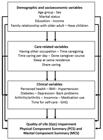
Hierarchical model of analysis for quality of life related factors of caregivers of older adults. Minas Gerais state, 2019.
For the final model, only variables associated with impaired QoL up to a 5% level (p<0.05) were retained, registering Odds Ratios and respective 95% confidence intervals.
The study was conducted in accordance with Resolution no. 466/2012 and study project approved by the Research Ethics Committee of the Universidade Estadual de Montes Claros (Permit no. 3.379.246). The Free and Informed Consent Form was signed by all participants as a pre-condition for data collection.
DATA AVAILABILITY
The full dataset underpinning the study results are available upon request from the corresponding author.
RESULTS
A total of 436 family caregivers took part in the study, of which 384 (88.1%) were women. Age ranged from 18 to 82 years, with most participants in the 41-59 years age group. Most of the caregivers (n=271; 62.2%) had a partner and an educational level of 5-12 years of formal study ((n=285; 65.4%). Also, 163 (37.8%) caregivers reported an income of ≤ 1 minimum wage.
Regarding QoL, 109 caregivers had impaired QoL for both components of the SF-12, representing individuals with scores below the 1 st quartile (25 th percentile).
The results of bivariate analysis for associations of demographic and socioeconomic factors with impaired QoL for both PCS and MCS in caregivers of older adults with dementia, are presented in Table 1.
Bivariate analysis of demographic and socioeconomic factors associated with impaired QoL (physical and mental components) in caregivers of older adults with dementia (N=436). Montes Claros, Minas Gerais state, 2019.
The bivariate analyses of caring-related factors and impairment of QoL for both PCS and MCS in caregivers of older adults with dementia are presented in Table 2.
Bivariate analysis of caring-related factors associated with impaired QoL (physical and mental components) in caregivers of older adults with dementia (N=436). Montes Claros, Minas Gerais state, 2019.
Significant associations of all independent (clinical and self-care) variables with impairment in QoL (physical component) are shown in Table 3. The only variable not exhibiting a significant association with QoL (mental component) was “back problems”.
Bivariate analysis of clinical and self-care variables associated with impaired QoL (physical and mental components) in caregivers of older adults with dementia (N=436). Montes Claros, Minas Gerais state, 2019.
The results of multiple analysis revealed that the variables age group ≥60 years (OR=2.48), female gender (OR=2.81), overweight (OR=2.13), obesity (OR=2.22), fair/poor/bad perceived health (OR=2.55), negative perception on GHQ (OR=2.10) and insomnia (OR=2.72) were associated with greater odds of impairment of the physical component of QoL. The variables occupation besides caring (OR=1.78), longer time involved in caring for older adults (OR=1.89), fair/poor/bad perceived health (OR=3.38), negative perception on GHQ (OR=2.15) and reported depression (OR=2.51), were associated with higher odds of impairment of the mental component of QoL (Table 4).
Multiple analysis of factors associated with impaired QoL (physical and mental components) in caregivers of older adults with dementia (N=436). Montes Claros, Minas Gerais state, 2019.
DISCUSSION
The present study identified factors associated with impairment of quality of life for an important sample of carers of older adults with dementia, highlighting different aspects for physical and mental components, besides aspects associated with both these components. With regard to PCS, results primarily showed aspects associated with advanced age, female gender, overweight, obesity and insomnia. For the MCS of QoL of the carers assessed, highest odds of impairment were found for individuals reporting other occupation besides caring, longer time involved in caring, negative perceived health (fair/poor/bad), lower GHQ scores and previous diagnosis of depression. These results are consistent with some previous reviews on the subject17,18.
The aspects associated with PCS are intrinsically related to physical difficulties and limitations in caring, such as assisting walking, changing decubitus, and helping with medications and feeding. However, among the variables assessed, negative perception of health and experiencing negative feelings (as measured by GHQ) were factors also found to be associated with impairment of the physical domain of QoL.
In the present study, carers who were older adults had almost double the chance of impaired QoL for PCS. This finding is similar to the results of a study of carers of older adults with dementia in the Northeast of Brazil, investigating burden and QoL of carers. The study found a negative correlation between the physical domain of QoL and older age group of the carer. The authors explained the results by the fact that older individuals tend to have more health issues8.
Effectively, when carers of older adults with dementia are themselves older individuals, care tasks are more limited owing to the natural aging process, negatively impacting the physical and mental well-being of the carer. One older adult taking care of another is a situation which should alert the family and society to the risk of double vulnerability and shortcomings in assistance, a scenario little explored in the literature17,19-21.
Female carers, in the present study, had an almost 3 times higher chance of impaired QoL for PCS than men. This profile of carers was also found in other national studies5,7,22,23 and international studies24,25. The social dynamic of gender means that the responsibility of providing family care to older adults/ sick individuals is usually delegated to women. This burden leads to impairment in QoL, promoting significant physical and mental burnout5,23.
Carers who were overweight/obese had a higher probability of impaired health-related physical QoL. This situation can lead to poor self-care, with delays seeking health care affecting the physical health of the carer, and to weight gain and impaired QoL2.
The presence of insomnia was associated with impaired QoL of the group assessed. This condition is prevalent among carers of older adults, and may contribute to greater perceived burden and worse QoL17. Particularly with regard to caring for older adults with dementia, it is important to note that this group commonly has irregular sleep, which may include reduced night-time sleep duration, frequent night-time awakenings/wandering, disturbing the carer´s sleep and their activities the following day26.
Negative perceived health and low scores on the GHQ were associated with impaired QoL for both components. It is important to emphasize that separate concurrent assessment of the two components of the SF-12, as was performed in the present investigation, is an approach that has been little explored in the national literature. Specifically regarding perceived health, a literature review showed that this variable has been little investigated in studies involving caregivers of older adults19. The authors noted that, although perceived health was increasingly explored in studies on health and aging, it rarely featured in studies of caregivers of older adults. Nevertheless, studies using other scales reported that impairment of QoL was associated with caregiver overload and psychological well-being, measures strongly associated with negative perceived health4,27.
Concerning GHQ scores indicating negative feeling and perceptions of life, these represent a measure of perceived psychic distress. No previous studies were found reporting an association between GHQ scores and impaired QoL among carers of older adults. However, a literature review selected several studies employing other scales that also assess subjective well-being of caregivers, concluding that these variables negatively impacted caregiver QoL and can also affect the provision of care to older individuals19. This finding is congruent with another variable in the present study also found to be associated with the MCS of QoL among the carers: reported previous diagnosis of depression.
The association between depression and impaired QoL has been previously documented28-30. Caregivers reporting a diagnosis of depression had a 2.5 times greater chance of impaired MCS. These symptoms were found in investigations using the same SF-12 scale employed by the present study among caregivers of end-stage renal disease patients in Nigéria14 and of palliative care patients in Spain31. Taking care of someone with dementia is a long-term responsibility that can be stressful and may lead to depression and impaired QoL among family caregivers29. This situation is particularly notable when this role is performed by next-of-kin, as is the case for most family caregivers27.
Carers who reported having another occupation besides providing care to older adults with dementia, as well as those who had spent longer involved with these individuals, also had higher odds of impaired QoL for the MCS. An investigation of family caregivers in the northeast of Brazil found conflicting results, where caregivers who declared themselves as “homemakers” had higher odds of poor QoL than those who had other occupations30. However, the study only investigated caregivers of bed-ridden individuals, a group that clearly requires a different level of care. The effort of informally caring for an older adult with dementia, invariably a family member, while also balancing work commitments out of home, is a situation which certainly influences many of the aspects that make up both PCS and MCS.
Concerning time involved in care activities with older adults, a national study found similar results to those of the present investigation, showing that time caring was associated with poor QoL of carers. The authors attributed the fact that longer time caring significantly impacted QoL and burden of these caregivers to the possibility of interruption of their life plan, the need to quit their jobs, missing out on social life, having low self-care and facing difficulties carrying out physical activities29. Importantly, for caregivers of older adults with dementia, the disease steadily progresses over time where, the more dependent the older individual becomes, the greater the workload and dedication required, translating to greater burden and worse QoL for the carer32.
In summary, the results highlight variables that are intrinsically associated with impaired QoL of family caregivers of older adults with dementia. The fact that some of these variables constitute modifiable factors calls for greater attention from health managers and professionals. The presence of an informal carer for an older adult is not uncommon in Brazil, especially amid the rapid process of population aging33. Although Brazil has a National Health Policy for Older Adults (PNSPI), plus a support program for home care offering support and guidance to the older population in general, there are few initiatives aimed at helping informal carers, despite the growth in this group over recent decades. Thus, the adoption of measures assuring protection of both older adults and their family caregivers is paramount, with the inclusion of systemic comprehensive assessment of health status of the caregiver-care recipient dyad in health clinics9,10.
The present study has some limitations, such as the use of self-reported variables, lack of a concurrent assessment of burden, and use of a cut-off for defining impaired QoL not validated for this population. However, data collection was carried out using scales validated and culturally adapted for Brazil and by a specially trained team, in a large sample of family caregivers of older adults with dementia. Thus, the results add to the national literature on this little-explored subject in the context of caregivers. The study revealed a disconcerting situation regarding the factors that may influence the impairment of physical and mental QoL of these caregivers, calling for a differentiated approach to this group.
CONCLUSION
The factors associated with impaired quality of life for the physical component were age group ≥ 60 years, female gender, overweight/obesity, negative perceived health, low score on the General Health Questionnaire, and insomnia. With regard to the mental component, a greater chance of impaired quality of life was found in carers reporting another occupation besides caring, longer time involved in caring for older adults, negative perceived health, low scores on the General Health Questionnaire, and depression. It is important to note that most of the variables associated with impaired quality of life were modifiable.
Further studies should be carried out that assess interventions to attenuate the situation observed and incorporate support for the physical and mental health of this group. Health managers and professionals should be aware of the complexity of the event assessed and work together to reduce the negative impact of caring on quality of life, recognizing that preserving the general health status of carers is also important for provision of adequate care.
References
- 1 Feter N, Leite JS. Is Brazil ready for the expected increase in dementia prevalence? Cad Saúde Pública [Internet]. 2021;37(6):e00056421. Disponível em: https://doi.org/10.1590/0102-311X00056421.
- 2 Batista IB, Marinho JS, Brito TR, Guimaraes MS, Silva Neto LS, Pagotto V, Nunes DP. Qualidade de vida de cuidadores familiares de pessoas idosas acamadas. Acta Paul Enferm [Internet]. 2023;36:eAPE00361. Disponível em: https://doi.org/10.37689/acta-ape/2023AO00361
- 3 Ohno S, Chen Y, Sakamaki H, Matsumaru N, Yoshino M, Tsukamoto K. Burden of caring for patients with Alzheimer's disease or dementia in Japan, US and EU: results from the National Health and Well-Being Survey: a cross-sectional survey. J Med Econ. 2021;24(1):266-278.
- 4 Teles MAB, Barbosa-Medeiros MR, Pinho L, Caldeira AP. Condições de saúde e sobrecarga de trabalho entre cuidadores informais de pessoas idosas com síndromes demenciais. Rev Bras Geriatr Gerontol [Internet]. 2023;26:e230066. Disponível em: https://doi.org/10.1590/1981-22562023026.230066.pt
-
5 Jesus ITM, Orlandi AAS, Zazzetta MS. Burden, profile and care: caregivers of socially vulnerable elderly persons. Rev Bras Geriatr Gerontol [Internet]. 2018; 21(2):194-204. Disponível em: https://doi.org/10.1590/1981-22562018021.170155
» https://doi.org/10.1590/1981-22562018021.170155 - 6 Costa AF, Lopes MCBT, Campanharo CRV, Batista REA, Okuno MFP. Quality of life and burden of caregivers of elderly people. Texto Contexto Enferm – enferm [Internet]. 2020;29:e20190043. Disponível em: https://doi.org/10.1590/1980-265X-TCE-2019-0043
- 7 Queiroz RS, Camacho ACLF, Gurgel JL, Assis CRC, Santos LM, Santos MLSC. Perfil sociodemográfico e qualidade de vida de cuidadores de idosos com demência. Rev Bras Geriatr Gerontol [Internet]. 2018; 21(2):205-14. Disponível em: https://doi.org/10.1590/1981-22562018021.170170
- 8 Rebelo FL, Juca MJ, Silva CM, Santos AI, Barbosa JV. Fatores associados à sobrecarga e qualidade de vida de cuidadores de idosos com demência. Estud Interdiscip Envelhec [internet]. 2021;26(2):275-92. Disponível em: https://seer.ufrgs.br/index.php/RevEnvelhecer/article/view/107194
- 9 Minayo MCS. Cuidar de quem cuida de idosos dependentes: por uma política necessária e urgente. Cien Saude Colet [Internet] 2021;26(1):7-15. Disponível em: https://doi.org/ 10.1590/1413-81232020261.30872020
- 10 Bierhals CCBK, Dal Pizzol FLF, Low G, Day CB, Santos NO, Paskulin LMG. Quality of life in caregivers of aged stroke survivors in southern Brazil: A randomized clinical trial. Rev Lat Am Enfermagem [Internet]. 2023;31:e3657. Disponível em: https://doi.org/10.1590/1518-8345.5935.3657
- 11 Oliveira TA, Gouveia VV, Ribeiro MGC, Oliveira KG, Melo RLP, M E. General Health Questionnaire (GHQ12): new evidence of construct validity. Cienc Saúde Colet [Internet]. 2023;28(3):803-810. Disponível em: https://doi.org/10.1590/1413-81232023283.09452022
- 12 Silveira MF, Almeida JC, Freire RS, Haikal DS, Martins AEBL. Propriedades psicométricas do instrumento de avaliação da qualidade de vida: 12-item health survey (SF-12). Cienc Saúde Colet [Internet]. 2013;18(7):1923-1931. Disponível em: https://doi.org/10.1590/S1413-81232013000700007
- 13 Ware J Jr, Kosinski M, Keller SD. A 12-Item Short-Form Health Survey: construction of scales and preliminary tests of reliability and validity. Med Care. 1996;34(3):220-33.
- 14 Adejumo OA, Iyawe IO, Akinbodewa AA, Abolarin OS, Alli EO. Burden, psychological well-being and quality of life of caregivers of end stage renal disease patients. Ghana Med J. 2019;53(3):190-196.
- 15 Vital A, Siman-Tov M, Shlomai G, Davidov Y, Cohen-Hagai K, Shashar M, Askenasy E, Ghinea R, Mor E, Hod T. Assessing Health-Related Quality of Life in Non-Directed Versus Directed Kidney Donors: Implications for the Promotion of Non-Directed Donation. Transpl Int. 2024 12;37:12417.
- 16 Kim J, Jeong K, Lee S, Baek Y. Machine-learning model predicting quality of life using multifaceted lifestyles in middle-aged South Korean adults: a cross-sectional study. BMC Public Health. 2024;24(1):159.
- 17 Pereira LSM, Soares SM. Fatores que influenciam a qualidade de vida do cuidador familiar do idoso com demência. Cienc Saúde Colet [Internet]. 2015;20(12):3839-51. Disponível em: https://doi.org/10.1590/1413-812320152012.15632014
- 18 Albuquerque FKO, Farias APEC, Montenegro CS, Lima NKF, Gerbasi HCLM. Quality of life of caregivers of the elderly: an integrative review. Rev Enferm Atual In Derme [Internet]. 2019;87(25). Disponível em: https://www.revistaenfermagematual.com.br/index.php/revista/article/view/189
- 19 Flesch LD, Batistoni SST, Neri AL, Cachioni M. Psychological aspects of the quality of life of caregivers of the elderly: an integrative review. Geriatr Gerontol Aging. 2017;11(3):138-149.
- 20 Flesch LD, Batistoni SST, Neri AL, Cachioni M. Elderly Who Care for Elderly: DoubleVulnerability and Quality of Life. Paidéia (Ribeirão Preto) [Internet]. 2020;30:e3003. Disponível em: https://doi.org/10.1590/1982-4327e3003
- 21 Bento MCSC, Amaral AS, Silva AP. Idosos a cuidar de idosos: um desafio à organização dos cuidados domiciliários. Cogitare Enferm [Internet]. 2021;26:e79093. Disponível em: https://doi.org/10.5380/ce.v26i0.79093
- 22 Delalibera M, Barbosa A, Leal I. Circunstâncias e consequências do cuidar: caracterização do cuidador familiar em cuidados paliativos. Ciênc Saúde Colet [Internet]. 2018; 23(4):1105-17. Disponível em: https://doi.org/10.1590/1413-81232018234.12902016
- 23 Fuhrmann AC, Bierhals CCBK, Santos NO, Paskulin LMG. Associação entre a capacidade funcional de idosos dependentes e a sobrecarga do cuidador familiar. Rev Gaúcha Enferm [Internet]. 2015; 36 (1):14-20. Disponível em: https://doi.org/10.1590/1983-1447.2015.01.49163
- 24 Orfila F, Coma-Solé M, Cabanas M, Cegri-Lombardo F, Moleras-Serra A, Pujol-Ribera E. Family caregiver mistreatment of the elderly: prevalence of risk and associated factors. BMC Public Health. 2018;18(1):167.
- 25 Kahle-Wrobleski K, Ye W, Henley D, Pescada AM, Siemers E, Chen Y, Liu-Seifert H. Assessing quality of life in Alzheimer's disease: Implications for clinical trials. Alzheimers Dement (Amst). 2016;6:82-90.
- 26 Monteiro BCC, Santos TTBA, Nogueira MML, Dourado MCN. The relationship between burden and caregiver’s sleep disturbances in dementia: a systematic review. Dement neuropsychol. 2023;17:e20230030. Disponível em: https://doi.org/10.1590/1980-5764-DN-2023-0030
- 27 Hernández-Padilla JM, Ruiz-Fernández MD, Granero-Molina J, Ortíz-Amo R, López Rodríguez MM, Fernández-Sola C. Perceived health, caregiver overload and perceived social support in family caregivers of patients with Alzheimer’s: gender differences. Health Soc Care Community. 2021;29(4):1001-1009.
- 28 Takahashi M, Tanaka K, Miyaoka H. Depression and associated factors of informal caregivers versus professional caregivers of demented patients. Psychiatry Clin Neurosci. 2005;59(4):473-80.
- 29 Huang SS. Depression among caregivers of patients with dementia: associative factors and management approaches. World J Psychiatry. 2022;12(1):59-76.
- 30 Melo MS, Coura AS, França IS, Feijão AR, Freitas CC, Aragão JS. Sobrecarga e qualidade de vida dos cuidadores de pessoas acamadas em domicílio. Acta paul enferm [Internet]. 2022;35:eAPE02087. Disponível em: https://doi.org/10.37689/acta-ape/2022AO02087
- 31 Perpiñá-Galvañ J, Orts-Beneito N, Fernández-Alcántara M, García-Sanjuán S, García-Caro MP, Cabañero-Martínez MJ. Level of Burden and Health-Related Quality of Life in Caregivers of Palliative Care Patients. Int J Environ Res Public Health. 2019;16(23):4806.
-
32 Moreno JA, Nicholls E, Ojeda N, De los Reyes-Aragón CJ, Rivera D, Arango-Lasprilla JC. Caregiving in Dementia and its Impact on Psychological Functioning and Health-Related Quality of Life: Findings from a Colombian Sample. J Cross Cult Gerontol. 2015;30(4):393-408. Disponível em: https://doi.org/doi:10.1007/s10823-015-9270-0
» https://doi.org/10.1007/s10823-015-9270-0 - 33 Ceccon RF, Vieira LJES, Brasil CCP, Soares KG, Portes VM, Garcia Júnior CAS, Schneider IJC, Carioca AAF. Envelhecimento e dependência no Brasil: características sociodemográficas e assistenciais de idosos e cuidadores. Cienc Saúde Colet [Internet]. 2021;26(1):17-26. Disponível em: https://doi.org/10.1590/1413-81232020261.30352020
Edited by
-
Edited by
Yan Nogueira Leite de Freitas