 Physical-functional performance of eutrophic and overweight older adults engaged in multicomponent tele-exercise programs
Abstract
Objective To evaluate and compare the physical-functional performance of eutrophic and overweight older adults following a multicomponent tele-exercise program.
Methods This longitudinal observational study was conducted between February 2022 and November 2023. Community-dwelling older adults (aged 60 to 80 years), classified as eutrophic (BMI = 22–27 kg/m²) or overweight (BMI > 27 kg/m²), participated in multicomponent tele-exercise sessions three times per week for 12 weeks, delivered either synchronously or asynchronously. Functional mobility was assessed using the Timed Up and Go (TUG) test, and muscle quality of upper and lower limbs was determined by the ratio of muscle strength to lean mass. Group comparisons were performed using ANCOVA, with the type of tele-exercise included as a covariate (α = 5%).
Results A total of 64 older adults were included (26 eutrophic and 38 overweight), with similar baseline characteristics. After 12 weeks of tele-exercise, an overall improvement in muscle quality was observed, with a significant time effect and no interaction with nutritional status. Within-group analysis showed improvements across all outcomes in the eutrophic group, whereas in the overweight group improvements were limited to upper-limb muscle quality. A significant interaction between time and nutritional status was found for the TUG test (F(1,60) = 4.664; p = 0.035), with superior post-test performance in the eutrophic group (p = 0.012). Significant between-group differences were also observed in the muscle quality of knee extensors (p = 0.025) and flexors (p = 0.041), favoring eutrophic participants.
Conclusion Nutritional status influenced the physical-functional performance of older adults undergoing tele-exercise, with differences in muscle quality and mobility between eutrophic and overweight individuals, highlighting the need for tailored strategies.
Keywords
Older Adults; Physical-Functional Performance; Obesity; Muscle Strength; Internet-Based Intervention; Physical Exercise.
Resumo
Objetivo avaliar e comparar o desempenho físico-funcional de pessoas idosas eutróficas e com sobrepeso após programa de tele-exercícios multicomponentes.
Métodos estudo observacional longitudinal, entre fevereiro de 2022 e novembro de 2023. Participaram pessoas idosas (60 a 80 anos) da comunidade, eutróficas (IMC=22 a 27 kg/m²) ou com sobrepeso (IMC> 27 kg/m²), que realizaram tele-exercícios multicomponentes, 3 vezes por semana, por 12 semanas, de forma síncrona ou assíncrona. Foram analisadas a mobilidade funcional (<italic>Timed Up and Go</italic> - TUG) e a qualidade muscular dos membros superiores e inferiores, determinada pela razão entre força muscular e massa magra. A comparação entre grupos foi realizada por ANCOVA, considerando o tipo de tele-exercício como covariável (α=5%).
Resultados foram incluídas 64 pessoas idosas (26 eutróficos e 38 com sobrepeso), com características basais semelhantes. Após 12 semanas de tele-exercícios, observou-se melhora geral na qualidade muscular, com efeito significativo do tempo, sem interação com o estado nutricional. A análise intragrupo indicou melhora em todos os desfechos no grupo eutrófico, enquanto o grupo com sobrepeso foi restrita à qualidade muscular de membros superiores. Houve interação significativa entre tempo e estado nutricional para o TUG (F(1,60)=4,664;p=0,035), com desempenho superior no grupo eutrófico no pós-teste (p=0,012). Diferenças significativas entre os grupos também foram identificadas na qualidade muscular de extensores (p=0,025) e flexores de joelho (p=0,041), favorecendo os eutróficos.
Conclusão o estado nutricional influenciou o desempenho físico-funcional de pessoas idosas submetidas a tele-exercício, com diferenças na qualidade muscular e mobilidade entre eutróficos e indivíduos com sobrepeso, destacando a necessidade de estratégias personalizadas.
Palavras-chave
Pessoa Idosa; Desempenho Físico Funcional; Obesidade; Força Muscular; Intervenção Baseada em Internet; Exercício Físico.
INTRODUCTION
Obesity among older adults is a global public health concern, with an estimated prevalence of up to 44% in this age group and an association with sarcopenia in 31.8% of cases among individuals with a BMI ≥30 kg/m² 1,2. This condition is closely linked to changes in body composition, including increased visceral fat and reduced muscle mass, which promote a chronic inflammatory state and fat infiltration into skeletal muscle. These alterations contribute to the development of sarcopenia and insulin resistance, conditions that, when combined with physical inactivity, accelerate functional decline and negatively affect mobility, functionality, and quality of life in older adults1,3.
In this context, metabolic disturbances, intramuscular fat infiltration, and shifts in muscle fiber type help explain the reduced muscle quality frequently observed in obese older individuals4. Although these individuals often present greater absolute lean mass, their muscle quality is diminished4. Muscle quality, defined as function per unit of muscle mass, has emerged as a relevant biomarker of muscular health in older adults, being associated with functional limitations in daily activities, increased risk of falls, loss of mobility, and greater frailty4-6. Consequently, its assessment has gained prominence as a key parameter for understanding the physiological properties of skeletal muscle, particularly in those facing the challenge of obesity-related sarcopenia7.
Managing sarcopenic obesity requires multifactorial approaches, with physical exercise being the first-line strategy to enhance muscle function and mitigate the harmful effects of this condition8. However, additional studies are needed to establish effective and sustainable protocols for this population. In this regard, multicomponent training combines various types of exercise within a single program, including strength, aerobic endurance, balance, and flexibility. This approach has proven effective in improving muscle quality, mobility, and both physical and cognitive capacities in eutrophic and overweight older adults9,10. Such programs can be delivered in person11 or remotely12, and responses may vary between overweight and eutrophic individuals due to differences in baseline fitness, health conditions, motivation, and individual responsiveness to exercise12,13.
In the field of geriatrics and gerontology, tele-exercise has emerged as a primary non-pharmacological strategy with the potential to preserve functionality and autonomy in the face of aging and excess weight. Understanding the implications of tele-exercise for different profiles of older adults may contribute to the development of more effective and personalized interventions. Assessing potential differences in response between eutrophic and overweight individuals can enhance exercise prescription by guiding adjustments according to body composition. This knowledge informs clinical practice toward promoting remote interventions that are more individualized, safe, and conducive to adherence. Therefore, this study aimed to evaluate and compare the physical-functional performance of eutrophic and overweight older adults following a multicomponent tele-exercise program, based on the hypothesis that nutritional status influences training response, with better outcomes expected among eutrophic participants.
METHODS
A longitudinal observational study with secondary analyses was conducted using data from the randomized clinical trial (RCT) “Technology as a Means of Intervention for Physical Exercise Practice: A Randomized Clinical Trial with Community-Dwelling Older Adults” (REBEC registration: RBR-75dvnfm). Data collection was performed at the Laboratory of Physical Assessment and Training (LAFIT/UCB) before and after the exercise programs. The main study was approved by the Research Ethics Committee of the Universidade Católica de Brasília (UCB) (Approval No. 4.922.410). All participants provided written Informed Consent Form (ICF). The data collection period spanned from February 2022 to November 2023.
A non-probabilistic sample was composed of community-dwelling older adults recruited through television media, digital platforms (newspapers and university channels), social networks, and flyers distributed across various regions of the Federal District. Eligible participants were aged 60 to 80 years, of both sexes, and without cognitive impairment as assessed by the Mini-Mental State Examination (MMSE) 14.
To participate in the tele-exercise program, individuals were required to have sufficient visual, auditory, and motor abilities to operate mobile devices (e.g., smartphone, computer, or tablet), own a smartphone, and have been physically inactive for at least three months. Exclusion criteria included older adults with low body weight (BMI <22 kg/m²), those who were bedridden or unable to maintain an upright posture, individuals with flu-like symptoms, low visual acuity, or hearing impairment without appropriate compensatory devices. Also excluded were individuals unable to walk independently (except those using mobility aids such as canes), those without internet access, and those living alone, as they might face difficulties accessing the exercise link and require external support.
The sample was characterized according to the type of tele-exercise and participants’ sociodemographic (sex, age, education, ethnicity, marital status, current employment status, pension/retirement status) and clinical (fall history, self-perceived health, medication use, and cognitive status) characteristics.
All participants, assigned to either the synchronous group (live classes at scheduled times) or the asynchronous group (recorded classes at flexible times), engaged in multicomponent tele-exercise sessions targeting the lower limbs, structured into four phases. Each session began with a five-minute warm-up, followed by strengthening exercises (three sets of 8–12 repetitions per exercise) and balance exercises (three sets of 12 repetitions per exercise). Sessions concluded with a relaxation phase, including active stretching of major muscle groups. The tele-exercise program was conducted three times per week, either synchronously or asynchronously, over a 12-week period. Participants received detailed instructions regarding the appropriate environment for exercise, accurate measurement of vital signs (blood pressure, oxygen saturation, and perceived exertion), and proper use of equipment provided by the researchers, such as dumbbells, ankle weights, sphygmomanometers, and pulse oximeters15.
The independent variable of this study was nutritional status, assessed using Body Mass Index (BMI), calculated as body mass (kg) divided by height squared (m²). Body mass was measured using a Toledo digital electronic scale (2295PP) and reported in kilograms (kg). Height was measured with a stadiometer (Country Technology) and reported in meters (m).
Based on BMI calculations, two study groups were formed according to participants’ nutritional status16: one group of eutrophic older adults (BMI between 22 and 27 kg/m²) and another group of overweight older adults (BMI greater than 27 kg/m²).
Physical-functional performance was one of the dependent variables of the study and was assessed through functional mobility and muscle quality of the upper and lower limbs. To analyze training responses, delta variation (Δ) was calculated as the difference between post-training values (12 weeks) and baseline values, with delta (Δ) also considered a dependent variable17,18. Assessments of dependent variables were conducted in a blinded manner at baseline and after 12 weeks of tele-exercise.
Functional mobility was evaluated using the Timed Up and Go (TUG) test, which assesses an individual's ability to move safely and independently across different environments while performing tasks required for activities of daily living (ADLs) 18. According to the World Health Organization’s International Classification of Functioning, Disability, and Health (ICF), mobility encompasses activities related to body movement for changing positions, moving between locations, transporting and handling objects, walking, running, climbing, and using various modes of transportation19.
Muscle quality (MQ) of the upper and lower limbs was determined by the ratio of muscle strength to lean mass (kg), using the equation: MQ = Muscle strength (Kgf or Nm) / Lean mass (kg). Higher MQ values indicate better muscle quality, reflecting greater functional efficiency per unit of muscle mass20.
To assess lean mass of the lower limbs, participants underwent dual-energy X-ray absorptiometry (DXA) using the LUNAR DPX NT model. Quantification of the obtained values was performed with enCORE software, version 4.7e. DXA provides a rapid, detailed, and precise analysis of body composition, including lean tissue, adipose tissue, bone mineral density, and fracture risk21. These data were used to calculate MQ. The equipment was calibrated daily according to the manufacturer’s standards and recommendations.
Handgrip strength was assessed using a Jamar® manual dynamometer (Sammons Preston, Illinois), model PC5030JI. The evaluation was performed isometrically (maximum effort sustained for 6 seconds) on the dominant upper limb, with participants positioned according to the guidelines of the American Society of Hand Therapy22. Scores were calculated as the mean of three attempts, with a 60-second rest interval between trials22-24.
Lower-limb muscle strength was assessed by measuring peak torque of knee flexor and extensor muscles in Newton-meters, using the Biodex System 3 Pro isokinetic dynamometer, set at an angular velocity of 60º/s. Equipment calibration and verification were performed manually on the day of use, following the manufacturer’s instructions.
The type of delivery (synchronous or asynchronous) was analyzed as a potential confounding factor.
Sample size calculation was based on data from Mendes et al. (2018)25, which reported a prevalence of 71.6% overweight or obesity and 5.2% eutrophy among older adults with low gait speed (≤0.8 m/s). Considering these proportions, a statistical power of 95%, a significance level of 5%, a two-tailed test, and a 1:1 allocation ratio between groups, it was estimated that 13 participants per group would be required to detect statistically significant differences.
Sample characterization was conducted using descriptive analysis, including measures of central tendency and variability (mean, median, standard deviation, and percentiles), as well as absolute and relative frequencies. Data normality was verified using the Shapiro-Wilk test. Comparisons of participant characteristics between the two study groups were conducted using independent Student’s t-test (for normally distributed data), Mann-Whitney U test (for non-normally distributed data), and chi-square test (for categorical data). To examine the effects of nutritional status (eutrophy versus overweight) and time (pre- and post-intervention) on physical-functional performance, a mixed repeated measures ANOVA was employed. Time was included as a within-subjects factor and nutritional status as a between-subjects factor. Type of tele-exercise (synchronous or asynchronous) was included as a covariate to control for potential influences on outcomes. A significance level of 5% (p < 0.05) was adopted, and effect size was estimated using partial eta squared (η²).
DATA AVAILABILITY
The full dataset supporting the results of this study is available upon request from the corresponding author.
RESULTS
Initially, 173 individuals underwent preliminary screening, of whom 92 were excluded for not meeting the inclusion criteria. Among the eligible older adults, 81 participated in the evaluation; however, 17 were further excluded due to cognitive impairment, health issues, or low body weight. Thus, 64 participants were included in the analysis and divided into two groups: eutrophic (n = 26) and overweight (n = 38) (Figure 1).
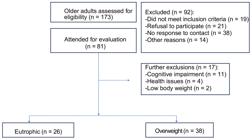
Flowchart of eligibility criteria and participant characteristics (N = 64). Brasília, DF, 2025.
The participants were predominantly female (n = 53, 82.8%), with a mean age in the sixth decade of life and a median of 12 years of education. In both groups, the majority were not employed (n = 52, 81.3%), were retired or receiving a pension (n = 47, 73.4%), were married (n = 38, 59.4%), and reported their health perception as “good” or “fair” (n = 50, 78.2%). The groups were homogeneous regarding the characteristics assessed, including sex, age, cognitive status, medication use, history of falls, type of tele-exercise, health perception, and racial composition (Table 1).
Analysis of variance, adjusted for the type of tele-exercise (synchronous or asynchronous), revealed a significant interaction between time and nutritional status only for performance on the Timed Up and Go (TUG) test (F(1,60) = 4.664; p = 0.035; η² = 0.072), indicating that the intervention response differed between groups. Although the eutrophic group showed a reduction in TUG execution time (baseline: 9.81 ± 1.545 s; 12 weeks: 9.15 ± 1.461 s; Δ = –0.66 s) and the overweight group showed an increase (baseline: 9.96 ± 2.414 s; 12 weeks: 10.29 ± 1.728 s; Δ = +0.33 s), these within-group changes did not reach statistical significance. Nevertheless, after 12 weeks of intervention, the mean TUG time in the eutrophic group was significantly lower than in the overweight group (p = 0.012). No significant main effects of time were observed (p = 0.425).
A significant time effect was observed for muscle quality outcomes, with overall improvement after the intervention in muscle quality of the upper limbs (F(1,58) = 10.823; p = 0.002; η² = 0.157), knee extensors (F(1,56) = 8.933; p = 0.004; η² = 0.138), and knee flexors (F(1,56) = 8.790; p = 0.004; η² = 0.136), independent of nutritional status. However, within-group analysis showed that only the eutrophic group exhibited significant improvement across all muscle quality outcomes (p < 0.05). The overweight group demonstrated significant improvement only in upper-limb muscle quality (baseline: 3.69 ± 1.408; 12 weeks: 4.40 ± 1.460; p < 0.001), with no significant changes in knee extensors (p = 0.360) or flexors (p = 0.050). There was no interaction between these outcomes and nutritional status (p > 0.05), indicating similar progression between groups over time.
Additionally, after 12 weeks, significant between-group differences were observed in the post-test for muscle quality of knee extensors (p = 0.025) and flexors (p = 0.041), with superior performance in the eutrophic group. Comparisons of the dependent variables between study groups are presented in Table 2.
Comparison of physical-functional performance between eutrophic and overweight older adults. Brasília, DF, 2025.
This longitudinal study demonstrated a significant effect of nutritional status on muscle quality (MQ) of the knee flexor and extensor muscles, as well as on functional performance in the Timed Up and Go (TUG) test, following 12 weeks of multicomponent tele-exercise. Overweight older adults exhibited lower MQ in the evaluated muscle groups and longer TUG completion times, indicating poorer functional performance compared to eutrophic individuals throughout the study period. These findings are consistent with previous literature emphasizing the influence of nutritional status, particularly excess weight, on muscle health and functional capacity in older adults25. Excessive body fat accumulation may compromise muscle mass and hinder physical activity, negatively affecting training response and functional performance26.
The results of this study showed overall improvement in muscle quality outcomes over time, with no interaction with nutritional status, suggesting similar progression between groups in response to the proposed exercise program. Nevertheless, within-group analysis revealed that only eutrophic participants experienced significant improvements across all three muscle quality indicators (upper limbs, knee extensors, and knee flexors), whereas overweight participants showed improvements limited to the upper limbs. These findings suggest that overweight may attenuate the benefits of tele-exercise, consistent with literature reporting reduced gains in muscle quality and functional efficiency among individuals with excess weight26. This limitation in lower-limb muscle gains among overweight participants may be associated with biomechanical and metabolic factors linked to excess weight, such as joint overload, fat infiltration into muscle tissue, and reduced neuromuscular efficiency26. Conversely, eutrophic individuals tend to respond more favorably to physical training, possibly due to a more balanced nutritional status and lower prevalence of comorbidities related to overweight, factors that may impair muscular adaptation to exercise stimuli.
Although our study identified significant improvements in lower-limb muscle quality in both groups, these gains were restricted to eutrophic participants. This lack of effect in the overweight group may be related to the specificity of the adopted protocol, which primarily targeted lower-limb exercises27. It has been observed that strength training combined with other modalities improves muscle strength (handgrip and knee extensors) and functional performance (TUG and SPPB) in frail older adults, but does not influence gait speed; in that study, nutritional status was not reported as a variable, unlike in the present investigation28.
In contrast, Chen et al.29 reported comprehensive improvements in various functional health outcomes, including physical capacity, gait, balance, and muscle strength, after 12 weeks of multicomponent training in older adults with a mean age of 85 years. These improvements were accompanied by increases in lean mass, fat-free mass, and skeletal muscle mass index, indicating positive effects on both upper- and lower-limb musculature. A possible explanation for the differences between studies lies in the impact of nutritional status. While Chen et al.29 did not highlight this factor as a relevant variable, our sample showed less favorable responses among overweight participants. This suggests that excess body fat may compromise the benefits of exercise, potentially by interfering with muscle function and mobility.
Conversely, Chen et al.29 also demonstrated that the benefits of multicomponent exercise occurred independently of baseline body composition, reinforcing the effectiveness of this type of intervention in improving functional health in older populations. This discrepancy may be explained by differences in the protocols used, training duration, or sample characteristics, indicating that the influence of nutritional status may vary depending on context. Moreover, studies investigating the effect of nutritional status on tele-exercise response remain scarce, underscoring the need for further scientific exploration to understand how different nutritional conditions affect outcomes in remotely delivered interventions. This evidence underscores the importance of tailoring interventions by considering nutritional status as a determining factor and ensuring a balanced distribution of exercise stimuli to maximize functional outcomes, especially in programs aimed at improving overall mobility and muscle strength in older populations.
The results of this study demonstrated that nutritional status differentially influenced the functional performance of older adults undergoing a multicomponent tele-exercise program. The significant interaction between time and nutritional status for the Timed Up and Go (TUG) test suggests that the intervention response varied between groups. Although within-group changes in TUG execution time did not reach statistical significance, the difference observed after 12 weeks of training, with superior performance in the eutrophic group, indicates greater functional benefit in this subgroup. Research shows that both eutrophic and obese older adults may benefit from structured online exercise programs, but outcomes can vary depending on nutritional status and baseline health conditions30-32. In this context, our findings may reflect a greater functional reserve or lower musculoskeletal impairment in the eutrophic group, favoring mobility gains following the intervention. Conversely, excess weight may impair functional capacity in older adults, negatively affecting the efficiency of knee flexor and extensor muscles, which manifests as slower performance during daily tasks33,34.
This study stands out for investigating how individual factors related to overweight and eutrophy influence physical-functional performance in older adults following multicomponent tele-exercise. This approach addresses important gaps in the literature regarding how individual characteristics11 and the tele-exercise format may modulate outcomes, particularly in terms of training response. However, several limitations should be considered. Factors such as differences in technological familiarity and motivational challenges due to the absence of personal interaction and immediate feedback typical of traditional settings were not assessed, which may have negatively influenced participant engagement. Additionally, variability in the home environment, including available space, safety, and potential interruptions, may have affected exercise execution. Psychosocial factors such as social support, stress levels, and mental health, which can influence outcomes, were also not controlled, representing an additional challenge for interpreting the findings. Furthermore, participants’ body mass was assessed only at baseline, preventing the identification of potential changes in nutritional status throughout the 12-week intervention period.
CONCLUSION
In conclusion, nutritional status distinctly influenced the physical-functional performance of older adults after 12 weeks of multicomponent tele-exercise. Eutrophic participants showed significant improvements in mobility and muscle quality of both upper and lower limbs, whereas gains among overweight individuals were limited to upper-limb muscle quality. These findings suggest that overweight may restrict the benefits of remote training, reinforcing the importance of tailoring interventions to individual characteristics, particularly nutritional status. Considering that tele-exercise is a promising modality for promoting adherence among older adults by reducing barriers such as transportation and safety concerns, the results of this study have important clinical applicability. To maximize functional outcomes, future interventions are recommended to assess specific training volumes, combine in-person and remote strategies, provide technological support, and consider additional variables such as body composition.
References
-
1 World Health Organization. Obesity: preventing and managing the global epidemic. Report of a WHO consultation [Internet]. Geneva: WHO; 2000. (WHO Technical Report Series 894). Disponível em: [https://apps.who.int/iris/handle/10665/42330]. Acesso em: 5 set. 2025.
» https://apps.who.int/iris/handle/10665/42330 - 2 Malandrino N, Bhat SZ, Alfaraidhy M, Grewal RS, Kalyani RR. Obesity and aging [Internet]. Endocrinol Metab Clin North Am. 2023;52(2):317-39. Disponível em: [https://doi.org/10.1016/j.ecl.2022.10.001] Acesso em: 5 set. 2025.
- 3 Santos VR, Gomes IC, Bueno DR, Christofaro DGD, Freitas IF Jr, Gobbo LA. Obesity, sarcopenia, sarcopenic obesity and reduced mobility in Brazilian older people aged 80 years and over [Internet]. einstein (Sao Paulo). 2017;15(4):435-40. Disponível em: [https://doi.org/10.1590/S1679-45082017AO4058]. Acesso em: 5 set. 2025.
- 4 Caamaño-Navarrete F, Jerez-Mayorga D, Alvarez C, del-Cuerpo I, Cresp-Barría M, Delgado-Floody P. Muscle quality index in morbidly obese patients related to metabolic syndrome markers and cardiorespiratory fitness [Internet]. Nutrients. 2023;15(11):2458. Disponível em: [https://doi.org/10.3390/nu15112458]. Acesso em: 5 set. 2025.
- 5 Michel E, Zory R, Guerin O, Prate F, Sacco G, Chorin F. Assessing muscle quality as a key predictor to differentiate fallers from non-fallers in older adults [Internet]. Eur Geriatr Med. 2024;15(5):1301-11. Disponível em: [https://doi.org/10.1007/s41999-024-01020-y]. Acesso em: 5 set. 2025.
- 6 Valenzuela PL, Maffiuletti NA, Tringali G, De Col A, Sartorio A. Obesity-associated poor muscle quality: prevalence and association with age, sex, and body mass index [Internet]. BMC Musculoskelet Disord. 2020;21:200. Disponível em: [https://doi.org/10.1186/s12891-020-03228-y]. Acesso em: 5 set. 2025.
- 7 Teixeira LA, Soares LA, Fonseca SF, Gonçalves GT, Santos JM, Viegas ÂA, et al. Analysis of body composition, functionality and muscle-specific strength of older women with obesity, sarcopenia and sarcopenic obesity: a cross-sectional study [Internet]. Sci Rep. 2024;14:24802. Disponível em: [https://doi.org/10.1038/s41598-024-76417-7]. Acesso em: 5 set. 2025.
- 8 Tallis J, Shelley S, Degens H, Hill C. Age-related skeletal muscle dysfunction is aggravated by obesity: an investigation of contractile function, implications and treatment [Internet]. Biomolecules. 2021;11(3):372. Disponível em: [https://doi.org/10.3390/biom11030372]. Acesso em: 5 set. 2025.
- 9 Pereira-Payo D, Denche-Zamorano Á, Mendoza-Muñoz M, Franco-García JM, Carlos-Vivas J, Pérez-Gómez J. Trends in multicomponent training research in the aged population: a bibliometric analysis [Internet]. Healthcare (Basel). 2024;12(15):1493. Disponível em: [https://doi.org/10.3390/healthcare12151493]. Acesso em: 5 set. 2025.
- 10 Kim YJ, Park H, Park JH, Park KW, Lee K, Kim S, et al. Effects of multicomponent exercise on cognitive function in elderly Korean individuals [Internet]. J Clin Neurol. 2020;16(4):612-20. Disponível em: [https://doi.org/10.3988/jcn.2020.16.4.612]. Acesso em: 5 set. 2025.
- 11 Caldas LR, Albuquerque MR, Araújo SR, Lopes E, Moreira AC, Cândido TM, et al. Dezesseis semanas de treinamento físico multicomponente melhoram a resistência muscular, agilidade e equilíbrio dinâmico em idosas [Internet]. Rev Bras Cienc Esporte. 2019;41(2):150-6. Disponível em: [https://doi.org/10.1016/j.rbce.2018.04.011]. Acesso em: 5 set. 2025.
- 12 de Souto Barreto P, Pothier K, Soriano G, Lussier M, Bherer L, Guyonnet S, et al. A web-based multidomain lifestyle intervention for older adults: the eMIND randomized controlled trial [Internet]. J Prev Alzheimers Dis. 2021;8(2):142-50. Disponível em: [https://doi.org/10.14283/jpad.2020.70]. Acesso em: 5 set. 2025.
- 13 Cooper D, Kavanagh R, Bolton J, Myers C, O’Connor S. Prime time of life: a 12-week home-based online multimodal exercise training and health education programme for middle-aged and older adults in Laois [Internet]. Phys Act Health. 2021;5(1):178-87. Disponível em: [https://doi.org/10.5334/paah.122]. Acesso em: 5 set. 2025.
- 14 Neri AL, Yassuda MS, Araújo LF, Eulálio MC, Cabral BE, Siqueira MEC, et al. Metodologia e perfil sociodemográfico, cognitivo e de fragilidade de idosos comunitários de sete cidades brasileiras: Estudo FIBRA [Internet]. Cad Saude Publica. 2013;29(4):778-92. Disponível em: [https://doi.org/10.1590/S0102-311X2013000400015]. Acesso em: 5 set. 2025.
- 15 Giuliani FNG, Jacobino NR, Vilaça e Silva KHC. Synchronous and asynchronous tele-exercise for older adults: study protocol for a randomized clinical trial [Internet]. Health Sci J. 2024;14:e1550. Disponível em: [https://doi.org/10.21876/hsjhci.v14.2024.e1550]. Acesso em: 5 set. 2025.
- 16 Lipschitz DA. Screening for nutritional status in the elderly [Internet]. Prim Care. 1994;21(1):55-67. Disponível em: [https://doi.org/10.1016/S0095-4543(21)00452-8]. Acesso em: 5 set. 2025.
- 17 Nascimento D, Rolnick N, Almeida IS, Cipriano Junior G, Durigan JL. Frequentist, Bayesian analysis and complementary statistical tools for geriatric and rehabilitation fields: are traditional null-hypothesis significance testing methods sufficient? [Internet]. Clin Interv Aging. 2024;19:277-87. Disponível em: [https://doi.org/10.2147/cia.s441799]. Acesso em: 5 set. 2025
- 18 Forhan M, Gill SV. Obesity, functional mobility and quality of life [Internet]. Best Pract Res Clin Endocrinol Metab. 2013;27(2):129-37. Disponível em: [https://doi.org/10.1016/j.beem.2013.01.003]. Acesso em: 5 set. 2025.
-
19 Organização Mundial da Saúde. CIF: classificação internacional de funcionalidade, incapacidade e saúde [Internet]. São Paulo: Edusp; 2003. Disponível em: [https://apps.who.int/iris/handle/10665/42407]. Acesso em: 5 set. 2025.
» https://apps.who.int/iris/handle/10665/42407 - 20 Straight CR, Brady AO, Evans EM. Muscle quality in older adults [Internet]. Am J Lifestyle Med. 2015;9(2):130-6. Disponível em: [https://doi.org/10.1177/1559827613510681]. Acesso em: 5 set. 2025.
- 21 Radecka A, Lubkowska A. The significance of dual-energy X-ray absorptiometry (DXA) examination in Cushing’s syndrome: a systematic review [Internet]. Diagnostics (Basel). 2023;13(9):1576. Disponível em: [https://doi.org/10.3390/diagnostics13091576]. Acesso em: 5 set. 2025.
- 22 Reis MM, Arantes PMM. Medida da força de preensão manual: validade e confiabilidade do dinamômetro Saehan [Internet]. Fisioter Pesqui. 2011;18(2):176-81. Disponível em: [https://doi.org/10.1590/S1809-29502011000200013]. Acesso em: 5 set. 2025.
- 23 American College of Sports Medicine. Progression models in resistance training for healthy adults [Internet]. Med Sci Sports Exerc. 2009;41(3):687-708. Disponível em: [https://doi.org/10.1249/MSS.0b013e3181915670]. Acesso em: 5 set. 2025.
- 24 Neumann S, Kwisda S, Krettek C, Gaulke R. Comparison of the grip strength using the Martin-Vigorimeter and the Jamar dynamometer: establishment of normal values [Internet]. In Vivo. 2017;31(5):917-24. Disponível em: [https://doi.org/10.21873/invivo.11147]. Acesso em: 5 set. 2025.
- 25 Mendes J, Borges N, Santos A, Padrão P, Moreira P, Afonso C, et al. Nutritional status and gait speed in a nationwide population-based sample of older adults [Internet]. Sci Rep. 2018;8:4227. Disponível em: [https://doi.org/10.1038/s41598-018-22584-3]. Acesso em: 5 set. 2025.
- 26 Pina FLC, Nascimento MA, Ribeiro AS, Tomeleri CM, Cyrino ES. Impacto do estado nutricional na composição corporal e força muscular de idosas inseridas em um programa de treinamento com pesos [Internet]. Rev Bras Cineantropom Desempenho Hum. 2018;20(3):235-46. Disponível em: [https://periodicos.ufsc.br/index.php/rbcdh/article/view/1980-0037.2018v20n3p235]. Acesso em: 5 set. 2025.
- 27 Weng WH, Cheng YH, Yang TH, Lee SJ, Yang YR, Wang RY. Effects of strength exercises combined with other training on physical performance in frail older adults: a systematic review and meta-analysis [Internet]. Arch Gerontol Geriatr. 2022;102:104757. Disponível em: [https://doi.org/10.1016/j.archger.2022.104757]. Acesso em: 5 set. 2025.
- 28 Zhang Y, Zhang Y, Du S, Wang Q, Xia H, Sun R. Exercise interventions for improving physical function, daily living activities and quality of life in community-dwelling frail older adults: a systematic review and meta-analysis of randomized controlled trials [Internet]. Geriatr Nurs. 2020;41(3):261-73. Disponível em: [https://doi.org/10.1016/j.gerinurse.2019.10.006]. Acesso em: 5 set. 2025.
- 29 Chen B, Li M, Zhao H, Liao R, Lu J, Tu J, et al. Effect of multicomponent intervention on functional decline in Chinese older adults: a multicenter randomized clinical trial [Internet]. J Nutr Health Aging. 2023;27(11):1063-75. Disponível em: [https://doi.org/10.1007/s12603-023-2031-9]. Acesso em: 5 set. 2025.
- 30 Peterlin J, Dimovski V, Colnar S, Blažica B, Kejžar A. Older adults’ perceptions of online physical exercise management [Internet]. Front Public Health. 2024;12:1303113. Disponível em: [https://doi.org/10.3389/fpubh.2024.1303113]. Acesso em: 5 set. 2025.
- 31 Coletta G, McQuarrie A, Tang A, Griffin M, Phillips S. The feasibility and associated physical activity outcomes using an online exercise program for older adults [Internet]. Med Sci Sports Exerc. 2023;55(Suppl 9):316. Disponível em: [https://doi.org/10.1249/01.mss.0000982704.89086.34]. Acesso em: 5 set. 2025.
- 32 Kariuki JK, Sereika S, Erickson K, Burke LE, Kriska A, Cheng J, et al. Feasibility and preliminary efficacy of a novel web-based physical activity intervention in adults with overweight/obesity: a pilot randomized controlled trial [Internet]. Contemp Clin Trials. 2023;133:107318. Disponível em: [https://doi.org/10.1016/j.cct.2023.107318]. Acesso em: 5 set. 2025.
- 33 Neto IV, Diniz JS, Alves VP, Oliveira ARV, Barbosa MPS, Prado CRS, et al. Field-based estimates of muscle quality index determine timed-up-and-go test performance in obese older women [Internet]. Clin Interv Aging. 2023;18:293-303. Disponível em: [https://doi.org/10.2147/CIA.S399827]. Acesso em: 5 set. 2025.
- 34 Pleticosic-Ramírez Y, Velarde-Sotres Á, Mecías-Calvo M, Navarro-Patón R. Can the functional physical fitness of older people with overweight or obesity be improved through a multicomponent physical exercise program? A Chilean population study [Internet]. Appl Sci (Basel). 2024;14(15):6502. Disponível em: [https://doi.org/10.3390/app14156502]. Acesso em: 5 set. 2025.
Edited by
-
Edited by
Rayssa Horacio Lopes