
 Temporal trends in tuberculosis incidence among older adults in Brazil: annual analysis from 2004 to 2023
Abstract
Objective To analyze the annual temporal trend of the tuberculosis incidence rate in older adults in Brazil, from 2004 to 2023.
Methods An epidemiological study with an ecological, descriptive, analytical design was conducted. Annual data were obtained from the Brazilian Notifiable Diseases Information System (SINAN). The general incidence rates of tuberculosis were calculated by sex, age group, and clinical form. The Prais-Winsten model and Annual Percentage Change (APC) were used to analyze the trend in the incidence rate.
Results For the period studied, 92,850 cases of tuberculosis were registered in the older population in Brazil. The general incidence rate of tuberculosis fluctuated, reaching a maximum in 2004 (70.10) and a minimum in 2020 (41.74), with a decreasing trend (β = -0.007; p = 0.003; APC = -1.8%). Analysis of the incidence rates of tuberculosis by sex revealed a decreasing trend for both genders, with higher rates among men throughout the historical series. Regarding age, there was a downward trend in incidence rates across all age groups. Analysis of the temporal trend by clinical form showed a stable trend for the combined pulmonary + extrapulmonary form, and a decreasing trend for the separate pulmonary and extrapulmonary forms.
Conclusion The study results showed a decrease in tuberculosis incidence rates among older adults. However, specific analysis of the clinical forms revealed that the incidence of the pulmonary + extrapulmonary form of tuberculosis remained stable, indicating specific challenges in diagnosing and managing these clinical presentations.
Keywords
Time Series Studies; Epidemiology; Incidence; Tuberculosis; Geriatric Health.
Resumo
Objetivo Analisar a tendência temporal anual da taxa de incidência de tuberculose em pessoas idosas no Brasil, no período de 2004 a 2023.
Métodos Trata-se de um estudo epidemiológico, ecológico, descritivo e analítico. Os dados foram obtidos no Sistema de Informação de Agravos de Notificação (SINAN). Foram calculadas as taxas de incidência da tuberculose geral, por sexo, faixa etária e forma clínica. Para analisar a tendência da taxa de incidência foram utilizados o modelo de Prais-Winsten e a Taxa de Incremento Anual (TIA).
Resultados No período estudado, foram registrados no Brasil, 92.850 casos de tuberculose na população idosa. A taxa de incidência geral da tuberculose oscilou, atingindo a máxima em 2004 (70,10/100.000 habitantes) e mínima em 2020 (41,74/100.00 habitantes), com uma tendência decrescente (β= -0,007; p=0,003; TIA= -1,8%). Ao analisar as taxas de incidência da tuberculose por sexo, identificou-se tendência decrescente para os dois grupos, com taxas maiores entre os homens durante toda a série histórica. Com relação à faixa etária, a tendência da taxa de incidência foi decrescente para todos os grupos etários. Quando analisada a tendência temporal por forma clínica, observou-se que a forma combinada Pulmonar + Extrapulmonar, apresentou uma tendência estacionária, já as formas pulmonar e extrapulmonar separadas, apresentaram uma tendência decrescente.
Conclusão Os resultados evidenciaram queda nas taxas de incidência de tuberculose entre pessoas idosas, entretanto, a análise específica das formas clínicas revelou que a incidência da tuberculose na forma pulmonar + extrapulmonar manteve-se estável, indicando desafios específicos no diagnóstico e manejo dessas apresentações clínicas.
Palavras-chave
Estudos de Séries Temporais; Epidemiologia; Incidência; Tuberculose; Saúde do Idoso.
INTRODUCTION
Tuberculosis (TB) is a chronic infection caused by the intracellular bacillus Mycobacterium tuberculosis, predominantly transmitted through the airborne route, that mainly affects the lungs1. According to the World Health Organization (WHO) estimates, one third of the global population is infected by M. tuberculosis2.
Although a disease with well-defined treatment and high probability of cure, TB remains a challenge for health managers worldwide. In 2023, approximately 8.2 million people were diagnosed with TB, the highest number recorded since global monitoring began in 1995. This significant rise in cases, relative to the 7.5 million reported in 2022, ranked TB as the leading cause of death from infectious disease in 2023, ahead of COVID-19 3.
Another factor impacting society in the 21 st century is population aging. Older adults represent a high-risk group for developing TB and, in Brazil, account for 10% of all notified cases of the disease4,5. This group is more vulnerable to developing TB due to reduced immune system efficacy, age-related functional limitations, and changes in both mucociliary clearance and lung function as a result of the aging processs6.
In this context, time-series analysis constitutes a valuable tool for epidemiological surveillance and control of TB, revealing changes in patterns of disease over time. This information is vital for planning and management of health services and policies, enabling the needs and demands of the population to be identified, and more effective actions to be implemented for the prevention and control of diseases7.
In view of this situation, understanding the epidemiological scenario of TB in the Brazilian older population is important. Therefore, the objective of the present study was to analyze the annual temporal trend of the incidence rate of tuberculosis among Brazilian older adults for the period spanning from 2004 to 2023.
METHODS
An epidemiological study with an ecological, descriptive, analytical design analyzing notified cases of TB in the Brazilian older population between 2004 and 2023 was conducted.
For the present study, older adults were defined as individuals aged ≥60 years. Only new confirmed cases of TB in the older population, by place of occurrence, were included. The Ministry of Health defines new cases as individuals with TB recorded under the following options: new case; don´t know; and post-death, referring to the different categories of patient entry into the Notifiable Diseases Information System (SINAN). “New case” denotes patients never undergoing chemotherapy for TB, “post-death” are notified cases of death from the disease, and “don´t know” indicates that information on patient status was either not recorded or incomplete8,9. Records not containing information on age and sex were excluded from the analysis. During the period spanning from 2004 to 2023, a total of 248,207 new cases of TB in older adults were registered in Brazil. After applying the study exclusion criteria, 26 cases were subsequently excluded, giving a final total of 248,181 cases for analysis.
The new TB cases were extracted from the SINAN on the 10 th of October 2024. The system (DATASUS) is run by the Informatics Department of the Brazilian National Health System (SUS)10. The number of older adult residents for calculating incidence rates was obtained from the website of the Brazilian Institute of Geography and Statistics (IBGE)11.
In order to characterize the sociodemographic and clinical profile of the population, the following variables were selected: year of notification (2004-2023), sex (male; female), age group in years (60-69; 70-79; ≥80), race/color (white; black; yellow; brown; indigenous; ignored), education in years of formal study (illiterate; 1-3; 4-7; ≥8; ignored), and clinical form (pulmonary; extrapulmonary; pulmonary + extrapulmonary).
General and specific incidence rates were calculating by dividing the number of new cases in the study population (totals, by sex, age group, and clinical form) by the number of resident Brazilian older adults, as estimated by the IBGE11, multiplied by 100,000 inhabitants.
Absolute and relative distributions, the TB incidence rate indicator, and decimal logarithm values, were calculated.
The time-trend of the TB rate was analyzed using Prais-Winsten linear regression, which takes into account serial autocorrelation7. To this end, regression analysis was performed of the decimal logarithm (log of base 10) for each indicator (dependent variable – Y) according to year of TB notification (independent variable – X), adopting the formula:
where: Log(Yt): value of decimal logarithm of indicator Y in year t; β0: constant or intercept; β1: coefficient of linear trend; x: year of registration of TB.
The percentage change was interpreted as follows7:
-
Increasing trend: when the β1 coefficient was positive and model statistically significant (p-value <0.05 on Prais-Winsten linear regression model);
-
Decreasing trend: when the β1 coefficient was negative and model statistically significant (p-value <0.05 on Prais-Winsten linear regression model);
-
Stable trend: statistically non-significant model (p-value>0.05 on Prais-Winsten linear regression model), irrespective of value of β1 coefficient.
The following formula was used for Annual Percentage Change (APC): APC=(-1+10 β)*100, where β value denotes the coefficient of slope of the straight line formed on regression.
The formula below was used for calculating confidence interval (CI) of the measures of the study: CI95% = (-1+10(β ± t*SE))*100, where t is the value at which Student´s t distribution attains 19 degrees of freedom and a two-tailed 95%CI; and SE is the standard error of the estimate of β, furnished by the regression analysis.
The data used in this study are freely available in the public domain and carry no personal identifying information, pursuant to Resolution nos. 466/2012 12 and no. 510/2016 13, of the National Board of Health (CNS), and to Law no.12.527/2011 14.
DATA AVAILABILITY
The complete dataset underpinning the results of the present study is available upon request from the corresponding author Ronilson Ferreira Freitas. The data can also be accessed on the Notifiable Diseases Information System (SINAN).
RESULTS
During the time-series studied (2004 to 2023), a total of 248,181 cases of TB were registered in the older population. The sociodemographic characteristics and clinical forms in the population studied are presented in Table 1.
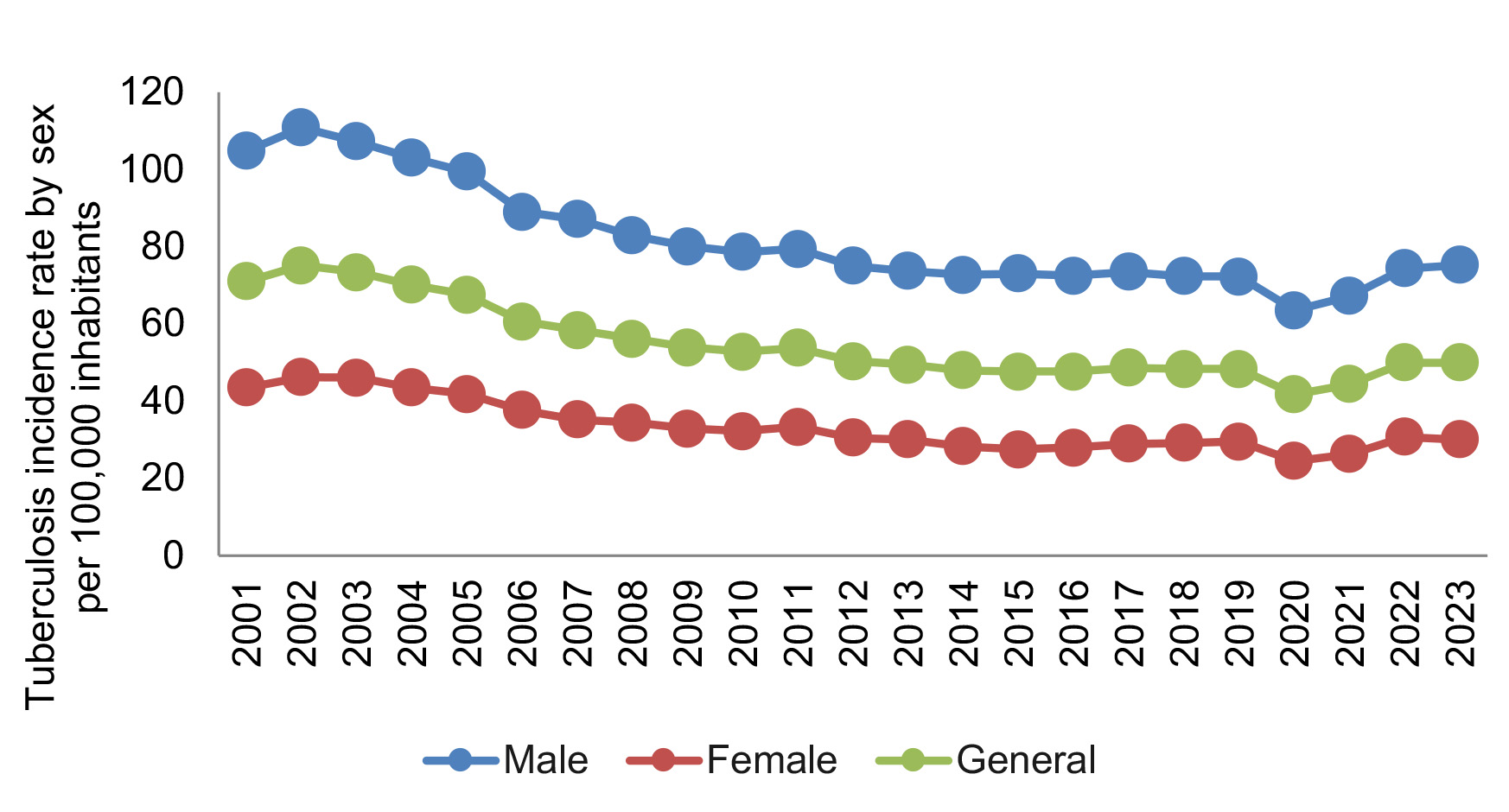
There was a decline in TB incidence rate over the period investigated. The highest rate registered in the time-series occurred in 2004 (70.10/100,000 inhabitants) and the lowest in 2020 (41.74/100,000) (Table 2, Figure 1A). The incidence rates were higher among males, where the highest rate registered for this gender was 103.00/100,000 inhabitants in 2004. The highest rate in females was 43.52/100,000 inhabitants, also peaking in 2004 (Table 2, Figure 1A).
General and specific tuberculosis incidence rates in older population (per 100,000 inhabitants) by sex, age group, and clinical form. Brazil, 2004-2023 (n=248,181)
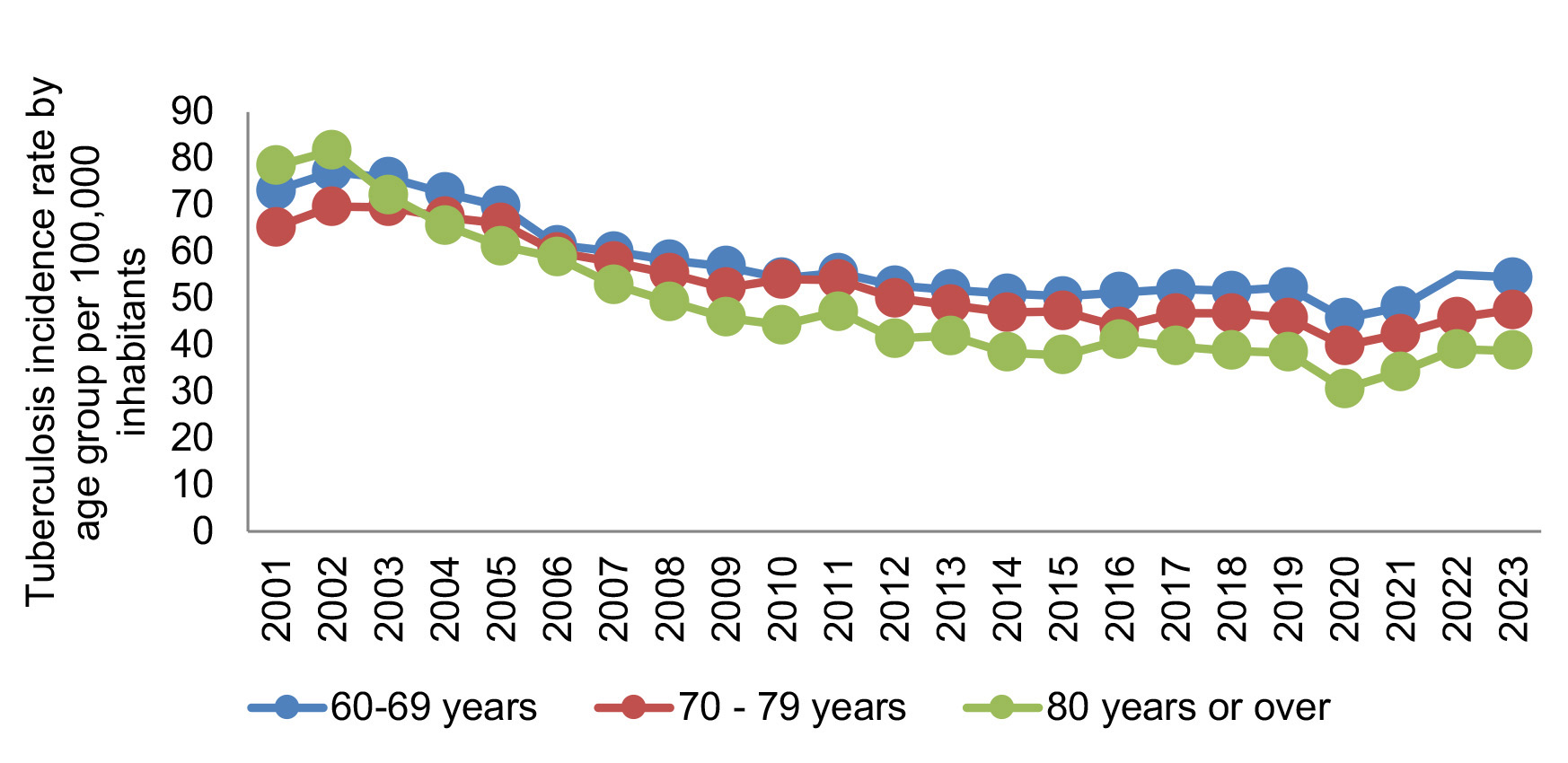
General and specific trends in tuberculosis incidence rate among older adults in Brazil, by sex and age group, 2004-2023.
Analysis of TB incidence rates among Brazilian older adults for the time-series studied showed a decreasing trend (β=-0.007; p=0.003; APC=-1.8%) a pattern repeated on analysis by sex and age group. For clinical form, the TB incidence showed a stable trend for the pulmonary + extrapulmonary form and a decreasing trend for the other forms (Table 2).
DISCUSSION
This study analyzed the temporal trend in TB incidence rate among older adults in Brazil during the period spanning from 2004 to 2023. Results showed a general decreasing trend in TB over the time-series assessed, with highest incidence in 2004 and lowest in 2020. Analysis of TB incidence rate by sex revealed higher rates among men throughout the time-series, but a decreasing trend for both genders. Regarding age group, there was a decreasing incidence trend across all age groups. On the analysis of time-series trends by clinical form, the Pulmonary + Extrapulmonary form was stable, although β values were negative and borderline statistically significant (p=0.055). The separate pulmonary and extrapulmonary forms exhibited a decreasing trend.
For general incidence of TB, results showed a high rate in Brazilian older adults, and that targets proposed by the World Health Organization (WHO) were far from being met. The target was to reduce overall incidence to under 10 cases per 100,000 inhabitants15, with a forecast reduction to 18.5 cases in more vulnerable groups such as older adults, which remains above WHO targets16.
The general incidence of TB in older adults remained high in this population, with peak rate registered in 2023, revealing ongoing challenges in controlling the disease. Factors such as changes in vaccine coverage, impact of the COVID-19 pandemic in screening of cases, and difficulties accessing health services, might be associated with the high rate of TB incidence observed in this population17.
Another relevant factor underlying the high rates of TB in the older population is immunosenescence, characterized by progressive deterioration of the immune system with advancing age. This phenomenon compromises the body´s immune response, rendering older individuals more prone to reactivation of latent infection by M. tuberculosis18. Moreover, the high prevalence of comorbidities in this age group, such as diabetes mellitus and cardiovascular diseases, not only increases vulnerability to TB, but can also reduce the efficacy of treatment and increase mortality rates19,20. This group of factors underscores the need for TB control strategies that take into account the impact of aging and chronic diseases on the course of the infection.
The results of the analysis of TB incidence by sex revealed higher rates in male older adults. In 2004, the TB incidence rate among males was 103.00 cases per 100,000 inhabitants, more than double the rate registered among women for the same year (43.52 cases per 100,000 inhabitants), a pattern that persists throughout the period assessed. This disparity can be explained by several factors, including men´s greater exposure to environments conducive to transmission of the disease, such as poorly ventilated workplaces and correctional facilities. Other factors include risky behaviors such as tabaco and alcohol use, which compromise immune response21. Also, men tend to seek health services less, potentially delaying diagnosis and increasing the risk of community transmission, perpetuating the incidence of disease in this population group22.
The analysis of the incidence of TB by age group revealed a specific pattern within the older population. The data show that the highest incidence rate was registered among individuals aged 60-69 years, with successively lower rates in older age groups. These findings are consistent with previous studies, showing that most cases of tuberculosis in the group of older individuals occur in young older adults19,23. A study conducted in Belém, Pará state, found that 64.6% of infected older adults were aged between 60 and 69 years19. Similarly, a study conducted in São Paulo state reported highest TB incidence in population aged 60-64 years, suggesting a consistent epidemiological pattern in different regions of Brazil23.
This lower incidence rate with advancing age might be explained by the fact that oldest-old tend to present fewer specific symptoms, hampering diagnosis and leading to under-notification of cases: the presence of comorbidities and progressive functional decline might mask the classic signs of TB, resulting in lower detection of the disease in this population24.
The analysis of the clinical form of TB in Brazilian older adults for the period studied reveals that the pulmonary form heavily predominated. These findings are in agreement with studies carried out in different regions of Brazil, confirming pulmonary TB as the most common presentation of the disease across a range of different age groups25,26.
A study conducted between 2011 and 2015 in Belém, Pará state, showed that 86.95% of TB cases in older adults were of the pulmonary form25. Another study, performed in Santa Catarina from 2010 to 2019, found a similar result, where 78.8% of cases notified in individuals aged 60 or older were the pulmonary clinical form26. This predominance might be related to the fact that transmission of the disease occurs mainly via the airborne route, making the pulmonary form responsible for much of the dissemination of the bacillus in the community27.
On the specific analysis of clinical forms, the incidence of TB in the pulmonary + extrapulmonary form remained stable. These data suggest that, while there was an overall reduction in incidence of the disease, the combined forms remained constant, pointing to specific challenges in the diagnosis and management of these clinical presentations28. These findings highlight the need to adopt public health strategies aimed not only at general reduction in incidence, but also at effective management of clinically combined forms of the disease.
Despite the scenario of a decreasing trend in TB incidence in Brazilian older adults, it is also important to note the rate of this fall. The rate of decrease in TB showed an annual fall of 1.8%. Although the analysis included the general Brazilian population, Guimarães et al.29 found almost double the rate of annual reduction compared to that observed in the present study for the years 1990 to 2010 (cumulated decrease of 48.8%). This finding lends credence to the notion that the scenario of TB control has lost impetus in the past decade.
The present study has some limitations, including the source of the data analyzed, given that studies based on data derived from the DATASUS are subject to incorrectly completed forms, missing or skipped data, and under-notification of the disease, especially during the COVID-19 pandemic. Moreover, the analysis was based on TB cases by place of occurrence, but an individual may have reported the case in one place while living in another, introducing bias. Another limitation which may have impacted results lies in the method, which used general trend in the data, without assessing possible changes in the pattern of the curve over time.
However, strengths of the study include the use of a quality national registry that included a large robust final population and time-series spanning 20 years. Furthermore, previous studies describing the profile of tuberculosis cases and analyzing the temporal trend in disease incidence in the Brazilian state of Santa Catarina concluded the data were adequate to guide actions for disease prevention and control26,30, enabling monitoring and assessment of public policies for TB diagnosis, as well as informing planning for public health actions, particularly in this specific population.
CONCLUSION
This study reported the incidence rate of tuberculosis in Brazil and its evolution over two decades among older adults. The profile of cases was predominantly in individuals who were male, aged 60-69 years, non-white, and with low education. The most common clinical form of tuberculosis was pulmonary. Over the two decades assessed, there was a significant decline in the incidence rates of tuberculosis in the population group studied. However, the assessment of temporal trends for the clinical forms showed that the pulmonary + extrapulmonary form remained stable, highlighting specific challenges in the diagnosis and management of these clinical presentations.
In this context, there is a clear need for devising actions for health promotion and tuberculosis prevention in older adults, through mass vaccination, guaranteed access to quality health services and specialized follow-up for older individuals with comorbidities, early detection of cases with investigation of respiratory symptoms, and promotion of favorable social and environmental conditions, including adequate housing and nutrition. Educational and awareness-raising actions, along with preventive treatment and strategies for improving treatment adherence and completion, are important to help meet the targets proposed by the World Health Organization.
ACKNOWLEDGEMENTS
The authors thank the Fundação de Amparo à Pesquisa do Estado do Amazonas (FAPEAM) for awarding a Scientific Initiation grant to author Daniel Brendon Melo Henriques Seabra, under the Institutional Scientific Initiation Grants Program of the Universidade Federal do Amazonas (PIBIC/UFAM), Tender 002/2023, and also the Conselho Nacional de Desenvolvimento Científico e Tecnológico (CNPq), Coordenação de Aperfeiçoamento de Pessoal de Nível Superior (CAPES), and the Pro-Rectory of Research and Graduate Studies of the Universidade Federal do Amazonas (PROPESP/UFAM).
References
-
1 Mohammadnabi N, Shamseddin J, Emadi M, Bodaghi AB, Varseh M, Shariati A, et al. Mycobacterium tuberculosis: The Mechanism of Pathogenicity, Immune Responses, and Diagnostic Challenges. J Clin Lab Anal. 2024; 38(23): e25122. DOI: https://doi.org/10.1002/jcla.25122
» https://doi.org/10.1002/jcla.25122 -
2 World Health Organization. Global Tuberculosis Report. [Internet]. Geneva: WHO; 2024. [acessado em 07 set. 2025]. Disponível em: https://reliefweb.int/report/world/global-tuberculosis-report-2024-enarruzh
» https://reliefweb.int/report/world/global-tuberculosis-report-2024-enarruzh -
3 World Health Organization. Global Tuberculosis Report. [Internet]. Geneva: WHO; 2022. [acessado em 07 set. 2025]. Disponível em: https://www.who.int/teams/global-tuberculosis- programme/tb-reports/global-tuberculosis-report-2022
» https://www.who.int/teams/global-tuberculosis- programme/tb-reports/global-tuberculosis-report-2022 - 4 Moares LNR, Souza FM, Possuelo LG, Soares KKS, Maciel ELN, Prado TN. Factors associated with unfavorable treatment outcomes of tuberculosis in older adults in Brazil: a multinomial analysis. Rev. Bras. Geriatr. Gerontol. 2024;27:e230244. DOI: https://doi.org/10.1590/1981-22562024027.230244.pt
-
5 Brasil. Ministério da Saúde Boletim Epidemiológico de Tuberculose. [Internet]. Brasília: MS; 2023. [acessado em 08 ago. 2025]. Disponível em: https://www.gov.br/aids/pt-br/central-de-conteudo/boletins-epidemiologicos/2023/tuberculose/boletim-epidemiologico-tuberculose-2023_eletronico.pdf/view
» https://www.gov.br/aids/pt-br/central-de-conteudo/boletins-epidemiologicos/2023/tuberculose/boletim-epidemiologico-tuberculose-2023_eletronico.pdf/view - 6 Shaikh SB, Goracci C, Tjitropranoto A, Rahman I. Impact of aging on immune function in the pathogenesis of pulmonary diseases: Potential for therapeutic targets. Expert Rev Respir Med. 2023; 26;17(5):351–364. DOI: 10.1080/17476348.2023.2205127
- 7 Antunes JLF, Cardoso MRA. Uso da análise de séries temporais em estudos epidemiológicos. Epidemiol Serv Saúde 2015; 24(3): 565-76. DOI: https://doi.org/10.5123/S1679-49742015000300024
-
8 Brasil. Ministério da Saúde. Boletim Epidemiológico. Tuberculose 2021. Brasília: MS; 2020 (Número Especial) [Internet]. [acessado em 15 de mar. 2025]. Disponível em: https://www.gov.br/aids/pt-br/central-de-conteudo/boletins-epidemiologicos/2021/tuberculose/boletim_tuberculose_2021_internet.pdf
» https://www.gov.br/aids/pt-br/central-de-conteudo/boletins-epidemiologicos/2021/tuberculose/boletim_tuberculose_2021_internet.pdf -
9 Brasil. Ministério da Saúde. Secretaria de Vigilância em Saúde. Departamento de Vigilância das Doenças Transmissíveis. Vigilância epidemiológica da tuberculose: análise de indicadores operacionais e epidemiológicos a partir da base de dados do Sinan versão 5.0. Brasília: MS; 2016. [Internet]. [acessado em 15 de mar. 2025]. Disponível em: https://portalsinan.saude.gov.br/images/documentos/Agravos/Tuberculose/Apostila_Curso_Sinan_2016.pdf
» https://portalsinan.saude.gov.br/images/documentos/Agravos/Tuberculose/Apostila_Curso_Sinan_2016.pdf -
10 Brasil. Ministério da Saúde. Datasus. Tecnologia da Informação a Serviço do SUS. Sistema de Informação de Agravos de Notificação (Sinan). Informações de Saúde. Epidemiológica e Morbidades – Brasil. Brasília: MS; 2024. [Internet]. [acessado em 10 out. 2024]. Disponível em: https://datasus.saude.gov.br/acesso-a-informacao/casos-de-tuberculose-desde-2001-sinan/
» https://datasus.saude.gov.br/acesso-a-informacao/casos-de-tuberculose-desde-2001-sinan/ -
11 Brasil. Instituto Brasileiro de Geografia e Estatística. Projeções populacionais. Rio de Janeiro: IBGE; 2018. [Internet]. [acessado em 10 out. 2024]. Disponível em: https://www.ibge.gov.br/estatisticas/sociais/populacao/9109-projecao-da-populacao.html?edicao=%209116%20&%20t=resultado
» https://www.ibge.gov.br/estatisticas/sociais/populacao/9109-projecao-da-populacao.html?edicao=%209116%20&%20t=resultado -
12 Brasil. Ministério da Saúde. Conselho Nacional de Saúde. Resolução no 466, de 12 de dezembro de 2012. Aprova diretrizes e normas regulamentadoras de pesquisas envolvendo seres humanos. Brasília: MS; 2012. [Internet]. [acessado em 03 de mai. 2023]. Disponível em: https://conselho.saude.gov.br/resolucoes/2012/Reso466.pdf
» https://conselho.saude.gov.br/resolucoes/2012/Reso466.pdf -
13 Brasil. Ministério da Saúde. Conselho Nacional de Saúde. Resolução no 510, de 07 de abril de 2016. Brasília: MS; 2016. [Internet]. [acessado em 03 de mai. 2023]. Disponível em: https://conselho.saude.gov.br/resolucoes/2016/Reso510.pdf
» https://conselho.saude.gov.br/resolucoes/2016/Reso510.pdf -
14 Brasil. Presidência da República. Casa Civil. Subchefia para Assuntos Jurídicos. Lei no 12.527, de 18 de novembro de 2011. Regula o acesso a informações previsto no inciso XXXIII do art. 5º, no inciso II do § 3º do art. 37 e no § 2º do art. 216 da Constituição Federal; altera a Lei no 8.112, de 11 de dezembro de 1990; revoga a Lei no 11.111, de 5 de maio de 2005, e dispositivos da Lei no 8.159, de 8 de janeiro de 1991; e dá outras providências [Internet]. 2011 [acessado em 03 de mai 2023]. Disponível em: https://www.planalto.gov.br/ccivil_03/_ato2011-2014/2011/lei/l12527.htm
» https://www.planalto.gov.br/ccivil_03/_ato2011-2014/2011/lei/l12527.htm -
15 Maciel ELN, Sales CMM, Bertolde AI, Reis-Santos B. Can Brazil achieve the new World Health Organization global targets for tuberculosis control? Epidemiol. Serv. Saude. 2018; 27(2):e0200007. DOI: https://doi.org/10.5123/S1679-49742018000200007
» https://doi.org/10.5123/S1679-49742018000200007 -
16 Villalva-Serra K, Barreto-Duarte B, Rodrigues MM, Queiroz ATL, Martínez L, Croda J, et al. Impact of strategic public health interventions to reduce tuberculosis incidence in Brazil: a Bayesian structural time-series scenario analysis. The Lancet Regional Health – Americas. 2025; 41:100963. DOI: https://doi.org/10.1016/j.lana.2024.100963
» https://doi.org/10.1016/j.lana.2024.100963 -
17 Ribeiro RR, Andrade RLP, Silva DC, Sthal HC, Oliveira JA, Regis IM, et al. Repercussão da pandemia da Covid-19 nas ações de controle da tuberculose na Atenção Primária à Saúde: revisão de escopo. Ciênc. Saúde Colet.. 2025; 30(7):1-14. DOI: https://doi.org/10.1590/1413-81232025307.00992024
» https://doi.org/10.1590/1413-81232025307.00992024 - 18 Caraux-Paz P, Diamantis S, de Wazières B, Gallien S. Tuberculosis in the elderly. J Clin Med. 2021;10(24):5888. DOI: https://doi.org/10.3390/jcm10245888
- 19 Chaves EC, Carneiro ICRS, Santos MIPO. Epidemiological, clinical and evolutionary aspects of tuberculosis among elderly patients of a university hospital in Belém, Pará. Rev Bras Geriatr Gerontol. 2017;20(1):45-55. DOI: https://doi.org/10.1590/1981-22562017020.160069
- 20 Ferlita S, Yegiazaryan A, Noori N, Lal G, Nguyen T, To K, et al. Type 2 diabetes mellitus and altered immune system leading to susceptibility to pathogens, especially Mycobacterium tuberculosis. J Clin Med. 2019;8(12):2219. DOI: https://doi.org/10.3390/jcm8122219
- 21 Silva DR, Muñoz-Torrico M, Duarte R, Galvão T, Bonini EH, Arbex FF, et al. Risk factors for tuberculosis: diabetes, smoking, alcohol use, and the use of other drugs. J. Bras. Pneumol.. 2018;44(2):145-152. DOI: http://dx.doi.org/10.1590/S1806-37562017000000443
- 22 Beraldo AA, Arakawa T, Pinto ESG, Andrade RLP, Wysocki AD, Sobrinho RAS, et al. Atraso na busca por serviço de saúde para o diagnóstico da tuberculose em Ribeirão Preto (SP). Ciênc. Saúde Colet.. 2012;17(11):3079-3086. DOI: https://doi.org/10.1590/S1413-81232012001100024
- 23 Latini IF, Rodrigues TF. Estudo do perfil epidemiológico da tuberculose na população idosa no estado de São Paulo entre os anos de 2018-2020. Arq Cienc Saude UNIPAR. 2022;26(3):725-735. DOI: https://doi.org/10.25110/arqsaude.v26i3.2022.8835
- 24 Abbara A, Collin SM, Kon OM, Buell K, Sullivan A, Barrett J, et al. Time to diagnosis of tuberculosis is greater in older patients: a retrospective cohort review. ERJ Open Research. 2019;5(4):00228-2018. DOI: https://doi.org/10.1183/23120541.00228-2018
- 25 Mesquita CR, Lima KVB, Guimarães RJPS, Santos BO, Rodrigues LHA, da Costa RJF, et al. Retrospective analysis of tuberculosis cases in older adults. Rev Bras Promoc Saude. 2021;34:11117. DOI: https://doi.org/10.5020/18061230.2021.11117
-
26 Pereira A, Hillesheim D, Silva FM, Valim RCS, Hallal ALC. Tuberculosis incidence rate time series in the state of Santa Catarina, Brazil: analysis of a decade, 2010-2019. Epidemiol. Serv. Saúde. 2022; 31(2):e20211067. DOI: https://doi.org/10.1590/S2237-96222022000300002
» https://doi.org/10.1590/S2237-96222022000300002 - 27 Coleman M, Martinez L, Theron G, Wood R, Marais B. Mycobacterium tuberculosis transmission in high-incidence settings - new paradigms and insights. Pathogens. 2022;11(11):1228. DOI: https://doi.org/10.3390/pathogens11111228
-
28 Carabalí-Isajar ML, Rodríguez-Bejarano OH, Amado T, Patarroyo MA, Izquierdo MA, Lutz JR et al. Clinical manifestations and immune response to tuberculosis. World Journal of Microbiology and Biotechnology. 2023; 39(206). DOI: https://doi.org/10.1007/s11274-023-03636-x
» https://doi.org/10.1007/s11274-023-03636-x - 29 Guimarães RM, Lobo A de P, Siqueira EA, Borges TFF, Melo SCC. Tuberculosis, HIV, and poverty: temporal trends in Brazil, the Americas, and worldwide. J. Bras. Pneumol.. 2012;38(4):511–7. DOI: https://doi.org/10.1590/S1806-37132012000400014
- 30 Canto VB, Nedel FB. Completeness of tuberculosis records held on the Notifiable Health Conditions Information System (Sinan) in Santa Catarina, Brazil, 2007-2016. Epidemiol. Serv. Saúde. 2020;29(3):e2019606. DOI: https://doi.org/10.5123/s1679-49742020000300020
Edited by
-
Edited by
Camila Alves dos Santos

 Thumbnail
 Thumbnail
 Thumbnail
 Source: Notifiable Diseases Information System (SINAN)
 Source: Notifiable Diseases Information System (SINAN)
 Source: Notifiable Diseases Information System (SINAN)