 Environmental characteristics and physical activity among older adults living in Santa Maria, Brazil
Abstract
Objective To examine the level of physical activity and the environmental characteristics reported by older adults living in Santa Maria, Rio Grande do Sul, Brazil.
Methods This cross-sectional study was conducted in the urban area and included a sample of 202 participants. Data were collected regarding sociodemographic characteristics, cognitive status, level of physical activity, and perceived environmental features. Analyses of relative and absolute frequencies were performed, along with chi-square tests and bivariate and multivariate logistic regressions.
Results The prevalence of physically active participants was below 30%, with a mean of 63.14 minutes (±115.15) of physical activity per week. The presence of street markets and pedestrian crosswalks near participants’ homes were the variables most strongly associated with physical activity, increasing the likelihood of being active by 3.3 and 2.7 times, respectively.
Conclusion The prevalence of physically active older adults in Santa Maria is low. Environmental factors such as the presence of street markets and pedestrian crosswalks had the strongest influence on the level of leisure-time physical activity.
Keywords
Older Adults; Aged; Environment; Physical Activity.
Resumo
Objetivo Analisar o nível de atividade física e as características ambientais relatadas por pessoas idosas residentes em Santa Maria, Rio Grande do Sul, Brasil.
Métodos Este estudo transversal foi conduzido na área urbana e incluiu uma amostra de 202 participantes. Foram coletados dados sobre características sociodemográficas, estado cognitivo, nível de atividade física e percepção de aspectos ambientais. Realizaram-se análises de frequências relativas e absolutas, além de testes do qui-quadrado e regressões logísticas bivariada e multivariada.
Resultados A prevalência de participantes fisicamente ativos foi inferior a 30%, com média de 63,14 minutos (±115,15) de atividade física por semana. A presença de feiras livres e de faixas de pedestres próximas às residências dos participantes foram as variáveis que mais influenciaram a prática de atividade física, aumentando a probabilidade de serem ativos em 3,3 e 2,7 vezes, respectivamente.
Conclusão A prevalência de pessoas idosas fisicamente ativas em Santa Maria é baixa. Fatores ambientais, como a presença de feiras livres e faixas de pedestres, exerceram a maior influência sobre o nível de atividade física no tempo livre.
Palavras-chave
Idoso; Envelhecimento; Ambiente; Exercício físico.
INTRODUCTION
Population aging has become an increasingly important topic in healthcare discussions1, mainly due to the growing number of older adults and the projected increase in this population over the coming years2. Physical activity is widely recognized as a biopsychosocial determinant of health, and it is well established that regular engagement in physical activity and the consequent increase in physical activity levels (PAL) is associated with reduced morbidity and mortality from various diseases, as well as with the prevention of chronic noncommunicable diseases (NCDs) and certain types of cancer3-5. Longitudinal studies have shown that older adults who maintain an active lifestyle perceive their health and quality of life as significantly better6.
In Brazil, physical inactivity in transportation and leisure domains is strongly associated with overweight and obesity, suggesting that these domains are characterized by longer periods of sedentary behavior7. A nationwide survey found that only 26.4% of adults were physically active during leisure time, and a considerable portion of the population did not meet international recommendations for physical activity8. These findings are concerning, as these adults will constitute the future population of older adults.
It is well recognized that the quality of life of older adults is closely correlated with their mobility, the absence of which results in poorer overall health and well-being. Daily mobility is a prerequisite for improving personal autonomy, promoting social engagement, and enhancing both the physical and mental health of older adults9.
In this context, the environment plays a key role not only in mobility but also in several other aspects of the aging process. The built environment has drawn considerable attention across disciplines, including urban planning, geography, transportation, public health, and psychology10-12.
However, in Brazil, there are few studies investigating perceived environmental characteristics associated with physical activity levels and active behaviors among older adults. The available evidence indicates a positive association between active behavior and favorable environmental conditions, consistent with international findings13-15. Therefore, this study aimed to analyze the prevalence of physical activity and its association with perceived environmental variables among older adults living in the city of Santa Maria, Rio Grande do Sul, Brazil.
METHODS
This cross-sectional, home-based, descriptive study was conducted in the urban area of Santa Maria, located in the central region of the state of Rio Grande do Sul, Brazil. The city has a total population of 271,633 inhabitants, of whom approximately 53,000 (19.51%) are aged 60 years or older. According to the latest census, Santa Maria had a Human Development Index (HDI) of 0.784 and a life expectancy at birth of 75.89 years. The urban area accounts for 95.14% of the city’s population and comprises 41 neighborhoods, three of which were selected for this study.
Neighborhood selection was based on data from the Brazilian Institute of Geography and Statistics (IBGE). The selection criteria included the average total household income and the percentage of older adults among neighborhood residents (ranging from 2% to 3.99%). The selected neighborhoods were categorized as higher-, middle-, and lower-income areas. Neighborhood 1 (N1) included 930 older adults; N2 included 620; and N3, 600.
The sample size was calculated using the finite population sampling procedures, with a statistical power of 95%, a significance level of 5%, and a precision level of 3%, based on the total number of older adults. Using this approach, at least 202 participants were required. Considering an additional 10% to account for potential losses, the final sample size was approximately 220 participants.
Based on this calculation, approximately 10% of the older adults in each neighborhood were approached and invited to participate. Accordingly, 66 participants were interviewed in N1 and N2, and 70 in N3, totaling 202 interviews. The sampling process was nonprobabilistic.
The study included community-dwelling adults aged 60 years or older who agreed to participate. Exclusion criteria included cognitive impairment based on the predetermined cutoff, musculoskeletal injuries or conditions that limited physical activity, and residence in long-term care institutions.
Prior to data collection, a pilot study was conducted to identify potential operational challenges related to participant recruitment and the applicability of the instruments. Eight older adults from a fourth neighborhood were interviewed. The instruments were found to be easy to administer, requiring an average of 35 minutes to complete each interview. However, difficulty in identifying data collectors was observed to reduce participants’ willingness to take part in the study. Therefore, the use of standardized t-shirts and identification badges was recommended to facilitate recognition of the interviewers. Informational brochures about the study and data collection procedures were also distributed to households and apartment mailboxes to raise awareness among residents.
Data collection took place during the second semester of 2015. When potential participants were approached, the Informed Consent Form was presented, explaining the study’s objectives and procedures, and emphasizing the voluntary nature of participation. Participants were informed about the possible risks and benefits of the study. Subsequently, an anamnesis and cognitive assessment were administered to verify eligibility. The next steps included applying questionnaires on physical activity levels and perceived environmental characteristics.
Sociodemographic and health-related data (such as the presence of chronic diseases, disabilities, and medication use) were collected through an anamnesis. Cognitive status was assessed using the Mini-Mental State Examination (MMSE), validated by Folstein et al.16, with cutoff points adjusted for educational level17. Participants were classified as having or not having cognitive impairment. Those identified with cognitive impairment were excluded from further data collection, as subsequent instruments required self-reported responses.
To assess the level of physical activity (PAL), the International Physical Activity Questionnaire (IPAQ – long version) adapted for older adults in Brazil18, was used. The present study considered only physical activity in the leisure-time domain, defining participants as physically active if they engaged in ≥150 minutes of physical activity per week.
For the environmental assessment, the adapted version13 of the Neighborhood Environment Walkability Scale (NEWS), validated for use in Brazil19, was used. The questions in the adapted NEWS offered dichotomous (“yes”/“no”) responses. Perceptions of the environment included participants’ views on physical and environmental structures near their homes that either facilitated or hindered physical activity, such as the presence and quality of sidewalks, green areas, parks, and squares, as well as traffic and neighborhood safety. Features that promote physical activity, such as bike lanes, trails, walking paths, sports courts, and the occurrence of sports events in the neighborhood, were also assessed, in addition to perceived social support for physical activity and weather conditions. All respondents were asked to consider as “near their homes” any place they could reach within a 15-minute walk.
All variables were analyzed descriptively using absolute and relative frequencies, both by neighborhood and for the total sample. The chi-square test was used to verify differences in physical activity levels (PAL) between neighborhoods, classifying participants as “physically active” or “insufficiently active” according to the cutoff point of 150 minutes per week.
Bivariate logistic regression analyses were conducted between PAL (dependent variable) and perceived environmental variables (independent variables). Variables with p < 0.20 were selected for inclusion in the multiple model. For the multiple logistic regression model, the independent variables were entered in ascending order of significance using a forward-selection strategy. Variables were retained or removed from the model according to their statistical significance (p < 0.05) and biological plausibility. All analyses accounted for the complex sampling design and incorporated sample weights.
This study was reviewed and approved by the Research Ethics Committee of the Universidade Federal de Santa Maria, under registration number 43071815.5.0000.5346 and process number 1082661. All ethical principles were observed in accordance with National Health Council (CNS) Resolutions 466/2012 and 510/2016. All participants provided written Informed Consent Form (ICF) prior to participation.
DATA AVAILABILITY
The complete dataset supporting the findings of this study is available from the corresponding author upon reasonable request.
RESULTS
A total of 202 older adults were interviewed. No interviews were conducted with caregivers or relatives. Among the respondents, 46 (22.8%) were excluded based on the MMSE cutoff score, resulting in a final sample of 156 participants (77.2%) for subsequent analyses.
Table 1 presents the main sociodemographic and health characteristics of the participants, both overall and by neighborhood. A low prevalence of leisure-time physical activity, less than 30%, was observed across all neighborhoods and in the total sample.
Sociodemographic and health characteristics of participants by neighborhood (N1, N2, N3) and for the total sample, with 95% confidence intervals (95% CI). Santa Maria, RS, 2015.
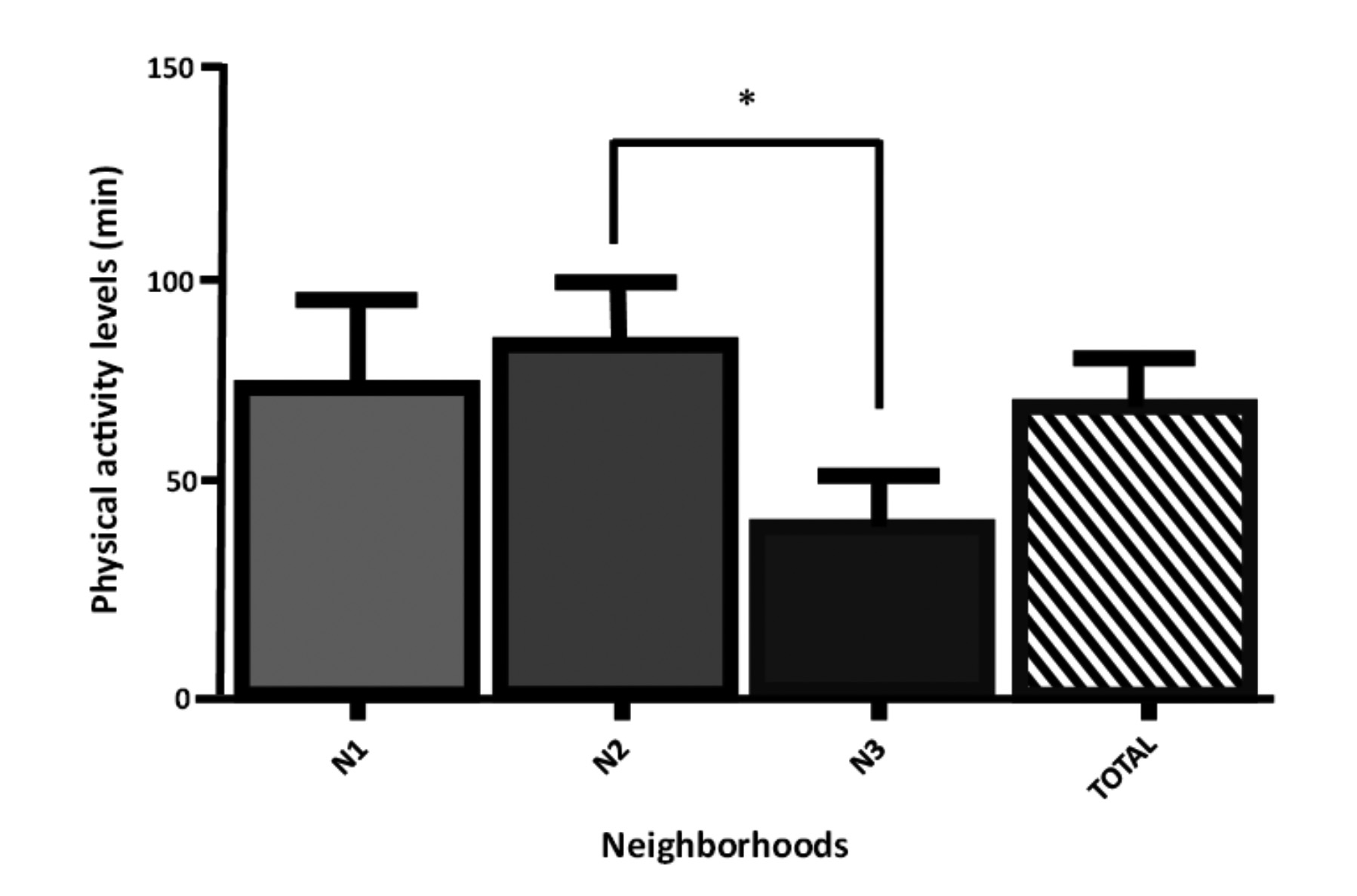
When considering PAL, it was observed that older adults from the three neighborhoods studied did not meet the recommended threshold of 150 minutes per week, showing an overall mean of 63.14 minutes (±115.15). Analyzing each neighborhood separately, N1 had a mean of 71.88 minutes (±138.31), N2 had 80.81 minutes (±108.89), and N3 had 38.51 minutes (±89.54) per week. A significant difference was found between the means of N2 and N3 (p = 0.007) (Figure 1).

Weekly physical activity level (in minutes) for the three neighborhoods and for the total sample.
Regarding environmental perception, the factors with the highest proportions of positive responses were “presence of a bus stop,” “church/temple,” “bakery,” “sense of safety,” and “absence of smoke/pollution.”
Conversely, factors such as “presence of clubs/sports courts/fields,” “parks or walking areas,” “benches,” “drivers yielding to pedestrians,” and “existence of sports events” received the highest proportions of negative responses (Table 2).
Most frequently reported positive and negative environmental responses among older adults (n = 156). Santa Maria, RS, 2015.
The majority of participants (53.8%) reported the presence of sidewalks on most streets near their homes, a variable that showed an Odds Ratio (OR) = 1.110, although with a non-significant p-value (p = 0.800). A similar finding was observed for the presence of green areas, reported as nonexistent by 70.5% of the sample, which presented an OR = 1.303 but also a non-significant p-value (p = 0.524).
Of the 41 environmental perception variables investigated in this study in relation to performing 150 minutes per week of leisure-time physical activity, four presented p-values < 0.20 and were therefore selected for the multiple logistic regression model. However, only the variables “presence of a street market” and “presence of pedestrian crosswalks near the home” remained in the final multiple model. Participants who reported the presence of a street market were 3.3 times more likely to be physically active, while those reporting pedestrian crosswalks near their homes were 2.7 times more likely to engage in leisure-time physical activity (Table 3).
Logistic regression model considering 150 minutes of leisure-time physical activity per week as the dependent variable among older adults in Santa Maria, RS, Brazil, 2015.
DISCUSSION
The present study identified a low prevalence of older adults who were physically active during leisure time, as well as a low mean number of minutes of physical activity per week.
Regarding environmental perception, the variables “presence of a street market” (OR = 3.547) and “presence of pedestrian crosswalks near the home” (OR = 2.717) remained in the final multiple regression model, indicating that the likelihood of engaging in more than 150 minutes per week of leisure-time physical activity increased when these environmental features were present. The first variable is related to neighborhood structure, while the second refers to traffic safety.
The low prevalence of physically active individuals may be associated with climatic conditions, as the city of Santa Maria has a subtropical climate characterized by sudden temperature changes, with cold winters and hot summers. This finding corroborates other studies indicating that climatic variation represents one of the main barriers to maintaining adequate levels of physical activity, especially for outdoor activities such as walking or exercising in parks and green areas20,21. One of these studies also reported that 53.2% of older adults mentioned that weather conditions interfere with walking and other outdoor activities.
Several studies with populations, instruments, and cut-off points similar to those used in this research have reported different findings. Salvador et al.13 evaluated 385 older adults from the city of Ermelino Matarazzo and observed a 15.1% prevalence of leisure-time physical activity, with men being more active than women. The same authors analyzed walking as a form of transportation among older adults, considering the 150-minute-per-week cut-off point, and found that 34.8% were classified as physically active. Giehl et al.14 assessed 1,656 older adults living in Florianópolis, SC, and found a 29.7% prevalence of leisure-time physical activity, with a mean of 131.8 minutes per week (±216).
In the international context, studies show similar results. For example, a study conducted in Belgium with 438 participants found that the population did not achieve 150 minutes of weekly leisure-time physical activity22. Bauman et al.23 investigated the physical activity levels (PAL) of men and women aged 18 to 64 years from 20 countries using the short version of the International Physical Activity Questionnaire (IPAQ) and observed that recommended PAL generally declines with age. Moreover, countries such as Australia, Canada, China, the Czech Republic, Hong Kong, New Zealand, and the United States showed a high prevalence of low PAL, corroborating both the present findings and those of more recent studies24.
The low PAL observed among participants in this study is concerning, as a recent Brazilian study by Thuan25 demonstrated that older adults who are physically active during leisure time report better health outcomes and lower levels of loneliness, emphasizing the important role of physical activity in maintaining both physical and mental health in this population.
Regarding neighborhood infrastructure, variables such as “presence of a club/sports court/field” and “presence of a park/place to walk” were often reported as absent, suggesting these were barriers to being physically active. However, no significant associations were found between these variables and leisure-time physical activity. Even so, the literature has consistently demonstrated a positive relationship between neighborhood infrastructure and physical activity among older adults13,14,24,26. It also underscores the importance of addressing barriers to physical activity among this population, aiming to transform the environment into attractive and appropriate leisure spaces, as such environments are associated with increased PAL and reduced risk of mobility decline and loss of motivation24,27.
In Santa Maria, according to the Superintendence of Parks, Squares, and Gardens, there are 25 outdoor gyms, 52 squares, 52 green areas, and 4 public walking areas. However, the results suggest that older adults do not perceive these facilities as being available in their city or near their homes. Although there are several outdoor gyms, the absence of professional guidance or support may hinder physical activity. The importance of planning and maintaining accessible leisure spaces is well established in the literature, as they appear to encourage leisure-time physical activity and active commuting. It is possible that, in the present study, the perception of nonexistence arises because these green areas, squares, and parks are either poorly maintained, not easily accessible, or do not effectively serve the needs of the community.
Variables such as the “presence of sidewalks” (OR = 1.110; p = 0.800) and “presence of green areas” (OR = 1.303; p = 0.524) were not retained in the final multiple regression model but showed positive odds ratios. It is important to note that previous studies have identified these features as significant contributors to higher levels of physical activity14,28. Although it was not the focus of this study, several authors have reported that walking is the most common form of physical activity among older adults3,12, and that regular use of nearby public spaces is associated with higher levels of walking and other forms of leisure-time activity27,29.
Considering neighborhood traffic safety, Giehl et al.14 found that the variable “presence of pedestrian crosswalks near home” was among the most frequently reported by older adults (62.4%), with leisure-time physical activity being more prevalent among those who perceived it positively (32%). A more recent study highlights that the quality of road networks and community spaces mediates the relationship between physical infrastructure and physical activity, underscoring the importance of both physical and social environments30.
A positive perception of safety and social support were variables that did not remain in the final multiple regression model, similar to the findings of Lim and Taylor31, who investigated 8,881 older adults and found no significant association between a good perception of safety and adherence to recommended levels of leisure-time physical activity (OR = 0.94). Adequate public lighting also stands out as both a safety and aesthetic factor that positively contributes to the willingness of older adults to engage in outdoor activities32, even though it did not emerge as a significant variable in this study.
Several studies indicate that these variables strongly influence leisure-time physical activity as well as overall active behavior11,12,15. For instance, the first cross-sectional study conducted in Europe in the 1990s, encompassing adults from Belgium, Finland, Germany, the Netherlands, and Spain, showed that individuals with low levels of social support were more likely to be physically inactive during leisure time (OR = 2.15; 95% CI: 1.72–2.68)33. This finding aligns with more recent evidence showing that groups with less social support and lower socioeconomic status tend to exhibit lower participation rates and physical activity levels34.
Although the present study did not find a positive association between leisure-time physical activity and either perceived safety or social support, investing in safe environments that foster not only physical activity itself but also interpersonal relationships and social interaction remains crucial for promoting physical activity levels (PAL).
Regarding social support, it is noteworthy that the city of Santa Maria has approximately 30 groups for older adults that offer physical, craft-based, and cultural activities. However, these groups generally arise from community initiatives and, for the most part, receive no governmental support. In this sense, it is important to highlight that socioeconomic factors also play a relevant role in adherence to physical activity and participation in general34. Public health initiatives should focus on raising awareness about the benefits of an active lifestyle, normalizing physical activity across the lifespan, and providing accessible and adapted programs for older adults, as well as environments that facilitate social interaction and opportunities for physical activity27.
Finally, it is worth emphasizing that engaging in outdoor physical activity, whether in natural or built environments, is associated with improved physical and mental health, suggesting that promoting safe outdoor spaces year-round may enhance adherence to physical activity guidelines35.
This study has some limitations, including its cross-sectional design, which precludes the establishment of cause-and-effect relationships, and the use of self-reported data, which reflects participants’ perceptions rather than objective measures of the environment. Another limitation is that the presence of diseases was self-reported rather than verified through medical examinations or records, which introduces the potential for recall bias.
CONCLUSION
This study concluded that the prevalence of physically active older adults is low, and that the environmental variables most strongly associated with leisure-time physical activity are the “presence of a street market” and the “presence of pedestrian crosswalks near home.” Most neighborhood infrastructure variables showed a high frequency of negative responses, indicating the absence of such structures in the vicinity. Based on these findings, the creation and maintenance of environments conducive to leisure-time and commuting physical activity are essential, as well as the implementation of health promotion policies that ensure safe environments fostering social interaction and providing social support.
References
- 1 Zhang Y, Cao M, Cheng L, Gao X, De Vos J. Exploring the temporal variations in accessibility to health services for older adults: A case study in Greater London. J Transport Health. 2022;24:101334. https://doi.org/10.1016/j.jth.2022.101334
- 2 United Nations, Department of Economic and Social Affairs, Population Division. World Population Prospects 2019: Highlights. New York: United Nations; 2019.
- 3 Ferrari G, Herrera-Cuenca M, Zimberg IZ, Guajardo V, Gomez G, Quesada D, et al. A Comparison of Associations Between Self-Reported and Device-Based Sedentary Behavior and Obesity Markers in Adults: A Multi-National Cross-Sectional Study. Assessment 2022;29: 1441–1457. https://doi.org/10.1177/10731911211017637
- 4 Silveira EA, Mendonça CR, Delpino FM, Elias Souza GV, Souza Rosa LP, de Oliveira C, Noll M. Sedentary behavior, physical inactivity, abdominal obesity and obesity in adults and older adults: A systematic review and meta-analysis. Clin Nutr ESPEN. 2022 Aug;50:63-73. https://doi.org/10.1016/j.clnesp.2022.06.001.
- 5 Patrício DS, Hilgemberg GR, Marques LHSC, Maceno MBS, Matias JMF, Carvalho LPC, et al. Physical activities and contributions to the prevention of chronic non-communicable diseases. [Internet]. 2024 Apr 25 [Acesso em 7Jul, 2025];1175-82. Disponível em: https://sevenpublicacoes.com.br/editora/article/view/4244
- 6 Teraž K, Pišot S, Šimunič B, Pišot R. Does an active lifestyle matter? A longitudinal study of physical activity and healthrelated determinants in older adults. Front Public Health. 2022;10:975608. https://doi.org/10.3389/fpubh.2022.975608.
- 7 Streb AR, Matias TS, Leonel LS, Tozetto WR, Vieira CG, Del Duca GF. Association between physical inactivity in leisure, work, commuting, and household domains and nutritional status in adults in the capital cities of Brazil. Rev Nutr. 2019;32:e180276. https://doi.org/10.1590/1678-9865201932e180276
- 8 Oliveira AB, Katzmarzyk PT, Dantas WS, Benseñor IM, Goulart AC, Ekelund U. Profile of leisure-time physical activity and sedentary behavior in adults in Brazil: a nationwide survey, 2019. Epidemiol Serv Saude. 2023 Aug 11;32(2):e2023168. https://doi.org/10.1590/S2237-96222023000200016
-
9 Yang Y, Sasaki K, Cheng L, Tao S. Does the built environment matter for active travel among older adults: Insights from Chiba City, Japan. J Transport Geogr. 2022; 101:103338. https://doi.org/10.1016/j.jtrangeo.2022.103338
» https://doi.org/10.1016/j.jtrangeo.2022.103338 - 10 Tu M, Li W, Orfila O, Li Y, Gruyer D. Exploring nonlinear effects of the built environment on ridesplitting: Evidence from Chengdu. Transport Res D. 2021; 93:102776. https//doi.org/10.1016/j.trd.2021.102776
- 11 Chen S, Bao Z, Lou V. Assessing the impact of the built environment on healthy aging: A gender-oriented Hong Kong study. Environ Impact Assess Rev 2022; 95:106812. https//doi.org/10.1016/j.eiar.2022.106812
- 12 Yang L, Tang X, Yang H, Meng F, Liu J. Using a system of equations to assess the determinants of the walking behavior of older adults. Trans. GIS. 2022; 26:1339–54. https//doi.org/10.1111/tgis.12916
- 13 Salvador PE, Florindo AA, Reis RS, Costa EF. Percepção do ambiente e prática de atividade física no lazer entre idosos. Rev Saude Publica. 2009;43(6):972-80. https//doi.org/ 0.1590/S0034-89102009005000082
- 14 Giehl MWC, Schneider IJC, Corseuil HX, Benedetti TRB, D’Orsi E. Atividade física e percepção do ambiente em idosos: estudo populacional em Florianópolis. Rev Saude Publica. 2012;46(3):516-25. https//doi.org/10.1590/S0034-89102012005000026
- 15 Paiva Neto FT, Confortin SC, Santos ACB, d'Orsi E, Rech CR. Is environment perception associated with change in leisure-time physical activity in Brazilian older adults? Results of EpiFloripa Idoso cohort study. Cad Saude Publica. 2022 Jun 27;38(6):e00210321. https//doi.org/10.1590/0102-311XEN210321
- 16 Folstein MF, Folstein SE, McHugh PR. "Mini-mental state". A practical method for grading the cognitive state of patients for the clinician. J Psychiatr Res. 1975 Nov;12(3):189-98. https//doi.org/10.1016/0022-3956(75)90026-6
- 17 Brucki SM, Nitrini R, Caramelli P, Bertolucci PH, Okamoto IH. Sugestões para o uso do mini-exame do estado mental no Brasil. Arq Neuropsiquiatr. 2003;61(3B):777-81. https//doi.org/10.1590/S0004-282X2003000500014
- 18 Mazo GZ, Benedetti TR. Adaptação do questionário internacional de atividade física para idosos. Rev Bras Cineantropom Desempenho Hum. 2010;12(6):480-4. https//doi.org/10.5007/1980-0037.2010v12n6p480
- 19 Florindo AA, Guimarães VV, Farias Junior JC, Salvador EP, Reis RS. Validação de uma escala de percepção do ambiente para a prática de atividade física em adultos de uma região de baixo nível socioeconômico. Rev Bras Cineantropom Desempenho Hum. 2012;14(6):647-59. https//doi.org/10.5007/1980-0037.2012v14n6p647
- 20 Santos SC, Knijnik JD. Motivos de adesão à prática de atividade física na vida adulta intermediária. Rev Mackenzie Educ Fis Esporte. 2006;5(1):23-34. Disponível em: https://editorarevistas.mackenzie.br/index.php/remef/article/view/1299
- 21 Albrecht BM, Stalling I, Recke C, Bammann K. Accelerometer-assessed outdoor physical activity is associated with meteorological conditions among older adults: Cross-sectional results from the OUTDOOR ACTIVE study. PLOS ONE [Internet]. 2020 Jan 24;15(1). https//doi.org/10.1371/journal.pone.0228019
- 22 Van Holle V, Deforche B, Van Cauwenberg J, Goubert L, Maes L, Van de Weghe N, et al. Relationship between neighborhood walkability and older adults' physical activity: results from the Belgian Environmental Physical Activity Study in Seniors (BEPAS Seniors). Int J Behav Nutr Phys Act. 2014;11:110. https//doi.org/10.1186/s12966-014-0110-5
- 23 Bauman A, Bull F, Chey T, Craig CL, Ainsworth BE, Sallis JF, et al. The international prevalence study on physical activity: results from 20 countries. Int J Behav Nutr Phys Act. 2009;6:21. https//doi.org/10.1186/1479-5868-6-21
- 24 Lind L, Zethelius B, Lindberg E, Pedersen NL, Byberg L. Changes in leisure-time physical activity during the adult life span and relations to cardiovascular risk factors-Results from multiple Swedish studies. PLOS ONE. 2021; 16(8). https//doi.org/10.1371/journal.pone.0256475
- 25 Thuan P. The Relationship Between Leisure Time use and Life Satisfaction of the Elderly from Foreign Studies and Policy Implications for Vietnam. VNU Journal of Science: Policy and Management Studies. 2022; 38(1). https//doi.org/10.25073/2588-1116/vnupam.4344
- 26 Li F, Harmer PA, Cardinal BJ, Bosworth M, Acock A, Johnson-Shelton D, et al. Built environment, adiposity, and physical activity in adults aged 50-75. Am J Prev Med. 2008;35(1):38-46. https//doi.org/10.1016/j.amepre.2008.03.021
- 27 Rai R, Jongenelis MI, Jackson B, Newton RU, Pettigrew S. Factors influencing physical activity participation among older people with low activity levels. Ageing & Society. 2020;40(12), 2593–2613. https//doi.org/10.1017/S0144686X1900109X
- 28 Gallagher NA, Gretebeck KA, Robinson JC, Torres ER, Murphy SL, Martyn KK. Neighborhood factors relevant for walking in older, urban, African American adults. J Aging Phys Act. 2010;18(1):99-115. https//doi.org/10.1123/japa.18.1.99
- 29 Mello RL, Santos Lopes AA, Fermino RC. Exposure to Public Open Spaces and Leisure-Time Physical Activity: An Analysis of Adults in Primary Health Care in Brazil. International Journal of Environmental Research and Public Health. 2022;19(14), 8355. https//doi.org/10.3390/ijerph19148355
- 30 Jiang J, Xia Z, Sun X, Wang X, Luo S. Social Infrastructure and Street Networks as Critical Infrastructure for Aging Friendly Community Design: Mediating the Effect of Physical Activity. International Journal of Environmental Research and Public Health. 2022; 19(19), 11842. https//doi.org/10.3390/ijerph191811842
- 31 Lim K, Taylor L. Factors associated with physical activity among older people: a population-based study. Prev Med. 2005;40(1):33-40. https//doi.org/10.1016/j.ypmed.2004.04.038
- 32 Bonaccorsi G, Manzi F, Del Riccio M, Setola N, Naldi E, Milani C, Giorgetti D, Dellisanti C, Lorini C. Impact of the Built Environment and the Neighborhood in Promoting the Physical Activity and the Healthy Aging in Older People: An Umbrella Review. International Journal of Environmental Research and Public Health. 2020. 17(17), 6127. https//doi.org/10.3390/ijerph17176127
- 33 Stähl T, Rütten A, Nutbeam D, Bauman A, Kannas L, Abel T, et al. The importance of the social environment for physically active lifestyle: results from an international study. Soc Sci Med. 2001;52(1):1-10. https//doi.org/10.1016/S0277-9536(00)00145-3
- 34 Halim N, Owen K, Smith BJ, Thomas M, Tiedemann A, Sherrington C, Bauman A. Increasing Reported Physical Activity Among Australian Adults: Progress Toward a Healthy Older Age. Journal of Aging and Physical Activity. 2024;1–9. https//doi.org/10.1123/japa.2023-0179
- 35 Dionne IJ. Seasonality and climate change: Challenges for physical activity in older adults. Open access government. 2024 Oct 10;44(1):96–7. Disponível em: https://www.openaccessgovernment.org/article/seasonality-and-climate-change-challenges-for-physical-activity-in-older-adults/183093/
Edited by
-
Edited by
Camila Alves dos Santos