 Perceptions about the decision to continue working after retirement: a qualitative study at a public university
Abstract
Objective To analyze the perception held by public university employees eligible for retirement, regarding the decision to continue working.
Method A qualitative study with in-depth interviews analyzed using IRAMUTEQ® software (version 0.7 alpha 2) was conducted. The sample included 12 participants (7 women and 5 men).
Results The most frequent words were “retire”, “process”, “life” and “continue”. In the similarity analysis, four communities of words were identified: "postponed retirement", "time to retire", "financial concerns", and "active aging". In the Descending Hierarchical Classification, four classes emerged: challenges of retirement, reinventing oneself, postponed retirement, and healthy aging. The results revealed that respondents held a multifaceted view of aging and retirement, considering financial, emotional and health aspects.
Conclusion The findings corroborate the evidence in the literature on the meanings of retirement, underscoring the importance of understanding the perceptions of employees regarding this crucial time of transition. The thematic axes reflected the complexity and multidimensionality of the aging and retirement experience, highlighting the need for policies that promote active healthy aging, as well as emotional and financial support for this population. The study highlights the importance of adequate planning for retirement, considering the various dimensions that affect the quality of life of older workers.
Keywords
Aging; Worker; Aged; University; Retirement.
Resumo
Objetivo Analisar a percepção dos trabalhadores de uma universidade pública que já alcançaram os critérios para aposentadoria, sobre a decisão de continuarem trabalhando.
Método Pesquisa qualitativa com entrevistas em profundidade, analisadas com o software IRAMUTEQ® (versão 0.7 alpha 2). A amostra incluiu 12 participantes (7 mulheres e 5 homens).
Resultado As palavras mais frequentes foram "aposentar", "processo", "vida" e "continuar". Na análise de similitude, foram identificadas quatro comunidades de palavras: "aposentadoria adiada", "momento de aposentar", "preocupações financeiras" e "envelhecimento ativo". Na Classificação Hierárquica Descendente, emergiram quatro classes: desafios da aposentadoria, reinventar-se, aposentadoria adiada e envelhecimento saudável. Os resultados enfatizaram que os entrevistados têm uma visão multifacetada sobre o envelhecimento e a aposentadoria, considerando aspectos financeiros, emocionais e de saúde.
Conclusão Os achados corroboram com as evidências na literatura sobre os significados da aposentadoria, reforçando a importância de compreender as percepções dos servidores diante desse momento crucial de transição. Os eixos temáticos refletem a complexidade e a multidimensionalidade da experiência de envelhecimento e aposentadoria, evidenciando a necessidade de políticas que promovam um envelhecimento ativo e saudável, bem como suporte emocional e financeiro para essa população. A pesquisa destaca a relevância de um planejamento adequado para a aposentadoria, considerando as diversas dimensões que afetam a qualidade de vida dos trabalhadores idosos.
Palavras-chave
Envelhecimento; Trabalhador; Idoso; Universidades; Aposentadoria.
INTRODUCTION
Work plays a central role during the life span, not only as a means of sustenance, but also as a source of meaning and purpose1,2. Work constitutes a fundamental value of the individual, influenced by their perception of themselves and of their place in society. Through work, individuals build their trajectory, develop skills, forge relationships and find ways of expressing their subjectivity3. Thus, work contributes both towards personal realization and plays a key role in building identity, reflection, and shaping the values, aspirations and experiences over the life span4,5.
The participation of older adults in the dynamic of the job market gives rise to new perspectives and approaches, in as far as longevity represents a social gain. In this respect, it is important for older individuals to stay active as a means of enhancing their quality of life. Moreover, there is another reality in which workers, despite having reached a more advanced age, need to carry on working, provided their psychic and motor functioning remains intact6.
This scenario can be explained by the need for additional income, keeping busy, or appreciation for the work performed. Involuntary loss of employment can negatively impact mental health, while rejoining the work force tends to restore previous psychological well-being7. For people who have worked for three decades or more during their lifetime, sudden loss of the daily work routine can disrupt mental health, and create the need for new routines and life perspectives in late-life. This process is also accompanied by physical diseases, mental disorders, social isolation and cognitive decline, factors contributing to decreased longevity2,4.
Although many associate aging with retirement, it should be recognized that not all these individuals are older adults, and of those who are, many remain actively engaged in the job market6. Socially, aging is regarded stereotypically with in the work environment, manifesting in different ways, ranging from refusal to hire older professionals to labeling older individuals as less able, less productive or less adaptable to change, and deemed by the system as incapable of doing their job8.
However, a number of factors playing a significant role in the decision to retire involve social representations. Retirement can be regarded by some as an opportunity to broaden the social role, while others see it as a time to rest, in the absence of plans for new projects. Therefore, retirement can also have positive connotations, representing freedom for workers, allowing them to dedicate to personal projects, the family and themselves9,10.
In the context of Brazilian higher education institutions (HEI), some have engaged in devising policies for employees experiencing the aging process, such as the Universidade Federal do Rio Grande do Norte (UFRN), whose Institute of Aging (IEN) runs programs promoting healthy aging among its public servants.
Amid the array of feelings and conceptions involving the meaning of work and retirement of older adults reported in the scientific literature, the contributions of the present study lie in furthering understanding on the challenges and perceptions of work on aging and retirement, including financial, emotional and health-related aspects. This multidimensional approach is fundamental for improving gerontology policy and practice in a bid to promote physical, mental and social well-being. In this context, the present study seeks to answer the following question: what are the perceptions held by public university employees of retirement age on their decision to carry on working?
The objective of this study was to analyze the perceptions held by public university employees eligible for retirement, on their decision to continue working.
METHOD
An exploratory study with a qualitative approach was conducted. Given the unit of analysis involved a specific Higher Education Institution (HEI), the investigation could also be defined as a single-case study11.
The study was carried out at a public HEI situated in Rio Grande do Norte state, Brazil. The institution was founded 63 years ago, and has one campus in the capital city, and 4 campuses located in the cities of Macaíba, Santa Cruz, Currais Novos and Caicó, in addition to three University Teaching Hospitals. The institution has a presence in 62 cities, with university extension activities and 20 Distance Education support centers, 12 of which are located in Rio Grande do Norte, and 8 in other Brazilian states. Currently, the HEI provides undergraduate and graduate courses, offering over 200 training opportunities12.
The HEI boasts a staff of 5,500 public employees. Of this total, around 1,000 employees, including technical-administrative staff and faculty members, had met the time-in-service or age eligibility requirements for retirement12.
The public servants (technicians and faculty) were selected from a databased provided by the human resources department at the HEI with permission from the Pro-Rector of People Management, containing a list of names of employees who have reached retirement age but continued working, together with their emails and telephone numbers. A total of 75 employees were individually invited by email or WhatsApp to take part in the study, if interested and available. Interviews were held face-to-face or remotely, as preferred by the respondent, and conducted until theoretical saturation, i.e. when further interviews failed to add materially to the categories analyzed, in this case reached with 12 participants. This method entails identifying patterns and repetitions in responses, defining saturation as when no new information or themes are forthcoming from participants, indicating progressive removal from the phenomenon being researched12.
Data collection was carried out using the following instruments:
I) Socioeconomic, demographic and work questionnaire: developed by the researchers, probing the variables: sex, age, marital status, color/race, religion, education, personal income, family income, religion, professional qualifications, current job role, length of professional service at the UFRN, years of social security contribution, age at first job, age at retirement/planned retirement.
II) Script for semi-structured Interview: based on two core questions: 1- what is your perception of the process of aging and working based on your reality?; 2 – what are your objectives in life and challenges expected given your situation?, plus brief follow-up questions, such as, 1 – With respect to your professional life, what motivates you to continue working?; Give words that express the aging process from your perspective (used for more in-depth investigation on the theme, when necessary).
Content Analysis (thematic mode) was employed for the qualitative analysis, involving revealing the nuclei of meaning making up communication, whose presence and frequency bears some relevance to the focus of analysis13. After constructing theoretical categories, the results were explored with reference to the relevant literature.
The data treatment and organization was performed using the software Interface de R pour les Analyses Multidimensionnelles de Textes et de Questionnaires (IRAMUTEQ), version 0.7 alpha 2, a free open-source program.
A textual corpus was prepared and coded from the data gathered. Data were first grouped into a word cloud to visualize the findings and their relevance, based on frequency14. Similarity analysis was then performed, drawing on graph theory, allowing identification of occurrence between the words from the text15. Lastly, Descending Hierarchical Classification (DHC) textual analysis was used to identify the dendogram of classes and significance of the relationship of the words14, with a minimum threshold = 75%, p-value < 0.05 and x2 > 3.82. Bardin´s content analysis method was adopted for interpreting DHC processing, whose terms were analyzed according to the steps: pre-analysis, exploration of material, treatment and interpretation of results, and discussion of findings in relation to the literature13.
The study was conducted pursuant to the precepts of Resolution no. 466/2012 of the National Health Council (CNS), which defines the ethics regulation governing research involving humans in Brazil. The research project was previously submitted to and approved by the Research Ethics Committee (CEP) of the School of Health Science of Trairí of the Universidade Federal do Rio Grande do Norte (FACISA/UFRN) under permit number 6.215.488, prior to commencing data collection. All study participants signed the informed consent form.
DATA AVAILABILITY
The full data set underpinning the study results is available from figshare.com at https://doi.org/10.6084/m9.figshare.28774475.v1.
RESULTS
The present study involved a sample of 12 participants, comprising 7 women and 5 men. Of this total, 2 participants had applied for “permanence bonus”, a financial incentive paid to active public servants which covers their pension contribution. Of the overall sample, 10 participants worked at the campus in Natal, 1 at the Caicó campus and 1 at the Currais Novos campus. In terms of professional category, 5 were faculty members and 7 technicians. For marital status, 10 participants were married, 1 divorced, and 1 single. Participant data on age, financial status and time in service are presented in Table 1.
Text segments representative of classes obtained from interviews of study participants (n=12). Rio Grande do Norte state, 2023.
Age, financial and working characteristics of study participants (n= 12). Rio Grande do Norte state, 2023.
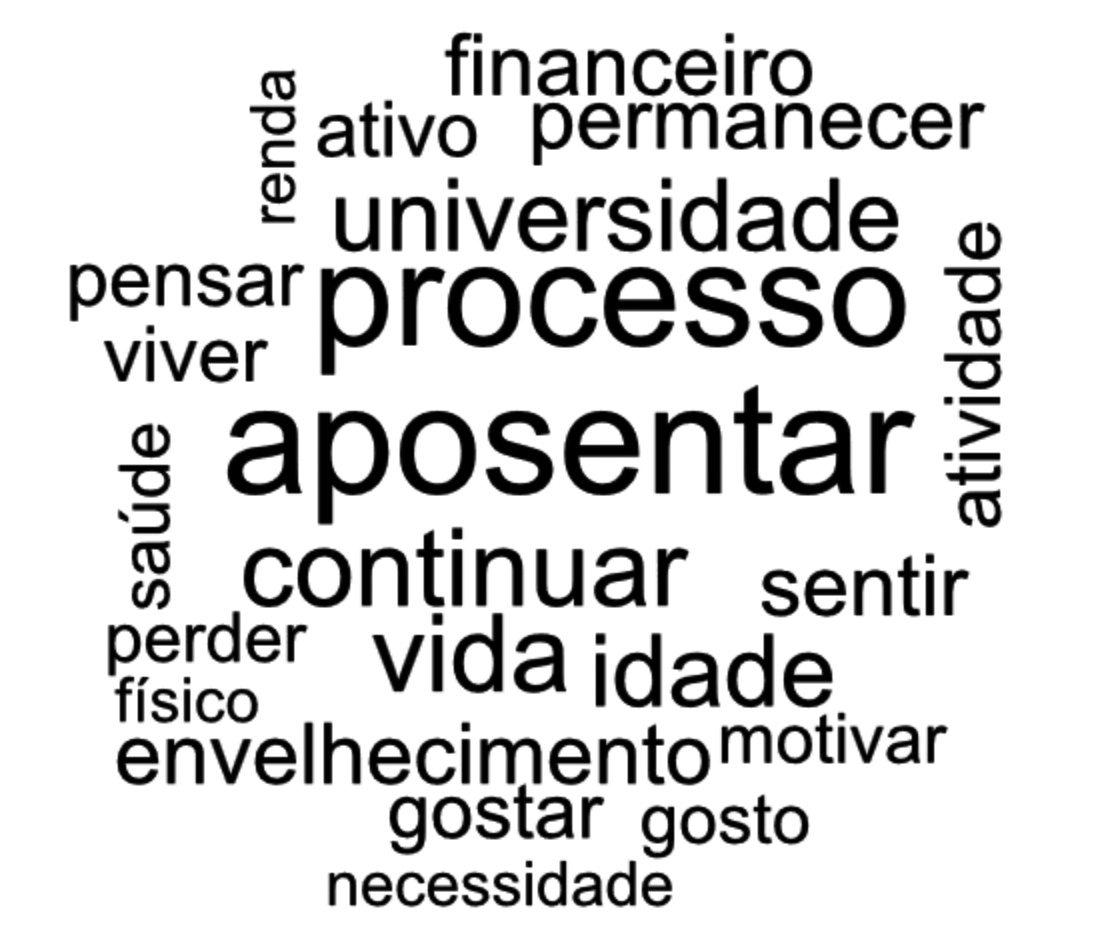
Analysis of the interview contents revealed the most frequently used words in participant dialogues: Retire (18); Process (17); Life (12); Continue (12); University (11); Age (11); Financial (9); Stay (9); Feel (9); Aging (9); Activity (8); Like (8); Live (8); Think (8); Active (8); Health (7); Motivate (7); Physical (6); Income 6); Necessity (6); Lose (7), (Figure 1).

Word cloud of distribution and importance of terms derived from interviews of study participants. Rio Grande do Norte state, 2023.
These expressions illustrate the main themes emerging from the dialogues, highlighting that retirement is understood as a process intrinsic to the institutional dynamic. In addition, the analysis encompasses less frequent themes, not ranking among the most commonly used words, but able to offer relevant perspectives for investigating similar patterns and the DHA analyses of the themes and concerns present in the dialogues.
A similarity analysis was performed to identify similarities and patterns among the different elements, including texts, words and data, yielding 4 pattern communities (Figure 2).
Analysis of similarity of word families in discourses of study participants. Rio Grande do Norte state, 2023.
The main community “postponed retirement” (green, centralized), formed by the words (retire, stay, like, continue, motivate, life, live), is associated with all perspectives and possibilities surrounding retirement, the idea of continuing working, the motivation to carry on working, the possibility of full retirement, and changing life habits.
A second community, “time to retire” (blue, centralized in upper part), comprises the words (time, lose, age, health), representing reflection on the time to retire, when health and age become central to the process influencing retirement.
The third community, “financial concerns” (lilac, to the right), represented by (finance, income, necessity), shows that participants had a high level of fear over economic issues, suggesting they are not sufficiently stable financially to enjoy retirement.
In the fourth community, “active aging” (red, to the left), a pattern exists justifying the reasons for continuing to work, encompassing aspects such as: liking what one does, engaging in active aging, and academic satisfaction in pursuing personal goals.
The study corpus was derived from 12 interviews, each taking an estimated 15-25 minutes, that was broken down into 69 text segments (TS), of which 52 TS were used, or 75.36% of the corpus analyzed. Of the data used, there were 2,436 occurrences (vocabulary items and expressions), 832 different words, and 531 that had a single occurrence.
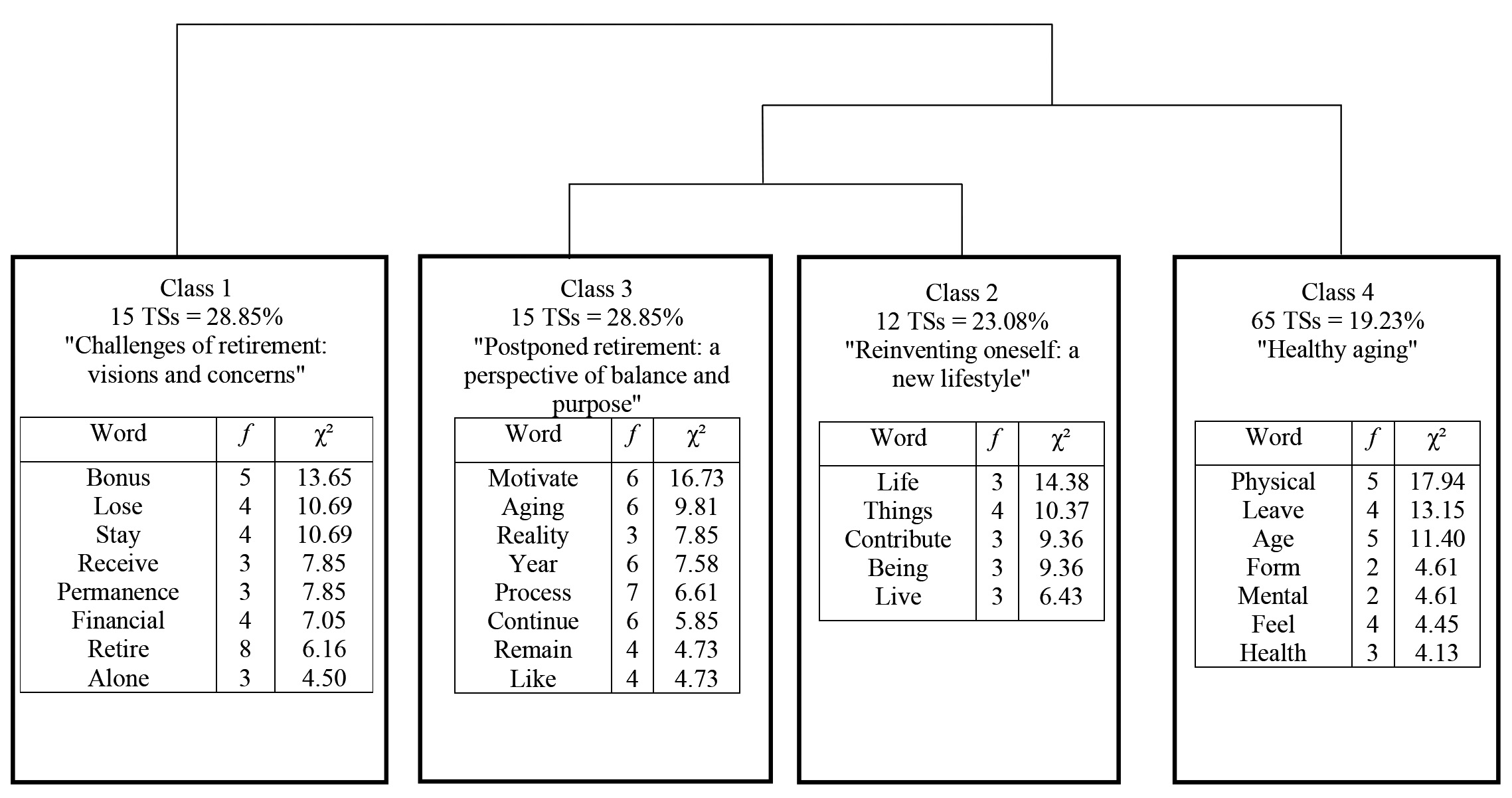
After content analysis of the interviews using DHC, four classes representing the corpus emerged: Class 1 – Challenges of retirement: visions and concerns; Class 2 – Reinventing oneself: a new lifestyle; Class 3 – Postponed retirement: a perspective of balance and purpose; Class 4 – “Healthy aging”. A direct relationship is evident between Classes 2 and 3, followed by Class 4, and lastly by Class 1 (Figure 3).
Dendrogram of classes of Descending Hierarchical Classification based on interviews with study participants. Rio Grande do Norte state, 2023.
In Class 1, an impasse emerged between financial stability and quality of life as a predominant factor in the decision to retire. In Class 2, there was a mix of different views on the transition to retirement. In Class 3, participants explored delaying retirement in pursuit of meaning and balance. Lastly, Class 4 exhibited different perspectives on leading a healthy active life over time.
Class 1 was called “challenges of retirement: visions and concerns”. This class accounted for 28.85% of the textual corpus, comprising words with interval ranging from x² = 13.65 (bonus) to x² = 4.50 (alone). Responses showed a host of dilemmas faced by individuals nearing retirement.
Many expressed concerns over losing benefits, such as bonuses and food vouchers, and with the direct impact of this on their routines and personal satisfaction. Also, the seeking of financial recognition, coupled with the appreciation for work, and fear of missing out on study activities and interaction, represented crucial aspect when considering the time to retire.
Class 2 was called “reinventing oneself: a new lifestyle”. Similarly, this class accounted for 23.08% of the textual corpus, comprising words with interval ranging from x² = 14.36 (life) to x² = 6.43 (live). Some respondents wished to keep the pace of life the same, postponing retirement until feeling fully ready for the change.
While some participants prioritized balance between work and pleasure, highlighting the pursuit of new objectives and personal realization, others emphasized the importance of contributing with knowledge acquired during their career, with a view to furthering society in areas of interest. Some participants expressed feelings of satisfaction and realization in the current job, whereas other sought to fill the vacuum that the absence of their children at home can create, finding in work a way to stay occupied, as well as a sense of purpose.
Class 3, called “postponed retirement: a perspective of balance and purpose”, accounted for 28.85% of the textual corpus. The class consisted of words with an interval ranging from x² = 16.73 (motivate) and x² = 4.73 (like). Other respondents found motivation in personal satisfaction and passion for their current occupations, challenging the traditional notion of retirement
Class 4, designated “health aging”, accounted for 19.23% of the textual corpus. The class comprised words with an interval ranging from x² = 17.94 (physical) and x² = 4.13 (health). Lastly, a number of participants expressed the understanding that chronological age does not serve as an absolute indicator of physical and mental abilities, placing emphasis on the importance of an active mind and health habits for a full life.
The TS, together with their respective degree of representativeness of the classes from the dendogram, are presented in Chart 1.
DISCUSSION
Most participants in this study met at least one of the criteria for retirement – albeit age, time in service or both. Exploring the relationship of these professionals with retirement, four main perspective were identified: financial challenges and concerns over losing benefits; the search for a new lifestyle that balances pleasure with work; postponement of retirement as a strategy for maintaining purpose and stability; and valorizing healthy living.
The analysis of similarities revealed thematic communities associated with the decision to stay active, economic concerns, and reflection on the ideal time to retire. The Descending Hierarchical Classification confirmed these tendencies, showing that financial stability, personal motivation and health were the main factors influencing this decision-making process. This scenario is consistent with the literature, which shows that the space for older individuals in society has grown significantly due to the increased life expectancy in Brazil, coupled with a decline in the birth rate. As a consequence, the country´s demographic structure shifted, as has occurred in other South-American nations16.
The results found highlighted the challenges and concerns of these employees regarding retirement, particularly with relation to financial losses and social involvement. In this respect, the influence of work on the quality of life of older adults is linked to the need for income. This influence, however, extends further, also involving the meaning attributed to work, such as the concept of identity, valorization, and personal development. Indeed, work can be considered an activity that promotes health and enables greater social involvement, independence and autonomy17. Thus, work can be deemed a key condition for human achievement in allowing transformative action on nature and itself, contributing to survival and personal realization18.
In this regard, the losses arising from social security reforms and the introduction of the permanence bonus has prompted public service employees, such as those in the present study, to delay the decision to retire19-22.
On the other hand, the fact that many people feel compelled to work owing to their financial situation, does not necessarily imply that work causes distress. On the contrary, in some situations working is associated with feelings of joy and positive experiences, promoting greater satisfaction, both personal and professional, and resulting in improved quality of life and healthy aging. It is clear that personal and external factors exert influence on the decision on what to do after retiring23.
Retirement often has an aura of uncertainty in relation to life in the future. This transition period, although expected, can trigger concerns and questions concerning financial changes, purpose, health and social interactions24. With this in mind, retirement preparation programs aim to assist employees during this transition phase25.
In terms of the need to reinvent oneself to continue working, work is often associated with self-image and identity as productive individuals with the physical ability to perform activities, being suggestive of the presence of healthier individuals both physically and mentally26.
However, this work-retirement transition can evoke feelings of inferiority, owing to the admission of younger, supposedly more up-to-date professionals. Hence, leaving an administrative post in the department or university, or showing a decline in academic output of publications, can trigger feelings of not belonging to the post held at work27.
Therefore, the retirement process is fraught with conflicting feelings and uncertainties which can be tackled in a positive fashion. A study analyzing the perception held by administrative technicians about the retirement process found that most individuals showed preparedness for retirement, with the decision supported by family member and motivated by having the necessary time. Expectations included having free time available, a quieter life and a drive for new habits and lifestyle23.
With regard to the time to retire, a study showed that age when leaving the job market is influenced by structural factors of the market and by the social security system, besides economic conditions, individual preferences and circumstances, whereby work often underpins an individual´s self-esteem, identity and sense of usefulness28. Thus, the multiple factors influencing the work-retirement decision, which has three possible courses of action: definitive retirement, delayed retirement staying in the same job, or working after retirement24.
Researchers report an association between educational level and remaining in the job market, a phenomenon evident in the sample investigated. The process of professional training can be a predictor for these professionals carrying on working, even when eligible to retire, viewing job retention as a way of achieving active aging10.
Therefore, retirement does not always mean leaving the world of work. Older employees are increasingly accepting bridge employment, which takes place when accepting a paid post after retiring from their main career28.
Another issue raised by the findings of this study relates to active aging. The work routine, involving repetitive activities and long shifts, can make the employee forget healthy habits in life, like engaging in physical exercise, falling into sedentarism29. In turn, this sedentary lifestyle can contribute to higher risk of developing chronic diseases such as obesity, diabetes, cardiovascular conditions and musculoskeletal problems30.
In this same context, psychological factors involving cognitive ability are indicators of active aging and longevity that are often stimulated during work, Hence, the more active an older adult in a line of work that requires cognitive effort, the greater their satisfaction with health and the better their ability to cope with adversities, thereby conferring enhanced quality of life31.
Thus, the continuation of older individuals in the workforce allows them to maintain their social circle and keep up the number of actions performed everyday, conferring greater protection against possible psychological decline associated with retirement and the problems caused by a steady decline in physical and mental functioning, promoting active healthy aging23.
Together with all the topics elected in the thematic axes, in order to have a later exit from the job market, it is fundamental to guarantee workers conditions congruent with their age, thereby avoiding risk of physical or mental illnesses. This means offering safe, healthy working conditions adapted to the current context of life of older adults, as well as promoting policies incentivizing health habits and self-care practices.
Therefore, it follows that preparing for retirement should be a positive experience, with help choosing future life activities, reorganizing the daily routine, controlling finances and promoting self-esteem. This underscores the role of public and private institutions in delivering programs preparing employees for retirement that offer reflection, support and strategies for defining and dealing with this phase of life, in an effort to render this process as healthy as possible.
Despite the strengths of this study in furthering understanding on the decision to continue working after being eligible for retirement, it is important to bear in mind the geographic limitations of the investigation, involving a single HEI in Grande do Norte state and thus reflecting only this specific reality.
CONCLUSION
The decision by public university employees to carry on working, despite being eligible for retirement, was found to be influenced by multiple factors. The most notable of these factors were financial necessity, identifying with work, maintaining a productive routine, and concerns over the impact of retirement on mental health and wellbeing. In addition, the academic environment and influence of colleagues also proved determinants, as did uncertainties associated with changes in the social security system. These aspects revealed that the decision to carry on working transcends the economic sphere, encompassing underlying subjective and institutional reasons.
The study findings corroborate evidence in the literature on the meanings of retirement, highlighting the complexity and multi-dimensional nature of this transition. The analysis of the perceptions held by the public servants underscores the need for individualized holistic approaches to support individuals with this process, taking into account the financial, psychological and social aspects involved. These results highlight the importance of specific policies and programs catering for the needs of these employees, with a view to mitigating the negative impacts and promoting a more satisfactory balanced transition to retirement.
ACKNOWLEDGMENTS
This study was financed in part by the Coordenação de Aperfeiçoamento de Pessoal de Nível Superior – Brasil (CAPES) – Finance Code 001.
References
-
1 Behr LC, Simm A, Kluttig A, Grosskopf (Großkopf) A. 60 Years of Healthy Aging: On Definitions, Biomarkers, Scores and Challenges. Ageing Res Rev [Internet]. Abr 2023 [citado em 04 out. 2023]:101934. Disponível em: https://doi.org/10.1016/j.arr.2023.101934
» https://doi.org/10.1016/j.arr.2023.101934 -
2 Ageing and health [Internet]. [citado em 5 ago. 2024]. Disponível em: https://www.who.int/news-room/fact-sheets/detail/ageing-and-health
» https://www.who.int/news-room/fact-sheets/detail/ageing-and-health -
3 United Nations [internet]. [citado em 5 ago. 2024]. Department of Economic and Social Affairs. World Population Ageing 2023: Challenges and opportunities of population ageing in the least developed countries. Disponível em: https://desapublications.un.org/publications/world-population-ageing-2023-challenges-and-opportunities-population-ageing-least
» https://desapublications.un.org/publications/world-population-ageing-2023-challenges-and-opportunities-population-ageing-least -
4 De Lima AV, Konrad J. A Transição Demográfica no Brasil e o Impacto na Previdência Social. Bol Econ Empírica. [citado em 7 maio 2020]; 1(2). Disponível em: https://www.portaldeperiodicos.idp.edu.br/bee/article/view/4112
» https://www.portaldeperiodicos.idp.edu.br/bee/article/view/4112 - 5 Neves DR, Nascimento RP, Felix Jr MS, Silva FA, Andrade RO. Sentido e significado do trabalho: uma análise dos artigos publicados em periódicos associados à Scientific Periodicals Electronic Library. Cad EBAPE BR [Internet]. Jun 2018 [citado em 03 out. 2023];16(2):318-30. Disponível em: https://doi.org/10.1590/1679-395159388.
-
6 Pazos PD, Ferreira AP. Pessoa idosa, mercado de trabalho, idadismo e a saúde do trabalhador: revisão de escopo. Rev Bras Geriatr Gerontol [Internet]. 2024 [citado em 5 ago. 2024]; 27. Disponível em: https://doi.org/10.1590/1981-22562024027.240004.pt
» https://doi.org/10.1590/1981-22562024027.240004.pt -
7 Pazos PD, Bonfatti RJ. Velhice, trabalho e saúde do trabalhador no Brasil: uma revisão integrativa. Rev Bras Geriatr Gerontol [Internet]. 2020 [citado em 5 ago. 2024]; 23(6). Disponível em: https://doi.org/10.1590/1981-22562020023.200198
» https://doi.org/10.1590/1981-22562020023.200198 - 8 Teixeira RM, Andrade VLP de. O Idoso na Busca por um Lugar no Mercado de Trabalho. Cad Psicol. 2019;1(2):515-35. Disponível em: https://doi.org/10.5281/zenodo.13887190.
- 9 Andrade L, Torres C. Retirement and Meaning Attribution: a study with active workers in Brazil. Psicol Teor Pesq [Internet]. 2020 [citado em 03 out. 2023];36. Disponível em: https://doi.org/10.1590/0102.3772e3652.
-
10 Macêdo LS, Bendassolli PF, Torres TD. Representações sociais da aposentadoria e intenção de continuar trabalhando. Psicol Amp Soc [Internet]. 2017 [citado em 03 out. 2023]; 29. Disponível em: https://doi.org/10.1590/1807-0310/2017v29145010
» https://doi.org/10.1590/1807-0310/2017v29145010 -
11 Minayo MC de S. Amostragem e saturação em pesquisa qualitativa: consensos e controvérsias. Revista Pesquisa Qualitativa [Internet]. 2017 [citado em 03 out. 2023]; 5(7). Disponível em: https://editora.sepq.org.br/rpq/article/view/82
» https://editora.sepq.org.br/rpq/article/view/82 -
12 Universidade Federal do Rio Grande do Norte. Portal de Acesso à Informação [Internet]. [citado em 17 abr 2025]. Disponível em: https://acessoainformacao.ufrn.br/
» https://acessoainformacao.ufrn.br/ - 13 Bardin L. Análise de conteúdo. São Paulo: Edições 70; 2016.
- 14 Sousa YSO, Gondim SMG, Carias IA, Batista JS, Machado KCM de. O uso do software Iramuteq na análise de dados de entrevistas. Pesqui Prát Psicosoc. 2020 ;15(2):1-19. Disponível em: http://pepsic.bvsalud.org/scielo.php?script=sci_arttext&pid=S1809-89082020000200015.
- 15 Ratinaud P, Marchand P. Application de la méthode ALCESTE aux « gros » corpus et stabilité des « mondes lexicaux » : analyse du « CableGate » avec IRAMUTEQ. Actes 11eme Journ Int Anál Dados Text. 2012;3:835-44. Disponível em: https://www.academia.edu/77027710/Application_de_la_m%C3%A9thode_ALCESTE_aux_gros_corpus_et_stabilit%C3%A9_des_mondes_lexicaux_analyse_du_CableGate_avec_IRAMUTEQ.
- 16 Escorsim SM. O envelhecimento no Brasil: aspectos sociais, políticos e demográficos em análise. Serv Soc Amp Soc [Internet]. Dez 2021 [citado em 17 abr 2025];(142):427-46. Disponível em: https://doi.org/10.1590/0101-6628.258.
- 17 Costa IP, Bezerra VP, Pontes MD, Moreira MA, Oliveira FB, Pimenta CJ, Silva CR, Silva AO. Qualidade de vida de idosos e sua relação com o trabalho. Rev Gauch Enferm [Internet]. 2018;39 [citado em 17 abr 2025]. Disponível em: https://doi.org/10.1590/1983-1447.2018.2017-0213.
- 18 Carneiro MD, Alves VP, Silva HS. Aposentadoria e planejamento para vida pós-trabalho: um estudo com servidores de um Instituto Federal de Educação. Rev Bras Geriatr Gerontol [Internet]. 2021 [citado em 04 mai 2024];24(1). Disponível em: https://doi.org/10.1590/1981-22562020023.200235.
-
19 Brasil. Emenda Constitucional nº 103 [Internet]. 12 Nov 2019. Altera o sistema de previdência social e estabelece regras de transição e disposições transitórias. Disponível em: https://www.planalto.gov.br/ccivil_03/constituicao/emendas/emc/emc103.htm
» https://www.planalto.gov.br/ccivil_03/constituicao/emendas/emc/emc103.htm -
20 Universidade Federal do Rio Grande do Norte (UFRN). Aposentadoria e Pensões. Direitos e Deveres. PROGESP. 2020. [citado em 04 mai 2024]. Disponível em: https://progesp.ufrn.br/secao/direitos-deveres
» https://progesp.ufrn.br/secao/direitos-deveres -
21 Universidade Federal do Rio Grande do Norte. Cartilha reforma da previdência - emenda constitucional n° 103/2019 [Internet]. Edufrn; 2019 [citado em 04 mai 2024]. Disponível em: https://progesp.ufrn.br/storage/documentos/HCyx4SbgMjBJC8t4v9lsLeGPB9VFAlPwelJFketl.pdf
» https://progesp.ufrn.br/storage/documentos/HCyx4SbgMjBJC8t4v9lsLeGPB9VFAlPwelJFketl.pdf - 22 Oliveira RC, Coelho RH. Efeitos das aposentadorias por tempo de contribuição e por idade sobre saúde e bem-estar dos indivíduos no Brasil. Cad Saude Publica [Internet]. 2021;37(10) [citado em 17 abr 2025]; Disponível em: https://doi.org/10.1590/0102-311x00084120.
- 23 Silva ML da, Silva Nilson R da, Rosa SS. Percepção de técnicos administrativos sobre o processo e Programa de preparação para aposentadoria. Saúde (Santa Maria) [Internet]. 2022 [citado em 17 abr 2025];48(1). Disponível em: https://periodicos.ufsm.br/revistasaude/article/view/65470.
- 24 Soares SSS, Costa CCP da, Oliveira CR de, Souza NVD de O. Teoria das Representações Sociais e os Sentidos da Aposentadoria no Brasil. Rev enferm UERJ. 2022;30(1):e59798. Disponível em: https://doi.org/10.12957/reuerj.2022.59798.
- 25 Vieira JF de F, Graeff B. Programas de preparação para aposentadoria no brasil: uma revisão de literatura. Estudos Interdisciplinares sobre o Envelhecimento [Internet]. 2020 [citado em 23 abr 2025];25(3). Disponível em: https://doi.org/10.22456/2316-2171.93976.
- 26 Silva LS, Machado EL, Oliveira HN, Ribeiro AP. Condições de trabalho e falta de informações sobre o impacto da COVID-19 entre trabalhadores da saúde. Rev Bras Saude Ocupacional [Internet]. 2020 [citado em 17 abr 2025];45. Disponível em: https://doi.org/10.1590/2317-6369000014520.
- 27 Carvalho LSM de, Rodrigues MDS, Oliveira AL de, Heleno MGV. Aposentadoria na perspectiva de trabalhadores do setor privado. Mud Pesqui Soc. 2021;29(1):21–31. Disponível em: https://pepsic.bvsalud.org/scielo.php?script=sci_arttext&pid=S0104-32692021000100003.
- 28 Santos GL dos, Longo MR. A reforma da previdência e seus reflexos para a concessão de aposentadoria aos seus segurados. Direito Fabe - Revista Jurídica [Internet]. 2022 [citado em 17 abr 2025];1(1). Disponível em: https://fabemarau.edu.br/seer/index.php/direitofabe/article/view/26/25.
-
29 Mori AE. Desafios do executivo aposentado: conflitos e perspectivas - uma leitura junguiana [dissertação Pontifícia Universidade Católica de São Paulo]. 2015 [citado em 07 ago 2024]. Disponível em: https://repositorio.pucsp.br/jspui/handle/handle/15387
» https://repositorio.pucsp.br/jspui/handle/handle/15387 - 30 Mathes Faustino MA, Neves R. Benefícios da prática de atividade física em pessoas idosas: revisão de literatura. Rev Eletronica Acervo Saude [Internet]. 26 mar 2020 [citado em 17 abr 2025];12(5):e3012. Disponível em: https://doi.org/10.25248/reas.e3012.2020.
- 31 Santos VP dos, Carreta PM. Aspectos sociais e psicológicos frente à falta de planejamento e preparação para aposentadoria na terceira idade. Rev Farol [Internet]. 2018 [citado em 23 abr 2025];6(6). Disponível em: https://revista.farol.edu.br/index.php/farol/article/view/128.
Edited by
-
Edited by
Rayssa Horacio Lopes