 Unipedal stance test as a risk marker for falls in older adults: accuracy analysis of a binary classification model
Abstract
Objective To investigate the accuracy of the Unipedal Stance Test as a risk marker for falls in older adults using receiver operating characteristic (ROC) curve analysis.
Method Fifty-eight older adults (15 men and 43 women) participated in the study, with a mean age of 66.9 (65.3–68.5) years, mean height of 1.61 ± 0.09 m, and mean body mass of 67.6 ± 11.6 kg. The Unipedal Stance Test and the Mini-Balance Evaluation Systems Test (Mini-BESTest), an instrument that assesses functional balance including transitions, anticipatory postural control, reactive postural control, sensory orientation, and gait stability, were administered. Statistical analysis included the Mann–Whitney U test and ROC curve analysis to verify the discriminative ability of the Unipedal Stance Test in relation to Mini-BESTest performance. The significance level was set at 5%.
Results Median Unipedal Stance Test (eyes open) was 27.49 seconds for the low fall-risk group and 12.47 seconds for the high fall-risk group. The area under the ROC curve was 0.828. The cutoff point ≤16.9 seconds showed 81.8% sensitivity and 80.9% specificity. The positive likelihood ratio (LR+ = 4.27) indicated that older adults with stance times ≤16.9 seconds were approximately four times more likely to exhibit postural imbalance.
Conclusion The Unipedal Stance Test proved to be a practical and effective tool for discriminating older adults with greater postural vulnerability, reinforcing its clinical utility for fall-risk screening.
Keywords
Postural Balance; Aged; Health of the Elderly; Accidental Falls.
Resumo
Objetivo Investigar a acurácia do teste de apoio unipodal como marcador de risco de quedas em pessoas idosas, por meio da análise da curva ROC.
Método Participaram 58 pessoas idosas (15 homens e 43 mulheres) com idade média de 66,9 (65,3 – 68,5) anos, estatura média de 1,61±0,09 m e massa corporal média de 67,6±11,6 kg. Foram aplicados o teste de apoio unipodal e o <italic>Mini-Balance Evaluation Systems Test</italic> (Mini-BESTest), instrumento que avalia o equilíbrio funcional, abrangendo transições e controle postural antecipatório, controle postural reativo, orientação sensorial e estabilidade da marcha. A análise estatística incluiu o teste U de Mann-Whitney e a curva ROC, utilizada para verificar a capacidade discriminativa do teste de apoio unipodal em relação ao desempenho no Mini-BESTest. O nível de significância adotado foi de 5%.
Resultados O tempo mediano no teste de apoio unipodal com olhos abertos de 27,49 segundos para o grupo de baixo risco de quedas e 12,47 segundos para o grupo de alto risco. A área sob a curva ROC foi de 0,828. O ponto de corte ≤16,9 segundos apresentou sensibilidade de 81,8% e especificidade de 80,9%. A razão de verossimilhança positiva (RV+= 4,27) indicou que pessoas idosas com tempo ≤16,9 segundos foram cerca de quatro vezes mais propensas a apresentarem desequilíbrio postural.
Conclusão O teste de apoio unipodal mostrou-se uma ferramenta prática e eficaz para discriminar pessoas idosas com maior vulnerabilidade postural, reforçando sua utilidade clínica para triagem do risco de quedas.
Palavras-chave
Equilíbrio Postural; Pessoa Idosa; Saúde da Pessoa Idosa; Acidentes por Quedas.
INTRODUCTION
Body control is an essential component for maintaining autonomy and quality of life in older adults, especially considering the physiological changes associated with aging, such as reduced muscle strength, diminished somatosensory sensitivity, and decreased sensorimotor integration capacity1-4. Postural control refers to the ability of the nervous and musculoskeletal systems to keep the body in balance, that is, within the limits of the base of support, either in a static position or during movement. Thus, the term balance is used as the outcome of postural control, whereas postural instability describes the loss of this capacity5,6.
These changes, which increase the risk of imbalance and, consequently, of falls, are considered one of the major public health problems among older adults because they are associated with fractures, hospitalizations, fear of falling, and functional decline7,8. Data from the World Health Organization (WHO)9 indicate that approximately 30% of individuals aged 65 years or older experience at least one fall per year, a rate that may reach 50% among those over 80 years. Falls represent the second leading cause of death from unintentional injuries worldwide, accounting for nearly 684,000 deaths annually, predominantly affecting individuals over 60 years of age. Brazilian data from the Hospital Information System of the Unified Health System (SIH/SUS)10 show that, in 2022 alone, more than 120,000 hospital admissions of older adults were fall-related, imposing a substantial burden on the public health system. In addition to hospitalizations, falls frequently result in fractures, loss of functional independence, institutionalization, and even death.
Given this scenario, promoting and maintaining balance are fundamental for the safe performance of activities of daily living and physical activity, contributing significantly to quality of life and to reducing the risk of falls and fractures in this population11-13.
Studies indicate that older adults tend to exhibit greater postural instability than younger adults, particularly in challenging tasks such as the unipedal stance. This instability may lead to reduced time maintaining the position, suggesting an increased risk of falls7. Clinically, this highlights the need for assessments that support health professionals in early detection and/or monitoring of interventions.
The Mini-Balance Evaluation Systems Test (Mini-BESTest) is widely recognized as a comprehensive and sensitive instrument for assessing postural control in older adults, encompassing different postural control systems that contribute to balance14-16. Although it is a well-established and sensitive method for postural assessment, the number of items included in the protocol and the extended time required for scoring may limit its use in daily clinical practice.
In contrast, the literature describes simple postural assessments that incorporate postural challenges, such as the Unipedal Stance Test17, in which individuals must remain standing on one leg for as long as possible. This test is directly related to balance capacity and is notable for its ease of administration, low cost, and ability to simulate everyday situations requiring single-limb support, such as walking or climbing steps18.
However, for its use in clinical practice to be more accurate, it is necessary to establish objective parameters that allow for more reliable classification of fall risk19,20. Its widespread clinical acceptance depends on the test providing evaluators with a clear cutoff point, which is particularly useful for older adults.
In this context, analyzing the accuracy of Unipedal Stance Time in relation to Mini-BESTest scores using receiver operating characteristic (ROC) curve analysis may offer a practical and validated tool for the early identification of older adults at higher risk of falls.
Therefore, this study aimed to investigate the accuracy of the Unipedal Stance Test as a fall-risk marker in this age group using ROC curve analysis.
METHOD
This was an observational cross-sectional study21. The study sample consisted of 58 older adults (15 men and 43 women), with a mean age of 66.9 (65.3–68.5) years, mean height of 1.61 ± 0.09 m, and mean body mass of 67.6 ± 11.6 kg. Among the participants, 46 reported engaging regularly in physical activity, whereas 12 were physically inactive. For the sample size calculation, a two-sample independent t-test was used, assuming a large effect size (d = 0.8), a significance level of α = 0.05, and a statistical power of 80% (0.80).
The study was conducted in accordance with the ethical principles established by Resolution No. 466/2012 of the Brazilian National Health Council. The protocol was approved by the Research Ethics Committee for Human Subjects at the Universidade Estadual de Maringá (UEM) (CAEE: 83440724.3.0000.0104; Approval No.: 7.152.153). All participants were fully informed about the study objectives and procedures and signed the Informed Consent Form (ICF) prior to participation. The inclusion criterion was being aged 60 years or older. The exclusion criterion was participant self-report indicating inadequate physical conditions to perform the proposed tests.
Data collection was conducted in a single session at the Biomechanics and Motor Behavior Laboratory between December 2024 and February 2025. Upon arrival at the assessment site, participants were welcomed and informed about the study objectives and procedures. After any questions were clarified, all participants signed the ICF.
Information regarding age (in years) and anthropometric measurements of body mass (in kilograms, kg) and height (in meters, m) was collected. These measurements were obtained using the same digital scale and the same stadiometer (Edulab®), both properly calibrated according to the manufacturer’s instructions prior to data collection. All assessments were performed by a single evaluator who had been previously trained to standardize procedures and minimize potential measurement bias.
After the anthropometric measurements were recorded, the Unipedal Stance Test17 and the Mini-BESTest14 were administered in the same session, following a standardized sequence for all participants.
The Unipedal Stance Test was used to assess postural stability under a reduced base-of-support condition. Participants were instructed to stand without external support, bearing their body weight on only one leg for up to 30 seconds15. The test was performed under the visual condition: eyes open.
Each participant freely chose the support leg, that is, the leg they felt most comfortable using for the test. To perform the test, the participant began in a bipedal position with the arms alongside the body; then the knee of the non-support leg was flexed backward until the foot was completely off the ground, and the participant remained in unipedal stance for as long as possible, with a maximum duration of 30 seconds per trial. Three trials were performed, and for each participant, the mean Unipedal Stance Time was calculated. All participants wore light and comfortable clothing to ensure that attire did not restrict test performance.
During the test, the actual time spent maintaining balance was recorded if the participant did not reach the 30-second limit.
The Mini-BESTest assesses functional balance, specifically anticipatory postural adjustments, reactive postural control, sensory orientation, and gait stability. The Mini-BESTest consists of 14 subtests scored from 0 (lowest functional level) to 2 (highest functional level). The maximum score is 28 points16.
The Mini-BESTest cutoff score varies by age group: 25 points for individuals aged 60–69 years, 21 points for those aged 70–79 years, and 20 points for individuals aged 80–89 years. Participants were classified as high or low fall risk based on these cutoff values, according to the method proposed by Almeida, Marques, and Santos22.
Initially, the type of distribution of the variables was assessed using the Kolmogorov-Smirnov normality test. After classifying participants into high- and low-risk groups based on the Unipedal Stance Test, the normality analysis revealed that the high-risk group showed a normal distribution, whereas the low-risk group did not. Given this result, nonparametric statistical tests were selected. For between-group comparisons, the Mann-Whitney U test was used. A Receiver Operating Characteristic (ROC) curve analysis was also conducted to evaluate the accuracy of continuous variables in discriminating between groups, extracting the area under the curve (AUC), cutoff points, and their corresponding sensitivity and specificity values. The significance level adopted was 5%.
DATA AVAILABILITY
The dataset is not publicly available in order to safeguard the privacy of the study participants and was used exclusively for the purposes of this publication.
RESULTS
Table 1 presents the comparison of Unipedal Stance Test results according to the Mini-BESTest classification.
Comparison of Unipedal Stance Test results according to Mini-BESTest classification (n = 58). Maringá, PR, 2025.
The analysis of the Unipedal Stance Test (eyes open) showed that participants classified as low fall risk by the Mini-BESTest performed better than those in the high-risk group.
Table 2 presents the statistical parameters obtained from the ROC curve analysis for the Unipedal OA variable, including the standard error, confidence interval, sensitivity and specificity values, and the positive and negative likelihood ratios used to discriminate the parameter indicative of fall risk.
Statistical parameters of the area under the curve and 95% confidence interval for ROC curve analysis (n = 58). Maringá, PR, 2025.
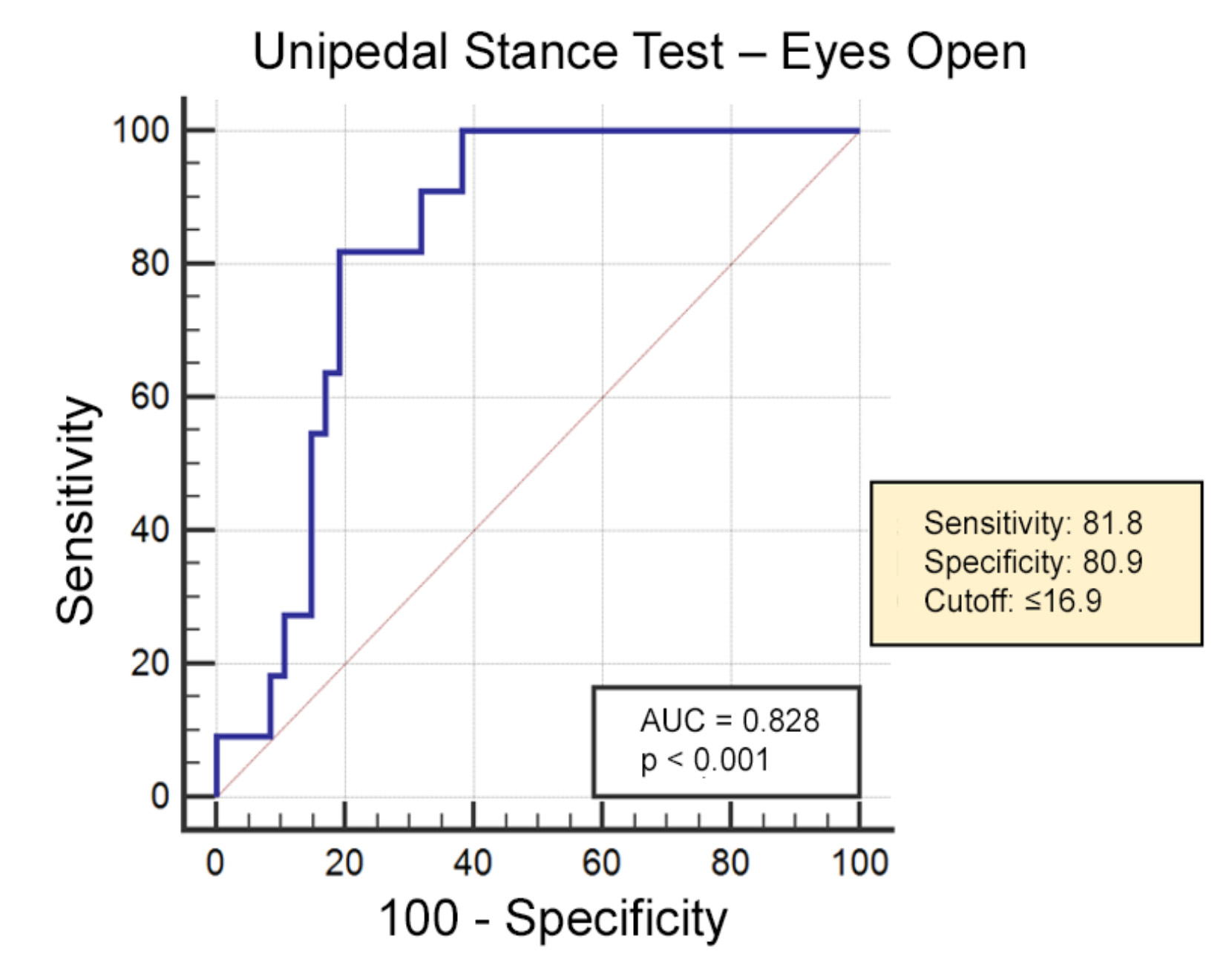
The area under the curve (AUC) was 0.828 (standard error: 0.054; 95% CI: 0.706–0.914), indicating excellent discriminatory ability of the Unipedal Stance Test (eyes open). The p value < 0.0001 confirms the statistical significance of the curve, suggesting that the test’s performance in predicting fall risk is significantly better than chance.
The optimal cutoff point identified was ≤16.9 seconds, which demonstrated a good balance between sensitivity (81.8%) and specificity (80.9%). This indicates that the test is effective both for identifying older adults at risk and for excluding those who are not at risk. The positive likelihood ratio (LR+ = 4.27) shows that an older adult with a time ≤ 16.9 seconds is approximately four times more likely to be at risk of imbalance, whereas the negative likelihood ratio (LR– = 0.22) suggests that a result above this cutoff point substantially reduces the probability of risk.
The discriminatory ability of the test is illustrated in the ROC curve (Figure 1), which illustrates the relationship between sensitivity and specificity. The shape of the curve reinforces the satisfactory performance of the test in classifying older adults according to risk of imbalance.

The ROC curve for the Unipedal Stance Test (eyes open) illustrates the test’s discriminatory performance, reinforcing its clinical utility. The curve departs substantially from the line of chance, demonstrating the test’s ability to appropriately distinguish between high-risk and low-risk groups.
In summary, the optimal cutoff point of ≤16.9 seconds demonstrated a good balance between sensitivity (81.8%) and specificity (80.9%). These findings, together with the AUC of 0.828 (95% CI: 0.706–0.914; p <0.0001), indicate that the test is effective in predicting fall risk in older adults.
DISCUSSION
The results revealed significant differences between the low- and high-risk groups across the analyzed variables. The Mini-BESTest is a functional test that assesses different components of balance. In this test, higher scores indicate better postural control and lower fall risk15,16. Thus, the findings of this study showed that individuals classified as high risk for falls according to the Mini-BESTest exhibited shorter times on the Unipedal Stance Test. This indicates that individuals with a greater propensity for falls have reduced postural stability and a diminished ability to maintain balance on a reduced base of support.
The findings also demonstrate that the Unipedal Stance Test (eyes open) has good ability to discriminate risk of imbalance in older adults. Compared with the Mini-BESTest, it is a simpler, more accessible, and easy-to-administer instrument, useful in both clinical and community settings. Studies such as Kozinc et al.23 likewise recognize the importance of this test as a functional marker.
In the ROC curve analysis for Unipedal Stance Time, an area under the curve (AUC) of 0.828 (95% CI: 0.706–0.914; p < 0.0001) was observed, indicating excellent discriminatory ability for identifying individuals at higher risk of imbalance. The identified cutoff point was ≤16.9 seconds, with a sensitivity of 81.8% and specificity of 80.9%, demonstrating high accuracy in distinguishing between the high-risk and low-risk groups according to the Mini-BESTest classification.
These results are consistent with previous findings in the literature validating the use of simple clinical tests as predictors of fall risk. According to Springer et al.24, the Unipedal Stance Test has good predictive validity, and times below 20 seconds are associated with an increased risk of falls, particularly among older adults. The present study corroborates these findings and adds, as a distinguishing contribution, an analysis of the test’s accuracy, highlighting its effectiveness in identifying individuals with greater postural vulnerability. Similarly, Hurvitz et al.25 emphasize that reduced Unipedal Stance Time may reflect impairments in sensory, motor, and central integration systems, all of which are essential for maintaining postural balance.
The high sensitivity and specificity observed in this study reinforce the clinical applicability of the Unipedal Stance Test as a screening tool. As discussed by Swets26 in analyses of diagnostic performance, and by De Abreu et al.19 and Brown et al.20 in studies involving older adults, AUC values between 0.8 and 0.9 are classified as excellent for diagnostic discrimination, suggesting that the evaluated test is effective both for identifying individuals at risk (sensitivity) and for ruling out those who are not at risk (specificity).
With aging, several changes occur across body systems, affecting quality of life and the ability to perform daily activities1. In the visual system, there is a reduction in visual acuity, along with decreased sensitivity to contrast and light, which impairs depth perception and adaptation to environments with different lighting levels. In the vestibular system, there is a decline in hair cells and vestibular sensitivity, compromising motion perception and spatial orientation. The somatosensory system also undergoes declines, including reduced tactile and proprioceptive sensitivity, limiting the ability to perceive and monitor body position2,4.
Moreover, the process of integrating these sensory inputs in the brain becomes less efficient with advancing age, resulting in slower reaction times and reduced ability to adapt to environmental changes. These alterations, combined with loss of muscle strength and flexibility, increase the risk of falls in older adults, affecting their autonomy and safety2,4.
Another factor related to balance is muscle strength, which is essential for maintaining the body in a stable posture and performing adequate adjustments to sustain this position. Wang et al.27 investigated the relationship among postural stability, muscle strength, and proprioception in 152 individuals aged 60 years or older, divided into two age groups (65–74 years and ≥75 years). The results showed that muscle strength was significantly associated with performance on balance and functional mobility tests in both groups, whereas proprioception remained correlated only among the younger participants. These findings indicate that, particularly in older adults aged 75 years or more, muscle strength plays a decisive role in maintaining balance, reinforcing its importance for postural stability and fall prevention in this population.
This study presents some limitations that should be considered when interpreting the findings. Limitations include its cross-sectional design and non-probabilistic sample. The proportion of individuals classified as high risk (n = 11; 18.97%) was relatively low, which may have influenced the precision of complementary measures such as positive and negative predictive values. In addition, specific characteristics of the sample, such as predominant age range, presence of comorbidities, and level of physical activity, may have influenced performance on the balance tests and should be considered when interpreting the generalizability of the results.
CONCLUSION
This study aimed to investigate the accuracy of the Unipedal Stance Test as a marker of fall risk in older adults using ROC curve analysis.
The results demonstrate that the Unipedal Stance Test is a practical and effective tool for discriminating individuals with greater postural vulnerability. The cutoff point of ≤16.9 seconds presented a sensitivity of 81.8% and a specificity of 80.9%, reinforcing its clinical utility.
The findings contribute to the fields of Geriatrics and Gerontology by emphasizing the importance of simple functional assessments for fall-risk screening. These results support the planning of local prevention initiatives and programs focused on strengthening and balance training for this population.
Future research should consider longitudinal studies examining the relationship between test performance and fall occurrence, as well as include more diverse profiles of older adults, to enhance the applicability and accuracy of assessment and intervention protocols.
ACKNOWLEDGMENTS
We thank the Coordenação de Aperfeiçoamento de Pessoal de Nível Superior (CAPES) for the scholarship awarded through the Social Demand Program.
References
- 1 Shumway-Cook A, Woollacott MH. Controle motor teoria e aplicações práticas. 3. ed. Barueri Manole; 2010.
- 2 Silva DF, Silva L de M, Oliveira TF, Martelli A, Delbim L. Sarcopenia em idosos: envelhecimento, exercícios resistidos e reserva funcional. Revista Faculdades Do Saber 2021;6 (12):804–13.
- 3 Macena WG, Hermano LO, Costa TC. Alterações fisiológicas decorrentes do envelhecimento. Mosaicum 2018:223–38. https://doi.org/10.26893/rm.v15i27.64.
- 4 Pontes FGA, Turibio TDO, Pedreira RC, Pontes HAN, Vieira BMS, Barbosa MT, et al. Senescência e mudanças corporais: uma análise abrangente das alterações fisiológicas e funcionais no envelhecimento. Cad Pedagógico 2025; 22:e13561.https://doi.org/10.54033/cadpedv22n1-212.
- 5 HAMILL J, KNUTZEN KM, DERRICK TR. Bases biomecânicas do movimento humano. 4th ed. Barueri: Editora Manole; 2016.
- 6 Sung PS, Lee D. Effects of Visual Input on Postural Stability and Compensatory Strategies in Adults with Chronic Low Back Pain. Vision 2025; 9:14. https://doi.org/10.3390/vision9010014.
-
7 Lahr SLN, Ugrinowitsch H, Santos LLP dos, Andrade AGP de, Benda RN. Efeitos do envelhecimento e da base de suporte no controle postural 2017. https://doi.org/10.11606/1807-5509201700010083
» https://doi.org/10.11606/1807-5509201700010083 - 8 Vaishya R, Vaish A. Falls in Older Adults are Serious. IJOO 2020; 54:69–74. https://doi.org/10.1007/s43465-019-00037-x.
-
9 ORGANIZAÇÃO MUNDIAL DA SAÚDE (OMS). Falls. Geneva: World Health Organization, 2021. Disponível em: https://www.who.int/news-room/fact-sheets/detail/falls Acesso em: 28 jun. 2025.
» https://www.who.int/news-room/fact-sheets/detail/falls -
10 BRASIL. Ministério da Saúde. DATASUS – Departamento de Informática do SUS. Sistema de Informações Hospitalares do SUS (SIH/SUS). Brasília, 2022. Disponível em: http://tabnet.datasus.gov.br/cgi/tabcgi.exe?sih/cnv/niuf.def Acesso em: 28 jun. 2025.
» http://tabnet.datasus.gov.br/cgi/tabcgi.exe?sih/cnv/niuf.def - 11 Mann L, Kleinpaul JF, Teixeira CS, Rossi AG, Lopes LFD, Mota CB. Investigação do equilíbrio corporal em idosos. Rev Bras Geriatr Gerontol 2008; 11:155–65. https://doi.org/10.1590/1809-9823.2008.11023.
- 12 Duarte M, Freitas SMSF. Revisão sobre posturografia baseada em plataforma de força para avaliação do equilíbrio. Rev Bras Fisioter 2010; 14:183–92. https://doi.org/10.1590/S1413-35552010000300003.
- 13 Dourado FW, Moreira ACA, Salles DL, Silva MAMD. Intervenções para prevenção de quedas em idosos na Atenção Primária: revisão sistemática. Acta Paulista de Enfermagem 2022; 35:eAPE02256. https://doi.org/10.37689/acta-ape/2022AR022566.
- 14 Horak FB, Wrisley DM, Frank J. The Balance Evaluation Systems Test (BESTest) to Differentiate Balance Deficits. Physical Therapy 2009; 89:484–98. https://doi.org/10.2522/ptj.20080071.
- 15 Liao W-Y, Chu Y-H, Liu F-Y, Chang K-M, Chou L-W. Cutoff Point of Mini-Balance Evaluation Systems Test Scores for Elderly Estimated by Center of Pressure Measurements by Linear Regression and Decision Tree Classification. Life 2022; 12:2133. https://doi.org/10.3390/life12122133.
- 16 Batistela RA, Rinaldi NM, Moraes R. Mini-BESTest cutoff points for classifying fallers and non-fallers female older adults. BJMB 2023; 17:155–62. https://doi.org/10.20338/bjmb.v17i4.354.
- 17 Freitas ERFSD, Rogério FRPG, Yamacita CM, Vareschi MDL, Silva RAD. Prática habitual de atividade física afeta o equilíbrio de idosas? Fisioter Mov 2013; 26:813–21. https://doi.org/10.1590/S0103-51502013000400010.
- 18 Oliveira MR, Vieira ER, Gil AWO, Fernandes KBP, Teixeira DC, Amorim CF, et al. One-legged stance sway of older adults with and without falls. PLoS ONE 2018; 13: e0203887. https://doi.org/10.1371/journal.pone.0203887.
- 19 De Abreu DCC, Bandeira ACL, Magnani PE, De Oliveira Grigoletto DA, De Faria Junior JR, Teixeira VRS, et al. Standing balance test for fall prediction in older adults: a 6-month longitudinal study. BMC Geriatr 2024; 24:947. https://doi.org/10.1186/s12877-024-05380-9.
- 20 Brown C, Oktapodas Feiler M, Anson ER, Simonsick EM. Narrow Walk, Condition II, Semi-Tandem, Tandem, and Single Leg Stance Test Failure Could Predict Falls in Older Adults. INQUIRY 2025; 62:00469580251337269. https://doi.org/10.1177/00469580251337269.
- 21 Hulley SB, Cummings SR, Browner WS, Grady DG, Newman TB. Delineando a Pesquisa Clínica: Uma Abordagem Epidemiológica. 4ed. Porto Alegre: Artmed; 2015.
- 22 Almeida SILD, Marques A, Santos J. Valores normativos do Balance Evaluation System Test (BESTest), Mini-BESTest, Brief-BESTest, Timed Up and Go Test e Usual Gait Speed em pessoas idosas Portuguesas saudáveis. RPMGF 2017; 33:106–16. https://doi.org/10.32385/rpmgf.v33i2.12039.
- 23 Kozinc Ž, Löfler S, Hofer C, Carraro U, Šarabon N. Diagnostic Balance Tests for Assessing Risk of Falls and Distinguishing Older Adult Fallers and Non-Fallers: A Systematic Review with Meta-Analysis. Diagnostics 2020; 10:667. https://doi.org/10.3390/diagnostics10090667.
- 24 Springer BA, Marin R, Cyhan T, Roberts H, Gill NW. Normative Values for the Unipedal Stance Test with Eyes Open and Closed: Journal of Geriatric Physical Therapy 2007;30:8–15. https://doi.org/10.1519/00139143-200704000-00003.
- 25 Hurvitz EA, Richardson JK, Werner RA, Ruhl AM, Dixon MR. Unipedal stance testing as an indicator of fall risk among older outpatients. Archives of Physical Medicine and Rehabilitation 2000; 81:587–91. https://doi.org/10.1016/S0003-9993(00)90039-X.
- 26 Swets JA. Measuring the Accuracy of Diagnostic Systems. Science 1988; 240:1285–93. https://doi.org/10.1126/science.3287615.
- 27 Wang Q, Li L, Mao M, Sun W, Zhang C, Mao D, et al. The relationships of postural stability with muscle strength and proprioception are different among older adults over and under 75 years of age. Journal of Exercise Science & Fitness 2022; 20:328–34. https://doi.org/10.1016/j.jesf.2022.07.004.
Edited by
-
Edited by
Camila Alves dos Santos