
 Experience with the use of Augmented Reality: a report of its use across two continents
ABSTRACT
Introduction: Immersive technologies, such as augmented reality (AR), have expanded teaching and learning possibilities in medicine, especially when combined with internationalization initiatives and clinical simulation.
Objective: To report the experience of an international activity using AR smart glasses as a proof of concept for remote usability in trauma care, involving the University of Granada (Spain) and the State University of Maringá (Brazil).
Methods: This is a descriptive report of an intercontinental proof-of-concept experience. The activity took place at the Iavante facilities at the University of Granada, with synchronous transmission to UEM. Participants included a researcher in Spain who performed the simulated procedure, a specialist in Brazil who guided the diagnosis, and undergraduate and graduate students who observed the activity.A pediatric abdominal trauma case was simulated, with a Focused Assessment with Sonography for Trauma (FAST) examination performed on a pediatric manikin and transmitted via AR smart glasses.
Results: Participants followed the examination in real time, with ultrasound images interpreted by a specialist. They were able to interact and discuss with the Spanish team, led by a Brazilian researcher. A specialist in Brazil remotely diagnosed hemoperitoneum, demonstrating the feasibility of remote decision-making, such as referring the patient to a trauma center. The experience was later presented at the XII National Congress of Clinical Simulation in Málaga, Spain.
Conclusion: The use of augmented reality proved to be a feasible and effective tool for integrating medical education across continents, with potential applications in both training and clinical practice.
Keywords:
Medical Education; Simulation; Augmented Reality; FAST
RESUMO
Introdução: Tecnologias imersivas, como a realidade aumentada, têm ampliado as possibilidades de ensino-aprendizagem na medicina, especialmente quando aliadas a iniciativas de internacionalização e simulaçãoclínica.
Objetivo: relatar uma atividade internacional em que foi utilizado óculos de realidade aumentada como prova de conceito da usabilidade a distância em trauma. Essa atividade envolveu Universidade de Granada (Espanha) e a UniversidadeEstadual de Maringá (Brasil) e o Centro IAVANTE de Simulação Clínica (Espanha). Métodos: Trata-se de um relato descritivo de experiência intercontinental de prova de conceito. A atividade ocorreu nas instalações do Iavante, na Universidade de Granada, com transmissão síncrona para a Universidade Estadual de Maringá (UEM). Participaram um pesquisador na Espanha que realizou o procedimento simulado e um especialista no Brasil que orientou o diagnóstico com a assistência de alunos de graduação e pós-graduação que presenciaram a atividade. Foi simulado um caso de trauma abdominal pediátrico, com a realização de Focused Assessment with Sonograph For Trauma (FAST) em um manequim infantil, transmitido via óculos de realidade aumentada
Resultados e Discussão: Os participantes puderam acompanhar a realização do exame, que foi interpretado por um especialista em imagens ultrassonográficas, e discutir em tempo real com a equipe espanhola, liderada por um pesquisador brasileiro. Um especialista no Brasil realizou o diagnóstico remoto de hemoperitônio, o que dá ao examinador a distância uma possibilidade de tomada de decisão nesse caso, o encaminhamento do paciente para um centro de trauma. A experiência foi posteriormente apresentada no XII Congreso Nacional de Simulación Clínica, em Málaga. Conclusão: A realidadeaumentada demonstrou ser uma ferramenta viável e eficaz para a integração de ensino médico entre diferentes continentes, com potencial de aplicação tanto em treinamentos quanto na prática clínica.
Palavras-chave:
Ensino; Simulação; Realidade Aumentada; Fast
INTRODUCTION
Augmented reality technologies have been consolidating themselves as promising tools in medical education, offering immersive experiences that facilitate the understanding of complex clinical procedures1),(2. The teaching of ultrasound in trauma, especially through the FAST (Focused Assessment with Sonography for Trauma) protocol, is a field in which these technologies have shown relevant results. At the same time, the internationalization of higher education institutions has stimulated the development of joint activities between universities from different countries, favoring the exchange of knowledge and the improvement of clinical and pedagogical skills.
In this context, we report an innovative experience of proof of concept and educational exchange between the University of Granada (UGR), in Spain, and Universidade Estadual de Maringá (UEM), in Brazil, using augmented reality glasses to evaluate the usability of this tool at a distance for decision-making in critically-ill patients.
METHODS
It is a descriptive report of an intercontinental proof of concept experience, carried out within the scope of a collaboration between the UGR and UEM. The activity took place on the premises of IAVANTE, a center of excellence in clinical simulation in Andalusia, during the period of academic mobility of a Brazilian researcher, responsible for leading the Spanish team.
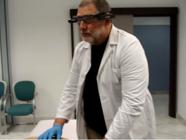
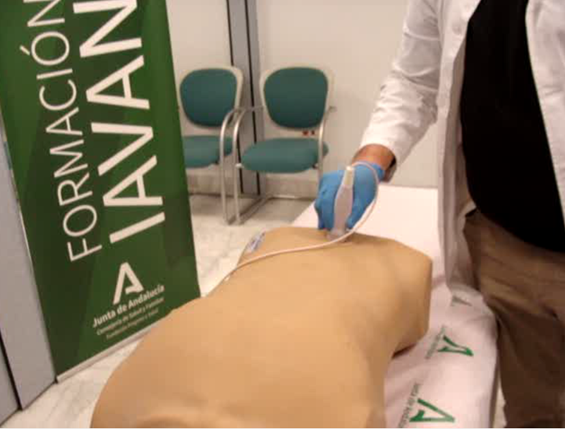
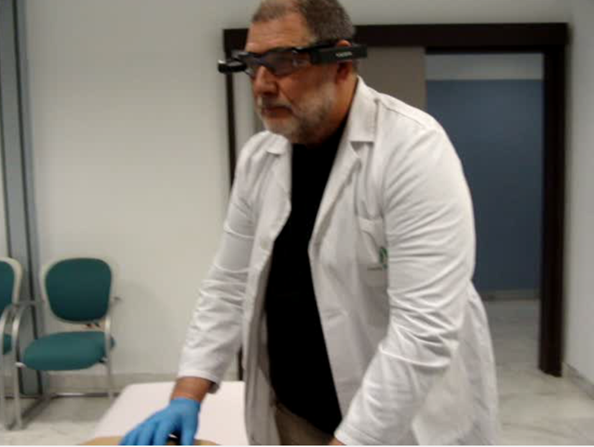
The clinical case of the simulation was the evaluation of a 12-year-old child with suspected abdominal trauma due to a car accident, who presented with abdominal pain, hemodynamic stability, BP, 110x70MMhg, HR, 90 bmp, Glasgow scale, 12 points, abdominal pain, and abdominal hematoma caused by the seat belt. The Spanish team performed the simulated service led by a Brazilian researcher (Fig. 5) using the FAST protocol, and the transmission of the simulated procedure was made through augmented reality glasses (VuzixM400) allowing the simultaneous synchronous visualization of the ultrasound images, the team’s approach and the communication between the professionals.
This project was evaluated and approved by the Research Committee of Universidade Estadual de Maringá CONEP/CEP CAAE: 82464724.3.0000.0104.

The following individuals participated in the activity as observers:
-
-Undergraduate medical students from UEM;
-
Students from the Professional Master’s Degree Program in Management, Technology and Innovation in Urgency and Emergency at UEM;
-
Students from the Master’s Degree in Critical Care in Urgencias y Emergencias at UGR;
-
Brazilian specialists in Urgent and Emergency Medicine, responsible for the remote diagnostic analysis;
-
Specialist and Researchers in Spain.
The interaction between the researchers occurred synchronously, with the possibility of clarifying doubts and clinical discussion in real time with decision-making.
RESULTS
The real-time transmission was successful, allowing Brazilian students to follow the entire procedure, from the initial approach to the interpretation of the ultrasound images. The diagnosis of free fluid in the abdominal cavity was performed remotely by a specialist in Brazil, contributing to clinical decision-making in a simulated situation. The participants highlighted as positive points:
-
The opportunity to experience an international teaching experience;
-
The contact with different health teaching methodologies;
-
The innovative use of augmented reality to visualize clinical procedures;
-
The stimulation of communication and interprofessional clinical reasoning.
The relevance of the experience was recognized through its presentation at the XII Congreso Nacional de Simulación Clínica, held in Málaga, Spain.
DISCUSSION
The use of technologies such as augmented reality has shown to be effective in promoting active learning, enabling greater student engagement and better retention of practical knowledge3),(4. Recent studies indicate that the application of augmented reality in medical education favors the acquisition of technical skills and the development of clinical reasoning5. There was no statistical analysis because it was a proof of concept of usability of the diagnostic aid tool at a distance regarding the feasibility, risk of delay, image quality. In addition, the performance of an educational activity between two continents, in a synchronous and interactive way, reinforces the potential of international partnerships as a strategy for the qualification of medical education, in line with the internationalization guidelines recommended by evaluation and accreditation bodies in higher education3),(4.

FAST image transmitted to Brazil marked by the specialist with a Circle in free fluid in the abdominal cavity.

Image of free fluid in the pelvic region transmitted by the augmented reality glasses and signaled by the specialist.


With the images analyzed in real time by a specialist in Brazil (Figure 6), it was possible to demonstrate the need for surgical treatment in a center of greater complexity because it presents an image compatible with free fluid in the abdominal cavity (Figures 2-3) and the need for surgical treatment. This information contributes to decision-making, increasing patient safety.
This experience also signals the future possibility of expanding the use of augmented reality in real clinical contexts, as remote support for diagnoses and decisions in urgent and emergency situations in remote locations6.
CONCLUSION
The described activity demonstrates the feasibility and positive impact of the use of augmented reality in international educational experiences in medical education. Demonstrates the possibility of remote diagnosis in remote areas for decision-making for patient safety. The integration between the University of Granada and Universidade Estadual de Maringá allowed the experience of a collaborative, innovative and technically feasible approach, with the potential for replication in other institutions.
The experience reinforces the importance of investments in educational technologies and in the promotion of international networks of academic collaboration3.
References
- 1 Barsom EZ, Graafland M, Schijven MP. Systematic review on the effectiveness of augmented reality applications in medical training. Surg Endosc. 2020;34(5):2051-9.
- 2 Azuma RT, Billinghurst M, Klinker G. Augmented reality in healthcare and education: recent advances and future directions. Comput Graph. 2022;102:19-34.
- 3 Marin-Gomez FX, Garcia-Valls F, Gasco-Laborda P, et al. Internationalization and innovation in medical education: a review of current practices. Med Educ Online. 2021;26(1):1924590.
- 4 Moro C, Phelps C, Redmond P, Stromberga Z. HoloLens and mobile augmented reality in medical and health science education: asystematic review. Br J Educ Technol. 2020;51(6):1970-88.
-
5 World Heath Organization. WHO Academy: tranforming lifelong learning for health impact. ; 2020[ Disponível em: https://www.who.int/initiatives/who-academy
» https://www.who.int/initiatives/who-academy - 6 Okuda Y, Bryson EO, De Maria Jr. S, et al. The utility of simulation in medical education: what is the evidence? Mt Sinai J Med. 2020;77(3):330-43.
Research data are available in the body of the document.

 Source: Photograph prepared by the author.
 Source: Photograph prepared by the author.
 Source: Photograph prepared by the author.
 Source: Photograph prepared by the author.
 Source: Photograph prepared by the author.
 Source: Photograph prepared by the author.