
 Federative coordination and territorial inequality: the effectiveness and limitations of the Brazilian Federal Government’s redistributive policy on health at the municipal level
Abstract:
Federal coordination of Brazilian subnational governments via financial induction has reduced health inequalities at the municipal level. At the same time, federal health policies depend on the adherence and conditions of subnational governments, which may favor municipalities with greater state capacity and, consequently, reproduce inequities. Against this backdrop, this article advocates that attacking the asymmetry of municipal state capacities is a more effective instrument for creating sustainable conditions for achieving equity in healthcare among Brazilian citizens. The research aims to analyze the federal government’s role in reducing health inequities in municipalities. It classifies municipalities into clusters based on their state capacities in health and analyzes the profile of transfers from the federal government by observing the Variable Basic Health Care Floor (variable-BHCF), which is a component of Brazil’s primary healthcare financing system, for each cluster. The clustering method considers nine indicators of state capacities in health from 2005 to 2017. The results indicate that clusters of municipalities with lower state capacities receive larger transfers when considering variable-BHCF per capita. Additionally, the largest clusters are those formed of municipalities with the lowest state capacities during this period. This research contributes to the federalism literature by introducing new analytical perspectives on horizontal inequalities and the federal government’s role in mitigating them.
Keywords:
federalism; inequalities; health; state capacity; intergovernmental transfers; redistribution
Resumo:
A coordenação federativa da União via indução financeira proporcionou a redução das desigualdades municipais em Saúde. Todavia, as políticas federais que dependem de adesão e contrapartidas podem privilegiar os municípios com maior capacidade estatal, o que gera a reprodução de iniquidades. Diante da diferença dessas duas formas de reduzir a desigualdade, o argumento básico do artigo é que atacar a assimetria de capacidades estatais dos governos municipais é um instrumento mais efetivo para criar condições sustentáveis de produzir maior equidade entre os cidadãos brasileiros no acesso à Saúde. Além de identificar qual é o papel equalizador da União na redução das disparidades municipais, o trabalho procura também, como objetivos específicos, criar uma clusterização de municípios a partir das suas capacidades estatais em Saúde e identificar o perfil das transferências da União via Piso da Atenção Básica (PAB) variável por grupo, bem como analisar se existem mudanças no perfil dos diferentes grupos associadas ao recebimento dessas transferências. Para isso, foi empregado o método de clusterização em nove indicadores de capacidades estatais em saúde no período de 2005 a 2017. Os resultados indicam que os clusters de municípios com piores níveis de capacidades são contemplados com maiores volumes do PAB variável per capita e que, ademais, os clusters de municípios com piores níveis de capacidades possuem a maior quantidade de municípios em todo o período. O texto contribui, assim, com a literatura de federalismo ao lançar novas perspectivas analíticas sobre as desigualdades horizontais e sobre a função do Governo Federal em atenuá-las.
Palavras-chave:
federalismo; desigualdades; saúde; capacidade estatal; transferências intergovernamentais; redistribuição
Introduction
Since the 1988 Constitution (Brasil, 2022), the Brazilian federative arrangement has been characterized by policies aimed at reducing territorial inequalities through financial transfers and the expansion of the Welfare State (Arretche, 2010). The federal government has led this equalization process, establishing various mechanisms - some more effective than others - for federative coordination with subnational governments, particularly municipalities (Abrucio, 2005; Arretche, 2012; Vazquez, 2014). The reduction of disparities among citizens across the national territory has been successful in several areas, with health being one of the most notable. However, questions remain regarding the long-term sustainability of this process and its ability to continue reducing inequalities and social inequities. This article explores these issues.
The research examines the health policy, which has the most universalist profile in Brazil. This choice allows us to observe the federal government’s equalizing role while considering local state capacities as a reference for the municipalities’ policy implementation ability. The institutional model governing the health policy is the national health system (or “SUS”), characterized by a combination of decentralization - primarily municipalization - federative cooperation, coordination arrangements, and federal support and inducement instruments for local governments, with a strong emphasis on financial transfers.
The federal government’s coordination with subnational governments in health policies at the municipal level has led to an expansion of services available to the population and a reduction of inequalities in municipal revenues and expenditures in this area (Arretche, 2010; Vazquez, 2014). These outcomes reflect the nature of Brazilian federalism, in which the federal government redistributes resources among municipalities based on its regulatory and financial capacity to allocate transfers (Arretche, 2010). However, federal policies that depend on municipal adherence and conditions - such as those that have contributed to reducing horizontal inequalities in health - may disproportionately benefit affluent municipalities with greater state capacity (Grin; Abrucio, 2017, 2021).
Although the literature recognizes the federal government’s role in reducing horizontal inequalities in health among Brazilian municipalities, the potential and effectiveness of policies implemented in this area remain underexplored. The literature has typically used conditional transfers from the federal government to subnational entities as a criterion for assessing the reduction of horizontal inequalities. However, inequality is a polysemic concept, and its analytical framing can highlight different dimensions of reality. Therefore, we argue that the financial dimension of territorial inequalities must be considered alongside municipalities’ capacity to implement public policies. Specifically, local state capacities should be assessed to determine whether municipalities receiving federal transfers are already better positioned to provide services to the population, potentially reinforcing social inequities in health service provision.
These resource transfer policies can generate not only inequalities but also inequities among municipalities. The World Health Organization (WHO), drawing on Whitehead’s (1992) concept of health inequities, defines them as unfair and avoidable differences (Valentine et al., 2008). Such inequities tend to be socially determined by factors such as gender, race, income, and sexual orientation or even by the health system itself as an intermediate determinant, as they are not linked to intrinsic individual characteristics (Valentine et al., 2008). There is also a territorial dimension to inequities, as an individual’s geographic location influences their access to services, given the uneven territorial distribution of health system conditions, which constitutes an inequity according to WHO parameters. In Brazil, this phenomenon is particularly evident at the municipal level, as municipalities are the primary governmental entities responsible for implementing SUS’s core policies.
According to the Valentine et al. (2008), addressing health inequities requires redistributing resources to ensure that the worst-situated municipalities improve their conditions more rapidly than the best-situated ones. In the Brazilian federal context, federal policies that favor local governments with greater resources and capacities create inequities among municipalities, as defined by WHO metrics, since these inequities are not only unfair but also preventable through adjustments to the policies’ institutional design.
Therefore, the primary aim of this article is to analyze the federal government’s role in equalizing and reducing health inequities in municipalities. Additionally, the study pursues two specific objectives. First, it seeks to classify municipalities into clusters based on their state capacities in health and to determine whether those with the lowest levels of state capacity receive a smaller share of federal transfers. The share of federal transfers is assessed through the Variable Basic Health Care Floor (variable-BHCF), which is a component of Brazil’s primary healthcare financing system. The second specific objective is to analyze whether the profiles of state capacities in health among different clusters of municipalities change over time in relation to the distribution of variable-BHCF transfers.
In this article, local state capacities in health are considered as indicators of the resources municipalities have to implement their policies. These capacities reflect the institutional and operational conditions of the health system at the municipal level that enable the policy implementation. We argue that health systems and the stock of related state capacities are social determinants of health, influencing governments’ ability to address social inequities and inequalities.
The central hypothesis of this study, in line with Grin and Abrucio (2017, 2021), is that municipalities with higher levels of state capacities in health are better equipped to provide SUS services and to adhere to the federal government’s transfer policy through variable-BHCF, which is voluntary and contingent upon the provision of a specified set of health services. Consequently, the rules governing variable-BHCF reinforce social inequities in the local provision of health services. Empirically, this argument connects to the study’s main objective in the following ways:
-
If municipalities with higher levels of state capacities in health are more likely to adhere to the variable-BHCF policy, then in this aspect of health policy, the federal government is a producer of inequities.
-
If municipalities with lower levels of state capacities in health are more likely to adhere to the variable-BHCF policy, then in this aspect of the policy, the federal government acts to reduce municipal health inequities.
This research does not seek to assess whether the federal government’s redistributive model strengthens local governments’ state capacity, nor does it measure inequalities among municipalities. Rather, it examines whether this model primarily benefits municipalities with greater or lesser availability of state capacity. The study assesses the redistributive nature of intergovernmental transfers - specifically, whether they predominantly support municipalities with lower state capacity (equitable redistribution) or those with higher state capacity (inequitable redistribution). Consequently, the concepts of equity and inequity are used to characterize the redistributive nature of intergovernmental transfers from the federal government to municipalities. This conceptual approach is justified by the WHO’s perspective that health systems can act as social determinants of health inequities. Thus, state capacities are examined as proxies for health systems and analytically employed to guide the selection of control variables in the model.
The study identifies the redistributive effects of federal government transfers through variable-BHCF to municipalities and provides insights to improve intergovernmental transfer policies by incorporating principles of equity and justice.
The remainder of this article is divided into four sections. The next section reviews the literature on the relationships between federalism and territorial inequalities, particularly within the Brazilian health sector, and examines state capacities. The subsequent section outlines the study’s methodology, detailing the techniques and databases used, followed by a section that presents and discusses the research findings. Finally, the fourth section summarizes the findings and offers final considerations.
Federalism, state capacities, and horizontal inequalities in health in Brazil
The 1988 Federal Constitution (Brasil, 2022) introduced a new model of citizenship in Brazil, reshaping various public policy areas, including health, by emphasizing universalization as a guiding principle, promoting the inclusion of outsiders, and reducing inequalities among individuals (Arretche, 2018). The expansion of the Brazilian welfare state was closely tied to the federalist structure, emerging alongside the establishment of national public policy systems (Franzese; Abrucio, 2013; Silva et al., 2023). According to Franzese and Abrucio (2013), this model of national policy, coordinated by the federal government and driven by decentralization, facilitated the transfer of resources to municipalities, enabling them to play a key role in implementing public policies. For the authors:
By inducing the universalization of social policies through decentralization, the Brazilian federal government not only promotes the execution of a national program through municipalities but also transfers to them the operationalization and management of public policy. (Franzese; Abrucio, 2013, p. 375, translated by authors).
However, the transfer of responsibilities to municipalities took place in a context of significant heterogeneity and inequality. As a result, most local governments lacked the state capacity to effectively manage the decentralization process (Grin; Demarco; Abrucio, 2021). Consequently, intergovernmental relations became central, requiring cooperation between states and, above all, federal support to create local conditions for expanding social policies. Federal coordination of public policies played a crucial role through dynamics of cooperation, inducement, and regulation. Throughout the 1990s, the federal government mobilized various coordination mechanisms to align the actions of subnational entities and create conditions to reduce territorial and regional inequalities in policy implementation (Abrucio, 2005).
According to Vazquez (2014), the Brazilian federal government leveraged its legislative and financial capacities to establish regulatory mechanisms, ensuring that subnational governments could deliver social policies effectively. Federative coordination instruments were developed in each policy sector to structure intergovernmental relationships, enabling subnational entities to locally manage policies designed by the central government. Among other objectives, these mechanisms aimed to “guarantee a national standard and reduce horizontal inequalities” (Vazquez, 2014, p. 972, translated by authors).
Health policy, which receives significant government attention regarding fiscal decentralization across all public policy sectors (Machado; Brasil; Peres, 2024), was decentralized with the Basic Operational Standard (BOS) 01/96 (Brasil, 1996).6 This regulation introduced substantial changes compared to previous standards (Arretche, 2002). Under this new framework, subnational entities received resources in advance, even before providing health services. Additionally, two types of management structures were introduced: full management of primary care and full management of the health system. To support subnational governments, two types of resource transfers were established through the Basic Health Care Floor (BHCF) - a component of Brazil’s primary healthcare financing system - which was divided into “fixed” and “variable”:
-
Fixed-BHCF - It is calculated based on a per capita value, i.e., resources are allocated in proportion to the population and designated for primary care specialties; and
-
Variable-BHCF - It has special financial incentives for priority programs defined by the federal government (Vazquez, 2014, p. 988-989, translated by authors).
Finally, BOS 1/96 (Brasil, 1996) led to the widespread adherence of municipalities to SUS and the provision of primary care services. According to Vazquez (2014), conditional transfers from the federal government, which require subnational entities to offer specific basic health services, along with federal regulations establishing minimum health spending thresholds for states and municipalities, played a crucial role in reducing horizontal inequalities in health.
Arretche (2010) also emphasizes that federal regulation of health policy was instrumental in reducing horizontal inequalities among municipalities. The author argues that the Brazilian federative model operates under two paradoxical but coexisting dynamics. While the federal government’s efforts are centripetal, seeking convergence, the actions of subnational entities are centrifugal and dispersed due to their autonomy in managing policies locally. The empirical outcome of these dynamics is that while the federal government’s interventions tend to reduce horizontal inequalities, the decentralized actions of subnational entities contribute to their persistence (Arretche, 2010).
Federal coordination produces both direct and indirect effects on territorial inequalities in terms of health. Specifically, a municipality’s financial capacity influences how it engages in intergovernmental relations. Greater resource availability enhances municipal cooperation, while financial constraints have the opposite effect, leading to varied policy outcomes across territories (Menicucci; Marques, 2016). Although federal arrangements significantly shape territorial inequalities, other institutional and economic factors also contribute to these inequalities (Menicucci; Leandro, 2023).
Given the impact of national and subnational institutions on public policies and their outcomes (Obinger; Leibfried; Castles, 2005), it is essential to understand the federal government’s role in mitigating municipal inequities across different policy sectors. This study focuses on health policy and advances in this direction. The distinction between inequality and inequity is not merely semantic but conceptual, incorporating variables that cannot be overlooked. Examining inequities alongside inequalities brings attention to aspects of reality that are crucial for justice.
This study analyzes health systems through the lens of state capacities in health, defined as the government’s stock of resources for implementing public policies (Gomide; Pereira; Machado, 2017). State capacities refer to the inputs needed to materialize policies, although not necessarily sufficient to guarantee successful outcomes, as numerous other factors influence results (Grin; Demarco; Abrucio, 2021). Therefore, when addressing horizontal inequalities between subnational governments from an equity perspective - understood as equality of conditions - it is essential to consider their capacities to implement public policies.
State capacities shape how governments can exercise “infrastructural power” (Mann, 1984), enabling them to take action within society. Infrastructural power refers to the state’s ability to penetrate civil society and coordinate its activities without necessarily exerting control over it. Identifying key aspects of bureaucratic effectiveness is therefore crucial for ensuring administrative cohesion and maintaining a state presence across territories (Grin; Demarco; Abrucio, 2021). State capacities indicate bureaucratic competence, improving the efficiency and effectiveness of government responses by bolstering managerial, technical, and administrative attributes (Enriquez; Centeno, 2012; Grindle, 1997). Hildebrand and Grindle (1997) along with Geddes (1994), present similar arguments, asserting that enhancing capacities improves government performance. Three key areas are relevant: (1) human resources (availability and training); (2) organizational development (new administrative structures, materials, and technological resources); and (3) system strengthening (e.g., administrative and budgetary systems). These capacities collectively enable public administration to implement policies, referred to as the “power to” by Weiss (1998) or as “input” by Migdal (1988).
State capacities are typically analyzed in two dimensions: the technical-administrative dimension, which encompasses bureaucratic and material resources, and the political-institutional dimension, which pertains to how public managers mobilize political capital to achieve policy objectives (Grin; Demarco; Abrucio, 2021; Pires; Gomide, 2014). In health policy, Oliveira and Coelho (2021) identify technical-administrative capacities as the availability of health units and services, human resources, information systems, medicines, and financing. Political-institutional capacities, meanwhile, manifest in institutional spaces for negotiation and interaction between different levels of government and civil society (Oliveira; Coelho, 2021). Thus, state capacities in health determine the ability to deliver essential health services to the population. In primary care, these services primarily include vaccination, diagnostic exams, and prenatal care.
State capacities in health also extend to providing outpatient care and basic medical assistance, ensuring the expansion of local health service access and coverage (Pinafo; Carvalho; Nunes, 2016). This infrastructure plays a critical role in improving healthcare availability in municipalities. Equally important is the technical expertise of healthcare professionals and the training of health personnel (Fleury et al., 2010). However, service infrastructure must be accompanied by adequate financial capacity, investment, and health-related expenditures. Planning and evaluation mechanisms are also vital, particularly given the challenges faced at the local level (Spedo; Tanaka; Pinto, 2009). Weaknesses in local management and planning are often linked to high turnover in administrative positions and the low qualification of municipal bureaucracies (Pinafo; Carvalho; Nunes, 2016). The lack of state capacities in health, especially in smaller municipalities, reinforces the importance of central government policies that strengthen the local management of the Brazilian national health system (SUS). In this context, ensuring federative equity with a focus on management quality emerges as a key issue on the intergovernmental cooperation agenda.
Building on this discussion, we argue that territorial inequalities in the health sector are deeply embedded in the Brazilian federative framework (Ribeiro et al., 2018), with municipalities exhibiting varying levels of state capacities for service provision. Within SUS, conditional transfer policies - such as those tied to BHCF - have played a role in mitigating territorial inequalities. However, federal policies that require municipal conditions may inadvertently favor subnational entities with greater state capacities, as these entities are better equipped to meet the requirements. Therefore, this study investigates whether municipalities with higher state capacities receive more resources from conditional transfers or whether these transfers have an equalizing effect by prioritizing municipalities with lower state capacities.
Methodology
This quantitative research employs clustering methods and descriptive statistics to analyze the intergovernmental transfers of health policy funds from the federal government to municipalities. Given the crucial role of local governments in the decentralization process of the 1990s and their status as the primary recipients of fixed and variable Basic Health Care Floor (BHCF) resources, the municipalities serve as the unit of analysis.
The regulation BOS 01/1996 (Brasil, 1996) was published in 1996, introducing both fixed and variable BHCF transfers. By 1998, nearly all municipalities had adopted one of the management models, either full management of primary care or full management of the health system. However, data on BHCF are only available from 2000 to 2017, as the intergovernmental transfer model was discontinued in 2019 and replaced by the “Previne Brasil” program.7 Additionally, municipal data on health equipment and human resources exist only from 2005 onward, making it possible to conduct complete analyses only for the period between 2005 and 2017. Consequently, this study focuses on the 13-year period during which the BHCF was in effect. The decision to conduct a longitudinal analysis based on BHCF is justified by the fact that the Previne Brasil program was implemented only in 2020, and its historical series is limited and does not differentiate transfer modalities in official databases. The objective is to assess whether a recent federal policy influenced inequities in municipal resource allocation through intergovernmental transfers. Additionally, the program features transfer modalities similar to those of the variable-BHCF, allowing for a meaningful comparative analysis.
The selection of variable-BHCF for analysis is justified by its nature as a policy centrally designed by the federal government with varying levels of municipal adherence. This policy imposes conditionalities on municipalities, requiring them to provide specific health services to qualify for transfers. The units of analysis are Brazilian municipalities rather than their respective populations, meaning that the inequities examined in this study pertain to municipal-level rather than individual-level differences.
The state capacity variables, used as proxies for health systems - which are, in turn, social determinants of health (Valentine et al., 2008) - were selected based on data availability from government portals. This introduces a selection bias, as the analysis is constrained to the variables for which data are accessible rather than an ideal set of variables for measuring municipal state capacities in health. Furthermore, this research focuses solely on the technical-administrative dimension of state capacities, as official databases provide political-relational capacity data for only two years (from the Munic-IBGE surveys conducted in 2014 and 2018). Additionally, prior studies (Oliveira; Coelho, 2021) have noted limited variability in these data across municipalities.
Databases and sample size
The first dataset that comprises the database formulated for this study consists of the values corresponding to the fixed and variable BHCF for municipalities between 2000 and 2017. These data were obtained from the National Health Fund (FNS) website and referred to primary care funding, including two components: Fixed Basic Health Care Floor (fixed-BHCF) and Variable Basic Health Floor (variable-BHCF). To facilitate the comparison of BHCF monetary values across years, all figures were adjusted for inflation using the Extended National Consumer Price Index (IPCA), with 2020 as the reference year.
The second dataset concerns state capacities in health variables, which can be understood through different conceptual frameworks and measured using various arrangements and strategies (Aguiar; Lima, 2019). Some databases allow for the identification and measurement of different dimensions of state capacities in health, though each selection entails specific limitations. For example, the Munic-IBGE database provides an extensive set of variables identifying municipal characteristics in the health sector related to state capacities, as noted by Oliveira and Coelho (2021). However, this dataset is available only for the years 2014 and 2018.
Conversely, Datasus offers a broad set of data on health establishments, professionals, and equipment across an extended time series. However, these variables do not capture all aspects of municipal state capacities that could explain health policy outcomes and the quality of municipal management. This study analyzes a longer time series, starting as close as possible to the beginning of the intergovernmental transfer via BHCF implementation. Additionally, the selection of Datasus variables prioritizes those that most influence the provision of services covered under the BHCF procedures. Thus, this set of state capacity indicators is the most appropriate for assessing the federal government’s role in reducing municipal health disparities.
The state capacities in health variables utilized in the analysis are detailed in Table 1 and correspond to various dimensions of municipal resources (inputs) for delivering health services (outputs). The nine variables analyzed are organized into three categories: health facilities, health professionals, and health equipment. All variables were adjusted for the population size of each municipality in the respective years. These data were obtained from the National Registry of Health Facilities (CNES), accessible via Datasus. All variables relate to municipal management and may reflect either services provided directly by municipal networks or those contracted externally. This approach aligns with the provisions of BOS 1/96 (Brasil, 1996), which permits municipalities to contract services funded by BHCF resources. Moreover, the municipalities’ capacity to assume control of state or federal outpatient facilities accounts for the absence of restrictions concerning the administrative level of the variables, ensuring that the only criterion is their relevance to municipal management.
Additionally, municipalities were clustered based on their state capacities and analyzed according to their level of exclusive dependence on the public health system. This level of dependence was calculated based on the proportion of the municipal population without access to private health services. Data on the number of individuals with access to private health services were obtained from the National Supplementary Health Agency (ANS) website for the years 2008 to 2017.
Cluster analysis
The relationship between the two key dimensions of this study - intergovernmental transfers and municipal state capacities - will be analyzed by clustering municipalities according to their levels of state capacities. This approach allows municipalities to be grouped based on the characteristics relevant to this study, independent of their geographic location. However, it is important to acknowledge that geographic location is also correlated with municipal characteristics.
To achieve this, municipalities are clustered based on the nine state capacity variables presented in Table 1. The clustering process ensures that the units of analysis maintain the lowest possible internal variance by grouping municipalities with similar state capacities while maximizing variance between different groups. This approach helps ensure that the clusters of municipalities are statistically distinct from one another (Hair Jr. et al., 2009). Each cluster represents a specific municipal profile, facilitating the identification of groups with the highest and lowest levels of state capacity.
This clustering method was applied independently for each year from 2005 to 2017, meaning that a municipality may belong to one cluster in a given year and a different one in another year, depending on its state capacity during the analyzed period. The selection of this time frame is justified by the availability of state capacities in health data in DataSUS, which begins in 2005, while 2017 is the last year for which BHCF data are available. The number of clusters was predetermined as five for each year to enable comparisons between different years. A similar method was employed by Moraes, Crozatti e Machado (2025) in the context of education, where five municipal profiles were established based on the structure of municipal education systems. Following Moraes, Crozatti e Machado (2025), we adopted Ward’s minimum variance clustering or sum-of-squares method. This hierarchical clustering technique aims to “minimize the increase in the sum of squares of total error within the cluster,” (Everitt et al., 2011, p. 77) thereby forming clusters with the lowest possible internal variance based on the squared Euclidean distance between data points. The choice of this method is further justified by the continuous nature of the variables used (Everitt et al., 2011).
Results
Descriptive analysis of the distribution of the Basic Health Care Floor
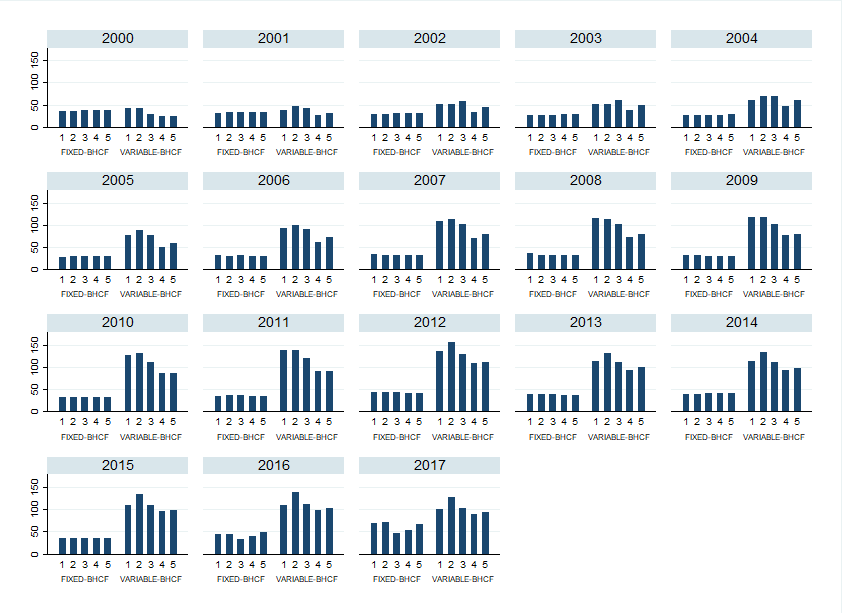
The analysis of the average fixed-BHCF per capita distribution by municipal population size (Figure 1) shows that until 2010, different groups received nearly identical average transfer values per capita, a result of the distribution criteria established in BOS 1/96 (Brasil, 1996). However, beginning in 2011, smaller municipalities started receiving priority over larger ones. By 2016, this difference had become highly significant, and in 2017 - the final year before this transfer modality was discontinued - the distribution curve of fixed-BHCF closely resembled that of variable-BHCF, favoring smaller municipalities over larger ones.
The distribution of variable-BHCF by population size reveals a consistent increase in its average values across all municipal sizes over time. However, since 2000, smaller municipalities have progressively received higher average per capita resource allocation compared to larger ones. Although this trend persists throughout the analyzed period, smaller municipalities receive proportionally larger average per capita transfers each year, suggesting that municipalities in these groups either adhere more frequently to variable-BHCF programs and/or have a greater proportion of their population covered by these programs.

Average per capita values of fixed-BHCF and variable-BHCF by population size and year (2000-2017)
The analysis of the average per capita value of fixed-BHCF by region (Figure 2) shows that until 2010, the values were similar across all regions, mirroring the distribution by population size. However, in 2011, regional differences emerged, with a decline in the Southeast region that year. By 2016, these disparities had become more pronounced, and in both 2016 and 2017, the North and Northeast regions had the highest per capita averages, while the Central-West and Southeast regions recorded the lowest values.

Similar to the distribution of variable-BHCF by population size, its distribution by region has also varied across different groups of municipalities since 2000. That year, the Brazilian regions receiving the highest average per capita values were the Northeast and North, followed by the Central-West, South, and Southeast. Although average per capita values increased across all regions, and there were slight variations in which regions received the highest amounts in specific years, the Northeast and North consistently had the highest per capita resource allocations, while the South and Southeast received the lowest average per capita values of variable-BHCF.
Analysis of clusters of municipalities with state capacities in health
Table 2 presents the average values of the state capacity indicators by cluster of municipalities. Despite the small variations between the best-situated and worst-situated groups of municipalities between the years and the relative position of some variables in relation to the others, the trends that characterize the profile of the groups of municipalities over the years are identified. In general terms, it can be seen that there was growth in the nine indicators from 2005 to 2017, which suggests an average growth in the municipalities’ level of state capacities in health.
There are differences in the average values of state capacity indicators among the different clusters of municipalities, demonstrating that the clustering method effectively describes and categorizes the distinct municipal profiles. Overall, there is a strong similarity in the relative positioning of the set of indicators, with the best-situated cluster consistently exhibiting higher values across almost all indicators, while the worst-situated cluster follows a similar pattern at the lower end. However, minor variations exist from one indicator to another.
Clusters 4 and 5 include the municipalities with the highest levels of state capacity from 2005 to 2012, whereas clusters 3 and 5 hold this position from 2013 to 2017. Clusters 1, 2, and 3 consistently rank among the lowest across all years, except for cluster 3 in 2013, 2015, and 2016. On average, from 2005 to 2017, the clusters exhibit increasing levels of state capacity in health, with cluster 1 showing the lowest levels and cluster 5 the highest. However, as the clusters are constructed independently each year, it is possible that the municipalities categorized as the worst-situated in 2005 (cluster 1) may be part of cluster 2 in 2007, which is also among the lowest-ranked groups. Therefore, analyses of BHCF resource distribution consider the state capacities of the clusters for each year to determine whether municipalities with greater state capacity in health receive more or fewer BHCF resources.
It is also important to examine the ratios between the best- and worst-situated municipalities to determine how many times the level of state capacity in the best-situated group exceeds that of the worst-situated and how these differences evolved over the analyzed period. Figure 3 shows that in eight of the nine indicators, the ratio between the average level of the best-situated cluster and the worst-situated cluster decreased over time. The indicator with the highest disparity is outpatient equipment, which in 2005 was, on average, 101 times greater in the best-situated cluster than in the worst-situated cluster, decreasing to 19.57 in 2017. Additionally, two other indicators with high levels of inequality between the best- and worst-situated municipalities are the number of specialized offices per 10,000 inhabitants and the number of doctors per 1,000 inhabitants, both of which also showed a significant decline in disparity over the analyzed period. The indicator with the smallest inequality throughout the period is the number of basic outpatient establishment per 10,000 inhabitants, with values ranging from 4.61 in 2005 to 1.78 in 2017, showing relatively minor variation compared to the other indicators.

Ratio of average values of state capacities in health variables between the best-situated cluster and the worst-situated cluster from 2005 to 2017
Distribution of Variable-BHCF by cluster
Table 3 shows that the municipalities in clusters 1 and 2, which represent the group of municipalities with the lowest levels of state capacity, on average, receive the highest amounts of variable-BHCF per capita. Conversely, the municipalities in clusters 4 and 5 or 3 and 5 receive, on average, the lowest amounts of variable-BHCF per capita. Notably, the years when cluster 3 exhibited the highest levels of state capacity (2013 to 2017) were also the years in which this cluster received the lowest average transfer values. In 2005, the highest-ranked cluster (cluster 5) in terms of state capacity in health received 2.1 times more resources than the lowest-ranked cluster (cluster 1). This ratio fluctuated over time, and in 2017, it was 1.33.
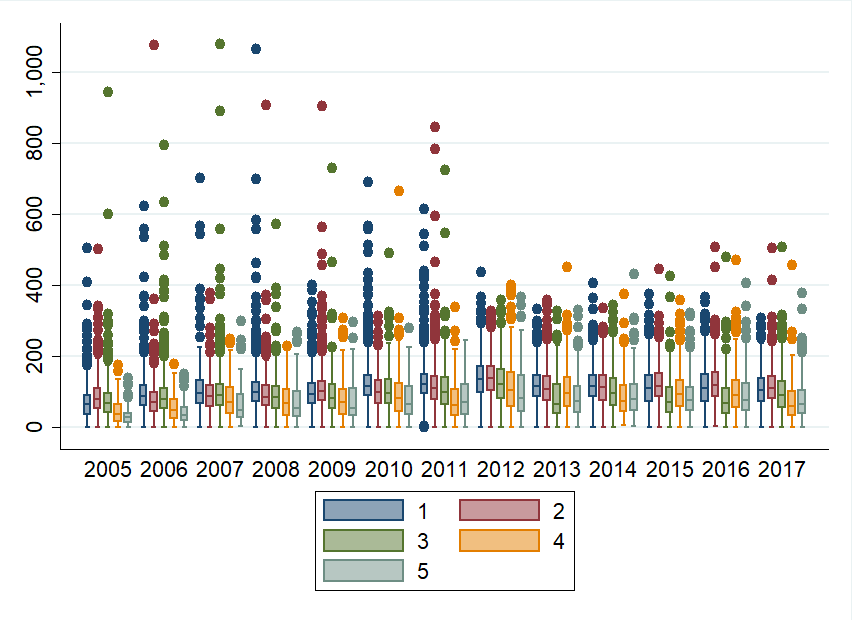
The analysis of the distribution of variable-BHCF per capita by cluster and year (figure 4) reveals internal variation and outliers across all clusters and years. Despite these differences, it shows that the highest concentration of observations in clusters 1 and 2 exceeds that in clusters 4 and 5 or 3 and 5. This indicates that the municipalities in clusters 1 and 2 tend to receive higher contributions of variable-BHCF per capita than those in the other clusters.
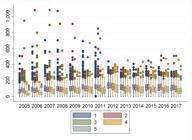
Table 3 also allows us to verify the number of municipalities by cluster and year. The first observation, as identified in Table 3, is that not all municipalities adhere to the variable-BHCF program, so only in 2017 did we come close to universalizing the program when 5,564 municipalities (out of 5,570 municipalities in the country) began to benefit from this type of transfer. The second point to highlight is that clusters 1 and 2 concentrate the largest number of municipalities, while clusters 3, 4 and 5 tend to concentrate the smallest number. Most municipalities are located in clusters with the lowest levels of state capacity in health, and a smaller number are located in groups of municipalities with the highest levels of state capacity. Figure 5 illustrates the percentage of municipalities by cluster and year.

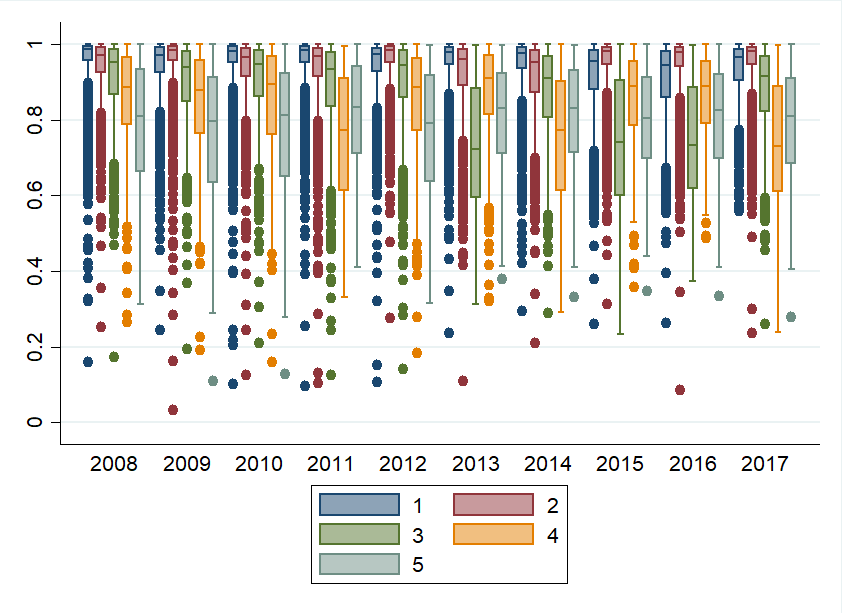
To deepen the descriptive analysis of municipal clusters and better understand the levels of variable-BHCF by cluster and year, Figure 6 presents the percentage of the municipal population that depends exclusively on the public health system. Machado (2021) demonstrated that municipalities with the highest levels of exclusive dependence on the public health system experienced the greatest increases in state capacity in health between 2013 and 2015.
Figure 4 shows that municipalities in clusters 1 and 2, which, on average, receive the highest BHCF values, are also the clusters with the largest number of municipalities where the population is most dependent on the public health system. Conversely, clusters 3, 4 and 5, which receive the lowest BHCF values on average, contain the smallest number of municipalities with high levels of exclusive dependence on the public health system. However, there is greater variation in dependence across clusters. Since 2013, municipalities in cluster 3 received, on average, higher BHCF values but had the largest concentration of municipalities with the lowest level of exclusive dependence.

Box plot of the percentage of the municipal population dependent exclusively on the public health system by cluster and year
Discussion of results
Oliveira (2007, p. 160) states that “inequalities [in health] were not addressed by the resource distribution formula introduced with the BHCF [program],” both fixed and variable. Variable-BHCF lacks “an equalizing nature in the sense of giving more resources to the neediest municipalities” (Oliveira, 2007, p. 154). Regarding fixed-BHCF, the results of this article corroborate Oliveira’s (2007) findings. However, from 2011 onward, smaller municipalities and those in the North and Northeast regions of the country have received a higher average volume of per capita resources due to changes in distribution criteria. These changes aim to be more equitable and prioritize the most vulnerable municipalities (Pinto, 2018).
On the other hand, regarding variable-BHCF, the results differ from those of Oliveira (2007), as this study identifies that its distributive effects manifest an equitative nature, prioritizing municipalities with lower state capacities over those with greater state capacities.
The findings indicate that the equitable distribution of variable-BHCF resources occurs despite the policy’s design, which does not include mechanisms that explicitly prioritize municipalities in greater need. This raises the question: why are municipalities with lower state capacities more likely to adhere to this federal policy? One possible explanation lies in their exclusive dependence on the public health system. The more a municipality’s population relies on the public health system, the stronger the incentives for local incumbents to seek federal resource transfers. As observed, municipalities with lower state capacities - those most adherent to the variable-BHCF policy - also tend to have the highest concentrations of populations exclusively dependent on SUS.
Another contributing factor is that smaller cities often lack sufficient resources to meet health needs independently, unlike larger cities, where it is more feasible to fund health services locally. This constraint increases adherence to variable-BHCF, even when local conditions are required. A similar argument was explored by Sátyro, Cunha, and Campos (2016) in their analysis of municipal spending on federal transfers for social assistance policies in Brazil.
However, further investigation is needed to determine whether greater dependence on SUS incentivizes incumbents to adhere to federal programs or whether this dependence reflects broader economic vulnerabilities within municipalities. Such vulnerabilities may be linked to lower revenue collection levels and weaker state capacities in health. In turn, this economic reality may explain why municipalities with lower state capacities are more reliant on federal transfers, whereas those with higher state capacities tend to be less dependent on external funding sources.
Oliveira (2007) also highlights that “directed decentralization” under federal coordination failed to reduce preexisting inequalities, a conclusion that partially aligns with the findings of this study. Between 2005 and 2017, there were no significant shifts in the composition of the clusters of municipalities based on their state capacities. The cluster formed of municipalities with the lowest state capacities continued to encompass the largest number of municipalities, while the clusters with municipalities showing the highest state capacities remained the smallest. This pattern indicates that the federal government faces limitations in changing municipal state capacities in health, prompting these subnational entities to bolster their ability to meet their responsibilities.
In recent years, particularly in 2019, the Brazilian policy of intergovernmental transfers to municipalities underwent significant changes, stimulating a debate within the health sector. The administration of President Jair Bolsonaro argued that replacing BHCF with the Previne Brasil program would improve transfer efficiency (Harzheim, 2020). However, other actors contended that this change would exacerbate territorial health inequalities by favoring municipalities with greater resources (Massuda, 2020; Seta; Ocké-Reis; Ramos, 2021). This study is central to this debate, as it analyzes the redistributive outcomes of a federal program that was in place for nearly two decades and whose core principles continue to shape the financing of primary healthcare in municipalities.
Final considerations
This study aimed to understand the equalizing role of the Brazilian federal government in reducing municipal health disparities through intergovernmental transfers via Variable Basic Health Care Floor (variable-BHCF) - a component of Brazil’s primary healthcare financing system - while controlling for the levels of state capacity in municipalities. The results indicate that the federal government has contributed to mitigating municipal health inequities, as municipalities with the weakest capacity to provide health services receive the largest amounts of conditional transfers. This finding contributes to the literature on federalism in Brazil, offering new perspectives for analyzing government transfers in the health sector. Previous studies on the federal government’s role regarding municipal inequalities have focused on the effect of transfers on municipal revenue inequalities (Arretche, 2010). However, this literature has not considered local state capacities for implementing public policies. The original contribution of this study is to identify the profile of municipalities that receive intergovernmental transfers based on their varying levels of state capacity.
Given that variable-BHCF was a voluntary program requiring municipalities to provide services in return, it would be intuitive to assume that municipalities with higher levels of state capacity would be more likely to participate. However, the empirical findings contradict this expectation. It is not an obvious outcome that municipalities with fewer resources to meet federal government requirements are the ones that adhere most to the conditional transfer policy, while those with theoretically greater capacity adhere less. This evidence contributes to the research agenda examining the effects of federal transfers within the framework of intergovernmental relations.
The results suggest that transfers from the federal government generate redistribution that primarily benefits the most vulnerable municipalities, despite the fragility of their state capacities in health. These transfers also promote vertical equity by distributing resources unequally among municipalities. However, the promotion of equity occurs despite the institutional design of the variable-BHCF policy, which does not explicitly include mechanisms to favor municipalities with lower state capacity over those with higher state capacity. Therefore, while the policy outcomes have an equitable effect, its design does not contain explicit provisions for this purpose.
Additionally, the hypothesis that municipalities with higher levels of state capacity would be the most likely to adhere to the federal program is not supported. One possible explanation lies in the nature of the policy under analysis. The argument proposed by Grin and Abrucio (2017, 2021), which informed this study, focuses on an area intended to enhance municipal state capacity to increase revenue levels. In contrast, the policy examined here is an end-area policy, delivering results directly to society through services. Future research could explore whether the nature of federal programs that depend on municipal conditions influences their distributive outcomes - specifically, whether transfers benefit municipalities with higher or lower state capacity. Likewise, future studies could compare the institutional design of variable-BHCF and Previne Brasil to determine whether their results align with the findings of this study.
The largest clusters identified in this study consist of municipalities with the lowest state capacities, suggesting that there are fewer Brazilian municipalities with high levels of state capacities. The clusters of the most disadvantaged municipalities are associated with receiving the highest average per capita values of variable-BHCF during the analyzed period, whereas the clusters of municipalities with higher state capacities receive the lowest average amounts. However, throughout the period analyzed, there was no increase in the number of municipalities belonging to the clusters with the highest levels of state capacity. This finding suggests that the transfers from variable-BHCF are not sufficient to alter the profile of municipalities in a way that enables them to transition from the most disadvantaged to the most advantaged groups.
In short, the results suggest that addressing inequities without improving state capacities may be a limited approach, as it does not ensure the necessary conditions for municipalities to change their resource profiles and effectively implement public health policies. Examining the equalizing role of the federal government and its efforts to reduce inequalities contributes to a deeper understanding of municipal disparities and the development of public policies in the local context, particularly concerning the reduction of territorial asymmetries and the improvement of service provision.
Nonetheless, although there are clear limitations on the federal government’s ability to alter the profiles of clusters of municipalities based on their state capacities, an overall increase in municipal state capacities was observed during the analyzed period. Additionally, the gap between the best- and worst-situated clusters narrowed for most indicators over time. However, it cannot be definitively concluded that these improvements resulted from the federal program.
Ultimately, the ability of local governments to become more autonomous in developing health policies in the coming years will depend on establishing local state capacities, which vary significantly across municipalities. The BHCF reduces inequalities in local health service provision but does not alter the structural conditions of local state capacities. Addressing this issue would require the Brazilian national health system (SUS), under federal coordination, to implement policies that not only combat inequalities but also promote equity by fostering the development of new capacities in municipalities with fewer resources. Federal initiatives should focus on ensuring that municipalities with lower state capacity can progress similarly to those with greater capacity.
From a theoretical perspective, this study contributes to the literature on the relationship between federalism and redistribution. The Brazilian federal system, particularly the coordination exercised by the federal government, facilitates not only the reduction of horizontal inequalities - measured by municipal revenues - but also a redistribution of an equalizing nature that prioritizes municipalities with the least capacity to implement public health policies.
References
- ABRUCIO, Fernando Luiz. A coordenação federativa no Brasil: a experiência do período FHC e os desafios do governo Lula. Revista de Sociologia e Política, Curitiba, n. 24, p. 41-67, jun. 2005.
- AGUIAR, Rafael Barbosa de; LIMA, Luciana Leite. Capacidade estatal: definições, dimensões e mensuração. Revista Brasileira de Informação Bibliográfica em Ciências Sociais, São Paulo, n. 89, p. 1-28, ago. 2019.
- ARRETCHE, Marta. Democracia e redução da desigualdade econômica no Brasil: a inclusão dos outsiders. Revista Brasileira de Ciências Sociais, São Paulo, v. 33, n. 96, p. 1-23, 5 fev. 2018.
- ARRETCHE, Marta. Democracia, federalismo e centralização no Brasil. Rio de Janeiro: Editora FGV; Editora Fiocruz, 2012.
- ARRETCHE, Marta. Federalismo e igualdade territorial: uma contradição em termos? Dados, Rio de Janeiro, v. 53, n. 3, p. 587-620, 2010.
- ARRTCHE, Marta. Federalismo e relações intergovernamentais no Brasil: a reforma de programas sociais. Dados, Rio de Janeiro, v. 45, n. 3, p. 431-458, 2002.
-
BRASIL. [Constituição (1988)]. Constituição da República Federativa do Brasil de 1988. Brasília, DF: Presidência da República, [2022]. Disponível em: Disponível em: http://www.planalto.gov.br/ccivil_03/constituicao/constituicao.htm Acesso em: 10 dez. 2022.
» http://www.planalto.gov.br/ccivil_03/constituicao/constituicao.htm - BRASIL. Ministério da Saúde. Portaria no 2.203, de 5 de novembro de 1996. Aprova a Norma Operacional Básica do Sistema Único de Saúde - NOB-SUS 01/96. Diário Oficial da União: República Federativa do Brasil: seção 1, Brasília, DF, nº 216, 6 nov. 1996. p. 22932-22940.
- ENRIQUEZ, E.; CENTENO, M. A. State capacity: utilization, durability, and the role of wealth vs. history. International and Multidisciplinary Journal of Social Sciences, v. 1, n. 2, p.130-162, 2012.
- EVERITT, Brian S.; LANDAU, Sabine; LEESE, Morven; STAHL, Daniel. Cluster analysis. King’s College London: John Wiley & Sons, 2011.
- FLEURY, Sonia; OUVERNEY, Assis Luiz Mafort; KRONEMBERGER, Thais Soares; ZANI, Felipe Barbosa. Governança local no sistema descentralizado de saúde no Brasil. Revista Panamericana de Salud Publica, v. 28, n. 6, p. 446-455, 2010.
- FRANZESE, Cibele; ABRUCIO, Fernando Luiz. Efeitos recíprocos entre federalismo e políticas públicas no Brasil: os casos dos sistemas de saúde, de assistência social e de educação. In: HOCHMAN, Gilberto; FARIA, Carlos Aurélio Pimenta de. Federalismo e políticas públicas no Brasil. Rio de Janeiro: Editora Fiocruz, 2013. p. 361-386.
- GEDDES, Barbara. Politician’s dilemma: building state capacity in Latin America. Los Angeles: University of California Press, 1994.
- GOMIDE, Alexandre de Ávila; PEREIRA, Ana Karine; MACHADO, Raphael. Apresentação - O conceito de capacidade estatal e a pesquisa científica. Sociedade e Cultura, Goiânia, v. 20, n. 1, p. 3-12, jan-jun. 2017.
- GRIN, Eduardo José; ABRUCIO, Fernando Luiz. O elo perdido da descentralização no Brasil: a promoção das capacidades estatais municipais pelo governo federal. Revista de Sociologia e Política, Curitiba, v. 29, n. 77, p. 1-23, 2021.
- GRIN, Eduardo José; ABRUCIO, Fernando Luiz. Quando “feds” e “locals” não falam a mesma língua: uma análise sobre dissonâncias na cooperação federativa. Cadernos EBAPE.BR, Rio de Janeiro, v. 14, n. 3, p. 694-719, jul-set. 2017.
- GRIN, Eduardo José; DEMARCO, Diogo José; ABRUCIO, Fernando Luiz (orgs.). Capacidades estatais municipais: o universo desconhecido no federalismo brasileiro. Porto Alegre: Editora da UFRGS/CEGOV, 2021.
- GRINDLE, M. S. (ed.) Getting good government: capacity building in the public sector of developing countries. Harvard Institute for International Development; Harvard University, 1997.
- HAIR JR, Joseph F.; BLACK, William C.; BABIN, Barry J.; ANDERSON, Rolph E.; TATHAM, Ronald L. Análise multivariada de dados. 6 ed. Porto Alegre: Editora Bookman, 2009.
- HARZHEIM, Erno. “Previne Brasil”: bases da reforma da Atenção Primária à Saúde. Ciência & Saúde Coletiva, Rio de Janeiro, v. 25, n. 4, p. 1189-1196, 2020.
- HILDEBRAND, M. E.; GRINDLE, M. S. Building sustainable capacity in the public sector: what can be done? In: GRINDLE, M. S. (ed.) Getting good government: capacity building in the public sector of developing countries. Harvard Institute for International Development; Harvard University, 1997. p. 31-62.
- MACHADO, Gabriel Santana. Partidos, eleições e desigualdades em saúde nos municípios brasileiros: uma análise relacional a partir dos fatores políticos, de gestão e da dependência do sistema público. Revista Brasileira de Políticas Públicas e Internacionais - RPPI, João Pessoa, v. 6, n. 3, p. 72-102, dez. 2021.
- MACHADO, Gabriel Santana. Coordenação federativa e desigualdade territorial: a efetividade e os limites da política redistributiva da União junto aos municípios no campo da saúde. 2023. Dissertação (Mestrado em Administração Pública e Governo) - Fundação Getulio Vargas, Escola de Administração de Empresas de São Paulo, São Paulo, 2023.
- MACHADO, Gabriel Santana; BRASIL, Felipe Gonçalves; PERES, Ursula Dias. Descentralização fiscal brasileira: as prioridades orçamentárias sob a perspectiva de agenda-setting Revista de Sociologia e Política, Curitiba, v. 32, p. 1-23, 2024. [e010].
- MANN, Michael. The autonomous power of the state: its origins, mechanisms and results. Archives Europénnes de Sociologie, v. 25, n. 2, p. 185-213, 1984.
- MASSUDA, Adriano. Mudanças no financiamento da Atenção Primária à Saúde no Sistema de Saúde Brasileiro: avanço ou retrocesso? Ciência & Saúde Coletiva, Rio de Janeiro, v. 25, n. 4, p. 1181-1188, 2020.
- MENICUCCI, Telma; LEANDRO, José Geraldo. Arranjo federativo e desigualdades em saúde no Brasil e na Argentina. Dados, Rio de Janeiro, v. 66, n. 4, p. 1-46, 2023. [e20200309].
- MENICUCCI, Telma; MARQUES, Alisson Maciel de Faria. Cooperação e coordenação na implementação de políticas públicas: o caso da saúde. Dados, Rio de Janeiro, v. 59, n. 3, p. 823-865, 2016.
- MIGDAL, J. S. Strong societies and weak states: state-society relations and state capabilities in the Third World. Princeton: Princeton University Press, 1988.
- MORAES, Vinicius Macedo de; CROZATTI, Jaime; MACHADO, Gabriel Santana. Federalismo e desigualdades horizontais em educação: conectando os anseios equalizadores por meio de uma tipologia de municípios. Dados, Rio de Janeiro, v. 68, n. 3, p. 1-50, 2025. [e20220063].
- OBINGER, Herbert; LEIBFRIED, Stephan; CASTLES, Francis G. Federalism and the welfare state: new world and european experiences. New York: Cambridge University Press, 2005.
- OLIVEIRA, Vanessa Elias. O municipalismo brasileiro e a provisão local de políticas de saúde: o caso dos serviços de saúde nos municípios paulistas. 2007. Tese (Doutorado em Ciência Política) - Universidade de São Paulo, São Paulo, 2007.
- OLIVEIRA, Vanessa Elias; COELHO, Vera Shattan P. Capacidades estatais municipais em saúde. In: GRIN, Eduardo José; DEMARCO, Diogo José; ABRUCIO, Fernando Luiz (orgs.). Capacidades estatais municipais: o universo desconhecido no federalismo brasileiro. Porto Alegre: Editora da UFRGS/CEGOV, 2021. p. 366-400.
- PINAFO, Elisangela; CARVALHO, Brígida Gimenez; NUNES, Elisabet de Fátima Polo de Almeida. Descentralização da gestão: caminho percorrido, nós críticos e perspectivas. Ciência & Saúde Coletiva, Rio de Janeiro, v. 21, n. 5, p.1511-1524, 2016.
- PIRES, Roberto Rocha C.; GOMIDE, Alexandre de Ávila. Análise comparativa: arranjos de implementação e resultados de políticas públicas. In: GOMIDE, Alexandre de Ávila; PIRES, Roberto Rocha C. Capacidades estatais e democracia: a abordagem dos arranjos institucionais para análise de políticas públicas. IPEA, 2014. p. 351-379.
- PINTO, Hêider Aurélio. Análise do financiamento da Política Nacional para a Atenção Básica de 1996 até 2017. Saúde em Redes, Porto Alegre, v. 4, n. 1, p. 35-53, 2018.
- RIBEIRO, José Mendes; MOREIRA, Marcelo Rasga; OUVERNEY, Assis Maffort; PINTO, Luiz Felipe; SILVA, Cosme Marcelo Furtado Passos da. Federalism and health policy in Brazil: institutional features and regional inequalities. Ciência & Saúde Coletiva, Rio de Janeiro, v. 23, n. 6, p. 1777-1789, 2018.
- SÁTYRO, Natália G. D.; CUNHA, Eleonora S. M.; CAMPOS, Járvis. Análise espacial da burocracia da assistência social nos municípios brasileiros: notas para uma reflexão sobre a capacidade de implementação dessa política. Opinião Pública, Campinas, v. 22, n. 2, p. 286-317, 2016.
- SETA, Marismary Horsth De; OCKÉ-REIS, Carlos Octávio; RAMOS, André Luis Paes. Programa Previne Brasil: o ápice das ameaças à Atenção Primária à Saúde?. Ciência & Saúde Coletiva, Rio de Janeiro, v. 26, p. 3781-3786, 2021. [suplemento 2].
- SILVA, André Luis Nogueira; SEGATTO, Catarina Ianni; ABRÚCIO, Fernando Luiz; MACHADO, Gabriel Santana. Criação, difusão e aprendizados dos sistemas nacionais de políticas públicas: os caminhos heterogêneos do SNRH, SUAS e SUSP. Administração Pública e Gestão Social, Viçosa, v. 15, n. 1, 20 jan. 2023.
- SPEDO, Sandra Maria; TANAKA, Oswaldo Yoshimi; PINTO, Nicanor Rodrigues da Silva. O desafio da descentralização do Sistema Único de Saúde em município de grande porte: o caso de São Paulo, Brasil. Cadernos Saúde Pública, Rio de Janeiro, v. 25, n. 8, p. 1781-1790, 2009.
- VALENTINE, Nicole; SOLAR, Orielle; IRWIN, Alec; NOLEN, Lexi; PRASAD, Amit. Health equity at the country level: building capacities and momentum for action. Geneva: World Health Organization - WHO, 2008. [SDHE Implementation Discussion Paper Series, 3].
- VAZQUEZ, Daniel Arias. Mecanismos institucionais de regulação federal e seus resultados nas políticas de educação e saúde. Dados, Rio de Janeiro, v. 57, n. 4, p. 969-1005, dez. 2014.
- WEISS, L. The myth of powerless state. New York: Cornell University Press, 1998.
- WHITEHEAD, M. The concepts and principles of equity and health. International Journal of Health Services, v. 23, n. 3, p. 429-445, 1992.
-
6
A Basic Operational Standard (BOS) is a regulatory tool issued by the Ministry through an ordinance that governs the organization of the sector’s management, including the transfer of resources.
-
7
Despite the replacement, one of the modalities of the new program remains based on transfers conditional on the municipality’s provision of a set of services, similar to variable-BHCF, which is the main object of analysis in this study (Massuda, 2020; Seta; Ocké-Reis; Ramos, 2021).
-
8
Examples: Mammography, X-ray, CT scanner, MRI, Ultrasound, Complete Dental Equipment.
-
1
This article presents some findings from the first author’s master’s dissertation, which was defended in the Graduate Program in Public Administration and Government at the Fundação Getulio Vargas (FGV). The research was partially funded by the Brazilian agency CAPES and the Konrad Adenauer Foundation (KAS), and we express our gratitude for their support, as well as to the anonymous reviewers of the RBCP.
-
2
Replication data: https://doi.org/10.7910/DVN/F0I7FX

 Source:
  Source:
  Source:
  Source:
  Source:
  Source: