 When is corruption a threat to democracy? Perception of corruption about politicians and bureaucrats and democratic legitimacy in Latin America
Abstract:
The article analyzes the relationship between perceptions of corruption and democratic legitimacy in Latin America based on the multidimensional structure of legitimacy. The paper differentiates the perception of corruption into two independent variables: politicians and bureaucrats. We used a quantitative analysis of the Americas Barometer (AB) survey in its 2018/2019 round of questions. The results of the study indicate that the perception of corruption weakens democratic legitimacy in Latin America not only with respect to more specific levels of political support, but also with respect to diffuse support for the regime in general, compromising the legitimacy and stability of democracy in the region. Our results also suggest that the impact of perceptions of legitimacy differs when the independent variable is politicians or public officials, being more negative for the regime when citizens perceive the political class as corrupt.
Keywords:
perception of corruption; democratic legitimacy; Latin America; politicians; public officials
Resumo:
O artigo analisa a relação entre percepção de corrupção e legitimidade democrática na América Latina a partir da estrutura multidimensional da legitimidade. Além disso, nosso trabalho diferenciou a percepção de corrupção em duas variáveis independentes: políticos e funcionários públicos. Utilizamos uma metodologia quantitativa ancorada em dados do survey do Barômetro das Américas (BA) em sua rodada de perguntas 2018/2019. Os resultados do estudo indicam que a percepção de corrupção enfraquece a legitimidade democrática na América Latina não apenas nos níveis mais específicos de apoio político, mas também no próprio apoio aos objetos mais difusos do regime, comprometendo a legitimidade e a estabilidade da democracia na região. Nossos resultados também sugerem que o impacto da percepção sobre a legitimidade difere quando a variável independente são os políticos ou os funcionários públicos, sendo mais deletério para o regime quando os cidadãos percebem a classe política como corrupta.
Palavras-chave:
percepção de corrupção; legitimidade democrática; América Latina; políticos; funcionários públicos
Resumen:
El artículo analiza la relación entre percepción de corrupción y legitimidad democrática en América Latina utilizando la estructura multidimensional de la legitimidad. Además, nuestro trabajo ha diferenciado la percepción de corrupción en dos variables independientes: políticos y funcionarios. Hemos utilizado una metodología cuantitativa anclada en los datos de la encuesta del Barómetro de las Américas (BA) en su ronda de preguntas 2018/2019. Los resultados del estudio indican que la percepción de corrupción debilita la legitimidad democrática en América Latina no solo en los niveles más específicos de apoyo político, sino también en el propio apoyo a los objetos más difusos del régimen, poniendo en riesgo la legitimidad y estabilidad de la democracia en la región. Nuestros resultados también sugieren que el impacto de la percepción sobre la legitimidad difiere cuando la variable independiente son políticos o funcionarios, siendo más deletéreo para el régimen cuando los ciudadanos perciben a la clase política como corrupta.
Palabras clave:
percepción de la corrupción; legitimidad democrática; América Latina; políticos; funcionarios
Introduction
The perception of corruption is diagnosed by many scholars as a potential negative factor of democratic legitimacy (Anderson; Tverdova, 2003; Della Porta, 2000; Mishler; Rose, 2001; Putnam, 1993). Citizens stop trusting the “public machine” and the “political system”, when they perceive them to be corrupt, that is, deviating from their public functions to serve private interests. When this occurs, citizens become more susceptible to populist/authoritarian discourses.
The problem of corruption has been especially discussed in Latin America. Unlike older democracies, Latin America’s young democracies were built on great economic hardship and social turmoil. In this context of instability, the corrosive effect of corruption scandals4 may be enhanced due to the fragile foundations of democratic legitimacy.
This more general diagnosis, however, misses some subtleties that help us better understand the phenomenon. On the one hand, we do not know for sure which institutions/actors are most relevant in this corrosive process. Does every institution/actor that is perceived as corrupt equally affect legitimacy? In this study, we analyzed whether the perception of corruption about bureaucrats and politicians has the same effect on the legitimacy of the regime. On the other hand, we also do not know exactly which spheres of legitimacy are affected by the perception of corruption. Does all perceived corruption equally affect trust in political actors, representative institutions, and adherence to democracy?
We seek to address these issues by analyzing the relationships between perceived corruption and support for the democratic regime in Latin America from the perspective of the multidimensional structure of political legitimacy. This refinement advances in relation to studies on the impact of perception on democracy by allowing the identification of independent variations in each level of support for the regime. This becomes particularly important because what endangers democracy is not necessarily corruption per se, but the drop-in support for the regime in its most diffuse dimension (Norris, 1999, 2011).
In this sense, this article contributes to the area of political behavior and democratic legitimacy by advancing these issues. To answer the survey questions, we used the most recent data from the Americas Barometer (AB), collected in 2018/2019. The AB is a survey carried out periodically since 2004 by the Latin American Public Opinion Project - LAPOP and currently covers 20 countries in the Americas. In addition, the survey has representative samples of the adult population of Latin American countries and with an extensive list of questions related to political culture and democratic legitimacy. Regarding the theme of the perception of corruption, the questionnaire includes two questions that distinguish two different political actors: 1) public officials and 2) politicians. On the topic of democratic legitimacy, the bank addresses multiple dimensions of political support, along the lines proposed by Norris (1999) and other scholars (Booth; Seligson, 2009; Dalton, 2004; Norris, 2011).
These two sets of questions allow us to move forward on two fronts. By distinguishing between “bureaucrats” and “politicians”, the AB allows us to test whether the effect of the perception of corruption on legitimacy changes depending on who is corrupted. On the one hand, we have the civil servant who, according to the theories of bureaucracy, is marked by the principles of merit,5 hierarchy,6 stability,7 and, above all, by impersonality.8 On the other hand, we have professional politicians, whose characteristics are opposite: election, horizontality, periodicity and personality.
The second front, to which we have already alluded , is a multifaceted vision of democratic legitimacy. As Norris (1999) argued, citizens can distinguish between different political objects, ranging from the most specific to the most diffuse: evaluation of political actors; trust in institutions; satisfaction with the functioning of democracy; and support for democracy. Each political object has autonomy in relation to the others, so that they can be affected and vary independently from each other. This element is fundamental because, as we will see later, it is not all corruption that puts democracy at risk, but that which manages to affect citizens’ support for the diffuse dimension of democratic legitimacy.
Our first research hypothesis is that the effect of the perception of corruption in relation to politicians has a stronger negative effect on democratic legitimacy than the perception directed at public officials. We consider that these actors are more exposed to the dissemination of negative news revealing cases and suspicions of corruption, in addition to being periodically scrutinized through the electoral cycle. This directly impacts the public image of the political class, corroborating the increase in their accountability in terms of the occurrence of corruption. Nevertheless, political actors are more easily associated with positions of command in the political system, being more easily identified as operators of democracy than bureaucrats.
The work of public officials is less newsworthy, which makes them, on average, less exposed to accountability for cases of corruption in the democratic regime. This does not exclude them from public accountability to citizens, but the fact that they often occupy subordinate positions to political actors may contribute to the perception that they are “less responsible” than the political class for corruption in the system.
Beyond the distinctions between politicians and bureaucrats, we believe that this effect tends to be greater the more specific the dimension of legitimacy considered, as citizens would differentiate the levels of legitimacy in terms of support for the democratic regime. Our expectation is anchored in the capacity of the democratic regime to legitimize itself to the extent that individuals are socialized in democratic institutions and develop knowledge, feelings, and aspirations about the regime. We thus expect individuals to be more impetuous critics of the quality of the regime than of the type of regime itself. In other words, citizens would contest the performance of institutions and actors, but would hardly renounce democracy, given the wide range of rights and advantages that the regime ensures.
In general, the results of the survey corroborate these expectations. Citizens attribute greater responsibility to politicians for corruption in the democratic regime and the drop-in support for the legitimacy dimensions of the regime is greater in the case of perceived corruption of politicians than in the case of perceived corruption of bureaucrats. Moreover, the more specific dimensions of legitimacy are more vulnerable to the effects of perceived corruption than the more diffuse dimension of support, i.e., adherence to democracy.
In addition to this brief introduction, this article brings, in the following section, a discussion on the concept of corruption and its effects on democracy, also arguing about the usefulness and advantages of the indicator of perception of corruption in studies on democratic legitimacy. Next, we present the framework of multidimensional democratic legitimacy based on the work of Norris (1999, 2011) and emphasize the importance of considering the multiple dimensions of legitimacy in relation to the possible effects that the perception of corruption may have on democracy.
After the discussions indicated above, we formalized the research design and the construction of the variables in our analysis model. Next, we present and discuss the main results found in our work and, finally, in the last section, we synthesize the final considerations about the results, emphasizing the fruitfulness of this research agenda and pointing out gaps that still need to be explored and overcome on the subject.
Corruption, corruptible agents and democratic legitimacy
Although there is a great debate about the theoretical conceptualization of corruption,9 it is possible to analyze the phenomenon in an analogous way to Silva (2014), who systematizes the concept in three aspects: it is, firstly, a behavior characterized by illegality; based on the calculation for one’s own benefit as opposed to the collective good; and, finally, that operates from the dual and disjunctive opposition between the public and private spheres, largely based on socially established normative standards.
For our analysis, the subjective dimension of corruption is more important, that is, what Latin American citizens see as corruption and how much corruption they identify in democracy. Therefore, despite using a conceptual basis for corruption, we understand that citizens may have different perceptions of this phenomenon. Still, as our work is centered on the effects that the system of beliefs and attitudes has on the stability of democracy, we argue that it is essential to identify the extent to which Latin American citizens take into account the volume of corruption they suppose there is in the political system to support and adhere to the regime, to become satisfied with its functioning, and to trust the actors and institutions of democracy.
In general, the literature agrees with the harmful effects of corruption on democracy. In normative terms, it subverts the sense of political equality, central to democracy, by ensuring privileged access to the resources of power and restricting competition and the capacity for opposition (Moisés, 2013). In the empirical field, the works of Seligson (2001, 2002, 2006) are among the pioneering studies. With original data collected in surveys in Central America - and which would later expand and give rise to the Americas Barometer - the author analyzed the relationship between victimization10 by corruption and low levels of support for the political system, finding that having been a victim of a crime of corruption would be associated with low levels of support for the system and a lower level of interpersonal trust (Seligson, 2002).
More recent empirical studies on Latin America and Brazil have also emphasized the harmful effects that corruption perceived by citizens has on the democratic regime from the point of view of legitimacy, the quality of democracy, and political trust (Amorim, 2015; Baquero, 2015; Meneguello, 2011; Moisés, 2010; Pavão, 2018; Santos et al., 2023). In general, these studies emphasize the decline in adherence to the democratic regime, the drop in interpersonal trust and trust in political institutions, and nevertheless the negative evaluation of the performance of the regime and political actors.
As the scholarship mentioned above indicate, the growth in the availability of empirical evidence on the relationship between corruption and democracy has enabled significant advances on the subject in political science, especially for comparative research. However, despite the congruences in terms of diagnoses and the increase in the number of empirical studies, there are still substantive theoretical and analytical gaps on the subject in question.
A first relevant point focuses on the independent variable: the conceptual difference between “victimization” - a variable used by Seligson (2002), for example - and the “perception” of corruption (Meneguello, 2011; Moisés, 2010). The victimization approach is relevant to analyze the effects of corruption on the regime, but it restricts this effect to individuals who claim to have experienced corrupt activity or who identify the possibility of experiencing this situation. However, the effects of corruption on the regime go beyond the individuals who experience this situation, especially in the case of political corruption, which mobilizes evaluative attitudes of citizens towards their representatives despite having experienced cases of corruption.
A second important issue to be explored refers to the number of countries analyzed in the works on corruption and democracy. Although some analyses have advanced on the issue of perception (Meneguello, 2011; Moisés, 2010), the literature has advanced little in comparative terms, having restricted a substantial part of the study to national surveys. In this sense, our work brings a substantial contribution by analyzing data from 17 Latin American democracies, increasing the analytical robustness on the topic in question.
Although there is no definitive consensus on the conceptualization of corruption, we understand that this comparison between 17 democracies is made possible by the fact that we are working with the citizens’ belief system, that is, to what extent citizens consider their subjective perception of the volume of corruption to support the regime. In other words, regardless of what a Latin American citizen understands by corruption, if he understands that there is corruption, does it affect his attitudes towards the democratic regime? We emphasize this aspect because individuals evaluate the regime according to their cognitive framework, which indicates the importance of taking into account the subjective dimension of support for the regime.
In addition to the increase in the number of countries studied, our work innovates by analyzing the corrosive effects on legitimacy separately, assessing the variation in each level of support for the regime. This is particularly important in the case of the analysis in question because, contrary to what the conclusions of a relevant portion of the literature on corruption suggest, we understand that not every perception of corruption is harmful to the regime. On the contrary, we conjecture that it is possible that low levels of citizen distrust resulting from the perception of corruption can forge critical support for actors, a more rigorous evaluation of the performance of institutions, or even give rise to forms of civic engagement around political activity. In these situations, it is possible that there are incentives to improve the quality of the regime and its institutions and actors.
On the other hand, if citizens maintain an unrestricted willingness to support institutions and political actors, this could result in fewer incentives to improve the performance and quality of the democratic regime. Notwithstanding this, the increase in the criticality of citizens in relation to the regime is healthy as long as it does not forge political attitudes and behaviors that contest the existence of the regime itself or its fundamental pillars. In cases of extreme contestation of the regime, it is democracy itself that is at risk. The multidimensional perspective, therefore, is fundamental to deal with this complexity that involves the need to identify which levels of distrust are healthy and safe for the regime, and which levels are profoundly deleterious to the sustenance of Latin American democracies.
Another relevant innovation consists in the way of dealing with the problem of social desirability present in works on adherence to democracy. This new look at legitimacy from the multidimensional approach to the structure of support for the regime allowed us to deal more precisely with the classic limitations of the “Churchill question” about preference for democracy. By inserting the rejection of military coups as a constitutive element of diffuse support, we establish a “test by fire” on attitudes of support for the regime. Although we understand that military coups are incompatible with a democratic government, we do not rule out that some citizens may call them democratic based on obscure criteria. For this reason, we have included the variable of rejection of coups in order to limit the “conceptual amplitude” that citizens who support authoritarian solutions claiming to be democratic can incur. At the same time, tolerance of coups allows us to assess whether the increase in perceived corruption favors support for violent regime breakdowns by military means.
The comparison between politicians and public officials makes it possible to identify which actors are more socially responsible for corruption and which are more related to the corrosion of support for democracy. Given that corruption can involve individuals strategically positioned in the structures of the State, but with different functions, it is valid to question whether any corruption affects democratic legitimacy. In other words, do citizens hold public officials and political actors equally or differently accountable? Or does any perceived corruption, whether it be about bureaucrats or political representatives, have the same potential to erode support for democracy?
Thus, our work contributes to the agenda of studies on corruption and democratic legitimacy by proposing a new theoretical and multidimensional framework of legitimacy, proposing a more sophisticated view of what levels of perceived corruption are corrosive to support for the regime, and deepening the differentiations between politicians and public officials. In which dimensions of support for the regime are the deleterious effects of perceived corruption concentrated? Are there differences between politicians and bureaucrats in this regard? Our argument is that not every agent is held equally responsible for the act of corruption and, secondly, that the perception of corruption does not affect legitimacy in a homogeneous way. Starting from the multidimensional structure of legitimacy, we assume that the impact of perceived corruption is stronger on the more specific levels of support, such as politicians and representative institutions, than on diffuse support for democracy, that is, its democratic rules, norms, values, and principles.
Analytical advantages of the corruption perception measure
In general, corruption has been studied from different theoretical approaches. Moisés (2013) argues that the current approaches establish different analytical models centered on the psychological profile of the actors, economic development, institutional performance and, finally, moral aspects. Among these paradigms, institutionalism has been preponderant in the analysis of corruption in political science.11
Despite the relevance of studies on corruption centered on institutional design, we understand that there are measurement problems inherent to the object of study. As Abramo (2005) states, the direct measurement of corruption is an insoluble problem, given that the phenomenon is characterized by secrecy. In other words, knowing about the existence of corruption cases informs very little about the real volume of the phenomenon, considering that we can only study cases that “went wrong”, that is, that came to light. In this sense, the explanatory institutional mechanisms relate to the cases of corruption discovered, or that have gone wrong, but are limited to conclude on possibly hidden cases.
The literature on political behavior has redirected the focus of the theoretical debate and provided important contributions in this regard. In general, studies make frequent use of indicators of perceived corruption and attitudes towards the regime. The most common metric to estimate the phenomenon are the perception indicators used by researchers and organizations for transparency purposes. These indicators are also common in surveys of large research institutes and have constituted a significant set of empirical evidence for numerous studies in the field of political behavior.
Regarding the index of perception of corruption, we considered the criticisms and considerations present in Abramo (2005) and agreed that the indices provide little information about the volume of real corruption and the difficulty of establishing associations between a portion of the corruption revealed and its effect on the democratic regime. We add to this argument that, as it is a topic with a lot of social sensitivity, it is directly intertwined with the media coverage of the cases. This means that, in addition to observing only the illegal acts that have come to light, that is, those that usually fail in the matter of secrecy, we are always working with the scandal. The literature has provided empirical evidence of the influence of the media in the construction of the corruption scandal (Meneguello, 2011; Seligson, 2001, 2002; Silva, 2017).
In the same sense, we also consider Melo’s (2017) argument that the publicity of a corruption scandal may be related to increases in institutional robustness, especially regarding transparency and accountability mechanisms, to be consistent. Since perception is an idea or estimate that individuals have about the level of corruption that exists, these factors of institutional performance directly influence the way citizens perceive a government as corrupt.
However, even agreeing with the criticisms raised above, we argue that the perception of corruption is a relevant indicator to understand the effect of the phenomenon on democracy and that, contrary to what one might suppose, the perception measure brings relevant information to studies on democracy. When taking these indicators into account, the fundamental question is to know what, in fact, these metrics are capable of informing and what their usefulness is for the research agenda.
Even if there is no necessary relationship between perception and the actual volume of corruption, perception indicators are valid because they provide broad and general data on the level of corruption recognized by citizens, and this information, per se, already allows us to understand some effects of the phenomenon on democracy from a behavioral perspective. In summary, in relation to the question of what the corruption perception indices measure, we can say that the perception of corruption provides us with information about the extent to which it is recognized and taken into account by citizens in their attitudes. In this sense, we argue that the democratic regime is also affected by the behavior of individuals in attitudinal terms, especially with regard to its legitimacy. The relations between citizens and the democratic regime involve belief systems and abstract dimensions whose relevance, amply corroborated by the literature, cannot be neglected (Almond; Verba, 1963; Dalton, 2004; Norris, 1999, 2011; Putnam, 1993).
Finally, there is another relevant issue of causality. As we are addressing the belief system of citizens, we must consider the assumption that the malfunctioning of democracy could affect the very perception that there is corruption. Unfortunately, there are no research methodologies and techniques that definitively solve this issue, but it is possible to rely on theory and evidence to identify the relationship between corruption and democracy. We have theoretical reasons to conjecture that perceived corruption also affects democratic stability, since the survival of a regime depends on the support it obtains among citizens. In every type of political regime, the belief in the validity of the regime, its values, principles and rules, makes the stability and organization of power less costly because citizens, when attesting to the validity of the regime, tend to accept the exercise of power as a right, not as arbitrariness.
For studies on democratic legitimacy, perception becomes relevant because it can predispose attitudes, beliefs, and behaviors that compromise support for democracy in different dimensions. In our view, the perception of corruption, when measured satisfactorily and associated with an adequate research design, provides broad and general information on the level of recognized corruption and, even if this information is not consistent with the actual volume of effective corruption, it still helps us to understand the role that corruption occupies in the cognitive system of beliefs and support for the democratic regime by citizens.
Politics, bureaucracy and the multidimensional structure of legitimacy
Unlike surveys that identify the effects of perceived corruption on democracy, we used two measures of perceived corruption: one directed at “politicians” and the other at “public officials”. We have theoretical reasons to suppose that citizens hold the corruption of public officials and their political representatives accountable differently. First, the form of recruitment among these actors is notoriously different, since the “bureaucrats” are generally recruited according to specifically meritocratic selection systems, that is, from mechanisms organized to promote meritocratic, impersonal, technical and universalist forms of competition for public office.12
This means that citizens do not participate directly in the choice of state officials at the bureaucratic level and that they possibly do not identify public officials as directly responsible for the success or failure of the regime’s performance. In addition, civil officials are less publicly exposed than political actors, which implies a lower impact on the image of these civil servants in the eyes of citizens. Considering that the main actors responsible for the elaboration of public policies and solutions to the demands of the electorate are the political representatives, evidently this may imply a different image of the responsibilities of bureaucrats and politicians in the performance of democracy.
This differentiation, per se, is relevant because political corruption is inserted in a relationship between the public and private spheres in which both politicians and bureaucrats act. However, we wonder if citizens identify the same level of corruption among state servants and political representatives. Or even, whether the recognized corruption in relation to bureaucrats and politicians has similar effects on support for the regime and its institutions and which of the two is more dangerous for the sustenance of the democratic regime.
The multidimensional concept of democratic legitimacy
In addition to this differentiation between bureaucrats and politicians, we argue that corruption itself is only dangerous to democracy when it affects adherence to the regime, because when it comes down to the level of actors, institutions, or performance of democracy, for example, the regime has mechanisms to deal with the problem. However, when the perception reduces the chances of supporting the regime or increases tolerance for military coups, it becomes a systemic problem for democratic survival itself. In this article, we answer this question by analyzing democratic legitimacy in a multidimensional way, having as a theoretical foundation the works of Norris (1999, 2011).
Norris (1999) emphasizes that the concept of political support is multidimensional and that the diagnoses of declining support for democracy would be “exaggerated” by researchers, since they did not differentiate the objects of support for the regime between diffuse and specific. The author’s analysis suggests that there are divergent tendencies in the scope of the objects of political support, that is, since the post-war period, there has been a tendency to increase support for democracy as an ideal form of government while citizens have become more “critical” of their representatives and their institutions.
Basically, the underlying argument is that citizens make a clear distinction between the type of government they consider ideal and the performance of the actors and institutions of the regimes under which they live. Developing the idea of diffuse support proposed by David Easton, the author subdivides legitimacy into a structure of five dimensions: 1) support for the national community; 2) support for democracy; 3) satisfaction with the performance of the regime; 4) trust in political institutions; and 5) support for political actors.
The first level of support for the national community, the most diffuse among those listed in the legitimacy structure, concerns the citizen’s attachment to the idea of nation and attitudes of cooperation with a national community of destination. In general, it is possible to obtain clues to this diffuse level of support from the measurement of indicators that evidence the feeling of national belonging, pride and national identities.
At the next level, support for the principles emphasizes attitudes related to the fundamental values of the democratic regime. Despite the conceptual polysemy, it seeks to identify whether democracy is supported by citizens as an ideal or preferable form of government in relation to the other existing ones. This level of support is intended to inform whether the idea of democracy is solidly established in the system of beliefs and values of individuals, obtaining from them adherence as a form of ideal regime. This object of support is a diffuse parameter of legitimacy because it is not directly identifiable in democracy but remains alive in the system of beliefs and feelings of citizens in relation to the best possible type of regime. The deterioration in this level of support means a serious threat to the existence of democracy because it erodes the axiological bases of validation and justification of the democratic regime.
The third dimension of support concerns the evaluation of the performance of the regime, i.e. the way in which citizens evaluate satisfaction with the functioning of the democratic regime in practice. It is possible that individuals support democratic principles and still evaluate the “functioning of democracy” in which they live in a negative way, making explicit a clear distinction between expectations of optimal functioning and the reality experienced. In these cases, it can be said that the belief in democracy as the best form of government is not being deteriorated.
In turn, the fourth level of support seeks to measure the generalized trust in the institutions that underpin and structure the regime, especially in relation to politics (parties, parliaments, the justice system, etc.). Finally, the level of support for political actors consists of the most specific dimension within the structure of legitimacy proposed by Norris (1999), and refers to political actors, authorities and political leaders. In this last dimension, it seeks to identify the support for the actors and organizations that operate democracy within the regime.
Through factor analysis, Norris (1999) identifies that citizens make this aforementioned distinction of legitimacy in several dimensions and, in addition, observes that the levels of support for each of these dimensions show divergent trends over time. In view of this multidimensional structure of support, she argues that there is no global movement of disregard for democracy at its level of diffuse support. Contrary to many explanations, Norris (1999) understands that a new form of citizen has become more important in relation to the direction of government and the performance of the political system and its institutions, without, however, ceasing to consider democracy as a legitimate form of political authority.
Although presenting a less pessimistic diagnosis of the course of democracy in the world, Norris (1999) acknowledges that the increase in critical citizens may pose problems for democratic regimes. The author presents two possible hypotheses for the future: (1) first, the growth in the number of critical citizens, who distrust democracy, could lead to a long-term erosion of support for institutions, fostering future crises and instabilities; (2) second, it could mean the strengthening of representative institutions, given the increase in accountability and the enhancement of democratic participation.
In a more recent work, Norris (2011) organizes an even more robust set of data on democratic legitimacy around the world. By resuming the debate initiated in Critical Citizens (1999), she develops the concept of “democratic deficit”, arguing that a good part of the frustrations of the modern citizen is explained by the gap between demand and supply of democracy. This frustration could be channeled through the democratic institutions themselves, via elections. The result would be a change of government and greater pressure on the new elected actors. However, it could also result in citizens predisposed to populist and authoritarian discourses.
After the work of Norris (1999, 2011), the multidimensional structure of support for the democratic regime has become recurrent in approaches to legitimacy (Dalton, 2004). The work of Booth and Seligson (2009) seeks to redefine this conceptualization and proposes a structure of legitimacy sustained in six dimensions, adding local government as one of the dimensions of legitimacy, justifying the addition based on the relevance that the subnational sphere has for the common citizen, especially in Latin America. However, despite some disagreements about the levels of support, the multidimensionality of support for the democratic regime has been the prevalent keynote in the debate on legitimacy.
We adopt the concept of legitimacy as support for the democratic regime in a multidimensional way. We start from the framework proposed by Norris (1999, 2011) as a basis for understanding the effect that the perception of corruption has on these dimensions of democratic legitimacy. Even though the dimensions of legitimacy may be correlated with each other, we believe it is important to consider them separately, given that levels of support may vary independently and, consequently, that the perception of corruption may exert a greater influence on some dimensions than on others.
The idea that there are diffuse and specific levels of support for democracy allows us to assume that the democratic arrangement persists and is more resilient to crises that affect political actors or institutions, as long as it does not erode diffuse support for the regime. It is expected and perfectly acceptable that the evaluation of the performance of governments varies over time, but with regard to the deepest ties between citizens and democracy, that is, at the most diffuse level of support, it is deduced that the ties are more lasting and persistent. According to Norris (2011), office holders and public authorities have a reservoir of affective goodwill in the long term that allows them to act without contesting the political regime.
In this sense, corruption scandals can mean the personal failure of a public authority or political party, or even result in a crisis that involves the institutional level and the performance of the regime. However, it is hoped that this will not affect, at first, the belief in the very validity of the democratic regime. Following this line of theoretical argumentation, the problem would be when disbelief can be broad enough to reach other levels of the legitimacy structure. This means that the “reservoirs of legitimacy” are important to understand how crises can destabilize not only elected servants, but support for democracy itself in its most diffuse dimensions.
In the case of perceived corruption, the level of corruption recognized by citizens is expected to affect the way they evaluate the incumbent government. The democratic institutional arrangement has accountability and conflict resolution mechanisms capable of dealing with the problem when it comes down to the holders in power. However, is it possible that the perception of corruption goes beyond the more specific dimensions of support for the government and evaluation of institutional performance and reaches diffuse support for the regime? When does corruption cease to be a government problem and become an issue for democracy? Are there safe levels for the corrosion of democratic legitimacy? Or, to put it another way, can the perception that corruption is persistent and widespread result in severe democratic deficits, compromising support for the most diffuse and basic dimensions of democracy?
Hypothesis, data and research design
Based on the above, our theoretical questions consist of evaluating the effects of the perception of corruption on support for the democratic regime in two senses. First, we analyze the distinction of citizens in relation to political actors and public officials. We believe that this difference is noticeable to the common voter, albeit intuitively.13 He understands that it is the “politician” who is at the forefront of the decision-making, formulation and inspection process of public policies, and the “public servant” is limited to its execution.
In addition, the politician was directly elected and can be personally “inspected” by the voter, unlike the bureaucrat who is selected via public tender or public administration selection processes. In this situation, the most logical thing is that the perception of corruption on the political agent has a greater impact on the legitimacy of the political system, after all, he is the one who was directly elected and who has greater autonomy of action. Thus, our first hypothesis is that:
H1: the impact of the perception of corruption on the dimensions of democratic legitimacy should be greater when politicians rather than public servants are perceived to be corrupt.
The second front is in the multifaceted vision of democratic legitimacy. As Norris (1999) argued, citizens distinguish between different political objects, which can range from the most diffuse to the most specific: evaluation of political actors; trust in institutions, satisfaction with the functioning of democracy and support for democracy.
Our argument is that the perception of corruption is not, in itself, harmful to democracy. It essentially depends on the dimensions of legitimacy it affects. If the perception of corruption impacts citizens’ trust in political actors, or their assessment of the practical functioning of the regime, it is not necessarily a problem. On the contrary, the virtue of representative democracy lies precisely in the possibility for political actors to be rewarded or punished periodically. Therefore, if a government is corrupt, or at least if this is how the majority of the population perceives it, it is understandable - and even desirable - that this perception affects support for the more specific dimensions of democratic legitimacy.
However, to the extent that this effect rises from the dimensions of these levels of support to the dimension of diffuse support, that is, support for democracy as a set of norms, rules and values, virtue becomes a vice, opening windows of opportunity for populist/authoritarian discourses, contrary to the very general idea of democracy, and therefore putting the regime at risk.
As in the previous case, we start from the assumption that the citizen recognizes, even if implicitly, this difference between political objects. In this case, our hypothesis is as follows:
H2: the impact of the perception of corruption, especially of politicians, should be greater in relation to more specific dimensions of support for democracy - evaluation of political actors, trust in institutions and satisfaction with the functioning of the regime - and lower with respect to diffuse support or adherence to democracy in general.
The corrosion of diffuse support implies a drop in adherence to democracy as a form of government in itself. However, in order to be more convinced about the negative effects that the increase in the perception of corruption engenders on democracy, we inserted our third hypothesis that, in fact, support for the regime is compromised when the perception of corruption increases. To this end, we measured the relationship between increased perceived corruption and tolerance of military coups to assess whether, in fact, this decrease in adherence to democracy could mean greater chances of regime breaks and clearly violent and authoritarian solutions.
In this sense, our third hypothesis is the following:
H3: the increase in the perception of political corruption increases tolerance for military coups, which is a great risk to the legitimacy of the democratic regime.
This third hypothesis is our “test by fire” for support for the regime, because it limits the effect of social desirability on the question of preference for democracy. In other words, we argue that, in a democratic context, it is less conducive to the direct defense of military coups, in view of the patently negative mark that it would be a violent and illegitimate deposition of the government based on processes that go far from the classic electoral rite. Nevertheless, this is a particularly important variable in Latin America, given the history of military interference in the region’s politics, including with military governments throughout its recent history.
To answer the research questions, we used the most recent data from the Americas Barometer survey (AB), collected in 2018/2019. The survey is nationally representative of the electoral population, with a sample developed from a probabilistic design of multiple stages (with quotas at the family level) stratified by the main regions of the country, size of the municipality and urban and rural areas. We excluded from the analysis the countries of British colonization and the official English language - USA, Canada and Jamaica. Thus, 17 Latin American countries were part of the analysis:14 Argentina, Bolivia, Brazil, Chile, Colombia, Costa Rica, El Salvador, Ecuador, Guatemala, Honduras, Mexico, Nicaragua, Panama, Paraguay, Peru, Dominican Republic and Uruguay.
The independent variable of interest of the survey is the perception of corruption. In the most recent wave of the AB, two questions related to this theme are applied. One of them mentions corruption among public officials: “Taking into account your own experience or what you have heard, corruption among public officials is”. The other question gives centrality to politicians: “Thinking of the politicians of [country], how many of them do you think are involved in corruption?”.
An important observation is that the questions were applied separately: half of the respondents were randomly chosen to answer the first (public officials), while the other half to answer the second (politicians). This application dynamic does not allow the variables to be analyzed together. That is, one should always analyze one, then the other. On the other hand, it brings an important conceptual gain by differentiating a perception of corruption directed at the “bureaucrats” of the system, that is, people who are usually depersonalized, who act in the execution of processes on behalf of the “public machine”; and another linked to politicians, who are the “operators” of democracy and decision-making agents.
The dimensions of legitimacy represent the dependent variables of the model. We use four dimensions here - support for democracy; trust in institutions; satisfaction with the functioning of democracy; evaluation of political actors - instead of five (Norris, 1999) or six (Booth; Seligson, 2009). Norris (2011) herself fails to give centrality to the dimension of the “political community” to emphasize the importance of the dimensions most directly linked to democracy and its institutions. Likewise, Booth and Seligson (2009) end up focusing much more on these dimensions, than on those of “community” or “local political actors”.
Appendix 1 details each of the variables used in the models. The scales of answers to the questions used were dichotomized for the construction of logistic regression models. In addition to perceptions of corruption and the dimensions of legitimacy, we used some sociodemographic and individual “control” variables, such as gender, age group, education, region of residence, and interest in political issues.
Results and discussion
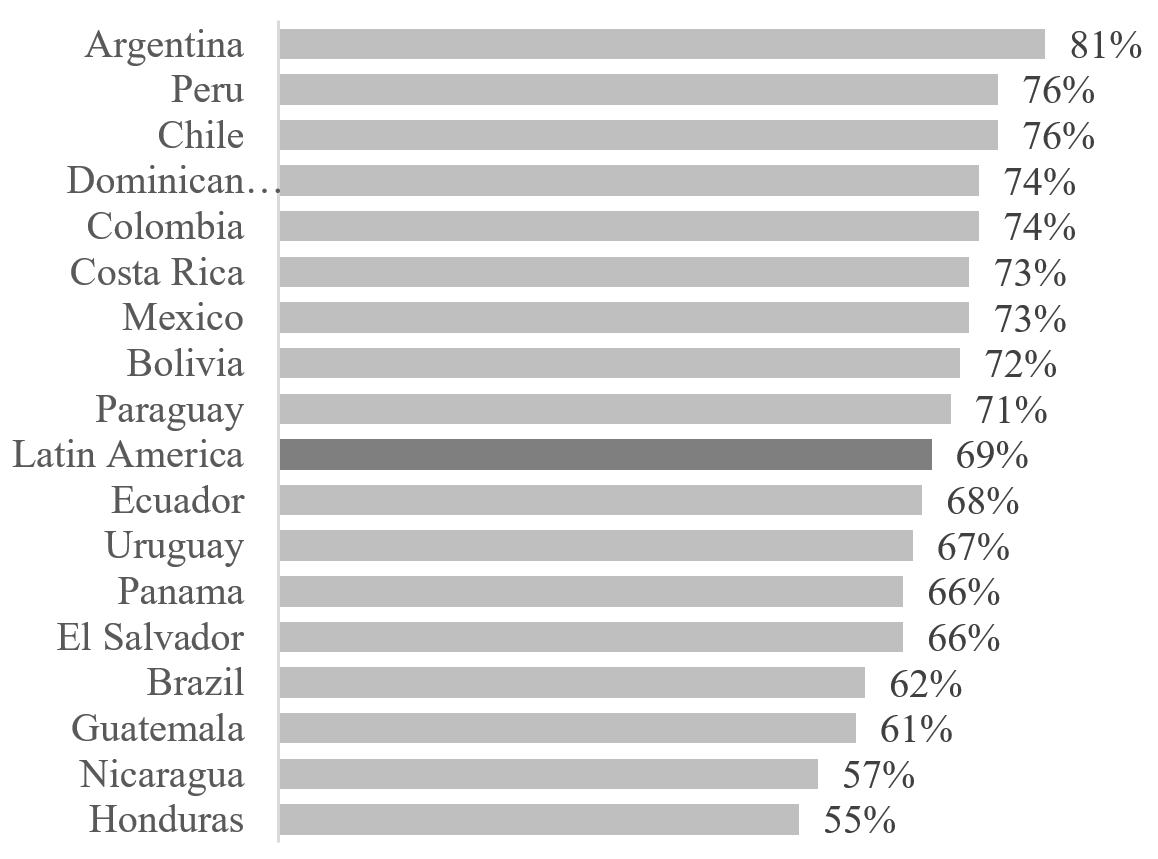
From the data of the Americas Barometer bank, we identified that there is a high perception of corruption among citizens, both for politicians and bureaucrats. Figure 1 presents the results for the perception of corruption of the “bureaucrats”. On average, 69% of Latin Americans believe that corruption among public officials is “very common” or “somewhat common”. The countries that stand out with the highest levels are Argentina (81%), Peru (76%) and Chile (76%), while Guatemala (61%), Nicaragua (57%) and Honduras (55%) sustain the lowest levels.

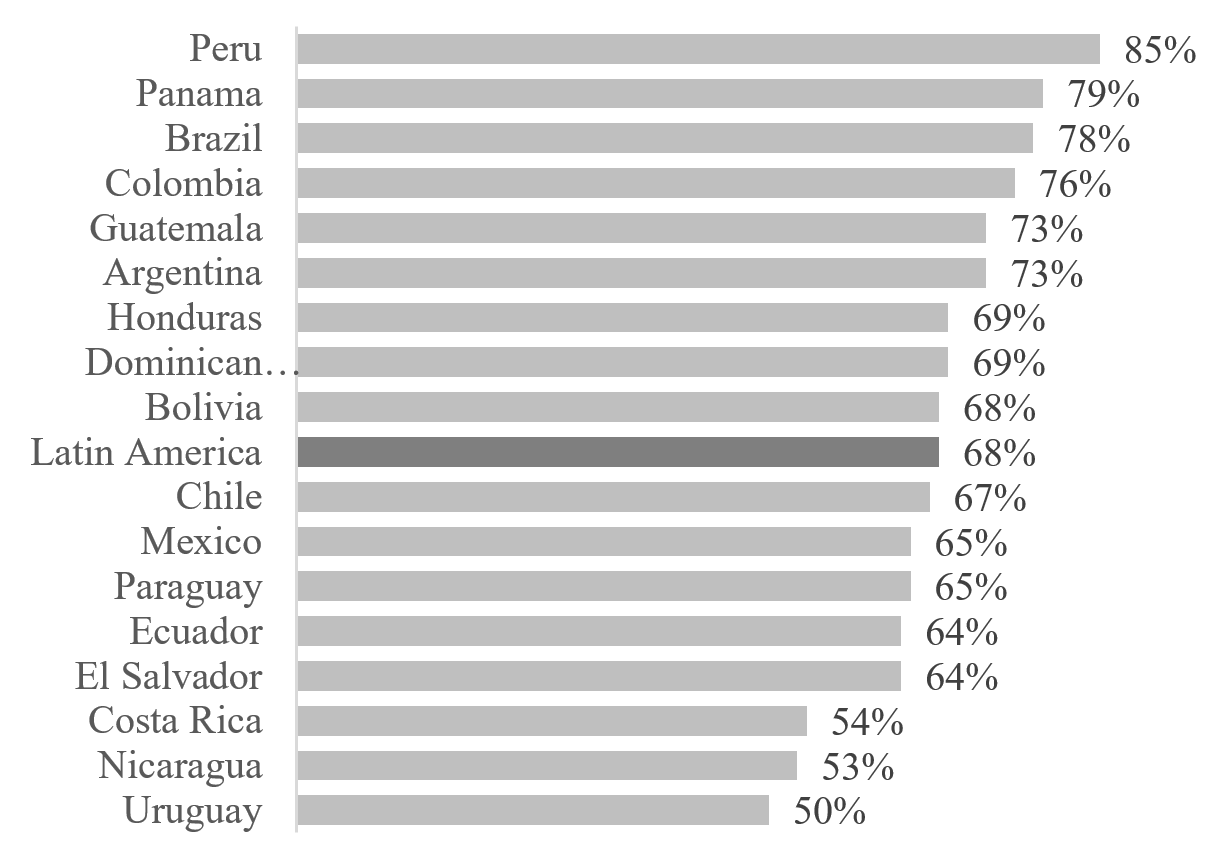
The data in Figure 2 indicate that the average perception of corruption by politicians is almost identical to that of bureaucrats (68%). However, the position of the countries changes considerably. At the top, with the highest percentages, are Peru (85%), Panama (75%) and Brazil (74%), while Costa Rica (54%), Nicaragua (53%) and Uruguay (50%) have the lowest levels of perceived corruption. This caveat about changing countries’ positions is important because, even if the average corruption perceived by Latin Americans for politicians and bureaucrats is close, the change in countries’ positions can have different meanings for democratic legitimacy, since, as we will present below, perception of politicians has greater potential to deteriorate support for the regime.

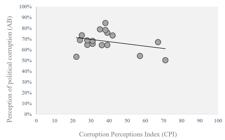
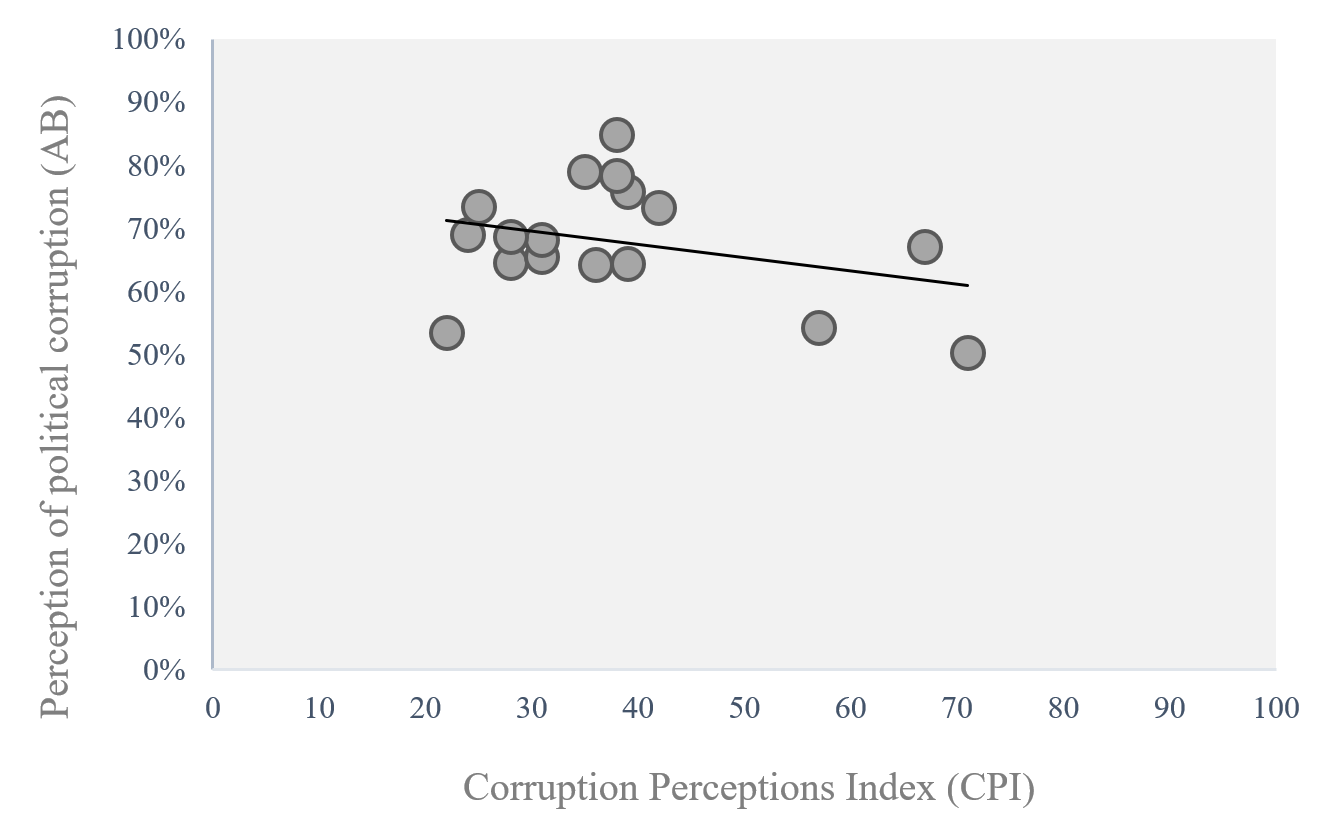
Figure 3 compares politicians’ perceptions of corruption with the Corruption Perceptions Index (CPI). Although it is very difficult to “objectively” measure corruption, the CPI is one of the most widely used indices in the world for this purpose. The low correlation between AB and CPI percentages reinforces the argument that corruption perceived by citizens does not always coincide with “effective” corruption in countries. The same pattern is observed when we use the percentage of corruption of bureaucrats.
Regarding the effects of the perception of corruption on legitimacy, we summarize the results of the logistic regression models that we ran in Table 1. As explained in the previous section, there are seven dependent variables that represent the dimensions of legitimacy. For each variable, we ran two models, one with the variable of perception of corruption of bureaucrats (PCB) and the other with the perception of corruption of politicians (PCP). That is, there were 14 logistic regression models. All models had fixed effects by country and were controlled for sex, age group, education, residence in urban or rural areas, and interest in policy. The table presents the odds ratio coefficients and, in parentheses, the standard error.
The first point to be highlighted is that there are differences between the ways of perceiving corruption. The perception of corruption by bureaucrats decreases support only in the most specific dimensions of the regime, satisfaction with democracy, and evaluation of the president. However, there is no significant effect for the rejection of military coups and we found an increase in the chances of support for democracy as a form of government, our most diffuse dimension analyzed. In addition, it has a systematically smaller effect than the perception of corruption in relation to politicians. The latter, in addition to exerting a greater impact on the specific spheres of legitimacy, also reaches the most diffuse strata, such as the belief that democracy is the best form of government and the rejection of military coups.
In percentage terms, PCB reduces satisfaction with democracy by 33%; 28% confidence in the elections; 36% confidence in Congress; 30% trust in the Superior Courts of Justice; and 22% in presidential approval. Regarding diffuse support, we found no statistically significant association between its corrosion and perceived corruption among bureaucrats. In turn, the perception of political corruption (PCP) reduced support for democracy by 21%; 23% rejecting military coups; 58% satisfaction with the regime; 63% confidence in the elections; 61% confidence in Congress; 61% trust in the Superior Courts of Justice; and 56% in presidential approval.
In this sense, our first hypothesis H1 that “the impact of the perception of corruption on the dimensions of democratic legitimacy should be greater when corruption is perceived in politicians than when it is perceived in public officials” was confirmed by the analysis. The perception of corruption on bureaucrats has a relatively minor effect on the legitimacy of the regime when compared to the effects of the perception of corruption on politicians.
This result incites to conjecture whether there would be a certain “sophistication” of the voter, since the effect of his perception of corruption is stronger precisely when it permeates the “operators” of the democratic system, that is, those who have effective conditions to change the political system. On the other hand, it also serves as a warning: the image of politicians is more powerful in affecting the legitimacy of democracy than the image of the “system”, impersonal and generalized, in the figure of public officials. We know, however, that politicians are much more vulnerable to corruption scandals and their disclosure in the media. The voter is constantly bombarded by negative news involving politicians, starting to give centrality to this information and making it more prominent when forming their opinion (Zaller; Feldman, 1992).
The second point that we call attention to is the strength of the effects and their relationship with the theory discussed earlier. It is noted that the effect of the perception of corruption is more pronounced exactly where it was expected: in the more specific dimensions of legitimacy. This result confirms our hypothesis H2 that “the impact of the perception of corruption, especially of politicians, should be greater in the more specific dimensions of support for democracy - evaluation of political actors, trust in institutions and satisfaction with the functioning of the regime - and lower in the diffuse dimension of support, adherence to democracy”.
The perception that politicians do not respect the laws to extract their own benefits to the detriment of the common good increases the chances that citizens will misjudge the country’s main political leadership, that they will be dissatisfied with the functioning of democracy and distrust of democratic institutions. As we have argued, this is not a problem per se for democracy. On the contrary: the virtue of democracy is precisely to have an institutional arrangement that accommodates public dissatisfaction through elections. From time to time, citizens have the opportunity to renew the political framework and, if they are dissatisfied with the performance of political actors, they can punish them or, conversely, if they are satisfied, reward them.
The problem, however, is when the perception of corruption is no longer limited to the “government of the day” to delegitimize the political regime, as a set of norms, rules and principles. In this case, the very institutions that accommodate public dissatisfaction are at risk and, at the limit, put in check by citizens. The data for Latin America suggest that this happens, at least when the target of the perception of corruption is politicians. Although the effect of this perception is more intense in the specific dimensions of legitimacy, it also reaches the most diffuse dimension. In other words: to the extent that they see more corruption in the “operators” of democracy, citizens begin to consider authoritarian alternatives.
In this sense, our analyses indicate the confirmation of our third hypothesis (H3): “the increase in the perception of political corruption increases the tolerance of military coups, which is a great risk to the legitimacy of the regime”. This is an alarming fact, because reducing the rejection of military coups implies greater tolerance for the violent overthrow of governments by force of arms. Even in our “test by fire” question of democracy, where we reduced the effect of the social desirability of democratic preference, we observed the explicit acceptance of a break with democracy in the event of an increase in the perception of political corruption. It is noteworthy that the reduction in the preference for democracy and the reduction in the rejection of coups have very similar values, respectively 21% and 23%, and are significant in our models.
Taking into account that the majority of Latin Americans (67%) perceive some degree of corruption among politicians, this result cannot be overlooked. It may be an exaggeration to say that democracy would be at imminent “risk” for this reason. But at the same time, it is prudent to admit that persistently high levels of perceived corruption can contribute to the deterioration of the democratic “reserve of legitimacy” and that, together with institutional and economic factors, can provide a favorable context for populist and authoritarian alternatives.
In other words, it is possible to conjecture that, by perceiving political corruption as something more systemic, Latin American citizens may understand that corruption is a problem of the regime itself, not just of individual political actors. If this occurs, the danger is that they will not differentiate between what is a problem of the regime and what is a problem of political actors and institutions, leading to the punishment of democracy itself. In this scenario, critical support for the regime can turn into contempt for the values that sustain and validate democracy.
Also in this sense, we emphasize that Latin American countries have a history of military interference in the political arena. Although it is not reasonable to consider these democracies as still “young”, given that the return to democracy occurred mostly in the 1980s and 1990s, this is not too distant and insignificant a past. On the contrary, we argue that it is necessary to pay attention to the quality of the democratic regime in the region, which is not only solidified with institutional changes, but also with the experience of citizens with satisfactory performances of the regime.
Final considerations
Our analysis of the data differentiated the perception of corruption practiced by public officials and politicians based on two Americas Barometer questions assumed here as independent variables. The results found from the regression analyses confirmed our hypotheses H1, H2 and H3, indicating that it is relevant to differentiate between corruption of politicians and bureaucrats, considering that the effects on legitimacy are much more significant for the perception of corruption in relation to politicians than in relation to public officials.
In addition, another important result related to this differentiation consists in the ability of both forms of perception to affect the dimensions of the legitimacy structure. The effects are substantively different according to the perception question adopted. The two independent variables have different effects in relation to the more specific and more diffuse levels of support, both maintaining the same meaning in the levels of legitimacy, namely: the higher one rises in the scale of the support structure, going from the most specific to the most diffuse objects, the lower the effect of perception on support and legitimacy. However, only the perception of corruption by politicians significantly reduced support for the more diffuse dimension of support for democracy.
When we compare our two explanatory variables, it is clear that politicians are more responsible for corruption and consistent with this data, the greater the capacity of the perception that politicians are corrupt to affect all dimensions. Even looking at the dimensions separately, the effect of accountability on politicians is greater and more corrosive than that of public officials. This leads us to think that the attitudes of citizens, in fact, may mean a differentiation with regard to accountability, since they attribute greater responsibility to the actors with greater power of control over decision-making processes and the operationalization of democracy itself than to bureaucrats.
However, while there may be a “sophistication” of citizens in terms of accountability, our study indicates that perceptions of corruption do not only affect attitudes toward the current government. The results of the analyses indicate that the effect of perception is corrosive also in the more diffuse dimension, of adherence to the regime, even if to a lesser extent in comparison with support at more specific levels. This gives greater centrality to the importance that the image of politicians has for the stability of the regime. These findings also confirm what the literature has been pointing out regarding the harmful effect of corruption on democratic legitimacy, but we pay attention to the need to consider the objects of support for legitimacy and, nevertheless, we warn of the possibility of contamination of the most diffuse dimensions of support, reducing the “reservoir of goodwill” in relation to democracy.
We point out that there are gaps to be advanced in research on the relationship between corruption and legitimacy. First, we highlight that countries differ greatly in terms of perception of corruption. In addition to individual characteristics, there are probably important contextual dimensions to explore. The democratic legacy draws our attention in view of its proximity to the idea of a “reservoir of support for the regime”. We understand that the time lived under a democracy and the quality of this experience with the regime can be interesting variables to assess whether there are interactive contextual elements that condition the effect of the perception of corruption.
Another interesting approach would be to analyze the corrosive effect of corruption taking into account the vote in the last elections or even the support for the ruler of the day. In other words, to analyze whether political or ideological affinity reduces the effect of perception or even perception itself. Or even, in more polarized contexts, can the corrosive effect be enhanced? In this aspect, research designs that offer good treatment of cases and that pay attention to interactive contextual aspects, especially the democratic legacy, political and ideological affinity and polarization, have the potential to contribute to the research agenda.
References
- ABRAMO, C. W. Percepções pantanosas: a dificuldade de medir a corrupção. Novos estudos CEBRAP, São Paulo, n. 73, p. 33-37, 2005.
- ADUT, A. Scandal as strategy and social form: the conditions, dynamics and paradoxes of French political corruption affairs. 2004. 256p. Thesis (PhD. in Sociology). University of Chicago, Chicago, 2004.
- ALMOND, G. A.; VERBA, S. The civic culture: political attitudes and democracy in five nations. Princeton: Princeton University Press, 1963. 562p.
- ANDERSON, C. J.; TVERDOVA, Y. V. Corruption, political allegiances, and attitudes toward government in contemporary democracies. American Journal of Political Science, v. 47, n. 1, p. 91-109, 2003.
- AMORIM, M. S. S. Democracia, desigualdades e corrupção: uma análise da qualidade democrática na América latina. Século XXI, Revista de Ciências Sociais, Santa Maria, v. 5, n. 2, p. 80-108, 2015.
- BAQUERO, M. Corruption, political culture and negative social capital in Brazil. Revista Debates, Porto Alegre, v. 9, n. 2, p. 139-157, 2015.
- BOOTH, J.; SELIGSON, M. The legitimacy puzzle in Latin America: political support and democracy in eight nations. Cambridge: Cambridge University Press, 2009. 355p.
- CALERA, N. Corrupción, ética y democracia: nueve tesis sobre la corrupción política. In: IBÁÑEZ, P.; LAPORTA, F.; ALVAREZ, S. (orgs.). La corrupción política. Madrid: Alianza Editorial, 1989. p. 117-135. [capítulo 4].
- DALTON, R. Democratic challenges, democratic choices: the erosion of political support in advanced industrial democracies. Oxford: Oxford University Press, 2004. 230p.
- DELLA PORTA, D. Social capital, beliefs in government, and political corruption. In: PHARR, S. J.; PUTNAM, R. D. (orgs.). Dissatisfied democracies: what’s troubling the trilateral countries? Princeton: Princeton University Press, 2000. p 202-228. [capítulo 9].
- FILGUEIRAS, F. Marcos teóricos da corrupção. In: AVRITZER, L.; GUIMARÃES, J.; STARLING, H. (orgs.). Corrupção: ensaios e críticas. 2. ed. Belo Horizonte: Editora UFMG, 2008. p. 299-306.
- HEIDENHEIMER, A.; JOHNSTON, M.; LEVINE, V. Introduction to part I. In: HEIDENHEIMER, A.; JOHNSTON, M.; LEVINE, V. (orgs.). Political corruption: a handbook. New Brunswich: Transaction Publishers, 1989. 1017p.
- MANZETTI, L.; WILSON, C. Why do corrupt governments maintain public support? In: BLAKE, C.; MORRIS, S. (orgs.). Corruption and democracy in Latin America. Pittsburgh: University of Pittsburgh Press, 2009. p. 77-93. [capítulo 4].
- MELO, M. A. A malaise política no Brasil: Causas reais e imaginárias. Journal of Democracy, São Paulo, v. 6, n. 2, p. 69-95, out. 2017.
- MENEGUELLO, R. O lugar da corrupção no mapa de referência dos brasileiros: aspectos da relação entre corrupção e democracia. In: AVRITZER, L.; FILGUEIRAS, F. Corrupção e sistema político no Brasil. Rio de Janeiro: Civilização Brasileira, 2011. p. 63-82.
- MISHLER, W.; ROSE, R. What are the origins of political trust? Testing institutional and cultural theories in post-communist societies. Comparative Political Studies, v. 34, n. 1, p. 30-62, 2001.
- MOISÉS, J. Á. Corrupção política e democracia no Brasil contemporâneo. In: MENEGUELLO, R.; MOISÉS, J. Á. (orgs.). A desconfiança política e os seus impactos na qualidade da democracia. São Paulo: Editora da Universidade de São Paulo, 2013. p. 201-335. [capítulo 7].
- MOISÉS, J. Á. A corrupção afeta a qualidade da democracia? Em Debate: Periódico de Opinião Pública e Conjuntura Política, Belo Horizonte, v. 2, n. 5, p. 27-37, 2010.
- NORRIS, P. Democratic deficit: critical citizens revisited. Cambridge: Cambridge University Press, 2011. 335 p.
- NORRIS. Critical citzens: global support for democratic government. Oxford: Oxford University Press, 1999. 303 p.
- NYE, J. Corruption and political development: a cost-benefit analysis. The American Political Science Review, v. 61, n. 2, p. 417-427, 1967.
- PAVÃO, N. Corruption as the only option: the limits to electoral accountability. Journal of Politics, v. 80, p. 996-1010, 2018.
- PUTNAM, R. D. Making democracy work: Civic traditions in modern Italy. Princeton: Princeton University Press, 1993. 258 p.
- ROSE-ACKERMAN, S. Corruption and government: causes, consequences, and reform. Cambridge: Cambridge University Press, 1999. 266p.
-
SANTOS, Everton Rodrigo; ALMEIDA NETO, Honor de; PASE, Hemerson Luiz; SILVA, Fabio Hoffman Maciel da. Democracia e corrupção na América Latina. Revista de Políticas Públicas, v. 26, n. 2, p. 582-597, jan. 2023. DOI: 10.18764/2178-2865.v26n2p582-597. Disponível em: Disponível em: https://periodicoseletronicos.ufma.br/index.php/rppublica/article/view/20642 Acesso em: 28 jul. 2023.
» https://doi.org/10.18764/2178-2865.v26n2p582-597» https://periodicoseletronicos.ufma.br/index.php/rppublica/article/view/20642 - SELIGSON, M. Corruption and democratization: what is to be done? Public integrity, São Luís do Maranhão, v. 3, n. 3, p. 221-241, 2001.
- SELIGSON, M. The impact of corruption on regime legitimacy: a comparative study of four Latin American countries. Journal of Politics, Chicago, v. 64, n. 2, p. 408-433, 2002.
- SELIGSON, M. The measurement and impact of corruption victimization: survey evidence from Latin America. World Development, v. 34, n. 2, p. 381-404, 2006.
- SILVA, Érica Anita Baptista. Corrupção e opinião pública: o escândalo da Lava Jato no governo Dilma Rousseff. 2017. 252p. Tese (Doutorado em Ciência Política). Universidade Federal de Minas Gerais. Belo Horizonte, 2017.
- SILVA, Roberto Bonifácio da. Corrupção e participação política nas Américas e no Caribe: 2004-2012. 2014. 178p. Tese (Doutorado em Ciência Política). Universidade Federal de Minas Gerais. Belo Horizonte, 2014.
- SINGER, A. Esquerda e direita no eleitorado brasileiro: a identificação ideológica nas disputas presidenciais de 1989 e 1994. São Paulo: Editora da Universidade de São Paulo, 2000. 208p.
- VALDÉS, E. G. Acerca del concepto de corrupción. Claves de Razón Práctica, n. 56, p. 26-39, 1995.
- ZALLER, J.; FELDMAN, S. A simple theory of the survey response: answering questions versus revealing preferences. American Journal of Political Science, v. 36, n. 3, p. 579-616, 1992.
-
1
Data replication: https://doi.org/10.7910/DVN/YMO8YJ
-
4
We use the term scandal in the sense listed by Adut (2004), in which the term is defined as the publicization of the transgression in a disturbing way, generating collective indignation and negative reactions in the public space.
-
5
Recruitment by merit is opposed to the electoral method because it is not based on popular suffrage, but on a set of mechanisms that seek to select individuals based on a system of universal competition for positions and for their performance in technical matters of the function that will be exercised.
-
6
By definition, the organization of the Weberian bureaucracy necessarily occurs in a hierarchical, subordinate, disciplined way and with pre-established rules of conduct, unlike politicians, who do not establish a pyramidal organization of obedience and discipline, building more “horizontal” relationships with their peers and often use the discourse of being “equal” in front of their voters.
-
7
The stability of the bureaucracy contrasts with the volatility to which politicians are susceptible according to the “political mood” of citizens. Thus, political turnover tends to be more “natural” in democracy than the turnover of bureaucrats.
-
8
In the Weberian ideal, impersonality is fundamental to depersonalize the administrative machinery of the State and establish universalist standards of procedures, contrasting with the search for the ‘good image” that politicians aim at in order to win votes.
-
9
However, there is no consensus regarding the precise conceptualization, so that the divergences can be grouped, according to Heidenheimer, Johnston and Levine (1989), into three models: public-office-centered definitions, in which the phenomenon concerns more properly public agents (Manzetti; Wilson, 2009; Nye, 1967); market-centered definitions, emphasizing economic and market aspects (Rose-Ackerman, 1999); and interest-centered definitions, whose central aspect consists of the opposition to the normative idea of public interest (Calera, 1989; Filgueiras, 2008; Valdés, 1995).
-
10
It is important to note that victimization actually consists of an indirect index to try to measure victimization by corruption, in view of the difficulty of conjecturing about the real volume of corruption and victimization by corruption. Given the peculiarity of corruption being characterized by secrecy and taking into account the social desirability on the subject, it is difficult to effectively measure both corruption and victimization by corruption.
-
11
From the institutional perspective, the occurrence of corruption is explained from variables internal to the political system. In general, the neo-institutional literature has used rational choice as an analytical paradigm to address the issue of corruption, adopting as a basic assumption the way in which institutional design can create mechanisms to encourage or inhibit corrupt behavior. It is also constant to assume rent-seeking behavior as a pre-ordained preference model and to analyze accountability mechanisms through institutional or vertical accountability. Although there is no consensus on which institutional mechanisms can effectively explain the occurrence of corruption, the argument that underlies the works assumes the institutional context as an explanatory variable.
-
12
The recruitment of the bureaucracy is more complex and involves relations with the political system itself, especially for high-level hierarchical and command positions. However, we refer to the characteristic pattern of recruitment of the bureaucracy delimited by the Weberian paradigm because this is the classic view of the form of bureaucratic recruitment and is widely identified by citizens as a form of selection for public positions.
-
13
We use the term “intuition” in an analogous way to Singer (2000), for example, when he argues that voters have an “ideological intuition”. This means that, even without knowing exactly the formal definitions that involve the concepts, citizens are able to understand them in what is most essential through the practical experiences they acquire when acting politically throughout their lives. This is the meaning used here: although there are formal definitions that separate the “bureaucrat” from the “politician”, the common voter makes a minimal, although not perfect, distinction that guides his judgments.
-
14
The questionnaire was not applied to Venezuela in the 2018/2019 round.
APPENDIX: TABLE 1
Edited by
-
Debora Rezende de Almeida
-
Rebecca Neaera Abers

 n = 13,646Source: Americas Barometer 2018/2019
 n = 13,437Source: Americas Barometer 2018/2019
 Source: Americas Barometer 2018/2019