 Effects of a cardiac rehabilitation program in the functional capacity and mental health of patients with heart disease
ABSTRACT
The study evaluated the effects of a cardiac rehabilitation program (CRP) on 21 patients using 48 sessions of functional training (FT). Functional capacity (FC) was assessed using the Six-Minute Walk Test (6MWT), and anxiety and depression levels were measured using the Hospital Anxiety and Depression Scale (HADS) before and after CRP. Post-intervention assessment revealed a significant increase in the distance covered during the 6MWT, but no changes were observed in HADS scores. It was concluded that CRP can improve FC, although it does not impact the anxiety and depression levels of participants.
Keywords:
Cardiovascular diseases; Mental health; Functional physical performance; Exercise
RESUMO
O estudo avaliou os efeitos de um programa de reabilitação cardíaca (PRC) em 21 pacientes, utilizando 48 sessões de treinamento funcional (TF). A capacidade funcional (CF) foi medida pelo Teste de Caminhada de Seis Minutos (TC6), e os níveis de ansiedade e depressão foram avaliados pela Escala Hospitalar de Ansiedade e Depressão (HADS) antes e após o PRC. Após a intervenção foi observado um aumento significativo na distância percorrida no TC6, mas não foram observadas mudanças nos escores do HADS. Conclui-se que o PRC pode melhorar a CF, embora não tenha impacto nos níveis de ansiedade e depressão dos participantes.
Palavras-chave:
Doenças cardiovasculares; Saúde mental; Desempenho físico funcional; Exercício físico
RESUMEN
Este estudio evaluó los efectos de un programa de rehabilitación cardiaca (PRC) en 21 pacientes, utilizando 48 sesiones de entrenamiento funcional (TF). La capacidad funcional (CF) se evaluó mediante el Test de Caminata de Seis Minutos (TC6), y los niveles de ansiedad y depresión se midieron mediante la Escala Hospitalaria de Ansiedad y Depresión (HADS) antes y después del PRC. Tras las reevaluaciones, se observó un aumento significativo en la distancia recorrida en el TC6, aunque no se encontraron cambios en los puntajes de la HADS. Se concluye que el PRC puede mejorar la CF, aunque no tiene impacto en los niveles de ansiedad y depresión de los participantes.
Palabras clave:
Enfermedades cardiovasculares; Salud mental; Rendimiento físico funcional; Ejercicio físico
INTRODUCTION
Cardiovascular diseases (CVDs), including acute myocardial infarction (AMI) and coronary artery disease (CAD), are the leading cause of death worldwide, primarily due to poor dietary habits and physical inactivity (Carvalho et al., 2020). Other risk factors like obesity, smoking, diabetes, and hypertension further increase the risk of adverse cardiovascular events (Castro et al., 2005).
Survivors of CVDs often experience reduced functional capacity (FC), evidenced by decreased strength, muscular endurance, agility, balance, and cardiorespiratory fitness (Prabhu et al., 2020). Additionally, CVDs can lead to psychological disorders, such as increased anxiety and depressive symptoms (Rabelo et al., 2018; Prugger et al., 2017). Consequently, CVDs are a major cause of physical disability and contribute significantly to healthcare costs (Carvalho et al., 2020). Therefore, effective treatment strategies are essential to minimize both the pathophysiological and psychological effects of CVDs, stabilizing or improving the patient's condition (Ashdown-Franks et al., 2020).
Cardiac rehabilitation programs (CRPs) are well-established non-pharmacological interventions that complement medication treatments by promoting lifestyle changes, focusing on physical exercise, healthy eating, and reducing cardiovascular risk factors. CRPs aim to rehabilitate and improve both the physiological and psychological states through multidisciplinary intervention. Traditional CRPs primarily use aerobic exercise, sometimes combined with strength training, yielding several health benefits (Carvalho et al., 2020). However, the modality of functional training (FT) is still underexplored (Campos and Coraucci, 2004; Antunes et al., 2020).
FT involves multi-joint exercises that mimic daily activities, developing integrated physical capacities such as strength, muscular endurance, aerobic endurance, flexibility, balance, and motor coordination. It is a practical and cost-effective method due to its accessible equipment (Boyle, 2018). While FT benefits healthy individuals and the elderly, its effects on cardiac patients in CRPs are less studied (Aikawa et al., 2014; Shen et al., 2005). Given this gap in the literature, the aim of this study was to evaluate the effects of a CRP, performed through FT, on FC and levels of anxiety and depression in cardiac patients.
MATERIALS AND METHODS
Design, population and sample
This is an experimental study, in which evaluations occurred before and after the completion of 48 sessions of FT in phase three of the CRP. Both the assessments and the intervention were conducted by the same physical education professional.
The population consisted of patients who progressed from phase two to phase three of the CRP called REVICARDIO at the University Hospital of Santa Maria (HUSM) between 2016 and 2019. Patients of both sexes with various cardiovascular diseases and/or those who had undergone surgical procedures were included. Additionally, all patients were clinically stable and fit for physical exercise, as per the consent of the responsible cardiologist. Exclusion criteria included any clinical complications preventing patients from continuing in the CRP, as well as failure to complete questionnaires and physical tests at the beginning and end of the intervention.
Assessment of functional capacity
FC was assessed using the six-minute walk test (6MWT) in a straight and flat corridor, free of pedestrian traffic, with a length of 30 meters marked every three meters (indicated by a cone). Patients were instructed to walk as fast as possible along the course, and the test was invalidated if the patient ran or walked a different route from the predetermined one. After the time ended, the evaluator instructed the patients to stop and remain in place so that the distance covered could be measured with a measuring tape. One attempt was conducted, and performance was determined by the distance (in meters) that the patient walked at the end of 6 minutes (Butland et al., 1982; Giannitsi et al., 2019).
Assessment of anxiety and depression
To assess anxiety and depression levels, the Hospital Anxiety and Depression Scale (HADS) was administered in the physical space used for the training sessions. The questionnaire was self-administered by the patients, who received explanations about its purpose and objectives. This instrument was developed by Zigmond and Snaith (1983) and validated in Brazil by Botega et al. (1995). It comprises 14 questions, seven of them assessing anxiety and seven assessing depression, using a response scale ranging from zero to three. The total score for each subscale ranges from zero to 21 points. The following cut-off points were used to detect the presence of anxiety and depression for each subscale: unlikely (zero to seven points), possible (eight to 11 points), and probable (12 to 21 points) (Rabelo et al., 2018).
Intervention
Table 1 presents the functional training protocol of the CRP, which consisted of 48 FT sessions, conducted twice a week over a period of six months. Each FT session lasted 45 minutes and was divided into three phases:
-
Warm-up: A five-minute walk;
-
Functional circuit (35 minutes): Three sets of six to seven functional exercises based on basic movements (squatting, pulling, pushing, and running) and some single-joint exercises were performed. Each exercise lasted one minute with minimal rest between them. After each set, there was a two-minute active rest with light walking. The intensity was maintained between 12 to 14 (moderate to somewhat hard) on the Borg Rating of Perceived Exertion Scale (Carvalho et al., 2020);
-
Stretching (5 minutes): Flexibility and relaxation exercises, both dynamic and static, were performed for the exercised body regions, each lasting 20 to 30 seconds.
The materials used in the sessions included 1 to 3 kg dumbbells, balls, mats, cones, ropes, mini bands, among others. The FT sessions were supervised, and the exercises were adapted when necessary, taking into account individual limitations or comorbidities. Safety limits established by the physician were also respected according to each patient's clinical condition (Carvalho et al., 2020).
Statistical analysis
The collected data were tabulated and analyzed using SPSS (Statistical Package for the Social Sciences), version 22.0. Initially, descriptive analyses were conducted to obtain means and standard deviations. Data normality was verified using the Shapiro-Wilk test. Comparisons between pre- and post-intervention moments were performed using paired Student’s t-tests, adopting a significance level of 5%. Additionally, the effect size was calculated for each variable using Cohen's equation and interpreted as trivial (<0.20), small (0.20 to 0.49), moderate (0.50 to 0.79), large (0.80 to 1.29), or very large (>1.30) (Cohen, 1988; Sawilowsky, 2009).
RESULTS
Table 2 presents the characterization of the sample, including the number of patients selected who met the inclusion criteria, as well as demographic, clinical, comorbidity, and medication usage information.
It is noted that the percentage of men (86%) was higher than that of women. Regarding pathologies, it is highlighted that AMI (71%) and CAD (33%) were the most common, and among the risk factors, the majority of patients had dyslipidemia and arterial hypertension (71%). Additionally, 48% of participants were former smokers.
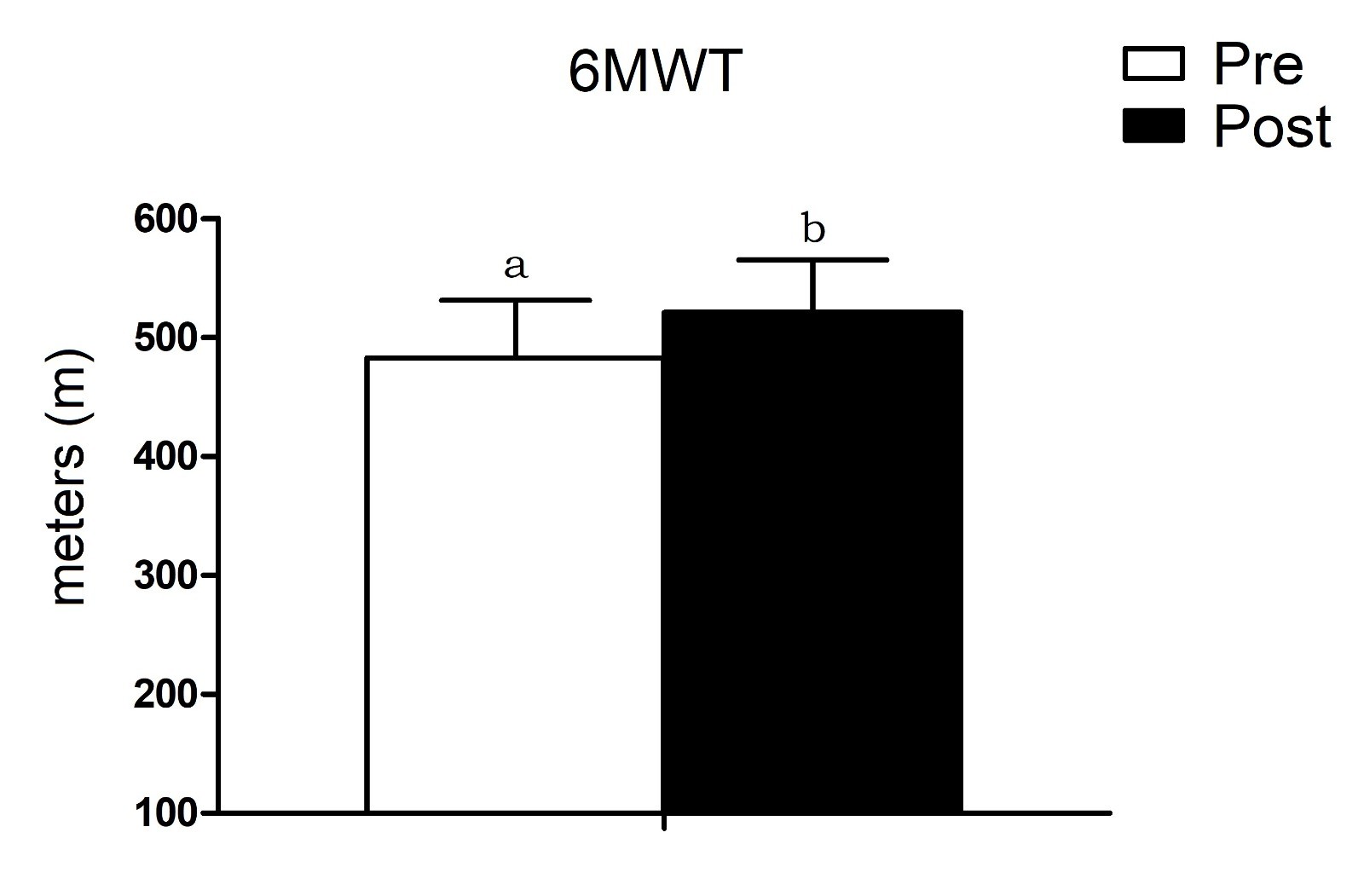
Figure 1 refers to the values of the 6MWT pre and post FT. It is observed that there was a significant increase in the distance walked in the 6MWT (483.24 ± 48.71 vs 521.35 ± 44.44; p = 0.003), with a large effect size (d = 0.88; 95% CI: 0.24 to 1.51) indicating improvement in aerobic endurance and FC of patients after 48 sessions of FT.

Results of the 6-minute walk test pre and post Functional Training. The mean distance walked and the standard deviation are represented in meters. Source: The author. Different letters indicate statistically significant differences between the time points. 6MWT: Six-minute walk test.
In Figure 2, the values of HADS pre and post FT are described. No significant differences were observed in the HADS Anxiety scores (5.00 ± 3.29 vs 5.64 ± 4.25; p = 0.308; d = 0.17; 95% CI: -0.44 to 0.77), HADS Depression scores (2.64 ± 2.42 vs 3.73 ± 3.43; p = 0.052; d = 0.36; 95% CI: -0.25 to 0.97), and HADS Total scores (7.64 ± 5.20 vs 9.36 ± 7.21; p = 0.109; d = 0.27; 95% CI: -0.34 to 0.88) of the patients after 48 sessions of FT.

Results of the Hospital Anxiety and Depression Scale pre and post Functional Training. The levels of anxiety and depression are represented by the mean and standard deviation of the HADS questionnaire scores. Source: The author. Identical letters indicate that there was no statistically significant difference between the time points. HADS: Hospital Anxiety and Depression Scale.
DISCUSSION
This study investigated the effects of a CRP utilizing FT on physical and mental health in cardiac patients. FC was evaluated as an indicator of physical health, while anxiety levels and depressive symptoms were assessed as indicators of mental health. The findings of the present study demonstrated that participation in the CRP resulted in a significant improvement in FC; however, no meaningful changes were observed in anxiety or depressive symptom levels following the intervention.
Aikawa et al. (2014) demonstrated significant improvements in FC in post-CABG patients following a three-month CRP, assessed through the 6MWT. Similarly, Whitehurst et al. (2005) found increased FC in elderly individuals after a 12-week FT intervention. Together, these studies reinforce the effectiveness of exercise-based CRPs in enhancing FC among different cardiac and older populations. Consistent with these findings, the present study also showed a significant improvement in FC after the intervention, supporting the notion that structured programs integrating aerobic and resistance exercises can promote meaningful functional gains in cardiac patients, even within a relatively short rehabilitation period.
Although improvements in FC after CRP are commonly reported, there are discrepancies in the literature. Sandercock et al. (2013) observed that cardiac rehabilitation patients in the United Kingdom, who completed an average of only eight supervised exercise sessions (range 6 to 16), achieved a modest gain of ~0.52 METs in cardiorespiratory fitness, about one third of the average improvement (~1.55 METs) reported internationally. In contrast, the present study, with a similar number of exercises per session but a substantially higher total volume (48 sessions), showed more expressive FC gains (~38 m increase in the 6MWT, p < 0.01; d = 0.88). Although natural recovery after cardiac surgery can contribute to initial improvements in FC, this process tends to slow substantially during more advanced phases of rehabilitation. Considering that the participants in the present study were already in phase III of the CRP, with clinical stabilization and previous gains achieved in earlier phases, the additional ~38 m increase in the 6MWT is more plausibly associated with the structured exercise program performed. Thus, the magnitude of improvement observed aligns with the literature reporting functional gains induced by CRPs that combine aerobic and resistance exercises (Campos and Coraucci, 2004; Carvalho et al., 2020; Castro et al., 2005; Prabhu et al., 2020).
Regular physical exercise contributes to the maintenance and improvement of FC, which often declines in elderly individuals and those with CVDs (Campos and Coraucci, 2004; Whitehurst et al., 2005; Oliveira et al., 2019; Prabhu et al., 2020). FC is a strong predictor of mortality and involves the ability to perform daily, occupational, sports, and leisure activities, essential for an independent life (Campos and Coraucci, 2004; Prabhu et al., 2020; Braga, 2019). It is also related to the capacity to sustain dynamic activities involving large muscle groups for extended periods (Oliveira et al., 2019; Braga, 2019).
Both aerobic exercise and strength training, as well as FT, promote beneficial adaptations in physical fitness and reduce cardiovascular risk factors (Carvalho et al., 2020; Castro et al., 2005). Aerobic training improves oxygen consumption and the oxidative capacity of muscles, while strength training increases muscle strength, endurance, and mass, aiding in cardiac function and maintaining basal metabolic rate (Carvalho et al., 2020; Castro et al., 2005; Boyle, 2018). FT, like conventional strength training, increases strength, power, muscle mass, and aerobic capacity, enhancing FC and the performance of daily activities (Campos and Coraucci, 2004; Boyle, 2018; Braga, 2019).
In addition to reduced FC, cardiac patients often experience psychological disorders such as anxiety and depression, which can worsen the prognosis of the disease (Whitehurst et al., 2005; Shen et al., 2005; Ko et al., 2019). The study by Shen et al. (2005) showed that depression and anxiety decreased after four to 12 weeks of participation in a CRP. Regular physical exercise can reduce depressive symptoms comparably to medication, improving self-confidence, self-esteem, social interaction, and increasing the activity of the serotonergic and noradrenergic systems, as well as brain-derived neurotrophic factor (BDNF) and beta-endorphin (Stubbs and Schuch, 2019; Ashdown-Franks et al., 2020; Schuch and Stubbs, 2019). FT programs of 12 to 14 weeks, with two weekly sessions, significantly reduce symptoms of anxiety and depression in the elderly (Oliveira et al., 2019). FT, usually performed in circuits and groups, improves social relationships and psychological state, as well as facilitates the performance of daily activities, contributing to the reduction of depressive symptoms (Botega et al., 1995; Campos and Coraucci, 2004; Oliveira et al., 2019; Braga, 2019).
Some factors may have contributed to the divergence between these findings and those of the present study. The study by Shen et al. (2005) is a systematic review that brought together different types of interventions, populations, and assessment tools, which limits direct comparability with our results. In turn, the sample in the study by Oliveira et al. (2019) consisted of community-dwelling elderly women, with no report of baseline functional capacity and possibly with higher initial levels of anxiety and depression, increasing the likelihood of observing significant reductions after the intervention.
Several factors may explain the lack of significant differences in the HADS scores after the FT period. Physically active cardiac patients with high FC are at lower risk for anxiety and depression (Castro et al., 2005; Chialà et al., 2018). Unlike the participants in the study by Oliveira et al. (2019) and possibly those included in the review by Shen et al. (2005), the patients in our sample were already clinically stable, in an advanced phase of CRP (phase III), with high baseline functional capacity (10.34 ± 2.58 METs; 483 ± 49 m in the 6MWT) and low initial HADS scores (anxiety = 5.00 ± 3.29; depression = 2.64 ± 2.42), indicating a low probability of anxiety and depression disorders (Rabelo et al., 2018). This suggests a potential “ceiling effect” that limited further reductions. Additionally, no structured psychological support or specific mental health interventions were provided during the CRP, which may have reduced the likelihood of significant changes in HADS scores. The use of anxiolytic medications (14%) and antidepressants (33%) may also have influenced the outcomes, potentially masking improvements or contributing to the slight increase observed in HADS Anxiety scores, given the lower percentage of anxiolytic use. In addition, the short interval between hospital discharge and the start of CRP, combined with prior progression in phase II, may have already improved FC and psychological state.
The association between depressive symptoms and regular exercise is bidirectional; depressive symptoms decrease the likelihood of regular exercise by 40% (Prugger et al., 2017; Samad et al., 2019). This suggests that patients with anxiety or depression are less likely to attend a CRP, which may have influenced the results. From this perspective, remote cardiac rehabilitation programs that adopt comprehensive and personalized approaches have been proposed to improve accessibility and engagement among patients who face barriers to attending in person (Pepera et al., 2024). Although the present study did not use a remote CRP model, this underscores the overall value of tailoring rehabilitation interventions to each patient’s needs in order to maximize participation and outcomes. The context of phase III being the last stage before outpatient discharge could also have generated uncertainty regarding continuity of care in the public healthcare system, contributing to the slight increase in total HADS scores.
The limitations of this study include the absence of a control group, which prevents comparison with individuals not participating in physical exercise, the lack of monitoring of patient attendance in the FT sessions of the CRP, the small sample size (only 21 patients completed the program), and the absence of long-term follow-up to verify the maintenance of benefits.
CONCLUSION
The CRP with 48 sessions of FT resulted in a significant improvement in FC in clinically stable cardiac patients, which may reflect gains in autonomy, independence, and a reduced risk of future cardiovascular events over time.
However, the observed limitations, such as the absence of a control group, lack of monitoring of attendance at sessions, small sample size, and absence of long-term follow-up, highlight the need for more robust investigations. Future studies should explore not only the maintenance of functional capacity but also the influence of adherence on outcomes and the evolution of anxiety and depression levels in post-CRP follow-up.
In addition, the potential benefits of incorporating comprehensive and personalized approaches into CRP, including remote formats when appropriate, should be examined to enhance accessibility, adherence, and patient outcomes. These findings may guide adjustments in the design and implementation of programs, improving their impact on both physical health and psychological well-being.
DATA AVAILABILITY
The data supporting the findings of this study are not publicly available due to ethical and confidentiality considerations, but are available from the corresponding author upon reasonable request.
-
FUNDING
This paper did not have financial support of any nature for its realization.
REFERENCES
-
Aikawa P, Cintra ARS, Oliveira AS Jr, Silva CTM, Pierucci JD, Afonso MDS, et al. Reabilitação cardíaca em pacientes submetidos à cirurgia de revascularização do miocárdio. Rev Bras Med Esporte. 2014;20(1):55-8. https://doi.org/10.1590/S1517-86922014000100011
» https://doi.org/10.1590/S1517-86922014000100011 -
Antunes BS, Bianco R, Lima WS. Treinamento funcional: conceitos e benefícios. Rev Cient Núcleo Multidisciplinar Conhecimento. 2020;6(8):69-80. https://doi.org/10.32749/nucleodoconhecimento.com.br/educacao-fisica/treinamento-funcional
» https://doi.org/10.32749/nucleodoconhecimento.com.br/educacao-fisica/treinamento-funcional -
Ashdown-Franks G, Firth J, Carney R, Carvalho AF, Hallgren M, Koyanagi A, et al. Exercise as medicine for mental and substance use disorders: a meta-review of the benefits for neuropsychiatric and cognitive outcomes. Sports Med. 2020;50(1):151-70. https://doi.org/10.1007/s40279-019-01187-6 PMid:31541410.
» https://doi.org/10.1007/s40279-019-01187-6 -
Botega NJ, Bio MR, Zomignani MA, Garcia C Jr, Pereira WAB. Transtornos do humor em enfermaria de clínica médica e validação de escala de medida (HAD) de ansiedade e depressão. Rev Saude Publica. 1995;29(5):355-63. https://doi.org/10.1590/S0034-89101995000500004 PMid:8731275.
» https://doi.org/10.1590/S0034-89101995000500004 - Boyle M. O novo modelo de treinamento funcional de Michael Boyle. Porto Alegre: Artmed; 2018.
-
Braga TM. Treinamento funcional como método para melhora da capacidade funcional em idosos: uma revisão de literatura [trabalho de conclusão de curso]. Porto Alegre: Universidade Federal do Rio Grande do Sul; 2019 [cited 2024 Oct 21]. Available from: http://hdl.handle.net/10183/202243
» http://hdl.handle.net/10183/202243 -
Butland RJ, Pang J, Gross ER, Woodcock AA, Geddes DM. Two-, six-, and 12-minute walking tests in respiratory disease. Br Med J. 1982;284(6329):1607-8. https://doi.org/10.1136/bmj.284.6329.1607 PMid:6805625.
» https://doi.org/10.1136/bmj.284.6329.1607 - Campos MA, Coraucci B No. Treinamento funcional resistido: para melhoria da capacidade funcional e reabilitação de lesões musculoesqueléticas. Rio de Janeiro: Revinter; 2004.
-
Carvalho T, Milani M, Ferraz AS, Silveira AD, Herdy AH, Hossri CAC, et al. Diretriz Brasileira de Reabilitação Cardiovascular – 2020. Arq Bras Cardiol. 2020;114(5):943-87. https://doi.org/10.36660/abc.20200407 PMid:32491079.
» https://doi.org/10.36660/abc.20200407 - Castro RRT, Negrão CE, Stein R, Serra SM, Teixeira JAC, Carvalho T, et al. Diretriz de Reabilitação Cardíaca. Arq Bras Cardiol. 2005;84(5):431-40. PMid:15917979.
-
Chialà O, Vellone E, Klompstra L, Ortali GA, Strömberg A, Jaarsma T. Relationships between exercise capacity and anxiety, depression, and cognition in patients with heart failure. Heart Lung. 2018;47(5):465-70. https://doi.org/10.1016/j.hrtlng.2018.07.010 PMid:30087002.
» https://doi.org/10.1016/j.hrtlng.2018.07.010 - Cohen J. Statistical power analysis for the behavioral sciences. 2nd ed. Hillsdale: Lawrence Erlbaum Associates; 1988.
-
Giannitsi S, Bougiakli M, Bechlioulis A, Kotsia A, Michalis LK, Naka KK. 6-minute walking test: a useful tool in the management of heart failure patients. Ther Adv Cardiovasc Dis. 2019;13:1-10. https://doi.org/10.1177/1753944719870084 PMid:31441375.
» https://doi.org/10.1177/1753944719870084 -
Ko JM, White KS, Kovacs AH, Tecson KM, Apers S, Luyckx K, et al. Differential impact of physical activity type on depression in adults with congenital heart disease: a multi-center international study. J Psychosom Res. 2019;124:109762. https://doi.org/10.1016/j.jpsychores.2019.109762 PMid:31443808.
» https://doi.org/10.1016/j.jpsychores.2019.109762 -
Oliveira DV, Santos R, Dias MA, Pacheco RRB, Andrade JR Jr. Efeito de um programa de treinamento funcional sobre a ansiedade e autoestima de idosas. Rev Bras Psicol Esporte. 2019;9(1):1-11. https://doi.org/10.31501/rbpe.v9i1.9614
» https://doi.org/10.31501/rbpe.v9i1.9614 -
Pepera G, Antoniou V, Su JJ, Lin R, Batalik L. Comprehensive and personalized approach is a critical area for developing remote cardiac rehabilitation programs. World J Clin Cases. 2024;12(12):2009-15. https://doi.org/10.12998/wjcc.v12.i12.2009 PMid:38680265.
» https://doi.org/10.12998/wjcc.v12.i12.2009 -
Prabhu NV, Maiya AG, Prabhu NS. Impact of cardiac rehabilitation on functional capacity and physical activity after coronary revascularization: a scientific review. Cardiol Res Pract. 2020;2020:1236968. https://doi.org/10.1155/2020/1236968 PMid:32274208.
» https://doi.org/10.1155/2020/1236968 -
Prugger C, Wellmann J, Heidrich J, Bacquer D, Smedt D, Backer G, et al. Regular exercise behaviour and intention and symptoms of anxiety and depression in coronary heart disease patients across Europe: Results from the EUROASPIRE III survey. Eur J Prev Cardiol. 2017;24(1):84-91. https://doi.org/10.1177/2047487316667781 PMid:27587188.
» https://doi.org/10.1177/2047487316667781 -
Rabelo D, Barros G, Dunningham W. Prevalência de sintomas de ansiedade e depressão em pacientes cardiopatas atendidos em uma clínica-escola. Rev Bras Neurol e Psiquiatr [Internet]. 2018 [cited 2024 Oct 21];22(1):3-19. Available from: https://www.revneuropsiq.com.br/rbnp/article/view/323/138
» https://www.revneuropsiq.com.br/rbnp/article/view/323/138 -
Samad WBA, Othman MAB, Safri NBM, Razak MABA. Portable cardiac self-stress test device development based on metabolic equivalent (MET). Indones J Electr Eng Comput Sci. 2019;15(3):1223-31. https://doi.org/10.11591/ijeecs.v15.i3.pp1223-1231
» https://doi.org/10.11591/ijeecs.v15.i3.pp1223-1231 -
Sandercock GRH, Cardoso F, Almodhy M, Pepera G. Cardiorespiratory fitness changes in patients receiving comprehensive outpatient cardiac rehabilitation in the UK: a multicentre study. Heart. 2013;99(11):785-90. https://doi.org/10.1136/heartjnl-2012-303055 PMid:23178183.
» https://doi.org/10.1136/heartjnl-2012-303055 -
Sawilowsky SS. New effect size rules of thumb. J Mod Appl Stat Methods. 2009;8(2):597-9. https://doi.org/10.22237/jmasm/1257035100
» https://doi.org/10.22237/jmasm/1257035100 -
Schuch FB, Stubbs B. The role of exercise in preventing and treating depression. Curr Sports Med Rep. 2019;18(8):299-304. https://doi.org/10.1249/JSR.0000000000000620 PMid:31389872.
» https://doi.org/10.1249/JSR.0000000000000620 - Shen BJ, Wachowiak PS, Brooks LG. Psychosocial factors and assessment in cardiac rehabilitation. Eura Medicophys. 2005;41(1):75-91. PMid:16175773.
-
Stubbs B, Schuch FB. Physical activity and exercise as a treatment of depression: evidence and neurobiological mechanism. In: Quevedo J, Carvalho AF, Zarate CA, editors. Neurobiology of depression. London: Academic Press; 2019. Chapter 26; p. 293-9. https://doi.org/10.1016/B978-0-12-813333-0.00026-3
» https://doi.org/10.1016/B978-0-12-813333-0.00026-3 -
Whitehurst MA, Johnson BL, Parker CM, Brown LE, Ford AM. The benefits of a functional exercise circuit for older adults. J Strength Cond Res. 2005;19(3):647-51. https://doi.org/10.1519/R-14964.1 PMid:16095420.
» https://doi.org/10.1519/R-14964.1 -
Zigmond AS, Snaith RP. The hospital anxiety and depression scale. Acta Psychiatr Scand. 1983;67(6):361-70. https://doi.org/10.1111/j.1600-0447.1983.tb09716.x PMid:6880820.
» https://doi.org/10.1111/j.1600-0447.1983.tb09716.x
Edited by
-
Responsible Editors:
Executive Editor: Pedro Otavio Pimpim BezerraChief Editor: Fábio LanferdiniAssociate Editor: André Ivaniski MelloFinal Editor: Ari Lazzarotti Filho