 Police officers with higher aerobic fitness exhibit less pressor hyperresponsiveness to mental stress
Abstract
Abstract Higher aerobic fitness has been associated with lower cardiovascular reactivity to stress. However, this relationship remains underexplored in professionals exposed to high levels of stressors. This study evaluated whether police with higher aerobic fitness exhibited lower blood pressure (BP) reactivity to mental stress. A cross-sectional study was conducted with 41 police officers divided into lower (n = 21) and higher aerobic fitness groups (n = 20), based on median peak oxygen consumption (VO2peak). Police officers were subjected to the Stroop Color and Word Test, with BP and heart rate (HR) measured at rest and during the stress condition. Cardiovascular reactivity was determined by the peak delta (Δ) of systolic BP (SBP), diastolic BP (DBP), and HR. Police officers were classified as hyperresponders based on the 75th percentile of these deltas. Police with higher aerobic fitness did not show lower SBP (↑VO2peak: 19±8mmHg vs. ↓VO2peak: 19±11, p=0.836), DBP (13±5vs. 15±6 mmHg, p=0.276), or HR (12±8vs. 8±7 bpm, p=0.102) reactivity. However, they exhibited less hyperresponsiveness for SBP (2 [18.2%] vs 9 [81.8%], p=0.018) and DBP (2 [20%] vs 8 [80%], p=0.036), with no difference for HR (7 [70%] vs 3 [30%], p=0.123). In summary, police officers with higher aerobic fitness did not exhibit lower average pressor reactivity to mental stress, but they showed less hyperresponsiveness.
Key words:
Blood pressure; Cardiorespiratory fitness; Occupational health; Psychological stress; Police professionals
Resumo
Resumo Aptidão aeróbia elevada tem sido associada a menor reatividade cardiovascular ao estresse. No entanto, essa relação permanece pouco explorada em profissionais expostos a altos níveis de estressores. Este estudo avaliou se policiais com maior aptidão aeróbica apresentam menor reatividade da pressão arterial (PA) ao estresse mental. Um estudo transversal foi conduzido com 41 policiais militares, divididos em baixa (n = 21) e elevada aptidão aeróbia (n = 20), com base no consumo médio de oxigênio de pico (VO2pico). Os policiais foram submetidos ao Teste de Cor e Palavra de Stroop, com aferição da PA e da frequência cardíaca (FC) mensuradas em repouso e durante o estresse. A reatividade cardiovascular foi determinada a partir do pico delta (Δ) da PA sistólica (PAS) e diastólica (PAD) e da FC. Os policiais foram classificados como hiperresponsivos com base no percentil 75 desses deltas. Policiais com maior aptidão aeróbica não apresentaram menor reatividade da PAS. (↑VO2 pico: 19±8vs ↓VO2 pico: 19±11 mmHg, p=0,836), PAD (13±5 vs15±6 mmHg, p=0,276) e FC (12±8vs 8±7 bpm, p=0,102). No entanto, apresentaram menos hiperresponsividade para PAS (2 [18,2%] vs. 9 [81,8%], p=0,018) e PAD (2 [20%] vs. 8 [80%], p=0,036), sem diferença para FC (7 [70%] vs 3 [30%], p=0,123). Em resumo, policiais militares com maior aptidão aeróbica não apresentaram menor reatividade pressórica média ao estresse mental, mas demonstraram menor hiperresponsividade.
Palavras-chave:
Pressão arterial; Aptidão cardiorrespiratória; Saúde ocupacional; Estresse psicológico; Profissionais de polícia
INTRODUCTION
The increasing prevalence of hypertension reflects not only biological and behavioral factors but also the influence of other elements, such as occupational stress1-3. Among high-risk professions, police work imposes constant challenges, including unexpected confrontations, physical threats, decision-making under pressure, and irregular shifts4-6, contributing to blood pressure (BP) variability. Unsurprisingly, the prevalence of hypertension among police officers ranges from 60.5% to 67.9%7, 8, approximately twice the rate observed in the general Brazilian population9.
Beyond traditional risk factors, chronic and repeated exposure to stress may also contribute to adverse cardiovascular outcomes10-12. Individuals who exhibit exacerbated pressor responses to psychological stressors are at increased risk of developing hypertension13. Among operational police officers, this situation is further aggravated by continuous exposure to confrontations and physical threats8, emphasizing the importance of protective factors to mitigate responses to daily stressors and improve cardiovascular risk management.
Aerobic fitness has been identified as a protective factor capable of attenuating the magnitude of the hemodynamic response to various stressors14-17. A recent meta-analysis demonstrated that aerobic training helps reduce BP reactivity to stress, particularly in hypertensive individuals, promoting a more adaptive cardiovascular response to stressful situations15. In Swiss army recruits, higher levels of aerobic fitness were associated with more appropriate cardiac responses to acute stress, suggesting an important protective role against exacerbated stress reactions17. However, results in the literature remain controversial, with some studies reporting no effect of aerobic fitness on the attenuation of hemodynamic reactivity to stress18. Thus, physical fitness emerges as a potential confounding factor in investigations of cardiovascular reactivity to stress and should be measured and considered in analyses.
Despite the high occupational exposure to stressors and the high prevalence of hypertension among police officers, the influence of aerobic fitness on BP reactivity to mental stress in this group remains poorly explored. Moreover, given the absence of standardized cutoff values for pressor hyperreactivity, additional analyses should be explored, such as those used in the study by Simoes GM, Campagnaro BPAB19, to identify individuals who are hyperresponsiveness to stress.
The objective of this study was to evaluate whether police officers with higher levels of aerobic fitness exhibited lower BP reactivity to mental stress. We hypothesized that police officers with higher levels of aerobic fitness would exhibit lower BP reactivity in response to mental stress and a lower likelihood of pressor hyperreactivity, based on the proposed hyperreactivity criteria.
METHODS
Participants
Forty-one male operational police officers participated in the study. Before participation, all participants received a detailed explanation of the experimental procedures and provided written informed consent. The experimental procedures were conducted following the Declaration of Helsinki, and the study was approved by the Institutional Human Research Ethics Committee (protocol no. 67074223.8.0000.8124). To be eligible for participation, the policemen had to be between 20 and 50 years old, be active employees of the institution, and have at least two years of service in the operational sector. Exclusion criteria included pre-existing cardiac diseases, osteoarticular conditions that prevented engagement in physical exercise, and color blindness.
Study design
This cross-sectional study was conducted in two morning sessions, separated by a minimum interval of 72 hours. To assess the influence of aerobic fitness, participants were divided into two groups based on the median value of peak oxygen consumption (VO2peak). The cutoff point adopted was 42.95 ml·kg−1·min−1, resulting in two groups: low aerobic fitness (VO2peak ≤ 42.95 ml·kg−1·min−1) and high aerobic fitness (VO2peak > 42.95 ml·kg−1·min−1).
Clinical evaluations were conducted during the first laboratory visit, including a maximal cardiopulmonary exercise test. During the second visit, participants underwent the experimental session to assess cardiovascular reactivity to mental stress. Participants were instructed to avoid vigorous exercise, as well as the consumption of tobacco, alcohol, and stimulant substances, in the 24 hours preceding each session. The Police officers from our sample worked in two different shift schedule rotations, 12h/24h and 12h/72h (i.e., 12h at-work, 24h or 72h off-work). To minimize the effects of sleep loss, all assessments occurred during the 72h off-work period after the participants had at least a regular night of sleep at home.
Clinical evaluation
Initially, participants underwent preliminary assessments, which included the administration of an anamnesis to obtain personal information (i.e., age, smoking and alcohol consumption habits), professional data (i.e., years of military service, years of operational service, work shift information), family history, medical (i.e., pre-existing heart diseases, osteoarticular conditions that prevented physical exercise, and color blindness) and medication use. Subsequently, the police completed the International Physical Activity Questionnaire (IPAQ)20 and the Effort-Reward Imbalance (ERI) questionnaire, which assesses effort, reward, and overcommitment, enabling the identification of occupational stress.
Body composition was assessed by measuring body mass (digital scale, CAMRY) and height (stadiometer, SANNY, 0.1 cm precision), allowing for the calculation of body mass index (BMI). Abdominal circumference was measured using a measuring tape (Cardiomed, 0.1 cm precision), and body fat percentage was determined by bioelectrical impedance analysis (OMRON HBF-510W).
All participants performed a maximal cardiopulmonary exercise test on a treadmill (Micromed, Centurion 300), conducted under specialized medical supervision. The protocol used was the Bruce protocol21, with progressive increases in speed and incline every three minutes. Respiratory variables were obtained using a portable gas analyzer (VO2000, Medical Graphics, USA). The criteria for determining VO2peak, perceived exertion, and the validation of maximal effort followed previously published protocols22
Experimental protocol and measurements
BP was measured on the left arm using an automated oscillometric device (MICROLIFE, BP 3BT0-A®), while heart rate (HR) was monitored with a Polar V800 device. HR data were exported to the Polar Precision Performance software (v.5.0) and analyzed using Kubios HRV® software (v.2.1), considering the final five minutes of resting. Assessments were performed at rest and during the Stroop Color and Word Test (SCWT). At rest, participants remained seated for 10 minutes. BP was measured twice with a two-minute interval. If a difference of 5 mmHg or more between measurements was observed, a third measurement was taken, and the mean of the two closest values was considered.
The SCWT was used to induce mental stress. The test consisted of the presentation of color-naming words printed in incongruent ink colors (e.g., the word “red” printed in blue), displayed for 1 second each. Participants were instructed to name the color of the ink while ignoring the written word23. An additional auditory stimulus, consisting of words different from those visually displayed, was included to intensify cognitive load. The test lasted 4 minutes24. After its completion, participants remained seated for a 5-minute recovery period. BP was recorded at 2 and 4 minutes during the SCWT. HR was continuously monitored. Participants also rated their perceived stress on a scale from 0 (none) to 4 (extreme).
Cardiovascular reactivity to mental stress was determined based on the peak delta (Δ) of BP and HR. The Δpeak was calculated as the difference between the highest value recorded during the test (at 2 or 4 minutes) and the pre-test values. Participants were classified as pressor and chronotropic hyper-responders based on the 75th percentile of the peak delta values for SBP, DBP, and HR. The cut-off points for defining hyperresponsiveness were: SBP 26 mmHg, DBP 17 mmHg, and HR 15.5 bpm.
Statistical analysis
Data normality was assessed using the Shapiro-Wilk test. Continuous variables were described as mean and standard deviation, while categorical variables were expressed as absolute and relative frequencies. Group comparisons were performed using the t-test for parametric variables and the Mann-Whitney U test for nonparametric variables. Categorical variables were analyzed using Pearson’s chi-square test (χ2). The significance level was set at p ≤ 0.05.
RESULTS
Participant characteristics
Forty-one police officers participated in the study. The higher aerobic fitness group showed a higher frequency of physically active individuals (p = 0.025) and higher VO2peak values (p < 0.001) compared to the group with lower aerobic fitness. No significant differences (p > 0.05) were observed between the groups for the other characterization variables (Table 1).
Hemodynamic reactivity
There were no differences in SBP (19 ± 8 vs19 ± 11 mmHg, p = 0.836), DBP (13 ± 5 vs 15 ± 6 mmHg, p = 0.276) and HR (12 ± 8 vs 8 ± 7 bpm; p = 0.102) reactivity to the mental stress test between higher and lower aerobic fitness groups - Figure 1. There were also no differences in the perceived stress between higher and lower aerobic fitness groups (1.60 ± 0.82 vs 1.57 ± 0.81 p = 0.966).

Systolic and diastolic blood pressure (SBP and DBP), and heart rate (HR) reactivity to the stroop color and word test. The independent samples t-test was used to compare SBP, DBP, and HR responses during mental stress. P ≤ 0.05.
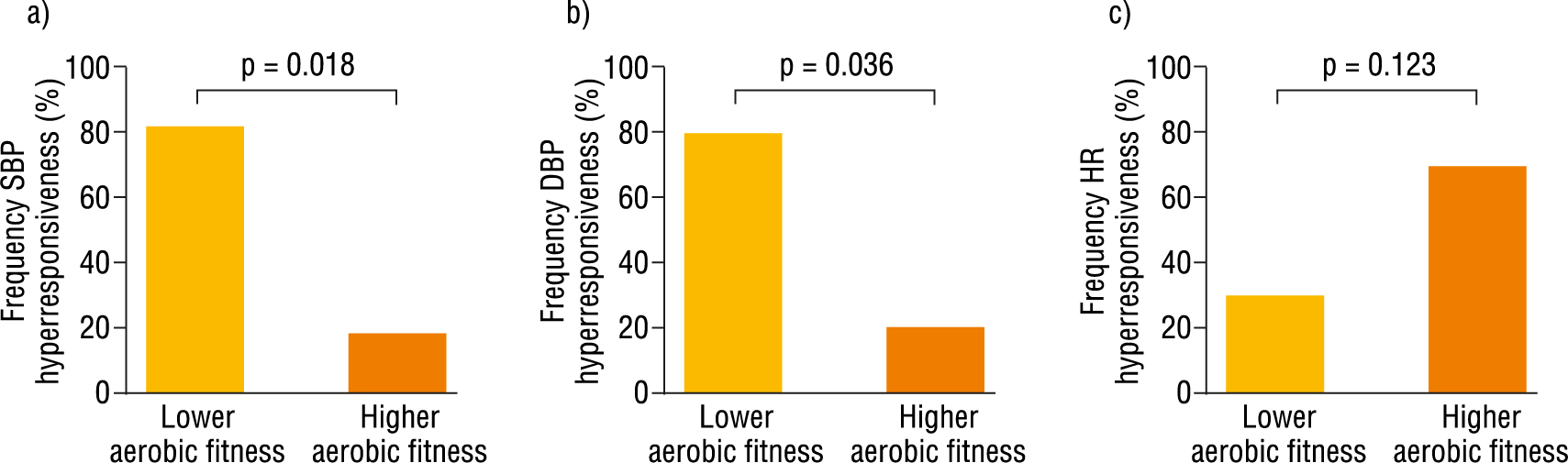
The proportion of police officers who exhibited pressor and chronotropic hyperresponsiveness to the mental stress test is presented in Figure 2. Among the 41 policemen evaluated, 11 showed hyperresponsive SBP, 10 showed hyperresponsive DBP, and 10 showed hyperresponsive HR.

Percentage of police officers with pressor (BP) and chronotropic (HR) hyperresponsiveness to mental stress according to aerobic fitness. The data in the graphs refer to police exhibiting hemodynamic hyperresponsiveness (SBP = 11; DBP = 10; HR = 10). The Pearson chi-square test was used to compare the percentage of police with hemodynamic hyperresponsiveness between the low and high aerobic fitness groups. p ≤ 0.05.
Hemodynamic hyperresponsiveness
Interestingly, the high aerobic fitness group showed fewer policemen classified as hyperresponsive to mental stress compared to the low aerobic fitness group for SBP (2 [18.2%] vs n = 9 [81.8%], p = 0.018) and DBP (2 [20%] vs n = 8 [80%], p = 0.036), with no significant difference between the groups for HR hyperresponsiveness (7 [70%] vs n = 3 [30%], p = 0.123) (Figure 2).
DISCUSSION
In the present study, we evaluated whether police officers with higher levels of aerobic fitness exhibited lower pressor reactivity to mental stress. Our hypothesis was partially confirmed: although no significant difference was observed in the mean values of pressor reactivity, policemen with higher aerobic fitness showed less hyperresponsiveness to stress.
These findings are consistent, in part, with the “cross-stressor adaptation” hypothesis, which posits that regular exercise promotes adaptations in stress response systems, resulting in less intense physiological reactions to psychological stressors25. This theory is grounded in the similarities between central and peripheral mechanisms activated by both physical exercise and mental stressors25.
Although this hypothesis has been widely investigated, the results remain inconsistent. One meta-analysis identified attenuated SBP and HR reactivity in individuals with higher aerobic fitness, although the study had high methodological heterogeneity14. Complementarily, a more recent meta-analysis demonstrated that aerobic training reduces pressor reactivity to stress, particularly in individuals with hypertension15. Among Swiss army recruits, higher fitness was associated with more adequate cardiac responses to acute stress17. On the other hand, a systematic review of studies using the Trier Social Stress Test found a significant association in only 40% of the studies, with methodological limitations regarding the measurement of fitness and heterogeneous cutoff points16. In police officers, Schilling et al.26 observed lower HR variability reactivity in officers with higher levels of cardiorespiratory fitness, although aerobic fitness was estimated using a submaximal test, without direct gas analysis.
The present study is strengthened by the use of a direct measure of VO2peak and by considering not only average reactivity values, but also the number of individuals classified as hyperresponsive. This approach contributes to a broader understanding of how aerobic fitness may modulate individual vulnerability to stress, particularly among professionals exposed to high occupational demands.
In parallel, our findings reflect results from more methodologically rigorous studies that did not identify consistent effects of aerobic fitness on cardiovascular reactivity18,27. In a previous meta-regression, randomized controlled trials using VO2peak as the measure of aerobic fitness found no significant differences18. Similarly, after eight weeks of training, students with higher VO2max did not exhibit attenuated HR reactivity27.
Thus, the results of the present study align with the literature suggesting that the impact of aerobic fitness on stress reactivity may be null or small when only group means are considered. However, by identifying a lower percent of hyperresponsiveness among the fittest individuals, our study adds a relevant perspective to the literature, suggesting that an analysis of the distribution of response profiles, beyond group averages, may be a more sensitive approach to understanding the effects of aerobic fitness on cardiovascular health. In addition to the use of direct measures of aerobic fitness, our study is also strengthened by evaluating police officers, a group known to experience high levels of occupational stress.
This study presents some limitations that should be considered when interpreting the results: 1) No experimental manipulation of aerobic fitness through physical training was performed. The observed outcomes were based on comparisons between groups with previously differing fitness levels, which limited causal inference. 2) The stress test was conducted in a laboratory setting, reducing its ecological validity, as the responses may not reflect reactivity to stress in daily life. 3) Physiological parameters that could explain the mechanisms underlying the clinical responses observed were not assessed. 4) Only male police officers were investigated, limiting the generalizability of the results to female officers. Future studies with experimental designs and the inclusion of additional physiological parameters are needed to elucidate the underlying mechanisms and validate these findings in other occupational populations.
CONCLUSION
In summary, police officers with higher aerobic fitness did not exhibit lower average pressor reactivity to mental stress but showed less pressor hyperresponsiveness. These findings partially support the hypothesis that higher levels of cardiorespiratory fitness may influence cardiovascular responses to stress. Moreover, the results highlight the importance of considering not only group averages but also the distribution of response profiles, which may enhance cardiovascular health screening among professionals exposed to occupational stressors. In addition, encouraging physical training programs is necessary to maintain/improve the aerobic fitness of police officers, reduce stress reactivity and minimize the risk of hypertension.
ACKNOWLEDGEMENTS
The English text of this paper has been revised by Sidney Pratt, Canadian, MAT (The Johns Hopkins University), RSAdip - TESL (Cambridge University).
-
How to cite this article
Araújo JA, Alves DAC, Tamanho S, Tobar KDL, Arruda LLCB, Damazo AS, Cambri LT. Police officers with higher aerobic fitness exhibit less pressor hyperresponsiveness to mental stress. Rev Bras Cineantropom Desempenho Hum 2025, 27:e107121. DOI: https://doi.org/10.1590/1980-0037.2025v27e107121
-
COMPLIANCE WITH ETHICAL STANDARDS
-
Funding
This study was financed in part by the Coordenação de Aperfeiçoamento de Pessoa de Nível Superior – Brazil (CAPES) – Financial Code 001.
-
Data Availability Statement
The data that support the findings of this study are available from the corresponding author, upon reasonable request.
-
Ethical approval
Ethical approval was obtained from the Human Research Ethics Committee of the Federal University of Mato Grosso (protocol number: 67074223.8.0000.8124) and the protocol was written in accordance with the standards established by the Helsinki Declaration.
REFERENCES
-
1 Moretti Anfossi C, Ahumada Muñoz M, Tobar Fredes C, Pérez Rojas F, Ross J, Head J, et al. Work exposures and development of cardiovascular diseases: a systematic review. Ann Work Expo Health 2022;66(6):698-713. http://doi.org/10.1093/annweh/wxac004 PMid:35237787.
» http://doi.org/10.1093/annweh/wxac004 -
2 Rosenthal T, Alter A. Occupational stress and hypertension. J Am Soc Hypertens 2012;6(1):2-22. http://doi.org/10.1016/j.jash.2011.09.002 PMid:22024667.
» http://doi.org/10.1016/j.jash.2011.09.002 -
3 Vrijkotte TG, Van Doornen LJ, De Geus EJ. Effects of work stress on ambulatory blood pressure, heart rate, and heart rate variability. Hypertension 2000;35(4):880-6. http://doi.org/10.1161/01.HYP.35.4.880 PMid:10775555.
» http://doi.org/10.1161/01.HYP.35.4.880 - 4 LaTourrette T. Safety and health protection efforts in the police service. Police Chief 2011;77:74-8.
-
5 Silva FC, Hernandez SSS, Arancibia BAV, Castro TLS, Gutierres PJB Fo, Silva R. Health-related quality of life and related factors of military police officers. Health Qual Life Outcomes 2014;12(1):60. http://doi.org/10.1186/1477-7525-12-60 PMid:24766910.
» http://doi.org/10.1186/1477-7525-12-60 -
6 Violanti JM, Fekedulegn D, Shi M, Andrew ME. Hidden danger: a 22-years analysis of law enforcement deaths associated with duty-related illnesses (1997–2018). Policing 2020;43(2):330-44. http://doi.org/10.1108/PIJPSM-07-2019-0109 PMid:37207254.
» http://doi.org/10.1108/PIJPSM-07-2019-0109 -
7 Chauhan VS, Bansal M, Sharma V, Gupta R. Prevalence and risk factors of hypertension among police personnel of district Gwalior-a cross sectional study. Indian J Community Med 2022;47(3):379-85. http://doi.org/10.4103/ijcm.ijcm_1154_21 PMid:36438512.
» http://doi.org/10.4103/ijcm.ijcm_1154_21 -
8 Yates JD, Aldous JW, Bailey DP, Chater AM, Mitchell AC, Richards JC. The prevalence and predictors of hypertension and the metabolic syndrome in police personnel. Int J Environ Res Public Health 2021;18(13):6728. http://doi.org/10.3390/ijerph18136728 PMid:34206524.
» http://doi.org/10.3390/ijerph18136728 -
9 Brasil. Vigitel Brasil 2023: vigilância de fatores de risco e proteção para doenças crônicas por inquérito telefônico: estimativas sobre frequência e distribuição sociodemográfica de fatores de risco e proteção para doenças crônicas nas capitais dos 26 estados brasileiros e no Distrito Federal em 2023 [Internet]. Brasília: Ministério da Saúde; 2023 [cited 2025 Mar 5]. Available from: http://bvsms.saude.gov.br/bvs/publicacoes/vigitel_brasil_2023.pdf
» http://bvsms.saude.gov.br/bvs/publicacoes/vigitel_brasil_2023.pdf -
10 Gerra G, Zaimovic A, Mascetti G, Gardini S, Zambelli U, Timpano M, et al. Neuroendocrine responses to experimentally-induced psychological stress in healthy humans. Psychoneuroendocrinology 2001;26(1):91-107. http://doi.org/10.1016/S0306-4530(00)00046-9 PMid:11070337.
» http://doi.org/10.1016/S0306-4530(00)00046-9 -
11 McEwen BS, Gianaros PJ. Stress-and allostasis-induced brain plasticity. Annu Rev Med 2011;62(1):431-45. http://doi.org/10.1146/annurev-med-052209-100430 PMid:20707675.
» http://doi.org/10.1146/annurev-med-052209-100430 -
12 Sparrenberger F, Cichelero F, Ascoli A, Fonseca F, Weiss G, Berwanger O, et al. Does psychosocial stress cause hypertension? A systematic review of observational studies. J Hum Hypertens 2009;23(1):12-9. http://doi.org/10.1038/jhh.2008.74 PMid:18615099.
» http://doi.org/10.1038/jhh.2008.74 -
13 Matthews KA, Katholi CR, McCreath H, Whooley MA, Williams DR, Zhu S, et al. Blood pressure reactivity to psychological stress predicts hypertension in the CARDIA study. Circulation 2004;110(1):74-8. http://doi.org/10.1161/01.CIR.0000133415.37578.E4 PMid:15210592.
» http://doi.org/10.1161/01.CIR.0000133415.37578.E4 -
14 Forcier K, Stroud LR, Papandonatos GD, Hitsman B, Reiches M, Krishnamoorthy J, et al. Links between physical fitness and cardiovascular reactivity and recovery to psychological stressors: a meta-analysis. Health Psychol 2006;25(6):723-39. http://doi.org/10.1037/0278-6133.25.6.723 PMid:17100501.
» http://doi.org/10.1037/0278-6133.25.6.723 -
15 Mariano IM, Amaral AL, Ribeiro PA, Puga GM. Exercise training improves blood pressure reactivity to stress: a systematic review and meta-analysis. Sci Rep 2023;13(1):10962. http://doi.org/10.1038/s41598-023-38041-9 PMid:37414810.
» http://doi.org/10.1038/s41598-023-38041-9 -
16 Mücke M, Ludyga S, Colledge F, Gerber M. Influence of regular physical activity and fitness on stress reactivity as measured with the trier social stress test protocol: a systematic review. Sports Med 2018;48(11):2607-22. http://doi.org/10.1007/s40279-018-0979-0 PMid:30159718.
» http://doi.org/10.1007/s40279-018-0979-0 -
17 Wyss T, Boesch M, Roos L, Tschopp C, Frei KM, Annen H, et al. Aerobic fitness level affects cardiovascular and salivary alpha amylase responses to acute psychosocial stress. Sports Med Open 2016;2(1):33. http://doi.org/10.1186/s40798-016-0057-9 PMid:27747788.
» http://doi.org/10.1186/s40798-016-0057-9 -
18 Jackson EM, Dishman RK. Cardiorespiratory fitness and laboratory stress: a meta‐regression analysis. Psychophysiology 2006;43(1):57-72. http://doi.org/10.1111/j.1469-8986.2006.00373.x PMid:16629686.
» http://doi.org/10.1111/j.1469-8986.2006.00373.x -
19 Simoes GM, Campagnaro BP, Tonini CL, Meyrelles SS, Kuniyoshi FHS, Vasquez EC. Hemodynamic reactivity to laboratory stressors in healthy subjects: influence of gender and family history of cardiovascular diseases. Int J Med Sci 2013;10(7):848-56. http://doi.org/10.7150/ijms.5967 PMid:23794949.
» http://doi.org/10.7150/ijms.5967 -
20 IPAQ: International Physical Activity Questionnaire. Guidelines for data processing and analysis of the International Physical Activity 414 Questionnaire (IPAQ)-short and long forms [Internet]. 2005 [cited 2025 Mar 5]. Available from: http://wwwipaq ki se/scoring.pdf
» http://wwwipaq -
21 Bruce RA, Blackmon J, Jones J, Strait G. Exercising testing in adult normal subjects and cardiac patients. Pediatrics 1963;32(4):742-56. http://doi.org/10.1542/peds.32.4.742 PMid:14070531.
» http://doi.org/10.1542/peds.32.4.742 -
22 Novelli FI, Araujo JA, Tolazzi GJ, Tricot GK, Arsa G, Cambri LT. Reproducibility of heart rate variability threshold in untrained individuals. Int J Sports Med 2019;40(2):95-9. http://doi.org/10.1055/a-0800-8633 PMid:30544269.
» http://doi.org/10.1055/a-0800-8633 -
23 Probst M, Bulbulian R, Knapp C. Hemodynamic responses to the stroop and cold pressor tests after submaximal cycling exercise in normotensive males. Physiol Behav 1997;62(6):1283-90. http://doi.org/10.1016/S0031-9384(97)00311-9 PMid:9383115.
» http://doi.org/10.1016/S0031-9384(97)00311-9 -
24 Cavalcante A, Araújo JA, Nonato LC, Ferreira JC, Cambri LT. Acute exercise modulates the mental stress-induced responses in healthy and obese young adults. Rev Bras Cineantropom Desempenho Hum 2023, 25:e89526. https://doi.org/10.1590/1980-0037.2023v25e89526 https://doi.org/10.1590/1980-0037.2023v25e89526
» https://doi.org/10.1590/1980-0037.2023v25e89526» https://doi.org/10.1590/1980-0037.2023v25e89526 -
25 Sothmann MS, Buckworth J, Claytor RP, Cox RH, White-Welkley JE, Dishman RK. Exercise training and the cross-stressor adaptation hypothesis. Exerc Sport Sci Rev 1996;24(1):267-88. http://doi.org/10.1249/00003677-199600240-00011 PMid:8744253.
» http://doi.org/10.1249/00003677-199600240-00011 -
26 Schilling R, Herrmann C, Ludyga S, Colledge F, Brand S, Pühse U, et al. Does cardiorespiratory fitness buffer stress reactivity and stress recovery in police officers? A real-life study. Front Psychiatry 2020;11:594. http://doi.org/10.3389/fpsyt.2020.00594 PMid:32670116.
» http://doi.org/10.3389/fpsyt.2020.00594 -
27 Chovanec L, Gröpel P. Effects of 8-week endurance and resistance training programmes on cardiovascular stress responses, life stress and coping. J Sports Sci 2020;38(15):1699-707. http://doi.org/10.1080/02640414.2020.1756672 PMid:32321385.
» http://doi.org/10.1080/02640414.2020.1756672
Edited by
-
Scientific Editor:
Diego Augusto Santos Silva
The data that support the findings of this study are available from the corresponding author, upon reasonable request.