
 Historical Evolution of Comfort in Nursing Care for the End-of-Life Cancer Patients: Integrative Literature Review
ABSTRACT
Introduction: End-of-life cancer patients are prone to experiencing unpleasant signs and symptoms due to the progression of the disease. Along nursing historical trajectory, care was targeted to identify, manage and evaluate the discomfort.
Objective: To identify the impact of the historical evolution of comfort in nursing care for end-of -life cancer patients.
Method: Exploratory and descriptive integrative literature review utilizing LILACS, MEDLINE and SciELO databases without time restraints for more comprehensive results.
Results: The main impacts of nursing theories based on comfort were the valorization of the holistic model, the stimulation of the nurse-patient bond, the control of symptoms, the reduction of suffering and behaviors aligned with the patient's values.
Conclusion: Comfort is mentioned in state-of-the-art historical texts, theories and nursing care practice. Nursing care to end-of-life cancer patients is guided by theories that address comfort and reduce the patient's discomfort and suffering.
Key words:
History of Nursing; Nursing Theory; Hospice Care/history
RESUMO
Introdução: O paciente oncológico em fim de vida está propenso a experienciar sinais e sintomas desagradáveis em virtude da progressão da doença. O enfermeiro, ao longo de toda a sua trajetória histórica, direcionou o cuidado para a identificação, o manejo e a avaliação do desconforto.
Objetivo: Identificar o impacto da evolução histórica do conforto no cuidado de enfermagem ao paciente oncológico em fim de vida.
Método: Revisão integrativa da literatura de caráter exploratório e descritivo utilizando as bases de dados LILACS, MEDLINE e SciELO sem recorte temporal para maior abrangência de resultados.
Resultados: Os principais impactos das teorias de enfermagem pautadas no conforto foram a valorização do modelo holístico, o estímulo do vínculo enfermeiro-paciente, o controle de sintomas, a diminuição do sofrimento e as condutas alinhadas aos valores do paciente.
Conclusão: O conforto é mencionado no estado da arte em textos históricos, teorias e na prática assistencial da enfermagem. As teorias que abordam o conforto direcionam o cuidado de enfermagem ao paciente oncológico em fim de vida buscando reduzir o desconforto e o sofrimento do paciente.
Palavra-chave:
História da Enfermagem; Teoria de Enfermagem; Cuidados Paliativos na Terminalidade da Vida/história
RESUMEN
Introducción: El paciente con cáncer al final de su vida es propenso a experimentar signos y síntomas desagradables debido a la progresión de la enfermedad. El personal de enfermería, a lo largo de su trayectoria histórica, dirigió los cuidados hacia la identificación, manejo y evaluación del malestar.
Objetivo: Identificar el impacto de la evolución histórica del confort en los cuidados de enfermería al paciente con cáncer al final de la vida.
Método: Revisión integradora de la literatura de carácter exploratorio y descriptivo, utilizando las bases de datos LILACS, MEDLINE y SciELO sin marco temporal para mayor cobertura de resultados.
Resultados: Los principales impactos de las teorías de enfermería basadas en el confort fueron la valorización del modelo holístico, la estimulación del vínculo enfermera-paciente, el control de los síntomas, la reducción del sufrimiento y los comportamientos alineados con los valores del paciente.
Conclusión: El confort es mencionado como lo más avanzado en textos históricos, teorías y en la práctica del cuidado de enfermería. Las teorías que abordan el confort dirigen los cuidados de enfermería hacia los pacientes con cáncer al final de la vida, buscando reducir el malestar y el sufrimiento del paciente.
Palabras clave:
Historia de la Enfermería; Teoría de la Enfermería; Cuidados Paliativos al Final de la Vida/historia
INTRODUCTION
The World Health Organization (WHO) estimates that in 2020, Brazil will be the fifth country with the world's oldest population1. This extended longevity comes together with increasing chronic non-communicable diseases (NCD) as cardiovascular, respiratory, cancers and diabetes. Currently, cancer is the second cause of death in the world and the main cause of death in 10% of the Brazilian cities2.
In 2002, WHO defined that palliative care is an approach that improves the quality-of-life of patients and their families who are facing the problems associated with life-threatening illness, by a multidisciplinary team through the prevention and relief of suffering by means of early identification and correct assessment and treatment of pain and other problems, whether physical, psychosocial or spiritual1,3,4.
Palliative care should be initiated since the diagnosis of a life-threatening disease while end-of-life care consists in care provided from 72 hours to one week of survival before death, focused to the quality-of-life of the patients and their families and minimizing the four dimensions of suffering elaborated by Cicely Saunders: physical, social, psychic and spiritual5–7.
The progression of the disease makes comfort measures paramount, since signs and symptoms as pain, nausea, dyspnea, fatigue, constipation, inappetence, depression, somnolence are disabling, quite often, adding complexity to the management of end-of-life cancer patients because the dimensions of suffering in face of the finitude are singular and go beyond the patient, affecting the family and the multidisciplinary team5,7–9.
Nursing care to end-of-life patients requires early identification and correct management of signs and symptoms in addition to patient-centered priorities and interaction with support network aligned with the therapeutic goal defined with the patient, family and healthcare team5.
Nursing to cancer patients is multifaceted with specific challenges to nurses further to their basic responsibilities. Oncologic care goes beyond medical treatment comprehending emotional, psychosocial and physical aspects. Nurses play a key role in instructing the patient about the diagnosis and treatment, providing emotional support during the course of the disease.
The approach of oncologic cancer care is patient-centered, respecting its individuality and wishes and special attention to quality-of-life, pain relief and coping should be ensured10,11.
History has shown that comfort is closely related to nursing care and is influenced by social, economic, political and religious factors. The word comfort comes from the Latin confortare, which means to strengthen, fortify. On its turn, infirm in Latin means infirmus, weak or feeble. Thus, the nurse is someone who instills strength to the infirm8,7.
In view of the quality of death in Brazil, the complexity of management of the dimensions of suffering cancer patients live in end-of-life and protagonism of nursing care, the objective is to identify the historical evolution of nurse comfort care to this patient.
METHOD
Exploratory and descriptive integrative literature review, compiling studies found in the literature separately, attempting to present the state-of-art on the theme, in addition to promoting discussions of the results and identify potential gaps. The methodology consisted in six stages: research question, search, data collection, critical analysis of the results, discussion and presentation12.
The research question followed the PICO strategy PICO (P – Population/Patient, I – Intervention, C – Control/Comparison and O – Outcome) (Chart 1). Topic C – Control/Comparison was not applied in this review because there was no control group12. The research question was: "What is the impact of the historic evolution of nurse comfort care to the end-of-life cancer patient?"
The second stage comprehended the search of articles indexed at the following databases: Latin American and Caribbean Health Science Literature (LILACS), Medical Literature Analysis and Retrieval System Online (MEDLINE) and Scientific Electronic Library Online (SciELO) and other dissertations utilizing the Health Science Descriptors (DeCs): "Nursing History", "Nursing Theory", "Comfort Care". Due to limitations of data availability, the descriptors related to palliative care, oncology and end-of-life care were not applied, only those associated with historical evolution of comfort and nurse care. Full articles published in Portuguese, English and Spanish in any year were included and studies out of the scope, case reports and duplicate articles have been rejected.
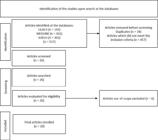
In the third stage, 517 articles matched to DeCs were exported to the software Rayyan to organize and manage the data collected.
The 517 articles were reviewed by two independent reviewers in the fourth stage; 457 not meeting the inclusion criteria and 34 duplicates were rejected. The 26 remaining were reviewed once again when the articles were read in full and six out of the scope were removed. Of the 20 eligible, four were focused to end-of-life patient and 16 were considered because they correlate comfort with nurse care. From those, 17 articles, two master's thesis and one PhD thesis were listed in a table containing the title, year, country, methodology and main results. Figure 1 portrays the flowchart of the methodology according to PRISMA13.
RESULTS
Brazil was the country origin of most of the studies (55%) followed by the United States of America (35%), China (5%) and Italy (5%), predominantly in English from 1991 to 2020.
The characteristics of the 20 articles included in the review are portrayed in Chart 2.
Five studies14,16,20,25,27 correlated comfort with historical evolution of nursing, the theories of comfort by Florence Nightingale, Callista Roy, Ida Jean Orlando, Jean Watson, Josephine Paterson, Hildegard Peplau, Madeleine Leininger, Loretta T. Zderad, Janice M. Morse and Katharine Kolcaba were quoted by the authors; Katherine Kolcaba was the author of five studies and half of the Brazilian publications were based in her theoretical framework of comfort.
Cardoso et al.28 emphasized the importance of systematized approaches while Hou et al.22 presented gaps of humanized care in nurse academic formation and brought up the necessity of discussing the National Policy of Humanization33, as well as associate and identify the theories of care.
Nine studies12,13,16,18,21,24,26 concurred that nursing theories are the core of holistic comfort-targeted nursing practices following the four dimensions of comfort and singularity of the individual. Only one study6 addressed music therapy as intervention within palliative care as strategy to promote comfort.
Four studies17,19,29,32 aimed the end-of-life patient and three of these17,19,29 described the patient's context. White et al.19 listed the required competencies for management of these patients.
The articles consistently converged to the main impacts of nursing theories on the management of end-of-life patients: to encourage the bond patient-nurse, symptoms control, suffering relief and actions matched to the patient's will avoiding futile interventions.
DISCUSSION
The historical evolution revealed that comfort is subjective, mutable, and bound to nursing. Initially, comfort was provided by women because it was believed they were docile, abnegated and gentle which made them naturally fit34. Care was empiric and intuitive with actions focused to fertility, and children's rearing and development, support to nurses and in death. Feeding-related instructions, medicinal herbs and management were passed from generation to generation14,16,29,26.
Renaissance stimulated art and science concomitantly with the dissolution of religious institutions and care-focused actions, delaying advances of nursing35. Decay exposed the insalubrity of the environment and exclusion of least socially endowed. And at that moment, the so-called ladyship and charity sisters began visiting the infirm, bringing comfort through food supply, drugs and encouragement to those dying14–16.
Since Christianity, care was provided by deacons, and it began to be seen as charity and virtue. Comfort meant pain relief and minimizing the suffering of the poor, infirm and prisoners14–16. According to Foucault36, ensure comfort to the infirm granted the own salvation. With the foundation of the Hospital Kaiserswerther Diakonie, the deaconesses resurfaced, tending to poor and infirm while studying theology and nursing. Florence Nightingale was among the women who have been trained and during the epidemics of cholera and after the Crimean War, she consolidated its environmentalist theory, emphasizing that unhealthy environments lead to sickening and discomfort14,16,24.
Twentieth century is marked by the substantial growth of nursing theories from Ida Jean Orlando, Hildegard Peplau (1952), Callista Roy (1979), Madeleine Leininger (1978), Jean Watson (1979), Josephine Paterson (1960) and Loretta T. Zderad, Janice M. Morse and Katharine Kocalba (1991).
Lydia Hall37 defined caring as a process and Ida Jean Orlando (1960) was one of the pioneer nurses who used the term "nursing process"; in her theory, nurse should ensure physical and mental comfort to the patient. Callista Roy utilizes psychological comfort to promote adaptation. Madeleine Leininger relates comfort with caring. Jean Watson considers comfort as a variable influencing development. Josephine Parteson and Loretta T. Zderad advocate that mental discomforts may reverberate in the physical. Janice M. Morse reinforces that comfort should be the final result of nursing actions. Katharine Kolcaba, in her theory of comfort, demonstrates the search for satisfaction of the needs by means of relief states, tranquility and transcendence which develop through physical, environmental, physical, social and psychospiritual comfort15,24,30.
Currently, it is recommended that the nursing process is grounded on a theory that guides the care as nursing practice requires thorough evaluation of the individual, critical thinking and mastering the area of action38. Even if comfort has followed the historical evolution of nursing, Hou et al.22 noticed that nearly 65% of the nurses working in oncology and caring for end-of-life patients did not have specific formation in that area. The nurses at the admission unit indicated that comfort is associated with clinical stability of the patient according to the study of Silva21. Berntzen et al.31 affirmed that inpatients have some discomfort that the nursing team could overlook due to the lack of systematized approaches.
Katharine Kolcaba14 comfort theory potentialized the holistic model guiding the nurse look towards signs of discomfort of end-of-life patient through four dimensions of comfort: physical, environmental, social and psychospiritual.
This theory differs from Saunders39 reflections regarding the multidimensionality of the concept of pain, called as total pain which encompasses four dimensions of suffering and reveals the necessity of thorough evaluation and attention to these aspects.
In the study of Ponte and Silva24, the physical dimension highlighted the necessity of pain management. The environmental context emphasized the importance of ensuring a pleasant, clean, airy and noiseless ambient. The social context involves interpersonal relations while the psychospiritual raised questions in relation to self-concept and beliefs. The nurse is responsible for the actions that target the comfort in these four dimensions since end-of-life patients management is marked by feelings as sadness, fear and impotence17,18,23,29,28.
According to Araújo6, Katharine Kolcaba's theory can warrant the required framework for the implementation of music therapy as complementary and integrative practice able to provide comfort in an environment that promotes relaxation, tranquility and symptoms relief concomitantly with the possibility of the patient accessing affectionate memories, strengthening the bond with family and health team.
Currently, there is material to apply this conduct by the National Policy of Integrative and Complementary Practices (PNPIC), sanctioned and implemented in the National Health System (SUS). It is possible to notice an array of options of access to and health practices that promote comfort to the patient as music therapy40. A recent study published in the American Society of Clinical Oncology (ASCO)41 emphasized the beneficial role of music as an effective strategy in reducing stress in patients submitted to cancer treatment with chemotherapy. The present study highlights the importance of therapeutic approach of music as an invaluable tool to improve the emotional well-being of these patients along the tough journey of the treatment.
White et al.19 noticed that nurses caring for endof-life patient should master the scientific-technical competencies in palliative care, patients’ rights, bioethics, communication, conflicts management, further to knowing how to identify and manage discomfort, due to the singularity of the individuals, the variability of symptoms, changes of the clinical condition, reduction of functionality and available resources39. Furthermore, it should include family and health team, respecting its will and avoiding futile conducts that could cause even more suffering18–19.
The theory of comfort needs to be explored continuously in educational settings to ensure professionals are able to incorporate in their caring practice23. Mussi et al.20 reinforce that institutions looking for theoretical foundation for comfort-based nursing practice tend to focus the patient, valuing its journey and safety, contributing to diminish the four dimensions of suffering proactively and holistically.
CONCLUSION
Comfort is inseparable from nursing care. Nursing theories addressing comfort warrant foundation to and guide nursing actions for end-of-life cancer patients in the light of the physical, environmental, psychosocial and spiritual dimensions.
The limitations of the studies are the scarcity of articles designed for end-of-life patients. However, they contributed to the state-of-art in promoting reflections about education and dissemination of the theory of comfort as caring practice to patients in palliative care in order to ensure more comfort and quality-of-life addressed in this type of care. Therefore, scientific productions focused to end-of-life comfort and discussions during the educational formation are necessary.
References
-
1 Worldwide Hospice Palliative Care Alliance. Global atlas of palliative care [Internet]. 2 ed. Londres: WHPCA; 2020 [acesso 2023 out 5]. Disponível em: https://www.thewhpca.org/resources/item/global-atlas-of-palliative-care-2nd-ed-2020
» https://www.thewhpca.org/resources/item/global-atlas-of-palliative-care-2nd-ed-2020 -
2 Santos MO, Lima FCS, Martins LFL, et al. Estimativa de incidência de câncer no Brasil, 2023-2025. Rev Bras Cancerol. 2023;69(1):e-213700. doi: https://doi.org/10.32635/2176-9745.RBC.2023v69n1.3700
» https://doi.org/10.32635/2176-9745.RBC.2023v69n1.3700 -
3 International Association for Hospice & Palliative Car [Internet]. Houston: IAHPC; 2019. Palliative care definition. [acesso 2023 out 6]. Disponível em: https://hospicecare.com/what-we-do/projects/consensus-based-definition-of-palliative-care/definition/
» https://hospicecare.com/what-we-do/projects/consensus-based-definition-of-palliative-care/definition/ - 4 Radbruch L, Lima L, Knaul F, et al. Redefining palliative care a new consensus-based definition. J Pain Symptom Manage. 2020;60(4):754-64.
- 5 Silva SMA. Os cuidados ao fim da vida no contexto dos cuidados paliativos. Rev Bras Cancerol. 2016;62(3):253-7.
-
6 Araújo TC. Comfort provided by the music: experiences of people under hospice care [dissertação na Internet]. 2013. Salvador: Universidade Federal da Bahia; 2013. [acesso 2023 out 6]. Disponível em: https://repositorio.ufba.br/bitstream/ri/15397/1/Disserta%C3%A7%C3%A3o_Enf_%20%20Taise%20Carneiro%20ara%C3%BAjo.pdf
» https://repositorio.ufba.br/bitstream/ri/15397/1/Disserta%C3%A7%C3%A3o_Enf_%20%20Taise%20Carneiro%20ara%C3%BAjo.pdf - 7 Burlá C, Py L. Palliative care: science and protection at the end of life. Cad Saude Publica. 2014;30(6):1139-41.
- 8 Bittencourt NCCM, Santos KA, Mesquita MGR, et al. Sinais e sintomas manifestados por pacientes em cuidados paliativos oncológicos na assistência domiciliar: uma revisão integrativa. Esc Anna Nery. 2021;25(4):e20200520.
- 9 Apóstolo JLA. O conforto nas teorias de enfermagem análise do conceito e significados teóricos. Rev Referência. 2009;2(9):61-7.
- 10 Oliveira LM, Evangelista RA. Sistematização da assistência de enfermagem (SAE): excelência no cuidado. Perquirere. 2010;1(7):83-8.
- 11 Silva FS Silva GS, Costa ACM, et al. Care of nursing on oncological patients: integration review. RSD. 2019;8(6):e35861037.
- 12 Santos CMC, Pimenta CAM, Nobre MRC. The PICO strategy for the research question construction and evidence search. Rev Lat Am Enfermagem. 2007;15(3):508-11.
- 13 Page MJ, McKenzie JE, Bossuyt PM, et al. The PRISMA 2020 statement: an updated guideline for reporting systematic reviews declaración PRISMA 2020: una guía actualizada para la publicación de revisiones sistemáticas. Rev Panam Salud Publica. 2022;46:e112.
- 14 Kolcaba KY, Kolcaba RJ. An analysis of the concept of comfort. J Adv Nurs. 1991;16(11):1301-10.
- 15 Kolcaba KY. The art of comfort care. Image J Nurs Sch. 1995;27(4):287-9.
- 16 McIlveen KH, Morse JM. The role of comfort in nursing care: 1900-1980. Clin Nurs Res. 1995;(2):127-48.
- 17 Kolcaba KY, Fisher EM. A holistic perspective on comfort care as an advance directive. Crit Care Nurs Q. 1996;18(4):66-76.
- 18 Vendlinski S, Kolcaba KY. Comfort care: a framework for hospice nursing. Am J Hosp Palliat Care. 1997;14(6):271-6.
- 19 White KR, Coyne PJ, Patel UB. Are nurses adequately prepared for end-of-life care? J Nurs Scholarsh. 2001;33(2):147-51.
- 20 Mussi FC. Conforto e lógica hospitalar: análise a partir da evolução histórica do conceito conforto na enfermagem. Acta paul enferm. 2005;18(1):72-81.
-
21 Silva CRL. Conceito de conforto na perspectiva de clientes e de enfermeiras em unidades de internação hospitalar [tese na Internet]. Rio de Janeiro: Universidade Federal do Rio de Janeiro; 2008. Disponível em: http://objdig.ufrj.br/51/teses/EEAN_D_CarlosRobertoLyraDaSilva.pdf
» http://objdig.ufrj.br/51/teses/EEAN_D_CarlosRobertoLyraDaSilva.pdf - 22 Hou YF, Zhao AP, Feng YX, et al. Nurses’ knowledge and attitudes on comfort nursing care for hospitalized patients. Int J Nurs Pract. 2014;20(6):573-8.
- 23 Moura LF. A consulta de enfermagem como instrumento de conforto aos clientes assistidos em ambulatórios de oncologia [dissertação]. Rio de Janeiro: Universidade Federal do Estado do Rio de Janeiro; 2015.
- 24 Ponte KMA, Silva LF. Comfort as a result of nursing care: an integrative review. Rev Pesqui Cuid é Fundam Online. 2015;7(2):2603-14.
- 25 Mendes RS, Mendes RS, Cruz AM, et al. Teoria do conforto como subsídio para o cuidado clínico de enfermagem. Ciênc Cuid Saúde. 2016;15(2):390.
- 26 Pinto S, Caldeira S, Martins JC, et al. Evolutionary analysis of the concept of comfort. Holist Nurs Pract. 2017;31(4):243-52.
- 27 Pereira CSCN, Mercês CAMF, Lopes ROP, et al. Análise do conceito de conforto: contribuições para o diagnóstico de disposição para conforto melhorado. Esc Anna Nery. 2019;24(2):e20190205.
-
28 Cardoso RB, Caldas CP, Souza PA. Uso da teoria do conforto de Kolcaba na implementação do processo de enfermagem: revisão integrativa. Rev Enferm Atenção à Saúde. 2019;8(1):118-28. doi: https://doi.org/10.18554/reas.v7i2.2758
» https://doi.org/10.18554/reas.v7i2.2758 - 29 Pereira R, Silveira T, Vilelas J, Pontífice-Sou. Conforto ao adulto em fim de vida hospitalizado. Rev Rol enferm. 2020;451-7.
-
30 Cardoso RB, Souza PA, Caldas CP, et al. Diagnósticos de enfermagem em idosos hospitalizados á luz da teoria do conforto de Kolcaba. 2020;5(4):e20066. doi: https://doi.org/10.12707/RV20066
» https://doi.org/10.12707/RV20066 - 31 Berntzen H, Bjørk IT, Storsveen AM, et al. "Please mind the gap": a secondary analysis of discomfort and comfort in intensive care. J Clin Nurs. 2020;29(13-14):2441-54.
- 32 Angheluta AA, Gonella S, Sgubin C, et a. When and how clinical nurses adjust nursing care at the end-of-life among patients with cancer: Findings from multiple focus groups. Eur J Oncol Nurs. 2020;49:101856.
-
33 Ministério da Saúde (BR). Secretaria-Executiva. HumanizaSUS: Política Nacional de Humanização: a humanização como eixo norteador das práticas de atenção e gestão em todas as instâncias do SUS. Brasília, DF: Ministério da Saúde; 2004. [acesso 2023 ago 23]. Disponível em: https://bvsms.saude.gov.br/bvs/publicacoes/humanizasus_2004.pdf
» https://bvsms.saude.gov.br/bvs/publicacoes/humanizasus_2004.pdf -
34 Pereira PF. Homens na enfermagem : atravessamentos de gênero na escolha, formação e exercício profissional. Porto Alegre: Universidade Federal do Rio Grande do Sul; 2008. [acesso 2023 dez 20]; Disponível em: https://www.lume.ufrgs.br/handle/10183/13069
» https://www.lume.ufrgs.br/handle/10183/13069 - 35 Angelo M, Forcella HT, Fukuda IMK. Do empirismo à ciência: a evolução do conhecimento de enfermagem. Rev Esc Enferm USP. 1995;29(2):211-23.
- 36 Foucault M. Incorporación del hospital en la tecnología moderna. Educación médica y salud. 1978;12(1):104.
-
37 Silva FR, Prado PF do, Carneiro JA, Costa FM da. Implementação da sistematização da assistência de enfermagem: dificuldades e potencialidades. Rev Univ Vale Rio Verde [Internet]. 2014 [acesso 2023 ago 23];12(2):580-90. Disponível em: https://dialnet.unirioja.es/servlet/articulo?codigo=4901289
» https://dialnet.unirioja.es/servlet/articulo?codigo=4901289 - 38 Pesut DJ, Herman J. Clinical reasoning: the art and science of critical and creative thinking. Delmar: Cengage Learning; 1999. 244 p.
- 39 Castro MCF, Fuly PSC, Santos MLSC, et al. Total pain and comfort theory: implications in the care to patients in oncology palliative care. Rev Gaúcha Enferm. 2021;42:e20200311.
-
40 Ministério da Saúde (BR). Política Nacional de Práticas Integrativas e Complementares no SUS - PNPICSUS [Internet]. Brasília, DF: Ministério da Saúde; 2006. Disponível em: https://bvsms.saude.gov.br/bvs/publicacoes/pnpic.pdf
» https://bvsms.saude.gov.br/bvs/publicacoes/pnpic.pdf - 41 Harper FWK, Heath AS, Moore TF, et al. Using music as a tool for distress reduction during cancer chemotherapy treatment. JCO Oncol Pract. 2023;19(12):1133-42.
Edited by
-
Associate-editor:
Fernando Lopes Tavares de Lima. Orcid iD: https://orcid.org/0000-0002-8618-7608
-
Scientific-editor:
Anke Bergmann. Orcid iD: https://orcid.org/0000-0002-1972-8777

 Source: Adapted from Page et al