Physical activity in the legislative production of the Federal Executive Power (1990 to 2023)
ABSTRACT
Objective: The goal of this study was to analyze the attention given to physical activity (PA) in laws promulgated by the Federal Executive Power from 1990 to 2023.
Methods: This is a documentary, exploratory, and quantitative-qualitative research. Political Science and the Punctuated Equilibrium model were adopted as the theoretical basis of this study. For the data collection, organization, and processing, the current study analyzed bills which mentioned the terms PA and body practices based on laws of several presidents that ruled the Federative Republic of Brazil. These documents are available on Legislative and Legal Information Network electronic pages.
Results: There was low attention given to PA, considering the relative frequency of the aforementioned bills (0.5%) in relation to the absolute value of the national legislative production in the Federal Executive Power in the years with laws mentioning PA. The legal system prioritized agendas on the acknowledgment of Physical Education as a healthcare profession and the insertion of PA in the Unified Health System.
Conclusion: Despite the inclusion of health promotion as a structuring element of the 1988 Brazilian Constitution and 2006 National Policy of Health Promotion, the legal fragility of PA as a vector of development of the aforementioned policy can be noted. In addition, the findings highlight the need to expand studies on the topic in the perspective of offering technical-scientific evidence for political discussion about the expansion of legislative production exclusively on PA.
Keywords:
Health polices; Agenda formation; Unified Health System; Health priorities agenda; Public health policies.
RESUMO
Objetivo: Analisar a atenção dada à atividade física (AF) nas leis promulgadas pelo Poder Executivo Federal, no período de 1990 a 2023.
Métodos: Trata-se de uma pesquisa documental, exploratória e qualitativa. Este estudo encontra-se alicerçado na Ciência Política e tem sua análise baseada no modelo teórico do Equilíbrio Pontuado. Para coleta, organização e tratamento dos dados, analisou-se as leis que mencionaram os termos AF e práticas corporais dos diversos presidentes que governaram a República Federativa do Brasil. Tais documentos encontram-se disponíveis no endereço eletrônico da Rede de Informação Legislativa e Jurídica.
Resultados: Os dados apontam uma baixa atenção dada à AF, quanto à frequência relativa das leis supracitadas (0,5%) em relação ao valor absoluto da produção legislativa nacional pelo poder executivo federal nos anos em que houve lei mencionando AF. O ordenamento legal em questão priorizou pautas correlatas ao processo de reconhecimento da Educação Física como profissão da saúde e à inserção da AF no Sistema Único de Saúde.
Conclusão: Apesar do delineamento constitucional da prevenção e promoção da saúde como elementos estruturantes da redução do risco de doenças e agravos a partir de 1988 e a criação da Política Nacional de Promoção da Saúde em 2006, constatou-se a fragilidade jurídica da AF enquanto vetor de desenvolvimento da referida política. Concomitantemente, elenca-se a necessidade da ampliação dos estudos na perspectiva de ofertar evidências técnico-científicas para a discussão política sobre a ampliação da produção legislativa exclusiva ao tema em questão.
Palavras-chave:
Atividade motora; Sistema Único de Saúde; Agenda de prioridades em saúde; Políticas públicas em saúde.
Introduction
Physical activity (PA) has been defined as any bodily movement resulting from muscular movements that, as a consequence, generates caloric expenditure1, However, this classical concept has been criticized due to the reductionism of PA to muscular actions2, excluding aspects such as socialization, meanings, and emotions that are provided by the practice of PA.
Since the mid-20th century, PA has been considered a determining and conditioning variable of health3, developing over time4-5, to the point of being recognized as an item on the policy agendas of several international institutions7-8.
In 1997, Brazilian Ministerial Ordinance No. 218, of March 6, 1997, which recognized the Physical Education (PE) professional in the list of professions that make up the Unified Health System (Sistema Único de Saúde - SUS), established a window of opportunity for the implementation of actions related to the promotion of regular PA practice. In 1998, PE was regulated as a profession, and in the 2000s its respective Federal and Regional Councils were created9. In the first decade of the 21st century, the PA agenda appears more frequently in the context of health, and epidemiological studies investigate PA in health outcomes intensified in Brazil6.
The position of the World Health Organization, entitled the Global Strategy for a healthy diet, PA, and health10, influenced the creation of the National Health Promotion Policy (Política Nacional de Promoção da Saúde - PNPS)11. Furthermore, in 2006, PA became part of the health policy agenda within the SUS, when it was listed as a priority action of the PNPS12.
In view of the above, it is necessary to understand the dynamics of the formation of the policy agenda, as well as the priorities listed by political actors on a given issue13. It needs to be highlighted that the composition of the policy agenda is consolidated through the attention given to public problems by political actors and certain specific demands of the population, which have the potential to produce political changes14-17.
In this sense, the following research problem was established: what attention is given to PA in the laws enacted by the Federal Executive Power? Considering this, the objective of the current study is to analyze the attention given to PA by the Federal Executive Power, based on legislative production for the period from 1990 to 2023.
Methods
This is a retrospective and exploratory study, using documentary sources, with a qualitative approach18. Taking into account that the research was outlined through hypothetical-deductive reasoning, the theoretical model of Punctuated Equilibrium developed by Baumgartner and Jones14 was used as a premise for analyzing the attention given to PA in the aforementioned legislative agenda. The time frame was outlined based on the enactment of the SUS Organic Law (1990) to the present day. It is worth highlighting that body practices (BP) were used in the investigation because the term composes the axis of priorities of the PNPS12. Consequently, the following analytical category was chosen, as shown in Chart 1:
For the research, data were collected based on the absolute production of laws drafted by the Presidents of the Federative Republic of Brazil. The data for the production of this article were collected, reviewed, and analyzed by the first three authors, while the fourth author contributed to the organization, review, description, transcription, and writing of the data and the text of the article. Data collection took place between November 2023 and January 2024. The data collected in this study are available on the website of the Legislative and Legal Information Network (www.lexml.gov.br).
It is worth mentioning that a data collection procedure was established. When first accessing the website (www.lexml.gov.br), the same term “legislation” was selected in the search box. Next, the descriptors “physical activity” and “body practices” were typed separately, one at a time. After the search results for the aforementioned descriptors have been displayed, when you click “enter”, the options for detailing what you want to search for appear on the left side of the “LEXML” website, in this case, whether it is a decree, ordinance, bill, among others.
In the current article, the “law” option was selected, and when clicking on search, more filters appear on the left side of the website, with options to select the sphere of power to the legislative production investigated, thus identifying the sphere of power that sanctioned the law; “municipal”, “state”, and/or “federal”. In this study, the federal option was selected.
After following this methodological path for data collection, information regarding the laws found; summary; year of publication; law number, was presented. In the next phase, the summaries of the aforementioned laws that mentioned the listed descriptors were read and selected, and in this way it was possible to quantify the number of laws that mentioned the searched terms, as well as to select the text of their summaries, so that they could be analyzed in a qualitative manner, to identify in which context the descriptors were mentioned in the laws that made up the sample.
After data collection, a databank was created with all the information necessary to individualize the setof descriptors according to the type of document analyzed, considering who were the political actors and authors of the bills that meet the requirements for the composition of the study, the years of their respective mandates, and information on whether there is a highlighted public policy, in addition to the text or device investigated.
To analyze the data, we used the calculation of the absolute and relative frequencies of the total legislative production and bills that mentioned the term “physical activity”. In this sense, the gross legislative production was compared year by year and the legislative production related to the theme was compared in order to understand the percentage of attention.
Furthermore, content analysis was chosen to examine the bills in order to identify the priorities listed in the legislative agenda through the recurrence of the items. Content analysis was performed using the coding process proposed by Baumgartner and Jones14.
This type of coding presents itself as a viable procedure for grouping information from different sources and originally presented in different formats. Coding becomes effective in the process of reducing speech, written documents, and numbers into smaller, simplified units of symbolic representation. In this sense, the code becomes a symbol that can be defined as the essence of the document being analyzed19.
Results
The descriptor “body practices” is not present as an item on the legislative agenda of the political actors analyzed, in the documents analyzed, as can be seenin Table 1.
Raw data on legislative production and bills related to physical activity of the Federal Executive Power (1990 to 2023)
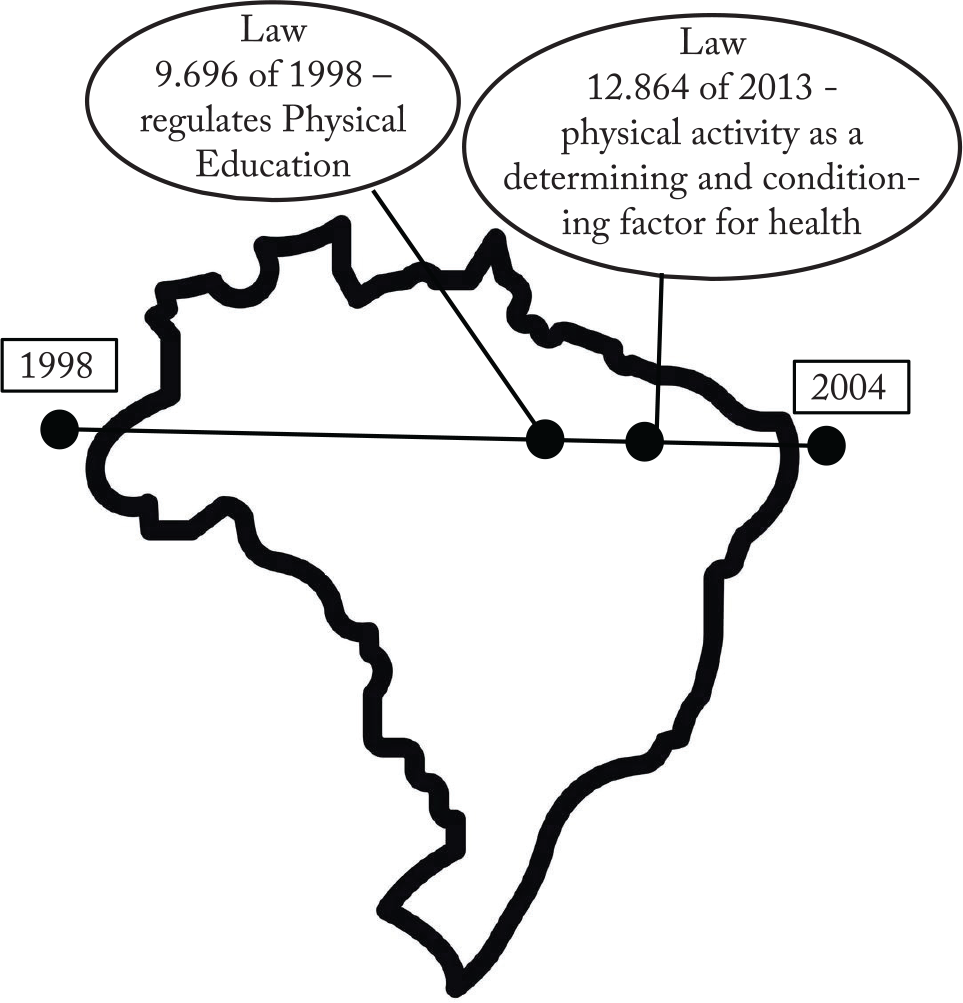
Figure 1 presents a timeline with the year 1990, when Law 8.080 was enacted, until the current year, 2023. During the period analyzed, only two laws produced by the presidents of the republic of Brazil mentioned the term physical activity in Brazil.

Timeline of legislative production by the Federal Executive Power regarding physical activity in Brazil between 1990 and 2023 Figure prepared by the authors
The first law investigated, number 9.696/98, was the law responsible for regulating the PE professionin 19989. In the year in question, the Federal Executive Power produced 178 laws, with only one mention of PA. Consequently, it was found that the attention given to PA in 1998 was 0.56% compared to the total legislative production. Within the law, article 3 discriminates the competencies of the PE professional, which are:
-
The PE Professional is responsible for coordinating, planning, programming, supervising, streamlining, directing, organizing, evaluating, and executing work, programs, plans, and projects, as well as providing auditing, consulting, and advisory services, carrying out specialized training, participating in multidisciplinary and interdisciplinary teams, and preparing technical, scientific, and pedagogical reports, all in the areas of physical activities and sports (Brasil, 1998)9.
-
The second Law, No. 12.864/2013, began to consider PA as a determining and conditioning factor for health. In that year, the Executive Power produced 172 laws, of which one mentioned the term PA. The percentage of attention given toPA in 2013 was equivalent to 0.58% compared to the total legislative production.
The amendment of the caput of Art. 3 of the Organic Health Law 8.080, by law 12.864 of 2013, with the aim of including PA as a determining and conditioning factor of health 20:
“Art. 3 - Health levels express the social and economic organization of the country, with health as determinants and conditioning factors, among others, food, housing, basic sanitation, the environment, work, income, education, physical activity, transportation, leisure and access to essential goods and services.”
Furthermore, there is empirical evidence of the insertion of PA in the context of the SUS by the Executive Power, through indirect governance and, mainly, through Ordinances and Decrees. Among them, the following stand out: the Ordinances that established the PNPS in 200612, the presidential decree that established the School Health Program (Programa Saúde na Escola - PSE) in 200721, the insertion of the PE professional in the Family Health Support Centers22, the Health Academy Program23, and the creation of the budgetary unit for the incentive of PA in 2024.
Discussion
The data indicated a vast absolute legislative production. On the other hand, the number of laws that mention PA was low. When analyzing the content, the importance of PA for the legal configuration of PE is understood, and as the main locus of action/manifestation in all areas of the profession24, which recognizes this legal framework as an essential element for PA to be included in the context of the SUS, given that all other health professions also went through this process of regulation and creation of professional councils well before PE, such as medicine, dentistry, nutrition, psychology, and nursing.
When regulating PE to acquire legal status, the legal system should also guarantee to beneficiaries the obligation to intervene in Public Policies related to physical activity in the promotion of health, by a PE professional qualified and registered with the Regional Council of Physical Education, who is subject to a Code of Ethics for the profession9,24. Since the PE professional, by force of the text of Law 9.696/98 itself, in Art. 3, is responsible for coordinating, planning, prescribing, and preparing technical, scientific, and pedagogical reports, all in the areas of physical activities and sports9.
It also presents itself as a legal framework that enabled the recognition of PA as a health promotion strategy within the context of the SUS. Until then, the aforementioned law addressed the conditions for the promotion, protection, and recovery of health. However, PA had not yet established a place within the scope of the SUS in the early 1990s, the period in which the Organic Health Law was published.
By analyzing both the number of times that PA was defined as an issue on the health policy agenda, through laws enacted by the Presidents of the Republic of Brazil, and the text and context of these legal acts,it becomes possible to verify how these political actors understand, approach and define solutions and deliberations regarding the theme13.
In addition, even though the attention given to PA through the legislative production of the Federal Executive Chiefs is numerically low, the laws analyzed represent the beginning of the insertion of PA in the context of the SUS, since the regulation of PE made this absorption of PA as a health strategy possible, as already mentioned in the current text. In turn, the second law investigated in the current study, which, from then on, began to consider PA as a conditioning and determinant of health, represents the phase of consolidation and recognition of the importance of PA as a variable that influences the health and illness process in the context of the Brazilian population.
Of note, it is possible to qualitatively analyze aspects of attention to the PA agenda through the characteristics of the legal measure (law, decree, or resolution) and understand which body or political actor (institutional arrangement) used the legal prerogative and competence to compose a public policy agenda based on PA.
When analyzing the legislative production of the Presidents of Brazil in the period analyzed, the two laws enacted by the presidents that deal with the PA occupy a secondary place in the Brazilian legal hierarchy. The Federal Constitution of Brazil represents the most important precepts, norms, and values from a legal point of view and all laws that appear in the second echelon, regardless of their characteristics, must be in accordance with the Magna Carta25.
In the third echelon of force of legal normative acts are the Decrees issued by the executive power, these acts complement the laws, but do not revoke them. Below the Decrees of the executive power are the Ordinances that assist the executive sphere of power, and are issued by the bodies linked to this category of governance (Ministries and Professional Councils) and have the function of regulating a certain topic or profession25.
In this way, power is exercised by the people through legal representatives chosen directly or indirectly by the people themselves. From this perspective, powers are granted to Union bodies, politicians, and other representatives of the people. Power, here, has the meaning of function, since the “power” to exercise a certain “function” was granted by the Executive Power (executive function); therefore, all powers have the function of ensuring democracy and a state of well-being, through the execution of their functions26.
The Punctuated Equilibrium model highlights the alternation of agendas through peaks of attention, also identifying moments of stability in the agenda; other characteristics are the logic of increased attention, as well as moments in which rapid and unexpected changes occur. The Punctuated Equilibrium model seeks to understand this dynamic of stability, periods punctuated by change14,15. When analyzing the legislative agenda of the executive power from the perspective of Punctuated Balance, it is possible to affirm peaksof attention at specific moments in the legislative production related to PA, and that the investigated agenda does not occupy space in this agenda of the federal executive power.
In this sense, it is worth stating that, when analyzing the dynamics of formation of the agenda for PA in public policy contexts and based on the application of the theoretical model of Punctuated Equilibrium, it was an advance for studies that seek to understand the attention given to PA in the formation of the government agenda in the Brazilian context. Given that the current study is exploratory in nature, this characteristic already represents this advance, since the method, the source of data collection, the parameters used for analysis, and the theoretical model used, present data so that the scientific community and society in general, can accept or refute what was produced in the present study.
However, the fragility of PA as a political agenda is evident, considering the aforementioned discretionary actions and the lack of systematization and dissemination of the topic through actions that could be regulated based on the outlining of principles, guidelines, objectives, and competences based on the constitution of a legal system exclusive to the topic.
Despite the recognition of the World Health Organization10,11,27 on the importance of PA for health promotion in the global context, considering the diverse potential of approach and accessibility of its practices, as well as the effectiveness in meeting various health demands, the topic has not yet received proportional prominence in the Brazilian presidential legislative agenda.
As a suggestion, we highlight the importance of the participation of PE professionals in the development of public policies, so that they may be based on scientific evidence from this area of intervention that can guide legal and political decisions that allow for better service in the field of PA to society.
As a limitation of the study, it is evident that PA is a polysemic descriptor, considering that sports, physical exercises, sports practices, and/or dances can represent the theme. However, these were not mentioned herein, as the descriptors chosen to compose the present research had as reference the PNPS.
Conclusion
It is possible to state that the attention given to PA in the Federal Executive Power’s policy agenda was specific and quantitatively low in comparison with the volume of legislative production identified. The law that regulated PE was extremely relevant from a legal point of view so that PA could be inserted into the context of public health, both for acquiring the legal requirements that some health professions had already acquired and for regulating spaces for offering PA through indirect governance by means of the Federal and Regional PE Counsels.
It is worth noting that the study and discussion on the versatility of the characteristics of the laws allowed us to assess how these political actors understand the theme of PA, taking into account the context of these agenda definitions. Thus, it is worth noting that PA is an issue that occupies little space on the Brazilian policy agenda.
From the point of view of practical implications, it is expected that this production can serve as a subsidy for expanding the debate on the process of regulating PA as an item on the agendas of Brazilian public policies, given the need to analyze several factors for political decision-making, among them, the technical-scientific evidence related to the topic that has been produced, historically, by the national and international scientific field. At the same time, the importance of developing similar studies is highlighted, in order to deepen logical reasoning on the subject beyond the beliefs and values that permeate scientific production.
-
Funding
This work was carried out with the support of the Bahia State Research Support Foundation (Fundação de Âmparo a Pesquisa do Estado da Bahia - FAPESB).
Declaration regarding the use of artificial intelligence tools in the article writing process
The authors did not use artificial intelligence tools for preparation of the manuscript.
Availability of research data and other materials
The data of this study is available on demand from referees.
References
- 1 Caspersen CJ, Powel KE, Christenson GM. Physical Activity, Exercise, and Physical Fitness: Definitions and Distinctions for Health-Related Research. Public Health Rep. 1985;100(2):126-31.
-
2 Piggin, J. What Is Physical Activity? A Holistic Definition for Teachers, Researchers and Policy Makers. Frontiers in Sports and Active Living, 18 de junho de 2020. Disponível em: <https://doi.org/10.3389/fspor.2020.00072> [2024 Fevereiro].
» https://doi.org/10.3389/fspor.2020.00072 -
3 Morris JN, Heady JA, Raffle PA, Roberts CG, Parks JW. Coronary heart-disease and physical activity of work. Lancet. 1953;262(6796):1111-20. doi: https://doi.org/10.1016/s0140-6736(53)91495-0
» https://doi.org/10.1016/s0140-6736(53)91495-0 - 4 Cooper KH. A means of assessing maximal oxygen intake: correlation between fi eld and treadmill testing. JAMA. 1968;203(3):201-4.
-
5 Paffenbarger Junior RS, Hyde RT, Wing AL, Hsieh CC. Physical activity, all-cause mortality, and longevity of college alumni. N Engl J Med. 1986;314(10):605-13. doi: https://doi.org/10.1056/NEJM198603063141003
» https://doi.org/10.1056/NEJM198603063141003 -
6 Hallal PC, Dumith SC, Bastos JP, Reichert FF, Siqueira FV, Azevedo MR. Evolução da pesquisa epidemiológica em atividade física no Brasil: revisão sistemática. Rev Saúde Pública. 2007;41(3):453-60. doi: https://doi.org/10.1590/S0034-89102007000300018
» https://doi.org/10.1590/S0034-89102007000300018 - 7 American Heart Association. Committee on Exercise. Exercise testing and training of apparently healthy individuals: a handbook for physicians. Michigan (EUA): American Heart Association, 1972.
- 8 Unesco. Carta Internacional da Educação Física, Atividade Física e Esporte. 1978.
-
9 Brasil. Lei nº 9.696, de 1 de setembro de 1998. Dispõe sobre a regulamentação da Profissão de Educação Física e cria os respectivos Conselho Federal e Conselhos Regionais de Educação Física. Disponível em: <http://www.planalto.gov.br/ccivil_03/leis/L9696.html> [2023 Novembro.].
» http://www.planalto.gov.br/ccivil_03/leis/L9696.html - 10 Word Health Organization (WHO). Global Recommendations on Physical Activity for Health. 2010. Disponível em: <9789241599979_eng.pdf (who.int)> [2024 Janeiro].
-
11 Barreto SM, Pinheiro ARO, Sichieri R, Monteiro CA, Batista Filho M, Schimidt MI, et al. Análise da estratégia global para alimentação, atividade física e saúde, da Organização Mundial da Saúde. Epidemiol Serv Saúde. 2005;14(1):41-68. doi: http://dx.doi.org/10.5123/S1679-49742005000100005
» http://dx.doi.org/10.5123/S1679-49742005000100005 -
12 Brasil. Política Nacional da Promoção da Saúde. Revisão da Portaria MS/GM n° 687 de 30 de março de 2006. Brasília, 2014. Disponível em: <https://www.saude.df.gov.br/documents/37101/73424/Pol%C3%ADtica+Nacional+de+Promo%C3%A7%C3%A3o+da+Sa%C3%BAde+2015.pdf/7c436d87-7af4-bc06-c8cb-7f2f474e8b2b?t=1648442000480> [2023 Novembro].
» https://www.saude.df.gov.br/documents/37101/73424/Pol%C3%ADtica+Nacional+de+Promo%C3%A7%C3%A3o+da+Sa%C3%BAde+2015.pdf/7c436d87-7af4-bc06-c8cb-7f2f474e8b2b?t=1648442000480 - 13 Capella ACN. Formulação de Políticas Públicas. Brasília: Enap, 2018.
- 14 Baumgartner FR, Jones BD. Agendas and Instability in American Politics. Chicago: University of Chicago Press, 1993.
- 15 Baumgartner, FR.; Jones, BD. “Punctuated Equilibrium Theory: Explaining stability and change in American policymaking”. In Sabatier, Paul A. (ed.). Theories of The Policy Process. Oxford, Westview Press. pp. 97-116, 1999.
- 16 Baumgartner FR, Jones BD. The Politics of Attention: How government priorizes problems. Chicago: University of Chicago Press, 2005.
- 17 Cohen, JE. The president´s legislative policy agenda, 1789-2002. New York: Cambridge University Press, 2012.
-
18 Proetti S. As pesquisas qualitativa e quantitativa como métodos de investigação científica: um estudo comparativo e objetivo. Revista Lumen. 2017;2(4). doi: https://doi.org/10.32459/revistalumen.v2i4.60
» https://doi.org/10.32459/revistalumen.v2i4.60 - 19 Brasil FG. A dinâmica das políticas de saúde e assistência social no Brasil: incrementalismo e pontuações na agenda governamental entre 1986 e 2003. [Tese de Doutorado]. São Paulo: Universidade Federal de São Carlos, São Paulo; 2018.
-
20 Brasil. Lei 12.864 altera o art. 3° da Lei n° 8.080, de 19 de setembro de 1990. Incluindo a atividade física como fator determinante e condicionante da saúde, e dá outras providências. 2013. Disponível em: <https://www2.camara.leg.br/legin/fed/lei/2013/lei-12864-24-setembro-2013-777084-publicacaooriginal-141217-pl.html> [2023 Novembro].
» https://www2.camara.leg.br/legin/fed/lei/2013/lei-12864-24-setembro-2013-777084-publicacaooriginal-141217-pl.html - 21 Brasil. Decreto presidencial 6.286 de 05 de dezembro de 2007. Institui o Programa Saúde na Escola PSE e dá outras providências. Disponível em: <planalto.gov.br> [2023, nov.].
-
22 Brasil. Portaria nº 154 de 24 de Janeiro de 2008. Cria os Núcleo de Apoio a Saúde da Família. Disponível em: <https://bvsms.saude.gov.br/bvs/saudelegis/gm/2008/prt0154_24_01_2008.html>. [2023 Novembro].
» https://bvsms.saude.gov.br/bvs/saudelegis/gm/2008/prt0154_24_01_2008.html -
23 Brasil. Portaria GM/MS 719 de 07 de abril de 2011. Institui o Programa Academia da Saúde. Brasília, 2011. Disponível em: <https://www.conass.org.br/biblioteca/wp-content/uploads/2011/01/NT-16_academias_da_saude.pdf> [2023 Novembro].
» https://www.conass.org.br/biblioteca/wp-content/uploads/2011/01/NT-16_academias_da_saude.pdf - 24 Silva AP. Conhecimento do código de ética profissional em educação física por profissionais de educação física atuantes em academias de ginástica [Dissertação de Mestrado]. Bahia: Universidade Estadual do Sudoeste da Bahia; 2017.
-
25 Brasil. Constituição da República Federativa do Brasil. Senado Federal. Brasília, 2015. Disponível em: <https://www2.senado.leg.br/bdsf/bitstream/handle/id/508200/CF88_EC85.pdf>.
» https://www2.senado.leg.br/bdsf/bitstream/handle/id/508200/CF88_EC85.pdf -
26 Pelicionli AC. A atualidade da reflexão sobre a separação dos poderes. Brasília. 2006;43(169). Disponível em: <https://www12.senado.leg.br/ril/edicoes/43/169/ril_v43_n169_p21.pdf> [2023 Novembro].
» https://www12.senado.leg.br/ril/edicoes/43/169/ril_v43_n169_p21.pdf -
27 Word Health Organization. Guidelines on physical activity and sedentary behaviour. 2020. Disponível em: <https://www.who.int/publications/i/item/9789240015128> [2023 Novembro].
» https://www.who.int/publications/i/item/9789240015128
Edited by
-
Editor in Chief
Raphael Ritti-Dias https://orcid.org/0000-0001-7883-6746Universidade Nove de Julho, São Paulo, São Paulo, Brazil.
-
Section editor
Valter Cordeiro Barbosa Filho https://orcid.org/0000-0002-4769-4068Universidade Estadual do Ceará, Fortaleza, Ceará, Brazil
Reviewers’ assessment
The reviews of this article were originally conducted in Portuguese. This version has been translated using ChatGPT and subsequently reviewed by the Chief Editors.Reviewer A
Anonymous
Format
-
Does the article comply with the manuscript preparation guidelines for submission to the Revista Brasileira de Atividade Física e Saúde?
Yes
-
Is the manuscript well-structured, including sections such as introduction, methods, results, and discussion (with conclusion as part of the discussion)?
Yes
-
Is the language appropriate, clear, precise, and objective?
Yes
-
Were any signs of plagiarism detected in the manuscript?
No
-
Suggestions/Comments: See comments to the author.
Abstract
-
Are the abstract and resumo adequate (including objectives, study participants, variables, key findings, and a conclusion) and reflective of the manuscript’s content?
Yes
-
Suggestions/Comments: See comments to the author.
Introduction
-
Is the research problem clearly stated and well-defined?
Yes
-
Is the research problem properly contextualized in relation to existing knowledge, progressing from general to specific?
Yes
-
Are the reasons justifying the study (including the authors’ assumptions about the problem) well-established in the text?
Partially
-
Are the references supporting the research problem relevant and up-to-date?
Partially
-
Is the objective clearly stated?
Yes
Suggestions/Comments
-
See comments to the author.
Methods
-
Are the methodological procedures generally appropriate for studying the research problem?
Partially
-
Are the methods sufficiently detailed?
Partially
-
Is the recruitment/selection process for participants adequately described and appropriate for the study?
Not applicable
-
Are the data collection tools, their psychometric properties (e.g., reliability, internal consistency, and validity), and variable operational definitions provided?
Not applicable
-
Is the data analysis plan adequate and clearly described?
No
-
Are inclusion/exclusion criteria for participants described and appropriate?
Not applicable
-
Did the authors provide information on ethical procedures adopted in the research?
Not applicable
-
Suggestions/Comments See comments to the author.
Results
-
Are tables and figures appropriately used to facilitate the presentation of results?
Yes
-
Does the number of illustrations comply with submission guidelines?
Yes
-
Are participant numbers, as well as reasons for losses and refusals, clearly presented?
Not applicable
-
Are participant characteristics adequately presented?
Not applicable
-
Are the results presented clearly, highlighting key findings and avoiding unnecessary repetition?
Yes
-
Suggestions/Comments: See comments to the author.
Discussion
-
Are the main findings of the study presented?
Yes
-
Are the study’s limitations and strengths discussed?
Partially
-
Are the results discussed considering the study’s limitations and existing knowledge on the subject?
Yes
-
Are the potential contributions of the main findings to scientific development, innovation, or real-world interventions discussed?
Partially
-
Suggestions/Comments: See comments to the author.
Conclusion
-
Is the conclusion appropriately presented and aligned with the study’s objectives?
Yes
-
Is the conclusion original?
Yes
-
Suggestions/Comments: See comments to the author.
References
-
Are the references updated and sufficient?
Yes
-
Are most references original research articles?
Yes
-
Do the references follow the journal’s formatting guidelines (quantity and format)?
Yes
-
Are the in-text citations appropriate and substantiate the claims made in the text?
Yes
-
Suggestions/Comments See comments to the author.
-
Comments to the Author
-
The manuscript addresses an important topic in the fields of physical education and physical activity (PA) and health. Qualitative studies significantly contribute to expanding reflections on PA and health. Below are some observations regarding areas in the manuscript that require further attention due to confusion or inaccuracies:
-
Page 3, Line 1: The hegemonic concept of physical activity is mentioned, reducing it to muscular behavior and energy expenditure. However, there are other broader concepts that compete and deserve to be highlighted, as the political theme introduces conceptual polysemy (and it seems the authors themselves recognize this). Therefore, a text that aims to discuss laws needs to consider the polysemies, including conceptual ones, of the proposed topic. For instance, the Unified Health System (SUS) and the National Policy for Health Promotion (PNPS), mentioned by the authors, outline an expanded discussion of health that goes beyond behaviors and habits. Thus, the hegemonic concept of physical activity poses challenges by reducing this phenomenon. As a suggestion for conceptual expansion, I highlight Joe Piggin’s text: “What Is Physical Activity? A Holistic Definition for Teachers, Researchers and Policy Makers.”
-
Page 3, Line 28: The authors formulate a hypothesis. However, qualitative research does not require hypotheses since it does not test them for confirmation. Including a hypothesis in this context may confuse new researchers and reinforce a quantitative research perspective. It is recommended to remove the hypothesis.
-
Page 4, Line 1: The authors state that the study is longitudinal and retrospective. However, I believe this is not the case, as such studies “[...] identify the effect and then seek the cause” (Bordalo, p. 5): http://scielo.iec.gov.br/pdf/rpm/v20n4/v20n4a01.pdf. The presented research involves a documentary analysis, with presidential laws as its sources. There is a temporal framework that should be mentioned, but the qualitative nature of the study introduces an analysis that encompasses the subjectivities in the formulation of the laws or their absences. I suggest removing the information that the research is longitudinal and retrospective.
-
Page 4, Line 26: The authors mention that a content analysis was conducted. However, they do not specify the technique/author on which it was based. This is an important detail, as qualitative research offers various techniques for conducting content analysis. Therefore, to enhance the methodological depth of the text, it is essential to clarify the technique/author used and explain how it was applied.
-
Page 6, Line 7 : Portarias (ordinances) and Decretos (decrees) are mentioned as indirect governance measures for promoting PA. The authors should clarify the differences between laws, ordinances, and decrees, as this distinction underscores the fragility of the latter. since a Law becomes a State Policy, while an Ordinance or Decree ends up being government policies that can easily be discontinued. Furthermore, this aspect can support the conclusion of the need for Advocacy actions aimed at creating Laws to promote Physical Practices and Activities.
Final Recommendation (Decision)
-
Substantial revisions required
- peer review recommendation: major-revision
Peer-Review
Reviewers’ assessment
The reviews of this article were originally conducted in Portuguese. This version has been translated using ChatGPT and subsequently reviewed by the Chief Editors. https://orcid.org/0000-0003-0442-0144 Antonio Ricardo Catunda de Oliveira
- peer review recommendation: minor-revision
Reviewer B
Format
-
Does the article comply with the manuscript preparation guidelines for submission to the Revista Brasileira de Atividade Física e Saúde?
Yes
-
Is the manuscript well-structured, containing the sections: Introduction, Methods, Results, and Discussion (with Conclusion as part of the Discussion)?
Yes
-
Is the language appropriate, clear, precise, and objective?
Yes
-
Was any evidence of plagiarism detected in the manuscript?
No
Suggestions/Comments
-
The manuscript meets the formal requirements of the journal, employing clear language for readers’ understanding. The topic is presented objectively, and the study appears relevant not only for future scientific contributions but also for ensuring professional interventions in Physical Education.
Abstract
-
Are the abstract and summary appropriate (containing the objective, information about study participants, variables studied, main results, and a conclusion) and reflective of the manuscript content?
Yes
Suggestions/Comments
No suggestions.
Introduction
-
Is the research problem clearly stated and defined?
Yes
-
Is the research problem properly contextualized in relation to the existing knowledge, moving from general to specific?
Yes
-
Are the reasons justifying the study (including the authors’ assumptions about the problem) well-established in the writing?
Yes
-
Are the references used to support the research problem current and relevant to the topic?
Yes
-
Was the objective clearly presented?
Yes
Suggestions/Comments
No suggestions.
Methods
-
Are the methodological procedures generally appropriate for the research problem?
Yes
-
Are the methodological procedures sufficiently detailed?
Yes
-
Is the procedure adopted for participant selection or recruitment appropriate and described in a sufficient, clear, and objective manner?
Not applicable
-
Were details about the instruments used for data collection, their psychometric qualities (e.g., reproducibility, internal consistency, validity), and, when relevant, the operational definitions of variables provided?
Yes
-
Is the data analysis plan appropriate and adequately described?
Yes
-
Were the inclusion and/or exclusion criteria for the sample described and appropriate?
Not applicable
-
Did the authors provide explanations about the ethical procedures adopted for the research?
Not applicable
Suggestions/Comments
No suggestions.
Results
-
Is the use of tables and figures appropriate and helpful for the presentation of the study’s results?
Yes
-
Is the number of illustrations consistent with the journal’s submission guidelines?
Yes
-
Is information provided about the number of participants at each study stage and the reasons for losses or refusals?
Not applicable
-
Are the characteristics of the participants presented and sufficient?
Not applicable
-
Are the results presented appropriately, highlighting the main findings while avoiding unnecessary repetition?
Yes
Suggestions/Comments
No suggestions.
Discussion
-
Are the main findings of the study presented?
Yes
-
Are the study’s limitations and strengths presented and discussed?
Yes
-
Are the results discussed considering the study’s limitations and existing knowledge on the subject?
Yes
-
Do the authors discuss the potential contributions of the study’s main findings to scientific development, innovation, or intervention?
Partially
Suggestions/Comments
-
Regarding the study’s contributions as progress and recommendations, it is suggested to reference Law 9696/98, which regulates the Physical Education profession. Consider referring to the legal framework to ensure that the beneficiaries of public policies related to physical activity for health promotion are served by qualified Physical Education professionals, registered with the Regional Council of Physical Education, and adhering to the profession’s Code of Ethics.
Conclusion
-
Was the conclusion presented appropriately and consistent with the study’s objective?
Yes
-
Is the study’s conclusion original?
Yes
Suggestions/Comments
-
Considering the identification of the technical and scientific weaknesses in how physical activity promotion is addressed by policymakers, the study could recommend the inclusion of Physical Education professionals to review evidence-based aspects of physical activity promotion for public health.
References
-
Are the references up-to-date and sufficient?
Yes
-
Are most references composed of original research articles?
Partially
-
Do the references comply with the journal’s guidelines (quantity and format)?
Yes
-
Are the citations in the text appropriate, substantiating the claims made?
Yes
Suggestions/Comments
No suggestions.
-
Comments to the Author
-
Consider including recommendations to improve the effectiveness and clarity of laws related to physical activity, based on scientific evidence. This aims to ensure the political actors’ effective service to society.
Final decision
-
Minor revisions required
- peer review recommendation: minor-revision