
 Network governance of the child and adolescent protection system
Access to justice for children and adolescents is a highly relevant social issue, and a set of agencies had been established to promote this access. This article aims to identify categories that influence the child and adolescent protection system in the Brazilian Federal District and describe its functioning. Network governance was used as the theoretical basis for the research, as the analysis of this system from a network perspective remains underexplored. Network governance is understood as a set of rules and behaviors for regulating and coordinating the actions of autonomous entities, aiming to ensure synergy and unity among the actions of these entities. The research methods and techniques included document analysis and 14 interviews with professionals who work at the researched system, including two judges, two public defenders, two prosecutors, four health technicians, two guardians, and two professionals from the psychosocial team of the Public Prosecutor’s Office. The data were analyzed using the content analysis technique, with the following analytical categories defined a priori: cooperation; network structure; participatory governance; and institutional resources and capacity. The results indicate that cooperation between the system’s actors occurs mostly informally; the network presents significant weaknesses in terms of institutional structure and capacity, especially in the most vulnerable regions; the participation of young people in public policies related to access to justice is minimal, highlighting the need for advances in participatory governance practices.
Keywords:
children and adolescents; network governance; access to justice; protection system
 Thumbnail
 Thumbnail
 Thumbnail
 Thumbnail
 Thumbnail
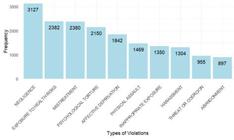
 Source: Ministry of Human Rights and Citizenship (Ministério dos Direitos Humanos e da Cidadania, 2024).
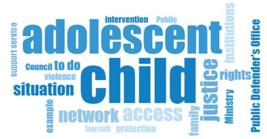
 Source: Research data, with the assistance of RStudio software.
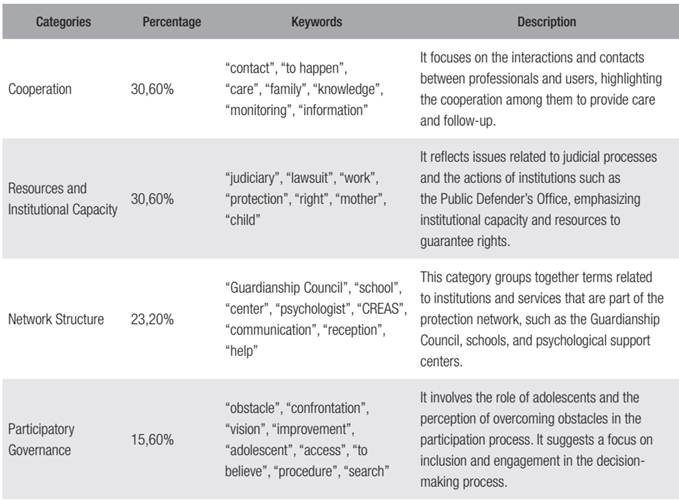 Source: Research data, with the assistance of Iramuteq software.

