
 Analysis of efficiency and productivity of Brazilian federal regional courts: a quantitative approach with 2023 data
Abstract
The efficiency and productivity of the Brazilian federal regional courts are crucial for strengthening the Rule of Law and the socioeconomic development of Brazil. This study quantitatively analyzes the efficiency of the Brazilian federal regional courts based on updated 2023 data extracted from the “Justice in Numbers” report by the National Council of Justice of Brazil. Indicators such as the number of new cases, case completion rate, expenses relative to Gross Domestic Product, and the number of judges per 100,000 inhabitants were examined. Using statistical techniques like Analysis of Variance, Spearman’s correlation, and multiple linear regression, the results indicate that the overload of new cases negatively affects the courts’ efficiency. Additionally, higher expenses relative to Gross Domestic Product are not necessarily associated with greater judicial efficiency. Although the availability of judges showed a positive trend in efficiency, it was not sufficient on its own. The study concludes that a more balanced and efficient management of human and financial resources, as well as the adoption of modern management practices and technologies, is necessary to improve the efficiency of the federal regional courts. Future research should incorporate longitudinal analyses and additional variables for a more comprehensive understanding.
Keywords:
judicial efficiency; federal regional courts; productivity; resource management; quantitative analysis
Resumo
A eficiência e a produtividade dos tribunais regionais federais são fundamentais para o fortalecimento do Estado de direito e o desenvolvimento socioeconômico do Brasil. Este estudo analisa, de forma quantitativa, a eficiência dos tribunais regionais federais com base em dados atualizados de 2023, extraídos do relatório Justiça em Números, do Conselho Nacional de Justiça. Foram examinados indicadores como número de casos novos, taxa de conclusão de processos, despesas em relação ao Produto Interno Bruto e número de magistrados por 100.000 habitantes. Utilizando técnicas estatísticas como Análise de Variância, correlação de Spearman e regressão linear múltipla, os resultados indicam que a sobrecarga de casos novos afeta negativamente a eficiência dos tribunais. Além disso, o aumento de despesas em relação ao Produto Interno Bruto não está necessariamente associado a uma maior eficiência judicial. Embora a disponibilidade de magistrados tenha mostrado tendência positiva na eficiência, não o foi isoladamente. O estudo conclui que é necessária uma gestão mais equilibrada e eficiente dos recursos humanos e financeiros, bem como a adoção de práticas de gestão modernas e tecnologias para aprimorar a eficiência dos tribunais regionais federais. Sugere-se que pesquisas futuras incorporem análises longitudinais e variáveis adicionais para uma compreensão mais abrangente.
Palavras-chave:
eficiência judicial; tribunais regionais federais; produtividade; gestão de recursos; análise quantitativa
Rsumen
La eficiencia y productividad de los tribunales regionales federales brasileños son fundamentales para el fortalecimiento del Estado de Derecho y el desarrollo socioeconómico de Brasil. Este estudio analiza cuantitativamente la eficiencia de los tribunales regionales federales basándose en datos actualizados de 2023, extraídos del informe “Justicia en Números” del Consejo Nacional de Justicia. Se examinaron indicadores como el número de casos nuevos, tasa de finalización de procesos, gastos en relación con el Producto Interno Bruto y número de magistrados por cada 100,000 habitantes. Utilizando técnicas estadísticas como Análisis de Varianza, correlación de Spearman y regresión lineal múltiple, los resultados indican que la sobrecarga de casos nuevos afecta negativamente la eficiencia de los tribunales. Además, mayores gastos en relación con el Producto Interno Bruto no están necesariamente asociados con una mayor eficiencia judicial. Aunque la disponibilidad de magistrados mostró una tendencia positiva en la eficiencia, no fue suficiente por sí sola. El estudio concluye que se requiere una gestión más equilibrada y eficiente de los recursos humanos y financieros, así como la adopción de prácticas de gestión modernas y tecnologías, para mejorar la eficiencia de los tribunales regionales federales brasileños. Se sugiere que futuras investigaciones incorporen análisis longitudinales y variables adicionales para una comprensión más amplia.
Palabras clave:
eficiencia judicial; tribunales regionales federales; productividad; gestión de recursos; análisis cuantitativo
1. INTRODUCTION
Efficiency and productivity in the Brazilian judicial system have been central themes in academic and political debates, given their importance for strengthening the rule of law and promoting socioeconomic development. Historically, the Brazilian judiciary has faced challenges related to procedural delays, excessive workloads, and the unequal distribution of resources, which negatively affect access to justice and public trust in judicial institutions (Silva & Pereira, 2021).
In recent decades, various initiatives have been implemented to enhance court efficiency. The establishment of the National Council of Justice (CNJ) in 2004 marked a significant turning point by creating national guidelines for judicial management and promoting transparency and accountability (CNJ, 2023a). Additionally, the Electronic Judicial Process (Processo Judicial Eletrônico - PJe), a digital platform launched by the CNJ, aimed to modernize judicial procedures, reduce costs, and streamline case processing (Oliveira & Souza, 2022). Programs like Justiça em Números and the Prêmio Innovare have also encouraged innovation and continuous improvement in the courts (CNJ, 2023b).
Despite these efforts, significant challenges continue, particularly in the country’s courts of appeals known as Federal Regional Courts (TRFs), which are crucial for adjudicating federal matters, including tax, social security, and environmental issues of national importance (Garoupa & Ginsburg, 2020). The efficiency of these courts is vital for resolving disputes, legal stability, and attracting investment, directly influencing public policy and the country’s economic environment (Viapiana, 2021).
In this context, this research analyzes the productivity and efficiency of Brazil’s TRFs using updated data from 2023. The results support recommendations to improve resource management and allocation within these courts, thus contributing to more effective public policies.
The focus on TRFs for this study is justified by the strategic relevance of these courts within the Brazilian judiciary. These courts of appeals are responsible for adjudicating cases of significant magnitude and complexity involving the Union, federal agencies, and state-owned enterprises, which have direct impacts on society and key economic sectors (Ramadan, 2021). Furthermore, analyzing the TRFs offers insights into regional disparities and the specific challenges faced across different parts of the country, providing a comprehensive and detailed view of judicial efficiency at the federal level.
This study seeks to contribute to the literature by providing an updated and in-depth analysis of the efficiency of federal courts. This topic remains underexplored in comparison to state courts (Sátiro & Sousa, 2021). By examining recent data and applying robust quantitative methodologies, the study aims to offer valuable insights for public administrators, judges, and policymakers to support the implementation of reforms and practices that promote faster, more transparent, and more accessible justice.
In today’s context, marked by increasing demands for justice and limited public resources, it is imperative to understand the factors that influence judicial efficiency. By addressing critical issues such as resource allocation and court management, this study seeks to diagnose key problems and suggest sustainable, effective solutions aligned with both national and international best practices (Ippoliti & Tria, 2020).
1.1. Theoretical framework
The efficiency and productivity of the judicial system are central themes in academic literature and public policy discussions, reflecting the importance of an effective judiciary for socioeconomic development and the consolidation of democratic rule of law. In the Brazilian context, these debates gain particular relevance due to longstanding challenges faced by the judiciary, such as procedural delays, excessive workloads, and the unequal distribution of resources (Teixeira & Gomes, 2019; Silva & Pereira, 2021).
The theory of productive efficiency, rooted in neoclassical economics, posits that organizations should maximize their outputs from a given set of inputs in order to avoid waste (Farrell, 1957). Applied to the judiciary, this theory implies resolving the greatest possible number of cases with the available resources, without compromising the quality of decisions (Sátiro & Sousa, 2021).
New public management (NPM) introduces principles of efficiency, effectiveness, and accountability into the public sector, drawing inspiration from private sector practices (Hood, 1991). In the judicial sphere, NPM encourages the use of performance indicators, strategic management, and a focus on results to improve the delivery of justice (Viapiana, 2021). However, implementing these principles presents challenges, particularly with respect to preserving judicial independence and accommodating the institutional specificities of the judicial system (Garoupa & Ginsburg, 2020).
Effective human resource management is essential for judicial efficiency. The unequal distribution of judges and civil servants leads to workload imbalances in certain regions, which in turn affects the speed of case processing (Gomes et al., 2017). In this context, the adoption of information technologies has been highlighted as a means to enhance efficiency by facilitating access to justice and reducing case processing times (Silva & Pereira, 2021). However, the implementation of such technologies requires investment and training, which can be challenging in scenarios marked by budget constraints (Oliveira & Souza, 2022).
Judicial independence is a cornerstone of the rule of law, as it ensures the impartiality of judicial decisions (Garoupa & Ginsburg, 2020). Nevertheless, in the pursuit of greater efficiency, it is crucial to balance managerial practices with the preservation of this independence. Studies suggest that judicial councils, such as the National Council of Justice (CNJ) in Brazil, can play a significant role in promoting efficiency without undermining the autonomy of the courts (Garoupa & Ginsburg, 2020; Viapiana, 2021).
Although international theories offer valuable insights, their direct application in the Brazilian context requires adaptation. Cultural, legal, and institutional differences may affect the effectiveness of management models developed in other countries (Teixeira & Gomes, 2019). For instance, Ippoliti and Tria (2020) analyzed judicial efficiency in Italy using data envelopment analysis (DEA). While this methodology is applicable to Brazil, the distinct characteristics of the Brazilian judiciary, such as the country’s vast territorial extension and socioeconomic diversity, demand a context-specific approach.
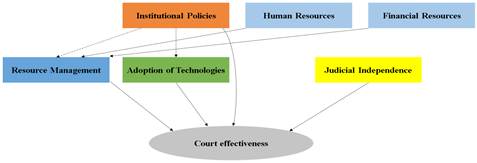
Judicial efficiency results from the interaction of multiple factors: resource management, technology adoption, institutional policies, and judicial independence. This study proposes a theoretical model that integrates these elements under the hypothesis that the efficiency of the TRFs is influenced by the distribution of human and financial resources, results-oriented management practices, and the preservation of judicial independence.
Figure 1 presents the proposed theoretical model, illustrating how these various factors interrelate and influence court efficiency.
In Brazil, the application of results-oriented management models faces specific challenges. The autonomy of the courts, guaranteed by the Constitution, can limit the implementation of standardized management policies (Viapiana, 2021). Moreover, resistance to change and a deeply rooted organizational culture may hinder the adoption of new practices (Rocha, 2017).
Studies such as that by Sátiro and Sousa (2021) indicate that, despite these obstacles, it is possible to identify quantitative factors that positively influence judicial performance, such as investments in technology and staff training. Additionally, the Brazilian experience with the Electronic Judicial Process (PJe) demonstrates that technology can be a valuable tool for greater efficiency. However, its implementation must be accompanied by appropriate management strategies and comprehensive training (Oliveira & Souza, 2022).
The literature on judicial efficiency emphasizes that court performance is influenced by multiple factors, including caseload volume, the qualifications of judges and staff, technological investments, and the proper allocation of resources (Teixeira & Gomes, 2019; Sátiro & Sousa, 2021). New public management (NPM) advocates for the incorporation of efficiency and accountability principles, which must be balanced with judicial independence, a fundamental pillar of the rule of law (Hood, 1991; Garoupa & Ginsburg, 2009).
This study aims to contribute to the ongoing discussion by empirically analyzing how these factors manifest in TRFs and how they affect productivity and efficiency.
1.2. Formulation of hypotheses
Based on this theoretical framework, the following hypotheses were derived from the literature:
H1: The unequal distribution of judges per inhabitant negatively affects the efficiency of the Brazilian courts of appeals, the Federal Regional Courts (TRFs) (Gomes et al., 2017; Sátiro & Sousa, 2021).
H2: Higher judicial expenditures relative to gross domestic product (GDP) are not necessarily associated with greater judicial efficiency (Viapiana, 2021).
It is assumed that case overload and the allocation of financial resources without strategic planning can reduce the courts’ capacity to resolve cases in a timely manner (Silva & Pereira, 2021). Therefore, advancing this debate requires understanding how the management of human and financial resources interacts with productivity variables, particularly in courts across different regions of the country.
Furthermore, studies such as that by Viana and Carvalho (2021) emphasize that people management directly influences judicial efficiency. Although technology implementation in the judiciary has been widely discussed, this study does not include a specific variable to measure the use of technological tools. This topic will be retained as an agenda item for future research.
2. METHODOLOGY
This study adopts a quantitative, descriptive, and explanatory approach to analyze the productivity and efficiency of the Federal Regional Courts (TRFs), which are courts of appeals in the Brazilian judicial system. Quantitative methods are justified by the need to measure and compare objective performance indicators, enabling a robust analysis of the relationships among the variables of interest (Creswell, 2014). The research is structured in stages, including data collection, processing, analysis, and interpretation, to address the research questions and test the proposed hypotheses.
Data were collected from the Justiça em Números report (Justice in Numbers) published in 2023 by the Brazilian National Council of Justice (CNJ, 2023b). This report serves as an official and comprehensive source of information on the performance of the Brazilian judiciary, ensuring the reliability and validity of the data used. Indicators related to the six existing TRFs were extracted, covering the following aspects:
-
New cases: number of cases started in 2023;
-
Case completion rate: percentage of cases concluded of the total in progress;
-
GDP-related expenses: ratio between the court’s total expenses and the corresponding region’s share of this indicator;
-
Number of judges per 100,000 inhabitants: indicator of the availability of judges to the population served.
The year 2023 was selected as the period of analysis because it was the most recent data at the time of this research, enabling an up-to-date assessment of court efficiency. While including data from previous years could enhance the temporal dimension of the analysis, limitations related to indicator standardization and methodological changes in CNJ reports made direct comparisons difficult. Therefore, a cross-sectional analysis focused on 2023 was chosen to ensure data consistency and reliability (Hair et al., 2019).
To ensure the integrity and quality of the data, detailed procedures for data treatment and cleaning were conducted, as described below.
1) Verification of missing data: An initial analysis was carried out to identify missing data in the data sets. When detected, missing data were treated as follows:
-
Data imputation: The mean or median imputation technique was used in cases where the absence of data was sporadic and did not represent a systematic pattern (Little & Rubin, 2019);
-
Case exclusion: When the absence of data significantly compromised the analysis of a variable, the corresponding case was excluded, as long as it did not affect the representativeness of the sample;
-
Outlier detection and treatment: Statistical methods, such as boxplot analysis and z-score calculation, were applied to identify discrepant values that could distort the results (Field, 2018). The outliers identified were assessed for their validity, as detailed below:
Maintenance of valid values: outliers resulting from real characteristics of the courts were maintained, considering the heterogeneity between regions;
Error correction: outliers resulting from typing errors or inconsistencies in the data were corrected based on original sources;
Normalization of variables: some variables were normalized to allow adequate comparisons, especially when they involved different scales or distinct populations.
The statistical analysis began with descriptive statistics to obtain measures of central tendency (mean, median) and dispersion (standard deviation, range), offering a preliminary overview of the indicators (Pestana & Gageiro, 2014). Following that, normality tests (Shapiro-Wilk and Kolmogorov-Smirnov) were conducted to determine whether the data adhered to a normal distribution, which is an essential assumption for parametric tests like ANOVA. Although some variables did not align with a normal distribution, the robustness of Analysis of Variance (ANOVA) for moderately non-normal data supported its use, as long as other assumptions were satisfied (such as independence of observations and homogeneity of variances) (Hair et al., 2019).
ANOVA was used to identify statistically significant differences among courts with respect to the collected indicators. When normality or homogeneity of variances was not met, nonparametric alternatives, such as the Kruskal-Wallis test, were employed to confirm the findings (Siegel & Castellan, 1988). Additionally, Spearman’s rank correlation was used to assess potential associations among variables, such as the relationship between case completion rates and the number of judges per 100,000 inhabitants (see Graph 4- Appendix).
A multiple linear regression analysis was conducted to test the proposed hypotheses, with the case completion rate as the dependent variable and the remaining indicators as independent variables. The assumptions for regression analysis were verified as follows: linearity through residual plots; independence of errors using the Durbin-Watson statistic; homoscedasticity through residual dispersion plots; and multicollinearity through the variance inflation factor (VIF).
All statistical analyses were performed using IBM SPSS Statistics (version 26) and Python (version 3.8), employing libraries such as pandas, numpy, matplotlib, and seaborn (Van Rossum & Drake, 2009). The integration of these tools enabled the systematic organization of the database and the generation of tables, graphs, and supplementary tests to support a thorough examination of the results.
Regarding ethics and transparency, this research complies with relevant ethical principles, ensuring the responsible use of publicly available data while maintaining a strictly academic and public interest-oriented purpose (resolution of the Brazilian National Council of Health - CNS 510/2016). By contributing to a better understanding of the operational dynamics of the TRFs, the findings support critical reflections on management practices and inform policies aimed at enhancing judicial efficiency.
3. RESULTS AND DISCUSSION
The data analysis revealed significant insights into the productivity and efficiency of TRFs in Brazil.
This section presents an analysis of the results through an in-depth interpretation of the findings, an examination of the interactions between the variables, and a discussion of the practical implications for public management and judicial policies.
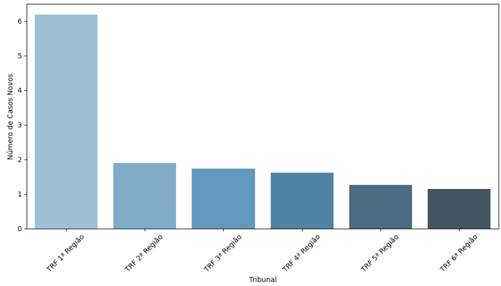
Descriptive statistics were initially calculated for the main performance indicators of the TRFs, as shown in Table 1 and Graph 1(Appendix).
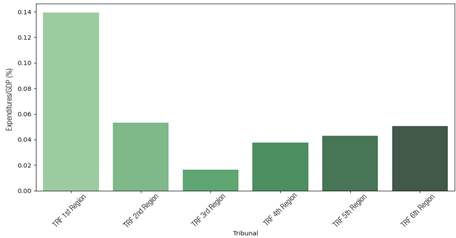
It can be seen that while the TRF of the 1st Region has the highest number of new cases and the greatest expenditure relative to GDP, the TRF of the 3rd Region has the lowest case completion rate, suggesting specific efficiency challenges (Graph 2).
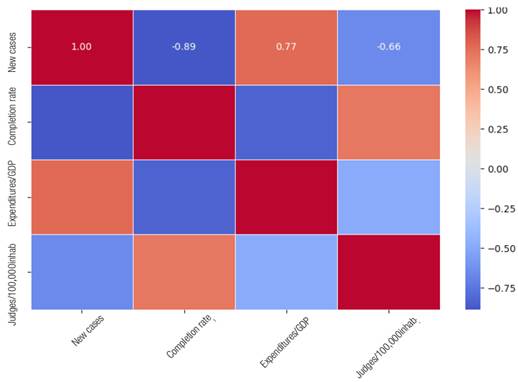
A Spearman correlation analysis was performed to explore the interactions between the variables studied due to the non-parametric nature of the data (Table 2).
The analysis reveals significant correlations between the variables:
-
New cases vs. completion rate: the strong negative correlation (r = -0.886, p < 0.01) indicates that courts with a higher number of new cases tend to have lower completion rates;
-
Completion rate vs. judges per 100,000 inhabitants: the moderate positive correlation (r = 0.714, p < 0.05) suggests that greater availability of judges is associated with higher completion rates;
-
Expenditure in relation to GDP vs. completion rate: the strong negative correlation (r = -0.829, p < 0.05) indicates that higher expenditure does not necessarily translate into greater efficiency.
These findings support hypotheses H1 and H2.
To deepen the analysis of the causal relationships, a multiple linear regression was performed, with the completion rate of cases as the dependent variable (Y) and the others as independent variables (regression model below):
Regression model:
Where:
Y = Completion rate (%)
X1 = New cases
X2 = Expenditure/GDP (%)
X3 = Judges/100,000 inhabitants
ɛ = Random error
Table 3 presents the results.
The negative and significant coefficient (β = -0.000005, p < 0.01) associated with the variable “new cases” indicates that an increase in the number of incoming cases is related to a decrease in the completion rate. This supports the hypothesis that workload overload negatively affects judicial efficiency. Regarding expenditures relative to GDP, the significant negative coefficient (β = -120.567, p < 0.05) suggests that higher spending does not necessarily lead to greater efficiency, possibly reflecting inefficiencies in allocating or using financial resources.
Although the coefficient for judges per 100,000 inhabitants is positive, it does not reach statistical significance at the 5% level (p = 0.078). Nonetheless, it suggests a trend indicating that more judges may contribute to improved completion rates.
The TRF of the 1st Region reports the highest number of new cases and the highest expenditure relative to GDP (Graph 3, Appendix). Despite this high workload, it also shows the highest completion rate (20%), indicating effective management practices and strategic human resource allocation. This positive performance could result from targeted management programs or greater adoption of technological solutions.
Conversely, the TRF of the 3rd Region shows the lowest completion rate (5.7%) and the lowest expenditure relative to GDP (Graph 5). These findings indicate significant efficiency challenges, potentially arising from high demand and limited resources. A thorough investigation into the institutional and administrative factors affecting this court’s performance is necessary.
The TRFs of the 2nd, 4th, and 5th Regions show intermediate completion rates, ranging from 10% to 15%, indicating moderate performance with room for improvement. The availability of judges in these regions seems to have a positive effect on efficiency, suggesting that a better allocation of human resources could improve outcomes.
Overall, the results show that the influx of new cases is a critical factor negatively impacting court efficiency. These findings align with previous research emphasizing the importance of managing case flow (Gomes et al., 2017; Sátiro & Sousa, 2021). Moreover, the negative association between expenditures relative to GDP and efficiency reinforces the notion that increased spending does not inherently improve performance, potentially due to inefficiencies in resource allocation and utilization (Viapiana, 2021).
The positive, albeit not statistically significant, trend in the influence of judge availability suggests that human resources play an important role in improving efficiency, but are not sufficient on their own. Additional factors, such as professional training, management practices, and the adoption of technological tools, are also essential (Silva & Pereira, 2021).
These findings have direct implications for court management and the formulation of public policies, including:
-
Redistribution of cases and resources: courts with heavy caseloads, such as the TRFs in the 1st and 3rd regions, can benefit from policies aimed at redistributing cases or enhancing human and technological resources;
-
Efficiency in the allocation of financial resources: the analysis indicates a need to reassess the allocation and use of financial resources to ensure that increased expenditures lead to efficiency gains;
-
Investment in technologies and management practices: adopting electronic systems and modern management practices can contribute to increased productivity, as indicated in the literature and evidenced by the performance of the TRF of the 1st Region (Oliveira & Souza, 2022).
The comparison of the results with the proposed theoretical model, which emphasizes the influence of resource management, institutional policies, and technology adoption on court efficiency, reveals a negative correlation between expenditures and efficiency. This suggests that the mere availability of financial resources is insufficient, reinforcing discussions on the necessity of effective management practices (Garoupa & Ginsburg, 2020; Viapiana, 2021).
The relevance of judge distribution and workload management supports the theory of productive efficiency and new public management principles, indicating that judicial efficiency is shaped by a combination of interrelated factors (Hood, 1991; Sátiro & Sousa, 2021).
4. LIMITATIONS AND RESEARCH AGENDA
The relevance of the results does not preclude acknowledgment of certain limitations. The small sample size, limited to six courts, restricts the scope of statistical analyses and calls for caution in interpreting the findings. Additionally, the use of cross-sectional data, based on a single year, does not allow for the examination of temporal trends or the long-term effects of policy changes. It is also important to note that the quantitative analysis did not account for qualitative variables, such as specific management practices, organizational culture, or the influence of local policies.
For future research, it is recommended to conduct longitudinal analyses incorporating data from previous years to identify trends and assess the impact of judicial reforms over time. Complementary qualitative studies, such as case studies or interviews, should also be conducted to investigate the specific practices contributing to efficiency in higher-performing courts. Moreover, the range of variables should be expanded to include other indicators, such as congestion rates, average processing time, and user satisfaction, to provide a more comprehensive evaluation of judicial performance.
5. FINAL CONSIDERATIONS
In summary, this study accomplished its objectives by identifying and analyzing the factors that affect the efficiency of the Brazilian Federal Regional Courts (TRFs) (or courts of appeals). The findings emphasize the need for more balanced and effective management of human and financial resources, which is in line with best practices in public administration.
By offering both practical and theoretical insights, this research contributes to the ongoing improvement of the Brazilian judicial system, fostering a justice system that is faster, more transparent, and more accessible to all citizens.
ACKNOWLEDGMENTS
I would like to thank the Conselho Nacional de Justiça (CNJ) for making the data used in this study publicly available, especially through the Justiça em Números (Justice in Numbers) report, which represents an important source of transparency and monitoring of the Brazilian judicial system. I would also like to thank the Federal University of Tocantins (UFT) for its academic and institutional support in developing this research. Finally, I would like to express my gratitude to the anonymous reviewers of RAP for their valuable contributions that significantly strengthened the quality of the manuscript.
Appendix


References
-
Conselho Nacional de Justiça. (2023a). Conselho Nacional de Justiça https://www.cnj.jus.br
» https://www.cnj.jus.br -
Conselho Nacional de Justiça. (2023b). Justiça em Números Conselho Nacional de Justiça. https://www.cnj.jus.br/wp-content/uploads/2024/02/justica-em-numeros-2023-16022024.pdf
» https://www.cnj.jus.br/wp-content/uploads/2024/02/justica-em-numeros-2023-16022024.pdf - Creswell, J. W. (2014). Research design: Qualitative, quantitative, and mixed methods approaches (4th ed.). Sage Publications.
- Farrell, M. J. (1957). The measurement of productive efficiency. Journal of the Royal Statistical Society, Series A (General), 120(3), 253-290.
- Field, A. (2018). Discovering statistics using IBM SPSS statistics (5nd ed.). Sage Publications.
-
Garoupa, N.; Ginsburg, T. Guarding the guardians: Judicial councils and judicial independence ENT#091;S. l.ENT#093;: Oxford Academic, 2020. Disponível em:https://dx.doi.org/10.5131/ajcl.2008.0004. Acesso em: 10 jul. 2024.
» https://doi.org/10.5131/ajcl.2008.0004 -
Gomes, A. O., Lopes, L. P. F., Zancan, C., Lima Neto, M. C., Costa, A. C. S., Dantas, A. B., & Ataide, J. A. R. (2017). Variáveis correlacionadas com a produtividade de juízes da primeira instância da Justiça Estadual de Minas Gerais. Sistemas & Gestão, 12(4), 401-409. https://doi.org./10.20985/1980-5160.2017.v12n4.977
» https://doi.org/10.20985/1980-5160.2017.v12n4.977 - Hair, J. F., Black, W. C., Babin, B. J., & Anderson, R. E. (2019). Análise multivariada de dados(7th ed.). Bookman.
- Hood, C. (1991). A public management for all seasons? Public Administration, 69(1), 3-19.
-
Ippoliti, R., & Tria, G. (2020). Efficiency of judicial systems: model definition and output estimation. Journal of Applied Economics, 23(1), 385-408. https://doi.org./10.1080/15140326.2020.1776977
» https://doi.org/10.1080/15140326.2020.1776977 - Little, R. J. A., & Rubin, D. B. (2019). Statistical analysis with missing data(3rd ed.). Wiley.
- Oliveira, L. F., & Souza, T. R. (2022). Análise comparativa da eficiência dos tribunais brasileiros pós-implementação do PJe. Justiça & Sociedade, 18(2), 200-220.
- Pestana, M. H., & Gageiro, J. N. (2014). Análise de dados para ciências sociais: a complementaridade do SPSS (6th ed.). Sílabo.
-
Ramadan, K. R. M. (2021). Um estudo cross-country acerca dos fatores institucionais capazes de impactar na corrupção judicial ENT#091;Dissertação de MestradoENT#093;. Universidade Federal de Campina Grande. http://dspace.sti.ufcg.edu.br:8080/jspui/handle/riufcg/21820
» http://dspace.sti.ufcg.edu.br:8080/jspui/handle/riufcg/21820 - Rocha, D. A. (2017). A eficiência na gestão do judiciário como hipótese de superação do problema da morosidade na atividade jurisdicional. Revista Processus de Estudos de Gestão, Jurídicos e Financeiros, 1(1), 21-50.
-
Sátiro, R. M., & Sousa, M. M. (2021). Determinantes quantitativos do desempenho judicial: fatores associados à produtividade dos tribunais de justiça. Revista Direito GV, 17(1), e2107. https://doi.org./10.1590/2317-6172202107
» https://doi.org/10.1590/2317-6172202107 - Siegel, S., & Castellan, N. J. (1988). Nonparametric statistics for the behavioral sciences(2nd ed.). McGraw-Hill.
-
Silva, R. A., & Pereira, M. J. (2021). Tecnologia e eficiência no judiciário brasileiro: avanços e desafios. Revista de Administração Pública, 55(3), 495-512. https://doi.org./10.1590/0034-761220200096
» https://doi.org/10.1590/0034-761220200096 -
Teixeira, L. R., & Gomes, R. C. (2019). Eficiência no judiciário: análise comparativa internacional e implicações para o Brasil. Revista de Administração Pública, 53(4), 676-695. https://doi.org./10.1590/0034-761220180280
» https://doi.org/10.1590/0034-761220180280 - Van Rossum, G., & Drake, F. L. (2009). Python 3 reference manual CreateSpace.
-
Viana, A. L., & Carvalho, P. H. B. (2021). Gestão de pessoas no Poder Judiciário: impacto na eficiência dos tribunais. Revista de Administração Pública, 55(5), 1020-1045. https://doi.org./10.1590/0034-761220200667
» https://doi.org/10.1590/0034-761220200667 -
Viapiana, F. (2021). A performance-based budget in the judiciary: Allocation of resources and performance variability in first instance courts. Journal of Public Budgeting, Accounting & Financial Management, 33(2), 177-206. https://doi.org./10.1108/JPBAFM-03-2020-0031
» https://doi.org/10.1108/JPBAFM-03-2020-0031
-
DATA RESPONSIBILITY
The data used in this study is publicly available on the website of Conselho Nacional de Justiça https://www.cnj.jus.br/pesquisas-judiciarias/justica-em-numeros/Additionally, the Python scripts, variables, and the complete dataset are uploaded on the Zenodo platform (https://zenodo.org/records/15377265) and can be accessed upon request to the author.
-
11
[Translated version] Note: All quotes in English translated by this article’s translator.
-
Reviewers:
Marcos de Moraes Sousa (Federal University of Goiás, Goiânia / GO - Brazil)
-
Reviewers:
Pedro Miguel Alves Ribeiro Correia (Universidade de Coimbra, Coimbra / Coimbra - Portugal)
-
Reviewers:
Renato Máximo Sátiro (Federal University of Goiás, Goiânia / GO - Brazil)
-
Peer review report:
Peer review report: the peer review report is available at this https://periodicos.fgv.br/rap/article/view/93503/87514
The data used in this study is publicly available on the website of Conselho Nacional de Justiça https://www.cnj.jus.br/pesquisas-judiciarias/justica-em-numeros/Additionally, the Python scripts, variables, and the complete dataset are uploaded on the Zenodo platform (https://zenodo.org/records/15377265) and can be accessed upon request to the author.

 Thumbnail
 Thumbnail
 Thumbnail
 Thumbnail
 Thumbnail
 Source: Elaborated by the author.
 Source: Data adapted from Conselho Nacional de Justiça (CNJ,
  Source: Data adapted from Conselho Nacional de Justiça (CNJ,
  Source: Data adapted from Conselho Nacional de Justiça (CNJ,
  Source: Data adapted from Conselho Nacional de Justiça (CNJ,
  Source: Data adapted from Conselho Nacional de Justiça (CNJ,
  Fonte: Dados adaptados do Conselho Nacional de Justiça (CNJ,
  Fonte: Dados adaptados do Conselho Nacional de Justiça (CNJ,
  Fonte: Dados adaptados do Conselho Nacional de Justiça (CNJ,
  Fonte: Dados adaptados do Conselho Nacional de Justiça (CNJ,
  Fonte: Dados adaptados do Conselho Nacional de Justiça (CNJ, 2023b).