 THE DEVELOPMENT OF CAPABILITIES THROUGH COGNITIVE INTERDEPENDENCE IN ENTREPRENEURIAL ECOSYSTEMS
ABSTRACT
This paper investigates the role of cognitive interdependence in university entrepreneurial ecosystems and its impact on developing their actors’ cognitive capabilities. Using a qualitative approach, we interviewed managers of new business development support programs, entrepreneurship professors, and entrepreneurs linked to startups within a university ecosystem to understand how the cognitive interdependence within these ecosystems influences the actors’ cognitive capabilities. The results indicate that this type of interdependence plays a significant role in the development of the actors’ cognitive capabilities a) indirectly when they are relationships between entities and individuals within the ecosystem, and b) directly when they are relationships between individuals. In addition, the psychological safety offered by university entrepreneurial ecosystems moderates and amplifies both the indirect and the direct influence of cognitive interdependence on the development of the actors’ cognitive capabilities.
Keywords:
entrepreneurial ecosystems; university entrepreneurship; cognitive interdependence; cognitive capabilities; case study
RESUMO
Este artigo investiga o papel da interdependência cognitiva em ecossistemas empreendedores universitários e seu impacto no desenvolvimento das capacidades cognitivas dos atores do ecossistema. Utilizando uma abordagem qualitativa, entrevistamos gestores de programas de apoio ao desenvolvimento de novos negócios, professores de empreendedorismo e empreendedores ligados a startups dentro de um ecossistema universitário para entender como a interdependência cognitiva dentro desses ecossistemas influencia as habilidades cognitivas dos atores. Os resultados indicam que esse tipo de interdependência desempenha um papel significativo no desenvolvimento das capacidades cognitivas dos atores indiretamente, quando são relacionamentos entre entidades e indivíduos, e diretamente, quando são relacionamentos entre indivíduos. Além disso, a segurança psicológica oferecida pelos ecossistemas empreendedores universitários moderam e ampliam a influência tanto direta como indireta da interdependência cognitiva no desenvolvimento das capacidades cognitivas dos atores.
Palavras-chave:
ecossistemas empreendedores; empreendedorismo universitário; interdependência cognitiva; capacidades cognitivas; estudo de caso
RESUMEN
Este artículo investiga el papel de la interdependencia cognitiva en los ecosistemas emprendedores universitarios y su impacto en el desarrollo de las capacidades cognitivas de los actores del ecosistema. Utilizando un enfoque cualitativo, entrevistamos a gestores de programas de apoyo al desarrollo de nuevos negocios, profesores de emprendimiento y emprendedores vinculados a startups dentro de un ecosistema universitario para entender cómo la interdependencia cognitiva dentro de esos ecosistemas influye en las habilidades cognitivas de los actores. Los resultados indican que este tipo de interdependencia desempeña un papel significativo en el desarrollo de las capacidades cognitivas de los actores indirectamente, cuando son relaciones entre entidades e individuos, y directamente, cuando son relaciones entre individuos. Además, la seguridad psicológica que ofrecen los ecosistemas emprendedores universitarios modera y amplía la influencia tanto directa como indirecta de la interdependencia cognitiva en el desarrollo de las capacidades cognitivas de los actores.
Palabras clave:
ecosistemas emprendedores; emprendimiento universitario; interdependencia cognitiva; capacidades cognitivas; estudio de caso
INTRODUCTION
The literature on entrepreneurial ecosystems highlights the interdependence of different stakeholders as fundamental to the development of superior ecosystem outputs, emphasizing the significant correlation between strong stakeholders and the quality of ecosystems in a region (Audretsch et al., 2019; Roundy et al., 2017; Stam & Ven, 2021). Interdependence significantly impacts the ecosystem’s ability to generate new outputs (Altman et al., 2022). The actors within an ecosystem, such as entrepreneurs, mentors, investors, and accelerator managers, use their cognitive capabilities to identify and evaluate opportunities, make strategic choices, and adapt to dynamic environments (Helfat & Martin, 2015). Entrepreneurs with strong cognitive capabilities are likely to make informed decisions, navigate uncertainty, and drive innovation within their ventures.
When considering ecosystems related to people development settings, such as the university environment, interactions and connections within the ecosystem appear crucial for developing the ability to access resources (Roundy, 2020) and can significantly impact individuals’ abilities to generate new businesses (Heaton et al., 2019). This suggests that the interdependence between actors may influence the development of their cognitive capabilities. This topic has yet to be explored in the literature on entrepreneurial ecosystems, but it is essential to understand how these ecosystems function. Thus, this study seeks to answer the following question: how does cognitive interdependence between actors within an entrepreneurial ecosystem influence the development of their cognitive capabilities?
This article explores the cognitive interdependence of actors within a university entrepreneurial ecosystem, investigating the influence of this interdependence on the development of the actors’ cognitive capabilities. It is a single case study of a relevant university entrepreneurial ecosystem in Brazil, involving the managers of the university accelerator, the entrepreneurship center, and the technology incubator, along with the coordinator of the entrepreneurship training track, and ten students and alums who founded six startups associated with programs and activities in this university ecosystem. Data was gathered from interviews, field observation, and secondary sources. Our results show that the cognitive interdependence between individuals within the university entrepreneurial ecosystem directly influences their cognitive capability. Additionally, the findings suggest that this influence is moderated and amplified by the psychological safety offered by university entrepreneurial ecosystems. These results provide valuable insights into why university entrepreneurial ecosystems outperform other ecosystems.
Our research contributes to the literature on entrepreneurial ecosystems by highlighting the importance of cognitive interdependence at the actor level for developing superior ecosystem results in terms of starting new businesses. Our model demonstrates two types of interdependence relationships influencing the actors’ cognitive capabilities in an ecosystem: relationships between entities and individuals and relationships between individuals. Interdependence relationships between entities and individuals indirectly influence the actors’ cognitive capabilities, creating opportunities for their development, while interdependence relationships between individuals directly influence the development of cognitive capabilities. Both the indirect and the direct influence are moderated and amplified by the psychological safety offered by a university entrepreneurial ecosystem.
These findings have significant implications for the players fostering entrepreneurial ecosystems, especially those linked to universities. They can use these insights to develop more effective strategies to interconnect stakeholders and build robust and successful ventures.
LITERATURE REVIEW
Entrepreneurial ecosystems are a community of multiple heterogeneous but interdependent stakeholders that provide a supportive environment for creating new ventures within a specific region (Thomas & Autio, 2020). These ecosystems are characterized by the interactions and relationships between entrepreneurs, investors, mentors, educational institutions, government, new venture accelerators, coworking spaces, maker spaces, startup academies, university entrepreneurship programs, crowdfunding, angel investors, venture capital, mentors, and other entities involved in entrepreneurship (Autio et al., 2018; Cao & Shi, 2021; Goswami et al., 2018). These formal and informal institutions, as well as culture, networks, physical infrastructure, finance, leadership, talent, and knowledge, work in a coordinated way to sustain entrepreneurial activities and boost the overall performance of the ecosystem (Leendertse et al., 2022). Thus, the various participants in this entrepreneurial ecosystem, each operating in a specialized way, play interdependent roles. In isolation, none of these participants can generate the result of the ecosystem, which is the innovation of the business model promoted by new companies. Thus, the performance of the entrepreneurial ecosystem is achieved through these different interactions between the various actors (Adner, 2017) and their particular capabilities.
Interdependence in entrepreneurial ecosystems
Interdependence refers to the mutual dependence and influence between actors and activities within the ecosystem (Adner, 2017). For example, entrepreneurs can depend on support services, mentors, investors, and other entrepreneurs to face challenges and seize opportunities (Abootorabi et al., 2021), just as mentors rely on the existence of entrepreneurs to carry out their guidance functions and investors depend on entrepreneurs to invest in businesses with growth potential and achieve financial success. The structure through which this ecosystem operates is ultimately defined by how these elements are aligned and how they interact to materialize the ecosystem’s output (Adner, 2017). These ecosystem constituent elements depend on each other for resources, knowledge, or market access, highlighting the interdependent nature of their relationships (Agarwal & Kapoor, 2023).
Interdependence between heterogeneous ecosystem participants has mainly been considered from technological, economic, and cognitive perspectives (Thomas & Autio, 2020). Technological interdependence refers to the dependence between ecosystem participants regarding technological specialization, often around a shared technological platform or a common modular architecture (Adner, 2012; Autio et al., 2018). For example, in telecommunications ecosystems, different organizations are interdependent when one provides the technology, another includes customer relationship management, and a third provides infrastructure management, defining the ecosystem’s output (Thomas & Autio, 2020). Economic interdependence appears when each member’s value from participating in the ecosystem depends on the simultaneous availability of compatible offers from other participants (Jacobides et al., 2018). Finally, cognitive interdependence occurs when ecosystem participants have a set of socially constructed standards, practices, assumptions, values, beliefs, and rules, which provide the formal and informal rules of action, interaction, and interpretation that guide and limit their decision-making (Thornton & Ocasio, 1999).
Cognitive interdependence implies differences in knowledge, skills, and cognitive frameworks between participants, especially when heterogeneous, leading to cognitive distance and potential differences in self-interest and expertise (Thomas & Autio, 2020; Thomas & Ritala, 2022). For example, when a startup accelerator manager follows the development of several businesses over the years, they acquire in-depth knowledge of best practices in the entrepreneurial development process, which startup entrepreneurs often lack. However, although the manager has this knowledge, they don’t always have the practical skills to implement it. It is, therefore, crucial for an entrepreneur to go through these stages, possibly with the guidance of the accelerator manager, to turn a new business into reality.
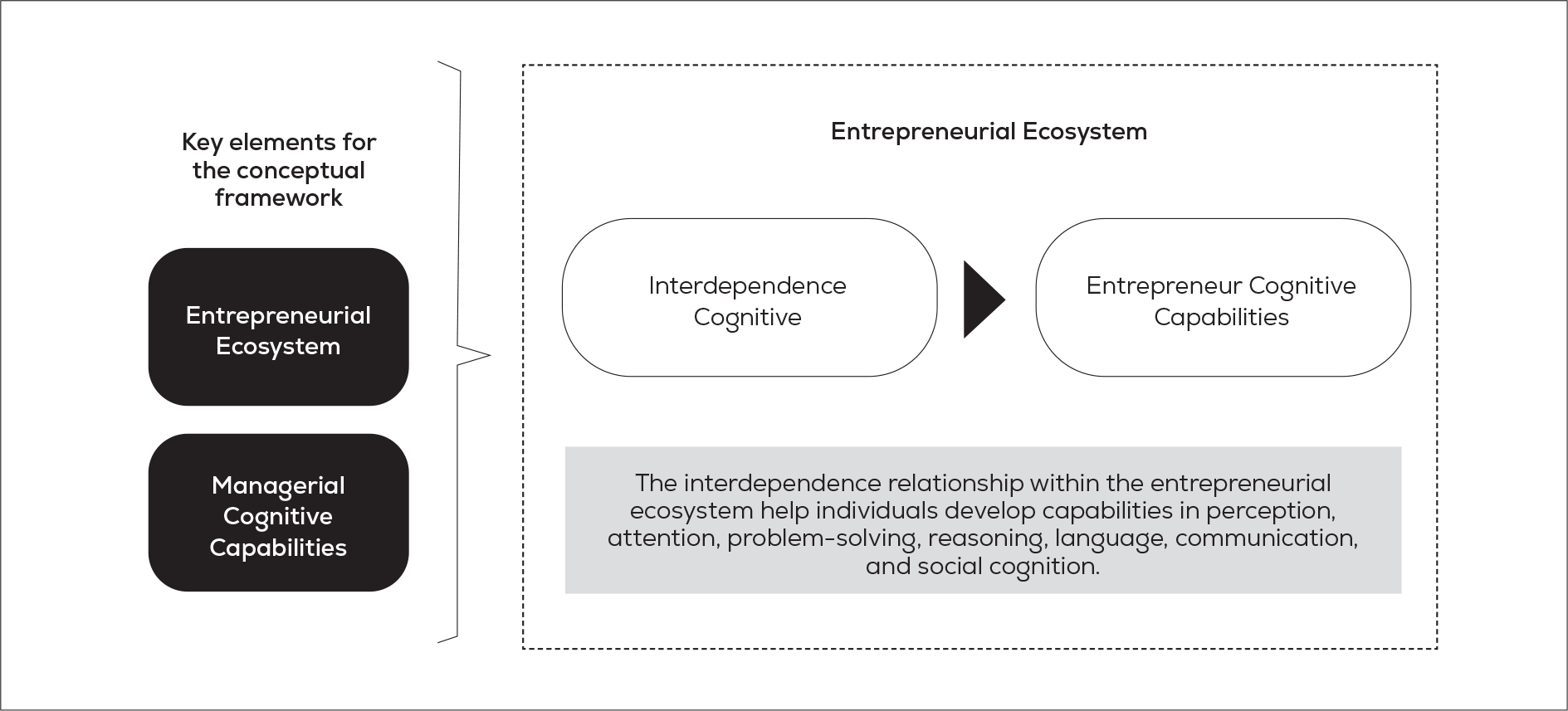
This type of interdependence resembles what Helfat and Martin (2015) call cognitive capabilities, which refer to the mental models, beliefs, and mental processes that managers within companies use to make decisions and act within an organization. These managerial cognitive capabilities can transfer knowledge structures between different contexts, allowing managers to perceive market opportunities that may not be immediately apparent (Helfat & Peteraf, 2014). Within an entrepreneurial ecosystem, the cognitive capability previously attributed to managers must be expanded. The actors in the entrepreneurial ecosystem, such as entrepreneurs, investors, accelerator managers, mentors, the government, and complementary companies, must possess this cognitive capability. In other words, cognitive capability is no longer limited to managers; all interdependent ecosystem actors must cultivate it.
Cognitive capabilities
This research proposes an analysis of cognitive interdependence through the lens of cognitive capabilities, which are organizational capabilities encompassing the cognitive aspect. It is organizational rather than individual because the collective cognition of individuals within an organization allows formulating mental content, defining guidelines, and establishing thoughts that reflect the organization’s position in the world (Peteraf & Reed, 2007).
According to Helfat and Peteraf (2014), the term “cognition” has two meanings: mental activities (or mental processes), and mental structures (or representations). In strategic management, capability is the ability to perform a specific function or activity consistently, reliably, effectively, and predictably (Amit & Schoemaker, 1993). Thus, cognitive capability refers to cognition’s activities and functions. Although the traditional view of entrepreneurs focuses on individuals starting new ventures and introducing innovative products or services (Gohmann, 2012), the role of entrepreneurship extends beyond startup activities and includes elements of managerial responsibilities. Entrepreneurial management involves tasks such as identifying problems and trends, directing resources, reshaping organizational structures, and addressing technological opportunities while aligning with customer needs (Heubeck & Meckl, 2022a; Teece, 2016). This managerial human capital is necessary to develop knowledge, skills, and expertise to lead organizational change efforts and cultivate innovation.
Studies indicate that cognitive mechanisms in entrepreneurship, such as biases, heuristics, alerts, and effectuation, are deeply related to the success of entrepreneurs (Grégoire et al., 2011). Cognitive capabilities, including both controlled and automatic processes, can be affected by practice and the mental states of individuals. For example, individuals can develop expertise through controlled processes that become automatic with practice, emphasizing the role of prior mental states and experiences in shaping cognitive abilities (Helfat & Martin, 2015). These actors must understand, identify, and pursue opportunities, coordinate available knowledge, and transform it into business results (Agarwal et al., 2007). In a recent study, Maus et al. (2023) found that directors of business incubators use their capabilities to expand established partnerships, transforming their organizations. Thus, the capabilities through which managers create, grow, and modify how companies generate value help to explain the relationship between the quality of managerial decisions, strategic changes, and organizational performance.
When team members feel safe, they are more likely to engage fully and actively in group interactions, fostering learning, stimulating creativity, and enhancing problem-solving capabilities (Miao et al., 2019). This supportive environment encourages individuals to use their capabilities and share their thoughts and feelings, promoting greater cognitive engagement and strengthening the team’s collective intelligence (Schulte et al., 2012). Teams operating in a context where they feel safe to apply their capabilities tend to achieve superior results and higher performance, driven by improved communication and a greater willingness to explore their skills and share diverse perspectives (Tang et al., 2021). These cognitive capabilities of managers in digital and technology-based companies seem sufficient for developing innovative projects and businesses (Heubeck & Meckl, 2022b). However, research is often assessed solely based on one actor without considering their relationship with the surrounding ecosystem - an essential characteristic for ecosystem innovation (Adner, 2017).
Entrepreneurship is often an effective channel for transferring and commercializing knowledge and promoting innovative activities and growth in a knowledge environment such as a university. The cognitive capability of actors in this ecosystem to frame situations opportunistically is a crucial resource that can be used to organize other resources (Alvarez & Busenitz, 2001). Interdependent actors with strong organizational capabilities - such as the ability to “perceive and seize” emerging market opportunities - within an entrepreneurial ecosystem are better equipped to effectively use the knowledge generated in universities and create value for both the company and the market (Link & Sarala, 2019). Therefore, all interdependent actors in the ecosystem must have this capability.
The interdependence of actors of a university entrepreneurial ecosystem as a mechanism for developing their cognitive capacities
Higher education institutions are crucial in generating knowledge and developing innovative startups (Johnson et al., 2019). University environments are characterized by collaboration between individuals and organizations and are recognized as entrepreneurial ecosystems that foster a knowledge-based economy (Etzkowitz et al., 2008; Heaton et al., 2019). In this context, mechanisms created by universities to support entrepreneurship, such as educational programs and incubators, facilitate technology transfer and encourage the development of new companies (Etzkowitz, 2016; Guerrero & Urbano, 2012). Thus, understanding the dynamics within an ecosystem so strongly centered on the development of individuals is fundamental to understanding how the cognitive interdependence of actors can impact their cognitive capabilities.

METHODOLOGY
Empirical approach
We adopted a qualitative and exploratory case study approach. As qualitative research analyzes highly complex concepts, carries out in-depth investigations, and searches for relevant elements to interpret social phenomena (Hoppen et al., 1996), it is understood to be pertinent to understanding the interdependencies within an ecosystem and their impacts. A contemporary phenomenon over which the researcher has no control is characterized by a “how” question (Eisenhardt, 1989; Yin, 2015).
A single-case research design was developed with multiple units of analysis. Each actor participating in the university entrepreneurial ecosystem studied was considered a unit of analysis, allowing comparison between them to identify recurring patterns within the ecosystem. The data collected includes information on the events, the people responsible for each action, the time of the events, and other activities organized over time, as well as their motivators (Pettigrew et al., 1990). These steps align with th research’s objectives, allowing for a more in-depth understanding of the reality of the ecosystem’s actors and their developed capabilities using the reference constructs in Table 1.
Methods
The case concerns the entrepreneurial ecosystem of a university recognized for its relevance to entrepreneurship. The university and the ecosystem around it have actors involved in the development of new businesses, such as the presence of an entrepreneurship support center, university accelerator, incubator, mentoring program, coworking space, angel investors network, and more than twenty different undergraduate entrepreneurship courses and graduate and executive education programs focused on entrepreneurship. In addition, the startups founded by students and alums of this institution were responsible for raising around 10% of all the money invested in startups in their country from 2021 to 2023.
To explore the relationship of interdependence within the entrepreneurial ecosystem, the study used the following units of analysis: Entrepreneurship Support Center, Accelerator, Incubator, Entrepreneurship Track, Graduate Program in Entrepreneurship and Innovation, Angel Investors Network, and six startups (Table 2).
Data collection
We conducted interviews in person or virtually via the Teams platform. A period of 60 minutes was allocated for each interview, with durations varying between 35 and 67 minutes. All interviews were recorded and transcribed. We conducted the interviews in Portuguese and manually translated each one into English. Table 2 presents the interviewees and their specific characteristics. We supplemented the interviews with observations made at meetings, mentoring sessions of the acceleration and incubation program, participated in a Demo Day of the university accelerator to which some startups were linked, and an investment day held by the angel investors’ network. We also had access to the pitch decks of some of the startups, the lesson plans for entrepreneurship subjects, the strategic planning of the entrepreneurship support center, and the accelerator’s implementation plan.
To further investigate the research problem, we began each interview with broad questions, seeking to understand from each actor: (a) what their day-to-day life is like, (b) what the process of developing and creating their activities was like, and (c) which actors they relate to. Based on this general context, we conducted each interview according to the need to go deeper, exploring with each actor information about how their activities have developed so far, their motivations for each activity, the actions taken, what has recently changed in their actions, and whether other actors have influenced any of these changes in the ecosystem.
Data analysis
We put the raw data, such as interview transcripts and documents, through content analysis according to the three phases proposed by Bardin (2011): description or preparation of the material, inference or deduction, and interpretation. The initial readings include the interview transcripts, the identification of indices, and their frequencies. We used a thematic or categorical analysis technique, dividing the text into units to discover nuclei of meaning, followed by regrouping into classes or categories.
Subsequently, we identified the mechanisms of interdependence by categorizing the ten units of analysis, guided by the literature review on cognitive interdependence, with the support of Atlas TI software. The material was explored through coding, cutting into context recording units, and categorizing.
Finally, we conducted a cross-analysis of the units, looking for similarities and differences through pairwise comparison, as indicated by Eisenhardt (1989), to avoid reductionist structures and achieve a more sophisticated understanding. This process helps to assess similarities and makes it possible to make theoretical generalizations about the influences of interdependence on the cognitive capacities of the ecosystem’s actors, as shown in Figures 2 and 3.


We observed that the interactions in the university entrepreneurial ecosystem unfold in two dimensions: entity-individual and individual-individual. These interactions outline how individuals connect with other actors in the ecosystem, be they different entities or people, and how these elements influence the improvement of their cognitive capacities, as shown in Figure 2. In addition, we observed that these elements contribute to forming an environment of psychological safety, which, when established, seems to intensify the impact of interdependence relationships on the development of capabilities (Figure 3).
RESULTS
Entity-individual relationship
The relationship between the entity and the individual refers to the interactions that occur between the existing organizations in the university entrepreneurial ecosystem (these entities include disciplines, accelerators, teaching materials, student bodies, student competitions, and coworking spaces, among others) and the individual who participates in the ecosystem (such as entrepreneurs, educational program managers, accelerator managers and collaborators, angel investors, among others). These relationships create opportunities for developing individuals’ cognitive capabilities through three main aspects: joint practical activities, development of theoretical content, and indirect connections.
Joint practical activities
The practical activities in the university and its ecosystem, such as entrepreneurship competitions, student organizations, and classroom activities, expose actors to situations that are close to reality. These experiences enable professors and university professionals to identify new ways of thinking and business models, adapting their teaching to students’ areas of interest. Additionally, they help entrepreneurs develop reasoning skills, problem-solving, opportunity recognition, and social cognition for leadership. As entrepreneur M pointed out, practical activities have an impact on attention and problem-solving skills:
We emerged in an international competition, but it was in the university competition where we could practice the most. So, although our startup was born partly thanks to the international competition, it started to grow because of the university competition.
Professor F.B., who acts as a mentor in the university’s entrepreneurship challenge, noticed trends and opportunities:
By accompanying the students in the challenge every semester, I can see their areas of interest and what types of business they are looking at. [...] This broadens my vision of how to work with them in the classroom.
Theoretical contents
Theoretical content, used in courses by the university’s entrepreneurial support center and mentors, are reference materials that help in the entrepreneurial process, impacting the thinking capability of everyone involved. The coordinator of the Entrepreneurship Center, T.H., highlights that these materials play a crucial role in building support and mentoring programs, as well as in training new collaborators and mentors. G.O., the Incubator’s manager, adds:
“Creating these materials at the university has significantly enhanced my ability to think critically during the development stages of new businesses.”
Entrepreneur L. points out that the material from his MBA was fundamental to understanding how to be a good manager and develop a strategic business vision. Entrepreneur A corroborates this, stating that:
The content of the entrepreneurship courses helped and significantly influenced my startup gaining traction.
Indirect connections
Indirect connections are relationships that arise naturally in the university entrepreneurial ecosystem without prior formalization and take place in coworking spaces, social areas, student organizations, and professional fairs. These interactions help entrepreneurs to identify potential partners and collaborators and encourage motivation for entrepreneurship. Entrepreneur V. mentions:
I met my partner at university, where I was involved in coordinating the university’s Entrepreneurship Support Center, and he was doing his executive MBA at the time.
Similarly, T.M., entrepreneurship professor, highlights the value of these spaces, noting that being in coworking areas and social spaces helps him generate ideas for innovative projects and gain insights into students’ perspectives, which often inspire new teaching approaches and collaborations. He emphasizes that these informal exchanges create a dynamic environment where ideas flow naturally, fostering connections that extend beyond business to address challenges and opportunities from diverse viewpoints.Based on these aspects, we can see that the relationship between the organization and the individual indirectly influences the capability of the actors in the ecosystem. Through activities, theories, and connections, entrepreneurs, teachers, managers, and other individuals can identify opportunities, focus their attention, understand the behavior of others, and recognize patterns of business development.
Individual-individual relationship
The individual-individual relationship refers to the interactions between the individuals existing in the university entrepreneurial ecosystem (these individuals include professors, mentors, students, and entrepreneurs). We observe that these relationships impact the cognitive capabilities of the actors through four main aspects: direct connections, direct guidance processes, conversations with colleagues and third parties, and observation of behaviors.
Direct connections
Direct connections are actively established between actors within the ecosystem, specifying with whom and why the individual should communicate. In the university ecosystem, just as professors and mentors facilitate these connections to create business opportunities or to broaden the entrepreneurs’ understanding of specific topics, entrepreneurs also generate connections to help professors, mentors, and program managers gain a deeper understanding of entrepreneurial practices.
These interactions help actors develop their thinking about the entrepreneurial process, identify new opportunities, and recognize potential partners. For example, it is common for entrepreneurs to refer people from their network of contacts so that professors and program managers can connect, as Professor F.P., coordinator of the entrepreneurship track, points out:
I met the manager of this fund through a former student who is currently in business. I have also learned a lot from this manager and invited him several times to participate in our various courses.
Similarly, the entrepreneurship center analyst R.S. commented:
“I was discussing investment rounds with a student who works at a VC fund, and he introduced me to an entrepreneur. [...] It was only by talking to this entrepreneur that I realized the importance of setting a time limit to close the fundraising period.”
Additionally, entrepreneurs B. and R. met at a university competition, introduced by mutual friends. When they met again, they realized the opportunity to become entrepreneurs together.
Orientation moments
Direct guidance involves instructions from one actor to another within the ecosystem, explaining how to carry out specific activities. Teachers and mentors often guide entrepreneurs on the best business development practices, helping them focus on priorities, make less biased, and understand the market. As F. mentioned:
We have mentors [at the university accelerator] who offer us a valuable outside perspective. They help us see obvious aspects we might overlook due to our immersion in the project.
It is also common for teachers to receive guidance from accelerator managers on carrying out practical activities or for incubator managers to guide advisors of angel investors’ networks on evaluating specific startups. This also applies to employees who support and accompany the orientation sessions, as mentioned by Analyst R.S.:
“[...] A lot of what I discuss here in the ecosystem I take to other activities. I see that I’m able to support the entrepreneurs more with each interaction [...] because I learn from them, from the teachers, mentors, and so on.
Conversations with peers and third parties
Peer conversations involve the exchange of information and discussions about the entrepreneurial process, as well as plans and business models, among professors, mentors, entrepreneurs, or other actors. These dialogues help actors improve their thinking about best practices, solve complex problems with real examples, understand the potential of entrepreneurship, and develop social skills. Entrepreneur M. mentioned that seeking guidance from people who have already founded companies helped with his decisions. Entrepreneur J. reinforced the importance of these conversations:
“[...] Talking to someone who’s been through what you’re going through, who’s already been an entrepreneur, who’s already had a company and is at the point of structuring it or changing it, is a big difference. Talking to these people during the course was very important for us.
F.T., Accelerator Leader, further adds: “These interactions are not only useful for entrepreneurs, [...] but also for me, as they allow me to better understand them, enhance the support I provide, and gain insights that improve my ability to help others.”
Behavior observation
Behavior observation involves analyzing the thinking of peers and interacting with people from different backgrounds. This process develops reasoning and problem-solving skills, influencing the actor’s mindset and perception of opportunities. Incubator’s leader, G.O., corroborates with that, stating:
Engaging with and observing the work of entrepreneurs helps me gain a deeper understanding of the challenges they face, enhancing my analysis and sparking creativity to develop solutions that address the broader needs of the ecosystem.
Entrepreneur A. adds that collective thinking during his technology course was crucial to improving his learning ability, which enhanced his entrepreneurial spirit. Observations from other entrepreneurs reinforce this idea, as reported by entrepreneur R.:
They were very important to us [talking about teachers]. [...] The mentality of the course, also visible in my colleagues, was effective. When I discovered the sales funnel recently, I set up a CRM [...] and the next steps. For me, processes are essential to measure and improve, an approach engineering has taught me to apply.”
Based on these aspects, we can see that the relationship between individuals directly influences the capability of the actors in the ecosystem. Through connections, guidance, conversations, and observation, entrepreneurs, teachers, managers, and other actors can recognize good practice patterns, solve problems and dilemmas they face in their work, and perceive previously unidentified opportunities.
Cognitive moderator
Psychological safety is a conviction shared by members of an environment, indicating that it is safe to take interpersonal risks (Edmondson, 1999). This component emerged during conversations with interviewees, manifesting itself through identifying opportunities to apply their skills in developing and supporting new businesses, strengthening individuals’ confidence in their capabilities and competencies, providing inspirational elements, and, finally, in the perception that third parties trust their work.
They felt that there are possibilities
We see that many entrepreneurs initially didn’t see entrepreneurship as a possibility. However, by observing the behavior of people with different realities and receiving support from others, they understand they can use their skills to become entrepreneurs.
Entrepreneur J. pointed out that:
The university environment changed my relationship with the market, not just in terms of entrepreneurship. Coming from a low-income family in the countryside, I had certain dogmas that only dissipated with access to information and relationships. [...] It was transformative for me. It completely changed my mentality. The environment was essential.
F.B., an entrepreneurship professor, highlighted that the university environment was instrumental in building his confidence and presenting him with new alternatives. He explained that engaging with aspiring entrepreneurs and exchanging experiences allowed him to explore different possibilities, broaden his perspective, and strengthen his belief in his own potential.Entrepreneur M also adds that:
“It gave us hope that it’s possible if someone else has done it. [...] The more we talked to people and sought their opinions, the more we believed in ourselves and received encouragement.”
They felt confident in their abilities
The different actors in the ecosystem face uncertainty and the need to make difficult decisions. With the support of others and theoretical knowledge as a reference, they begin to feel more confident in their abilities to make decisions.
As Entrepreneur M. mentioned, often:
It was more about others believing in us than us believing in ourselves, you know? I don’t think we had that confidence.
F.T., Accelerator Leader, added that the interactions and environment significantly boosted his confidence in his own capabilities:
Being surrounded by people who shared their experiences and supported my ideas made me trust my skills more and believe that I could navigate challenges and create opportunities.”
This demonstrates the importance of support and encouragement throughout the process. As Entrepreneur A. observed:
I realized that many people were going through similar experiences. Having a supportive environment and someone to discuss ideas with was crucial to gaining confidence in my entrepreneurial path.”
They felt inspired to use their abilities
The actors inspire one another to use their skills and competencies within the entrepreneurial ecosystem. This aspect is evident in the experience of T.H., Coordinator of the Entrepreneurship Center, who shared that many entrepreneurs, mentors, and professors inspire him through their stories and actions. He emphasized that the quality of individuals within the ecosystem motivates him to develop even greater projects and initiatives in this environment.This element is also evident in the discourse of entrepreneur F.:
I was impressed by the high level of the teachers, especially in the entrepreneurship course. The ability to condense vast theory into a short period demonstrates competence and inspires confidence in the students. I believe that this quality of teaching contributed significantly to my inspiration and confidence in my entrepreneurial abilities.
They received the trust of the people
Finally, the trust people place in each other, often due to the university’s reputation, helps expand their perception and seize opportunities. According to R.S., entrepreneur support center analyst:
Working at a well-known university increased the confidence people placed in me, as they were more open to hearing about my experiences and getting my take on technical topics related to my work.
Entrepreneur J. also pointed this out:
The university has provided me with significant development opportunities. I’ve done several internships in different places, all very interesting, thanks to companies’ recognition from the university.
Based on these aspects, we can see that psychological safety acts as a moderator capable of expanding the capability of the actors in the ecosystem. Through trust and inspiration, individuals take risks and test more, extending the learning cycle and developing the cognitive skills necessary for their work.
DISCUSSION
Cognitive interdependence is important in heterogeneous environments such as universities, where different perspectives, thoughts, and skills coexist (Wareham et al., 2014). However, it does not explain how these different perspectives relate to the other ecosystem actors. Thus, we have identified two distinct types of relationship, which can be separated into two types of cognitive interdependence: cognitive interdependence in the relationship between entity and individual and cognitive interdependence in the relationship between individuals, as illustrated in Figure 4. This helps explain how different actors develop their cognitive capabilities and why some entrepreneurial ecosystems are more successful in generating new businesses.

Cognitive Interdependence in Entrepreneurial Ecosystems Impacting the Development of Individuals’ Managerial Cognitive Capacities
Impact of individual-to-individual relationships
The cognitive interdependence between the actors is characterized by a reciprocal exchange of resources within the same environment. In this dynamic, individuals obtain knowledge, information, and opportunities from other individuals in the ecosystem. The relationships among teachers, mentors, and other fellow entrepreneurs are based on the participants’ diversity of knowledge, values, and beliefs, helping to develop superior results from the ecosystem.
As observed by Grégoire et al. (2011), cognitive mechanisms directly influence entrepreneurial success. However, these studies focused on the entrepreneur. Therefore, this interdependence typology helps us understand how these mechanisms can influence the different results generated by actors’ cognitive capabilities. We realize that not only do entrepreneurs need to understand, identify, and pursue opportunities, coordinating the available knowledge and transforming it into business results (Agarwal et al.,2007), but also all other actors in the ecosystem need to develop these capabilities so that the ecosystem as a whole grows and generates more and better businesses, as expected from an entrepreneurial ecosystem. We expand on studies addressing the cognitive mechanisms of entrepreneurs by arguing that the performance of an entrepreneurial ecosystem is achieved through the development of the cognitive capabilities of all the actors involved in entrepreneurship.
This interaction is fundamental to creating an environment conducive to the development of all those involved in the entrepreneurial ecosystem, whether teachers, mentors, fellow entrepreneurs, entrepreneurial partners, or guest speakers. This study also identified that conversations among these different actors promote the cohesion of the ecosystem, mitigating cognitive disparities and encouraging unity (Friedland & Alford, 1991). The actors observed that they expanded their social cognition and problem-solving capability by mirroring and learning from other individuals in the ecosystem.
Thus, the actors’ cognitive interdependence directly impact how they perceive their environment. By interacting collaboratively, participants can align their understandings (Schulte et al., 2012), which contributes to creating a shared mental model of the ecosystem. This alignment process reduces cognitive disparities, enabling ecosystem members to perceive the environment more cohesively. When individuals feel that their perceptions are validated and that they are immersed in a space of mutual support, it strengthens the sense that the environment is favorable to their development and success (Edmondson, 1999). Therefore, the quality of interactions between actors not only plays an important role in the development of cognitive capabilities but also shapes the collective perception of the ecosystem environment, influencing how each person feels about it.
Impacts of entity-individual relationships
At the individual level, Maus et al. (2023) have already investigated that incubator directors use their reflections, skills, and professional networks to develop new strategic visions in response to environmental changes. Our study points out that by separating the typology of what constitutes an entity, such as an incubator, from the individual, such as the incubator director, we can better understand the real influence of each element on the ecosystem’s results. While this type of relationship is explored in entrepreneurship and entrepreneur support programs literature (Hallen et al., 2014; Isabelle, 2013; Pauwels et al., 2016), it has not been widely addressed in ecosystem studies. These relationships can be seen as a form of interdependence, as entities adapt and enhance their capabilities in response to changes and shifts in their structure (Teece, 2016).
The interaction between actors within the university entrepreneurial ecosystem, for example, is considered a crucial component for the effective functioning of this ecosystem, especially due to the participants’ differences in knowledge, skills, and cognitive perspectives (Weick, 1995). Therefore, separating the interdependence between individuals and entities is essential to understanding how entrepreneurship develops and strengthens within the university, as cognitive interdependence often manifests itself through a collective identity (Gawer & Phillips, 2013; Thomas & Ritala, 2022. Thus, the interaction between individual actors and ecosystem entities contributes to improving attention, perception, reasoning, and social cognition capacities through exchanges and experiences between entities and individuals as well as individuals and individuals.
The interactions between individuals and entities are also essential in influencing how participants perceive their surrounding environment. By providing development opportunities, entities play a key role in shaping how each actor views the environment, helping to reduce cognitive gaps and improve their ability to recognize the environment as conducive to their growth (Edmondson, 1999; Johnson et al., 2019). Thus, these relationships affect cognitive abilities and contribute to forming a collective perception of the environment, fostering a more cohesive, innovative, and growth-oriented ecosystem.
Impacts of the perceived environment on capabilities
The study also reveals that the emotional state of the actors within the ecosystem influences how the relationships of cognitive interdependence contribute to the development of their skills. This finding aligns with research in various sectors, which indicates that the situational context affects the psychological safety of the people who are part of that environment (as in Grailey et al., 2021; Idris & Dollard, 2011). Huy and Zott (2019) point to the role of emotions, an element of cognition, as fundamental in forming managerial capabilities. Thus, psychological safety, defined as the shared belief in the ability to take interpersonal risks (Edmondson, 1999) and identified by Kahn (1990) as a psychological condition that affects personal engagement and disengagement at work, is understood in this study as a moderating factor of interdependencies within an entrepreneurial ecosystem, promoting the development of the cognitive abilities of the individuals present in this environment.
The literature suggests that when team members feel psychologically safe, they are more likely to fully engage in team interactions, fostering learning, creativity, and problem-solving (Miao et al., 2019). We expand the concept, which previously focused solely on the individual within their organization, to argue that when individuals feel psychologically safe, they are more likely to engage in activities with other actors within the ecosystem. This leads to increased interaction and better use of opportunities provided by entities in the entrepreneurial ecosystem, thereby promoting continuous learning and the development of their capabilities. The actors analyzed during the research improved their cognitive skills even more when they felt confident and received support to take risks and experiment. These results corroborate the idea that shared beliefs influence team results (McClintock et al., 2023).
All the relationships described highlight the interdependence within an entrepreneurial ecosystem, which occurs through various interactions between the involved actors, allowing for a better understanding of the phenomenon and a more precise study of the different forms of interdependence in these ecosystems. When investigating performance in innovation ecosystems, Gomes et al. (2023) point out that the performance of an ecosystem can be measured by the interactions and mutual dependencies among participants. This way, we expand the concept of managerial capabilities (Helfat & Matin, 2015; Helfat & Peteraf, 2014) so that it can be applied to ecosystems. This leads us to understand that the capabilities of each ecosystem actor contribute to improving the quality of decisions, promoting changes in ecosystem behavior, and enhancing the performance of newly generated businesses, helping to explain the strong performance of the university entrepreneurial ecosystem.
CONCLUSION
This study contributes to the ecosystem literature by enriching the concept of cognitive interdependence in entrepreneurial ecosystems. The study introduces an additional typology with two types of interdependence relationships, expanding the existing understanding by demonstrating the impact of cognitive interdependence on the development of cognitive capabilities.
Another relevant contribution of this study is showing that cognitive interdependence influences the actors’ perception of the environment, and this perception moderates the development of individuals’ cognitive capabilities. This should help future researchers observe how relationships occur and how the perception of these relationships influences the behavior of the constituent elements of the ecosystem.
Finally, the study contributes to the literature on cognitive capabilities by expanding the concept previously used to explain individuals’ capabilities within firms and how these capabilities explain company performance. A new line of research can now be developed from the understanding that the cognitive capabilities of individuals who are actors in ecosystems help explain the performance of the ecosystem.
For practice, this study helps actors in entrepreneurial ecosystems, emphasizing managers in university environments and optimizing their actions. By understanding that the development of the entrepreneurial ecosystem is influenced by the interaction between all the different actors that compose it, they need to ensure that the environment is psychologically safe within their institutions. Managers and stakeholders in entrepreneurial ecosystems, recognizing the importance of these relationships, can make more informed decisions about which ecosystems they wish to belong to and contribute to.
Our limitations include the excessive focus on relationships that directly influenced the development of managerial cognitive capabilities, neglecting other influences in the ecosystem that may not have been captured in our analysis. Future research could study the relationship between cognitive interdependence and the development of individuals in other types of ecosystems beyond the entrepreneurial one and investigate the different relationships within the entrepreneurial ecosystem from the perspective of the two typologies presented in this study.
-
The reviewers did not authorize disclosure of their identity and peer review report.
-
Evaluated through a double-anonymized peer review. Guest Editors: Charles Kirschbaum, Daniel Paulino Teixeira Lopes, Gregory Pogue, Kadígia Faccin e Ricardo Reolon
REFERENCES
-
Abootorabi, H., Wiklund, J., Johnson, A. R., & Miller, C. D. (2021). A holistic approach to the evolution of an entrepreneurial ecosystem: An exploratory study of academic spin-offs. Journal of Business Venturing, 36(5). https://doi.org/10.1016/j.jbusvent.2021.106143
» https://doi.org/10.1016/j.jbusvent.2021.106143 - Adner, R. (2012). The wide lens: A new strategy for innovation Portfolio Penguin.
-
Adner, R. (2017). Ecosystem as structure: An actionable construct for strategy. Journal of Management, 43(1), 39-58. https://doi.org/10.1177/0149206316678451
» https://doi.org/10.1177/0149206316678451 -
Agarwal, R., Audretsch, D., & Sarkar, M. B. (2007). The process of creative construction: Knowledge spillovers, entrepreneurship, and economic growth. Strategic Entrepreneurship Journal, 1(3/4), 263-286. https://doi.org/10.1002/sej.36
» https://doi.org/10.1002/sej.36 -
Agarwal, S., & Kapoor, R. (2023). Value creation tradeoff in business ecosystems: MillerLeveraging complementarities while managing interdependencies. Organization Science, 34(3), 1216-1242. https://doi.org/10.1287/orsc.2022.1615
» https://doi.org/10.1287/orsc.2022.1615 -
Altman, E. J., Nagle, F., & Tushman, M. L. (2022). The translucent hand of managed ecosystems: Engaging communities for value creation and capture. Academy of Management Annals, 16(1), 70-101. https://doi.org/10.5465/annals.2020.0244
» https://doi.org/10.5465/annals.2020.0244 -
Alvarez, S. A., & Busenitz, L. W. (2001). The entrepreneurship of resource-based theory. Journal of Management, 27(6), 755-775. https://doi.org/10.1177/014920630102700609
» https://doi.org/10.1177/014920630102700609 -
Amit, R., & Schoemaker, P. J. H. (1993). Strategic assets and organizational rent. Strategic Management Journal, 14(1), 33-46. https://doi.org/10.1002/smj.4250140105
» https://doi.org/10.1002/smj.4250140105 -
Audretsch, D. B., Cunningham, J. A., Kuratko, D. F., Lehmann, E. E., & Menter, M. (2019). Entrepreneurial ecosystems: Economic, technological, and societal impacts. The Journal of Technology Transfer, 44, 313-325. https://doi.org/10.1007/s10961-018-9690-4
» https://doi.org/10.1007/s10961-018-9690-4 -
Autio, E., Nambisan, S., Thomas, L. D. W., & Wright, M. (2018). Digital affordances, spatial affordances, and the genesis of entrepreneurial ecosystems. Strategic Entrepreneurship Journal, 12(1), 72-95. https://doi.org/10.1002/sej.1266
» https://doi.org/10.1002/sej.1266 - Bardin, L. (2011). Análise de conteúdo Almedina.
-
Cao, Z., & Shi, X. (2021). A systematic literature review of entrepreneurial ecosystems in advanced and emerging economies. Small Business Economics, 57, 75-110. https://doi.org/10.1007/s11187-020-00326-y
» https://doi.org/10.1007/s11187-020-00326-y -
Edmondson, A. (1999). Psychological safety and learning behavior in work teams. Administrative Science Quarterly, 44(2), 350-383. https://doi.org/10.2307/2666999
» https://doi.org/10.2307/2666999 -
Eisenhardt, K. M. (1989). Building theories from case study research. Academy of Management Review, 14(4), 532-550. https://doi.org/10.2307/258557
» https://doi.org/10.2307/258557 -
Etzkowitz, H. (2016). The entrepreneurial university: Vision and metrics. Industry and Higher Education, 30(2), 83-97. https://doi.org/10.5367/ihe.2016.0303
» https://doi.org/10.5367/ihe.2016.0303 -
Etzkowitz, H., Ranga, M., Benner, M., Guaranys, L., Maculan, A. M., & Kneller, R. (2008). Pathways to the entrepreneurial university: Towards a global convergence. Science and Public Policy, 35(9), 681-695. https://doi.org/10.3152/030234208X389701
» https://doi.org/10.3152/030234208X389701 - Friedland, R., & Alford, R. A. (1991). Bringing society back in: Symbols, practices, and institutional contradictions. In W. W. Powell & P. J. DiMaggio (Eds.), The new institutionalism in organizational analysis (pp. 232-263). University of Chicago Press.
-
Gawer, A., & Phillips, N. (2013). Institutional work as logics shift: The case of intel’s transformation to platform leader. Organization Studies, 34(8), 1035-1071. https://doi.org/10.1177/0170840613492071
» https://doi.org/10.1177/0170840613492071 -
Gohmann, S. F. (2012). Institutions, latent entrepreneurship, and self-employment: An international comparison. Entrepreneurship Theory and Practice, 36(2), 295-321. https://doi.org/10.1111/j.1540-6520.2010.00406.x
» https://doi.org/10.1111/j.1540-6520.2010.00406.x -
Gomes, L. A. V., Hourneaux, F., Junior, Facin, A. L. F., & Leal, L. F. (2023). Performance measurement and management systems for dealing with strategies in uncertain ecosystems. International Journal of Operations & Production Management, 43(3), 543-577. https://doi.org/10.1108/IJOPM-03-2021-0209
» https://doi.org/10.1108/IJOPM-03-2021-0209 -
Goswami, K., Mitchell, J. R., & Bhagavatula, S. (2018). Accelerator expertise: Understanding the intermediary role of accelerators in the development of the Bangalore entrepreneurial ecosystem. Strategic Entrepreneurship Journal, 12(1), 117-150. https://doi.org/10.1002/sej.1281
» https://doi.org/10.1002/sej.1281 -
Grailey, K., Murray, E., Reader, T., & Brett, S. (2021). The presence and potential impact of psychological safety in the healthcare setting: An evidence synthesis. BMC Health Services Research, 21, 1-15. https://doi.org/10.1186/s12913-021-06740-6
» https://doi.org/10.1186/s12913-021-06740-6 -
Grégoire, D. A., Corbett, A. C., & McMullen, J. S. (2011). The cognitive perspective in entrepreneurship: An agenda for future research. Journal of Management Studies, 48(6), 1443-1477. https://doi.org/10.1111/j.1467-6486.2010.00922.x
» https://doi.org/10.1111/j.1467-6486.2010.00922.x -
Guerrero, M., & Urbano, D. (2012). The development of an entrepreneurial university. The Journal of Technology Transfer, 37, 43-74. https://doi.org/10.1007/s10961-010-9171-x
» https://doi.org/10.1007/s10961-010-9171-x -
Hallen, B. L., Bingham, C. B., & Cohen, S. L. (2014). Do accelerators accelerate? A study of venture accelerators as a path to success. Academy of Management Proceedings, 747-752. https://doi.org/10.5465/ambpp.2014.185
» https://doi.org/10.5465/ambpp.2014.185 -
Heaton, S., Siegel, D. S., & Teece, D. J. (2019). Universities and innovation ecosystems: A dynamic capabilities perspective. Industrial and Corporate Change, 28(4), 921-939. https://doi.org/10.1093/icc/dtz038
» https://doi.org/10.1093/icc/dtz038 -
Helfat, C. E., & Martin, J. A. (2015). Dynamic managerial capabilities: Review and assessment of managerial impact on strategic change. Journal of Management, 41(5), 1281-1312. https://doi.org/10.1177/0149206314561301
» https://doi.org/10.1177/0149206314561301 -
Helfat, C. E., & Peteraf, M. A. (2014). Managerial cognitive capabilities and the microfoundations of dynamic capabilities. Strategic Management Journal, 36(6), 831-850. https://doi.org/10.1002/smj.2247
» https://doi.org/10.1002/smj.2247 -
Heubeck, T., & Meckl, R. (2022a). Antecedents to cognitive business model evaluation: A dynamic managerial capabilities perspective. Review of Managerial Science, 16(8), 2441-2466. https://doi.org/10.1007/s11846-021-00503-7
» https://doi.org/10.1007/s11846-021-00503-7 -
Heubeck, T., & Meckl, R. (2022b). More capable, more innovative? An empirical inquiry into the effects of dynamic managerial capabilities on digital firms’ innovativeness. European Journal of Innovation Management, 25(6), 892-915. https://doi.org/10.1108/EJIM-02-2022-0099
» https://doi.org/10.1108/EJIM-02-2022-0099 -
Hoppen, N., Lapointe, L., & Moreau, E. (1996). Um guia para avaliação de artigos de pesquisas em sistemas de informação. REAd: Revista Eletrônica de Administração, 2(2), 1-34. Retrieved from https://lume.ufrgs.br/handle/10183/19397
» https://lume.ufrgs.br/handle/10183/19397 -
Huy, Q., & Zott, C. (2019). Exploring the affective underpinnings of dynamic managerial capabilities: How managers’ emotion regulation behaviors mobilize resources for their firms. Strategic Management Journal, 40(1), 28-54. https://doi.org/10.1002/smj.2971
» https://doi.org/10.1002/smj.2971 -
Idris, M., & Dollard, M. (2011). Psychosocial safety climate, work conditions, and emotions in the workplace: A Malaysian population-based work stress study. International Journal of Stress Management, 18(4), 324-347. https://doi.org/10.1037/a0024849
» https://doi.org/10.1037/a0024849 -
Isabelle, D. (2013). Key factors affecting a technology entrepreneur’s choice of incubator or accelerator. Technology Innovation Management Review, 3(2), 16. http://dx.doi.org/10.22215/timreview/656
» http://dx.doi.org/10.22215/timreview/656 -
Jacobides, M. G., Cennamo, C., & Gawer, A. (2018). Towards a theory of ecosystems. Strategic Management Journal, 39(8), 2255-2276. https://doi.org/10.1002/smj.2904
» https://doi.org/10.1002/smj.2904 -
Johnson, D., Bock, A. J., & George, G. (2019). Entrepreneurial dynamism and the built environment in the evolution of university entrepreneurial ecosystems. Industrial and Corporate Change, 28(4), 941-959. https://doi.org/10.1093/icc/dtz034
» https://doi.org/10.1093/icc/dtz034 -
Kahn, W. (1990). Psychological conditions of personal engagement and disengagement at work. Academy of Management Journal, 33, 692-724. https://doi.org/10.2307/256287
» https://doi.org/10.2307/256287 -
Leendertse, J., Schrijvers, M., & Stam, E. (2022). Measure twice, cut once: Entrepreneurial ecosystem metrics. Research Policy, 51(9), 104336. https://doi.org/10.1016/j.respol.2021.104336
» https://doi.org/10.1016/j.respol.2021.104336 -
Link, A. N., & Sarala, R. M. 2019. Advancing conceptualisation of university entrepreneurial ecosystems: The role of knowledge-intensive entrepreneurial firms. International Small Business Journal, 37(3), 289-310. https://doi.org/10.1177/0266242618821720
» https://doi.org/10.1177/0266242618821720 -
Maus, A., Sammut, S., & Delacour, H. (2023). If you want to go fast, go alone; if you want to go far, go together. In favor of a partnership approach to directors of incubators’ dynamic managerial capabilities. M@ n@ gement, 26(4), 1-15. https://doi.org/10.37725/mgmt.2023.5237
» https://doi.org/10.37725/mgmt.2023.5237 -
McClintock, A., Fainstad, T., Blau, K., & Jauregui, J. (2023). Psychological safety in medical education: A scoping review and synthesis of the literature. Medical Teacher, 45, 1290-1299. https://doi.org/10.1080/0142159x.2023.2216863
» https://doi.org/10.1080/0142159x.2023.2216863 -
Miao, Q., Eva, N., Newman, A., & Cooper, B. (2019). CEO entrepreneurial leadership and performance outcomes of top management teams in entrepreneurial ventures: The mediating effects of psychological safety. Journal of Small Business Management, 57(3), 1119-1135. https://doi.org/10.1111/jsbm.12465
» https://doi.org/10.1111/jsbm.12465 -
Pauwels, C., Clarysse, B., Wright, M., & Hove, J. Van. (2016). Understanding a new generation incubation model: The accelerator. Technovation, 50/51, 13-24. https://doi.org/10.1016/j.technovation.2015.09.003
» https://doi.org/10.1016/j.technovation.2015.09.003 -
Peteraf, M. A., & Reed, R. (2007). Managerial discretion and internal alignment under regulatory constraints and change. Strategic Management Journal, 28(11), 1089-1112. https://doi.org/10.1002/smj.628
» https://doi.org/10.1002/smj.628 -
Pettigrew, A. M. (1990). Longitudinal field research on change: Theory and practice. Organization Science, 1(3), 267-292. https://doi.org/10.1287/orsc.1.3.267
» https://doi.org/10.1287/orsc.1.3.267 -
Roundy, P. T. (2020). Do we lead together? Leadership behavioral integration and coordination in entrepreneurial ecosystems. Journal of Leadership Studies, 14(1), 6-25. https://doi.org/10.1002/jls.21688
» https://doi.org/10.1002/jls.21688 -
Roundy, P. T., Brockman, B. K., & Bradshaw, M. (2017). The resilience of entrepreneurial ecosystems. Journal of Business Venturing Insights, 8, 99-104. https://doi.org/10.1016/j.jbvi.2017.08.002
» https://doi.org/10.1016/j.jbvi.2017.08.002 -
Schulte, M., Cohen, N. A., & Klein, K. J. (2012). The coevolution of network ties and perceptions of team psychological safety. Organization Science, 23(2), 564-581. https://doi.org/10.1287/orsc.1100.0582
» https://doi.org/10.1287/orsc.1100.0582 -
Stam, E., & Ven, A. Van de. (2021). Entrepreneurial ecosystem elements. Small Business Economics, 56(2), 809-832. https://doi.org/10.1007/s11187-019-00270-6
» https://doi.org/10.1007/s11187-019-00270-6 -
Tang, S., Nadkarni, S., Wei, L., & Zhang, S. X. (2021). Balancing the yin and yang: TMT gender diversity, psychological safety, and firm ambidextrous strategic orientation in Chinese high-tech SMEs. Academy of Management Journal, 64(5), 1578-1604. https://doi.org/10.5465/amj.2019.0378
» https://doi.org/10.5465/amj.2019.0378 -
Teece, D. J. (2016). Dynamic capabilities and entrepreneurial management in large organizations: Toward a theory of the (entrepreneurial) firm. European Economic Review, 86, 202-216. https://doi.org/10.1016/j.euroecorev.2015.11.006
» https://doi.org/10.1016/j.euroecorev.2015.11.006 -
Thomas, L. D., & Ritala, P. (2022). Ecosystem legitimacy emergence: A collective action view. Journal of Management, 48(3), 515-541. https://doi.org/10.1177/0149206320986617
» https://doi.org/10.1177/0149206320986617 - Thomas, L. D. W., & Autio, E. (2020). Innovation ecosystems in management: An organizing typology. In The Oxford research encyclopedia of business and management Oxford University Press
-
Thornton, P. H., & Ocasio, W. (1999). Institutional logics and the historical contingency of power in organizations: Executive succession in the higher education publishing industry, 1958-1990. American Journal of Sociology, 105(3), 801-843. https://doi.org/10.1086/210361
» https://doi.org/10.1086/210361 -
Wareham, J., Fox, P. B., & Giner, J. L. C. (2014). Technology ecosystem governance. Organization Science, 25(4), 1195-1215. https://doi.org/10.1287/orsc.2014.0895
» https://doi.org/10.1287/orsc.2014.0895 - Weick, K. E. (1995). Sensemaking in organizations Sage Publications.
- Yin, R. K. (2015). Estudo de caso: Planejamento e métodos Bookman Editora.