
 THE TRANSFORMATION OF PUBLIC UNIVERSITIES IN VIETNAM AND THEIR ROLE IN NATIONAL INNOVATION SYSTEMS
ABSTRACT
The concept of national innovation systems (NIS) has been commonly applied as a theoretical lens for researching innovation systems worldwide. This phenomenon has occurred also in Asia. Although underreported, the case of Vietnam is worth exploring, including the role of public universities (PUs) in the NIS and the transformation of these institutions in order to enhance their influence in this system. This qualitative study includes a literature review and in-depth interviews with eleven high-ranking managers from nine Vietnamese PUs to assess the transition of these universities toward innovation and entrepreneurship and their significant role in NIS, particularly for three characteristics identified in the gray literature: effective leadership, interdisciplinarity, and entrepreneurship. Insights from interviews revealed PUs’ strong leadership in NIS and the universities’ clear objectives and significant efforts to change toward innovation and entrepreneurship. However, institutional barriers rooted in the long-standing Soviet Union-style educational system, such as rigidly defined education boundaries and premature networking with industry, pose major constraints to change. The study offers suggestions to improve the Vietnamese PUs’ ability to promote innovation and entrepreneurship, including integrating interdisciplinary courses into the curriculum, establishing interdisciplinary offices, encouraging talent mobility between universities and industry as well as devising robust intellectual property rights.
Keywords:
public universities; innovation; entrepreneurship; interdisciplinarity; technological transfer.
RESUMO
O conceito de sistemas nacionais de inovação (SNI) tem sido aplicado com frequência como lente teórica para a pesquisa sobre esses sistemas em todo o mundo. Esse fenômeno ocorre também na Ásia. Embora pouco estudado, o caso do Vietnã vale a pena ser explorado, particularmente o papel das universidades públicas (UP) nos SNI e a transformação dessas instituições na busca de ampliar sua influência nesse sistema. Este estudo adotou uma abordagem qualitativa, que inclui revisão da literatura e entrevistas aprofundadas com gestores de alto-escalão de UPs do Vietnã, para avaliar a transformação dessas universidades com relação à inovação e ao empreendedorismo, bem como seu papel significativo no SNI, especialmente em virtude de três características identificadas na literatura cinzenta: liderança eficaz, interdisciplinaridade e empreendedorismo. As entrevistas revelaram uma forte liderança das UPs no SNI, com objetivos claros, e esforços organizacionais significativos para uma transformação em direção à inovação e ao empreendedorismo. No entanto, as barreiras institucionais, enraizadas em um sistema educacional com características marcadas pelo estilo adotado na União Soviética (tais como fronteiras educacionais rigidamente definidas e uma relação bastante incipiente com a indústria), dificultam essa transformação. O estudo também apresenta sugestões de melhorias às UPs, ampliando sua capacidade de promover a inovação e o empreendedorismo, incluindo a integração de cursos interdisciplinares no currículo, o estabelecimento de escritórios interdisciplinares, o incentivo à mobilidade de talentos entre universidades e as empresas, bem como a criação de uma estrutura robusta de direitos de propriedade intelectual.
Palavras-chave:
universidades públicas; inovação; empreendedorismo; interdisciplinaridade; transferência tecnológica.
RESUMEN
El concepto de sistemas nacionales de innovación (SNI) se ha aplicado comúnmente como lente teórica para investigar estos fenómenos en todo el mundo. Este es también el caso de Asia. Aunque poco estudiado, el caso de Vietnam, merece ser explorado, en particular el papel de las universidades públicas (UP) en los SNI y la transformación de estas instituciones en la búsqueda de ampliar su influencia en este sistema. Este estudio adoptó un enfoque cualitativo, que incluye revisión de la literatura y entrevistas en profundidad con altos directivos de las UP de Vietnam, para evaluar la transformación de dichas universidades en relación con la innovación y el espíritu empresarial, así como su papel significativo en los SIN, especialmente en virtud de tres características identificadas en la literatura gris: liderazgo efectivo, interdisciplinariedad y espíritu empresarial. Las entrevistas revelaron un fuerte liderazgo de las UP en los SIN, con objetivos claros e importantes esfuerzos organizativos para una transformación hacia la innovación y el emprendimiento. Sin embargo, las barreras institucionales, arraigadas en el antiguo sistema educativo al estilo de la Unión Soviética, como los límites educativos rígidamente definidos y una relación bastante incipiente con la industria, plantean limitaciones importantes a la transformación. El estudio también sugirió varias mejoras para que las UP vietnamitas promuevan la innovación y el espíritu empresarial, incluida la integración de cursos interdisciplinarios en el plan de estudios, el establecimiento de oficinas interdisciplinarias, el fomento de la movilidad de talentos entre las universidades y las empresas, así como la elaboración de un marco sólido de derechos de propiedad intelectual.
Palabras clave:
universidades públicas; innovación; emprendimiento; interdisciplinariedad; transferencia tecnológica.
INTRODUCTION
Edquist (1997, p. 8) presented a concept of the national innovation system (NIS) developed by Freeman (1987, p. 1): “the network of institutions in the public and private sectors whose activities and interactions initiate, import, modify and diffuse new technologies.” Freeman (1995) reviewed the history of NIS back to the 1840s, highlighting the interlinkages among national education systems, industrial relations, technical and scientific institutions, government policies, and cultural traditions, observing differences between nations. For Cierra and Maloney (2017), the differences in NIS in developed and developing countries may be reduced with investments in science, technology, and innovation. Additionally, authors such as Krishna (2017) and Mathews and Hu (2007) emphasize the crucial role of universities and research institutions in the development of NIS (Krishna, 2017; Mathews & Hu, 2007). Mowery and Sampat (2009) corroborate the importance of universities, including other players such as R&D laboratories, public scientific institutions, and businesses, as essential in the development of a country’s economy and innovation system.
Regarding the importance of universities within NIS, Mowery and Oxley (1995) argue that NIS is a catalyst expediting the transfer of technology produced in universities to the entire nation, ultimately benefiting the whole economic system (Mowery & Oxley, 1995). There are many successful and unsuccessful examples of the contribution of universities to NIS worldwide (López-Rubio et al., 2021; Weerasinghe et al., 2024). On the one hand, the functions and roles of universities and institutions in technology development within NIS are typically well-determined (Krishna, 2019). On the other hand, as Ockwell and Byrne (2016) have noted, these national systems are deeply embedded within the socio-technical regimes and landscapes, offering systematic interventions at the national level to facilitate the process of technology transfer and diffusion. The interventions can be integrated into overall economic and trade policies, bolstering R&D efforts and fostering spillover effects in technology (Mowery & Oxley, 1995). Furthermore, the inherent qualities of NIS processes contribute to addressing challenges in technology performance. They provide incentives for experimentation, foster interconnectedness among various actors, and promote shared vision and learning (Ockwell & Byrne, 2016; OECD, 1997).
Universities hold a privileged position in society as ‘ivory towers’ esteemed for their role in producing and disseminating knowledge through education and research (Blass & Hayward, 2014). With such privilege, universities have traditionally defined education and research as their two primary missions (Etzkowitz, 2003). However, more recently, the social and economic value of these roles has been questioned (Schmitz et al., 2017). This inquiry into universities’ roles as socio-economic drivers has given rise to the concept of universities’ third mission.
Innovation is a crucial concept in the discussion around the social and economic value of the universities’ role within NIS. Unlike invention, which simply entails creating new knowledge, the concept of innovation encompasses the idea of using knowledge for socio-economic development (Fagerberg et al., 2018). In the context of higher education, fostering innovation requires research policies that transform new knowledge into assets for capitalization and commercialization (Schmitz et al., 2017). This demand represents a significant shift from traditional academic norms that prioritize professional recognition through publications in peer-reviewed journals (Partha & David, 1994). As a result, frameworks like ‘Mode 2’ research (Gibbons, 1994) or the ‘Triple Helix’ (Etzkowitz & Leydesdorff, 1997) have been applied to promote universities as a source of innovation. While the ‘Mode 2’ framework conceptualizes academic research with interdisciplinarity and network, the ‘Triple Helix’ suggests the interrelatedness of universities, government and industry within the innovation network (Etzkowitz & Leydesdorff, 1997, 2000).
Another important activity of universities as drivers of socio-economic growth refers to technology transfer, a dynamic process encompassing interdisciplinarity, leadership, and entrepreneurship, all contributing to their role in knowledge production and dissemination. In the realm of knowledge creation, Leahey and Barringer (2020) suggest that interdisciplinary research activities can facilitate the development of transformative and high-impact technologies or inventions that address real-world problems. The effectiveness of transferring these technologies or inventions hinges on the proactive decisions and actions of university leaders as they provide incentives and supporting initiatives (Horner et al., 2019). Furthermore, the technology transfer process has evolved beyond a simple linear disclosure model; it now aims to optimize the market value and profitability of knowledge or inventions through diverse forms and sizes of firms and industries (Bradley et al., 2013). In essence, this process operates flexibly and collaboratively, aligning with an entrepreneurial attitude on the part of universities (Amry et al., 2021; Bradley et al., 2013). For example, disclosing and sharing activities involve various formal and informal instruments, including technology transfer agreements, sponsored research, licenses, student recruitment, publications, joint conferences, meetings, and teaching (Bercovitz & Feldmann, 2006).
The idea of capitalization of knowledge adhering to innovation pinpointed the necessity of entrepreneurship in universities’ education and research. The entrepreneurial university has emerged as a contemporary model in which universities take the lead in production through innovation. Entrepreneurship is the engine for innovation in higher education as it fosters an entrepreneurial ethos in academia, facilitating the practical use of academic knowledge with industrial potential (Etzkowitz & Zhou, 2017; Wood, 2011). The interplay between entrepreneurship and innovation was also discussed in Abreu and Grinevich (2013), Wright (2014) and Zhao (2005) which substantiated the role of entrepreneurship in commercializing research outcomes from universities and stressed the necessity of balancing entrepreneurship and innovation in an academic environment.
In this context, Vietnamese public universities (PUs) are undergoing changes to incorporate entrepreneurship and innovation in their role within NIS. The main objective of this transformation is to move beyond producing and disseminating knowledge through education and basic research, enhancing their capacity to generate socio-economic value. However, Vietnamese PUs still have not performed well as sources of innovation despite governmental support in this direction (Nguyen et al., 2017). They lack technology transfer capacity, consulting services, technology transfer support, and commercialization of research results (Parajuli et al., 2020). The Higher Education Law enacted in 2013 was an initiative to boost the role of Vietnamese universities in NIS, establishing research universities and facilitating the autonomy of PUs. The legislation also posed grand challenges to Vietnamese higher education institutions, which operate with governmental funding. Other challenges that can be hindrances to the universities’ contribution to NIS are an economy featured by small and medium enterprises, low public funding for science and technology activities, and a lack of understanding of issues related to intellectual property (IP) (Nguyen et al., 2017).
However, there are limited studies in Vietnam regarding the contribution of PU to the NIS. This research was conducted with two main objectives: (1) to adapt an analytical framework for assessing the Vietnamese PUs’ transition toward innovation and entrepreneurship and (2) to apply the framework to several PUs in Vietnam. This study is the first attempt to provide insights regarding the PUs’ role in Vietnam’s NIS.
METHODOLOGY
Analytical framework
This section outlines the rationale behind our approach to assess the transformation of Vietnamese PUs into hubs of innovation and entrepreneurship. A systematic review conducted by Schmitz et al. (2017) explored the link between entrepreneurship and innovation within universities, observing heterogeneous frameworks fragmenting these connections. This finding pointed to an absence of systematic understanding of these two concepts in the academic environment. In such a condition, we did not attempt to invent the best analytical framework but relied on established literature for our analysis. We selected three primary aspects that are particularly relevant for higher education institutions in the early stages of the transformation toward innovation: leadership, interdisciplinarity, and entrepreneurship.
According to Al-Mansoori and Koç (2009), leadership is essential in the development of the universities’ entrepreneurial and innovative potential. Transformational leadership positively affects innovative activities through knowledge management and organizational learning (Jia et al., 2018; Shao et al., 2017). Effective organizational leadership promotes a culture of change, aligns stakeholders and teams with the vision and mission of the transformation, develops knowledge and skills, and provides essential resources (Fullan, 2007). On the other hand, many issues today require multiple types of knowledge for effective solutions, making interdisciplinarity a vital approach to tackling complex challenges (Blackwell et al., 2009). Interdisciplinarity is linked to the generation of new boundary-crossing ideas, while innovation relates to the economic impacts of these ideas (Blackwell et al., 2009). The higher education sector fosters innovation mainly through education and academic research. However, students still choose courses to gain qualifications in specific disciplines, and research is structured similarly. Research is aligned with the same departmental categories as the undergraduate programs, thereby adhering to the same disciplinary limits (Blackwell et al., 2009). Finally, entrepreneurship consists of business dynamics, networking with business sectors, the types of research outputs, and technology transfer (Khorsheed, 2016). These are all functions of higher education institutions. Figure 1 presents the analytical framework used to assess the innovation transformation of Vietnamese PUs. Below, we outline each component.
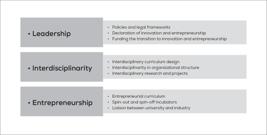
Leadership plays an important role in shaping the culture of an institution. Effective leadership goes beyond merely setting references or visions for actions; it refers to proactivity and translating goals into actionable agendas. Furthermore, strong governance is essential to reaching these goals. In a statist country like Vietnam, where the central government wields a significant influence (Etzkowitz & Zhou, 2017), changes in public universities rely heavily on governmental initiatives. The government is not only responsible for providing resources but also for allocating them strategically. Etzkowitz and Zhou (2017) emphasize that the success of a statist model relies on good leadership, clear objectives, and the allocation of substantial resources.
Interdisciplinarity was described in Mansilla (2007) as an approach to advance joint knowledge by traversing boundaries of disciplines. Interdisciplinarity is associated with the Mode 2 framework for knowledge production (Gibbons et al., 2010). Being different from multidisciplinarity, which involves collaborative work in parallel between multiple disciplines, interdisciplinary requires coordinated activities based on a mutual development of understanding (Morse et al., 2007). Interdisciplinarity is a powerful tool to face complex contemporary problems, such as climate change, environmental degradation, or social inequality (Morse et al., 2007; Yang et al., 2021). The impacts of interdisciplinarity on higher education institutions’ innovation and entrepreneurship were discussed in Boni et al. (2009). The authors suggested that interdisciplinary education can lead to unique results by combining different knowledge. Such outcomes would be the engine for marketable, sustainable innovation. The study by Whalen (2018) offered evidence of interdisciplinarity reflected in a growing number of inventions resulting from disciplinary boundary-spanning activities. Another study by Yang et al. (2021) proved that the existence of interdisciplinary organizations in universities can promote interdisciplinary collaborations but also maintain the values of traditional disciplinary structures.
Entrepreneurship, according to Etzkowitz and Zhou (2017), entrepreneurial identity can be recognized in higher education institutions when they perform technology transfer and firm formation. The awareness of knowledge capitalization changes the way universities look at the outcomes of their education and research. Entrepreneurial universities not only use education and research to provide human resources and advanced knowledge to industry but also to create firms. Commercialization of universities’ knowledge is indispensable when universities become autonomous and receive less funding from the government (Blass & Hayward, 2014).
The chance that universities can generate commercial value depends on entrepreneurship education, technology transfers, and spin-off creation (Klofsten et al., 2019). The guideline by the Organization for Economic Co-operation and Development (OECD) suggests the way to assess entrepreneurship teaching and learning with a number of aspects: 1) the presence of entrepreneurs in academic departments, 2) entrepreneurship lectures and practices, 3) entrepreneurial experience, 4) specific learning outcomes obtained from entrepreneurship-related knowledge, skills, and competencies, and 5) regular update of curriculum based on research results (OECD & European Commission, 2012). Regarding technology transfer, the university campus must have offices responsible for licensing and incubating enterprises. In practice, a technology transfer office usually leads the licensing and patent applications. Meanwhile, the incubator office is responsible for creating spin-out and spin-off enterprises using technology developed at the university. The connection between university and industry prevails in both entrepreneurship education and technology transfer. The communication between universities and industry happens at many levels, ranging from the role of liaison offices brokering research results from universities to industry to a talent mobility model in which experts from the two spheres can switch roles.
Research design and data analysis
The in-depth interviews were conducted using a script structured into four parts: (i) Respondents’ basic profile, (ii) leadership in innovation and entrepreneurship, (iii) interdisciplinarity in education and research, and (iv) entrepreneurship education and university-industry interaction and technology transfers. Table 1 lists the main parts of the script and specific covered topics.
Eleven top managers from nine public universities were interviewed. Eight were members of their university’s board of rectors, while the remaining three headed the universities’ incubation offices. Each interview lasted approximately one hour and was recorded with the interviewees’ consent. The recordings were subsequently transcribed for content analysis. The interviewees were identified as I1, I2, I3, and so forth, and the universities were labeled as Uni1, Uni2, Uni3, and so forth.
RESULTS
The national innovation system in Vietnam
The Document of the 13th National Congress of Deputies (TW, 2021) recognizes science, technology, and innovation as essential pillars of Vietnam’s socio-economic development strategy, pointing to the same direction as the studies by Tran et al. (2020) and the World Bank (2021). The introduction of the Higher Education Law (enacted in 2013 and revised in 2019) mentions the role of Vietnamese public universities (PUs) in the national innovation system (NIS), promoting the development of research universities and creating good conditions for university autonomy (National Assembly [NA], 2019). These decisions aim to promote entrepreneurship in students by equipping them with knowledge and skills such as training courses, experiential exercises, and sharing forums. They prepared a favorable environment by establishing start-up support centers and encouraging cooperation and technology transfer with enterprises (World Bank, 2021).
Vietnam’s recent economic development has shown that it is gradually approaching an innovation-oriented approach. Vietnam’s Global Innovation Index (GII) has continuously increased in recent years, leading the group of low-middle-income countries. In 2017, Vietnam gained 12 positions, from 59 out of 128 countries to 47 out of 127; by 2019, Vietnam was ranked 42 out of 129 countries (Nguyen & Minh, 2019). The Vietnamese NIS includes four main entities: the government, businesses, research institutions, and the university system. It has promoted labor productivity, growth quality, and competitiveness. However, the Vietnam 2035 Report assesses that Vietnam NIS is “still weak and contributes insignificantly to output or growth” (WB & MPI, 2016, p.32).
Leadership
The university plays a critical role within NIS and the entrepreneurial ecosystem. These institutions develop scientific research and technology, as well as serve as an incubator preparing human resources for science, technology, and innovation activities. As Vietnam moves closer to a knowledge-based economy and digital transformation, many universities are transforming their university governance models in order to focus on teaching, research, entrepreneurship, and innovation.
The government has issued legal decisions to create a policy framework for entrepreneurship and innovation activities at educational institutions. These Decisions aim to promote the spirit of entrepreneurship among students by equipping them with knowledge and skills such as training courses, experiential exercises, and sharing forums. Additionally, the policy framework creates a favorable environment by facilitating the offer of support centers for startups and encouraging collaboration and technology transfer between universities and enterprises (PMV, 2016, 2017). On that basis, the Ministry of Education and Training (MOET, 2023) also issued a couple of plans, including pilot initiatives and capacity-building training for students with knowledge and skills in entrepreneurship. In May 2022, the Prime Minister signed Decision No. 569/2022/QD-TTg to specify the government’s guidelines and policies on science, technology, and innovation development by 2030 (PMV, 2022).
The vision of the “startup university” was built early in some public universities in Southern Vietnam. According to the interviews, Uni2 has been working on a strategy to build a startup university model since 2000. As a result, according to I3, “Uni2’s strategy is built on three pillars: education, research, and community service. The community service pillar refers to projects to assist students in creating businesses and developing highly applicable products.” Since the 2005-2006 school year, “Uni3’s educational philosophy has been based on humanities, innovation, and integration. Innovative philosophy is the foundation for carrying out the startup and innovation program in order to become the most innovative university [in the country]“ (I5). In 2010, Uni1 announced a “strategy to turn the institution into a startup university, which will become a reality by 2026” (I1). According to I1, entrepreneurship and innovation should not be separated but rather integrated to form a complete ecosystem in the university.
The university autonomy empowers institutions to take proactive and bold steps in investing in innovation and entrepreneurship. According to I5 and I3, respectively, Uni3 allocates “approximately 5% of tuition revenue in non-refundable grants to support startup ideas” each year, while Uni2 allocates approximately “8% of its regular operating budget on support startups and innovation activities” annually. In addition to the universities’ own capital, startups created in PUs can access resources from the Innovative Startup Fund, a government-led mechanism that receives support from various sources, including the Department of Science and Technology of Ho Chi Minh City, businesses, the Ministry of Science and Technology, international partners. The Entrepreneurship and Innovation Support fund for university students is another government-led funding program. It addresses the students’ financial needs and fosters innovative entrepreneurial aspirations by cultivating and disseminating the students-led startup movement.
Interdisciplinarity
The interviews revealed that Vietnamese PUs recognize the importance of interdisciplinarity. However, PUs face institutional barriers in integrating interdisciplinarity into educational programs at undergraduate or graduate levels. These barriers are related to the legacy of the Soviet mono-disciplinary structure historically adopted by the Vietnamese public university system. Despite the necessity of an interdisciplinary education program to meet the demands of contemporary social needs, radically transitioning from old-fashioned disciplinary organization is challenging. In many PUs, the best effort to offer students access to other disciplines was through optional courses so that students could choose subjects outside the regular curriculum. The effectiveness of this model in facilitating the dialogue among different disciplines was questionable. The following comments reflected the interviewees’ awareness of the importance of interdisciplinarity in curriculum design:
[...] we know that all innovations nowadays are complex and require the integration of multiple disciplines. Creating a mobile phone, for example, involves electronics, optics, and artificial intelligence […]. The purely mono-disciplinary mechanics or economics is no longer legitimate. The curriculum needs to be reset […]. There will be no innovation in a mono-discipline organization. Also, the entrepreneurial environment emphasizes teamwork. (I5)
According to interviewees, institutional barriers are undermining the feasibility of interdisciplinary organizations in Vietnam’s public university system. Despite recognizing the need for networking to generate knowledge through the Mode 2 framework, departments have no collaboration platform. Major institutional factors that limit the development of interdisciplinary organizations include the disciplinary culture and mechanisms that still favor values such as disciplinary achievements and contributions. PUs mostly favor maintaining a structure of multi-disciplinary departments rather than integrating them holistically. Such institutional barriers discourage collaborations. According to Interviewee 5:
Each department promotes its own innovation activities, even though new products today require multi-discipline [a multidisciplinary approach]. Most Vietnamese universities, including [Uni5], have not transformed their organizations. (I5)
In Vietnam, asking for collaboration among departments is very hard. I used to invite managers from different departments to work together. However, nobody agreed as this [practice] could undermine their positions. (I5).
Nevertheless, despite the barriers in transitioning toward interdisciplinarity, many innovative endeavors have been conducted to promote this movement, mostly organizing multi-disciplinary research teams to work on a practical issue at a later stage of the graduate program. The model of a multi-disciplinary research group at Uni6 is worth noticing for its manifestation of interdisciplinarity contributing to innovation. Specifically, a university with strong expertise in developing business models formed a network with other universities with more technological portfolios to cooperate in developing high-tech products. Students joining the research groups were prepared to work productively in multi-disciplinary teams, developing essential skills and attitudes. The construction of a “maker space” at Uni3 was another concrete attempt to promote interdisciplinarity. This space served as a physical environment for students with backgrounds in different disciplines to work on big projects.
Entrepreneurship
Most interviewees shared a broad consensus that the universities have not yet had a comprehensive plan to implement the model of an entrepreneurial university. According to the interviewees, three PUs have included an entrepreneurial model in their strategic plans recently, and only one of these three has set the goal of becoming an entrepreneurial university in 2026 (the plan of this specific university was started in 2010). The interviewees indicated that the remaining universities have set up a unit in charge of innovation and entrepreneurship, but these units have not been working effectively.
The PUs had no formal framework to enable their interactions with the industries. Two aspects missing were a) human mobility between universities and industry and b) a robust arrangement regarding intellectual property. The absence of these two aspects implied conflicts of interest, which greatly hindered collaborations between PUs and the industry in generating marketable products and services.
About the interviewees’ discourse, when first referring to the entrepreneurial university model, they mentioned key terms such as entrepreneurship courses, startup, technology transfer, and innovation. They seem not to have yet defined specific criteria of an entrepreneurial university model. When examining the interviewees’ contribution against the discussion by Guerrero and Urbano (2012), it is possible to say that the interviewees are more concerned about internal factors rather than environmental factors for the development of an entrepreneurial university.
When discussing the role of innovation in relation to an entrepreneurial university model, most universities seem to acknowledge the importance of innovation and include this concept when addressing entrepreneurship. The interviewees emphasized the importance of being innovative to foster entrepreneurship, arguing that one can only start a business when having something innovative to offer. Table 3 below summarizes the five main ways that universities can contribute to industries in the role of an entrepreneurial university following the suggestions of Etzkowitz and Zhou (2008).
The analysis showed that universities did not allocate balanced efforts across the five forms of contribution listed in Table 3. Entrepreneurship education is the form of contribution that receives the most attention from PUs, although the comprehensiveness of this education was not confirmed in the interviews. Some PUs organize entrepreneurship education in the form of elective courses, but they do not control the number of students who attend these courses. An interviewee (I1) stated that their university has a comprehensive entrepreneurship program, which is something unusual in Vietnam. In addition, none of the universities examined provide rare facilities for R&D to the industries, i.e., these PUs, though being leading universities in the country, do not have modern facilities as required by industries, or their mechanisms to rent equipment to the industries are not adequate. Only four of the eleven interviewees stated that their universities offered consulting services for industries and advised researchers regarding patents and licensing. Finally, only two interviewees noted the attention to spin-offs as an outcome of an entrepreneurial university model.
In summary, these results suggest that the Vietnamese PUs will require a couple more years to fully transition into entrepreneurial universities. Their current plans are neither robust nor comprehensive, and they have yet to balance their efforts across the many forms of contributions they can make to the country’s economic development. In particular, they lack focus on incubating spin-offs and enhancing R&D facilities. Therefore, we recommended that PUs further develop their entrepreneurship capacity by improving and implementing more effective plans in the near future.
DISCUSSIONS
This study examined the transformation of public universities in Vietnam and their role in national innovation systems in knowledge production and dissemination, particularly technology transfer.
The emerging transition of Vietnamese PUs toward innovation and entrepreneurship
PUs play a central role in knowledge production and dissemination, making it imperative for them to adopt dynamic approaches and strategies that promote knowledge-based economic growth through effective leadership mechanisms. The Vietnamese Government has undertaken various initiatives to enhance the roles of universities in the NIS. These initiatives focus on boosting innovation and entrepreneurship and have demonstrated PUs effective leadership with clear objectives. It is possible to observe a gradual transformation of PUs toward an autonomous model with financial self-reliance, which is a dynamic that pressures the institutions to achieve sustainability while opening opportunities for innovation. The PUs leadership role within NIS requires a top-down approach to enabling and facilitating technology transfer and knowledge sharing (Krishma, 2019; Weckowska, 2015). Also, the leadership by granting institutional support could foster knowledge production and commercialization since this support entails interactions and exchanges between academics and practitioners (Audretsch & Caiazza, 2016; Ockwell & Byrne, 2016). Especially while the NIS considers technology transfers, the top-down approach appears to be more important for implementing the NIS policies, facilitating the still lacking partnerships and collaborations (Njøs & Fosse, 2019).
The analysis of innovation capacities under the lens of interdisciplinary ability and entrepreneurship revealed that the transition of PUs toward innovation was at an early stage. This was observed particularly for the prevalence of basic disciplinary orientation in education and research practices compromising the potential of innovation by adopting the Mode 2 framework in knowledge production. The dominance of disciplinary structure in public university organizations is a great institutional barrier to forming an interdisciplinary ecosystem within PUs, constraining the invention of high-impact technologies as well as their application to real-world problems (Leahey & Barringer, 2020). Meanwhile, collaborative networks between universities and industries are set across disciplines to enhance research and offer a platform for knowledge sharing (Borge & Bröring, 2017). Thus, it is possible to infer that any certain dominance of a disciplinary structure could limit the collaborative opportunities to strengthen the universities’ role in entrepreneurship (Amry et al., 2021; Bradley et al., 2013).
The research indicates that the performance of Vietnamese PUs within NIS has been jeopardized by their emerging transition toward an entrepreneurial model. Most facilities to support networking with the industries and spin-offs, such as liaison or incubation offices, are still under development and at a very early stage. At the moment, these offices have a questionable capacity to fulfill their roles as academic brokers. PUs also lack a formal mechanism for human resources mobility between academic and industry environments. Finally, when considering that intellectual property transactions facilitate technology transfers (Weckowska, 2015), the absence of robust intellectual property arrangement is another major obstacle to the collaboration between universities and industry.
Moreover, the results obtained in recent years are limited (OCED & World Bank, 2014; World Bank, 2021). Despite the state’s support, Vietnamese PUs have yet to improve in order to be a successful source of innovation (Nguyen et al., 2017). Vietnam needs universities with solid R&D and technology transfer capabilities, able to provide consulting services and facilitate the commercialization of research results (Parajuli et al., 2020). According to Van (2024), from 2016 to 2022, less than 10% of innovative startups were established in universities in Vietnam. After nearly 8 years, the whole country has only nearly 200 innovative startups established in universities.
A study by Nguyen et al. (2024) selected the Global Entrepreneurial University Metrics (GEUM) indicators (Etzkowitz et al., 2017) to assess innovation-related topics in Vietnamese PUs, including the main categories: inputs, throughputs, and outputs. The primary assessment is based on published strategies from three universities. The universities are still heavily focusing on teaching and research. Linkages to industry or income generated by collaboration with industry or spin-offs are lightly mentioned. There are no or only limited connections with industry talents (those who have industrial experiences). However, the universities are intensely interested in supporting the development of regional/national entrepreneurial strategies and policies. This can be seen as a good base for future updated strategies. In addition, the Vietnamese Ministry of Education and Training (MOET, 2023) is developing official indicators of entrepreneurial universities.
Vietnamese universities have contributed significantly to the NIS (Hoc & Trong, 2019; OCED & World Bank, 2014; World Bank, 2021). Hoc and Trong (2019) review the contributions of Vietnamese universities to the NIS, especially in knowledge transfer and university-industry collaboration, highlighting incentives and barriers to fostering stronger connections between these two players in Vietnam. The authors found gaps between the universities’ research objectives, their efforts to prepare the workforce, and the demands of industry. The relationship between universities and industry plays a crucial role in driving innovation. Universities produce and transfer knowledge to industries, which, in turn, can apply this knowledge to enhance their products’ value and competitiveness. Industries can also fund academic research and obtain more support from universities. However, these collaborations remain limited, primarily involving personal and informal connections between individual university professors and industry representatives rather than being supervised institutionally by the university. In addition, the Vietnamese government works closely with universities and research institutions to support innovation. The government relies heavily on academia for consulting services to improve public policies. It also funds research at local and national levels, focusing on applied research and early-stage studies in science, technology, and innovation. This funding is essential given the limited internal budgets of PUs to finance research independently.
Policy Implications for Vietnamese PUs
Interdisciplinary education and establishment of interdisciplinary organizations
The absence or misshape of interdisciplinary education in Vietnamese PUs requires the renovation of curriculums. Furthermore, the barriers presented in current learning and teaching programs demand innovative solutions to integrate interdisciplinarity into current educational programs. A probable approach to get over institutional rigidity is to educate interdisciplinarity in the form of bridging courses besides disciplinary courses (MacKinnon et al., 2013). Such an approach would strike a balance between developing disciplinary expertise and interdisciplinary literacy. An interdisciplinary course should also facilitate interaction between different disciplines in a real-life setting experience. Lastly, interdisciplinarity can be introduced early at the undergraduate level (MacKinnon et al., 2013) or later at the graduate level (Gantogtokh & Quinlan, 2017).
The establishment of interdisciplinary organizations is a necessary structural change to foster the institutionalization of interdisciplinarity in universities. Interdisciplinary organizations can take the form of problem-oriented centers with missions of addressing complex problems and conducting outreach activities to potential users, including the industry, community, and policymakers (Yang et al., 2021).
Horizontal talent mobility and sensible property rights arrangement to boost technology transfers
An essential trait of entrepreneurial universities is their sensitivity to industrial and social demands. To further support bridging between universities and the industry for technology transfer, it is necessary to have a mechanism for introducing expertise from the industrial or social sphere to the higher education sector and vice versa. The notion of horizontal circulation of talents discussed by Etzkowitz and Zhou (2017) represent a strategy to support such knowledge exchange. The movement of experts from the industry or the government into PUs demands institutional initiatives. The professors-of-practice scheme mentioned by the authors can be a good design to adopt, as this scheme guarantees the success of commercialization of research outcomes at an early stage (Etzkowitz & Dzisah, 2015). With the professors-of-practice, an individual can work half-time in a university and half-time for the industries, in a logic as that of a venture capitalist.
While the connection between universities and industries can be tightened through the lateral mobility of human resources, sensible intellectual property arrangements can improve the performance of this cooperation. Good intellectual property policies should be equitable and flexible instead of rigid and fixed to a set of rules about cost and benefit sharing (Okamuro & Nishimura, 2013).
Limitations
In this study, the Mode 2 and the Triple Helix frameworks are used to narrow the scope of the research to interdisciplinarity and entrepreneurship for innovation transformation. The statist model of NIS, with the government playing the main role, was also focused on setting the analytical framework. The model has been criticized for its bureaucratic features, which might suppress innovation (Etzkowitz & Zhou, 2017). Also, there was little empirical evidence about the success of innovation transformation in the statist model in academia. In addition, the survey targeted only experts in managerial positions at the universities, who may not be fully responsible for decision-making processes. Therefore, the insights from interviews might not fully reflect the reality of innovation policies at PUs.
CONCLUSION
Vietnamese public universities (PUs) are on a transition pathway toward innovation and entrepreneurship in order to improve these institutions’ role in knowledge production through the Mode 2 framework within the national innovation system (NIS). However, studies on this topic are rather limited, and this research seeks to fill this gap. The study showed that existing barriers, including disciplinary structures in educational programs and research orientation, as well as premature university-industry networking, have been major challenges for PUs in terms of operating when considering the triple helix approach. Undoubtedly, some PUs would not go further than their traditional basic research and education roles. Proactive PUs leading the movement to break such barriers are likely to be successful in transitioning to innovation and entrepreneurship, enhancing their role in NIS. Policy suggestions to facilitate this transformation include integrating interdisciplinary courses into curriculums, establishing interdisciplinary offices, encouraging talent mobility between universities and industry as well as devising robust intellectual property rights.
In conclusion, Vietnamese PUs are still in the early stages of transitioning into entrepreneurial universities. Their current plans and strategies lack both specificity and comprehensiveness. In addition, their contribution to the economy remains limited, particularly regarding technology transfer and innovation. Therefore, policies and solutions to improve the role of Vietnamese PUs in supporting NIS must be given greater attention in the future.
-
Evaluated through a double-anonymized peer review.
-
FUNDING
This research is funded by Vietnam National University Ho Chi Minh City (VNU - HCM) under grant number ĐA2021 - 76 - 02
REFERENCES
-
Abreu, M., & Grinevich, V. (2013). The nature of academic entrepreneurship in the UK: Widening the focus on entrepreneurial activities. Research Policy, 42(2), 408-422. https://doi.org/10.1016/j.respol.2012.10.005
» https://doi.org/10.1016/j.respol.2012.10.005 -
Al-Mansoori, R. S., & Koç, M. (2009). Toward knowledge-based economy: Innovation and transformational leadership in public universities in Texas and Qatar. Sustainability 2019, 11, 6721. https://doi.org/10.3390/su11236721
» https://doi.org/10.3390/su11236721 -
Amry, D. K., Ahmad, A. J., & Lu, D. (2021). The new inclusive role of university technology transfer: Setting an agenda for further research. International Journal of Innovation Studies, 5(1), 9-22. https://doi.org/10.1016/j.ijis.2021.02.001
» https://doi.org/10.1016/j.ijis.2021.02.001 -
Audretsch, D., & Caiazza, R. (2016). Technology transfer and entrepreneurship: Cross-national analysis. The Journal of Technology Transfer, 41, 1247-1259. https://doi.org/10.1007/s10961-015-9441-8
» https://doi.org/10.1007/s10961-015-9441-8 -
Bercovitz, J., & Feldman, M. (2006). Entrepreneurial universities and technology transfer: A conceptual framework for understanding knowledge-based economic development. The Journal of Technology Transfer, 31, 175-188. https://doi.org/10.1007/s10961-005-5029-z
» https://doi.org/10.1007/s10961-005-5029-z - Blackwel, A. F., Wilson, L., Street, A., Boulton, C., & Knell, J. (2009). Radical innovation: Crossing knowledge boundaries with interdisciplinary teams. University of Cambridge.
-
Blass, E., & Hayward, P. (2014). Innovation in higher education; will there be a role for “the academe/university” in 2025? European Journal of Futures Research, 2(41), 1-9. https://doi.org/10.1007/s40309-014-0041-x
» https://doi.org/10.1007/s40309-014-0041-x -
Boni, A., Weingart, L., & Evenson, S. (2009). Innovation in an academic setting: Designing and leading a business through market-focused, interdisciplinary teams. Academy of Management Learning and Education, 8(3), 407-417. https://doi.org/10.5465/AMLE.2009.44287939
» https://doi.org/10.5465/AMLE.2009.44287939 -
Borge, L., & Bröring, S. (2017). Exploring effectiveness of technology transfer in interdisciplinary settings: The case of the bioeconomy. Creativity and Innovation Management, 26(3), 311-322. https://doi.org/10.1111/caim.12222
» https://doi.org/10.1111/caim.12222 -
Bradley, S. R., Hayter, C. S., & Link, A. N. (2013). Models and methods of university technology transfer. Foundations and Trends® in Entrepreneurship, 9(6), 571-650. https://doi.org/10.1561/0300000048
» https://doi.org/10.1561/0300000048 -
Cierra, X., & Maloney, W. (2017). The innovation paradox: Developing-country capabilities and the unrealized promise of technological catch-up Washington, D.C. : World Bank Group. http://documents.worldbank.org/curated/en/322521507638821474
» http://documents.worldbank.org/curated/en/322521507638821474 - Edquist, C. (1997). Systems of innovation: Technologies, institutions and organizations (C. Edquist, Ed.). Pinter Publishers.
-
Etzkowitz, H. (2003). Innovation in innovation: The triple helix of university-industry-government relations. Social Science Information, 42(3), 293-337. https://doi.org/10.1177/05390184030423002
» https://doi.org/10.1177/05390184030423002 - Etzkowitz, H., Bikkulov, A., Kovaleinen, A., Leitner, K. H., Poutanen, S., Grey, D., Leonchuck, L., Axelberg, J., Plonski, G. A., & Almeida, M. (2017). Metrics for the entrepreneurial university (Triple Helix Working Papers Series n. 6).
-
Etzkowitz, H., & Dzisah, J. (2015). Professors of practice and the entrepreneurial university. International Higher Education, 49, 10-11. https://doi.org/10.6017/ihe.2007.49.7989
» https://doi.org/10.6017/ihe.2007.49.7989 -
Etzkowitz, H., & Leydesdorff, L. (2000). The dynamics of innovation: From National Systems and “mode 2” to a Triple Helix of university-industry-government relations. Research Policy, 29(2), 109-123. https://doi.org/10.1016/S0048-7333(99)00055-4
» https://doi.org/10.1016/S0048-7333(99)00055-4 -
Etzkowitz, H. and Leydesdorff, L., Universities and the Global Knowledge Economy: A Triple Helix of University-Industry Relations (June 16, 1997). Preprint version of: Etzkowitz, H., & Leydesdorff, L. (1997). Universities and the Global Knowledge Economy: A Triple Helix of University-Industry-Government Relations. London: Pinter. [archival reprint], Available at SSRN: https://ssrn.com/abstract=3404823
» https://ssrn.com/abstract=3404823 -
Etzkowitz, H., & Zhou, C. (2008). Introduction to special issue: Building the entrepreneurial university: a global perspective. Science and Public Policy, 35(9), 627-635. https://doi.org/10.3152/030234208X363178
» https://doi.org/10.3152/030234208X363178 -
Etzkowitz, H., & Zhou, C. (2017). The triple helix: University-industry-government innovation and entrepreneurship Routledge. https://doi.org/10.4324/9781315620183
» https://doi.org/10.4324/9781315620183 - Fagerberg, J., Mowery, D., & Nelson, R. (2018). The Oxford handbook of innovation Oxford University Press.
- Freeman (1987) Technology Policy and Economic Performance. Lessons from Japan. London: Pinter.
-
Freeman, C. (1995). The national system of innovation ‘in historical perspective. Cambridge Journal of Economics, 19, 5-24. https://doi.org/10.1093/oxfordjournals.cje.a035309
» https://doi.org/10.1093/oxfordjournals.cje.a035309 - Fullan, M. (2007). Leading in a culture of change. John Wiley & Sons.
-
Gantogtokh, O., & Quinlan, K. M. (2017). Challenges of designing interdisciplinary postgraduate curricula: Case studies of interdisciplinary master’s programmes at a research-intensive UK university. Teaching in Higher Education, 22(5), 569-586. https://doi.org/10.1080/13562517.2016.1273211
» https://doi.org/10.1080/13562517.2016.1273211 - Gibbons, M. (1994). The new production of knowledge: The dynamics of science and research in contemporary societies Sage Publications.
-
Gibbons, M., Limoges, C., Nowotny, H., & Schwartzman, S. (2010). The new production of knowledge: The dynamics of science and research in contemporary societies SAGE Publications. https://doi.org/10.4135/9781446221853
» https://doi.org/10.4135/9781446221853 -
Guerrero, M., & Urbano, D. (2012). The development of an entrepreneurial university. The Journal of Technology Transfer, 37(1), 43-74. https://doi.org/10.1007/s10961-010-9171-x
» https://doi.org/10.1007/s10961-010-9171-x -
Hoc, L. H., & Trong, N. D. (2019). University-industry linkages in promoting technology transfer: A study of Vietnamese technical and engineering universities. Science, Technology and Society, 24(1), 73-100. https://doi.org/10.1177/0971721818821796
» https://doi.org/10.1177/0971721818821796 -
Horner, S., Jayawarna, D., Giordano, B., & Jones, O. (2019). Strategic choice in universities: Managerial agency and effective technology transfer. Research Policy, 48(5), 1297-1309. https://doi.org/10.1016/j.respol.2019.01.015
» https://doi.org/10.1016/j.respol.2019.01.015 -
Jia, X., Chen, J., Mei, L., & Wu, Q. (2018). How leadership matters in organizational innovation: A perspective of openness. Management Decision, 56(1), 6-25. https://doi.org/10.1108/MD-04-2017-0415
» https://doi.org/10.1108/MD-04-2017-0415 -
Khorsheed, M. S. (2016). Learning from global pacesetters to build the Country Innovation Ecosystem. Journal of the Knowledge Economy, 8(1), 177-196. doi:10.1007/s13132-016-0362-z
» https://doi.org/10.1007/s13132-016-0362-z -
Klofsten, M., Fayolle, A., Guerrero, M., Mian, S., Urbano, D., & Wright, M. (2019). The entrepreneurial university as driver for economic growth and social change: Key strategic challenges. Technological Forecasting and Social Change, 141, 149-158. https://doi.org/10.1016/j.techfore.2018.12.004
» https://doi.org/10.1016/j.techfore.2018.12.004 - Krishna, V. V. (2017). Universities in the national innovation systems: Experiences from Asia Pacific Routledge.
-
Krishna, V. V. (2019). Universities in the national innovation systems: Emerging innovation landscapes in Asia-Pacific. Journal of Open Innovation: Technology, Market, and Complexity, 5(3), 43. https://doi.org/10.3390/joitmc5030043
» https://doi.org/10.3390/joitmc5030043 -
Leahey, E., & Barringer, S. N. (2020). Universities’ commitment to interdisciplinary research: To what end?. Research Policy, 49(2), 103910. https://doi.org/10.1016/j.respol.2019.103910
» https://doi.org/10.1016/j.respol.2019.103910 -
Lopez-Rubio, P., Roig-Tierno, N., & Mas-Verdu, F. (2021). Assessing the origins, evolution and prospects of national innovation systems. Journal of the Knowledge Economy, 13, 161-184. https://doi.org/10.1007/s13132-020-00712-7
» https://doi.org/10.1007/s13132-020-00712-7 -
MacKinnon, P. J., Hine, D., & Barnard, R. T. (2013). Interdisciplinary science research and education. Higher Education Research and Development, 32(3), 407-419. https://doi.org/10.1080/07294360.2012.686482
» https://doi.org/10.1080/07294360.2012.686482 -
Mansilla, V. B. (2007, May). Targeted assessment of students‘ interdisciplinary work: An Veronica Boix Mansilla targeted assessment of students‘ interdisciplinary work: An empirically grounded framework proposed. The Journal of Higher Education 78 (2), 215-237. https://doi.org/10.1353/jhe.2007.0008
» https://doi.org/10.1353/jhe.2007.0008 -
Mathews, J. A., & Hu, M. C. (2007). Enhancing the role of universities in building national innovative capacity in Asia: The case of Taiwan. World Development, 35(6), 1005-1020. https://doi.org/10.1016/J.WORLDDEV.2006.05.012
» https://doi.org/10.1016/J.WORLDDEV.2006.05.012 -
MOET. (2023). Vietnamese Ministry of Education and Training (MOET) creates criteria for evaluating startup and entrepreneurial universities.https://dantri.com.vn/giao-duc/bo-giao-duc-lam-bo-tieu-chi-danh-gia-dai-hoc-khoi-nghiep-doi-moi-sang-tao-20231030182630985.htm
» https://dantri.com.vn/giao-duc/bo-giao-duc-lam-bo-tieu-chi-danh-gia-dai-hoc-khoi-nghiep-doi-moi-sang-tao-20231030182630985.htm -
Morse, W. C., Nielsen-Pincus, M., Force, J. E., & Wulfhorst, J. D. (2007). Bridges and barriers to developing and conducting interdisciplinary graduate-student team research. Ecology and Society, 12(2), 1-14. https://doi.org/10.5751/ES-02082-120208
» https://doi.org/10.5751/ES-02082-120208 - Mowery, D. & Oxley, J., 1995. Inward Technology Transfer and Competitiveness: The Role of National Innovation Systems. Cambridge Journal of Economics, Cambridge Political Economy Society, vol. 19(1), pages 67-93, February.
-
Mowery, D., & Sampat, B. (2009). Universities in national innovation systems. In J. Fagerberg & D. D. Mowery (Eds.), The Oxford handbook of innovation (pp. 209-239). (2006; online edn, Oxford Academic, 2 Sept. 2009), https://doi.org/10.1093/oxfordhb/9780199286805.001.0001
» https://doi.org/10.1093/oxfordhb/9780199286805.001.0001 - National Assembly. (2019). Law No. 43/2019/QH14 of the National Assembly: Law on Education.
- Nguyen, H. Q., Nguyen, V. L., Le B. N. M. , Pincus, J. (2024). Talent management for innovation in Vietnamese public universities, 6th Vietnam Symposium on Leadership and Public Policy.
- Nguyen, N. A., Nguyen, P. M., Doan, Q. H., & Dao, N. T. (2017). The roles of universities in Vietnam’s national innovation system. In V. V. Krishna (Ed.), Universities in the national innovation systems Routledge India.
-
Nguyen, T. T. A., & Minh, T. B. (2019). Current status of Vietnam innovation system (in Vietnamese). Central Institute for Economic Management. Thematic report 6/2019. https://ciem.org.vn/tin-tuc/8929/thuc-trang-va-nhung-he-thong-doi-moi-sang-tao-quoc-giavan-de-dt-ra?newsgroup=Th%C3%B4ng%20tin%20-%20T%C6%B0%20li%E1%BB%87u
» https://ciem.org.vn/tin-tuc/8929/thuc-trang-va-nhung-he-thong-doi-moi-sang-tao-quoc-giavan-de-dt-ra?newsgroup=Th%C3%B4ng%20tin%20-%20T%C6%B0%20li%E1%BB%87u -
Njøs, R., & Fosse, J. K. (2019). Linking the bottom-up and top-down evolution of regional innovation systems to policy: Organizations, support structures and learning processes. Industry and Innovation, 26(4), 419-438. https://doi.org/10.1080/13662716.2018.1438248
» https://doi.org/10.1080/13662716.2018.1438248 - OCED, & World Bank. (2014). Science, technology and innovation in Viet Nam Organisation for Economic Co-operation and Development (OECD).
-
Ockwell, D., & Byrne, R. (2016). Improving technology transfer through national systems of innovation: Climate relevant innovation-system builders (CRIBs). Climate Policy, 16(7), 836-854. https://doi.org/10.1080/14693062.2015.1052958
» https://doi.org/10.1080/14693062.2015.1052958 - OECD. (1997). National innovation systems OECD Publications. Organisation for Economic Co-operation and Development (OCED).
- OECD & European Commission. (2012). A guiding framework for entrepreneurial universities OECD Publications. Organisation for Economic Co-operation and Development (OCED).
-
Okamuro, H., & Nishimura, J. (2013). Impact of university intellectual property policy on the performance of university-industry research collaboration. Journal of Technology Transfer, 38(3), 273-301. https://doi.org/10.1007/s10961-012-9253-z
» https://doi.org/10.1007/s10961-012-9253-z -
Parajuli, D., Vo, D. K., Salmi, J., & Tran, N. T. A. (2020). Improving the performance of higher education in Vietnam: Strategic priorities and policy options (English) World Bank Group. United States of America. Retrieved from https://coilink.org/20.500.12592/pw1n06 on 06 Feb 2025. COI: 20.500.12592/pw1n06
» https://coilink.org/20.500.12592/pw1n06 on 06 Feb 2025. COI: 20.500.12592/pw1n06 -
Partha, D., & David, P. A. (1994). Toward a new economics of science. Research Policy, 23(5), 487-521. https://doi.org/10.1016/0048-7333(94)01002-1
» https://doi.org/10.1016/0048-7333(94)01002-1 - PMV (2016). Decision No. 844/QD-TTg of the Prime Minister of Vietnam (PMV): On the approval of the Project “Supporting the national innovation startup ecosystem until 2025.” P
- PMV (2017). Decision No. 1665/QD-TTg of the Prime Minister of Vietnam (PMV): On the approval of the Project “Supporting students and students to start a business up to 2025.”
- PMV (2022). Decision 569/QD-TTg of the Prime Minister of Vietnam (PMV): On promulgating the Strategy for Science, Technology and Innovation Development to 2030.
-
Schmitz, A., Urbano, D., Dandolini, G. A., Souza, J. A. de, & Guerrero, M. (2017). Innovation and entrepreneurship in the academic setting: A systematic literature review. International Entrepreneurship and Management Journal, 13(2), 369-395. https://doi.org/10.1007/s11365-016-0401-z
» https://doi.org/10.1007/s11365-016-0401-z -
Shao, Z., Feng, Y., & Hu, Q. (2017). Impact of top management leadership styles on ERP assimilation and the role of organizational learning. Information and Management, 54(7), 902-919. https://doi.org/10.1016/j.im.2017.01.005
» https://doi.org/10.1016/j.im.2017.01.005 - Tran, D. H., Dao, M. T., Vu, A. T., Tran, T. T. H., Vo, T. T. H., Nguyen, P. A., & Tran, T. H. Y. (2020). Science, Technology and Innovation Vietnam 2019
- TW. (2021). Document of the 13th National Congress of Deputies Communist Party of Vietnam Central Committee (TW)
-
Van, D. T. (2024). Elevating universities in the innovation and startup ecosystem (in Vietnamese). Vietnamese Economic and Forecast. https://kinhtevadubao.vn/nang-tam-cac-truong-dai-hoc-trong-he-sinh-thai-khoi-nghiep-doi-moi-sang-tao-30049.html
» https://kinhtevadubao.vn/nang-tam-cac-truong-dai-hoc-trong-he-sinh-thai-khoi-nghiep-doi-moi-sang-tao-30049.html - WB and MPI (2016). Vietnam 2035 Toward Prosperity, Creativity, Equity, and Democracy World Bank (WB) and Ministry of Investment and Planning (MPI) of Vietnam
-
Weckowska, D. M. (2015). Learning in university technology transfer offices: Transactions-focused and relations-focused approaches to commercialization of academic research. Technovation, 41, 62-74. https://doi.org/10.1016/j.technovation.2014.11.003
» https://doi.org/10.1016/j.technovation.2014.11.003 -
Weerasinghe, R. N., Jayawardane, A. K. W., & Huang, Q. (2024). Critical inquiry on National Innovation System: Does NIS fit with developing countries? Sustainable Technology and Entrepreneurship, 3(1), 100052. https://doi.org/10.1016/J.STAE.2023.100052
» https://doi.org/10.1016/J.STAE.2023.100052 -
Whalen, R. (2018). Boundary spanning innovation and the patent system: Interdisciplinary challenges for a specialized examination system. Research Policy, 47(7), 1334-1343. https://doi.org/10.1016/j.respol.2018.04.017
» https://doi.org/10.1016/j.respol.2018.04.017 -
Wood, M. S. (2011). A process model of academic entrepreneurship. Business Horizons, 54(2), 153-161. https://doi.org/10.1016/j.bushor.2010.11.004
» https://doi.org/10.1016/j.bushor.2010.11.004 - World Bank. (2021). Vietnam: Science, Technology, and Innovation Report 2020
-
Wright, M. (2014). Academic entrepreneurship, technology transfer and society: Where next? Journal of Technology Transfer, 39(3), 322-334. https://doi.org/10.1007/s10961-012-9286-3
» https://doi.org/10.1007/s10961-012-9286-3 -
Yang, L., Albats, E., & Etzkowitz, H. (2021). Interdisciplinary organization as a basic academic unit? Industry and Higher Education, 35(3), 173-187. https://doi.org/10.1177/0950422220956951
» https://doi.org/10.1177/0950422220956951 -
Zhao, F. (2005). Exploring the synergy between entrepreneurship and innovation. International Journal of Entrepreneurial Behaviour and Research, 11(1), 25-41. https://doi.org/10.1108/13552550510580825
» https://doi.org/10.1108/13552550510580825
Edited by
-
Guest Editor:
Charles Kirschbaum, Daniel Paulino Teixeira Lopes, Gregory Pogue, Kadígia Faccin e Ricardo Reolon

