
 The ‘Siren Song’: Career Transition of Financial Market Professionals
ABSTRACT
Objetive: the purpose of this study was to analyze the career transition of financial market professionals who gave up formal employment contracts with major banks to pursue an autonomous career in the same sector.
Theoretical approach: the literature on flexible work and career transition in contemporary times served as the theoretical foundation for the study.
Method: a qualitative study was conducted with 17 workers who voluntarily made this transition. The data were analyzed using categorical content analysis.
Results: the results showed that the prospect of working more independently and obtaining higher earnings was the main motivation for the transition, also fueled by dissatisfaction with the bank of origin. Additionally, participants’ assessments of the outcomes of the transition indicate growing dissatisfaction. In other words, those who have been working as independent agents for a longer period tend to be more critical of the process than those who changed more recently.
Conclusions: the growing dissatisfaction observed among participants suggests that there is a ‘siren song’ associated with this transition. The evidence also points to a process we refer to as XPtization, associated with the precarization of work in the Brazilian financial market, along the same lines as Uberization, a term coined to illustrate the precarious conditions experienced by workers linked to digital platforms.
Keywords:
career; career transition; flexible work; precarization; financial market
RESUMO
Objetivo: este estudo teve por objetivo analisar a transição de carreira de profissionais do mercado financeiro que abriram mão de contratos formais de trabalho em grandes bancos por uma carreira autônoma no mesmo setor de atividade.
Marco teórico: as literaturas sobre flexibilização do trabalho e transição de carreira na contemporaneidade serviram de aporte teórico para o estudo.
Método: foi conduzida uma pesquisa qualitativa com 17 trabalhadores que fizeram essa transição de forma voluntária. Os dados foram analisados por meio de análise de conteúdo categorial.
Resultados: os resultados mostraram que a perspectiva de atuar de forma mais independente e obter ganhos superiores foi o principal atrativo para a transição, também estimulada por insatisfações com o banco de origem. Adicionalmente, a avaliação dos participantes quanto aos resultados da transição aponta uma insatisfação crescente. Ou seja, aqueles que já atuam há mais tempo como agentes autônomos se mostram mais críticos em relação ao processo do que os que mudaram mais recentemente.
Conclusões: a crescente insatisfação observada entre os participantes sugere haver um ‘canto da sereia’ nessa transição. As evidências do estudo também apontam para um processo que denominamos XPtização, associado à precarização do trabalho no mercado financeiro brasileiro, nos mesmos moldes da uberização, termo cunhado para ilustrar a precarização vivenciada por trabalhadores vinculados a plataformas digitais.
Palavras-chave:
carreira; transição de carreira; trabalho flexível; precarização; mercado financeiro
INTRODUCTION
The Brazilian financial market is characterized by its concentration in a relatively small group of large institutions (Cardoso et al., 2016). In recent years, however, competition in this sector has expanded to include independent brokerages, investment advisory firms, and fully digital banks (Machado, 2020). In the investment market, these competitors have captured significant market share from large banks, particularly by offering a more diverse range of products and adopting a communication strategy named ‘debanking,’ understood as a critique of the products offered by major banks - regarded as expensive and limited (Partyka et al., 2020).
From the perspective of workers in the sector - especially those with direct contact with customers - this movement implies new career opportunities. This is because, in addition to their knowledge and experience, these professionals can bring with them their client portfolios, making them attractive to new entrants. For traditional banks, the new competitors can lead to the loss of both clients and qualified professionals. In this regard, it is important to note that, in large banks, the psychological employment contract - or the individual’s beliefs regarding the terms and conditions of the employment relationship (Rousseau, 2011) - usually involves aggressive targets and performance-based variable pay, competitive salaries, good benefits, career advancement opportunities, as well as the status associated with working for a well-known organization (Correa et al., 2017; Jardim & Carraro, 2019).
However, in line with developments observed in other sectors of activity (Azevedo et al., 2015; Carneiro et al., 2023; Franco & Ferraz, 2019; Franco et al., 2023; Vaclavik et al., 2021), more flexible employment relationships have also emerged in the financial market. In addition to workers in the field of information technology, there has been an increase in the number of independent investment agents, professionals without any formal employment relationship, who act as intermediaries between financial institutions and their clients (Cavarzan & Vazquez, 2020).
This trend toward greater flexibility in the financial market appears to represent yet another example of a phenomenon that has been proliferating worldwide, associated with the sharing economy and uberized work, which, according to the literature, distances workers from formal and protected employment and leads them toward a path of instability and precariousness (Antunes, 2018; Carneiro et al., 2023; Fleming, 2017; Franco & Ferraz, 2019; Franco et al., 2023; Valenduc, 2018).
Based on this reality, this qualitative study aimed to analyze the career transition of professionals who gave up formal employment contracts in large banks, private or public, for an autonomous career in the same sector of activity. As intermediate objectives, we sought to analyze the motivations for breaking formal employment relationships, as well as the results of this change, in light of the literature on flexible work (Antunes, 2018; Azevedo et al., 2015; Fleming, 2017; Franco & Ferraz, 2019; Franco et al., 2023; Melges et al., 2022; Tessarini et al., 2023; Valenduc, 2018) and career transition in contemporary times (Baruch & Vardi, 2016; Budtz-Jørgensen et al., 2019; Souza et al., 2020; Sullivan & Al Ariss, 2021, 2022).
Seventeen professionals from major Brazilian banks - Bradesco, Itaú Unibanco, Safra, Santander, Banco do Brasil, and Caixa Econômica Federal - who chose to leave their corporate careers to become independent investment agents participated in the study. We selected professionals who had remained at their original bank for at least two years and held managerial positions or positions related to client portfolio management.
This study seeks to contribute to the debate on the flexibilization of employment relationships by analyzing the reality of financial market workers who have given up formal employment contracts to work as self-employed professionals. In this regard, it is worth highlighting the growing flexibilization also observed in this sector and the lack of studies focusing on self-employed workers in this segment - a gap we seek to address. In searches on the SPELL and SciELO Brasil databases, we found only one article on this group, which focused on their daily work and the construction of their professional identity (Holanda et al., 2014).
The work also contributes to the literature on careers, more specifically on career transition, by shedding light on the motivations that led financial market professionals to transition from formal employment to freelance work. As Sullivan and Al Ariss (2022), point out, there is relatively little academic literature on career transition and the process that guides this decision.
From a practical standpoint, we expect that identifying factors that lead to the voluntary turnover of professionals from large banks may guide the development of policies and practices aimed at their retention. For workers, evidence on the motivations and outcomes of the transition to self-employment can be useful for assessing and planning such changes.
THEORETICAL FRAMEWORK
Employment and flexible work in the Brazilian banking sector
Globally, the flexibilization of labor relations has been a trend observed since the 1970s, resulting from the productive restructuring carried out by organizations (Boltanski & Chiapello, 2009; Cappelli, 1999). More recently, the literature on the subject has pointed to the intensification of this phenomenon, associated with new forms of relationships between companies and workers, including pejotização (hiring workers as independent legal entities), zero-hour contracts, and uberization, a term coined from the way the company Uber relates to its workers (Antunes, 2018, 2020; Azevedo et al., 2015; Fleming, 2017; Franco & Ferraz, 2019; Franco et al., 2023; Melges et al., 2022; Tessarini et al., 2023).
This movement, previously restricted to the so-called sharing economy, has expanded to other professional categories and sectors of the economy, including university professors (Gemelli et al., 2020), executives (Kim et al., 2017), journalists (Lima-Souza et al., 2021) and airline pilots (Fleming, 2017). Thus, the uberization of work appears to be spreading across more territories and taking deeper root. It is no longer just a neologism and is becoming an increasingly present force in society and in contemporary labor markets - digitalized, flexible, and increasingly precarious (Antunes, 2018; Franco & Ferraz, 2019; Franco et al., 2023; Melges et al., 2022; Tessarini et al., 2023; Valenduc, 2018).
Regarding the consequences for workers, contrasting perspectives can be identified. On the one hand, there are those who celebrate this new reality, as it would expand workers’ autonomy, freeing them to be entrepreneurs of themselves and reap the fruits of their labor. Critics, however, warn that by ‘buying into’ this idea, workers find themselves trapped in a hegemonic system that masks the true nature of the capital-labor relationship (Carmo et al., 2021; Costa & Saraiva, 2012; Costa et al., 2011). In the words of Costa et al. (2011), it is an ideology that “deviates from the pursuit of human emancipation and, on the contrary, promotes oppressive forms of individual behavior.” There are also those who point out the perversities and imbalances of this relationship, in which workers take more risks, are poorly paid, and lack any social protection (Antunes, 2018; Fleming, 2017; Franco & Ferraz, 2019; Franco et al., 2023; Melges et al., 2022; Tessarini et al., 2023; Valenduc, 2018).
In this regard, it is also important to highlight the significant changes to the Consolidation of Labor Laws (CLT) resulting from the 2017 labor reform. Under the claim that the reform would promote the modernization of the CLT and contribute to reducing informality and generating jobs, what actually occurred was yet another movement toward the flexibilization of employment relationships, with a loss of workers’ rights and protections (Krein, 2018). Among the changes instituted by Law No. 13,467, we can highlight the prevalence of negotiated agreements over legislated terms in several situations, the expansion of outsourcing possibilities, including the company’s core activities, and the regulation of intermittent work, allowing contracts in which the worker is paid only for the period actually worked (Lei nº 13.467, 2017; Krein, 2018).
In the Brazilian financial market, changes have also impacted the quantity and quality of work (Cavarzan & Vazquez, 2020). According to the Inter-Union Department of Statistics and Socioeconomic Studies (Departamento Intersindical de Estatística e Estudos Socioeconômico [DIEESE], 2023), while the sector was previously a benchmark in job creation, this trend has been reversing. Between 2012 and 2022, the country’s five largest banks (Itaú Unibanco, Bradesco, Santander, Caixa Econômica Federal, and Banco do Brasil) cut more than 52,000 jobs, with the number of employees falling from 455,000 to 403,000 (an 11% decrease).
While technology and process optimization allow for the employment of a smaller contingent of workers, there is, on the other hand, an overload of functions, pressure for results, and increased work intensity (Cavarzan & Vazquez, 2020; Correa et al., 2017; Moronte & Albuquerque, 2021). Silva and Navarro (2012) note that bank employees are among those who suffer most from occupational diseases, while Correa et al. (2017) add that “the transformation in the work process of bank employees has also resulted in a profound change in the status of this function, depreciating this professional category previously seen as a symbol of prestige.” (p. 67).
Another trend involves the growth of the financial advisor profession, indicating a movement toward more flexible employment relationships in the financial market as well (Cavarzan & Vazquez, 2020). Known as the independent investment agent (AAI - agente autônomo de investimentos), this professional is responsible for managing clients’ investment portfolios and providing market information and investment recommendations. They are affiliated with financial institutions, such as brokerages and investment advisory firms and use their platforms to serve clients. All resources are provided by the professionals, who work without a formal employment relationship (Comissão de Valores Mobiliários [CVM], 2019; Reis, 2018). Their compensation involves a previously agreed-upon percentage of the business they generate. In some firms, these professionals can become partners, thus increasing their financial gains. It is also common for firms to offer an initial monthly stipend for a predetermined period so that professionals can support themselves while prospecting and building their client portfolios (Reis, 2018).
Since 2012, the National Association of Brokers and Distributors of Securities, Foreign Exchange, and Commodities (ANCORD) has acted as the accreditor of independent investment agents. To work as an AAI, therefore, it is necessary to obtain ANCORD certification, but no previous experience in the field is required (ANCORD, 2022). This ease of entry and the promise of high earnings have attracted professionals from the financial market itself and from other segments seeking a career transition - a topic discussed in the next section.
Career transition in contemporary times
Changes in the work context have also given rise to new approaches in the literature on careers and career transitions. While traditional models, which flourished from the post-war period until the 1970s, emphasized stability and a long-term perspective (Arthur, 2014; Chudzikowski, 2012), more recent models have emphasized flexibility and discontinuities in career trajectories (Baruch & Vardi, 2016).
Contrasting perspectives can also be identified in this literature. On the one hand, there are those who emphasize the role of individual agency, notably protean and boundaryless career theories (Arthur, 2014; Hall, 2004). These approaches celebrate workers’ greater autonomy to make career choices and transitions more aligned with their personal interests (e.g., Arthur et al., 2017).
In contrast, there are those who draw attention to the limitations imposed by the context and the growing adversities faced by workers (Baruch & Vardi, 2016; Budtz-Jørgensen et al., 2019; Kovalenko & Mortelmans, 2014; Mayrhofer et al., 2007; Souza et al., 2020; Vaclavik et al., 2021). Souza et al. (2020), for example, argue that the boundaryless career discourse represents an ideological resource that exalts “a positive - and even ‘liberating’ - sense to the precariousness underlying the need for frequent organizational mobility currently required by capitalism.” (p. 105).
In the literature on career transition, it is emphasized that such transitions are influenced by both individual and situational/contextual aspects (Ibarra, 2004; Sullivan & Al Ariss, 2021). Regarding individual factors, Ibarra (2004) discusses three elements: self-concept, social relationships, and triggers. Self-concept involves an individual’s perception of themselves that can motivate a transition if the current path no longer brings rewards. Social relationships can also favor career transitions, as new bonds can bring new perspectives. Connecting with people who have already made the transition can, for example, lead someone to make a similar change. Finally, triggers are events or shocks that stimulate change, which may be positive or negative and related to either personal or professional life. Such events prompt reflections that can later lead to a career change. The author also notes that people who take the risk of changing careers face several challenges, including skepticism and questioning from family members, close friends, and coworkers (Ibarra, 2004).
In a more dynamic context, career transitions tend to be more frequent, especially given the hegemonic discourse that seeks to promote mobility (Budtz-Jørgensen et al., 2019; Souza et al., 2020). Voluntary transitions, the focus of this study, are usually triggered by the desire for a better career fit, coupled with dissatisfaction with the current situation and/or the search for better conditions, whether material or psychological (De Vos et al., 2021; Forrier et al., 2009; Kovalenko & Mortelmans, 2014).
Regarding career transition outcomes, a longitudinal study conducted by Kovalenko and Mortelmans (2014) identified three distinct groups. The first encompasses workers with low mobility aligned with the traditional career model. The second group is composed of highly mobile workers capable of reaping the benefits of the transition, and finally, a third group that also exhibits high mobility but cannot cope satisfactorily with the instabilities and inconsistencies of a mobile career. The authors, therefore, warn that the increasing flexibilization of labor relations and greater career mobility can lead to a process of polarization, pitting “those who embrace flexibility and thrive on it against those who are forced into precarious conditions by circumstances” (Kovalenko & Mortelmans, 2014, p. 247, our translate).
METHODOLOGICAL APPROACH
To achieve the study’s objectives, a qualitative and exploratory approach was adopted. The study group consisted of professionals who voluntarily left their formal employment at a large public or private bank to work as independent investment agents, without any formal employment relationship. Participants could be male or female, with no restrictions regarding age or educational background, and residing in any state of Brazil. In this way, we sought heterogeneity in the group with respect to these demographic characteristics. Finally, it was established that participants should have at least two years of experience at their original bank, ensuring they had solid knowledge of its routines and processes and experience with different workplace situations. Based on this profile, participant selection was carried out through the personal network of one of the authors and posts on LinkedIn. In total, 17 professionals participated in the study.
The interviews were conducted between November and December 2020 via Zoom, following a semi-structured script organized into three sections: professional trajectory and the original bank; motivations for the career transition; and transition outcomes. All interviews were recorded with the participants’ consent and fully transcribed. To ensure participant confidentiality, their names have been omitted. The study was also approved by the Research Ethics Compliance Committee of the researchers’ institution under protocol number 236/2020.
The profile of each participant is presented in Table 1. Of the 17 interviewees, nine were women. Their ages ranged from 24 to 47, with an average of 35.4 years. Ten reside in Rio de Janeiro, two are from São Paulo, two from Ceará, one from Minas Gerais, one from Santa Catarina, and one from Goiânia. Eleven interviewees left Banco Itaú, two left Santander, one left Bradesco, one left Banco do Brasil, one left Safra, and one left Caixa Econômica Federal.
The data were analyzed using categorical content analysis (Bardin, 2011), supported by the Atlas.ti software. As proposed by Bardin (2011), there was a preliminary analysis stage involving reading and initial exploration of the material. Next, relevant segments were coded, and finally, the interpretation stage took place. The codes were defined a posteriori, based on the participants’ statements, and organized into two categories - motivations for transition and transition outcomes - as presented next.
ANALYSIS AND DISCUSSION OF RESULTS
Motivations for transition: The siren’s song
Most of the participants stated that they were attracted by the opportunities that arose due to the market environment, which was buoyed by the arrival and expansion of new competitors. As the literature points out, career transitions can be motivated by both individual and situational factors, the latter being related to the characteristics of the external environment (Ibarra, 2004; Sullivan & Al Ariss, 2021). In the financial market, the emergence of new ‘occupational configurations’ appears to have created an environment conducive to mobility, including the proliferation of brokerage firms seeking to emulate the pioneering model created by XP (Filgueiras, 2019).
We found such evidence in the case of some interviewees who were not actively looking for opportunities but were approached by brokerages and investment advisory firms with offers. Their statements suggest the presence of a hegemonic discourse in which individual initiatives and the advantages of flying solo become increasingly compelling (Carmo et al., 2021; Costa & Saraiva, 2012). It’s a siren song fueling restlessness among participants, who feel valued and drawn to this ‘world of opportunities.’
You have to consider that there’s a very new market out there, new opportunities we didn’t have in the past. You have a completely different market landscape. They’re attracting clients and professionals. (E1)
I’ve trained my whole life to be an investment professional, to provide investment services. … So, actually, I didn’t pull this opportunity; it came to me because of this new market. (E2)
Today we have a world of opportunities for bank managers, because everyone wants a bank manager in their portfolio, right? So, today you have a whole new universe that wasn’t available two years ago, right? People are really building these possibilities with fintechs, brokerages, BTG, XP, and other banks looking to capture the digital banking market. (E11)
At the same time, all participants reported various points of dissatisfaction with the large banks where they worked. After all, to hear a siren’s song, one must be attuned to its sound. The accounts of E1 and E2 describe this reality well.
If I were happy, I wouldn’t look away. It’s the same thing, if you’re happy in a relationship, you don’t look away. Now, if you are in an abusive relationship, where someone hits you, humiliates you, bothers you... then you lose strength, you get tired of keeping up that pace, you start looking for other opportunities, you start pursuing other things, you start talking to people. (E1)
I wasn’t planning, but I wasn’t satisfied. So when you’re not satisfied and an opportunity comes along, I think it was the perfect match to make the decision. (E2)
Still regarding dissatisfaction with their former banks, noteworthy factors include stress and strong pressure for results, lack of appreciation and recognition, and the feeling of career stagnation, in line with the literature (Antunes, 2018, 2020; Baruch & Vardi, 2016; Souza et al., 2020).
A bank manager is a professional who works a lot, works very hard, and isn’t appreciated. … In the bank, it’s like we have those horse blinders, you know? The feeling I had on my first day after leaving the bank was that I was getting dumber while working there. (E16)
Let’s wait, wait for an opportunity, wait for an opportunity. I was waiting too long, and then the stress of everyday life started to take over. (E13)
What was missing wasn’t money, you know, I could have stayed on the same salary; it was more like, “You’ve done so much, now let me do a little something for you.” (E3)
Several interviewees also reported physical and mental health problems (especially stress and burnout) and poor quality of life, often associated with the heavy workload and a lack of work-life balance. This reality is corroborated by several other studies on the occupational health of workers in the banking sector (Correa et al., 2017; Moronte & Albuquerque, 2021; Silva & Navarro, 2012).
I could see myself gradually becoming ill at the bank, growing more and more stressed. … I worked at a branch; it opened at eight, but I would arrive earlier, often at seven in the morning, and stayed until seven at night. I lived in a wonderful city, but I had no quality of life, I didn’t see my children. … That’s not what I want for my life, even if I earn a little less, as long as I can have more quality of life. (E13)
At the bank, I discovered I had high blood pressure, that I became hypertensive at the bank. I’ve always had low blood pressure my entire life. (E12)
The number of sick colleagues at the bank - I used to see no one, but now I have several colleagues on leave with psychological problems. (E16)
A hierarchical structure, bureaucracy, and difficulties in safeguarding the customer’s true interests were other points of dissatisfaction highlighted by participants.
I didn’t want to stay still, I was not satisfied. The bank wasn’t going to change, right? It’s their model, it’s what we hear most at the bank. We were trying to fight for a customer, and they said, “The customer isn’t yours; the customer belongs to the bank.” We heard that all the time. (E16)
The bank hat, all that hierarchy, all that pressure, targets that you’re not always sure are really aligned with the client’s goals, you know? It’s the ‘shove it through’ because there’s a target to be met. (E15)
On the other hand, some participants pointed out that job stability and all the benefits associated with formal employment acted as a counterbalance to delay the decision to make the transition.
The salary was always very good… and the benefits. Regardless of whether you met your goals or not, the salary was there every month; that makes you comfortable. (E1)
The three months I spent reflecting were largely due to this change, to no longer having benefits from the CLT and everything else. And this change has a bearing on your life. For example, being married, having children, owning your own home or not - all of this counts a lot. (E12)
However, it’s worth noting that the stability of formal employment seems to be associated with ‘complacency,’ like a shackle that imprisons workers in a system that doesn’t satisfy them. In the following statements, we can see that the interviewees judge people who remain this way as complacent.
There are people sitting there, and I think they’re kind of like hostages: “Oh, I’m here, I’m safe, I’m in my little corner.” … We had colleagues who had been sitting in the management chair since Unibanco, and we knew they would die sitting in the management chair. (E1)
People think: “I can pay for my child’s school, I can have my own car, I can have health insurance, I can get meal vouchers.” So, thinking along those lines, no one wants to leave this place, right, this comfort zone. … So, when we talk about stability, I see many complacent managers. Most agencies fail to meet targets because people are simply thinking about the salary they’ll get at the end of the month. (E10)
This relationship between the stability of formal employment and the perception of ‘complacency’ has been portrayed by several authors, who argue that there is an excessive valorization of entrepreneurship and individual agency (Antunes, 2018; Carmo et al., 2021; Costa et al., 2011; Costa & Saraiva, 2012; Fleming, 2017; Franco & Ferraz, 2019; Franco et al., 2023; Valenduc, 2018). This emphasis appears to be linked to the neoliberal discourse, which shifts social and structural issues to the individual sphere. As individual success is exalted and associated with the ability to innovate and take risks, the stability of formal employment becomes associated with a lack of ambition and initiative. From this perspective, the precarization of work and the lack of opportunities are downplayed in favor of a narrative suggesting that anyone can achieve success, provided they work hard enough (Azevedo et al., 2015; Carmo et al., 2021).
Some participants, however, noted that they had to deal with doubts and resistance from family members, close friends, or co-workers, in line with Ibarra (2004). In such cases, these questions seemed to be directly related to the shift from formal employment to flexible work.
A bit of prejudice from my brother-in-law. He said: “Wow, but there’s a global financial crisis, a health crisis, job shortages, and you have stability. You’re crazy! How can you do this, being the head of a family?” (E13)
When I left the bank last year, people called me crazy: “You’re crazy! How can you leave a career to start a business from scratch?” (E16)
In sum, from this ground of dissatisfaction with their former positions and an external environment conducive to mobility, these professionals began to open their ears to the siren’s song - an expression from Greek mythology used as a metaphor to describe something that appears extremely appealing, alluring, or tempting but may lead to negative or dangerous consequences (Meneses, 2020). With the prospect of greater autonomy to work in line with the real interests of clients and to become partners in the firms, many believed they could feel more fulfilled and achieve financial returns superior to those obtained in their former banks.
Transition outcomes: When the allure fades
Even while working in the same market segment, some participants reported that the transition brought greater satisfaction, fulfillment, and meaning to their work. The possibility of putting their knowledge into practice and offering higher-quality service was among the points they highlighted.
Providing my clients with the best advisory service - something I can do now but couldn’t before, due to lack of time and the constraints of the previous model. … That’s what motivates me: being the best professional I can be. (E5)
My goal is to take care of people’s assets and deliver quality service. If the bank doesn’t value that, I’ll look for someone who does. (E6)
The perception that an investment advisor is more valued by clients than a bank manager also emerged from participants’ accounts. In this regard, and as noted by Ibarra (2004), the loss of status and prestige experienced by bank managers can negatively affect their self-concept and encourage them to pursue a career transition.
A bank manager is like a luxury secretary - with no real value to the client. … Today, as an advisor, you’re “the advisor.” I didn’t change by becoming an advisor, I’m the same person, with the same clients, in the same way, but just by being on this side, the client sees me differently. (E11)
The client no longer valued me in the bank. The image of the manager is becoming quite tarnished - “I need to meet my target,” all that stuff. Today I can see that the client perceives me on another level and values me much more. (E16)
The prospect of higher earnings and the greater freedom of autonomous work were other aspects highlighted. Once again, we can consider that these professionals seem to have absorbed the hegemonic discourse that a worker must be an entrepreneur to be successful and modern (Costa & Saraiva, 2012; Souza et al., 2020).
You have to work to make your salary - you know how much you want to earn, the sky’s the limit! … Today I make more than I did at Itaú, with far fewer clients, with a much smaller portfolio, but in a much better job. (E1)
I don’t report to a boss because today I work for myself. (E2)
On the other hand, during the process and already working as investment agents, some interviewees began to realize that they might have been drawn into a reality also fraught with problems. Earnings below expectations and unfulfilled promises from investment and brokerage firms were among the issues mentioned.
It’s a profession where people want to have status and claim to earn a lot - lies! You really need to think carefully before ending up at any firm; the clauses are extremely abusive and draconian, designed to lock in your client portfolio and impose a bunch of other restrictions. This is truly extremely unfair and needs to be reviewed. (E9)
Another aspect emphasized is the growing competition, including from professionals coming from other sectors. With the promise of substantial earnings, flexible hours, better quality of life, and higher social status, the career of an independent investment agent appears to be attracting professionals from a wide range of fields.
As soon as I left, I realized there were people from all kinds of professions - dentists, architects, lawyers… People looking for a new profession, a new opportunity, believing that easy money would come, but there’s no easy money anywhere, right? (E16)
This rapid expansion was associated by the participants with the phenomenon of the ‘uberization’ of work, indicating that the precarization brought about by new technologies may also have reached the financial market (Antunes, 2018, 2020; Azevedo et al., 2015; Carneiro et al., 2023; Franco & Ferraz, 2019; Franco et al., 2023; Tessarini et al., 2023).
It’s like Uber, because now everyone has become an advisor - people think it’s easy. First, they caught the market going up, so they just start doing it. A trader makes some money and already thinks he’s “the advisor.” It’s a fad. (E9)
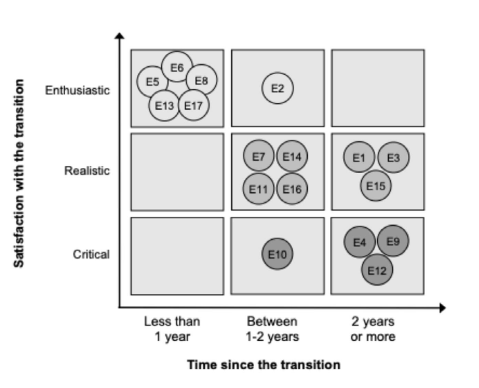
From these contrasting perspectives on career transition, it was possible to identify three distinct groups among the participants - enthusiastic, realistic, and critical. The six participants in the first group (E2, E5, E6, E8, E13, E17) show enthusiasm for their new venture. They believe they will become partners in their firms, are motivated to seek new clients, and aim to provide differentiated advisory services. They report having a better quality of life, do not identify problems or challenges associated with their new occupation, and do not mention disagreements with their partner firms. They hold a positive outlook for the future, seeing a market that is expanding and full of opportunities. However, it is worth noting that the professionals in this group are still in the period during which they receive a fixed salary from the firm to build their client portfolio and, therefore, have not yet fully experienced the reality of depending solely on themselves.
I’m quite satisfied; I think I’ve found my place. But as I told you, I enjoy it - it’s my thing. … I think I’m in the right place and on the right track. (E8)
I’m quite satisfied here at the moment. I know I’m not a complacent person - in a good way. My goal is to become a partner at the firm and so on, to climb to another position. (E5)
In the group of realists - comprising seven participants (E1, E3, E7, E11, E14, E15, E16) - are those who seem to recognize both sides of the scale. In other words, they are satisfied with the transition but are aware of the challenges of a flexible career. It is worth noting that the participants in this group made the transition a year or more ago, unlike the enthusiastic participants, whose transition occurred less than a year ago.
I’m satisfied. As I told you, I look back and see that I made the right choice. Despite having gone through difficult moments, I look back and see that I made the right choice. (E3)
What I really want today is to remain in the firm, doing what I do and, of course, being recognized. I’m quite happy with what I do today at the firm. (E7)
Finally, the four participants in the third group (E4, E9, E10, E12) - three of whom made the transition two years ago or more - are those who hold a more critical view of their own situation. They question the commission and compensation system, disagree with the policies of certain firms, and warn those intending to enter this market about the abusive clauses in some contracts. They stress that some firms aim to entice professionals with a strong client portfolio but do not allow clients to follow the advisor when changing firms. They have not reached the income they initially estimated and say they are unlikely to do so, as achieving it would require going against their principles of transparency with their clients.
What messes with the minds of people who are in the bank and not in this brokerage environment is a lie, right? Because they say, “Man, you’re going to make much more money than you did at the bank.” (E4)
The ad says, “Become an investment advisor and earn 20,000 a month.” But there are people making far less than 20,000. I still haven’t gotten there myself. (E9)
One participant in this group chose to return to a formal employment contract, and another is considering doing so.
I wanted to run back to stability… I left for several reasons - the pandemic, insecurity, and I don’t see such a positive long-term outlook. Even knowing that there is still a lot of room for growth in advisory work, I wanted a bit more stability. (E10)
Today I find myself in a moment where I’m not satisfied. I’ll probably make a transition next year. … I don’t regret leaving Itaú; that was very important for my career, and I learned a lot at XP. I’m very satisfied with the knowledge and growth I’ve gained. … I’m just not satisfied with some of the deviations that happened along the way. (E4)
When analyzing the time since the transition in each of these groups, as illustrated in Figure 1, it was possible to identify growing dissatisfaction, suggesting the presence of a siren’s song. In line with the metaphor from Greek mythology, these professionals appear to have been drawn in by an illusion - the siren’s song or the hegemonic discourse of the ‘entrepreneur of the self’ (Carmo et al., 2021; Costa et al., 2011; Costa & Saraiva, 2012; Souza et al., 2020) - but have gradually come to realize that the transition has not materialized in fulfillment, but rather in resignation or even frustration with the chosen path.

This result is consistent with what Kovalenko and Mortelmans (2014), suggest, namely that career mobility can be positive for some workers but, for others, may be a path leading to precarization. Similarly, Antunes (2018) points out that entrepreneurship has been exalted as an alternative to the elimination of jobs and to precarization, “in which all hopes are placed and whose outcome is never known.” (p. 44).
FINAL CONSIDERATIONS
The aim of this study was to analyze the career transition of professionals who voluntarily chose to leave their formal employment in a large bank to work as independent investment agents. The results revealed dissatisfaction with their former banks and a positive perception - particularly in the initial period following the transition - that an autonomous career, aligned with the principles of a more flexible career path, would offer them a more enjoyable and rewarding work environment. In other words, discontent with their former banks seems to have made participants more open to change and, therefore, more inclined to hear the ‘siren’s song’ of new entrants to this market, calling them toward a new life of advantages, financial gains, and freedom.
In this way, dissatisfaction with formal employers was a decisive factor in the decision to transition, in line with the literature (De Vos et al., 2021; Forrier et al., 2009, Kovalenko & Mortelmans, 2014). Some participants felt undervalued in their roles, while others mentioned that nowadays the position of bank manager lacks status and social recognition. There were also reports of difficulties in putting acquired knowledge into practice and in providing the best advice to clients, due to directives from the banks that did not necessarily make sense for the client.
At the same time, recent changes in the financial market - particularly the entry of new competitors - were also an influencing factor, as they opened new opportunities for professionals in the sector. Notably, none of the participants had any previous self-employment experience and, according to some, this form of employment had even been viewed with prejudice. The growing status attributed to investment advisors and to the firms that bring these professionals together thus appears to be in line with the dissemination of the discourse on flexibilization and the ‘entrepreneur of the self’ (Carmo et al., 2021; Costa et al., 2011; Costa & Saraiva, 2012; Souza et al., 2020; Tessarini et al., 2023), also among financial market professionals.
These results contribute to the literature on career transition by showing that the decision to leave a formal and relatively stable job to embark on an autonomous career appears to be driven by a combination of increasingly adverse working conditions offered by traditional employers - in this case, large banks - and by a favorable context, which includes the growing market demand for independent investment advisors as well as the dominance of a discourse that extols entrepreneurship, flexibility, and mobility.
When analyzing the outcomes of the career transition, one aspect that stood out was the gradual demystification, over time, of the positive perspectives regarding the flexible work model. In other words, for workers who choose or are driven into these work arrangements, the exaltation of freedom and flexibility, aligned with neoliberal ideology, appears to gradually materialize into a reality of precarization, in the form of the absence of employment benefits, financial uncertainty, and an intensification of working time (Antunes, 2018; Fleming, 2017).
As a contribution to the literature on the flexibilization of labor relations, and from the perspective of the more critical participants, it can be proposed that the phenomenon of the ‘uberization’ of work is also present in this sector. After all, the profession of independent investment agent requires a relatively low individual investment and comes with the promise of freedom and good financial return. Moreover, brokerages and investment advisory firms do not offer a formal employment relationship, and the initial monthly stipend is treated as a debt to be repaid once the professional begins generating returns from their client portfolio.
The association with the ‘uberization’ of work is also due to the fact that professionals from other fields - not only from the financial market - are migrating to the profession with the dream of running their own business, becoming entrepreneurs, setting their own work hours, and achieving a better quality of life, even though, according to the accounts of several participants, the reality points in a different direction. If this trend consolidates, would we be witnessing the ‘XPtization’ of work - in reference to XP, a pioneer of this movement - given that the same functionalist and asymmetrical logic would be repeating itself, this time in the financial market?
Regarding the limitations of this study, its interpretive nature may have introduced biases related to the researchers’ subjectivity, as one of them is a professional in the financial market. In addition, the analysis drew on theoretical frameworks from the literature on labor flexibilization and career transition, which may not encompass the full complexity of the phenomenon. Finally, as the study involved a relatively small number of participants, it is possible that other perspectives on the phenomenon under investigation were not identified. In this regard, we suggest that the study be expanded to include independent investment advisors who chose to leave the profession, as well as professionals who entered the career of investment advisor from other sectors of activity.
REFERENCES
-
Associação Nacional das Corretoras e Distribuidoras de Títulos e Valores Mobiliários, Câmbios e Mercadorias. (2022). Certificação e Credenciamento. ANCORD. https://www.ancord.org.br/certificacao-e-credenciamento
» https://www.ancord.org.br/certificacao-e-credenciamento - Antunes, R. (2018). O privilégio da servidão: O novo proletariado de serviços na era digital. Boitempo.
-
Antunes, R. (2020). Qual é o futuro do trabalho na Era Digital? Laborare, 3(4), 6-14. https://doi.org/10.33637/2595-847x.2020-46
» https://doi.org/10.33637/2595-847x.2020-46 -
Arthur, M. B. (2014). The boundaryless career at 20: where do we stand, and where can we go? Career Development International, 19(6), 627-640. https://doi.org/10.1108/CDI-05-2014-0068
» https://doi.org/10.1108/CDI-05-2014-0068 - Arthur, M. B., Khapova, S. N., & Richardson, J. (2017). An intelligent career: Taking ownership of your work and your life. Oxford University Press.
-
Azevedo, M. C., Tonelli, M. J., & Silva, A. L. (2015). Contratos flexíveis de trabalho: Diferentes perfis de trabalhadores qualificados brasileiros. RAUSP, 50(3), 277-291. https://doi.org/10.5700/rausp1200
» https://doi.org/10.5700/rausp1200 - Bardin, L. (2011). Análise de conteúdo (Edição revista e ampliada). Edições 70.
-
Baruch, Y., & Vardi, Y. (2016). A fresh look at the dark side of contemporary careers: toward a realistic discourse. British Journal of Management, 27(2), 355-372. https://doi.org/10.1111/1467-8551.12107
» https://doi.org/10.1111/1467-8551.12107 - Boltanski, L., & Chiapello, È. (2009). O novo espírito do capitalismo. Martins Fontes.
-
Budtz-Jørgensen, J., Johnsen, C. G., & Sørensen, B. M. (2019). Against boundarylessness: The liminal career of the flexible employee. Organization, 26(6), 917-935. https://doi.org/10.1177/1350508418821005
» https://doi.org/10.1177/1350508418821005 - Cappelli, P. (1999). The new deal at work: Managing the market-driven workforce. Harvard Business School Press.
- Cardoso, M., Azevedo, P. F., & Barbosa, K. (2016). Concorrência no setor bancário brasileiro: Bancos individuais versus conglomerados bancários. Pesquisa e Planejamento Econômico, 46(1), 113-146.
-
Carmo, L. J. O., Assis, L. B., Gomes Júnior, A. B., & Teixeira, M. B. M. (2021). O empreendedorismo como uma ideologia neoliberal. Cadernos EBAPE.BR, 19(1), 18-31. https://doi.org/10.1590/1679-395120200043
» https://doi.org/10.1590/1679-395120200043 -
Carneiro, L. L., Moscon, D. C. B., Dias, L. M. M., Oliveira, S. M. D., & Alves, H. M. C. (2023). Digitrab: Reflexões sobre o cenário do trabalho mediado por plataformas digitais no Brasil. RAM - Revista de Administração Mackenzie, 24(2), 1-30. https://doi.org/10.1590/1678-6971/eramr230060.pt
» https://doi.org/10.1590/1678-6971/eramr230060.pt - Cavarzan, G. M., & Vazquez, B. V. (2020). Transformações no mundo dos serviços e o emprego no setor financeiro. In J. J. Conceição & C. P. Noronha (Orgs.), A era digital e o trabalho bancário (pp. 221-238). Coopacesso.
-
Chudzikowski, K. (2012). Career transitions and career success in the ‘new’ career era. Journal of Vocational Behavior, 81(2), 298-306. https://doi.org/10.1016/j.jvb.2011.10.005
» https://doi.org/10.1016/j.jvb.2011.10.005 - Comissão de Valores Mobiliários. (2019). Instrução CVM n. 497, de 3 de junho de 2011, com as alterações introduzidas pelas instruções CVM n. 515/2011, 593/2017 e 610/2019. CVM.
-
Correa, R., Camelo, S. H. H., & Leal, L. A. (2017). Satisfação no trabalho dos bancários e seus fatores determinantes - Uma revisão integrativa. Revista Economia & Gestão, 17(47), 65-84. https://doi.org/10.5752/P.1984-6606.2017v17n47p65
» https://doi.org/10.5752/P.1984-6606.2017v17n47p65 -
Costa, A. M., Barros, D. F., & Carvalho, J. L. F. (2011). A dimensão histórica dos discursos acerca do empreendedor e do empreendedorismo. Revista de Administração Contemporânea, 15(2), 179-197. https://doi.org/10.1590/S1415-65552011000200002
» https://doi.org/10.1590/S1415-65552011000200002 -
Costa, A. S. M., & Saraiva, L. A. S. (2012). Hegemonic discourses on entrepreneurship as an ideological mechanism for the reproduction of capital. Organization, 19(5), 587-614. https://doi.org/10.1177/1350508412448696
» https://doi.org/10.1177/1350508412448696 -
De Vos, A., Jacobs, S., & Verbruggen, M. (2021). Career transitions and employability. Journal of Vocational Behavior, 126, 103475. https://doi.org/10.1016/j.jvb.2020.103475
» https://doi.org/10.1016/j.jvb.2020.103475 - Departamento Intersindical de Estatística e Estudos Socioeconômico. (2023). Desempenho dos bancos em 2022. DIEESE.
- Filgueiras, M. L. (2019). Na raça: Como Guilherme Benchimol criou a XP e iniciou a maior revolução do mercado financeiro brasileiro. Intrínseca.
-
Fleming, P. (2017). The human capital hoax: Work, debt and insecurity in the Era of Uberization. Organization Studies, 38(5), 691-709. https://doi.org/10.1177/0170840616686129
» https://doi.org/10.1177/0170840616686129 -
Forrier, A., Sels, L., & Stynen, D. (2009). Career mobility at the intersection between agent and structure: A conceptual model. Journal of Occupational and Organizational Psychology, 82(4), 739-759. https://doi.org/10.1348/096317909X470933
» https://doi.org/10.1348/096317909X470933 -
Franco, D. S., & Ferraz, D. L. S. (2019). Uberização do trabalho e acumulação capitalista. Cadernos EBAPE.BR, 17 (edição especial), 844-856. https://doi.org/10.1590/1679-395176936
» https://doi.org/10.1590/1679-395176936 -
Franco, D. S., Ferraz, D. L. S., & Ferraz, J. M. (2023). Economia política da uberização: A exploração dos trabalhadores conforme as três formas de intermediação do trabalho nas empresas-plataforma. Organizações & Sociedade, 30(105), 367-396. https://doi.org/10.1590/1984-92302023v30n0012pt
» https://doi.org/10.1590/1984-92302023v30n0012pt -
Gemelli, C. E., Closs, L. Q., & Fraga, A. M. (2020). Multiformidade e pejotização: (re)configurações do trabalho docente no ensino superior privado sob o capitalismo flexível. REAd - Revista Eletrônica de Administração, 26(2), 409-438. https://doi.org/10.1590/1413-2311.289.101464
» https://doi.org/10.1590/1413-2311.289.101464 -
Hall, D. T. (2004). The protean career: A quarter-century journey. Journal of Vocational Behavior, 65(1), 1-13. https://doi.org/10.1016/j.jvb.2003.10.006
» https://doi.org/10.1016/j.jvb.2003.10.006 -
Holanda, A. R. M. D., Leite, L. O., Oliveira, M. A., Arrais, R. H., & Aquino, C. A. B. (2014). O trabalho na contemporaneidade: Análise das implicações subjetivas em um agente autônomo da bolsa de valores. Revista Labor, 11(1), 45-61. http://www.repositorio.ufc.br/handle/riufc/21239
» http://www.repositorio.ufc.br/handle/riufc/21239 - Ibarra, H. (2004). Career transition and change. INSEAD Working Paper Series.
-
Jardim, L. S., & Carraro, N. C. (2019). Análise da empregabilidade no setor bancário brasileiro. Revista Observatorio de La Economía Latinoamericana. https://www.eumed.net/rev/oel/2019/07/empregabilidade-setor-bancario.html
» https://www.eumed.net/rev/oel/2019/07/empregabilidade-setor-bancario.html -
Kim, H. N., Tonelli, M. J., & Silva, A. L. (2017). Do formal ao informal: executivos que migraram para o trabalho flexível. Revista Brasileira de Gestão de Negócios, 19(63), 133-152. https://doi.org/10.7819/rbgn.v0i0.2999
» https://doi.org/10.7819/rbgn.v0i0.2999 -
Kovalenko, M., & Mortelmans, D. (2014). Does career type matter? Outcomes in traditional and transitional career patterns. Journal of Vocational Behavior, 85(2), 238-249. https://doi.org/10.1016/j.jvb.2014.07.003
» https://doi.org/10.1016/j.jvb.2014.07.003 -
Krein, J. D. (2018). O desmonte dos direitos, as novas configurações do trabalho e o esvaziamento da ação coletiva. Tempo Social, 30(1), 77-104. http://dx.doi.org/10.11606/0103-2070.ts.2018.138082
» http://dx.doi.org/10.11606/0103-2070.ts.2018.138082 -
Lei nº 13.467, de 13 de julho de 2017. (2017). Altera a Consolidação das Leis do Trabalho (CLT). Diário Oficial da União, Brasília, DF. https://www.planalto.gov.br/ccivil_03/_ato2015-2018/2017/lei/l13467.htm
» https://www.planalto.gov.br/ccivil_03/_ato2015-2018/2017/lei/l13467.htm -
Lima-Souza, É. C. P., Mota-Santos, C. M., & Carvalho, A. Neto (2021). Reforma trabalhista, revolução digital e violência política: último prego no caixão do trabalho do telejornalista. O Social Em Questão, XXIV(49), 173-196. https://doi.org/10.17771/pucrio.osq.51132
» https://doi.org/10.17771/pucrio.osq.51132 - Machado, V. (2020). Colaboração e competição entre bancos e fintechs afetam o emprego nos bancos e a oferta de serviços bancários. In J. J. Conceição, & C. P. Noronha (Orgs.). A era digital e o trabalho bancário. Coopacesso.
- Mayrhofer, W., Meyer, M., & Steyrer, J. (2007). Contextual issues in the study of careers. In H. Gunz & M. Peiperl (Eds.), Handbook of career studies (pp. 215-240). Sage Publications.
-
Melges, F., Calarge, T. C. C., Benini, É. G., & Pacheco, A. P. C. (2022). A nova precarização do trabalho: Um mapa conceitual. Organizações & Sociedade, 29(103), 652-680. https://doi.org/10.1590/1984-92302022v29n0032pt
» https://doi.org/10.1590/1984-92302022v29n0032pt -
Meneses, A. B. (2020). Sereias: Sedução e saber. Revista do Instituto de Estudos Brasileiros, 75, 71-93. https://doi.org/10.11606/issn.2316-901X.v1i75p71-93
» https://doi.org/10.11606/issn.2316-901X.v1i75p71-93 -
Moronte, E. A., & Albuquerque, G. S. C. (2021). Organização do trabalho e adoecimento dos bancários: Uma revisão de literatura. Saúde em Debate, 45(128), 216-233. https://doi.org/10.1590/0103-1104202112817
» https://doi.org/10.1590/0103-1104202112817 -
Partyka, R. B., Lana, J., & Marcon, R. (2020). A XP e o Itaú Unibanco: Dos produtos de investimento à desbancarização. Administração: Ensino e Pesquisa, 21(2), 214-238. https://doi.org/10.13058/raep.2020.v21n2.1749
» https://doi.org/10.13058/raep.2020.v21n2.1749 -
Reis, T. (2018). O que faz um Agente Autônomo de Investimentos? Grupo Suno. https://www.suno.com.br/artigos/agente-autonomo-investimentos-aai/
» https://www.suno.com.br/artigos/agente-autonomo-investimentos-aai/ -
Rousseau, D. M. (2011). The individual-organization relationship: The psychological contract. In S. Zedeck (Ed.), APA Handbook of Industrial and Organizational Psychology, Vol. 3. Maintaining, expanding, and contracting the organization (pp. 191-220). American Psychological Association. https://doi.org/10.1037/12171-005
» https://doi.org/10.1037/12171-005 -
Silva, J. L., & Navarro, V. L. (2012). Organização do trabalho e saúde de trabalhadores bancários. Revista Latino-Americana de Enfermagem, 20(2), 226-234. https://doi.org/10.1590/S0104-11692012000200003
» https://doi.org/10.1590/S0104-11692012000200003 -
Souza, F. A. S., Lemos, A. H. C., & Silva, M. A. C. (2020). Metamorfoses de um discurso: carreiras sem fronteiras e o novo espírito do capitalismo. Organizações & Sociedade, 27(92), 95-112. https://doi.org/10.1590/1984-9270925
» https://doi.org/10.1590/1984-9270925 -
Sullivan, S. E., & Al Ariss, A. (2021). Making sense of different perspectives on career transitions: A review and agenda for future research. Human Resource Management Review, 31(1), 100727. https://doi.org/10.1016/j.hrmr.2019.100727
» https://doi.org/10.1016/j.hrmr.2019.100727 -
Sullivan, S. E., & Al Ariss, A. (2022). A conservation of resources approach to inter-role career transitions. Human Resource Management Review, 32(3), 100852. https://doi.org/10.1016/j.hrmr.2021.100852
» https://doi.org/10.1016/j.hrmr.2021.100852 -
Tessarini, G. Jr., Saltorato, P., & Rosa, K. L. S. (2023). A flexibilização do trabalho como regra no capitalismo: Conceituação e proposições teórico-analíticas. Cadernos EBAPE.BR, 21(1), 1-13. https://doi.org/10.1590/1679-395120220049
» https://doi.org/10.1590/1679-395120220049 -
Vaclavik, M. C., Rocha-de-Oliveira, S., & Oltramari, A. P. (2021). Proteus looks around: agency, time and context in a Gig Economy career analysis. BAR - Brazilian Administration Review, 18(2), e200098. https://doi.org/10.1590/1807-7692bar2021200098
» https://doi.org/10.1590/1807-7692bar2021200098 - Valenduc, G. (2018). New forms of work and employment in the digital economy. In A. Serrano-Pascual & M. Jepsen (Eds.), The deconstruction of employment as a political question (pp. 63-80). Palgrave Macmillan.
-
Funding
The author reported that there was no funding for the research in this article.
-
Peer Review Method
This content was evaluated using the double-blind peer review process. The disclosure of the reviewers’ information on the first page, as well as the Peer Review Report, is made only after concluding the evaluation process, and with the voluntary consent of the respective reviewers and authors.
-
Plagiarism Check
RAC maintains the practice of submitting all documents approved for publication to the plagiarism check, using specific tools, e.g.: iThenticate.
-
Data Availability
RAC encourages data sharing but, in compliance with ethical principles, it does not demand the disclosure of any means of identifying research subjects, preserving the privacy of research subjects. The practice of open data is to enable the reproducibility of results, and to ensure the unrestricted transparency of the results of the published research, without requiring the identity of research subjects.
-
Cite as:
Oliveira, L. B., Vieira, L. L., & Celano, A. (2025). The ‘Siren Song’: Career transition of financial market professionals. Revista de Administração Contemporânea, 29(4), e240283. https://doi.org/10.1590/1982-7849rac2025240283.en
-
JEL Code:
J24, J62, J81, J83, L26
-
Peer Review Report:
The disclosure of the Peer Review Report was not authorized by its reviewers.
Edited by
-
Editor-in-chief:
Paula Chimenti (Universidade Federal do Rio de Janeiro, COPPEAD, Brazil) https://orcid.org/0000-0002-6492-4072
-
Associate Editor:
Ludmila Guimarães (Centro Federal de Educação Tecnólogica de Minas Gerais, Brazil) https://orcid.org/0000-0001-5741-0279
RAC encourages data sharing but, in compliance with ethical principles, it does not demand the disclosure of any means of identifying research subjects, preserving the privacy of research subjects. The practice of open data is to enable the reproducibility of results, and to ensure the unrestricted transparency of the results of the published research, without requiring the identity of research subjects.

 Source: Elaborated by the Authors..

