
 Adaptive Governance in Conservation Units in Rondônia, Brazil
ABSTRACT
Objective: this study aims to describe adaptive governance in Conservation Units (CUs) in Rondônia, based on the actions of management councils and local actors’ perceptions.
Theoretical approach: the research draws on theoretical approaches to governance, adaptive governance, and common-pool resources.
Method: three extractive reserves (Resexs) were selected based on their management systems and council dynamics: Resex Rio Preto-Jacundá, Resex Maracatiara (in Machadinho D’Oeste), and Resex Itaúba (in Vale do Anari). This is a qualitative research using primary data, document compilations, specific legislation, and management plans for the reserves.
Results: the results demonstrate that the management of CU councils aligns with the premises of adaptive governance. The councils comply with the requirements set out in their creation decrees, exercise governance by evaluating and approving the accountability reports of associations based in CUs, and deliberate on issues that facilitate the implementation of management plans aimed at improving the quality of life of Resex residents. However, the discontinuity in the management of the local office responsible for the councils’ actions - compensated by the general secretariat’s intervention - highlights the adaptive capacity of governance.
Conclusion: the study concludes that the challenges faced by community members, together with the specific contingencies of Amazonian CUs, necessitate changes to promote alternative governance models adapted to local conditions, including the integration of technology to enhance the quality of life of extractive families and, consequently, their participation in council actions. Future research should extend the analysis to CUs managed by other government spheres and in other states to allow for comparison and generalization.
Keywords:
adaptive governance; Conservation Units; common resources; Amazon; Rondônia
RESUMO
Objetivo: este artigo objetiva descrever a governança adaptativa nas Unidades de Conservação (UCs) no estado de Rondônia, a partir das ações dos conselhos gestores e da percepção dos atores locais.
Marco teórico: Para tal, foram utilizadas as abordagens teóricas sobre governança, governança adaptativa e recursos comuns.
Método: foram analisadas três reservas extrativistas (Resexs) - Resex Rio Preto-Jacundá, Resex Maracatiara (Machadinho D’Oeste) e Resex Itaúba (Vale do Anari) -, selecionadas considerando o sistema de gestão e a dinâmica dos conselhos. A pesquisa qualitativa utilizou dados primários, documentos, legislações específicas e planos de manejo das reservas.
Resultados: os resultados evidenciam que a gestão dos conselhos das UCs, por meio do cumprimento das exigências dos decretos de criação, avaliação e aprovação das prestações de contas das associações e deliberação sobre questões dos planos de manejo, corrobora os pressupostos da governança adaptativa. A descontinuidade na gestão do escritório local responsável pelos conselhos, superada pela atuação da secretaria geral, ressalta a capacidade de adaptação na governança.
Conclusão: conclui-se que as dificuldades enfrentadas pelos comunitários e as contingências nas UCs da Amazônia demandam mudanças que favoreçam práticas alternativas de governança, adaptadas às condições locais, com a inserção de tecnologia para melhorar a qualidade de vida das famílias extrativistas e ampliar sua participação nas ações dos conselhos. Recomenda-se, como continuidade desta pesquisa, a ampliação do estudo para UCs sob diferentes esferas de gestão e em outros estados, permitindo a comparação e generalização dos resultados.
Palavras-chave:
governança adaptativa; Unidades de Conservação; recursos comuns; Amazônia; Rondônia
INTRODUCTION
Governance can promote collective adaptation by fostering the development and modification of shared rules, whose institutionalization within a group serves as an incentive for cooperation and resource-sharing. Actors communicate among themselves and typically use these interactions to establish rules, enforcement mechanisms, compliance monitoring, and sanctions for violations. Ostrom (1990) demonstrates, through game theory, that users of common-pool resources can establish contracts among themselves to ensure the responsible use of these common resources (Ostrom & Walker, 2003; Partelow, 2018).
These assumptions align with the definitions of adaptive governance proposed by Sharma-Wallace et al. (2018), who argue that it emerges from the need to implement governance structures resilient enough to achieve ecological sustainability while enabling communities to meet their objectives even under conditions of uncertainty (Sharma-Wallace et al., 2018). Such structures represent an evolution of rules and norms that enhance flexibility, resilience, and the capacity for change in planning and implementation processes.
Adaptive governance seeks to engage actors collaboratively in cross-scale interactions, relying on self-organizing collaborative arrangements that extend beyond government structures, such as networks and partnerships. These arrangements are essential for large-scale implementation, facilitating stakeholder coordination, social capital formation, and community empowerment and engagement. Thus, it involves capacity development, knowledge integration, and decision-making through data collection and monitoring, leadership promotion, and the exploration or creation of governance opportunities (Marques et al., 2019), This highlights its relevance in the study of common-pool resources, particularly in understanding how people relate to land.
It encompasses how people perceive land and how institutions construct and organize processes related to territorialization. Institutions and the rules associated with land use and ownership face challenges in identifying solutions to improve land management, regardless of its intended purpose (FAO/SEAD, 2017). In this context, fauna and flora, rivers, seas, mountains, and the history of traditional populations are all integral elements of nature and history, each playing a distinct role.
The relevance of studying adaptive governance in common-pool resource territories stems from the necessity for extractivist communities to adapt to the changes surrounding them. Over time, rules and norms evolve, altering the reality of these communities and threatening the preservation of traditional ways of life due to advancements in planning and implementation processes, the institutionalization of governance systems, and the need to improve their quality of life.
The Brazilian Federal Government established the National System of Conservation Units (Sistema Nacional de Unidades de Conservação - SNUC) as a key strategy for the preservation, restoration, and governance of areas designated as Conservation Units (CUs). Additionally, it recognizes the role of traditional communities in assisting the state in monitoring these regions to maintain territorial control (Andrade, 2008).
Each Conservation Unit has a management council, which enables mechanisms for local community participation in its governance. According to current policies, the management of CUs should be based on a participatory and shared governance model that involves traditional communities, government agencies, civil society, and the private sector. Ensuring effective environmental conservation and preservation requires the legitimate participation of various institutions, whether directly or indirectly involved, fostering cooperative management between public authorities and other stakeholders.
Through the management councils of CUs, it becomes possible to establish mechanisms for local community participation in governance. These councils may have a consultative role for fully protected units or a deliberative role for sustainable use units. The primary objective of the council is to ensure transparency in the management of the units and to connect communities with the private sector, research institutions, NGOs, and public authorities.
This study examined the management councils of the following Extractive Reserves (Reservas Extrativistas - Resexs): Resex Rio Preto-Jacundá, Resex Maracatiara, in the municipality of Machadinho D’Oeste, and Resex Itaúba, in the municipality of Vale do Anari. The objective was to describe adaptive governance in Conservation Units in the state of Rondônia, based on the actions of management councils and the perceptions of local stakeholders.
These units were intentionally selected based on their characteristics. The first is the most developed, with distinct physical infrastructure and an active association of local residents. The second is in another municipality, making it more remote than the others, and its residents’ association has recently been working to address the needs of extractivists and mitigate existing challenges. Finally, the third Resex was chosen because it is a community where the association is inactive, and long-time residents could provide valuable insights for the research.
THEORETICAL FRAMEWORK
Governance and adaptive governance
Governance can be understood as a mode of social coordination, distinct from the act of governing, which is an intentional effort to guide, direct, control, and manage sectors of society (Kooiman, 1993). Governance refers to the ways in which individuals act through various forms of interaction, deliberation, negotiation, self-regulation, or authorized decision-making, as well as the extent to which actors adhere to collective decisions. It is linked to the level and scope of political allocation, the dominant orientation of the state, and the interactions among institutions. Kemp et al. (2005) argue that governance structures negotiations, differentiates objectives, influences people’s motivations and behavioral patterns, and affects the assignment of responsibilities, monitoring, enforcement of penalties, and the resolution of conflicts and rivalries among actors.
The various classifications of governance can be expressed along a continuum between the extremes of hierarchical governance and co-governance. In hierarchical governance, the state is the most dominant actor, as it holds decision-making power and authority. It is characterized by goal-setting driven by the government, a vertical relationship between the government and social actors, a strong focus on coordination, direction, planning, and control, an instrumental approach, directive policies, and a linear political process. In contrast, co-governance involves shared power among all actors - state, market, and society - who operate on an equal footing in a deliberate and open manner. Its characteristics include goal-setting by both the government and social actors, horizontal relationships, mutual interdependence, negotiation, learning by doing, uncertainty, a deliberative approach, adaptive policies, and an evolving social process.
From this perspective, common-pool resource theory has been refined over time and has diverged into two main approaches. The first approach originates from a concern with governance at the level of common-pool resource communities, focusing on power-sharing agreements between communities and governments. As studies evolved, co-management approaches emerged and were incorporated into the field of adaptive management (Armitage et al., 2008; Folke et al., 2005), giving rise to adaptive governance and its managerial counterpart, adaptive co-management. The second approach is rooted in social science traditions, including anthropology, sociology, and development studies (Cleaver & Whaley, 2018).
Ostrom (1990), through the principles of the commons, highlights the institutional conditions of self-organized collective action systems directed toward common-pool resources. These principles are highly relevant to the advancement of commons theory and governance, as they encompass different actors and resource systems (Armitage et al., 2008).
Adaptive governance involves identifying the evolution of rules and norms aimed at meeting human needs and interests within social, economic, and environmental contexts (Chaffin et al., 2014). It is primarily characterized by its capacity to facilitate adaptive co-management, ensuring the integration of biophysical and geopolitical elements in contexts of unexpected changes (Folke et al., 2005).
Dietz et al. (2003) propose that the study of adaptive governance should consider the following factors: the provision of adequate information for decision-makers; conflict management and rule enforcement legitimized by the actors involved in resource governance; mechanisms that induce compliance with rules; the availability of physical, social, institutional, and technological infrastructure; and institutional flexibility, which is linked to the capacity to learn and revise rules and norms in response to environmental changes.
The factor related to the provision of adequate information for decision-makers emphasizes that governance depends on accurate and reliable information regarding the stocks, flows, and processes within the resource systems being managed, as well as the interactions between humans and the environment that impact these systems. This information must be proportionally aligned with events and environmental decision-making processes. Any additional information introduced may influence the identification of future problems and the development of solutions (Dietz et al., 2003).
The use of common-pool resources and the perspective of collective action
The theory of common-pool resources was developed based on case studies and empirical experiences of populations that successfully managed shared resources. When the results of this management model are compared to those proposed by Hardin, they demonstrate greater efficiency in the studied communities, where users’ behaviors diverge from the selfishness and individualism emphasized in Hardin’s approach (Capelari et al., 2017; Ostrom et al., 1994; Pereira, 2013).
Collective assets, such as forests, natural resources, rivers, and agricultural areas, can be efficiently managed by local users through cooperation among actors and associations that oversee communal property. These associations organize themselves by developing their own decision-making structures and establishing rules to mediate conflicts, adapting governance mechanisms to the specific realities of their communities (Ostrom, 1990).
The term common-pool resources (CPR) refers to the study of natural resources that are accessible to individuals, either individually or collectively. Examples include fishing rights, waterways, and river usage, which can be exploited to the point of depletion, often in response to individual needs.
In the studies of Ostrom et al. (1992), various forms of resistance among traditional populations are identified, particularly concerning the defense of their ancestral territories for residence and/or work.
Thus, governance is closely linked to the processes through which rules and strategies that guide human behavior are incorporated into the regulation of interactions, shaping how actions are formulated, implemented, interpreted, and redefined (Baland & Platteau, 1996; Berkes et al., 1989; Feeny et al., 1990; Hanna & Bromley, 1993; Lansing, 1991; Sengupta, 1991).
Conservation Units (Reservas Extrativistas - Resexs)
In the year 2000, the Sistema de Unidades de Conservação da Natureza (SNUC) was established through Brazilian Federal Law No. 9,985, a specific piece of legislation that “sets criteria and norms for the creation, implementation, and management of conservation units” (Lei n. 9.985, 2000), This law was enacted to regulate Article 225, §1, items I, II, III, and VII of the Brazilian Federal Constitution, which guarantees and enforces the right to an ecologically balanced environment as a common good for the people.
According to SNUC, Conservation Units are divided into two categories: Strictly Protected Units (Unidades de Proteção Integral) and Sustainable Use Units (Unidades de Uso Sustentável). The primary objective of Sustainable Use Units is to reconcile nature conservation with the sustainable use of a portion of their natural resources. Reservas Extrativistas fall under this category and are defined by Law No. 9,985, 2000, in Article 18, caput, as “an area used by traditional extractivist populations whose subsistence is based on extractivism and, complementarily, on subsistence agriculture and small-scale livestock farming. Its primary objectives are to protect the livelihoods and culture of these populations and to ensure the sustainable use of the unit’s natural resources” (Lei n. 9.985, 2000).
The Resex are managed by a deliberative council, a collegiate body chaired by the entity responsible for their administration and composed of representatives from public agencies, civil society organizations, and traditional populations residing in the area (Lei n. 9.985, 2000).
The main objectives of the deliberative councils of CUs are to ensure transparency in their management through social oversight, contribute to the development and implementation of the management plan (plano de manejo), and integrate the CU with local communities, the private sector, research institutions, NGOs, public authorities, and other Protected Areas. Additionally, they are responsible for approving the management plan and overseeing the contracting of Public Interest Civil Society Organizations (Organizações da Sociedade Civil de Interesse Público - OSCIPs) for shared management.
The management plan for CUs is developed by the managing authority in accordance with the unit’s guidelines established by SNUC and must adhere to specific parameters while being periodically updated.
Ministry of Environment (Ministério do Meio Ambiente, 2023), sets the rules and restrictions for use, outlines the actions to be implemented, and regulates the management of natural resources within the CU, its surrounding areas, and, when applicable, the ecological corridors associated with it. Additionally, it may include the development of physical infrastructure within the CU to ensure the maintenance of ecological processes and prevent the simplification of natural systems.
The management plan also includes measures to promote the integration of the CU into the economic and social life of neighboring communities, which is essential for its effective implementation. This document also establishes the rules for visitation.
Among common-pool resources are Conservation Units, management policies, and common-pool resources themselves, referring to the study of natural resources shared by individuals or collectives. These actors are linked to the property rights structures of these Conservation Units and the way these areas are managed, whether through shared use among members, their rights, or responsibilities over common goods.
Synthesis of the theoretical framework
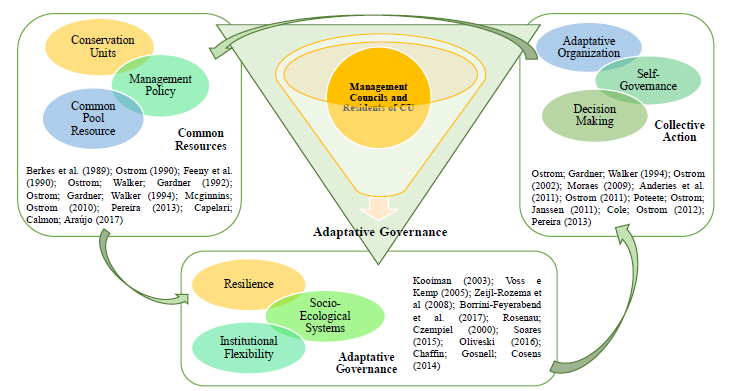
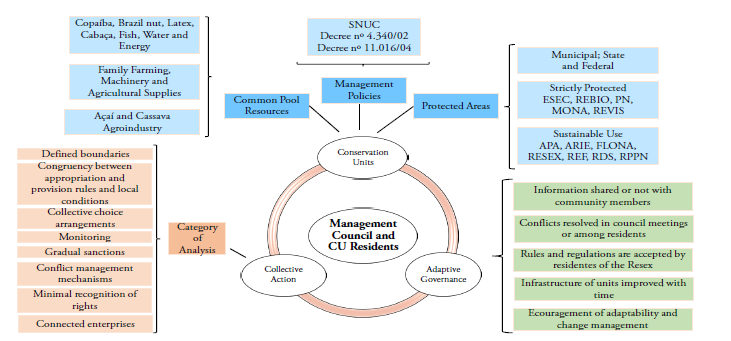
In the theoretical framework presented in Figure 1, the center illustrates the interrelationship between governance, common-pool resources, and collective action, showing how these elements collectively influence the management councils of the studied Conservation Units, either positively or negatively.

Theoretical framework of adaptive governance for management councils and residents of Conservation Units (CUs)
Adaptive management is considered an integrated and multidisciplinary approach to addressing uncertainties in natural resource governance. It is adaptive because it acknowledges that managed resources will be altered by the outcomes of human interaction, that unexpected changes are inherent to the system, and that uncertainties will always persist (Cysne, 2012).
Studies on resilience and adaptability have evolved from perspectives focused on the behavior of socio-ecological systems in response to disturbances and stress factors (Holling, 2001), or on the processes of structural change in social systems, considering the complex interactions between human and environmental systems (Turner et al., 2003), as well as the development of conceptual models that integrate both systems (Berkes & Folke, 1998).
Socio-ecological resilience is interpreted as: (1) the amount of disturbance a system can absorb while remaining within the same state or basin of attraction; (2) the extent to which the system is capable of self-organization (as opposed to disorganization or externally imposed organization); and (3) the degree to which the system can build and enhance its capacity for learning and adaptation.
METHODOLOGY
This research is characterized by a qualitative approach, involving the collection of both secondary and primary data through semi-structured interviews.
The object of study in this research is a Deliberative Council for the Management of Conservation Units (Conselho Deliberativo de Gestão de Unidades de Conservação) located in the territory of Rondônia, known as Conselho Deliberativo das Reservas Extrativistas (CDREX) de Machadinho D’Oeste e Vale do Anari. It operates at the state level, with the State Secretariat for Environmental Development of Rondônia (Secretaria de Estado de Desenvolvimento Ambiental de Rondônia - SEDAM) as the responsible governing body. The coordination of these communities falls under the Coordination of Conservation Units (Coordenadoria de Unidades de Conservação - CUC). CDREX is composed of sixteen Reservas Extrativistas (Resexs), of which three were studied: Resex Rio Preto-Jacundá, Resex Itaúba, and Resex Maracatiara. These reserves have deliberative councils, as they are classified as Sustainable Use Units.
Multiple data collection sources were used, including:
(a) Documents - 5 management plans, 5 statutes, 3 meeting minutes, and 21 specific pieces of legislation.
After organizing the collection of secondary data, an interview script was developed for participants in the meetings, as well as for residents, association members, and government representatives.
(b) Interviews - 3 with community leaders, 3 with residents, 2 with government agents, and 9 with council members.
(c) Field observation - Monitoring the activities of the head of the CUCs within SEDAM.
Subsequently, the collected data were analyzed and structured to provide an overview of how the councils operate, considering the theoretical constructs of Ostrom (1990).
After organizing the secondary data from meeting minutes, specific legislation, and other documents, these materials were analyzed, allowing for the development of an interview guide for meeting participants, as well as for residents, association members, and government representatives. This approach aimed to provide a better understanding of the functioning of the study object (Creswell, 2014).
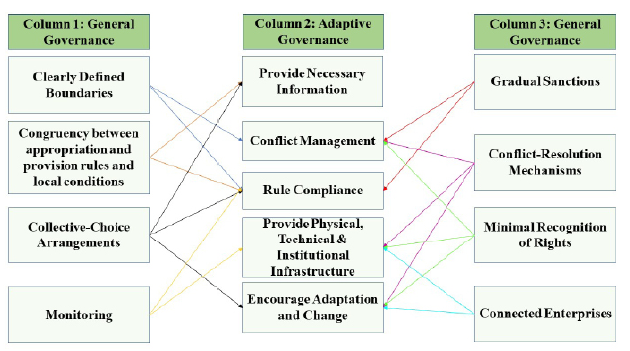
Figure 2 below presents the individual connections between the eight governance principles outlined by Ostrom (1990), displayed in columns (1) and (3). The middle column (2) represents the adaptive governance variables studied, as described by Dietz et al. (2003).
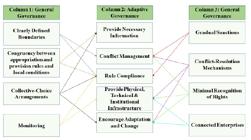
The connection between the variables and principles presented in Figure 2 is established through the relationships between general governance principles and adaptive governance. Clearly defined boundaries are linked to conflict management and rule compliance enforcement. The congruence between appropriation and provision rules, as well as local conditions, is related to the provision of necessary information and the enforcement of rule compliance.
RESULTS AND DISCUSSION
Characteristics of Reservas Extrativistas
The deliberative council studied is composed of 16 Reservas Extrativistas (Resexs), two of which are located in the municipality of Vale do Anari - Resex Itaúba and Resex Aquariquara - while the remaining 14 are situated in the municipality of Machadinho D’Oeste: Resex Rio Preto-Jacundá, Angelim, Ipê, Massaranduba, Maracatiara, Castanheira, Seringueira, Roxinho, Feijó, Piquiá, Jatobá, Mogno, Garrote, and Sucupira. All these extractive reserves are managed by a single council, known as CDREX, with Resex Itaúba, Resex Rio Preto-Jacundá, and Resex Maracatiara being the focus of this study.
Resex Maracatiara, located in the northeast of the municipality of Machadinho D’Oeste, covers an area of 9,503.1284 hectares. Access by land from the city of Porto Velho is via the federal highway BR-364 and the state highways RO-455, RO-257, and RO-133, which connect directly to BR-364. The population consists of 100 people, forming 18 families, most of whom have lived in the Resex for over 20 years. Of these families, six hold the Real Use Right Concession Contract (Contrato de Concessão de Direito Real de Uso - CCDRU).
In Resex Itaúba, according to the socioeconomic study report, there are five occupied colocações (extractive landholdings), which are divided as follows: Itamarati I, Itamarati II, Serra Queimada, Boa Esperança, and Rio Piaú. All of these hold the Real Use Right Concession Contract (Contrato de Concessão de Direito Real de Uso - CCDRU), and these records are documented in the socioeconomic registry conducted by SEDAM in 2019.
Resex Rio Preto-Jacundá is also partially located in the municipality of Machadinho D’Oeste. The main land access is from the urban area of Machadinho D’Oeste, following a 47 km route along the road leading to the Tabajara community via RO-133. Socioeconomic studies indicate a resident population of 133 people. The unit covers an area of approximately 95,300 hectares, and unlike the other Resexs, its management plan was developed in 2016, providing a more accurate representation of current conditions. Socioeconomic studies conducted in 2019 recorded 24 resident families within the unit. However, according to the perception of interviewee ECM2, this data is already outdated, as follows:
We have about 30 families. Recently, we had five families leave, but it’s not yet confirmed whether they will return before the deadline established by the unit’s utilization plan expires, because they have up to one year and one day to return to their original place. If they don’t come back within that time, the utilization plan itself removes their right to stay. So yes, this departure happened. These families are not there right now, but they still have the possibility and the opportunity. If they don’t return within the deadline, they will be legally prevented from coming back. They could return, but under a new proposal, which would have to go through the assembly’s approval again for reintegration.
In the past, this type of departure was less frequent because these areas were remote, access was difficult, and there was no ease of movement as there is today.
Since 2017, some changes in the management of these units have been implemented, leading to improvements in the quality of life for extractivists and even encouraging families to remain in these areas, which hold great importance for the state. One of the key changes was in the way resources extracted from the forest are distributed to residents. Previously, the extracted resources were deposited into the association’s account, and the president, along with the members, decided how the funds would be used. This often resulted in losses for the community, as highlighted in the statement from interviewee EC7:
That’s how it used to work, and this system caused a lot of losses for the units, you know, because several association presidents who passed through there misappropriated the funds, right? The state had no control over these resources, so it didn’t know how much was coming in, how much was being spent in the unit, or even if it was actually being spent there. So, we had a really bad history, a troubled past when it came to the distribution, control, and management of these funds. But that doesn’t happen anymore, not today.
In response to this situation, regulations and normative instructions were developed to organize the extraction of resources from forest assets, ensuring that the funds were applied directly rather than being transferred to the associations. As a result of these changes, the revenue is now distributed as follows: 15% is allocated to maintaining the association, 5% goes to the management council to support necessary actions, and 80% is directly applied to meeting the extractivists’ needs.
Many actions were implemented and adapted based on the diagnoses and recommendations outlined in the management plans of the units, such as the installation and improvement of infrastructure. However, several issues related to health and education remained largely unchanged until 2021.
According to interviewee EC9, many of the persistent issues were the result of poor management by the presidents of the producers’ associations, who misused community funds and benefited only those within their close circles. However, the changes in resource management have also improved the quality of life for residents.
Description of the management system and council dynamics
Resex Maracatiara and Resex Rio Preto-Jacundá have management plans that are currently being implemented. However, there is a noticeable data gap, as the document for Resex Maracatiara was developed in 2003, meaning 17 years have passed since its creation. In contrast, Resex Rio Preto-Jacundá has an updated management and activity plan, with the study conducted in 2016.
The implications of the management plan on the dynamics of the CU directly influence economic activities and sociobiodiversity dynamics. Considering this aspect, the participation of the council is essential in addressing fundamental needs.
The interviewed council members expressed concerns regarding the composition of the councils. According to them, the presence of members who are unfamiliar with and do not experience the reality of the Resex may lead to a lack of interest in participation, ineffective collaboration, and a failure to contribute to improving the residents’ quality of life. Additionally, these members may not prioritize biodiversity conservation, ultimately hindering the achievement of the objectives established for the unit by SNUC.
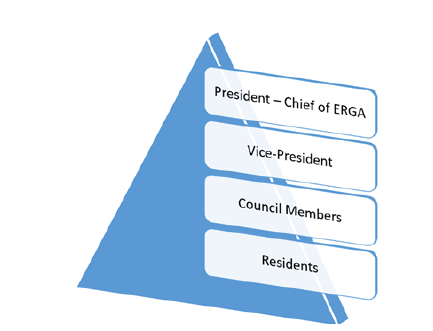
Figure 3 below presents the hierarchical structure of the deliberative management council studied, illustrating the decision-making organization regarding voting and the replacement of council members. It also highlights the perspective that, although residents do not have voting rights, they participate in these moments to enhance the transparency and legitimacy of the decision-making process, ensuring it aligns with the realities of these communities.
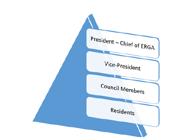
A minimum of three regular meetings are held each year to facilitate debate and voting on matters concerning the needs of the Conservation Units. However, when necessary, extraordinary meetings may be convened.
Local actors’ perception of the adaptive governance of the management council
The research instrument used to assess local actors’ perception of the management council was based on the key requirements of adaptive governance: information provision, conflict resolution, rule compliance, the availability of physical, technical, and institutional infrastructure, and the encouragement of adaptation and change.
Initially, some extractivist leaders reported difficulties in managing and disseminating information to other residents, attributing this issue to the absence or low level of formal education among the population. However, they emphasized their efforts to share information with those residents who are interested and actively participate in the council’s activities. Table 2 presents the characteristics of adaptive governance according to the perception of local actors.
When asked about the main challenges faced by representatives in managing associations and transmitting information, interviewee EC6 pointed out that financial reporting was the most significant difficulty. Closing accounts and submitting them for council review requires specific knowledge that extractivists often lack. As a result, financial statements frequently need to be voted on multiple times, delaying the implementation of new actions.
In line with Dietz et al. (2003), governance requires accurate and reliable information regarding decisions made in council meetings, as any incorrectly conveyed action can affect the outcomes of initiatives within the communities. When analyzing the interview responses, it becomes evident that there are differences among the studied Resexs. Some association presidents are more participatory and actively seek to address issues by gathering information to understand the needs of those they represent. This allows them to assess the extent of the problem, consider residents’ perspectives, and ultimately find a more effective solution.
According to interviewees ECM1, ECM2, and ECM3, some of the existing conflicts arise from residents’ failure to comply with the utilization plans, whether by engaging in illegal hunting, selling timber without authorization, or harvesting Brazil nuts without the consent of the entire community. Additionally, conflicts emerge when land invasions by squatters or land grabbers are identified in protected areas.
Regarding the existing infrastructure in the studied Conservation Units, interviewees ECM1, ECM2, and ECM3 highlighted discrepancies among the Resexs. In the past, some received greater economic incentives than others, which contrasts with the assessment by Dietz et al. (2003), who argue that physical and technological infrastructure is often overlooked, a reality observed among residents. However, these established infrastructure limitations have been gradually overcome with access to the internet, electricity, and improved roads, which facilitate access to nearby cities and, consequently, to health and education services.
As a result, the changes introduced by the council have had positive effects on the quality of life of community members. Many infrastructure projects are being carried out in the Conservation Units. For example, 90% of the reserves now have electricity, houses are being built, and the use of heavy machinery (per hour) is being funded to help extractivists expand their cassava plantations to supply agro-industries, thereby improving their income. Additionally, water tanks, tubular wells, and water distribution systems have been installed. However, not all Resexs have received these improvements, such as Rio Preto-Jacundá. Regarding conflict resolution, some issues among residents are settled through dialogue, as many have known each other for years.
According to interviewees in Resexs Itaúba and Rio Preto-Jacundá, the heterogeneity among residents is low. There are respected leaders who represent the needs of extractivists in meetings and engage with the secretariat responsible for managing the units. Their efforts help secure projects that enhance quality of life, provide training for residents, and improve the management of ongoing initiatives.
In Resex Maracatiara, according to the interviewee, the absence of a leader has negatively impacted the improvement of residents’ quality of life, as it is one of the Resexs where some residents still lack access to electricity. The overall heterogeneity is low, which helps prevent conflicts and facilitates addressing the group’s interests and objectives. However, in cases where diversity is higher, conflicts may arise, making it more challenging to align collective goals. Based on the interviews, no significant subgroups were identified seeking to defend particular interests. On the contrary, there is a presence of less formal leadership figures who, together with the residents, work to address difficulties and seek solutions for community challenges.
Communication among residents is face-to-face, which is a distinctive characteristic of these communities and essential for negotiations and the fulfillment of agreements. This feature was observed in the interviews and is an indispensable attribute, as it is through this interaction that trust among group members is established. Information is passed down from generation to generation, and these groups are relatively small.
Application of the proposed theoretical framework for adaptive governance in CUs
The theoretical framework was divided into three blocks to integrate all the constituent parts of the management council, aligning them with the theory used in the research. Thus, to address the general objective of the study, Figure 4 places at its center the key driver of the research: the actions of management councils and the perception of local actors. In response to the specific objectives, the figure illustrates the convergence between Conservation Units, collective action, and adaptive governance.
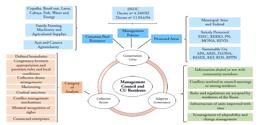
In the Conservation Units, three key aspects were explored: common-pool resources, management policy, and protected areas. Regarding common-pool resources, data collection identified three groups of shared elements among Resex members. The first group consists of forest products, such as copaiba, latex, Brazil nuts, calabash, fish, water, and energy. The second element is family farming, which includes the cultivation of cassava, bananas, corn, açaí, vegetables, and fruit trees. Another important aspect is the sharing of agricultural tools and supplies, which supports the cultivation of crops. Additionally, a recently inaugurated agro-industry for açaí and cassava has provided a new source of income for Resex families.
The third aspect identified within the Conservation Units, as shown in Figure 4, is protected areas, including those designated for sustainable use, such as Resexs. These areas balance nature conservation with the sustainable use of a portion of their natural resources, allowing for the presence of residents. This ensures both the protection of these areas and the possibility of generating a sustainable economy for the populations that inhabit them.
In collective action within management councils and residents’ perceptions of the CU, the following aspects were categorized: clearly defined boundaries, congruence between appropriation and provision rules and local conditions, collective-choice arrangements, monitoring, graduated sanctions, conflict-resolution mechanisms, minimal recognition of rights, and connected enterprises. Regarding clearly defined boundaries, a consensus was observed across the three studied Resexs, as their demarcations were established in the decree that created the units, and both residents and landowners are well aware of them. However, in terms of congruence between appropriation and provision rules and local conditions, a disparity was noted among the Resexs. Resex Rio Preto-Jacundá exhibits more structured conditions and better organization among residents compared to the other Resexs.
In collective-choice arrangements, differences were observed among the Resexs. Resex Rio Preto-Jacundá demonstrates greater organization compared to the others. However, it was noted that some residents of the units do not participate collectively in council actions but rather act individually, distancing themselves from the associations.
FINAL CONSIDERATIONS
The results indicate that there is still a long way to go before the reserves are perceived as productive units rather than merely as barriers to economic growth.
The training of Resex members has been a key factor in facilitating adaptive governance in a more natural and conscious manner, balancing the relationship between the ecosystem and the development of management practices by extractivists.
It was observed that there is a continuous effort to improve quality of life through the adaptability of these communities to the initiatives implemented by SEDAM. This adaptation to new practices occurs while maintaining traditional ways of life.
Another important aspect is the emergence and establishment of açaí and cassava agro-industries, which have introduced a new source of income for families. This has provided the necessary infrastructure for residents to remain in these areas while ensuring the protection of these regions.
Recommendations
It is recommended that the research be continued to complement the findings and include on-site visits to the studied Conservation Units.
Another suggestion is to expand the number of Resexs analyzed and compare different management approaches and the domains of adaptive governance. Additionally, incorporating Conservation Units under federal jurisdiction would allow for a comparative analysis of management practices.
It is also important to monitor the updating of management plans in accordance with socio-environmental dynamics and adaptive governance.
REFERENCES
-
Anderies, J. M., Janssen, M. A., & Ostrom, E. (2011). The challenge of understanding decisions in experimental studies of common pool resource governance. Ecological Economics, 70(9), 1571-1579. https://doi.org/10.1016/j.ecolecon.2011.01.011
» https://doi.org/10.1016/j.ecolecon.2011.01.011 -
Armitage, D., Marschke, M., Plummer, R. (2008). Adaptive co-management and the paradox of learning. Global Environmental Change, 18(1), 86-98. https://doi.org/10.1016/j.gloenvcha.2007.07.002
» https://doi.org/10.1016/j.gloenvcha.2007.07.002 -
Andrade, G. A. R. (2008). Estudo econométrico dos efeitos da migração para OIGC: índice de ações com governança corporativa diferenciada da Bovespa. Internext, 3(1), 39-53. https://doi.org/10.18568/1980-4865.3139-53
» https://doi.org/10.18568/1980-4865.3139-53 - Baland, J.-M., & Platteau, J.-P. (1996). Halting degradation of natural resources: Is there a Role for Rural Communities? Clarendon.
- Berkes, F. & Folke, C. (Eds.). (1998). Linking social and ecological systems: Management practices and social mechanisms for building resilience. Cambridge University Press.
- Berkes, F., Feeny, D., McCay, B. J., & Acheson, J. M. (1989). The benefits of the commons. Nature, 240, 91-93.
- Borrini-Feyerabend, G., Dudley, N., Jaeger, T., Lassen, B., Pathak Broome, N., Phillips, A., & Sandwith, T. (2017). Governança de áreas protegidas: Da compreensão à ação. IUCN.
-
Capelari, M. G. M., Calmon, P. C. D. P., & Araújo, S. M. V. G. (2017). Vincent e Elinor Ostrom: Duas confluentes trajetórias para a governança de recursos de propriedade comum. Ambiente & Sociedade, 20(1), 207-226. https://doi.org/10.1590/1809-4422ASOC20150135R1V2012017
» https://doi.org/10.1590/1809-4422ASOC20150135R1V2012017 -
Chaffin, B. C., Gosnell, H., & Cosens, B. A. (2014). A decade of adaptive governance scholarship: Synthesis and future directions. Ecology and Society, 19(3). https://www.jstor.org/stable/26269646
» https://www.jstor.org/stable/26269646 -
Cleaver, F., & Whaley, L. (2018). Understanding process, power, and meaning in adaptive governance: a critical institutional reading. Ecology and Society, 23(2), 49. https://www.jstor.org/stable/26799116
» https://www.jstor.org/stable/26799116 - Cole, D., & Ostrom, E. (2012). Property in land and other resources. Lincoln Institute of Land Policy.
- Creswell, J. W. (2014). Investigação qualitativa e projeto de pesquisa: Escolhendo entre cinco abordagens (3rd ed.). Penso.
-
Cysne, A. P. (2012). Modelo de Governança Adaptativa para Recursos Hídricos utilizando cenários climáticos (tese de doutorado). Universidade Federal do Ceará. https://repositorio.ufc.br/handle/riufc/3878
» https://repositorio.ufc.br/handle/riufc/3878 -
Dietz, T., Ostrom, E., & Stern, P. C. (2003). The struggle to govern the commons. Science, 302, 1907-1912. https://doi.org/10.1126/science.1091015
» https://doi.org/10.1126/science.1091015 - FAO/SEAD. (2017). Governança de terras: Da teoria à realidade brasileira. Organização das Nações Unidas para a Alimentação e a Agricultura. FAO; SEAD.
-
Feeny, D., Berkes, F., McCay, B. J., & Acheson, J. M. (1990). The tragedy of the commons: Twenty-two years later. Human Ecology, 18(1), 1-19. https://www.jstor.org/stable/4602950
» https://www.jstor.org/stable/4602950 -
Folke, C., Hahn, T., Olsson, P., & Norberg, J. (2005). Adaptive governance of social-ecological systems. Annual Review of Environment and Resources, 30, 441-473. https://doi.org/10.1146/annurev.energy.30.050504.144511
» https://doi.org/10.1146/annurev.energy.30.050504.144511 -
Hanna, S. S., & Bromley, D. W. (1993). Making the commons work: Theory, practice, and policy. American Journal of Agricultural Economics, 75(3), 862-863. https://doi.org/10.2307/1243610
» https://doi.org/10.2307/1243610 -
Holling, C. (2001). Understanding the complexity of economic, ecological, and social systems. Ecosystems 4, 390-405, 2001. http://dx.doi. org/10.1007/s10021-001-0101-5
» http://dx.doi. org/10.1007/s10021-001-0101-5 -
Kemp, R. P. M., Parto, S., & Gibson, R. B. (2005). Governance for Sustainable Development: Moving from theory to practice. International Journal of Sustainable Development, 8(1-2), 12-30. https://doi.org/10.1504/IJSD.2005.007372
» https://doi.org/10.1504/IJSD.2005.007372 - Kooiman, J. (1993) Social-Political Governance: Introduction. In: J. Kooiman, (Ed.), Modern Governance: New Government-Society Interactions (pp. 1-8). Sage.
- Lansing, J. S. (1991). Priests and Programmers: Technologies of power in the engineered landscape of Bali. Princeton University Press.
-
Lei n. 9.985, de 18 de julho de 2000. (2000). Regulamenta o art. 225, § 1o, incisos I, II, III e VII da Constituição Federal, institui o Sistema Nacional de Unidades de Conservação da Natureza e dá outras providências. https://www.planalto.gov.br/ccivil_03/leis/l9985.htm#:~:text=LEI%20No%209.985%2C%20DE%2018%20DE%20JULHO%20DE%202000.&text=Regulamenta%20o%20art.,Natureza%20e%20d%C3%A1%20outras%20provid%C3%AAncias
» https://www.planalto.gov.br/ccivil_03/leis/l9985.htm#:~:text=LEI%20No%209.985%2C%20DE%2018%20DE%20JULHO%20DE%202000.&text=Regulamenta%20o%20art.,Natureza%20e%20d%C3%A1%20outras%20provid%C3%AAncias -
Marques, M. A. J., Pacheco, R. C. dos S., & Giugliani, E. (2019). Governança adaptativa: Desenvolvendo capacidade de adaptação à mudança e resiliência. Anais do Congresso Internacional de Conhecimento e Inovação, 1(1). https://proceeding.ciki.ufsc.br/index.php/ciki/article/view/694
» https://proceeding.ciki.ufsc.br/index.php/ciki/article/view/694 - McGinnis, M., & Ostrom, E. (2010). IAD and SES dynamic flows: Program in institutional analysis of social-ecological systems (PIASES) framework. Proceedings of the 13th Economics Infrastructures Conference, Delft, Netherlands.
-
Ministério do Meio Ambiente. (2023). Plano de Manejo. https://antigo.mma.gov.br/areas-protegidas/unidades-de-conservacao/plano-de-manejo.html
» https://antigo.mma.gov.br/areas-protegidas/unidades-de-conservacao/plano-de-manejo.html - Moraes, E. A. de. (2009). Encontro na floresta... Interpretando o ecoturismo sob a ótica local na Reserva Extrativista do Cazumbá - Iracema (Acre - Brasil) (Dissertação de Mestrado, Universidade Federal do Rio de Janeiro).
- Oliveski, M. D. C. (2016). Governança ambiental em fenômenos relacionados ao complexo hidrelétrico do Rio Madeira (Dissertação de Mestrado), Fundação Universidade Federal de Rondônia).
- Ostrom, E. (1990). Govermimg the Commons (1st ed.). The University of Cambridge.
-
Ostrom, E. (2002). Reformulating the commons. Ambiente & Sociedade, 5(10). https://www.scielo.br/j/asoc/a/b9vdr8nFV3FNpnwtZNk86CC/?format=pdf⟨=en
» https://www.scielo.br/j/asoc/a/b9vdr8nFV3FNpnwtZNk86CC/?format=pdf⟨=en -
Ostrom, E. (2011). Background on the Institutional Analysis and Development Framework. Policy Studies Journal, 39(1), 1-21. https://doi.org/10.1111/j.1541-0072.2010.00394.x
» https://doi.org/10.1111/j.1541-0072.2010.00394.x -
Ostrom, E., Gardner, R., & Walker, J. (1994). Rules, games, and common-pool resources. University of Michigan Press. https://doi.org/10.3998/mpub.9739
» https://doi.org/10.3998/mpub.9739 - Ostrom, E., & Walker, J. (Eds.). (2003). Trust and reciprocity: Interdisciplinary lessons from experimental research. Russell Sage Foundation.
-
Ostrom, E., Walker, J., & Gardner, R. (1992). Covenants With and Without a Sword: Self-Governance is Possible. The American Political Science Review, 86(2), 404-417. https://doi.org/10.2307/1964229
» https://doi.org/10.2307/1964229 -
Partelow, S. (2018). A review of the social-ecological systems framework: applications, methods, modifications, and challenges. Ecology and Society, 23(4). https://www.jstor.org/stable/26796887
» https://www.jstor.org/stable/26796887 - Pereira, M. A. (2013). Gestão de recursos comuns no entorno de áreas protegidas: ação coletiva e desenvolvimento rural no sistema socioecológico (SES) do Parque Nacional da Serra da Bodoquena - MS. Tese (Doutorado em Desenvolvimento Rural) - Universidade Federal do Rio Grande do Sul.
- Poteete, A. R., Ostrom, E., & Janssen, M. A. (2011). Trabalho em parceria: Ação coletiva, bens comuns e múltiplos métodos. SENAC.
- Rosenau, J. N., & Czempiel, E.-O. (2000). Governança sem governo: Ordem e transformação na política mundial. Universidade de Brasília.
- Sengupta, N. (1991). Managing common property: Irrigation in India and the Philippines. Sage Publications India.
- Soares, C. C. S. S. (2015). Governança ambiental: Conceitos, abordagens, focos e lócus de pesquisa (Dissertação de Mestrado) Fundação Universidade Federal de Rondônia.
-
Sharma-Wallace, L., Velarde, S. J., & Wreford, A. (2018). Adaptive governance good practice: Show me the evidence! Journal of Environmental Management, 222, 174-184. https://doi.org/10.1016/j.jenvman.2018.05.067
» https://doi.org/10.1016/j.jenvman.2018.05.067 - Turner II, B. L., Matson, P. A., Mccarthy, J. J., Corell, R. W., Christensen, L., Eckley, N., Hovelsrud-Broda, G., Kasperson, J. X., Kasperson, R. E., Luers, A., Martello, S., Mathiesen, M. L., Naylor, R., Polsky, C., Pulsipher, A., Schiller, A., Selin, H., & Tyler, N. (2003). Illustrating the coupled human-environment system for vulnerability analysis: Three case studies (pp. 8080-8085). Proceedings of the National Academy of Science, USA.
-
Voss, J.-P., & Kemp, R. (2005). Reflexive governance: Learning to cope with fundamental limitations in steering sustainable development. Proceedings of the ESEE Conference - Special Session on Transition Management, Lisbon, Portugal. http://kemp.unu-merit.nl/pdf/Voss_Kemp_Reflexive_Governance_FUTURES.pdf
» http://kemp.unu-merit.nl/pdf/Voss_Kemp_Reflexive_Governance_FUTURES.pdf -
Zeijl-Rozema, A. van, Cörvers, R., Kemp, R., & Martens, P. (2008). Governance for sustainable development: A framework. Sustainable Development, 16(6), 410-421. https://doi.org/10.1002/sd.367
» https://doi.org/10.1002/sd.367
-
Funding
The authors reported that there was no funding for the research in this article.
-
Plagiarism Check
RAC maintains the practice of submitting all documents approved for publication to the plagiarism check, using specific tools, e.g.: iThenticate.
-
Peer Review Method
This content was evaluated using the double-blind peer review process. The disclosure of the reviewers’ information on the first page, as well as the Peer Review Report, is made only after concluding the evaluation process, and with the voluntary consent of the respective reviewers and authors.
-
Data Availability
The authors claim that all data used in the research have been made publicly available, and can be accessed via the Harvard Dataverse platform:Carolina Pante, Dércio Bernardes, Diego Cristovão Alves de Souza Paes, Alessandra Bastos, 2025, "Adaptive Governance in Conservation Units in the State of Rondônia - Brazil" published by RAC-Revista de Administração Contemporânea", Harvard Dataverse, V1. https://doi.org/10.7910/DVN/2YWLWGRAC encourages data sharing but, in compliance with ethical principles, it does not demand the disclosure of any means of identifying research subjects, preserving the privacy of research subjects. The practice of open data is to enable the reproducibility of results, and to ensure the unrestricted transparency of the results of the published research, without requiring the identity of research subjects.
-
Cite as:
Paes, D. C. A. S., Bernardes-de-Souza, D., Pante, C., & Bastos, A. M. (2024). Adaptive governance in conservation units in Rondônia, Brazil. Revista de Administração Contemporânea, 28(6), e240193. https://doi.org/10.1590/1982-7849rac2024240193.en
-
JEL Code:
H41, Q58
-
Peer Review Report:
The disclosure of the Peer Review Report was not authorized by its reviewers.

Edited by
-
Editor-in-chief:
Paula Chimenti (Universidade Federal do Rio de Janeiro, COPPEAD, Brazil) https://orcid.org/0000-0002-6492-4072
-
Guest Editors:
Mário Vasconcellos Sobrinho (Universidade Federal do Pará, Brazil) https://orcid.org/0000-0001-6489-219XMariluce Paes-de-Souza (Universidade Federal de Rondônia, Brazil) https://orcid.org/0000-0002-4202-0769Ana Maria de Albuquerque Vasconcellos (Universidade da Amazônia, Brazil) https://orcid.org/0000-0002-7594-3578Irma Garcia-Serrano (Universidad Central Del Ecuador, Ecuador) https://orcid.org/0000-0002-3907-9540Emilio F. Moran (Michigan State University, Estados Unidos; Universidade de Campinas, Brazil) https://orcid.org/0000-0001-5153-545X
The authors claim that all data used in the research have been made publicly available, and can be accessed via the Harvard Dataverse platform:
Carolina Pante, Dércio Bernardes, Diego Cristovão Alves de Souza Paes, Alessandra Bastos, 2025, "Adaptive Governance in Conservation Units in the State of Rondônia - Brazil" published by RAC-Revista de Administração Contemporânea", Harvard Dataverse, V1. https://doi.org/10.7910/DVN/2YWLWG
RAC encourages data sharing but, in compliance with ethical principles, it does not demand the disclosure of any means of identifying research subjects, preserving the privacy of research subjects. The practice of open data is to enable the reproducibility of results, and to ensure the unrestricted transparency of the results of the published research, without requiring the identity of research subjects.

 Source: Elaborated by the Authors.
 Source: Elaborated by the authors.
 Source: Elaborated by the authors.
 Source: Elaborated by the Authors.