
 A life dealing with water: women and urban water under occupation
ABSTRACT
This article analyzes the water infrastructure in the occupation of the West Bank and how its control unfolds in the lives of my interlocutors. By examining domestic water usage, we access two analytical scales. The first reveals the biopolitics of water control through Israel’s occupation of the West Bank. The second exposes the ways in which some women produce everyday life and how water management influences gender individuation processes. To do this, I resort to a “patchwork of stories and maps”. Through interviews and documentary and ethnographic secondary sources, it was possible to observe the impact of water control on the lives of Palestinian women. The constant quest for water and its management within families establishes a life “in function of water”, highlighting the role of care work in city construction.
KEYWORDS
Water; Gender; Palestine; Infrastructure; Care
RESUMO
Este artigo analisa a infraestrutura de água na ocupação da Cisjordânia e a maneira como o controle dela se desdobra na vida das interlocutoras. Argumento que, a partir da observação do uso doméstico da água, podemos acessar duas escalas analíticas. A primeira mostra a biopolítica de controle da água na ocupação de Israel sobre a Cisjordânia. Já a segunda revela as formas de produzir a vida cotidiana de algumas mulheres e como o manejo da água influencia os processos de individuação de gênero. Para isso, recorro a um “remendo de histórias e mapas”. Com base em entrevistas e em fontes secundárias documentais e etnográficas, foi possível observar o impacto desse controle da água sobre a vida das mulheres palestinas. A constante busca pela água e a administração desta dentro das famílias estabelecem uma vida em “função da água”, que ressalta o papel do trabalho de cuidado na construção da cidade.
PALAVRAS-CHAVE
Água; gênero; Palestina; Infraestrutura; Cuidado
Introduction
“I can take you up there if you want,”1 Saara told me as she picked up the cell phone she was using to video chat with me and walked to the terrace of her house. When she opened the door, the sudden glare revealed a beautiful green landscape of olive trees and a blue sky. As she moved the camera, I could see the huge water tanks that I often see in photos of Palestinian neighborhoods, and which were the subject of my conversation with her. These water tanks are an essential element in dealing with the crisis. By storing water for a longer period of time, they allow families to still have it whenever its supply is interrupted (Millington, 2018).
Nevertheless, these same water tanks create a series of problems: stagnant water leads to waste accumulation and produces significant extra weight on houses - which are now built and sold considering the tank as part of the structure to be bought. In the West Bank, specifically in Saara’s neighborhood of Ramallah, inequality is exposed by the water tanks in the landscape. In Israeli settlements, which receive continuous supply of piped water, buildings have nothing on their roofs. In Palestinian neighborhoods, on the other hand, a sea of tanks on top of houses make up the landscape. The sheer quantity of water tanks is shocking, as the comparison of the two landscapes in figure 1 illustrates. This contrast exposes the inequality levels in accessing water - subject of this article.

Comparative landscapes of the Har Homa settlement (1) and a Palestinian residential neighborhood in the West Bank (2).
When Saara returned to her living room and began to tell me how she managed her water supply, I realized that this discrepancy in access had a deep impact in her and her neighbors’ daily lives. Piped water is supplied only once a week and for a few hours. Sometimes it’s not distributed at all, it’s unpredictable. When the piped supply system is active, residents stay at home to be able to perform household chores that require larger amounts of water, such as washing clothes, cleaning yards and stairs, doing dishes, and watering plants.
In addition, the tanks need to be filled from time to time, and because they are above the houses, a pump is needed in order to keep the water flowing against gravity. This means that water pumps need energy. Since the power source is hydroelectric, it becomes intermittent when water is being supplied. In other words, turning on the water pump means one can run out of electricity, and these choices have to be made by dwellers on a daily basis. Throughout this article, I analyze the concept of “a life dealing with water”2, including the tasks of managing water distribution among the household inhabitants, defining the days in which each domestic chore will be done and, in times of scarcity, especially in summer, defining when and who will be able to shower.
Considering the tradition of a whole family living in the same house, these tanks often serve 10 or 12 people, including children, adults, and the elderly. How does one decide who will be able to use this water and who won’t? In cases of mains water shortages, which are fairly common, they negotiate with neighbors who have rainwater harvesting wells, go in search of water trucks or seek water from distant sources. All these tasks are carried out by women like Saara. Household and life organization revolve around dealing with water, characterizing a reality imposed by the occupation and managed by the men and women at home. Based on a gendered division of care work, women are mostly responsible for managing water usage and distribution whilst men maintain the piped infrastructure and search for water.
In this article, I argue that we can access two different analytical scales by observing domestic water usage. The first one illustrates the biopolitics of water control through Israel’s occupation of the West Bank. The second one allows us to access different ways of producing everyday life - as in the cases of Saara, Lilah and Hana, my interlocutors.
To develop this analysis, I use the “patching stories and maps” methodology, inspired by Hiba Bou Akar (2018) and defined by the combination of interviews and documentary research. By videoconference, I conducted five semi-structured interviews with three Palestinian women - Lilah, Hana and Saara3. I analyzed documents from the Palestinian Water Authority - such as maps, plans, water and sanitation strategies, statistics and regulations - and the Oslo Accords. In addition, I “patched” these methods with some field research (used here as a secondary research source), in particular, the extensive one produced by Amnesty International (2009) and by Michele Rudolph (2020).
Because they are exactly what allow us to mediate the scales of analysis, my starting point in this article are the water tanks. They are both outside and inside houses, they expose the scarcity and strategies used by the families, and for this reason they become an interesting analytical anchor4. The distinct problems and violations regarding water access are issues that will be dealt with throughout this article.
To do so, I link the theoretical-methodological debate on the anthropology of infrastructures with empirical work on the Palestinian-Israeli case. Both bibliographies lack an explicit and in-depth debate on gender, especially when it comes to the gendered effects of infrastructures’ control - water in particular - and the domestic life management strategies developed by women.
This article is carried out around three overlapping debates: the anthropology of urban infrastructures, Palestine’s occupation, and gender. Although it is rare to find texts associating these three issues, there are some tangents between them. Larkin (2020) starts his literature review on urban infrastructures by telling us that “Infrastructures are networks built to facilitate the flow of goods, people and ideas, enabling their exchange in space.” (p.28).
As I hope it is clear by now, my research questions this integrative notion highlighted by the author. The discussion that emerges with Susan Star’s (1999) pioneering work begins with small things - such as taps - and unravels into material networks of people and politics. As Araújo and Cavalcanti tell us:
From the point of view of the ethnography of infrastructures, a banal act such as turning on a tap imposes an interrogation of a network of materialities, techniques, processes, agents and social disputes that make it possible for water to circulate from its catchment to the sink (Araújo; Cavalcanti, 2023, p.8).
In this sense, the discussion is inspired by the actor-network theory and focuses on the networks constituted by infrastructures and on the notions of governmentality that they allow us to observe. Some field studies, especially those produced in the Global South or on the peripheries of the North, include conflict and biopolitics as a central point for observing such networks. Among a range of subjects of the anthropology of infrastructures, here I’m focusing mainly on water.
The seminal works of Anand (2017) and Von Schinitzler (2016) point to how the unequal distribution of water impacts urban peripheries and notions of citizenship in Mumbai and South Africa - respectively. Anand (2017) follows the distribution network and shows how even in homes with water lines and pumps there is a huge shortage of water and different strategies are needed to access it.
Von Schinitzler (2016) highlights the biopolitics of water by talking about how the installation of water meters introduces a rationality about water usage for residents. Despite these studies being important for theoretically and empirically analyzing biopolitics and the uses of water, they do not address places in conflict or talk extensively about gender. Although this debate is not an analytical key to his research, Anand (2017) briefly discusses the “water time” imposed on women, and I will elaborate on this throughout the text.
The relationship between water and conflict appears in Graham, Desai and McFarlane’s “Water Wars in Mumbai” (2013). They use water as an analytical tool to understand disputes and armed groups in Mumbai, but again, without mentioning gender issues. Pierobon (2021), Pierobon and Fernandes (2023), and Truelove (2022) discuss the anthropology of infrastructure, water, gender and conflicts. In the first two texts, the authors show us how water management and domestic life suffer the effects of drug trafficking faction conflicts in Rio de Janeiro.
Truelove (2022) talks about the “slow infrastructural violence” as a result of long-term conflicts. These texts, although central to my analysis, deal with very different forms of conflict from the one I am analyzing here. Israel’s occupation of Palestine produces a long-lasting conflict that translates into the biopolitics of control of the Palestinian population and, therefore, is interwoven into urban infrastructures.
The ways in which the occupation unfolds in Israeli water control have already been widely explored in the literature, which includes accusations of illegalities and international crimes committed by Israel in water management (Klawitter, 2007; Abouali, 1998; Malone, 2004) as well as the colonial authority hidden behind apparent institutional cooperation (Selby, 2003; Selby, 2013; Alsharif Et Al., 2008; Trottier, 1999; Ed; Mimi, 2010; Pandey, 2011; Amjad, 1999), denunciations made by international organizations (International, 2009) and fieldworks that analyze infrastructures and impacts on the Palestinian population that go beyond legislation (Rudolph, 2020; Stamatopoulou-Robbins, 2021; Naguib, 2009).
Most of these works are based on the notion that water is a scarce resource in the Palestinian region, creating a series of problems for the population. This is the result of an institutionalist perspective on the water issue, which focuses on the political arrangements established by the agreements and, in many cases, on the technicalities and the way water distribution should be done, but isn’t - which is why they always start from the perspective of a shortage. This leaves aside how distribution actually happens in the everyday and the arrangements that take place in the relationship between residents of the neighborhoods and water companies - or Israeli occupation soldiers. The way in which this control produces gendered effects and issues about private life are not mentioned by these authors.
Additionally, in-depth dialog with the anthropology of infrastructures can only be found in the works of Stamatopoulou-Robbins (2021). However, the author focuses on waste rather than water, and does very little to address gender issues. Naguib (2009), on the other hand, uses gender as a central point of analysis, highlighting women’s resistance in the water searching process. However, as the research takes place in rural rather than urban Palestine, it produces a theoretical debate much more focused on memory than on water infrastructure.
By establishing a dialogue between this literature and my fieldwork, I intend to contribute to the debate on the anthropology of infrastructures based on two central points. Firstly, by going beyond the notion of water as a scarce resource, understanding it as an abundant resource that becomes scarce due to the occupation’s biopolitical control. Here, water becomes an instrument of population control and often of violence. Secondly, I see gender as a central analytical tool for understanding private life in relation to public infrastructure usage . Beyond what some of the literature argues (Truelove; Ruszczyk, 2022; Anand, 2017), the care work involved in managing infrastructure is both a violent process that restricts the movement and organization of women’s daily lives, as well as something that reinforces the gender individuation of women and men.
In addition to this introduction, the article is made up of three more sections and some final considerations. In the next section, I briefly present the methodology used to develop this research and the alternative routes it has taken because of the COVID-19 pandemic. The impossibility of face-to-face fieldwork required creative solutions and the combination of different research materials that made the analysis possible. Next, I bring up the first analytical level of the research: from the water tanks to the public water supply system, showing how occupation establishes control over water’s distribution and sources. For the last section, we then return to the water tanks and enter the houses to observe domestic life and elaborate on the construction of a “life dealing with water”. Based on my interlocutors’ experiences and the research I mobilize as an additional source of investigation, I follow the path of the search for water and observe how it is often interrupted by the destruction of infrastructure by occupational forces. Finally, I conclude by elaborating on the relationship between the temporality of war, the control of infrastructures and the gendered effects that both produce.
The research’s kitchen
During the course of this research, I conducted interviews with Saara, Lilah and Hana (Lilah and Hana are mother and daughter), which now I will describe in more detail. All three are older women, with children of their own, who have closer ties to the Ramallah region of urban Palestine. All three also went to university, married Palestinian men and have Palestinian parents/family, which directly affects their relationship with the region.
The women I interviewed were all Palestinians with some connection to Brazil, so they spoke Portuguese fluently. Initially, I wanted to understand their perceptions of violence in Palestine. They always told me that they felt safe there and that the “real problem” was urban mobility and access to water. This cross-section of Palestinian-Brazilian women directly influences the analysis, since Palestinian women who came to Brazil as refugees or who were born here have this country as some kind of a hidden reference in their conversations about Palestine. Because their reference points and experiences are different, Palestinian women that are somehow related to other countries - either by being born there or by immigrating to them - will have a different perspective on violence, security, and war. So, explicitly or implicitly, the perception of life in Palestine is always based on a comparison of experiences.
Lilah is a 61-year-old dentist who was born in Palestine and came to Brazil as a refugee at the age of 8. She has always maintained a close relationship with her homeland. When her eldest daughter, Hana, moved to Ramallah in the West Bank, she started visiting her every year. Hana was born in Brazil, but her whole family is Palestinian. She is around 40 years old and is a dentist, just like her mother. She moved to Palestine after getting married and has been living there for a few years, still without any permanent documentation. Saara is a 60-year-old historian and tour guide who was born in Brazil and moved to Ramallah in her early 20s with her husband. Through the lives and stories of these women in the West Bank, I tried to understand how their daily routines are affected by the occupation and the control over water access.
The interviews were conducted during the COVID-19 pandemic, an event that deeply affects this research due to the need for remote fieldwork. Despite the impossibility of face-to-face ethnography, the popularization of video calls for communication allowed the research to be carried out, albeit with analytical limitations. For this reason, I opted for a methodology that combines interviews with documentary research, thus developing a process of “patching stories and maps” (Akar, 2018).
Through the interviews, I built up an index of these women’s concerns, trying to understand which were the main urban problems that affected their daily lives and how they dealt with them. The two main areas of concern were mobility in the territory5 and access to water. From then on, I turned to document analysis as a secondary source of research to deepen the investigation.
The interviews were all conducted by video calls over the course of two years of research. I spoke informally with my interlocutors for some time before interviewing them by video call - a method that was chosen because I knew it would be comfortable for them. The interviews were conducted in a life story format and were divided into two parts. First, they told me about their relationship with Palestine, their families and what life was like there. Then I asked them questions about their daily lives and their relationship with the occupation. When I realized that water distribution was a central issue, I tried to find out more information through follow-up interviews about how they dealt with the difficulties in accessing water.
Of course, the concerns of my interlocutors should not be generalized to the whole of the West Bank, but they do help us to observe a certain nuance of the occupation that is usually overlooked: the way it infiltrates through infrastructures.
With this in mind, I turned to documents to understand how this penetration took place. I analyzed the Palestinian Water Authority documents, the Oslo Accords, and field research that is used here as a secondary source (Rudolph, 2002; Internacional, 2009). The argument presented in this paper is the product of piecing together this puzzle of documents and memories.
From the sources to the water tanks
Before water reaches the pipeline that transports potable water from the main water distribution line to my interlocutors’ house, it travels a long way from its source. This path crosses different power disputes and scales - from international to municipal politics - culminating in the water control operated by the occupying government. Throughout this section, the reader will walk this “water path” with me in order to understand why “the water is distributed only once a week for a few hours”, as Saara said.
Let’s start with the water sources. The configuration of water as a device of life and control begins with them. Intertwining the underground of Israeli and Palestinian territory, the Mountain Aquifer is the only water source still available to the Palestinian people and the most important one for Israel. It is made up of three main basins - or aquifers -: the Western, the Northeastern and the Eastern. Its waters are mainly renewed by rainfall and snowmelt, and are characterized by a great depth (an average of 250 meters).
The total yield of the Aquifers averages from 679 to 734 MCM/Y6 , with the Western Aquifer having the highest capacity (362 to 400 MCM/Y) and the highest water quality, thus supplying a fifth of Israel’s fresh water. The Eastern and Northeastern Aquifers are located almost entirely in the West Bank. The Coastal Aquifer, on the other hand, has a capacity of 450 MCM/Y in Israel and 55MCM/Y in Gaza, and is the only source of water in the Palestinian Strip. Because of it, extraction from this aquifer far exceeds its capacity and its waters are now 90% contaminated7 and unfit for consumption (Rudolph, 2020; International, 2009).
The Jordan River is another important water source for the region. Its basin is shared between Lebanon, Syria, Jordan, and the West Bank. Its waters are not only of historical and religious importance, but are also a significant source of water and energy for Israel. In this case, it is only for Israel, because Palestinian access to the Jordan River is completely forbidden. Since the 1967 occupation, this entire bank has been classified as a security zone8, so the palestinian access to the river has been prohibited, which means that they aren’t even allowed to get near it.
With an exploration rate of 64% of its capacity9, the river has also had its flow diverted by the countries that make up its basin in order to generate electricity. This movement has led to a flow reduction, making its water highly salinized and contaminated by untreated sewage (International, 2009). Thus, the Palestinian population has only one source of water, the Mountain Aquifer.
As a way of compensating for this shortage and the difficulties of getting permits to build newer and deeper wells, Palestinians families and municipalities have started buying water from the Mekorot company, which is delivered mainly through the cities’ networks of water mainlines. Nonetheless, this piped supply is also inefficient - due to the old aged pipelines and the loss of 34% of the water supply during its transportation. In villages and refugee camps, most of which are not connected to these mainlines, water is bought from water trucks (either from Mekorot or from private Palestinian citizens who fetch it from the few sources still available).
This difficulty in accessing water is directly related to the way in which the occupation controls urban infrastructures. Military control of the region and power inequalities permeate rivers, aquifers, pipelines and even rain (especially regarding the way it is stored). Recalling the idea of biopolitics (Foucault, 2012), we can think of water not only as a device for managing life, but in the Palestinian case, for letting people die.
Thus, I assume water as an infrastructure that is fundamentally mobilized as one of the many Israeli biopower instruments. In this sense, it culminates in the building of a life that is always “dealing with water”, but also in the building of daily alternatives to the “shortages”.
From the moment water is extracted from its source, it has to be treated and distributed to the population of both countries. This is a moment when power disputes are intertwined, ranging from international politics to municipal arrangements. As Saara pointed out in our conversations, the Oslo Accords were very damaging to Palestinians lives, precisely because they prohibited autonomy over water. This includes constraints on drilling artesian wells for Palestinians while “the illegal settlements build these artesian wells close to Palestine’s natural water sources and then they draw all this water for themselves while us, in many cities here, who used to get our water from these sources that nowadays are dry”. She told me that the water is “stolen” by Israel from Palestinian sources and then resold to the Palestinian government to be redistributed to the municipalities. We will now briefly dive into this process of water distribution.
The Palestinian and Israeli water infrastructure in the West Bank is managed by a body that unites ministries, joint agencies and companies, as figure 3 illustrates. The system is divided into four phases: planning (policies, development and regulation systems), supply, distribution and consumption. In the first phase, the Joint Water Committee (JWC) reviews applications for permits to manage wells, drill new ones, and for general water extraction from both Mountain Aquifer and the rainwater reserve10.
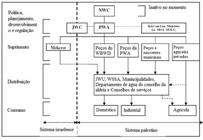
The committee was created during Oslo II and was supposed to last only 5 years until the transition from this administration to the Palestinians was completed. In practice, it continued to exist, still without any prediction for changing. Selby (2013) analyzed this issue and showed that until 2013 all Israeli requests were approved by the Palestinian Water Authority (PWA) whilst Israel vetoed all requests for new wells and delayed approved maintenance and restoration works. Adding to this asymmetry, even when approved by the JWC, any project in the C11 area can be vetoed by the military government of the occupation, with the imposition of bureaucracy and violence throughout the process.
The PWA also approves and regulates water issues in the Palestinian water mainlines distribution system, but in a subordinate way to the JWC and in dialogue with the Ministry of Agriculture (MOA) and the Ministry of Local Governance (MOLG). The second phase, supply, is organized in four ways. First one includes both farmers’ private wells, which store rainwater and are used to irrigate crops, and private wells that have not yet been contaminated since the measurements made in 1967. The second organization section includes wells and springs administered by municipalities; then PWA wells, which provide distribution mainly to cities; followed by WBWD wells - that are mostly contaminated due to being very old. There’s also Mekorot, which owns some wells but also sells to the PWA.
In the distribution phase, the urban areas are mainly covered by the Jerusalem Water Company (JWU) and the Water Supply and Sewerage Authority (WSSA), while in rural areas, municipal councils and private individuals take care of distribution.
This complex configuration that overlaps Israeli and Palestinian instances is a legacy of the occupation and the Oslo Accords. In 1967, water disputes became part of the occupation and colonial control. In August of the same year, the military government issued Order 9212 granting the Israeli army with full authority over water issues in the Occupied Palestinian Territories (OPT). A few months later, Order 158 stipulated that Palestinians could not build water facilities without obtaining a permit issued by the army, and that any construction that didn’t have a permit could be demolished.
The land and water arrangements that existed prior to the occupation were annulled by Order 291 of December 1968. This bureaucratic set-up meant that the drilling of wells and the construction of pipelines and water tanks had to pass Israeli scrutiny. At the same time, new settlements were being established under civil law, i.e. without these Orders being valid for them. This means that the same territory is constituted by different legal parameters and on the basis of a hydrological apartheid (Graham; Desai; Mcfarlane, 2013) that actively denied access to water for a large part of the Palestinian population.
Additionally to the issuance of Military Orders, the occupation government took control of the West Bank Water Department (WBWD)13, which controlled approximately 13 wells and sold water to Palestinian communities and Israeli settlements. This urban water infrastructure once controlled by the military government was handed over to Mekorot14 in 1982. In the early 1990s, the Oslo Accords institutionalized Israeli hydro-hegemony over water sources (Rudolph, 2020).
The Palestinian Authority (PA) is responsible for managing the Palestinian supply, buying water from Israel and distributing it to the Palestinian population mainly in areas A and B, and for maintaining the existing water infrastructure. In places where there are no pipelines or where maintenance is needed, the PA is also responsible for arranging water trucks that provide water supply to the villages and neighborhoods. Nevertheless, in most cases, this supply is done by private trucks and by the organization of the population itself (Rudolph, 2020; International, 2009).
This resource control and the complex asymmetry in a non-cooperative system have impacts on Palestinians daily lives. Due to the many different restrictions on water, the population, which was mostly rural and made its living from agriculture, began to seek employment in Israel as low-skilled workers, which deepened Palestine’s economic dependency (Huberman, 2020; International, 2009; Rudolph, 2020). In addition, the constraints also create a series of water insecurities for the population.
According to Rudolph (2020), the main impacts of controlling access to water are related to quality, distance and time spent collecting water; price and accessibility; availability and reliability; and security (the latter being a specific result of occupation). These insecurities create a “life dealing with water”, which has a significant impact on women’s lives.
From the water tank to the house
“In my town, for example, we only get water once a week and for a few hours, okay? So on the day the water comes, you have to spend the day dealing with water, you can’t go to work...” (excerpt taken from interview with Saara)
The idea of a life “dealing with water” comes from what Saara said when she told me about the problems arising from the Oslo Accords. She then described how she has to organize her days when piped water is supplied: doing laundry, cleaning stairs and windows, watering plants, and washing her hair. Everything must be done while the water is in town. Water tanks also must be filled during this time, always thinking about the cost/benefit ratio that the need for a pump causes. All these weekly calculations about what to do during the seven hours of water supply in Saara’s house are made by her. During this period of time, “there’s no way you can leave the house [...] you’re stuck there”, and during all the other days of the week, calculations have to be made so that the family doesn’t run out of water. During summer, water time is shorter and the situation becomes more critical.
First, the population has to demand that their homes be connected to the pipes’ network, then that they receive water with sufficient quantity, quality, and pressure in order to make it possible to consume (Anand, 2017). Beyond that, this supply is always subject to the implications of the occupation that does not see Palestinians as citizens. Sometimes, when all the house’s pipelines and infrastructure are fully functional, water tanks are used as training targets by the Israel Defense Forces (IDF). At other times, part of the network is bombed by some conflict, which takes the families back to square one.
Observing how my interlocutors deal with water-related household chores helps us understand the biopolitical control produced by the occupation, which incorporates urban infrastructures into the war (and dialectically incorporates war into everyday life). As presented in the previous section, here I intend to follow the path of water search, going through the domestic administration of this resource and the army’s destruction of water-supply networks. In addition, I would like to point out that the process of obtaining water is also one of individuation and reification of gender (McCallum; Bustamante, 2012). Because of this, it is possible to see a profound aspect of the occupation from a woman’s perspective.
So we began our journey in search of water. As we’ve already mentioned, piped water is only delivered once a week and for a few hours. In the week I spoke with Saara, the water supply was available for seven hours. When I asked Saara how she dealt with this situation, she told me that she stored water in tanks and took me up to the terrace to see, as I exposed at the beginning of this article. As she climbed up, she kept talking to me:
But of course we only wash clothes once a week, we don’t wash more than that. Dishes, for example, I only turn on my machine, the dishwasher, when I’ve run out of plates, cutlery, nothing else, the machine is overloaded (Excerpt from interview with Saara).


The image of the tanks on the terrace is noteworthy. They have a plumbing system external to the house and consisting of a pipe and some wiring around it. It transports water from the street to the concrete slab that makes up the terrace. The hot water tanks have a kind of compressor at the base helping to heat the water without using too much energy. Although Saara lives with only her nuclear family in the house, her husband and two children, she has five water tanks. As she tells me, on the day of the piped water delivery she has to undertake a series of household chores that require water: washing the house, stairs, and clothes, doing dishes, watering plants, etc. Over time, knowing that water would be supplied only for a short period, she has acquired tools and materials to help her with managing those tasks. The dishwasher mentioned above is an example, which was bought so that she could store dirty dishes for longer and not waste water. The tanks were a family investment, made possible through the work of Saara and her husband.
On days when the mains water is supplied, she stays at home to carry out the housework. Her husband helps a lot with the housework and they usually take turns. But on “water days” she prefers to stay at home while her husband works at the office and the children go to university. Hana gives me fewer details about housework’ division in her place, but tells me that her daughters usually help her with the housework and that it’s easier to manage this situation since her job is near their home and she’s able to make her own timetable.
Water supply is a source of great uncertainty, because residents don’t know for sure the day and time when it will be delivered; in some places we know that it is delivered once a week, in others, not even that. A woman in the Aqbat Jaber refugee camp told Rudolph (2020) that “I know it will arrive today or tomorrow [...] because it hasn’t been delivered since last Thursday” (p. 34). Filling the tanks and ensuring water’s supply and storage also depends on location and the pressure with which the water is delivered.
Saara tells me that “the water is often supplied with a very low pressure, so people can’t store it”. Many houses connected to the same water network can’t fill their tanks or have an even more intermittent supply - as in the case of Fasayil, a municipality where only one family has water supplied by Mekorot, even though they are all connected to the same water network. This is because, according to the father of the family, “our house is close to the main pipeline, so the location is good” (Rudolph, 2020, p.34). Saara also points out that the pressure decreases between cities: the further away from the wells, the lower the pressure and the greater the need for pumps.
When families’ houses are not connected to the pipe distribution system, either Mekorot’s or AP’s networks, their search for water becomes even more complex. It involves a conjunction of going long distances to reach the sources, time spent collecting water, its availability and price (which is even higher than piped water) (Rudolph, 2020). This way, if water does not reach homes through the formal pipeline infrastructure, people themselves become the infrastructure by fetching water in different ways (Simone, 2004; Truelove; Ruszczyk, 2022). The use of water trucks has become a common practice because it helps to fill these distribution gaps with larger quantities of water than individual families fetching directly from sources. But buying water from this improvised source is even more expensive15 than piped water:
We pay about 30 shekels for 1.5 cubic meters (1500l) when he brings water to other families as well. If he fills only our tank, then he asks for maybe 50 or 60 shekels - since he must come all the way just for us (Rudolph, 2020, p. 34).
In this family’s case, they buy water from a person who owns a truck and charges for the supply, a trade that has become extremely common in the region. When they can’t afford to buy this water, they find ways of fetching it themselves. The path of this search can be tortuous because the roads are often unpaved (so the trucks have to travel very slowly when they are loaded) and the checkpoints create obstacles along the way, making it necessary to take detours so that the water doesn’t get confiscated by occupation authorities. In my interlocutors’ cases, the search for water usually takes place at a water well near their homes in a field of olive trees. The problem is that the field is very close to a settlement and sometimes acquiring that water can be very dangerous. Because of this, and since they have cars, they prefer to go even further. Although this is a good alternative, cars can’t transport as much water as trucks. The cost of fuel and the long hours it takes to search for water turns it into an expensive journey:
We have to travel a long way to buy water and bring it to the village by tanker. With the cost of transportation, water costs 15 NIS per m3, which is three or four times what it would cost if we had a connection to the water network or a well in the village. It’s unaffordable (International, 2009)
These trips take up hours of one’s day, and since the storage capacity of cars is small, they usually need to be made every three or four days. This means that every three or four days one of the family members in the household needs to be responsible for finding an available water source, pumping the water from it, finding the best route back home (thinking about fixed and mobile checkpoints), calculating the fuel needed16, transporting water along unpaved roads and restocking the household. Since most of the time families don’t own their own trucks or tractors, the list of duties and expenses also includes the rental of a vehicle. In summer, the intervals for having to search for water are even shorter due to the heat and consequent greater water consumption. It’s interesting to note that the search for water made by truck is usually done by men, especially when the sources are further away. When they are closer, and the problem is mainly the lack of a functional plumbing system, women fetch the water in smaller containers and make numerous trips - which is the case of my interlocutors at the water well. Routine, then, is built around “water time” (Anand, 2017). Family budget, domestic duties and even working hours are at the mercy of water availability and, consequently, of Israel.
This domestic work regarding water access and usage involves women manually working to build the rhythms and routines of daily life. The precariousness of water distribution networks and the instability of its supply mean that families’ routines depend on someone being at home, collecting the water and managing its use for the different functions in which it is essential. This person is responsible not only for searching for water, but also for thinking about how they will be able to wash, clean, make food and, more broadly, reproduce life on a daily basis. This is all while considering the small amount of the resource that they have available. Most of the time, this person is a woman (Anand, 2017; Truelove; Ruszczyk, 2022).
As McCallum and Bustamante (2012) show, house management leads to a process of gender individuation, in which women, in order to construct their femininity within the configuration of houses that surround them, need to have their own house and coordinate it; while men, in order to construct their masculinity, need to provide for that house and for their family. Water management is part of this process of reinforcing individual gendering. When my interlocutors say that they prefer to stay at home to be in charge of water duties themselves, they show me the importance of this process for them as the “women of the house”.
Saara tells me that she prefers to do this because “it’s my [her] way”, and her husband comes to help when there’s a need to “fix something in the pipeline” that will transport water to the tanks. Fixing the pipes then becomes a task that reinforces Hadi’s place as the man of the house. It’s important to note that my interlocutors don’t see these domestic roles as oppressive because of their gender, but rather because as Palestinians they have to do this kind of work considering Israel’s control. The gender division of roles is seen as a way of dealing with the occupation imposed on them and the care work is understood as part of life.
Pierobon (2021) sees this care work as being crossed by a series of multi-scalar negotiations involving individuals, associations and the state itself, in an intertwining of the legal, the illegal and the state’s illegibility. Based on fieldwork conducted in a popular occupation in Rio de Janeiro, the author points out that gender is central to analyzing the enormous effort made to “maintain social life in face of the instability that characterizes their lives” (p. 4) and also to blur the lines between public and private - highlighting the permeability between the construction of her interlocutor’s personal life, the state-practices and the armed groups’ actions that control the territory. Rudolph (2020) also highlights the gendered bias of water insecurities when she heard her interlocutors saying that women needed more water:
As a percentage, I face about 8% of the problems with water; 92% are faced by my wife [...] because she needs more water. [...] I only go to the hills [with the sheep]. She gets up at 4am; she starts making milk, cheese and yogurt. Then she starts making breakfast. [...] After that she starts cleaning, doing the laundry, bathing the children and then making lunch for me and my children. [...] In the evening, she helps me feed the animals. All day she’s like a machine. She works from 4am until midnight. (Rudolph, 2020)
They also said that individually they needed more water because of their longer hair (especially Muslim women) and because of “women’s things”, referring to their specific needs during the menstrual cycle. Thus, even though water insecurity is widespread among the Palestinian population, there is a gendered social division of these impacts that affects women’s daily lives on different levels: from the political, to the familiar, to the most intimate and personal.
In many cases, the death or imprisonment of men leads to a process of family impoverishment and intensification of water-related problems. This is because women then have to manage the water supply in their homes and also find the financial means to pay for it. As a result, the division between women’s and men’s roles regarding water supply, which would be complementary, becomes blurred. This is the case of Fatma Zein, interviewed by the human rights organization B’Tselem:
I’m a widow with six young children, three boys and three girls, aged between 6 and 12. My husband was killed in 2003. His two daughters from his first wife, who died, live with us. We live in a small house in Yatta. The only income we have is a quota of 1,000 NIS per month that we receive from a charity in Yatta. This sum is not enough to pay for food for nine people. In addition to our income problems, we also suffer from a lack of water, as do most of the city’s residents. The shortage affects every aspect of our lives. We are connected to the city’s water network, but since January 2008 we haven’t received mains water because we live at a high altitude and the water pressure is insufficient to reach us. We buy all our water from tanker trucks. The city sells water at a rate of 120 NIS per ten cubic meters. You have to wait your turn, and we only get water once every twenty or thirty days. That’s often not enough, so I have to buy water from private tanks, which charge 170 or 180 NIS. It’s difficult for us financially, but we have no choice. I save a lot of water. I always warn the children not to waste water, and I tell them to pay attention to every drop of water they use. The children already know that they need to save water. Every two children are given a bucket of water to bathe in. We have carpets on the floor all year round, so I don’t wash the floor. This saves water. I haven’t washed carpets or blankets for more than two years. I use a washing machine that uses less water than other machines and I use the shortest wash cycle to save water, even if the clothes don’t come out clean enough. My husband’s son lives next door and sometimes asks if he can have some of our water. Sometimes we don’t have enough to give him. We’ve got used to living like this because we have no choice. When my husband died, we owed the city NIS 4,500 for water and NIS 5,000 for electricity. I don’t have the money to pay these debts and I’m afraid they’ll disconnect us. We don’t get mains water, but I’m afraid they’ll cut off the electricity. The house is surrounded by more than two dunams of land. If we had water, we could grow crops and generate some income that way (B’Tselem, 2009)17
High prices are a constant complaint and a factor that profoundly affects the search for water. Saara tells me that the pipe route of water distribution makes it more expensive: “It’s taken from the groundwater of the Palestinian state, taken to Israel and sold back to the Palestinians”. For her, this water is stolen from the Palestinians and generates a huge profit for Israel because “we pay much more than we would if they didn’t steal it”. The price of a cubic meter of water in the West Bank is between 4 and 10 dollars, and in many cases the water bill takes up almost half of a family’s monthly income. When the cost doesn’t come as a water bill - for example due to the lack of a plumbing system - it comes as vehicle’s rent and fuel, an amount of money that is spent to collect and transport water with trucks. Besides that, since the highest quality water is always located at greater depths, pumping it out means a huge expense.
On their way to find water, residents must always be aware of the possibility of crossing paths with the Israeli army. Water facilities’ and networks’ destruction happens during military operations, both as sabotage and retaliation, or when the infrastructure has been built without the JWC permits - which are difficult to obtain. This reflects an insecurity that permeates the search for, the maintenance and the repair of water networks’ pipes, leading to a situation of constantly having to rebuild the domestic water supply lines and sometimes the entire water infrastructure.
These water pipelines run through the Palestinian territory, underground and above ground, feeding tanks and distributing water to different regions. The water tanks sit on top of houses and buildings. Rainwater collection wells are displayed in the backyards of houses. Artesian wells, legal or not, pump water against gravity on a daily basis. And all this infrastructure can be destroyed in the blink of an eye by bombing, forced demolition or sabotage by the army and settlers.
Hana tells me that the destruction of water infrastructure happens especially when “they attack refugee camps”. The common destruction of houses during army attacks on camps destroys the water supply network, which is very costly to rebuild: “It takes months to get the money and people end up not drinking water for months”. In addition, the weight of Israeli bulldozers often bursts pipes during military incursions. During times when there is a declared war in the region, the infrastructure is sabotaged with water contamination by sewage or by the bombing of water facilities and pipes.
But this destruction isn’t limited to conflictive events, it’s a daily occurrence. The water tanks that are so essential to Palestinians’ lives also generate vulnerabilities to their houses. Since 2002, water tanks have been the target of frequent attacks by the Israeli army, mainly as target practice. As one Israeli soldier told Amnesty International:
Water tanks are good for target practice; they’re everywhere and just the right size for aiming and calibrating your weapon, for relieving your frustration, for teaching a lesson to the neighborhood kids who threw rocks at you and you couldn’t catch, or breaking up the monotony of a period of guard duty. (INTERNATIONAL, 2009, p.61)
In other words, the tanks that only exist as an alternative strategy to compensate for the major problems in accessing piped water are still pierced by Israeli bullets for fun, idleness or as a form of “lesson”. For soldiers, it’s fun to “see how they explode” (Rudolph, 2020). Another common action is sabotage by Israeli settlers, who hinder the Palestinian’s access to water in different ways. Shortly before one of our conversations, Saara told me on WhatsApp that she was harvesting in the olive groves but that it was getting more and more difficult in the field where she was, since there was a settlement nearby and armed settlers started moving in the direction of the water source that Palestinians usually use during harvest time. She also told me that “when they don’t throw bombs, there are settlers to scare us”, a fear that is mainly the result of the heavy arming of civilian populations in settlements. Apart from the threat of physical violence, other forms of sabotage are reported, such as dumping of toxic substances in water sources or rainwater wells, using nails or iron spikes on the roads that the water trucks travel on, disposing children’s diapers and dead animals in water reservoirs or even cutting and destroying exposed pipes (Internacional, 2009).
Final considerations
Understanding the paths through which water travels in the West Bank helps us to understand the multiple impacts of the occupation in Palestinians’ lives. As an instrument of Israeli biopolitics, water is controlled in every step of the way, from the divided and over-exploited sources, to the Jordan River with forbidden access, to the rainwater that cannot be collected due to restrictions. In distribution, there is the control over water pipes’ maintenance, the prohibition of artesian wells drilling and the concession of urban water distribution to the Mekorot company. This complex patchwork of mechanisms expresses an attempt to control the possibility of maintaining life.
In day-to-day practices, this biopower is diluted and complexified by the multiple alternative arrangements made by Palestinians in order to get water to their homes and to be able to manage its distribution. With this constant search for water, making a living every day means having “a life dealing with water”. Making daily calculations about water supply and coordinating its usage in the household is primarily a female task.
This care work has two central ramifications. On the one hand, it interferes with these women’s construction of everyday life. How can they plan a day without knowing when water is going to be available? How can they plan meals, decide when to leave the house and coordinate a family’s entire routine without knowing for how long the water supply will last? This ontological insecurity produced by water control shows us that, in this scenario, water is a device for life control and population control.
On the other hand, water management is also a form of gender individuation. In the process of organizing everyday life according to the water resource availability, my interlocutors also go through a process of differentiation that places them as the person responsible for managing the family and their home. In the same sense, when they - and eventually their daughters - take on the day-to-day management of water supply and delegate the maintenance and costs of infrastructure to their husbands or sons, they also reinforce the gender individuation of men in their family and their community.
For this reason, the methodological choice of working only with women helps us understand the consequences of the occupation in families’ daily and intimate practices. The problems that arise in my interlocutors’ everyday lives are multiple, but water has a central position because it demands a huge amount of time and countless uncertainties. At this point, I believe the debate presented here helps us to illuminate two points about the anthropology of infrastructures. Firstly, going beyond water as a scarce resource in urban peripheries, I have pointed out how it is a biopolitical instrument of population control and often of violence.
By understanding the specific configurations that are formed by the water distribution reality in Occupied Palestinian Territories, we can see that the different levels of control lead to life, but also to death. With these water restraints, the occupation seeks to produce a daily precariousness that allows for it to infiltrate all aspects of Palestinian life.
Secondly, I’ve tried to show how this water handling, based on occupation control, becomes entrenched in people’s daily lives, transforming individual aspects while also producing gender. By going beyond what part of the anthropology of infrastructure bibliography argues, that water management is a form of violence against women, I sought to observe how it reflects both processes of violence and the production of life. The long occupation establishes a need to create and manage life in the midst of a controlled environment. Therefore, at the same time as there is a biopolitics that controls the “livings and dyings” in this space, there is also the construction of gender individuations in everyday life “dealing with water”.
Thus, in their constant search for water, women are essential to the water infrastructures’ management. Their daily care work is dedicated to organizing water usage in their homes, so they are central to the action of Israeli control, since by having a life that is devoted to water it becomes more difficult to devote life to other things. At the same time, life dealing with water is part of the construction of being a woman - and a man - in Palestine, articulating the relationship between caring for the home and genderization. In this sense, having a “life dealing with water” became a fundamental part for my interlocutors’ building of relationships within their families and with their neighborhoods, producing alternative ways of inhabiting the occupation.
References
-
ABOUALI, Gamal. 1998. “Natural resources under occupation: The status of Palestinian water under International Law”. Pace International Law Rewiew, 10(411): 165. DOI: https://doi.org/10.58948/2331-3536.1265.
» https://doi.org/10.58948/2331-3536.1265 - AKAR, Hiba Bou. 2018. For the war yet to come: Planning Beirut’s frontiers (1st edition). Stanford, California, Stanford University Press.
-
ALATOUT, Samer. 1º dez. 2008. “‘States’ of scarcity: Water, space, and identity politics in Israel, 1948-59”. Environment and Planning D: Society and Space, 26(6): 95982. DOI: https://doi.org/10.1068/d1106.
» https://doi.org/10.1068/d1106 - ANAND, Nikhil. 2017. Hydraulic city: Water and the infrastructures of citizenship in Mumbai Durham; London, Duke University Press.
-
BALLESTERO, Andrea. 21 out. 2019. “The anthropology of water”. Annual Review of Anthropology, 48(1): 405-21. DOI: 10.1146/annurev-anthro-102218-011428.
» https://doi.org/10.1146/annurev-anthro-102218-011428 - BUSHNAQ, Rawand Bassam Othman. 2004. Implications of water management policies on water poverty in Palestine Faculty of Graduate Studies, An-Najah National University, Nablus, Palestine.
-
FREIRE-MEDEIROS, Bianca.; LAGES, Maurício P. 1º dez. 2020. “A virada das mobilidades: fluxos, fixos e fricções”. Revista Crítica de Ciências Sociais, 123: 121-142. DOI: 10.4000/rccs.11193
» https://doi.org/10.4000/rccs.11193 -
GRAHAM, Stephen; DESAI, Renu; McFARLANE, Colin. 2013. “Water wars in Mumbai”. Public Culture, 25(1): 115-41. DOI: 10.1215/08992363-1890486.
» https://doi.org/10.1215/08992363-1890486 - INTERNACIONAL, Anistia. 2009. “Troubled waters: Palestinians denied fair acess to water”. Relatório Anistia Internacional Anistia Internacional.
-
KLAWITTER, Simone. 2007. “Water as a Human Right: The understanding of water rights in Palestine”. International Journal of Water Resources Development, 23(2): 303-327. DOI: https://doi.org/10.1080/07900620601181697.
» https://doi.org/10.1080/07900620601181697 -
MALONE, Andrew R. 2004. “Water Now: The impact of Israel’s security fence on Palestinian water rights and agriculture in the West Bank”. Case Western Reserve, Journal of International Law, 36(2). Disponível em: https://scholarlycommons.law.case.edu/jil/vol36/iss2/22
» https://scholarlycommons.law.case.edu/jil/vol36/iss2/22 -
McCALLUM, C.; BUSTAMANTE, V. 1º jun. 2012. “Parentesco, gênero e individuação no cotidiano da casa em um bairro popular de Salvador da Bahia”. Etnografica, 16(2): 221-246. DOI: 10.4000/etnografica.1476.
» https://doi.org/10.4000/etnografica.1476 -
NAGUIB, Nefissa. fev. 2007. “Women’s dignity scorched in Palestine: When clean water is cut off”. Anthropology News, 48(2): 1010. DOI: 10.1525/an.2007.48.2.10.
» https://doi.org/10.1525/an.2007.48.2.10 - NAGUIB, Nefissa. 2009. Women, water and memory: Recasting lives in Palestine Leiden; Boston, Brill. Women and Gender, the Middle East and the Islamic World, vol. 6.
-
PANDEY, Punam. 2011. “Water between Israel and Palestine: An iniquitous bargain”. Journal of South Asian and Middle Eastern Studies, 34 (3): 83-100. DOI: 10.1353/jsa.2011.0007.
» https://doi.org/10.1353/jsa.2011.0007 -
PIEROBON, Camila. 2021. “Fazer a água circular: tempo e rotina na batalha pela habitação”. Mana, 27(2): e272203. DOI: 10.1590/1678-49442021v27n2a203
» https://doi.org/10.1590/1678-49442021v27n2a203 -
RABI, Ayman. 2009. “Water pricing as a means to ensure water conservation: A case study from Palestine”. In: EL MOUJABBER, M.; MANDI L.; TRISORIO-LIUZZI, G.; MARTÍN, I.; RABI, A.; RODRÍGUEZ, R. (eds.).Technological perspectives for rational use of water resources in the Mediterranean region Bari, Ciheam, pp. 119-129 (Options Méditerranéennes: Série A. Séminaires Méditerranéens, n. 88). 2. MELIA Workshop Technological Perspectives for Rational Use of Water Resources in the Mediterranean Region, 2008/10/29-2008/11/02, Marrakesh (Morocco). http://om.ciheam.org/om/pdf/a88/00801186.pdf
» http://om.ciheam.org/om/pdf/a88/00801186.pdf - RUDOLPH, Michelle. 2020. Water governance under occupation: A contemporary analysis of the water insecurities of Palestinians in the Jordan Valley, West Bank Erasmus University.
- SELBY, Jan. jan. 2003. “Dressing up domination as ‘cooperation’: the case of Israeli-Palestinian water relations”. Review of International Studies, 29(1): 121-138. Cambridge Core. Acessado em 7 jun. 2022.
-
STAMATOPOULOU-ROBBINS, Sophia C. mar. 2021. “Failure to build: Sewage and the choppy temporality of infrastructure in Palestine”. Environment and Planning E: Nature and Space, 4(1): 28-42. DOI: 10.1177/2514848620908193.
» https://doi.org/10.1177/2514848620908193 - VON SCHNITZLER, Antina. 2016. Democracy’s infrastructure: Techno-politics and protest after apartheid Princeton, Princeton University Press.
-
1
This article was debated in various forums as it was being written. I would like to thank the attentive comments of the entire Urban Infrastructures group, the CASA group and BONDE. I would especially like to thank Mariana Cavalcanti and Camila Pierobon, who accompanied the construction, research and development of this work.
-
2
The term was taken from an interview and will be developed throughout the article.
-
3
The names used throughout this work have been changed to protect the identity of the interlocutors
-
4
The notion of an analytical anchorage is proposed by Bianca Freire-Medeiros as part of the debate on urban mobility. The author sees anchorage as a material place that allows the researcher to visualize flows and understand their dependence on fixed objects. In this sense, although I am looking at an object that has movement almost as its principle - water - I am observing it from fixed points that support the analysis. For more on anchorage, see Freire-Medeiros and Lages, 2020.
-
5
I deal specifically with mobility issues in other texts. For more,see Monteiro-Macedo (no prelo)
-
6
Millions of cubic meters per year.
-
7
Water contamination is related to both excessive extraction and infiltration of sewage. It is important to note that sewage disposal in Gaza is extremely precarious due to the Israeli embargo on funding and the constant bombing of sewage facilities and drainage infrastructure.
-
8
This undermines not only access to water, but also the development of agriculture, livestock and grazing in the region. According to the World Bank (2013), the control of the Jordan River has a huge impact on Palestinian economy and is largely responsible for the region’s poverty. Meanwhile, the Jordan Valley is home to Israel’s most profitable agricultural export farms, most of which are run by settlers (International, 2009).
-
9
It supplies around 650 MCM/Y to Israel.
-
10
The JWC has an equal number of Israeli and Palestinian representatives, both have veto rights and decisions must be reached by consensus, however, the asymmetry of power between the parties leads to an underutilization of the committee
-
11
The Oslo agreements (1993; 1995) divided the West Bank into three large areas (A, B and C) and Hebron into two (H1 and H2). Area A would be under PA civilian and military control, constituting around 3% of the West Bank in the first phase and expanding to 18% from 2013. The region includes eight Palestinian cities: Ramallah, Nablus, Hebron (only 80%), Jericho, Bethlehem, Jenin, Tulkaren and Qalendia, and would have no Israeli settlements. Initially, the entry of Israeli military forces into this area was going to be prohibited, but during the Second Intifada this became commonplace. Area B would be divided between PA civilian control and Israeli army control, making up 22% of the territory as of 2013. There were mainly Palestinian villages in this area. Area C would be under Israeli civilian and military control consisting of 72% of the West Bank in the first phase.
-
12
The military orders were decrees issued by the military government occupying the West Bank.
-
13
The WBWD was established in 1966 to maintain the West Bank’s water supply system
-
14
The company now operates 42 wells that mostly distribute water to the settlements, but it has also been selling to the Palestinian government since the Oslo Accords. The amount of water sold to the Palestinians is determined by the Israeli government.
-
15
By way of comparison, 1 Israeli shekel is equivalent to 1.53 Brazilian real at the July 2022 exchange rate
-
16
The average annual price of gasoline (based on the survey carried out in 2017) is around NIS 5.98 (R$ 8.58) and diesel NIS 5.59 (R$ 9.17) (PCBS, 2018).
-
17
Dunam is a measurement inherited from the Ottoman Empire that is not part of the international system of measurements. One dunam is equivalent to one thousand square meters.
-
Funding:
The research was funded by a FAPERJ Nota 10 grant.

 Source: (1) Musa Al-Shaer, s/a; (2) Humanium, 2020.
 Source:
  Source: Photo by Saara.
 Source: Photo by Saara.