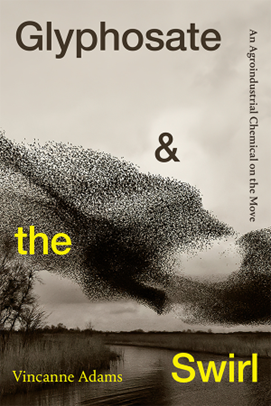
The multiple existences of glyphosate: an ethnography of the agri-food industry following a poison

What if, contrary to the modern scientific distinction between chemistry and biology, we considered a chemical element as a living being? What if we closely examined the myriad forms of existence that this chemical acquires in the world? What if we understood that this chemical does not exist in isolation but rather in relation to the materials it interacts with and the environments through which it circulates-such as the chemical industry, the food industry, regulatory agencies, plants, animal bodies, human bodies, medical clinics, soils, and courts of law?
These are the labyrinthine provocations presented in Vincanne Adams’ book, which offers an ethnographic exploration of the most widely used herbicide on the planet: glyphosate, commonly sold under the Roundup brand by the agro-pharmaceutical conglomerate Monsanto-Bayer. Hence, the image that permeates the book, and which also serves as its title: the swirl, into which we enter with Adams following the chemical. This does not exactly mean treating the chemical as a fixed entity to track, but treating it as a tool for attentive research navigating the fluid and often disorienting movements of glyphosate’s existence.
Glyphosate was initially used as a chelator for cleaning pipes, but when it was discovered to kill plants, it was repurposed as a herbicide. Today, glyphosate is also integrated into the food industry through its role in the cultivation of genetically modified seeds. Additionally, scientific evidence suggests that glyphosate continues to operate within human bodies, manifesting in illnesses such as non-Hodgkin’s lymphoma and intestinal disorders. Adams approaches these various possibilities of existence not as compartmentalized uses but as expressions of glyphosate’s capacity to metamorphose across chemical and biological boundaries, interacting with humans and political institutions alike. This adaptability allows glyphosate to navigate in a certain regulatory limbo in the United States, evading the oversight of regulatory agencies.
Through the image of a swirl, Adams conveys not just movement but the rapid changes in direction that make glyphosate so difficult to grasp. Similar to how a murmuration, that is, a flock of birds starling, may abruptly shift direction, the substance’s properties transform depending on the context in which it operates. The author is not interested in denying glyphosate’s potential or what it has enabled, “but offers a way to trace these that allows us to recognize how to place commitments in these unsettled assemblages” (Adams, 2023, p. 133). This analytical framework prompts us to reconsider how chemicals like glyphosate, along with countless others circulating in global markets, challenge existing systems of knowledge, production, and regulation, which have already proven powerless in ensuring environmental health (Boudia & Jas, 2014; Goldstein, 2017). It highlights how the idea of a single, monolithic, and stabilized consensus, so desired when it comes to defining whether a chemical substance is safe or not, also becomes unattainable. With its provisional forms, the swirl draws attention to how debates about knowledge operate in unstable ways. Its image, therefore, makes it possible to reflect on the very science in the making and assign responsibilities around glyphosate.
The book does not primarily focus on the populations most directly affected by glyphosate, such as agricultural workers. Alex Nading (2020), in a bibliographical review of the contemporary production of anthropology on toxicity, brings a wide range of references on these impacts - including drawing attention to the fact that it is common for pesticides banned in the Global North to be widely used by agricultural workers in the Global South, following a pattern of geopolitically structured inequalities around race, gender, and class. Following this dynamics, Kristina Lyons (2020), demonstrates how glyphosate has been used as an instrument of ecological warfare in Colombia. Furthermore, Zuker (2022) has described the use of glyphosate as part of a process of “expulsion by suffocation” in traditional territories in the Brazilian Amazon.
“My focus, in other words, is on the upstream problems - the slippery way that facts about this chemical are diffracted at the very moment that traction on accountability for its harms becomes possible” (Adams, 2023, p. 12). The book is, therefore, an investigation of the scientific, regulatory, commercial, and medical practices that emerge from the ontological instability of glyphosate. Adams draws inspiration from Anna Tsing’s (2022) work on the Matsutake mushroom and studies on other chemical elements such as mercury, formaldehydes, and arsenic. These references inspire the author in her own challenge of producing knowledge about and with glyphosate, conducting ethnography based on engagement with the chemical entity, following the molecule in a way that is attentive to the socialities that it causes to emerge, resulting in a chemical ethnography (SHAPIRO e KIRKSEY, 2017).
Glyphosate emerges then not as a static object but as a set of relationships that are constantly and dizzily formed and transformed in its instability. Multiple and deeply intertwined with academic capitalism, agrochemical industrialism, and the pursuit of scientific consensus, glyphosate evades systems that try inefficiently to control it, while continuing to circulate across markets, bodies, and bureaucracies, producing a form of life that is, as Murphy (2017) suggests, chemically altered-what she terms “alterlife.”
Each chapter of Adams’ book explores a different facet of glyphosate’s existence: its elusiveness, its medical manifestations, the momentary crystallization of scientific consensus, and how legal systems handle the health impacts caused by glyphosate exposure. Two key aspects emerge that are particularly fruitful for future research: glyphosate’s connections with military efforts and its symbiotic relationship with genetically modified crops.
MILITARY CONNECTIONS
As everything related to glyphosate’s life is unstable, so are its origins. One version says that glyphosate has a precise date and place of birth: 1950, in the laboratory of Swiss chemist Henri Martin, carrying out experiments for the pharmaceutical industry. The registration of this chemical as an innovation, however, only occurred 14 years later, with a patent that materialized its first form of existence: as a metal chelator for cleaning pipes. Reports then emerged from it being used to kill plants around pipes, which led to Monsanto purchasing it. A second version attributes its formulation to John Franz, a scientist at Monsanto while trying to synthesize a type of chelator for another purpose, as a herbicide. In any case, Adams points out that Franz formulated a function that was then unprecedented for glyphosate: its efficiency in killing plants by blocking a fundamental enzyme in the Shikimate pathway metabolic process by which plants (but also bacteria, fungi, and algae) produce specific amino acids. It is important to note that, although already patented, glyphosate’s unprecedented function allowed for a new patent, exclusive to Monsanto, also making it possible to highlight the crystallization of the chemical’s different expressions.
Whether the purchase of the patent or the invention of glyphosate by Monsanto, they resulted from the company’s effort to find substitutes for agrochemical products that were becoming problematic. This is because the company played an important role in the production of chemicals intended for use in wars1, and which only later began to be used in agriculture, including defoliants, herbicides, insecticides, and larvicides. This is the case of DDT and Agent Orange which, after the Second World War, began to be sold on the North American market, leading Monsanto to create its agriculture division and conquer a profitable market, despite controversies about the impacts and benefits already in place.
Drawing on the neo-Malthusian rhetoric of the Green Revolution2, and pressured by public concerns about DDT toxicity, Monsanto changed the direction of its efforts. The company’s agro-industrial division concentrates its efforts on genetics, to develop what would then be promoted as a non-toxic form of pest control based on the genetic recombination of plants. While on the one hand, the agrochemical industry argues that glyphosate is less harmful than chemical substances previously used in agriculture, on the other, Adams points out that the fact that glyphosate is replacing substances previously intended for military use can help us understand aspects of how it works. Glyphosate’s association with Monsanto is born from this context that overlaps scientific research and business experiences between the military and domestic uses, becoming an increasingly specialized agent in killing plants and producing profits. In other words, although glyphosate as a chemical does not itself have a military origin, it is part of the production logic of a company whose expertise was largely acquired in the production of substances for military use, aimed at killing.
SEED-POISON SYMBIOSIS
The story continues. Although the patent for glyphosate as a “broad-spectrum herbicide” represents a revolution in itself, if it were commercialized in the usual way by Monsanto it would kill all the plants along with the “pests”, due to its high toxicity. However, the company’s genetic engineering research has achieved another important combination between glyphosate and the Bacillus thuringiensis (Bt) bacteria inserted directly into the plant’s DNA. This innovation, now patented as “Roundup Ready Seeds”, created seeds capable of, at the same time, repelling insects and resisting glyphosate. As one of the results, agents such as Bt, which were partly dissipated into the environment, become constituent elements of the seed itself, leading to their ingestion by anyone who consumes it.
The result of this formula is well known and widely publicized: the exhaustion of the soil and the adaptation of weeds, which become increasingly resistant to the poison and whose control requires ever higher doses of pesticides, the contamination of farm workers and people living near the farms and, of course, the increase in profits for the company that controls the entire chain (fertilizers, genetically modified seeds, and glyphosate), the Bayer-Monsanto conglomerate.
Glyphosate is thus capable of turning something non-living (a chemical element) into something that generates life (glyphosate-resistant seeds), and of transforming forms of plant life (non-genetically modified plants) into biological corpses. Hence Adams’ use of a zombie metaphor to refer to farmers, who are triply dependent on agrochemical seeds, pesticides, and fertilizers, with little room to decide how to plant. The zombie metaphor also applies to companies, producing value from the death of ecosystems. And here is where the author’s fundamental argument comes in: the nature of these genetically modified and chemically dependent agricultural crops generates an ambiguity between material and non-material, living and non-living systems, which blurs the ability to know what these new foods actually are, and the damage they generate. This ambiguity, in turn, produces a reality that is beyond the control of US regulatory agencies and the demand for scientific consensus.
Whether a pesticide, a food ingredient or a chemical substance used in the laboratory, glyphosate circulates through various regulatory agencies. Theoretically, if it were considered a toxic element in food, seeds genetically modified to resist glyphosate would be regulated by the Food and Drug Administration (FDA). However, for the FDA, genetically modified foods are not different enough from other foods to warrant special regulation. As for the Environmental Protection Agency (EPA), glyphosate is a non-issue, since they don’t study it as a living being, or part of an ecosystem. Adams makes another twist here: she recognizes the existence of the capture of regulatory agencies by industry, and what she calls proactive collusion (apparently disinterested studies, but which hide having been paid for by the agrochemical industry and on which these agencies are based). But she is less interested in thinking in these terms, and more interested in reflecting on how glyphosate itself operates in this institutional interaction, which as a rule focuses on isolated chemical elements/substances and their specific effects. In other words: glyphosate’s intrinsic multiplicity allows it to escape regulation by the agencies, due to its power to be one thing or another, depending on what it interacts with and the place it occupies. Even though it is carefully regulated as a chemical substance, its multiple existence exceeds the capacity of the regulatory agencies. Therein lies one of the central questions of the book: what would change, in terms of regulation, if we thought of glyphosate as endowed with life?
Finally, this elusive reality of glyphosate has a particular form of existence in the formation of scientific consensus around the substance. Here too, Adams takes a step back: she is not particularly interested in the dishonesty of studies, nor in the industry’s persecution of researchers whose experiments point to a positive correlation between exposure to glyphosate and carcinogenesis (although she also brings up these cases). Above all, Adams is interested in understanding how glyphosate produces evidence that goes in different directions according to what and with whom the relationship is established (plants, the human body, those who apply glyphosate, laboratory tests on animals, etc...). It is thus a question of producing competing truths, of different consensuses, so that everyone can be correct despite reaching opposite conclusions.
CONCLUSION
Believing that we have presented the reader with the main points of the book, we would like to end this review by connecting some of the main arguments of the book with possible avenues for ethnographic research in the Brazilian and South American context, given that the expansion of soy is presented in the region as a transnational project, as seen in the “United Soy Republics” propaganda of the multinational giant Syngenta.
-
Scientific consensus and the geopolitics of toxins: based on the work of Pompeia (2021, 2023), mapping the political forces of agribusiness, one of the fruitful paths for ethnographies in the Brazilian context and the region is both to investigate how these actors influence the scientific policy of pesticide approval in Brazil and to replicate the movement made by Adams in relation to Brazilian regulatory agencies: what scientific assumptions does the agency work with? Is there a replication of the same methodology for isolating the chemical elements that make pesticides available in the market, thus generating similar results to the tests carried out by the industry? And above all, what scientific procedures allow pesticides banned in countries of the Global North to be released in Brazil, and in neighboring countries? How do they differ from the scientific criteria used to ban pesticides in Northern countries, so that they produce different results? Cardoso’s (2022) research into the controversies surrounding the banning of another pesticide, sulfluramid, points to interesting ways forward in this debate;
-
Military chemical uses and colonial expansion: Brazilian researchers (BOMBARDI, 2023; ZUKER, 2023) have pointed to the use of pesticides, and glyphosate in particular, as a weapon used in the context of the conquest of new territories by agribusiness. The contamination of watercourses, the impossibility of continuing to grow other crops that have not been genetically modified to withstand the spraying of poison, the difficulty of producing food and the increase in hunger are all forms of violence that jeopardize the possibility of survival of the life forms cultivated by Indigenous, Quilombola and other communities. So the questions we raise are: how are glyphosate and other chemical substances, including those of warlike origin, used to advance agribusiness? How can we ethnographically describe the intertwining between the development of chemical substances, war efforts, and their effects on bodies, vegetation, and territories?
These are some of the paths we have left open.
References
- BOMBARDI, Larissa. 2023. Agrotóxicos e colonialismo químico São Paulo, Editora Elefante.
- BOUDIA, Soraya; JAS, Nathalie. 2014. Powerless science?: Science and politics in a toxic world New York, Berghahn Books.
-
CARDOSO, Jéssica Ferreira. 2022. Entre seguro e poluente: disputas ontológicas em torno do PFOS e da sulfluramida no Brasil Campinas, Dissertação de Mestrado, Unicamp. 2022. Disponível em: https://hdl.handle.net/20.500.12733/5274
» https://hdl.handle.net/20.500.12733/5274 -
DICIONÁRIO Oxford Advanced Learner’s Dictionary 2024. Oxford University Press. Oxford. Disponível em: https://www.oxfordlearnersdictionaries.com/us/ Acesso em: 29 fev. 2024.
» https://www.oxfordlearnersdictionaries.com/us/ -
GOLDSTEIN, Donna. 2017. “Invisible harm: science, subjectivity and the things we cannot see”. Culture, Theory and Critique, 58(4): 321-329, 2 out. https://doi.org/10.1080/14735784.2017.1365310.
» https://doi.org/10.1080/14735784.2017.1365310 - LYONS, Kristina. 2020. Vital decomposition: Soil practitioners and life politics Durham, Duke University Press.
-
MURPHY, Michelle. 2017. “Alterlife and decolonial chemical relations”. Cultural Anthropology, 32: 494-503. https://doi.org/10.14506/ca32.4.02.
» https://doi.org/10.14506/ca32.4.02 -
NADING, Alex M. 2020. “Living in a toxic world”. Annu. Rev. Anthropol, 49: 209-224. https://doi.org/10.1146/annurev-anthro-010220074557.
» https://doi.org/10.1146/annurev-anthro-010220074557 - PATEL, Raj. 2013. “The long green revolution”. The Journal of Peasant Studies, 40(1): 1-63.
- POMPEIA, Caio. 2021. Formação política do agronegócio São Paulo, Editora Elefante .
-
POMPEIA, Caio. 2023. “As cinco faces do agronegócio: mudanças climáticas e territórios indígenas”. Revista de Antropologia, 66. https://doi.org/10.11606/1678-9857.ra.2022.202839.
» https://doi.org/10.11606/1678-9857.ra.2022.202839 - ROBIN, Marie-Monique. 2010. The world according to Monsanto: Pollution, corruption, and the control of the world’s food supply New York, New Press.
- RUSSELL, Edmund. 2001. War and nature: Fighting humans and insects with chemicals from World War I to Silent Spring Cambridge, Cambridge University Press.
-
SHAPIRO, Nicholas; KIRKSEY, Eben. 2017. “Chemo-ethnography: An Introduction”. Cultural Anthropology, 32: 481-493. https://doi.org/10.14506/ca32.4.01.
» https://doi.org/10.14506/ca32.4.01 - TSING, Anna. 2001. O cogumelo no fim do mundo: Sobre a possibilidade de vida nas ruínas do capitalismo São Paulo, n-1 Edições.
-
ZUKER, Fábio. 2022. Fazer mundos, destruir mundos e refazê-los: ensaios de antropologia política no Baixo Tapajós São Paulo, tese de doutorado, Universidade de São Paulo. 2022. https://doi.org/10.11606/T.8.2022.tde-24022023-200625.
» https://doi.org/10.11606/T.8.2022.tde-24022023-200625 -
ZUKER, Fábio. 25 set. 2023. “Autoritarismo e guerra ecológica”. O Joio e o Trigo Disponível em: https://ojoioeotrigo.com.br/2023/09/guerra-ecologica/ Acesso em: 26 fev. 2024.
» https://ojoioeotrigo.com.br/2023/09/guerra-ecologica/
-
1
For a historical analysis focused on the use of chemicals in 20th century wars and their use to control agricultural “pests”, see RUSSEL (2021); for the role of Monsanto, see ROBIN (2010).
-
2
For a recent debate on the Green Revolution (PATEL, 2013)
-
Chief-Editor: Guilherme Moura Fagundes
-
Associated Editor: Marta Rosa Amoroso
-
Associated Editor: Ana Claudia Duarte Rocha Marques